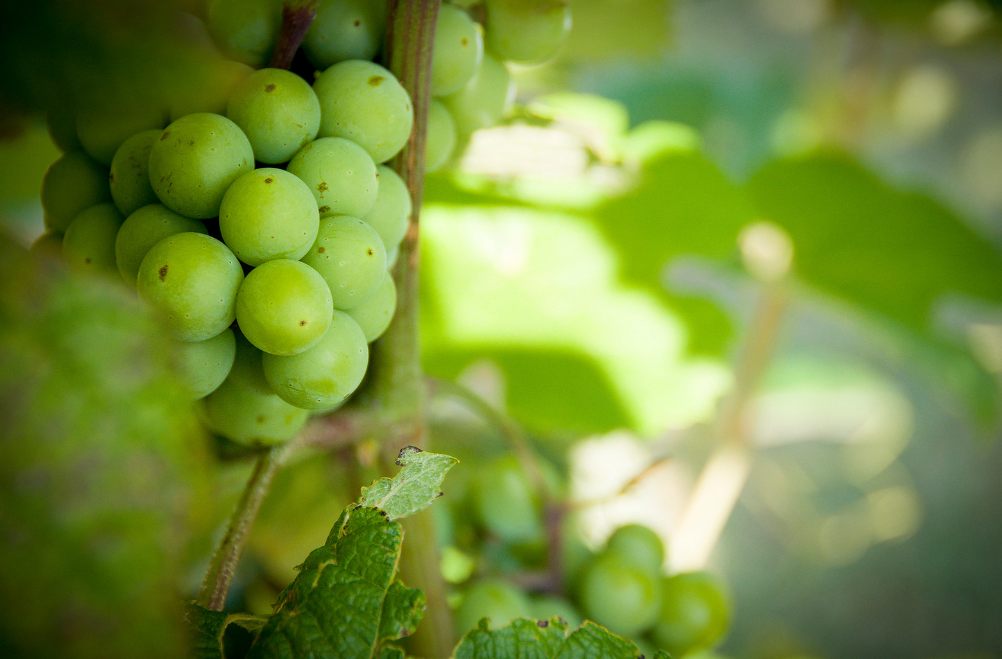
The OSU Extension grape management course will cover topics including site selection, pruning, weed and disease management, wine chemistry and vineyard care. (Photo by Mitchell Alcala, OSU Agriculture)
Registration is now open for the 2024 Oklahoma State University Extension Grape Management Course that begins in March and ends in September.
What: OSU Extension and the OSU Department of Horticulture and Landscape Architecture will share grape management information and provide networking opportunities for new and established grape growers.
Participants will also receive:
Who: Prospective and seasoned grape producers
When: The course is broken into six half-day experiences designed to show each stage of grape production:
Each session is set for 1 to 5 p.m., but dates and topics may be subject to change. No session will be held in July.
Where: Cimarron Valley Research Station, Perkins, Oklahoma. The station is located a half-mile north of the intersection at Highway 33 and 177.
The course is limited to the first 50 registrants and costs $250 per person. Register online by Feb. 23.
For more information, please contact Aaron Essary, OSU Extension specialist for viticulture and enology, at 405-744-7472 or aaron.essary@okstate.edu.
OSU Extension uses research-based information to help all Oklahomans solve local issues and concerns, promote leadership and manage resources wisely throughout the state's 77 counties. Most information is available at little to no cost.
The office of the State Treasurer announces the completion in the first inaugural, Legacy Capital Financing Fund from the Oklahoma Capitol Improvement Authority or "OCIA". The act creating the states self-financing structure passed during the First Special Session of the 2023 Legislature, marking a new era of capital project funding for the state of Oklahoma.
With this new way of funding, OCIA is no rookie. The agency has issued bonds for 65 years, equaling more than $4.2 billion in bonds. With direct access to capital markets and strong credit ratings, along with favorable interest rates over the last decade, we provide attractive mechanisms to fund state capital needs. Surplus state revenues have created opportunities to finance state projects and maintenance at zero percent interest, something capital markets can never beat.
Jamie Manoles, Director of OCIA for the Legacy Capital Financing Fund said, "OCIA staff worked tirelessly to create a Memoranda of Understanding to structure and monitor the projects authorized through the Legacy Capital Fund and to keep with the goals of the legislation, reducing financing and interest costs to accelerating the project timelines."
New projects currently with the fund include the Capitol complex tunnels, Jim Thorpe Memorial Building, Oklahoma Library facilities and more. Manoles stated, "policies and procedures were also implemented to prudently monitor spending of taxpayer dollars."
"As this fund is a direct display of legislative and executive powers for the state of Oklahoma, I want to thank the Governor and all authority members from the Senate and House of Representatives," said Oklahoma State Treasurer, Todd Russ.
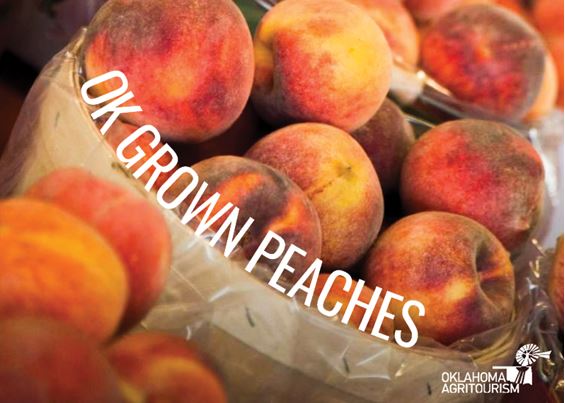
The Oklahoma Department of Agriculture, Food and Forestry is accepting applications through the Specialty Crop Block Grant Program. More than $542,000.00 is available in competitive grant funding to enhance the specialty crop industry.
The program's funding opportunities are made possible through the U.S. Department of Agriculture's (USDA) Agricultural Marketing Service.
ODAFF Market Development Coordinator Jason Harvey said eligible applicants include non-profits, local, state, and federal government entities, for-profit organizations, and colleges and universities.
"Projects must bolster competitiveness of specialty crop markets and benefit more than just the individual applicant," Harvey said. "Specialty crops are a vital part of Oklahoma agriculture and applications will be evaluated on how projects enhance the competitiveness of Oklahoma's specialty crop industry."
Proposals may be for, but not limited to research, promotion, marketing, nutrition, food safety and security, education, increased knowledge and consumption, improved efficiency and reduced costs of distribution systems, conservation, product development, food agricultural practices, good handling practices and good manufacturing practices.
Projects involving the following specialty crops are eligible:
Applications that only benefit an individual grower or business are not eligible.
For more information about the Specialty Crop Block Grant and to apply, visit the ODAFF website. Completed grant applications must be emailed to Jason.harvey@ag.ok.gov. Applications will be accepted through Feb. 28, 2024. For additional information about the Specialty Crop Block Grant Program, contact Jason Harvey at 405-606-1477.
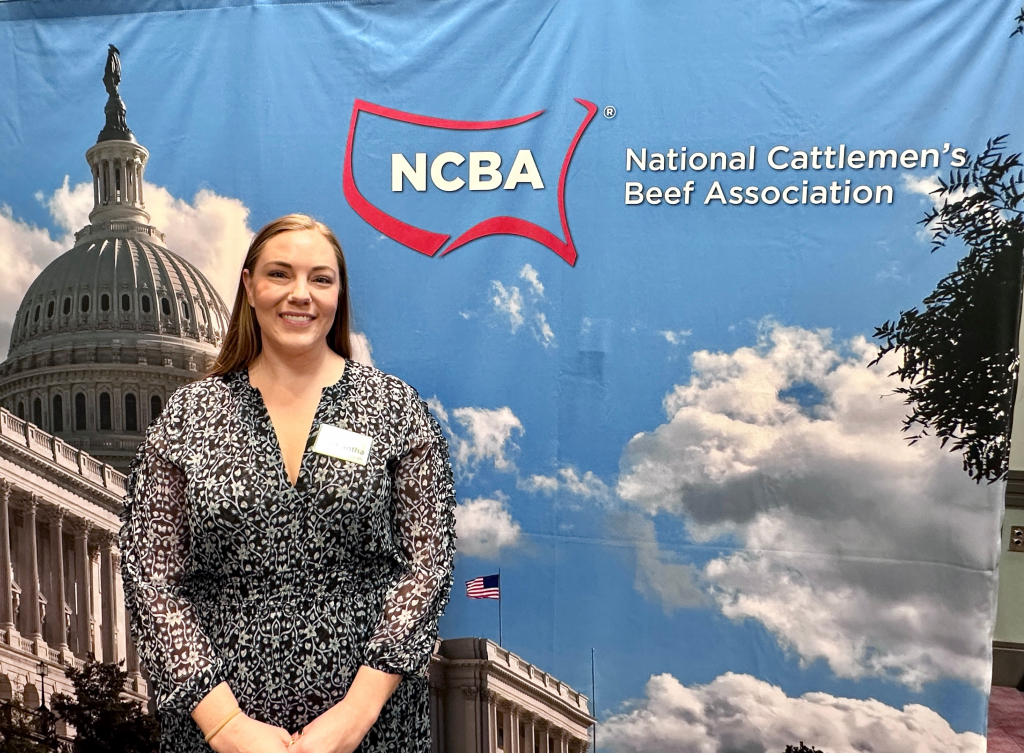
At the 2024 Cattle Industry Convention and NCBA Trade Show (CattleCon) held in Orlando, Florida, Senior Farm and Ranch Broadcaster, Ron Hays, had the chance to talk with NCBA Senior Director of Sustainability Samantha Werth.
Looking at NCBA's sustainability goals launched in November of 2021, Werth said there has been a continued focus on defining what sustainability means for U.S. beef.
"For us, that comes down to the animals, the people, and the planet," Werth said. "We are really focused on what we can do as a cattle ranching and producing community to advance sustainability initiatives, continuously improve as we have for decades, and be able to leverage that work we are doing to share across the broader industry."
In the sustainability conversation, Werth said everything stems back to the financial perspective. Because of this, Werth said NCBA works to help add value for producers when it comes to implementing new practices that would increase sustainability.
"There are a lot of things we can do and are doing in terms of how we manage our animals already," Werth said.
Regarding the goal set to be carbon-neutral by 2040, Werth said things are on track.
"Things we have been doing here at NCBA and with our partners like the U.S. Roundtable for Sustainable Beef is working to amplify the need to have grazing management plans for ranchers thinking through what are those elements we can do through grazing management to optimize how we are producing our animals, optimize our resources and use that to help leverage that conversion of improving efficiency as in reducing our impacts leading to climate neutrality," Werth said.
To ensure that climate neutrality can be achieved by 2040, Werth said the biggest factor is raising awareness. Werth said there are ways that producers can be compensated and increase profitability by partaking in sustainable practices.
Our coverage from the 2024 Cattle Industry Convention and NCBA Trade Show in Orlando is being powered by Farm Data Services of Stillwater.

U.S. Senator Markwayne Mullin (R-OK) will host a live telephone town hall event for all Oklahomansnext Tuesday, February 6th at 6:30pm CT. During the call, Mullin will provide a quick legislative update before opening the phones to take questions from constituents.
"Next week's telephone town hall event will be a great way for thousands of Oklahomans across the state to receive a timely update on our work in Washington and speak with me directly about the issues that matter most to them," said Senator Mullin. "We'll be discussing the latest on U.S. border security, the economy, America's response to emerging threats overseas, and other priorities for this year. I encourage everyone to join our important conversation, and I look forward to speaking with as many Oklahomans as possible."
Details for participating in the call are below:
Date: Tuesday, February 6th, 2024
Time: 6:30pm CT
Dial In: (855) 614-0277
Note: Due to the anticipated size of this event, all participating Oklahomans are encouraged to dial into the telephone town hall at least 5-10 minutes early to get connected. For all press inquiries regarding this event, please contact: Kate_Currie@mullin.senate.gov or Grace_Farmer@mullin.senate.gov. The telephone town hall will also stream live and be available for playback on Senator Mullin's Facebook page.

The annual National Bell Ringing Ceremony, a cherished tradition in Oklahoma, will once again honor the legacy of Dr. Martin Luther King Jr. Representative Ajay Pittman of House District 99 is proud to commemorate this historic event, which serves as a powerful symbol of freedom, justice, and equality.
Representative Ajay Pittman highlights the activities that will remain historic in House District 99, as a part of the Martin Luther King Jr. Holiday. These significant events recognize Dr. King's profound impact on the nation and highlight the ongoing pursuit of equality and justice in our society.
This year was a challenge for the Martin Luther King Jr. Holiday Coalition and a host of volunteers who had to reschedule all of the events that helped Oklahomans celebrate the life and leadership of the non-violent civil rights Icon.
The National Bell Ringing Ceremony traces its roots back to 1986 when Mrs. Coretta Scott King, wife of Dr. Martin Luther King Jr., requested a bell-ringing ceremony to kickstart the celebration of the Martin Luther King Jr. Federal Holiday. Initially held at Independence Hall in Philadelphia, the ceremony has since become a nationwide observance, with the Liberty Bell serving as a powerful symbol of the fight for civil rights.
"It is an honor to have Oklahoma be an intricate part of the National Bell Ringing Ceremony and pay tribute to the legacy of Dr. Martin Luther King Jr.," said Representative Pittman, Vice Chair of the Legislative Black Caucus. "This ceremony represents the enduring spirit of the civil rights movement all across the nation and serves as a reminder of the work that still lies ahead in hopes of building a more inclusive and equitable society."
Dr. Martin Luther King Jr. has a unique connection to Oklahoma, having visited Oklahoma City and spoken during a Freedom Rally at Calvary Baptist Church on July 29, 1960. His powerful words resonated with the audience, inspiring local youth to take action in their pursuit of desegregation.
"There are locations and events that were a part of his history. Such as, the original sit-in movement happened at Katz Drug Store with Dr. Clara Luper and the resistant youth, in addition to Dr. King's speech at Calvary Baptist Church located at 4th Street and Walnut Ave. He was seeking to become the Pastor of the church at the rally at the age of 16, afterwards, he and supporters marched across the bridge that we now know as the G.E. Finley Bridge. This bridge leads into Bricktown where lots of businesses have flourished and a large part of tourism happens," said Pittman.
According to Representative Ajay Pittman the National Bell Ringing Ceremony underscores their commitment to honoring civil rights leaders and advocating for equality in Oklahoma and beyond. By actively engaging in historic events, Representative Pittman exemplifies her dedication to promoting social progress and fostering a more just society.
"This annual event is generally immediately after the silent march through the district down N.E. 23rd street to our Oklahoma History Center with a program to honor the Legacy of Dr. Clara S. Luper, Marylin Luper Hildreth, daughter of Clara Luper, all of the original sit-inners. This program allows the Oklahoma City NAACP and NAACP youth council to hear from local legislators, community leaders, and the Oklahoma Governor who comes to give remarks on the state of Oklahoma and ring the bell with a diverse group of youth, college students and dedicated citizens" said Pittman.
For more information contact Representative Ajay Pittman or for more about her initiatives, please visit repajaypittman.com. For media inquiries, please contact her office at (405) 557-7393 or email ajay.pittman@okhouse.gov.
It's time to mark your calendars for 2024 Stockmanship & Stewardship events. During CattleCon24 in Orlando, four Stockmanship & Stewardship locations were announced. Event registration will open late spring.
2024 Stockmanship & Stewardship dates and locations:
Stockmanship & Stewardship is a unique educational experience for cattle producers featuring low-stress cattle handling demonstrations, Beef Quality Assurance (BQA) educational sessions, facility design sessions and industry updates. Producers can become BQA certified, network with fellow cattlemen and women, participate in hands-on demonstrations led by animal handling experts including Curt Pate and Dr. Ron Gill, and learn cutting-edge techniques. The program is sponsored by the National Cattlemen's Beef Association (NCBA), Neogen, and the Beef Checkoff-funded National Beef Quality Assurance program.
"Neogen is dedicated to the advancement of human and animal well-being through science and technology," said Elizabeth Wonsowski, livestock director of marketing at Neogen. "As a leader within the beef industry and proud partner of cattle ranchers and beef production, we recognize the important role that education and resources play in helping the cattle industry continue to grow in a healthy and sustainable way. We are proud to support NCBA and the Beef Checkoff through the Stockmanship & Stewardship program. Together, we can fuel a brighter future of global food security."
For more information about Stockmanship & Stewardship, visit www.StockmanshipAndStewardship.org. Cattle producers attending a Stockmanship & Stewardship event are eligible for reimbursement through the Rancher Resilience Grant. To apply for a grant to cover registration and hotel costs, visit www.ncba.org/producers/rancher-resilience-grant.
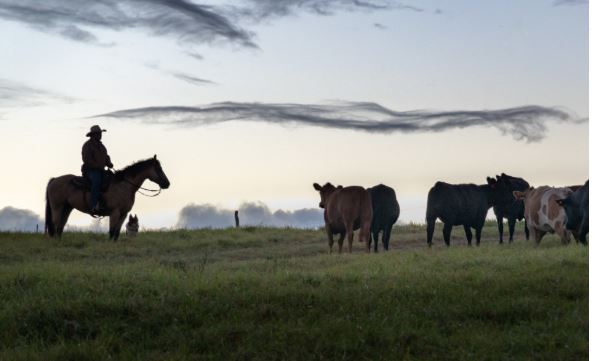
The U.S. Department of Agriculture (USDA) is now accepting applications for the Continuous Conservation Reserve Program (Continuous CRP) signup. USDA's Farm Service Agency (FSA) encourages agricultural producers and landowners in Oklahoma who are interested in conservation opportunities for their land in exchange for yearly rental payments to consider the enrollment options available through Continuous CRP, which also includes the Conservation Reserve Enhancement Program (CREP) offered by FSA partners. Additionally, producers participating in CRP can now apply to reenroll, if their contracts will expire this year.
"We are pleased to announce we are now accepting Continuous CRP offers," said Farm Service Agency (FSA) State Executive Director Steve Kouplen. "Continuous CRP is one of the best conservation tools we can provide producers and landowners. Whether a producer wants to focus on water quality benefits or work with one of our partners to address a natural resource concern in their area, the program offers many options to help you meet your resource conservation goals."
On Nov. 16, 2023, President Biden signed into law H.R. 6363, the Further Continuing Appropriations and Other Extensions Act, 2024 (Pub. L. 118-22), which extended the Agriculture Improvement Act of 2018 (Pub. L. 115-334), more commonly known as the 2018 Farm Bill, through Sept. 30, 2024. This extension allows authorized programs, including CRP, to continue operating.
To submit an offer, producers should contact the FSA at their local USDA Service Center by July 31, 2024, in order to have an offer effective by Oct. 1, 2024. To ensure enrollment acreages do not exceed the statutory cap, FSA will accept offers from producers on a first-come, first-served basis and will return offers for approval in batches throughout the year.
Additionally, producers with acres enrolled in Continuous CRP set to expire Sept. 30, 2024, can now offer acres for re-enrollment. A producer can both enroll new acres into Continuous CRP and re-enroll any acres expiring Sept. 30, 2024.
FSA water quality practices, such as riparian buffers, prairie strips, grassed waterways, and wetlands, will receive an additional 20% incentive. Buffer practices have a positive impact on water quality. Additionally, the Climate-Smart Practice Incentive launched in 2021 is also available in the Continuous signup.
There are several enrollment options within Continuous CRP, including:
More Information
The water quality practice incentive builds on other improvements to Continuous CRP that were made in 2021, including expanding CLEAR30 from two pilot areas to nationwide availability and repositioning SAFE within Continuous CRP to give producers and landowners more opportunities to participate. Additionally, FSA has improved CREP by creating flexibilities within CREP for partners to provide matching funds in the form of cash, in-kind contributions, or technical assistance, adding staff to work directly with partners, and expanding opportunities for Tribal Nations to participate, beginning with three Tribal Nations in the Great Plains, the Cheyenne River, Oglala, and Rosebud Sioux Tribes, for the first time ever, to help conserve, maintain, and improve grassland productivity while reducing soil erosion and enhancing wildlife habitat.
Signed into law in 1985, CRP is one of the largest voluntary private-lands conservation programs in the United States. It was originally intended to primarily control soil erosion and potentially stabilize commodity prices by taking marginal lands out of production. The program has evolved over the years, providing many conservation and economic benefits.
USDA touches the lives of all Americans each day in so many positive ways. Under the Biden-Harris administration, USDA is transforming America's food system with a greater focus on more resilient local and regional food production, fairer markets for all producers, ensuring access to safe, healthy and nutritious food in all communities, building new markets and streams of income for farmers and producers using climate smart food and forestry practices, making historic investments in infrastructure and clean energy capabilities in rural America, and committing to equity across the Department by removing systemic barriers and building a workforce more representative of America. To learn more, visit www.usda.gov.
USDA is an equal opportunity provider, employer and lender.
.) American Farmland Trust (AFT) released a white paper summarizing the climate benefits associated with agricultural conservation easements. The paper comes when global attention is focused on addressing climate change on the heels of the United Nations Climate Change Conference in Dubai last December.
"Agricultural conservation easements are an essential – and too often overlooked – tool in our efforts to address climate change," said Cris Coffin, Director of AFT's National Agricultural Land Network and Senior Policy Advisor. "These easements help reduce greenhouse gas emissions generated from low-density development. And protecting America's disappearing farm and ranch lands is foundational to securing broader climate gains from American agriculture."
The white paper, entitled "Agricultural Land Protection: An Essential Tool for Fighting Climate Change," presents five ways in which agricultural conservation easements help mitigate climate change, positing that they:
The paper builds off of survey results – published by AFT last September – of owners whose land was protected by the federal Farm and Ranch Land Protection Program (FRPP). This program is the precursor to the USDA Natural Resource Conservation Service's (NRCS) current Agricultural Conservation Easement Program (ACEP). The survey showed a direct relationship between program participation and implementing "climate-smart" practices, the subset of conservation practices identified by USDA NRCS as delivering carbon sequestration and GHG reductions.
"We found that participation in the federal farmland protection program resulted in a so-called 'permanence syndrome,'" said AFT Director of Farmland Information Center and Senior Advisor Jen Dempsey, who led the research effort which was conducted in partnership with the Resources Social Science Lab at Purdue University. "Proceeds from the voluntary sale of conservation easements gave landowners money to help adopt new practices. But more than that, owners said the protected status of the land motivated them to make long-term investments and improvements to their land."
The FRPP survey shows higher adoption rates of climate-smart practices by owners of eased land than the general farming population. For instance, 65 percent of respondents used conservation tillage and 57 percent implemented cover crops or green manure crops. The National Agricultural Statistic Service's 2017 Census of Agriculture of the general farming population shows 34 percent of farms using no-till or reduced tillage and 10 percent implementing cover crops.
The white paper also points to how permanently protecting agricultural land can avoid GHG emissions when coupled with Smart Growth. This approach has been taken by the State of California through its Sustainable Agricultural Land Conservation program, which funds agricultural conservation easements based on quantifying their potential GHG benefits. AFT is presently exploring how such an approach could be used nationally.
"To date, over 8 million farmland acres have been protected," said Coffin. "While this is an incredible achievement, it represents less than 1 percent of our nation's farmland. If we are to meet our climate goals and feed a growing world, we must redouble our support for agricultural conservation easement programs at all levels of government."
Congress is currently working on the next Farm Bill, which will include opportunities to improve and strengthen ACEP, the sole federal program devoted to the purchase of agricultural conservation easements. More information on AFT's Farm Bill farmland protection policies can be found here.
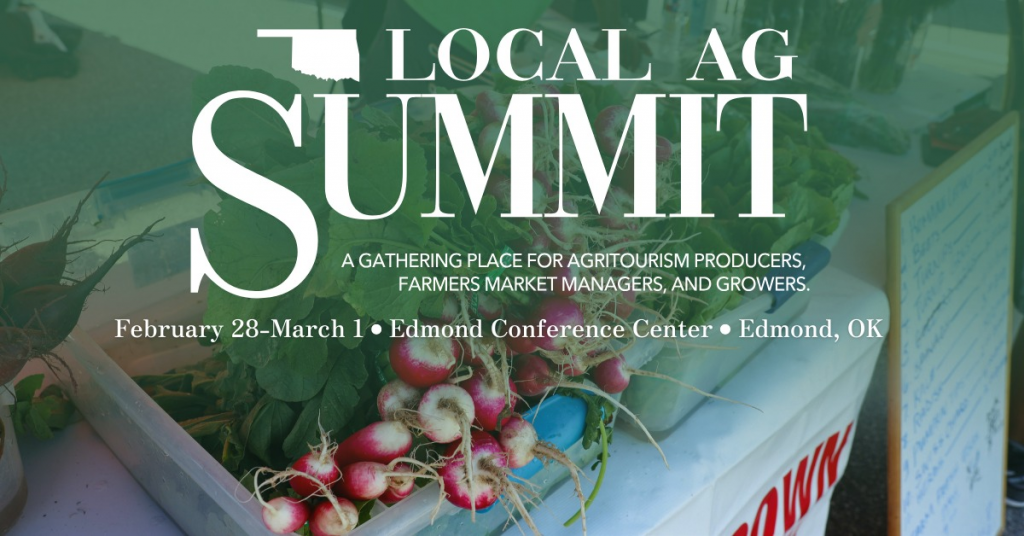
Gear up for the 2024 Oklahoma Local Agriculture Summit (OKLAS) on February 28- March 1st at the Hilton Garden Inn Edmond Conference Center in Edmond, OK! This multi-day conference will feature hands-on workshops, panel discussions, and traditional conference sessions of interest to farmers market managers, producers, community support organizations and agritourism site managers. OKLAS is hosted by the Oklahoma Department of Ag, Food, and Forestry in partnership with the Oklahoma Local Ag Collaborative.
Associate Farm Editor, Reagan Calk, had the chance to visit with event coordinator, Diana Prieto about this year's schedule and more. Prieto is the Outreach Coordinator of the ONIE Project, which focuses on promoting healthy living through innovative strategies for communities, families, and individuals.
The conference will begin on Wednesday, February 28th with OKLAS workshops, including Innovative Farm Practices by Langston University and a marketing workshop.
"This year's focus, we really wanted to help producers with the business aspect, and this is something we have been asked of a lot," Prieto said.
As part of the OKLAS workshops, Prieto said attendees will have the chance to have one-on-one consultations with agricultural business managers.
"We also have a USDA programs workshop at the end of the day from 1-4, and that is allowing producers to talk to NRCS and learn to utilize their programs to grow their business," Prieto said.
On Wednesday evening, there will also be a Farm-to-Table dinner at 6 p.m. in Piedmont, OK.
Thursday will be a full summit day, featuring over 20 breakout sessions including topics on building your farm business strategy, liability insurance for producers, meat processing and more.
The conference will conclude on Friday with the Agritourism Bus Tours. Stops include Chester's Party Barn & Farm, Lakeview Market, Clauren Ridge Vineyard & Winery, and Parkhurst Ranch.
Overall, Prieto said the event covers various topics of interest for producers, market managers, support organizations, and those involved in agritourism.
"Anybody is welcome to attend, and it is free," Prieto said.
For more information about OKLAS 2024 and to see registration info, visit https://oklac.org/oklas. To visit the OKLAS Facebook page, CLICK HERE.
| ||||||||||||||||||||||||||||||||||||||||||||||||||||||||||||||||||||||||||||||||||||||||||||||||||||||||||||||||||||||||||||||||||||||||||||||||||||||||||||||||||||||||||||||||||||||||||||||||||||||||||||||||||||||
|

Food and agriculture companies spend a lot of time looking outward - focusing on external image, responding to pressure from adversarial groups, and finding new customers. In the process, these companies often overlook their most critical audience: employees. Hinda Mitchell, founder and president of Inspire PR Group, will share how to turn team members from potential brand assassins to brand ambassadors at the Animal Agriculture Alliance's 2024 Stakeholders Summit. Check out the full agenda and register by March 8 for the lowest rates here: https://bit.ly/AAA24.
The annual Summit is a one-of-a-kind conference attended by a diverse group of decision makers, including representatives from farms, ranches, allied industries, food processors, restaurants, grocery stores, legislatures, universities, government agencies and media. The 2024 event is themed "Ready, Set, Solve! Advancing Animal Agriculture" and set for May 8-9 in Kansas City, Mo.
"2024 Summit attendees will be scoring big with a dynamic lineup of speakers and sessions," said Abby Kornegay, manager, issues and engagement, Animal Agriculture Alliance. "The two-day program will cover key topics and issues in agriculture including how to navigate pressure and attacks from animal rights extremist groups. This includes outreach campaigns to current food and agriculture employees in attempts to gain sensitive information. Hinda's session will be a great place to learn more about building employee engagement and loyalty to prevent these issues."
In the session "Whose Team Are They On? How Employees Can Make or Break Your Brand," Mitchell will explore employee engagement and its impact on recruitment and retention, and focus on transparency and purpose as essential workforce strategies. Attendees will learn how to turn team members from potential brand assassins to brand ambassadors, audit their own employer brand, create lasting internal communications and engagement programs that build culture, and secure that first line of defense as employees can often be pressured by animal rights extremist groups to turn their back on their own team.
Mitchell leads Inspire PR Group, a national, multi-service public relations and marketing communications firm based in Columbus, Oh. A trusted counselor to major c-suite executives, she is a sought-after strategic leader and crisis and issues manager for corporate leaders, manufacturers, food companies, higher education, and school districts. She has led crisis management for numerous high-profile, challenging crises during her career, including recalls, labor negotiations, activism, and worker accidents. She has protected the reputations and preserved the brands of hundreds of businesses and organizations in her role. She has passion for employee engagement and positioning major food brands as an employer of choice.
Thank you to our 2024 Summit sponsors: Farm Journal, Meatingplace, U.S. Poultry & Egg Association, Watt Global Media, Cargill, Zoetis, American Feed Industry Association, broadhead. + Filament, Merck, United Soybean Board, Dairy MAX, Farm Credit Council, National Pork Producers Council, Smithfield Foods, United Egg Producers, American Farm Bureau Federation, Cobb-Vantress, Inc., Edge Dairy Farmer Cooperative, Kemin, National Cattlemen's Beef Association, National Chicken Council, National Pork Board, Phileo Lesaffre Animal Care, Progressive Dairy, Protect the Harvest, Sustainable Environmental Consultants, Trans Ova Genetics, Eggland's Best, North Carolina Farm Bureau, and Vivayic.
The National Cattlemen's Beef Association's (NCBA) Executive Committee approved the organization's policy priorities at the 2024 Cattle Industry Convention and NCBA Trade Show. This year's priorities focus on advocating for the reauthorization of the Farm Bill, protecting cattle producers from federal regulatory overreach, and defending the U.S. cattle industry against external attacks.
"NCBA will continue pushing for passage of a Farm Bill that includes key animal health and voluntary conservation provisions, as well as hold the line against all federal policies that could damage the livelihoods of U.S. cattle producers," said NCBA President-Elect and Wyoming cattle rancher Mark Eisele. "In the past year we have seen radical animal activists ramp up their attacks on our industry and our producer-funded Beef Checkoff that drives consumer demand and funds critical research. We will never let the same people that want to shut down family cattle operations, dictate how we promote our products."
NCBA's policy priorities include:
"Despite our success last year in finally reducing the size and scope of the onerous Waters of the U.S. rule, many more misguided regulations have been proposed that undermine the voluntary conservation work of cattle producers. NCBA will stand strong against these rulemakings – setting the record straight on regulations that are not backed by science and would leave America's rangelands in total disorder," Eisele added.
Read the full 2024 Policy Priorities list here.
From Gregg Doud, President and CEO, National Milk Producers Federation:
"NMPF spent more than two years preparing for USDA's Federal Order hearing, and that preparation paid off. Our proposals, unanimously supported by our Board of Directors, reflect farmer unity and a good-faith effort to build industry consensus. After five months, 12,000 pages of testimony, and almost two dozen separate proposals considered, our plan remains the most comprehensive, coherent, and compelling framework for modernizing a system that's badly in need of improvement. We look forward to working with USDA and the entire industry in the weeks and months to come, noting that any plan USDA designs will by necessity require complex analysis to result in a proposal that serves diverse farmer needs well.
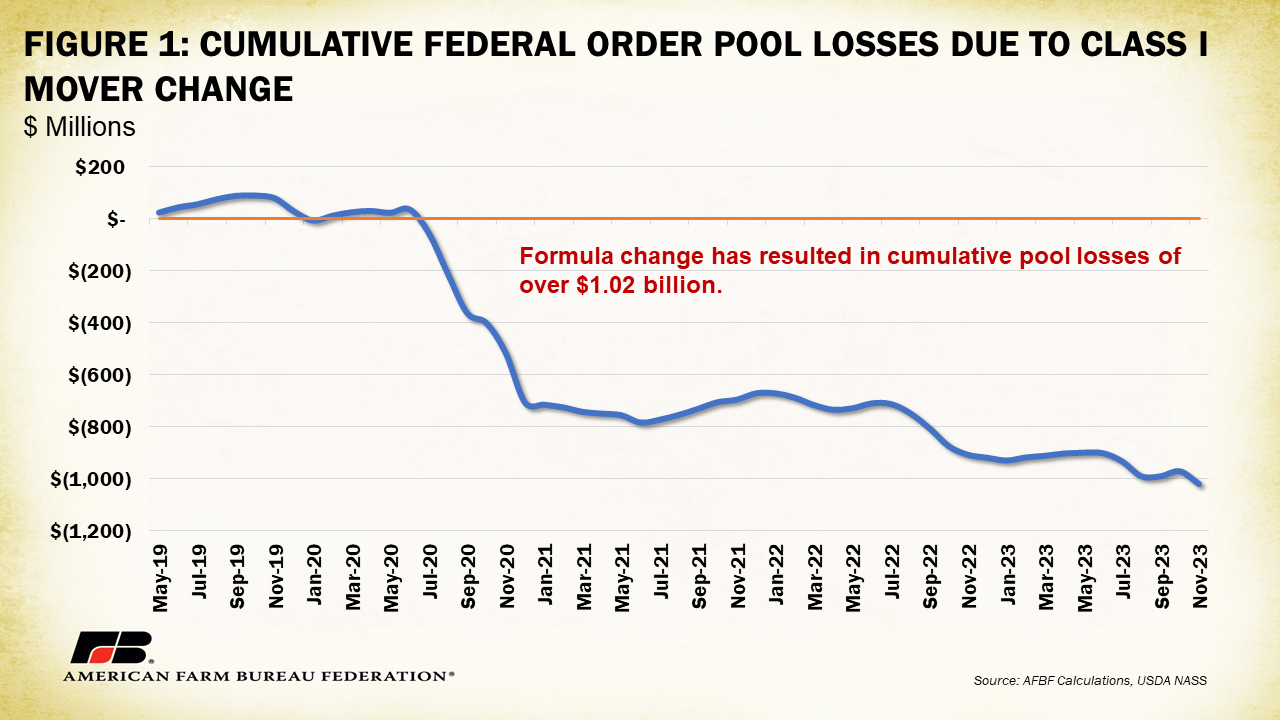
"In the meantime, we'll continue to advocate for badly needed changes in areas such as the Class I mover. The current formula has cost farmers $1.2 billion in losses since its implementation after the 2018 farm bill, with additional losses expected in the coming months. It needs to change back to the previous "higher-of' formula that served farmers best. The higher-of responds quickly to the marketplace, it helps farmer cash flow, it's simple to understand, and it would have no real impact on processors who are using the formula to boost their immediate balance sheets, not manage future risk as they claim. "Dating to NMPF's first internal discussions, our path toward FMMO modernization is now nearly three years old. This final year is the most critical. We are excited to continue our leadership in this critical area, and will, as always, fight for the best approaches to ensure that dairy farms prosper."
FACTS ABOUT NMPF's FMMO PROPOSAL:
NMPF supports the federal legislation that authorizes the FMMO system, as well as improvements that increase clarity and producer understanding of milk pricing and ensure an orderly market and fair prices for dairy farmers.
NMPF's proposed changes to the Federal Milk Marketing Order System include:
For more information, visit here.
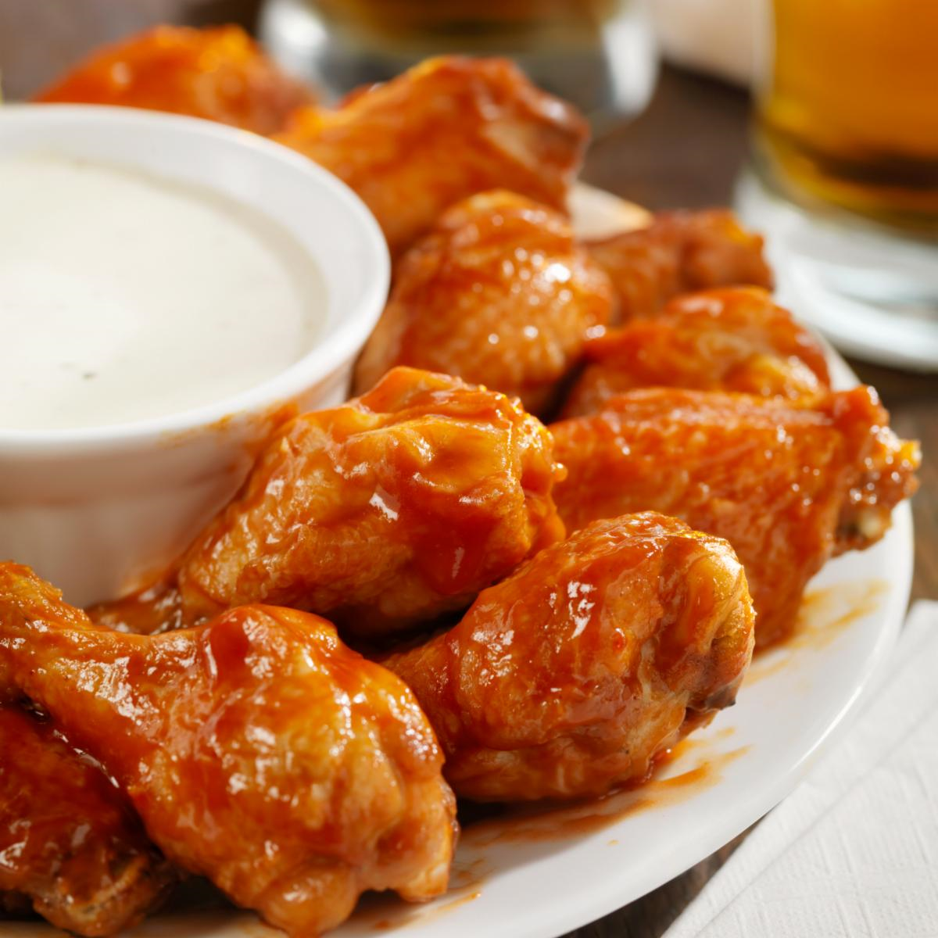
With the second biggest eating day of the year after Thanksgiving upon us, there's no hotter time for chicken wings. According to the National Chicken Council's 2024 Wing Report, Americans will devour 1.45 billion wings while watching Kansas City and San Francisco battle for the championship trophy.
"Football is great. Wings are great. But they're even better together," said Council spokesman Tom Super. "Sure, you can have your chips, your guacamole, your pizza. But when it comes to menus next Sunday, wings rule the roost. So, grab a wet nap and enjoy America's favorite party food for the Big Game."
To help visualize just how many wings that is:
Visit our TikTok page to watch a video animation of these numbers: https://www.tiktok.com/@chickencheck.in/video/7330083982559677742
This year's projection is flat compared to 2023, with USDA reporting chicken production levels are slightly down from last year and wing stocks in cold storage down 13% in November compared to the year prior. This could explain the higher demand and thus the higher wholesale prices we are seeing on wings. At the retail level, fresh chicken wing prices are down approximately 5%, and frozen wing prices are down 11% compared to January of 2023, according to Circana data.
"One of these days, Buffalo will get back to the Big Game which would give wing consumption a nice boost," Super noted. "Maybe we'll see Taylor Swift breaking out the 'seemingly ranch' again, to dip a wing in this time, though."
For the full report, please click here.
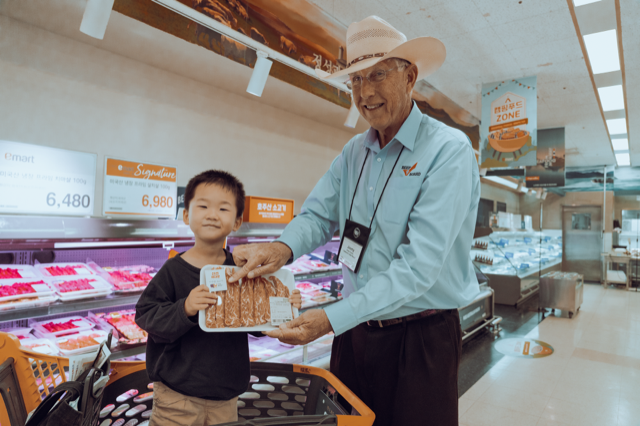
At the 2024 CattleCon held in Orlando, Florida, Senior Farm and Ranch Broadcaster, Ron Hays, had the chance to catch up with Oklahoma rancher and Chairman of the Cattlemen's Beef Promotion Board, Jimmy Taylor.
Our coverage from the 2024 Cattle Industry Convention and NCBA Trade Show in Orlando is being powered by Farm Data Services of Stillwater.
Regarding Checkoff dollars, Taylor said a significant area of growth he has seen is the export demand.
"In my first year as a board member, they set an all-time record in 2018 with a little over 8 billion dollars," Taylor said. "Since that time, the last two years have been over 10 billion dollars."
While there have been headwinds in the export market this past year, causing volume and value percentages to fall behind, Taylor said numbers are still high above years in the past.
"Our value this year(Calendar year 2023) at 11 months is 9.11 billion dollars," Taylor said. "That blows that year in 2018 out of the water."
Taylor recently had the chance to travel abroad to South Korea with the U.S. Meat Export Federation and see firsthand the programs USMEF has implemented in foreign countries.
"Those markets are very important to us, and they are going to get more important as we move forward," Taylor said. "Ninety-six of the world's population lives outside of the United States."
Among the many ways the Cattlemen's Beef Board works to support American ranchers, one project Taylor mentioned that he believes is critical to the beef industry is the Cattlemen's Beef Board issues management team.
"We have groups that don't particularly like our industry and are trying to do away with us that will put out half-truths or misinformation, and that team monitors media 24/7, so if one of those stories comes out that is not right, they can get right on top of it and get the truth out before that half-truth grows legs," Taylor said.
The Beef Buzz is a regular feature heard on radio stations around the region on the Radio Oklahoma Ag Network and is a regular audio feature found on this website as well. Click on the LISTEN BAR at the top of the story for today's show and check out our archives for older Beef Buzz shows covering the gamut of the beef cattle industry today.
Below is an update from Congressman Frank Lucas in his latest newsletter!
This month in Washington, on top of participating in some meaningful committee hearings, I was pleased to see one of my bills pass on the House floor. I was also able to travel back to Oklahoma for some productive discussions. Keep reading for my full January update.
PROTECT Taiwan Act
On the House Floor this month, my bill – the PROTECT Taiwan Act – passed. While the world watched Russia's rogue invasion on Ukraine in horror, it is our responsibility to ensure China does not attempt to emulate such blatant aggression on Taiwan.
That's why Congress must take the necessary steps to ensure Beijing would be subject to significant financial and economic consequences should it threaten our allies in Taiwan. I spoke on the House floor to explain how my bill will do exactly that, which you can watch by clicking here or on the image below. You can also read more about the PROTECT Taiwan Act here.
Honoring Chairwoman Eddie Bernice Johnson
I also had the chance to speak on the House floor this month for more somber news, which was the passing of the former Science Committee Chairwoman, and my dear friend, Eddie Bernice Johnson.
Chairwoman Johnson, or EBJ as I liked to call her, was an exceptional human being. In the 28 years that we worked together, she proved to be a good steward of her constituents and an outstanding legislator. But what I admired most about her spirit was the fact that she was willing to give anyone the benefit of the doubt. She will be greatly missed. You can watch my remarks by clicking here or on the image below.
Science, Space, and Technology Hearing
As Chairman of the House Committee on Science, Space, and Technology, I joined the Subcommittee on Research and Technology for a hearing to review federal natural hazard research and development programs.
Oklahoma saw 74 tornadoes just last year, so I have a particular interest in this issue. That's why I asked what research and development efforts are needed to better prepare for tornado season, especially in our rural communities. I also inquired as to how FEMA is working with other agencies to bolster our understanding of tornadoes and increase lead times for tornado warnings. Click here or on the image below to watch my line of questioning.
Financial Services Committee Hearing
The Financial Services Committee held a hearing this month to conduct oversight of the SEC's climate disclosure rule, which imposes overwhelming climate-related disclosure requirements on public companies. This rule would negatively impact many in Oklahoma, particularly farmers and ranchers. At the hearing, I had the opportunity to hear directly from a farmer how the broad implications of this rule would affect him and his family's business. Click here or on the image below to watch my line of questioning.
Farm Bureau Award
Before I headed back to Oklahoma, I stopped in Salt Lake City to receive the Distinguished Service Award from the American Farm Bureau Federation. I consider my friends at the Farm Bureau to be family. And there's nothing more important than having your family acknowledge that your hard work has been for a purpose. As a lifelong Farm Bureau member, I look forward to continue working with them to serve the national interests of American agriculture.

Sam's Club Ribbon Cutting
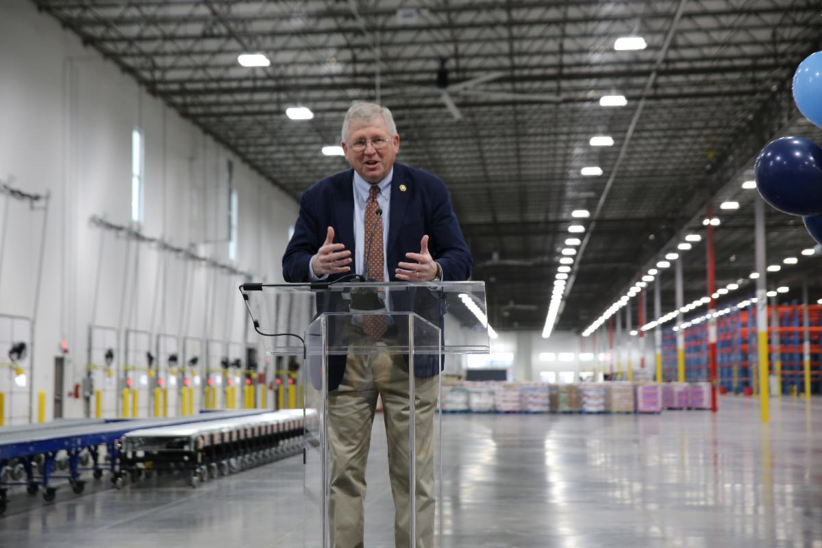
I then made it home to Oklahoma, where I was able to attend the ribbon cutting ceremony of Oklahoma's newest Sam's Club Distribution Center. Walmart and Sam's Club founder, Sam Walton, was born right here in Oklahoma's Third District. His mission has created tens of thousands of jobs for Oklahomans, many of which have been veterans. This facility will create even more jobs and serve as a boon to our economy.
Tri-State Conference
The Tri-State Conference – a joint effort between Oklahoma's AFR Cooperative, the South Dakota Farmers Union, and the North Dakota Farmers Union – was held in Oklahoma this year.
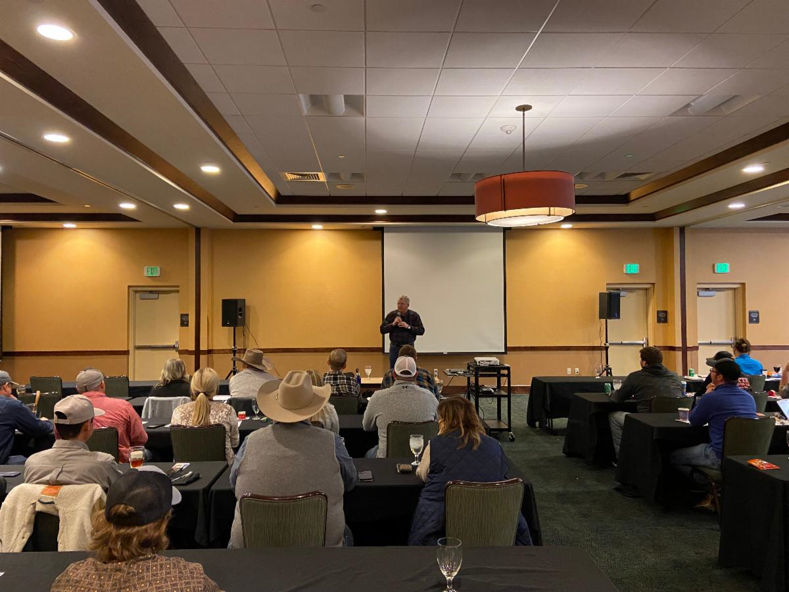
I spoke at the conference about the importance of learning from past mistakes that led to the Dust Bowl and Great Depression, and also the need to ensure our states receive the same federal protections as others. I'd like to thank the 50+ farmers and ranchers who participated in making the second annual Tri-State Conference a success!
Oklahoma Aerospace Institute
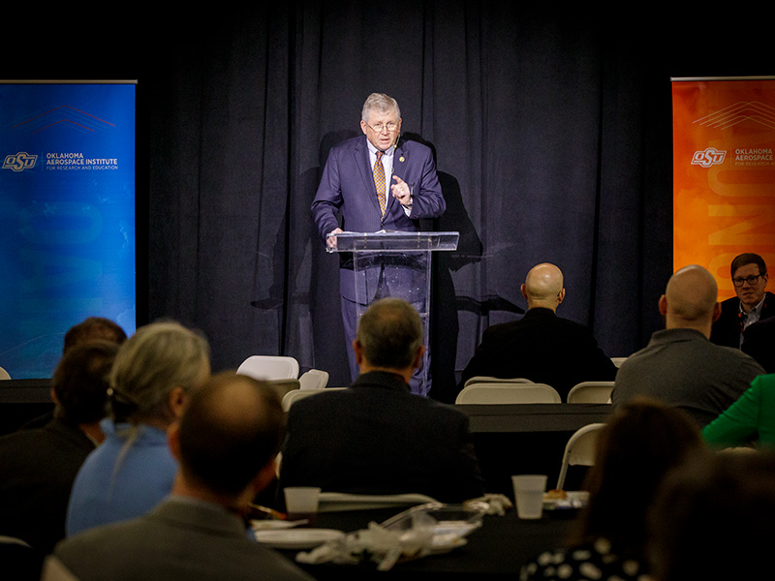
I joined the Oklahoma Aerospace Institute at Oklahoma State University for a workshop on for Civilians in Spaceflight and Space Habitation.
As a proud OSU alumnus and the chairman of the House Committee on Science, Space, and Technology, I enjoyed the opportunity to speak with them about the work of the committee and how it ties into their efforts to be a leader in aerospace. Working together, we can be certain that Oklahoma is a world leader in aerospace and in other science and technology fields.
University of Tulsa
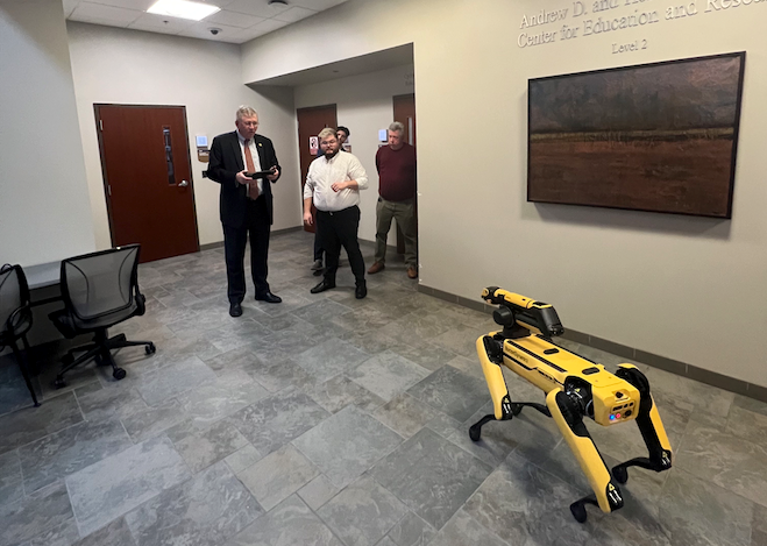
I also visited the University of Tulsa to tour their research facilities, which housed cutting edge technology such as Hopper and Krypto – four-legged robotic dogs.
US Customer Harvesters Convention
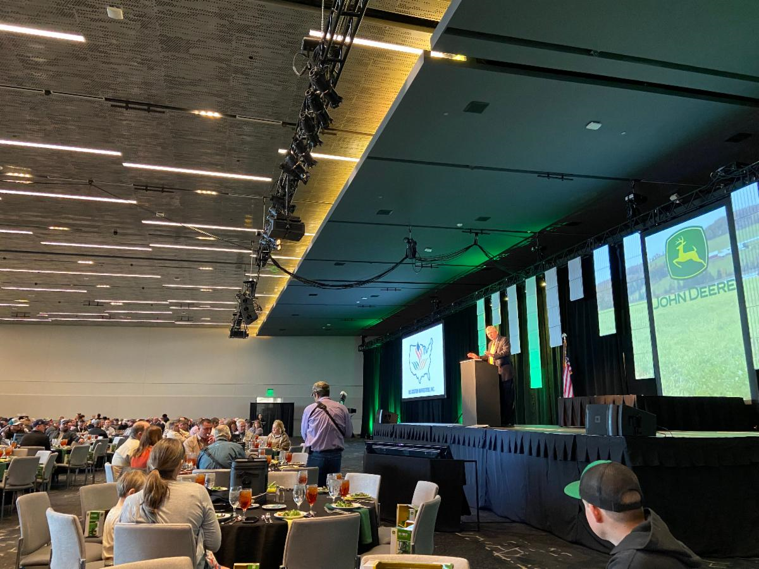
Lastly, I attended the U.S. Customer Harvesters Convention in Oklahoma City. We discussed the current status of the Farm Bill in the House, including what hurdles need to be jumped before we can pass it and how it will look compared to the 2018 Farm Bill. This was the first time the convention was held in Oklahoma, so I am glad I was able to make the trip.

RhizoSorb® is setting a groundbreaking industry standard for phosphorus fertilizer efficiency. To help growers adopt RhizoSorb 8-39-0 in 2024, corn growers who purchase a minimum of 200 acres will receive a warranty that will reduce their risk of adopting the new fertilizer technology. The RhizoSorb Grower Guarantee is designed to empower growers to embrace "The Next Generation of Phosphorus Fertilizer" TM with confidence.
RhizoSorb was commercially launched to agriculture in 2023 after five years and over 500 trials across the United States. Phospholutions is committed to supporting farmers in the implementation of agronomically sound, economically beneficial, and sustainably positive fertilizers. In collaboration with Growers Edge, Phospholutions is introducing an inaugural Warranty Backed Crop Plan. The purpose is to reduce risk and offer assurance to growers seeking to adopt new sustainable, Enhanced-Efficiency Fertilizers like RhizoSorb 8-39-0.
"Even though our multi-state, multi-year trials show RhizoSorb 8-39-0 has more than 2 times the phosphate utilization compared to MAP 11-52-0, farmers still want to see the product perform on their farm. By partnering with Growers Edge to provide a warranty-backed purchase, we've reduced the risk for farmers to make the change to RhizoSorb, The Next Generation of Phosphate Fertilizer," states Craig Dick, VP of Sales and Marketing at Phospholutions."
The RhizoSorb Grower Guarantee empowers farmers to seamlessly adopt RhizoSorb 8-39-0 across their corn acres while mitigating the risks associated with the implementation of new products. Should RhizoSorb performance fail to match or surpass past yields, farmers will receive a per-acre payment. By enrolling in the RhizoSorb Grower Guarantee, farmers enable a smooth transition innovative, profitable, and sustainable dry phosphate fertilizer on the market.
For more information on how to enroll in the Phospholutions RhizoSorb Grower Guarantee Program, growers can visit www.phospholutions.com/growerguarantee.
About Phospholutions
At Phospholutions, our mission is to enhance global phosphorus use. We believe sustainable production and responsible use of phosphorus is critical to support global food demands. RhizoSorb® was developed to cut costs and reduce the environmental impact of fertilizer use by releasing nutrients in the soil more efficiently. Our patented fertilizer additive is incorporated into production to create higher efficiency products that maximize the use of phosphate resources.
Thousands of cattle producers, industry partners and stakeholders have arrived in Orlando, Florida, for CattleCon24. The largest cattle industry event in the country offers education, engagement and entertainment through February 2.
This year's event begins in patriotic fashion with Anna Sponheim, winner of the 11th Annual NCBA National Anthem Contest, singing the "Star-Spangled Banner." Buzz Brainard, host of Music Row Happy Hour, returns as convention emcee and will introduce opening general session speaker Jon Dorenbos, a former professional football player and sleight-of-hand magician.
The Beef Checkoff-funded Beef Quality Assurance (BQA) program's Celebration of Excellence will honor BQA award winners and feature keynote speaker Jim Carroll, renowned futurist and author. Throughout CattleCon, the 31st annual Cattlemen's College will include educational sessions with industry leaders tackling innovative topics.
Other highlights include a D.C. Issues update, Sustainability Forum and business meetings. Annual meetings of the National Cattlemen's Beef Association, the Cattlemen's Beef Board, American National CattleWomen, CattleFax and National Cattlemen's Foundation will also take place.
The Cattle Feeders Hall of Fame banquet and Environmental Stewardship Award Program reception will recognize leaders for their achievements, and there will be more than eight acres of trade show displays and exhibitors to explore. CattleFax will conduct their U.S. & Global Protein and Grain Outlook Session on Friday morning. Randy Blach, the team at CattleFax and meteorologist Matt Makens will discuss what 2024 and beyond might look like for the cattle industry.
In addition to conducting the business of the beef industry, CattleCon attendees will enjoy entertainment and family fun throughout the event. Paul Bogart will bring his down-to-earth charm and country music to Thursday night's Palm Tree Pachanga, and The Bellamy Brothers will headline the Cowboys & Coasters event on Friday night.
On-site registration is open for those who still would like to attend, and single day and trade show only tickets are available. For more information, visit convention.ncba.org.
The National Corn Growers Association's (NCGA) new Fields-of-Corn.com photo contest site attracted new participants as well as seasoned contest alumni, resulting in a record-breaking number of entrants and high-quality photo submissions.
Our 2023 grand prize winner, for Ready! is no stranger to the Fields-of-Corn.com contest. Mary Morken of Casselton, North Dakota has been contributing since 2017!

In contrast, the award for Most Popular belongs to newcomer Michael Sanders of Sun Prairie, Wisconsin for Sunset on Another Harvest with 2,850 votes.

The tenth contest began Sept. 1, and broke records with more than 600 photos across eight categories. The new Red, White and Blue and the Farm Family Lifestyle categories were awarded soley on votes, providing judges with aid as six remaining categories were just short of impossible to narrow down.
Twenty-six winners across 15 states were awarded Visa gift cards, ranging from $100-$500 value. Visit Fields-of-Corn.com!
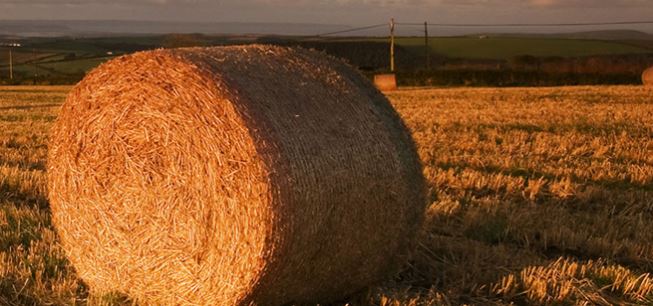
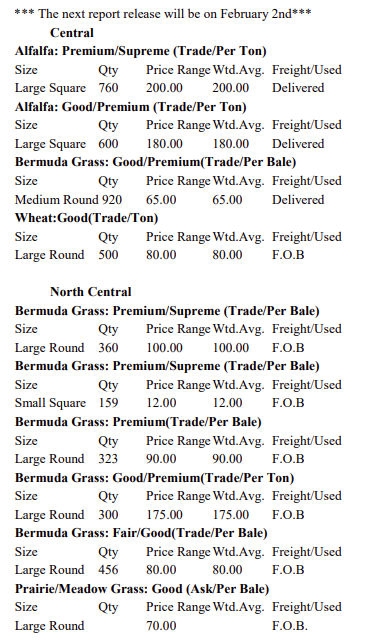
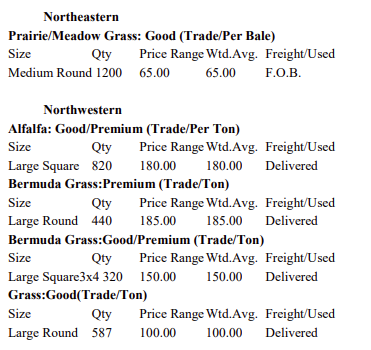
Compared to the last report: Demand remains low. Overall, total hay bought and sold was up a little, with most producers reporting that they are still not trading much hay, with most trades being to previ-ous clients. Many producers anticipate not much movement over the next couple of weeks, even with the cold temperatures and winter storms.
Trends:
Alfalfa Large squares $180-$200 a ton
Alfalfa Rounds - No Trend
Grinding hay - No Trend
Bermuda 5x6 rounds - $70-$100 a bale
Bermuda Large Squares - No Trend
Grass Hay 4x5-4x6 - $60-$70 a bale
Grass Hay 5x6 - $70-$80 a bale
The Oklahoma Mesonet Drought Monitor shows we are at 0 percent in exceptional drought, 0 percent in an extreme drought, 1.67 percent in severe drought, 15.01 percent in moderate, 34.19 percent in abnormally dry conditions, and 65.81 percent that has no drought conditions.
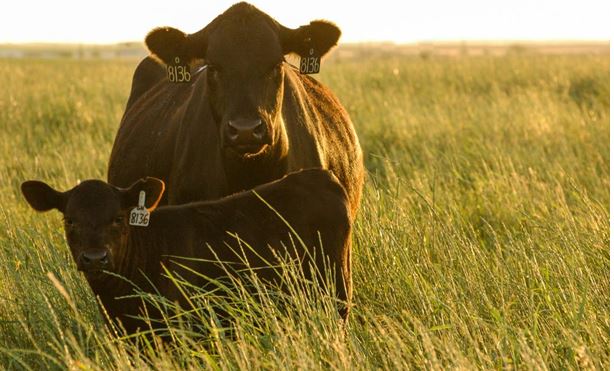
Weekly, Oklahoma State University Extension Beef Cattle Nutrition Specialist Paul Beck offers his expertise on the beef cattle industry. This is a part of the weekly series known as the "Cow-Calf Corner." Today, he talks about how mature cow weight can impact a producer's operation.
From the 2012 Ag Census to the 2017 Ag Census, the number of beef farms decreased by 3.9% but cow numbers slightly increased. The consolidation was from a 5% reduction in small ranches (1 to 100 cows), but 6% increases in medium ranches with 100 to 500 cows and 1% increase in large ranches with 500 or more cows. We will get to see what impact the recent droughts had on consolidation of cattle farms with the release of the 2022 Ag Census in mid February.
There are several barriers for young or new farmers entering beef cattle operations, these include high cost of land and equipment and relatively low returns on investment. The average annual cost per breeding female increased to over $1000 dollars per cow in 2022 and have remained at that level. The recent good calf prices have resulted in positive returns over cash costs for the last few years for cow-calf producers.
These numbers should grab your attention, because I don't believe the costs and returns can be much different across the regions where beef cows are produced. The costs of maintaining a beef cow and the unit cost of production of weaned calves have increased tremendously over the past 5 years. Variable costs such as fuel, fertilizer and herbicides have been blamed as the primary culprits; however, fixed costs such as equipment, hired labor, and land have increased as well. When cattle numbers rebound, and they always do, will these high calf prices remain stable enough to cover these high costs of production?
Additionally, cow carrying costs have increased because of a 30% increase in cow size over the last 30 years from 1,047 pounds in the mid 1970's to 1,369 pounds in the mid 2000's, and this trend appears to have continued. A 30% larger cow requires 22% more energy per day for maintenance and will consume 20 to 30% more forage per day, decreasing cow carrying capacity of the farm or increasing input costs associated with pasture management, supplementation, and stored forages. Smaller cows also have been shown to have greater weaning efficiency (lbs of calf weaned per lb of cow body weight).
The increased cow mature weight equates to an increase in stocking rate if cows numbers are not adjusted. As stocking rate increases we know that weaning weights and rebreeding rates decrease. This has been linked to reductions in forage allowance (lbs of forage available/ lb animal body weight) limiting diet selectivity, diet quality, dry matter intake, and forage regrowth rate. Total weaning weight/acre has been shown to increase up to a point even though individual animal is decreased; until animal performance is reduced to such an extent that weaning weight/acre begins to decrease.
In research on introduced warm season grasses in the Southeastern U.S. (Beck and others, 2016; doi:10.2527/jas2015-0049) cow-calf pairs were separated into heavy (weighing 1,220 lb) and light (weighing 970 lbs) cow size groups and stocked on pastures 2.5, 1.7, 1.2, and 1 acres per cow unit over 4 years. These pastures were fertilized with 100 lbs of nitrogen per acre over the summer.
Heavy cows weaned calves than light cows, but the increase was only 19 lbs heavier weaning weight for every 100 pound increase in cow mature weight. Larger cows also lost more weight and body condition than smaller cows. Weaning efficiency ratios of smaller cows were higher (0.49 lbs of calf weaned per lb of cow for small cows vs. 0.42 for large cows). As stocking rate increased, lbs of calf weaned per acre increased from 130 lbs at the lightest stocking rate to 411 at the heaviest stocking rate.
The increase in weight and condition loss with larger cows is a concern and this could lead to reduction in fertility and increases in rebreeding interval for large cows, especially those with higher stocking rates. Because hay was fed when needed and cows were supplemented to maintain appropriate body condition, rebreeding rates were not affected. But, as cow mature weight and stocking rate increased the amount of hay and annual cow costs increased as well. Increasing stocking rate reduces individual calf body weigh gain but increases total calf gain per acre.
For the larger cows, any advantage in calf weaning weight was diminished during 2 year long periods of drought while this research was conducted, but were enhanced during periods of normal rainfall. These responses to drought indicate production systems with higher stocking rates and larger cows are more impacted by climatic stressors and thus less resilient to harsh environments.

Compact wheel loaders are one of the fastest-growing classes of equipment in agriculture today, and for good reason. Their versatility makes them the perfect do-all tools for stacking, loading, pallet transport, even snow removal. That's why John Deere is thrilled to offer the new 326 P-Tier telescopic compact wheel loader, a powerful, easy-to-operate loader that's sure to find a welcoming home on farms across the country.
"Ranchers and dairy producers will love the 326 P-Tier for its reach, its flexibility and its lift capacity," said Luke Gribble, John Deere go-to-market manager. "Operators will enjoy it for the cab visibility, the boom controls and the exclusive Articulation Plus steering system. Put it all together, and the 326 P-Tier is a real multitool' for the farm or ranch."
Lift, load and stack with over 16 feet of reach
Starting at the business end, the 326 P-Tier telescopic compact wheel loader offers 16-plus feet of reach from its telescopic lift arm – more than enough to stack bales or load TMRs – while still being compact enough to work in barns or other tight spaces. Extending and retracting the telescoping arm is performed with the mini-joystick located on the main control lever, meaning operators don't have to remove their hands from the main controls to activate the arm.
To help guard against overloading the arm, The Load Torque Indicator System gives visual and audible alarms if stability limits are exceeded during lifting, lowering or extension. If the stability limit is reached, movement of the lift arm is only possible if the movement reduces the load. In addition, a separate indicator warns of potential overload of the tilt cylinder.
"Features like these help make the 326 P-Tier one of the most confidence-inspiring and operator-friendly wheel loaders available," Gribble said. "And it is perfect for helping less-experienced operators become better, faster."
A cab built for the business of movement
Inside the cab, operators will find a comfortable, easy-to-navigate environment with all the features necessary for stress-free lifting and loading. To start, the 9-inch touchscreen display puts key information within easy view; the configurable display shows key data such as warnings, status and machine-positioning information. Intuitive user-friendly menus allow operators to tailor the display and machine functionality to the task at hand.
Conveniently placed electro-hydraulic controls, customizable from the touchscreen display, offer Auto Return-to-Dig, and Auto Lift and Lower functions, and help to reduce cycle times while enabling consistent, repeatable movements. All the while, optional boom-mounted lights and standard overhead window allow a clear view to the end of the telescoping arm so operators can place bales, pallets or bucketloads with confidence.
The 326 P-Tier telescopic compact wheel loader also features a brisk 23-mph top speed to help move quickly between jobs. And for tight turning in barns and other cramped spaces, the industry-exclusive Articulation PlusTM steering system offers a full 30 degrees of articulation plus 10 additional degrees of rear-wheel steering.
"The farm or ranch is no place for equipment that doesn't pull its weight," Gribble said. "But with the power and versatility to tackle such a wide range of jobs, the 326 P-Tier is a 'go-to' piece of equipment for operations of all types and sizes."
To learn more about the new 326 P-Tier telescopic compact wheel loader, visit JohnDeere.com or contact your local John Deere dealer.
RON's Dave Lanning has a pre-opening look at today's agricultural Markets.
Click the audio tab below for today's report.

While the passage of the Bipartisan Infrastructure Law and the Inflation Reduction Act offers an unprecedented amount of funding to rural communities for infrastructure, energy, and conservation projects, applying for the grants can be challenging.
"Rural communities have the desire and the need to make improvements," said Lindsay Mouw, senior policy associate with the Center for Rural Affairs. "But, the application process can sometimes be an intimidating and time-consuming process for communities that have limited staff, time, or expertise."
A new resource from the Center for Rural Affairs seeks to demystify the process by walking community leaders through the various stages of federal grant application.
The new "Grant Application Guide for Rural Communities" provides tips and information for identifying grant opportunities, preparing to apply, setting a timeline, and writing and submitting an application. The guide also lists commonly used terms and phrases associated with grant application processes.
Mouw said it's important that rural communities don't miss out on funding opportunities through the Bipartisan Infrastructure Law and the Inflation Reduction Act. She hopes the guide serves as a valuable tool in their planning efforts.
"Communities that invest in themselves can better keep and attract the people who energize communities and create new businesses," she said.
Mouw said the Center plans to host a webinar to walk communities through the guide and answer questions they may have concerning grant applications. Information on the webinar will be available at cfra.org when details are finalized.
To learn more, view and download "Grant Application Guide for Rural Communities" at cfra.org/publications.
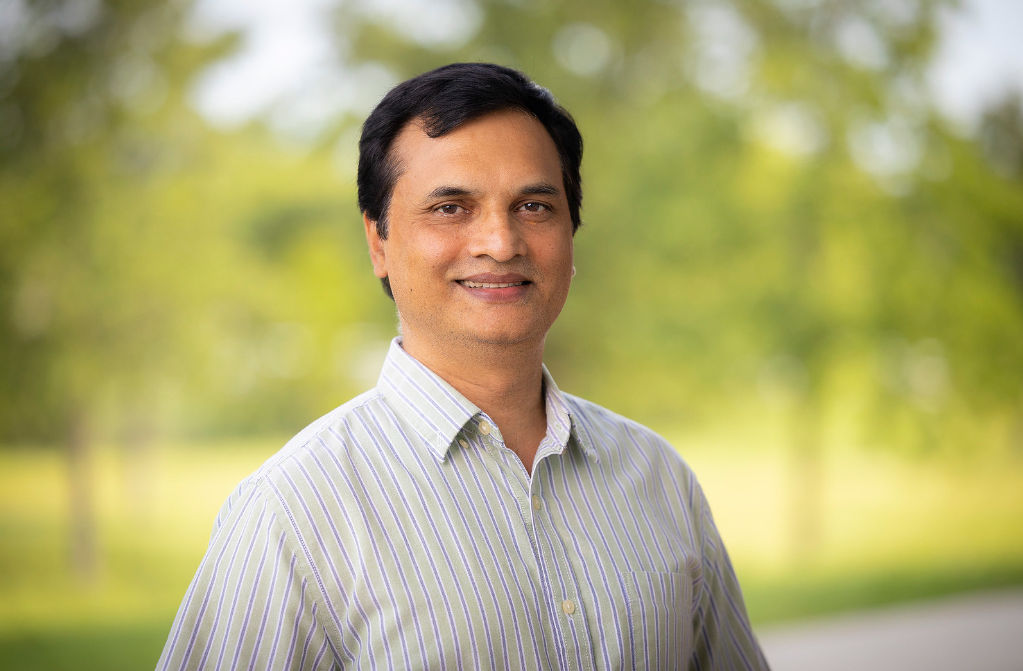
Kirankumar Mysore, professor in the OSU Department of Biochemistry and Molecular Biology, was awarded the Sarkeys Distinguished Professor Award. (Photo by OSU Agriculture)
Oklahoma State University's Kirankumar Mysore has been named a recipient of the 2023 Sarkeys Distinguished Professor Award by the OSU Division of Agricultural Sciences and Natural Resources.
The Sarkeys Award was created by the Sarkeys Foundation in 1980 in honor of Elmo Baumann, an agronomist who worked with the foundation following his retirement from OSU. The annual award recognizes those with outstanding contributions to the agricultural industry through teaching, research or Extension efforts.
"Looking at the past awardees, they are all highly accomplished individuals, and it is great to be a part of the prestigious awardee list," Mysore said. "This being my first award from OSU, it means a lot to me, and I am motivated to achieve more in my research."
Mysore, a professor in the OSU Department of Biochemistry and Molecular Biology, specializes in plant-microbe interactions, specifically in the understanding of how certain plants become infected with pathogens. Before arriving at OSU in 2021, Mysore was a professor and head of the plant, microbe and soil section at the Noble Research Institute.
Mysore serves as editor or associate editor of four major journals: "BMC Plant Biology," "PeerJ Journal," "Bioenergy Research" and "Grassland Research." He has co-authored 270 peer-reviewed publications and 17 book chapters.
Mysore is currently the fourth highest-ranking OSU life sciences researcher in total Google Scholar citations and the second highest-ranking life scientist in the h-index of 77, which means 77 of his publications have been cited 77 or more times.
He also holds eight patents in plant disease resistance and Agrobacterium-mediated plant transformation, a process used to transfer a gene of interest into plants.
As a leader in nonhost resistance and technology development, Mysore has been an invited speaker to approximately 75 national or international conferences and universities. In addition to research, Mysore is committed to teaching students, having trained several postdoctoral fellows, research technicians, undergraduate researchers and graduate students.
"One of Dr. Mysore's remarkable qualities is his dedication to mentoring and educating the next generation of scientists," said Feng Feng, assistant professor in the OSU Department of Biochemistry and Molecular Biology. "His mentorship has guided numerous postdoctoral researchers, graduate students and undergraduates, many of whom have subsequently embarked on successful careers in academia and industry."
Mysore currently teaches molecular genetics at a graduate level and has plans to teach courses in plant-microbe interactions.
Throughout his career, Mysore has received about $7.5 million in state, federal, international and corporate funding. His research and accomplishments have been recognized on national levels, including his election as a Fellow of the American Association for the Advancement of Science.
Since arriving at OSU, he has generated more than $3.4 million in grant funding from a variety of sources, which includes a $2.3 million National Science Foundation grant.
Mysore's academic history brings great distinction to OSU Agriculture, his department and institution, said John Gustafson, head of the OSU Department of Biochemistry and Molecular Biology.
"Dr. Mysore's impact continues on an exponential upward trajectory," Gustafson said. "Dr. Mysore is likely one of the most highly cited life science faculty members in OSU history."
By Ainsley Treesh
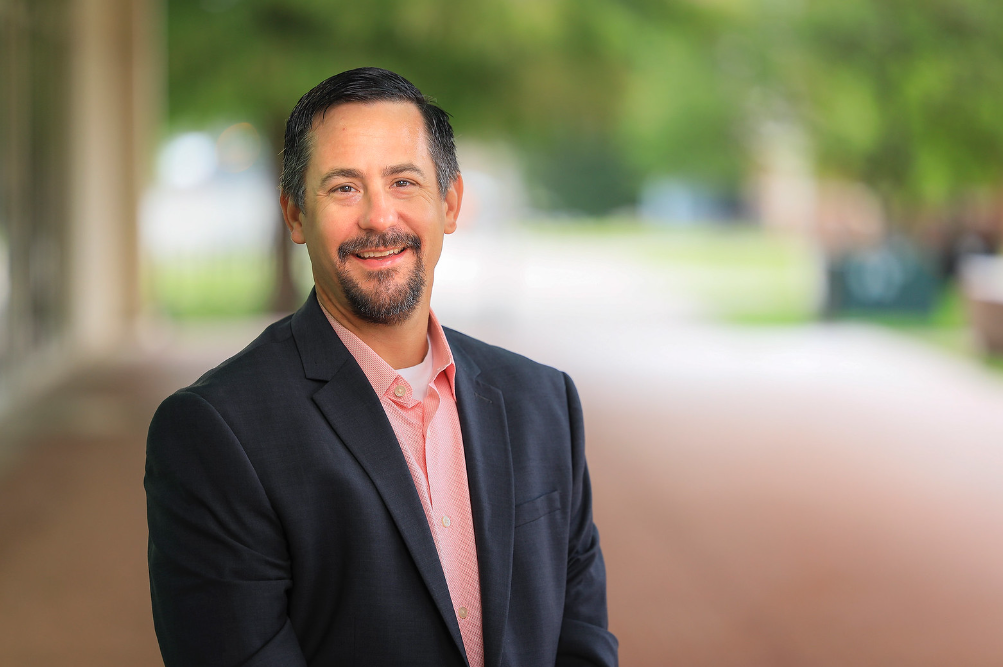
Brian Arnall, professor in the OSU Department of Plant and Soil Sciences and an OSU Extension specialist for precision nutrient management, was awarded the James A. Whatley Award for Meritorious Research in Agricultural Sciences. (Photo by OSU Agriculture)
Oklahoma State University's Brian Arnall has been named the 2023 recipient of the James A. Whatley Award for Meritorious Research in Agricultural Sciences by the OSU Division of Agricultural Sciences and Natural Resources.
First recognized in 1982, the award is presented annually and recognizes outstanding research contributions to advancements in agricultural sciences.
Arnall began as an OSU Extension precision nutrient management specialist in 2006 and also became a professor in the OSU Department of Plant and Soil Sciences in 2019.
"It is such an honor to receive an award, especially given the amazing research contributions of my colleagues here at OSU," Arnall said. "It is extremely important to me that I am doing research that can lead to recommendations implemented by Oklahoma's farmers and ranchers to ensure their sustainability and economic viability."
Arnall is a global leader in the use of N-rich strips to improve crop nitrogen management, specializing in the timing of nitrogen applied in wheat, based on crop response.
Arnall's work is widely respected and known across Oklahoma and several states due to his electronic and social media presence, said Brett Carver, regents professor and OSU wheat genetics chair.
"This tool is a classic example of Dr. Arnall's advancement of environmental stewardship, impacting a half-million acres of wheat production via in-season nutrient applications," Carver said. "Further, more than 1 million wheat acres from Nebraska to central Texas follow Dr. Arnall's program for delayed nitrogen applications, intended to fine-tune the impact of nitrogen inputs."
During his career, Arnall has authored 74 journal publications, four book chapters and received more than $13 million in support of his program. He has delivered more than 700 Extension presentations across Oklahoma and the world.
Arnall has served as a consultant or advisor to researchers at schools across the nation, including Cornell, the University of Kentucky, the University of North Carolina and Michigan State University.
"His group has pioneered the use of remote sensing tools to estimate crop nutrient content, plant growth and crop yield," said Wade Thomason, head of the OSU Department of Plant and Soil Sciences. "This diversity of crops highlights his focus on teamwork and collaboration with other scientists. It also illustrates his desire to serve multiple stakeholder groups in Oklahoma and the southern plains region."
Arnall credits teamwork as a driving factor in his research success, and his program's accomplishments would not be possible without students and collaborators.
"He believes there is a need for research that pushes the boundaries of science, conventional wisdom and application," Thomason said. "This approach means many of the concepts tested are unlikely to succeed with the expectations that successful projects will be that much more impactful on the scientific community and production agriculture."
Whatley, in whose name the award is presented, was an animal geneticist who became director of the statewide Oklahoma Agricultural Experiment Station system and dean of the division, which is comprised of the OSU Ferguson College of Agriculture and two state agencies: OSU Extension and OSU Ag Research. Whatley served OSU for 41 years.
By Ainsley Treesh
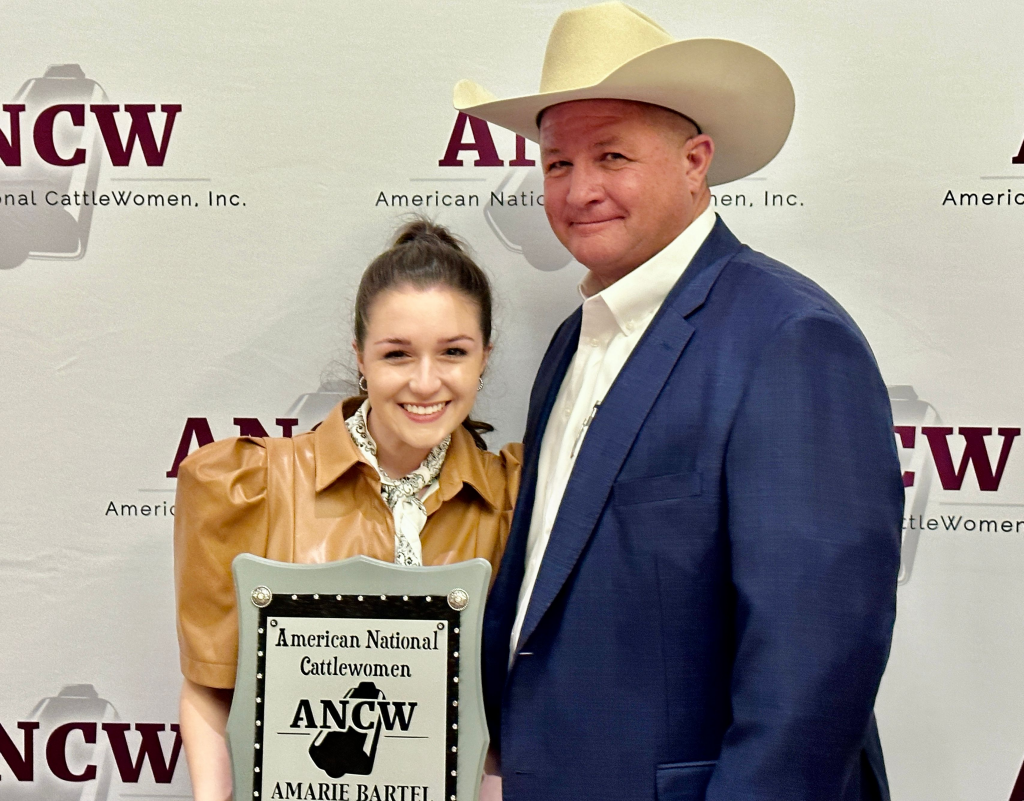
Amarie Bartel (left) and her father, Greg Griffith (right)
Amarie Bartel of Yukon, Oklahoma, was awarded the Beef Promotor of the Year national award by the American CattleWomen at their annual meeting in Orlando, Florida. Bartel is the current president-elect of the Oklahoma CattleWomen and serves as the Economic Development Coordinator for the Oklahoma Farm Bureau.
Senior Farm and Ranch Broadcaster Ron Hays caught up with Bartel after receiving her award to talk about her journey thus far in advocating for and promoting the beef industry.
Between her family's involvement in the livestock marketing business and growing up on a cow-calf operation in Cushing, Oklahoma, Bartel said her passion for the beef industry was built on a strong foundation.
"We say that we are in the cattle business, but we are also in the people business," Bartel said.
When the opportunity to be part of the Oklahoma CattleWomen presented itself, Bartel said the pillars of beef education, legislation, and promotion were conversations she felt called to be a part of.
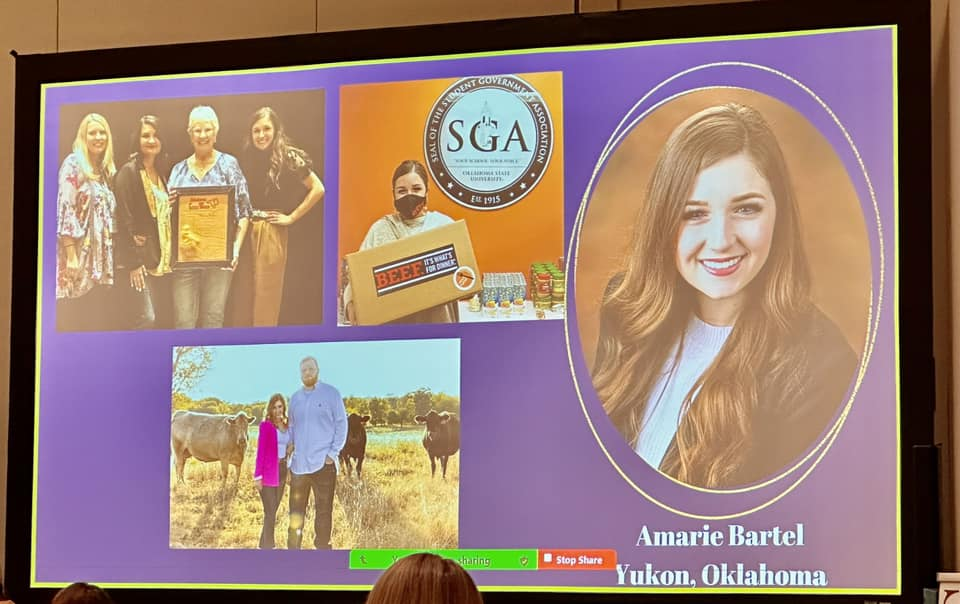
"Through the organization, I have had the opportunity to serve in many leadership roles, but I have also had the opportunity to learn from many influential women who have taught me more about how to take my voice and use it for the benefit of Oklahoma and our country's producers," Bartel said. "We have done that through a variety of things, even down to revitalizing our state's Beef Certificate Program, which catalyzes the purchase of beef in the form of a beef certificate from local establishments."
Looking back on her time at Oklahoma State University, Bartel reflected on the time she spent as the Student Government Association Director of Food Insecurity. One statistic Bartel mentioned is that 43 percent of OSU students do not know where their next meal is coming from.
"We had a student-led food pantry," Bartel said. "I realized that it is important to return to my agricultural roots and make sure we were promoting animal protein as the premier protein source, specifically beef."
With the help of the Oklahoma Collegiate CattleWomen, Bartel said an authorization request was submitted to the Oklahoma Beef Council, which allowed the group to give 2,000 beef sticks to students across the university.
"It was a full-circle moment to me to know that we were providing a healthy, safe, sustainable protein source to Oklahoma State University students," Bartel said.
Bartel said she is looking forward to staying involved in legislative conversations in a beef industry that is rapidly changing. Through her involvement with the Oklahoma CattleWomen and the Oklahoma Farm Bureau, Bartel talked about the great mentorship she has received and continues to receive to help her grow along the way.
"I am going to try to be a sponge and absorb the things that are happening legislatively and then use that to catalyze that information to our country's producers and consumers," Bartel said.
Our coverage from the 2024 Cattle Industry Convention and NCBA Trade Show in Orlando is being powered by Farm Data Services of Stillwater.
The American Farm Bureau Federation sent a letter today to U.S. Department of Agriculture Secretary Tom Vilsack urging the agency to issue a final decision on an emergency basis to speed the implementation of the "higher-of" Class I mover formula to buffer dairy farmers from further losses during the forthcoming Federal Milk Marketing Order rulemaking process.
"The comprehensive process of amending federal orders, though important, means dairy farmers remain stuck with current pricing regulations until USDA publishes a final rule," Sam Kieffer, AFBF vice president of public policy, said in the letter, which also notes that FMMO reform is in step five of a 12-step process. "The current Class I mover was a well-intentioned policy misstep that has reduced dairy farmers' checks, with little relief in sight. Emergency implementation of the 'higher-of' Class I mover formula will help buffer against persistent losses associated with mistaken and outdated policies that have left dairy farmers struggling to make ends meet."
AFBF economist Danny Munch read the letter into the official record as the last witness of the hearing process. AFBF has participated in the full 49 days of the hearing, which began on Aug. 23, 2023.
Prior to the convening of the hearing, AFBF has long been an advocate of Federal Milk Marketing Order reform, including hosting a Federal Milk Marketing Order Forum in October 2022, where a return to the "higher-of" Class I mover was the number one FMMO reform priority of the gathered farmers. AFBF economists and Farm Bureau members testified numerous times throughout the hearing.
To read the full letter click here. To see AFBF's other testimony and exhibits, visit the hearing website here.
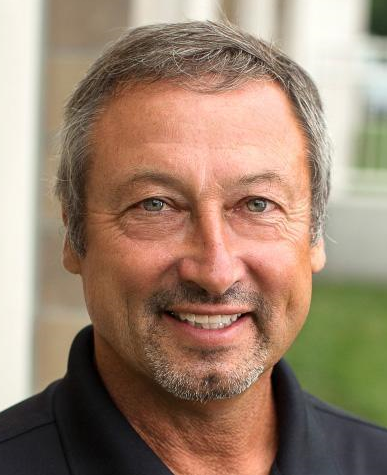
At its Jan. 26 meeting in Washington, D.C., the U.S. Wheat Associates (USW) Board of Directors elected wheat farmer Gary Millershaski of Lakin, Kan., as Secretary-Treasurer for fiscal year 2024-25. The board also elected Clark Hamilton, of Ririe, Idaho, as Chairman; Jim Pellman, of McClusky, N.D., as Vice Chairman; and Michael Peters, of Okarche, Okla., as Past Chairman. These elected officers will take their positions at the USW Board of Directors Annual Meeting July 9-12 in Oklahoma City, Okla.
Millershaski, along with his wife Jana and their sons Jeremy and Kyler, grow hard white (HW) and hard red winter (HRW) wheat, dryland corn and milo, and manage a cow/calf operation on their farm, which was passed along from Jana's father Earl Kleeman. Millershaski became a Kansas Wheat Commissioner in 2016 and currently serves as its chairman. He also served as a director of the Kansas Association of Wheat Growers (KAWG) from 2007 to 2017 after he received a KAWG scholarship while a member of the Class VIII Kansas Agricultural & Rural Leadership (KARL) program. Learn more about Millershaski's experience and commitment to the U.S. wheat industry and USW in the video below.
Azotic Technologies Ltd is pleased to announce that Envita® SC has received certification from the Organic Materials Review Institute (OMRI) for use in compliance with the USDA National Organic Program.
Envita SC is now OMRI Listed® in the Generic Material Listing: National Organic Program (NOP): Microbial Inoculants Class: Crop Fertilizers and Soil Amendments.
Envita SC is a unique nitrogen-fixing biological based on the microbe Gluconacetobacter diazotrophicus (Gd), originally discovered in sugarcane. This highly effective solution was introduced to the North American market in 2019. Since then, it has experienced phenomenal uptake by farmers around the world as it has consistently delivered exceptional results in a multitude of crops.
"OMRI certification for Envita SC provides a much-needed solution for organic growers who may otherwise face a limited selection of products that help to ensure plant access to Nitrogen," explains Ray Chyc, CEO of Azotic.
Tom Tregunno, Global Business Development for Azotic, adds, "OMRI certification introduces Envita SC to one of the fastest growing segments in agriculture. Growers supplying bio-rational and organic products will now be able to take advantage of the many benefits of nitrogen fixation in a variety of crops and growing environments."
About Azotic
Azotic (www.azotic.com) was founded in 2012 to introduce sustainable nitrogen-fixing technology to farmers across the globe. With global offices in York, UK and North American offices in California, USA and Guelph Ontario, Canada, Azotic has taken more than 20 years of academic and field research to create the leading nitrogen-fixation product in the world. Finally, there is no compromise between high-yield production agriculture and nitrogen sustainability.
Today, the National Cattlemen's Beef Association (NCBA) announced support for the bipartisan Fair and Accurate Ingredient Representation on Labels Act of 2024 (FAIR Labels Act) introduced by Sen. Roger Marshall (R-KS), Rep. Mark Alford (R-MO), Rep. Roger Williams (R-TX), Rep. Don Davis (D-NC), and Rep. Jonathan Jackson (D-IL). The bill would end deceptive labeling practices on fake meat products and ensure that consumers know exactly what they are buying at the grocery store.
"America's farmers and ranchers work hard every day to bring a high-quality, wholesome product to market. We're not afraid of a little competition, but it is unfair for lab grown or plant-based fake meat products to trade on beef's good name," said NCBA President Todd Wilkinson, a South Dakota cattle producer. "This bill is especially important for ensuring that consumers recognize lab-grown products that may be coming to market in the future. Consumers deserve to know how their food is made and to understand that lab-grown products made in a bioreactor are not the same as the high-quality beef raised by farmers and ranchers."
The FAIR Labels Act would require fake meat products to be labeled as "imitation," to clearly differentiate between real meat and plant-based or substitute protein products. The bill would also provide clarity on lab grown products, especially in light of the U.S. Department of Agriculture's approval of lab-grown chicken. Lab-grown products are created from animal cells that are artificially replicated in a laboratory environment. While no lab-grown imitations of beef have been approved for sale in the United States, several companies are currently involved in research that could soon bring beef imitation lab-grown products to market. Under the FAIR Labels Act, lab-grown products would need to be clearly labeled as "lab-grown" and bear a statement that the product was not produced by traditional farming and ranching methods.
"Lab-grown products are an emerging technology, and the FAIR Labels Act is an important first step for making sure consumers understand the difference between lab-grown or plant-based products and real beef raised by farmers and ranchers," said NCBA Director of Animal Health and Food Safety Policy Rebecca Barnett. "NCBA thanks Sen. Marshall, Rep. Alford, Rep. Williams, Rep. Davis, and Rep. Jackson for introducing this critical legislation that ensures American consumers know where their food comes from."
| ||||||||||||||||||||||||||||||||||||||||||||||||||||||||||||||||||||||||||||||||||||||||||||||||||||||||||||||||||||||||||||||||||||||||||||||||||||||||||||||||||||||||||||||||||||||||||||||||||||||||||||||||
|
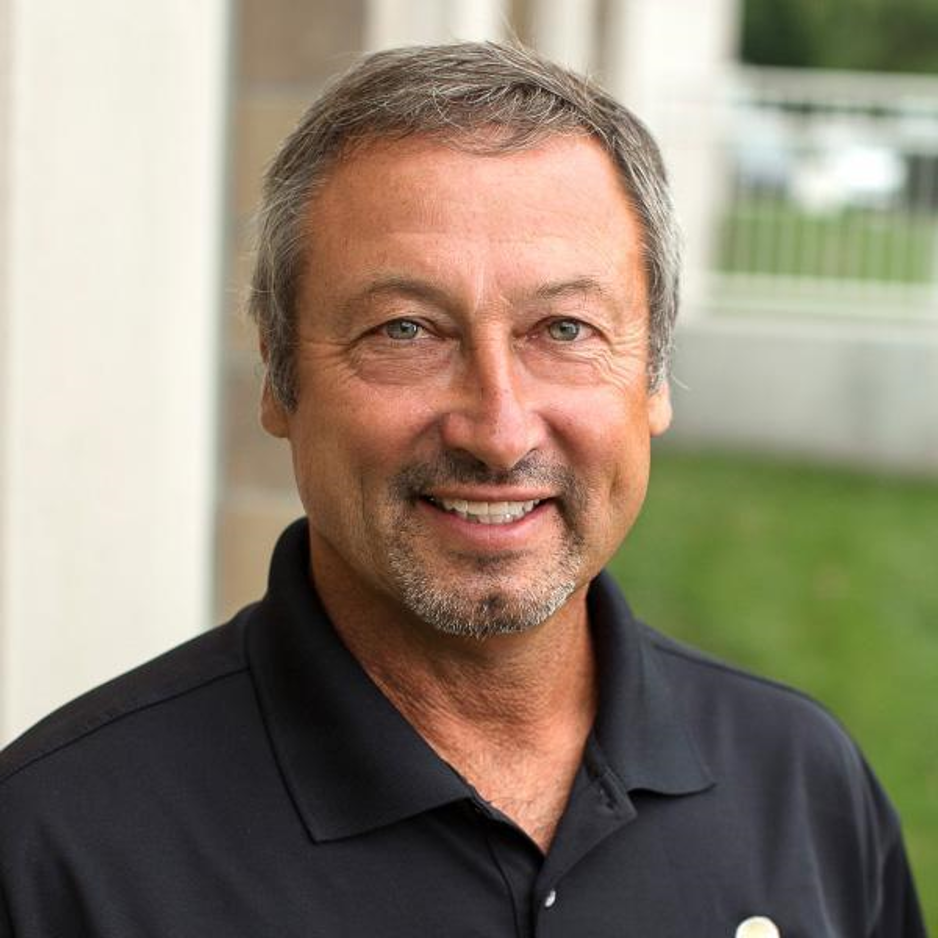
At its Jan. 26 meeting in Washington, D.C., the U.S. Wheat Associates (USW) Board of Directors elected wheat farmer Gary Millershaski of Lakin, Kan., as Secretary-Treasurer for fiscal year 2024-25. The board also elected Clark Hamilton, of Ririe, Idaho, as Chairman; Jim Pellman, of McClusky, N.D., as Vice Chairman; and Michael Peters, of Okarche, Okla., as Past Chairman. These elected officers will take their positions at the USW Board of Directors Annual Meeting July 9-12 in Oklahoma City, Okla.
Millershaski, along with his wife Jana and their sons Jeremy and Kyler, grow hard white (HW) and hard red winter (HRW) wheat, dryland corn and milo, and manage a cow/calf operation on their farm, which was passed along from Jana's father Earl Kleeman. Millershaski became a Kansas Wheat Commissioner in 2016 and currently serves as its chairman. He also served as a director of the Kansas Association of Wheat Growers (KAWG) from 2007 to 2017 after he received a KAWG scholarship while a member of the Class VIII Kansas Agricultural & Rural Leadership (KARL) program. Learn more about Millershaski's experience and commitment to the U.S. wheat industry and USW in the video below
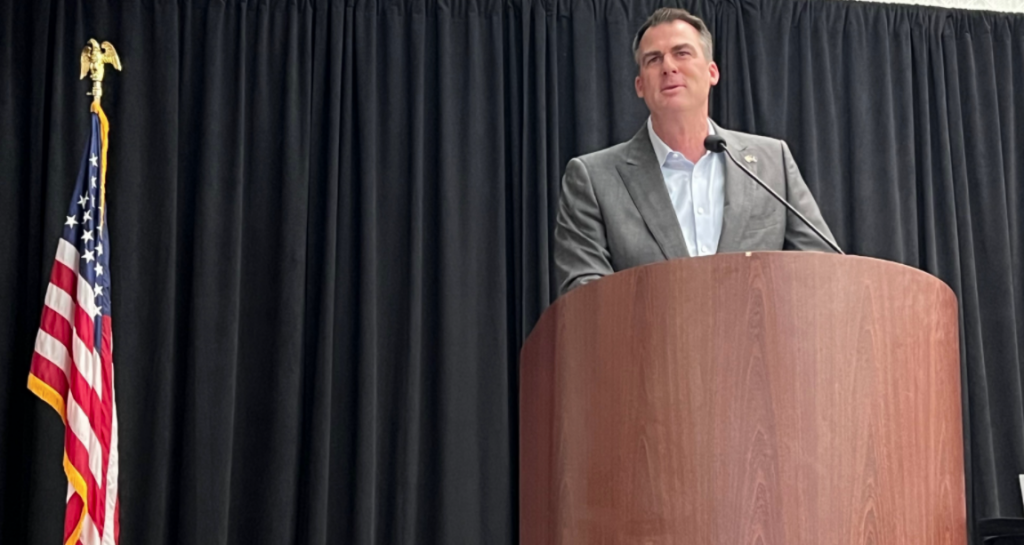
The Oklahoma Department of Agriculture, Food and Forestry is accepting nominations for Gov. Stitt's Outstanding Achievement in Agriculture Award.
The winner will be inducted into the Oklahoma Agriculture Hall of Fame, which is the state's most prestigious award honoring distinguished Oklahoma agriculture producers. The Governor's Outstanding Achievement in Agriculture award honors leaders in the agriculture industry who exemplify personal values, performance and achievement.
Nominees should have high standards of conduct, leadership, innovation, and accomplishments in agriculture, while also being a role model for Oklahoma agriculture's young people.
Previous award-winners have represented different areas of Oklahoma, as well as a variety of agricultural groups and commodities. Past recipients have guided their families and communities to success by excelling as dairymen, cattle ranchers, pork producers, wheat farmers, conservationists and educators.
Last year, Bob Howard, a longtime southwest Oklahoma wheat, pasture, and cattle producer, was honored with the 2023 Governor Stitt's Outstanding Achievement in Agriculture Award and became the 26th inductee into the Oklahoma Agriculture Hall of Fame.
The nomination application is available HERE.
Nominations will be accepted through Friday, March 8.
The inductee will be honored with a recognition ceremony during Oklahoma Ag Day at the State Capitol on April 16, 2024.
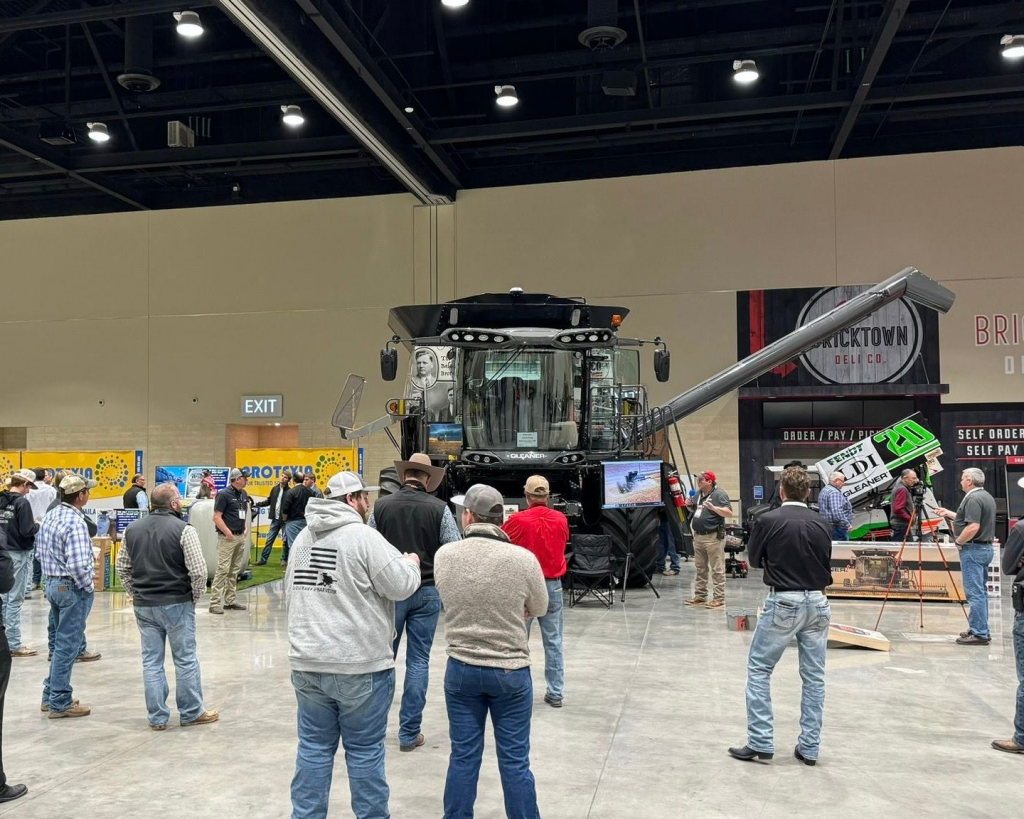
Following the conclusion of the annual convention of the U.S Custom Harvesters that took place in Oklahoma City last week, Farm Director KC Sheperd had the chance to catch up with the president of the group, David Misener, and talk about the highlights from the event and what the U.S. Custom Harvesters are all about.
Misener said the event kicked off with words from Oklahoma Secretary of Agriculture Blayne Arthur. Following Secretary Arthur, Misener said the convention featured an array of impactful speakers, including Congressman Frank Lucas.
"Our membership is everywhere across the U.S., and we also have members in Canada," Misener said. "I can also say we had some individuals that also showed up from Germany."
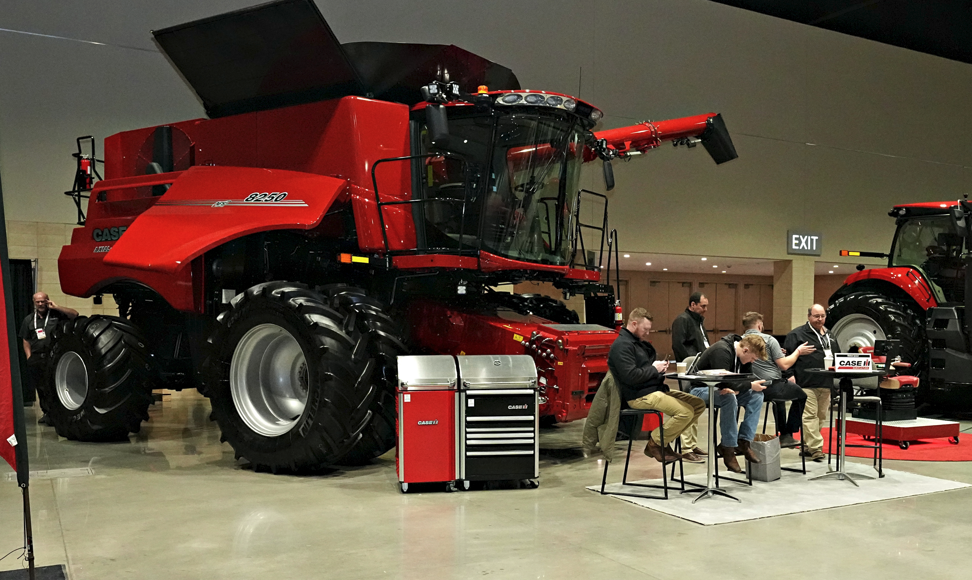
said U.S. Custom Harvester membership consists of three base entities: custom combining, silage chopping, and cotton harvest. Misener partakes in custom combining, where he begins wheat harvest in Oklahoma and ends in North Dakota.
Like most U.S. Custom Harvester members, Misener covers a lot of territory. After Misener finishes with wheat in North Dakota in September, he travels to South Dakota for soybean and corn harvest.
"We have some members who start in South Texas doing wheat and come up into Kansas and stop their wheat run, then they go back down into South Texas and start their cotton harvest," Misener said.
Using top-notch equipment with cutting-edge technology, Misener said the U.S. Custom Harvesters can get the job done efficiently and effectively.
Misener said next year's annual U.S. Custom Harvester convention will take place in Des Moines, Iowa.
To get in touch with a Custom Harvester or learn more, Misener said individuals can visit https://uschi.com/index.php or call the office at 620-200-1381.
The characteristics and management of a pond or marsh influence its ability to attract migratory ducks. Noble senior Regen Ranching Advisor Mike Porter writes about beneficial factors and offers resources for technical and cost-sharing assistance.
If it is a goal of yours to have more ducks visiting ponds and other water features on your farm or ranch, these are some of the most important variables and management decisions to consider.

Impoundments located close to major rivers, waterfowl refuges or preferred crops such as peanuts, rice or corn typically draw more ducks. Duck numbers seem to recharge more quickly following disturbances such as hunting when impoundments are located closer to such locales.
Remote impoundments exposed to minimal human activity usually hold more ducks than impoundments exposed to frequent human activity. However, ducks can learn to tolerate human activity when an impoundment is not hunted.
Larger impoundments generally draw and hold more ducks than smaller impoundments.
Shallow impoundments draw more dabbling ducks than deep impoundments. Dabbling ducks prefer to feed by dipping their heads and breasts into the water to feed rather than diving completely underwater. Dabbling duck species include mallard, mottled, black, gadwall, wigeon, pintail, shoveler and teal. A significant percentage of an impoundment should be shallower than 3 feet to attract maximum numbers of dabbling ducks.
Clear water is better than muddy water for duck ponds. It encourages more aquatic plant growth and allows ducks to see food easier.

The presence of abundant duck food plants in water is probably the most important criteria for attracting dabbling ducks. Duck food plants include several submersed aquatic plants, emersed aquatic plants, floating aquatic plants, moist soil plants and flooded terrestrial plants. Clear, shallow water is generally the best approach to encourage submersed and emersed aquatic duck food plants in permanently flooded impoundments.

Livestock activity in an impoundment can be neutral or negative depending upon the characteristics of the impoundment and the amount of impact. When livestock do not affect water clarity or plant community, their influence is usually neutral. Problems can occur when livestock muddy water and eliminate vegetation along the banks. Fencing can eliminate these problems. See Pond Fencing.
A new impoundment with waterfowl goals should include a drawdown structure that allows a manager to manipulate water levels. A drawdown structure allows a pond or marsh to be drawn down 1-3 feet during early spring and summer to encourage the growth of moist soil plants such as smartweeds, barnyard grass and sedges that provide food for dabbling ducks. The impoundment should be refilled during fall to place the moist soil plants in shallow water. However, drawdown for this purpose is not recommended in most of the U.S. unless a dependable water supply is available, due to inconsistent fall rains.
Ducks should not be hunted too frequently at an impoundment because excessive hunting scares them away. I prefer a pond or marsh be hunted no more than once per week.

Ducks use a few ponds and marshes that do not fit any of these criteria, because some ducks simply select impoundments for resting or roosting purposes. Also, some impoundments with all these criteria may not have ducks at times when few or no ducks are in the area due to the vagaries of duck migration. However, impoundments with more of these beneficial characteristics generally attract more ducks and attract ducks more consistently than impoundments with few of these characteristics.
Technical assistance for landowners wanting to build or manage impoundments for ducks is available from many state wildlife agencies, such as the Oklahoma Department of Wildlife Conservation and the Texas Parks and Wildlife Department, and some federal agencies such as the USDA Natural Resources Conservation Service, and U.S. Fish and Wildlife Service. Cost-share assistance for wetland restoration, waterfowl marsh construction or waterfowl management has been available from several sources, such as some state programs such as the Oklahoma Department of Wildlife Conservation Wildlife Habitat Improvement Program, the Natural Resources Conservation Service Wetland Reserve Program, the Natural Resources Conservation Service Environmental Quality Incentives Program and the U.S. Fish and Wildlife Service Partners for Fish and Wildlife Program. The amount of cost-share varies depending upon the program, size and type of project, and wildlife species benefiting from the project.
For more information about managing impoundments for ducks, see 3 Ways to Attract More Ducks to Your Pond.
Story credit: Mike Porter, Noble Research Institute.
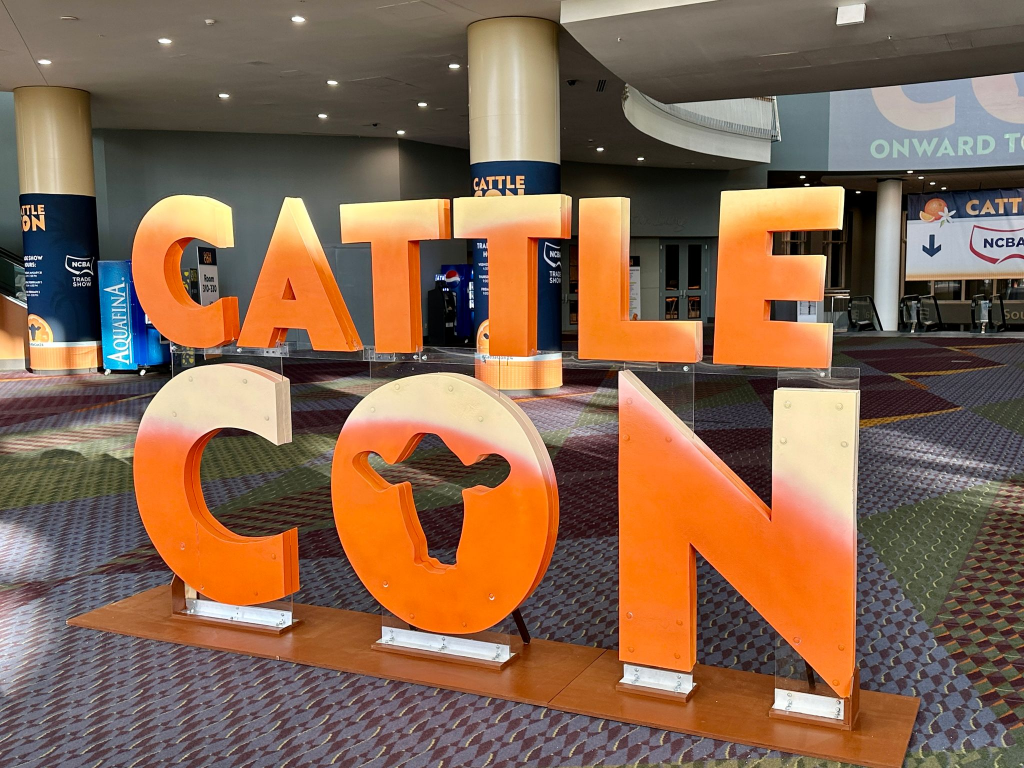
At the 2024 Cattle Industry Convention and NCBA Trade Show (CattleCon) held in Orlando, Florida, Senior Farm and Ranch Broadcaster had the chance to catch up with the Vice President of Governmental Affairs at the National Cattlemen's Beef Association, Ethan Lane, about NCBA's latest policy work and more.
Our coverage from the 2024 Cattle Industry Convention and NCBA Trade Show in Orlando is being powered by Farm Data Services of Stillwater.
Currently, Lane said one of the biggest issues in Washington, D.C., is the push and pull of an administration that is running an "end game" of four years in office leading up to the next presidential election.
"They do that through putting out regulations that we may or may not like; they do that through new policy proposals and showing aspirations for a second term, and then you have a congress on the other side who is severely limited in their capacity to do much, and you have very tight majorities down to one or two votes for House Republicans and about the same in the Senate," Lane said. "That spells not a whole lot of real movement or action on a range of topics."
The appropriations process also continues, Lane said, as there have been a few extensions since September.
"There is talk that we are starting to see some progress, but they set some top-line spending numbers for those individual spending bills this week, and that gives them some operating room, and now they know what they are working with," Lane said.
Some of those "big ticket items" Lane said NCBA is focusing on in the appropriations process include maintaining the delay on electronic logging devices for cattle producers, endangered species issues, the Packers and Stockyards Act, and more.
"We are working for money to pay for electronic tags," Lane said. "USDA is working on a traceability rule right now. Our policy is that we prefer a voluntary solution to that issue, but we want to make sure if the government puts a mandate for it, we want to make sure there is money to pay for tags, so producers aren't bearing that cost."
Looking into next year, Lane said there is a discussion regarding making changes to the estate tax, as the dramatic increase in the limit for the death tax will expire at the end of next year.
"Although this Congress will probably not deal with that in substance, the conversation starts now," Lane said. "There is a tax package that is kind of working its way through the Hill that is bipartisan. We don't really know whether that is more of a marker or if that really has some legs. They are debating whether to run that on the hill here in the next week or so."
The Beef Buzz is a regular feature heard on radio stations around the region on the Radio Oklahoma Ag Network and is a regular audio feature found on this website as well. Click on the LISTEN BAR at the top of the story for today's show and check out our archives for older Beef Buzz shows covering the gamut of the beef cattle industry today.
In December 2023, OWRB hosted the second in a series of statewide meetings designed to engage with local officials, water utility suppliers, regulated industry, commercial agricultural producers, economic development entities, and other organizations to converse on local water challenges, share opportunities, and identify ways the OCWP can support local water planning and management.
During the first round of regional meetings, three categories emerged to frame the breakout groups for this second round. While the conversations and suggestions varied across the regions, the summary below captures some takeaways and discussion where we found general agreement (For additional details download Round 2 Summary).
Permitting / Regulations / Policy - Many participants expressed support for increasing timely enforcement of existing rules and use limits. Ideas for achieving this included establishing regional OWRB offices or representatives, local management authorities, or modifying enforcement rules.
Nearly all participants expressed views that some form of local control or management of water resources would be beneficial, although there was no consensus on what the management structures should be implemented or what kinds of authorities, if any, should be established.
Infrastructure Improvements and Funding / Financing – It was uniformly agreed in the groups that clean safe abundant water is a public health issue; and that the daunting challenges of aging infrastructure and treating drinking water for new complex constituents, especially in small communities are often not met through current funding and assistance programs. There was broad support in the groups for some level of state match (cost-share) to address at least the most dire needs, in order to ensure public safety and public health. Most agreed that such cost-share should come with certain requirements that ensured recipients improved their long-term planning, improved their business management practices and operations.
With those requirements, discussions usually segued into funding for and development of a more robust education program on effective utility management and board training, expanded planning and technical assistance programs, and provide substantial and ongoing state funding for water and wastewater activities. Most agreed that these could be accomplished within existing program authorities if these programs were provided ongoing additional funding and/or staff.
Collaboration and Partnership - Many participants expressed support for developing regional water plans, and support for the role coordination can play to leverage and improve individual plans within a region. Participants noted that regional water plans can be useful tools in identifying local capital project needs for water supply, and that the state could help incentivize such regional planning through existing financial programs by giving preference to or even cost-share to those projects that are participants of a larger regional water plan.
Group members identified several best management practices (BMPs) and mechanisms through which the state can encourage or incentivize voluntary BMPs. Examples include providing training and / or technical assistance for utilities to implement effective utility management and sustainable utilities practices (e.g. appropriate rate structures, regular rate increases, long-term planning, etc.).

Central Life Sciences will be featuring Gravista®-D Insecticide at Commodity Classic 2024, held February 28 – March 2 in Houston, TX. Designed specifically to control profit-robbing insects in stored grain, Gravista®-D Insecticide combines a synergized adulticide with an insect growth regulator to kill a broad-spectrum of labeled adult insects and break the insects' life cycles.
Gravista®-D Insecticide is a ready-to-use solution for protecting post-harvest stored grains from weevils and other listed costly insects, helping users to reduce insect damaged kernels (IDK) and grain shrink.
"In our studies, Gravista-D Insecticide helps to provide long-lasting insect control. We observed insect damage on 18% of the kernels after 90 days in untreated grain infested with lesser grain borers compared to virtually no insect damage on infested grain which had been treated with Gravista-D," said Johnny Wilson, PhD, from the Technical Services Specialty Agriculture division of Central Life Sciences. "The use of Gravista-D Insecticide can yield a positive return on your investment."
Labeled for use in grain sorghum (milo), corn, popcorn, barley, oats, rice, rye and wheat, Gravista®-D Insecticide can be applied as a pre-bin treatment and on post-harvest grain as it flows into storage for extended residual insect control.
"We're proud to deliver an effective insect control product to help protect on-farm post-harvest stored grains," said Nancy Stratinsky, Sr. Business Manager for the Specialty Agriculture division of Central Life Sciences.
Gravista®-D Insecticide helps protect the post-harvest stored grain investment from a variety of stored grain insects including the Indian meal moth, sawtoothed grain beetle, red flour beetle, rice weevil, maize weevil, lesser grain borer and other listed pests. Gravista®-D Insecticide is CODEX approved for cereal grains.
For more information on Gravista®-D Insecticide as well as the complete lineup of stored grain protectants from Central Life Sciences, visit www.BugFreeGrains.com.
For years, farmers have had to navigate a complex landscape of digital tools to harness the power of their on-farm data. Corteva Agriscience (NYSE: CTVA) and John Deere (NYSE: DE) today announced a partnership to make it easier for farmers to access Corteva's industry-leading agronomic recommendations through the John Deere Operations Center™.
This partnership combines the digital and onboard capabilities of John Deere, the global leader in intelligent farm equipment, with the agronomic expertise and analysis of Corteva, the global leader in agricultural solutions. The result is the delivery of precise, customized, agronomic insights to:
"We are focused on making it as easy as possible for farmers to unlock even more value through data-driven, scientific recommendations, based on the unique characteristics of their farm. This partnership does exactly that, said Brian Lutz, vice president of agricultural solutions, Corteva. "As a technology company dedicated to putting the best, most innovative tools in the hands of farmers, this partnership, by setting a new standard for the industry, is an exciting next step both for farmers and our companies. We're pleased to be able to combine Corteva's cutting-edge science with John Deere's technology stack to simplify the last mile of execution in the field."
"The future of farming will be enabled by the combination of data-driven insights and science-based agronomic recommendations that are precisely executed by connected and increasingly intelligent machines," said Doug Sauder, director, product management and user experience at John Deere. "Achieving the ambitious goals for providing food, fuel, and shelter for an increasing global population necessitates the entire industry work better together to ensure we are doing everything we can to help farmers optimize how they plan and execute in the field with the best products. We are excited to work with Corteva to provide a seamless experience for our mutual customers and help them garner more value from their farm data."
Pilot programs will begin in the spring across the United States and expand to Canada in the future. These pilots are the foundation for a strategic, multi-year partnership, leveraging the companies' respective areas of expertise to develop and deploy digital solutions that support farmers and their pursuit of more efficient, productive and sustainable farms.
Mark Johnson, Oklahoma State University Extension Beef Cattle Breeding Specialist, offers herd health advice as part of the weekly series known as the "Cow Calf Corner," published electronically by Dr. Peel, Mark Johnson, and Paul Beck. Today, Johnson talks about the cattle market cycle.
The complexity and dynamics of the beef industry can create financial opportunities for cow-calf operations willing to take a business approach to their decision-making process. The cattle cycle, often referred to in this newsletter, is the topic of my article this week. This cycle is repeated time after time and summarized as follows:
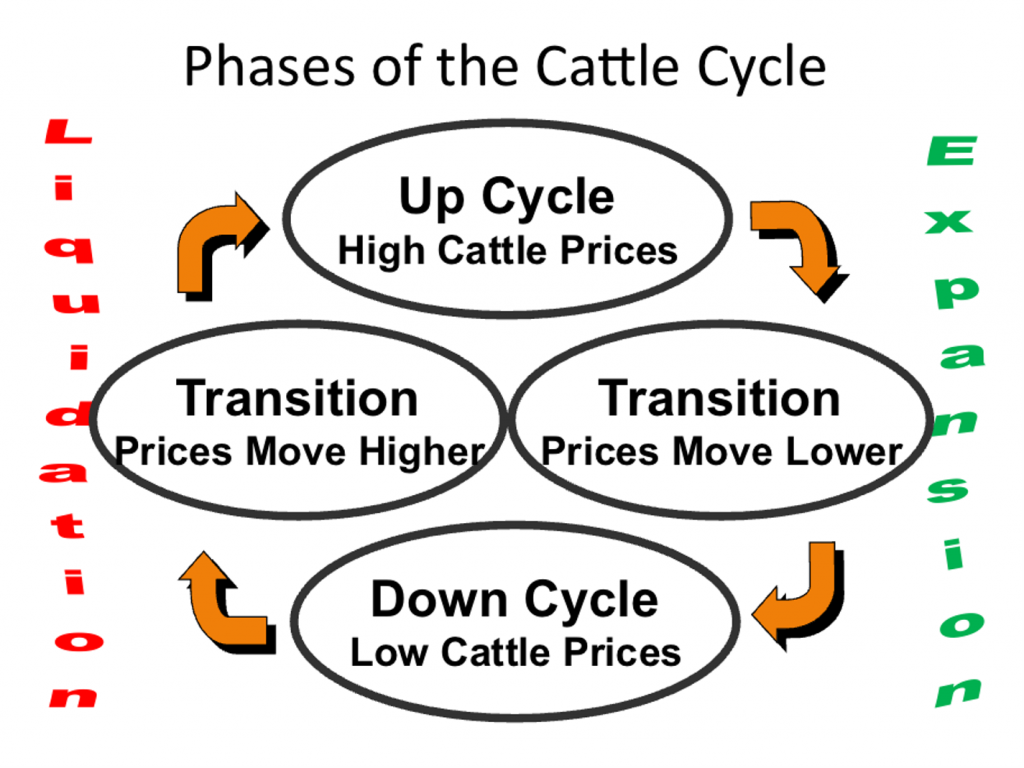
The cattle cycle reflects the impact that supply and demand has on cattle prices. When cow inventory is low the prices of calves and all age and weight categories of cattle will move higher and vice versa. At the onset of 2024, our national cow inventory is the lowest since the early 1960s and prices of calves, yearlings, fed cattle and cull cows are historically high. High profit potential exist for the cow-calf sector in 2024.
How Long Will This Last?
This is the question being asked and debated in early 2024. As of now there is little indication of a rising cow inventory in the near future, Why? Several factors are working against it, these include:
RON's Dave Lanning has a pre-opening look at today's agricultural Markets.
Click the audio tab below for today's report.
Ron Hays talks with Heather Buckmaster of the Oklahoma Beef Council about using TV apps like Netflix, Hulu and YouTube to get what we used to call TV commercials out to consumers- targeting consumers that are looking for mealtime solutions for their family. Take a listen!
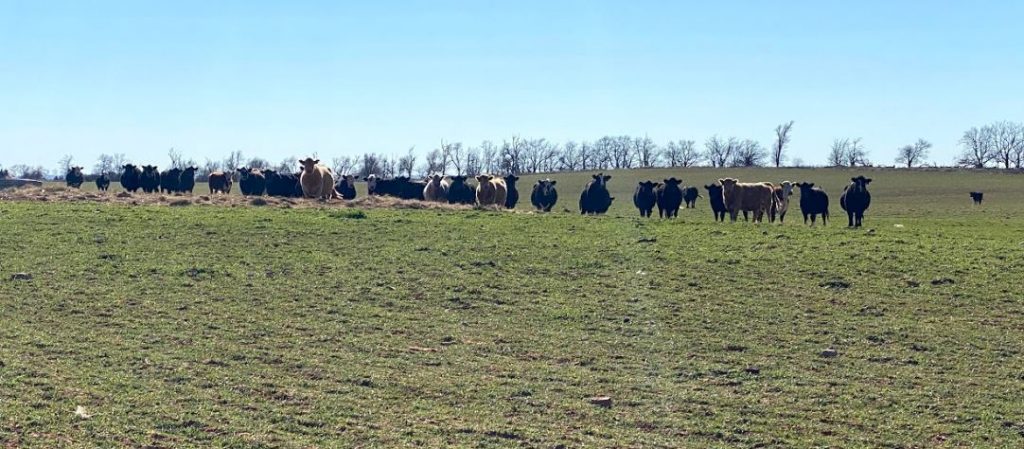
Cattle on Wheat Pasture in December
While the weekly Crop Condition reports don't begin by USDA until the first week of March- states release periodic reports over the winter- and the latest reports for Oklahoma and Texas were dropped on Monday, January 29th.
For Oklahoma- it was a monthly summary for January- showing the 2024 winter wheat crop is in 63 percent in good to excellent condition- up from 53% good to excellent that was reported in the last weekly report of 2023 at the end of November. USDA reports that 55% of the wheat acreage in the state is being grazed which is 19 points higher than the number of one year ago.
The pasture and range ratings for the January summary showed a 31% good to excellent rating- up from 22% good to excellent for the December summary that concluded 2023 but little changed from the end of November report of 30% good to excellent that was in the final weekly report of 2023 at the end of November.
Texas reports this week that their winter wheat crop is 42% good to excellent versus 46% good to excellent back in their November 26, 2023 report. Pasture and range ratings in Texas continue to be awful- just seven percent good to excellent versus fourteen percent good to excellent as of November 26, 2023. That might be one reason for the lack of interest in beef cow herd rebuilding in the southern plains.
Kansas did not have an update on wheat crop conditions on Monday. Their last report was on December 31st when they indicated that their winter wheat crop was 38% in good to excellent condition.
The American Farm Bureau Federation and West Virginia Farm Bureau today presented Sen. Shelley Moore Capito (R-W.V.) with the highest honor the organization gives to sitting members of Congress, the Golden Plow award.
"Senator Capito has proven time and again that she is a strong advocate, fierce negotiator and formidable champion for agriculture and rural America," said AFBF President Zippy Duvall. "She's helped us fight against overregulation by the Environmental Protection Agency, led the charge for comprehensive economic development and played a key role in supporting affordable, reliable energy production. Our country's farmers and ranchers are better off because of the work she has done."
Sen. Capito is the first female U.S. senator in West Virginia's history and serves as ranking member on the Committee on Environment and Public Works. She is also a member of the Appropriations and Commerce committees, where she's helped secure hearings for bills vital to the protection of farmers and ranchers.
West Virginia Farm Bureau nominated Sen. Capito for her tireless advocacy on behalf of agriculture, including for common sense government regulations, especially at USDA and EPA. She was also nominated for her dedication to improving the lives of veterans and preventing substance abuse.
"Senator Capito has been and continues to be a leading voice to address issues critical to West Virginia and all of rural America, including broadband expansion, building our nation's infrastructure and helping every American access affordable, dependable energy," said West Virginia Farm Bureau President Charles Wilfong. "Her leadership and vision epitomize the spirit of the Golden Plow. The West Virginia Farm Bureau strongly supports Senator Capito as a recipient of the award."
AFBF's Golden Plow award recognizes members of Congress who exemplify agricultural leadership. Recipients are chosen for having a philosophy or record that demonstrates a commitment to sound agricultural policies supported by Farm Bureau, the private enterprise system, fiscal conservatism and reduced federal regulation of businesses and individuals.

Representative Forrest Bennett, D-OKC, was appointed as Assistant Floor Leader on the Oklahoma House Democratic Leadership Team by House Democratic Leader Cyndi Munson for Oklahoma's 59th Legislature.
"I am thrilled to join Leader Munson's team this session as an Assistant Floor Leader," said Rep. Bennett. "I look forward to utilizing my role to facilitate healthy discussions between our caucus and our Republican counterparts."
This year is Rep. Bennett's eighth year serving in the Oklahoma House of Representatives. Rep. Bennett is a member of the National Council of Insurance Legislators and chair of the Property and Casualty Committee.
Leader Munson added Rep. Bennett to the team to further ensure a Floor Leader is consistently available to Democratic members for questions and feedback and to strengthen our Floor strategy as House Democrats work on policies that positively impact all Oklahomans.
"Representative Forrest Bennett will make a great addition to our already strong team of leaders," said Leader Munson. "Bennett believes in open and productive communication on the Floor and has been a strong voice on the issues important to our constituents. His leadership will help our Caucus not only push back on harmful legislation, but also move our agenda to help working families forward."

Growth Energy, the nation's largest biofuel trade association, released updated data today showing that American drivers recently surpassed a massive milestone: 100 billion miles driven on affordable, homegrown E15 fuel.
The 15-percent biofuel blend is saving motorists nationwide an average of up to 15 cents per gallon at the pump. In some states, amid heightened fuel costs this past summer, drivers saw E15 savings climb as high as 60 cents per gallon.
"At Growth Energy, we are proud to lead the charge on American-made, plant-based fuels," said CEO Emily Skor. "Homegrown biofuels deliver value for consumers at the pump, value for American agriculture and rural communities, and value for our nation's climate goals. We're proud of the 100 billion miles driven on E15 and excited that consumers have access to an affordable, earth-friendly option to fuel their travels."
Despite the widespread use of E15 to power light-duty vehicles, this fuel blend is only available for sale nine months of the year. Outdated regulations prevent it from being sold during the summer without the issuance of an emergency waiver each year from the U.S. Environmental Protection Agency (EPA). Skor used today's news to urge lawmakers to find a federal legislative solution that provides for the unrestricted sale of E15 in every state, all year long.
"There aren't very many products on the market today that allow consumers to both save money and lower their carbon emissions at the same time. E15 is one of them," she added. "We need a permanent fix to ensure retailers can continue to offer this fuel option and consumers can continue to rely on it to quickly and easily lower their fuel costs and shrink their carbon footprint."
About E15
E15 is a fuel blend made of gasoline and 15% bioethanol. The U.S. Environmental Protection Agency (EPA) has approved its use in all cars, trucks, and sport utility vehicles (SUVs) made in model year 2001 and newer—representing more than 96% of all vehicles on the road today. E15 can be found at over 3,400 gas stations in 31 states and is legal for sale in every state except California. Last summer drivers saved an average of 15 cents per gallon by filling up with E15 compared to regular, or E10. In some areas, E15 saved drivers as much as $.60 per gallon at the pump.
Learn more about E15 here.
The Metro-Wide Town Hall concerning the new jail location for Oklahoma County will take place tonight, Monday January 29th from 6-7:30 pm at Metrotech Springlake Campus Auditorium, 1900 Springlake Drive.
Panelists include:
Representative Jason Lowe, HD 97
Representative Forest Bennett, HD 92
Councilwoman Claudia Browne, Del City, Ward 3
Councilwoman Nikki Nice, OKC, Ward 7
Councilwoman JoBeth Hamon, OKC, Ward 6
Councilperson James Cooper, OKC, Ward 2
Please join us tonight to discuss this important topic!

This past Saturday, the world came together to observe Holocaust Remembrance Day and remember the 11 million innocent lives lost, including six million Jewish victims, during this incredibly dark time in history. This evil genocide carried out by the Nazi regime serves as a stark reminder of the horrors unleashed when hatred and prejudice go unchecked. As antisemitism and attacks on Jewish communities increase today, reflecting on this atrocity becomes more crucial than ever.
From 1941 to 1945, six million Jewish people and millions more who were targeted for ethnicity, religion, political beliefs and much more, fell victim to the most brutal genocide the world ever witnessed. Concentration camps located across Europe became haunting manifestations of the unimaginable suffering endured by millions of innocent lives. As we reflect on the collective failure to prevent such atrocities, this remembrance day also served as an emphasis of the continued commitment to prevent future acts of discrimination and violence.
The recent resurgence in antisemitism was certainly exacerbated by Hamas' invasion of Israel and the deadliest attack seen in 15 years. The results have been nothing short of devastating with countless innocent lives lost, kidnapped and taken hostage or seriously injured, far worse than the United States' own September 11th.
Israel has been an indispensable ally and partner to the U.S. for decades. There is no room to sympathize with Hamas and its outright hatred of the Jewish people. The U.S. must do its part to stand with Israel and against quickly spreading antisemitism. Moreover, we must provide aid to our ally in its desperate time of need and ensure Hamas' most significant backer – Iran – does not have access to money that can be used on weapons, training, rockets and weapons of mass destruction.
Those who do not remember history are doomed to repeat it. We cannot forget the putrid evil that was the Holocaust so that it may never happen again. As we remember the victims, we must also strive to build a future where the lessons of the Holocaust shape a world that embraces the inherent dignity of every individual.
The U.S. Department of Agriculture (USDA) announced today that most farm loan borrowers will be able to make payments to their direct loans online through the Pay My Loan feature on farmers.gov in early February. Pay My Loan is part of a broader effort by USDA's Farm Service Agency (FSA) to streamline its processes, especially for producers who may have limited time during the planting or harvest seasons to visit a local FSA office; modernize and improve customer service; provide additional customer self-service tools; and expand credit access to assist more producers.
"Farmers and ranchers have responded to some difficult challenges over the last few years and their time is a precious commodity," said Agriculture Deputy Secretary Xochitl Torres Small. "Having the option to conduct business online is essential, and the Pay My Loan feature allows customers to take care of business seamlessly. The online payment feature is just one of many ways the Farm Service Agency is modernizing its Farm Loan Programs and enhancing the customer experience for this incredibly hardworking group."
On average, local USDA Service Centers process more than 225,000 farm loan payments each year. Pay My Loan gives most borrowers an online repayment option and relieves them from needing to call, mail, or visit a Service Center to pay their loan installment. Farm loan payments can now be made at the borrower's convenience, on their schedule and outside of FSA office hours.
Pay My Loan also provides time savings for FSA's farm loan employees by minimizing manual payment processing activities. This new service for producers means that farm loan employees will have more time to focus on reviewing and processing new loans or servicing requests.
The Pay My Loan feature can be accessed at farmers.gov/loans. To use the payment feature, producers must establish a USDA customer account and a USDA Level 2 eAuthentication ("eAuth") account or a Login.gov account. This initial release only allows individuals with loans to make online payments. For now, borrowers with jointly payable checks will need to continue to make loan payments through their local office.
FSA has a significant initiative underway to streamline and automate the Farm Loan Program customer-facing business process. For the over 26,000 producers who submit a direct loan application annually, FSA has made various improvements including:
More Information
USDA touches the lives of all Americans each day in so many positive ways. In the Biden-Harris administration, USDA is transforming America's food system with a greater focus on more resilient local and regional food production, fairer markets for all producers, ensuring access to safe, healthy and nutritious food in all communities, building new markets and streams of income for farmers and producers using climate smart food and forestry practices, making historic investments in infrastructure and clean energy capabilities in rural America, and committing to equity across the Department by removing systemic barriers and building a workforce more representative of America. To learn more, visit www.usda.gov.

The National Sorghum Foundation will soon open applications for three scholarships it has available to college students studying agriculture in the 2024-2025 academic year.
"These scholarships represent individuals who had an enduring impact on sorghum and sorghum research," said Foundation Chair Dr. Jeff Dahlberg. "We look forward to offering assistance to future students who exhibit these same skills and leadership capabilities."
Bruce Maunder Memorial Scholarship
This scholarship is presented in honor of Bruce Maunder, a lifetime advocate and researcher in the sorghum industry. Maunder dedicated 37 years of his life to sorghum and crop improvement and inspired a new generation along the way. Applicants must be sophomores through seniors and enrolled in agriculture-based degree programs to apply.
Darrell Rosenow Memorial Scholarship
Darrell Rosenow revolutionized hybrid sorghum in the United States, spending more than 40 years of his life as a sorghum plant breeder. Students applying for this scholarship must be sophomores through seniors and enrolled in agriculture-based science programs related to agronomy, plant pathology, entomology and/or plant breeding with an emphasis on sorghum.
Bill Kubecka Memorial Scholarship
A leader in the sorghum industry for more than two decades, Bill Kubecka created a legacy of dedication and service to an industry he loved. Paired with the tuition award, this scholarship covers travel expenses for the selected student to attend the National Sorghum Producers annual legislative fly-in. Undergraduate students, sophomores through seniors, graduate students and law school students are eligible to apply. Applicants must be enrolled in a curriculum related to agricultural economics, agricultural policy or agricultural law.
Each scholarship is valued at $1,500. The application windows for each will run from April 15 to June 1, 2024.
More information about each scholarship's criteria and application forms can be found online at https://sorghumgrowers.com/foundation-scholarships/.
Senior Farm and Ranch Broadcaster, Ron Hays, is visiting with the President of Certified Angus Beef, John Stika, about an outlook on CAB for 2024. Stika said it all starts with demand for the brand.
"As an industry, we probably all are very pleased with the consumer's willingness to continue to pay for high quality products, and that is what we are seeing with Certified Angus Beef," Stika said.
Even with inflation and more factors at play, Stika said the value consumers see within the CAB brand speaks volumes to the work that has been done in the industry.
"The consumer just continues to come forward with the desire to pay for products that bring them satisfaction," Stika said. "As cattle producers, we are no different. We just don't oftentimes think of ourselves as consumers."
Today's market is supply-driven, Stika said, as the prices seen today reflect the smaller cow herd numbers.
"It is putting dollars back into the pockets of farming and ranching families in rural America that we really depend on as an industry, and they have earned the right to prosper during this period of time, especially while they are having to pay higher prices for inputs, and so forth," Stika said. "We need these market prices to be high."
High market prices have also helped to keep ranchers optimistic about rebuilding the cow herd, Stika said, and he feels that the Angus breed will be at the heart of the American cowherd rebuild.
"We are not as good as we can be," Stika said. "We are better than we were, but we know there is still a lot of opportunity to improve."
The Beef Buzz is a regular feature heard on radio stations around the region on the Radio Oklahoma Ag Network and is a regular audio feature found on this website as well. Click on the LISTEN BAR for today's show and check out our archives for older Beef Buzz shows covering the gamut of the beef cattle industry today.
January 29, 2024 The Oklahoma Association of Conservation Districts (OACD) is delighted to announce the upcoming State Meeting, scheduled to take place from February 25th to 27th, 2024, at the Embassy Suites located at 3233 Northwest Expressway
Oklahoma City, OK.
This year's state meeting has been meticulously planned, with a focus on addressing the needs and interests of our valued members. Responding to the requests for training, networking, and insights into regenerative agriculture, the event promises an enriching experience for all attendees.
Key Highlights of the State Meeting Include:
OACD President, Joe Caughlin, expressed enthusiasm about the upcoming event, stating, "Our annual State Meeting is a cornerstone of collaboration and knowledge-sharing within the conservation community. We have curated a program that caters to the diverse needs of our members, ensuring a valuable experience for everyone involved."
Details of the State Meeting:
Date: February 25th, 26th, and 27th, 2024
Location: Embassy Suites, 3233 Northwest Expressway
Oklahoma City, OK
We extend a warm invitation to all individuals passionate about conservation and eager to contribute to the sustainable future of our state.
Register now to secure your spot and be part of this enriching event.
For registration and additional information,
please visit https://www.okconservation.org/statemeeting24 or
contact Nicol Ragland at nicolragland@okconservation.org
| |||||||||||||||||||||||||||||||||||||||||||||||||||||||||||||||||||||||||||||||||||||||||||||||||||||||||||||||||||||||||||||||||||||||||||||||||||||||||||||||||||||||||||||||||||||||||||||||||||||||||||||||||||
|
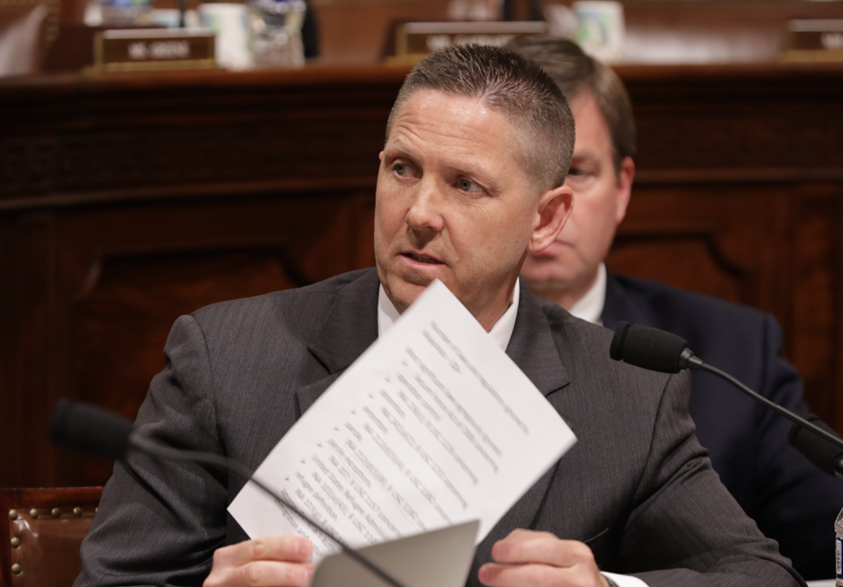
Farm Director, KC Sheperd, had the chance to catch up with Congressman Josh Brecheen and talk about legislative highlights from his past year in office and more.
Despite headwinds, Brecheen said he is proud to be part of a group that can sit down and decide what is best for the country and the state of Oklahoma.
"It has not been easy," Brecheen said. "It has been quite a ride the past year."
Brecheen said that he and others on the budget committee are looking forward to putting together a budget that is solid and will balance within ten years, including sizeable cuts.
"I am on the budget committee, and I am disappointed in the final numbers that we ended up with, but we are now starting the process of looking ahead for next year," Brecheen said.
This week, Brecheen said he is on the committee that plans to move forward with the impeachment of Secretary of Homeland Security Alejandro Mayorkas.
"That has to happen," Brecheen said. "He has violated the rule of law, he is violating congressional law, he is violating constitutional law, and whatever you tolerate, you empower. Mayorkas has been empowered for too long."
Regarding the crisis on the Mexican border, Brecheen said failure to gain control will have detrimental effects on the U.S.
"If you take the total numbers of illegal immigrants, they would have a state that is the seventh largest in population," Brecheen said. "But they are dispersed among all the states. When you have states like Illinois and New York that are giving these people the ability to get drivers licenses and the ability to vote, what a dangerous concept."
Immigrants are not just coming from Mexico, Brecheen said, as there are illegal migrants crossing over from 160 different countries.
"They are going to undermine what we hold in believing that the best allocation of scarce resources is the free market, and they are going to undermine liberty," Brecheen said.
Brecheen said he believes the ultimate goal of the Democratic party is to grant illegal immigrants citizenship state-by-state in order to lock in democratic control in different areas of the nation.
"That is going to fundamentally change this nation," Brecheen said. "I am one of those who contends that not only do we have to seal the border, but we have to deport anywhere from 12 million to 20 million people. I am convinced they have to be deported. If they are allowed to stay here, they are going to undermine what we in this country believe."
Regarding some initiatives in the agriculture realm, Brecheen said he has been working to provide the opportunity to make some changes to the food stamp program. The total farm bill now is close to 85 percent food stamp related, Brecheen said.
"We have 40 million Americans that are on food stamps today," Brecheen said. "If you take all of agriculture- both the value-added side and the production side together, agriculture represents 40 million jobs. For every job that is ag-related, it is a one-to-one ratio of people who are on food stamps."
Brecheen added that the food stamp program has undermined work ethic and the workforce across the country. For those who are recipients of food stamp dollars, Brecheen said he also believes those dollars should be utilized for foods besides soft drinks, and junk food.
"You have got a big lobby out there who benefits from selling this junk food to our kids," Brecheen said.

Today, Agriculture Secretary Tom Vilsack announced two U.S. Department of Agriculture (USDA) investments designed to support the U.S. specialty crops industry. The launch of the Assisting Specialty Crop Exports (ASCE) initiative will provide $65 million for projects that will help the specialty crop sector increase global exports and expand to new markets. Additionally, today USDA is announcing $72.9 million in grant funding available to support the specialty crops industry through the Specialty Crop Block Grant Program. The Specialty Crop Block Grant Program (SCBGP) will fund innovative projects designed to bolster the competitiveness of the expanding specialty crop sector. Specialty crop exports totaled $24.6 billion in FY2023, representing 13.8 percent of total U.S. agricultural exports.
"Specialty crop producers feed our nation and the world with nutritious fruits, nuts, and vegetables and supply our communities with horticulture products. Yet, they have unique challenges and opportunities to compete in the domestic market and a vast array of barriers that prevent their world-class products from entering foreign markets," Secretary Vilsack said. "The Biden-Harris Administration is making these significant investments to maintain, open, and grow markets and reduce and eliminate trade barriers for U.S. specialty crop producers, which in turn will support rural communities, enhance our competitive edge, and help establish lifelong consumers for U.S. food and agricultural products across the world."
Today in Grant, Michigan, USDA Under Secretary for Marketing and Regulatory Programs Jenny Lester Moffitt and Under Secretary for Trade and Foreign Agricultural Affairs Alexis Taylor joined Senator Debbie Stabenow, Chairwoman of the Senate Agriculture, Nutrition, and Forestry Committee, to highlight these two investments and the Specialty Crop Competitiveness Initiative (SCCI), which is part of a larger effort to support specialty crop producers. While there, Under Secretary Moffitt, Under Secretary Taylor, and Senator Stabenow met with producers at a local business as the Biden-Harris Administration continues to improve market access for American products, including specialty crops, at home and abroad.
SCCI's objective is to better focus USDA resources and identify needs to support the competitiveness of U.S. specialty crops in domestic and international markets, minimize costs, manage pests and diseases, strengthen supply chains, and support climate outcomes.
Assisting Specialty Crops Exports
ASCE is funded through a set aside from USDA's new Regional Agricultural Promotion Program (RAPP), a foreign market development and food security initiative announced in October 2023. USDA plans to use $65 million for initial projects that will address barriers unique to specialty crops exports. The initiative, administered by USDA's Foreign Agricultural Service, or FAS, will support projects that advance U.S. specialty crop exports by expanding domestic understanding of foreign food safety systems and foreign understanding of U.S. food safety systems. The initiative will also collect information needed for export certification, and packaging to meet other countries' new requirements.
"Each specialty crop product faces a myriad of import standards in every market it enters, including plant health standards, facility and product certifications, packaging requirements, licensing, inspections, maximum residue limits for pesticides and fungicides, and various import permits," said USDA Under Secretary for Trade and Foreign Agricultural Affairs Alexis Taylor. "In order to meet all these requirements, it takes significant investment by commodity organizations and producers to navigate the gauntlet of regulations. The new resources provided through Assisting Specialty Crop Exports initiative will help introduce U.S. specialty crops to new markets and consumers around the globe."
USDA has identified three workstreams to assist specialty crop exporters: commodity-specific trade and regulatory capacity building; plastics and packaging solutions; and funding of a maximum residue limits (MRL) database. Each workstream addresses a critical issue identified by specialty crop producers and exporters. These efforts will create new market opportunities and ensure existing markets remain open to U.S. specialty crops.
RAPP will help exporters break into new markets and increase market share in growth markets. The United States enjoyed a three-year streak of record agricultural exports from 2021-2023, with exports expected to remain high in FY24. Even at record export levels, the FY23 agricultural trade deficit is $19 billion, and USDA has projected that it will grow in FY24. There is also increased competition in the United States' export markets in Asia and Africa. Therefore, additional investments in market development are needed to sustain and open new markets. RAPP will help exporters to diversify their markets and ensure continuity of the relationships key to market development.
Specialty Crop Block Grant Program
Through the Specialty Crop Block Grant Program, USDA's Agricultural Marketing Service, also known as AMS, will issue noncompetitive grants to state departments of agriculture or equivalent in the 50 States, District of Columbia, the Commonwealth of Puerto Rico, Guam, American Samoa, the U.S. Virgin Islands, and the Commonwealth of the Northern Mariana Islands to fund projects that enhance the competitiveness of specialty crops and support specialty crop growers through marketing, education, and research. Specialty crops include fruits, vegetables, tree nuts, dried fruits, horticulture, and nursery crops, including floriculture.
"The innovative projects funded through this year's USDA Specialty Crop Block Grant Program will help U.S. specialty crops producers remain competitive, open new market channels, and increase the consumption of specialty crops products," said USDA Marketing and Regulatory Programs Under Secretary Jenny Lester Moffitt. "The grant program also furthers the goals of USDA's Specialty Crops Competitiveness Initiative – ensuring that specialty crops producers and businesses have the resources they need to remain competitive in markets across the world while improving the sustainability and profitability of their operations. Programs like these are key components of the Biden-Harris Administration's efforts to support American agricultural producers and rural America by transforming our food system from one that benefits a few to one that benefits many."
AMS encourages applications that serve smaller farms and ranches, new and beginning farmers and ranchers, underserved producers, veteran producers, and/or underserved communities. Interested applicants should apply directly through their state departments of agriculture. A list of state contacts is available on the SCBGP website.
Applications from states and territories must be submitted electronically through www.grants.gov by 11:59 p.m. ET on May 2, 2024. Any grant application submitted after the due date will not be considered unless the applicant provides documentation of an extenuating circumstance that prevented their timely submission of the grant application. More information is available in the AMS Late and Non-Responsive Application Policy.
For more information about grant eligibility, visit the SCBGP website or contact the SCBGP Team at scblockgrants@usda.gov.
USDA touches the lives of all Americans each day in so many positive ways. Under the Biden-Harris Administration, USDA is transforming America's food system with a greater focus on more resilient local and regional food production, fairer markets for all producers, ensuring access to safe, healthy and nutritious food in all communities, building new markets and streams of income for farmers and producers using climate-smart food and forestry practices, making historic investments in infrastructure and clean energy capabilities in rural America, and committing to equity across the Department by removing systemic barriers and building a workforce more representative of America. To learn more, visit www.usda.gov.
Dr. Derrell Peel, Oklahoma State University Extension Livestock Marketing Specialist, offers his economic analysis of the beef cattle industry as part of the weekly series known as the "Cow Calf Corner," published electronically by Dr. Peel and Mark Johnson. Today, Dr. Peel talks about managing forage costs in 2024.
Cattle prices are expected to average higher in 2024 compared to 2023, which means that cow-calf producers are expecting increased returns and profitability. However, profit maximization implies careful cost management regardless of the revenue potential. The biggest cost component of cow-calf production is feed costs and specifically, harvested, and supplemental feeds. January may seem early to start planning grazing for the coming growing season but the ability to minimize non-grazing feed costs will depend on comprehensive grazing plans and management for the entire year.
The economic basis for cow-calf production is growing grass and using cows to harvest the grass. Feed costs are typically the largest component of annual cow costs in cow-calf operations. Total feed cost includes grazing cost, harvested forage and purchased supplemental feed. Producers can minimize annual feed costs by managing for maximum grazing; with minimal use of hay and supplemental feed to seasonally overcome lack of forage quantity and/or quality.
Planning grazing management now for the growing season and beyond can significantly influence hay needs next winter. Summer grazing management will set up the potential for stockpiling forage for fall and winter grazing. For introduced forages, strategic fertilization can be used to increase forage quantity and quality beyond the growing season. Grazing of native range can be deferred to save forage for later use. Of course, grazing management must be planned and implemented according to the wide range of forage types as well as climate and soil conditions where cattle production occurs. In all cases, proper stocking rates are critical to achieve grazing management objectives. It is important to assess forage condition and production potential in order to develop realistic grazing management plans. The assessment should be completed now, i.e. prior to or at the beginning of the growing season.
Considering the distinction between pasture and non-pasture costs is particularly useful because it focuses on the forage, which is the primary production of cow-calf and stocker operations, and the management of that grazing resource compared to the use of harvested forages and supplemental feed to augment the quantity and quality of grazed forages. Often tradeoffs are possible in the efficient use of grazed forage compared to the use of more expensive harvested forages and purchased supplemental feeds. Forage fed as harvested hay costs 2.5 to 5 times more than grazed forage. Of course, all of this takes place against the backdrop of herd nutritional management as an important component of herd health, reproductive efficiency and overall productivity. Both feed quantity and quality are critically important in herd nutritional management.
Hay use for beef cow-calf production is predominantly round bales. Round bale technology is convenient and saves labor. Unfortunately, the convenience of round bales has also frequently encouraged production of low-quality hay and poor storage and feeding management. Often hay production is a residual to poor pasture management where mature, rank grass that was not grazed effectively is baled, resulting in expensive, poor-quality feed. Good pasture management and good hay management are two sides of the same coin. The labor saving and convenience of round bales has, in many cases, fostered poor pasture management that results in increased hay needs and production of low-quality hay.
Perhaps rounds bales are too convenient. In days of old, producers feeding small square bales were typically more aware of the quality of the hay, how much they were feeding, how much was being wasted and, as a result, often did a better job of managing cow herd nutrition and feed cost. It takes some additional management to capture the advantages of round bales without wasting hay and incurring additional cost. For example, in Oklahoma, hay production per beef cow has more than doubled in the past 40 years. It appears that now significantly more hay is wasted and that poor pasture management has increased the number of days that cows are fed hay. Round bales very probably have contributed to this trend. Better grazing management and efficient, minimal hay use can reduce costs and add $150-$250/head or more to per cow profitability in 2024. Now is the time to start planning forage management.
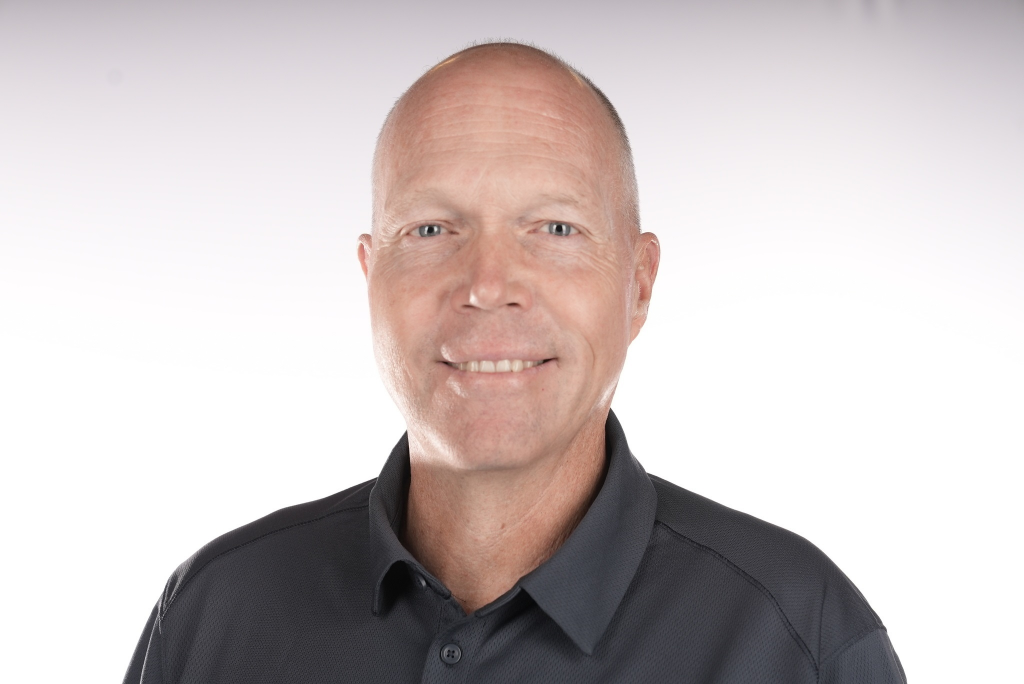
LG Seeds agronomist Mark Grundmayer encourages farmers to plan for a successful crop season, even in the face of adverse weather conditions.
LG Seeds successfully completed a series of experimental corn test plots in a wide geographical area of the Western Corn Belt, expanding the company's knowledge base and enhancing its product portfolio.
LG Seeds agronomist Mark Grundmayer refers to these plots as "west tests" and says the information gathered helps him make more precise recommendations for farmers.
"Our west tests are experimental plots that we use to select our commercial products for the next year," he says. "Anytime we can add more knowledge or increase our comfort level on a particular product is good for us, our dealers and our customers."
The west tests included comprehensive evaluation of hybrid performance across diverse environments — dry versus irrigated, high versus moderate yielding, heavier versus lighter soils, etc. Grundmayer says the adaptability of some hybrids to certain conditions surprised him.
Hybrid performance
"A few hybrids thrived in certain environments that we didn't anticipate — like LG62C07 on dry land and LG62C22 on irrigated land. A great example is LG58C48, which performed well on irrigated ground with good drainage," Grundmayer explains. "LG63C82 did extremely well in a high-yield and irrigated environment, and on the early side, LG57C33 performed well, as expected."
To plan for a successful 2024 growing season, Grundmayer encourages farmers to review how their crops did in 2023 and address concerns when selecting products. Whether heat, moisture, wind or hail, he points out there will likely be a stressor.
"Spread the risk out, both from a maturity and genetic standpoint, to ensure there's a crop to harvest at the end of the season," he says. "If you think there will be a lot of stress in July, come in with some early maturity hybrids. Or flip it the other way and push the maturity window a little bit further than usual to help capture breaks in heat or late-season rains."
Grundmayer advises farmers to select at least four or five different hybrids for their acres. "Incorporating the right mix of genetic diversity and hybrids helps farmers manage and mitigate challenges, such as irrigation issues, scheduling problems or potential water restrictions," he adds.
Continuous crop scouting, especially in irrigated areas where moisture conditions may contribute to disease development, is a must, says Grundmayer. This helps farmers make timely decisions around weed control, fungicide use and other inputs as the season progresses.
What did you learn in 2023?
Grundmayer encourages farmers to take this time to reflect on how crops did in 2023 and address issues they encountered. "This is a great time to review your crop scouting notes, analyze harvest data and take a second look at the products you have planned for 2024," he says.
Even though Nebraska saw below-normal moisture in 2023, Grundmayer says tar spot was detected. "We have hybrids that tolerate tar spot very well and can put those in fields that have had some tar spot pressure in the past."
He wants farmers to plan for success in the face of adversity. "Despite drought conditions, we harvested a crop in 2023 that was a little bit better than anticipated, and we had a relatively open fall with quite a bit of tillage and a lot of fertilizer spread, so we have a leg up on getting some things done in the spring," he says.
Work closely with an agronomist
Grundmayer encourages farmers to work with their agronomist to explore the new LG Seeds offerings for optimizing yield potential.
"We have more knowledge about where products perform well and a wider range of hybrids, from early to late, that perform well across the board," he says. "We've added some products to increase our mix of high-performing hybrids that I'm excited about."
As LG Seeds continues its commitment to innovation and performance, the insights gained from the west tests play a crucial role in shaping product recommendations and supporting farmers in the Western Corn Belt. Learn more at LGSeeds.com.
Small-town businesses in rural areas will benefit from OSU Extension's efforts to improve local retail and e-commerce capabilities. (Photo by Mitchell Alcala, OSU Agriculture)
Oklahoma State University economic development specialists have received a grant from the Small Business Administration to help rural retailers adapt to a digital shift in consumer behavior.
June Park, associate professor of design and merchandising in the College of Education and Human Sciences, and Andrew Van Leuven, assistant professor in the OSU Department of Agricultural Economics in the Ferguson College of Agriculture, teamed up in 2021 to write a grant proposal that reflected the pandemic's impact on rural commerce. Funding for the grant was earmarked by Rep. Frank Lucas of Oklahoma in a U.S. House appropriations bill and awarded to OSU in 2023.
Even before the initial lockdown of 2020, many consumers had transitioned to online shopping. While the digital experience is here to stay, Park said most rural retailers are still based on a traditional, brick-and-mortar retail model.
"Without technical assistance and training to help them redevelop business strategies, rural retailers will not recover from the economic impact of the pandemic," she said.
This grant will establish a two-year program, branded the Oklahoma Rural E-Commerce Academy, to support rural business owners with technical assistance, training and digital retail workshops. Van Leuven said the first step involves analyzing the strengths, weaknesses, opportunities and threats present in today's digital environment to then recognize and emphasize retailers' custom identities and values.
"Through digital-focused retail assistance, we'll help rural retailers create a new e-commerce web presence, search engine optimization and social media marketing," he said.
Another project component will deploy research tools to gauge rural retailers' perceptions of contemporary retailing and marketing strategies and evaluate their effectiveness in small-town business districts.
Park said the Oklahoma Rural E-Commerce Academy will help retailers increase vitality and reconnect with both local residents and visitors.
"Small-town rural retailers not only create jobs and encourage entrepreneurship but also provide a space that defines the cultural identity of a town," she said.
As the community and rural development specialist for OSU Extension, Van Leuven manages programming that implements educational and technical assistance to aid rural economies and address the practical, everyday problems of Oklahoma's small business owners.
After identifying the needs of rural retailers, Van Leuven and Park will deploy OSU undergraduate students skilled in e-commerce web development and marketing to assist in digital modernization.
"This program is a small business development tool that should yield immediate benefits for rural retailers, enabling them to compete in regional and global markets," Van Leuven said. "The accompanying research will provide feedback to continually improve and refine the training and workshops as well as practical, evidence-based knowledge for policymakers and community leaders in Oklahoma and other states."
The multi-disciplinary team will hire a post-doctoral researcher to assist in training development and outreach activities. The Oklahoma Rural E-Commerce Academy's primary area of focus includes five counties: Garfield, Grant, Kay, Noble and Payne.
See an in-depth look at how Park and Van Leuven plan to leverage digital marketing for small businesses in the new OSU Extension fact sheet Digital Retailing and Marketing: Tools for Rural Small Businesses Navigating the Digital Age.
To learn about participating in the Oklahoma Rural E-Commerce Academy, contact Van Leuven at andrew.vanleuven@okstate.edu or Park at june.park@okstate.edu.
By Gail Ellis
OSU Extension uses research-based information to help all Oklahomans solve local issues and concerns, promote leadership and manage resources wisely throughout the state's 77 counties. Most information is available at little to no cost.

Safely serving friends and family during the big game is a win for everyone; don't fumble it this Super Bowl Sunday. February 11 kicks off Super Bowl LVIII, and football fans will be huddling up to watch the big game while enjoying their favorite foods. Whether you're ordering delivery, or preparing and serving food to guests, the U.S. Department of Agriculture's (USDA) Food Safety and Inspection Service (FSIS) has some gameday plans to keep your Super Bowl from being intercepted by foodborne illness.
"Super Bowl parties are a fun time for people to unwind and enjoy the big game, but food safety must remain a top priority," said USDA Under Secretary for Food Safety Dr. Emilio Esteban. "Simple steps like not leaving food out at room temperature for more than two hours or keeping hot foods hot and cold foods cold can help keep your friends and family safe."
Follow these USDA tips to avoid getting caught offside with food safety this Super Bowl Sunday.
Deliveries and Takeout Foods
If you're ordering takeout earlier in the day before the big game, make sure someone is there to get the food in a timely manner. Place any food that is not being eaten immediately in the refrigerator. When storing leftovers, divide them into smaller portions and place them into small, shallow containers. Perishable foods that have been sitting out at room temperature must be eaten within two hours after being cooked.
Stay in the In Zone, not the Danger Zone
If you're serving food to groups, follow the two-hour rule. When perishable foods sit in the Danger Zone (temperatures between 40 F and 140 F) for more than two hours, bacteria can multiply rapidly. Meat and poultry must be refrigerated or frozen within two hours of sitting out on a counter in the Danger Zone. If you want to enjoy the big game and serve food longer than two hours, keep hot foods hot and cold foods cold. Hot foods must be kept at 140 F or above by using warming trays, chafing dishes, or a slow cooker. Cold foods must be kept at 40 F or below. To keep them cold, serve them in smaller portions and refill them, or place the food in containers and nestle them in ice.
Don't Let Leftovers Sit on the Sidelines
Your Super Bowl leftovers will be safe for three to four days in the refrigerator. Reheat leftovers to the safe internal temperature of 165 F as measured with a food thermometer. Reheat liquid foods like soups and sauces to a boil. Tasting food to determine its safety is dangerous. When in doubt, throw it out!
Always Remember the Four Steps to Food Safety
If you have food safety questions, call the USDA Meat and Poultry Hotline at 1-888-MPHotline (1-888-674-6854), email MPHotline@usda.gov or chat live at www.ask.usda.gov 10 a.m. to 6 p.m. Eastern Time, Monday through Friday.
Access news releases and other information at USDA's Food Safety and Inspection Service's (FSIS) website at www.fsis.usda.gov/newsroom. Follow FSIS on X at @usdafoodsafety or in Spanish at X @usdafoodsafety_es.
USDA touches the lives of all Americans each day in so many positive ways. In the Biden-Harris Administration, USDA is transforming America's food system with a greater focus on more resilient local and regional food production, fairer markets for all producers, ensuring access to safe, healthy and nutritious food in all communities, building new markets and streams of income for farmers and producers using climate smart food and forestry practices, making historic investments in infrastructure and clean energy capabilities in rural America, and committing to equity across the Department by removing systemic barriers and building a workforce more representative of America. To learn more, visit www.usda.gov.

When something takes place that hasn't happened in more than two decades, it merits attention. And when it involves the impact of interest rates on farmland, it attracts even more eyeballs.
For months American Farmland Owner has sought out economic and policy experts on the future of interest rates. Have rates risen as high as they are going to climb? When will the Fed lower them? By how much? How many times could they lower them in 2024? And what effect could those have?

It's like predicting the weather: meteorologists rely on numerous forecasting models and years of experience. Sometimes they get it 100%. Tomorrow's expected 70 degrees with sunshine becomes exactly that. Other times, a dusting turns into a blizzard or temperatures drop a bit more than expected, and wet roads instead become skating rinks.
Ty Kreitman isn't a meteorologist, but he is trying to predict the future. Kreitman is associate economist in the Regional Affairs Department at the Omaha branch of the Federal Reserve Bank of Kansas City.
And his research has spotted a potentially troubling trend that he incorporated into a visual warning.
For 20 years – 2002 to 2022 -- agricultural real estate values enjoyed consistent appreciation. That growth surpassed the cost of financing. That is a big reason why farmland remained so appealing for farm expansion or investors looking to diversify their assets.
But interest rates that had doubled borrowing costs since the economic hit triggered by COVID-19's impacts slowly took their toll. Kreitman found that in 2023, that two-decade run of growth outpacing higher borrowing costs halted. Interest costs on new farmland loans rose higher than land value's average yearly appreciation. Not a shocking development given how much the Fed elevated interest rates. But it is significant enough that it could make a difference for the year ahead.

"With interest costs now above average land value appreciation, farm operating profits will determine the magnitude of returns for financed land," Kreitman wrote.
NOTE: Farm profits slid in 2023 compared to the record earnings in 2022. And there are concerns about 2024's profits. Listen to a USDA audio report on that here.
Kreitman continued, "Although growth in farmland values held firm in 2023, higher interest rates and a moderation in agricultural commodity prices have cut potential returns and could dampen demand for farmland—and thus farmland values—going forward."
Article courtesy of American Farmland Owner
National Farmers Union (NFU) urges the U.S. Federal Trade Commission (FTC) to write regulations that ensure farmers and ranchers can repair their own equipment. Major farm equipment manufacturers refuse to provide farmers with full access to repair tools and information, leaving them no choice but to take their broken equipment to the manufacturer's dealer. This has led to inflated repair costs and service delays for farmers.
Right to Repair is a pillar of NFU's Fairness for Farmers campaign to address the monopoly crisis in agriculture. Just three manufacturers control the majority of farm equipment production, sales, and repairs, and use software locks to prevent farmers and independent mechanics from completing certain repairs.
Sign this petition and then submit your own comments to the Federal Register to show FTC farmers and ranchers support Right to Repair!
To: U.S. Federal Trade Commission
From: [Your Name]
NFU believes farmers and ranchers deserve the right to access, on fair and reasonable terms, the tools and information required to make timely farm equipment repairs.
Modern farm equipment requires special software tools to make certain repairs. Major equipment manufacturers refuse to make these tools available to farmers and independent mechanics, leaving farmers no choice but to take broken equipment to the manufacturer's dealer. These restrictions lead to inflated repair costs and service delays during tight planting and harvest windows that can cost farmers their crop.
The FTC should write and implement rules that ensure farmers, ranchers, and independent mechanics have access to the tools and information needed to repair farm equipment.
Farmers, ranchers, and our communities need the Right to Repair!
Beginning farmer education for adult and young audiences in the United States can generally be traced back to the advent of the 1862 and 1890 Morrill Land-Grant Acts. But, for the first time, the Food, Conservation, and Energy Act of 2008 (Pub .L. No. 110-234, Section 7410) appropriated $75 million for FY 2009 to FY 2012 to develop and offer education, training, outreach and mentoring programs to enhance the sustainability of the next generation of farmers.
The Agriculture Act of 2014 provided an additional $20 million per year for 2014 through 2018. The reasons for the renewed interest in beginning farmer and rancher programs are as follows: the rising average age of U.S. farmers; the 8% projected decrease in the number of farmers and ranchers between 2008 and 2018; and the growing recognition that new programs are needed to address the needs of the next generation of beginning farmers and ranchers.
The Agriculture Improvement Act of 2018 (aka the 2018 Farm Bill) reauthorized the Beginning Farmer and Rancher Development Program and provides mandatory funds for which supports education, mentoring, and technical assistance initiatives for beginning farmers and ranchers.
The technical assistance webinar related to this FY 2024 funding opportunity will be scheduled soon. Please visit again for more information.
Last year, the Kansas Pork Association (KPA) used funding from NPB's grant program to promote fresh pork purchases through the digital shopping app Ibotta®. Ibotta is a free mobile app that gives users cash back on purchased items. Large, well-known grocery stores like Walmart, Kroger, Publix and Food Lion use Ibotta to engage shoppers. KPA capitalized on past successful campaigns with Ibotta to promote ribs, sausage and ground pork in 2023.
Ribs
Ground Pork
Sausage
The 3 Ibotta campaigns successfully influenced customers nationwide, driving an estimated $6 million in pork product purchases
The National Institute of Food and Agriculture's Agricultural Genome to Phenome Initiative (AG2PI) focuses on collaborative science engagement that intends to develop a community of researchers across both crops and animals that will lay the foundation for expanding knowledge concerning genomes and phenomes of importance to the agriculture sector of the United States. Success of the initiative will inform approaches to understanding how variable weather, environments, and production systems interact with genetic diversity present in crops and animals to impact growth and productivity. This will provide greater accuracy in predicting crop and animal performance under variable conditions and more efficient selection of well-adapted, superior genotypes that farmers and ranchers can produce.
These goals require interdisciplinary approaches that combine technologies such as advanced computing, automated high throughput phenotyping and genotyping as well as climatic modelling to be successful. The initiative seeks to build on efforts such as the Plant Genome Research Project, the National Animal Genome Research Program, and other public initiatives. Key criteria include promoting fair access to data, software, germplasm, and other biological materials through open data sources, standards, and exchange of research materials. The initiative also seeks to connect animal sciences (e.g. animal physiology, meat science, animal nutrition, and veterinary science), plant sciences (e.g. agronomy, crop modeling, and plant physiology) and allied fields including genetics, genomics, artificial intelligence, informatics, statistics and engineering.
The technical assistance webinar related to this FY 2024 funding opportunity will be scheduled soon. Please visit again for more information.
Dates may vary. Please see RFA for exact details.
After making a brief weekend trip to $3.07, the national average for gas edged higher by one penny since last week to $3.10. The meandering journey is likely caused by low gas demand countered by slightly higher costs for oil. The result is a pump price stalemate. Today's national average of $3.10 is two cents less than a month ago and 40 cents less than a year ago.
In Oklahoma, the gas average is $2.66 today, up six cents in the last week and 53 cents lower than one year ago.
According to new data from the Energy Information Administration (EIA), gas demand dipped from 8.27 to 7.89 million b/d last week. Meanwhile, total domestic gasoline stocks increased by 4.9 million bbl to 253 million bbl. Due to fluctuating oil prices, lower gas demand, and rising stocks, pump price increases have been limited. If oil prices continue to see upward pressure, drivers could see pump prices increase steadily in the weeks ahead.
CURRENT AND PAST GAS PRICE AVERAGES
Regular Unleaded Gasoline (*indicates record high)
| 1/26/24 | Week Ago | Year Ago | |
| National | $3.10 | $3.08 | $3.50 |
| Oklahoma | $2.66 | $2.60 | $3.19 |
| Oklahoma City | $2.72 | $2.63 | $3.18 |
| Tulsa | $2.62 | $2.49 | $3.18 |
| Lawton | $2.59 | $2.40 | $3.05 |
| Le Flore-Sequoyah | $2.60 | $2.59 | $3.15 |
| Crude Oil | $78.13 per barrel (1/26/24) | $73.41 per barrel (1/19/23) | $79.68 per barrel (1/27/23) |
At the close of Wednesday's formal trading session, WTI increased by $4.72 to settle at $78.13. Oil prices rose yesterday after the EIA reported that total domestic commercial crude stocks decreased significantly by 9.2 million bbl to 420.7 million bbl. The drop in total stocks signals that tight supply could increase prices if demand grows.
The Weekend
"Like watching dogs play chess, not much is happening," said Rylie Fletcher, AAA Oklahoma spokesperson. "The national average for gas will likely maintain a glacial grind higher for the immediate future."
AAA has a variety of resources to help motorists save on fuel:
Next Weekend Gas Watch: Friday, February 2, 2024
For his service to the industry, recent OSU PhD graduate Jared Harshman was awarded Oklahoma Pork's 2023 Ambassador Award at the Oklahoma Pork Congress in Oklahoma City.
In 2006, the Oklahoma Pork Council Board of Directors created the Ambassador Award to recognize individuals who don't directly raise pigs but have made a significant impact on our state's pork industry as a champion and promoter of what our farmers do.
Having just completed his doctorate in July 2023, Dr. Jared Harshman recently finished his nine-year Oklahoma academic career as an expert in swine nutrition. During the past decade, Jared has made significant research contributions while serving as a passionate advocate for modern pig farming. Because of his hard work and meaningful industry engagement, Jared was selected for the 2023 Oklahoma Pork Council Ambassador Award.
Originally from Mount Airy, Maryland, Jared first came to Oklahoma in 2014 to judge livestock and study Animal Science at Redlands Community College. From there, he transferred to Oklahoma State University where he worked at the university swine farm while earning a bachelor's degree, master's degree and doctorate with a focus on swine nutrition. While his research as a graduate student covered a wide array of topics, his master's research focused on feed additives in nursery and wean-to-finish pigs, while his PhD dissertation was focused on sow prolapse. Jared worked closely with longtime Oklahoma Pork ex-officio board member and OSU swine nutritionist Dr. Scott Carter. Jared has also found time during his studies to assist with Oklahoma Pork's collegiate leadership program and work with our staff on key projects that serve the broader pork industry.
With his PhD complete, Jared plans to begin his full-time career as a swine nutritionist. When he is not conducting research, he enjoys spending time outside with his girlfriend and friends either hunting or fishing. Thank you to Dr. Jared Harshman for being a true champion of our state's pork industry!
Interested in learning more about Jared's sow prolapse research? Click here to check out Part One of his interview on The Swine Nutrition Blackbelt podcast earlier this year.
Congressman Tom Cole (OK-04) released the following statement in response to President Joe Biden's decision today to pause new or pending export terminal applications to export liquified natural gas (LNG) to non-Free Trade Agreement (FTA) countries.
"The Biden Administration's utterly outrageous decision today is just one more of many short-sighted calls that will be detrimental to our country and our European allies at a time when we need to be maximizing the production of our plentiful American energy," said Cole. "Many nations depend on our energy production, and this is putting their security at risk as tensions from adversaries are on the rise. Moreover, this is deeply unfair to our own energy industry and the American consumer. The Biden Administration is yet again succumbing to environmental groups and the far-left faction of the Democratic Party by working against our own American companies and workforce."
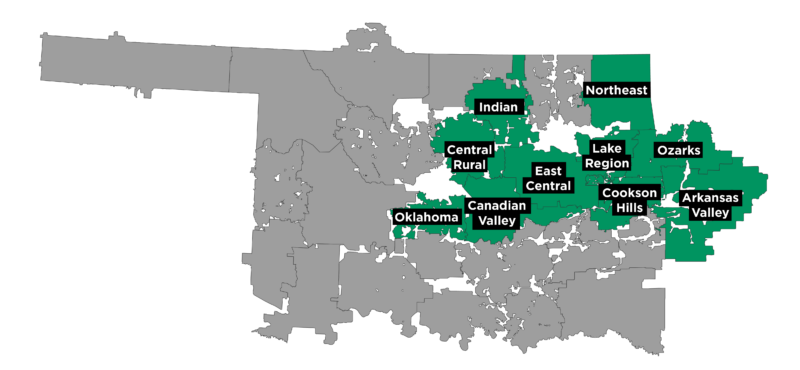
Participating Oklahoma cooperatives offering fiber in their service territories
Rural consumers in the service areas of five electric cooperatives with fiber subsidiaries will be empowered with reliable, high-speed broadband following a historic announcement from the Oklahoma Broadband Office (OBO).
The Oklahoma Broadband Governing Board authorized 142 broadband infrastructure expansion projects in 57 counties. Project funding is designated from Oklahoma Legislature-approved American Rescue Plan Act (ARPA) State and Local Fiscal Recovery Funds.
"Access to reliable and affordable broadband will enable better educational and healthcare services, stimulate economic development, and empower Oklahomans to leverage the online technologies of the future, regardless of zip code," Mike Sanders, OBO executive director, said.
Approved projects for electric cooperatives will be carried out in 18 counties and total more than $76 million in awarded grants. The boost in funding will enable electric cooperatives with fiber subsidiaries to continue empowerment of the unserved and underserved with high-speed internet.
Selected co-ops to receive grants are: Canadian Valley Electric Cooperative based in Seminole; Central Rural Electric Cooperative's Centranet, based in Stillwater; East Central Electric Cooperative's ecoLINK based in Okmulgee; Indian Electric Cooperative and Northeast Oklahoma Electric Cooperative's Northeast Rural Services, Inc. based in Vinita, Oklahoma.
"The cooperative business model is uniquely suited to provide this essential service," says Hunter Robinson, chair of the Cooperative Broadband Coalition and CEO of Central Rural Electric Cooperative and its fiber subsidiary, Centranet. "We stand on a legacy of bringing service to those who never had it, much like we did 80 years ago, bringing electricity to rural areas that were in the dark."
To date, 10 electric cooperatives with fiber subsidiaries have connected more than 113,000 households, empowering 285,000 Oklahomans with reliable broadband. Co-op subsidiaries are bringing reliable, high-speed internet not only to residences across Oklahoma but to county offices, city offices, small businesses, farming operations, health organizations, public schools and educational institutions.
"Providing rural broadband is an extension of the cooperatives' mission to work toward quality-of-life improvements in rural areas of the state," says Chris Meyers, General Manager of the Oklahoma Association of Electric Cooperatives. "Rural communities deserve the same opportunity as their urban neighbors. We thank the Oklahoma Legislature, the Broadband Governing Board and the Oklahoma Broadband Office for the opportunity to continue investing in broadband projects that change lives for the better."
About the Cooperative Broadband Coalition (CBC): CBC is a consortium of electric cooperatives with fiber subsidiaries. The CBC is an affiliated organization of the Oklahoma Association of electric cooperatives. Collectively, CBC member co-ops have connected more than 113,000 households, bringing reliable broadband to 285,000 Oklahomans.Learn more at https://cooperativebroadband.coop
About OAEC: The Oklahoma Association of Electric Cooperatives (OAEC) is a statewide association created and voluntarily supported by local electric distribution and generation & transmission cooperatives. OAEC is comprised of 30 member systems: 27 distribution electric cooperatives (two of which are headquartered in Arkansas) and 3 generation & transmission electric cooperatives (one of which is headquartered in Texas). Learn more at oaec.coop
Tom Fanning
The Board of Directors of the Pratt Feeders Group is excited to announce significant leadership changes within our organization. Following the retirement of Dave Latta, Tom Fanning, the long-time manager at Buffalo Feeders, will be stepping up as the new General Manager of the Pratt Feeders Group effective at the end of May 2024.
Dave Latta has led our company through significant challenges and our success and growth reflect his steady hand guiding the Pratt Feeders Group, which includes Pratt Feeders in Pratt, KS, Ashland Feeders in Ashland, KS, Ford Feeders in Ford, KS, and Buffalo Feeders in Buffalo, OK.
Under the leadership of Manager Tom Fanning, Buffalo Feeders has established a distinguished legacy of excellence and industry recognition. In 2009, Buffalo Feeders was honored with the prestigious Certified Angus Beef Feedyard of the Year award, a testament to the outstanding quality of beef produced under its management. A decade later, in 2019, the feedyard's commitment to superior practices and animal welfare was further acknowledged when it received the National Beef Quality Assurance (BQA) Feedyard of the Year award. This accolade underscores the feedyard's dedication to maintaining the highest standards in beef quality and safety. Continuing this trajectory of excellence, Buffalo Feeders achieved notable recognition in 2023, winning the Texas Cattle Feeders Excellence in BQA award, further solidifying its reputation in the industry. Additionally, in the same year, the feedyard achieved a significant milestone by joining the Progressive Beef certification, demonstrating its ongoing commitment to sustainable and responsible cattle feeding practices. These accolades, achieved under Tom Fanning's guidance, reflect Buffalo Feeders' enduring dedication to quality, animal welfare, and industry-leading standards.
In tandem with this leadership change, we are also thrilled to announce that Raul Lizardo, currently serving as the Cattle and Feedyard Operations Manager and a native of Buffalo, OK, will assume the duties as the Feedyard Manager at Buffalo Feeders this spring. Raul's deep understanding of cattle operations and his connection to the Buffalo community make him exceptionally well-suited for this role. His appointment is a testament to our commitment to nurturing talent within our organization and ensuring our operations continue to be led by the best in the industry.
Please join us in expressing our gratitude to Dave for his years of dedicated service, in congratulating Tom Fanning on his new position as General Manager, and in welcoming Raul Lizardo as the new Feedyard Manager at Buffalo Feeders. We are excited about the future of Pratt Feeders Group under their capable and dynamic leadership.
Thank you for your ongoing support and commitment to our group's success.
-Pratt Feeders Group
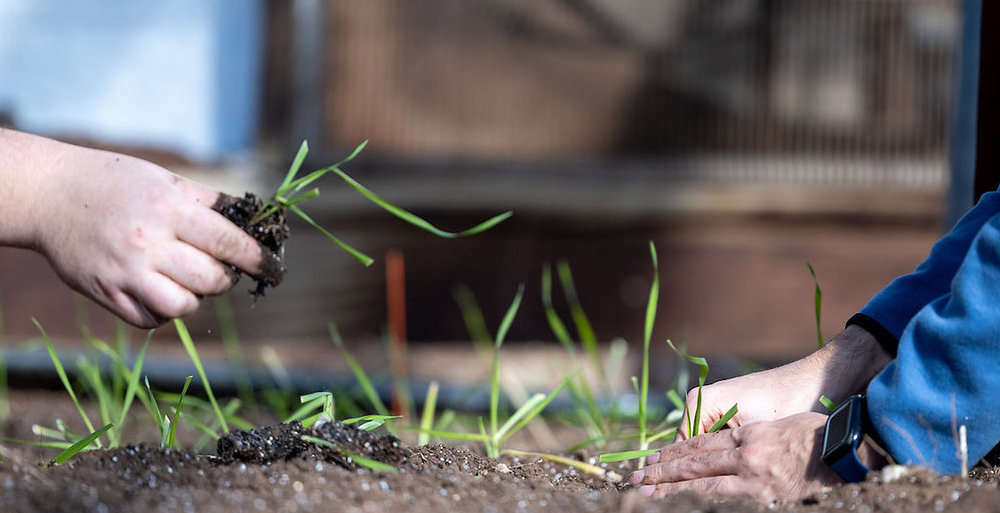
The Oklahoma State University/A&M Board of Regents has approved a request to draft construction plans for new facilities at the OSU Agronomy Research Station in Stillwater, home to the university's renowned wheat improvement program.
The project's first phase will involve selecting architectural and construction management firms to assist with the design and construction of new greenhouses and a headhouse at the site. The cost for this initial phase is expected to be $10 million.
The current OSU agronomy farm, located on the west side of campus along Highway 51, is a historic facility that houses one of the top wheat breeding programs in the world. OSU has commercialized 34 wheat varieties since 2000 and has the largest footprint for variety development in the Great Plains region.
"When we talk about our efforts at OSU to feed and nourish the world, it starts at the agronomy farm and is led by the wheat improvement team," said Jayson Lusk, vice president and dean of OSU Agriculture. "Economically, wheat is the most important crop in Oklahoma, and the state's harvest feeds people all over the United States and the world."
The OSU Agronomy Research Station supports all three of OSU Agriculture's mission areas: research, Extension and teaching. It includes 28 buildings, totaling 134,826 square feet, that are used for classroom instruction, greenhouse trials, research and support services. A master plan study performed in 2018 to identify potential improvements and expansion of the research station yielded several stand-alone projects or phases to be activated based on funding availability and need. Many of its structures were built 60 years ago and have been deemed in need of at least minor repairs. Several others require major repairs or have been classified in a state of "end of life."
These aging structures threaten to compromise the advancement of OSU's wheat breeding trials.
During a deep freeze in February 2021, pipes froze in the program's main greenhouse, a building constructed in the 1960s. The facility's heating system failed, and the OSU wheat breeding team lost 70% of its potential new plant lines for the year. After surveying the damage, Brett Carver, regents professor and OSU wheat genetics chair in agriculture, determined the plant loss would delay important wheat variety development for several years, and some of the losses were never recovered.
The weather's effect on deteriorating greenhouse conditions highlighted OSU's need to update or replace dilapidated research facilities within its division of agriculture; one teaching lab still used today was built in 1957. Other structures in operation on the premises date back to the 1930s.
"If we had new facilities, we could stretch out our season to nine months out of the year and respond more quickly to wheat breeding developments that are happening elsewhere in the world," Carver said.
A 2020 study released by the Association of Public and Land-Grant Universities reported $11.5 billion in repairs and renovations are needed at schools authorized to receive U.S. Department of Agriculture research funding. The data indicates that 69% of the buildings at 97 land-grant universities are more than 25 years old and require urgent upgrades to remain safe and effective, including experimental farms, greenhouses and support facilities. A continued lack of funding to address university research infrastructure will negatively affect agriculture, food and related industries that annually contribute $1.1 trillion to America's economy.
Lusk said these initial steps for the OSU agronomy farm are promising.
"We look forward to seeing improvements in motion at the Agronomy Research Station and how those upgrades will translate to our land-grant mission areas, and ultimately, the agricultural industry," he said.
By Gail Ellis
OSU Agriculture is dedicated to improving the quality of life of Oklahomans through science-based information and education. It is comprised of the Ferguson College of Agriculture and two state agencies: OSU Ag Research and OSU Extension.

Representative Forrest Bennett, D-OKC, says it is unfair to ask Oklahoma teachers to repay their errant bonuses after being granted the bonus by the Oklahoma State Department of Education.
The bonus program was created by the OSDE to incentivize teachers to return to the classroom and reward longtime educators. The bonus program came with a list of qualifications for the OSDE to confirm via an application before granting the bonuses that went up to $50,000.
"I know it's hard to stay on top of every little thing happening at the department, especially when you spend so little of your time in your office, but to pin the blame on teachers, some of whom were encouraged by school supervisors who believed these teachers were eligible for the program, is beyond unfair," Bennett said.
At least nine Oklahoma teachers received letters from the OSDE stating they need to repay their bonuses by the end of February.
"This follows a pattern of poor fiscal management by the State Superintendent," Bennett said in reference to the GEER fund scandal. "It is clear to me that the mistakes made here came from the OSDE, and the OSDE should eat the cost," Bennett said. "I figure it will taste a lot like humble pie."
Mark your calendars for the 2024 Denim Ball planned for April 5th and 6th at the Skirvin Hilton Hotel in Oklahoma City. If you wear cotton, you are invited! Farm Director KC Sheperd recently had the chance to visit with Oklahoma Cotton Council Member Services Representative, Charity Martin, and talk about this year's event.
"This event is Oklahoma's fundraiser for the Committee for the Advancement of Cotton," Martin said. "That is the National Cotton Council's PAC fund that they use to support the cotton industry on a variety of levels."
Each state is responsible for raising a certain amount of money to go towards the national fund, Martin said, so the Denim Ball allows Oklahomans to come together to raise money and support the cotton industry.
"Friday night is a kick-off, and we have a welcome reception that is Casino Night," Martin said. "Last year was the first year that we had Casino Night, and it was a blast. I think I'd be in trouble if we didn't do it again this year."
On Saturday morning, Martin said a golf tournament will be at the Trosper Park Golf Course. Admission is $250 per team, and awards will be given to the first, second, and third place, along with awards for the longest drive and closest pin.
"Saturday night, April 6th, is the official 2024 Denim Ball," Martin said. "We will have a live auction, a silent auction, and another really cool thing that this committee started was the Oklahoma Cotton Hall of Fame. We will induct two new members into that this year."
Margin said the Demin Ball is aimed to be a fun weekend for attendees with no meetings or business!
"We want to give you a break," Margin said. "Come relaxed and celebrate with those like-minded producers."
For those looking to give back to cotton producers through a Demin Ball sponsorship, Martin said there are three different sponsorship levels that can be FOUND HERE.
Registration is open now, Martin said, and more information can be accessed HERE.
"Even though this is an Oklahoma event, if you are coming from another state and you donate money to CAC (Committee for the Advancement of Cotton), that money is going to go back to your state's fund for CAC," Martin said.
| |||||||||||||||||||||||||||||||||||||||||||||||||||||||||||||||||||||||||||||||||||||||||||||||||||||||||||||||||||||||||||||||||||||||||||||||||||||||||||||||||||||||||||||||||||||||||||||||||||||||||||||||||||||||||||||||||||||||||||||
|
Oklahoma Farm Bureau members are encouraged to attend the organization's 2024 Leadership Conference Tuesday, Feb. 13, at the Embassy Suites Downtown Medical Center in Oklahoma City.
The one-day event will give Farm Bureau members the opportunity to hone their leadership skills, hear about the latest Farm Bureau news, and learn about legislative and regulatory issues that affect agriculture from lawmakers, state officials and leaders from around the state. The evening will conclude with a legislative reception and awards dinner.
Featured speakers and guests include Oklahoma Secretary of Agriculture Blayne Arthur, NonDoc Editor in Chief Tres Savage, AFBF Economist Danny Munch and more.
Farm Bureau members planning to attend may register for the conference using the online form below. Overnight accommodations are available at a discounted rate until Friday, Jan. 26.
For more information about the 2024 Leadership Conference, contact Kinsey Westwood at (405) 523-2412.
| 12 p.m. | Welcome |
| 12:15 p.m. | Lunch |
| 12:40 p.m. | Oklahoma Ag and NASDA Update Blayne Arthur, Oklahoma Secretary of Agriculture and NASDA president |
| 1:15 p.m. | Break |
| 1:30 p.m. | A Look at NonDoc, Rural Journalism and the 2024 Oklahoma Political Landscape Tres Savage, NonDoc Editor in Chief |
| 2:15 p.m. | 2024 Elections Panel |
| 3 p.m. | Break |
| 3:15 p.m. | Foreign Ownership of Ag Land and Farm Bill Funding Danny Munch, AFBF Economist |
| 4 p.m. | Farm Bureau Voice: Importance of Membership Advocacy HJ Reid, ConocoPhillips |
| 5 p.m. | Adjournment and hotel check-in |
| 6 p.m. | Reception |
| 7:30 p.m. | Dinner and awards |
Schedule subject to change
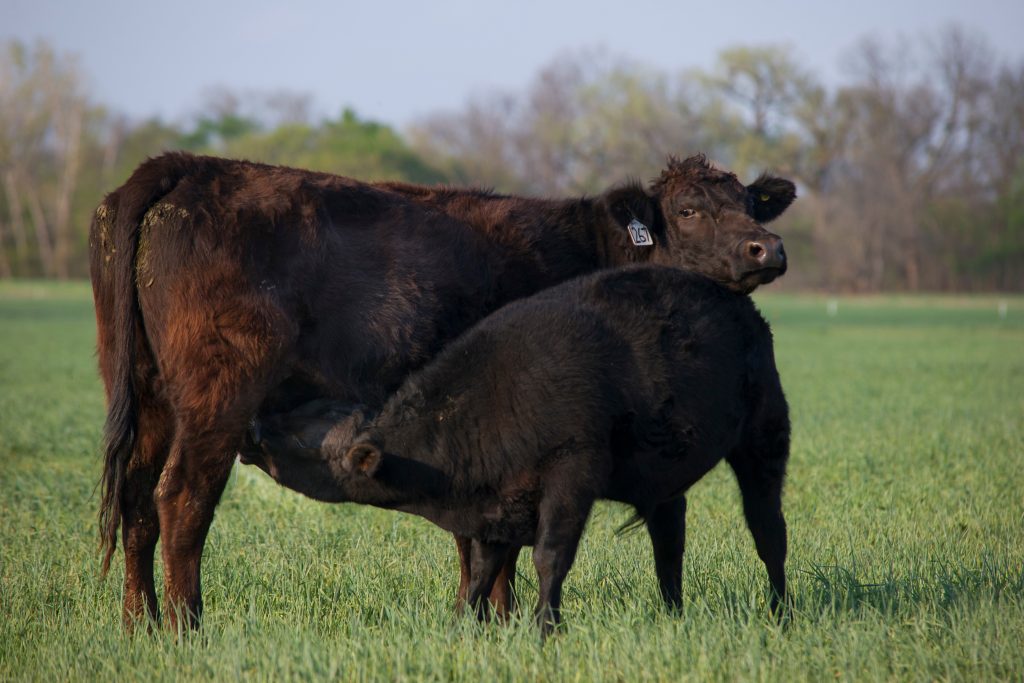
Senior Farm and Ranch Broadcaster, Ron Hays, is back talking with Kansas State University's Dr. Bob Weaber about the future of genomics in beef cattle.
At Kansas State, Weaber said there is continued work on direct measures of dry matter intake, and carcass data. Weaber said carcass data is incredibly important to the cattle business, although it has lagged across many breed organizations because of the expensive cost and difficulty level of collection.
"Mature cow weight is another area that is really important from a selection index standpoint because it describes cost of production for our cows," Weaber said.
While it is important to work on the progress of existing traits, Weaber said it is also critical to focus on the future. At Kansas State, Weaber said he and his colleagues are conducting more research on male fertility work to better understand differences in breeding soundness exams and how they influence conception rate and male fertility to improve the number of bulls that make it through seed stock production and out into the commercial space to improve efficiency.
Regarding discussions on sustainability in the beef industry, Weaber said methane is energy loss to the cowherd, and some estimates say upwards of ten percent of a cow's energy is discarded as methane. Weaber said if there were a way to capture and use that energy, it would be to cattle producers' advantage from a production strategy and an environmental improvement standpoint.
"The challenge is that data is really difficult to collect, so there is a lot of work going on to see if we can figure out sort of indicators of methane emission," Weaber said.
In the long run, Weaber said he expects the public will demand decreased methane emissions over time, but in the short run, those in the industry can do a better job of improving the reproductive efficiency of the cow herd and more.
"If we can make sure our cows are more reproductively efficient, we get to wean off more calves per kilogram of methane emission, and we have improved what environmentalists call 'intensity' of our emission," Weaber said. "I think that is an important thing for us to think about, and it supports almost all of the best practices or best management practices we have advocated for from an extension perspective."
Weaber said focusing on the cow herd's maternal performance, reproductive efficiency, and biological efficiency will dramatically improve sustainable outcomes.
The Beef Buzz is a regular feature heard on radio stations around the region on the Radio Oklahoma Ag Network and is a regular audio feature found on this website as well. Click on the LISTEN BAR for today's show and check out our archives for older Beef Buzz shows covering the gamut of the beef cattle industry today.
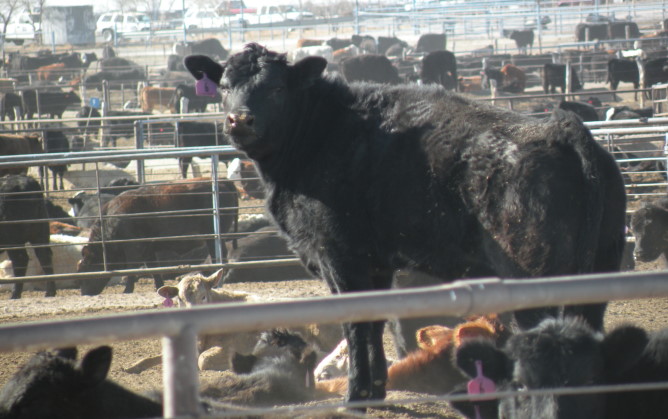
Farm Director KC Sheperd is back talking with Bob Rodenberger, a partner with Stockman Oklahoma Livestock, as he gives the latest on the cattle markets.
Rodenberger said that the cattle markets started out this week higher than the week prior, and all markets have been higher than 2023 in general.
"Yesterday, at our market at Apache, we had a light run, but feeder cattle had an awfully good selection of quality, and that market was better," Rodenberger said. "We had our video market and had a lot of good demand on it Wednesday and sold about 1,000 head on it."
Looking into next week, Rodenberger said he expects a run at OKC National Stockyards from 7,000 to 9,000, depending on the weather.
"It is muddy," Rodenberger said. "It is hard to get around."
Regarding the feeder cattle market, Rodenberger said the lower cost of corn has helped.
"Your cost of gains has gone down from the $1.30 to $1.50 down to $1.00 to $1.20," Rodenberger said.
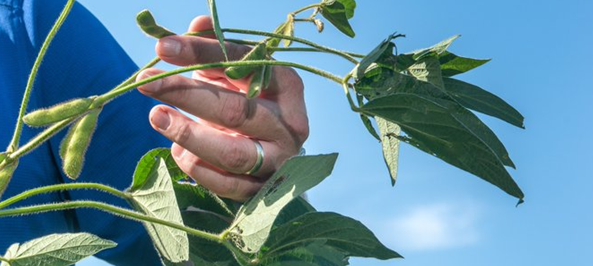
As a member of the Ag Biotech Alliance, ASA drafted a letter from the coalition in response to USDA's open comment period on proposed regulatory exemptions for certain plant modifications resulting from genetic engineering. The letter drew 60 co-signers.
While generally supportive of USDA's proposed exemptions, the coalition offered several recommendations to foster a more inclusive and scientifically sound approach to benefit both the agricultural community and consumers. Specifically in its comments, the coalition recommends:
Why it matters: This proposal will be critical for advancing applications of gene editing in agriculture as the industry faces mounting issues like climate change and a growing population to feed. Gene editing is an important tool that can enhance the sustainability of crop production, develop crop varieties more resistant to pests or to better utilize nutrients, and help meet agricultural production needs without entering significant new areas of land into production.
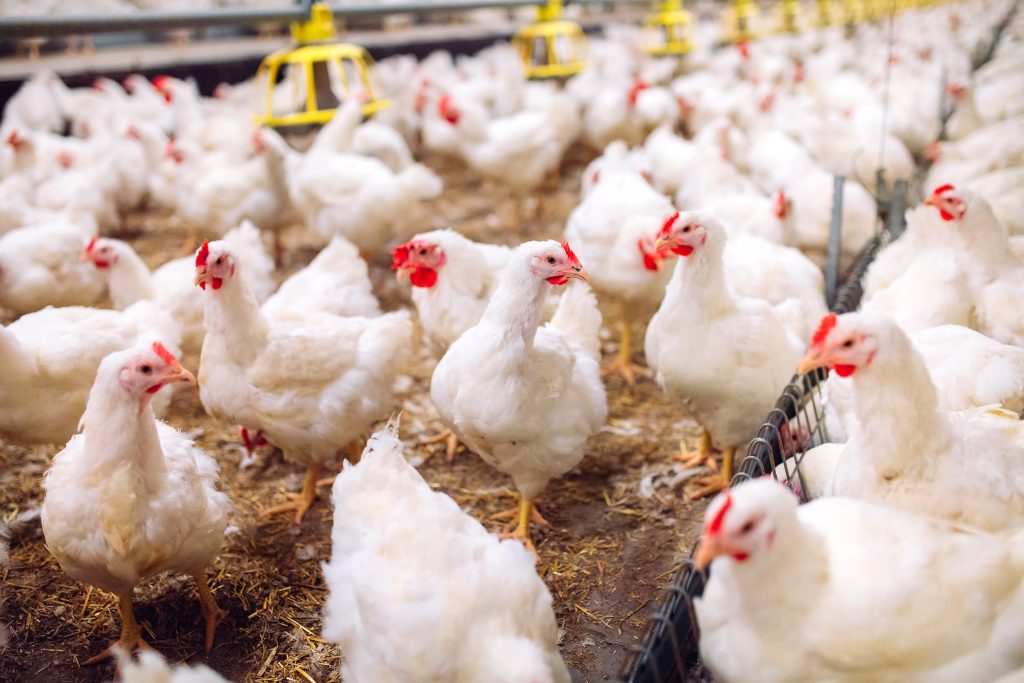
On November 2, 2023, USDA published the final rule to amend organic livestock and poultry production standards. According to USDA, the purpose of the final rule is to "clarify aspects of the existing USDA organic regulations that are not interpreted or enforced in a consistent manner" and to "better assure consumers that organic livestock products meet a consistent standard, as intended by the Organic Foods Production Act."
The final rule amends livestock care and production practices. In the updated livestock care and production standard section, USDA provided a list of prohibited physical alterations for both avian and mammalian species. The rule affirms that treatment of animal with a synthetic substance not on the approved list or with a non-synthetic substance on the prohibited list would cause the animal to lose its organic status. The rule further affirms that producers may not withhold treatment from an animal even if the animal would lose its organic status.
The final rule also separates the existing living conditions standard into two distinct sections – living conditions for mammalian species, which includes honeybees, and living conditions for avian species. For the mammalian living condition standard, producers must provide enough space for animals to lie down, stand up, and fully stretch their limbs and allow animals to express normal behavioral patterns over a twenty-four-hour period. Additionally, the final rule outlines when mammalian animals may be housed individually or must be housed in groups. Further, the final rule clarifies that animals may be temporarily confined for breeding, but they may not be confined to observe estrus or to confirm pregnancy. For avian species, the final rule describes the requirements for indoor and outdoor spaces, providing producers with two options for calculating the amount of space needed. Lastly the avian living conditions section prohibits total confinement of birds but also provides a list of circumstances that allow for temporary confinement.
Additionally, the final rule creates a standard for transportation and slaughter. Producers are required to ensure organic animals are clearly identified as organic during transport and the identity must be able to be traced for the duration of transport. Producers must also have procedures in place to address emergency problems like livestock escaping. The new section requires modes of transportation to have season-appropriate ventilation and bedding appropriate for the species and mode of transportation. Lastly, the new section reiterates that organic producers must follow all Food Safety Inspection Service laws, regulations, and directives.
Most operations must comply with the new requirements by January 2, 2025, which is one year after the effective date of the rule. However, there are limited exceptions for some avian, broiler, and layer operations. Current certified organic producers will be required to comply with these new regulations to remain certified. Producers seeking to become certified organic will also be required to comply with these new regulations.
For more resources on the National Organic Program, click here.
Article courtesy of: Capaldo, Samantha. "USDA Finalizes Rule on Organic Livestock and Poultry Standards." Southern Ag Today 4(4.5). January 26, 2024. Permalink
Ecosystem Services Market Consortium (ESMC)'s Eco-Harvest is one of only two agricultural carbon programs to achieve 3rd party SustainCERT validation and verification for project Impact Units. SustainCERT conducted a rigorous audit of Eco-Harvest project outcomes for greenhouse gas (GHG) reductions and removals to be used for corporate partner agricultural supply chain reporting. Eco-Harvest Impact Units, and supporting programmatic documentation, are listed on SustainCERT's VIVID platform.
These Impact Units are measured and verified outcomes from Eco-Harvest agricultural supply chain carbon projects. SustainCERT's third-party validation and verification demonstrates that Eco-Harvest outcomes from on-farm regenerative agriculture projects are credible, verified, and aligned with corporate Scope 3 GHG reporting standards and guidance. Corporate buyers of Eco-Harvest outcomes, including ESMC members can invest in GHG reduction and removal projects with the assurance that their investments have real impacts.
ESMC's Eco-Harvest market program was designed to collectively engage shared corporate approaches to reduce agriculture's GHG and environmental footprint while delivering claimable outcomes to corporations investing in regenerative agriculture. This is the latest milestone for the Eco-Harvest program, which received program validation and verification according to the Value Change Initiative Guidance in 2022 by SustainCERT.
Marion Verles, CEO of SustainCERT said: "We are delighted to collaborate with ESMC as they lead the way for the industry to take credible climate action and bring them one step closer to decarbonizing agricultural supply chains. Our role as a verifier is crucial to ensure that intervention impact reporting is accurate, credible, and representative of their on-the-ground impact. We are confident that ESMC's achievement will further incentivize agricultural GHG emission reductions in the sector, and we look forward to the role Impact Units play in this."
Debbie Reed, ESMC Executive Director said, "Eco-Harvest generates credible, verified Scope 3 claims from regenerative agriculture that corporate members, partners, and stakeholders in the agricultural supply chain can purchase to represent improvements in agricultural supply chain GHG emissions. SustainCERT program validation and Impact Unit verification ensures our Eco-Harvest program Impact Units adhere to the highest standard for decarbonization solutions in the agricultural supply chain. Our co-investment model allows multiple partners to make valid claims for soil carbon removals and GHG reductions achieved in Eco-Harvest projects." Corporates seeking to participate in ESMC projects or purchase Eco-Harvest Impact Units can contact ESMC at info@ecosystemservicesmarket.org.
On this episode of Cow-Calf Corner, Paul Beck, Oklahoma State University Extension Beef Cattle Specialist, talks about upcoming extension events at OSU:
We have some excellent Extension events coming soon to help keep everyone updated on current technologies, management, and economic conditions throughout the region.
The Oklahoma State University Beef Cattle Extension team has announced a Rancher's Thursday Lunchtime Webinar Series "Successful Timed AI Programs in Commercial Cow Herds" beginning on February 8th meeting weekly through February 22nd. These free Zoom webinar sessions are scheduled for Thursdays at noon. The sessions on February 8 and 15 feature Dr. Guillermo de Nava who operates a highly efficient and innovative breeding program in Uruguay with the ability to artificially inseminate hundreds of cows per day. The final session on February 22nd features Dr. Richard Prather, who will talk about his successes in using timed AI programs in commercial herds in northwest Oklahoma. Register for this event at: https://okstate-edu.zoom.us/webinar/register/WN_wtA1lY26QWOR_T8N9emDkQ#/registration .
The Cooperative Extension Service from Kansas State University, Oklahoma State University, University of Missouri, and University of Arkansas are providing a joint conference in Missouri and Oklahoma titled the KOMA Beef Cattle Conference located at the MU Southwest Research Extension and Education Center (14548 State Rd H, Mount Vernon, MO 65712) on February 12 and on February 13th at the Donald W. Reynolds Community Center (105 Reynolds Ave. Poteau, OK 74953).
"This year's conference will update the public on recent research from the 4 universities in cattle feeding, supplementation, reproduction, and grazing management," says Patrick Davis MU Extension Regional Livestock Field Specialist. These presentations will be given by university agricultural graduate students and professors. In addition, there will be a keynote presentation given by James Mitchell who is an extension livestock economist with the University of Arkansas Division of Agriculture. A catered lunch will be provided by MERCK Animal Health, snacks and drinks will be provided throughout the day. To attend the event, register and pay the fee prior to February 8th. Fee for the event is $20 per person. No refunds for cancellations after the registration deadline. For the Mt Vernon, Missouri site register online at https://extension.missouri.edu/events/koma-beef-cattle-conference. To attend at the Poteau, Oklahoma site register by February 7thhttps://forms.office.com/pages/responsepage.aspx?id=HclpKknoNE6iMM34sn4ZZNmp-qhrbzVMvlqQ2Ey37_tUMjhJMTFXQzNRSlBVOTNUQkNHNTg0VERYNS4u or email Liana Jones County Extension Ag Educator at liana.jones@okstate.edu
Direct Link to Register: https://forms.office.com/pages/responsepage.aspx?id=HclpKknoNE6iMM34sn4ZZNmp-qhrbzVMvlqQ2Ey37_tUMjhJMTFXQzNRSlBVOTNUQkNHNTg0VERYNS4u

E. Michael Castle II has been appointed chief operations and financial officer at Alltech.
Castle has been with Alltech for 19 years, most recently serving as chief operating officer and CEO of the Alltech Feed Division. He has deep experience in the business globally, having also served as chief administrative and legal officer, among other roles.
Castle began his career at Alltech as an engineering intern. He went on to earn a Juris Doctor from Washington University St. Louis School of Law and then returned to Alltech.
"Having worked with Alltech for almost two decades, Mike has Alltech DNA through and through. He worked closely with our leadership team and my father on many of the most important deals in our history. Since the passing of Dr. Pearse Lyons in 2018, Mike and I have worked hand in glove to lead the business," said Dr. Mark Lyons, president and CEO of Alltech. "In all his endeavors, Mike has demonstrated unparalleled dedication, exemplary leadership and a passion for excellence. He is an invaluable asset to Alltech – and a trusted friend and colleague to me. There is no one better prepared — and no one I'd rather work alongside — to lead Alltech into the future."
Castle is supported in leadership of Alltech's financial strategy by:
Alric Blake, former CFO and CEO of Alltech who served as interim CFO over 2023 Q3-Q4, will remain a senior advisor to the business.
"Alltech has an exciting future built on its strong foundation of helping farmers, ranchers and producers nourish the world and nurture the planet," said Castle. "I am pleased to continue working alongside Dr. Mark Lyons to help Alltech capitalize on opportunities to provide solutions that improve the health of animals and the soil, maximize the value of feed, increase on-farm efficiency and help lower environmental impact."
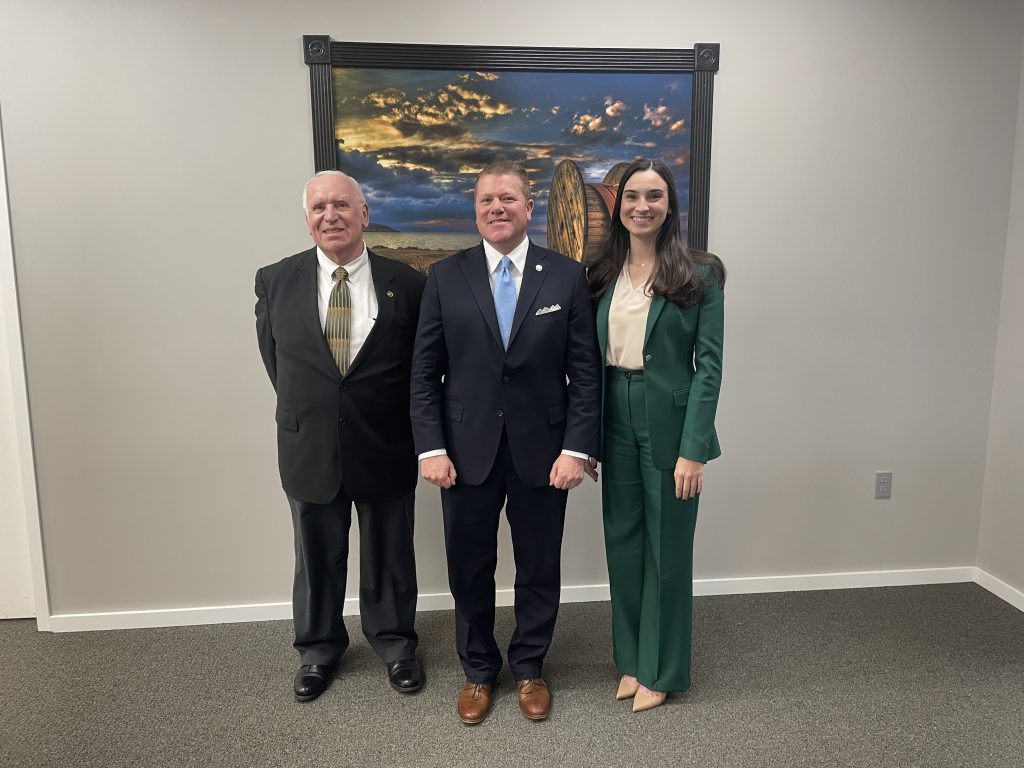
More than 55,000 Oklahoma homes and businesses are one step closer to receiving high-speed internet service, thanks to votes Thursday by the Oklahoma Broadband Governing Board to authorize 142 broadband infrastructure expansion projects. The approved projects would provide broadband to nearly a quarter of locations without such service today.
In a first of its kind of investment in Oklahoma, the Legislature designated ARPA State and Local Fiscal Recovery Funds to create and administer the broadband investment grant program. Grant funds of $374 million will be coupled with more than $90 million in matching funds from 31 internet service providers (ISPs) that submitted approved proposals for service expansion.
Of the 41 companies that applied for the grants, 31 were approved. Those ten companies that were not selected either decided to pull back during the process or did not complete their entire application.
Following the meeting, Associate Farm Editor Reagan Calk had the chance to visit with the Executive Director of the Oklahoma Broadband Office, Michael A. Sanders.
"I don't know if there is enough time in the day to tell you all of the real benefits from an economic development aspect for our rural communities, and quite frankly, even some of our urban communities," Sanders said. "I have always believed that a healthy rural Oklahoma means a healthy, vibrant urban Oklahoma, and vice versa."
Aside from boosting economic development, Sanders also emphasized the benefits of increasing broadband access for rural health, education, and more.
"These are real life-changing opportunities for folks who, by the way, have never had high-speed internet," Sanders said.
This is one of four rounds of funding that companies can apply for, Sanders said, and for this round, 57 of the 77 counties in Oklahoma will be served.
Once all necessary agreements are executed, the projects can begin construction in 57 counties and must be completed before the end of 2026. The final list of funded projects is subject to some modification. If an approved provider chooses to withdraw participation, funding will move to the next project on the list until available funding is obligated with the approval of the board.
The next grant program to be administered by the OBO will award some $159 million from the ARPA Capital Projects Fund to Expand high-speed internet service in the state.
"They are really going to make a difference in the lives of Oklahomans because we are here to serve, and we are here to take care of those folks who have never had broadband, the unserved and underserved," Sanders said. "That is it, that is our mission, and it is crystal-clear. We will deliver on that mission."
The next meeting of the Oklahoma Broadband Council will take place at 10 a.m. on February 13th at Harvey Parkway Building, Room 115.
ARPA SLFRF FACTS:
To view the official press release from the Oklahoma Broadband Office, CLICK HERE.
See the list of fund recipients from this round of approved applicants below:
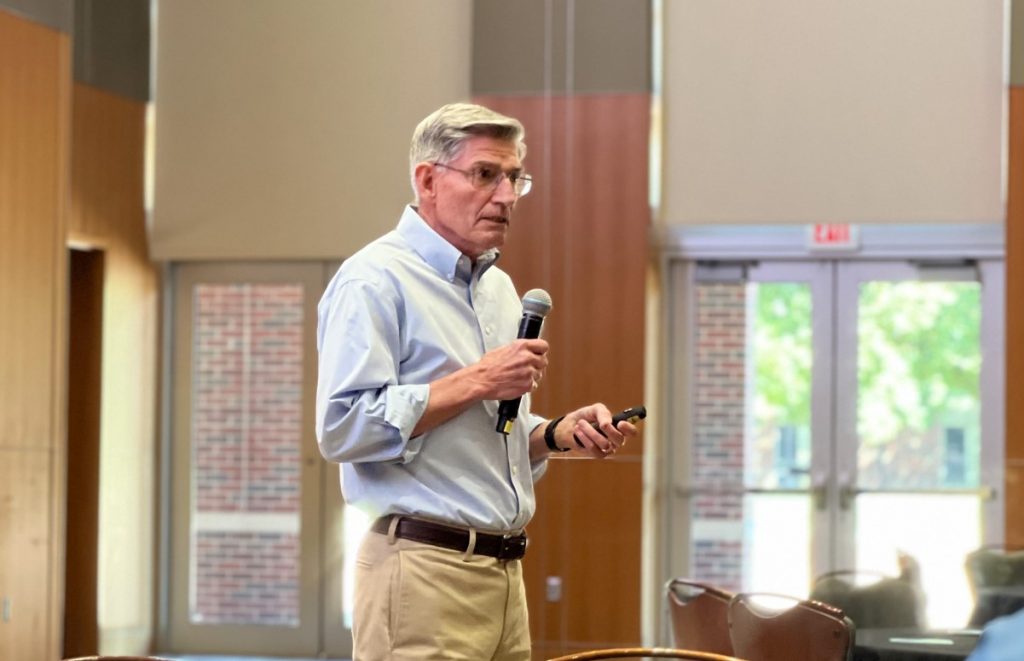
This Week on SUNUP is Oklahoma State University Extension grain market economist Kim Anderson. During this week's edition, Anderson discusses movement in the crop markets from the past few weeks.
"If you look at wheat, corn, and beans, they have been going in the tank during January," Anderson said.
Going back to December, Anderson said wheat was priced around $5.75 to $6.00. During January, Anderson said wheat has dropped to about $5.45, and is back up to about $5.70.
Corn in December was around $4.70 to $4.75 and fell to $4.27 in the month of January. It has risen about 10 cents as of now, he added.
Looking at soybeans in December, Anderson said they were close to $12.50 to $12.75 and fell to $11.53 for the month of January. Soybeans have picked up to around 30 cents now, he added.
The reason for these price declines, Anderson said, is because of supply and demand. Stocks-to-use ratios are predicted to be near last year's averages, Anderson said, but there is more wheat now than can be put on the market.
Anderson said wheat in Oklahoma can be forward contracted for around $5.77 per bushel.
This week on SUNUP:
Watch SUNUP:
Saturday at 7:30 a.m. & Sunday at 6 a.m. on OETA (PBS)
YouTube.com/SUNUPtv
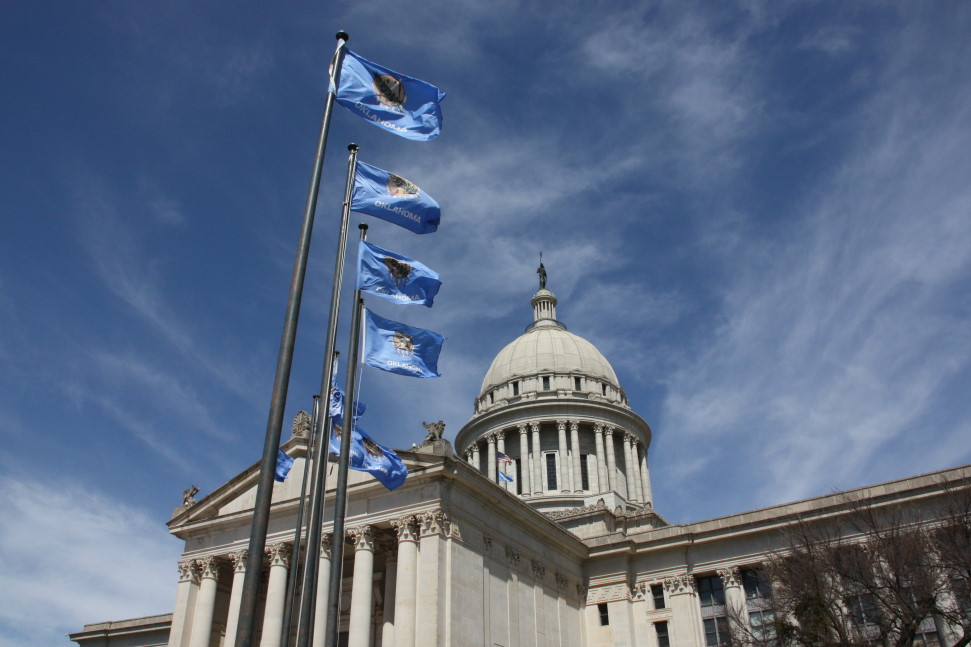
Sen. Micheal Bergstrom, R-Adair, has filed Senate Bill 1xxx for the upcoming special session. This legislation outlines a strategic pathway to gradually eliminate the Oklahoma state income tax while protecting state revenue. Gov. Kevin Stitt has called the state legislature into special session to cut taxes.
Bergstrom's measure answers that call and offers a bold but reasonable pathway for easing the financial burden on hardworking Oklahomans while fostering a climate that promotes economic growth and job creation, particularly within the small business sector. The bill also sets up guidelines to protect state revenue and services.
"This bill is based on a careful review of Oklahoma's economic history, including state government revenue and spending, over the last quarter century," Bergstrom said. "SB1xxx is a comprehensive plan that paves the way for the gradual elimination of the state income tax, while also safeguarding the essential revenue required for public services."
The initial tax cut will be a quarter percent, dropping the maximum rate to 4.5 percent.
"I was recently told by a gentleman that he has been trying to get his son to move to Oklahoma. He reminded his son that the cost of living was lower in our state, and the son agreed," Bergstrom said. "But the son told his Dad that the state he lived in had no income tax and he just wasn't going to move where the government takes almost five percent of what he earns."
"I am committed to ensuring that the Oklahoma state income tax doesn't hinder the hard work and innovation of individuals and businesses, and is not a reason for our children to move somewhere else," Bergstrom said. SB 1xxx can be considered when special session begins January 29, 2024
| |||||||||||||||||||||||||||||||||||||||||||||||||||||||||||||||||||||||||||||||||||||||||||||||||||||||||||||||||||||||||||||||||||||||||||||||||||||||||||||||||||||||||||||||||||||||||||||||||||||||||||||
|
U.S. Wheat Associates (USW) Market Analyst Tyllor Ledford compiles a comprehensive "World Wheat Supply and Demand" summary for three USW Board of Directors meetings each year. Using the USDA World Agricultural Supply and Demand Estimates (WASDE) report as her primary source, Ledford prepared the attached market summary for the USW Winter Board Meeting in Washington, D.C., Jan. 23 to 26, 2024.
Following is the start of Ledford's report. Continue reading the entire report here.
Released on January 12, the World Agricultural Supply and Demand Estimates (WASDE) had a bearish impact on the market, as the estimates quantified the sustained record export flows from the Black Sea and increased ending stock levels. The 2023/24 global wheat production is forecast at 784.9 MMT, up 1.9 MMT from December's estimates. Meanwhile, world wheat demand remains at a record high of 796.4 MMT, outpacing world wheat production by 11.5 MMT
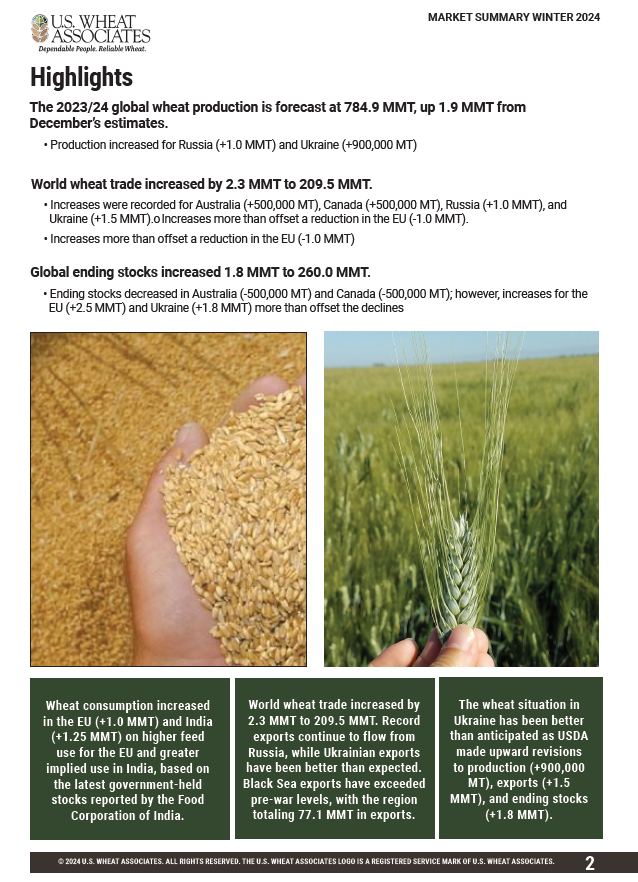
USW Market Analyst Tyllor Ledford's report to the USW Board of Directors includes highlights of world wheat supply and demand. Read more at https://www.uswheat.org/wp-content/uploads/USW-Market-Summary-Winter-2024.pdf.
Although demand surpassed supplies, the January WASDE increased world ending stocks by 1.8 MMT. The current estimate of 260.0 MMT is a 4% decrease from the year prior and the lowest level since 2015/16. In major exporting countries, wheat stocks sit at 58.7 MMT, an improvement from previous estimates but still below 60.4 MMT the year prior. Increased ending stocks in the EU and Ukraine helped support the recent increases. World wheat trade is expected to reach 209.5 MMT, down from 220.2 MMT in 2022/23.
Domestically, the January WASDE made few significant changes, while the Winter Wheat Seedings Report overshadowed the WASDE's impacts. U.S. ending stocks came in 300,000 MT lower, though USDA foresees ending stocks at 17.6 MMT, a 14% increase year over year and the first increase since 2015/16. That estimate helps loosen the U.S. wheat balance sheet and relieve underlying price pressure, though ending stocks still sit 13.9 MMT below the recent highs hit in 2016/17.
Join us for the 2024 Central Oklahoma Cattle Conference on Friday, February 16 at the Payne County Expo Center. Enjoy a delicious lunch and hear about topics such as General Agricultural Pest Control, 2024 Market Outlook, Management Decisions Impacting Herd Reproductive Performance and much more! OSU Beef cattle Extension Specialist, Dr. Rosslyn Biggs will be on hand talking all things cattle.
Registration is due in THREE WEEKS by Friday, February 9. Registration is $20/person. Call or visit the Payne County OSU Extension office with any questions and to register!
The OSU Cattlewomen's Bootcamp will be this year on June 10th-12th in Stillwater, OK. This is a great 3-day hands-on boot camp. Registration won't be open for a few more months, but if you want to be notified when it is, please visit the link below.
The link to that form is https://forms.office.com/r/icq9FEKnuE
The importance of collaborative ag industry partnerships is front and center in a new video funded in part by the National Corn Growers Association's (NCGA) Market Development Action Team. The U.S. Meat Export Federation (USMEF) partnered with U.S. Pork, U.S. Soy, NCGA, the Beef Checkoff, and American Lamb to produce a visually engaging narrative that showcases how American producers' dedication to the land and animals translates into high-quality, sustainable protein worldwide. The video—Beyond Borders—aims to highlight the U.S. red meat industry's commitment to sustainability, recognizing its growing importance in global markets and meeting customer demand.
"The USMEF Beyond Borders video illustrates the power of collaboration between corn and our valued partners across the meat industry. By working hand in hand with our animal ag partners, we are not just cultivating crops; we are cultivating a future where best practices and a shared commitment to the land will lead the way to a more sustainable and resilient agricultural landscape," said Ohio grower and Market Development Action Team Chair Denny Vennekotter. By working hand in hand with our animal ag partners, we are not just cultivating crops; we are cultivating a future where best practices and a shared commitment to the land, will lead the way to a more sustainable and resilient agricultural landscape," said Ohio grower and Market Development Action Team Chair Denny Vennekotter. "U.S. corn producers want everyone to have access to the best quality, most sustainable corn-based products. It is part of our commitment to be good stewards, and we take that commitment very seriously."
The video serves as a powerful tool in conveying the message of sustainability to both international trade partners and consumers. This joint effort across the ag sector effectively communicates the story of how conscientious farming practices contribute to delicious meals on tables worldwide. High quality, good taste and sustainability should have no borders.

The Animal Agriculture Alliance is seeking applicants to join the rankings of Animal Ag Allies in 2024. The Animal Ag Allies program, launched in 2020, is a development program to empower farmers, ranchers, veterinarians, and industry professionals to be outspoken advocates for agriculture online and in person. The enrollment deadline for the next class is February 2. Apply here!
The Animal Ag Allies program provides opportunities for networking, training, and continuous development of issue expertise and communication skills. Animal Ag Allies are on the front lines of responding to emerging issues and sharing positive content about animal agriculture. Coming into 2024, more than 150 participants have completed the modules and have consistently rated the overall value and usefulness of the program and its resources as a 4.7 out of 5.
The program consists of two phases: five self-paced, online training modules and a private forum to discuss engagement strategies and emerging issues. Participants will have six weeks to complete the modules and will then be invited to a private online group where they will have the ability to interact with other Allies. Program modules include: overviews of each sector of animal agriculture, hot topics and emerging issues facing animal agriculture, how to address contentious issues, growing your social following and reaching outside the choir, and public outreach.
"Research has shown time and time again that the most effective ambassadors we have within animal agriculture are those on the farm every day – in particular, farmers, ranchers, and veterinarians," said Abby Kornegay, manager, issues and engagement, Animal Agriculture Alliance. "The Animal Ag Allies program equips those with their boots on the ground to feel confident telling their story and engaging with the public on key issues in animal agriculture."
Four rounds of applications will be considered for Animal Ag Allies in 2024. The deadlines for enrollment and time periods to complete the modules are as follows:
Farmers, ranchers, veterinarians, and others who want to make a difference in public understanding and perception of animal agriculture are encouraged to submit interest. For more information and to apply, click here.
The Animal Ag Allies program would not be possible without the generous support of our founding sponsor, Zoetis, and program sponsors United Soybean Board, National Pork Board, Animal Health Institute, Iowa Pork Producers Association, GreenStone Farm Credit Services, National Pork Producers Council, Professional Dairy Producers Foundation, California Milk Advisory Board, and Colorado Pork Producers Council. Sponsor the 2024 program to hand-pick up to 20 participants to go through the modules, while also being invited to participate in the private forum. To learn more about the benefits of sponsorship or to become a sponsor of the program, contact Logan Hall, director, membership and marketing, at lhall@animalagalliance.org.
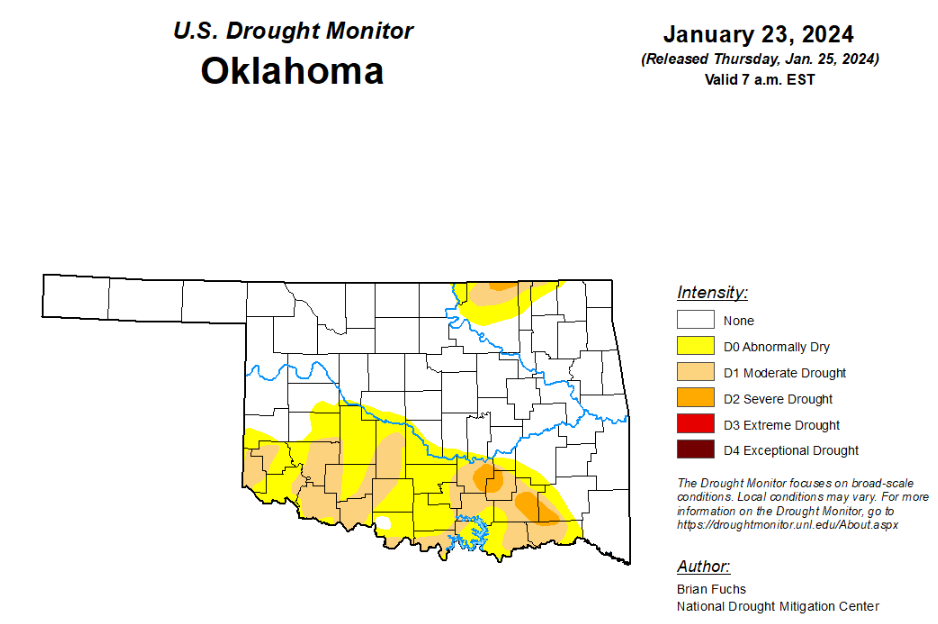
To view the latest Oklahoma drought map, CLICK HERE.
According to the latest Oklahoma drought monitor report, exceptional drought remains at zero percent, unchanged from the start of the calendar year.
Extreme drought or worse remains at zero percent, unchanged from the past four weeks.
Severe drought or worse remains at 1.67 percent, unchanged from the past two weeks.
Moderate drought or worse is now at 14.52 percent, down from last week's 15.01 percent.
Abnormally dry conditions are now at 32.77 percent, down from last week's 34.19 percent.
According to the 6-to-10-day precipitation outlook map, the majority of the state is leaning above a 40 to 50 percent chance of precipitation through February 3. A small portion of the northeast corner is leaning above a 33 to 40 percent chance of precipitation through that same date, and a small portion of the southwest border can expect a 50 to 60 percent chance of precipitation through February 3.
To view the United States Drought Map, click here.
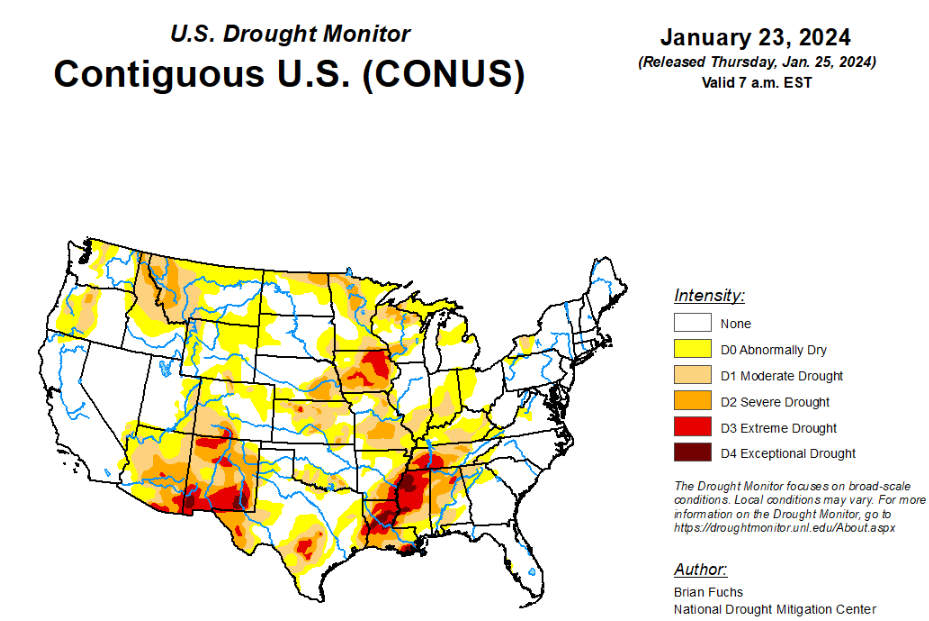
According to the latest U.S. Drought Monitor, the current period was dry over most of the country with the greatest amount of precipitation occurring along the west coast and from east Texas into Arkansas. Temperatures were well below normal for most locations east of the Rocky Mountains, where departures were 5 degrees or more below normal for most areas. The greatest departures from normal were over Tennessee, Kentucky, and northern portions of Alabama and Mississippi where readings were 20-25 degrees below normal. The warm winter continued in the West with temperatures 5-10 degrees above normal over a majority of the region. The warmer-than-normal temperatures have been a challenge for snow accumulation with many locations, especially in the northern Rockies, having a very challenging start to the snow accumulation season. With an active pattern through the central Plains into the Midwest the past few weeks, a reassessment of drought indicators was done in many locations this week to examine drought intensity levels and adjust where the data supported it. In most instances, drought remains but the data allowed for intensities to be reduced. The end of the period had an active pattern again developing in the southern Plains and into the South where widespread precipitation was anticipated after the data cutoff for this week. These locations will be assessed on next week's map.
In the Southern Plains, cooler-than-normal conditions dominated the region with departures of 10-15 degrees below normal common in the region. The greatest rains took place in east Texas to southwest Arkansas and into southeast Oklahoma. These rains continued past the data cutoff period and everything from Tuesday morning forward will be assessed on the next map. The rains allowed for some improvements, with a full category change over much of east Texas and improvements to moderate drought over central and northern Arkansas as well as the far northwest corner of Louisiana and southeast Oklahoma.
In the High Plains, it was a mostly dry week over much of the region with only eastern Kansas receiving widespread, albeit light, precipitation. Temperatures were below normal for all areas outside the plains of Colorado and Wyoming and northern North Dakota where they were 3-6 degrees above normal. Outside of these areas, temperatures were generally 9-15 degrees below normal for the week. The wetter pattern over the last several months allowed for a reassessment of the data to investigate potential changes in the drought intensity levels. It was noted that even though the last 9-12 months have a stronger signal toward the wet spectrum, there are still long-term issues that go out 24-36 months or more in much of the central Plains. In looking at the data, support for the existing extreme drought in eastern Nebraska was not there, so it was improved to severe drought this week. In Kansas, areas of moderate and severe drought were also improved based on the lagging support for these intensity levels. Degradation took place over portions of northern North Dakota and eastern Wyoming where abnormally dry conditions were expanded based on the short-term dryness in these regions.
In the West, above-normal temperatures dominated much of the region with departures of 9-12 degrees above normal over portions of western Wyoming, northern Nevada, central Idaho and northeast Utah. Temperatures were cooler than normal over Washington, northern Oregon, northern Idaho and much of Montana. The greatest rains were along the coast with some flooding issues being reported this week, especially in southern California. Further inland, it remained dry and the dryness coupled with the warmer temperatures has allowed for snow drought to develop, especially in the northern Rocky Mountains. The wetter pattern over the most recent weeks allowed for a reassessment of conditions over New Mexico and into eastern Arizona, where improvements were made. Areas of extreme and exceptional drought were reduced this week in western New Mexico while severe drought was improved in western New Mexico into eastern Arizona. Moderate drought was expanded over western Wyoming and severe drought was expanded over western Montana. Oregon had moderate and severe drought improvements in the west while moderate drought expanded in the central portion of the state. Washington saw moderate drought improved along the northwest coast and western portions of the state with abnormally dry conditions expanding in the north central.
Looking ahead, over the next 5-7 days, the active pattern over the South and Southeast will continue, with much of the region anticipating 3-5 inches of precipitation. The coastal areas of the Pacific Northwest also will remain active with the next system coming ashore. Dry conditions are expected over the central and northern Plains, northern Rocky Mountains and Southwest. Temperatures will flip back to a warmer-than-normal pattern for most of the country, with greatest departures above normal over the northern Plains and upper Midwest.
The 6–10 day outlooks show a high probability of warmer-than-normal temperatures over much of the U.S. during this period with the highest probabilities over the Plains and Upper Midwest. There is a high probability of below-normal temperatures over Alaska and much of Florida. The precipitation outlook has the highest probability of below-normal precipitation over much of the eastern third of the U.S. with the greatest chances over the Ohio River valley. There are above-normal chances of above-normal precipitation over much of the West and into the Plains during this time.
To view the 6-10 Day Precipitation Outlook Map, click here.
To view the 6-10 Day Temperature Outlook Map, click here.
To view the Monthly Drought Outlook Map, click here.
Senate Pro Tem Greg Treat, R – Oklahoma City, today announced the Oklahoma Senate will gavel into Monday's special session and adjourn immediately following, taking no action.
"Nothing has changed in the Senate's position since the last special session was called in October," Pro Tem Treat said. "The senate plans to gavel to call of the chair. The appropriate time for discussion on budget and taxes is during regular session that starts a week after the governor's special session call. Since there is no agreement, special session – a week prior to regular session - is just political theater and a waste of taxpayer dollars.
"During the regular session and only after we have certified numbers from the Board of Equalization, is when we will know how much we have to spend. I feel like the governor's numbers compared to what we are seeing are simply not accurate.
"For these reasons and more are why my colleagues in the Senate will adhere to the Constitution by coming in for the special session and adjourn on Monday, without action on legislation."
Pro Tem Treat will host a media availability Monday following the adjournment of special session. The time and location will be announced at a later date.
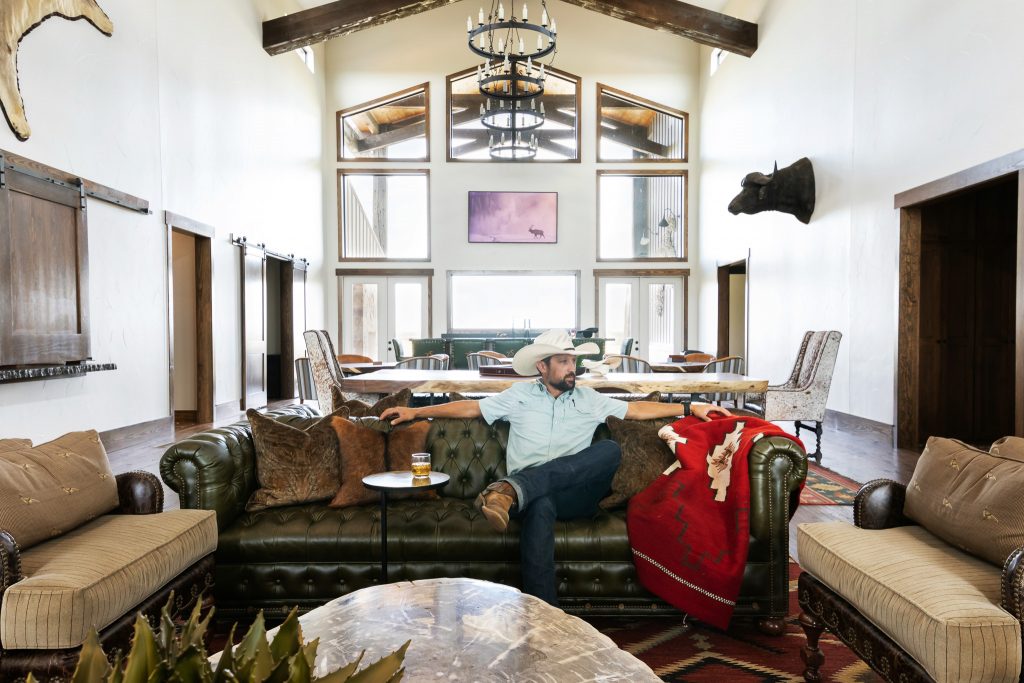
A furniture collection born from 156 years of history and tradition has come to life at Stuart Ranch, a family owned Oklahoma legacy founded in Indian Territory in 1868.
As Oklahoma's oldest ranch under continuous family ownership, Stuart Ranch has inspired a unique line of furnishings with the help of Arcadia-based interior design firm, Designer's Brew and Co.
Stuart Ranch and Designer's Brew first designed the collection for use in The Lodge at Stuart Ranch, where outdoor enthusiasts from across the region come for elite hunting experiences. The furniture has been so popular among guests that the collection is now available for purchase at designersbrew.com.
"Everything at Stuart Ranch is meaningful and built with purpose, and furnishings at The Lodge are no exception," said Clay Forst, 6th generation Stuart Ranch family member. "They are laced with our family's legacy and serve as a reminder of where we came from and what is driving us on. We are glad to be working with Designer's Brew to share this piece of the Stuart Ranch legacy with others."
While many interior designers are curators only, Designer's Brew owner Brett McPherson is also a creator. She used Stuart Ranch's legacy as a major influence in creating each unique piece of furniture designed exclusively for The Lodge at Stuart Ranch.
But now, anyone who loves the west can showcase pieces within the Stuart Ranch 7S furniture collection, which is full of unique designs, quality fabrics, and the character that defines Oklahoma's storied western heritage. Each piece within the new furniture line is fully customizable when it comes to the brand it showcases.
"Working with the Stuart Ranch family has been an honor and a joy," McPherson said. "Designing projects that echo my western roots resonates deeply within me, and the opportunity to be part of the ranch's legacy has been incredibly meaningful. Working with them wasn't just about design – it was about connecting with remarkable individuals who carry a legacy with grace and pride."
A fixture on Oklahoma's southern plains, Stuart Ranch has grown from a simple cattle operation to a nationally recognized Quarter Horse program, an award-winning cattle program, a nationally accessible meat company, and a regionally coveted outfitters division, seasoned with history and character that is uniquely Oklahoma.
Since developing the Outfitters Division of Stuart Ranch in 2009, Stuart Ranch Outfitters manager Forst envisioned a premier hunting destination, which ultimately led to The Lodge at Stuart Ranch. Since 2022, The Lodge has been offering packaged hunts on more than 46,000 private, well-managed acres of spectacular habitat where trophy whitetail deer, Rio Grande turkey, waterfowl and feral, free ranging hogs thrive. Hunters also enjoy spacious rooms, entertainment options, stunning views, a merchandise store, and on-site chef-made meals utilizing Stuart Ranch's own beef products.
In addition to The Lodge, an award-winning quarter horse program and cattle operations, Stuart Ranch's enterprises also include the Meat Company, which provides top-quality beef directly from the Stuart Ranch to the customer's door.
More information about The Lodge, The Meat Company, Stuart Ranch Outfitters, or other aspects of the ranch's historic legacy is available at stuartranch.com. To shop the new Stuart Ranch inspired furniture line, visit designersbrew.com.
Stuart Ranch was established in 1868 and is now the oldest ranch in Oklahoma under continuous family ownership. The 5th, 6th, and 7th generations of the Stuart Ranch family lineage currently live on the land, led by Ranch Manager, Terry Stuart Forst. More than 155 years into their operation, Stuart Ranch spans four counties in southeastern and southwestern Oklahoma. The operation has diversified into four main divisions: Cattle, Quarter Horses, Stuart Ranch Outfitters, and the Stuart Ranch Meat Co. Stuart Ranch Quarter Horses are some of the most revered in the performance horse competition world. The family raises and works their own cattle to both sell at auction and use for Meat Co. production. Stuart Ranch Outfitters packaged hunts are some of the most sought-after experiences in the region. View furniture collection photos here. View full media kit here.
Designer's Brew & Co. is owned by Brett Brinkley McPherson, an experienced and talented interior designer and stylist based in Arcadia and serving clients throughout Oklahoma and Texas. With over 17 years of professional styling experience, McPherson has an eye for design and a passion for creating warm and inviting spaces through a unique style that showcases her Oklahoma roots. For more information go to: designersbrew.com.
The Agricultural Retailers Association (ARA) announces a new member service to help effectively train more drivers to meet the Entry Level Driver Training (ELDT) requirements set by the Federal Motor Carrier Safety Administration (FMCSA).
"When FMCSA adopted the ELDT requirement for new CDL Class A/B or HAZMAT amid the already-problematic truck driver shortage, ARA flagged a need for training resources to help its member companies safely and quickly train new drivers," says ARA Senior Vice President of Public Policy & Counsel Richard Gupton.
"By partnering with the National Propane Gas Association's Administrative Compliance Experts (ACE), ARA is able to relieve some of the pressure on ag retailer members caused by the ongoing need for more truck drivers on the road."
As a FMCSA Registered Training Provider, NPGA's ACE Services is authorized to submit all the required materials to FMSCA on behalf of the participating company. ACE Services provides the resources needed so that behind-the-wheel training can be done in-house with a qualified instructor.
ARA members enrolled in the new member service will benefit from ACE handling:
ARA is launching this member service in a webinar on Jan. 30 with ACE to share more on how to get started with this new service.
ACE says this service has helped train more than 3,000 drivers and can save companies up to $3,000 per driver. ARA members unlock ACE network partner pricing available at various tiers of service with separate pricing for HAZMAT-only.
Recent reports from USDA provide insight into the supply prospects for the 2024 winter wheat crop. The Winter Wheat and Canola Seedings publication on January 12, 2024, showed U.S. farmers planted 34.425 million acres of winter wheat for 2024, down about 6 percent from the 36.699 million planted for 2023. This is still the second-highest winter wheat seedings number in the last eight years. Texas planted 5.9 million acres compared to 6.4 million last year; Oklahoma planted 4.3 million compared to 4.6 million. Kansas, the top winter wheat producing state in the nation, planted 7.5 million acres for 2024, down from 8.1 million last year.

Winter wheat crop condition ratings are well above last year, raising prospects for better winter wheat yields and a better harvested-to-planted ratio in 2024 compared to 2023. The last USDA report available for the U.S. and specific states was November 26. Kansas updated its wheat crop condition ratings on December 31. The USDA has since suspended weekly crop condition rating reports until the first of April.


Over the last three years, the average harvested-to-planted percentage for winter wheat is about 71 percent. With a trendline yield of about 51 bushels per acre and 34.425 million planted acres, an early estimate of 2024 winter wheat production is 1.246 billion bushels, around last year's production and a little lower than the 10-year average production. Winter wheat production in 2023 was 1.248 billion bushels. The 10-year average production level is 1.286 billion bushels. A higher expected yield and harvested-to-plated ratio are expected to compensate for this season's lower acreage.


References
USDA, NASS Crop Progress, November 27, 2023 and January 2, 2024
USDA, NASS Quickstats, accessed January 17, 2024.
USDA, NASS Small Grains Summary, September 30, 2023
USDA, NASS Winter Wheat and Canola Seedings, January 12, 2024
Article courtesy of Welch, J. Mark. "2024 Winter Wheat Production Prospects." Southern Ag Today 4(4.1). January 22, 2024. Permalink
The 10th annual Oklahoma Local Agriculture Summit is set for Feb. 28 – March 1, 2024, at the Edmond Conference Center located at 2833 Conference Dr, Edmond, OK 73034. The focus of the conference is to increase the availability of local food in Oklahoma communities and strengthen farmers markets and agritourism sites through education and networking opportunities.
The conference is made possible by the Oklahoma Department of Agriculture, Food and Forestry, ONIE Project, Langston University, and key stakeholders from agricultural, community, and public health agencies.
Two in-depth workshops will take place on Wednesday, Feb. 28, including hands-on marketing training and a workshop sharing best farm practices. The full summit with more than 20 breakout sessions is scheduled for Thursday, Feb. 29 followed by the agritourism bus tour and innovative farm bus tour on Friday, March 1.
Most of the events associated with the summit are free to attend, however, registration is required for each event. Registration is open online at https://oklac.org/oklas and will close on Feb. 28, or once capacity is met.
The conference has five tracks addressing topics of special interest to farmers market managers, growers, agritourism producers, Christmas tree growers, and community support organizations. Topics will include accepting SNAP/EBT, growing practices, marketing to consumers, and more. A meal on February 29 will be provided to all registrants.
There are more than 45 registered farmers markets and 400 agritourism producers in Oklahoma, providing quality and tasty local food and enjoyment to communities across the state. Information on Oklahoma's agritourism industry can be found at www.oklahomaagritourism.com.
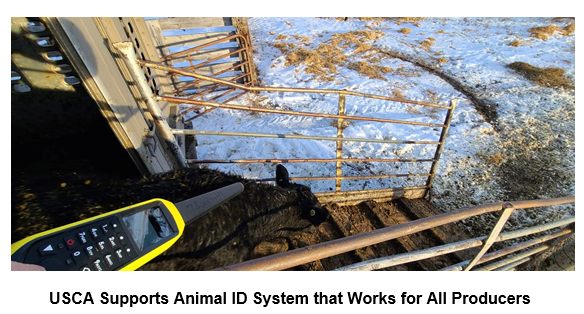
| The U.S. Cattlemen's Association (USCA) reiterates its call to strengthen and establish a national animal identification system that works for, and is accountable to, all producers. There should be no private control of data, or access to the data, without the prior approval of who the owner of the cattle was at the time of application of the official tags. All official USDA tag information should be held in state animal health databases and shared with federal animal health officials only as needed. Under no circumstances should a national cattlemen's association coordinate or control producer data. Producers should never be responsible for more than the cost of the tags. Premises identification numbers (PINs) should not be required to acquire and apply EID tags. The same information can be gathered on health certificates and test charts and other animal health documents. Official ID should only be required on breeding cattle and only as they move into interstate commerce, or as determined by each state's importation requirements. The use of USDA metal NEUS tags and electronic tags should continue for all classes of cattle. The industry requires more time to adapt and transfer to an all-electronic system; time will determine whether multiple systems can be used. Only 840 series EID tags should be used as official EID on U.S. born and raised cattle (900 series tags are not unique in their official identification). As the industry looks to adopt EIDs, financial assistance from USDA will be required to supply reader equipment, both low frequency (LF) and ultra-high frequency (UHF). As any future transition is made to EIDs, the process will eventually needs to move to UHF in order to improve read range and the ability to read animals and groups at speed of commerce. USCA President Justin Tupper issued the following statement: "USCA supports a voluntary national animal identification program and opposes the establishment of a national mandate. Our members believe that each individual producer knows what's best for their herd as it relates to animal husbandry practices. We stand with a majority of state and national producer organizations that believe the same." |
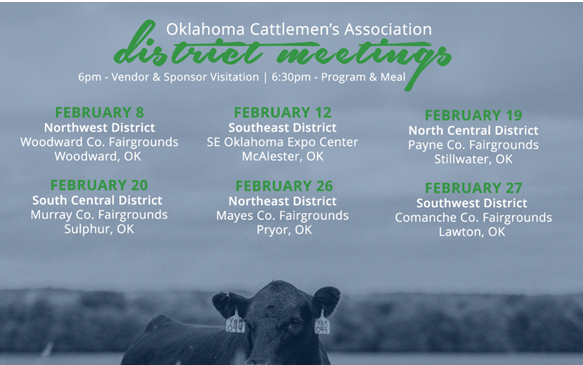
| Join Us - OCA Spring District Meetings February 2024 Spring District Meetings Are Around the Corner! Mark your calendars for the upcoming Spring District Meetings—a time of community, insights and shared passion for the beef industry. From informative discussions to networking opportunities, these meetings are your chance to connect with fellow enthusiasts and contribute to the thriving cattle community. 6:30 pmSupper will be served Legislative Issues Discussed | Sponsor Presentations | Oklahoma Beef Council Update | Update District Election for OCA Nomination Committee Thanks to our title sponsor ADM Cattle Nutrition for making these possible! |
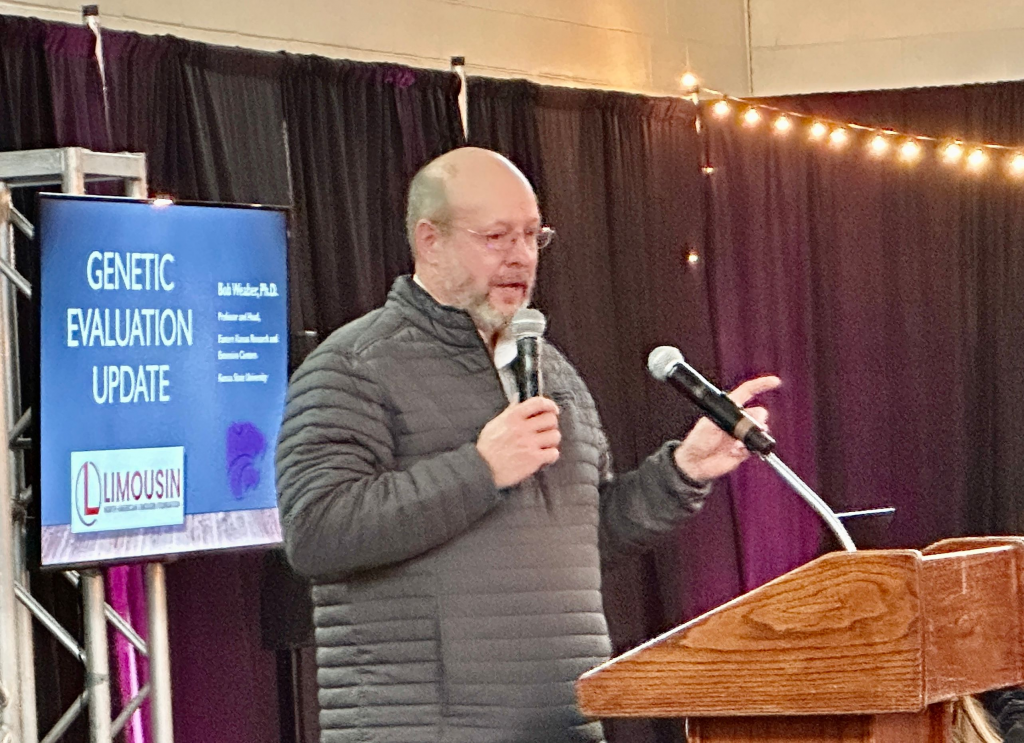
Senior Farm and Ranch Broadcaster, Ron Hays, is talking with Kansas State University's Dr. Bob Weaber about genomic EPDs.
"I think one of the really important things for both seedstock and commercial producers to recognize is that we are well into the adoption and implementation phases of genomic technology in the beef space," Weaber said.
Weaber said the more producers engaged in data collection across the range of traits evaluated, the better job genomic tools can do.
"Our current genomic technology is an association kind of marker approach, so we are not describing the exact genes that are influential in the genome of the cattle, but the markers let us identify those genomic regions kind of like an ear tag on a piece of DNA," Weaber said. "The more information we supply to the evaluation in terms of phenotypes, across the range of performance characteristics of the animals, the better job our prediction models do."
While a few producers may have been hesitant about using these tools early on, Weaber said the impacts of genomic tools can be extremely useful for cattle raisers.
"For a seed stock female, her genomic profile contributes more information to the genetic evaluation than her lifetime of natural calves does," Weaber said.
When using genetic information to select females to add to a herd, Weaber said producers can plot their genetic destiny.
"We just recently had a Beef Improvement Federation genetic prediction workshop in Kansas City right before Christmas where we spent a couple of days talking about the next wave of genomics technologies that will be implemented in the beef space," Weaber said. "That is really around the idea of low-pass sequencing data, so detailing the entire beef genome at a relatively low resolution, but lots of animal genotypes and sequenced at low cost will provide us a breadth of information to actually go find causal mutations that affect the performance attributes of our cattle."
The Beef Buzz is a regular feature heard on radio stations around the region on the Radio Oklahoma Ag Network and is a regular audio feature found on this website as well. Click on the LISTEN BAR for today's show and check out our archives for older Beef Buzz shows covering the gamut of the beef cattle industry today.
RON's Dave Lanning has a pre-opening look at today's agricultural Markets.
Click the audio tab below for today's report.
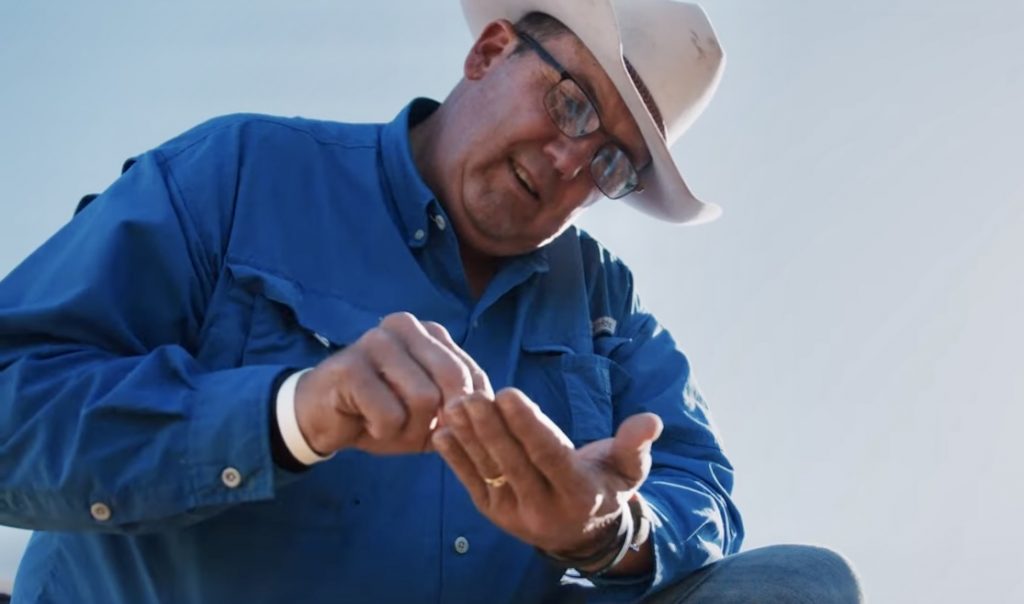
Episode 2 of the U.S. Wheat Associates (USW) "Stories of Stewardship" series has been released and this episode features Tom Cannon, a wheat farmer and cattle rancher from Blackwell, Oklahoma. Cannon, who operates Goodson Ranch with his family, went "all-in" and became a 100% no-till farmer 25 years ago. Cannon and his family have worked to adopt new technologies and processes to protect the land.
One of the soil health practices that Cannon describes in the video is the idea of having a live root in the soil year round, which has led him to aggressively utilize cover crops on his wheat acres between crops.
The Oklahoma Wheat Commission sponsored and worked with US Wheat Associates on this video. You can watch Episode 2 by clicking on the video below:
The time and effort U.S. farmers put into caring for the land makes for a story that is not shared often enough. A new video series produced by U.S. Wheat Associates (USW) aims to change that for overseas wheat buyers by focusing on how producers help feed the world while also acting as stewards of soil, water, and the environment.
USW's "Stories of Stewardship" project goes straight to the source. Five wheat farmers in five different states appear on camera, from their farms, to talk about their work to assure economic security for the next generation of farmers by leaving their land in better shape than it was when they started farming it.
"Consumers around the world want to know how their food is grown and U.S. wheat is definitely a food ingredient," said USW Vice President of Communications Steve Mercer. "Here at home, we know U.S. farmers work every day to nourish and improve the land and produce a sustainable source of high-quality wheat. The purpose of the Stories of Stewardship series is to share this information with international buyers, millers, wheat food processors, and consumers who value the quality and reliability of U.S. wheat."
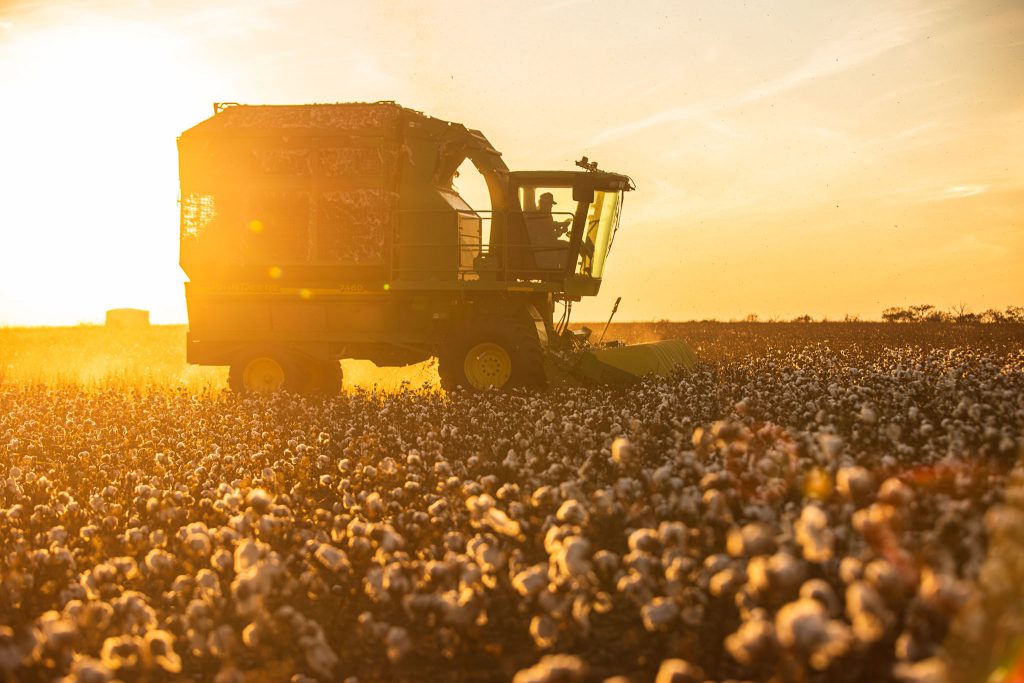
Crop insurance is a tool that helps farmers manage the risks linked to lower yields or revenue in agriculture. The prices used in determining crop insurance indemnities are established in the projected and/or harvest price discovery periods each year. The projected price is determined for each crop by taking an average of the daily closing futures prices across a 30-day window in early spring, when crop planting would normally occur, for a given crop's harvest month contract. Similarly, the harvest price is determined for each crop by taking an average of the daily closing futures prices across a 30-day window in the fall, when harvest would normally occur for a given crop's harvest month contract.
These price discovery periods vary across states and locations due to the timing of planting for each location. Projected and harvest prices for upland cotton hinge on the average daily settlement price of the Inter Continental Exchange (ICE) December futures contract for cotton during the price discovery periods. Commodity Exchange Price Provisions (CEPP) list the variance in price discovery periods across states and locations, aligned with distinct sales closing dates for each specific area, as Table 1 illustrates. Our recent article on Southern Ag Today delved into the regional variations surrounding the Sales Closing Date. Texas, being a sizable state, notably features three distinct Sales Closing Dates (Liu et al., 2023). The projected and harvest prices are published by the U.S. Department of Agriculture Risk Management Agency no later than three business days following the end of the price discovery period.
Projected prices are used when determining the indemnity for yield policies for upland cotton, while both projected and harvest prices are used in determining indemnity for revenue policies. For a comprehensive breakdown of yield protection versus revenue protection policies for upland cotton, refer to Table 1 in Chong, Liu, and Biram (2023). Producers opting for revenue protection policies can choose between the default plan, where indemnity payment relies on crop yield and the higher value between the projected and harvest prices for the insured year, or the harvest price exclusion (HPE) option, where indemnity payments depend solely on crop yield and the projected price (Chong and Liu, 2023).
In insurance plans featuring HPE, since indemnity calculations rely solely on the projected price, these policies typically come with lower premium costs for producers. One frequent query from producers revolves around choosing between the options—with or without HPE. Figure 1 illustrates the ratio between the harvest price and projected price for upland cotton, from 2011 to 2023, across various projected price and harvest price discovery periods. When the ratio is higher than one, it signifies that the harvest price exceeds the projected price. For example, according to Figure 1.A, cotton harvest prices exceeded projected prices in 6 years out of 13 years. These graphs serve as a tool for producers to make informed decisions regarding their insurance, helping them weigh between the default option and the HPE option.
Table 1. Projected Price and Harvest Price Discovery Periods for Upland Cotton among Different Regions Based on the Sales Closing Date

Figure 1. The ratio of harvest price (HP) to projected price (PP) for cotton insurance policies across various price discovery periods from 2011 to 2023.


Data Source: U.S. Department of Agriculture. Price Discovery Reporting Tool. https://prodwebnlb.rma.usda.gov/apps/PriceDiscovery
Reference:
Chong, Fayu, and Yangxuan Liu. "Cotton Crop Insurance to Protect Against Revenue Losses: Select Harvest Price Exclusion or Not?" Southern Ag Today 3(3.3). January 18, 2023.
Chong, Fayu, Yangxuan Liu, and Hunter Biram. "Exploring Diverse Crop Insurance Options for Cotton Producers." Southern Ag Today 3(51.3). December 20, 2023. Permalink
Liu, Yangxuan, Hunter Biram, and Fayu Chong. "Cotton Crop Insurance: Regional Differences in Sales Closing Dates and Cancellation Dates." Southern Ag Today 4(3.3). January 17, 2024. Permalink
USDA Federal Crop Insurance Corporation, Commodity Exchange Price Provisions, Section II – Cotton. 24-CEPP-0021, Released June 2023.
U.S. Department of Agriculture. Price Discovery Reporting Tool. https://prodwebnlb.rma.usda.gov/apps/PriceDiscovery
Article courtesy of Liu, Yangxuan, Fayu Chong, and Hunter Biram. "Cotton Crop Insurance: Unveiling Regional Differences in Projected and Harvest Prices." Southern Ag Today 4(4.3). January 24, 2024. Permalink
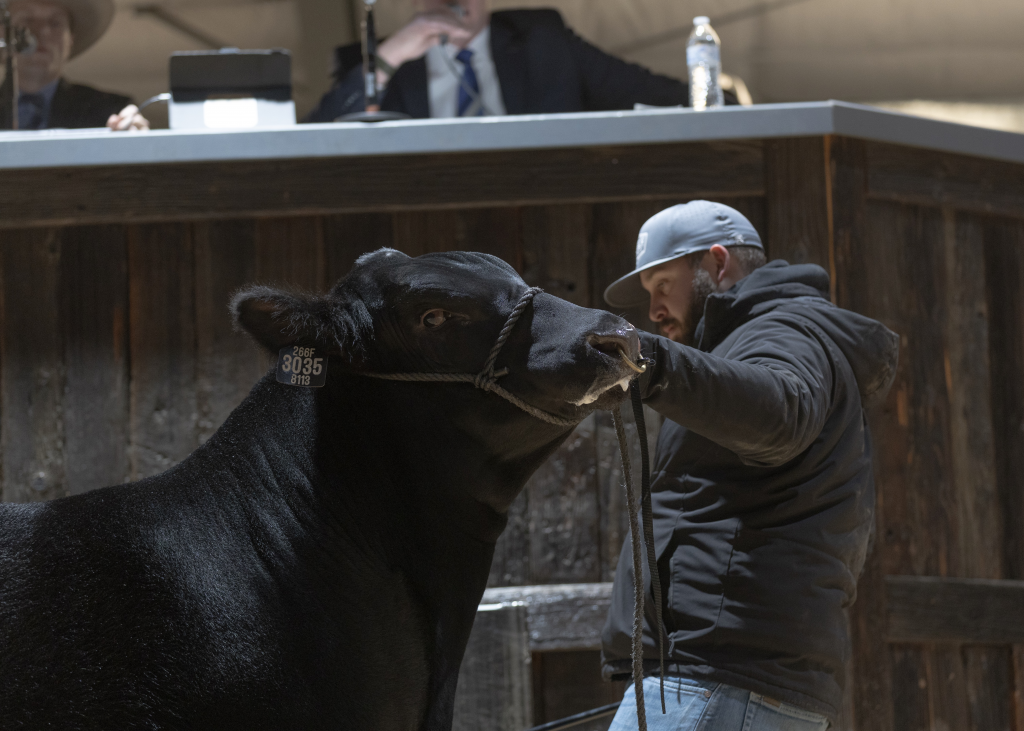
Braden Henricks sets up Sadler Defender 3035 during the Foundation Angus Sale on January 11 in Denver during the National Western Stock Show. The bull was donated by Sadler Ranches of Perkins, OK and sold for $70,000 to Carpenter Cattle Enterprises. All of its proceeds support the Angus Foundation's mission of education, youth and research.
The Angus Foundation started the year with strong support for its mission, raising over $150,000 through the sales of donated lots at Cattlemen's Congress and the National Western Stock Show. The lots were sold in Oklahoma City at the Bases Loaded Sale, and in Denver at the Foundation Angus Sale at the National Western Stock Show. Money raised benefits the Angus Fund, which provides unrestricted funding for Angus education, youth and research.
The lots were generously donated by Four Sons Farm, Yon Family Farms, and Sadler Ranches. Lathrop Livestock Services donated complimentary trucking of all the lots.
"Those who supported our donated lots weren't just investing in elite genetics — they were also investing in the future of our breed," said Jaclyn Boester, Angus Foundation executive director. "We're thankful to this set of donors and buyers for their commitment to the Angus legacy, as well as the sale management companies who included the lots in their sales."
The Angus Fund sustains various programs including academic scholarships, leadership conferences and cutting-edge research to enhance the breed's future. To learn more about the Angus Foundation, visit www.AngusFoundation.org.
More about the donated lots:
Bases Loaded Sale at Cattlemen's Congress | Jan. 2
Lot: Heifer Pregnancy
Sire: GAR Fireproof, Registration No. 20370357
Dam: Registration No. 2018969
Donated by Four Sons Farm of Cynthiana, Ky.
Purchased by Heritage Farm of Shelbyville, Ky. for $20,000
National Angus Bull Sale at Cattlemen's Congress | Jan. 5
Lot: Bred Heifer Package
Donated Heifer: Yon Sarah K1233, Registration No. 20450734
Pregnancy's Sire: Yon Toccoa F1054, Registration No. 19306162
Donated by Yon Family Farms of Ridge Spring, S.C.
Purchased by Express Ranches of Yukon, Okla. for $52,500
To learn more about the 2024 Angus Foundation Heifer Package, visit https://bit.ly/48FH1Sb.
Foundation Angus Sale at the National Western Stock Show | Jan. 11
Lot: Sadler Defender 3035, Registration No. 20707994
Sire: Blair's External Law, Registration No. 19639203
Dam: Registration No. 19258348
Donated by Sadler Ranches of Perkins, Okla.
Purchased by Carpenter Cattle Enterprises of Decatur, Texas for $70,000
The Angus Foundation also auctioned items to support their mission during the annual Herdsman Social at Cattlemen's Congress on Jan. 5. The event welcomed the Angus family for an evening of fellowship and also featured refreshments, door prizes and the announcement of Cole Atkinson of Conley Cattle as 2024 Angus Herdsman of the Year.
For the auction items, past National Junior Angus Board foundation director Josh Jasper served as the auctioneer, and items sold included: landscape branded stones, a women's accessory set, men's tie collection lot and a wild hog hunt package.
The Foundation supports a diverse set of efforts focused on ensuring the Angus legacy remains strong. For more information about the Angus Foundation, visit www.AngusFoundation.org.
A complete list of auction items sold at the Herdsman Social, along with their donors and buyers, follows:
Auction Items:
Landscape Branded Stones Set
Donated by: Angus Foundation
Purchased by: Nowatzke Cattle, Michigan City, Ind.
Women's Accessory Set
Donated by: Angus Foundation
Purchased by: Circle M Farms, LLC, Rockwall, Texas
Angus Foundation Men's Tie Lot
Donated by: Angus Foundation
Purchased by: Circle M Farms, LLC, Rockwall, Texas
Wild Hog Hunt
Donated by: Arrowhead Ranch Texas, Clarksville, Texas
Purchased by: Panther Creek Farm, Pink Hill, N.C.
Door Prize Items:
Wood Angus Basket
Donated by: Wood Angus Farm, LLC, Willow Spring, N.C.
Alltech Basket
Donated by: Alltech, Nicholasville, Ky.
Custom Chore Glove Order
Donated by: PlainJan's, Scott City, Kan.
Custom Cool Grip Glove Order
Donated by: PlainJan's, Scott City, Kan.
— Written by Jaclyn Boester and Sarah Kocher, Angus Communications
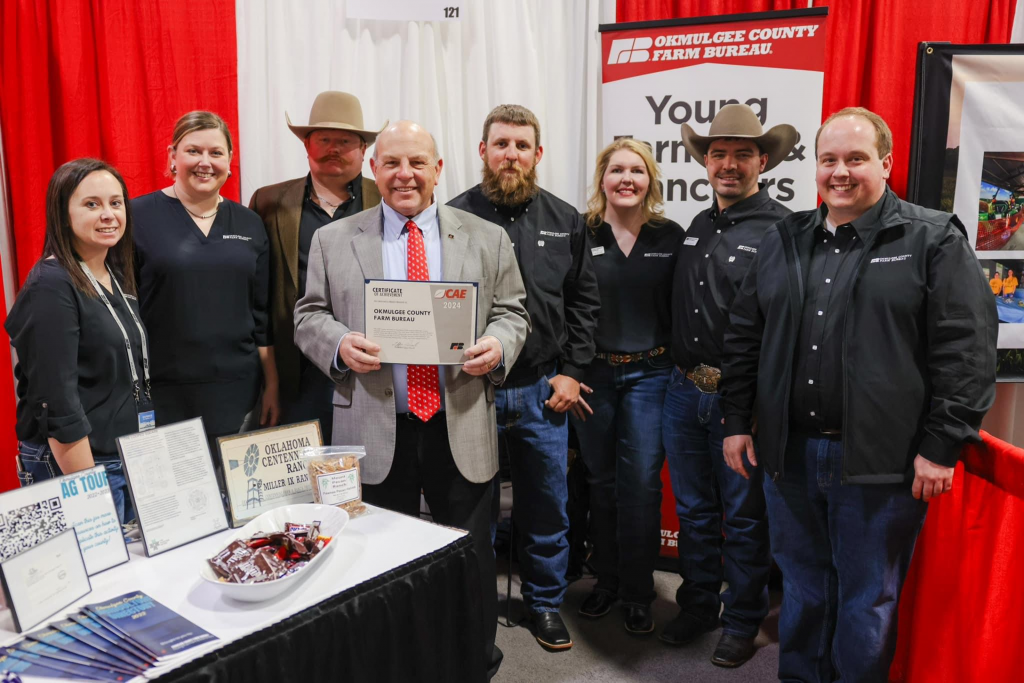
Okmulgee County Farm Bureau
The American Farm Bureau Federation will honor 24 county Farm Bureaus at its 105th Convention in Salt Lake City, Utah, Jan. 19-24. The selected winners participated in the County Activities of Excellence program and demonstrated a commitment to offering quality programming to their counties. Attendees can learn more about these winning programs during the trade show at convention.
"I'm proud of the strong leadership and engagement at the county level that leads to these outstanding volunteer-driven programs," said AFBF President Zippy Duvall. "Improving the lives of Farm Bureau members, supporting our rural communities and giving our urban neighbors a window into the world of agriculture are all worthy goals," said AFBF President Zippy Duvall.
The winners (listed by state and county Farm Bureau) are:
Illinois
Kentucky
Michigan
Minnesota
Missouri
Nevada
Ohio
Oklahoma
South Carolina
Texas
Virginia
Wisconsin
For more information on the winning programs, contact Mary Beth Dale, AFBF project coordinator, leadership development (maryd@fb.org, 202-406-3658).

Harvesting Excellence: MyLand Appoints Agronomist and Certified Crop Advisor (CCA) to Further Agricultural Research and Support Grower Success .
MyLand, a soil health company, announced today that Kelsey Neppel has joined the company's leadership team as Director of Ag Science to lead MyLand's Agricultural Science research and development efforts.
In her new role, Neppel will oversee agronomic research related to MyLand's Soil as a Service® (SaaS). Her efforts will demonstrate the economic returns for growers from improved soil health, which stem from yield improvements, water savings, reduced inputs, nutrient use efficiency, and carbon sequestration. Neppel reports to Bill Mennell, MyLand Principal, Strategy & Analysis.
"We're truly thrilled to welcome Kelsey to the team. Kelsey is an accomplished agronomist who managed and oversaw crop protection teams, including development and oversight of new projects and related R&D at one of the largest privately owned farms in the western United States. Kelsey will be spearheading the R&D efforts that support MyLand's growth and allow us to provide exceptional service to our Grower Partners," said Mennell.
Neppel will lead MyLand's collaborative research efforts with growers and universities, including the company's program with Texas A&M AgriLife Research. The study will measure MyLand's impact on soil health across 12,000 acres of commercial farmland in Texas to address pressing agricultural issues and enhance the quality of life and economic return for growers. In addition to Texas, Neppel will oversee research efforts with strategic partners across the United States, with initial focus in California, Washington, Florida, Arizona, and Idaho. Neppel's work will help bridge the knowledge gap between microalgae as a building block for healthy soil and its effect on enhancing soil function and crop production.
"I'm excited to join a forward-thinking and innovative company in the agricultural tech space. MyLand is making a positive impact for growers across the country, and I am looking forward to furthering our research efforts, especially in partnership with our growers and collaborative universities," said Neppel.
As a graduate of Kansas State University, Neppel holds a Bachelor of Science in both Agriculture and Natural Resources and Environmental Sciences. She previously served as the Agronomy Manager at Duncan Family Farms and as a Research and Development Specialist at Bayer CropScience.
About MyLand MyLand is a soil health company. MyLand's innovative and patented technology and unique Soil as a Service™ approach allows farmers to easily and rapidly implement regenerative agriculture practices and improve their soil health by harnessing the land's own native ecosystem, because No Two Farms Are Alike™. MyLand partners with farmers to infuse life into their soil, helping to return farms to their most fertile state, achieving greater productivity and enhanced profitability. By improving soil health, MyLand is helping to tackle two of the world's biggest challenges: food security and climate disruption. For additional information on how MyLand is transforming soil health globally, visit MyLand.ag.
Radio Oklahoma Ag Network Intern, Maci Carter, is visiting with the outreach specialist for the National Farm Medicine Center, Melissa Ploekelman, about prioritizing safety on the farm.
The National Farm Medicine Center is located in Central Wisconsin, and researches incidents and fatalities that occur on farms and how to prevent them.
"After we do that research, we give resources back to farmers," Ploekelman said.
Statistically, Ploekelman said 33 children sustain serious injuries on farms every day.
"We just need to make sure we are supervising them when they are out on the farm," Ploekelman said. "We also know that children learn a lot when they are on the farm, and they learn all about animals, and how life works, and they learn a good work ethic, so it is important for us to let our youth grow up on the farm. We just have to make sure that we supervise them when they are out there."
Ploekelman said resources can be found at https://cultivatesafety.org/ to help farmers cultivate safety on the farm.
"Maybe we say, at 16 years old, they can drive a skid steer on a farm, but are they really ready to do that," Ploekelman said. "It is important that we make sure that task is appropriate for not only the age of the child, but also the ability level of the child."
Aside from accidents and injuries that can occur on the farm, Ploekelman also talked about fatigue.
"Fatigue is a new topic that the Upper Midwest Agricultural Safety and House Center is talking about, and they have some really great resources," Ploekelman said. "Some things that they remind us of are that you are actually supposed to get up at the same time every day. Farmers maybe do that already when they have animals to care for."
Getting enough sunlight throughout the day can also help individuals feel less fatigued, Ploekelman added. The most important factor to prevent working fatigue, Ploekelman said, is to talk to family and employees about the risks of doing so.
"Working when you are fatigued can be equivalent to working under the influence so that it can be very dangerous," Ploekelman said. "It is not only dangerous to the worker, but to the people around them, and also to all of the equipment on the farm."
Ploekelman said signs of fatigue can include brain fog, not feeling as quick-witted, or dozing off.
"When you start to notice these signs early on, some things that you can do are to stop, take a break, get a drink of water, and do some stretching," Ploekelman said. "Be honest with yourself and those around you."
| ||||||||||||||||||||||||||||||||||||||||||||||||||||||||||||||||||||||||||||||||||||||||||||||||||||||||||||||||||||||||||||||||||||||||||||||||||||||||||||||||||||||||||||||||||||||||||||||||||||||||||||||
|

The Agricultural Retailers Association (ARA) announces a new member service to help effectively train more drivers to meet the Entry Level Driver Training (ELDT) requirements set by the Federal Motor Carrier Safety Administration (FMCSA).
"When FMCSA adopted the ELDT requirement for new CDL Class A/B or HAZMAT amid the already-problematic truck driver shortage, ARA flagged a need for training resources to help its member companies safely and quickly train new drivers," says ARA Senior Vice President of Public Policy & Counsel Richard Gupton.
"By partnering with the National Propane Gas Association's Administrative Compliance Experts (ACE), ARA is able to relieve some of the pressure on ag retailer members caused by the ongoing need for more truck drivers on the road."
As a FMCSA Registered Training Provider, NPGA's ACE Services is authorized to submit all the required materials to FMSCA on behalf of the participating company. ACE Services provides the resources needed so that behind-the-wheel training can be done in-house with a qualified instructor.
ARA members enrolled in the new member service will benefit from ACE handling:
ARA is launching this member service in a webinar on Jan. 30 with ACE to share more on how to get started with this new service.
ACE says this service has helped train more than 3,000 drivers and can save companies up to $3,000 per driver. ARA members unlock ACE network partner pricing available at various tiers of service with separate pricing for HAZMAT-only.

At the end of each growing season, AgriGold ranks its Field GX™ genetic families by overall performance. Family H topped the list for 2023, but don't take that as a nudge to go all in on Family H in 2024. AgriGold ranks its hybrid families not to point farmers toward any one family, but rather to showcase how much the leaderboard changes from year to year.
"We all tend to see what worked last year and say, 'Well, let's do that again,' expecting the same results," says AgriGold Product Manager Steve Schany. "But it rarely works out that way; there's just an 11.3% chance that Family H will repeat and come out on top in 2024."
The one thing I can guarantee is this year's rankings will be different than the previous year," Schany says. "The reason we rank families is to emphasize the need for genetic diversity in farmers' seed strategies. Planting products with different genetic backgrounds better prepares them for whatever the 2024 growing season holds."
Use the rankings as a report card
Schany recommends farmers use the annual rankings of Field GX families as a report card that sheds light on how and why things turned out as they did.
Family H performed well across the AgriGold portfolio in 2023. "The family not only had the most wins, but several products within the family also were truly dominant, outyielding our plot average by more than 5 bushels an acre," Schany says.
"These outperformers were very offensive hybrids, and all the stars aligned to create the perfect environment for them," Schany explains. "They got the right weather and the right precipitation at the right time."
That doesn't discredit other hybrid families. "Had rain not fallen when it did, the rankings could have looked completely different," Schany says.
"The top three families — H, J and A — handled this season's challenges of a cool spring and bouts of dryness well."
What to look for when choosing products
Schany recommends farmers make sure their seed portfolio includes at least three different genetic families. He adds, "If you can handle more, that's even better."
AgriGold developed the Field GX family format to make it simple and intuitive for farmers to understand hybrids' genetic differences and choose products that are genetically diverse. "The groupings provide a simple way for farmers to know they are managing risk by having genetic diversity in the field."
Don't get hung up on what families complement one another. "All families are great companions," Schany says. "It's more about finding hybrids from several families that offer the benefits and protections farmers need and work with their management style and growing zone.
"If farmers can diversify and select products that work with their management style, that will help them succeed," he adds.
Look for areas to improve
As farmers look ahead to 2024, Schany encourages them to think through the season they just had and anticipate potential challenges for the year ahead.
"Take a step back and look at what you went through this past year. Consider where you might improve," he advises. "Whether that's picking a better, more diverse set of hybrids, eliminating weed pressure or improving stand establishment by working on your planter, there's always something that can be improved."
Consider likely threats
Next, Schany says farmers should think through some of the likely challenges for the coming season, noting drought and insect pressure are potential threats. "We need a cold winter to reduce insect populations. So far, this winter has been mild," he says. Corn rootworm, in particular, is top of mind for farmers.
"AgriGold offers traits like SmartStax® PRO and DuracadeViptera™ that give farmers another way to diversify and protect against corn rootworm," Schany says. He encourages farmers to think through resistance management and the benefits of rotating traits to keep corn rootworm from becoming an even bigger problem.
A dry fall signals drought is another possible threat, with Schany pointing out droughts start in the fall, not the spring. Farmers in areas that have been dry should consider hybrids from the Field GX families with stress and drought tolerance.
"Family G has some of our best products for tolerating stress and drought," Schany says, adding that Family H and Family J also have some strong contenders.
Ultimately, the best defense is to spread risk by planting hybrids from several genetic families. Reach out to your local AgriGold agronomist for support in making those choices.
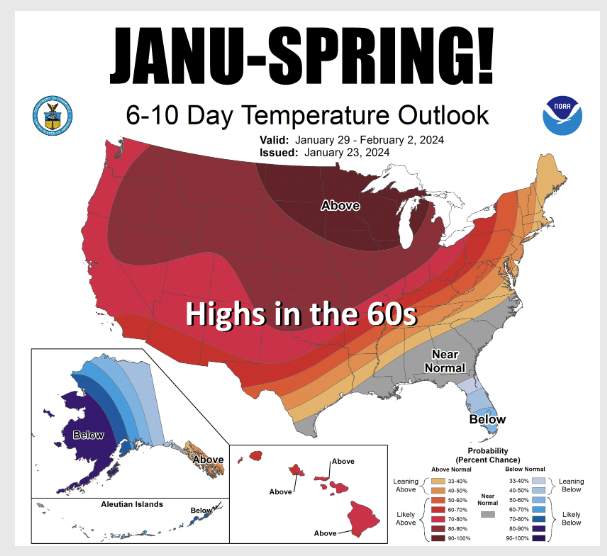
Well, we have finally seen Winter Weather across the state, as December was the 4th warmest record (dating back to 1895), according to State Climatologist Gary McManus. He says we will see Temps in the 60s as we get into Next week, "In the case for next week, the trends in weather will greatly overcome climate and give us highs 10+ degrees above normal."
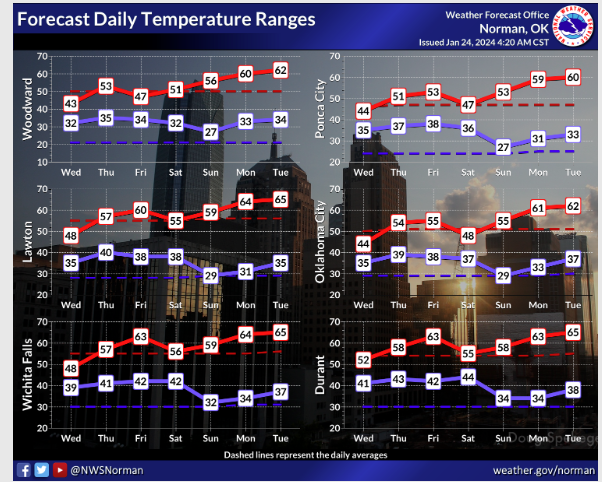
However, this latest trend is not moving in until Monday, and we will continue to see cloudiness and rain over the next few days parts of Western Oklahoma did receive additional rain showers this morning as they moved in from the Texas Panhandle.
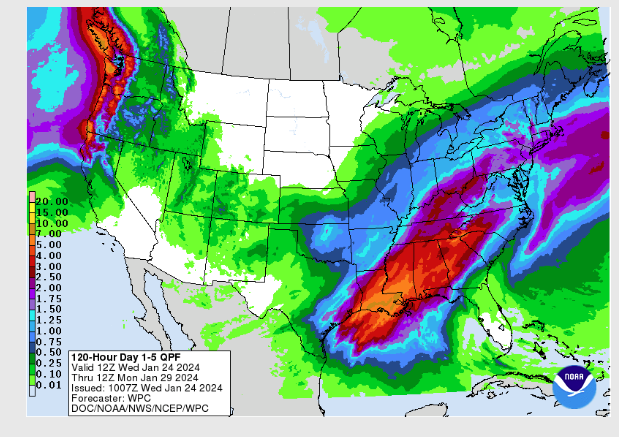
To read more from State Climatologist, Gary McManus on his ticker, click here:
Noble Research Institute guest author and rancher James A. Stuart shares his appreciation of how those who work cattle are an important influence on the well-being of livestock, land and livelihood.
Over the past 20-plus years, my family and I have been fortunate to work on ranches from Nevada to Florida and from Montana to Mexico. I have gained an appreciation for good stockmen in all parts of the country and have learned much from the way they care for their livestock and the range.
In many discussions with these men and women, I have heard a common, self-effacing phrase. "I'm just a cowboy," they say, in a manner that sells themselves short of their true role and abilities. My purpose in writing this article is to help all of us who care for livestock on the ranch or farm reflect on the value of our daily duties and expound on the great good that our complex efforts produce.
There are three aspects of sustainability that must be considered to assure the future of a livestock operation: namely ecological, financial and social. The ability to find balance between and progression within each of these three aspects determines in large part the viability and long-term success of any agriculture and livestock production.

Much of the modern-day research and discussion is focused on the many aspects of keeping livestock alive, healthy, growing and reproducing. It is true that without an efficient production operation, it is nearly impossible to be financially profitable. However, the status of land health also determines the financial well-being and longevity of a ranch. Livestock play an important role as our partners in the state of land health and, in turn, provide financial revenues. Cowboys in their daily efforts and responsibilities have a heavy influence on their livestock's health, growth and impact on the land.
Managed properly, livestock are efficient tools to improve water and nutrient cycles, flow of energy and biodiversity, which all work together to improve soil composition and function. Healthy soil serves as the lifeblood of regenerative agriculture and life. Healthy ecosystems provide for the animals on the land, and the animals provide us with food and fiber while also framing a foundation of our lifestyle, culture and quality of life.

The principle of using livestock as partners to manage the land requires a balance between disturbance and recovery. Grazing is our most common form of disturbance and is necessary for our rangelands to be more resilient and vigorous. A crucial requirement for disturbance to be beneficial is ensuring appropriate recovery periods. Plant recovery is required to rebuild sugar (energy) supplies which feed the plant. From our early elementary days, we all learned about photosynthesis or a plant's ability to make sugars from sunlight, water, and carbon dioxide. These sugars are stored in the roots of every plant.
Managing when and how often plants are "bitten" has a huge impact on whether the plants will respond positively or negatively to the disturbance. After a disturbance during the growing season, sugars are transferred up from the roots, and new plant growth begins. This regrowth is tender, full of nutrients and very palatable, making the plants extra vulnerable to overgrazing.

Overgrazing occurs when the new growth is grazed again prior to the plant being fully recovered from the previous bite. If livestock distribution is not managed appropriately, animals may overgraze a plant multiple times in a single season. These stressed plants have reduced root growth and production, creating a bankrupt sugar storage. This negatively affects the plant's resiliency, vigor and ability to regrow and support the photosynthetic process. As the number of palatable plants decline due to overgrazing on the landscape, the abundance of less palatable plants often increase, resulting in a decrease in grazing value.
The opposite of overgrazing is underutilization, when plants have no disturbance over long periods of time, leaving decadent forage with decreased palatability and nutrition for livestock and wildlife. This underutilization causes the plant's photosynthesis and sugar-transferring processes to become less active or even idle. In this situation, plant vigor and health also decline.
Both overgrazed and undergrazed plants with diminished root systems provide less function, contribution and protection to the surrounding ecological system. A plant that has an active photosynthesis process and well-developed root system full of sugars is vigorous and capable of feeding living organisms above and below the soil surface. Active populations of macroorganisms and microorganisms in the soil break down organic matter and create nutrient-rich soils capable of storing carbon, oxygen and water. As soil and plant health increase, the amount of forage available to grazing animals also increases. Hence, healthy rangelands are more productive and can generate increased revenues.

The art of knowing the appropriate time, timing and intensity of grazing, and the ability to quietly move and settle livestock to strategic locations is within our influence. Cowboys who know the animals and are aware of these plant cycles need to be involved in the planning process where they can share their observations and experienced-earned input.
I have seen the positive impacts of proper livestock distribution over the range. I have observed forage production that increased six times over when it was managed for appropriate disturbance (grazing) and recovery. I believe that improving the health of the land and providing quality meat and fiber to the nation is a noble and valuable task to dedicate our lives to.
A cowboy's role is crucial to the balance and sustainability of an operation. This focus on the whole picture does not take away from those things that we love about cowboying. Keep improving that horse. Keep mastering the art of cattle flow and movement. Keep letting that encouraging holler out when your buddy sneaks that loop on a calf with a fancy shot; and while you're out there, observe what the grass and soil need, then respond with talent and confidence.
Our goal should be to increase our ability to read the land and the livestock each day. This is the art that completes the management on the range, where art and science must coexist for success.

The well-being of ranching and food production is in the hands of good cowboys, cowhands, cattlewomen – whatever we call ourselves. I hope to be dropped off in a circle near you in the future. Let's saddle up and improve our skills of managing the whole interconnected system; and when we are asked what we do for a living, we can hold our head high and say, "I am a cowboy!"
Image at top of page: Christian Stuart on the range in New Mexico. Photo credit: James Stuart.
Story Credit:
As the 2024 Cattle Industry Convention and NCBA Trade Show approaches, Senior Farm and Ranch Broadcaster Ron Hays is back talking with the Executive Vice President of the Oklahoma Cattlemen's Association, Michael Kelsey, about some of the top ideas of conversation that the convention will focus on.
Kelsey said animal disease traceability will be a topic of discussion, as the National Animal Disease Traceability Taskforce will be bringing some of their policy to the convention that will consider how to institute disease surveillance on a national level that includes not only older and more mature cattle but also younger cattle.
Aside from disease traceability, Kelsey said there may also be discussion regarding beef sustainability.
"To make sure we are part of those conversations wherever those conversations may occur," Kelsey said. "If they are at the state level, if they are at the national level, even if they are at the international level, we need to make sure beef is positioned positively. Sustainability, whether we like it or not, is a topic."
Oklahoman Jimmy Taylor will be in the spotlight on the Beef Checkoff side of things, on the Cattlemen's Beef Board. Taylor has been chairman of the Cattlemen's Beef Board for the past year.
"We are so blessed with great leadership in this state," Kelsey said. "Jimmy, out in western Oklahoma, has done a phenomenal job on the Cattlemen's Beef Board. He is just an upstanding, very nice gentleman. He is just a good person. Sharp and smart and wants to help the industry move forward."
The incoming president for the American National CattleWomen, Ruth Coffey, is another Oklahoman who will be attending the convention. Coffey assumes the office of President of ANCW at the end of their meetings next Tuesday.
Kelsey described Coffey as a "salt of the Earth, top shelf type of person." Both Ruth Coffey and her husband serve as a great model for the cattle industry, Kelsey added, from a conservation and leadership standpoint.
"All of us can lead in this industry in some form or fashion," Kelsey said. "We need that because our adversaries are extremely well funded, extremely highly motivated, and they have momentum."
The Beef Buzz is a regular feature heard on radio stations around the region on the Radio Oklahoma Ag Network and is a regular audio feature found on this website as well. Click on the LISTEN BAR for today's show and check out our archives for older Beef Buzz shows covering the gamut of the beef cattle industry today.

Attorney General Gentner Drummond today commended Gov. Kevin Stitt for signing three new state-tribal compact agreements. The Governor signed tobacco tax compacts with the Chickasaw and Apache nations and approved a car tag agreement with the Chickasaw Nation.
"I have been critical of the Governor on his past dealings with the tribal nations of Oklahoma, but his recent negotiations with the Chickasaw Nation and Apache Tribe to secure sound tobacco compacts and renewal of a successful license tag compact merits praise," Drummond said. "I commend his efforts with Gov. Bill Anoatubby and Chairman Durell Cooper, who likewise deserve recognition for their exemplary leadership."
Drummond said the compacting process is the ideal way forward for Oklahoma.
"I continue to believe the most prosperous path for all 4 million Oklahomans is one of mutual cooperation and respect," he said. "Working with the Native American Tribes of Oklahoma instead of against them will benefit Oklahoma for generations to come — as long as the waters run."
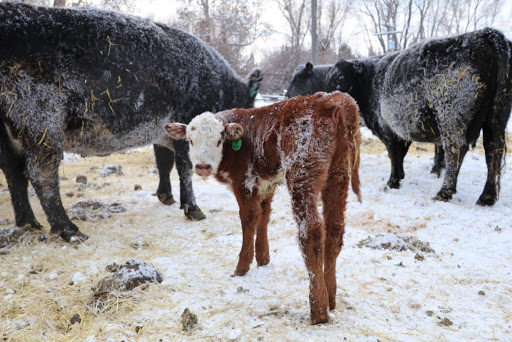
On today's Cow-Calf Corner, Rosslyn Biggs, DVM, Oklahoma State University Extension Beef Cattle Specialist, talks about caring for calves during colder weather.
When the weather becomes severe, calving becomes much more challenging. Calves born in extreme cold quickly utilize all body fat reserves and exposure to wind can exacerbate temperatures. Preparing in advance of inclement weather can lead to improved calf survival.
Remember to discuss your calving plan with your veterinarian and communicate well before there is a calving issue. Your veterinarian can also help you develop essentials for a calving kit.
Items to consider in your calving kit may include:
Assess body temperature if a calf appears stressed. The best way to monitor a calf's temperature is with a rectal thermometer. Inexpensive digital thermometers work well and make it easy to evaluate progress when rewarming a calf.
If a calf's temperature falls below 100 degrees F, interventions are needed. Bring the calf indoors and out of the elements if needed. Bedding can be provided and should be deep enough to cover the calf's legs. Empty plastic soda bottles can be filled with hot water and placed near the calf. When used appropriately, warm water baths, blankets, calf jackets, and warming boxes are all options to rewarm a calf.
Be careful not to damage the skin of the calf by either rubbing too vigorously or placing them too close to heaters. Additionally, do not to wash off the odor of amniotic fluid. This helps prevent rejection by the cow. Warm oral or intravenous fluids as advised by a veterinarian can also make a big difference but should be used with caution in calves without a suckle reflex. Once a calf is warm and has been fed colostrum, return it to its mother. Colostrum should be received within the first 6 hours of life.
Below, Dr. Rosslyn Biggs explains what producers can do to rehabilitate cold stressed calves from March 2, 2020 on SUNUPTV.
RON's Dave Lanning has a pre-opening look at today's agricultural Markets.
Click the audio tab below for today's report.
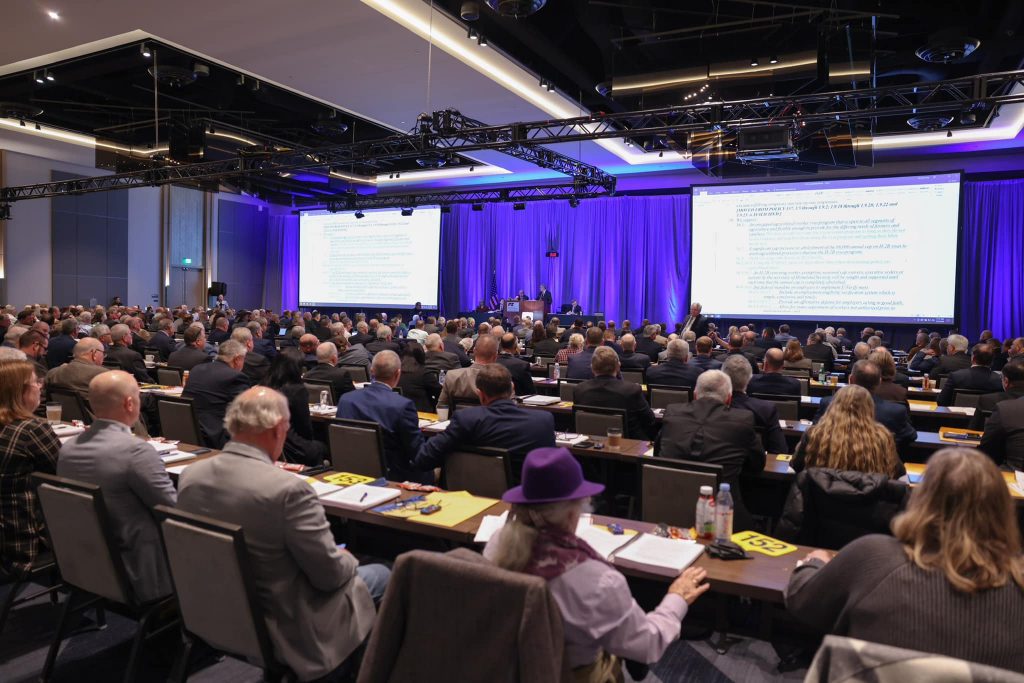
Delegates at 2024 Convention in Salt Lake City
Farmer and rancher delegates from Oklahoma and 49 other states and Puerto Rico to the American Farm Bureau Federation's 105th Convention adopted policies to guide the organization's work in 2024 on Tuesday. After the work was done, Oklahoma Farm Report's Ron Hays talked with the Vice President of Public Policy for Oklahoma Farm Bureau, Steve Thompson, about the highlights of the body of work from Oklahoma's perspective.
For Oklahoma, "It's really a reaffirmation of issues that we have been working on for awhile- EPA rules and regulations and how they are formulated- from the countless new water rules we have been fighting over to really specifically the pesticide rule they have put in place that is tied to the Endangered Species Act and the frustrations we have with EPA and how they have implemented things we think are bad. for the real world."
Thompson adds that Oklahoma was pushing for policy language in the regulatory front that would help Farm Bureau members have the general farm organization backing them up when they interact with members of Congress.
Hays and Thompson also talked about the resolutions established or reaffirmed that dealt with the farm bill debate, crop insurance, ag labor, the beef checkoff, a Prop 12 legislative solution and more.
Listen to their full conversation by clicking on the Listen Bar above.
Thompson also told Hays that even as AFBF worked on their policy for 2024- he was on the phone during the day with Oklahoma lawmakers who are getting ready for the Special Session on January 29th called by Governor Stitt to consider a income tax cut for individuals- which will be quickly followed by the General Session starting February Fifth.
Thompson says he sees little chance of the lawmakers voting for the Stitt income tax cut in the special session as the Senate has little interest this early in the process to make that commitment. Farm Bureau is concerned about the pressure that could come on property taxes if income tax cuts reduce revenues to the state significantly.
Click here for more details of the work of the AFBF delegates in Salt Lake City.
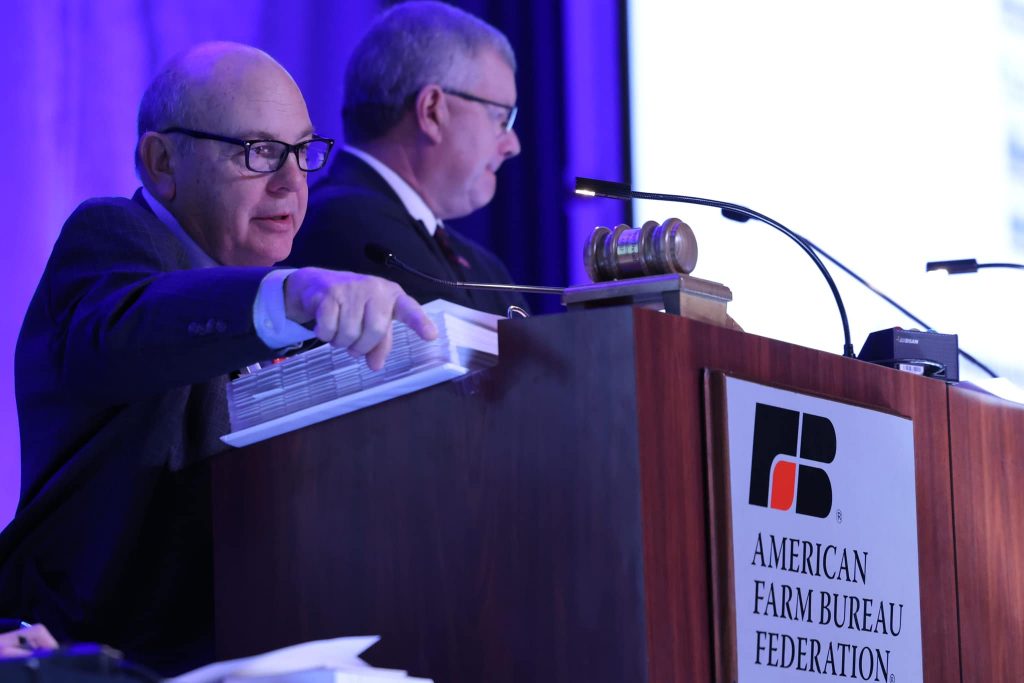
AFBF President Zippy Duvall leads delegates as they set policy for 2024 in Salt Lake City
Farmer and rancher delegates to the American Farm Bureau Federation's 105th Convention today adopted policies to guide the organization's work in 2024. Key topics ranged from artificial intelligence, to labor, to crop insurance.
For the second year, delegates were polled at the beginning of the voting session regarding their farms. The results show 99% of those who cast votes operate family farms and nearly two-thirds represent small to mid-size farms as defined by USDA.
"Today, delegates demonstrated their readiness to seize the opportunities and take on the challenges facing agriculture," said AFBF President Zippy Duvall. "It's crucial that Congress pass a new farm bill and address the labor shortage in 2024. The policy set forth by Farm Bureaus in all 50 states and Puerto Rico will guide AFBF in its efforts through the process. We look forward to making our members' unified voice heard as they work to ensure a strong food supply for America's families."
Today, delegates to the American Farm Bureau business meeting voted to create new policy to address the growth of artificial intelligence in agriculture. AI has the potential to enhance farming practices and conserve resources, but privacy rights must be respected.
Recognizing the challenges of maintaining a strong agriculture workforce, delegates voted to stabilize wage rates for guest workers and revise H-2A and H-2B programs to better meet the needs of America's farms.
They reaffirmed their support for increasing reference prices in the farm bill and maintaining a strong crop insurance program, including an expansion of eligibility to ensure more commodities are covered.
On foreign investment, delegates added policy in support of additional funding to improve data collection on the foreign ownership of agricultural land. Delegates also voted to support the Committee on Foreign Investment in the U.S. reviewing foreign investments in U.S. agribusinesses, natural resources and real estate.
Delegates called for changes to the contract poultry pay system to ensure long-term economic sustainability for farmers, and to require more transparency from chicken companies.
On trade, delegates added policy to recommend Congress investigate fertilizer supply chain outages and tariffs placed on imports.
Beyond policy changes, AFBF President Zippy Duvall and Vice President Scott VanderWal were unanimously re-elected for another two-year term.
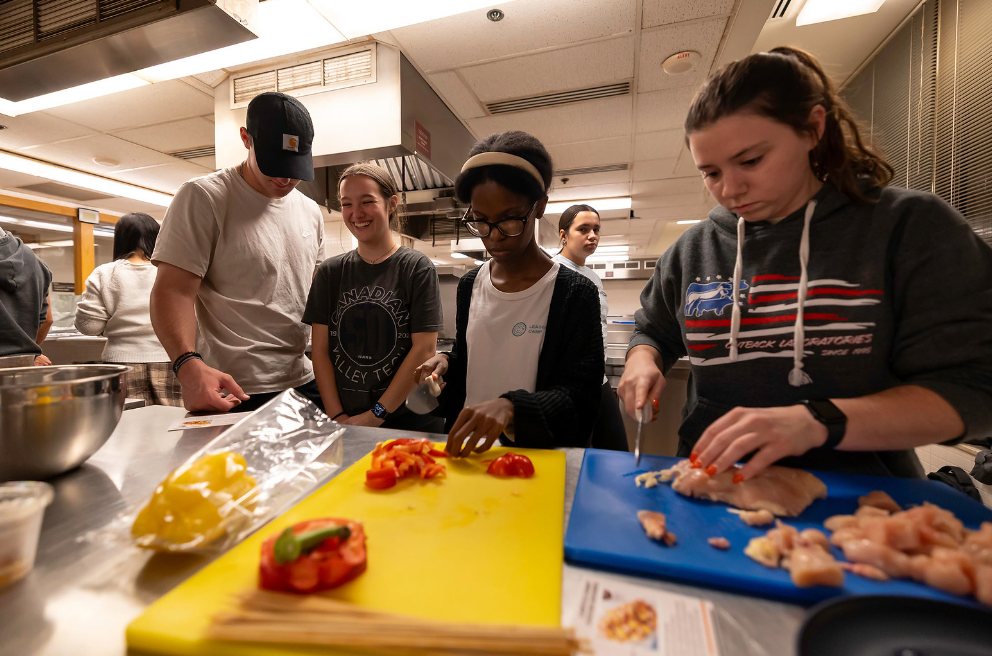
Oklahoma State University students learn about nutrition, meal planning, budgeting and cooking skills in the hands-on Cooking with Extension and Pete's Pantry class. (Photo by Mitchell Alcala, OSU Agriculture)
Students at Oklahoma State University are well-versed in attending classes, taking notes and test preparation. Still, some may need assistance with developing skills in food preparation, healthy cooking techniques, food safety and nutrition.
Cooking with Extension and Pete's Pantry is a joint effort of OSU Extension, Community Nutrition Education Programs, Pete's Pantry, Basic Needs Resources and the University of Oklahoma's Oklahoma Nutrition Information and Education Project. The free, five-week pilot program in the fall of 2023 proved to be so successful that a second five-week course will be offered this spring semester, beginning in February.
Each class combines 30 minutes of classroom learning and 30 minutes of cooking to teach students how to prepare delicious and nutritious meals.
Parker Jackson, Community and Nutrition Education Programs educator and program coordinator with OSU Extension, said the collaborative effort began with a discussion between the Community Nutrition Education Programs and Pete's Pantry, OSU's on-campus food bank, in the summer of 2023. The Oklahoma Nutrition Information and Education Project provided the curriculum for the classroom segment, and the food was donated by Pete's Pantry.
"A lot of college students don't have much experience in the kitchen preparing healthy food," Jackson said. "The students involved in the pilot class prepared a different recipe each week using ingredients from Pete's Pantry and recipes from USDA's MyPlate. The recipes were adaptable to fit vegetarian and vegan preferences, and we used protein substitutes such as lentils and tofu."
Some of the recipes students prepared last fall included skillet lasagna, chicken pad Thai, chicken skewers and chicken skillet.
Jackson said students learned knife skills, how to use a meat thermometer, food safety and adaptability in the kitchen.
"Many students don't have fully stocked kitchens, so they have to work with what they have," he said. "If a recipe called to cover the pot and simmer but there wasn't a lid available, we taught them how to use a baking sheet as a lid. They also learned about how much protein, carbs, fruits and vegetables are needed each day."
In addition to gaining experience in the kitchen, Jackson said participants also learned how to determine a grocery budget and shop wisely to get the most for their food dollars.
"We want to make this class as inclusive as possible. Groceries are expensive, and Pete's Pantry is a wonderful resource to help members of the OSU family have healthy foods to eat," he said.
Cassidy Davis, graduate assistant for Basic Needs Resources and Pete's Pantry, assisted with the coordination and implementation of the cooking classes.
"The students benefitted by not only getting a warm, nutritious meal each week, but also learning and utilizing proper cooking techniques and understanding the benefits of healthy eating," she said. "The curriculum we used is great at connecting students to various nutritional information they may not have known otherwise."
Davis said the feedback from the pilot class has been positive.
"The students would show up to class excited, and some said it was the highlight of their week," she said. "The students not only enjoyed trying new recipes but also meeting new people."
Marissa Story, a senior majoring in communication sciences and disorders, took the class with her boyfriend.
"I love Pete's Pantry on campus and the resources that are available to students facing food insecurity. When I got the email about the class, we signed up immediately," she said. "While I enjoy cooking, I'm a community mentor living on campus so I don't have a lot of experience doing it. My boyfriend struggles with eating certain foods and textures, and I thought this would be a great learning opportunity for both of us."
Story said the class exceeded her expectations. One of her most valuable takeaways was learning that cooking doesn't have to be complicated.
"Cooking food that tastes good isn't as hard as we think it is," she said. "We learned we can make great tasting, nutritious meals by sticking to the basics. The coordinators of the class make it fun because they were so enthusiastic."
She encourages other students to sign up for the session that begins in February.
All OSU-Stillwater students are eligible to participate. Each five-week course is limited to 25 participants. Students will receive an announcement in their OSU email accounts with information about the next class.
For more information, contact Jackson at 405-744 -6699 or parker.jackson@okstate.edu.
OSU Extension uses research-based information to help all Oklahomans solve local issues and concerns, promote leadership and manage resources wisely throughout the state's 77 counties. Most information is available at little to no cost.
By Trisha Gedon
Last week, both chambers of Congress passed, and the president signed into law, another continuing resolution to temporarily fund the government and avoid a partial government shutdown. While this is not where I hoped lawmakers would be at this point in the appropriations process, Congress's annual process to fund government functions and agencies, it has unfortunately been significantly drawn out this past year because of compounding delays.
A continuing resolution (CR), a tool to keep the government open and functioning at current spending levels and policies for a temporary period, is certainly not anyone's first choice to fund the government. However, this CR was a responsible step forward to ensure Congress finishes the appropriations process and avoids a possible government shutdown as we continue to work with the Senate to complete regular appropriations bills. We cannot forgo finishing the appropriations process to address the current and evolving needs of our nation.
House Republicans are making a greater effort to spend responsibly and avoid oversized "packages" instead of individual bills. This allows lawmakers to make necessary policy changes and adjust spending levels, and it also allows Congress to avoid a rushed, massive trillion-dollar spending bill. We must address the evolving challenges and changing needs both in the Fourth District of Oklahoma and the entire nation.
Just like at a train station, late train after late train creates a ripple effect, causing more and more delays for the rest of the day. The first late train occurred when President Joe Biden submitted his budget request more than a month after the statutory deadline. This caused a delay in lawmakers' ability to review his request, then hold hearings and markups to craft our own bills. Next, Democrats' binge spending spree over the last two years created artificial expectations on spending and created inflationary effects that has discouraged the American people in this process. Recent runaway inflation has reduced the value of the dollar dramatically, creating more holes in the budget. Unfortunately, weeks apart this fall without a Speaker also contributed. Having said all that, the House did pass eight appropriations bills on time last year while Leader Schumer and the Senate passed none before the end of the fiscal year.
While the House and Senate work toward finishing the job, there are two paths our country does not want to take in the interim: a government shutdown at any point for any length of time or surrendering to a yearlong continuing resolution. A government shutdown only negatively affects the economy and critical functions, such as border patrol, military readiness and aviation and air control functions. It is not a viable negotiation tactic, and I do not believe in putting the livelihoods of Americans at stake. In turn, a yearlong CR would not allow Congress to make policy changes to address changing needs such as the need for a stronger national defense, enhancing protection at the southern border and reeling back spending in bloated areas. A yearlong CR would be a failure in Congress's and the president's duty to govern.
Lawmakers have a responsibility to the American people to pass individual funding bills that include commonsense policy changes to reflect the current needs of our country. The process and negotiations will continue to move forward, and I am hopeful the Senate and President will work with us to have everything wrapped up as soon as possible.
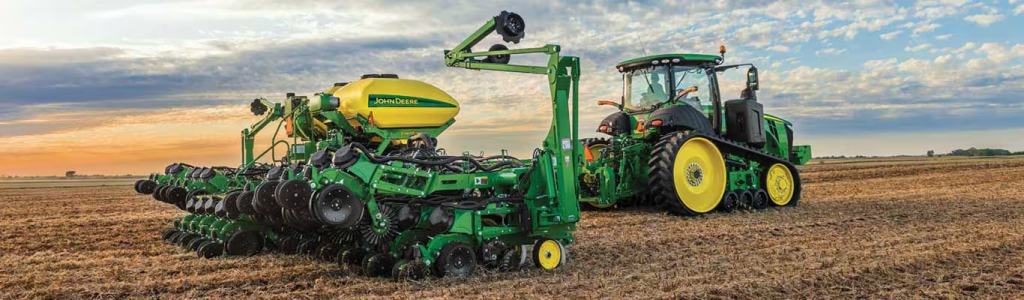
Radio Oklahoma Ag Network Intern Maci Carter recently had the chance to visit with John Deere, Marketing Manager for Precision Upgrades, Yancy Wright, about how Precision Upgrades is helping farmers invest in greater technology to improve their operations.
Previously branded as John Deere Performance Upgrades, John Deere Precision Upgrades is a group within John Deere that is focused on bringing the latest technology to as many producers as possible to help upgrade producers' current equipment.
Some of these upgrades include equipment such as planter kits, row units, metering systems for planters, and more. While these upgrades are a big focus for the team, Wright said they are also focused on bringing more precision ag products to the market.
"An example is that we just introduced this Precision Ag Essentials kit through upgrades," Wright said.
The Precision Ag Essentials kit includes a G5 universal display, a Starfire 7500 position receiver, and a JD Link M or R Modern modem that allows the vehicle to connect with the operations center for data.

"Growers can get that kit at a lower upfront cost, and then choose the level of precision they want," Wright said.
There are different subscriptions depending on the level of precision that a farmer wants for their operation, Wright added.
John Deere takes care of its customers, Wright said, as the staff puts in the effort to ensure that producers are correctly utilizing new technologies to see the most success in their operations.
"We are focused on bringing things to the market that either help producers manage their input costs or potentially give them more yield potential," Wright said.
Producers can talk with their John Deere dealer about what might work best for their operation. To find a John Deere dealer near you, CLICK HERE.
| ||||||||||||||||||||||||||||||||||||||||||||||||||||||||||||||||||||||||||||||||||||||||||||||||||||||||||||||||||||||||||||||||||||||||||||||||||||||||||||||||||||||||||||||||||||||||||||||||||||||||||||||||||||
|
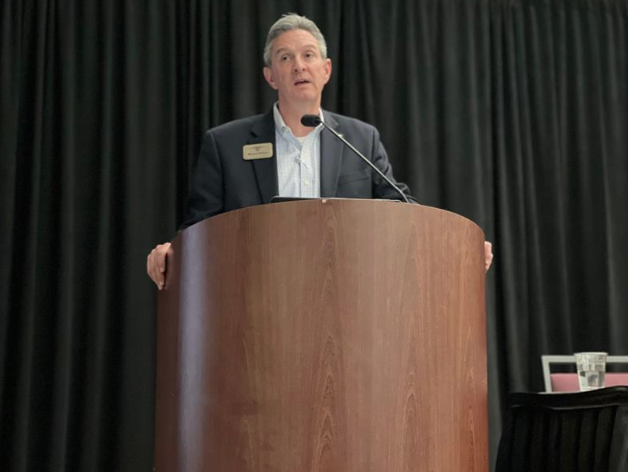
At the 2024 Oklahoma Cattlemen's Association's annual policy meeting, Senior Farm and Ranch Broadcaster Ron Hays caught up with OCA's Executive Vice President, Michael Kelsey, and talked about the association's positions on particular policies.
Kelsey first talked about OCA members' stance on income taxes.
"We modified our opposition to the removal of the state income tax to be not only against eliminating it but also understanding that if legislators are going to take a quarter percent, if you will, there is a trigger mechanism that they also pass at the same time that would raise the tax back or replace the tax, should something fall, like state revenue or something like that...," Kelsey said.
Kelsey said there were a few new policies introduced, including one regarding deals with natural asset companies. Kelsey said natural asset companies purchase the ecological value of land.
"If they purchase that, then they have the ability to affect what happens on that land because it may impact, positively or negatively, that greenspace in the air or so forth," Kelsey said.
While a private landowner has the freedom to do as he or she pleases on their land when it comes to signing agreements with natural asset companies, Kelsey said OCA membership is concerned with the impacts of natural asset companies purchasing the ecological value of state-owned or federally owned land.
"What if they had more value in the greenspace and sold that to an entity that is adversarial to animal agriculture, and not only we might not would we be able to graze that country anymore, but they may have other detrimental effects such as invasive species and so forth...," Kelsey said.
Kelsey said OCA opposes natural asset companies' leasing or purchasing rights on federal and state land.
Another big topic of discussion at the meeting was about the county assessor model. Kelsey said there have been many challenges regarding county assessors in the last two or three years.
"There are good county assessors out there; that is not the point," Kelsey said. "What falls into play is sometimes a county assessor may interpret the law differently from what we believe the law, or we believe the intent of the law was, and it can negatively impact someone such as assessing real property value assessment on cattle."
The Beef Buzz is a regular feature heard on radio stations around the region on the Radio Oklahoma Ag Network and is a regular audio feature found on this website as well. Click on the LISTEN BAR for today's show and check out our archives for older Beef Buzz shows covering the gamut of the beef cattle industry today.
The Farm Bureau Ag Innovation Challenge, now in its 10th year, provides opportunities for Farm Bureau members to showcase business innovations being developed for agriculture. Barn Owl Precision Agriculture is the winner of this year's competition. The American Farm Bureau Federation, in partnership with Farm Credit, announced the winner from among four finalists at the 2024 American Farm Bureau Convention.
Barn Owl Precision Agriculture received a total of $50,000 to grow the business. Sarah Hinkley and Bryan Stafford, Colorado Farm Bureau members, are team leads for the company, which manufactures a fully autonomous robot that supports farmers as they plant crops, control weeds and collect soil samples.
Udder Ways was named runner-up in the contest and received a total of $20,000. Zachary Neal and Jody Neal, New York Farm Bureau members, are team leads for the company, which developed an innovative device that improves sanitation and enhances milk flow as dairy cattle are milked.
Secret Garden Bees, one of the 10 semi-finalist teams, won the People's Choice Award, which is decided by public vote, and received $5,000 in additional prize money. Jim Hartman, a North Carolina member, is team lead for the company, which is a veteran-owned and operated honey farm that helps train veterans seeking to enter agriculture.
Appanoose Manufactured Products of Iowa, team lead Marck Mendick; and ReproHealth Technologies of Indiana, team leads Jim Donahue and Michael Whitt, also reached the final four round of the competition.
The final four teams were selected on Friday from the 10 semi-finalist business owners who presented to a panel of three industry judges: Will Hileman, president & CEO, Farm Bureau Bank; Trey Davis, state policy & advocacy lead, Bayer CropScience; and Jarrod McGinnis, division customer support manager, John Deere.
Each of the semi-finalist teams was awarded $10,000; the final four teams were awarded an additional $5,000 each.
"The hardworking entrepreneurs we're recognizing today are the driving force behind the resilience and ingenuity of American agriculture," said AFBF President Zippy Duvall. "We commend their commitment to helping rural communities and supporting farmers and ranchers in their mission to provide the food, fuel and fiber we all rely on."
The Ag Innovation Challenge winner was selected by a three-person judging panel: Angela Bailey, president, Oregon Farm Bureau; David G. Brown, president and CEO, Western AgCredit; George Gough, state policy & advocacy lead west, Bayer CropScience.
Farm Bureau is proud to recognize these innovative businesses, in partnership with sponsors Farm Credit, Bayer Crop Science, John Deere, Farm Bureau Bank, Farm Bureau Financial Services and T-Mobile. Learn more about the competition at fb.org/challenge.

PORTFOLIO PERFORMANCE, DIVERSIFICATION, AND STRATEGY
September portfolio yielded 3.05% with a weighted average maturity of 976 days.
Total portfolio market value of $15.8 billion, up $1.9 billion in comparison to December 2022.
Total portfolio contained 66% in U.S. Treasurys, 8% in U.S. government agencies,
17% in mortgage-backed securities, 8% money market mutual funds, 0.3% in certificates of deposit,and 0.6% in state bond issues and foreign bonds, comprised the balance of funds invested.

TOTAL FUNDS INVESTED Funds available for investment at market value include the State Treasurer's investments at $12,348,659,042 and State Agency balances in OK Invest at $3,528,661,428 for a total of $15,877,320,470.
MARKET CONDITIONS
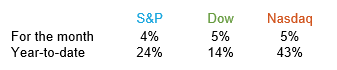
The treasury market fluctuated with the 10-year treasury ending 2023 at 3.88% which was very close to where it began the year. The 10-year rate reached a 16-year high above 5% but retreated by year-end. Meanwhile, the 2-year treasury closed at 4.25% in comparison to 4.43% on January 1. The 30-year came in at 4.03% which was only 0.06% higher than at the beginning of the year. The 2023 equity market reflected a bull environment beating expectations for the year. The S&P 500, Dow Jones Industrial Average and Nasdaq had rates of return for the year of 24%, 14% and 43%, respectively. The S&P earned 4%, the Dow was at 5% and the Nasdaq at 5% for the month of December. According to Barron's the Dow topped 37000 for the first time and set seven record closes in the final days of 2023. A mania surrounding artificial intelligence and big technology stocks sent the Nasdaq soaring.
The Federal Reserve met on December 13 and decided to hold interest rates steady, reflecting the third consecutive policy meeting in which there was no increase in the federal funds rate. Fed officials projected that interest rates could be lowered to approximately 4.6% by the end of 2024.
ECONOMIC DEVELOPMENTS
The unemployment rate for November fell to 3.7% from 3.9% in October and near historic lows. The nonfarm payroll was at 199,000. The Wall Street Journal said, "That number was aided by the end of auto strikes, which resulted in roughly 30,000 jobs added back to payrolls. November marked the second consecutive month job gains have fallen below the average for 2023".
The consumer price index (CPI) increased slightly from the prior month coming in at 0.1% and on a year-over-year basis was 3.1%. Core CPI, which removes food and energy prices, was 0.3% for November and 4% annualized. According to CNBC, "A 2.3% decrease in energy prices helped keep inflation in check, as gasoline fell 6% and fuel oil was off 2.7%. Food prices increased 0.2%, boosted by a 0.4% jump in food away from home. On an annualized basis, food rose 2.9% while energy was down 5.4%". The producer price index (PPI) was flat and the October number was downwardly revised by 0.4%. On a year-over-year basis, PPI advanced 0.9% in comparison to 1.2% the previous month. The core PPI reflected a gain of 0.2%.
Retail sales beat expectations gaining 0.3% for November and year-over-year sales rose 4.1%. When automobile and gasoline was removed, retail sales came in at 0.6%. The previous months sales were downwardly revised by 0.1%. The holiday shopping season started strong at food services and drinking places, non-store retailers, health and personal care and furniture stores reflecting largest increases. Retail Monitor released, "figures on December sales were up in six out of nine retail categories on a yearly basis, led by online sales, health and personal care stores, clothing and accessory stores."
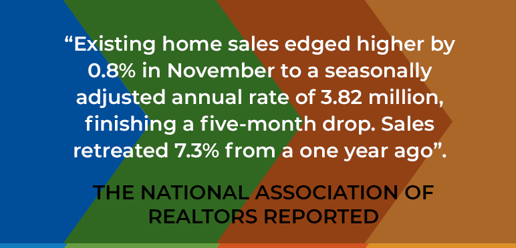
Home sales continue to be affected by low supply with the median price in November rising by 4% on an annualized basis to $387,600. The inventory of unsold existing homes dropped by 1.7% to 1.13 million which represented a 3.5 months' supply.
The final estimate for the third quarter real gross domestic product (GDP) was at an annualized rate of 4.9% in comparison to 2.1% the previous quarter. The Bureau of Economic Analysis said, "compared to the second quarter, the acceleration in real GDP in the third quarter primarily reflect an upturn in exports and accelerations in consumer spending and private inventory investment that were partly offset by a deceleration in nonresidential fixed investment. Imports turned up".
COLLATERALIZATION
All funds under the control of this office requiring collateralization were secured at rates ranging from 100% to 110%, depending on the type of investment.
PAYMENTS, FEES AND COMMISSIONS
Securities were purchased or sold utilizing competitive bidding. Bank fees and money market mutual fund operating expenses are detailed in the attached pages, as is the earnings split between the State Treasurer and the master custodian bank on securities lending income.
Best regards,
TODD RUSS
STATE TREASURER
View full report below.
Winners of the Young Farmers & Ranchers Achievement Award, Discussion Meet and Excellence in Agriculture competitive events were announced at the American Farm Bureau's 105th Convention. Young farmers and ranchers from across the country competed for the awards by demonstrating knowledge, achievement and commitment to promoting agriculture.
First-place award winners in each of the three competitive events receive $35,000 in credit toward a new Ford vehicle, as well as paid registration to the AFBF YF&R Leadership Conference, which will be held March 8-11 in Omaha, Nebraska. Both prizes are provided by Ford Motor Company.
Runners-up who finish in second place in each competitive event receive a $25,000 credit toward new Case IH equipment, courtesy of Case IH. Finalists in third place receive a $2,500 Investing in Your Future cash prize from AmericanAg, a Case IH-branded safe, courtesy of Case IH, as well as $2,500 worth of Stanley Black & Decker merchandise, courtesy of Stanley Black & Decker. Finalists in fourth place receive a Case IH-branded Solo Stove worth more than $1,000, courtesy of Case IH.
Achievement Award
The Achievement Award recognizes young farmers and ranchers who have excelled in their farming or ranching operations and exhibited superior leadership abilities. Participants are evaluated on a combination of their agricultural operation's growth and financial progress, Farm Bureau leadership and leadership outside of Farm Bureau.
Discussion Meet
The Discussion Meet simulates a committee meeting in which active discussion and participation are expected. Participants are evaluated on their ability to exchange ideas and information on a predetermined topic.
Excellence in Agriculture Award
The Excellence in Agriculture Award recognizes young farmers and ranchers who do not derive the majority of their income from an agricultural operation, but who actively contribute and grow through their involvement in agriculture, leadership ability and participation in Farm Bureau and other organizations.
New YF&R Executive Team
Also during the convention, members of the AFBF YF&R Committee elected a new executive team. Kevin Lussier of Florida will be the committee's chair for 2024, taking over the position in March at the end of the YF&R Leadership Conference, and will serve for one year. He will also serve a one-year term on the AFBF board of directors.
Clarissa Cauthorn of Missouri was elected vice chair and Haily Sand of Wisconsin was elected secretary. They will each serve one-year terms.
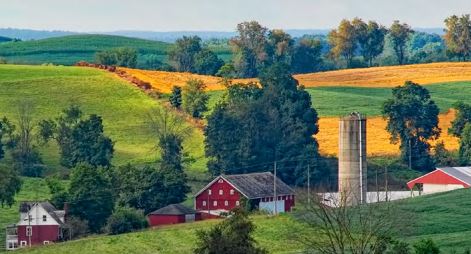
Despite increasing pressure from declining commodity markets, rising interest rates and inflation, the land market seems to be moving into 2024 maintaining the value increases it has built during the past three years.
The sharp increase in land values from a year ago that was primarily driven by strong commodity markets has slowed, but those values are being maintained, which is evidenced in Farmers National Company sale results logged in the past six months. Buyer demand remains strong for good quality cropland across the Midwest, while the supply of land for sale remains limited.
"These factors further play into the dynamics of the supply/demand scenario and remain a large factor in supporting current values in early 2024," said Paul Schadegg, senior vice president of real estate operations, Farmers National Company.
Who are the buyers? Successful farmland buyers continue to be local farmer/operators in nearly 80 percent of transactions. Available cash has played a significant role in how aggressive buyers are able to bid at land sales within the past several years.
"Current market operator's equity positions have narrowed over the past year and lending has increased as outlined in the most recent Ag Credit Survey from the Federal Reserve Bank of Kansas City," Schadegg said.
Along with the increase in lending comes the expense from interest, which will cut into potential net farm income in the coming year for farm operators.
What continues to motivate land buyers? Buyer motivation varies between a farm operator and a land investor in that a farm operator is typically interested in land that will fit well into their operation, is adjacent to other owned land, or has historical ties. The land investor typically looks for return on investment, a diversification to their investment portfolio, or potential hedge against inflation.
"One common motivation between these two types of buyers is that land has proven to be a valuable asset due to the historic appreciation in ag land values. Over the past 25 years, average land values have experienced steady growth following the 1980s farm crisis. Under a strong ag economy, Farmers National Company expects that trend to continue," Schadegg said.
What dynamics will affect land values? Commodity markets and input costs will impact land values in the short term. As farm operators make cropping plans for 2024 and buying decisions for expansion of their operations, the key word will be profitability. Easing interest rates and reduced inflation across the country will bring some positive light to balance sheets.
However, the current world conflicts, geopolitical events, and U.S. political processes have the opportunity to create both positive and negative impacts on the ag economy and subsequent land values.
Company statistics remain above 5-year averages. Operationally, Farmers National Company completed nearly 700 transactions across the Midwest in 2023 accounting for $600 million dollars of sales volume.
"More than 55 percent of these transactions were conducted through the company's auctions, providing true market exposure. While this is off the extraordinary pace set in 2021 and 2022, it remains above the five-year company averages. These strong sale results are a true testament to our professional agents and managers in the field and their commitment to achieving our client's goals in marketing agriculture properties," said Schadegg.
Moving into 2024. Farmers National Company's pipeline has been filling up with both land auctions and listings at a volume very typical for the start of a new year. Many landowners are making the decision to take advantage of the current land value strength and sell into a market with a large pool of motivated buyers.
At the same time, other landowners have contemplated the current appreciated value of their land assets and determined there is no better investment outside of land. These landowners are making the decision to retain ownership and further limit the available properties coming into the market.
"Farmers National Company, our agents, and managers market agricultural real estate assets across 29 states in the U.S. Real estate activity, values, and expectations vary across these regions but overall are experiencing stable land values that are expected to continue into 2024," Schadegg said.
Click here to access our online newsroom where you'll find a company fact sheet, this release and the regional report.
More than 70 current and past state FFA officers started the new year by exploring Australia and the various types of agriculture the country offers.
It was part of the International Leadership Seminar for State Officers, ILSSO, supported by FFA corporate donors Bungee and John Deere.
While in Australia, the students explored Sydney. Then they traveled to Canberra, where they visited with the counselor for agricultural affairs, agricultural specialists and agricultural marketing specialists based at the U.S. Embassy, a representative from the National Farmers' Federation, and a representative from the Australian Rural Leadership Program. They visited perennial pastures, Reiland Angus and more. While visiting the Darlington Point District, they explored one of Australia's most productive farmland, where rice and other cereal crops, fruits and vegetables, grapes, and citrus are grown. Students also visited Australia's only independent agricultural college – Marcus Oldham College. They wrapped up their journey in Melbourne, where they explored the city and visited the Healesville Wildlife Sanctuary.
ILSSO immerses participants in the culture of the country they are visiting while facilitating learning opportunities while the students are there. Throughout the trip, they had opportunities to demonstrate foundational knowledge of global values and diversity while forming empathy and awareness of domestic and global conditions. Those who attended the trip also did pre-work to prepare for the experience.
Students who participate in the trip are:
Alabama
Jayden McMillian
Rachel Perry
Arkansas
Riley Swofford
Reese Mitchell
Colorado
Natali Boerner
Connecticut
Matthew Syrotiak
Delaware
Noah Dixon
Kyle Gares
Andrew Nowotny
Anya Phillips
Florida
Makenleigh Bledsoe
Mackenzie Cunningham
Kayelee Ehrisman
Jenna Larson
Iowa
Collin Bauer
Lauren Beyer
Josephine Kelly
Annabelle Newton
Holly Schmitt
Idaho
Hallye Duckett
Delainee Ellsworth
Josiah Knapp
Kamille Mirkin
Clayton Moore
Illinois
Haley Bode
Indiana
Mary Jones
Kansas
Kai Cox
Karli Neher
Cecilia Newby
Sage Toews
Kentucky
Casey Montgomery
Louisiana
Abbygail Davis
Maryland
Brandon Boyer
Abby Dinterman
Hope Mullins
Hailey Ogg
Michigan
Lillian Houtteman
Dakota Spink
Minnesota
Noah Erickson
Montana
Haley Rigler
Nebraska
Paige Bunn
Bethany Nichols
Abby Hodges
Thomas Perrin
North Carolina
Madeline Kluttz
Belle Merlo
New Jersey
Maisie Shimko
New York
Courtney Taibi
Ella Underberg
Ohio
Chloee Howard
Luke Jennings
Katelyn Kinsella
Anna Moeller
Kaydence Morris
Lauren Thornhill
Emma Wells
Oregon
Jael Cruikshank
Ryan Mizee
Kylie Temple
Mary Thiel
Tennessee
Lillie Cagle
Virginia
Adam Hawkins
Anne Martz
Kirin Miller
Liberti Sell
Jadyn Smith
Grace Walbroehl
Kelcey Weston
Nathan Zerkel
Washington
Nathan Heay
Kyia Hunter-Kanoff
Andrew Schulz
West Virginia
Garret Ammons
Coleen Mitchell
Wyoming
Larkin Williams
The National FFA Organization is a school-based national youth leadership development organization of more than 945,000 student members as part of 9,163 local FFA chapters in all 50 states, Puerto Rico and the U.S. Virgin Islands.
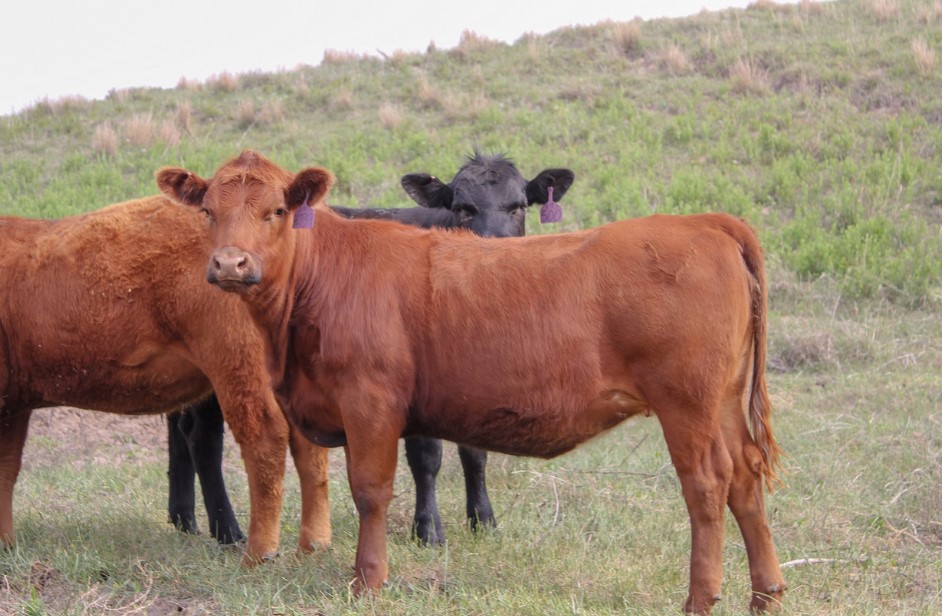
Dr. Derrell Peel, Oklahoma State University Extension Livestock Marketing Specialist, offers his economic analysis of the beef cattle industry as part of the weekly series known as the "Cow Calf Corner," published electronically by Dr. Peel and Mark Johnson. Today, Dr. Peel talks about the latest USDA Cattle on Feed Report and more.
The first few weeks of the New Year are always a challenge for cattle and beef markets. Whether it is January marketings of feeder cattle for tax purposes or post-holiday boxed beef pipeline issues, it always takes a couple of weeks to get a bead on cattle and beef markets in the new year. January 2024 has been particularly challenging with multiple winter storms disrupting feeder and fed cattle markets, as well as boxed beef markets.
With January 1 falling on a Monday, many Oklahoma auctions did not schedule sales the first week of the month. Most scheduled feeder sales occurred as planned the second week of January, but weather conditions and threats limited market demand and volumes. Most sales were cancelled the third week of January due to severe winter weather in the state. The combined Oklahoma auction report for January 19 showed a total feeder cattle volume of 1,694 head compared to 40,125 head for the same week one year ago. Some major auctions in Oklahoma have only had one sale so far in 2024 and icy conditions on the fourth Monday of January may impact some early week sales once again.
Cattle producers have been challenged with extended periods of sub-freezing weather that requires chopping ice and increased cattle feed requirements. Fortunately, most Oklahoma cattle entered the mid-January frigid weather with dry conditions and dry hair coats, which avoids some of the worst animal impacts. Some regions south and east of Oklahoma were not as lucky with rain preceding the freezing temperatures. It is also fortunate that the majority of cow-calf producers were not yet into the spring calving season. The forecast for late January is above-freezing temperatures but still cold and rainy which adversely impacts cattle.
Feedlots have been impacted by several winter storms starting with a storm in the central and northern plains after Christmas and another major storm in early January. Fed cattle performance is reduced and will be impacted for several weeks after storms. Fed cattle carcass weights are expected to decrease in the coming weeks as a result.
Boxed beef markets decreased the first week of January as retailers assessed holiday markets and sorted out post-holiday beef pipelines. However, the winter weather suspended some packing operations for a couple of days and boxed beef markets jumped in response to supply disruptions. From January 4 to January 17, Choice boxed beef price increased over $22/cwt. The current Choice boxed beef price is roughly $295/cwt. It will likely take another week or two to sort out both demand and supply conditions assuming no additional major disruptions.
The January Cattle on Feed report had no surprises with placements 96 percent of last year and marketings 99 percent of one year ago. The January 1 on-feed inventory was 102 percent of last year. The quarterly breakdown of steers and heifers in feedlots showed that the number of heifers on feed was the highest January 1 total in the data back to 1994.
Below, Derrell Peel, OSU Extension livestock marketing specialist, discusses how temperature drops can impact many aspects of cattle production on Livestock Marketing segment of SunUpTV from January 13, 2024.
RON's Dave Lanning has a pre-opening look at today's agricultural Markets.
Click the audio tab below for today's report.

Rep. Eric Roberts, R-Oklahoma City, has filed legislation to prohibit the use of ranked-choice voting in all Oklahoma elections, emphasizing the importance of safeguarding the state's electoral processes.
House Bill 3156 would ban ranked-choice voting within the state. House Joint Resolution 1048 would introduce a legislative referendum allowing voters to decide whether to add stipulations about how elections are conducted into the Oklahoma Constitution and ensure voters can select only one candidate for the same office.
"Ranked-choice voting makes voting more confusing and has delayed election results everywhere it has been tried," Roberts said. "We need to preserve the simplicity and timeliness of our current elections, along with our current ease in doing hand recounts when needed."
Ranked-choice voting requires voters to designate their top choice in a race, their second choice and so on down the ballot. Roberts gave the example of a ballot with five offices. If each office has four candidates, he said, each voter would be expected to review and rank four candidates for each race, which is a total of 20 votes. If no candidate receives a majority, the least popular candidate is then eliminated and their voters would have their votes reallocated to their second-choice candidate, with the process repeating until one candidate has a majority.
The process requires specialized computer software to handle the reallocation of votes from one candidate to another. In an interim study last year, Oklahoma State Election Board Secretary Paul Ziriax said the adoption of ranked-choice voting would necessitate the replacement of all state election machines, including new computer software, with an estimated cost of "tens of millions of dollars."
Ziriax told committee members that "the days of knowing the election results on election night would be long gone."
Ranked-choice voting has already been banned in Florida, Tennessee, Idaho, Montana and South Dakota.
HB3156 and HJR1048 are available for consideration in the Second Regular Session of the 59th Legislature, which begins Monday, Feb. 5.
The National Cattlemen's Beef Association (NCBA) is providing multiple internship opportunities for students to learn about different aspects of the cattle industry. Internships are offered in NCBA's offices in Denver, Colorado and Washington, D.C.
New this year, NCBA is launching a Producer Education and Sustainability Internship focused on implementing the cattle industry's sustainability goals, supporting the Beef Checkoff funded Beef Quality Assurance program, and providing educational resources to cattle producers to improve land management, animal health, and profitability. The internship will occur summer 2024.
"We are excited to launch the Producer Education and Sustainability Internship as we expand NCBA's educational offerings and increase our focus on cattle industry sustainability," said NCBA Senior Executive Director of Producer Education and Sustainability Josh White. "This internship is a great opportunity for students to learn about the educational resources, research, and events that NCBA provides for cattle producers across the country."
NCBA and the Public Lands Council (PLC) are also now accepting applications for the summer 2024 Public Policy Internship in Washington, D.C., occurring from May 20 – Aug. 23, 2024.
"Interning at NCBA is the best way to get first-hand experience influencing public policy and defending America's cattle producers," said NCBA Vice President of Government Affairs Ethan Lane. "Interns take an active role in NCBA's day-to-day work and are critical for advancing the policy priorities of beef farmers and ranchers across the country. Interns leave the office with the skills necessary to be effective advocates for agriculture whether they are back home or in our nation's capital."
The internship provides students with the opportunity to work jointly with NCBA and PLC to advance policies important to the beef and sheep industries.
"The Public Lands Council represents a vital segment of the livestock industry, and our producers face a unique set of challenges," said PLC Director Sigrid Johannes. "Interns are essential to the daily exchange of information between D.C. policy staff and the thousands of cattle and sheep ranchers who graze on federal lands. We are always working to keep Western public lands healthy and open for multiple use, and interns play an important role in highlighting the environmental, economic, and social benefits of grazing."
The full description and qualifications for both internship opportunities are available on the careers page of ncba.org. Applications are due by Feb. 23, 2024.

U.S. Department of Agriculture (USDA) Secretary Tom Vilsack today announced that USDA is investing $207 million in renewable energy and domestic fertilizer projects to lower energy bills, generate new income, create jobs, and strengthen competition for U.S. farmers, ranchers and agricultural producers. Many of the projects are being funded by President Biden's Inflation Reduction Act, the nation's largest-ever investment in combating the climate crisis.
Today's announcement was made by Secretary Vilsack at the 105th annual American Farm Bureau Federation convention in Salt Lake City, Utah. This funding advances President Biden's Investing in America and Bidenomics agenda to grow the nation's economy from the middle-out and bottom up, create jobs and spur economic growth in rural communities by increasing competition in agricultural markets, lowering costs and expanding clean energy.
"President Biden and USDA are ensuring farmers, ranchers and small businesses are not only a part of the clean energy economy, but directly benefitting from it," Secretary Vilsack said. "The investments announced will expand access to renewable energy infrastructure and increase domestic fertilizer production, all while creating good-paying jobs and saving people money on their energy costs that they can then invest back into their businesses and communities."
Today, the Department is awarding $207 million in 42 states for projects through the Rural Energy for America Program (REAP) and the Fertilizer Production Expansion Program (FPEP).
Today's REAP awards total $157 million for 675 projects in 42 states, including more than $94 million from President Biden's Inflation Reduction Act. The REAP program delivers on the President's Justice40 Initiative, which aims to deliver 40% of the overall benefits of certain federal investments to disadvantaged communities that are marginalized by underinvestment and overburdened by pollution. These investments will cut energy costs for farmers and ag producers that can instead be used to create jobs and new revenue streams for people in their communities. For example:
Projects financed through FPEP will help U.S. farmers increase independent, domestic fertilizer production. Today's investments include $50 million in seven projects in seven states. President Biden committed up to $900 million through the Commodity Credit Corporation for FPEP. Funding supports long-term investments that will strengthen supply chains, create new economic opportunities for American businesses, and support climate-smart innovation. For example:
USDA is making the REAP and FPEP awards in Alabama, Alaska, Arizona, Arkansas, California, Colorado, Georgia, Hawaii, Idaho, Illinois, Indiana, Iowa, Kansas, Kentucky, Louisiana, Massachusetts, Michigan, Minnesota, Mississippi, Missouri, Montana, Nebraska, New Hampshire, New Jersey, New Mexico, New York, North Carolina, Ohio, Oklahoma, Oregon, Pennsylvania, Rhode Island, South Carolina, South Dakota, Tennessee, Texas, Utah, Vermont, Virginia, Washington, Wisconsin and West Virginia.
Since the start of the Biden-Harris Administration, USDA has invested more than $166 million in 40 projects nationwide to boost domestic fertilizer production through FPEP. USDA has also taken steps to support producers in leveraging these tools through nutrient management assistance and climate-smart management practices. During that same time, USDA has invested more than $1.6 billion through REAP in 5,457 renewable energy and energy efficiency improvements that will help rural business owners lower energy costs, generate new income, and strengthen their resiliency of operations.
Background
The Rural Energy for America Program (REAP) provides grants and loans to help ag producers and rural small business owners expand their use of wind, solar and other forms of clean energy and make energy efficiency improvements. These innovations help them increase their income, grow their businesses, address climate change and lower energy costs for American families.
USDA continues to accept REAP applications and will hold funding competitions quarterly through Sept. 30, 2024. The funding includes a dedicated portion for underutilized renewable energy technologies. For additional information on application deadlines and submission details, see page 19239 of the March 31 Federal Register.
The Fertilizer Production Expansion Program (FPEP) provides grants to independent business owners to help them modernize equipment, adopt new technologies, build production plants and more. Funding helps boost domestic fertilizer production, strengthen competition and lower costs for U.S. farmers.
The Biden-Harris Administration and USDA created FPEP to combat issues facing American farmers due to rising fertilizer prices, which more than doubled between 2021 and 2022 due to a variety of factors. Factors included the war in Ukraine, a lack of competition in the fertilizer industry, and more.
FPEP is part of a broader effort to help producers boost production and address global food insecurity. It is also one of many ways the Administration is promoting fair competition, innovation and resiliency across food and agriculture while combating the climate crisis.
USDA touches the lives of all Americans each day in so many positive ways. Under the Biden-Harris Administration, USDA is transforming America's food system with a greater focus on more resilient local and regional food production, fairer markets for all producers, ensuring access to safe, healthy and nutritious food in all communities, building new markets and streams of income for farmers and producers using climate-smart food and forestry practices, making historic investments in infrastructure and clean energy capabilities in rural America, and committing to equity across the Department by removing systemic barriers and building a workforce more representative of America. To learn more, visit www.usda.gov.
The importance of collaborative ag industry partnerships is front and center in a new video funded in part by the National Corn Growers Association's (NCGA) Market Development Action Team. The U.S. Meat Export Federation (USMEF) partnered with U.S. Pork, U.S. Soy, NCGA, the Beef Checkoff, and American Lamb to produce a visually engaging narrative that showcases how American producers' dedication to the land and animals translates into high-quality, sustainable protein worldwide. The video—Beyond Borders—aims to highlight the U.S. red meat industry's commitment to sustainability, recognizing its growing importance in global markets and meeting customer demand.
"The USMEF Beyond Borders video illustrates the power of collaboration between corn and our valued partners across the meat industry. By working hand in hand with our animal ag partners, we are not just cultivating crops; we are cultivating a future where best practices and a shared commitment to the land will lead the way to a more sustainable and resilient agricultural landscape," said Ohio grower and Market Development Action Team Chair Denny Vennekotter. By working hand in hand with our animal ag partners, we are not just cultivating crops; we are cultivating a future where best practices and a shared commitment to the land, will lead the way to a more sustainable and resilient agricultural landscape," said Ohio grower and Market Development Action Team Chair Denny Vennekotter. "U.S. corn producers want everyone to have access to the best quality, most sustainable corn-based products. It is part of our commitment to be good stewards, and we take that commitment very seriously."
The video serves as a powerful tool in conveying the message of sustainability to both international trade partners and consumers. This joint effort across the ag sector effectively communicates the story of how conscientious farming practices contribute to delicious meals on tables worldwide. High quality, good taste and sustainability should have no borders.

Rep. Rick West, R-Heavener, this year will again pursue legislation that would remove the ability of the Council on Law Enforcement Education and Training (CLEET) to certify as a peace officer any person with permanent resident alien status.
West filed House Bill 1026 in 2023, and the bill passed the House Criminal Justice Committee but was not heard on the House floor. It is still eligible for consideration during the Second Regular Session of the 59th Legislature. Anyone certified prior to Nov. 1, 2023, would not be subject to the provisions of the amended act.
"It's my belief, shared by many in my House district, that those who apply to enforce the laws of our state should be permanent citizens" West said. "This is just a common-sense amendment to better protect the rights of Oklahomans."
Established in 1963, CLEET supports Oklahoma law enforcement by providing education and training. The council also provides education and licensing to private security, private investigations and bail enforcers in the state.
CLEET-certified peace officer cadets can go on to work for municipal, county or state law enforcement agencies, where they might perform work from conducting traffic stops to criminal investigations and more. Certification also includes firearms training.
Sen. Hamilton, R-McCurtain, is the Senate author of the measure.
The bill will be eligible for consideration during the upcoming legislative session, which starts Feb. 5.
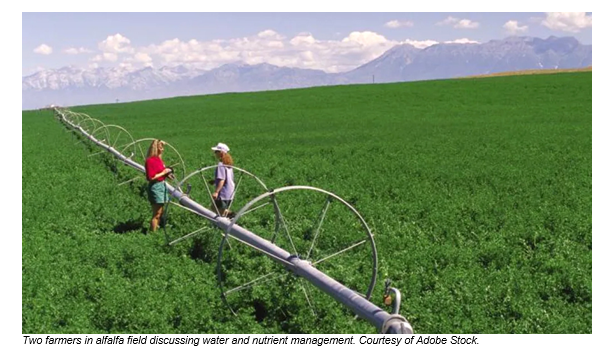
Alfalfa Seed and Alfalfa Forage System Program (ASAFS) supports the development of improved alfalfa forage and seed production systems. Proposals submitted to ASAFS should address one or more of the following priorities:
The ASAFS is an integrated research and Extension program that supports technology transfer to improve overall agricultural productivity, profitability and conservation of natural resources through conventional and organic alfalfa seed and forage production systems.
Application deadline is May 2. For more information, read the ASAFS funding opportunity
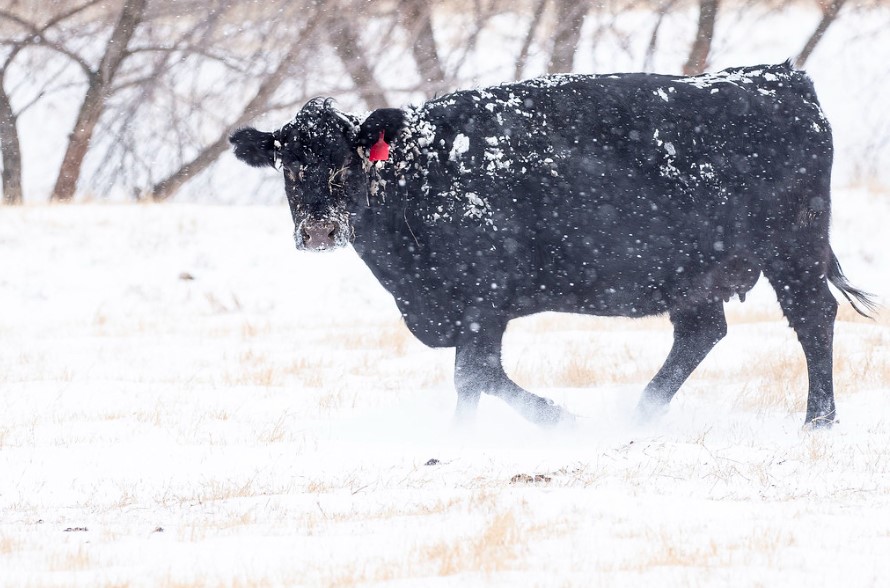
Farm Director, KC Sheperd, is talking with DVM, Oklahoma State University State Extension Beef Cattle Specialist, Rosslyn Biggs, about caring for livestock in cold weather and preparations to make beforehand. Biggs also talks about OSU's study on internal parasites, the Integrated Beef Cattle Program, and the upcoming Oklahoma Veterinary Conference.
Biggs said older cows and baby calves will need the most care regarding shelter and nutrition during colder weather. Calves can sustain injuries due to freezing conditions that can impact their ears and more, Biggs added.
Bulls do not need to be forgotten during extreme cold weather either, Biggs said, as they can sustain injuries that can have a negative impact on breeding.
"Make sure we have bedding for these animals where they can get down and be warm and out of the wind," Biggs said.
Biggs also stressed the importance of feeding cattle well before the cold weather hits and having backup plans for water issues. For calving during colder weather, Biggs said she likes to have a calving kit ready to go at all times.
The calving kit may be different for everyone, Biggs said, but it should consist of items such as medications, trash bags, colostrum, a veterinarian's number, and more.
Biggs also gave an update on OSU's study on internal parasites, which was first discussed in a previous interview.
The study began in the fall of 2023, Biggs said and evaluates the resistance of parasites in cattle of all ages.
Anthelmintic (dewormer) resistance is a growing concern, and OSU researchers are evaluating levels in Oklahoma beef cattle herds through ongoing studies. This research is important for the cattle industry in developing parasite management strategies that preserve the effectiveness of dewormers while maintaining cattle production levels for the future.
Ideally, Biggs said they are looking for at least 50 different groups of cattle from all over the state. Individual operations, depending on size, Biggs added, could have multiple groups within their operation.
For the study, Biggs said they are looking for groups of about 20 head of cattle in each group.
Biggs said producers will first use their routine dewormer, then fecal samples will be taken to see how well the dewormer worked on the cattle.
"We are trying to make sure that if you are using a product, it is effective," Biggs said.
Producers interested in participating in the study can sign up and read more online at https://okstatecasnr.az1.qualtrics.com/jfe/form/SV_cAtiVIHwoLyow50
Producers can also sign up by contacting their local extension educators, or Dr. Rosslyn Biggs directly at rosslyn.biggs@okstate.edu.
Sheperd also talked with Biggs about the Integrated Beef Cattle Program at Oklahoma State University's School of Veterinary Medicine. Biggs said the program is aimed at addressing the shortage of rural veterinarians and to provide more tools for veterinarians and students. Click the listen bar above the story to hear the full conversation

The Oklahoma Association of Conservation Districts (OACD) is excited to announce new financial support from General Mills for the CARE program – an initiative in partnership with the Oklahoma Black Historical Research Project Inc. (OBHRPI).
The goal of the CARE program is to increase the number of farmers and ranchers in Oklahoma participating in conservation planning and programs to improve soil health, water quality and the viability of working lands.
The CARE program focuses on providing resources and assistance to socially disadvantaged and veteran farmers and ranchers, expanding their knowledge of innovative technology, soil health, and invasive species eradication to sustain their farms, and empowering them to actively participate in all conservation programs. Since its inception in 2017,
the CARE program has made significant strides, reaching and positively impacting more than 7,000 producers.
"At General Mills, we know the influence local organizations have to reach farmers and help advance regenerative agriculture in their communities," said Jay Watson, director regenerative agriculture, General Mills.
"We strongly believe in the purpose of the CARE program and support their efforts to ensure everyone has access to the resources and assistance required to help restore the health of our planet
and improve farmer livelihood."
'Being a Care Champion has brought a lot of benefits," said Milford Roberts, CARE program. "We've been able to learn a lot about farming as well as attend meetings in other states to learn additional benefits from other farmers. We've also been able to plant grass as well as remove trees to make our acreage even stronger.
The program has given us about $12,000 gain per year."
"We are grateful for the support from General Mills, as it allows us to expand the reach and impact of the CARE program. This is the largest private offering in the history of our organization," said Sarah Blaney, Executive Director at the Oklahoma Association of Conservation Districts. "Together with our partners, we are working towards a more inclusive agricultural landscape, ensuring that all farmers and ranchers have equal opportunities to benefit from conservation programs."
The Oklahoma Association of Conservation Districts and the Oklahoma Black Historical Research Project Inc. remain deeply committed to fostering diversity and inclusion in the agricultural community.
Organizations, companies, and producers looking to support and engage with the CARE program can learn more here.
| |||||||||||||||||||||||||||||||||||||||||||||||||||||||||||||||||||||||||||||||||||||||||||||||||||||||||||||||||||||||||||||||||||||||||||||||||||||||||||||||||||||||||||||||||||||||||||||||||||||||||||||||
|
NASDA members, the state commissioners, secretaries and directors of agriculture, have chosen five issues to serve as the organization's primary policy focus for 2024. They include the 2024 Farm Bill, food safety, labor reform, pesticide regulation and PFAS.
NASDA CEO Ted McKinney remarked on the gravity of these issues for 2024.
"These issues were chosen for the organization's 2024 focus as NASDA members see urgent need for action in these areas to support farmers and ranchers in their ability to grow our nation's food, fiber and fuel. Further, we believe these are the areas where state departments of agriculture are uniquely positioned to champion policy solutions this year," McKinney said.
NASDA has published one-pagers offering background and insight for each policy priority.
2024 Farm Bill
NASDA implores Congress to expedite passage of a unified farm bill that secures a commitment to American agriculture, notably its farmers and ranchers, and the critical food and nutritional assistance programs for those who need it most.
Food Safety
State departments of agriculture are the frontline in protecting consumers against foodborne illness and food contamination. NASDA will continue to advocate for funding state Food Safety Modernization Act programs to protect our food supply and ensure farmers across the country are equipped with the information needed to apply Food Safety Modernization Act requirements on their farms.
Labor Reform
Farmers and ranchers need a legal, reliable guest worker program that provides a workforce that supports farms and ranches and treats workers respectfully. Reforming the H-2A program would provide farmers and ranchers with a legal and reliable workforce while curbing rising food prices and maintaining our global competitiveness.
Pesticide Regulation
In 43 states and Puerto Rico, the state department of agriculture is a co-regulatory partner with EPA and is responsible for administering, implementing and enforcing the production, labeling, distribution, sale, use and disposal of pesticides under the Federal Insecticide, Fungicide, and Rodenticide Act which establishes a rigorous, scientific evaluation and review process for these tools. EPA has stated that the agency faces several challenges in developing timely and effective strategies that protect listed endangered species in a way that is both practical for pesticide users to implement and timely to protect species. NASDA, as always, stands ready to work with EPA on developing an Endangered Species Act compliance strategy that growers can support and comply with while safeguarding endangered species.
PFAS
Per-and-poly-fluoroalkyl substances (PFAS) are steadily emerging as a major issue to society at large, including farmers and ranchers in the United States. NASDA supports urgently funding additional federal research to answer questions and concerns regarding the presence of PFAS in our society and the degree to which it presents risk. NASDA also supports developing strategies to address the presence of PFAS should it be found on or around farms. Our country must ensure farmers and ranchers keep their agricultural land and animals healthy and productive.
Read more about each of the 2024 policy priorities and all NASDA's policy work at NASDA.org/policy.
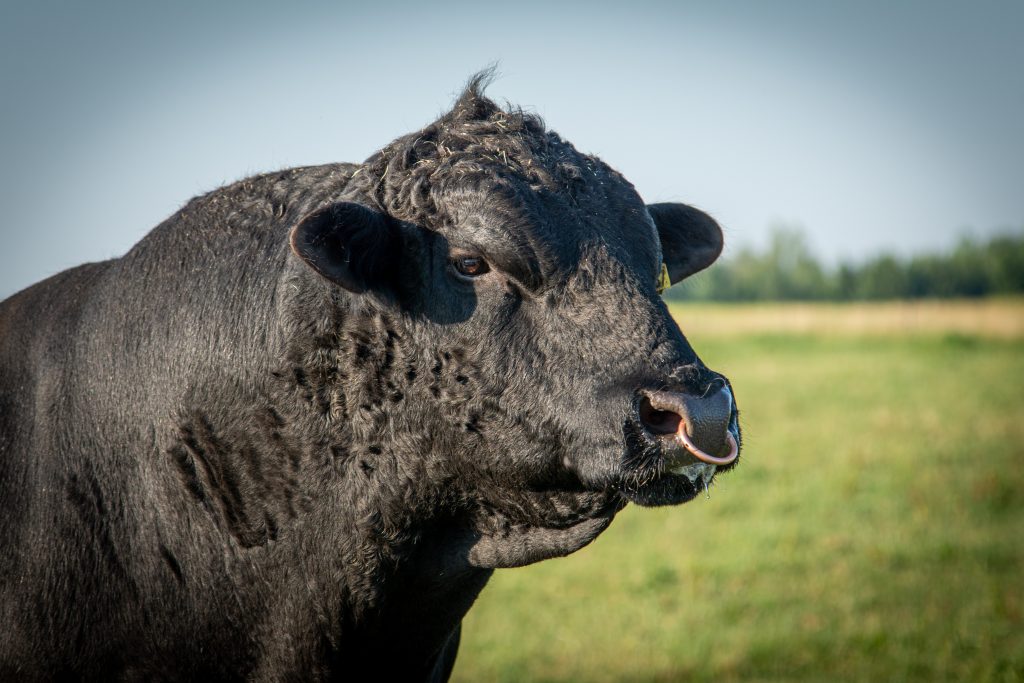
Mark Johnson, Oklahoma State University Extension Beef Cattle Breeding Specialist, offers herd health advice as part of the weekly series known as the "Cow Calf Corner," published electronically by Dr. Peel, Mark Johnson, and Paul Beck. Today, Johnson talks about the value of a good bull.
The spring bull buying season is here it's time to revisit the age old question. The question has been asked forever, or at least as long as we have been breeding cattle with a notion of trying to make the next generation better. It is a classic and timeless question. It is an important question. At this time of year, when many bulls are being marketed and we are planning ahead for spring breeding season, it is a question that is asked a lot!
The Answer
I remember first hearing the answer nearly 40 years ago as a student at OSU. "A good bull is worth the value of five calves he sires." I've heard that answer again many times over the years. It is a good answer and a good rule of thumb to follow, the problem is it doesn't exactly narrow down the range. If we do a little "cowboy math," this answer may in fact lead to more questions. Such as .........
What is considered a "Good Bull"?
For this discussion, qualifications to meet "Good Bull" status are:
When are we marketing our Calves? What is their Value?
According to the most recent Oklahoma Market Report:
521 lb. weaned steer calves (Large, 1) are worth about $2.96/lb. for a value of approximately $1,542 per head. Therefore, if my future marketing plan is to sell weaned steers, $1,542 x 5 = $7,710 is the answer.
910 lb. yearling steers (Large, 1) are worth about $2.09/lb. for a value of $1,902 per head. Therefore, if my future marketing plan is to sell yearling steers, $1,902 x 5 = $9,510 is the answer.
1,400 lb. finished beef steers are worth $172.50/cwt live for a value of $2,415 each. Therefore, if my future marketing plan is to retain ownership through finishing and sell fed cattle on a live weight basis, $2,415 x 5 = $12,075 is the answer.
So, in the current market, a good bull is worth somewhere between $7,710 - $12,075 to a commercial cattle operation. Where exactly in that range depends on your marketing plan and the market conditions at that time. Not an exact number because there are many variables in play. One key point illustrated here is that the longer you own the offspring before marketing, the greater the value of the bull to your operation. Retained ownership gives you more time and opportunity to capture the value of your investment in genetics. It is noteworthy that we haven't considered the value added to replacement females if we select daughters as our next generation of cows. Bulls used to sire the next generation of cows have a greater long-term economic impact on the profit potential of your operation.
I encourage cow-calf operations to consider their production system and marketing plan. Doing so should dictate where to apply selection pressure. Genetic values pay when you purchase bulls capable of improving genetic potential for the specific traits that will translate to added value at your intended marketing endpoint.
Keep the following chart in mind as another way to evaluate ownership cost of bulls on a per calf sired basis.
Bull Purchase Price: $6,000 $9,000 $12,000
$40 $60 $80
Cost per calf sired - assuming 150 calves sired over duration of time as a herd bull.
Below, Mark Johnson, OSU Extension beef cattle breeding specialist, discusses the worth of a good bull on SunUpTV from March 4, 2023.
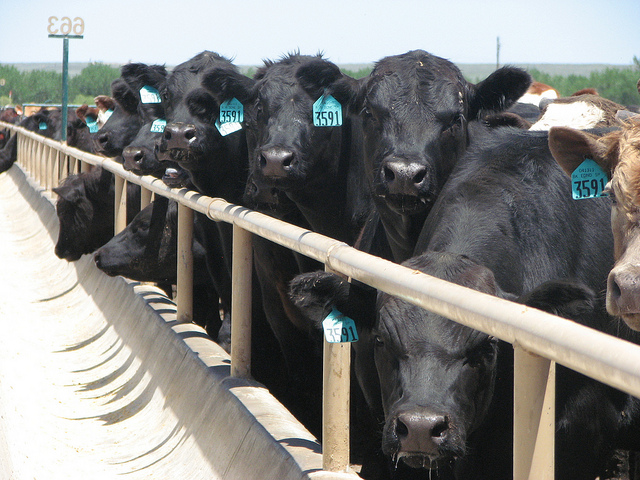
Senior Farm and Ranch Broadcaster, Ron Hays, is talking with Oklahoma State University Livestock Market Economist, Derrell Peel, about the latest USDA Cattle on Feed Report released on January 19, 2024.
In the January Cattle on Feed Report, Peel said placements in the month of December came in at 96 percent of a year ago. Peel said marketings in December came in at 99 percent of a year ago.
Peel said the on-feed total for the report was 102 percent of last year.
"We are still carrying more cattle compared to a year ago into the new year, but this report was very close to expectations," Peel said. "No surprises. I don't think there will be any market reaction to it from the standpoint of the general report."
Peel said the fact that cattle numbers peaked in 2019 and have been declining for five years says that at some point, feedlot inventories will come down. Due to drought and strong markets last fall, Peel said the industry has been pulling cattle ahead.
"One of the things we continue to do is place and feed a lot of heifers," Peel said.
For the short run, Peel said feedlot inventories have been held longer than he expected.
Heifers on feed for January have shown a fractional decrease from October, Peel said, but they are still making up about 40 percent of cattle in the feedlot.
"If you look at the absolute number of heifers on feed, the breakdown of steers and heifers, that data goes back to 1994," Peel said. "This is the largest January heifer on feed total in that data series."
There is still no herd rebuilding in sight, Peel said, as it appears the initial steps have not been taken to start that process.
Over on the dairy side, Peel said the fact that sex semen is being used to produce heifers means that part of the bigger heifer crop can be attributed to the dairy industry.
"In my travels over the last two to four weeks, it appears pretty strongly that we have more stocker cattle out on wheat in the southern plains, at least in Oklahoma, than we have had in several years," Peel said. "Obviously, a significant number of those are heifer calves. The cow-calf producers may have sold their heifers because they needed the money."
Even if the cow herd rebuilding process starts today, Peel said, the best result that would come from those actions would be stable cow numbers compared to January 1st.
"It is going to be a slow rebuild process that really probably couldn't start much now before 2025," Peel said.
With weather and other factors at play, Peel said there is no guarantee that liquidation will come to a halt in 2024.
"If we do, then I think the best that can happen is that we just stabilize," Peel said. "It is going to be a lengthy process here. If you start with a heifer calf in 2024, you are talking about 2026 to 2027 before you see any increase in beef production."
The Beef Buzz is a regular feature heard on radio stations around the region on the Radio Oklahoma Ag Network and is a regular audio feature found on this website as well. Click on the LISTEN BAR for today's show and check out our archives for older Beef Buzz shows covering the gamut of the beef cattle industry today.
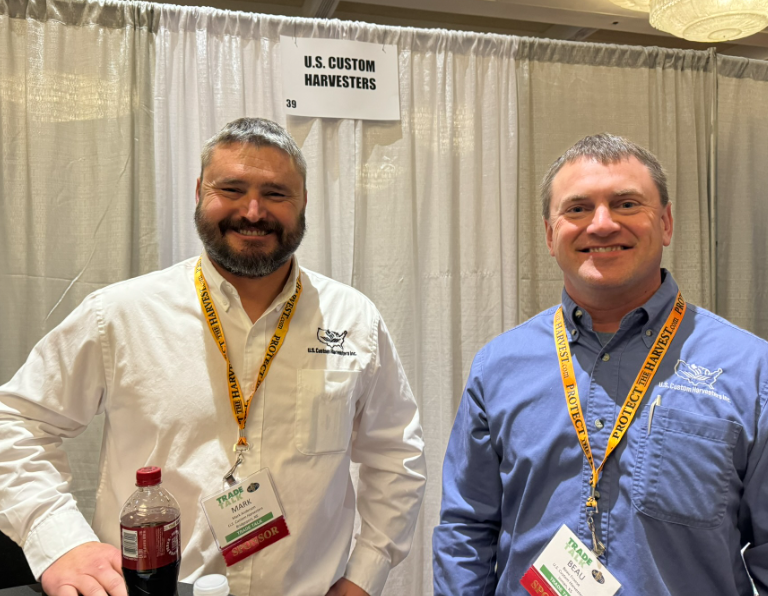
U.S. Custom Harvesters, Inc. (USCHI) will host their Annual Convention in Oklahoma City, OK from January 25-27, 2024, and gather more than 800 members in the custom harvesting industry.
Oklahoma City's new Convention Center will host USCHI members. The Annual Convention will feature a tradeshow showcasing 142,590 square feet for vendors and associate members, combine clinics, forage clinics, state meetings, speaker sessions, women's and kids' events, a children's safety day, musical entertainment from Wade Hayes.
The tradeshow will feature sponsors such as Case IH, CLAAS of America, John Deere, JCB North America, Krone North America, and more to demonstrate the newest equipment, services, and technology harvest crew owners.
Ag Secretary Blayne Arthur will be speaking to the group on Thursday to talk about Oklahoma Agriculture. Several Guest speakers will be on hand covering topics from USCHI updates, Triad Safe Shopping, Combine Clinics, Forage Clinics & More.
To find out more information on the event, click here.

Attorney General Gentner Drummond said he is pleased the U.S. Supreme Court has announced it will hear the case of Oklahoma death row inmate Richard Glossip. Drummond had supported Glossip's July 2023 petition to the high court for a writ of certiorari to hear the case.
As the state's chief law enforcement officer, Drummond has contended Glossip's conviction for the 1997 murder of Barry Van Treese should be vacated and remanded back to district court amid revelations of false testimony by the prosecution's key witness.
"Public confidence in the death penalty requires the highest standard of reliability, so it is appropriate that the U.S. Supreme Court will review this case," Drummond said. "As Oklahoma's chief law officer, I will continue fighting to ensure justice is done in this case and every other."
Despite the State's extraordinary admission of error in Glossip's trial, the Oklahoma Court of Criminal Appeals rejected the death row inmate's application last April for post-conviction relief. That ruling prompted Glossip's request for the Supreme Court to take up his case. The court granted him a temporary stay of execution in May.
Glossip was initially charged with accessory to murder on Jan. 15, 1997, after the murder of his boss, Van Treese. A co-worker of Glossip's confessed to beating Van Treese to death in an Oklahoma City motel room. As part of a plea agreement to avoid the death penalty, the co-worker testified that Glossip offered to pay him for the killing.
As a result, Glossip was charged and eventually convicted of first-degree murder in 1998. The co-worker, who was the prosecution's star witness, was convicted and received a sentence of life without the possibility of parole.
The Oklahoma Court of Criminal Appeals later overturned Glossip's conviction for ineffective assistance of counsel, but he was again convicted and sentenced to death at a 2004 retrial.
With the case long mired in controversy, Drummond began seeking answers shortly after taking office. He quickly learned that the State had withheld specific materials from Glossip's defense team. The Attorney General quickly provided access to these items, referred to as "Box 8," and appointed an independent counsel to conduct a thorough review of the case.
Evidence in Box 8 led to the revelation in January that Glossip's co-worker – the prosecution's star witness – had been allowed to give false testimony that failed to disclose he had been prescribed lithium by a psychiatrist for a serious psychiatric condition.
The Supreme Court is expected to hear oral arguments later this year.

This year, U.S. farmers and producers have experienced droughts, high rainfall, and other weather events affecting the corn harvest, making it more critical than ever to analyze mycotoxin risks across the nation. The Alltech 2023 U.S. Harvest Analysis has collected and assessed almost 450 new-crop samples from across the U.S., and the results show regional variation in mycotoxin risk. Samples showed lower risk in the upper Midwest and higher risk in the East. A combination of drought and untimely rains led to much of the risk.
Mycotoxins are produced by certain species of molds and are a concern for livestock producers, as they can influence feed quality and subsequent animal health and performance. The Alltech U.S. Harvest Analysis, a decade-long initiative, is a comprehensive step in understanding the complexities of new-crop quality, mycotoxin prevalence, and the threat that mycotoxins pose to animals and producers. To determine the most accurate representation of mycotoxin risk across the U.S., samples are collected by Alltech representatives and sent to the Alltech 37+®laboratory at the company's headquarters in Kentucky, which can detect up to 54 individual mycotoxins.
The corn silage and corn grain crops for the U.S. in 2023 have been a "moving target" for mycotoxin risk, according to Dr. Max Hawkins, technical support manager with Alltech's mycotoxin management team.
"Drought in the Southwest and the Western Corn Belt created distinct fumonisin risks in this region, while further eastward, late season rainfall created ideal conditions for Fusarium toxins such as type B trichothecenes to flourish," he said.
As always, Dr. Hawkins recommends routine monitoring of these ingredients during storage, noting, "Ingredients will rarely be in better condition than when they are harvested.''
Key insights from the Alltech 2023 U.S. Harvest Analysis include:
•Dry conditions in the West created more fumonisin risk, while the later, rain-affected harvest in the East resulted in higher levels of deoxynivalenol (DON).
•In general, the mycotoxin challenge in corn grain and corn silage is lower in 2023 than in recent years. However, there are still pockets of higher risk in the Midwest and the South.
•A surprisingly high risk of aflatoxin B1 was identified in Iowa this year. Another surprising find was Penicillium present in grains, since they are typically a concern in forages.
•A good amount of corn went into storage at 14% moisture this year. It will be crucial to monitor corn coming out of storage, as it may be at higher risk now than when it was first stored.
Corn
Mycotoxin levels continue to be higher in the East and Midwest U.S., specifically for Fusarium mycotoxins such as deoxynivalenol (DON). Earlier harvest conditions and drier conditions in the West helped to create lower risk conditions. However, producers there should be aware of a higher fumonisin risk.
More than 190 new-crop corn grain samples were analyzed this year, and results show an average of 4.4 mycotoxins per sample, with 87% of samples having multiple mycotoxins. Beyond the DON and fumonsin risks already described, another interesting finding was a high level of aflatoxin B1 identified in Iowa. Producers should be vigilant about testing their grains.
Corn silage
Drought early in the growing season negatively affected corn silage in the West this harvest season. The stress of dry conditions followed by moisture allowed certain molds to flourish, particularly Fusarium molds. In the East, the risk was varied, but overall higher. Feed and livestock producers are encouraged to continue to monitor and test silage in storage every 60 to 90 days. This will help inform them of the mycotoxin risk they are facing as the season progresses.
The Alltech 2023 U.S. Harvest Analysis demonstrates that mycotoxins are an ongoing, dynamic issue that livestock producers need to manage. Although testing directly post harvest provides an overview of regional contamination patterns, what happens before the animal receives the feed — including storage conditions post harvest and feeding practices on-farm — can influence what the animal will actually be ingesting in terms of mycotoxins. To best manage this ongoing challenge, producers should consider a routine testing program that can uncover the specific risks. With this information, informed choices can be made on what mitigation strategies are necessary to support the health and performance of the animals.
To access the complete report, as well as a series of videos that provide further species-specific insights, visit Alltech 2023 U.S. Harvest Analysis. For more information about Alltech Mycotoxin Management solutions, visit knowmycotoxins.com.
In a few short days, thousands of cattlemen and women will gather in Orlando, Florida, for CattleCon24, the largest cattle industry event in the country. Registration is available online or on-site, so make plans to join the excitement in the Sunshine State.
Arrive early for an engaging half-day Grazing Management Workshop on Tuesday, Jan. 30, where experts will discuss benefits of pasture and grazing management, assessing pasture condition, forage growth and quality, the latest technology resources, fencing strategies, drought management and water resource management. The workshop will feature targeted breakout sessions, based upon average annual rainfall, providing grazing solutions that are catered to different regions across the country. Producers will be provided with a grazing workbook so they can leave with a completed grazing management plan for their operation.
CattleCon24 officially kicks off on Wednesday, Jan. 31, with Buzz Brainard, host of Music Row Happy Hour, returning as emcee. The Opening General Session will feature former professional football player and sleight-of-hand magician, Jon Dorenbos, sharing his humbling story. Dorenbos played professional football for 14 years before a life-threatening heart condition ended his athletic career. Adversity didn't keep Dorenbos down, whose passion for magic made him a top contender on America's Got Talent.
Thursday morning begins with the Beef Checkoff-funded Beef Quality Assurance (BQA) program's Celebration of Excellence, honoring BQA award winners and featuring keynote speaker Jim Carroll. Carroll, a renowned futurist, author, and innovation expert, will share the knowledge and foresight needed to embrace the ever-changing agricultural landscape, shedding light on the trends and technologies that are shaping the future of the cattle industry.
The final day begins with CattleFax conducting their U.S. & Global Protein and Grain Outlook Session. Randy Blach, the team at CattleFax and meteorologist Matt Makens will discuss what 2024 and beyond might look like for the cattle industry.
Throughout CattleCon, the 31st annual Cattlemen's College will include educational sessions with industry leaders tackling innovative topics. Other highlights include a D.C. Issues update, Sustainability Forum and Beef Industry Forum. The Cattle Feeders Hall of Fame banquet and Environmental Stewardship Award Program reception will recognize leaders for their achievements, and there will be more than eight acres of trade show displays and exhibitors to explore.
While the general sessions are packed with engaging speakers and information every producer can use, entertainment will also be around every corner. Anna Sponheim, winner of the 11th annual NCBA National Anthem Contest, will perform at the Opening General Session, Paul Bogart will bring his down-to-earth charm and country music to Thursday night's Palm Tree Pachanga, and The Bellamy Brothers will headline the Cowboys & Coasters event on Friday night.
In addition, producers will be hard at work guiding both NCBA policy and Beef Checkoff programs. Annual meetings of the National Cattlemen's Beef Association, the Cattlemen's Beef Board, American National CattleWomen, CattleFax and National Cattlemen's Foundation will also take place.
Make plans to attend CattleCon24 in Orlando, Florida. For more information and to register, visit convention.ncba.org.
Today, Clean Fuels Alliance America welcomed EPA's release of Public Data for the Renewable Fuel Standard, including final production volumes for 2023. EPA's data shows that U.S. production of biomass-based diesel – including biodiesel, renewable diesel, sustainable aviation fuel (SAF), and heating oil – reached 4 billion gallons in 2023. Both domestic production and use of advanced biomass-based diesel grew by 1 billion gallons in 2023, compared to 2022.
"The clean fuels industry achieved what EPA said could not be done – namely continued growth of advanced biodiesel, renewable diesel, SAF and heating oil from sustainably sourced feedstocks," said Kurt Kovarik, Vice President of Federal Affairs for Clean Fuels.
In June 2023, EPA finalized Renewable Fuel Standards for 2023, 2024 and 2025 that provided only moderate increases in the biomass-based diesel and non-cellulosic advanced volumes each year. EPA established a mere 60-million-gallon increase in biomass-based diesel volumes for 2023 and only a 530-million-gallon increase for 2024 and 2025. Clean Fuels advocated increased growth of 500 million gallons for the biomass-based diesel category each of the three years. Kovarik continued, "Our industry – including producers, oilseed processors, fuel distributors and marketers – has made significant investments to make clean fuels available to more consumers and rapidly decarbonize heavy-duty transportation fuels, including for aviation and marine markets. EPA's data demonstrates that the rapid, sustainable growth we projected is being achieved. Clean Fuels and its members remain extremely disappointed that EPA refused to recognize and support sustainable growth of biodiesel, renewable diesel, and SAF."
EPA's final 2023 production numbers confirm sustainable growth of biomass-based diesel.
Today, Clean Fuels Alliance America welcomed EPA's release of Public Data for the Renewable Fuel Standard, including final production volumes for 2023. EPA's data shows that U.S. production of biomass-based diesel – including biodiesel, renewable diesel, sustainable aviation fuel (SAF), and heating oil – reached 4 billion gallons in 2023. Both domestic production and use of advanced biomass-based diesel grew by 1 billion gallons in 2023, compared to 2022.
"The clean fuels industry achieved what EPA said could not be done – namely continued growth of advanced biodiesel, renewable diesel, SAF and heating oil from sustainably sourced feedstocks," said Kurt Kovarik, Vice President of Federal Affairs for Clean Fuels.
In June 2023, EPA finalized Renewable Fuel Standards for 2023, 2024 and 2025 that provided only moderate increases in the biomass-based diesel and non-cellulosic advanced volumes each year. EPA established a mere 60-million-gallon increase in biomass-based diesel volumes for 2023 and only a 530-million-gallon increase for 2024 and 2025. Clean Fuels advocated increased growth of 500 million gallons for the biomass-based diesel category each of the three years. Kovarik continued, "Our industry – including producers, oilseed processors, fuel distributors and marketers – has made significant investments to make clean fuels available to more consumers and rapidly decarbonize heavy-duty transportation fuels, including for aviation and marine markets. EPA's data demonstrates that the rapid, sustainable growth we projected is being achieved. Clean Fuels and its members remain extremely disappointed that EPA refused to recognize and support sustainable growth of biodiesel, renewable diesel, and SAF."
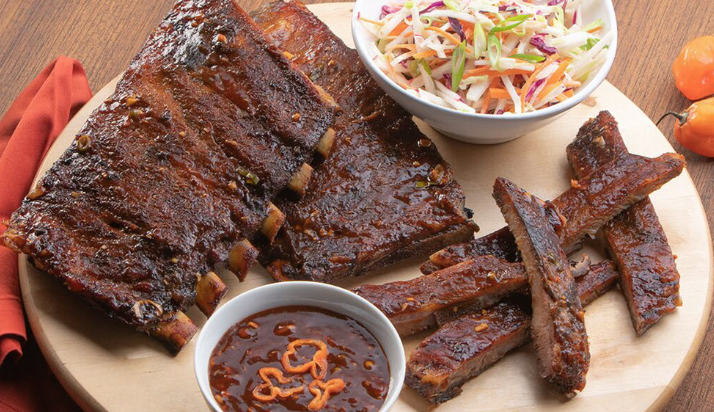
Looking ahead, NPB remains dedicated to growing strong relationships within the foodservice industry. NPB is actively engaged in efforts to build trust and add substantial value to foodservice distributors. Stay tuned for more exciting developments in 2024 as NPB helps to bring more pork to food service partners.
NPB and three pork producers were invited to participate in a panel discussion at UniPro's Center of the Plate Protein Symposium in September 2023. The focus of the panel was on real on-farm sustainability efforts. Producers shared their on-farm reports, revealing that two out of three were carbon-negative. This event sparked interest in additional opportunities with foodservice corporation, UniPro.
In October 2023, NPB invested checkoff funds to grow the value of the loin/rib complex in collaboration with UniPro, a promotional campaign featuring both bone-in and boneless pork loins, as well as spare ribs.
UniPro Foodservice, Inc., boasting over 460 members, stands as a foodservice distribution cooperative. It provides nationwide access to exclusive purchasing opportunities with premier suppliers through its Group Purchasing Organization (GPO). As a federation of independent distributor members, UniPro offers various services and programs to empower its members in the competitive foodservice industry.
The campaign initiative was exclusively offered to distributor members participating in the GPO program. The Checkoff funds that were invested in this campaign were equally distributed to UniPro members who met the qualifying purchases.
To measure true incremental growth, UniPro members were required to demonstrate sales of loin and rib complexes in both 2022 and 2023, with a minimum of 1,000 pounds of growth. The collective results were remarkable – across 25 members, more than 1 million pounds of loin and rib complex were sold, an increase of nearly 330,000 pounds from the previous year.
Looking ahead, NPB remains dedicated to growing strong relationships within the foodservice industry. NPB is actively engaged in efforts to build trust and add substantial value to foodservice distributors. Stay tuned for more exciting developments in 2024 as NPB helps to bring more pork to food service partners.
Registration for our 2024 Annual Convention is now open! Our 122nd Anniversary Convention will be hosted in Scottsdale, Arizona from March 10-12 where attendees will hear from prominent speakers, have the opportunity to participate in breakout sessions, and – most importantly – participate in our grassroots policy development process.
Many Farmers Union state offices handle registration directly, so please make sure to check with your state division before registering here. We will have updates and announcements for convention rolling out throughout the rest of the year and early 2024, so be on the lookout for those!
Four-legged friends often play a vital role on family farms and ranches, prompting Farm Bureau to launch the Farm Dog of the Year contest several years ago – now a popular feature of the American Farm Bureau Federation's Convention.
The winner of the 2024 Farm Bureau Farm Dog of the Year award is Skippy, owned by Georgia Farm Bureau members Donald and Laura Adams. AFBF, with support from Nestlé Purina PetCare, recognized Skippy, three regional runners-up and a People's Choice Pup today at its convention.
"It has been a pleasure partnering with Purina for the sixth annual Farm Dog of the Year contest, providing the public a glimpse of daily life on the farm," said AFBF President Zippy Duvall. "Although farmers and ranchers love what they do, it's well known that farming can be stressful. Farm dogs can help ease the burden, because they often play a dual role as both working dogs and companions to farm families."
Rounding up livestock and chasing off predators are among the many tasks performed by farm dogs. The contest celebrates farm dogs that work alongside farmers and ranchers as they sustainably produce nutritious food for families and their pets across America.
Skippy, the grand prize winner of the 2024 Farm Bureau Farm Dog of the Year award, is a 4-year-old mixed breed with Border Collie, Australian Shepherd and Catahoula hound in her lineage. She has been with the Adams for about two years. Working livestock – helping move beef cattle where they need to go – is Skippy's primary role on the farm.
"Skippy's a partner, she's a pet and she helps us with the cattle every day," Donald said. That assistance was necessary after he was injured on the farm in 2019 – paralyzed from the neck down – and faced a long road to recovery. "Being able to keep the cows and having something for me to live for every day...she has contributed to that immensely," he said.
Laura Adams sheds more light on the farmer-farm dog connection and what having Skippy means to them: "Skippy and Donald had an instant bond from day one. Getting a farm dog changed our lives." They received Skippy from P.H.A.R.M Dog USA, which supports farmers and farm family members with physical, cognitive or illness-related disabilities.
Purina donated prizes for the contest again this year. This included $5,000 in prize money, a trophy plate, a year's supply of Pro-Plan dog food and other Purina products for Skippy. The company has been helping dogs and cats live longer, healthier lives through scientifically based nutritional innovations for more than 90 years.
"Purina is proud to support the sixth annual Farm Dog of the Year competition with the American Farm Bureau, and we applaud this year's winner, Skippy," said Jack Scott, vice president of sustainable sourcing at Nestlé Purina PetCare. "We believe people and pets are better together, and Skippy's role on the farm along with her bond to Donald perfectly exemplifies what this contest is about."
Three regional runners-up in the contest will each receive $1,000 in prize money, a trophy plate and Purina products. They are:
Cinco, owned by Caleb and Samantha Smith, Utah members (Western region);
Meg, owned by Michelle Wilfong, West Virginia member (Northeast region); and
Fancy, owned by Miles Bailey, Missouri member (Midwest region).
A panel of judges with expertise in the pet care industry, veterinary medicine and communications reviewed more than 100 nominations to select the 2024 Farm Dog of the Year. Judging criteria included the dog's helpfulness to the farmer and his/her family, playfulness and their role in making life better on and off the farm. Farm Bureau members submitted written responses to questions, photos and video clips to nominate their dogs for Farm Dog of the Year.
People's Choice Pup
More than 100,000 people voted online in the People's Choice Pup part of the competition. Casper, owned by Georgia Farm Bureau member John Wierwille, was named People's Choice Pup.
Casper receives a trophy plate and Purina products. A $1,000 cash prize will be directly donated to Atlanta-based LifeLine Animal Project at the request of Wierwille. LifeLine cared for Casper after he was injured by coyotes while protecting his flock of sheep.
Four other dogs were contenders for People's Choice Pup: runner-up Cinco, owned by Utah members Caleb and Samantha Smith; Trip, owned by Ohio member Loralynn Kadell; Margo, owned by Indiana member Rachel Hyde; and Morgan, owned by Idaho member Megan Stark.
About NestléPurina PetCare Company
Nestlé Purina PetCare creates richer lives for pets and the people who love them. Founded in 1894, Purina has helped dogs and cats live longer, healthier lives by offering scientifically based nutritional innovations. Purina manufactures some of the world's most trusted and popular pet care products, including Purina ONE, Pro Plan, Fancy Feast and Tidy Cats. Its more than 8,000 U.S. associates take pride in the company's trusted pet food, treat and litter brands that feed 51 million dogs and 65 million cats every year. More than 500 Purina scientists, veterinarians and pet care experts ensure the brand's commitment to unsurpassed quality and nutrition. Purina is part of Nestlé, a global leader in Nutrition, Health and Wellness.
About American Farm Bureau Federation
The American Farm Bureau Federation is the Voice of Agriculture. We are farm and ranch families working together to build a sustainable future of safe and abundant food, fiber and renewable fuel for our nation and the world.
The American Simmental Association (ASA) held its 56th Annual Meeting the first week of January, 2024.
The Annual Meeting highlighted each committee's minutes for the previous year, and reflected on the successes of 2023, including the continued expansion of ASA research projects, data collection, funds raised by the American Simmental-Simbrah Foundation (ASF), the breed's presence at national events in 2023, and more. Each committee's full report will be available in print and online in the March 2024 edition of the Register magazine.
During the Annual Meeting, new and re-elected members of the ASA Board of Trustees were formally seated. In the South Central Region, Greg Walthall, Windsor, MO, was elected for a first term; and Victor Guerra, Linn, TX, was elected for a second term. In the North Central Region, Tim Clark, Turtle Lake, ND, was elected for a second term. In the Eastern Region, Mark Smith, Picayune, MS, was elected for a first term; and Chris Ivie, Summertown, TN, was elected for a second term. In the Western Region, Chad Cook, Walsh, CO, was elected for a second term.
New members of the Executive Committee were also officially seated during the Annual Meeting. Chris Ivie will serve as the Chairman of the ASA Board of Trustees. Victor Guerra will serve as Vice-Chairman, and Scott Trennepohl will serve as Treasurer. Position #1 and #2 were filled by Chad Cook and Ryan Thorson, respectively. Doug Parke, Paris, KY, will serve as the Immediate Past Chairman.
Founded in 1968, the American Simmental Association is headquartered in Bozeman, MT. ASA is committed to leveraging technology, education, and collaboration to accelerate genetic profitability for the beef industry. In keeping with its commitment, ASA, along with its partners, formed International Genetic Solutions — the world's largest genetic evaluation of beef cattle. Learn more at www.simmental.org.
Recent reports from USDA provide insight into the supply prospects for the 2024 winter wheat crop. The Winter Wheat and Canola Seedings publication on January 12, 2024, showed U.S. farmers planted 34.425 million acres of winter wheat for 2024, down about 6 percent from the 36.699 million planted for 2023. This is still the second-highest winter wheat seedings number in the last eight years. Texas planted 5.9 million acres compared to 6.4 million last year; Oklahoma planted 4.3 million compared to 4.6 million. Kansas, the top winter wheat producing state in the nation, planted 7.5 million acres for 2024, down from 8.1 million last year.
Winter wheat crop condition ratings are well above last year, raising prospects for better winter wheat yields and a better harvested-to-planted ratio in 2024 compared to 2023. The last USDA report available for the U.S. and specific states was November 26. Kansas updated its wheat crop condition ratings on December 31. The USDA has since suspended weekly crop condition rating reports until the first of April.
Over the last three years, the average harvested-to-planted percentage for winter wheat is about 71 percent. With a trendline yield of about 51 bushels per acre and 34.425 million planted acres, an early estimate of 2024 winter wheat production is 1.246 billion bushels, around last year's production and a little lower than the 10-year average production. Winter wheat production in 2023 was 1.248 billion bushels. The 10-year average production level is 1.286 billion bushels. A higher expected yield and harvested-to-plated ratio are expected to compensate for this season's lower acreage.
References
USDA, NASS Crop Progress, November 27, 2023 and January 2, 2024
USDA, NASS Quickstats, accessed January 17, 2024.
USDA, NASS Small Grains Summary, September 30, 2023
USDA, NASS Winter Wheat and Canola Seedings, January 12, 2024
Article courtesy of Welch, J. Mark. "2024 Winter Wheat Production Prospects." Southern Ag Today 4(4.1). January 22, 2024. Permalink
There is a new blog post out at the Southern Plains Perspective. The Southern Plains Perspective is authored by Clay Pope- who farms with his wife Sarah. Read Below!
If you follow the weather news (and if you live in Oklahoma and the Southern Plains you should) you already know that since about mid-summer we have been in a El Niño weather pattern. For those of you who don't know, El Niño is a climate phenomenon that describes the unusual warming of surface waters in the eastern tropical Pacific Ocean. This warming causes a shift in atmospheric circulation and precipitation patterns. It impacts ocean temperatures, the speed and strength of ocean currents and causes the low-level surface trade winds, which normally blow from east to west along the equator, to either weaken or start blowing from the other direction.
This change generally results in cooler than normal temperatures across the Southern Plains with higher amounts of precipitation, especially during the fall and winter. The impact of El Niño generally hits harder the further south you are. Because of this, how much this phenomenon actually effects Oklahoma and North Texas really depends on how strong the El Niño turns out to be.
This is important because since at least last April experts have been warning that we could be looking at the development of a "Super El Niño" due to the higher than normal sea temperatures at the surface in the central and eastern tropical Pacific. Basically what they are saying is that because this weather pattern develops with the warming of the eastern Pacific Ocean this El Niño could be stronger than normal since the water was already warmer to start with.
Now fast forward to this past December, when the National Oceanic and Atmospheric Administration (NOAA) came out with its latest prediction that says there is now a 54% chance of a "historically strong" El Niño during this winter season, potentially resulting in one of the five strongest El Niño events since 1950. For a point of reference, the last "Super El Niño" we had was in 2015. If you remember that far back, May 2015 was the wettest month EVER recorded in Oklahoma and Texas.
So are we heading for a super "Super El Niño?" Maybe, maybe not. A 54% chance for such an event means we have a 46% chance that it won't happen. On top of that some experts are calling for El Niño to play out early this spring and possibly switch over to a La Niña by late 2024. La Niña would result in the opposite of El Niño with higher temperatures and below normal precipitation in our part of the world. As a reminder, we just came out of a rare "triple dip" La Niña pattern last spring. This means that we had three years in a row of hot, dry conditions before we moved into our current weather pattern. The end of El Niño could also mean that we move into a neutral pattern in the Pacific, what Oklahoma State Climatologist Gary McManus sometimes refers to as the "La Nada" pattern.
Then what's on the horizon? Is it Super El Niño, La Niña or La Nada? You can't say for certain—we all know that weather conditions can change. But regardless of what happens, it's probably a good bet that we are looking at more extreme weather.
Now wild weather is not unusual for Oklahoma and the Southern Plains. What we need to keep in mind though is that we are dealing with a changing climate; and what climate change means for our region is that the crazy weather we have always had is getting shot full of steroids.
The droughts will be longer and hotter; the rains will be heavier and more violent; wildfires will be more likely and we can look forward to crazy winter events like a polar vortex, ice storms and blizzards. We have had these things before—now we will have them in spades.
That's why it's so important that we put some thought into planning for extreme weather. We need to harden our farms, ranches and communities to better ride through what mother nature is going to throw our way.
Will Rogers once said, "If you don't like the weather in Oklahoma, wait a minute." That statement is true now more than ever. We need to stay mindful of how extreme our weather can be-remember, it can change on a dime.
RON's Dave Lanning has a pre-opening look at today's agricultural Markets.
Click the audio tab below for today's report.

Congressman Frank Lucas Presented AFBF Distinguished Service to Agriculture Award by Zippy Duvall and Rodd Moesel
Oklahoma Third District Congressman Frank Lucas was presented with the Distinguished Service Award by the nation's largest general farm organization on Sunday during their annual convention in Salt Lake City. AFBF established the Distinguished Service Award in 1928 to honor individuals who have devoted their careers to serving the national interest of American agriculture. Lucas was nominated for the award by the Oklahoma Farm Bureau.
Lucas is a fifth-generation Oklahoman and farmer who has been a defender of agriculture for more than 40 years. With a bachelor's degree in agricultural economics from Oklahoma State University, he successfully brought the perspective of the American farmer with him to Capitol Hill. Elected to Congress in 1994, he is recognized as the longest-serving member on the House Agriculture Committee and served as chairman of the committee from 2011 to 2015, playing an instrumental role in the 2014 farm bill. Prior to serving in Congress, Lucas served in the Oklahoma State House of Representatives where he focused on prominent agriculture issues.
Lucas commended AFBF for the important role the organization plays in informing farmers about congressional happenings and making sure they can voice their opinions and needs. A lifelong Farm Bureau member, Lucas shared what receiving this award means to him.
"It's like having your family say you've done a really good job for them," Lucas said. "There's nothing more important than having your family acknowledge that your hard work has been for a purpose and accomplished things. I appreciate my Farm Bureau family acknowledging my 29 years of constantly working on their behalf. It's very kind of them."
Oklahoma Farm Bureau President Rodd Moesel shared the value Lucas' background brings to Capitol Hill, noting not many in his role go home on the weekends to complete a list of farm chores and move cattle.
"He's so rare because he is a real farmer and rancher. There are very few of those left in Congress," Moesel said. "He really understands our issues and is able to take those messages to Congress."
Farm Broadcast Colleague Jeff Nalley talked with Lucas in Salt Lake City and the former House Ag Committee Chair reiterated his appreciation to the farm group for this honor:
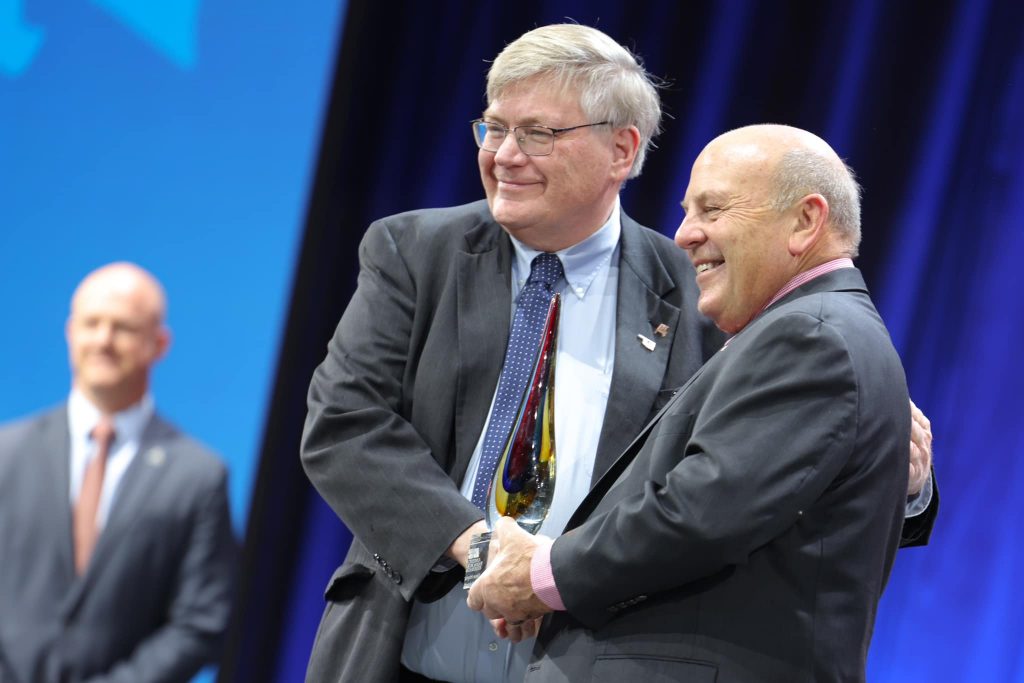
OkFB President Rodd Moesel a National New Horizon Award from AFBF President Zippy Duvall at 2024 AFBF Convention in Utah on Sunday
The American Farm Bureau convention opening session on Sunday, January 21st included the presentation of an AFBF New Horizon Award to Oklahoma Farm Bureau. The New Horizon Award is presented to one State Farm Bureau in each AFBF membership category, and OKFB's award recognizes the OKFB Capitol Camp, a legislative experience for Oklahoma 4-H and FFA members.
Held for the second time in the summer of 2023, Capitol Camp is an immersive two-day experience for high school juniors and seniors to learn about Oklahoma's legislative process and how bills become law through a mock legislature held on the floor of the Oklahoma House of Representatives. More than 70 4-H and FFA students gathered at the Oklahoma state Capitol in June of 2023 for Oklahoma Farm Bureau's second-annual Capitol Camp.
Throughout the event, students in attendance had the opportunity to present and lobby a piece of legislation they wrote about an issue important to them. Bills were first heard in committees, and those that advanced were heard on the House floor.
Capitol Camp delegates elected a governor, speaker of the House and floor leader to run floor sessions in the House chamber both days.
"I have been involved in agriculture policy a lot because it is something that I find extremely important because nothing happens without it," said Capitol Camp House Speaker Courtney Blagg of Nowata FFA. "This has been one of the best legislative experiences I have been to."
The 2023 American Farm Bureau Convention continues through Tuesday. Oklahoma Farm Bureau delegates will be representing the state during the resolution policy session on Tuesday that will conclude the annual meeting and set policy for the general farm organization for the coming year.
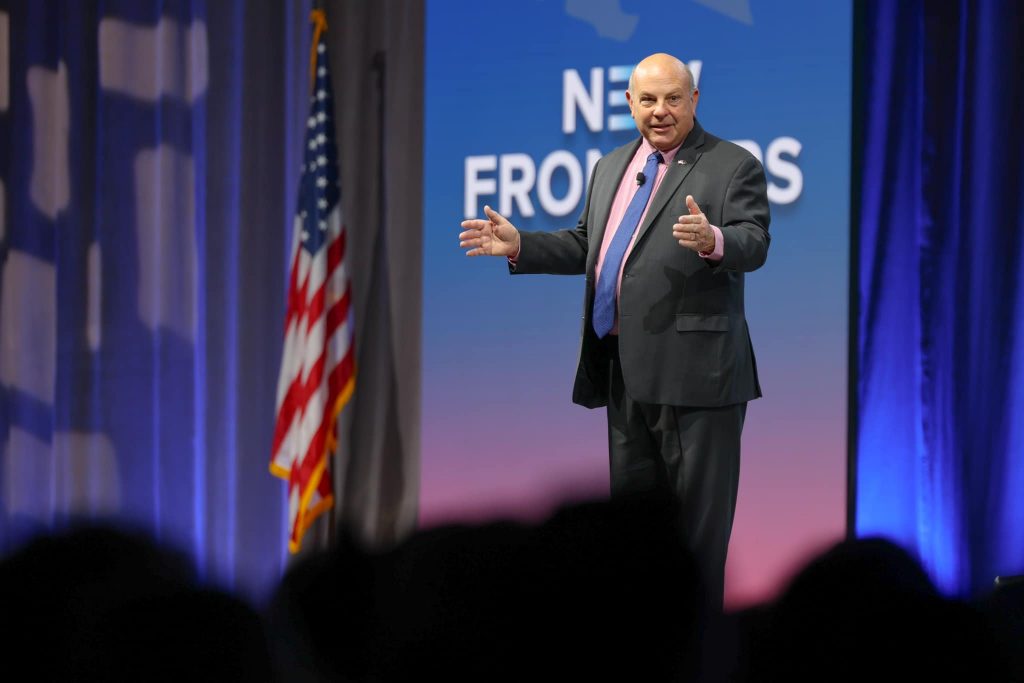
AFBF President Zippy Duvall at Opening General Session, AFBF Convention in Salt Lake City
A landmark alliance is launching free, anonymous, online mental health and wellbeing services to provide a nationwide safety net of confidential and on-demand support to farmers, ranchers and farm families. Unveiled at the American Farm Bureau Federation 2024 Convention, Farm Family Wellness Alliance's groundbreaking solution harnesses the best resource to build farm family wellness—access to a community, including a network of farmers and ranchers who understand the challenges and rewards that come with the agricultural way of life.
Access to services starts at Togetherall, a safe, clinically moderated peer-to-peer community, where members around the world are there to listen, support and give members' mental wellbeing a boost. Through an anonymous profile, users can access a global network of peers, backed by the safeguarding of licensed clinicians overseeing the community around-the-clock. Access to the platform is available to members of a farm family aged 16 and older.
In addition to Togetherall's global community, farmers and their families will have access to an agricultural sector sub-group to share or read others' experiences in a safe, judgement-free zone.
"Farming is tough even on the best days. That's why Farm Bureau has been committed to helping farmers and ranchers across the country get connected with the tools and resources they need to promote mental health and wellbeing—and to check in on their friends, neighbors and loved ones. Togetherall will help us all to do just that," said AFBF President Zippy Duvall." It's OK not to be OK, but it's not OK not to reach out when you're hurting. We are grateful for how this partnership will strengthen our rural communities and provide the support we all need.
The Farm Family Wellness Alliance is made possible through a coalition of organizations, including Farm Foundation, American Farm Bureau Federation, Farm Credit, CoBank, Iowa Farm Bureau, CHS, Land O'Lakes, National Farmers Union, 4-H, FFA, Agriculture Future of America, Togetherall and Personal Assistance Services. This coalition makes it possible to offer services to farm families nationwide and deepens the impact of an earlier pilot initiative started in Iowa with the addition of the Togetherall peer-to-peer support platform.
"Farm Foundation has been working towards the goal of improving farmer access to mental health and other wellness services for several years, with the Farm Family Wellness Alliance pilot starting in 2020 after the derecho in Iowa," said Shari Rogge-Fidler, president and CEO of Farm Foundation. "We are pleased to have been able to bring together this coalition of farmer-serving organizations into a partnership that allowed us to expand the program nationwide and will offer so much direct and immediate benefits to American farmers."
Togetherall also offers a range of wellbeing tools, such as self-assessments and access to additional support services through a partnership with Personal Assistance Services. Topics covered include anxiety, depression, financial health, improving sleep and more.
"Navigating the challenges of farming can be tough, and other farmers are often the only other people who can understand the unique stressors of the industry. Anonymous, safe, online peer support is a critical component on the mental health support continuum, and especially important in reaching communities such as farmers, who may otherwise not reach out for support," said Matthew McEvoy, CEO of Togetherall. "We are thrilled to partner with the Farm Family Wellness Alliance to offer Togetherall's online, clinically moderated, peer support community to all farmers and their families across the US."
The landmark alliance bringing Togetherall and Personal Assistance Services to farm families represents a broad swath of agricultural organizations, illustrating the far-reaching impacts of mental health and well-being in rural America.
"Farm Credit recognizes the challenges America's farmers and ranchers face, especially related to mental health and stress. Fewer resources exist in rural areas as compared to urban areas," said Todd Van Hoose, president and CEO of Farm Credit Council. "This free, anonymous, and safe access to mental health support offers assistance in a way nothing has before for rural Americans. We appreciate Farm Foundation's leadership in bringing this resource to fruition."
To learn more about the Farm Family Wellness Alliance and the services available through the Togetherall platform, go to www.farmfoundation.org/farm-family-wellness-alliance/.

Rep. Justin Humphrey, R-Lane, today responded to critics of legislation he filed that targets Hispanic gang members in an attempt to protect Oklahomans from illegal activity by Mexican and other drug cartels that have brought fentanyl and other illegal drugs into the state and that perpetuate other illegal activity such as sex and labor trafficking.
House Bill 3133, as it is currently worded, states that any person who is of Hispanic descent living within the state of Oklahoma; is a member of a criminal street gang as such term is defined in state statutes; and has been convicted of a gang-related offense enumerated in state statute shall be deemed to have committed an act of terrorism and will be subject to property forfeiture.
Humphrey said he hadn't considered the language offensive, but after consulting with others, he intends to change the measure to read something along the lines of anyone involved in a transnational criminal organization that includes documented and known gang affiliation.
"My recently filed House Bill 3133 has received massive criticism," Humphrey said. "The indignation seems to be over the use of the word Hispanic. It appears that calling out the Mexican cartel or Hispanic gangs has become racist.
"Border agents and narcotics agents have advised there are two Mexican Cartels – the Sinola and New Age Cartels – that are primarily responsible for the horde of drugs and fentanyl that is destroying and murdering thousands of Americans.
"When we see a plane fly into a building killing 3,000 people, we recognize that as an act of terrorism. But when a reported 107,000 people are illegally slain with illegal fentanyl, we remain silent and take no action. America has seen more people dying from fentanyl overdose in one year than American military members killed in the Korean and Vietnam wars combined. Yet, our government has not declared this an act of war or an act of terrorism. We have not declared these cartels or the gangs they employ as terrorists.
"House Bill 3133 seeks to rectify the government's indefensible failure. The bill seeks to identify, classify and punish these horrific terrorists.
"I have been shocked that America is being invaded and undergoing acts of terrorism resulting in at least 107,000 peoples' deaths, and yet the public's outrage is aimed at me for simply declaring the groups that are mainly responsible are Hispanic. When I declared Mexican cartels are Hispanic, there was moral outrage and accusations of racism. I believe these continual accusations of racism present an indisputable danger to America freedom and democracy. United we Stand; divided we fall.
"While I am not moved by unwarranted accusations of racism, I do admit a valid point that House Bill 3133 should not be limited to just Mexican cartels. I have agreed to change the bill and am working with narcotics' experts to provide better language. I will remove the word Hispanic and replace it with something like transnational criminal organization to include documented and known gang affiliation.
"Hearing from everyone and adapting bill language is how good legislation is formed."
Oklahoma Farm Bureau members are encouraged to attend the organization's 2024 Leadership Conference Tuesday, Feb. 13, at the Embassy Suites Downtown Medical Center in Oklahoma City.
The one-day event will give Farm Bureau members the opportunity to hone their leadership skills, hear about the latest Farm Bureau news, and learn about legislative and regulatory issues that affect agriculture from lawmakers, state officials and leaders from around the state. The evening will conclude with a legislative reception and awards dinner.
Featured speakers and guests include Oklahoma Secretary of Agriculture Blayne Arthur, NonDoc Editor in Chief Tres Savage, AFBF Economist Danny Munch and more.
Farm Bureau members planning to attend may register for the conference using the online form below. Overnight accommodations are available at a discounted rate until Friday, Jan. 26.
For more information about the 2024 Leadership Conference, contact Kinsey Westwood at (405) 523-2412.
| 12 p.m. | Welcome |
| 12:15 p.m. | Lunch |
| 12:40 p.m. | Oklahoma Ag and NASDA Update Blayne Arthur, Oklahoma Secretary of Agriculture and NASDA president |
| 1:15 p.m. | Break |
| 1:30 p.m. | A Look at NonDoc, Rural Journalism and the 2024 Oklahoma Political Landscape Tres Savage, NonDoc Editor in Chief |
| 2:15 p.m. | 2024 Elections Panel |
| 3 p.m. | Break |
| 3:15 p.m. | Foreign Ownership of Ag Land and Farm Bill Funding Danny Munch, AFBF Economist |
| 4 p.m. | Farm Bureau Voice: Importance of Membership Advocacy HJ Reid, ConocoPhillips |
| 5 p.m. | Adjournment and hotel check-in |
| 6 p.m. | Reception |
| 7:30 p.m. | Dinner and awards |
Schedule subject to change
On Friday, Secretary of Agriculture Tom Vilsack announced a pilot program to make accessing carcass quality grades – such as Prime, Choice, and Select – available and affordable for small and mid-sized processors.
Through the pilot program, processors will be able to take a picture of the ribeye loin and upload it from their phone to a secure cloud vault. A trained USDA grader, based elsewhere in the U.S., will then review the image and assign a quality grade within 24 hours. The program is specified for use by small and mid-sized operations only, limiting the number of carcasses a processor can present for grading to 100 per week.
The U.S. Cattlemen's Association (USCA) worked with USDA's Agricultural Marketing Service (AMS) to provide technical guidance on this pilot program. The concept was presented by the USCA Independent Beef Processing Committee in a policy resolution adopted in 2020.
USCA Independent Beef Processing Chairman Patrick Robinette said, "Before today's announcement, it was simply unaffordable for an independent producer or processor to participate in providing quality-graded beef to the marketplace. On my operation, the cost would have averaged $410 per head to receive grading services, which I would have never recouped."
"The pilot program would reduce that cost to $4.56 per head." Robinette continued. "Now, the producers I serve will be able to access value-added programs that were previously unavailable to them. With the free ribeye grid device that will be provided to participating processing facilities, independent producers and processors can qualify for programs like Certified Angus Beef.
"USCA brought forward a producer pinch point in the marketplace and USDA provided a competitive and producer-driven solution, bringing a process developed in 1916 into the modern era. USCA welcomes this pilot program and looks forward to continuing its work with the Biden Administration and providing technical assistance to fully implement it across the U.S."
Today, the National Cattlemen's Beef Association (NCBA) welcomed the U.S. Department of Agriculture's (USDA) announcement that the agency is pursuing a Remote Grading Pilot Program for beef. The pilot program will allow a USDA meat grader to assign grades from a remote location, increasing the grading options available to producers who sell into smaller, local processing facilities.
"The USDA quality grades of prime, choice, and select are instantly recognized by consumers and an important way for cattle producers to be rewarded for raising high-quality beef," said NCBA Vice President of Government Affairs Ethan Lane. "NCBA is glad that USDA is launching this Remote Grading Pilot Program and expanding opportunities for meat grading to occur in smaller, local processing facilities. This will increase marketing opportunities for cattle producers and help them capture more value from their product."
The USDA quality grades have become recognized by consumers as important indicators of beef quality, flavor, and eating experience. While many large meat processing plants provide this grading, the costs of maintaining a USDA grader on-site are often too high for smaller, local, and regional processing facilities. This pilot program will help ensure that smaller processors have access to USDA grading too, which in turn benefits the cattle producers who sell to these smaller processors by ensuring that their beef receives a quality grade as well.
NCBA looks forward to working with USDA to implement and evaluate this pilot program.
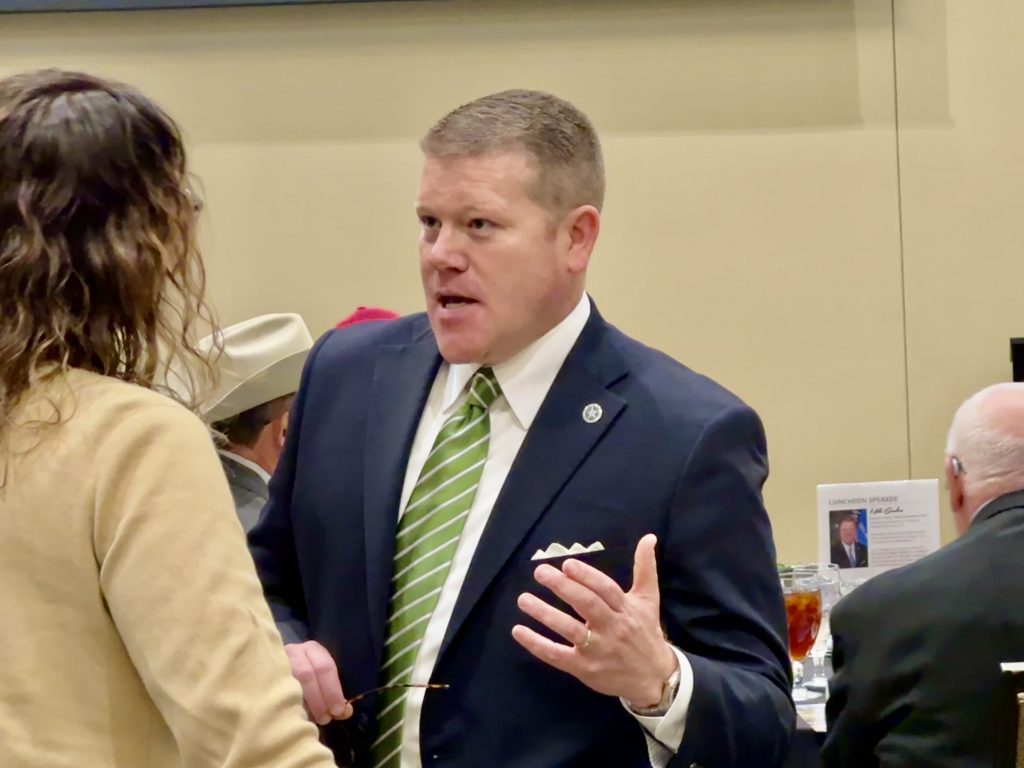
At the Oklahoma Cattlemen's Association's Annual Policy Meeting, Senior Farm and Ranch Broadcaster, Ron Hays, had the chance to talk with the Executive Director of the Oklahoma Broadband Authority, Mike Sanders, about improving access to rural broadband in Oklahoma.
"When I first walked in on day one at the Oklahoma Broadband Office, we didn't even have high-speed internet," Sanders said. "I say that jokingly now because where we were and where we are is a 180-degree difference."
After decades of rural Oklahomans being underserved and unserved, Sanders said, with the help of a tremendous board at the Oklahoma Broadband Office, policies and procedures have been set in place to make a difference in rural Oklahoma.
"Being a formal rural legislator, I knew intimately the issues and challenges that rural Oklahoma sometimes is up against," Sanders said. "I will tell you in our last nine months of putting in the policies and administering all of this federal money, we are going to have some very good news coming very soon."
Sanders said there are nearly 600,000 Oklahomans who do not have high-speed internet.
"That must change and that will change, because we have the right people and the right policies in place to make sure we make that change here for Oklahoma, and I am excited to be a part of that," Sanders said.
This past summer, Sanders said over 30 listening sessions were held by the broadband office to receive input from Oklahomans across the state about their broadband needs.
"We took their information, and we put that into our plan that we are going to be implementing the rollout of our broadband deployment," Sanders said.
Sanders said serving each and every last Oklahoman means a great impact will be had on the entire state.
"What that means to Oklahomans is one, you have that grandmother who lives out in the country, and her grandkids may live in an entirely different state," Sanders said. "She is going to be able to interact and have face-to-face contact with them."
Economic development will be another benefit of serving Oklahomans in need of high-speed internet, Sanders said, because rural communities need that connection to grow and do business in today's world.
"You have got to be able to be connected," Sanders said. "You have got to be able to get your goods to market, you have got to be able to check the weather, and you have got to have real-time, agricultural data. I could go on and on and on."
Sanders said a healthy rural Oklahoma means an absolutely healthy urban Oklahoma.
"This is not a rural versus urban situation," Sanders said. "This is an Oklahoma situation where everyone is going to benefit, especially rural Oklahoma."
| ||||||||||||||||||||||||||||||||||||||||||||||||||||||||||||||||||||||||||||||||||||||||||||||||||||||||||||||||||||||||||||||||||||||||||||||||||||||||||||||||||||||||||||||||||||||||||||||||||||||||||||||||||||||||||||||||||
|
The Oklahoma State Election Board has released its annual voter registration report showing 2,301,188 registered voters in Oklahoma. Oklahoma's official voter registration statistics are counted every year on January 15.
According to Oklahoma State Election Board Secretary Paul Ziriax, the largest number of Oklahoma's voters are Republicans, who make up 51.7% of registered voters. Democrats are the second-largest party with 28.4% of registered voters.
Meanwhile, both the Libertarian Party (which gained recognition in 2016) and Independent voters continue to see steady growth. Libertarians now account for almost 1% of Oklahoma voters and Independents (those with no party affiliation) round out the total with 19% of registered voters.
A comparison of statewide voter registration numbers can be found below:
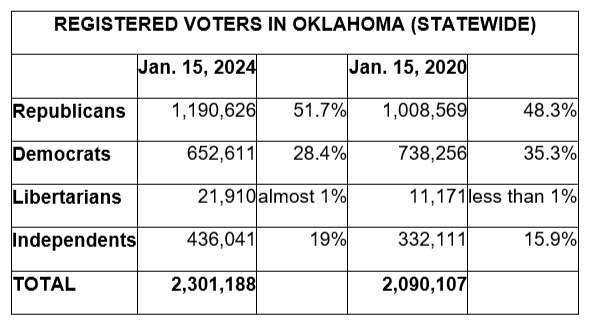
Historical voter registration numbers can be found on the State Election Board website.
The State Election Board reminds Oklahomans that it is easy to register to vote in Oklahoma. Eligible applicants can register using the OK Voter Portal's Online Voter Registration System or download a Voter Registration Application from the State Election Board website. Applications are also available at all seventy-seven (77) County Election Boards, most tag agencies, post offices, and libraries. The voter registration deadline for the February elections is January 19. The voter registration deadline for the March elections is February 9.
Current voters who need to make changes to their registration can update their registration online using the OK Voter Portal or by submitting a new Voter Registration Application to their County Election Board.
For more information on voter registration visit our website at oklahoma.gov/elections.
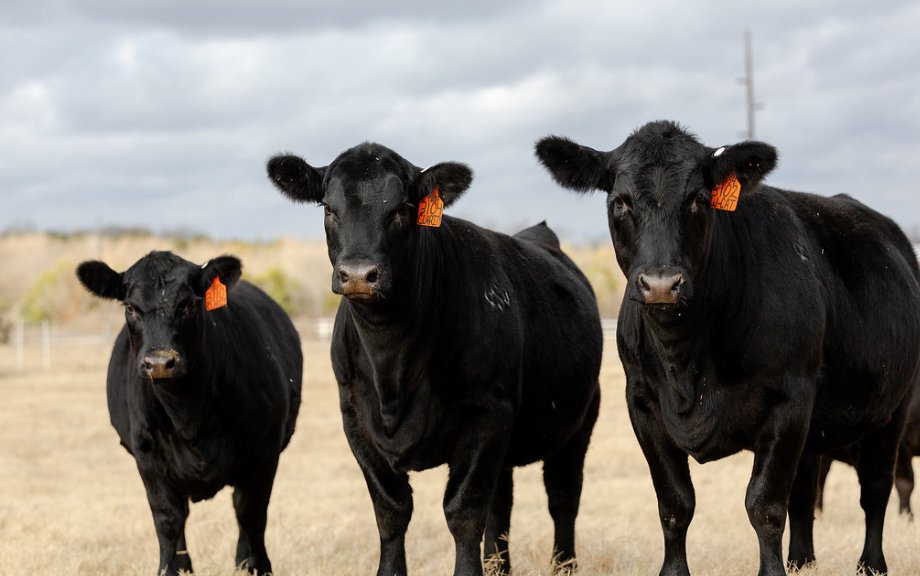
The upcoming series will feature information on controlled reproductive management and superior fertility in grazing conditions. (Photo by Mitchell Alcala, OSU Agriculture)
The Oklahoma State University Beef Extension team will host three Rancher's Thursday Lunchtime Series sessions in February. The hour-long webinars will focus on implementing timed artificial insemination and selection programs designed to achieve a high level of fertility in commercial cow herds.
"These two presenters, both veterinarians, have established proven, data-driven reproductive management and selection programs. They are truly among the best in the world," said David Lalman, OSU Extension beef cattle specialist.
The Rancher's Thursday Lunchtime Series is free of charge as experienced ranchers and scientists join to share production, management and marketing tips. The following sessions will begin at noon via Zoom.
Feb. 8 – Controlled Reproductive Management in Cow/Calf Operations under Grazing Conditions
Feb. 15 – Breeding a Cow Herd for Superior Fertility in Grazing Conditions
Feb. 22 – Successful Implementation of Timed AI Programs in Commercial Herds
Registration is required. For more information, contact David Lalman at 405-744-6060 or david.lalman@okstate.edu.
OSU Extension uses research-based information to help all Oklahomans solve local issues and concerns, promote leadership and manage resources wisely throughout the state's 77 counties. Most information is available at little to no cost.
By Gail Ellis

During the 20th Annual National Assembly of Sportsmen's Caucuses (NASC) Sportsman-Legislator Summit held in Dewey Beach, DE, Rep. Kevin Wallace, R-Wellston, was elected to serve a full, two-year term as a member of the NASC Executive Council (EC).
Established in 2004 by the Congressional Sportsmen's Foundation (CSF), NASC provides the synergy to protect and advance hunting, angling, recreational shooting, trapping, and professional fish and wildlife management in state capitols. With more than 2,000 legislators who are members of state legislative sportsmen's caucuses from all 50 states, this unprecedented network of pro-sportsmen legislators provides the nexus and support among the state caucuses that is critical to the successful advancement of pro-sportsmen policies across the nation.
Last year, Rep. Wallace was elected as one of three alternates who serve one-year terms alongside the full, 12-member EC. Working with staff at CSF, the EC assists with the establishment and promotion of pro-sportsmen ideas, and facilitates the sharing of information between state caucuses, conservation partners and allied industries. The EC plays a critical role in the protection and advancement of hunting and angling rights and the continuation of our sportsmen's heritage by establishing the activities of NASC, assisting with policy development, setting guidelines for affiliated state caucuses, as well as media outreach intended to highlight the role hunting, angling, recreational shooting and trapping play in supporting conservation policies that also benefit our nation's social and economic well-being.
"I've spent much of my life enjoying hunting, fishing and other outdoor sports, and much of my time in public service making sure others are free to enjoy these pursuits as well," Wallace said. "It's truly an honor, therefore, to be elected to serve a full two-year term as a member of the NASC Executive Council. I've already learned so much from the assembly, and look forward to sharing this national perspective with my peers in Oklahoma. With Oklahoma's robust outdoor sporting community, I know we'll have much to bring to the table as well."
Rep. Wallace also serves as co-chair of the Oklahoma Legislative Sportsmen's Caucus.

The Oklahoma House of Representatives completed bill filing Thursday, Jan. 18, for the second regular session of the 59th Legislature. A total of 1,210 House Bills, 12 House Joint Resolutions and one House Concurrent Resolution were filed.
The full text of the bills, along with additional information including authors and co-authors, can be found online at www.okhouse.gov.
Last year, the Clerk of the House reported 1,901 House Bills, 44 House Joint Resolutions and one House Resolution were filed. A total of 1,463 House Bills and 42 House Joint Resolutions filed in 2023 are still available for consideration in the second regular session. Joint resolutions may be filed at any point during the session.
The House is currently comprised of 80 Republicans and 20 Democrats with one vacancy. The second regular session of the 59th Legislature will begin Monday, Feb. 5, at noon with the State of the State address from Gov. Kevin Stitt in the House Chamber.
Agriculture Secretary Tom Vilsack today announced a pilot program to allow more cattle producers and meat processors to access better markets through the U.S. Department of Agriculture's (USDA) official beef quality grading and certification. The Remote Grading Pilot for Beef, developed by USDA's Agricultural Marketing Service (AMS), matches simple technology with robust data management and program oversight to allow a USDA grader to assess beef carcass characteristics and assign the official quality grade from a remote location, reducing costs and location as barriers to participation in voluntary grading services.
Secretary Vilsack announced the new pilot during a panelist discussion with livestock producers and independent meat processing business owners in conjunction with the National Western Stock Show in Denver, Colo. In addition to the pilot, Secretary Vilsack highlighted USDA programs in the West that create economic prosperity for farms, ranches and rural communities by supporting on-farm conservation, bolstering new markets, creating jobs, and keeping farming and ranching viable for the next generation. Today's announcement builds on USDA's comprehensive approach to increase competition in agricultural markets, create a fairer playing field for small- and mid-size farmers and ranchers, and provide producers more options to market their products.
"On average, a beef carcass that grades as USDA Prime is valued at hundreds of dollars more than an ungraded carcass, but costs for this voluntary USDA service often prevents smaller scale processors and the farmers and ranchers they serve from using this valuable marketing tool," Secretary Vilsack said. "This remote grading pilot opens the door for additional packers and processors to receive grading and certification services allowing them to access new, better, and more diverse marketing opportunities."
Consumers as well as buyers and sellers of beef rely on USDA quality grades, including Prime, Choice, and Select, as a clear and standardized way to indicate quality. Everyone involved in the beef supply chain, from cattle producers to beef consumers, benefit from the greater efficiency permitted by the application of official U.S. grade standards.
USDA offers these services to packers and processors on a user-fee basis. While over 90% of America's fed beef supply is officially graded by USDA, most users are large beef packing operations. USDA's meat grading and certification services are significantly underutilized by small, independent processors, in large part due to the expense of paying for a highly trained USDA grader to travel to their facility to perform service in-person for a relatively small number of cattle that may not require a full day of the graders' work. Experience with remote grading so far has shown it dramatically reduces travel-related expenses, which makes the service more accessible to smaller processors.
In this pilot, trained plant employees capture specific images of the live animal and beef carcass. These images are submitted electronically to a USDA grader already stationed elsewhere in the U.S., likely located in another rural community, who reviews the images and accompanying plant records and product data, assigns the USDA Quality Grade and applicable carcass certification programs, and communicates the official grade back to the plant to be applied to the carcass. Plants can then use this information in their retail marketing and transmit carcass performance information back to producers.
The pilot will build on lessons-learned during AMS' feasibility study of a "remote grading" process conducted during the second half of 2023. AMS will expand its testing by engaging a larger and more diverse number of beef packers to participate in the development of this procedure. Through the pilot, AMS will gather additional information on actual cost and the level of in-person surveillance needed to ensure program consistency and integrity to formalize this innovative service option as part of the USDA Quality Grading Service.
The Remote Grading Pilot for Beef is limited to domestic beef slaughter facilities operating under federal inspection and producing product that meets the eligibility criteria for the USDA grading program.
For more information about the Remote Grading Pilot for Beef, visit www.ams.usda.gov/remote-beef-grading or email AskLP@usda.gov.
USDA will host a webinar Thursday, Jan. 25 at 3:00 PM Eastern Time to provide additional information about the program. To register, visit the signup webpage. A recording will be made available.
USDA touches the lives of all Americans each day in so many positive ways. Under the Biden-Harris Administration, USDA is transforming America's food system with a greater focus on more resilient local and regional food production, promoting competition and fairer markets for all producers, ensuring access to safe, healthy and nutritious food in all communities, building new markets and streams of income for farmers and producers using climate-smart food and forestry practices, making historic investments in infrastructure and clean energy capabilities in rural America, and committing to equity across the Department by removing systemic barriers and building a workforce more representative of America. To learn more, visit www.usda.gov.
Oklahoma Farm Bureau members are encouraged to attend the organization's 2024 Leadership Conference Tuesday, Feb. 13, at the Embassy Suites Downtown Medical Center in Oklahoma City.
The one-day event will give Farm Bureau members the opportunity to hone their leadership skills, hear about the latest Farm Bureau news, and learn about legislative and regulatory issues that affect agriculture from lawmakers, state officials and leaders from around the state. The evening will conclude with a legislative reception and awards dinner.
Featured speakers and guests include Oklahoma Secretary of Agriculture Blayne Arthur, NonDoc Editor in Chief Tres Savage, AFBF Economist Danny Munch and more.
Farm Bureau members planning to attend may register for the conference using the online form below. Overnight accommodations are available at a discounted rate until Friday, Jan. 26.
For more information about the 2024 Leadership Conference, contact Kinsey Westwood at (405) 523-2412.
For schedule and registration information, CLICK HERE.
In an effort to grow the industry's global relationships to drive exports, the American Pecan Council (APC) conducted its first reverse trade mission this week with Indian nut importers in key growing regions. The mission gave importers an up-close, educational look at the U.S. pecan industry and how the full value chain can offer a high-value, nutritious product for Indian consumers.
"We're excited to open up our farms and doors to these importers from India," said Larry Don Womack, APC Chair. "Our industry believes this isn't just an opportunity to grow demand for U.S. pecans overseas, but can also build our industry's standing in the global agricultural sector and grow economic opportunities here and internationally."
The first stop on the three-state tour included Atlanta and Fort Valley, GA where importers participated in a welcome reception hosted by the Consulate General of India, Atlanta. They then went on to learn more about the history and proper handling of U.S. pecans, visited an orchard and met many of Georgia's pecan growers and suppliers. Activities were co-hosted by APC and the Georgia Pecan Growers Association.
In El Paso and Las Cruces, importers saw pecan orchards and toured multiple processing facilities. They also met with growers and suppliers in Las Cruces to learn more about the local industry courtesy of the Wester Pecan Growers Association.
The tour wrapped in Dallas where expert chefs showed importers the versatility of pecans in global cuisine in a custom culinary experience hosted by APC and the Texas Pecan Growers Association.
The APC thanks these state and regional organizations for their collaboration and looks forward to deeper partnerships with all pecan industry groups.
The Importance of Pecans and International Exports
Driving export opportunities is a significant area of focus for APC. India presents a great opportunity to reach a growing, heavily vegetarian country where general awareness about pecans is low, but interest in nuts, particularly U.S. nuts are high – not just for cultural holidays, weddings or gift-giving, but for nutritious snacking and ingredient solutions.
"India's population is projected to reach 1.5 billion by the end of this decade, and with the recent tariff reduction, it's a critical moment for U.S. pecans to secure a foothold there," said Anne Warden, CEO of the American Pecan Council. "We think educational opportunities like these can catalyze one of the world's youngest and fastest growing markets to choose the health benefits and taste of pecans and bring our industry both short- and long-term sales."
In addition to hosting importers in the U.S. to learn about the entire pecan industry, APC is also focusing international promotion efforts in-country in India, China, Germany and the U.K. with a series of retail partnerships (online and in-store), trade shows, influencers and social media aimed at growing awareness of U.S. Pecans as a good for you and tasty snack option.
About the American Pecan Council
The American Pecan Council (APC) is a group of passionate pecan growers and shellers whose life work is dedicated to growing, harvesting and processing America's native nut.
Founded in 2016 through a Federal Marketing Order, the APC's mission is to promote the many benefits of the American Pecan and help tell the story of this truly unique nut. With oversight by the USDA, APC aims to build consumer demand, develop markets and establish industry standards. APC is based in Fort Worth, Texas, and funded by pecan handlers in 15 pecan-producing states: Alabama, Arkansas, Arizona, California, Florida, Georgia, Kansas, Louisiana, Missouri, Mississippi, North Carolina, New Mexico, Oklahoma, South Carolina, and Texas. To learn more visit www.AmericanPecan.com.
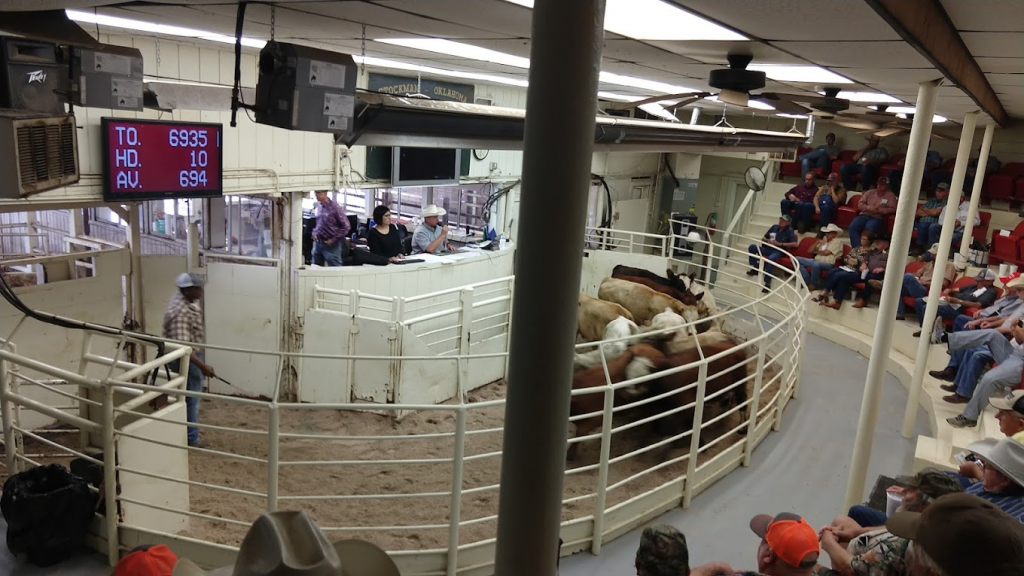
Farm Director KC Sheperd is back talking with Bob Rodenberger, a partner with Stockman Oklahoma Livestock, as he gives the latest on the cattle markets.
Although the weather was not ideal, Rodenberger said there was a sale at Apache, and runs were just shy of 1,000 head.
"We had a lot of good cattle, and had a lot of demand, and had an excellent market," Rodenberger said. "This time of year, you can't out-guess the weather."
Because of the shutdown at Oklahoma National Stockyards this week, Rodenberger said he expects runs to be adequate with good demand next week.
"On days like last Monday, we might have had 150 to 200 cattle," Rodenberger said. "It was a good idea to shut down. I think the management made good decisions."
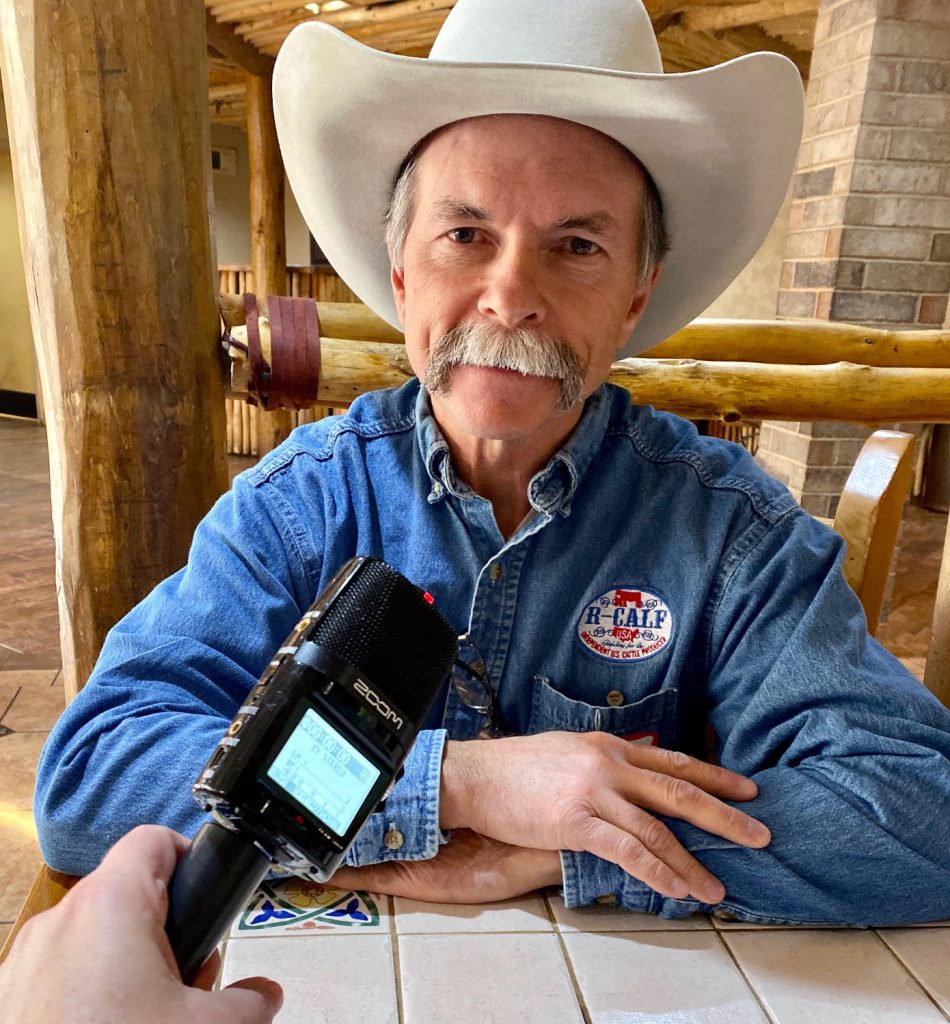
Sounding Property Rights Alarm--Commentary by Bill Bullard, CEO, R-CALF USA
Some say, "Knowledge is suffering" and others "Ignorance is bliss." Either way, it means we can feel comfortable while we're not aware of potential threats against us. Well, and unfortunately, I'm likely to make you uncomfortable.
This has to do with a progressive threat that initially started several years ago when global entities began trying to convince you to jump onto their path of continuous improvement so you could become sustainable and protect our earth from climate change. The first of these was the Global Roundtable for Sustainable Beef (GRSB). Next was the environmental, social and governance sustainability standards pushed by the U.S. Securities and Exchange Commission (SEC), and then we had governments around the globe that began issuing depopulation directives for cattle herds.
All of that was a bit complicated to understand, but soon became very unsettling when the abstract threat was actually implemented. That is, when the governments of the Netherlands and Ireland actually began demanding the depopulation of their respective cattle herds in the name of sustainability and climate concerns.
But there's been another, and this one was as big a threat or even bigger than those we've already discussed. This one was so big that some said it's the greatest threat to rural America, ever. And they say that because rural America is where our nation's natural resources are located, and it's those natural resources that were targeted by this latest threat.
Now that I've said all that, you need to know that what I'm about to describe has been officially and abruptly withdrawn. But you still need to know how aggressive and blatant the globalists are in their effort to strip away your property rights.
Here's what went on: The Securities and Exchange Commission was considering a proposed rule change that would, according to the proposal, create a new publicly traded asset that would own the rights to control the use of natural resources over both private and federally managed land, including national parks, for example.
So, let's break this down because the proposal read like a frightening, futuristic, science-fiction movie about the destruction from within of America's economic system.
First the players: The players were global corporations including the New York Stock Exchange, which is part of Intercontinental Exchange, Inc., and the Intrinsic Exchange Group (IEG), which is funded in part by the Rockefeller Foundation.
The players had asked the SEC to approve their plan, but we'll call their plan the plot to their movie.
So, here's the plot: The players wanted to create a new entity to be traded on the New York Stock Exchange. The new entity is called a Natural Asset Company, but it isn't a company under the Exchange's rules because it isn't based on economic activity. In other words, it's not designed to make money. Instead, it's designed to allow private investors to lock up natural resources to limit economic activity on and with those resources. This means it's designed to authorize private investors to limit agriculture, grazing, mining, logging, and fossil fuel extraction from federally managed lands, and to place similar limits on private lands for which there are conservation easements or other encumbrances that may already restrict the use of the lands.
You might wonder who these private investors might have been. Well, they could be anyone or any country because the Natural Asset Companies would be publicly traded. This means adversarial countries like China, which is controlled by a Communist party, could gain control over the United State's otherwise sovereign right to control its natural resources.
This proposal was so far-fetched that it would require an entirely new accounting system because it's not designed to generate value for investors. Consequently, in order to affect this plot, the SEC would have to rely on a proprietary accounting framework owned by one or more of the players mentioned earlier. And this new framework would assign some artificial value to non-monetized services. Now those non-monetized services, of course, would be the value of not using God's creations, such as air, land, and water.
So, here's the summary: The proposed rule change would make a mockery of private property rights by creating a virtual playground for global investors, replete with contrived renumerations and accounting, that promises to deprive landowners (including those who own water and grazing rights on federally managed land) of their right to the beneficial use and enjoyment of their private property. It would accomplish this insidious outcome by authorizing domestic and foreign corporations alike to seize control over that which makes private property property – the right to use and enjoy (i.e., to manage) the property's surface and air above and water below in accordance with the owner's desire.
In the face of overwhelming opposition by us and several other groups, including a group of 25 state attorneys general, On January 17 the NYSE voluntarily withdrew its rule change request to begin listing Natural Asset Companies on its Exchange. This is a big win for us, but we cannot rest because this global effort to capture private property rights away from Americans is certainly not over.
So, let's all remain vigilant. The property rights alarm has now been duly sounded.

Congressman Tom Cole (OK-04), Vice Chairman of the Appropriations Committee, released the following statement after the U.S. House of Representatives passed the Senate Amendment to H.R. 2872, the Further Additional Continuing Appropriations and Other Extensions Act, 2024.
"This continuing resolution is a responsible step forward to ensure Congress finishes the appropriations process and avoids a possible government shutdown as we continue to work with the Senate to complete regular appropriations bills," said Cole. "We cannot forgo finishing the appropriations process to address the current evolving needs of our nation. The process and negotiations will continue to move forward, and I am hopeful to have everything wrapped up as soon as possible."
Today, the U.S. House of Representatives voted to avert a government shutdown and extend the funding for Military Construction-Veterans Affairs, Transportation-Housing-Urban Development, Agriculture, and Energy and Water until March 1st and the other eight appropriations bills until March 8th.
Congresswoman Bice issued the following statement:
"Shutting the government down does not solve the border crisis. In fact, it makes it worse. If the government were shutdown, Customs and Border Patrol agents would be forced to deal with the disastrous impacts of Biden's Border Crisis with no pay and diminished resources. Ending the immigration crisis remains a top priority for me, which is why I drafted legislation late last year that contained robust border security provisions while also reducing spending by 8%. We must responsibly cut spending and focus on conservative priorities without holding our military and federal workers hostage. While I am frustrated with the need for another continuing resolution, this was the only feasible option on the table."
According to USDA's 2017 Ag Census, about 97% of the United States' 2.1 million farms are considered family farms and 88% of all U.S. farms have a gross cash farm income of less than $350,000 annually, putting them in the small family farm category. This means that most farms in the U.S. are small, family-owned businesses that rely on the availability of finance options to fund the high cost of producing the food, fiber and renewable energy our country and the world rely on every day.
According to USDA's most recent Farm Sector Income Forecast, interest as an expense increased by about 43%, or $10.3 billion, to $34.42 billion in 2023 (Figure 1). Interest rate hikes have not only increased the cost of credit as an input but have also limited farmers' ability to use it. This Market Intel will give you a glimpse of farmers' credit world and explain how changes in that environment could lead to challenges with liquidity, a problem that is hard to fix.
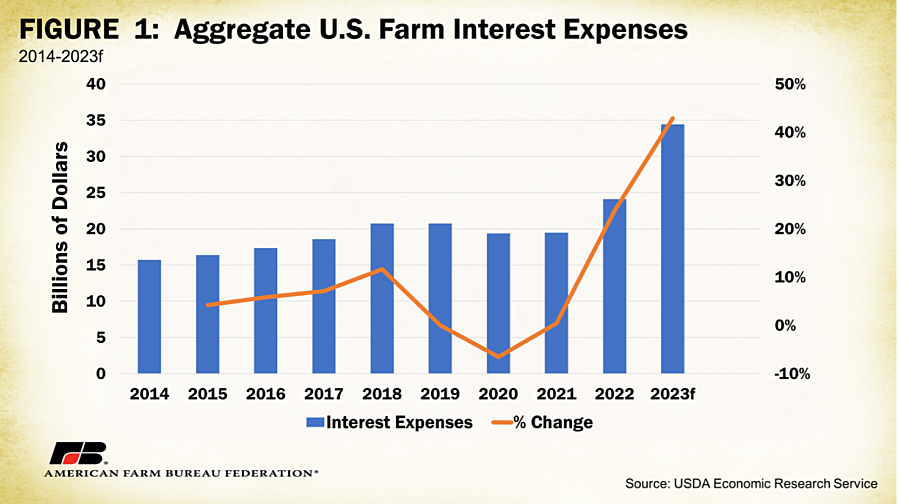
What is Liquidity and why is it Important?
An extremely important part of farm finances, farm liquidity is "the ability of a farmer to generate cash quickly and efficiently in order to meet his or her financial obligations." Some assets, such as corn in storage, can be sold and turned into cash quickly and are considered assets with high liquidity. Others, such as a crop that was recently planted or livestock that have not yet been born, take more time to turn into cash and can require additional input expenses to become the final product for sale, such as grain or marketable livestock. When farms get tight on cash due to the high cost of operating or from overspending, lack of liquidity can become a real problem.
According to the 2023 Ag Lenders Survey conducted by the American Bankers Association in partnership with Farmer Mac, liquidity was farm lenders' top concern in 2023 followed by farm income. Lenders listed rising interest rates as their number one reason for liquidity concerns.
How is Liquidity Measured?
Liquidity is measured using several different accounting ratios. Before diving into the different ratios, it is important to first understand working capital. Working capital is not a ratio, it is a measure in dollars of total assets minus total liabilities. This is a measure of available cash. When evaluating this measure, the question often asked is, "How much working capital does a farm need?" Working capital needs are highly variable by farm size, exposure to risk and volatility of the overall business environment. When net returns are more variable, more working capital is needed. Due to these differences, it is helpful to measure working capital by either gross revenue or value of farm production. More on this later.
One of the most used liquidity ratios is the current ratio. The current ratio (sometimes called the "working capital" ratio) measures a business's or farm's ability to pay off debt due within one year. It is the ratio of current assets divided by current liabilities (due within one year). A current ratio of 2 or higher is considered good. Anything below 2 is cause for concern.
The debt service ratio, sometimes called the term debt coverage ratio, measures a farm's ability to use operating cash flow to pay debt obligations. Lenders typically like this ratio to be 1.5 or greater. A ratio of 1 would mean that the farm has adequate cash flow to meet payment obligations. A ratio less than 1 would mean the farm falls short and will have to rely on other resources to service debt.
As previously addressed, it is helpful to evaluate working capital needs in comparison to gross revenue or value of farm production. The working capital-gross revenue ratio is a measure of whether or not a farm has adequate working capital for its level of gross revenue. A farm with a ratio of 30% or greater is considered strong, 10%-30% is cause for concern, and a ratio less than 10% is considered vulnerable. For example, a farm that has a ratio under 10% will rely heavily on borrowed money to operate because they will run out of their own money early in the year. A farm with a ratio above 30% will rely on borrowed money, but not as heavily and not as quickly.
One ratio that has not been widely used since the '80s is the interest expense ratio. This ratio shows how much gross income is being used to pay interest on debt. In years when interest rates are low, this ratio may be overlooked as it remains well within healthy parameters. However, when interest rates go up, the interest expense ratio can be a stark reminder that taking on unnecessary debt or too much debt can be costly. When more capital is being used to pay for interest, it means less capital is being paid toward equity-building principal. Figure 2 illustrates the ratio of total U.S. ag sector interest expense to total U.S. ag sector cash receipts. Note the 2.25% increase in this ratio from 2022 to
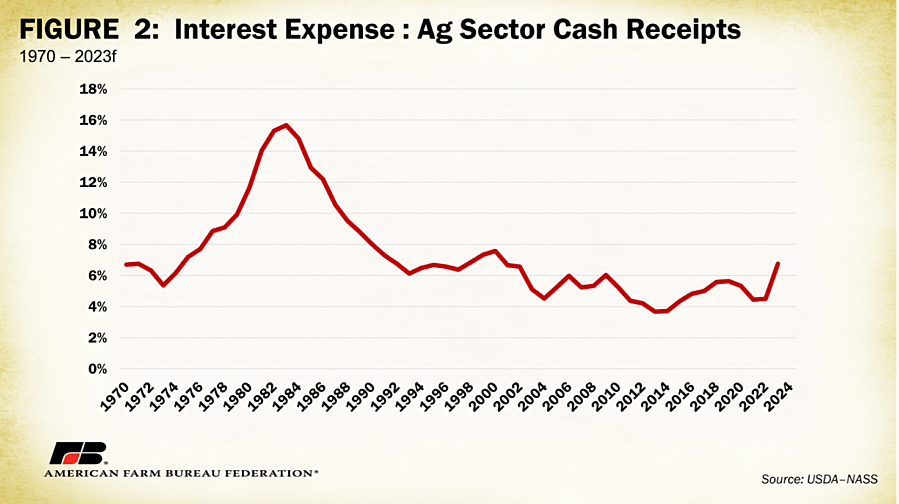
What are Some Common Liquidity Problems Farmers Face?
Farmers have many recurring annual costs such as land rent, input expenses and debt payments. A farm with strong liquidity has cash available to pay these recurring costs and potentially pay for growth such as new land or equipment purchases.
Problems with liquidity can arise from changes in the financial environment. For example, when costs of inputs such as fertilizer, seed and fuel go up, it takes a greater amount of working capital to pay for them. This means working capital is depleted faster, potentially limiting a farmer's ability to meet cash flow needs. When working capital is depleted, farmers have a variety of options to help liquidity. Selling cash assets such as crops in storage may be an option but may be costly if market conditions are not favorable. One of the most common solutions to liquidity is through a variety of credit-based solutions such as operating loans, which will be addressed in more detail later in this article. While credit-type solutions can be a great option, they can be expensive and endanger the long-term sustainability of a farm if relied on too heavily when interest rates are high. Liquidity problems of this nature can turn into a cycle that is increasingly hard to break for the farmer.
What does U.S. farm sector debt and liquidity look like?
U.S. farm sector liquidity has been good and strengthening since 2020. However, the recent drop in ad hoc government assistance combined with Federal Reserve-driven interest rate hikes and increasing operating costs have changed the financial environment. According to USDA-Economic Research Service's Agricultural Resource Management Survey, approximately 23% of U.S. farms carried some form of debt in 2022, down 4% from 28% in 2018 (Figure 3 ). While this data provides a general feel for farms carrying debt through 2022, it does not capture which farms are carrying debt. So even though the percentage of farms carrying debt has come down, it is not necessarily an indication of a healthier farm economy.
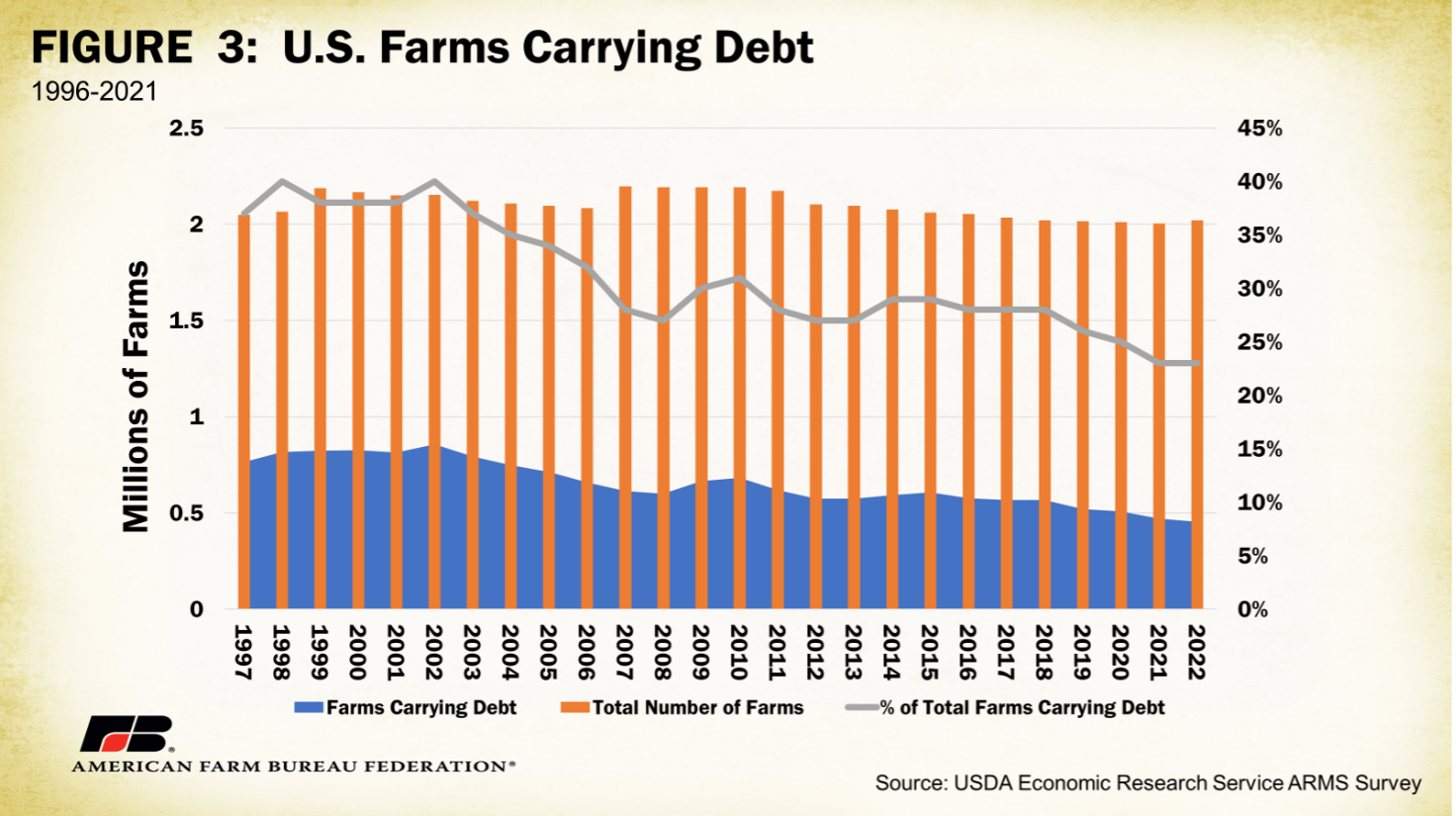
Recall from earlier in the article, a good current ratio is above 2. According to the U.S. Farm Sector Financial Ratios published by ERS, the U.S. ag sector had a current ratio below 2 from 2015-2021. This ratio has remained above 2 since 2021 but is forecast to fall from 2.15 in 2022 to 2.09 for 2023, just above the threshold for caution.
The debt servicing ratio used by ERS is a modified version of the term debt coverage ratio. USDA uses this ratio to measure the share of production plus direct government payments that are used to pay off farm sector debt. A higher debt servicing ratio implies that a greater share of production is needed to pay off debts, and thus less liquidity in the farm sector. ERS forecasts the ratio to rise from .21 in 2022 to .24 in 2023. Higher cost of debt from sustained elevated interest rates could lead to continued debt servicing ratio growth in 2024. For comparison, the debt service ratio reached a record level of .46 in 1983. This means that 46% of all farm sector production and government subsidies were used to pay for farm debt.
What are Some Tools Farmers Have That Assist with Liquidity Problems?
Management – One of a farmer's greatest financial resources can be their lender. Loan officers are more than just a face at a lending institution. They become friends and advisors, in addition to financial service providers. Helping farmers avoid problems with liquidity is typically in the lender's best interest as well as the farmer's, so it's important they work together. When problems come up with liquidity, operating loans can be a go-to solution. Operating loans can be refinanced to adjust for operating cash needs. However, it is important to note that refinancing costs money in the long run, and every time a refinance occurs, there are fewer options available the next time around. Refinances can become a danger zone if used improperly. This is why the relationship between a farmer and their lender is so important.
Farm operating loans and revolving lines of credit are an essential tool to help farmers manage day-to-day expenses. They are available through federal programs such as USDA-Farm Service Agency's Direct Farm Operating Loans or through commercial ag lenders. These loans are designed to provide financing for the cost of operating a farm and can help provide much-needed liquidity when capital gets tight. Operating loans can be used for a variety of purposes including supply costs, repairs, land development, and livestock and equipment purchases. The terms of repayment vary but operating loans are typically renewed on an annual basis.
FSA's commodity loans such as marketing assistance loans (MALs) and loan deficiency payments (LDPs), can help mitigate liquidity problems. Both of these tools can offer financial support to farmers at and after harvest.
MAL
An MAL is a nine-month loan that provides producers with interim financing at the time of harvest to meet cash flow needs without having to sell their commodity under current market conditions. There are two types of loans, recourse and non-recourse. During the life of the loan, farmers are allowed to store the covered commodity so they can sell it when market conditions (hopefully) improve. Under non-recourse loans, USDA must accept the commodity, pledged as collateral, as payment. A recourse loan must be repaid in full as principal and interest. These loans are valued using county-level, commodity-specific loan rates established by the 2018 farm bill. For non-recourse loans, if local prices rise above the loan rate, the farmer may repay the loan and keep the pledged commodity. If local prices fall below the loan rate, the farmer can repay the loan at the lower market price or surrender the pledged commodity in lieu of repayment. The farmer would then receive the difference between the lower market price and the MAL loan rate.
LDP
LDP provisions specify that a farmer, though eligible for a non-recourse MAL, may choose to receive an LDP instead. The payment is equal to the LDP rate times the quantity that is eligible for a loan. An LDP payment is triggered when the posted county price drops below the county loan rate. An LDP is the difference the producer would have received if a loan was repaid at the lower market price, a direct benefit that does not need to be repaid. The farmer may then store or market the covered crop however they choose.
Term Loans
One more solution available for farmers when capital is depleted and liquidity is an issue is a term loan. Agricultural term loans are long-term loans that are used to finance investments and operations. These loans are collateralized and are different than an annually renewed operating loan. Using a term loan for short-term needs is often a last resort because it is expensive when interest rates are at decade highs and is not an indicator of good financial health.
Summary and Conclusions
While ag sector liquidity has been strong in recent years, the financial environment has changed and high interest rates are adding another expense to farmers' lists of rising input costs. Operating loans and other forms of financing cost farmers a whopping 43% more in 2023 than in 2022 and are forecast to remain elevated for much of 2024, causing working capital (cash) stocks to decline faster and forcing farmers to lean on expensive credit to provide liquidity. When farmers pay more for interest on that credit, less money gets paid toward principal. The amount of income being used to pay interest on farm debt in the U.S. has increased at a rate not seen since the 1980s. There are many tools available to help farmers persevere when liquidity makes their business vulnerable, but it's important for decision makers to remember a lesson from the 80's. Short-term borrowing during times of vulnerability can turn into costly long-term debt. Excellent management and decision making are a must to remain resilient during times of vulnerability.
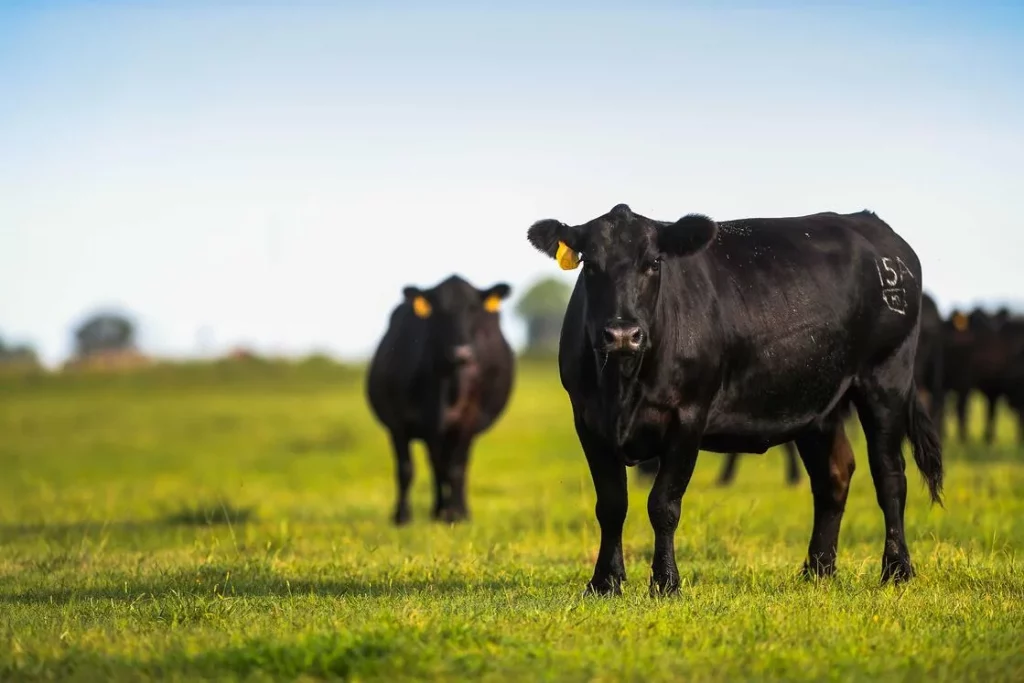
Senior Farm and Ranch Broadcaster, Ron Hays, is back talking with the Director of Supply Management and Analysis at Certified Angus Beef, Paul Dykstra, about his perspectives on building back the cow herd.
Dykstra says building back the cow herd will not be an easy process as many replacement heifers are not being kept back, at least for now. There is not a large number of cows to generate replacement heifers to begin with, Dykstra added.
"The ability of your average cow-calf operator to go out and really bite off on a large purchase of replacements may not be as great as it was at some other time. Just a number of things that will probably slow that rebuilding, but perhaps that is a healthy pace as well."
Better genetics are expected to come into play in the next herd rebuilding, Dykstra said, which will benefit many regions.
"We have got a great set of genetics across the board that have continually been improved, and consequently, we will up the ante when it comes to the end product when it is all said and done," Dykstra said.
More quality, Dykstra said, can mean more demand for beef.
"We know that if the supply is there keeping those price spreads a little bit in line, we can continue to add more customers as end users both domestic and international," Dykstra said.
Once customers experience Certified Angus Beef, Dykstra said it is hard to drive them away.
"They know that the product is worth the premium," Dykstra said. "That is really, to me, the perfect scenario for U.S. beef."
The Beef Buzz is a regular feature heard on radio stations around the region on the Radio Oklahoma Ag Network and is a regular audio feature found on this website as well. Click on the LISTEN BAR for today's show and check out our archives for older Beef Buzz shows covering the gamut of the beef cattle industry today.
Oklahoma State University Extension will partner with the Oklahoma Department of Environmental Quality and the U.S. Department of Agriculture-Rural Development to host a free Oklahoma Environmental Law Enforcement Training Seminar on Feb. 29 in Stillwater, Oklahoma. (Photo by Shutterstock)
To help combat the issue of illegal roadside dumps, Oklahoma State University Extension is partnering with the Oklahoma Department of Environmental Quality and the U.S. Department of Agriculture-Rural Development to host an Oklahoma Environmental Law Enforcement Training Seminar in Stillwater, Oklahoma.
What: Law enforcement professionals, city officials, tribal environmental representatives, county commissioners and anyone interested in learning about environmental law enforcement are invited to participate in the free workshop. Chad Keller, senior environmental specialist with the Oklahoma Department of Environmental Quality, will instruct the class. He has been an investigator with the DEQ for 29 years and is a sergeant with the Criminal Investigation Unit.
When and where: Feb. 29, 8:30 a.m. to 5 p.m., Meridian Technology Center for Business Development, 1414 S. Sangre Rd., Stillwater, Oklahoma. Testing and certification will take place from 4 p.m. to 5 p.m. There is a one-hour break from noon to 1 p.m. for lunch on your own.
Why: Roadside dumpsites are not only unsightly and illegal, but they also wreak havoc on the environment. These sites can cause contamination of soil, groundwater, drinking water wells, streams and rivers. Other side effects include possible injury to children playing in or around the site, damage to plant and wildlife habitats, and a decrease in the quality of life for nearby residents and the local community. Participants will gain expertise in environmental crime investigations involving the following topics and more:
Participants will also learn more about identifying resources for improving local enforcement programs and have an opportunity to network with others involved in law enforcement.
For more information or to register for the free workshop, contact Keima Borsuah at 405-744-9827 or keima.kamara@okstate.edu.
OSU Extension uses research-based information to help all Oklahomans solve local issues and concerns, promote leadership and manage resources wisely throughout the state's 77 counties. Most information is available at little to no cost.

Attorney General Gentner Drummond is commending the New York Stock Exchange for listening to him and his fellow attorneys general by withdrawing a proposed rule change that would have allowed the listing of "Natural Asset Companies" (NACs) on the exchange. NACs are a novel corporate structure designed to take land off the market to prohibit productive economic uses, which would have negative effects on domestic oil and gas exploration and production.
Drummond had signed on to a Jan. 9 public comment letter joined by 24 other states.
"The strict requirements for NACs would have significantly halted the development of natural resources, particularly energy exploration," Drummond said. "Such a move would have had severe economic consequences for Oklahoma. I applaud the NYSE for listening to the counsel of this coalition of attorneys general and withdrawing this ill-advised and illegal proposed rule change."
NACs are a new, untested corporate structure created to lease so-called "ecological performance rights" from landowners, including the federal government. NACs manage "natural assets" in lieu of generating revenue. Any "revenue-generating operations" an NAC engages in must be both "sustainable" and consistent with "its primary purpose" of protecting nature.
Ultimately, NACs can lock up lands from economic uses such as oil and gas exploration, agriculture, logging or mining. The proposed rule change would have allowed NACs to raise capital through listing stock on the NYSE.
In the comment letter spearheaded by attorneys general in Utah and Kansas, the coalition had urged the U.S. Securities and Exchange Commission (SEC) to disapprove the would-be change. They contended the proposal ran contrary to law, exceeded the SEC's statutory authority, violated the major questions doctrine, and was bad policy.
The letter was also joined by the attorneys general of Alabama, Alaska, Arkansas, Florida, Idaho, Indiana, Iowa, Kentucky, Louisiana, Mississippi, Missouri, Montana, Nebraska, New Hampshire, North Dakota, Ohio, South Carolina, Tennessee, Texas, Virginia, West Virginia and Wyoming.
Read the letter here.
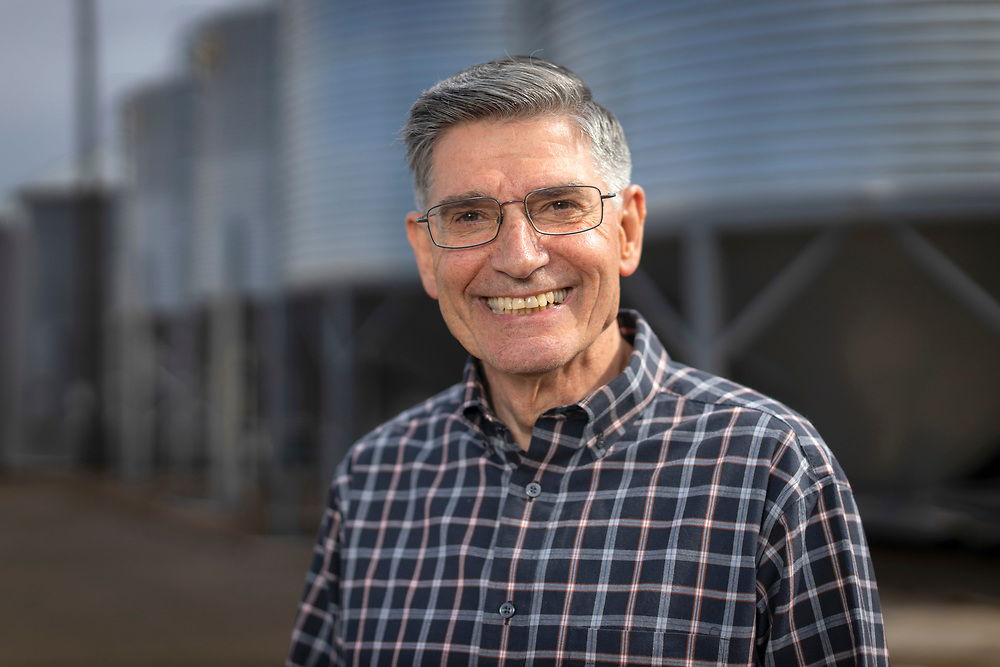
Below is an analysis of the latest movements in the commodity markets from OSU Crop Marketing Specialist Kim Anderson:
Wheat and corn prices fell 15 cents, and soybeans fell 30 cents this week. On Thursday, the current cash wheat price in Pond Creek Oklahoma was $5.53 and wheat could be forward contracted for 2024 harvest delivery in Pond Creed and the Panhandle for $5.55. Panhandle and southern Oklahoma current cash wheat prices were 25 to 30 cents lower than the current Pond Creek price.
Corn prices fell about 15 cents with the current Pond Creek price being $4.30 and the 2024 harvest forward contact price being $4.52. Corn prices are higher in the Panhandle and about the same in southern Oklahoma.
Soybean Price fell about 30 cents with the current cash price being $11.54 and the 2024 harvest forward contract price is $11.14.
Both wheat and corn 2024 harvest prices are below the 15-year Oklahoma average. In Pond Creek, wheat may be forward contracted for harvest deliver for $5.55. The 15-year average Pond Creed wheat harvest price is $5.83.
Wheat stocks-to-use ratios (ending stocks divided by use) support average wheat prices. The stocks-to-use ratio for U.S. hard red winter (HRW) wheat is projected to be 48% compared to a 15-year average of 50%. The stocks-to-use ratio for world wheat is projected to be 33% compared to a 15-year average of 34%.
Corn stocks-to-use ratios support below average prices. Corn may be forward contacted for 2024 harvest delivery for $4.52 compared to a 15-year average of $4.70.
The stocks-to-use ratio for U.S. corn is projected to be 15% compared to a 15-year average of 11.5%. For the world, corn's stocks-to-use ratio is projected to be 26% compared to a 15-year average of 24%.
Soybeans may be forward contracted for 2024 harvest delivery in Pond Creek for $11.14 compared to a 15-year average of $10.80.
The stocks-to-use ratios for soybeans provide mixed signals. The stocks-to-use ratio for U.S. soybeans is projected to be 5.9% compared to a 15-year average of 7.4%.
The world soybean stocks-to-use ratio is projected to be 28% compared to a 15-year average of 27%. The U.S. implies above average prices and the world soybean stocks-to-use ratio implies average prices.
American Farmland Trust will be the Title Sponsor for the 2024 Solar Farm Summit, North America's Agrivoltaics Expo, with a three-year commitment to collaborate in the development of an effective and catalytic annual event focused on solar projects that combine active farming with energy generation—a dual land use known as "agrivoltaics." Both AFT and SFS hope to build on momentum in the agrivoltaics movement by working together in advancing thought leadership, nurturing healthy market development, promoting robust adoption, and achieving widely distributed benefits to farmers and ranchers, local communities, economies, and the environment.
Entering its second year, the summit is an annual conference, exhibition, and information exchange dedicated to agrivoltaics – a means of keeping land in active agricultural production while also producing renewable power that strengthens local agribusiness, community resilience, and energy independence. The summit—to be held at the Loews Chicago O'Hare Hotel in Rosemont, IL, July 8-10, 2024— will bring together a large and diverse audience of practitioners, stakeholders, and decision-makers.
"The agrivoltaics opportunity is so big and the stakes so high, it's essential to get everyone at the table and working collaboratively to guide dual-use development down its most constructive pathway," said Dan French, Executive Producer of the Solar Farm Summit. "So far, the solar boom risks repeating the mistakes of so many great American land rushes before," he continued, "meeting the needs of acute development demand, but missing bigger opportunities to harvest the whole basket of value-add. We're honored to partner with AFT in its title role and timely mission to realize the full measure of agrivoltaic benefits empowering farmers and ranchers to bring new solutions to bear on ancient food, water and energy challenges."
AFT is the only national agricultural organization that approaches its mission of saving the land that sustains us in a comprehensive, holistic manner recognizing the connection between keeping land in farming, helping farmers adopt environmentally-sound farming practices, and working to keep farmers and ranchers on the land. AFT recognizes that well-sited on-the-ground solar projects, combined with objective research and effective advocacy such as through its Smart Solar℠ initiative, can help meet three main, equally important goals: (1) safeguarding land well-suited for farming and ranching, (2) strengthening farm viability, and (3) accelerating solar energy development.
"To achieve the nation's solar energy production goals, America's farmers and ranchers and the land they steward will be a critical piece of the puzzle," said John Piotti, AFT President and Chief Executive Officer. "While we cannot ignore the challenges solar projects can present in farm country as projects trend larger, at AFT, we know that Smart Solar℠ development can provide farmers, ranchers, and landowners with a realistic path to ensuring our nation's agricultural land is available to the next generation. AFT is proud to be the Title Sponsor of the 2024 Solar Farm Summit and looks forward to a great event in Chicago this summer where the latest agrivoltaic best practices, policy innovations, and technologies will be on full display."
SFS is the preeminent national gathering of the development community focused on agrivoltaics. With AFT's support and focus it will continue to grow, while also expanding participation of farmers, agricultural service providers, and public agencies at all levels of government. Tickets for the event are now available as well as additional sponsorship and exhibition opportunities. For more information, please visit https://solarfarmsummit.com. Limited conference passes for landowners and media are also available.
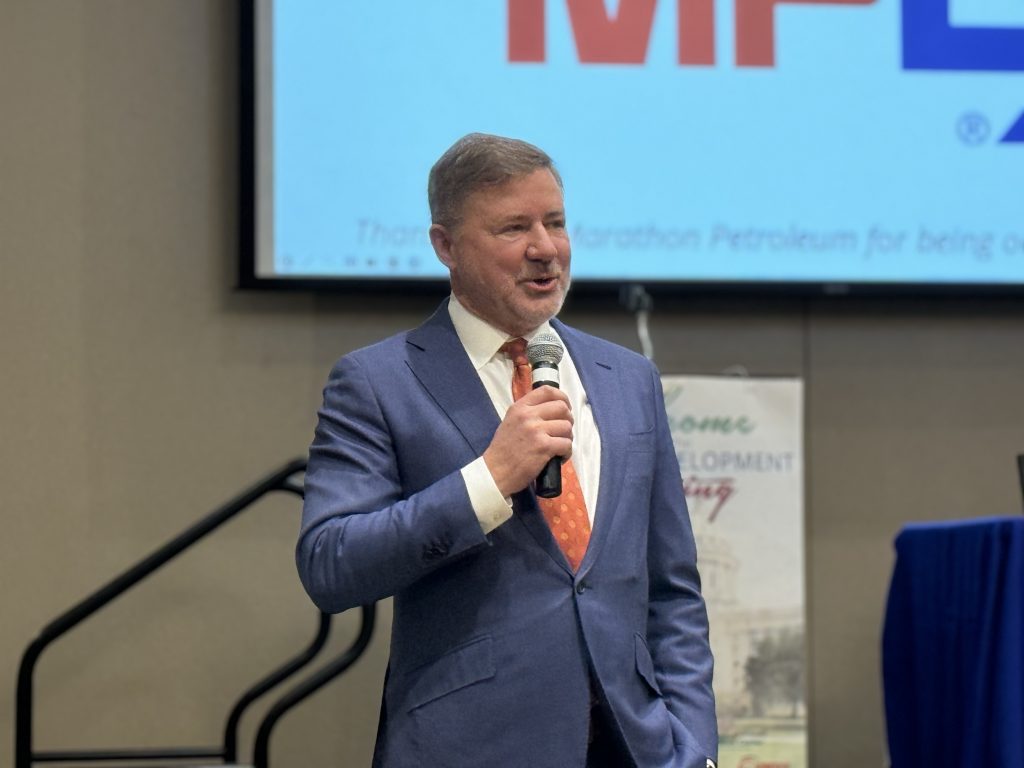
At the Oklahoma Cattlemen's Association's 2024 Policy Meeting, Farm Director KC Sheperd had the chance to talk with the keynote speaker at the event, Attorney General Gentner Drummond, about an update on illegal marijuana grow operations in the state and more.
Drummond first talked about the recent arrest of several foreign nationals in connection with the seizure of a significant amount of marijuana allegedly headed for the illegal drug market.
Task force agents, in collaboration with several law enforcement agencies, executed two search warrants in Muskogee County on Jan. 11 that led to the seizure. Multiple firearms also were discovered in the search, as well as evidence that led agents to a half-million-dollar marijuana "stash house" in Bixby where they discovered signs of drug trafficking.
Following this most recent bust, Drummond said another 14 illegal marijuana grow houses voluntarily shut down in the state.
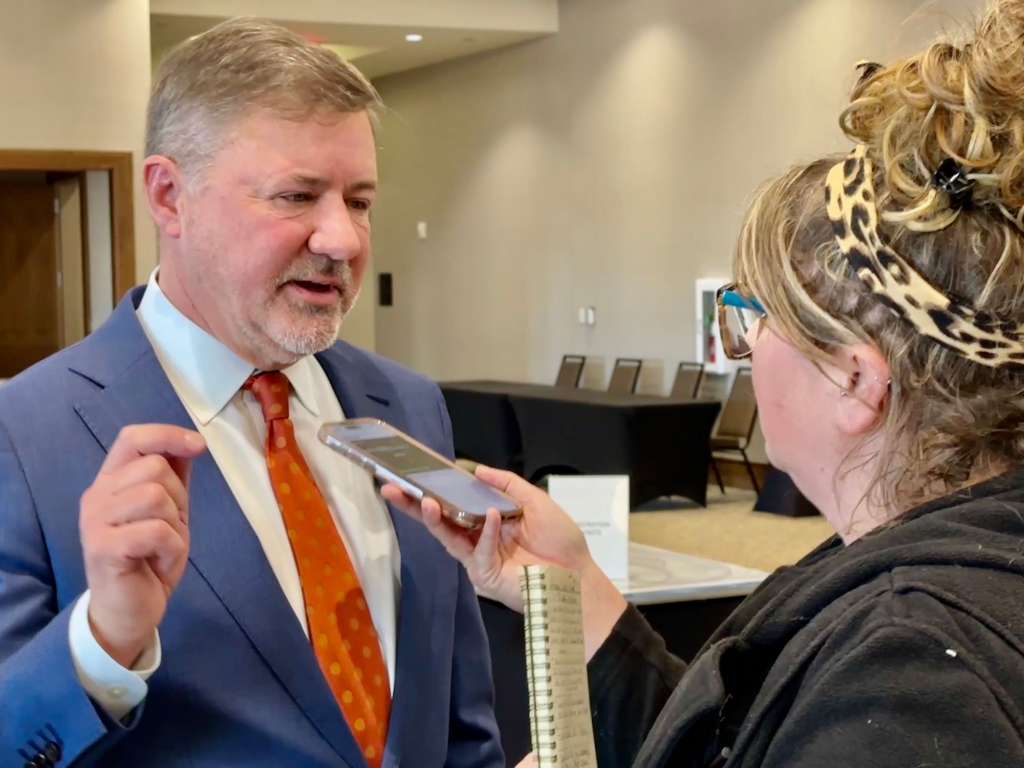
"This afternoon at 3:15, I am going to go on a bus where we are probably going to round up a whole bunch of bad people and destroy hundreds of thousands of dollars' worth of illegal marijuana, and probably retrieve fentanyl, and probably liberate those who are being trafficked for labor and sex," Drummond said. "It is a tragedy."
Drummond said the illegal marijuana has created a distribution network for more illegal activity in the state.
"We have to not be naïve about it, and we have to be aggressive," Drummond said.
Over 100,000 acres of Oklahoma have been purchased illegally by foreign nationals, Drummond said, and there is now a requirement as of November 1st, that if someone is transferring land, the person receiving that land must sign an affidavit that they are a legal resident of Oklahoma and qualified to buy land.
"Our objective is to root out those who illegally own land in Oklahoma..." Drummond said.
Drummond said that the land that is found to be owned illegally will be auctioned off and sold back into the ownership of Oklahoma residents.
On November 16, 2023, President Biden signed H.R. 6363 – the Further Continuing Appropriations and Other Extensions Act of 2024 – into law. The bill extended the Agriculture Improvement Act of 2018 (2018 Farm Bill), reauthorizing programs like the Agriculture Risk (ARC) and Price Loss Coverage (PLC) programs through September 30, 2024. Producers will have an opportunity to make a one-time election between ARC and PLC for the 2024 crop year. USDA opened the election and enrollment period on December 18, 2023, and it runs through March 15, 2024.[1]
The ARC/PLC decision for 2024 is against the backdrop of a general softening in prices, but the implications vary by crop. For some crops, the decision may be clear-cut. In this article, we illustrate the case of wheat (Figure 1). While Effective Reference Prices are projected to climb starting next year for wheat, it is important to remember that you are making a one-year decision for crop year 2024, where the Statutory Reference Price remains at $5.50/bu. With a projected Marketing Year Average Price (MYAP) of $6.63/bu, it is unlikely (though not impossible as we are very early in the growing season) that PLC will trigger. While some may be tempted to elect ARC as a result, note that the 86% trigger threshold is at a price of $5.34/bu, largely indicating that any hope of receiving an ARC payment would rest on very low yields. In other words, in the case of wheat, it's unlikely that either ARC or PLC will trigger (unless there is a disaster that results in low yields).
Figure 1. Historical and Projected Wheat Prices and What They Mean for the ARC/PLC Decision.

As we have noted in the past,[2] we highly encourage you to also look at tools like the Supplemental Coverage Option (SCO) or the Enhanced Coverage Option (ECO), both of which provide area-wide coverage for part of the deductible not covered by your underlying policy. Importantly, if you elect ARC, you cannot purchase SCO. In other words, you are essentially evaluating ARC versus PLC + SCO. Even if PLC is not expected to trigger, you may still choose to elect it and purchase SCO, particularly if the value of SCO is expected to exceed that of ARC.
For cotton producers, we continue recommending that you first evaluate the Stacked Income Protection Plan (STAX) before making decisions about ARC/PLC. In the case of cotton, STAX cannot be purchased on any farm where the seed cotton base has been enrolled in ARC or PLC for that crop year. As we will discuss at the Red River Crops Conference in Altus, OK, later today, in a scenario where the crop is a total loss, the area-wide policies can provide considerably more coverage than ARC. For example, as noted in the example for Jackson County, OK, in Table 1, STAX can provide more than twice as much support as ARC in a total loss scenario.
Table 1. ARC versus STAX Comparison for Cotton in 2024, Jackson County, OK
| Practice | Maximum Possible ARC Payment | STAX | Ratio: STAX-to-ARC | |||
| Expected County Yield (lint lbs/ac) | Maximum Possible Indemnity | Producer-Paid Premium | Maximum Possible Net Indemnity | |||
| IRR | $126 | 1,273 | $243 | $30 | $213 | 1.69 |
| DRY | $31 | 385 | $74 | $9 | $65 | 2.08 |
NOTE: this example relies on several key assumptions that are subject to change: (1) a price election of $0.7959/lb (based on CTZ23 as of 1/16/2024); (2) volatility factor of 0.23 (from 2023); (3) 70% Revenue Protection (RP); and (4) 20% STAX Coverage with 120% Protection Factor. Importantly, ARC payments are limited to 85% of base acres and are subject to a number of restrictions, including payment limits.
As always, we aren't in the business of telling you exactly what to do because, frankly, we don't know what will end up being the best choice. But, as with previous years, we do have a decision aid available at www.afpc.tamu.edu where you can input your info, and it will show you expected payments under as many different price scenarios as you want to look at. We also have students who will input your information for you and call you to discuss results. All you need to do is call (979) 845-5913 and ask for decision aid help.
Hopefully we have given you something to think about as you consider your signup decisions. We wish you luck, and don't hesitate to call for assistance.
[1] https://www.fsa.usda.gov/programs-and-services/arcplc_program/index
[2] https://southernagtoday.org/2023/03/02/strongarc-plc-sign-up-deadline-just-weeks-away-strong/
Article courtesy of Southern Ag Today, Fischer, Bart L., and Joe Outlaw. "Making the ARC/PLC Election for 2024." Southern Ag Today 4(3.4). January 18, 2024. Permalink

Steph Carlson has joined the National Pork Producers Council (NPPC) as assistant vice president (AVP) of state and national relations. In her role, she will serve as the primary NPPC point of contact for state pork organizations. Carlson will be based in Des Moines, Iowa.
"Steph's wealth of experience will be a huge asset to NPPC and state associations," said Cody McKinley, NPPC vice president of operations and state and national relations "Her agricultural roots run deep, and I'm confident she will represent the industry well and be a trusted, insightful resource."
Carlson most recently served as U.S. Sen. Joni Ernst's (R-IA) deputy legislative director and policy advisor. She also has worked for U.S. Sen. Chuck Grassley (R-IA) and former U.S. Rep. David Young (IA-03). Additionally, Carlson was the producer outreach and federal policy director at the Iowa Pork Producers Association.
"Returning home to Iowa and joining the NPPC team is a tremendous opportunity to combine my policy experience and my passion for the pork industry," said Carlson. "I am excited to work closely with our state pork organizations to advocate for pork producers all across the United States."
An Iowa native, Carlson earned a Bachelor of Science degree in Animal Science from Iowa State University. In addition to her professional achievements, Steph is currently a First Lieutenant and serves as the company executive officer of Alpha Company, 1-133d Infantry Battalion in the Iowa Army National Guard.
Yesterday, the Securities and Exchange Commission's (SEC) Division of Trading and Markets issued a statement that the New York Stock Exchange (NYSE) had abruptly withdrawn a proposed rule change to allow the NYSE's listing of Natural Asset Companies (NACs).
On October 4, 2023, the proposed rule change was published in the Federal Register. The proposal would have allowed the buying and selling of undefined "rights" to certain private and public lands, including to foreign nations and noncitizens. Lands enrolled in an NAC would have been controlled by private and public investors and would be prohibited from engaging in "unsustainable activities," which would have included grazing and agricultural purposes.
The withdrawal was made just a day before the SEC's public comment period on the issue ended. R-CALF USA submitted comments opposing the proposal alongside a mass opposition of nearly 2,000 comments from across the country, including from 25 state attorneys general, citing the potential threats to property rights, the prosperity of rural America, and national security.
"R-CALF USA is the only agricultural group that followed the evidence and stood for the property rights of the American rancher to keep them solvent and preserve their ability to keep America fed," said R-CALF USA President Brett Kenzy. "The New York Stock Exchange's decision to withdraw their proposal is a win for ranchers, farmers, and rural America, and is proof that the voice of America is still heard loudly above overreaching, unelected rule makers," said R-CALF USA Region V Director and Property Rights Chair Shad Sullivan. "The foundation of our republic rests upon the shoulders of property rights and this win demonstrates that the American people are still willing to fight for liberty."
The United Sorghum Checkoff Program (USCP) announces the addition of Chef Chase Obenchain as its inaugural Corporate Chef Consultant. With an extensive culinary background and a passion for sorghum, Chef Obenchain is set to bring a fresh perspective and innovative approach to the Checkoff's culinary initiatives.
Chef Obenchain, originally from North Carolina, developed a passion for culinary arts from a young age. Graduating with distinction from the prestigious Culinary Institute of America, he holds degrees in Baking, Pastry and Culinary Science, allowing him to shape his lifelong appreciation for sorghum in various culinary art forms.
Chef Obenchain has dedicated his career to creating delicious and nutritious food that is accessible to all. His experience includes key roles in some of the world's leading Consumer Packaged Goods (CPG) and ingredient companies. Notably, he served as the Innovation Chef at Campbell's Soup Company®, contributing to the design, development and launch of multiple brands within their portfolio, and as a Corporate Chef Consultant on the foodservice team at Dole Packaged Foods®, spreading awareness and developing innovative ideas, recipes and menus.
"We are thrilled to welcome Chase Obenchain to our team as the Corporate Chef Consultant," Director of Nutrition and Food Innovation, Lanier Dabruzzi, MS, RD, LD said. "His diverse culinary background and proven track record in bringing innovative ideas to fruition make him an invaluable addition to our program. We look forward to leveraging his expertise further to promote the versatility and nutritional benefits of sorghum from foodservice and CPG partners to home cooking alike."
"I am honored to join the United Sorghum Checkoff Program and contribute to the promotion of this good-for-you grain," Chef Obenchain said. "This is an exciting opportunity to showcase sorghum's incredible possibilities for creating delicious and nutritious culinary experiences. I look forward to collaborating with the team and bringing fresh ideas to the table."
Chef Obenchain's culinary proficiency and innovative mindset will play a pivotal role in advancing the Sorghum Checkoff's goals and mission to highlight sorghum's nutritional benefits in the consumer and culinary world. For media inquiries or further information, please contact culinary@sorghumcheckoff.com.
The National Corn Growers Association (NCGA) said today that it is deeply disappointed in a decision released by the International Trade Commission, which upholds an earlier opinion that found material injury to U.S. fertilizer companies during a time of rising on-farm fertilizer prices that went on to reach record highs.
The decision comes after the U.S. Court of International Trade asked the U.S. Department of Commerce and ITC to reconsider earlier decisions they issued on the matter.
"The idea that major fertilizer conglomerates were materially injured even as they were posting substantially higher profits during the time in question sounds dubious to me," said Minnesota farmer and NCGA President Harold Wolle. "ITC's decision flies in the face of the U.S. Court of International Trade's request to seriously reconsider this issue and ignores the negative impact these tariffs continue to have on America's farmers who are facing higher prices for fertilizers that are critical to the success of their crops. We will continue to make a vigorous case for eliminating or lowering these tariffs."
The ITC opinion upholds an earlier decision by the agency that the trade practices of a Moroccan-based company caused harm to U.S. fertilizer companies. The decision comes almost a week after the U.S. Department of Commerce announced it was lowering duties on these products from 19.97% to 7.41%, and introduces uncertainty on the fate of tariffs as it could be used as an argument to keep tariffs on phosphate fertilizers high.
The U.S. Court of International Trade will now review the remand decisions and issue a final ruling. The Department of Commerce is also set to make another decision regarding its administrative review later this year.
Commerce and the ITC originally acted on a petition by The Mosaic Company, a U.S.-based fertilizer producer, which had requested the tariffs over what it called unfair trading practices. Over the past three years, NCGA has advocated for growers who were facing record-high phosphate prices by filing an amicus brief in the case, sending letters to the White House and federal agencies, and informing Members of Congress about the impact of the high prices on corn farmers.

Senior Farm and Ranch Broadcaster, Ron Hays, is talking with the President of the Oklahoma Farm Bureau, Rodd Moesel, about the 2024 American Farm Bureau Federation Convention coming up on January 19-24 in in Salt Lake City, Utah.
This year will mark the 105th year of the annual AFBF Convention. The convention will give members the chance to help set the agenda for the leading voice of agriculture in Washington, D.C., and more.
Attendees can participate in workshops, visit the trade show, fellowship with farmers and ranchers, and more.
Moesel said Oklahoma will be represented by a delegation of about 75 members who are making the trip to Salt Lake City.
Oklahoma will also be bringing some competitors for the Young Farmers and Ranchers program who will have the chance to receive national awards. Moesel said it is exciting to see the number of young farmers and ranchers who are actively participating in the OKFB.
"Now that we know we are going to be hosting the 2028 convention, we will all be trying to be observant for ideas and things we want to do to make the Oklahoma City experience special in a few years," Moesel said.
On Sunday of the convention, AFBF will be honoring Congressman Frank Lucas of Oklahoma's 3rd district with the Distinguished Service Award.
"That will probably be our highlight," Moesel said.
The AFBF Distinguished Service Award is awarded to one person each year.
"We are so blessed to have a congressman who understands agricultural policy and actually lives by agricultural policy since he is still an active farmer and rancher," Moesel said. "There just aren't many of those left in Congress."
At the OKFB state convention in November, Moesel said a number of new policies were voted on by Oklahoma members. Many of those policies from Oklahoma will make it to the floor on Tuesday of the annual AFBF convention.
"I would say this year, the issues are more general all across the board," Moesel said. "There is a number that relate to the farm bill, a number that relate to a lot of labor issues, there is a lot of concern about the agriculture labor force across the country, so that will maybe be the hottest subject, I think, besides the general farm bill issues."
| ||||||||||||||||||||||||||||||||||||||||||||||||||||||||||||||||||||||||||||||||||||||||||||||||||||||||||||||||||||||||||||||||||||||||||||||||||||||||||||||||||||||||||||||||||||||||||||||||||||||||||||
|
The National Cattlemen's Beef Association (NCBA) strongly supports the Death Tax Repeal Act, led by Reps. Randy Feenstra (IA) and Sanford Bishop (GA). The Senate companion bill is led by Sen. John Thune (SD). Repealing the federal estate tax, also known as the Death Tax, is a top priority for NCBA.
"It is unconscionable for cattle producers to face a tax that forces them to sell all or part of their family's farm or ranch due to the death of a family member. With the cost of farmland rapidly rising, the Death Tax presents a significant threat to the future of family farms and ranches," said NCBA President and South Dakota cattle producer Todd Wilkinson. "Most cattle producers have significant assets but are cash-poor and operate on thin margins, leaving them with few options when they are saddled with an unexpected tax liability. Some producers are forced to sell off assets including land, livestock, farm equipment, or even their home. This is an incredible loss, and it starts a vicious cycle where future generations continue to face punitive taxes their ancestors paid multiple times. Rural America needs a tax code that promotes multi-generational, family-owned businesses instead of chopping them up."
Current Death Tax relief is set to expire at the end of 2025, and it is vital that Congress acts soon and provide permanent relief for our family operations. If the federal estate tax exemption reverts to pre-2017 limits, coupled with the rapid inflation of farmland values, many more families will be subject to the Death Tax.
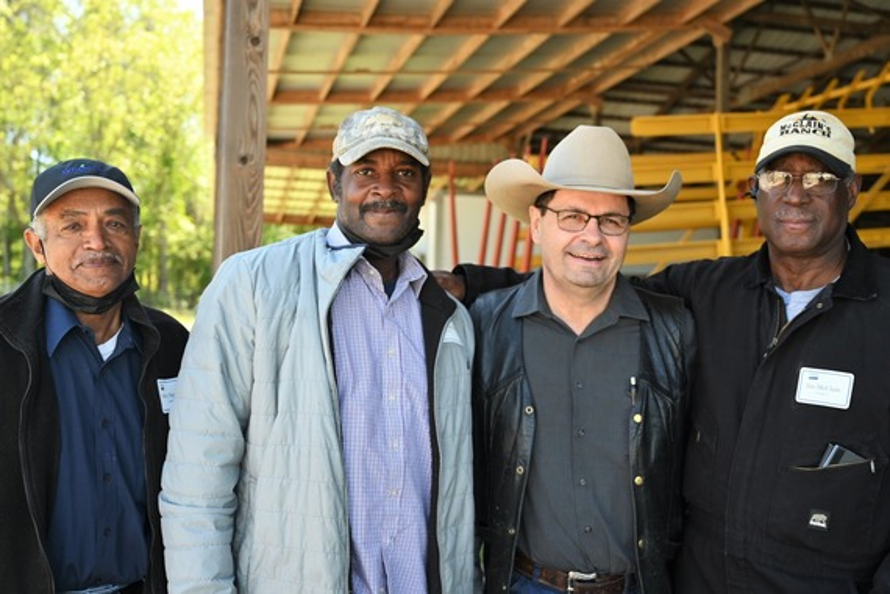
The U.S. Department of Agriculture (USDA) announces the appointment of 15 new members to the Advisory Committee on Minority Farmers (ACMF). The newly appointed members serve terms of up to two years.
"Minority farmers face unique challenges in accessing the land, credit, and training they need to succeed," said Agriculture Secretary Tom Vilsack. "This committee is part of USDA's commitment to ensure that all farmers have equal access to USDA programs and services, especially minority farmers and producers in underserved communities."
Newly appointed members are:
Committee members represent socially disadvantaged farmers, nonprofit organizations, civil rights organizations or professions, and institutions of higher education.
The Advisory Committee for Minority Farmers was established by Congress in the Food Conservation and Energy Act of 2008 to ensure that underserved farmers have equal access to USDA programs. Committee members advise the Secretary of Agriculture on the administration of the Outreach and Assistance for Socially Disadvantaged Farmers and Ranchers Competitive Grant Program. They also make recommendations to the Secretary on how to increase minority participation in USDA programs.
USDA's Office of Partnerships and Public Engagement (OPPE) provides administrative staff support for the work initiated by the committee. OPPE develops and maintains partnerships focused on solutions to challenges facing rural and underserved communities and connects those communities to the education, tools, and resources available to them through USDA programs and initiatives.
For more information, visit the Advisory Committee on Minority Farmers website. USDA touches the lives of all Americans each day in so many positive ways. In the Biden-Harris Administration, USDA is transforming America's food system with a greater focus on more resilient local and regional food production, fairer markets for all producers, ensuring access to safe, healthy and nutritious food in all communities, building new markets and streams of income for farmers and producers using climate smart food and forestry practices, making historic investments in infrastructure and clean energy capabilities in rural America, and committing to equity across the Department by removing systemic barriers and building a workforce more representative of America. For more information, visit www.usda.gov.

Rep. Tom Gann, R-Inola, said he is taking a proactive step toward safeguarding Oklahoma's public school students with the introduction of House Bill 3112. The bill would prohibit schools and school districts from accepting financial donations or gifts from countries designated as "hostile" or "Countries of Particular Concern (CPC)" by the United States Secretary of State.
On Sept. 21, 2023, Superintendent for Public Instruction Ryan Walters issued a report to the Legislature from his testimony to the U.S. House Subcommittee on Early Childhood, Elementary and Secondary Education. He described the involvement of the Chinese Communist Party in Oklahoma public education.
The hearing titled "Academic Freedom Under Attack: Loosening the CCP's Grip on America's Classrooms," covered the investigation that began under the Trump Administration, and the work of Parents Defending Education. Gann said the hearing uncovered the covert efforts by the Chinese Communist Party to influence young people in the United States through the nation's universities and K-12 systems of public education.
"One of the most disturbing statements in the report was, 'The Chinese International Education Foundation (CIEF), a Chinese-based organization sponsored by the CCP, is directly mentioned ten times in a contract that Tulsa Public Schools signed with the Confucius Classroom Coordination Office (CCCO) within the nonprofit IL Texas Global," Gann said.
"We must never allow an avowed enemy of America and of freedom direct influence over the education of our children," he said.
HB3112 would prevent school districts from accepting funding from hostile foreign governments beginning in the 2024-25 school year going forward. In addition to the prohibition, the bill mandates that school districts annually report any receipt of donations or gifts falling within the specified criteria. These reports will be required to be submitted through the Oklahoma Cost Accounting System used by schools and the state Department of Education, ensuring transparency and accountability in financial transactions.
The bill contains an emergency clause, so it would take effect immediately upon being signed into law. It will be eligible to be considered when the regular legislative session starts. Feb. 5.
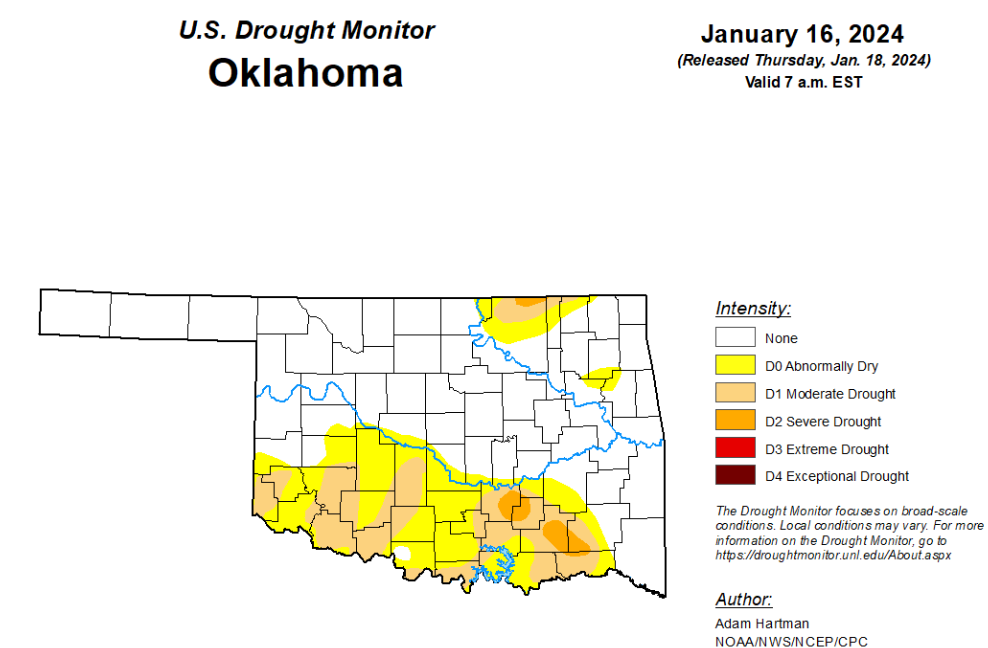
To view the latest Oklahoma drought map, CLICK HERE.
According to the latest Oklahoma drought monitor report, exceptional drought remains at zero percent, unchanged from the start of the calendar year.
Extreme drought or worse remains at zero percent, unchanged from the past three weeks.
Severe drought or worse remains at 1.67 percent, unchanged from last week.
Moderate drought or worse remains at 15.01 percent, unchanged from last week.
Abnormally dry or worse conditions remain at 34.19 percent, unchanged from last week.
According to the 6-to-10-day precipitation outlook map, the majority of the state is leaning above a 70 to 80 percent chance of precipitation through January 27th. In the northwest region of the state, there is a 60 to 70 percent chance of precipitation through that date. The western half of the panhandle is learning above a 40 to 50 percent chance of precipitation through January 27th.
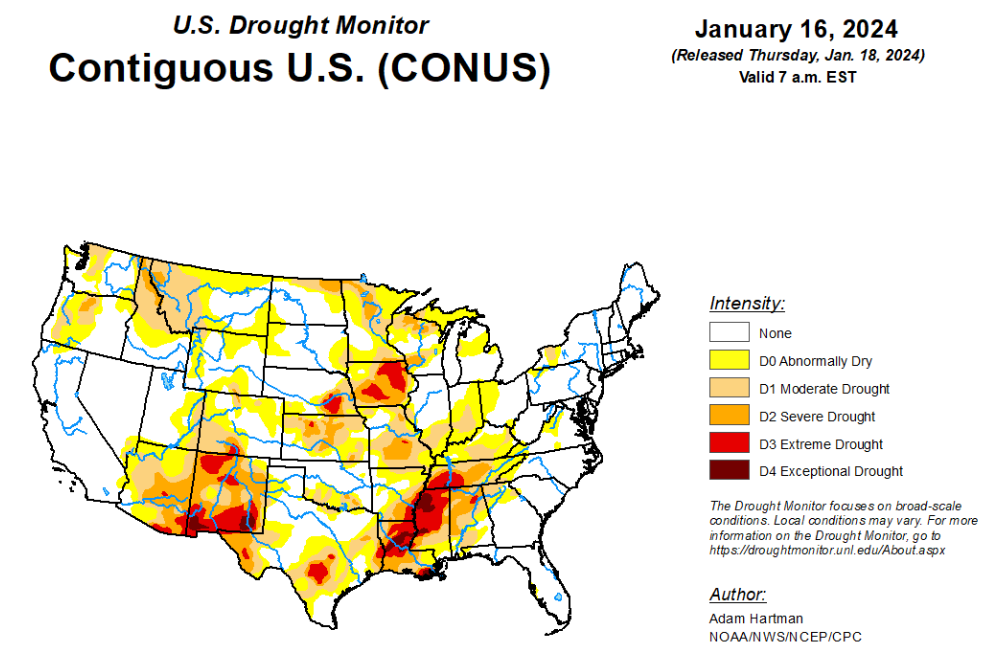
To view the United States Drought Map, click here.
According to the latest U.S. drought monitor, it was another stormy week across much of the eastern lower 48 states leading to widespread drought improvements from the Mississippi River Valley eastward to the Appalachians. A powerful storm system early in the week (January 9-10) brought heavy rainfall to parts of the eastern U.S., with most locations from Georgia to New England picking up more than 2 inches of precipitation, leading to flooding for several locations. In some locations across the Mid-Atlantic and interior Northeast, flooding was exacerbated by melting snow left over from a winter storm hitting the region the previous weekend (January 6-7). Behind the powerful storm system early this week, cold air plunged southward from Canada across the northern tier states, gradually spreading southward and eastward and overtaking most of the country east of the Rockies by the end of the week (January 16). Toward the end of the week, another storm system dropped wintry precipitation in a swath stretching from the Ozarks eastward to the Mid-Atlantic and Northeast. Across the western lower 48 states, precipitation was above average for the week, leading to targeted improvements to drought areas across the Intermountain West, where snowpack continues to build for several locations. Unfortunately, weekly precipitation and seasonal snowpack remain below normal this week across the Southwest and northern Rockies, leading to some degradation of drought conditions. No changes are warranted in Alaska this week, as the snowpack is in good shape statewide. Hawaii received more heavy rainfall this week, predominantly from a Kona Low early on, leading to improvement. Conversely, another warm and dry week in Puerto Rico warranted another round of degradation.
In the Southern Plains, much of the precipitation this week fell across portions of the Ozarks and Tennessee Valley, associated with a couple of storm systems leading up to the start of the weekend (January 13), with many locations receiving in excess of 1 inch of rainfall. Toward the end of the week (January 15-16), a winter storm dropped several inches of snowfall across many of these same locations. Given the wetter than average conditions last week and another round of above average precipitation again this week, widespread improvement to drought conditions are warranted across portions of Arkansas and Tennessee. In parts of southern Texas, some degradation to the drought depiction is warranted, where short-term precipitation deficits are starting to mount. No changes are warranted elsewhere across the region due to above average precipitation last week and cold temperatures spreading across the region this week.
In the High Plains, storminess in recent weeks and frigid temperatures this week warrant no changes across much of the Central and Northern Plains. However, there are mixed improvements (Colorado Plateau) and degradations (High Plains along the Front Range) warranted this week. Improvements to snowpack and short-term precipitation deficits this week warrant the improvements across the Colorado Plateau. Conversely, the lack of seasonal snow cover has led to degradations across parts of the High Plains along the Front Range, due to topsoils being exposed and drying out.
In the West, some degradation of drought conditions is warranted where below average precipitation was observed this week. This is especially the case across western portions of Montana, where below average seasonal snow cover has left soils predominantly exposed, resulting in a slow decline in soil moisture over the past couple of months. On the other hand, targeted improvements are warranted across parts of the Pacific Northwest and eastern Great Basin, where 7-day precipitation totals and storminess in recent weeks have improved some of the long-term drought indicators. The active storm track in recent weeks has also led to gradual improvements to seasonal snowpack for several locations across the higher elevations of the Pacific Northwest, Great Basin, and portions of the Colorado Plateau.
Looking ahead, during the next five days (January 18-22), a fast moving storm system could bring some snowfall to portions of the Great Plains, Midwest, and Mid-Atlantic January 18-20. Surface high pressure behind this system is expected to gradually bring more southerly flow across much of the eastern U.S. as it moves eastward, leading to a moderation of the bitterly cold temperatures east of the Rockies, and some storminess across the south-central U.S., by January 22. A series of storms is also forecast to impact the West Coast over the next five days.
The Climate Prediction Center's 6-10 day outlook (valid January 22-26), favors enhanced chances of above average temperatures across the entirety of the lower 48 states, with the highest chances (greater the 80%) centered over the Great Lakes. Enhanced chances of above average precipitation is also favored across much of the lower 48 states from coast to coast, with the highest chances (greater than 70%) across the south-central U.S. The exception is across the Northern Plains, where below average precipitation is favored.
To view the 6-10 Day Precipitation Outlook Map, click here.
To view the 6-10 Day Temperature Outlook Map, click here.
To view the Monthly Drought Outlook Map, click here.
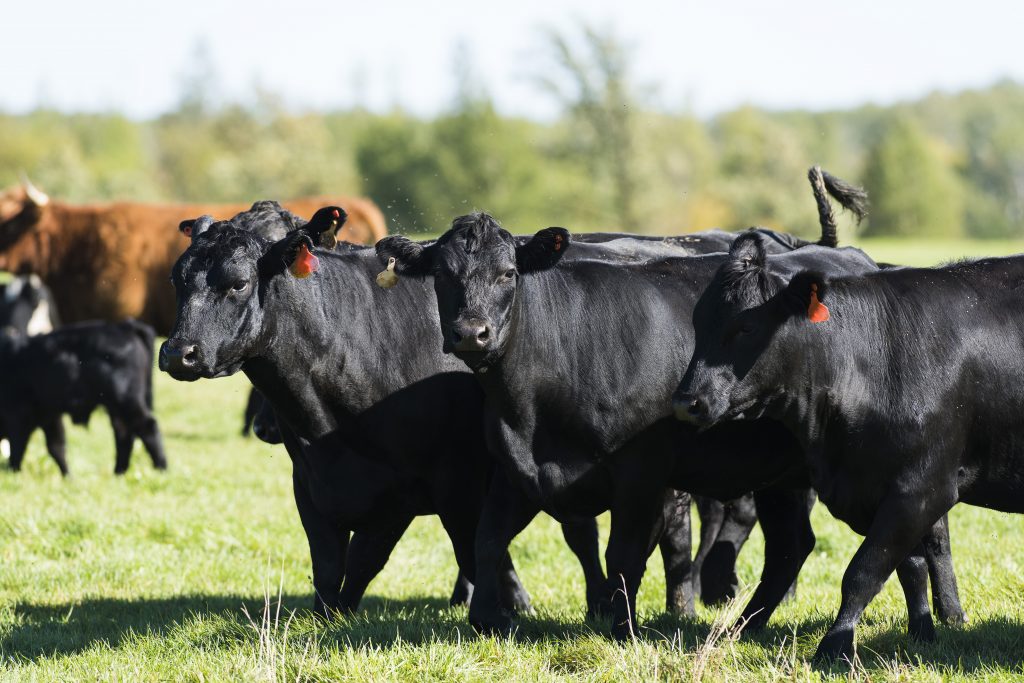
Senior Farm and Ranch Broadcaster, Ron Hays, is visiting with the Director of Supply Management and Analysis of Certified Angus Beef, Paul Dykstra, about the CAB program.
With those who are producing successful CAB cattle, Dykstra said terminal traits versus maternal traits is a conversation he enjoys having.
"It is one that I think is very appropriate for our times as we have advanced in a number of genetic tools that we have available to us, predictions in terms of EPDs, and those indexes that we have," Dykstra said.
With so many traits to pay attention to, Dykstra said discussing maternal and terminal traits with cattlemen is a good topic of conversation about where to put emphasis.
"At Certified Angus Beef, we are pretty single minded with regard to high-quality beef product that fits our specifications," Dykstra said. "We are absolutely sensitive to and agree with the fact that cow-calf producers first have to take care of cow functionality at home."
With smaller cow numbers, Dykstra said things are more challenging for CAB from a supply perspective.
"In the last year, particularly, of course, the fed cattle harvest was smaller on a weekly basis, so that starts us behind the eight-ball in terms of headcount available to our supply to evaluate for our standards," Dykstra said. "We have been the benefactors of an increasing Angus-type cattle population in the country, and more animals are eligible as a percentage of the total."
Dykstra said the premium choice grade was bit higher this year and was strong. The prime grade percentage, Dykstra added, was stronger for three quarters of the year.
"We were down slightly, but it could have been much worse, and we are tickled with the outcome given the headwinds and the challenges that the industry faced this year," Dykstra said.
2023 brought an increased market until the fourth quarter, when an adjustment was seen. In 2024, Dykstra said the industry is working toward building those values higher, and given demand and supply metrics, he expects positive times ahead.
"With these smaller head counts, it is just a fact of the matter that demand is great, supply is down, and I think that is a pretty simple equation to put together as we move forward," Dykstra said.
The Beef Buzz is a regular feature heard on radio stations around the region on the Radio Oklahoma Ag Network and is a regular audio feature found on this website as well. Click on the LISTEN BAR for today's show and check out our archives for older Beef Buzz shows covering the gamut of the beef cattle industry today.

Agricultural Innovation in Focus: Andy Heath of Pivot Bio Shares Groundbreaking Silage Data at the 2024 Dairy Strong Conference
An extensive new study conducted in collaboration with over 30 dairy producers during the 2022 and 2023 growing seasons demonstrated that replacing up to 40 pounds per acre of synthetic nitrogen with Pivot Bio PROVEN® 40 significantly improved silage tonnage without sacrificing quality.
The results, presented at the Dairy Business Association's Dairy Strong event in Green Bay, Wisconsin, showed that farmers who used PROVEN 40 and a reduced rate of nitrogen saw a 0.91 increase in tonnage per acre, representing a 4.2% advantage over the grower standard.
PROVEN 40 not only increased silage production but also boosted farmer profitability. Replacing synthetic nitrogen with up to 40 pounds of PROVEN 40 led to a 3.4% increase in milk production per acre. While production per acre increased, milk per ton remained consistent, demonstrating that production can increase while maintaining quality.
"PROVEN 40 isn't just about increasing production. It's also a path to maximizing profit for farmers," said Andy Heath, a Pivot Bio agronomist from Central Wisconsin. "For the second year in a row, our results show that Pivot Bio's revolutionary microbial nitrogen is a step toward a more prosperous future in corn silage production, optimizing tonnage, maintaining quality, improving environmental outcomes and ultimately driving profitability."
Key findings include:
● Consistent performance across varied weather conditions: The study, conducted over two years, showcased the consistent advantages of PROVEN 40 in increasing silage yield across diverse weather conditions, soil types and corn silage management systems.
● Impressive tonnage increase: Dairy producers who replaced up to 40 pounds of synthetic nitrogen per acre with PROVEN 40 increased tonnage per acre by 0.91, a 4.2% boost when adjusted to 65% moisture content. ● Maintaining quality while growing profitability: In addition to increasing corn tonnage, replacing synthetic nitrogen with PROVEN 40 led to no statistical difference in quality metrics, including 30-hour neutral detergent fiber digestibility, starch content, 240-hour undigestible neutral detergent fiber and crude protein.

Representative Lowe will join with 5 other elected officials in the Oklahoma City Metro Area to share current and pressing information regarding the ongoing efforts by the Board of Oklahoma County Commissioners to select a site for the new jail. The Town Hall will also provide an opportunity for the public to communicate their preferences or concerns for the location of the new county jail.
"The public has a right to have an opinion in the question of where the new jail should be, and they will be able to voice their opinion on Monday night," said Rep. Lowe.
Details for Your Planning:WHAT: TOWN HALL RE: the New Jail Location
WHO: ● Jason Lowe, State Representative (HD 97–NE OKC)
● Nikki Nice, OKC City Council (Ward 7–NE OKC)
● Claudia Browne, Del City City Council (Ward 3)
● JoBeth Hamon, OKC City Council (Ward 6–Downtown OKC)
● James Cooper, OKC City Council (Ward 2–North OKC)
● Forrest Bennett, State Representative (HD 92 – South OKC)
WHEN: Monday, Jan. 22, 2024 – 6:00 PM
WHERE: MetroTech Springlake Campus – Auditorium
1900 Springlake Dr., Oklahoma City, OK 73111
Share your thoughts, exercise your membership voting power and help chart the course for a successful Oklahoma beef industry!
Member Engagement is Vital to the Success of Policy Development! Be sure to attend the Annual Winter Policy Meeting on
Located at 2833 Conference Dr, Edmond, OK
$45 Early Registration Fee, Lunch Included
Onsite registration is $60/person.
AGENDA:
8:30 - 9:00 am Registration
9:00 - 10:15 am Opening Session
Dr. Troy Shelby, OCA President
Guest Speaker: Oklahoma Attorney General Gentner Drummond
10:15 - 11:45 am Beef Production Committee Meeting
Dr. Rosslyn Biggs, Chair
Noon - 1:30 pm Lunch **ticketed meal
Guest Speaker: Mike Sanders, Oklahoma Broadband Authority
1:30 - 3:00 pm Beef Business Committee Meeting
Jeremy Kinder, Chair
3:00 - 4:30 pm OCA Winter Quarterly Board Meeting
Dr. Troy Shelby, OCA President

Only a day after Attorney General Gentner Drummond told a U.S. House committee how illegal immigration is fueling criminal activity in Oklahoma, members of his office's Organized Crime Task Force arrested several foreign nationals in connection with the seizure of a significant amount of marijuana allegedly headed for the illegal drug market.
"As I told Congress last week, the border crisis is imperiling public safety in our state," Drummond said. "It is unconscionable that Oklahomans continue to pay the price for the failure of the Biden Administration to secure the border."
Task force agents, in collaboration with several law enforcement agencies, executed two search warrants in Muskogee County on Jan. 11 that led to the seizure. Multiple firearms also were discovered in the search, as well as evidence that led agents to a half-million-dollar marijuana "stash house" in Bixby where they discovered signs of drug trafficking.
Five individuals are facing various criminal charges, including aggravated trafficking, unlawful manufacturing of marijuana, and the possession of firearms in the commission of a felony. Four of those arrested are in the country illegally and listed as U.S. Immigration and Customs Enforcement detainers.
Drummond commended the Oklahoma Medical Marijuana Authority, the Muskogee County Sheriff's Office, the Tulsa County Sheriff's Office and the Bixby Police Department for their help with the investigation.
"The best way to eliminate organized criminal activity in Oklahoma is for agencies statewide to work together with the common goal of driving out these offenders. That is exactly what happened here," he said. "I appreciate the critical work task force agents and our partner agencies are carrying out in every corner of the state."
The bust originated with information received on the Attorney General's Illegal Marijuana Tipline. The form is accessible on the Office of the Attorney General website (oag.ok.gov) and tipsters can remain anonymous.
The task force is working closely with the Oklahoma Bureau of Narcotics and Dangerous Drugs Control (OBN), the Oklahoma Medical Marijuana Authority and other state agencies to investigate all crimes related to illegal grow operations, including human trafficking and the distribution of deadly drugs such as fentanyl.
Drummond was one of three state attorneys general who testified Jan. 10 before the U.S. House Committee on Homeland Security.
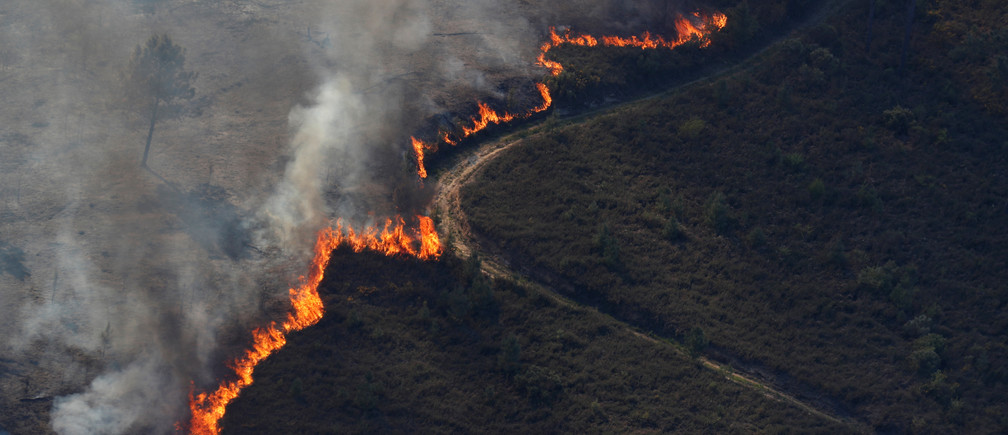
Oklahoma Forestry Services (OFS) closed out 2023 with below-normal wildfire occurrence and acres burned. OFS responded to 536 wildfires burning 47,222 acres.
Compared to the 10-year average of 1,203 fires burning 230,247 acres annually, OFS responded to only 45% of normal fires burning less than 21% of normal acres burned.
"The ongoing drought from 2022 into 2023 resulted in less available wildland fuel on the landscape during the winter and spring months, which is the primary fire season in Oklahoma," said State Forester and Director of Oklahoma Forestry Services, Mark Goeller. "Abundant rainfall early in the growing season prompted vigorous, early green-up. Additional rainfall through early summer kept live wildland fuel moisture high which kept wildfire occurrence low."
Additionally, OFS ended the year completing 46 prescribed fires treating 7,946.7 acres. The burning was targeted at achieving multiple objectives with most of the activity focused on both ecological restoration and hazard fuels mitigation.
"A few of the prescribed fires were implemented for site preparation for production forestry practices," Goeller said. "Wildfire response activity often limits the ability to conduct prescribed fires. However, despite the lack of wildfire the past year proved difficult to conduct prescribed fires given the lack of favorable burning conditions in January through early March. This is the time frame when the bulk of burning is completed to meet land management objectives."
Leaning into 2024, OFS has several prescribed burns planned or in the process of plan development targeted at treating approximately 12,000 acres.
"Despite the drought conditions that have persisted, Oklahoma generally received adequate rainfall early in the growing season coupled with a few timely summer rains producing normal to above-normal herbaceous fuel loading across the state," Goeller said. "The big takeaway for now is that, unlike last year, there is ample wildland fuels on the Oklahoma landscape to support potential for large and significant fire activity when combined with fire effective weather."

Growth Energy, the nation's largest biofuels trade association, published its 2024 federal policy priorities today. Organized into three categories, the agenda offers a roadmap toward a more vibrant, sustainable future characterized by lower fuel costs, lower greenhouse gas (GHG) emissions, greater energy independence, and stronger rural communities.
"These are the policy decisions that will shape the next era of growth in plant-based energy and climate solutions," said Growth Energy CEO Emily Skor. "We hope these priorities serve as roadmap for elected officials seeking to support biomanufacturing facilities at the heart of America's bioeconomy."
"Growth Energy, its members, and its champions on Capitol Hill know that the full potential of America's bioethanol sector has yet to be fully realized," she added. "With the right policies in place, our industry will continue to meet America's energy needs, economic demands, and carbon reduction goals — all at the same time."
Growth Energy's 2024 federal policy priorities focus on:
Ensuring drivers can use more lower-carbon, lower-cost bioethanol at the pump at home and abroad.
Using bioethanol to expeditiously advance our national transportation carbon reduction goals.
Optimizing the Renewable Fuel Standard (RFS) to maximize carbon reduction potential.
For more information on Growth Energy's policy priorities, visit growthenergy.org/policy
New Report Highlights the Partnerships that Power U.S. Soy's Growing Role as a Sustainable Source for Food, Feed, Fuel and Thousands of Other Products.
What's the power of one unassuming soybean? When it's sustainably grown by U.S. Soy farmers and adopted by their growing roster of public and private partners, that single bean can simultaneously advance food security, renewable energy and environmental stewardship through an ever-expanding range of products people depend on every day.
On behalf of U.S. soybean farmers, United Soybean Board (USB) today released its 2023 U.S. Soy Sustainability Overview. Titled "Partners for a Better Tomorrow," the report shines a spotlight on the partnerships fostered by these farmers' checkoff investments to drive innovation both on and off the farm. These advances include efforts to enhance sustainability in production agriculture as well as ongoing development of new soy-based products that provide cleaner alternatives for everything from rubbers and plastics to adhesives and lubricants.
"U.S. Soy farmers are proud of the important and growing role they play in maximizing sustainability not only in farming but throughout industries and around the globe," said Iowa farmer April Hemmes, who serves as chair of the Demand Action Team at USB. "We work with partners every day to discover new ways to use U.S. Soy to sustainably solve some of society's biggest challenges. At the same time, these efforts support the U.S. economy by opening important new markets for the soy industry."
Building Sustainable Food Security
The report highlights the efforts of U.S. soybean farmers and their partners to advance sustainable food production and support food security around the world. This starts on the farm, where modern practices and advanced technologies help farmers to conserve land, water, energy and other natural resources. Partners like Farmers for Soy Health and The Nature Conservancy work with U.S. Soy to expand the use of sustainable farming practices, such as cover crops and conservation tillage, which help to improve soil health and reduce greenhouse gas emissions.
U.S. farmers also support initiatives like U.S. Soybean Export Council (USSEC)'s Soy Excellence Centers and the World Initiative for Soy in Human Health (WISHH) aquaculture internship program. These programs provide protein producers in developing countries around the world with training and capacity-building programs to help them enhance productivity and sustainability.
Renewable Alternatives for Fossil Fuels and Other Products
The U.S. Soy Sustainability Overview also puts a spotlight on the growing range of renewable soy-based products available or in development today. Biodiesel is perhaps the best-known non-food use for U.S. Soy, as the renewable fuel can reduce total greenhouse gas emissions by up to 86% compared with petroleum diesel. Biodiesel is the first and only fuel commercially available nationwide to meet the U.S. Environmental Protection Agency's definition of an advanced biofuel. U.S. Soy farmers' checkoff investments helped to launch this fast-growing market and will continue to support its development in the years to come.
U.S. Soy also provides a renewable and safer alternative to fossil fuels and chemicals in manufacturing of thousands of products, replacing petroleum in rubbers and plastics, and chemicals like formaldehyde in adhesives. Soy shows up today in everyday products ranging from shoe soles to plywood and from carpet to paint, even in synthetic lawns.
U.S. Soy and its partners continue to make advances in new uses for soy-based products, developing better options for thousands of products that not only provide renewable resources for manufacturing, but in many cases also enable faster biodegradability or composting to help protect the environment.
Ongoing Research Advances
The report provides updates on checkoff-funded research projects that hold significant promise in advancing sustainability, both on the farm and through groundbreaking new uses for soy. For example, USB and multiple partners are in the midst of a three-year project aimed at reducing the impact of drought on soybean varieties, which could potentially improve yields by 10% to 15%. Partners are also in various stages of development for new soy-based products and applications ranging from mulch to groundwater remediation to cat litter.
U.S. Soy constantly seeks new partners across industries and in academia to drive food security, alternative energy, renewable consumer products and beyond. To learn more, please visit ussoy.org.
| Abbreviated slaughter schedules have been prevalent because of last week's weather burdening packers with power outages and transportation issues. Following two reduced weekly head counts, due to holidays, last week's estimated 549,000 head total was 17% smaller than the same week a year ago. This week also started below recent normal weekday head counts with just 112,000 head harvested compared to the more typical 125,000 head range. Although last week's $173.80/cwt. fed steer price was down $0.70/cwt., the market found decent support as packer needs to fill the supply chain were offset by cattle being pushed back in the harvest schedule. |
| Live Cattle futures prices have been mounting a comeback in seesaw fashion since the first of the year. The February contract has gained $3.50/cwt. since January 2, but the setbacks have been as frequent as progress. Boxed beef are reflecting the recent smaller production volume with the Choice cutout up 2% or $5.83/cwt. this Monday versus last Monday. The CAB cutout shows a decline of $2.75/cwt. in the week-to-week average. Yet the decrease follows a week when the CAB price advanced while the Choice cutout trended lower, generating an abnormally wide CAB-Choice price spread of $26.31/cwt. Last week's opposite relationship between the two was a trailing realignment On average across several years, January through the first week of February is typically a lower beef demand period when prices move generally sideways. It's a time when high-flying middle meat values deflate from December and end meats strengthen a bit as the cheaper roasting items come into focus. Logically, spot market cutout prices may remain more elevated in light of recent supply struggles. In December, the brand recorded the second largest pounds of CAB product sold by packers to licensed partners. |
| Carcass Weights to Plunge, Quality to Remain |
| The onset of severe cold temperatures and snow accumulation in a broad spectrum of cattle feeding regions will pull fed cattle production down. Beyond the reduced weekly slaughter head counts, carcass weights are set to plunge. Since the all-time record high carcass weights were recently recorded in late December, there is certainly some flex in the production system as far as boxed pounds of product per head. From a cattle feeder's perspective that conversation is void since feed efficiency and daily gains have been slashed dramatically the past ten days. Pen conditions will erode in the future as temperatures warm up, adding to cattle performance declines. The chart details fed cattle carcass weights for the past two years. The 2023 weight trend started with the first four months trailing 2022 by an average of 16 lb. per carcass. That winter's storms and brutal temperatures are still fresh in our minds with the duration of poor conditions measured in months, not weeks. Although this season's weather impact is not yet two weeks underway, a similar pattern in decreased cattle performance will come through in the carcass weight data very soon. Formula steer weights were down 5 lb. Monday, January 15, as the weather shift was initially developing. That was the the tip of the iceburg. |
| Shifting focus from carcass weight to carcass quality the outlook remains positive through the first quarter. We've detailed previously in the Insider that extreme cold temperatures haven't historically had a negative impact on marbling scores. In fact, the trend is just the opposite as improved national average carcass quality, in terms of percent USDA Choice and Prime and percent CAB acceptance, is often noted during these weather conditions. Increased potential carcass quality is one of the only benefits of a polar vortex event for cattle feeders. Feedyards may see more of their Angus-type cattle qualifying for the Certified Angus Beef ® brand than would have been achieved under conditions favoring heavier carcass weights. Since marbling scores below Modest 00 (the minimum requirement for Premium Choice) are the primary reason carcasses are not certified for the brand, marbling improvement is key to capturing more CAB carcasses and premiums. But lighter average carcass weights (primarily in big steers) pull the percentage of carcasses exceeding the brand's 1,100 lb. maximum lower than otherwise might have been realized in ideal feeding performance conditions, increasing the pen's percent CAB acceptance. Lighter weights also mean fewer ribeyes exceeding the brand's traditional 16 square inch maximum and those measuring more than the one square inch upper limit. |

Rep. Chris Banning, R-Bixby, recently filed legislation prohibiting the state of Oklahoma from purchasing drones from covered foreign entities.
House Bill 3068 would restrict the state from purchasing or operating small unmanned aircraft systems, known as drones, that are built or assembled by covered foreign entities without specific waivers.
"This bill marks a step in safeguarding Oklahoma's interests," Banning said. "House Bill 3068 demonstrates that Oklahoma values the privacy and safety of its residents with its proactive approach to regulating foreign drones."
HB3068 categorizes covered foreign entities as those whose names appear on the Consolidated Screening List or Entity List, as designated by the United States Secretary of Commerce, or domicile in the People's Republic of China or the Russian Federation.
The Office of Management and Enterprise Services can waive these restrictions after reviewing the necessity to purchase a covered foreign entity-manufactured system due to difficult circumstances, Counter-Unmanned Aircraft Systems, or criminal investigative purposes.
Under HB3068, public entities cannot operate small unmanned aircraft systems from covered foreign entities after May 1, 2027. HB3068 is available to be heard after the legislative session commences on Monday, February 5.
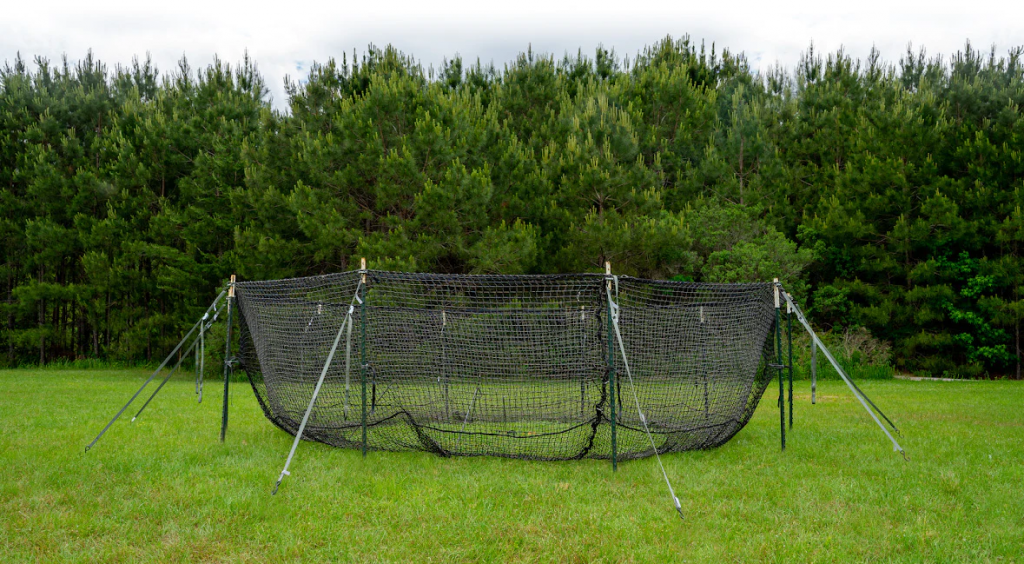
Associate Farm Editor, Reagan Calk, had the chance to talk with Aaron Sumrall, the Director of Outreach, Education and Research at Pig Brig Trap Systems, about what these trapping systems have to offer for a variety of operations and properties.
"Pig Brig is something that is unique and innovative to the pig trapping world/pig management option world," Sumrall said.
The Pig Brig trap is a silent, continuous catch system that is tough, easy to transport, and simple to use.
"We don't require technology, we don't require staying up all night to watch a gate or to shut a door when the pigs go in," Sumrall said. "We don't require data plans or anything of that nature. It is basically a passive catch system that allows an unbelievable ability to remove large numbers of pigs in a short period of time."
Sumrall said wild pigs impact anyone who eats, wears clothes, or lives in a house. While producers are impacted at the ground level, Sumrall said, because the production of commodities is impacted by wild pigs, the consumer is affected as well.
Another thing to remember is that wild pigs are going to reproduce, Sumrall said, so if they are not being controlled, the population will multiply. Wild pigs directly impact production agriculture in a negative direction, Sumrall added.
"We are much more than just a trap," Sumrall said. "When you invest in Pig Brig, we invest in you. You have the opportunity to communicate specifically with one of us. We are not farming out any of the customer services to someone else. If you call Pig Brig, you talk to us."
Sumrall said the Pig Brig team provides assistance through trap support, customer support, management advice, theories, approaches, and more. Whether an individual is new to trapping or is an experienced trapper, Sumrall said the team has invaluable resources to offer to ensure success.
"Right now, we have scattered around 7,000 traps around the 35 countries on the planet," Sumrall said.
Pig Brig also conducts trials in different areas to learn more about what works best in particular regions.
"There is a research project we are going to be putting on with Northeastern State University in Tahlequah probably within the next two to three weeks," Sumrall said. "A lot of those university trials we like to cooperate with are the pulse point for that region of the state."
Sumrall said Pig Brig has trials going with many different universities, so anyone interested in what Pig Brig can do for them might consider contacting their local university to see if there is a trial they can check out.
Pig Brig is funding numerous research projects around the world, Sumrall said with the goal of learning more about feral pigs.
"The only way we are going to gain that knowledge is to invest in that research and to invest in those future land managers, those future biologists, those future farmers, to be able to go out there in the field, conduct that research, and answer those questions..." Sumrall said.
For those looking for more information and resources regarding the Pig Brig trapping system, Sumrall said https://pigbrig.com/ has an abundance of resources to offer.
"We have research there that is pertinent to pig management and some of the trapping theories and ideologies," Sumrall said.
Pig Brig focuses on the science behind pig management, Sumrall said, and promotes an adaptive approach to pig management.
The website also has an education landing page, Sumrall said, that offers free education to the general public through monthly webinars and more. Sumrall said Pig Brig also has quarterly mitigation programs with world leaders in feral pig management.
"If you want to find a place where you can set up a sound management program or sound management approach to feral pigs anywhere around the country, we have got you covered on that," Sumrall said. "We have people scattered across the country that are regional, that know the specifics about your given region."
For more information, visit https://pigbrig.com/ or call Pig Brig at 833-744-2744.
| |||||||||||||||||||||||||||||||||||||||||||||||||||||||||||||||||||||||||||||||||||||||||||||||||||||||||||||||||||||||||||||||||||||||||||||||||||||||||||||||||||||||||||||||||||||||||||||||||||||||||
|

Widespread adoption of genomic testing is fueling big gains in production, efficiency and sustainability.
U.S. dairy producers are increasingly leveraging the power of genomic science to optimize the genetic potential of their herds for milk production, animal health and operational efficiency. Since genomic testing became commercially available in 2008, over 8 million U.S. dairy animals have been genotyped for dozens of key genetic traits related to milk production and quality, feed efficiency, reproductive viability, and cow health.
The investment has paid off handsomely for the overall industry in terms of production output and efficiency. While the U.S. dairy herd is only 1% larger than it was in 2008, milk production has climbed by 19.2% and butterfat rose an impressive 32.2% from 2008 levels. Some of those gains have come from improved nutrition and cow comfort initiatives, but genomics has played a crucial role. Improvements in milk composition, including higher levels of protein and butterfat, are also directly attributable to the use of genomics to inform breeding decisions and mating selections.
According to a new report from CoBank's Knowledge Exchange, an often-overlooked benefit of the dairy industry's adoption of genomics is the impact it is having on sustainability. By optimizing genetics within their herds, dairy producers have successfully bred new generations of cows to produce more milk, butterfat and protein with fewer resources.
"The sustainability aspect of dairy genomics is largely an untold story," said Corey Geiger, lead dairy economist for CoBank. "With each passing year, the U.S. dairy industry needs fewer cows to produce the same amount of milk. That translates to less methane production, a smaller carbon footprint and less feed required for each unit of milk. Genomics is having a profound impact on dairy sustainability and the upside potential is enormous."
Genomic science centers on the comparison of an individual animal's DNA to the phenotypic performance of the entire population. The comparison allows producers to evaluate each animal within their herd for a wide variety of genetic traits and make informed breeding and retention decisions that advance overall herd genetics.
While several indexes track genetic progress, the Net Merit Index — or NM$ — is the most universally implemented index across all major dairy breeds as it combines over 40 traits into one measurement based on U.S. dollars. The NM$ index, which serves as a proxy for genetic progress on sustainability, is formulated by the geneticists at the USDA and published by the Council on Dairy Cattle Breeding.
Data from the NM$ indicates that genomic selection has delivered $70 in additional value per cow per year. That calculation is based on the difference between the $13.50 in annual genetic improvement prior to the availability of genomics and the $83.33 annual genetic gain from 2010 to 2022. The financial incentive has fueled a rapid increase in the adoption of genomics among dairy producers in the U.S. and abroad.
"The exciting part of dairy genomics is that we're really just scratching the surface and major advances are likely coming in the years ahead," said Geiger. "For example, genomic science has the potential to identify new traits that will further reduce methane production and the carbon footprint of dairy operations."
Toward that end, the CDCB is working with the Foundation for Food & Agriculture Research to collect data to further study the opportunities for methane and carbon reduction. In addition, the Greener Cattle Initiative and its research consortium have awarded $5 million to support research to mitigate enteric methane emissions.
"The ultimate goal is to collect the data needed to create a national genomic evaluation for methane emissions," said Geiger. "When fueled by the power of genomics, this work will open the next chapter in breeding more sustainable cows." Watch a video synopsis and read the report, Dairy Cattle Genomics is Quietly Improving Sustainability
Congressman Tom Cole (OK-04) announced staff changes and promotions to his D.C. legislative staff.
Shane Hand will be starting a new position at America's Health Insurance Plans as the Vice President of Federal Affairs. Hand has served as Cole's Legislative Director since December 2021 and formerly as Cole's Senior Policy Advisor on Health in 2021 and Legislative Assistant handling health, education and tax issues, among others, from 2019-2021.
"Shane's success throughout the last five years working in my office cannot be overstated," said Cole. "He has been an exceptional leader to the entire legislative team and in integral advisor to me on health and education issues, especially during my time as the top Republican on the LHHS-Education Appropriations Subcommittee. He will be missed by my entire team, the many congressional staffers and advocates with whom he interacted and certainly by me, but he has certainly earned this next chapter and I look forward to seeing what he accomplishes next."
Sofia Deiro will be promoted from Legislative Assistant to Legislative Director. Deiro has worked in Cole's D.C. office since 2020 in various positions. As Legislative Assistant, she specialized in Tribal issues. Lauren Ketchum will also be promoted to Legislative Assistant. Ketchum previously interned in Cole's D.C. office during the summer of 2022 and was later hired on as a permanent staff member in February 2023 as Legislative Correspondent.
"I am proud to congratulate both Sofia and Lauren on their well-deserved promotions. Both have shown tremendous professional growth in just a few short years. Sofia has been passionate about the issues within her portfolio, and I know this will translate into her new leadership role. Lauren has done a phenomenal job as Legislative Correspondent, I know she will do a fantastic job with taking on additional responsibilities and moving up within the legislative team."
Finally, Cole will welcome an additional team member, Lieutenant Commander John Peach, who will serve as his Defense Fellow as part the Department of Defense Legislative Fellow Program until the end of this year. Peach is a Yuma, Arizona native and is currently earning his commission through the Naval Reserve Officers Training Corps (NROTC) program. He has a lengthy list of naval assignments, including his most recent as a lead exercise planner for Commander, conducting Strike Group integration and training.
"I am also delighted to welcome John to my team as this year's military fellow. I am proud to represent roughly 1300 sailors serving at the Fourth District's Tinker Air Force Base through the TACAMO mission, and I look forward to the unique perspective John will bring."
Adam Sullivan will continue to serve as Senior Policy Advisor, Will McPherson will continue to serve as State Policy Advisor and Zach Kensinger will continue to serve as Legislative Assistant.
The U.S. Department of Agriculture (USDA) today announced the selection of 20 undergraduate and graduate students as the 2024 winners of the USDA Future Leaders in Agriculture program. The selected students hail from land-grant universities and Hispanic-serving institutions (HSI).
"The Future Leaders Program is at the heart of our efforts to cultivate an agricultural workforce as diverse as America itself," said Agriculture Secretary Tom Vilsack. "These students represent the exciting future of agriculture, and USDA is committed to fostering their development which is essential to ensuring a robust and sustainable food system."
Now in its 17th year, the USDA Future Leaders in Agriculture program is aimed at undergraduates and graduate students majoring in agriculture-related subjects, including business, economics, communications, nutrition, food science, and pre-veterinary studies. The program seeks students who exhibit leadership at their university or in their community. For their applications, undergraduate students wrote essays on "Agriculture as a Career," while graduate students explored "The Greatest Challenge Facing Agriculture over the Next Five Years."
Program winners will travel to Washington, D.C., in February to tour the nation's capital and attend USDA's premier annual event, the Agricultural Outlook Forum. They will also participate in several USDA briefings, gaining numerous opportunities for career development with leaders at USDA.
Dedicated to building and sustaining the next generation of agriculturalists, the Future Leaders in Agriculture Program is supported by the University of Maryland Eastern Shore, Farm Credit and USDA agencies.
The 2024 Future Leaders Program winners are:
Undergraduate:
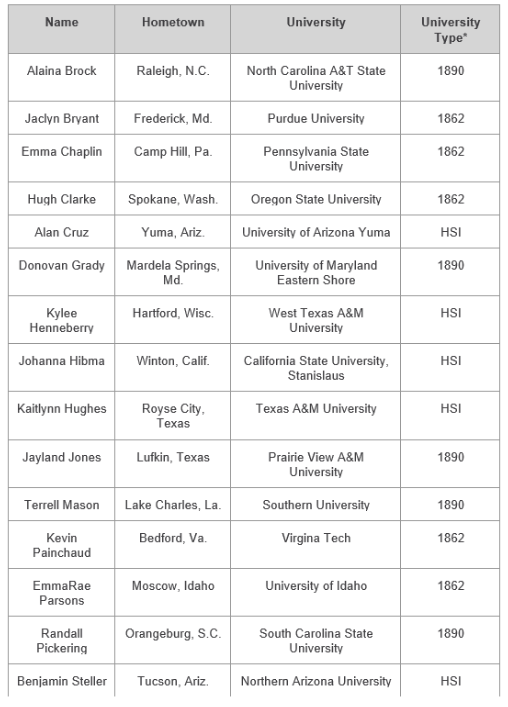
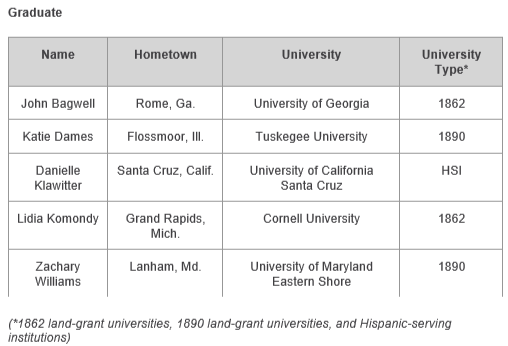
Learn more about the Future Leaders Program and register for the 2024 USDA Agricultural Outlook Forum, celebrating its 100th anniversary this year.
USDA touches the lives of all Americans each day in many positive ways. In the Biden-Harris Administration, USDA is transforming America's food system with a greater focus on more resilient local and regional food production and fairer markets for all producers. USDA is dedicated to ensuring access to safe, healthy, and nutritious food in all communities, building new markets and streams of income for farmers and producers. In order to reach these goals, USDA encourages the use of climate smart food and forestry practices. USDA is making historic investments in infrastructure and clean energy capabilities in rural America and is committed to equity across the Department by removing systemic barriers and building a workforce more representative of America. To learn more, visit www.usda.gov.
Congressman Josh Brecheen will be hosting a telephone town hall on January 30th at 7:00pm CT.
During the call, Congressman Brecheen will provide an update on some of the most pressing policy issues facing our country, including our more than $34 trillion national debt, and answer live questions from constituents.
Details for participating in the call are below:
Date: Tuesday, January 30th, 2024
Time: 7:00-8:00 p.m. CT
Dial-in Number: 888-480-3675
Constituents should dial 888-480-3675 if they would like to participate in the call. To watch a live stream of the call, constituents can visit our Facebook page here.
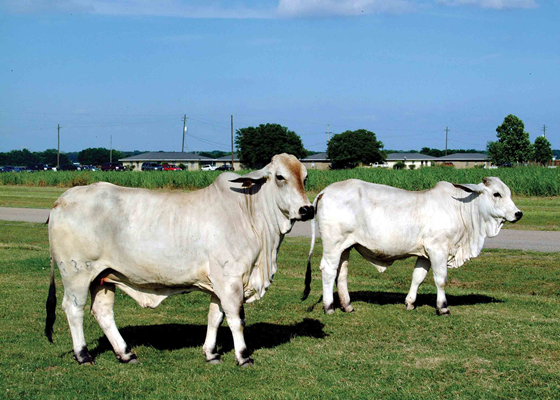
Last fall, the U.S. Department of Agriculture announced that they were moving forward with allowing the nation of Paraguay to send their fresh beef into the U.S. Following this decision, Cattle organizations in the U.S. raised immediate concern along with members of Congress because of the risk of disease outbreak in the U.S. Senior Farm and Ranch Broadcaster, Ron Hays, is talking with Congressman Frank Lucas about the risks of importing beef from Paraguay.
Lucas said that he and over two dozen members of Congress wrote a letter to the Secretary of Agriculture but have yet to hear a response. The letter, Lucas said demanded that the rule to allow fresh beef from Paraguay be put to a halt until more research is conducted.
"It appears, based on our understanding, that they are using info that is a decade old, almost, that no one physically was in the field down there to verify the results," Lucas said. "This is just not good science."
Foot and Mouth disease is an incredibly contagious disease that impacts livestock, Lucas said, and importing fresh beef from Paraguay without taking the necessary precautions puts the entire U.S. at risk of an outbreak.
"We have had a major national focus on eradicating and keeping it (Foot and Mouth disease) out of the country for a century and a half," Lucas said. "As a matter of fact, there has not been a case of Foot and Mouth in the United States since 1929, which says something about our state departments of agriculture and USDA's success."
Lucas said the type of quarantine that would take place if there was a Foot and Mouth outbreak in the United States is unimaginable.
"We just can't take any chances, "Lucas said. "USDA needs to suspend their rule, go back and reassess their science, then come back and explain to us why they really think this is actually allowable. I think they will have a hard time explaining that."
If there is no response to the letter sent by Lucas and his colleagues, Lucas said there will be bipartisan legislation by the House and Senate to overturn the rule.
"I would prefer that we not have to do that," Lucas said. "I would prefer USDA just simply announce they stop in their tracks and start over. If we have to, we will use the legislative process as quickly as we can to help them stop this process if they won't."
Lucas said he supports trade, but to trade safely, it must be a science-based process to protect consumption.
The Beef Buzz is a regular feature heard on radio stations around the region on the Radio Oklahoma Ag Network and is a regular audio feature found on this website as well. Click on the LISTEN BAR for today's show and check out our archives for older Beef Buzz shows covering the gamut of the beef cattle industry today.
The U.S. Department of Agriculture (USDA) announces the appointment of 15 new members to the Advisory Committee on Minority Farmers (ACMF). The newly appointed members serve terms of up to two years.
"Minority farmers face unique challenges in accessing the land, credit, and training they need to succeed," said Agriculture Secretary Tom Vilsack. "This committee is part of USDA's commitment to ensure that all farmers have equal access to USDA programs and services, especially minority farmers an
d producers in underserved communities."
Newly appointed members are:
Sarah E. Bell, Alabama
Amalia Zimmerman-Lommel, California
Jacqueline Bido, Florida
Sedrick K. Rowe, Jr., Georgia
Jeremy L. Hendrix, Louisiana
Carolyn G. Jones, Mississippi
Delmar Stamps, Mississippi
Anita Lee, New York
Julian R. Mangano, New York
Arnetta Cotton, Oklahoma
Elsa Sanchez, Pennsylvania
Willette M. Crawford, South Carolina
Kimberly M. Ratcliff, Texas
Christina Chanes, U.S. Virgin Islands/U.S. Territories
Mercy Kariuki-McGee, Washington
Committee members represent socially disadvantaged farmers, nonprofit organizations, civil rights organizations or professions, and institutions of higher education.
The Advisory Committee for Minority Farmers was established by Congress in the Food Conservation and Energy Act of 2008 to ensure that underserved farmers have equal access to USDA programs. Committee members advise the Secretary of Agriculture on the administration of the Outreach and Assistance for Socially Disadvantaged Farmers and Ranchers Competitive Grant Program. They also make recommendations to the Secretary on how to increase minority participation in USDA programs.
USDA's Office of Partnerships and Public Engagement (OPPE) provides administrative staff support for the work initiated by the committee. OPPE develops and maintains partnerships focused on solutions to challenges facing rural and underserved communities and connects those communities to the education, tools, and resources available to them through USDA programs and initiatives.
For more information, visit the Advisory Committee on Minority Farmers website.
USDA touches the lives of all Americans each day in so many positive ways. In the Biden-Harris Administration, USDA is transforming America's food system with a greater focus on more resilient local and regional food production, fairer markets for all producers, ensuring access to safe, healthy and nutritious food in all communities, building new markets and streams of income for farmers and producers using climate smart food and forestry practices, making historic investments in infrastructure and clean energy capabilities in rural America, and committing to equity across the Department by removing systemic barriers and building a workforce more representative of America. To learn more, visit www.usda.gov.
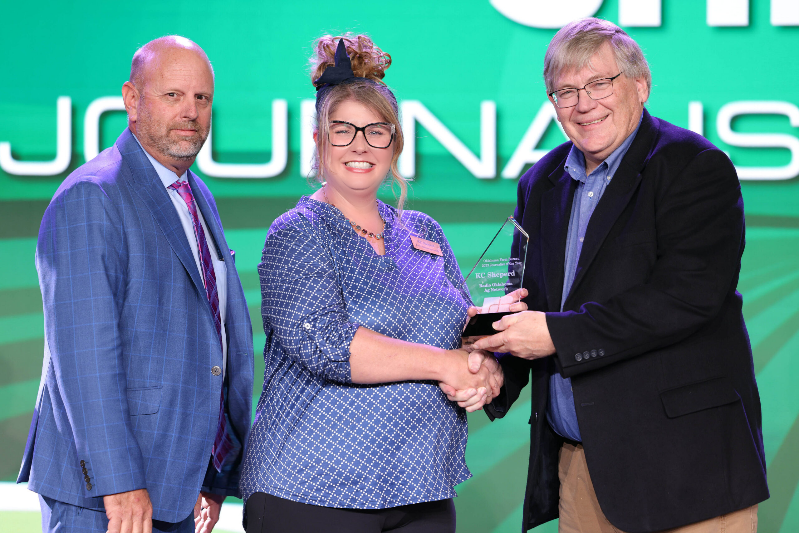
KC Sheperd, director of farm and ranch programming for Radio Oklahoma Ag Network, received the Journalist of the Year award from Oklahoma Farm Bureau during their 82nd Annual Meeting in November 2023.
Sheperd graduated from Southwestern Oklahoma State University with her bachelor's degree in English literature in 1999. During her time in undergrad, she interned at a KWEY radio station in Weatherford, Oklahoma, where she fell in love with the broadcasting world. After graduation, she went to work full-time for the radio station where she interned in college.
She worked there for two years before she transitioned to a radio station in Corpus Christi, Texas. In 2003, she moved back to Weatherford to work at KWEY as the program director. Around that time, her former English professor contacted her with a special request.
"My former professor said that my old college wanted me to teach a radio class," Sheperd said. "However, I had to get my master's degree to be able to teach at a collegiate level. So, I graduated with my master's degree in English literature only to teach radio to students."
After graduating with her master's in 2006, she taught at Southwestern Oklahoma State University for one year before she got the call to join a morning show at KKNG/King Country in Oklahoma City. Due to cutbacks, Sheperd was laid off from that job after three years of working there. Luckily, a former listener heard about Sheperd's unfortunate situation and reached out to help.
"One of my former listeners was the IT project manager at Chesapeake, which is an oil and gas company in Oklahoma City," Sheperd said. "He hired me to work in IT, which I'd never done a day in my life. Eventually, I became a project manager for Chesapeake."
After a few years, her former listener went to work for Love's Travel Stops, and she went with him. She worked there in IT for approximately six years. Her bosses at Love's agreed to let Sheperd leave the office early in the afternoons to do a radio show at Hank FM in Oklahoma City on a part-time basis.
"Ron Hayes and Tim West called me from Radio Oklahoma Ag Network, and they wanted to chat about getting me back into the radio industry," Sheperd said. "Ron was getting ready to retire, and they wanted someone with a strong agricultural background to step in."
She went to work for Radio Oklahoma Ag Network in 2020, where she started covering the agriculture industry of Oklahoma. She was proud to receive the award for her work in farm broadcasting.
"It was a complete surprise, and I had no idea it was coming," Sheperd said. "I am just honored to be considered, let alone chosen for an award for simply doing my job."
Sheperd's best advice for a new broadcaster is to focus on the passion of the job.
"Don't worry about the money. Just make sure that you're following something that's important to you," Sheperd said. "Networking is also crucial. You never know who you're going to meet and who is going to help you in your future career."
Compared to the last report: The demand remains low and most ofour hay producers are still not trading much hay and only delivering to long-time customers. Many producers report they are interested inseeing if this winter storm will help move the hay market.
Trends:
Alfalfa Large squares $180-$200 a ton
Alfalfa Rounds - No Trend
Grinding hay - No Trend
Bermuda 5x6 rounds - $70-$100 a bale
Bermuda Large Squares - No Trend
Grass Hay 4x5-4x6 - $60-$70 a bale
Grass Hay 5x6 - $70-$80 a bale
The Oklahoma Mesonet Drought Monitor shows we are at 0 percent in exceptional drought, 0 percent in an extreme drought, 3.08 percent in severe drought, 21.64 percent in moderate, 44.32 percent in abnor-mally dry conditions, 55.32 percent that has no drought conditions
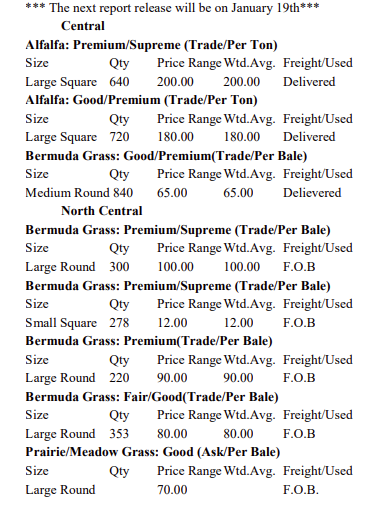
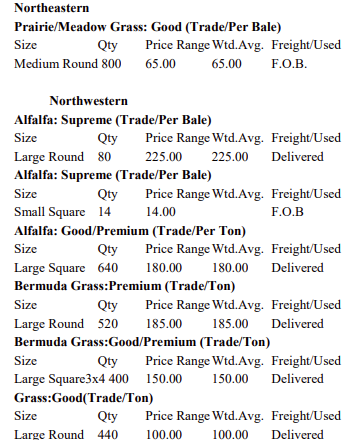

Vive Crop Protection Inc. announces the launch of Phobos™ FC, a foliar fungicide, designed to bring unparalleled results to sugarbeet growers facing the challenges of Cercospora leaf spot.
Phobos FC fungicide combines Vive's Allosperse® Delivery Technology with prothioconazole, to provide superior protection against Cercospora leaf spot while delivering maximum yield and sugar content. Using patented nano-polymers, Allosperse optimizes the active ingredient, enabling targeted placement for more uniform disease protection.
"We are thrilled with our 2023 field trial results where Phobos FC is not only meeting but exceeding the Proline® fungicide market standard for disease protection," states David Reif, Vive's Northern Technical Sales Agronomist. "Phobos FC fungicide represents a breakthrough in our commitment to delivering real results to growers. By harnessing the power of Precision Chemistry™, we are providing sugarbeet growers with a cutting-edge solution to effectively manage Cercospora leaf spot and maximize sugar content at the end of the season."
Phobos FC is recommended as part of a foliar application program anywhere from the 8-leaf stage to pre-harvest, for defense against this notorious fungal disease. Vive Crop Protection invites sugarbeet growers, COIs, and agricultural enthusiasts to explore the exciting potential of Phobos FC fungicide for the 2024 growing season. Reach out to your local Vive representative to learn more about Phobos FC.
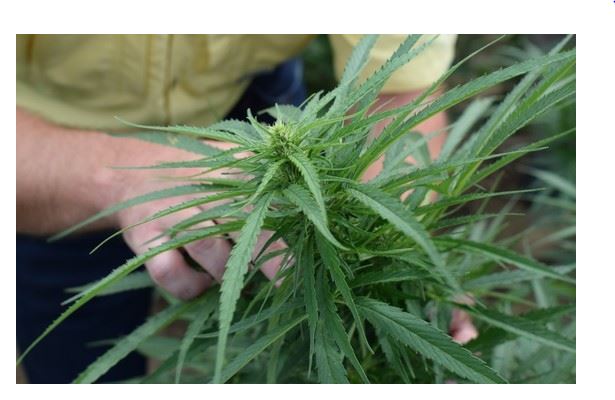
Organic Payment Gateways, an A+ rated and BBB-accredited provider of payment processing solutions, is pleased to announce the launch of its latest offering: Online payment gateways designed specifically for legal, Farm Bill-compliant CBD and hemp seed businesses in the United States.
This stable, affordable online payment processing solution for federally legal cannabis seed businesses empowers website owners to accept credit card payments seamlessly. Unlike other payment integrations in the market, this new solution allows business owners to confidently promote the plants' anticipated cannabinol levels, including THC and CBD, that will ultimately be grown from their seeds.
With these new payment processing options, American hemp and CBD businesses can showcase the quality and potential of their seeds. As a Gold Member of the National Hemp Association, OrganicPaymentGateways.com recognizes CBD and hemp seed businesses' unique needs and aims to provide them with a range of payment processing options that integrate seamlessly with their preferred website builders and shopping carts.
The payment processing solutions offered by Organic Payment Gateways are compatible with leading e-commerce platforms such as WordPress, WooCommerce, BigCommerce, and more. Working closely with businesses and their web designers, Organic Payment Gateways ensures a smooth and cost-effective setup, reducing concerns about merchant account shutdowns or the need to switch shopping carts at the last minute.
Finding a suitable payment gateway for online CBD and hemp seed businesses can be a daunting and time-consuming task. Organic Payment Gateways aims to simplify this process, enabling businesses to focus on sales and customer service. Organic Payment Gateways allows businesses to efficiently sell their hemp and CBD products by providing hassle-free online payment processing.
These new payment processing options enable most established CBD and hemp seed businesses to publicize the levels of cannabinol they expect from the plants their seeds will produce – whether it's the THC or CBD level. Because of this, companies can now effectively showcase the value and potential of their hemp and CBD products to their customers without fear of having their merchant account shut down due to violating a payment gateway's prohibited products policy.
Organic Payment Gateways provides specialized, user-friendly payment gateways tailored to CBD and hemp seed businesses' unique needs. The solutions cover a wide range of products, including CBD oils, beauty products, skincare items, hemp oil, homeopathic remedies, dietary supplements, vitamins, and now seeds. In cases where a unique or innovative product is offered for sale, Organic Payment Gateways provides free personalized consultations to cater to individual business requirements.
Recognizing the needs of business-to-business (B2B) and business-to-consumer (B2C) websites in the CBD and supplement industries, Organic Payment Gateways provides payment gateway solutions for US-based websites that engage in wholesaling and direct-to-home shipments of seeds. This helps ensure that regulated businesses involved in B2B and B2C product sales can seamlessly accept online credit card payments.
Website owners in the CBD and hemp seed industries can now experience the convenience and flexibility of the new payment acceptance options offered by Organic Payment Gateways. To learn more about these credit card processing solutions and how they can help businesses secure and stabilize their cash flow, you can visit their website at https://organicpaymentgateways.com/cbd/how-to-get-a-seed-payment-gateway/
About Organic Payment Gateways:
With a focus on one-on-one, US-based customer service and seamless payment gateway integrations, Organic Payment Gateways has been a trusted provider of payment gateways and merchant account placements for businesses in the CBD and hemp industries since 2018. By simplifying the payment processing application and integration experience, OrganicPaymentGateways.com empowers businesses to succeed in the rapidly evolving market.
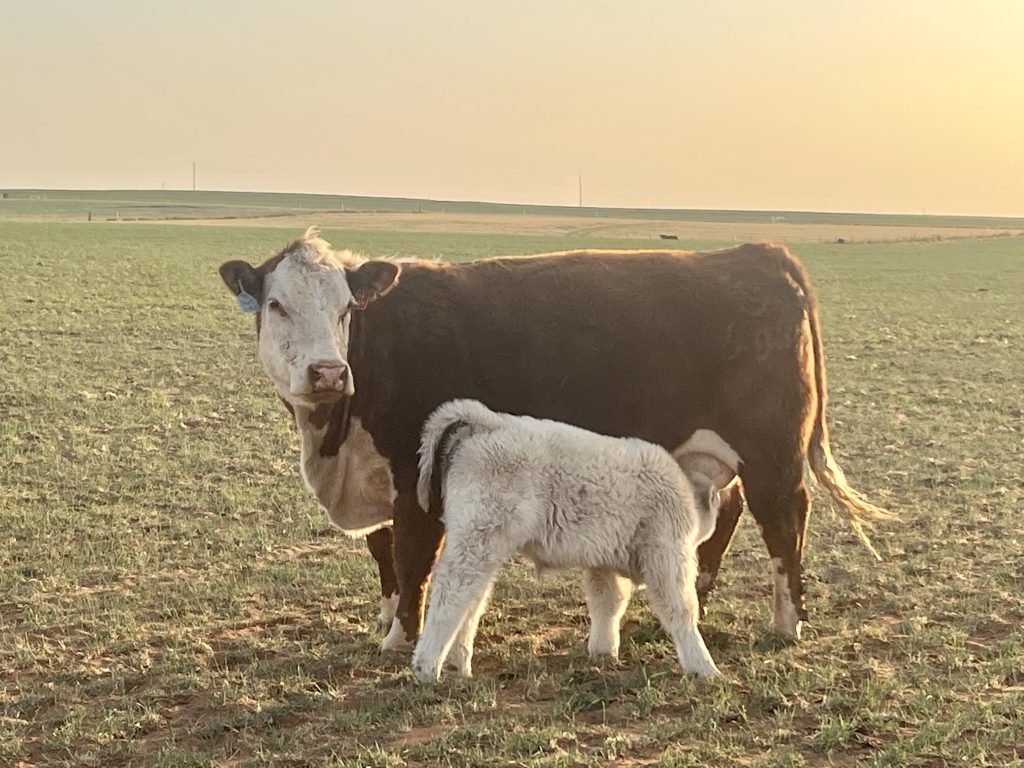
University Products LLC, a pioneer in animal vaccine solutions, is helping to tackle the escalating threat of bovine anaplasmosis in South Dakota and beyond during recent unseasonable weather. The changing climate conditions have extended the lifespan of disease-spreading insects like ticks and biting flies, posing a significant risk to cattle herds. And a recent discovery of anaplasmosis near Woonsocket, South Dakota, highlights the urgent need to protect herds now from this costly endemic infection.
Unpredictable Weather, Unforeseen Challenges
Across the U.S., ranchers face a variety of unprecedented challenges due to severe vector shifts. But among the diseases posing the most serious threat to herds is bovine anaplasmosis, caused by the bacteria, Anaplasma marginale. The bacteria attack red blood cells, resulting in early signs such as fever, anemia, weakness, and loss of appetite.
As the disease progresses, it can lead to worse symptoms like jaundice, incoordination, and even death. Anaplasmosis can also increase the risk of abortions, while infecting whole herds – resulting in catastrophic costs to ranchers and the cattle industry.
Gene Luther, a researcher at University Products, emphasized the importance of intervention as key to winning the fight:
"Anaplasmosis devastates cattle herds quickly and quietly. Often, the disease spreads rapidly before ranchers are even aware. It's sometimes challenging to diagnose, especially with other concurrent cattle diseases like Babesia, and Theileria, which share similar symptoms. So ranchers must recognize anaplasmosis signs immediately and involve their veterinarians to stay ahead of this."
Combatting the Spread of Anaplasmosis: Pharmaceutical Stewardship
"Transmission primarily occurs through ticks, biting flies, and contaminated equipment like shared vaccine or antibiotic needles," explained researchers. "Producers have to implement effective preventive strategies early, with proper management and vaccination, to reduce the risk of anaplasmosis. Our vaccine is a well-tested tool."
With limited treatment options available for anaplasmosis, pharmaceutical use remains another key issue – especially with recent FDA crackdowns on the use of animal antibiotics. Researchers emphasizes the need for responsible antimicrobial use, ensuring the long-term effectiveness of these products:
"Veterinarians tell ranchers this often, but it's absolutely worth repeating. You cannot rely on antibiotics over and over again to protect herds from these bacterial diseases. It just leads to more resistant strains down the road. And while judicious use of antimicrobials to combat active anaplasmosis outbreaks makes sense in the short term, prevention is much more cost effective overall."
The major message to cattle producers is clear: "Diligence and vigilance are our best defenses against anaplasmosis. By working closely with your vets, implementing biosecurity measures like fly and tick prevention programs, and vaccinating bulls as a preventative, ranchers can better protect from this persistent threat."
University Products produces the only vaccine (for experimental use) against anaplasmosis.
For more information on University Products' bovine vaccines and assistance with obtaining doses for cattle in South Dakota and elsewhere, please contact University Products directly at docndoc@aol.com.
About University Products LLC
Based in Louisiana, University Products specializes in bovine vaccines. Successfully deployed for over 20 years across the globe, University Products vaccines minimize clinical signs in at-risk animals and are safe to use during bovine pregnancy, requiring two initial doses plus annual boosters. The company is currently conducting R&D for vaccines against bovine babesiosis and theileriosis.
A comprehensive vaccine description is available for PDF download. While veterinarians can inquire about availability by emailing University Products directly at docndoc@aol.com. Learn more at: www.AnaplasmosisVaccine.com.
Facts and guidelines sourced from:

Rabo AgriFinance, a subsidiary of Rabobank, a leading global food and agribusiness bank, announces the expansion and strengthening of the RaboResearch Food & Agribusiness (F&A) team in North America by welcoming Chase Beisly, Eric Gibson, Charlotte Talbott, and Matt Lewis to the growing team.
Rabobank's RaboResearch F&A group is a global team of more than 80 analysts who monitor and evaluate global market events that affect food and agriculture worldwide. The new members join more than 20 analysts based in North America who are internationally respected experts in sectors ranging from dairy to produce, farm inputs to consumer foods and beverages. The F&A team discerns key insights into agricultural markets; conducts in-depth analysis of the factors that drive sector success or failure; and examines megatrends that ultimately influence clients' business strategies.
"With the appointments of Chase, Eric, Charlotte and Matt, we have cultivated a dynamic team with deep knowledge of the growing trends in North America's agricultural markets," said Roland Fumasi, Head of RaboResearch North America. "Their combined insightful analysis and industry engagement will continue to support our North American clients across the entire food value chain in feeding the world."
Chase Beisly joins the RaboResearch team as an Animal Protein Analyst to leverage his practical livestock and farming background with direct research and project management experience. Beisly comes to Rabobank from Seaboard Foods, the largest U.S.-owned pork producer, where he served as a Business Logistics Analyst. His expertise working with both primary producers and industry leaders in the animal protein value chain combined with his agricultural data analysis experience will complement the world-class animal protein team.
Beisly holds a Master of Science in Agricultural and Applied Economics, a bachelor's in agribusiness management, and a minor in agricultural systems management from the University of Missouri. He enjoys staying involved with his family's livestock and farming operation.
Eric Gibson joins the team as a Farm Inputs & Crop Production Sustainability Analyst with experience to effectively to build robust relationships with U.S. crop producers and coordinating industry sustainability efforts. He brings a hands-on farming and livestock background combined with 10 years of industry experience in market research and data analysis and agricultural marketing.
Gibson comes to Rabobank after serving as a Fusion Leader & Intelligence Analyst at Aimpoint Research. He also spent six years with the U.S. Soybean Export Council in both Industry Relations Manager and Stakeholder Relations positions, where he helped coordinate USSEC's sustainability program.
Gibson attended the University of Missouri where he earned a bachelor's in agriculture with concentrations in animal and plant sciences, economics and communications, and minors in rural sociology and leadership in agriculture. He enjoys staying involved with his family's cattle and farming operation.
Charlotte Talbott joins the team as the Animal Agriculture Sustainability Analyst and brings a strong background in applied agricultural research and a passion for livestock sustainability. She has experience working closely with research institutions, industry partners, and producers to make practical contributions to the food and agriculture industry's understanding of challenges and opportunities regarding sustainability.
Prior to joining Rabobank, Talbott served as Associate Director of Beef Sustainability Research at National Cattleman's Beef Association (NCBA), where she managed sustainability research projects under NCBA's Beef Checkoff program to advance the environmental, social, and economic pillars of sustainability in the beef industry.
Talbott attended North Carolina State University where she earned both a Master of Science degree and a bachelor's in animal science with minors in crop science and agricultural business management. Her research has earned her various grants, scholarships, and awards, and she has been published in the Journal of Animal Science.

Matt Lewis joins the team as a Consumer Food & Beverage Sustainability Analyst with a career squarely focused on the intersection of finance and environmental sustainability. He has collaborated with global corporate clients and investors to help further their journey around sustainability and other ESG-related goals.
Previously he served as a Senior ESG Consultant at Aeterra, LLC, where he coordinated and conducted both buy and sell side ESG-related reviews for merger & acquisition transactions in various industries, including food & beverage. Lewis held related roles at Adams Street Partners and ABN AMRO, where he focused on investment strategy and risk management related to ESG.
Lewis holds a master's degree in law, justice, and culture and a bachelor's in cultural anthropology from Ohio University. He also earned a Chartered Financial Analyst certificate in ESG Investing.
Rabobank is committed to a culture where diversity and inclusion is valued, respected and encouraged. Learn more to join one of the world's leading food and agribusiness teams here.
RaboResearch appoints four highly accomplished research analysts to serve Rabobank and Rabo AgriFinance clients.
Rabo AgriFinance, a subsidiary of Rabobank, a leading global food and agribusiness bank, announces the expansion and strengthening of the RaboResearch Food & Agribusiness (F&A) team in North America by welcoming Chase Beisly, Eric Gibson, Charlotte Talbott, and Matt Lewis to the growing team.
Rabobank's RaboResearch F&A group is a global team of more than 80 analysts who monitor and evaluate global market events that affect food and agriculture worldwide. The new members join more than 20 analysts based in North America who are internationally respected experts in sectors ranging from dairy to produce, farm inputs to consumer foods and beverages. The F&A team discerns key insights into agricultural markets; conducts in-depth analysis of the factors that drive sector success or failure; and examines megatrends that ultimately influence clients' business strategies. "With the appointments of Chase, Eric, Charlotte and Matt, we have cultivated a dynamic team with deep knowledge of the growing trends in North America's agricultural markets," said Roland Fumasi, Head of RaboResearch North America. "Their combined insightful analysis and industry engagement will continue to support our North American clients across the entire food value chain in feeding the world."
Chase Beisly joins the RaboResearch team as an Animal Protein Analyst to leverage his practical livestock and farming background with direct research and project management experience. Beisly comes to Rabobank from Seaboard Foods, the largest U.S.-owned pork producer, where he served as a Business Logistics Analyst. His expertise working with both primary producers and industry leaders in the animal protein value chain combined with his agricultural data analysis experience will complement the world-class animal protein team.
Beisly holds a Master of Science in Agricultural and Applied Economics, a bachelor's in agribusiness management, and a minor in agricultural systems management from the University of Missouri. He enjoys staying involved with his family's livestock and farming operation.
Eric Gibson joins the team as a Farm Inputs & Crop Production Sustainability Analyst with experience to effectively to build robust relationships with U.S. crop producers and coordinating industry sustainability efforts. He brings a hands-on farming and livestock background combined with 10 years of industry experience in market research and data analysis and agricultural marketing.
Gibson comes to Rabobank after serving as a Fusion Leader & Intelligence Analyst at Aimpoint Research. He also spent six years with the U.S. Soybean Export Council in both Industry Relations Manager and Stakeholder Relations positions, where he helped coordinate USSEC's sustainability program.
Gibson attended the University of Missouri where he earned a bachelor's in agriculture with concentrations in animal and plant sciences, economics and communications, and minors in rural sociology and leadership in agriculture. He enjoys staying involved with his family's cattle and farming operation.
Charlotte Talbott joins the team as the Animal Agriculture Sustainability Analyst and brings a strong background in applied agricultural research and a passion for livestock sustainability. She has experience working closely with research institutions, industry partners, and producers to make practical contributions to the food and agriculture industry's understanding of challenges and opportunities regarding sustainability.
Prior to joining Rabobank, Talbott served as Associate Director of Beef Sustainability Research at National Cattleman's Beef Association (NCBA), where she managed sustainability research projects under NCBA's Beef Checkoff program to advance the environmental, social, and economic pillars of sustainability in the beef industry.
Talbott attended North Carolina State University where she earned both a Master of Science degree and a bachelor's in animal science with minors in crop science and agricultural business management. Her research has earned her various grants, scholarships, and awards, and she has been published in the Journal of Animal Science.

Matt Lewis joins the team as a Consumer Food & Beverage Sustainability Analyst with a career squarely focused on the intersection of finance and environmental sustainability. He has collaborated with global corporate clients and investors to help further their journey around sustainability and other ESG-related goals.
Previously he served as a Senior ESG Consultant at Aeterra, LLC, where he coordinated and conducted both buy and sell side ESG-related reviews for merger & acquisition transactions in various industries, including food & beverage. Lewis held related roles at Adams Street Partners and ABN AMRO, where he focused on investment strategy and risk management related to ESG.
Lewis holds a master's degree in law, justice, and culture and a bachelor's in cultural anthropology from Ohio University. He also earned a Chartered Financial Analyst certificate in ESG Investing.
Rabobank is committed to a culture where diversity and inclusion is valued, respected and encouraged. Learn more to join one of the world's leading food and agribusiness teams here.
On today's Cow-Calf Corner, Brian Freking, Oklahoma State University SE Extension Livestock Specialist talks about reproductive efficiency.
Breeding efficient cows is usually measured by a cows' ability to calve each year and maintain a yearly calving interval. Recently, one of my cows provided a calf on February 14, 2023 and turned around and provided another one on December 20, 2023. This cow has reached the pinnacle of reproductive efficiency. Normal beef cow gestation length is 283 days therefore subtracting those number of days from the latest calf puts conception for March 12. Now subtracting this conception date to the valentines' day calf only allows for 26 days of uterine involution and recovery from the previous birthing process. This is quite unusual. My management has bulls exposed to the cows during a limited breeding season resulting in a defined calving season so apparently there was a visitor during the night to allow this immaculate conception to occur.
This example shows that selecting for reproductive efficient cows can be achieved. One of my main recordkeeping goals is to keep track of birth dates and target for the start of calving season around March 1 which has a corresponding Julian Day of 60. Some cows will not read the book and can have unique gestation lengths. The easiest way to find these cows is through artificial insemination because then you know the day of hopeful ovulation/conception and once the calf is born then gestation length can be calculated within an individual or breed differences.
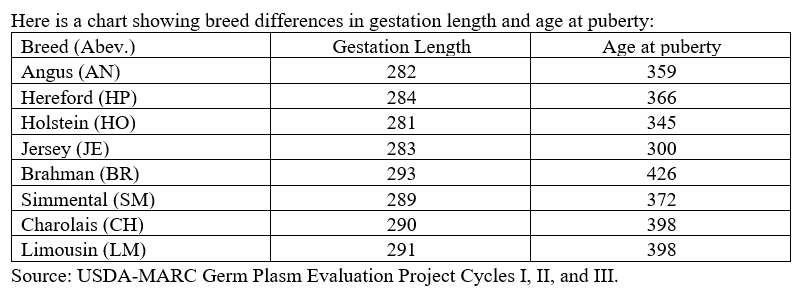
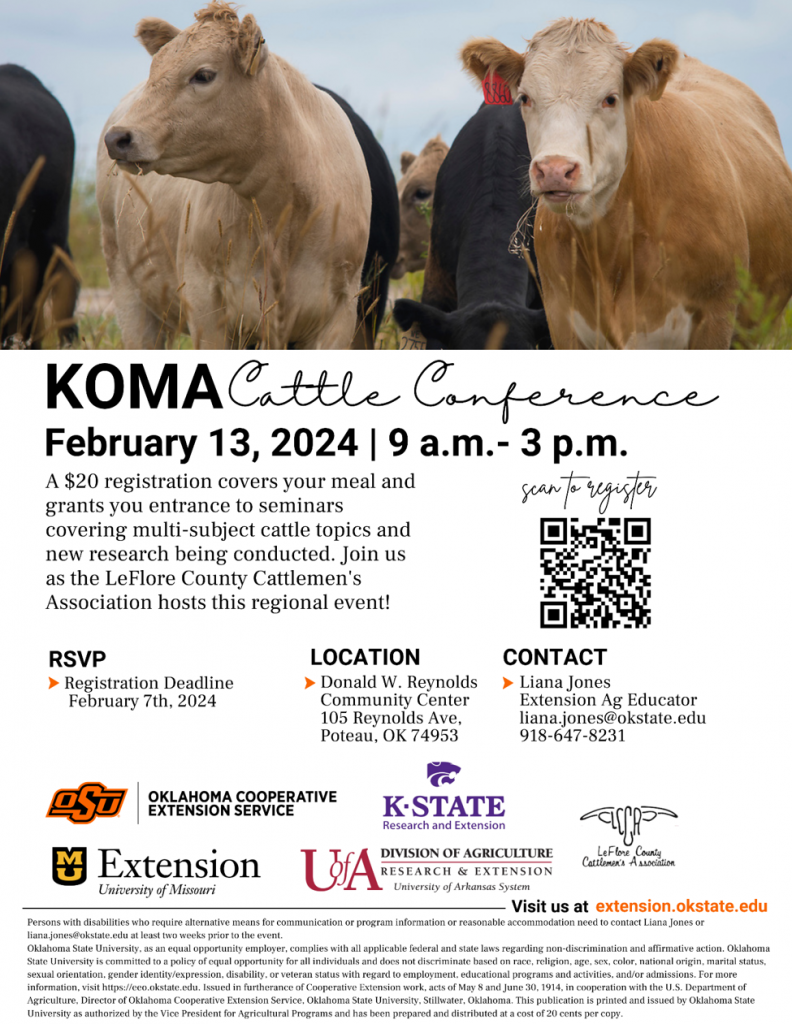
direct link to register: https://forms.office.com/pages/responsepage.aspx?id=HclpKknoNE6iMM34sn4ZZNmp-qhrbzVMvlqQ2Ey37_tUMjhJMTFXQzNRSlBVOTNUQkNHNTg0VERYNS4u
RON's Dave Lanning has a pre-opening look at today's agricultural Markets.
Click the audio tab below for today's report.
Today, Governor Kevin Stitt called for a special session of Oklahoma's 59th Legislature beginning January 29, 2024, to seek a .25% reduction in the personal income tax for every Oklahoman.
"From day one, I've called on the Legislature to give Oklahomans a much deserved tax cut," said Governor Stitt. "With record-breaking savings and a strong economic outlook, there's no time like the present to deliver a pay raise to all Oklahomans. Let's get this across the finish line before we head into regular session."
The Board of Equalization delivered good news at the end of 2023, demonstrating strong fiscal practices that confirmed the state's predictions for 2024 and a bright outlook for 2025. With $5.4 billion in savings, a strong economy, and fiscally conservative policies, Oklahoma is well-positioned to reduce the personal income tax burden on all four million Oklahomans.
Executive Order 2024-01 can be found here.

Oklahoma House Democratic Leader Cyndi Munson, D-OKC, today issued a statement questioning the Governor's fiscal responsibility after his latest political stunt calling for another wasteful special session.
"The Governor's call for a Special Session to cut income taxes is just his latest political stunt, and it is not a genuine attempt to lower costs for Oklahoma families. We have not even completed our agency budget hearings to gain a comprehensive understanding of our state's fiscal picture, including the potential loss of federal dollars post-Covid.
We will have four months beginning February 5 to deliberate fiscal and policy ideas. Our job as legislators is to work through these important issues, as we are called to do every year. Instead, the Governor is asking us to waste time and taxpayer dollars by throwing ideas at the wall to see what sticks. It is unwise and fiscally irresponsible to ask the Legislature to haphazardly cut revenue.
Why does the Governor insist we keep doing what we've been doing when it hasn't worked? It is time to invest in Oklahoma."

Rep. Rick West, R-Heavener, has filed legislation that would amend the Homemade Food Freedom Act to protect the private information of producers.
House Bill 2975 would allow producers of homemade food products to obtain a registration number to affix to their product labels instead of the current requirement that they list their name, phone number and the physical address where the food is produced on all products sold. The $15 registration fee would be voluntary.
"Requiring homemade food producers to put their names, personal phone numbers and home addresses on their products presents a privacy risk," West said. "Under this amendment, they would still have to provide their personal information to the Oklahoma Department of Agriculture, Food and Forestry, allowing consumers an outlet to still voice any concerns. But the producer's personal information would be protected."
West said the idea for the legislation came from a constituent that makes and sells homemade food products at local outlets such as farmers markets and local stores. The products would still have to list ingredients, including common allergens, as well as notice that they were produced in a private residence that is exempt from government licensing and inspection.
If signed into law, the act would become effective Nov. 1. The bill will be eligible for consideration during the upcoming legislative session, which starts Feb. 5.
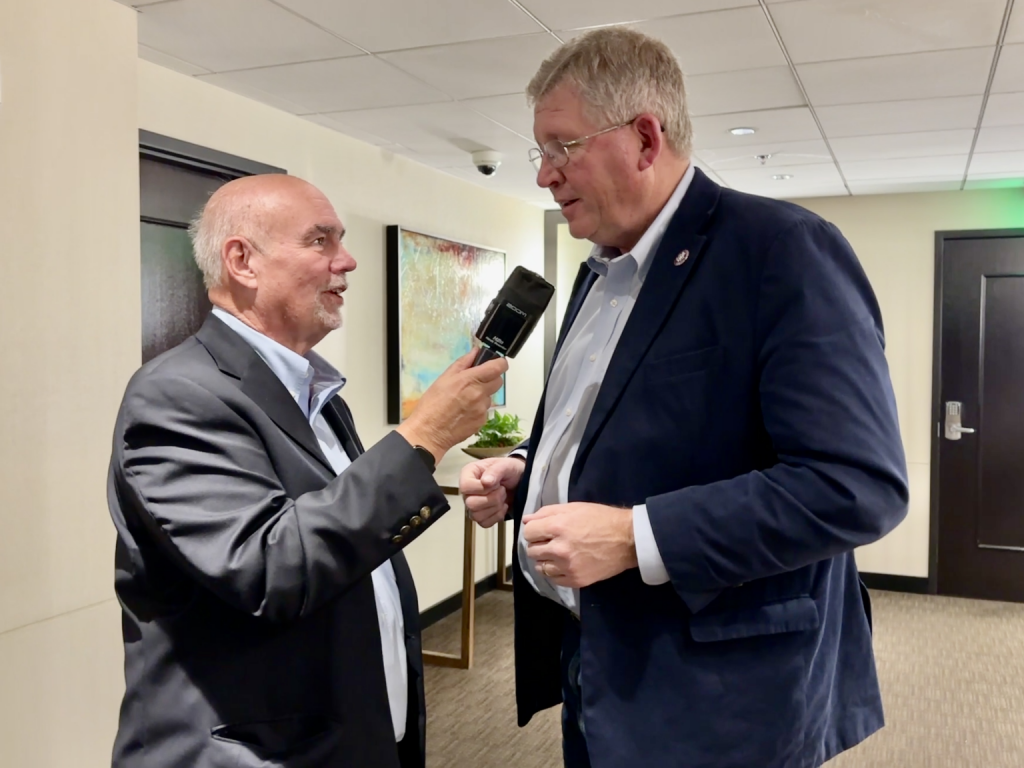
Farm and Ranch Broadcaster, Ron Hays, is talking with Congressman Frank Lucas about the latest movements in politics, the presidential campaign, farm bill, and more.
"This is kind of the 'triple witching hour,' so to speak, when you have a presidential campaign, you have a third of the Senate, and you have the entire House of Representatives on the ballot," Lucas said. "That just creates all manners of chaos, and this is a different sort of a campaign than we have typically had in most of my lifetime."
As the government is narrowly divided at the moment, Lucas said there have been numerous issues when it comes to funding the federal government.
"The federal government should have been funded in October 1st of 2023 to fund the fiscal year that runs to the end of September of 2024," Lucas said. "Right now, we are looking at running out of money starting this Friday."
Lucas said that Speaker Mike Johnson has started a six-week extension to buy the appropriators more time.
"We have to fund the federal government," Lucas said. "Shutdowns only hurt industries and people."
If there is a government shutdown on Friday, January 19th, Lucas said the first thing on the chopping block will be the funding at USDA.
"It is important that those folks go to work," Lucas said. "It is important that they have the ability to work with farmers and ranchers. It is important that they do their responsibilities."
There has not been time on the floor to move forward with much farm bill progress, Lucas said, because of the focus on the appropriations process for funding. To make the safety net as strong as it was in 2018, Lucas said there needs to be more funds.
"I think most of our producers would agree that many expenses have gone up, perhaps in some industries, as much as 70 percent over what they were in 2018, and with inflation, the buying power of things we are selling, may have gone down as much as 30 percent," Lucas said. "We are in a real squeeze on having a valid safety net."
Lucas said he believes between 70 and 100 billion dollars will be needed in the next farm bill to ensure a strong safety net.
"Once we get past this chaos of funding the government, we have to know how much money we have to work with, and then I think we can move forward to complete our work," Lucas said.
In the 2014 farm bill, Lucas said it took two and a half years to achieve the "formula" to secure an effective amount of funding. Lucas added that he believes it is possible to do this again at an even faster pace.
"We don't have to rewrite the policies," Lucas said. "We just have to properly fund the policies. We need to reign in some of the efforts by the Biden Administration. They are very focused on their version of environmental and social justice. Those kind of policies may make somebody feel good in an office building in Washington, D.C., but they don't put food on the table here in the United States or around the world."
| ||||||||||||||||||||||||||||||||||||||||||||||||||||||||||||||||||||||||||||||||||||||||||||||||||||||||||||||||||||||||||||||||||||||||||||||||||||||||||||||||||||||||||||||||||||||||||||||||||||||||||||||
|
Democrats and the left-leaning media has certainly tried to paint a pretty picture of an economy on the mend over the last several months. However, their misguided reporting could not be further from the truth, and everyday Americans certainly know inflation is eating away at their hard-earned money.
Last month, the Consumer Price Index (CPI), the measure of the average change over time in the prices paid, reached a four-month high at 3.4 percent, much hotter than expected by market experts. While it is true that the pace which prices are rising has cooled compared to the last two years, they are still rising at a rate nearly tripled than when President Joe Biden took office, which at the time was 1.4 percent. And although Democrats like to point to the CPI cooling as a sign of an improving economy, the actual prices on goods and services remain at a 40-year high at a whopping 17 percent increase.
Under Democrats' failed economic policy, American households are paying $11,400 more on necessities annually. Even every day bills are becoming unaffordable, forcing more and more Americans to turn to second jobs to make ends meet and financing options as their savings are depleted. In fact, the cost of electricity is up 26.6 percent, food is up 20.2 percent, vehicle insurance is up 20.3 percent and vehicle repairs are up 10.3 percent.
Inflation is not only affecting individual Americans and American families, however. According to the National Federation of Independent Businesses (NFIB), 23 percent of small business owners reported that inflation was their single most important problem in operating their business, up one point from last month. Also, according to NFIB's most recent monthly jobs report, 40 percent of reported job openings they could not fill in the current period. Finally, a recent Job Creators Network Foundation Small Business survey revealed that small employers' outlook on the U.S. economy has hit a 14-month low. The report also showed that of 400 small business owners, 61 percent say the "Bidenomics" plan is "bad for the economy," and only 26 percent say the president's plan is helpful in the current environment.
Upon assuming the presidency and gaining control of both chambers of Congress, President Biden and Democrats went on an unprecedented spending spree that continues to have negative effects on our economy. This certainly has not helped Americans and small business owners get back on their feet and recover from the COVID-19 pandemic. A healthy economy is the key to a prosperous America, and House Republicans passed legislation last year including the Limit, Save, Grow Act and REIN In Inflation Act to move our economy on the right direction. I look forward to working with my colleagues to continue building on this crucial priority this year.
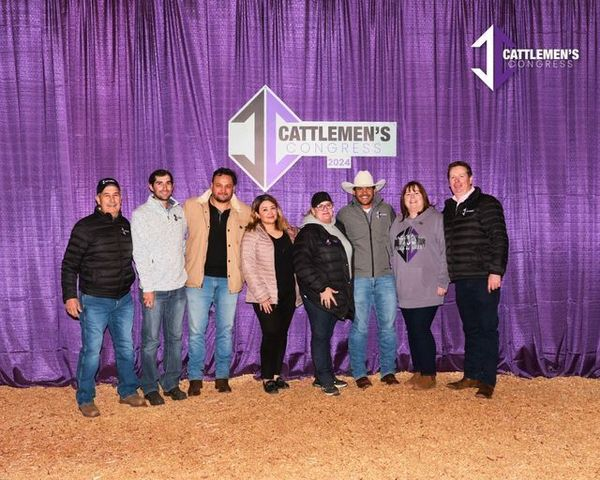
At the 2024 Cattlemen's Congress, Senior Farm and Ranch Broadcaster, Ron Hays, had the chance to talk about a review of the show with Cattlemen's Congress consultant, Erin Dorsey. Before her time with Cattlemen's Congress, Dorsey worked with the National Western Livestock Show.
"We have grown, we have progressed, we got our schedule down pretty solid this year, and it has been a really good show," Dorsey said.
In fact, Dorsey said she believes 2024 has been the best year yet for Cattlemen's Congress. When comparing Cattlemen's Congress to the National Western Livestock Show, Dorsey said Cattlemen's Congress caters to the cattlemen and does not include other attractions.
"My passion here has really been the international program, and I absolutely love the people," Dorsey said.
In her time working with Cattlemen's Congress, Dorsey said she has traveled around the world to different livestock events.
"People do not realize the number of imports and exports, semen, embryos, and just livestock that go out of the U.S. and Canada to Mexico, Argentina, the UK, even Singapore and Australia," Dorsey said.
Over the past four years, Dorsey said the international presence at Cattlemen's Congress has seen significant growth. This year, Dorsey said tours were offered and planned for international guests at the show and across the state of Oklahoma to showcase different breeds and genetics.
"This year, we did three breed tours in the state of Oklahoma, and then we also had some groups that I actually sent to Kansas for a tour, and they went to Texas for a tour as well," Dorsey said.
Next year's Cattlemen's Congress is planned to start close to January 4th, after the start of the new year, which Dorsey said will help boost numbers of foreign guests coming to the show. Dorsey added that next year may be the best year in terms of numbers of international cattlemen and women coming to Oklahoma City.
The Beef Buzz is a regular feature heard on radio stations around the region on the Radio Oklahoma Ag Network and is a regular audio feature found on this website as well. Click on the LISTEN BAR for today's show and check out our archives for older Beef Buzz shows covering the gamut of the beef cattle industry today.

Annual Winter Conference introduces farmers to new CornerStone Planting System; announces Panorama is now available for purchase as well as additional product updates.
Precision Planting today revealed their newest product, a fully custom, factory-built planting system called CornerStone. The CornerStone Planting System, which comes fully built with everything but the planter bar and is integrated with Precision Planting's technology, was announced during the first day of Precision Planting's annual Winter Conference.
The company also announced that Panorama from Precision Planting now has two Application Programming Interface (API) connections and is available for purchase. Additionally, a larger 20|20 monitor was announced, as well as updates on the Radicle Agronomics platform.
"Helping farmers do more is why we're here — that's why we always say we Believe in Better," said Bryce Baker, director of marketing, Precision Planting. "This year's Winter Conference is delivering on that promise by bringing the best products and services back to our farmers so they can focus on what they do best: growing our food, fiber and fuel."
The event, which will repeat sessions daily through Friday, Jan. 19, typically hosts more than 5,000 attendees at the company's Tremont headquarters and remotely at 20 other locations in the U.S. and Canada. The 2024 event offers attendees the opportunity to hear from Precision Planting's experts as they share insights on improving farm operations and efficiency in the field and present the latest Precision Planting technologies.
CornerStone Planting System
Allowing growers unmatched planting performance through ease of in-field use, simple adjustments for changing planting conditions, and best-in-class durability and serviceability, the CornerStone Planting System is the newest product revealed from Precision Planting.
"CornerStone really is everything but the planter bar," said Caleb Schleder, director of technical services and support, Precision Planting. "We've built the CornerStone Planting System with farmers in mind, optimizing performance, maintenance and wear all while making upgrading their existing planter simple — and certainly more affordable than buying a new one."
Compatible with all standard-height 7x7 planter bars, the system is fully integrated with Precision Planting technologies and will allow farmers to customize their planter with a factory-built system that ships with all components — both mechanical and electronic — already installed.
"We're currently beta testing the CornerStone Planting System and, with successful field trials this spring, anticipate it being commercially available to dealers and farmers in 2025," Schleder said.
Panorama Commercially Available
Announced during the 2023 Winter Conference, Precision Planting's Panorama allows farmers to easily view maps and input summaries and agronomic data from a Gen 3 20|20. Now commercially available, farmers can see all of their 20|20 data on their phone, computer or other platform of their choice.
Also announced are the first two API connections to Panorama: John Deere Operations Center and Climate FieldView. Users of Precision Planting's 20|20 who want to further explore and analyze their 20|20 data in either of these two connections can do so by linking the two together.
16-inch 20|20 Display
A staple in Precision Planting's offerings to farmers, the 20|20 display is now available at 16-inches and offers two times the widget locations and is perfect for visualizing more data in the cab.
"Farmers want to visualize more data in the field than ever before," said Justin Vollmer, software engineer, Precision Planting. "With the new 16-inch 20|20 display, they can. Plus, with the latest software release, a grower can mount secondary 20|20 displays wherever it makes the most sense in their cab, and interact with them from the comfort of their primary 20|20 display."
Along with the new display, a new 5 port ethernet switch is being beta tested to allow multiple screen combinations in the cab.
Radicle Agronomics
The final showcase at Winter Conference was Radicle Agronomics by Precision Planting. Radicle agronomics is a suite of soil sampling and analysis tools to improve the efficiency and repeatability of the soil sample to fertilizer recommendation process.
"Radicle Agronomics can help growers optimize the way they manage their fertilizer by integrating and improving all steps of the decision process," said Dale Koch, Radicle product manager, Precision Planting.
Starting with GeoPress and GeoTube in the field, soil samplers can take samples and mix and package them into an RFID coded GeoTube that references the location of the sample. The tubes are then taken to the Radicle Lab, the world's first self-contained soil lab. MicroFlow technology used in the Radicle lab helps eliminate human errors from the traditional laboratory process, completing a precision soil analysis in minutes, Koch added.
The final step in the integrated Radicle system is Precision Planting purpose-built software that allows users to set up field boundaries, track the GeoPress' location, and view sample results from the lab.
"Agronomists and growers will be able to more easily determine soil pH, buffer pH, phosphorus, potassium, magnesium, calcium, cation exchange capacity and base saturation, providing a wealth of information to allow for precision application of fertilizer," Koch said.
The Radicle system is planned for a staged rollout, with a limited number of GeoPress systems in the field in 2024 and a beta with the Radicle Lab. Agronomists with an interest in using GeoPress can contact Precision Planting for more information.
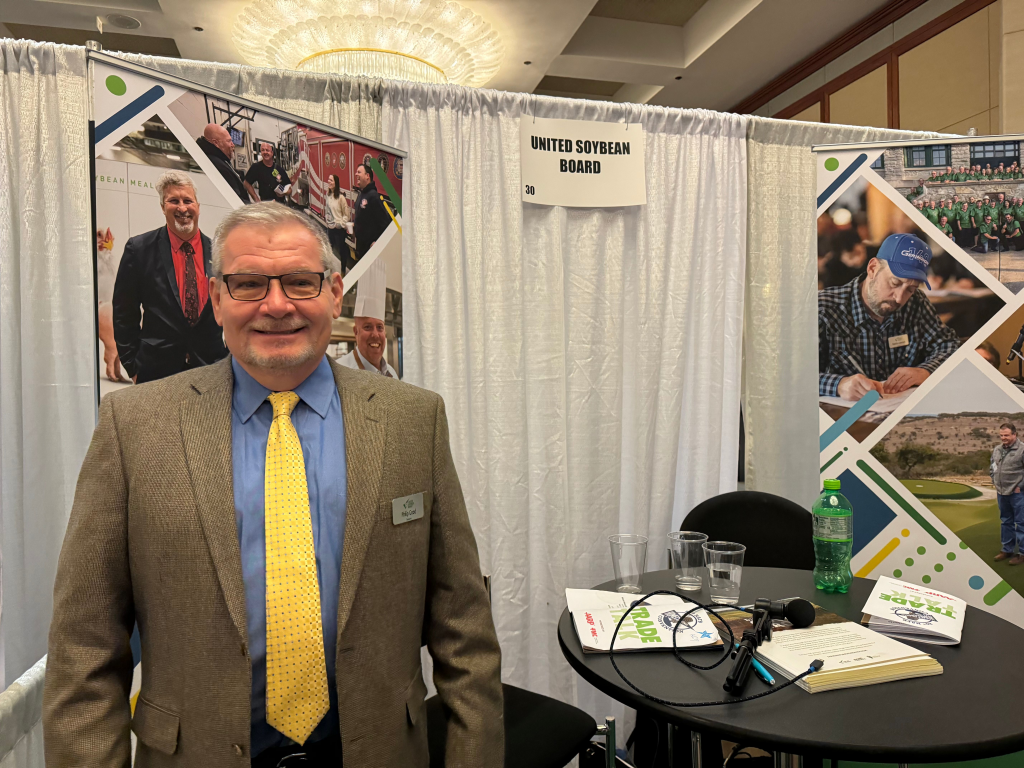
Farm Director, KC Sheperd is talking with the treasurer of the United Soybean Board, Philip Good, about the soybean industry. Good is also an author at U.S. Soy, and raises soybeans, corn, cotton, cattle and catfish with his son near Macon, Mississippi.
"One of the things I am excited about is how much production has increased," Good said.
When he began his career, Good said 30-bushel fields of soybeans were considered a good yield. The progress made over the years has been tremendous; Good added, as this year, there were fields yielding nearly 90 bushels.
"It is an exciting time to be a soybean farmer," Good said. "Production is absolutely amazing."
Good said he is looking forward to more success with soybean exports, promotion, and research.
"There are a lot of new things that are helping us on water efficiency, and there is some new genetics that we are excited about that we are tying in some of our new seed as well...There are more tools in our toolbox than ever before," Good said.
BASF is further expanding its FiberMax® and Stoneville® cotton seed industry-leading portfolio with the addition of four new varieties for the 2024 growing season.
With these strong additions, the FiberMax and Stoneville cotton seed portfolio includes a total of 18 varieties. All new varieties feature Axant™ Flex herbicide tolerance technology, cotton's first quad-stacked herbicide trait**.
"The addition of these new FiberMax and Stoneville varieties provides growers numerous versatile options to support high-yield potential, excellent fiber quality and strong insect and weed control," said Bryan Perry, Head of Seeds and Traits for BASF. "We understand a successful season starts with a high-performing seed, and we are excited to share these new varieties with growers to help provide a strong foundation for their cotton acres."
The high-performing new varieties include:
Powered by a proprietary new germplasm from BASF, Axant Flex Technology includes outstanding weed control and is bred to include native traits that help control yield-robbing pests, like root-knot nematodes and reniform nematodes as well as tolerance to other diseases such as verticillium wilt and bacterial blight.
BASF is committed to ongoing investments in the cotton industry to best meet the needs of its growers doing the Biggest Job on Earth. FiberMax and Stoneville cotton are regularly enhanced with trait development to ensure cotton growers can effectively manage their crops and get the most out of every acre. To learn more about the best cottonseed varieties for your field, talk with your local retailer or a BASF representative, or visit FiberMax.comor Stoneville.com.
*Individual results may vary. Information provided is based on experience with tests, trials, or practices as well as general observations. BASF does not guarantee the results noted above and grower is solely responsible for farming management practices and decisions, including, without limitation, selecting seed best suitable for the intended growth and use under grower's local conditions.
** Availability of cotton seed containing the Axant Flex Technology for the 2024 growing season and beyond is subject to many factors, and such seed may not be available in all cotton-growing areas. Commercial sales of cotton seed containing the Axant Flex Technology will be subject to contractual terms and conditions and stewardship obligations, which may include among other requirements restrictions on where the crop resulting from such seed may be sold, transferred and/or exported.
Always read and follow label directions. At time of compilation of this press release, no HPPD herbicide is registered for use with cotton. Axant, TwinLink, FiberMax and Stoneville are registered trademarks of BASF Corporation. ©2024 BASF Corporation. All rights reserved.
Each week, Beltway Beef brings you the latest policy news affecting the U.S. cattle and beef industry. Hear from subject-matter experts, producers, and industry leaders on the topics that impact the business viability of farms and ranches across the country.
On this episode, we are joined by NCBA Policy Division Chair Gene Copenhaver, a Virginia cattle producer. Copenhaver provides insight into his recent meeting with Speaker of the House Mike Johnson, shares information on NCBA's major policy wins from 2023 and priorities for 2024, and explains the value of NCBA's producer-led grassroots policy process. Copenhaver also previews CattleCon24 in Orlando and highlights some of the policy meetings, trade show exhibits, and special events that CattleCon attendees can expect to see. Finally, Copenhaver discusses several priorities for the next Farm Bill.

Deere & Company (NYSE: DE) announced it has entered into an agreement with SpaceX to provide cutting-edge satellite communications (SATCOM) service to farmers. Utilizing the industry-leading Starlink network, this solution will allow farmers facing rural connectivity challenges to fully leverage precision agriculture technologies. This partnership, an industry first, will enable John Deere customers to be more productive, profitable, and sustainable in their operations as they continue to provide food, fuel, and fiber for their communities and a growing global population.
"The value of connectivity to farmers is broader than any single task or action. Connectivity unlocks vast opportunities that were previously limited or unavailable," said Aaron Wetzel, Vice President of Production and Precision Ag Production Systems at John Deere. "For example, throughout the year, farmers must complete tasks within extremely short windows of time. This requires executing incredibly precise production steps while coordinating between machines and managing machine performance. Each of these areas are enhanced through connectivity, making the entire operation more efficient, effective, and profitable."
The SATCOM solution will connect both new and existing machines through satellite internet service and ruggedized satellite terminals. This will fully enable technologies such as autonomy, real-time data sharing, remote diagnostics, enhanced self-repair solutions, and machine-to-machine communication, all of which help farmers work more efficiently while minimizing downtime.
"John Deere has led the agriculture equipment industry for more than two decades with satellite-based precision guidance technology," said Jahmy Hindman, Senior Vice President & Chief Technology Officer at John Deere. "Now, we are bringing satellite communications service to the farm at scale so farmers with cellular coverage challenges can maximize the value of connectivity to their operations. The SATCOM solution unlocks the John Deere tech stack so every farmer can fully utilize their current precision agriculture technology in addition to the new innovative solutions they will deploy in the future. We initiated this process with a fierce focus on delivering value to our customers, and this partnership ensures we have a solution that meets their needs today and in the future."
John Deere's SATCOM solution will leverage SpaceX's Starlink satellite internet constellation. To activate this solution, John Deere dealers will install a ruggedized Starlink terminal on compatible machines, along with a 4G LTE JDLink modem to connect the machine to the John Deere Operations Center. The SATCOM solution will initially be available through a limited release in the United States and Brazil starting in the second half of 2024.
About Deere & Company
Deere & Company (www.JohnDeere.com) is a global leader in the delivery of agricultural, construction, and forestry equipment. We help our customers push the boundaries of what's possible in ways that are more productive and sustainable to help life leap forward. Our technology-enabled products including John Deere Autonomous 8R Tractor, See & Spray™, and E-Power Backhoe are just some of the ways we help meet the world's increasing need for food, shelter, and infrastructure. Deere & Company also provides financial services through John Deere Financial.
For more information on Deere & Company, visit us at www.deere.com/en/news/.
Mark Johnson, Oklahoma State University Extension Beef Cattle Breeding Specialist, offers herd health advice as part of the weekly series known as the "Cow Calf Corner," published electronically by Dr. Peel, Mark Johnson, and Paul Beck. Today, Johnson talks about cow management in the cold winter months.
Winter has arrived in Oklahoma. Hopefully all your cows are at a Body Condition Score (BCS) of 5 or better. When this is the case, cows can remain comfortable at temperatures in the 20 – 30 degree Fahrenheit range as long as it is dry with little wind. Adequate BCS means cows have adequate fat reserves to provide some insulation and to be used as an energy reserve. Nutritional requirements of cows can be found in the OSU Cooperative Extension Fact Sheet E-974. Severe cold, wet and windy conditions will drive up the nutritional requirements of your cow herd.
Relative to nutrition, keep the following in mind during severe wintry weather:
1 – As a general rule of thumb, for each 1 degree Fahrenheit the average daily temperature is below 30 degrees a cow in moderate BCS will need an additional one percent in daily energy requirement. For example, if the average daily temperature is 10 degrees Fahrenheit, a cow will need approximately 20% more energy. If the cow needs 10 pounds of TDN per day during normal weather, this requirement will increase to approximately 12 pounds per day.
2 – Wind chill and wet hair coats should be accounted for in determining daily energy needs. Cattle in thin condition, with wet hair coats and under windy conditions may not be able to produce enough heat to stay warm. The Mesonet Cattle Comfort Advisor is an excellent resource to monitor cold stress. It can be accessed at the website address referenced below.
3 – When additional supplemental feed is needed for cows on roughage diets, use feedstuffs which are high in digestible fiber and energy dense. For example, soybean hulls and distillers grains fit this criteria.
4 – Windbreaks and shelter can be a huge benefit to reduce cold stress. Bedding to create a dry place to lie down can aid to reduce the stress of frozen ground.
5 – If calving during severe cold, take extra precaution. Frozen ground and severe cold, windy weather pose an immediate threat to newborns. Be there to provide immediate assistance and a warm, dry environment for newborn calves.
References:
Nutritional Requirements of Beef Cattle. OSU Cooperative Extension Fact Sheet E-974
Caring for Cattle in Cold Weather
Paul Beck has advice for producers to help cattle manage strong cold snaps from OSU SunUPTV on February 8, 2021, https://www.youtube.com/watch?v=5j_z2pCuyzs&t=7s
RON's Dave Lanning has a pre-opening look at today's agricultural Markets.
Click the audio tab below for today's report.
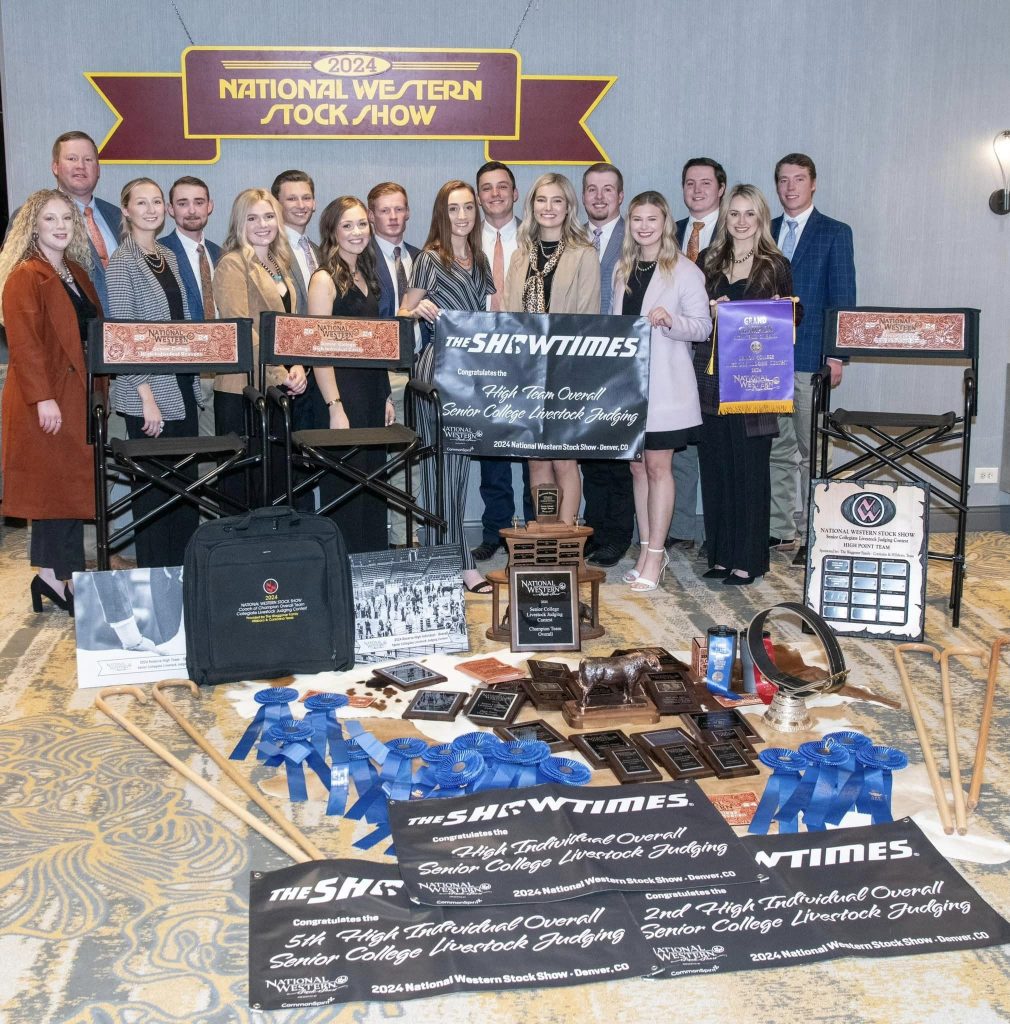
OSU Cowboys Grab Top Prize at the National Western Livestock Judging Contest in Denver
For the second time in January- the Oklahoma State University Livestock Judging Team was named the Champion Team at the 2024 National Western Stock Show. Earlier in January- they were named the Champions at the 2024 Jarold Callahan Memorial Livestock Judging Contest at the Cattlemen's Congress. Click here for our story from Congress about the Cowboys taking the championship.
In Denver- the OSU team bested Texas A&M by 55 points to claim top honors. OSU was led by Ashlyn O'Brien who came to Stillwater from Ohio by way of Butler Community College- she was the high individual overall at the NWSS- besting teammate Braylon Spears by three points. She matched her score in Denver that she racked up in Oklahoma City a few days earlier- 942- that earned her a fourth place finish at Cattlemen's Congress- she was the high individual on the team for the second contest in a row. Spears also duplicated his score in both the Oklahoma City and Denver contests.
OSU Coach Parker Henley says in a Facebook post that OSU wants to thank the staff at both the Cattlemen's Congress, and the NWSS, for putting on high quality contests.
NWSS
INDIVIDUAL RESULTS:
ASHLYN O'BRIEN
1st Overall
2nd Reasons
2nd Feedlot Cattle
4th Swine
5th Sheep and Goats
6th Cattle Reasons
BRAYLON SPEARS
2nd Overall
6th Cattle
7th Reasons
8th Swine
ANNA HANNON
5th Overall
1st Swine
1st Cattle
1st Reasons
1st Cattle Reasons
9th Feedlot Cattle
JED SIDWELL
1st Feedlot Cattle
2nd Cattle Reasons
9th Reasons
NWSS CARLOAD CONTEST
7th Overall
INDIVIDUAL RESULTS
MCKENZIE LAYTON:
5th Overall
PARKER FLEMING:
10th Overall
CATTLEMEN'S CONGRESS
ASHLYN O'BRIEN
4th Overall
2nd Cattle
4th Reasons
6th Sheep and Goats
BRAYLON SPEARS
5th Overall
2nd Swine
8th Reasons
JED SIDWELL
6th Overall
3rd Swine
KALE CAMPBELL
1st Swine
7th Reasons
ANNA HANNON
3rd Reasons
Click here for the Judging Card link to see the complete results of the National Western Collegiate Livestock Judging Contest
Farm Director, KC Sheperd, is talking with the head of sales and service at the Rural Community Insurance Services (RCIS), Jeff Bahr. Bahr talks about what producers need to be aware of in 2024 and the RCIS Apprenticeship Program.
RCIS is a crop insurance provider, insuring farms across the country. RCIS works directly with crop insurance agents who travel to farms to deliver policies.
"What we encourage them to do is to start looking at all of these different risk management plans that are available, talk to their RCIS agent in advance, and start putting that together to make sure all of their crops are going to be protected in 2024," Bahr said.
When it comes to volatile weather patterns, Bahr said crop insurance is the best protection method that a producer can invest in.
"We have the federal crop insurance program that 90 percent of farmers actually take advantage of, so most all of them do that, however, there are also some private products like a revenue protection policy through RCIS that provides coverage beyond what the federal crop insurance program does, and it also can have a claim on that without having a federal crop insurance claim," Bahr said.
RCIS has a presence in Washington, D.C., Bahr said, and is always trying to help make sure that farmers, crop insurance agents, and insurance programs are protected.
"As we know, the farm bill is being pushed out for a year, but we want to continue to have a presence there," Bahr said.
Bahr also talked about the RCIS apprenticeship program, a two-year program that will pay for an individual's associate's degree while working for RCIS.
"They get full benefits, full pay, and full tuition reimbursement," Bahr said. "This is a wonderful program for high school graduates, veterans, and anybody who is wanting to do a career change," Bahr said.
Once individuals graduate and complete the program, Bahr said they have a guaranteed spot on the RCIS team.
"We have had fantastic results through the last few years on this, and we want to continue," Bahr said.
Bahr said applications are being accepted now, and the team plans to have interviews completed by June 1, 2024. To apply or learn more about the RCIS Apprenticeship Program, CLICK HERE!
| |||||||||||||||||||||||||||||||||||||||||||||||||||||||||||||||||||||||||||||||||||||||||||||||||||||||||||||||||||||||||||||||||||||||||||||||||||||||||||||||||||||||||||||||||||||||||||||||||||||||||||||||
|
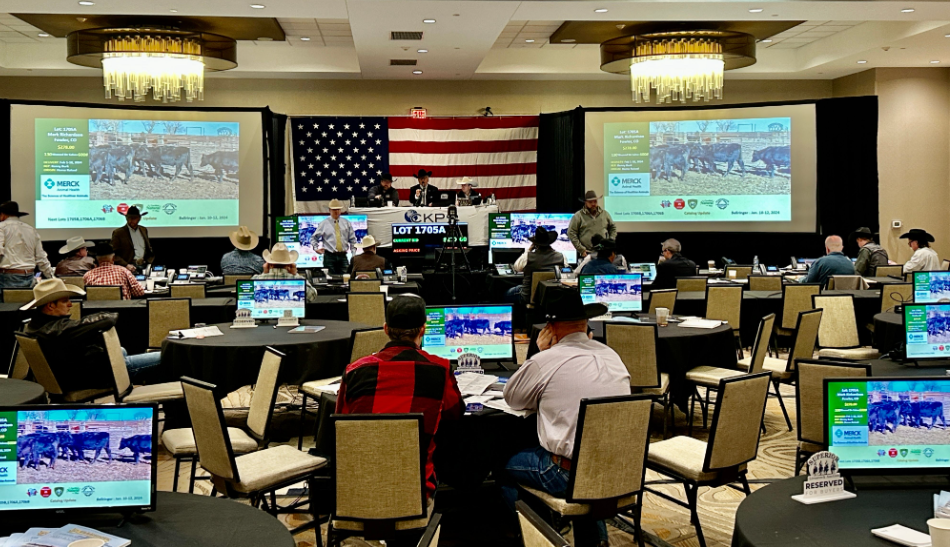
At the 2024 Superior Livestock Bellringer Sale held live in Oklahoma City last week, Senior Farm and Ranch Broadcaster, Ron Hays, caught up with the President of Superior Livestock, Danny Jones, and talked about the year 2023 and what 2024 holds for the cattle industry and Superior.
This year's Bellringer Sale has been a success, Jones said, and about 110,000 cattle were included in the sale. The year of 2023 was also a big success for Superior Livestock, Jones added.
"It has been the third year in a row we have had significant growth," Jones said. "We were up 205,000 cattle in 2023. In a year that had fewer cattle to be sold, we had a nice increase."
Superior has not only seen growth in the number of cattle sellers and buyers who are willing to utilize an online sale, but also in the value-added programs.
"The programs started as kind of a niche market, but it has turned into a bigger deal," Jones said. "As the programs have grown, obviously you are going to go specifically after those program dollars, then you have to put them in front of an audience where all those buyers can find those cattle. At Superior Livestock, we feel like we do a good job of accomplishing that for our customers."
Jones said the programs have been promoted to consumers by end users such as the feedlot and the packer, which helps to deliver results to the buyer and seller.
One example of a program consumers have shown interest in is the Beef Quality Assurance program.
"From the handling of vaccines to the handling and care of the cattle, it is important to everyone in the chain that it be done right," Jones said. "It all starts at the ranch level, and we have seen ranchers respond really well. They are proud of what they do, and they want to make sure they are doing it the right way and don't mind the recognition for what they are accomplishing."
Jones said he believes Superior Livestock will see another year of growth in 2024.
"We recognize the value in all the different ways that cattle are marketed," Jones said. "In fact, as an organization through National Livestock, we are involved in every facet of how cattle get marketed, and we are supportive of all those ways."
The Beef Buzz is a regular feature heard on radio stations around the region on the Radio Oklahoma Ag Network and is a regular audio feature found on this website as well. Click on the LISTEN BAR for today's show and check out our archives for older Beef Buzz shows covering the gamut of the beef cattle industry today.
Farmers and ranchers share what they learned in Noble's first year of regenerative courses as the initial 2024 class offerings are announced, starting with New Braunfels, Texas, this February.
As Noble Research Institute expands its educational programs this year, with a wider range of regenerative courses delivered across several states in the Southwest, Midwest and Great Plains, we wanted to share what participants are saying about the first two courses in the curriculum.
In 2023, farmers and ranchers attended the two-day Essentials of Regenerative Ranching course in Oklahoma and Texas and the three-day Essentials of Regenerative Grazing course offered in Ardmore and Miami, Oklahoma, both debuting that year.
The first course of 2024 is Essentials of Regenerative Ranching, to be held Feb. 21-22 in New Braunfels, Texas. Start here to register for that course or any of these locations on the calendar so far:
Essentials of Regenerative Ranching:
Essentials of Regenerative Grazing
"We're pleased to be expanding our geography to reach people interested in regenerative ranching in Arkansas, Kansas and Missouri, with plans to offer courses in the Dakotas as well," says Hugh Aljoe, director of ranches, outreach and partnerships at Noble. In addition, he says to watch for news of new course topics and locations during the year.

As Noble had hoped and expected, class participants came with experience levels ranging from those new to ranching, to seasoned ranchers using conventional practices, to dedicated regenerative ranchers looking for new ideas. Here are some examples of what they say they learned and planned to try out when they got home.
Edward Barrett, the regenerative farming manager for Chimney Stack Farm in Mabank, Texas, says he was glad to learn that moving cattle or any animals through a grazing system entails a mix of both art and science.
Admitting he was not that good at math, he was relieved to reach the in-field portions of Essentials of Regenerative Grazing and hear things like: "'Hey, just take some polywire and move it. If you get it wrong, just make it bigger or smaller tomorrow.' That was really good for me to take away from the course."
He also appreciated the experience of his classmates.
"I've only been doing this a short time, so there's a wealth of information with the men and women who were in this room. I got a lot from them."
Barrett says he learned that there's no specific or rigid prescription for regenerative grazing, but that "it's adaptive." He says it's helped him refocus, while solidifying his tentative plan to put in more water lines. He also says he's going to think about destocking and "using less resources for now so I can improve the soil and the land.
"Additionally, we use a lot of hay, and I found out there's a way that I don't have to use so much hay. That as I move down the road of regenerative ranching, I'll be able to use less hay in the future. And I think that's very valuable."

Paul Bush traveled from Fort Smith, Arkansas, to attend one of Noble's earliest Essentials of Regenerative Ranching courses, and he reports seeing results when he put what he learned into practice at Circle PK Farm and Ranch.
"Since I've started assessing my soil health and applying the (soil health) principles, I can see improvements in soil cover already," he says. "Land that was bare six months ago is now covered."
He says the most important thing he learned at the Noble training "was not just the importance of soil health, but how to attain it, how to work within the systems, recognize the systems and how they work together.
"My message to someone who is just starting this journey is to find resources, find friends, find a network that you can bounce questions off of. Find an organization, such as Noble, that has a bank of information."

Hollie Boyer is a seventh-generation cattle rancher from Muskogee County, Oklahoma, and was new to the concept of regenerative grazing until her cousin, who is second-generation on her ranch, started talking about it and told her about Noble's Essentials of Regenerative Grazing course.
Boyer says she came to the course with the impression that using regenerative grazing was a means to an end, strictly financial.
"You can get to a point where you don't have to use fertilizer and chemicals and all those things, but it's actually so much more than that," she says. "It's bringing it back to the very basics. When we take those things away, the cow are just fine on their own. Yes, there is a financial component to it, obviously, but it's a nature component. Being able to see what God intended it to be, not what we or I have created it to be."
Boyer says she learned that moving her cattle more often than she had been will be much more effective and not necessarily more time-intensive; that she'll need to look at stocking levels and hopes to help her production-minded dad understand that "you can have perfectly healthy cattle without all the inputs.
"I also learned that we're not alone. In this class, we're all trying to get to the same end. We all want to be better ranchers; we want to be more sustainable. And now I have resources – there's a whole community."
Story Credit: Marilyn Cummins, Noble Research Institute
Dr. Derrell Peel, Oklahoma State University Extension Livestock Marketing Specialist, offers his economic analysis of the beef cattle industry as part of the weekly series known as the "Cow Calf Corner," published electronically by Dr. Peel and Mark Johnson. Today, Dr. Peel talks about hay production.
The Crop Production 2023 Summary recently released by USDA included data on hay production and December 1 hay stocks. All hay production in the U.S. was 6.3 percent higher year over year from drought-reduced production in 2022 but was 7.8 percent below the 10-year average from 2012-2021. Total alfalfa hay production in 2023 was 2.2 percent higher year over year but remains 9.8 percent below the 2012-2021 average. Total other hay production was up 9.5 percent year over year in 2023 but was 6.3 percent below the ten-year average. Total December 1, 2023 hay stocks were 6.9 percent higher than one year earlier but were 10.8 percent below the ten-year average from 2012-2021 (Table 1).
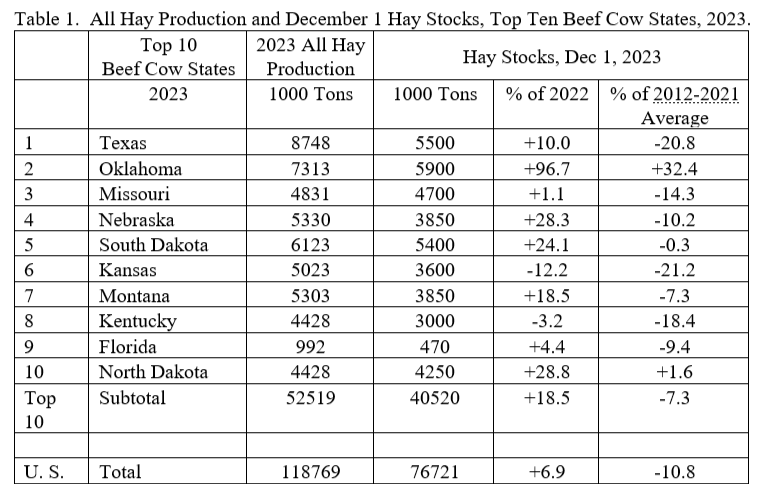
Table 1 shows the hay situation for the ten largest beef cow states. These states account for 57.8 percent of the total beef cow inventory in 2023 and represent nine of the top ten states for December 1 hay stocks. Hay stocks in the top ten beef cow states were up 18.5 percent year over year but were 7.3 percent below the 2012-2021 average for these states. Total December 1 hay stocks in these states represented 52.8 percent of total U.S. hay stocks. Table 1 shows that hay stocks were higher year over year in eight of the ten states, with decreases only in Kansas and Kentucky. Among the top ten states, Oklahoma stands out with December 1 hay stocks up 96.7 percent year over year and 32.4 percent higher than the ten-year average. Oklahoma had 2023 hay production up 88.0 percent year over year and up 36.8 percent over the 2012-2021 average. Oklahoma and North Dakota were the only top ten beef cow states with December 1 hay stocks that were larger than the ten-year average.
In general, the hay situation is better this winter than one year ago, but hay stocks remain below long-term averages in most states. The current severe winter weather will significantly increase hay usage and highlights the reality that the overall forage situation is questionable going forward.
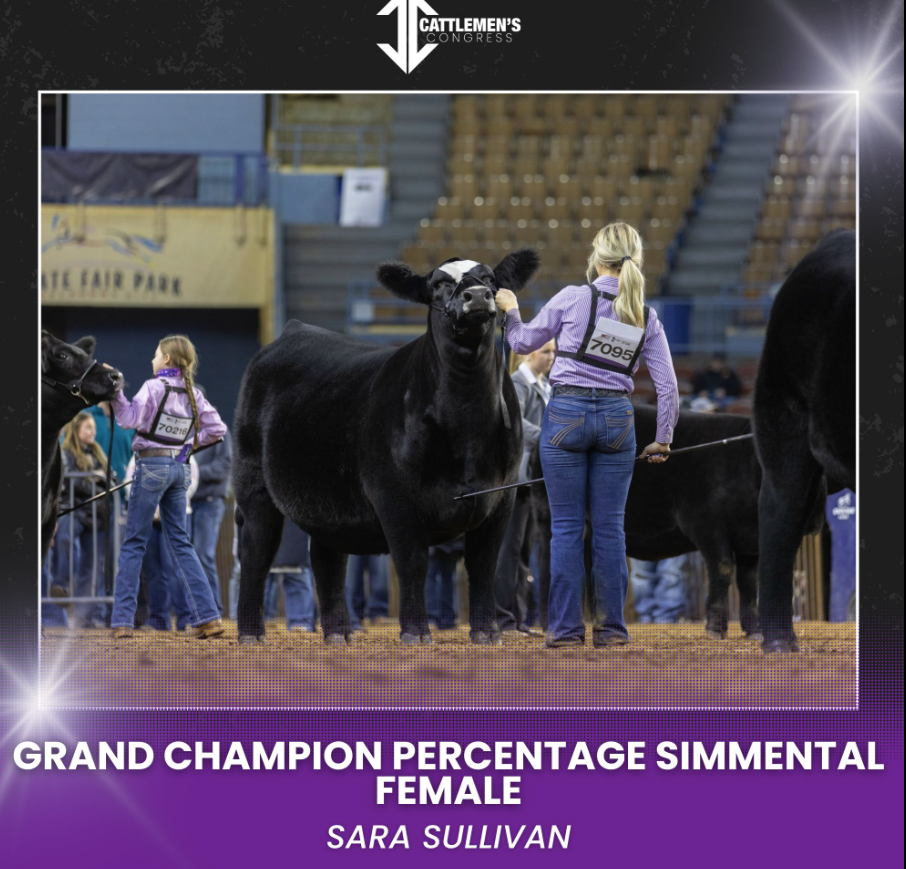
The third Ring of Champions Major PTP Show, Cattlemen's Congress in Oklahoma City, wrapped up last week. Luke Bowman, Director of SimGenetic Development, summarized the event saying, "Cattlemen's Congress is always a premiere exhibition venue for SimGenetics producers and a great way to kick off the new year.
With more than 500 entries checked in covering all three days of pen & halter shows, Simmental-influenced cattle were highlighted as one of the largest breeds shown in Oklahoma City this year. Chance Ujazdowski, Mia Bayer, and I enjoyed visiting with producers throughout the event, and the American Simmental-Simbrah Foundation (ASF) fundraising was quite a feat. Hats off to Mia, ASF staff liaison, and all her Foundation board members who helped to raise so many dollars for the "Foundation Heifer" from Hart Simmentals, SD.
A sincere thank you to the Harts for their wonderful contribution and donation. It's a great day to be part of the ASA!"
What happened: California Proposition 12 (Prop. 12) has come into full effect as of Jan. 1, mandating that all covered pork shipped to California must abide by the state's arbitrary production standards. Pork producers across the country continue to voice their concerns over how California's overregulation could negatively impact family farms and are looking to Congress for a solution.
Three Illinois pork producers, including former NPPC board member Phil Borgic, have weighed in on Prop. 12, with a letter to the editor that ran in The Pantagraph of Bloomington, IL. In the letter, the producers highlighted: "If we want to continue farming, Proposition 12 will undoubtedly raise the cost of producing pork for us and other hog farmers, which jeopardizes an Illinois industry that contributes $3.3 billion in economic value and supports nearly 34,000 jobs."
Prop. 12 requires pork to be from hogs born to sows that are provided both a minimum of 24 square feet per sow and are not housed in individual pens. In the United States, the industry average for sow breeding pens is 16 to 18 square feet.
NPPC board member Todd Marotz, a pork producer from Sleepy Eye, MN, in an interview with the Minneapolis Star-Tribune, estimated only 20% of his farm's barns meet the California standard. He also pointed out some of the consequences of Prop. 12, including higher prices for pork and a larger carbon footprint for the pork industry as producers use more energy to heat larger barns in the winter and cool those barns in the summer.
Prop. 12 applies to uncooked cuts of whole pork meat, including bacon, ham, chops, ribs, riblet, loins, shanks, roast, brisket, steak, sirloin, or cutlets. California regulations exclude products that are cooked, or otherwise ready to eat, in addition to sausage and ground pork.
Why it matters: Pork producers across the country interested in selling to California's massive 40-million-person marketplace must comply with Prop. 12. With producers facing average losses of $30 — sometimes exceeding $40 to $60 — on each hog marketed in 2023, most can't afford the often significant costs of complying.
NPPC's take: NPPC — which has fought against ballot initiatives such as California Prop. 12 and Massachusetts Question 3 for the past decade, including challenging these laws before the U.S. Supreme Court — is working with members of Congress on a solution to the problems created by the law and the rapidly emerging complex web of conflicting state laws.

Due to unforeseen technical difficulties with our hosting platform, the following events currently on the NIFA Events Calendar are being rescheduled or revised with new registration links. Updated links are noted below where available; additional links to follow in the days ahead. If you have already registered for any of these events, you will need to register again at the updated link to access the event.
The current IRS tax code is 74,600 pages long. In book form it would stretch 36 feet high, in case you want a climbing challenge! But according to Tyler Bruch, founder and CEO of Boa Safra Ag, there's one paragraph in that code that has the potential to save some farmers thousands of dollars through tax deductions. But most landowners have never heard about it before.
RELATED: The IRS Farmer's Tax Guide, Publication 225, can be accessed here.
So, what are we talking about here? This must be something new, right? As a matter of fact, it's been around for a long time. The little-known code was written and passed by Congress in 1960. According to Section 180, the IRS allows owners of agriculture land to deduct the residual fertility value of nutrients in their soils at the time of acquisition.
RELATED: The University of Nebraska Center for Agricultural Profitability explains Section 180 and how it works. Read that here.
That means purchasers of agriculture land can depreciate the value of fertilizer ingredients that are present in the soil at the time of purchase in the same way as other capital items such as fencing, equipment or structures. To capture these deductions, owners need to put a number on the volume and value of these nutrients in their farm soil. That's where Boa Safra Ag comes in.

When the company is hired, it goes through three steps with landowners:
1. Sampling Soils - This involves measuring existing micro and macronutrients at multiple depth levels.
2. Establishing Nutrient Values – Once nutrient volumes are determined, the company determines the market value of those nutrients based on public pricing information. In other words, they want a snapshot of what it was like at the time of purchase.
3. Generating Comprehensive Reports – These range from dozens to hundreds of pages depending on the land, enabling owners and CPAs to file returns.
Bruch, who owns a farm in Nebraska, pointed out that the land must actively use the soil nutrients which means Conservation Reserve Program (CRP) land does not qualify. Land acquired through inheritance is also not eligible to use this tax benefit.
RELATED: The National Sustainable Agriculture Coalition lays out requirements to be eligible for the Conservation Reserve Program. Check those out here.
Even if you've owned the land for a while, you can still take advantage of the deduction through either an amended return or by filling a 3115 form with the IRS. But it doesn't work for everyone.
Bruch puts it like this: "If you've had the land for fifteen to twenty years, it makes sense. Anything beyond that doesn't make a lot of sense. That's because there wouldn't be enough value to generate a number that would be sizable."
Company figures show that the average deduction is $1,700 per acre. The higher the fertility, the higher the deduction. Deductions can also be spread over several years depending on the situation.
From start to finish, the process takes about 60 days to complete and costs $40 per acre of land. "So, think about it," Bruch said, "If you get a $1,500 deduction and you are in a 30 percent tax bracket, that's about a $500 per acre savings. There aren't many things we can do as farmers today that can make 500 bucks an acre."
Tyler Bruch led a discussion about Section 180 and farmland tax deductions during the 2024 Land Investment Expo in Des Moines, Iowa. Written by: Brooke Bouma Kohlsdorf Edited by: Dave Price

Do you or a student you know want to advocate for family farmers and their communities through your career? NFU Foundation wants to help! Learn more about our three scholarship opportunities and apply by April 1 at nfu.org/scholarships
RON's Dave Lanning has a pre-opening look at today's agricultural Markets.
Click the audio tab below for today's report.
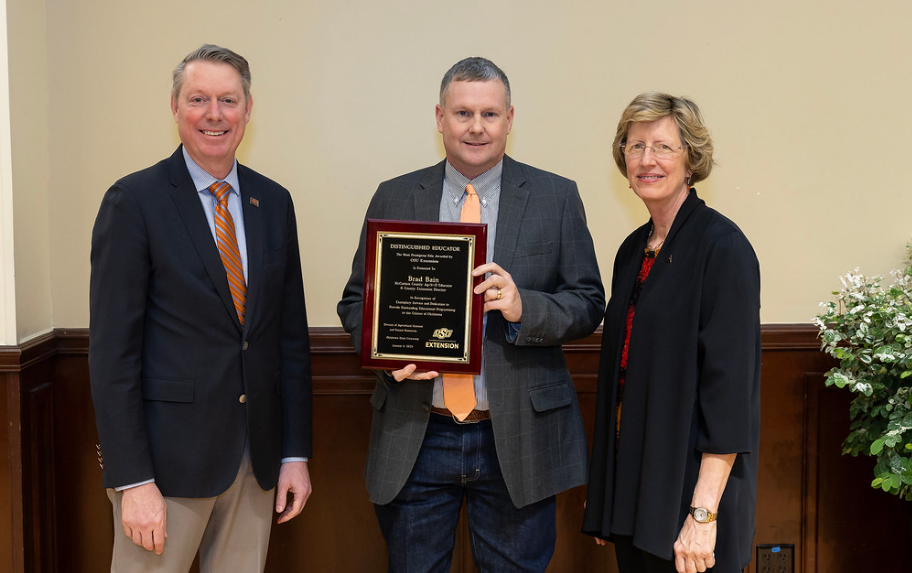
Brad Bain, McCurtain County Extension director and agriculture educator, (center) receives the Distinguished Educator award from Jayson Lusk, vice president and dean of OSU Agriculture, (left) and Damona Doye, associate vice president of OSU Extension, (right) at the 2024 OSU Extension Biennial Conference. (Photo by Mitchell Alcala, OSU Agriculture)
Oklahoma State University Extension has recognized Brad Bain, McCurtain County Extension director and agriculture educator, with its annual Distinguished Educator award.
He was honored at an awards ceremony during the OSU Extension Biennial Conference Jan. 11 in Stillwater.
"We are grateful that Brad's experiences in 4-H as a youth helped bring him to a career in Extension," said Damona Doye, OSU Extension associate vice president. "He has contributed tremendously to youth development, production agriculture and community economic development in his role. His hard work and commitment to the Extension mission have served many people very well."
Bain's early days in 4-H and Extension are linked to his childhood. He was a member of the Valliant 4-H Club and enjoyed livestock judging. His county team won the Oklahoma 4-H championship twice, took home the OSU Field Days Sweepstakes Trophy and competed in three national contests. His mother served as a Valliant 4-H leader, and both of his parents were involved in county and district Extension advisory committees.
While a student at Eastern Oklahoma State College, Bain launched his professional career in Extension by serving as a program assistant for 4-H youth in the Choctaw Nation. He earned a degree in agricultural education from OSU and worked as the 4-H educator in Dewey and Major counties for two years. After a six-year stint teaching high school agricultural education, he returned to Extension as the 4-H educator in McCurtain County in 2002. Bain took on the duties of county Extension director in 2008 and added the title of state poultry waste management education coordinator to his title in 2022.
Bain considers 4-H and Extension programming his life's work, providing youth and producers opportunities to develop and thrive within their communities. As a 4-H educator, he enjoyed organizing McCurtain County's 4-H camp with fun breakout workshops, evening presentations, good food, a comedy skit night and a dance for 150 camp attendees.
He also initiated officer workshops, public speaking events and record book sessions.
"I believed then, and still do, that a county 4-H program is only as good as its local clubs," Bain said.
His school enrichment projects through 4-H included Ag in the Classroom, High School Financial Planning, an environmental stewardship program, dairy education and the Southeast Oklahoma Youth Leadership Program. Bain hosted the two-day leadership retreat with fellow educators from Choctaw and Pushmataha counties for non-4-H members who had been denied leadership opportunities at school due to race, economic status or other factors.
He also coached a successful forestry judging team and partnered with his county's family and consumer sciences educator to offer beef cooking schools.
When Bain became McCurtain County Extension's director and agriculture educator, he learned firsthand how his community relies on the expertise of a local Extension office.
"With 4-H, you can look at your calendar and predict what questions you are going to get 90% of the time," he said. "As an ag educator, it feels like it's something new every time someone comes in the door, calls you on your phone, or sees you at your grocery store or kid's ball game."
The McCurtain County office typically sends 250-275 test samples to the OSU Soil, Water and Forage Analytical Laboratory in Stillwater every year, and Bain provides handwritten recommendations for each set of results. He is available for weed, insect and disease identification services, has served as the executive director of the McCurtain County Cattlemen's Association and has led his county's Master Cattlemen program, developing and presenting short courses on hay and forage management for producers.
As the county Extension director, Bain has strengthened relationships with county commissioners, the excise board and other local funding sources while advocating for Extension resources and programming. Bain's additional role of state poultry waste management education coordinator has allowed him to work closely with the Oklahoma Department of Agriculture, Food and Forestry and the Oklahoma Conservation Commission to write new rules and regulations for the state's newest poultry legislation.
"Brad has that unique mix of intellect, wit and practicality that enables him to be a great county educator," said Claude Bess, OSU Extension southeast district director. "However, it's his servant's heart and strong work ethic combined with his love of people and family that makes him a distinguished educator."
Like all hardworking and devoted Extension educators, there are no limits to the amount of energy and time Bain devotes to his Extension career. He said he's always been fortunate to have the support of excellent county and district directors to elevate Extension engagement in McCurtain County.
"Extension has changed a lot in the past 20 years — first the internet, then social media," Bain said. "It's caused our job to evolve. In a time when information and misinformation are everywhere, my neighbors know they can rely on Extension for research-based answers to their questions."
Alongside his wife and two children, Bain operates the family cattle herd on land that was owned by his grandfather. Even though he didn't grow up to become the full-time farmer he dreamed of as a child, he thrives today in his role of helping others find success in their agricultural pursuits.
"I know that I'm in a distinguished profession, and I will forever be grateful to serve my home county and state in this role," Bain said.
By Gail Ellis
OSU Extension uses research-based information to help all Oklahomans solve local issues and concerns, promote leadership and manage resources wisely throughout the state's 77 counties. Most information is available at little to no cost.
Flour millers and bakers in the Philippines have a strong preference for U.S. wheat, and U.S. Wheat Associates (USW) has spent many years building relationships in the important market.
Because of USW's work there, USDA invited USW to participate in "Spotlight on the Philippines," a webinar held in December that was organized by the Foreign Agricultural Service (FAS) office in Manila. USW Assistant Regional Director Joe Bippert presented during the event. He shared USW's experiences in the market and some of its plans for the coming year.
In this short video – the first of two videos on USW's work in the market – Bippert explains why USW was chosen to participate in the FAS event. He also provides some background on U.S. wheat's successes in the Philippines.
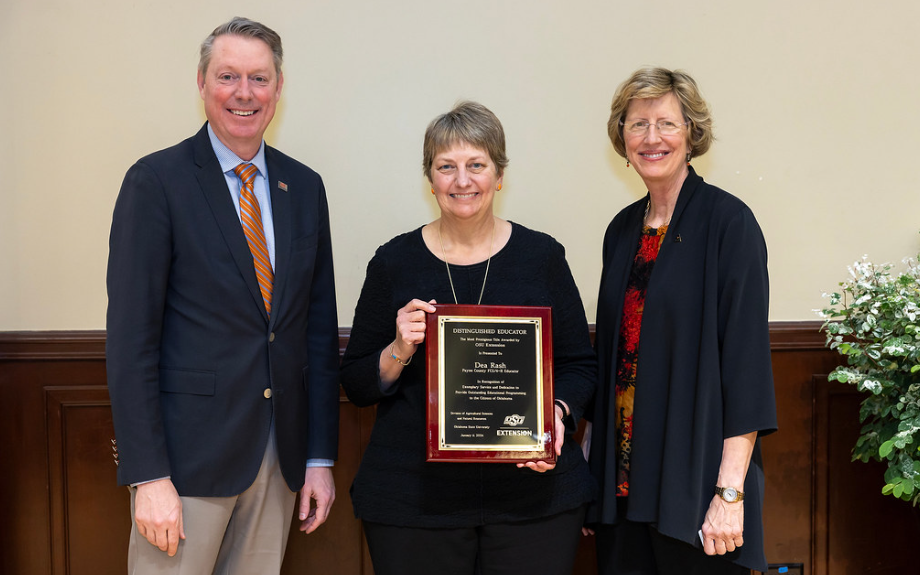
Dea Rash, Payne County family and consumer sciences educator, (center) receives the Distinguished Educator award from Jayson Lusk, vice president and dean of OSU Agriculture, (left) and Damona Doye, associate vice president of OSU Extension, (right) at the 2024 OSU Extension Biennial Conference. (Photo by Mitchell Alcala, OSU Agriculture)
Oklahoma State University Extension has named Dea Rash a recipient of the Distinguished Educator Award.
Rash is the family and consumer sciences/4-H educator for Payne County Extension and was honored Jan. 11 at the OSU Extension Biennial Conference in Stillwater.
Extension has played a significant role in Rash's life since her youth. She was an active 4-H member in Grant County for nine years. Extension has been a tradition in her family for four generations, and they were honored as an Oklahoma 4-H Centennial Family in 2009.
"We are grateful that Dea's family legacy of Extension involvement and her 4-H experience as a youth inspired her to a career in Extension," said Damona Doye, associate vice president of OSU Extension. "She has been involved in developing and delivering many innovative and impactful programs for both youth and adult audiences. Her commitment to serving others and helping them improve their quality of life makes her a great Extension educator."
Rash began her Extension career in 1991 as a 4-H youth development educator for Payne County. Her focus on 4-H curriculum enrichment encompassed 4-H outreach in schools, daycares and summer youth programs, as well as non-traditional 4-H settings. She developed a tornado safety program, including a tornado simulator and facilitated many other educational initiatives like Color Me Healthy, Chick and Quail Embryology, Plant Science and Kids with Character.
"Working with non-traditional 4-H audiences was not only educational and fun, but it was also very rewarding. I had to learn how to hatch chicks in an incubator because the chick embryology program was one of our most popular programs. It was very exciting when teachers called to tell me how many baby chicks hatched," she said.
Under Rash's leadership, participation in the Payne County 4-H curriculum enrichment program grew exponentially for 13 years, reaching 40,000 youth.
Rash also co-created the Payne County PRIDE Customer Service Program to teach quality customer service concepts to front-line employees; this program was updated for statewide use, and it is still taught by educators today.
In 2003, Rash was named Payne County's family and consumer sciences educator and continued focusing on the needs of children and families. Among the many impactful programs she has created are a Discover MyPlate nutrition program and cooking class for Afghan and Hispanic families relocated to the Stillwater area. She partnered with the multilingual learners coordinator at Stillwater Public Schools to teach workshops on how to prepare nutritious meals and healthy snacks as well as teach families how to manage money and make wise financial decisions.
"In addition to the nutrition and financial workshops, we have also taken the families on an agritourism tour to a blackberry farm and taught a STEM blackberry jam-making workshop. We are taking a pecan farm tour in January and will teach them how to make pecan pie," Rash said. "It's been a very successful program to help them acclimate to American customs and learn about nutrition, finances and agriculture."
Rash is a familiar face at Our Daily Bread Food and Resource Center, where she regularly teaches MyPlate nutrition courses and workshops on pressure cooking, cast iron cooking, jam-making and air frying. Thanks to Simmons Bank Foundation grant funding acquired by Our Daily Bread, students from Stillwater Public School's Lincoln Alternative Academy attend similar workshops to learn about MyPlate, food and kitchen safety and how to use kitchen appliances like air fryers and pressure cookers. Once they complete the series, the students earn an air fryer or pressure cooker of their own.
One of the most popular family and consumer sciences youth programs is the Cooking Together is Fun youth cooking school Rash co-teaches with fellow educator, Trinity Brown. Fourth-grade students in Payne and Pawnee counties learn MyPlate nutrition, food and kitchen safety and proper handwashing. After the educational program, students work in small groups with a teen or adult leader to prepare a recipe and have a tasting lunch. They also take home a cookbook of the recipes prepared at the school and are encouraged to make their favorite recipes with their families.
"It's a program the kids and teachers look forward to each year," Rash said.
Rash's vast portfolio of programming also includes teaching co-parenting for resilience to support parents with minor children who are experiencing divorce.
"The thing I like best about my job is that it's different nearly every day," she said. "Getting out and teaching people how to make a difference in their lives and then receiving their feedback makes it all worth it."
A proud mother of two daughters who participated in 4-H and graduated from OSU, Rash's dedication to not only her own family but also those in her community is evident across Payne County.
"When 4-H parents say, 'You helped raise our kids' by teaching them life skills they're still using every day like leadership, citizenship, public speaking, record keeping and time management, that's pretty special," Rash said. "If we weren't there to teach those life skills and be a positive role model for 4-H members, they wouldn't be the individuals they are today."
A mentor, leader and teacher, Rash has also served as an advisor for Payne County Home and Community Education since 2003 and enjoys the friendship and comradery of the group.
"Dea is always looking for ways to help others in her community," said Nancy Johnson, OSU Extension northeast district director. "She is a hard worker with tons of compassion, and it shows in all that she does. I count it a blessing to serve as her district director."
No matter the hour or day of the week, Rash can be found teaching, demonstrating, and listening to improve the quality of life for those in her community.
"I'm blessed to have had the opportunity to work in Payne County for the past 32½ years," she said. "It's been a dream of mine to receive this Distinguished Educator award. I certainly didn't get here by myself. There are many people who have supported me, and I am grateful to everyone who has helped me achieve this goal. I am very honored to be a member of this impressive group of educators."
By Gail Ellis
OSU Extension uses research-based information to help all Oklahomans solve local issues and concerns, promote leadership and manage resources wisely throughout the state's 77 counties. Most information is available at little to no cost.
USDA on Friday released its January Crop Production, World Agricultural Supply and Demand Estimates (WASDE) Dec. 1 Grain Stocks and Winter Wheat Seedings reports.
USDA pegged final national average corn yield at a record 177.3 bushels per acre (bpa), well above the range of pre-report expectations. Production was pegged at 15.34 billion bushels (bb).
Soybean yields also climbed to a national average of 50.6 bpa. Production clocked in at 4.17 bb.
You can also access the full reports here:
-- Crop Production: https://www.nass.usda.gov/...
-- World Agricultural Supply and Demand Estimates (WASDE): http://www.usda.gov/...
Farm Director, KC Sheperd, had the chance to talk with Allendale's Rich Nelson about this month's WASDE report, USDA's winter wheat seedings report and more.
Nelson said there were significant changes seen on the wheat side, as a 2.2-million-acre decline was seen in USDA's view of winter wheat seedings. This number was much lower than the trade expected to see.
"For today's discussion, we are back to 34.4 million acres for all winter wheat," Nelson said.
Nelson said hard red winter wheat was responsible for close to 1.7 million acres of the decline, and the bulk of that decline occurred in the Southern Plains.
Kansas saw a decline of 600,000 acres, Nelson said, and Oklahoma saw a decline of 250,000 acres. Nelson added that Texas took a significant half-million-acre decline.
The biggest surprise, Nelson said, was the winter wheat planting number.
"We had a minor increase in recent years," Nelson said. "Now for this discussion today, down 2.2 million acres, that is quite important because that does set us up for some of the questions we will have on spring corn, soybean, and cotton plantings in these months ahead."
WHEAT
The agency estimates ending stocks at 648 mb, down from 659 mb from December's report.
Seed demand is pegged at 64 mb, a decrease from 65 mb in December. Feed and residual use is estimated at 120 mb, unchanged from December.
Domestic use was estimated at 1.879 bb, a slight decrease from December's estimate of 1.88 bb. Exports are estimated at 725 mb, unchanged from last month. The farmgate price is estimated at $7.20, down from $7.30 last month.
All wheat stored in all positions on Dec. 1 totaled 1.41 bb, up 8% from a year ago. On-farm stocks are estimated at 395 million bushels, up 9% from last December.
Off-farm stocks, at 1.02 bb, are up 7% from a year ago. The September to November 2023 indicated use is 357 mb, 23% below the same period a year earlier.
Globally, ending stocks increased to 260.0 mmt from 258.2 mmt in December.
Exports are estimated at 51.0 mmt for Russia and 14.0 mmt for Ukraine, both are slight increases from December.
Production in Australia was estimated at 25.5 mmt, an unchanged from last month. Production in Argentina was estimated at 15.0 mmt, unchanged from December.
CORN
U.S. production for 2023-24 crop was pegged at 15.342 bb, up 108 million bushels (mb) from December numbers. The national corn yield was increased 2.4 bpa to 177.3 bpa, with both production and yield setting records and higher than pre-report analysis had forecast.
Higher production rippled down to higher ending stocks for the 2023-24 crop at 2.162 bb, up 31 mb from the December forecast.
On the demand side, Feed and Residual use came in at 5.675 bb, up 25 mb. Total 2023-24 Food, Seed and Industrial use is pegged at 6.79 bb, up 50 mb. Ethanol use also was increased 50 mb and is forecast at 5.375 bb. Total domestic use is forecast at 12.465 bb, up 75 mb.
Exports for the corn crop are pegged at 2.1 bb, the same as December.
The farmgate price for the 2023-24 crop was dropped 5 cents to $4.80 a bushel.
Quarterly stocks for corn: Looking at usage and storage, corn stocks in all positions on Dec. 1, 2023 totaled 12.2 bb, up 13% from a year ago and the highest in five years. Of total stocks, 7.83 bb were stored on farms, up 16% from a year ago. Off-farm stocks were 4.34 bb, up 7% from a year ago. Usage for the quarter from September to December 2023 came in at 4.53 bb, compared to 4.21 bb for the same period last year.
Globally, beginning stocks for the 2023-24 new crop were raised .46 million metric tons (mmt) to 300.56 mmt. Production globally was raised 13.66 mmt to 1,235.73 mmt. Global exports were lowered .6 mmt to 200.89 mmt. Global ending stocks for the new crop are forecast at 325.22 mmt, up 10 mmt.
Despite the rise in global production, USDA lowered Brazil's production 2 mmt to 127 mmt. Argentina's production was held pat at 55 mmt.
Ukraine's production was held pat at 30.5 mmt and Ukraine's exports also were held at 21 mmt.
SOYBEANS
USDA raised its forecast for 2023 soybean production to 4.16 bb with a national average yield of 50.6 bpa. But while those estimates are higher than USDA's previous estimates, it's the smallest crop in four years.
USDA also trimmed harvested acreage in its Annual Crop Production report to 82.4 million.
In its quarterly Grain Stocks report, USDA pegged supplies on hand at 3 bb, down 1% from 2022. Stocks stored on-farms totaled 1.45 bb, while off-farm stocks stood at 1.55 bb. Indicated usage for September-November totaled 1.43 bb, 6% lower than the same time period in 2022.
As a result of the supply side changes, USDA's forecast for ending stocks for the 2023-24 season came in at 280 mb, above the range of pre-report expectations. USDA made only one tweak to demand -- a 3 mb cut to the residual.
The largest crop also resulted in a 15 cent drop in the national average farm gate price. It declined to $12.75 per bushel.
Globally, USDA's stocks estimate for the 2023-24 growing year increased by less than 0.5 million metric tons to 114.60 mmt. USDA boosted Argentina production by 2 mmt to 50 mmt, while cutting Brazil's expected output by 4 mmt to 157 mmt.
WINTER WHEAT SEEDINGS
Farmers planted 34.4 million acres to winter wheat this fall, down 6% compared to last year and below the average pre-report estimate of 35.9 ma.
Kansas and Texas, the two largest acreage states, are expected to be down 7% and 8%, respectively. A record-low planted area is expected in Michigan and Utah.
USDA said area seeded to hard red winter wheat is expected to total 24.0 ma, down 5% from 2023. Planted acreage is down from last year across most of the growing region. The largest decreases in planted acreage are estimated in Kansas and Texas, while Montana is estimated to have a modest increase.
Soft red winter wheat area, at 6.86 ma, down 13% from last year. Compared with last year the largest acreage decrease is expected in Michigan, while the largest acreage increase is expected in Pennsylvania.
Farmers planted 3.54 ma to white winter wheat, a 5% decrease from 2023. Seeding was virtually complete in the region by the start of November.
LIVESTOCK
The January WASDE report focused on increased beef and pork production levels in 2024 compared to the December estimate. Beef production is estimated to increase by 120 million pounds during the 2024 marketing year, while pork production is projected to increase 240 million pounds.
Although this is not expected to have a significant impact in overall price levels in the long term, due to larger-than-expected production already factored into both cash and future prices, this will have an impact on the ability to sustain longer-term support in both live cattle and lean hog prices, as well as pork and beef cutout values over the upcoming weeks and months. The increased beef production is stated to be hitting the retail market in both the first and second quarter of 2024, with an estimated 65-million-pound gain in first quarter 2024, while second quarter increased projections are 59 million pounds.
Pork production increases are seen through the year, although the majority of the gains are developing in both the first and second quarter with 100-million-pound increases reported in first quarter, and 105-million-pound increase in the second quarter. This increased production level is expected to be carried over to increased total use, with most of the demand growth needing to develop in domestic markets.
Beef exports in the latest report are expected to fall 60 million pounds in 2024, while pork exports are projected to increase 20 million pounds. This will leave an increase of 2024 total use for beef increasing 225 million pounds from the December report, while total use for pork is projected to increase in 2024 from last months report by 220 million pounds. The impact of this increased production estimate follows the previous reports seen in the hogs and pigs, and cattle on feed reports seen in December, and so far has had little impact on overall futures prices, due to most of this bearish market news already factored into price levels.
This report is a confirmation that the next six months of beef and pork markets will continue to be bogged down with strong production levels, and the search for increased domestic demand growth will be the key to keep markets stable during the first half of 2024. Estimated price levels for live cattle is expected to remain stable, while annual projections for hogs has been reduced by $2 per cwt from the December report.
At the 2024 Cattlemen's Congress, Radio Oklahoma Ag Network Intern, Maci Carter had a chance to visit with one of the vendor's, Randy Baker and Dwayne Baudino of Showstring USA Embroidery.
Showstring USA is out of Frederick, Oklahoma and attends many shows, mostly around the state of Oklahoma. They do mostly embroidery and carry lots of other items for all types of customers.
"We are a customizing business," Baker said. "Our roots are our ball caps and our jackets."
Baker explained that they provide on site product customization with their embroidery. Whether it's promoting a family business or displaying what you've won at Cattlemen's Congress, they can do it all.
Showstring USA was a well known vendor at the National Western Stock Show in Denver, CO for years until everything was changed by COVID-19 in 2020. Ever since, they've been at Cattlemen's Congress and are so glad to be home.
"You can find us at showstring.com," Baker said. "You can email us showstringUSAinc@aol.com."
The USDA released the Winter Wheat Seedings report which contained estimates of 2024 winter wheat planted acres. Pryor to the report, market analysts estimated 2024 hard red winter (HRW) wheat planted acres 2.4% lower (25.1 million acres (ma) vs. 25.7 ma) than was planted for the 2023 crop. Soft red winter wheat planted acres were estimated to be 4% lower (7.077 ma vs. 7.36 ma).
USDA's January Winter Wheat Seedings Estimate was 34.4 ma which is 6% less than for the 2023 crop and 2% lower than the market's prerelease estimate.
USDA's HRW seedings estimate was 24 ma which was 7% less than last year and 2% below the prerelease estimate.
The SRW seedings estimate was 6.86 ma which was 7% less than for the 2023 crop and 4% less than the prerelease estimate.
The Seedings Report should be positive for wheat prices. One because the planted acres were below expectations and two, because U.S. and world wheat stocks are relatively tight.
The January WASDE report lowered HRW wheat 2023/24 wheat marketing year ending stocks 10 million bushels (mb) to 274 mb. Over the last 10-years, U.S. HRW wheat ending stocks have average 421 mb. The ending stocks estimate should also support higher wheat prices.
For the period 2009 through 2023, the average Oklahoma June, July and August wheat price has been $5.85. With below average ending stocks, wheat prices are expected to be above average.
The initial July 2024 HRW wheat futures contract price reaction to the reports was to decline $0.11 cents. The price decline could have partially been due to projected export increases from Australia, Canada, Russia, and Ukraine. All these countries wheat exports compete directly with U.S. HRW wheat exports. Projected U.S. 2023/24 HRW wheat exports were unchanged.
The major determinant of U.S. 2024 HRW wheat prices will be harvested acres and yield (production). Weather will determine production.
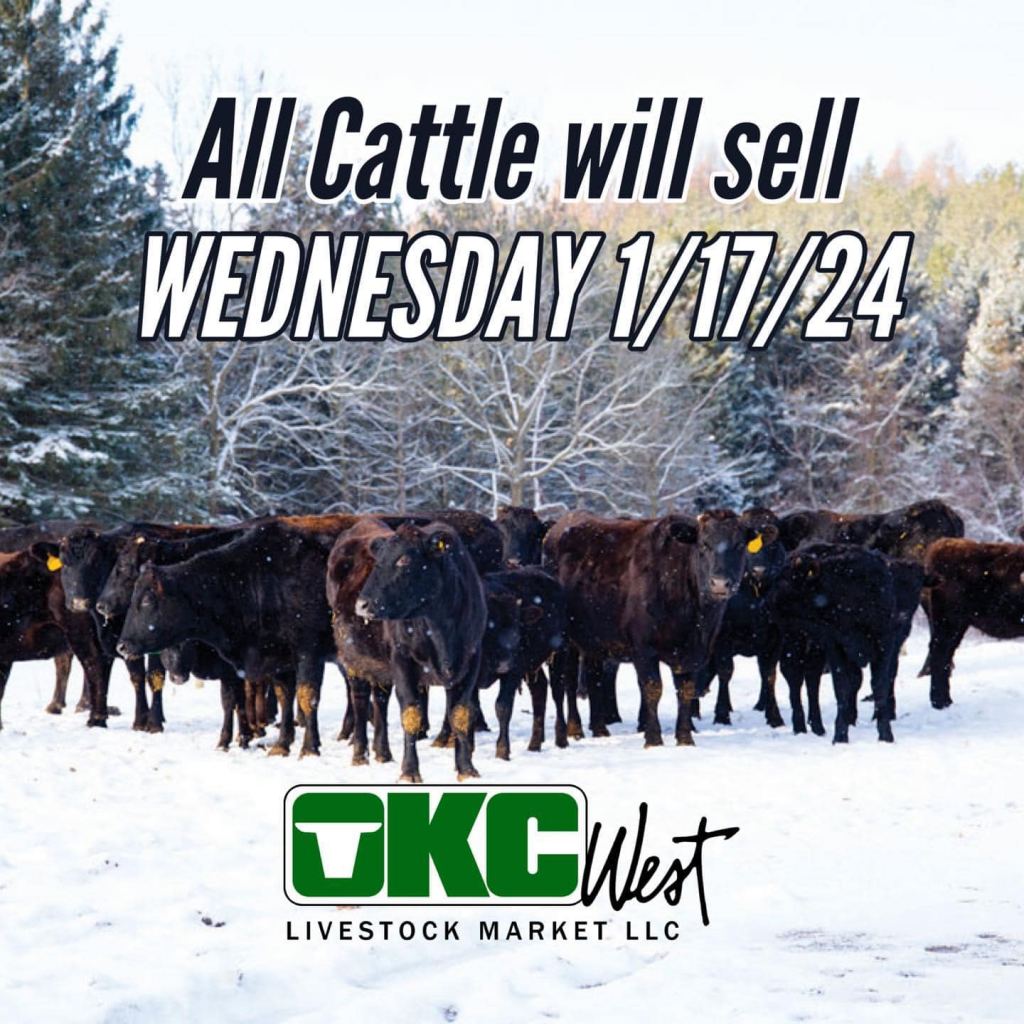
After considering the forecast for the upcoming days and the dangerous temperatures approaching, there will be no sales on Monday at ONSY, Joplin, or Tulsa as everyone prepares for the cold temps and winter weather. Also OKC West will not sell cattle on Monday or Tuesday but will have a single day where all cattle sell Wednesday the 17th. Everyone say safe and warm!
It is recommended that producers contact their local sale barn or sale of choice with any questions regarding next week's sales or the weather.
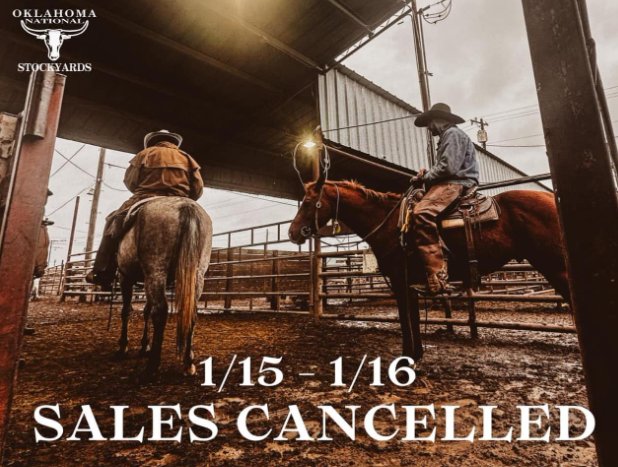
On January 12, 2024, USDA NASS released the Annual Crop Production Summary for 2023. To view the full report, CLICK HERE.
U.S. Crop Production 2023 Summary:
Corn for grain production in 2023 was estimated at a record high 15.3 billion bushels, up 12 percent from the 2022 estimate. The average yield in the United States was estimated at a record high 177.3 bushels per acre, 3.9 bushels above the 2022 yield of 173.4 bushels per acre. Area harvested for grain was estimated at 86.5 million acres, up 10 percent from the 2022 estimate.
Sorghum grain production in 2023 was estimated at 318 million bushels, up 69 percent from the 2022 total. Planted area for 2023 was estimated at 7.20 million acres, up 14 percent from the previous year. Area harvested for grain, at 6.12 million acres, up 34 percent from 2022. Grain yield was estimated at 52.0 bushels per acre, up 10.9 bushels from 2022.
Soybean production in 2023 totaled 4.16 billion bushels, down 2 percent from 2022. The average yield per acre was estimated at 50.6 bushels, up 1.0 bushel from 2022. Harvested area, at 82.4 million acres, was down 4 percent from last year.
All cotton production is estimated at 12.4 million 480-pound bales, down 14 percent from 2022. The United States yield is estimated at 845 pounds per acre, down 108 pounds from last year. Harvested area, at 7.06 million acres, is down 3 percent from last year.
Oklahoma Crop Production 2023 Summary:
Winter wheat production in 2023 was estimated at 68.6 million bushels, even with last year's production. The average yield per acre for winter wheat in Oklahoma is estimated to be 28 bushels per acre, the same as 2022. The estimated area harvested for grain is at 2.45 million acres, also unchanged from 2022.
Corn for grain production in 2023 was estimated at 50.6 million bushels, up 108 percent from the 2022 estimate. The average yield for corn in Oklahoma was estimated at 149 bushels, up 27 bushels per acre from the 2022 yield of 122 bushels per acre. Area harvested for grain was estimated at 340,000 acres, up 70 percent from the 2022 estimate.
Sorghum grain production in 2023 was estimated at 16.5 billion bushels, up 186 percent from the 2022 total. Planted area for 2023 was estimated at 410,000 acres, down 5 percent from the previous year. Area harvested for grain was estimated at 350,000 acres, up 46 percent from 2022. Grain yield was estimated at 47 bushels per acre, up 23 bushels from 2022.
Soybean production in 2023 totaled 10.6 million bushels, up 65 percent from 2022. The average yield per acre was estimated at 26 bushels per acre, up 9 bushels per acre from 2022. Harvested area, at 410,000 acres, was up 8 percent from last year.
Cotton production is estimated at 310,000 acres, up 2 percent from 2022. The yield is estimated at 783 pounds per acre, up 18 percent from 2022. Harvested area, at 190,000 bales, is down 14 percent from 2022.
| |||||||||||||||||||||||||||||||||||||||||||||||||||||||||||||||||||||||||||||||||||||||||||||||||||||||||||||||||||||||||||||||||||||||||||||||||||||||||||||||||||||||||||||||||||||||||||||||||||||||||||||||||||||||||||||||||||||||||||||
|
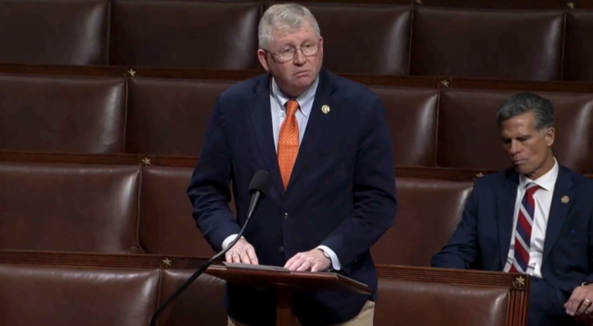
Today, Congressman Frank Lucas's (OK-03) Pressure Regulatory Organizations To End Chinese Threats to Taiwan Act, or the PROTECT Taiwan Act, passed on the House floor.
Currently, under the Taiwan Relations Act, the President is required to notify Congress if China poses an immediate threat to Taiwan's security. If this notification is triggered, H.R. 803 states that it is U.S. policy to exclude Chinese representatives from key international organizations – such as the G20, the Financial Stability Board, and the Basel Committee on Banking Supervision.
"Even in today's partisan gridlock, one thing we can all agree on is that the Chinese Communist Party poses the greatest economic, political, and national security threat to the United States. While the world watched Russia's rogue invasion on Ukraine in horror, it is our responsibility to ensure China does not attempt to emulate such blatant aggression on Taiwan," said Congressman Lucas. "That's why Congress must take the necessary steps to ensure Beijing would be subject to significant financial and economic consequences should it threaten our allies in Taiwan. The PROTECT Taiwan Act will do exactly that." Congressman Lucas spoke on the House floor on Wednesday in support of the PROTECT Taiwan Act, which you can watch by clicking here or on the image below.
BACKGROUND:
Congressman Tom Cole (OK-04) released the statement below following passage of H.J. Res. 98 in the U.S. House of Representatives. The resolution would address the National Labor Relations Board's (NLRB) effort to redefine the joint employer rule. If allowed to take effect, the rule will upend the franchise business model that has empowered entrepreneurship and job creation in the United States.
"If implemented, this rule would make operational costs skyrocket and will eliminate countless small businesses and job opportunities nationwide," said Cole. "We know what the consequences would be as a similar rule was put in place under the Obama Administration and had far-reaching disruptions across the economy, particularly for businesses using the franchise model. The American Dream is already slipping from the reach of so many over the last three years, and the last thing people need is another radical policy upending their livelihoods."

Today, the GROWMARK and CHSBoards of Directors are pleased to announce that they have jointly agreed to conduct an exploratory process over the coming months to identify opportunities for the two cooperatives to further collaborate to better serve owners, customers and the cooperative system into the future.
The two farmer-owned cooperatives have had a long-standing relationship. Teams from GROWMARK and CHS have collaborated on strategic projects in ways that benefit their farmer-owners, cooperative-owners and customers.
CHS and GROWMARKare currently collaborating to improve agriculture, invest in technology and bring new solutions to customers. In 2021, the two cooperatives formed Cooperative Ventures, a venture capital fund focused on supporting advancements in breakthrough technologies for the agriculture industry.
"Continuing our long history of adding value?to our members and customers, while ensuring a strong and vibrant cooperative system for the future, is critical to the GROWMARK System," said GROWMARK CEO Mark Orr. "Our partnership with CHS in Cooperative Ventures is a great example of cooperation amongst cooperatives that benefits the shareholders of both companies."
"We believe that by working together we can better serve our farmer- and cooperative-owners. Ultimately, we aim to better meet customer demand for our owners' products around the world and increase the value of the cooperative system," said Jay Debertin, president and CEO of CHS.
While the outcome of the exploratory process is not yet known, both GROWMARK and CHS anticipate emerging with an even stronger relationship focused on improving customer outcomes and strengthening agriculture for farmer- and cooperative-owners
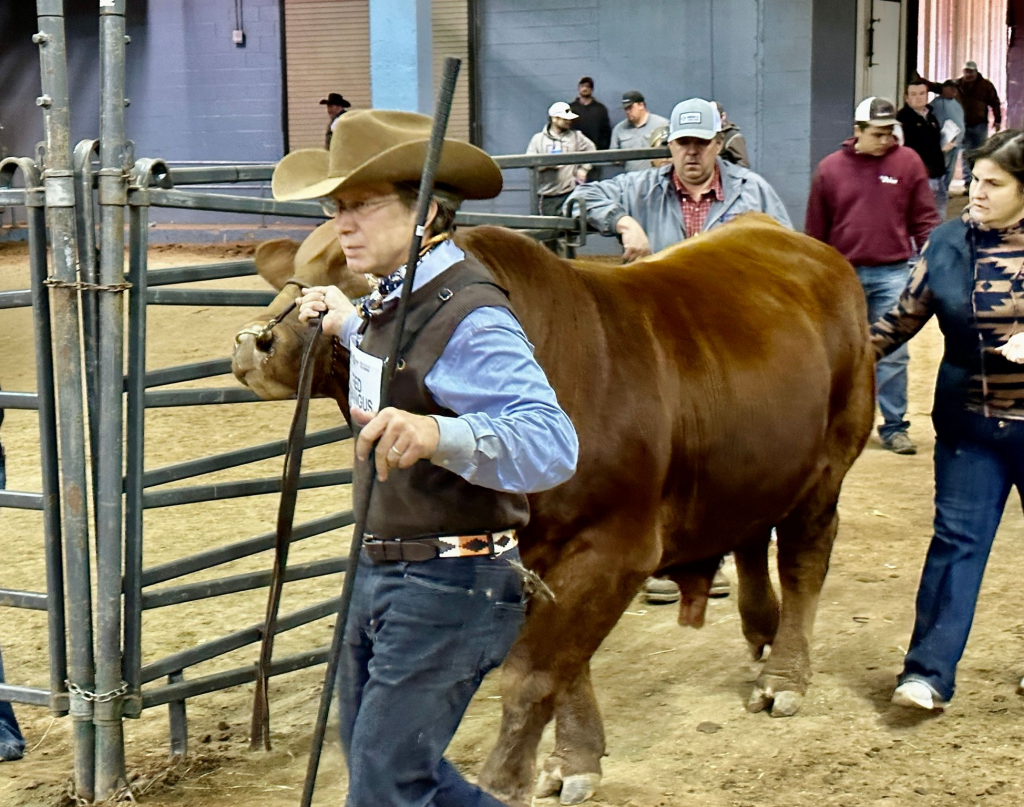
Senior Farm and Ranch Broadcaster Ron Hays is back talking with Brangus breeder and former president of the International Brangus Breed Association, Allen Goode.
Today's Brangus, Goode said, is all about maximizing genetic potential.
"The industry today is really about what is under the hide, and being able to measure that, tell the story about that, what that means to the commercial man and what it means to dollars in your pocket at the end of the business cycle," Goode said.
The IBBA has launched the Brangus Value Project, which is a controlled test of sets of Brangus-sired calves out of commercial herds.
"There is always at least two Brangus sires, or an Angus-reference sire," Goode said. "Those calves go to a feedlot for full testing and for packing. The data we have been able to obtain from that has really proven the carcass merit of the Brangus cattle and how much emphasis our breeders across the entire spectrum of the breed have placed on doing that."
Goode said many producers chose to add Brangus genetics into their cow herds because of the adaptability of the breed in hotter conditions.
"(They) add that extra thriftiness and heartiness to get through the warm months, but they can still survive the cold and do that with a high-quality end product," Goode said.
IBBA strives to become a leader worldwide, Goode said, as the Brangus breed can be seen across the globe. Good added that U.S.-produced Brangus bulls are in high demand around the world.
"It is still about what is under the hide," Good said. "If we can share that genetic merit data, the carcass quality, it is giving Brangus a strong leap up in the global beef market."
The Beef Buzz is a regular feature heard on radio stations around the region on the Radio Oklahoma Ag Network and is a regular audio feature found on this website as well. Click on the LISTEN BAR for today's show and check out our archives for older Beef Buzz shows covering the gamut of the beef cattle industry today.
Farm Director KC Sheperd is back talking with Bob Rodenberger, a partner with Stockman Oklahoma Livestock, as he gives the latest on the cattle markets.
"Monday, we had a little over 14,000," Rodenberger said. "The market was good; a little sluggish. A lot of it was due to the weather up north of us. People were hesitant to be very aggressive, but the calf market- the grazing calf market- is still awful good."
In general, Rodenberger said the market is still good compared to what it was a year ago.
Regarding the cold weather coming in next week, Rodenberger said he expects that runs may be lighter.
"If they are coming from a distance, everybody is on a 'wait and see' attitude, to see what develops through this afternoon and into tomorrow," Rodenberger said.
Rodenberger advises producers who are planning on sending cattle to Oklahoma City next week to call and check in on the weather and the market first.
"Hopefully we will be cleaned up by this time next week and back on course," Rodenberger said.

Attorney General Gentner Drummond announced today that his office will be monitoring natural gas supply and marketing activity during the frigid weather expected over the next few days. With bone-chilling temperatures in the forecast, Drummond said he wants to ensure Oklahomans are not exploited as they were during Winter Storm Uri.
"I am committed to protecting ratepayers from price manipulation to ensure fair costs that reflect market conditions," Drummond said. "I understand the natural volatility of energy prices during inclement weather. My office will be closely monitoring the situation and any suspicious activity will be investigated promptly. I will not permit unscrupulous actors to exploit Oklahoma on my watch."
Drummond is asking public utilities to notify his office if natural gas marketers fail to meet their obligations as specified by contract.
Drummond announced last year possible legal action against various entities he believes were responsible for soaring natural gas prices during Winter Storm Uri in 2021. An investigation into activity during the Uri storm is active.
The U.S. Department of Agriculture (USDA) will begin accepting applications for the Continuous Conservation Reserve Program (Continuous CRP) signup on Jan. 12, 2024. USDA's Farm Service Agency (FSA) encourages agricultural producers and landowners interested in conservation opportunities for their land in exchange for yearly rental payments to consider the enrollment options available through Continuous CRP, which also includes the Conservation Reserve Enhancement Program (CREP) offered by FSA partners. Additionally, producers participating in CRP can apply to re-enroll beginning Jan. 12, 2024 if their contracts will expire this year.
"We are pleased to announce we are now accepting Continuous CRP offers," said FSA Administrator Zach Ducheneaux. "Continuous CRP is one of the best conservation tools we can provide producers and landowners. Whether a producer wants to focus on water quality benefits or work with one of our partners to address a natural resource concern in their area, the program offers many options to help you meet your resource conservation goals."
On Nov. 16, 2023, President Biden signed into law H.R. 6363, the Further Continuing Appropriations and Other Extensions Act, 2024 (Pub. L. 118-22), which extended the Agriculture Improvement Act of 2018 (Pub. L. 115-334), more commonly known as the 2018 Farm Bill, through Sept. 30, 2024. This extension allows authorized programs, including CRP, to continue operating.
To submit an offer, producers should contact the FSA at their local USDA Service Center by July 31, 2024, in order to have an offer effective by Oct. 1, 2024. To ensure enrollment acreages do not exceed the statutory cap, FSA will accept offers from producers on a first-come, first-served basis and will return offers for approval in batches throughout the year.
Additionally, producers with acres enrolled in Continuous CRP set to expire Sept. 30, 2024, can offer acres for re-enrollment beginning Jan.12, 2024. A producer can both enroll new acres into Continuous CRP and re-enroll any acres expiring Sept.30, 2024.
FSA water quality practices, such as riparian buffers, prairie strips, grassed waterways, and wetlands, will receive an additional 20% incentive. Buffer practices have a positive impact on water quality. Additionally, the Climate-Smart Practice Incentive launched in 2021 is also available in the Continuous signup.
There are several enrollment options within Continuous CRP, including:
More Information
The water quality practice incentive builds on other improvements to Continuous CRP that were made in 2021, including expanding CLEAR30 from two pilot areas to nationwide availability and repositioning SAFE within Continuous CRP to give producers and landowners more opportunities to participate. Additionally, FSA has improved CREP by creating flexibilities within CREP for partners to provide matching funds in the form of cash, in-kind contributions, or technical assistance, adding staff to work directly with partners, and expanding opportunities for Tribal Nations to participate, beginning with three Tribal Nations in the Great Plains, the Cheyenne River, Oglala, and Rosebud Sioux Tribes, for the first time ever, to help conserve, maintain, and improve grassland productivity while reducing soil erosion and enhancing wildlife habitat.
Signed into law in 1985, CRP is one of the largest voluntary private-lands conservation programs in the United States. It was originally intended to primarily control soil erosion and potentially stabilize commodity prices by taking marginal lands out of production. The program has evolved over the years, providing many conservation and economic benefits.
USDA touches the lives of all Americans each day in so many positive ways. Under the Biden-Harris administration, USDA is transforming America's food system with a greater focus on more resilient local and regional food production, fairer markets for all producers, ensuring access to safe, healthy and nutritious food in all communities, building new markets and streams of income for farmers and producers using climate smart food and forestry practices, making historic investments in infrastructure and clean energy capabilities in rural America, and committing to equity across the Department by removing systemic barriers and building a workforce more representative of America. To learn more, visit www.usda.gov.
USDA is an equal opportunity provider, employer and lender.
USDA's Foreign Agricultural Service this week announced it will award more than $203 million to nearly 70 agricultural organizations to help expand export markets for U.S. food and agricultural products through the Market Access Program and Foreign Market Development program.
Through MAP, FAS will provide $174.3 million for fiscal year 2024 to 68 nonprofit organizations and cooperatives. Organizations use the funds on consumer promotion, including brand promotion for small companies and cooperatives. These dollars are used extensively by organizations promoting fruits, vegetables, nuts, processed products and bulk and intermediate commodities. According to FAS, the average MAP participant provides more than $2.50 in contributions for every $1 in federal funding it receives through the program.
FAS will allocate $27 million for fiscal year 2024 under the FMD program to 20 trade organizations. FAS focuses on generic promotion of U.S. commodities rather than consumer-oriented promotion of branded products. Preference is given to organizations that represent an entire industry or are nationwide in membership and scope. According to FAS, organizations that contribute on average more than $2.50 for every $1 in federal funding they receive through the program will conduct activities that help maintain or increase demand for U.S. agricultural commodities overseas.
As the cooperator of record for the U.S. Soybean Export Council, ASA is receiving $5.6 million in MAP funding and $7.4 million in FMD.
Why it matters: MAP and FMD are vital to U.S. soybean farmers, as they provide opportunities to develop new markets and grow demand for U.S. products in foreign markets. Utilizing MAP and FMD funds, ASA—through WISHH and USSEC—has leveraged those dollars to increase market access, address technical barriers to entry and create on-the-ground capacity and demand for U.S. soy. One of ASA's top priorities for a new farm bill is expanding trade promotion programs to help grow and diversify agricultural markets as tensions continue with U.S. agriculture's largest export market—China. Support is also important for proposals that ensure in-kind food aid remains the foundation of international food assistance programs
Today, a group of veterinarians announced the formation of a new nonprofit organization called, The Veterinary Association for Farm Animal Welfare (VAFAW). VAFAW is the only veterinary association in the United States devoted solely to improving the welfare of farm animals. The association was formed out of a need for increased veterinary leadership, education, and advocacy focused on the welfare of animals used in food and fiber production systems. Members of VAFAW will provide a veterinary perspective grounded in animal welfare and ethics to advance policies and practices that improve the lives of farm animals.
Through education, policy development, advocacy, and collaborative animal care, VAFAW seeks to:
Gwendolen Reyes-Illg, DVM, MA, Chair of the VAFAW Board of Directors and Director of Policy Development, said, "Veterinarians are known for their compassion, scientific understanding, and pragmatism; VAFAW seeks to leverage this unique constellation of professional attributes to speed up the pace of progress when it comes to improving farm animal welfare."
As a diverse group of veterinarians, VAFAW wants to see animal welfare research informing animal agricultural policy and practices through legislation, regulations, industry standards, and corporate protocols. The initial focus of the association will be on: (1) preventing and mitigating pain experienced by farm animals; (2) encouraging living environments that meet the animals' physical and psychological needs; and (3) ensuring humane end-of-life practices. From livestock barns to the halls of Congress and veterinary schools to slaughterhouses, members of VAFAW will use their veterinary voice and expertise to meaningfully improve farm animal welfare.
VAFAW organizational leaders are available to provide a veterinary perspective on farm animal welfare issues to the media. VAFAW membership is open to veterinarians, veterinary students, and members of the public who are supportive of the mission.
For more information about VAFAW, to make a donation, and to become a member, visit www.VAFAW.org.
New Oklahoma State University Agricultural Sciences & Natural Resources Vice President and Dean Dr. Jayson Lusk will lead off the Friday afternoon seminars at 1 p.m. at AgriFest at the Chisholm Trail Expo Center. The new National Sorghum Producers Executive Director Greg Ruehle will also speak to area farmers at the meeting and answer questions.
Sorghum growers, farmers interested in planting sorghum, and any other area agriculturists are welcome at the program scheduled for 1 p.m. to 3 p.m. in the seminar room in the northeast corner of the Expo Center.
Steve Carson, field representative and ag policy advisor to U.S. Senator James Lankford will also update attendees on the new federal Farm Bill Congress is drafting as well as other national issues. OSU Associate Professor and Cropping Systems Specialist Dr. Josh Lofton will share findings from the university's sorghum variety trials at test plots around the state last year and will talk with producers about raising sorghum in Oklahoma.
Sorghum is an ancient, nutrient-rich grain which can be grown as a grain, forage or sweet crop. It is one of the top five cereal crops in the world. The United States is the world's largest producer of grain sorghum, having produced 373 million bushels in 2020, with more than 300,000 acres planted in Oklahoma. For more information, visit Oklahoma Sorghum Producers Association at www.oklahomaag.com or National Sorghum Producers at www.sorghumgrowers.com
RON's Dave Lanning has a pre-opening look at today's agricultural Markets.
Click the audio tab below for today's report.
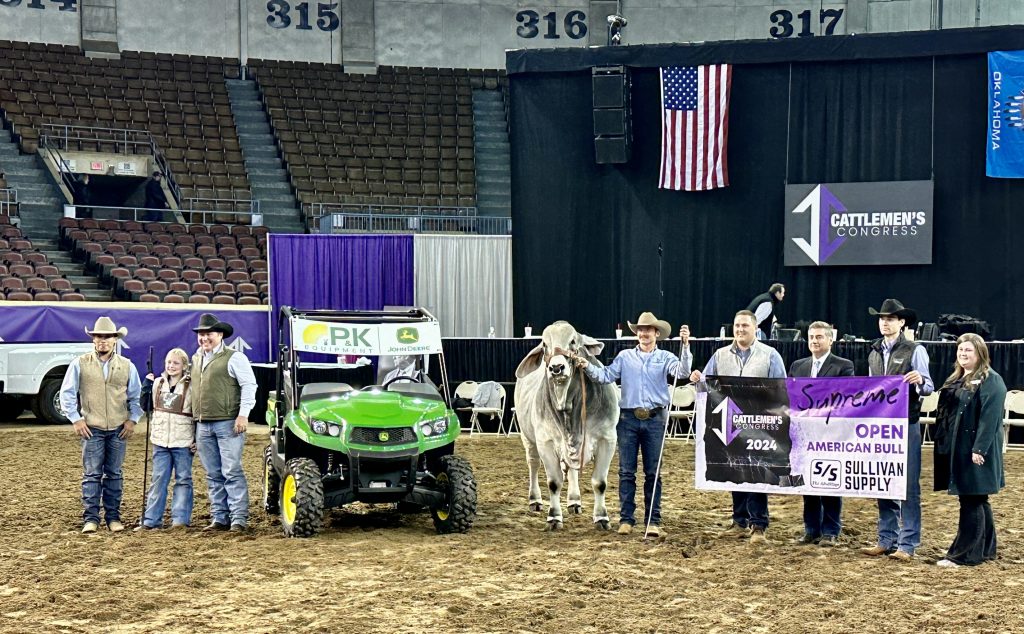
Supreme Open American Bull for 2024 Cattlemen's Congress
The grand finale at Cattlemens Congress was the American breeds Supreme Drive
Supreme Open Bull was the Gray Brahman BRC Money Don't Jiggle 240 owned by B.R. Cutrer of Wharton, Texas. The Reserve Supreme American Bull was the Black Brangus champion owned by Burns Brangus of Wharton, Texas. The third best American Bull in the drive was the Simbrah Champion- owned by Hagan Cattle of Yoakum, Texas.
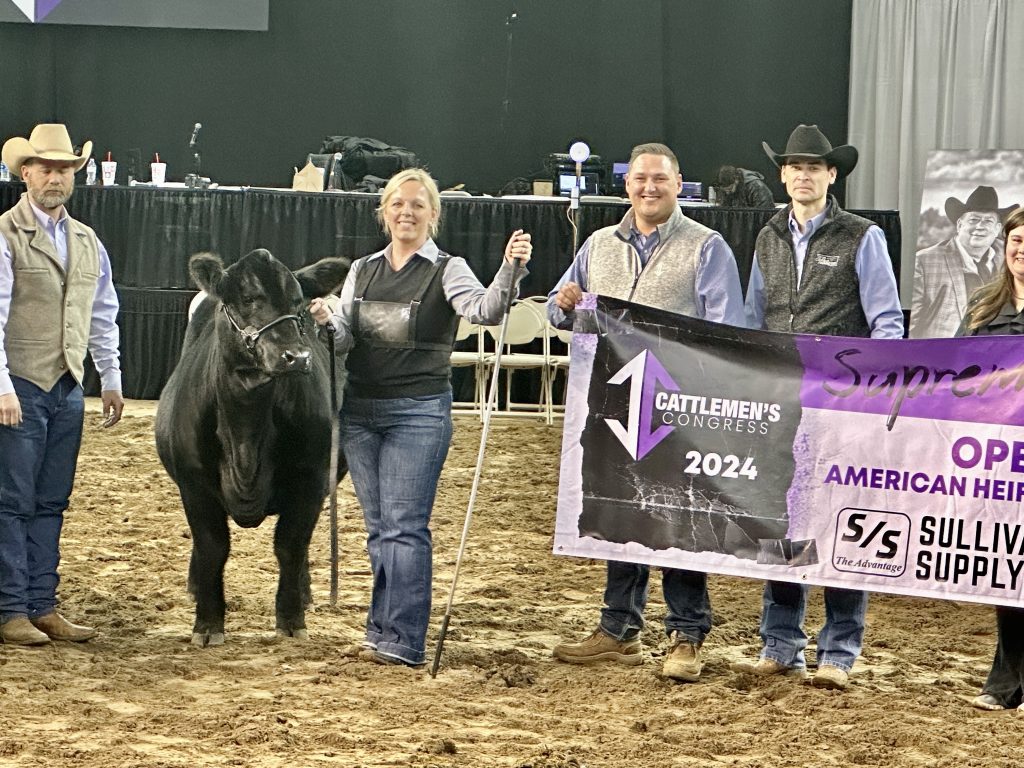
Supreme American Open Female was the Ultra-Brangus Champion- MC Bada Boom 628K8- shown by Traci Middleton of Puryear, Tennessee. The Reserve Supreme Open American Female was the Grey Brahman owned by B.R. Cutrer, Inc of Wharton, Texas. The third open female in the American Drive was the Simbrah shown by Jakob Sansom of Brenham, Texas.
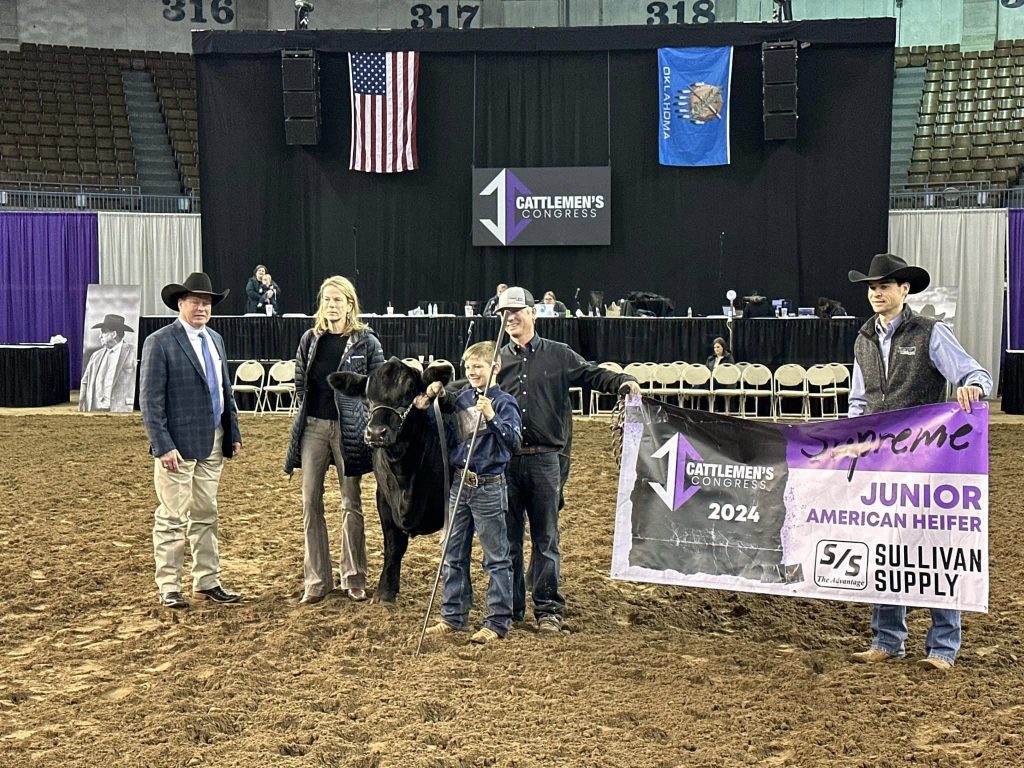
And the Supreme American Junior Female was the Champion Simbrah- LMC/JSSC Augusta 230K- owned and shown by Nolan Seale of San Augustine, Texas. The Reserve Supreme American Junior Female was the Grey Brahman Champion owned by Mollie Cutrer of Wharton, Texas while the third Junior Female selected on Thursday was the Black Brangus Champion- shown by Roxton Stone of Stanton, Texas.
With the selection of the American Supreme Champions- the 2024 Cattlemen's Congress- which began with the Texas Longhorns shown on December 30th and 31st- officially concluded. Tyler Norvell, who has been named the Board Chairman for Cattlemen's Congress, called the 2024 event the best one yet and told Oklahoma Farm Report that the dates for the 2025 Cattlemen's Congress will be January 4th through the 16th.
This Week on SUNUP is Oklahoma State University Extension grain market economist Kim Anderson. During this week's edition, Anderson discusses the price movements in the markets and more.
"Prices are starting to settle down a little bit," Anderson said. "We had some sales at the beginning of the year, and there will be a few more coming in that might impact the prices."
Wheat prices in Oklahoma now are around $5.75, Anderson said, and wheat can be forward contracted for $5.80 in northern Oklahoma, and about 30 cents less in southern Oklahoma. In the panhandle, Anderson said wheat can be forward contracted for about $5.85.
"Our next harvest coming up in the world will be India, Pakistan, and North Africa, but none of those countries export," Anderson said. "The good news is, the U.S. winter wheat crop is the next crop to hit the export (market), so the market is going to watch that crop. They are going to look at the planted acres and they are going to look at crop conditions."
Looking at corn prices, Anderson said they have bottomed out around $4.40.
"You can look at the forward contract for corn for 2024 delivery around $4.70," Anderson said. "That is close to that average price for the corn harvest time period."
Anderson also talked about fertilizer prices for winter wheat and said they have come down 20 to 30 percent from last year.
This week on SUNUP:
Watch SUNUP:
Saturday at 7:30 a.m. & Sunday at 6 a.m. on OETA (PBS)
YouTube.com/SUNUPtv
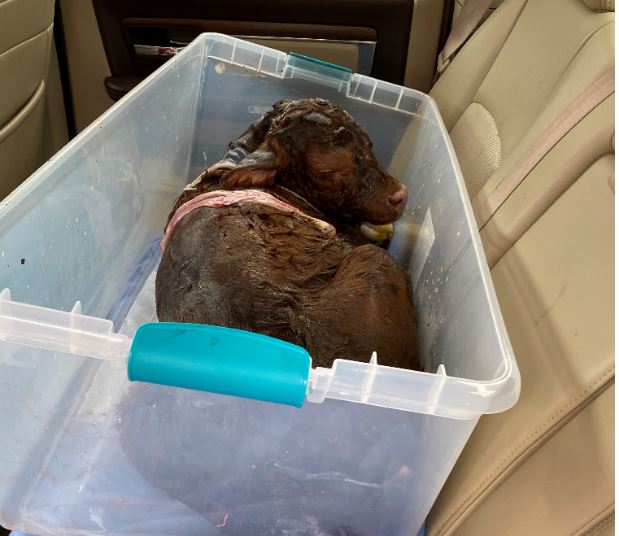
When the weather becomes severe, calving becomes much more challenging. Although, both hot and cold weather can impact a calf's ability to thermoregulate. Calves who are born in extremely cold temperatures quickly utilize all body fat reserves, putting them at risk. Exposure to wind can exacerbate cold temperatures. Preparing in advance of inclement weather can lead to improved calf survival.
Remember to discuss your calving plan with your veterinarian and communicate well before there is a calving issue. Your veterinarian can work with you and your team to develop protocols so everyone is on the same page when a problem occurs. Your veterinarian can also help you develop essentials for a calving kit.
Items to consider in your calving kit may include:
Assess body temperature if a calf appears stressed. The best way to monitor a calf's temperature is with a rectal thermometer. Inexpensive digital thermometers work well and make it easy to evaluate progress when rewarming a calf.
If a calf's temperature falls below 100 degrees F, interventions are needed to gradually raise its temperature. Bring the calf indoors and out of the elements if needed. Bedding can be provided and should be deep enough to cover the calf's legs. Empty plastic soda bottles can be filled with hot water and placed near the calf. Bottles can be refilled and changed as needed to provide heat. When used appropriately, warm water baths, blankets, calf jackets, and warming boxes are all options to rewarm a calf.
Be careful not to damage the skin of the calf by either rubbing too vigorously or placing them too close to heaters. Additionally, do not to wash off the odor of amniotic fluid. This helps prevent rejection by the cow. Warm oral or intravenous fluids as advised by a veterinarian can also make a big difference but should be used with caution in calves without a suckle reflex due to the increased risk of aspiration pneumonia. Once a calf is warm and has been fed colostrum, return it to its mother. Colostrum should be received within the first 6 hours of life; the sooner the better.
Working with your veterinarian to develop protocols before calving season can reduce stress and lead to more successful outcomes if an emergency arises. Your veterinarian can guide and train you and your team on how and when to call for assistance.

Rep. Frank Lucas of Oklahoma is the recipient of the American Farm Bureau Federation's 2024 Distinguished Service Award.
Lucas will be recognized during the upcoming 2024 American Farm Bureau Convention, Jan. 19-24, held in Salt Lake City, Utah. The award is among the highest honors presented by AFBF.
Lucas is a fifth-generation Oklahoman and farmer who has been a defender of agriculture for more than 40 years. With a bachelor's degree in agricultural economics from Oklahoma State University, he successfully brought the perspective of the American farmer with him to Capitol Hill.
Elected to Congress in 1994, he is recognized as the longest-serving member on the House Agriculture Committee and served as chairman of the committee from 2011 to 2015, playing an instrumental role in the 2014 farm bill. Prior to serving in Congress, Lucas served in the Oklahoma State House of Representatives where he focused on prominent agriculture issues.
Lucas commended AFBF for the important role the organization plays in informing farmers about congressional happenings and making sure they can voice their opinions and needs. A lifelong Farm Bureau member, Lucas shared what receiving this award means to him.
"It's like having your family say you've done a really good job for them," Lucas said. "There's nothing more important than having your family acknowledge that your hard work has been for a purpose and accomplished things. I appreciate my Farm Bureau family acknowledging my 29 years of constantly working on their behalf. It's very kind of them."
Oklahoma Farm Bureau President Rodd Moesel shared the value Lucas' background brings to Capitol Hill, noting not many in his role go home on the weekends to complete a list of farm chores and move cattle.
"He's so rare because he is a real farmer and rancher," Moesel said. "There are very few of those left in Congress. He really understands our issues and is able to take those messages to Congress."
Lucas was nominated by the Oklahoma Farm Bureau for the DSA, and a national Farm Bureau committee selected Lucas as the recipient. AFBF established the Distinguished Service Award in 1928 to honor individuals who

Company's Clinton and Wilson, North Carolina, facilities also recognized for environmental leadershipand commitment to exemplary environmental performance beyond regulatory requirements.
The North Carolina Department of Environmental Quality recognized Smithfield Foods' Tar Heel, North Carolina, pork-processing facility as a Rising Environmental Steward for its continuing commitment to exceeding compliance with environmental regulations and maintaining a high standard of environmental excellence.
"Smithfield has prioritized environmental stewardship and transparent reporting for more than two decades," said Stewart Leeth, chief sustainability officer for Smithfield Foods. "This recognition from NCDEQ reflects the strength of our environmental programs in North Carolina and our commitment to enhancing and protecting the state's natural resources above and beyond what is required by law."
NCDEQ's Environmental Stewardship Initiative recognizes and supports companies and facilities that go above and beyond to reduce their impact on the environment. The Rising Environmental Steward designation is for organizations that have a mature environmental management system and measurable environmental performance goals.
Smithfield's Tar Heel facility has been recognized as an environmental leader under the Environmental Stewardship Initiative for the past 21 years and became a Rising Steward in 2005. The facility's wastewater treatment system produces renewable natural gas that provides power to the processing plant and more than 2,000 local homes and businesses. Tar Heel's reuse and reclaimed water systems send approximately 1 million gallons of water per day back to the refrigeration system and outdoor washdown hoses to significantly decrease the facility's use of potable water.
Smithfield's Clinton, North Carolina, facility has been recognized for environmental performance under the program since 2004 and is also a Rising Environmental Steward. Smithfield's facility in Wilson, North Carolina, has been recognized since 2005 and has been named a Steward, NCDEQ's elite designation for organizations displaying a commitment to exemplary environmental performance beyond what is required by law.
Smithfield was the first U.S. agriculture livestock company to achieve ISO 14001 certification for its environmental management system, in 2001. The company was also the first in its industry to announce an absolute greenhouse gas emission-reduction goal and first to commit to becoming carbon negative in all U.S. company-owned operations by 2030.
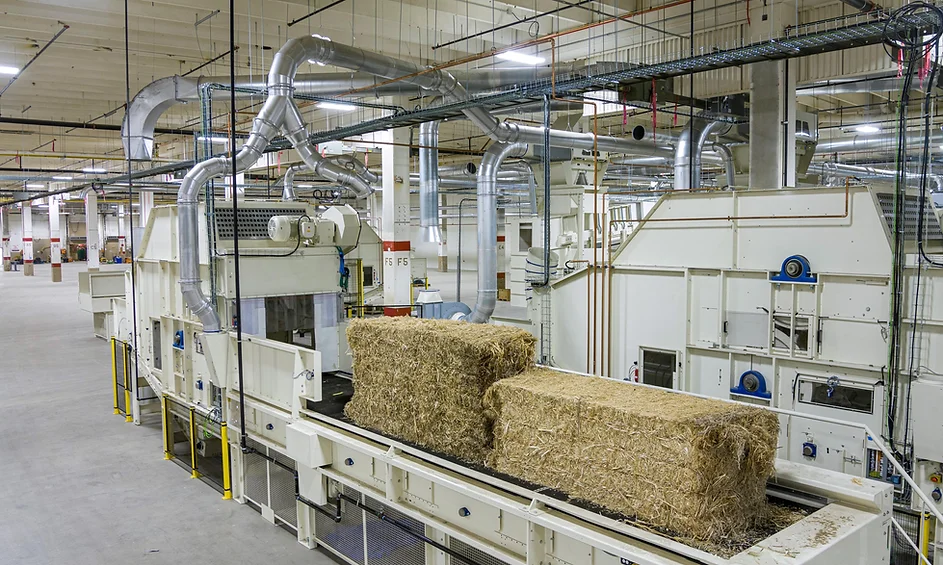
Senior Farm and Ranch Broadcaster, Ron Hays, is visiting with the Executive Vice President of Panda BioTech, Scott Evans. BioTech is working with producers to grow a particular variety of industrial hemp which is then processed at the Panda High Plains Hemp Gin in Wichita Falls, Texas.
"Panda BioTech is developing a large industrial-scale help processing center where we process industrial hemp," Evans said.
In a process called decortication, Evans said the green outer part of the hemp stem, called the bast fiber, is separated from the rest of the plant. Once the outer bast is separated from the plant, Evans said the inner woody core of the stem, called the hurd of the plant, will remain.
Evans said the bast fiber is similar to short-staple cotton but it has a few different properties.
"It is a very strong fiber and antimicrobial, and the list goes on," Evans said.
After the decortication process at Panda BioTech, Evans said the fiber produced is sold downstream to other manufacturers for use in various applications.
"It is a great crop; it remediates soil, it is low input, doesn't use a lot of water, it is a tap root crop, it will go down there, break down the soil, and look for water," Evans said.
Evans said for hemp to be utilized at Panda BioTech, it is grown for 90 days before it is cut. This way, a flower or seed head does not have the chance to form.
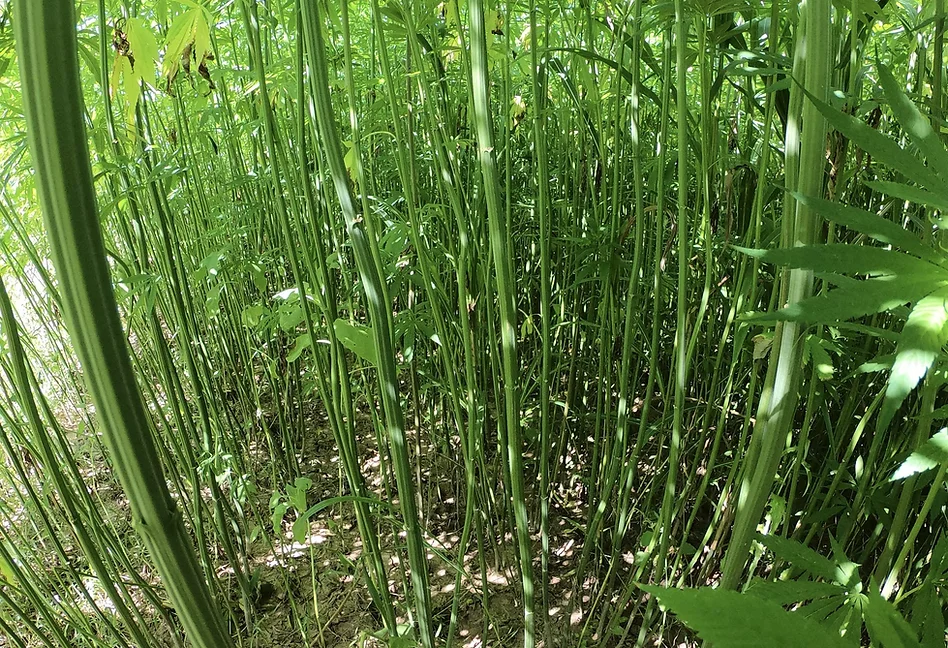
"It looks just like a bale of straw going down the road," Evans said. "We receive round bales and square bales, and to the untrained eye, you really can't tell the difference between this and silage."
The primary target of Panda BioTech is the textile market, Evans said, where hemp is cleaned to mimic short staple cotton. It is then sent to a spinning mill, and depending on the fabric, a percentage of cotton will be blended into the hemp.
"We will make denim, khaki, twill, or whatever the brands are looking for," Evans said.
There is also plenty of use for hemp in the non-woven industry for things such as installation, sound-dampening materials, trunk lids, door panels, and more.
"It is just another fiber that manufacturers can use," Evans said. "Textiles are our target market with the bast fiber. The hurd is about 50 to 55 percent of the plant, and that is used for high-end horse or chicken bedding, as well as hempcrete, which is a non-structural concrete substitute that is gaining popularity in the construction industry."
Because hemp is one of the strongest fibers on Earth, Evans said when it is blended with cotton, the final product results in more durability and more strength. Evans said this means a pair of jeans or any type of clothing may last an extra year or two if it is made with hemp.
"The main benefit is the strength of the fiber, and we blend it with cotton because cotton has that buttery-soft feel," Evans said. "With cotton and hemp blended together, we get the great hand feel, and we also get some strength and antimicrobial and UV resistance. It just makes a more durable fabric than cotton alone."
Over the past four to five years, Evans said Panda BioTech has worked with Texas A&M Agrilife to trial varieties from all over the world.
"We have narrowed in on the variety that works best for our latitude and our region, as well as our process," Evans said. "That is a big part of what we did, and then we have rolled out a new 'pay to grow' program, that essentially de-risks this for the farmer."
While some farmers may be hesitant about trying a new crop, Evans said Panda BioTech will provide the verified seed they source at no cost. The farmer is also guaranteed payments after planting and harvesting, and then the farmer is paid at a per-pound rate for the biomass on the back end.
"We have stepped in to essentially act as their crop insurance so they can experiment with this crop, see what it does, and not have the fear of losing out on revenue from wheat, or whatever they would normally grow in their rotation," Evans said. "There are a lot of benefits for their soil, as well as economic benefits to this."
In Oklahoma, Evans said the hemp crop will be planted in early April or late March, depending on the part of the state. Evans said this plant offers the chance to rotate other crops afterward.
"All in, it is about a four-month growing cycle, and they can follow that up with winter wheat or whatever else they want to grow," Evans said.
Hemp is a soil remediator, Evans said, so if farmers add hemp to their crop rotations, it will clean up their soil and put nitrogen back into the soil.
"Whatever they follow that hemp crop up with should have better yields," Evans said.
For more information, producers can visit https://www.pandabiotech.com/. Producers can also utilize the grower inquiry tab for specific questions.
| ||||||||||||||||||||||||||||||||||||||||||||||||||||||||||||||||||||||||||||||||||||||||||||||||||||||||||||||||||||||||||||||||||||||||||||||||||||||||||||||||||||||||||||||||||||||||||||||||||||||||||||||||||||||||
|

As the geopolitical conflict between Russia and Ukraine comes back into focus following the attacks on port infrastructure in the Ukrainian Black Sea ports of Odesa, Chornomorsk, and the terminals along the Danube River, wheat market volatility remains an ever-present risk.
Despite the recent swings, export basis trends can help provide clues to potential buying opportunities for U.S. wheat classes. In recent months, we have seen Pacific Northwest (PNW) hard red spring wheat (HRS) export basis erode from $1.75 per bushel ($64.30 per metric ton) in November 2022 to $0.80 ($29.40) in July 2023. Considering the recent drifts, this article will investigate the PNW HRS basis trend and provide additional context around the weakening basis.
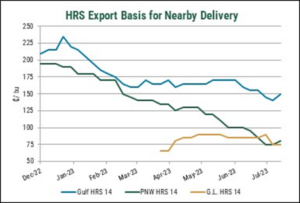
PNW HRS basis has drifted down since the start of 2023, recently hitting lows not seen since 2007, hovering 90 cents below last year's level. Below average basis poses a unique opportunity for those interested in purchasing PNW HRS. Source: U.S. Wheat Associates Price Report.
Otherwise known as the difference between the free on board (FOB) cash price and the futures price, export basis encompasses transportation costs, storage, and supply and demand at the regional level (e.g., farmer sales, local demand), and can fluctuate based on seasonality. In the pre-harvest months, basis generally weakens as the market looks to the influx of new crop stocks. Though a weaker basis is common for this period, unique to this year, the pace of farmer selling has remained slow. Throughout 2023, exporters noted low farmer sales, and USDA's June Grain Stocks report noted on-farm stocks increased 34% from the year prior. In the last few weeks, farmer sales increased with the increased volume helping drive down basis.
Meanwhile, demand for U.S. wheat has also been relatively light. In 2022/23, commercial U.S. wheat sales were 20.7 MMT, down 4% from the year prior. So far in 2023/24, the U.S. export pace remains slow, tracking 32% behind last year at the same time.
The combined impact of seasonal weakness, the release of farmer-held stocks, and slow export demand have quickly eroded basis. Last week's basis level of $0.75 ($27.56) signifies the weakest PNW HRS basis since July 2007. For this time of year, the current basis level is 51% below the ten-year average and down 90 cents per bushel from last year. The historically low basis level presents an opportunity for U.S. wheat importers to make purchases of HRS from the PNW or to lock in a low basis contract.
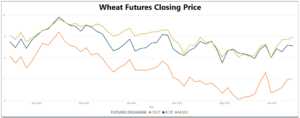
Wheat futures continue to fluctuate based on the global supply and demand situation and the erratic influences of geopolitics, weather. The most recent example is the response to the airstrikes in Ukraine last week. CBOT futures closed limit up at $7.57/bu; however, by the end of the week, CBOT futures were down 53 cents at $7.04/bu. Source: U.S. Wheat Associates Price Charting Tool.
Despite the historically low basis, volatility presents a risk in the market. On July 24, Chicago Board of Trade (CBOT) wheat futures were limit up in response to the airstrikes in Ukraine, closing at $7.57/bu; however, by the end of the week, CBOT futures were down 53 cents at $7.04/bu.
Every marketing year presents new challenges and opportunities for buyers of U.S. wheat, and this year is no exception. Markets are volatile, but unique buying opportunities continue to arise. With proper risk mitigation, U.S. wheat importers can capitalize on opportunities for purchasing U.S. wheat and maximize the value of U.S. wheat classes, even in unpredictable times. Contact your local U.S. Wheat Associates office for more individualized information on risk mitigation strategies for your business and opportunities for U.S. wheat.
By U.S. Wheat Associates (USW) Market Analyst Tyllor Ledford.
Growth Energy CEO Emily Skor delivered the keynote address to the Iowa Renewable Fuels Association's Renewable Fuels Summit today. Speaking alongside Governor Kim Reynolds, Florida Governor Ron DeSantis, former United Nations Ambassador Nikki Haley, U.S. Secretary of Agriculture Tom Vilsack, and former Arkansas Governor Asa Hutchinson, Skor updated the crowd on the state of the U.S. bioeconomy and outlined the biofuel sector's policy agenda for the new year.
Among other priorities, Skor discussed the Renewable Fuel Standard (RFS) and ongoing efforts to secure year-round nationwide access to E15, as well the U.S. Treasury Department's recent guidance on administering tax credits under the Inflation Reduction Act (IRA) and next week's Iowa Caucuses.
Highlights are available below, and Skor's full speech, as prepared for delivery, is available here.
On the bioeconomy:
"The bioeconomy is our entire mission at Growth Energy: cultivating it, expanding it, accelerating its growth by breaking down barriers and securing policies that recognize our innovations and advancements. We are making sure our members get the attention and the credit they deserve for investing in science and talent—for producing an endless variety of renewable, plant-based fuels and products."
On the RFS:
"Opponents are challenging us with all kinds of litigation — from endangered species to refinery exemptions to blending obligations. Fortunately, after years of our hard work, the EPA has largely taken our side. But those decisions need to stand up in court. The RFS will need a clear and accurate defense. And we are there, alongside the agency — marshalling facts, presenting research, and deploying legal arguments — until this fight is won. Alongside allies like Iowa RFA, we will ensure that America's most successful clean energy policy keeps delivering the market access we need to expand the bioeconomy."
On E15:
"Last summer, E15 saved drivers an average of 15 cents per gallon compared to standard E10 fuel choices. In some states, drivers saw savings reach 40 to 60 cents per gallon. As you well know, continuing this momentum depends on federal decisions to let consumers access E15 year-round.
"Midwestern states – led by your own Governor Reynolds and Attorney General Bird – have stepped up to show real leadership on this issue. Over nearly two years, they have demanded EPA act on a rule that would allow year-round E15 in eight states, including Iowa."
On the IRA tax incentives:
"We need the Treasury Department to implement tax credits in ways that allow bioethanol producers to accelerate our climate progress while expanding economic opportunity across rural America. We cannot let the tax code put agriculture on the sidelines."
On the Presidential campaign:
"We're working to cultivate allies and maximize the number of office holders who make firm commitments to bioethanol. The proof is right here on this stage, where major candidates—Governor Hutchinson, Ambassador Haley, Governor DeSantis—are presenting detailed, nuanced agendas for expanding the bioeconomy. And I'm confident they will continue supporting the bioeconomy regardless of whether they capture their party's nomination.
"To that end, I am especially grateful for those of you who have opened your doors to candidates as they barnstormed Iowa. You showed them the full potential of the bioeconomy. And Iowa is just the tip of the spear. Growth Energy members will continue the push in other states over the next 10 months."
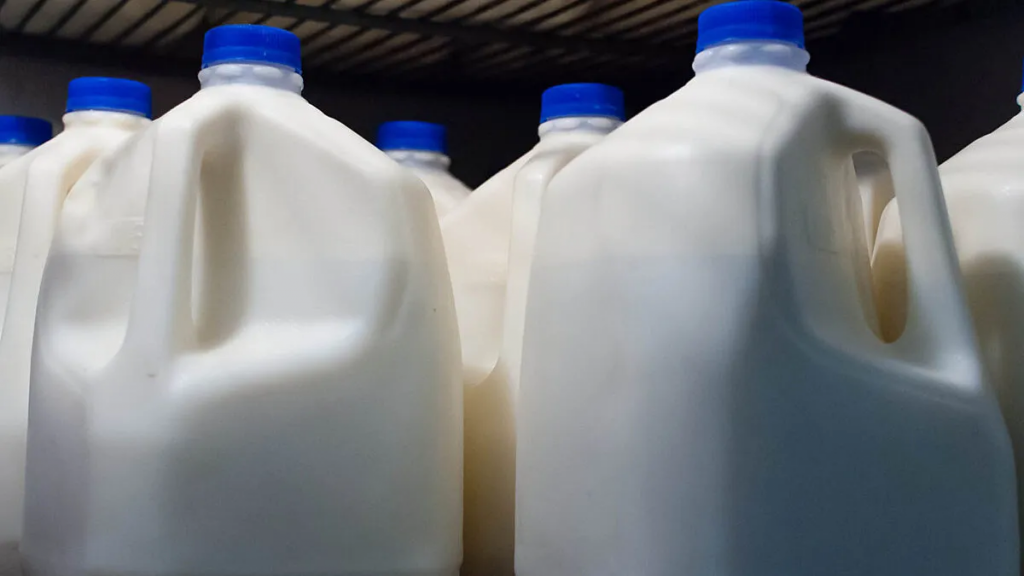
Since May 2019, the price for Class I milk, i.e., milk used to produce beverage milk products, has been calculated using the simple average of advanced Class III (cheese) and Class IV (milk powders) skim milk prices plus 74 cents. In years prior, the formula was the "higher-of" advanced Class III and Class IV skim milk prices. Milk marketing conditions, starting with COVID-19-induced disruptions, have since resulted in continued revenue pool losses linked to the formula switch. In November 2023, cumulative pool losses since the formula change passed $1 billion. With no immediate changes in sight from the ongoing Federal Milk Marketing Order hearing or in renewed farm bill discussions, dairy farmers continue to feel the impacts of diminished pool values and outdated pricing regulations. Today's article reviews the latest dairy market and pricing policy information contributing to uncertain milk checks as we start 2024.
The 2018 farm bill included a small provision that swapped the "higher-of" formula for the simple average-of advanced Class III and IV skim milk prices plus 74 cents. The change was made at the request of dairy processors and dairy cooperatives and was intended as a revenue-neutral way to improve risk management opportunities for beverage milk. Under the classified dairy pricing system, handlers participating in an order have a payment obligation to – or a draw from – the revenue pool of federal orders. In a simple sense, the value of the four classes of milk participating in the order is combined or "pooled" together so that farmers in the region are paid the same minimum price for their milk. In this manner, for example, milk that is worth more because of a hypothetical higher current value of fluid milk offsets milk that is worth less because of a hypothetical lower cost of milk going into cheese production. The milk going into both products is essentially the same, so farmers should receive a similar price regardless of the final use.
Only Class I handlers are required to pool their milk every month. Class II, III and IV handlers can remove their milk from the order, or "de-pool," in certain months if they so desire. Different orders have different regulations governing how and at what pace handlers can re-pool milk on the order if they decide to not participate. If a handler de-pools higher-valued milk, it leaves less value to be divided and paid to producers whose milk remains in the pool. This situation creates "pool losses" where dairy farmers with pooled milk are paid less than they would have had the additional milk value remained. When there is not enough value in the pool to cover the calculated component values (butterfat, protein, other solids) in dairy farmers' milk, it results in deductions on milk checks known as negative producer price differentials (PPDs).
While dairy farmers were generally spared from negative PPDs throughout 2023, the Class I pricing formula change continues to result in lower values being paid to producers with pooled milk. In November 2023, pool losses due to the formula switch reached nearly $50 million. Combining this with all other losses from previous months brings cumulative pool losses due to the formula switch to over $1.02 billion since May 2019.

A large contributor to the continued pool losses is a persistent large spread between Class III (cheese) and Class IV (butter and powders) prices. The current "average-of" formula smooths the difference between the two values while the "higher-of" uses the simple higher of between the two options. In this manner, when the two prices differ more than $1.48 (twice the 74-cent mover) the "average-of" formula becomes less advantageous to manufactured product handlers looking to receive a higher value for their milk, incentivizing them to de-pool their higher valued Class III or IV milk and avoid pooling obligations that could reduce their overall revenue potential.
Between May 2019 and October 2021 Class III prices were driving much of the dairy market atop cheese-related supply disruptions during the pandemic. During those 30 months, the spread from Class IV exceeded $1.48 on 17 occasions or 57% of the time. This means Class III handlers were heavily incentivized to de-pool to retain higher values of their milk during this period. Since October 2021, however, Class IV prices have exceeded Class III prices. Of the 25 months between November 2021 and November 2023, the spread from Class III exceeded $1.48 on 17 occasions as well, or 68% of the time. Thus, Class IV handlers have been heavily incentivized to de-pool the past two years.
Indeed, since 2020, average monthly de-pooled milk has exceeded 20% across all federal orders (compared to an average 12% between 2016 and 2019). The 74-cent mover originally included to buffer against price spreads has failed to do so. Additionally, the upside of the formula to farmers is limited to the 74-cents-per-hundredweight mover, while the downside is unlimited. For now, the "average-of" formula remains a culprit behind lower milk checks for farmers with pooled milk. Other pricing dynamics, such as the use of advanced pricing and outdated price differentials, also play a role in what are considered disorderly marketing conditions. AFBF has targeted these factors and others that have resulted in excessive price volatility in its Federal Milk Marketing Order reform efforts.

Part of the reason behind continued large spreads between Class III and IV prices is a growing stockpile of cheese stocks creating downward pressure on cheese prices that has not occurred with Class IV products. Combined with production from a myriad of new cheese plants across the nation and imports, increases in domestic consumption have not been enough to eat into cold storage stocks and bolster prices. Domestic production in October 2021 was 690 million pounds. In October 2022, this increased to 709 million pounds and has grown to 720 million pounds (for an increase of 4.4% across this three-year term), as of October 2023. Ending cold storage stocks in October 2021 sat at 605 million pounds. In October 2022 this increased to 617 million pounds and had grown to 626 million pounds (for an increase of 3.5% across this three-year term) by October 2023. Production continues to outpace consumption as reflected in these values, weakening the strength of cheese prices.

As mentioned in previous dairy market analyses, in periods of excess supply, the hope is that export markets can soak up the difference. This was the case in 2021 when exports of dairy products in the first half of the year exceeded the prior three-year average by 14% or 365 million pounds of dairy products. It was also the case in the first half of 2022, when dairy product exports surpassed 2021 levels by 119 million pounds (4%). 2023 was a different story.
Between January and October, exports dropped 391 million pounds (7%) in terms of quantity and $1.25 billion (16%) in terms of value compared to the same 10-month period in 2022. Demand in places such as Southeast Asia has continued to be more depressed than expected. U.S. exports in terms of volume for the first 10 months of 2023 were down 13% in China, 10% in Japan, 26% in the Philippines, and 42% in South Korea. These countries all sit in the top seven of dairy product export markets for the United States.
In addition, exports to our northern neighbor and second-largest market, Canada, slumped 10% in volume in 2023, though they were up 4% in value. Mexico, our leading dairy export market, last year bucked the volume trend slightly, with the first 10 months of 2023 up 14% (165 million pounds) in volume but down 4% ($80 million) in value. Without foreign consumption of excess U.S. dairy supply, the resulting price received by farmers is pressured downward. This is especially true for certain dairy products, like cheese, where large cold stores loom.

Federal Milk Marketing Order Hearing
The ongoing Federal Milk Marketing Order hearing is set to reconvene on Jan. 16 in Carmel, Indiana. If the hearing is not completed by 5 p.m. ET, Jan. 19, the hearing will reconvene at 8 a.m. ET, Jan. 29, and will be held each weekday from 8 a.m. to 5 p.m. If the hearing is not completed by 5 p.m. ET, Feb. 2, it will be reconvened at a later date.
AFBF has taken a leading role in the hearing, supporting the return to the higher-of and raising the Class I differential, and advocating for the end of advanced Class I pricing, among other measures.
USDA categorized hearing topics numerically, with the failure of the "average-of" formula change part of category four. Remaining hearing discussions pertain to the final category on Class I and II differentials. With no certain end to the hearing, the outlook for when changes can occur stretches further. There are still many steps in the federal order hearing process before any referendum approved can be implemented. Remaining steps once the public hearing concludes include:
Combined, the remaining steps include up to 270 days between when the hearing transcript is published and when a referendum may occur. This puts any likelihood of pricing regulatory changes into 2025 or later. It is important to reiterate if farmers reject the final rule in a failed vote, USDA has a precedent of terminating the order completely. This means instead of returning to the order regulations that were in place before the hearing, the order and its regulations cease to exist altogether. Additionally, any language passed in a future farm bill related to FMMO pricing regulations supersede the hearing process (i.e., if a switch back to the "higher-of" was included in a farm bill).
Conclusion
The monotonous process of amending federal orders, though important, means dairy farmers remain stuck with current pricing regulations until USDA publishes a final rule, that rule is approved by dairy farmers in a referendum and the stipulations around the timing and implementation of the rule are published in the Federal Register. In a market based on dynamics of transporting a highly perishable fluid product to processors, retailers and ultimately customers, even short spans of time result in wide pricing spreads and corresponding positive or negative impacts on producers. Current market dynamics underscore the need for FMMO modernization. The ongoing impacts of the Class I mover change are a prime example of a well-intentioned policy misstep that has reduced dairy farmers' checks, with little relief in sight. An effective hearing outcome and comprehensive updated farm bill can buffer against mistaken and outdated policies that have left dairy farmers struggling to make ends meet.
Two college students pursuing degrees in agriculture that will benefit the wheat industry will be awarded $2,500 scholarships this semester. Thanks to a great partnership with BASF, the National Wheat Foundation is pleased to award these annual scholarships to undergraduate college students.
"All the applicants were excellent and it was very difficult to select only two," said Ben Scholz, NWF Director and Scholarship Committee Chairman. "The next generation is responsible for the future of the wheat industry, and with applicants like these, the future is bright."
The two scholarship winners are:
Grace Timm, a junior at the University of Nebraska-Lincoln pursuing an Agribusiness degree on a Pre-Law track. Grace demonstrates the highest levels of achievement in her academics, extra-curricular involvement and personal leadership qualities. She is serving as the Nebraska Wheat Ambassador, and as such, helps to educate and promote wheat to consumers.
Sophia Flikkema, a junior at Mississippi State University from Bozeman, Montana, is awarded a $2,500 scholarship. Sophia is majoring in Economics and Asian Studies and plans to work in wheat merchandising. Sophia wants to tackle the global challenges that affect wheat growers and is studying the Chinese language in order to communicate and understand the United States' third-biggest trading partner. The National Wheat Foundation appreciates the work that Sophia is doing to prepare herself to keep the American wheat industry strong in the global marketplace.
Congratulations Grace and Sophia, the National Wheat Foundation and BASF wish you well this semester and in your future endeavors. We are thrilled to award you these scholarships and look forward to your further contributions to the wheat industry.
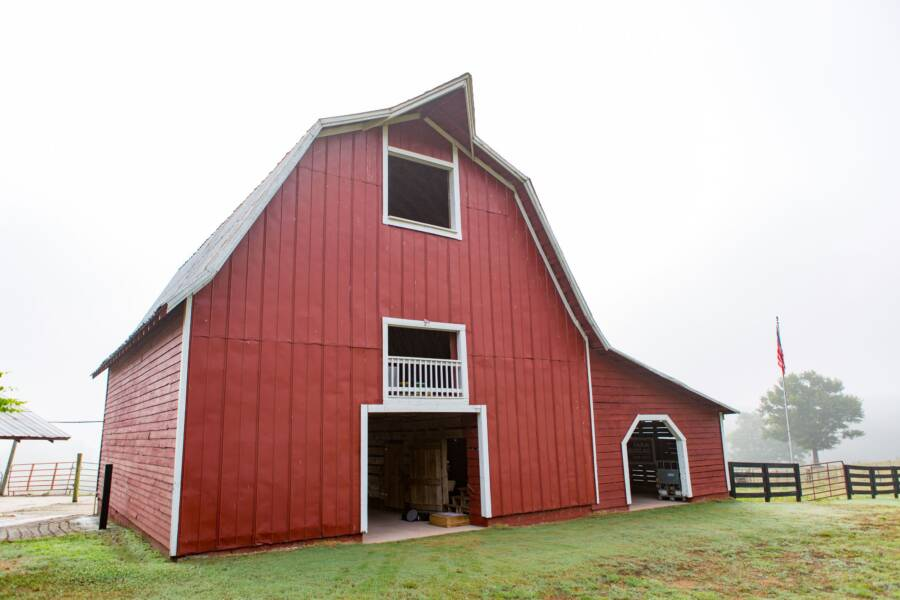
Frank Lucas (R-Okla.) and former Iowa Farm Bureau President Craig Hill are the recipients of the American Farm Bureau Federation's 2024 Distinguished Service Award and Farm Bureau Founders Award, respectively. The DSA and Founders Award are the highest honors presented by AFBF. Lucas and Hill will be recognized during the 2024 American Farm Bureau Convention, Jan. 17-24, in Salt Lake City, Utah.
AFBF established the Distinguished Service Award in 1928 to honor individuals who have devoted their careers to serving the national interest of American agriculture. First presented in January 2017, AFBF's Founders Award for exemplary leadership, service or contributions to Farm Bureau is presented in recognition of outstanding achievements and work in the interest of Farm Bureau.
Lucas was nominated by the Oklahoma Farm Bureau for the DSA. Hill was nominated by the Iowa Farm Bureau for the Founders Award. A national Farm Bureau committee selected each of the winners.
Lucas Honored with Distinguished Service Award
Lucas is a fifth-generation Oklahoman and farmer who has been a defender of agriculture for more than 40 years. With a bachelor's degree in agricultural economics from Oklahoma State University, he successfully brought the perspective of the American farmer with him to Capitol Hill. Elected to Congress in 1994, he is recognized as the longest-serving member on the House Agriculture Committee and served as chairman of the committee from 2011 to 2015, playing an instrumental role in the 2014 farm bill. Prior to serving in Congress, Lucas served in the Oklahoma State House of Representatives where he focused on prominent agriculture issues.
Lucas commended AFBF for the important role the organization plays in informing farmers about congressional happenings and making sure they can voice their opinions and needs. A lifelong Farm Bureau member, Lucas shared what receiving this award means to him.
"It's like having your family say you've done a really good job for them," Lucas said. "There's nothing more important than having your family acknowledge that your hard work has been for a purpose and accomplished things. I appreciate my Farm Bureau family acknowledging my 29 years of constantly working on their behalf. It's very kind of them."
Oklahoma Farm Bureau President Rodd Moesel shared the value Lucas' background brings to Capitol Hill, noting not many in his role go home on the weekends to complete a list of farm chores and move cattle.
"He's so rare because he is a real farmer and rancher. There are very few of those left in Congress," Moesel said. "He really understands our issues and is able to take those messages to Congress."
Hill Honored with Farm Bureau Founders Award
Hill is the longest-serving member of the Iowa Farm Bureau board of directors, serving for 32 years before retiring as president in December 2021. During his tenure, he traveled throughout Iowa, the U.S. and internationally, visiting 23 countries on trade and diplomacy missions. His experience included sharing information about agriculture with government officials, including six U.S. presidents, and farmers on many continents.
Throughout his time at Iowa Farm Bureau, Hill carried members' voices into his conversations with trade officials, lawmakers and the media, sharing the impact trade policies and lack of markets have on family farms. A notable example of Hill's work is his role in helping to create the Revenue Assurance program, which provides protection to farmers against revenue losses due to low prices and/or low yields. In 1996, this policy was written into the farm bill and continues to be the most popular form of crop insurance used by farmers.
Hill was also a prominent voice in Farm Bureau's 2017 campaign for a new Waters of the U.S. rule. He met with Environmental Protection Agency officials, participated in roundtable discussions and provided testimony to Congress about how a new WOTUS would negatively impact farmers in Iowa and across the country.
"This is a remarkable honor because I know how much so many have given to move this organization forward," Hill said. "I'm humbled to be included in that category."
Although Hill's list of accomplishments and awards is long, he remains firm in saying his family has been his greatest joy and source of pride. He and his wife, Patti, have been farming since 1978, raising row crops and pigs. They have two children, Abbie, an attorney, and Adam, who they farm alongside today. Both are married and have blessed the Hills with wonderful grandchildren.
"I would sum up Craig's service to Farm Bureau as complete," Iowa Farm Bureau President Brent Johnson said. "Every step of the way, he spoke up, led where he could and showed up where he needed to. I really appreciate his long-tenured, dedicated experience at Farm Bureau."
Read comments from Frank Lucas and Oklahoma Farm Bureau President below regarding Lucas as the recipient of the AFBF 2024 Distinguished Service Award:
Rep. Frank Lucas (OK-03) is the recipient of the American Farm Bureau Federation's 2024 Distinguished Service Award. The DSA is the highest honor presented by AFBF. Lucas will be recognized during the 2024 American Farm Bureau Convention, Jan. 17-24, in Salt Lake City, Utah.
Lucas commended AFBF for the important role the organization plays in informing farmers about congressional happenings and making sure they can voice their opinions and needs. A lifelong Farm Bureau member, Lucas shared what receiving this award means to him:
"It's like having your family say you've done a really good job for them," said Congressman Lucas. "There's nothing more important than having your family acknowledge that your hard work has been for a purpose and accomplished things. I appreciate my Farm Bureau family acknowledging my 29 years of constantly working on their behalf. It's very kind of them."
"He's so rare because he is a real farmer and rancher. There are very few of those left in Congress. He really understands our issues and is able to take those messages to Congress." -Oklahoma Farm Bureau President Rodd Moesel

U.S. Department of Agriculture (USDA) Secretary Tom Vilsack announced today that USDA is awarding $19 million in grants to U.S. business owners to increase the availability of domestic biofuels in 22 states and give Americans cleaner, more affordable fuel options at gas station pumps as part of President Biden's Bidenomics agenda to lower costs and invest in America.
Blending ethanol into gasoline has helped reduce fuel costs by approximately 25 percent, contributing to falling gas prices across the country. Gas prices are now under $2.99 in more than half of U.S. states and saving the average driver more than $100 per month relative to peak prices. HBIIP increases the number of Americans that benefit from falling prices by expanding the use of ethanol-based fuels at gas stations around the nation.
The Department is making the awards through the Higher Blends Infrastructure Incentive Program (HBIIP), made possible with funding from President Biden's Inflation Reduction Act.
"President Biden's Inflation Reduction Act is giving people in rural areas the historic opportunity to expand clean energy and build an economy that benefits working families," Vilsack said. "By increasing the supply of biofuels made here in the U.S., we are strengthening our energy independence, lowering costs for American families, creating new streams of income for agricultural producers and bringing good-paying jobs to people in rural communities."
Secretary Vilsack made today's announcement during his visit to the Iowa Renewable Fuels Summit in Altoona. Secretary Vilsack was awarded the Lifetime Champion of Renewable Fuels Award by the Iowa Renewable Fuels Association during the Summit.
Through this most recent tranche of awards, business owners are receiving $19 million to expand access to domestic biofuels in 22 states and strengthen America's energy independence. For example:
The full list of states to receive funding is: Arizona, California, Florida, Georgia, Illinois, Indiana, Iowa, Kansas, Kentucky, Maryland, Michigan, Minnesota, Missouri, Nebraska, Nevada, New Mexico, North Carolina, Ohio, Oklahoma, South Dakota, Texas and Wisconsin.
Since the start of the Biden-Harris Administration, USDA has invested more than $96 million nationwide to increase access to biofuels at fueling stations. $11.6 million of this has been invested in Iowa.
Background: Higher Blends Infrastructure Incentive Program
The Higher Blends Infrastructure Incentive Program (HBIIP) provides grants to fueling station and distribution facility owners, including marine, rail, and home heating oil facilities, to help expand access to domestic biofuels, a clean and affordable source of energy. These investments help business owners install and upgrade infrastructure such as fuel pumps, dispensers and storage tanks. Expanding the availability of homegrown biofuels strengthens energy independence, creates new revenue for American businesses and brings good-paying jobs to rural communities.
In June 2023, USDA made $450 million available in Inflation Reduction Act funding through the HBIIP to expand the use and availability of higher-blend biofuels. That same month, USDA also announced the first round of Inflation Reduction Act-funded HBIIP awardees.
USDA continues to accept applications for funding to expand access to domestic biofuels. These grants will support the infrastructure needed to reduce out-of-pocket costs for transportation fueling and distribution facilities to install and upgrade biofuel-related infrastructure such as pumps, dispensers and storage tanks. There are three quarterly application windows left, and the program ends Sept. 30, 2024. The next application deadline is March 31, 2024.
For more information, go to the HBIIP webpage.
Background: Inflation Reduction Act
This announcement is part of President Biden's Investing in America agenda to grow the American economy from the middle out and bottom up by rebuilding our nation's infrastructure, driving over $640 billion in private-sector manufacturing investments, creating good-paying jobs and building a clean-energy economy to tackle the climate crisis and make our communities more resilient.
The Biden-Harris Administration championed the Inflation Reduction Act, the nation's largest-ever investment in combatting the climate crisis, a key pillar of Bidenomics and part of the Investing in America agenda. Through the Inflation Reduction Act, the Administration is delivering on its promise to fight climate change and reduce greenhouse gas emissions across America. The Act provides funding to USDA Rural Development to help eligible organizations invest in renewable energy infrastructure and zero-emission systems and make energy-efficiency improvements that will significantly reduce greenhouse gas emissions.
For more information on the Inflation Reduction Act, visit: www.rd.usda.gov/inflation-reduction-act.
Under the Biden-Harris Administration, USDA Rural Development provides loans and grants to help expand economic opportunities, create jobs and improve the quality of life for millions of Americans in rural areas. This assistance supports infrastructure improvements; business development; housing; community facilities such as schools, public safety and health care; and high-speed internet access in rural, Tribal and high-poverty areas. For more information, visit www.rd.usda.gov.
USDA touches the lives of all Americans each day in so many positive ways. Under the Biden-Harris Administration, USDA is transforming America's food system with a greater focus on more resilient local and regional food production, fairer markets for all producers, ensuring access to safe, healthy and nutritious food in all communities, building new markets and streams of income for farmers and producers using climate-smart food and forestry practices, making historic investments in infrastructure and clean energy capabilities in rural America, and committing to equity across the Department by removing systemic barriers and building a workforce more representative of America. To learn more, visit www.usda.gov.

Bidding is underway in an online auction of Oklahoma Department of Wildlife Conservation surplus vehicles and equipment. Potential bidders can view and bid on auction items at purplewave.com/auction/240130.
The Wildlife Department annually auctions surplus vehicles and equipment to the public. For this event, the Department has 40 vehicles, agricultural equipment, trailers, electronics, and various shop equipment at PurpleWave.com.
"Vehicles are always a popular item among buyers. These vehicles undergo scheduled maintenance from the time we purchase them new to when we sell them," said Daniel Griffith, property manager for the Wildlife Department. "Boats, boat motors, and trailers are other popular items that draw interest from buyers each year. "The sale of these items helps bring back funds into the Department to help purchase new vehicles and equipment, or to fund projects. Those who purchase these items directly help fund the Wildlife Department and its activities to conserve fish and wildlife."
Bidding is open now for anyone interested. Bidding will begin to close at 10 a.m. CST on Tuesday, Jan. 30. Bidders must register with the online auction site before bidding. A 10% buyer's premium will be added to all winning bids to arrive at the final price. Other auction details, terms, and conditions are found on the auction website. Items are sold to the highest bidder as-is, where-is. The vehicles located at Oklahoma City headquarters will be available for inspection from 9 a.m. to 3 p.m. Monday, Jan. 29, at 1801 N Lincoln Blvd., Oklahoma City, OK 73152.
For more information, email Daniel Griffith at daniel.griffith@odwc.ok.gov.
Support conservation by tagging your ride with one of nine wildlife
conservation specialty license plates, available at oklahoma.gov.

The Financial Crimes Enforcement Network (FinCEN) has granted state, local and tribal entities appropriate access to corporate ownership information following a national effort led by Attorney General Gentner Drummond.
Drummond and 41 other attorneys general asked the U.S. Department of Treasury bureau last February to adjust its proposed requirements for a national database established in the Corporate Transparency Act. The proposed requirements included burdensome regulations for non-federal entities to access information. Drummond said information in the database will be critical to fighting crime and terrorism.
"I am pleased FinCEN's Final Rule takes into account the concerns expressed by law enforcement representatives and streamlines access to the database for state, local and tribal enforcers," Drummond said. "We can now use the database as Congress intended to efficiently access important corporate ownership data to protect the public."
He said the database will help investigators hold accountable bad actors, from corrupt officials to organized criminals.
The Corporate Transparency Act, passed in 2021, requires certain companies to disclose their actual, or "beneficial," owners to FinCEN. That information is then included in the national database, which began functioning Jan. 1.
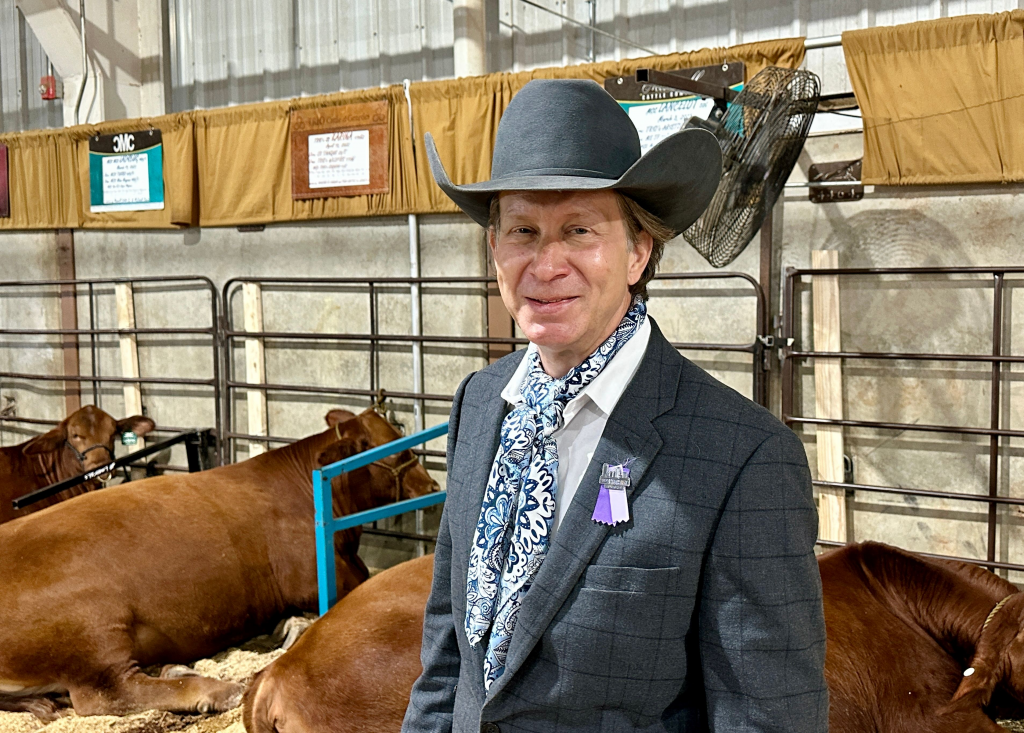
At the 2024 Cattlemen's Congress, Senior Farm and Ranch Broadcaster Ron Hays had the chance to talk about the Brangus breed with Brangus producer Allen Goode. Aside from being a Brangus producer, Goode is also a past president of the International Brangus Breeders Association (IBBA).
"It is a pleasure for the Brangus breed to be here once again at Cattlemen's Congress," Goode said.
Goode stays active in the cattle industry in numerous ways, and one of those ways is being a judge at livestock shows. Goode had the chance to judge the Santa Gertrudis show at this year's Cattlemen's Congress.
The spotlight that Cattlemen's Congress has become has been a big boost for the registered Brangus industry, Goode said, and he is glad that the American breeds were included from the inception of the event.
"It is a very central location, of course, geographically," Goode said. "For the Brangus breed, we have breeders from Florida, Georgia, the Carolinas, all throughout the southeast that come here, and of course all the surrounding states- Texas, Louisiana, Arkansas, and Missouri. It is a big show for Brangus."
Goode said this year will mark the 75th anniversary of the International Brangus Breeders Association.
"We are going to have a big celebration weekend in August in Fort Worth, so it is a momentous time for all of Brangus, and it has really come at a time when Brangus is hitting all strides in terms of the industry and the acceptance of the demand for our cattle," Goode said.
Brangus checks many of the boxes when it comes to what a commercial producer needs, Goode said, and the breed fits into many different environments.
Goode also talked about a relatively new addition to the Brangus breed called the Ultra-Brangus. Ultrablack and Ultrared animals are registered composite animals with validated and documented lineage that are between 12.5% and 87.5% Brangus breeding. The remaining 87.5% to 12.5% must be a registered Angus to be an Ultrablack or Red Angus to be an Ultrared.
"For us, it is a way to bring in some of the newer Angus genetics into the breed, and what that has really done is helped us boost our carcass quality traits," Goode said. "Our EPDs for marbling, ribeye, and intermuscular fat have really climbed high to be on par with any other breed in the industry right now."
Overall, Goode said the adaptability from an environmental standpoint for Brangus cattle combined with carcass quality has expanded the demand for Brangus cattle.
The Beef Buzz is a regular feature heard on radio stations around the region on the Radio Oklahoma Ag Network and is a regular audio feature found on this website as well. Click on the LISTEN BAR for today's show and check out our archives for older Beef Buzz shows covering the gamut of the beef cattle industry today.
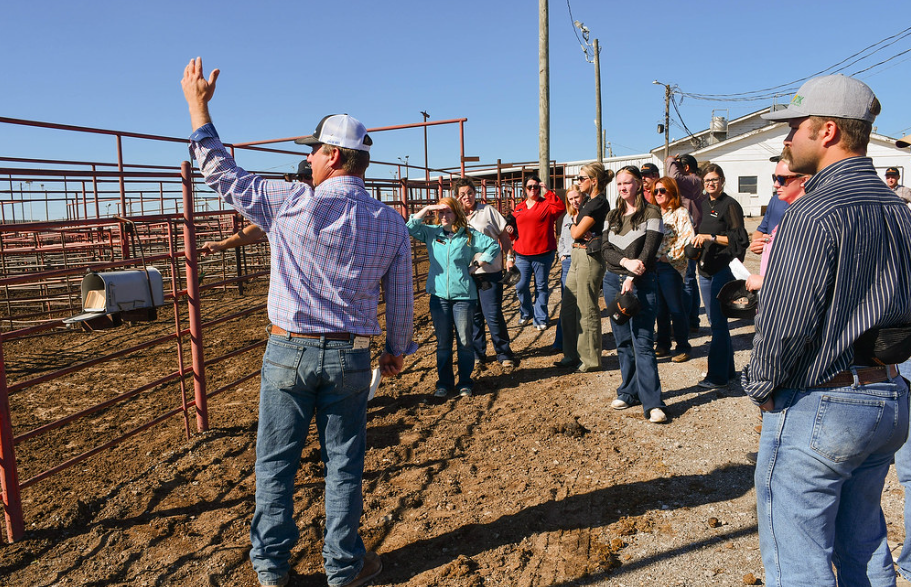
The Oklahoma Agricultural Leadership Program provides leadership development and industry knowledge to members of the agriculture community. The 21st class of OALP is underway, with informational tours including a visit to the Apache Livestock Auction. (Photo courtesy of Edmond Bonjour)
The Oklahoma Agricultural Leadership Program, an experience dedicated to empowering leadership in agriculture and rural Oklahoma, celebrates 40 years in 2024.
Since 1982, OALP has been a trailblazer in providing leadership development for Oklahoma residents involved in the agricultural industry. OALP is hosted through Oklahoma State University Agriculture to attract potential leaders and encourage them to reach their full potential.
One of the program's objectives is to help participants expand their knowledge to take on leadership roles in their communities and beyond, said OALP director Edmond Bonjour.
"It's a leadership program to expose the participants to different aspects of agriculture," he said. "We tour around the country and learn as much as we can about agriculture in different regions."
Bonjour was a member of Class XIII; he took over as OALP's director just two years later, in April 2013. His wife, Rose Bonjour, is also an OALP graduate.
An OSU Extension specialist for stored grain entomology and plant pathology, Bonjour wanted to apply his passion for education to the program.
"It's been very rewarding for me," he said. "It's always fun and exciting to see how people grow from timid and reserved to involved and outgoing and how they advance after our program."
OALP is a two-year program, requiring class participants to attend about 55 days of seminars locally and abroad.
"We expect that participants commit 100% to those 55 days," Bonjour said.
Most of the program seminars take place in Oklahoma and southern Kansas, but OALP participants also spend eight days on the East Coast learning about the area's agricultural industry and legislation. Each class ends with a two-week international experience.
The program tours and farm/ranch visits showcase different aspects of agriculture, which Bonjour said encourages diversity among participants.
"It makes the class that much better," he said. "Even though they learn from our seminars, a lot of the learning comes from one another."
Bonjour witnessed the collaboration in a recent class when one participant with nearly 40 years of experience in the banking industry taught many of the younger participants about finances and investing.
Aside from agricultural knowledge, OALP participants gain insight on economic and governmental systems, effective communication strategies and leadership skills.
"They have a working knowledge of the different aspects of agriculture," Bonjour said. "We hope they use that information to become better leaders and that it encourages them to take on leadership roles."
Three alumni of OALP currently serve in the Oklahoma Senate, and many others serve in leadership roles within their communities, regions and the state.
Brain Arnall, OSU Extension precision nutrient management specialist and professor in the OSU Department of Plant and Soil Sciences, is an alumnus of Class XV.
"As a new state Extension specialist, I came to realize many farmers and industry leaders I interact with regularly were OALP alumni," Arnall said. "I could easily see how it would benefit me to get a rapid introduction to a very diversified state and develop leadership skills and relationships along the way."
Arnall is one of 21 alumni from OALP Class XV, which included Oklahoma residents and a few from Texas and Kansas.
"I joined to learn more about our amazing state and develop new relationships," he said. "I graduated with a sense of awe to the true diversity and beauty of our state's agriculture system, along with lifetime friendships."
Arnall's classmate, Blayne Arthur, serves as Oklahoma's first female secretary of agriculture, while another, Todd Love, serves as chair of the OALP Advisory Council.
OALP allows participants to get an immersive view of the agriculture industry — from producer operation tours at the micro level to state and federal legislative processes affecting agriculture.
"My biggest takeaway from this program is the relationships I've created," Love said. "Other programs I've completed are different. OALP participants are almost family."
Love completed his OALP class experience from 2010 to 2012 and served on the OALP Advisory Committee for eight years before taking on the role of committee chair. The committee discusses how to solve current agricultural challenges that many OALP members, past and present, encounter in the industry.
"OALP supports graduates serving as leaders in their communities, state and beyond," said Damona Doye, associate vice president of OSU Extension, OSU regents professor and an OALP advisory council member. "The program offers participants a unique opportunity to interact with agricultural leaders locally, nationally and internationally."
OALP Class XXI is underway, and applications for Class XXII will open in February 2025. Visit the OALP website or contact Edmond Bonjour to learn more.
By Laney Reasner
OSU Agriculture is dedicated to improving the quality of life of Oklahomans through science-based information and education. It is comprised of the Ferguson College of Agriculture and two state agencies: OSU Ag Research and OSU Extension.
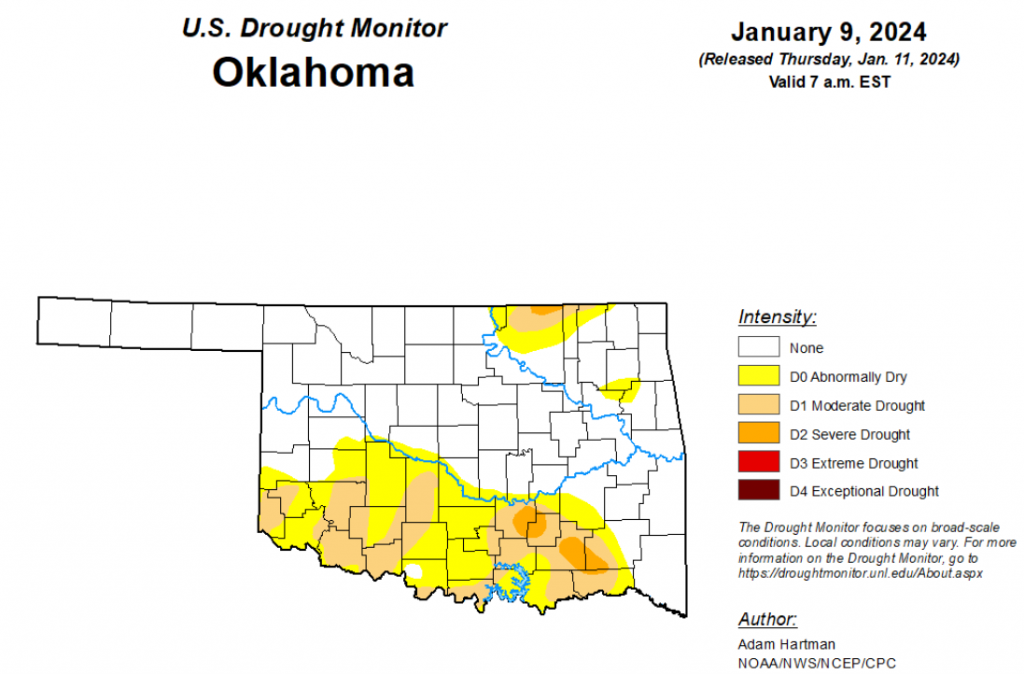
To view the latest Oklahoma drought map, CLICK HERE.
According to the latest Oklahoma drought monitor report, exceptional drought remains at zero percent, unchanged from the start of the calendar year.
Extreme drought or worse remains at zero percent, unchanged from the past two weeks.
Severe drought or worse is now at 1.67 percent, down from last week's 3.08 percent.
Moderate drought or worse is now at 15.01 percent, down from last week's 21.64 percent.
Abnormally dry or worse conditions are now at 34.19 percent, down from last week's 44.68 percent.
According to the 6-to-10-day precipitation outlook map, the state's northeast corner is leaning below a 40 to 50 percent chance of precipitation through January 20. The Panhandle is leaning below a 33 to 40 percent chance of precipitation through January 20, and the remaining parts of the state are leaning below a 40 to 50 percent chance of precipitation through that date.
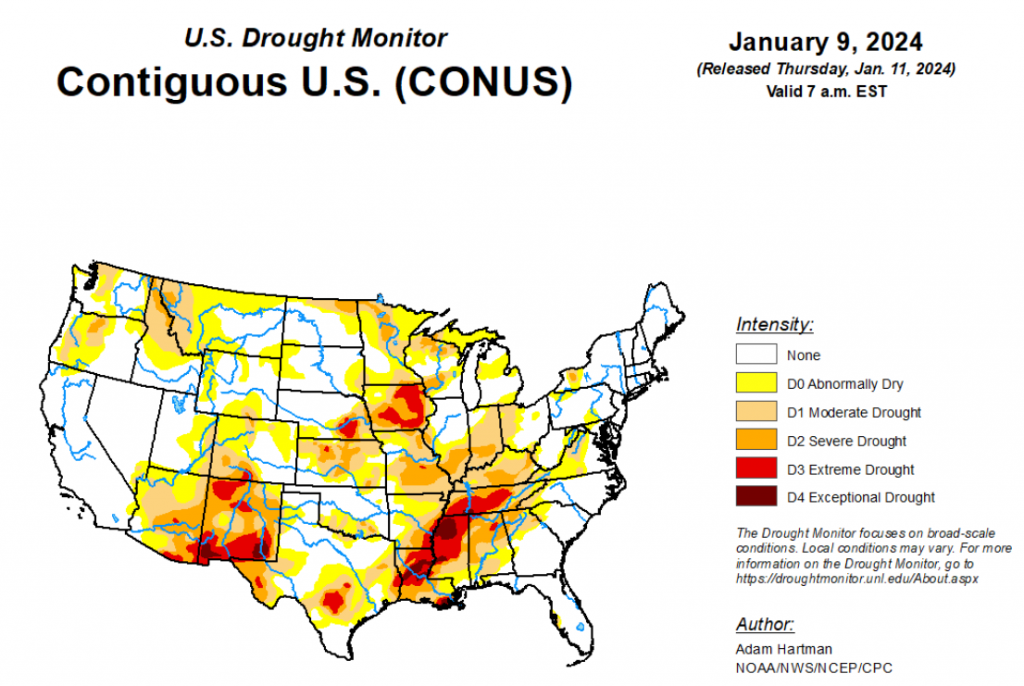
To view the United States Drought Map, click here.
According to the latest U.S. drought monitor, it was a stormy week across much of the eastern lower 48 states, leading to widespread drought improvements east of the Rockies. A winter storm pummeled the Mid-Atlantic and Northeast over the weekend (January 6-7). Then a second system in its wake was ramping up across the Mississippi Valley toward the end of this week (Tuesday, January 9), bringing heavy rainfall to the Lower Mississippi and the Deep South. More than 2 inches of rain fell in many areas, with localized amounts upwards of 5 inches. Heavy snow also fell across parts of the Central Plains and Midwest as it moved slowly eastward, with snowfall still ongoing across parts of the Midwest and Great Lakes by the end of this week. Across the Intermountain West, it was a wet and snowy week mainly for parts of the Pacific Northwest and isolated locations in the Great Basin and Four Corners region, leading to some targeted improvements. However, several areas experiencing antecedent dryness and drought missed out on the precipitation, leading to further degradations, particularly across the northern Rockies, Front Range, and across parts of the western Colorado Plateau in Arizona. In Alaska, no changes to the drought depiction are warranted this week. In Hawaii, a Kona low spinning off to the north brought heavy bands of precipitation to western portions of the island chain, warranting some improvements to drought conditions. Conversely, another week of warm temperatures and below normal rainfall in Puerto Rico resulted in widespread deterioration of the drought depiction.
In the Southern Plains, much needed rain fell this week across much of the South, with many locations across the Lower Mississippi and Tennessee Valleys picking up well over 2 inches of rainfall. However, long-term drought conditions still very much remain in place across much of the Lower Mississippi Valley, with several areas across Louisiana and Mississippi experiencing upwards of 20-inch rainfall deficits over the past year. There are marked improvements in the upper layers of the soils and in some of the short-term drought indices in recent weeks, as the storm track has been active across the Gulf Coast states. However, more rainfall will be needed to dig into the long-term precipitation deficits and recharge groundwater. Improvements to drought conditions are also warranted across parts of the Southern Plains this week, where widespread precipitation totals in excess of 1 inch were received.
In the High Plains, storminess in recent weeks has resulted in widespread improvements across the Central Plains. Additional improvements were again warranted this week in the Central Plains, where a couple of storm systems brought wintry precipitation, with weekly snowfall totals of over 5 inches for many areas (locally more than 10 inches), further increasing short-term precipitation surpluses. Unfortunately, the storm track has predominantly been displaced southward across the southern half of the U.S. over the past couple of months, which has led to slow deterioration of drought conditions across portions of the western High Plains and along the Front Range of the Rockies. With another week of below normal precipitation, degradation was again warranted this week. Seasonal snowfall remains below average for many locations and daytime temperatures have been running above normal (and above freezing), exposing soils to evaporation, predominantly from high winds.
In the West, targeted improvements are warranted across parts of the Pacific Northwest and New Mexico, where 7-day precipitation totals, in combination with storminess in recent weeks, have improved some of the long-term drought indicators, even improving seasonal snowpack to be closer to normal for several locations. However, some degradation was also warranted in locations that missed out on heavier precipitation amounts this week, and who have experienced below normal precipitation and above normal temperatures over the past few months. Seasonal snowpack is running below normal throughout much of the Intermountain West, although interior portions of the Great Basin are faring a little better. So much of the recent improvements can be attributed to rainfall and improving soil moisture and stream flows.
Looking ahead, during the next five days (January 11-15), a storm system is forecast to develop and intensify east of the Rockies, bringing potentially heavy rain and snow to parts of the eastern U.S. In the wake of this storm system bitterly cold temperatures are forecast to spill southward from Canada, leading to dangerously cold temperatures and wind chills across portions of the central and northern U.S.
The Climate Prediction Center's 6-10 day outlook (valid January 16-20), favors enhanced chances of below normal temperatures across much of the lower 48 states, with the highest chances (greater the 90%) centered over the Middle Mississippi Valley. Conversely, above normal temperatures are favored in the southwest U.S., underneath a mid-level ridge of high pressure that is forecast. Below normal precipitation is favored across many areas east of the Rockies during the next 6-10 days, as dry air moves in behind a departing storm system. However, a frontal boundary is forecast to remain draped across the Gulf of Mexico, bringing increased above normal precipitation chances to southern Texas and the Florida Peninsula. Above normal precipitation is also favored across parts of the West Coast, northern Rockies, and northern High Plains, associated with moist southwesterly flow into the northwestern U.S.
Congressman Josh Brecheen spoke during a House Committee on Homeland Security hearing entitled, "Havoc in the Heartland: How Secretary Mayorkas' Failed Leadership Has Impacted the States."
This is the Committee's first impeachment hearing against Department of Homeland Security (DHS) Secretary Alejandro Mayorkas.
The witnesses included three state attorney generals, including Oklahoma Attorney General Gentner Drummond.
You can watch Congressman Brecheen's full remarks here.
"Today, three State Attorney Generals, including Oklahoma Attorney General Gentner Drummond, agreed that Secretary Mayorkas is guilty of high crimes and misdemeanors. Congress must do its job and send a strong signal that if you violate the law, you will be impeached," said Congressman Josh Brecheen.
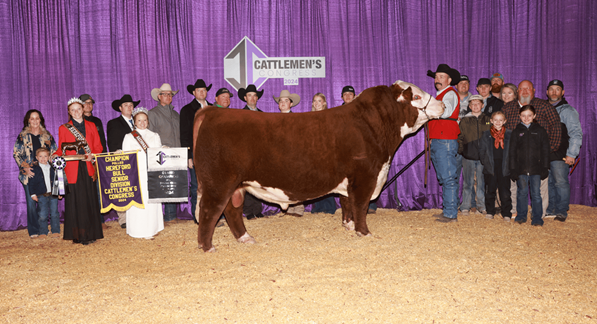
Herefords hit the Oklahoma red dirt as judge Kyle Colyer, Bruneau, Idaho, sorted the 58-head Hereford bull show and 220-head Hereford female show at the 2024 Cattlemen's Congress in Oklahoma City, Okla., to find his champions with son, Cruz, by his side. Throughout the four-day national Hereford show, Jan. 3-6, a total of 572 Herefords were exhibited.
Bull show champions
Buck Cattle Co., Madill, Okla.; Ella Weldon, Piedmont, Okla.; and 6 Mile Creek LLC, Yukon, Okla., received the polled grand champion bull banner with BK Jet Smooth J18 ET. The champion senior bull, born Sept. 10, 2021, was sired by JDH AH Standout 16G ET. Curry Herefords, McAlester, Okla., took home the reserve champion bull title with CH Premier 233 ET. The KLD RW Marksman D87 ET son was born March 22, 2022, and was also named champion yearling bull.
Grand champion horned bull honors went to Copeland and Sons LLC, Nara Visa, N.M., and Running P Cattle Co., Canyon, Texas, with RPC 7119 007 Rubble 210, sired by BR ER Big Country 007 ET. The Feb. 20, 2022, entry won the yearling bull division. Barber Ranch, Channing, Texas, exhibited the reserve champion horned bull; BR Panhandle Drifter L002 ET. Sired by BR ER Big County 007 ET, this champion junior bull calf was born Jan. 1, 2023. "We have the best breed show in the bull division and the bull classes of any national show, and it's a commitment to the breeders," Colyer said before selecting his first round of champions in Oklahoma City.
Female show champions
Madilyn Norvell, Tuttle, Okla., exhibited the polled champion female with NCC Rhea 2058 ET, sired by CH High Roller 756 ET. The Nov. 27, 2022, entry was first awarded champion senior heifer calf honors. The polled reserve champion female was shown by Sara Sullivan, Dunlap, Iowa. SSF KKH 25W Belle 211 ET, the March 3, 2022, daughter of H Bell Ringer 8459 ET, and was also named the champion spring yearling female.
Fallon and Gunnar Gohr, Madras, Ore., and their champion junior yearling female, BK Keep It Simple 259K ET, were awarded the horned champion female title. This daughter of SR Dominate 308F ET was born Feb. 4, 2022. Dylan Kottkamp, Clayton, Ind., with GKB 8688 2296 Monroe K110 ET, won reserve horned champion female. The March 7, 2022, entry sired by UPS Sensation 2296 ET, was first awarded champion spring yearling female honors.
Buck Cattle Co. Madill, Okla., was recognized as the horned premier breeder. T/R Cattle Co., Glencoe, Okla., was named polled premier breeder. Polled premier exhibitor honors went to Ella Weldon, Piedmont, Okla., and Hurricane Hefty Ranch, Oklahoma City, Okla., and Hendricks Cattle Co., Troy, Ala., were awarded horned premier exhibitor.
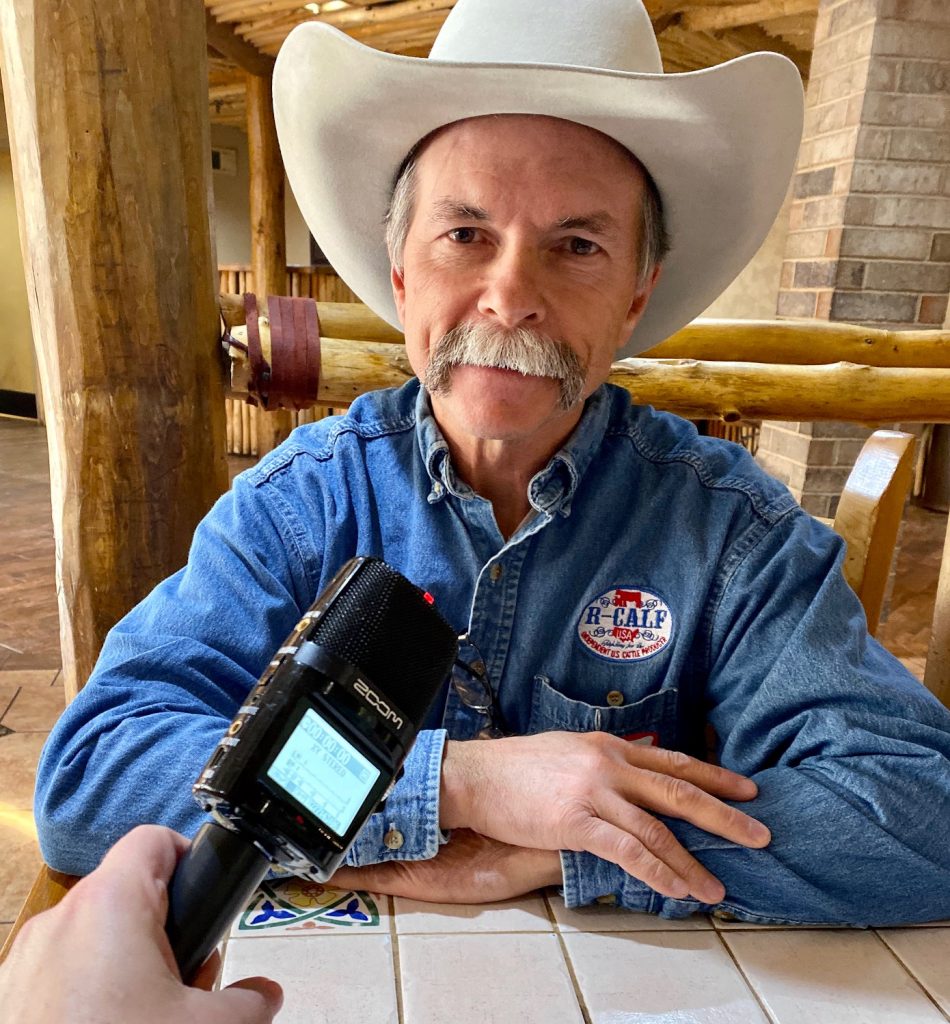
I hope you're not missing this. We're standing at the precipice of a major upheaval and many of our nation's leaders have yet to understand what's going on. So, let's look at what's going on.
One can arguably say it started about three years ago, in India. There, the government had been providing price supports for farmers, protecting them from the abuses of large corporations that threatened to take control of the markets if those price supports were eliminated. And that's what India's government proposed to do – to eliminate the price supports for farmers and allow the corporations agribusinesses to control the markets. Given the dominance of large agribusinesses over India's agricultural markets, the threat of collusion and market manipulation was cited as the reason India's farmers began protesting en masse. It's estimated that 200,000 tractors and 250 million people took part in India's months-long protests.
Then two years ago the Dutch government began blaming its farmers for polluting the atmosphere. It issued a directive to cut emissions from farming by 50% by 2030. To accomplish this, the Dutch government is attempting to eliminate farmers. Reports indicate the Dutch government wants to reduce livestock production eliminating thousands of farms and reducing the production of livestock from even more farms. In response, Dutch farmers began protesting against their government en masse.
Last year, protests sprang up in France where farmers complained of higher fuel prices, higher taxes, and climate and agricultural policies. And last year, the government of Ireland reportedly announced it would reduce Ireland's cow herd by 200,000 cows to meet climate goals.
And right now there's a huge farmer protest going on in Germany. The farmers there claim their operating costs, particularly fuel prices, have skyrocketed and their government is intending to end or reduce the price supports that farmers there receive and to increase taxes upon them. You see, like in India, the large corporations that dominate the food industry are poised to take control over the markets, leaving farmers with markets that won't cover their costs of production and no subsidy to make up the difference. German farmers are now protesting during their "Week of Action," which may actually last for many weeks, as they vow to continue until their government listens to them.
World leaders and some media label all these farmers as right-wing extremists. But are they? They're not protesting over some ideology; they're protesting over their inability to stay in business. This suggests these farmers are pragmatists, if not realists. The German mantra is "No Farmers, No Food, No Future."
So, what can we learn from this unprecedented swell of farmer protests that appears to be spreading at an accelerated pace around the world?
Well, first and foremost we need national leaders to say: "Houston, we have a problem." Unsurprisingly, however, that hasn't happened.
The reason national leaders don't recognize there is a problem is because they stopped listening to farmers and ranchers decades ago. You see, the multinational agribusiness corporations operating here and abroad have positioned themselves to be the surrogate voice of farmers and ranchers. They infiltrated all the conventional commodity groups for cattle, hogs, sheep and chicken to ensure that these so-called producer groups support their economic interests, not the interests of actual farmers and ranchers.
And these agribusiness conglomerates have convinced our national leaders that what is good for them is also good for the farmers and ranchers from whom they extract their raw products.
So, let's identify the problem ourselves. The problem is that farmers and ranchers have unwittingly allowed themselves to be controlled by their respective governments and by the multinational agribusinesses that have become so big and so powerful that they're able to speak through governments with their unprecedented political influence.
As evidenced by the protests in India and Germany, the farmers have grown dependent on government subsidies for their survival, and the loss of those subsidies would make them vulnerable in the marketplace that's controlled by the multinational agribusinesses.
In the case of the French, Dutch, and Irish farmers, they're controlled by their respective governments that view them as the low hanging fruit, easy targets for which to begin implementing arbitrary climate goals.
Farmers and Ranchers must break free of the controls that allow governments and multinational agribusinesses to weaponize food policies that give them, and not the farmers and ranchers, control over food production, and the public needs to help them do that. There's nothing more dependable than a fully competitive marketplace where the government's role is limited to protecting against antitrust and anticompetitive behavior. In such a marketplace, there will be thousands more farmers and ranchers producing what the consuming public wants and needs, and they'll be paid a competitive price for their efforts. So, let's change Germany's mantra to: More Farmers, More Food, and a Better Future.
Experienced Texas seed rep Allen Hensley has joined Meristem Crop Performance Group, LLC (www.MeristemAg.com), one of the fastest-growing crop input suppliers in America. Hensley becomes Meristem's sales and dealer development operative in central and southern Texas.
"Allen Hensley is knowledgeable and service-oriented expert at getting solid crop production results in the challenging conditions facing Texas crop producers," says Mitch Eviston, Meristem Founder and CEO in announcing the hire. "He knows his stuff and not afraid to incorporate innovative technology to get better results. We are excited to have him on our growing all-star team."
Hensley grew up working on a family farm south of San Antonio. After classes at a local community college, he enrolled at Rogers State University in Oklahoma, where he met his future wife, Svetlana. The couple now live near Alice, Texas and have three sons: Miryk, 17, Kirym, 9 and Maverik, 7.
"Meristem's mission and messages are very important and very straightforward," he says. "Meristem means less stress to the crops, more bushels for less and reducing waste." As he continues to operate a farm business providing Rob-See-Co seed to growers, he sees Meristem's innovation as key to making the most of every seed that goes into the ground.
"I've been seeing these different biologicals come out over the past several years and I could see there had to be a better way of doing it," he says. "As soon as I saw REVLINE® HOPPER THROTTLE™ in that BIO-CAPSULE™, it just made sense. And it's really working."
Allen and Svetlana returned to Texas in 2010 when his grandfather passed away and the family needed a hand with the operation, then run by his uncle and cousin. After a conversation with family and friends, he became farm manager for a 12,000-acre operation nearby and at the same time launched his farm business with Rob-See-Co.
"I've had a very good experience with Rob-See-Co," says Hensley. "It turned into a consulting business, and I would wake up in the middle of the night thinking about a farmer's problem and how to solve it. I realized then that it had reignited a passion in me for bringing the best solutions to farmers." When Meristem's President Rob McClelland called about carrying the Meristem portfolio to more farmers in Texas, he seized the opportunity.
"It starts with the soil and the seed, but you need to feed that crop all season long and Meristem has the products that can do that," he says. "Farmers down here are in a lower yield environment and have to be careful managers. Meristem's "more bushels for less," makes perfect sense to them. They need it."
About Meristem Crop Performance
Meristem Crop Performance Group, LLC (www.meristemag.com) is one of the fastest-growing crop input companies in America. Meristem sources, formulates, licenses, and delivers high-quality crop inputs to farmers at a price point empowering them to gain real productivity by increasing yields and lowering their per unit production cost. Meristem is building a highly efficient channel to bring crop inputs to market, reducing waste and accelerating access to farm-ready innovations, such as their patented Bio-Capsule Technology™ and Microbilize Technology™ biological delivery systems. For more information, visit meristemag.com, or follow Meristem Crop Performance on Twitter, Facebook, LinkedIn, and YouTube.
With extreme arctic temperatures forecast for the area starting this weekend and throughout next week, AAA Oklahoma urges drivers to make sure their vehicles are ready for the cold.

"Winter is a tough season on vehicles," said AAA Oklahoma spokesperson Rylie Fletcher. "Last winter (Dec. 2022-March 2023), AAA emergency roadside service crews responded to more than 58,000 calls for assistance in Oklahoma alone. The sudden onset of dangerously cold weather often leads to a spike in assistance calls, especially for dead batteries."
Batteries
Did you know that a car battery loses a third of its power in freezing weather? Because as the air outside cools, the oil in your car thickens. Parts move slower, and your battery has to use more power to turn over and start the engine. If the temperature drops to zero or below, your battery has only HALF its power to start the vehicle.
Here are a few quick tips to help you avoid the moment when you turn the key in the ignition and nothing happens.
Warning Signs
What You Can Do

If drivers experience some of the warning signs above with their battery, they are urged to have their battery charge tested. A car care center, such as an AAA Approved Auto Repair Facility (https://www.aaa.com/autorepair/), or auto parts store such as Napa Auto Parts can test a battery. And AAA members can call for a AAA Mobile Battery service technician to come out to test the battery and, if needed, replace it on site.
Other important vehicle components
AAA automotive experts also recommend drivers pay special attention to these other key vehicle components during extreme cold:
Tires
Air expands when it is heated and contracts when it is cooled. As the air temperature drops outside, so does the air pressure in your tires. Why is this important? Maintaining proper tire inflation is essential for safe driving. For every 10 degree-change in air temperature, a tire's pressure will change by about 1-2 psi (pounds per square inch).
How to Check Your Tires:
Fluids
AAA automotive experts report seeing increased numbers of vehicles in need of repair because of issues with fluids. With subzero temperatures expected, it's critical that drivers take time to ensure proper vehicle fluids are being used, levels are correct and they are rated for the weather conditions.
How to stay safe if stranded
Whether you have a long commute to work or just need to drive a short distance to the store, preparation is key to staying safe should a vehicle breakdown happen in extremely cold temperatures.
Drivers are advised to prepare a winter emergency kit now and stow it in the trunk or cargo area of their vehicle to have it immediately available should the need arise. AAA warns, more than 40% of motorists do not carry an emergency kit in their vehicle.
The emergency kit should include:
Many of the winter emergency items listed above – plus pre-assembled multi-item kits – are available, at a discount to AAA members in the online store at AAA.com. Some emergency kits may also be available at local AAA retail locations.
On today's Cow-Calf Corner, Rosslyn Biggs, DVM, Oklahoma State University State Beef Cattle Extension Veterinarian, talks about cow nutrition.
Good nutrition is one of the foundations for success in any cattle operation. Obtaining a basic understanding of nutrition and making data driven decisions can give every cattleman an advantage in creating a nutrition program best suited to their operation. The following recommendations may help revise or build a new a nutrition program.
Recommendation #1: Update Skills
Oklahoma State University Extension offers a variety of opportunities to increase beef cattle nutrition knowledge, including a recently launched "Introduction to Beef Cattle Nutrition" online course. The online course is self-paced, introduces participants to the fundamental principles of beef cattle nutrition and walks users through approaches to use this information in an interactive fashion. OSU Extension is offering the course for 20% discount through March, and this discount is exclusive to our readers. To receive the discount, use the code OKCow24. More information on the course can be found at extension.okstate.edu/programs/extension-online-courses/.
Recommendation #2: Forage Testing
Forage testing provides cattle producers with quantitative data which allows them to make decisions based on quality. The results from forage testing are used to calculate ration formulations, estimate feeding value and establish market price for hay sales. The Oklahoma State University Soil, Water, & Forage Analytical Laboratory measures three principal forage quality values: crude protein, acid detergent fiber, and neutral detergent fiber. These three values can then be used to calculate other quality parameters such as digestible protein, total digestible nutrients, and net energies for maintenance, lactation, and gain. Producers interested in forage testing should contact their local county extension office for more information on submitting samples. Samples should be submitted either through your local County Extension Office (https://extension.okstate.edu/county). Although samples can be submitted directly to the lab (https://agriculture.okstate.edu/departments-programs/plant-soil/soil-testing/) County Extension Offices across the state provide sample bags, tools, and technical assistance for sample collection and shipping, and provide result interpretation.
Recommendation #3: Use Available Tools
The Oklahoma State University Cowculator is used routinely by top producers and veterinarians across the United States and internationally when assessing or developing balanced rations for the cow herd.
Cowculator is a Microsoft Excel spreadsheet designed to assist cattle producers and veterinarians in making informed decisions associated with beef cow herd nutrition. Animal characteristics (such as cow weight, body condition, stage of production and breed), as well as the feed and forage lists can be customized to each operation or specific scenarios within an operation. More information on Cowculator and other useful beef focused decision aids can be found at www.beef.okstate.edu .
Combine harvester sales closed out the year ahead of 2022 levels, while almost all tractor segments saw declines in both the United States and Canada, according to the latest data from the Association of Equipment Manufacturers (AEM).
Total U.S. farm tractor sales fell 5.1 percent in December compared to 2022, while year-to-date sales came in 8.7 percent lower than a year ago. However, 100+hp tractors grew 5.2 percent for the year and 3.6 percent in December, while combine harvesters finished 2023 with sales up 1.7 percent last month. The sub-40hp segment led losses for the year as a whole, falling 10.7 percent for calendar 2023 on the heels of a 5.8 percent drop in December.
For Canada, 4WD farm tractor sales jumped 64.9 percent in December and finished the year up 44.4 percent overall. Overall unit tractor sales finished 2023 down 14 percent for the month of December and 10.7 percent overall. All tractor segments other than 4WD units experienced double-digit declines in December, but combine harvesters did close out the year with YTD gains of 5.5 percent.
"Seeing year-over-year gains in U.S. sales of both combine harvesters and 100+hp tractors is a welcome sight as 2024 gets underway," said AEM Senior Vice President Curt Blades. "And while several tractor segments fell last month versus 2023, we're still confident in the strength of the equipment market and remain optimistic about its long-term growth."
The full reports can be found in the Market Data section of the AEM website under Ag Tractor and Combine Reports or downloaded below.
The third class participating in the National Institute for Animal Agriculture's (NIAA) Advanced Training for Animal Agriculture Leaders has been selected and will convene for their first session in Chicago in February 2024.
NIAA established the leadership program in 2021 to provide an opportunity for animal agriculture leaders to gain next-level leadership and professional development training. What makes the Advanced Training for Animal Agriculture Leaders unique is that its curriculum and experience is co-designed by the leadership cohort and is specifically designed for the animal agriculture segment of the industry.
The 16-month program is sponsored by the United Soybean Board and Farm Credit and was created by NIAA to empower professionals in the early to midpart of their careers to build on previous leadership development experiences and collaborate with peers across the industry. The cohort attends five in-person meetings with additional virtual working sessions to focus on four areas of development: critical thinking, leadership development, connecting and relating skills, and operational excellence. A presentation of a group capstone project will complete Cohort 3's leadership training at NIAA's Annual Conference in April 2025.
"Part of NIAA's mission is to foster collaboration and cooperation throughout the industry. This program was intentionally developed to build upon existing leadership experiences, so professionals advance their skills - specifically, collaboration," said Eric Moore, NIAA Board Chairman. "It was important to me to participate in the inaugural cohort and it has been an enriching experience for me and my fellow leaders."
There were more than 50 very capable applicants for the Advanced Training for Animal Agriculture Leaders. The third cohort represents 20 leaders in a diverse range of agricultural sectors to advance animal agriculture's role in today's food system. NIAA welcomes:
To learn more about the program, it's sponsors and how to participate in the next cohort, visit https://www.animalagriculture.org/leadership-program/.
RON's Dave Lanning has a pre-opening look at today's agricultural Markets.
Click the audio tab below for today's report.
Today, Agriculture Secretary Tom Vilsack offered the following statement in support of America's dairy industry, in advance of National Milk Day, which will be celebrated on Thursday, January 11. Agriculture Secretary Vilsack today visited the Pennsylvania Farm Show in Harrisburg, Pa., which is the nation's largest indoor agricultural event. While there, he met with several dairy farmers and business owners who are contributing to local and regional food systems in and around Pennsylvania, and announced a $26 million Regional Food Systems Infrastructure grant that will help increase capacity and resilience in middle-of-the-supply chain activities, including dairy processing.
"On National Milk Day, we celebrate the historic moment in 1878 when milk was first delivered to homes in sterilized glass bottles, marking a turning point that made milk more accessible and a vital source of nutrition for families across the country. Our dairy farmers are the unsung heroes behind every glass of milk, working tirelessly to ensure families receive essential nutrients at the dinner table. Thanks to their innovation and productivity, high-quality dairy products can be relied upon as a component of nutritious school meals, at child and adult food service programs, and by families who participate in WIC—an important, evidence-based nutrition program that is gaining new participants at historic levels. Through active support for international trade, specialized safety net programs like the Dairy Margin Coverage Program, popular conservation programs like Environmental Quality Incentives Program, dedicated Dairy Business Innovation Centers, and more, USDA is committed to helping the America's dairy industry remain competitive, access new and better markets, and keep their family businesses in operation for the long-term. At USDA, we are honored to work alongside America's dairy producers as they provide necessary, nutritious dairy products to communities nationwide. Next time you enjoy a glass of milk, a slice of cheese, or a cup of yogurt, remember that these products are a result of the hard work and dedication of America's dairy farmers."
USDA's Economic Research Service reports that in 2022, 226.46 billion pounds of milk were produced in the U.S., generating $57.51 billion (source). Milk cash receipts in Pennsylvania were $2.6 billion in 2022, putting them at their highest level since 2014. According to the International Dairy Foods Association, The U.S. dairy industry supports 3.2 million jobs (source), including 134,600 jobs in Pennsylvania (source). For more information about the ways USDA stands with America's dairy industry, see this infographic and follow USDA on Instagram,X, and Facebook

Attorney General Gentner Drummond testified today before the U.S. House Homeland Security Committee that the failure of the Biden Administration to secure the nation's southwest border is seriously endangering public safety in Oklahoma. The Capitol Hill hearing was part of that committee's impeachment proceedings against Department of Homeland Security Secretary Alejandro Mayorkas.
Drummond noted that the flood of illegal immigrants into the U.S. under Mayorkas has allowed criminal enterprises, primarily populated by Mexican and Chinese nationals, to jeopardize public safety through drug trafficking and other crimes. He recounted the details of a November 2022 quadruple homicide at an illegal marijuana farm in Kingfisher County where a Chinese national allegedly killed four people.
"The carnage of that day is but one tragic example of a failed system plagued by failing leadership," Drummond said. "Throughout Oklahoma, law enforcement comes into daily contact with foreign nationals who entered our country illegally or who remain here illegally – or both. This is all too common in Oklahoma's marijuana grow operations."
He told the committee that criminal illegal immigrants have heavily infiltrated Oklahoma's legal medical marijuana industry to manufacture and distribute black-market marijuana. Drummond noted that these criminal organizations also produce and distribute fentanyl and engage in sex trafficking and labor trafficking.
"Oklahoma's law enforcement community fights a constant battle against these evils," he said.
Drummond praised the Oklahoma Bureau of Narcotics and Dangerous Drugs, the Oklahoma State Bureau of Investigation, and the scores of local law enforcement agencies for their heroic efforts combating the crime syndicates.
"While there have been great successes," Drummond said, "the ongoing border crisis ensures a never-ending flood of illegal foreign nationals who continue to perpetrate criminal activities that endanger our people."
The Attorney General said that over the past seven months his Organized Crime Task Force – the first of its kind in the Oklahoma Attorney General's Office – has investigated and is prosecuting more than 50 multi-jurisdictional criminal cases, the vast majority of which involve Mexican or Chinese drug syndicates.
"The people of Oklahoma don't deserve to live under constant threat from criminal foreign nationals," Drummond said. "We don't deserve to have our communities flooded with illegal drugs that were smuggled across our unsecure border, and we don't deserve to have our loved ones ripped away by those same drugs."
Drummond was one of three state attorneys general who testified at the hearing, entitled "Havoc in the Heartland: How Secretary Mayorkas' Failed Leadership Has Impacted the States." Committee Chairman Mark Green has indicated the panel will hear from other witnesses in two additional hearings before members vote on impeachment.
Drummond's opening statement can be read here and his submitted written testimony is available here. Today's entire hearing can be viewed here.
Fueled by record performances in Mexico, Central America and Colombia, November exports of U.S. pork reached the highest value since mid-2021, according to data released by USDA and compiled by the U.S. Meat Export Federation (USMEF). U.S. beef exports slowed in November, recording the third lowest value of 2023. November lamb exports also trended lower.
November pork exports totaled 258,601 metric tons (mt), up 5% from a year ago and the highest in six months. Export value was up 2% to $737.4 million, the highest since May 2021 and the seventh highest on record. For January through November, exports totaled 2.64 million mt, up 8% from a year ago, valued at $7.39 billion (up 5%).
"The momentum for U.S. pork exports is remarkable and very broad-based," said USMEF President and CEO Dan Halstrom. "While Mexico accounts for much of the past year's export growth, there are success stories throughout the Western Hemisphere and across the entire globe. And the coming year also looks very promising in both established and emerging markets."
Beef exports totaled 99,029 mt in November, down 14% from a year ago and the second lowest of the year, while value fell 7% to $786.2 million. For the first 11 months of the year, beef exports were 13% below the record pace of 2022 at 1.18 million mt, while value declined 17% to $9.11 billion.
"There are certainly bright spots for U.S. beef, with exports rebounding in Mexico and demand in several Western Hemisphere markets the strongest we've seen in years," Halstrom said. "But economic conditions in our largest Asian markets and the sharp rebound in Australian production and exports have been persistent obstacles over the past year, making it a sharp contrast with the tremendous 2022 performance for U.S. beef exports. Despite these challenges, we still see sustained demand for chilled U.S. beef, and the U.S. remains the dominant supplier of chilled beef entering Korea, Japan and Taiwan."
With a month to spare, pork exports set numerous annual records
November pork exports to leading market Mexico set a value record at $221.3 million, up 5% from the large total posted a year ago. Export volume (100,313 mt) increased 14% and was the second largest on record, trailing only October 2023. January-November exports already surpassed the annual records set in 2022, with volume increasing 13% year-over-year to 995,534 mt, while value was 15% higher at $2.12 billion.
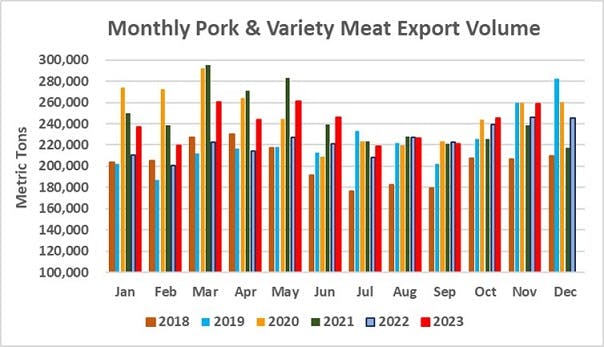
Mexico's surging demand for U.S. pork is especially impressive because the market attracted new competition over the past two years. Since mid-2021, Mexico has granted zero-duty access to all eligible pork, beef and poultry suppliers, and this policy has been extended through 2024. The main beneficiaries are European and Brazilian pork, though pork imports from Brazil have been suspended since late November due to a court challenge to Mexico's import procedures. Even with new players in the arena, the U.S. share of Mexico's imported pork market increased in 2023, reaching 84%.
Led by outstanding growth in Honduras, Guatemala and El Salvador, pork exports to Central America set monthly volume and value records in November. Shipments increased 35% from a year ago to 16,565 mt, while value surged 37% to $51.3 million. Through the first 11 months of the year, exports increased 15% to 119,348 mt, while value climbed 20% to $352.4 million. Shipments to the region are on a record pace, with exports already setting annual value records in Honduras and Guatemala and both volume and value records in El Salvador and Nicaragua.
November pork exports to Colombia set a value record at $34.3 million, up 59% from a year ago, while November volume was the second largest on record at 12,148 mt (up 46%). After a slow start in 2023, exports to Colombia have strengthened in recent months. For January-November, exports were 6% below the 2022 pace at 88,550 mt, but value increased 6% to $242.2 million. The record performance in Colombia and robust growth in Chile and Peru pushed November pork exports to South America to the largest levels in two years. Shipments increased 55% from a year ago to 15,056 mt, the sixth largest on record, while value jumped 58% to $43.2 million, the third highest on record. Exports to Chile were the largest in 11 years and exports to Peru were the largest since June. Through November, exports to South America were 1% lower in volume (106,968 mt) but increased 8% in value ($306.7 million).
Other January-November results for U.S. pork exports include:
Solid demand for U.S. beef in Western Hemisphere, but struggling in Asia
Beef exports to Mexico posted another impressive performance in November, increasing 3% from a year ago to 17,843 mt and climbing 14% in value to $103.6 million. Through the first 11 months of 2023, exports to Mexico rebounded 14% in volume to 189,242 mt and an impressive 24% in value to $1.08 billion – already surpassing the full-year totals from 2022. This included a 16% increase in beef variety meat exports, to 98,330 mt, with value up 20% to $286.5 million.

November beef exports to Central America were steady with a year ago at 1,940 mt, while value increased 20% to $15.1 million, the highest in two years. For January through November, exports to the region edged 1% higher than a year ago to 19,027 mt, while value increased 5% to $135.4 million. Exports to leading market Guatemala were up 5% to 8,471 mt, while value increased 14% to $66.8 million. In Honduras, shipments increased 10% to 2,294 mt and soared 33% higher in value to just under $13 million. Both of these markets have already set annual value records and are on a record volume pace. Export volume to El Salvador is also on a record pace.
Despite lower shipments to leading market South Africa, November beef exports to Africa nearly doubled from a year ago to 1,221 mt (up 97%), while value was 33% higher at $1.5 million. Growth was led by Angola, Cote D'Ivoire and Gabon. January-November shipments to Africa increased 60% to 19,364 mt, valued at $24 million (up 28%). About 98% of these shipments are beef variety meat, mainly livers and kidneys.
Other January-November results for U.S. beef exports include:
Lamb exports still trending lower
November exports of U.S. lamb totaled 115 mt, down 64% from a year ago, while value fell 50% to $817,000. January-November exports were 18% below the previous year's pace at 2,169 mt, while value was 17% lower at $11.5 million. Exports trended higher to Costa Rica, Guatemala, the Netherlands Antilles and Barbados, but these gains were offset by lower shipments to Mexico and Canada.
Complete January-November export results for U.S. pork, beef and lamb are available from USMEF's statistics web page.
For questions, please contact Joe Schuele or call 303-547-0030.
CHS Inc., the nation's leading agribusiness cooperative, today released results for its first quarter ended Nov. 30, 2023. The company reported quarterly net income of $522.9 million compared to $782.6 million in the first quarter of fiscal year 2023.
First quarter fiscal year 2024 highlights:
"CHS earnings were strong for the first quarter, despite a relative decline from last year's record earnings," said Jay Debertin, president and CEO of CHS Inc. "Our focus on execution and efficiency improvements bolstered results across all operations. We continue to see the benefits of our diversified ag and energy portfolio, our strategic footprint and investments in our supply chain. The success of our domestic soybean and canola processing business and our international origination capabilities have helped us add value to our farmer-owners' businesses."
Energy
Pretax earnings of $266.8 million represent a $129.8 million decrease versus the prior year period and reflect:
Ag
Pretax earnings of $169.7 million represent a $117.6 million decrease versus the prior year period and reflect:
Nitrogen Production
Pretax earnings of $36.5 million represent a $60.4 million decrease versus the prior year period and reflect lower equity income from CF Nitrogen attributed to decreased market prices of urea and UAN.
Corporate and Other
Pretax earnings of $43.8 million represent a $7.1 million increase versus the prior year period, primarily reflecting increased interest income due to higher interest rates.
| CHS Inc. Earnings* | |||
| by Segment | |||
| (in thousands $) | |||
| Three Months Ended November 30, | |||
| 2023 | 2022 | ||
| Energy | $ 266,835 | $ 396,594 | |
| Ag | 169,720 | 287,299 | |
| Nitrogen Production | 36,459 | 96,873 | |
| Corporate and Other | 43,832 | 36,704 | |
| Income before income taxes | 516,846 | 817,470 | |
| Income tax (benefit) expense | (6,522) | 34,554 | |
| Net income | 523,368 | 782,916 | |
| Net income attributable to noncontrolling interests | 445 | 318 | |
| Net income attributable to CHS Inc. | $ 522,923 | $ 782,598 | |
| *Earnings is defined as income (loss) before income taxes. |
CHS Inc. (www.chsinc.com) creates connections to empower agriculture. As a leading global agribusiness and the largest farmer-owned cooperative in the United States, CHS serves customers in 65 countries and employs nearly 10,000 people worldwide. We provide critical crop inputs, market access and risk management services that help farmers feed the world. Our diversified agronomy, grains, foods and energy businesses recorded revenues of $45.6 billion in fiscal year 2023. We advance sustainability through our commitment to being stewards of the environment, building economic viability and strengthening community and employee well-being.
| ||||||||||||||||||||||||||||||||||||||||||||||||||||||||||||||||||||||||||||||||||||||||||||||||||||||||||||||||||||||||||||||||||||||||||||||||||||||||||||||||||||||||||||||||||||||||||||||||||||||||||||||||
|
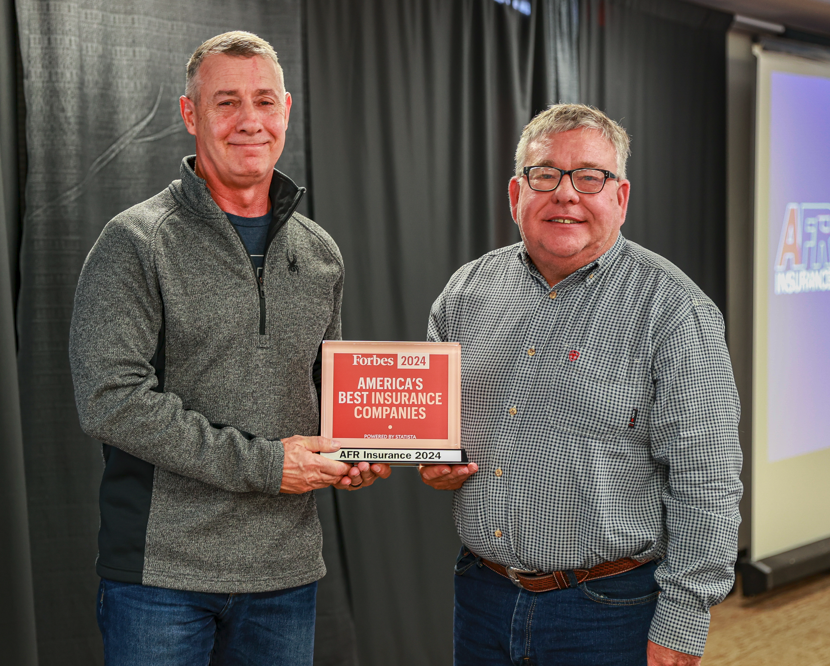
AFR Insurance has been named on the 2024 Forbes list of America's Best Insurance Companies. This prestigious award is presented by Forbes and Statista Inc., the world-leading statistics portal and industry ranking provider. The awards list was announced Sept. 26, 2023, and can currently be viewed at forbes.com.
Forbes' 2024 America's Best Insurance Companies were identified in an independent survey based on a vast sample of more than 15,000 participants across the nation. The participants were asked to evaluate the insurance companies they have held a policy with within the last three years. The survey considered customer recommendations, customer satisfaction and customer loyalty. Additionally, six sub-dimensions were also taken into consideration: Advice, Customer Service, Price/Performance ratio, Transparency, Digital Services and Damage Service. The recommendations and ratings were transformed into score values and aggregated toward a final score.
In total, 155 companies were awarded in five insurance types: Auto, Homeowners, Renters, Term Life and Permanent Life.
Based on the results of the study, AFR Insurance is ecstatic to be recognized on 2024 Forbes list of America's Best Insurance Companies. "We want to say thank you for those who voted for us to make us the only Oklahoma-based company to make the America's Best Insurance Companies 2024 list," said Jon Srna, president and CEO of AFR Insurance. As well as a big thank you to our dedicated agents and employees at AFR Insurance as this is a reflection not only of your hard work and loyal service to the state of Oklahoma but also the positive impact you've made in the insurance industry. Well done!"
AFR Insurance provides automobile, home, farm and life insurance with an emphasis on quality products and exceptional customer service. Affiliated with Oklahoma Farmers Union, AFR was established in 1905 and is headquartered in Oklahoma City. The organization is actively supportive of Oklahoma's agricultural industry and rural population, and provides educational, legislative and cooperative programs across the state. AFR Insurance is available statewide and is recognized as a leading domestic insurance carrier serving more than 150 communities throughout Oklahoma.
Statista publishes hundreds of worldwide industry rankings and company listings with high-profile media partners. This research and analysis service is based on the success of statista.com, the leading data and business intelligence portal that provides statistics, business-relevant data, and various market and consumer studies and surveys.
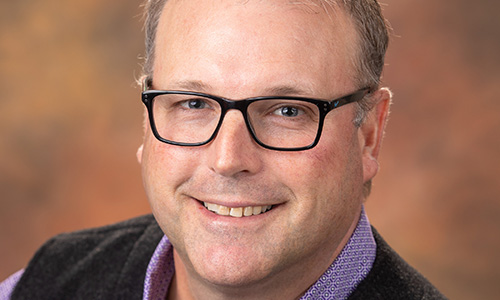
Oklahoma Farm Bureau has named Burton Harmon as the organization's senior director of Young Farmers and Ranchers.
In his new position, Harmon will work alongside OKFB's grassroots-elected YF&R Committee to coordinate programs and events for Oklahoma agriculturalists ages 18-35 to help young Farm Bureau members develop their leadership, advocacy and business skills.
Harmon has worked alongside YF&R members for decades going back to his time on the state YF&R committee as a Farm Bureau member. He also worked alongside county YF&R committees as a north central field representative.
"I am excited to work with our future agricultural leaders through Farm Bureau's YF&R Program," Harmon said. "I loved my time serving on the state committee as a Farm Bureau member, and I am proud to have the opportunity to work with YF&R members to help them grow and develop their skills and abilities to benefit agriculture and Farm Bureau."
Harmon most recently served as OKFB's safety and special projects coordinator, and he will continue to lead and teach OKFB's safety programs as time allows. Burton and his wife, Audrey, live in Morrison where they are active in their local community and have five children, KayLee, Alburto, Benjamin, Aaron and Jared.
Cattle producers need to follow recommended livestock-care checklists to mitigate significant dangers that arctic blasts bring to animal health and production, said Oklahoma State University experts.
Ranchers might not typically think about frozen water sources during a mild winter, for example.
So it's important to remember that cattle in southern Great Plains states are relatively naïve when it comes to the presence of ice in the field, said David Lalman, OSU Extension beef cattle specialist and holder of the university's Harrington Endowed Chair in Animal Science.
"Calves, yearlings and young cows may never have experienced ice-covered water sources, so they're more likely than older cattle to walk into the middle of a pond as a group," he said. "Breakthroughs can be a disaster and possibly even fatal. Keep the water open or move them to a less risky situation such as an automatic water tank."
Other OSU Extension cold-weather recommendations include:
Cattle will eat snow to meet their water needs. However, it takes time for livestock to learn this strategy. The learning curve can result in physical distress.

Research indicates cattle consume 105% to 110% of predicted intake when temperatures drop below 22 degrees Fahrenheit and up to 125% of predicted intake when temperatures drop below 5 degrees. For wind chills of minus-20 degrees or lower, feed intake may be reduced because cattle are reluctant to leave sheltered areas.
"Extremely cold weather is one time that producers should not be overly concerned with waste when rolling out hay across the pasture, because cattle may take advantage of it as bedding and this will provide some relief from the extreme temperatures," said Paul Beck, OSU Extension beef cattle specialist and holder of the university's Dennis and Marta White Endowed Chair in Animal Science.
A video segment of Beck providing additional insights about cold-weather cattle care is available online through OState TV.
Bedding is beneficial in helping to keep cattle insulated from snow or frozen ground and can help protect cow udders from frostbite and contamination. Breeding bulls should be moved indoors, if possible. Producers have too much money invested to risk frostbitten testicles in their breeding sires, which can result in reduced fertility.
Beck cautioned producers to take extra care when breaking ice on frozen ponds. If possible, do not do it alone. Have somebody on hand to render aid if the ice-chopper falls in. Keep a first-aid kit readily accessible and a hot thermos of coffee, tea or similar warm drink. If cutting through an ice-covered farm pond seems too risky, haul in water for the cattle.
Fact sheets detailing additional research-based information about best management practices for cattle operations are available online and through OSU Extension county offices.
The following column by Congressman Josh Brecheen first appeared in The McCarville Report.
Since coming to Congress just over a year ago, I've had the honor of serving on the House Committee on Homeland Security. Our committee has been granted broad legislative authority to keep America's homeland safe. We're responsible for overseeing the Department of Homeland Security (DHS) and ensuring its leadership follows the laws Congress passed.
But as Oklahomans already know, DHS leadership is failing to follow the law and keep our country secure.
Under the reckless leadership of DHS Secretary Alejandro Mayorkas, more than 6.7 million illegal aliens have been apprehended by U.S. Customs and Border Protection (CBP) at the Southwest border. An estimated 1.8 million more illegal aliens snuck across and altogether evaded CBP. Oklahomans don't just know these are the worst numbers ever, they see it and they feel it.
Now, after a nearly year-long investigation, our committee is taking up impeachment proceedings against Secretary Mayorkas. I support this effort 100 percent. We need a Secretary who is going to follow the laws passed by Congress.
Take, for example, section 274 of the Immigration and Nationality Act. The section makes it a crime to "transport, or move, or attempt to transport or move" illegal aliens inside the United States. Thousands of people are charged annually under this statute. But since taking office, Secretary Mayorkas has overseen a system that moves illegal aliens to their preferred destination inside the U.S. through a network of non- governmental organizations that receive taxpayer-grants.
Last year, as part of our investigation into Secretary Mayorkas, the Committee detailed the taxpayer-funded system DHS created:
"DHS has released illegal aliens to a vast network of non-governmental organizations (NGOs), particularly those located at the border, who then provide logistical support. These groups receive hundreds of millions of taxpayer dollars to provide all manner of services to illegal aliens once they are released from CBP or ICE custody, including food, lodging, and transportation to the destination of their choice...The Biden administration is not just working with NGOs to transport illegal aliens across the country, but is also actively doing so using charter and commercial flights, often under the cover of night."
Right now, drug cartels are encouraging families in Latin America to take the dangerous trip to the Southwest border, with the promise that DHS will release them from the border and to the city of their choice. All the while, a non-profit organization receiving taxpayer funds will be providing care and transport.
Secretary Mayorkas knows that cartels profit when they move aliens through Mexico to the Southwest border. Yet, he continues to increase the budget for programs and policies that cartels capitalize on.
Imagine being a mom or dad in Bartlesville, Oklahoma. You work hard every day to put food on the table for your kids, trying to survive the record-high inflation Biden caused. Meanwhile, the government uses your tax dollars to fund transit and care costs for illegal immigrants, which perpetuates the human smuggling system run by cartels. Under this perverse system, drug cartels are getting richer, American families are getting poorer, and American cities get flooded with illegal aliens.
It's completely unacceptable and merits the impeachment proceedings coming before our Committee.
DHS refuses to be transparent about how much the federal government is spending transporting and caring for illegal aliens once they arrive in the United States. Yet we do know that this fiscal year, DHS doled out $770 million to NGOs to shelter and transport aliens paroled into the United States and in fiscal year 2022, it gave at least $140 million in advance payments to NGOs. Shockingly, but not unpredictable, we've learned that some of these funds are being spent on migrants who purposely evaded border patrol.
It's not just the cost of the transportation program that's shocking. DHS-funded planes arrive, often in the middle of the night, and leave migrants and their families on the side of the road or in parking lots, assuming NGOs and local governments will pick up the slack. Because of Secretary Mayorkas' catch-and-release gambit, every state is now a border state. As a former Obama DHS official put it, "This [decision by the Biden administration] is being laid at the feet of every single city in the United States who are not going to have the resources to deal with this."
This system is unsustainable for Oklahoma and for every other state in the Union.
At the end of the day, we are either a nation of laws, or we are not. We either have borders, or we don't. Secretary Mayorkas has repeatedly flouted the law, ignored our border, and used taxpayer funds to advance a system of law-breaking. He must be held accountable.
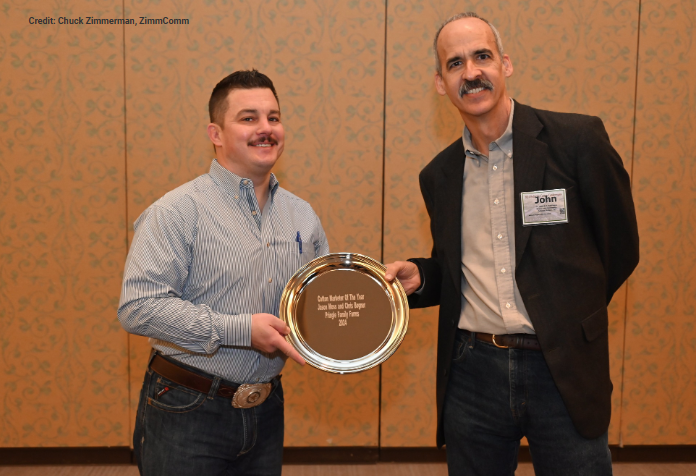
BASF is proud to sponsor the prestigious Cotton Marketer of the Year award, given annually at the Beltwide Cotton Conferences in Fort Worth, Texas. The Joseph J. O'Neill Cotton Marketer of the Year award presented by ICE Futures (formerly the New York Cotton Exchange) and BASF dates back to 1991. This year's recipient is Jason Moss of Pringle Family Farms in Pringle, Texas.
Jason Moss is a second-generation farmer who has been farming for as long as he can remember. Pringle Family Farms in Pringle, Texas, is 8,000 acres of cotton, corn, wheat and sorghum.
"Jason is a successful grower and businessman who understands the importance of not only being knowledgeable about the market, but being knowledgeable about his crops," said Darren Patton, BASF Agricultural Solutions Senior Advisor. "Jason's understanding of all aspects of his business and his emphasis on cotton quality makes him a very worthy recipient of this year's Cotton Marketer of the Year award."
Moss runs Pringle Family Farms with his business partner, Chris Bogner, and also farms in his home state of Illinois. Moss was recognized for this award during the Cotton Economic Outlook Symposium as part of the Beltwide Cotton Conferences.

Time is running out to secure your spot at 2024's Commodity Classic in Houston, Texas! Early bird pricing ends on January 12, so make sure to register now to take advantage of the discounted rates for National Corn Growers Association members. This year's event promises to be bigger and better than ever, with exciting activities planned from February 28 to March 2.
New this year:
For those looking to explore Houston beyond the convention center, unique tours are available, including visits to the NASA Space Center, Port of Houston Boat Tour, breweries and distilleries. The deadline for tour registration is February 6, so act fast!
To register and find more information about housing, trade show details, unique tours or the Houston Rodeo, visit CommodityClassic.com. Don't wait – register now before the early bird pricing ends on January 12!
The demand remains low and most of our hay producers are still not trading much hay and only delivering
to long-time customers. Many producers report they are interested in seeing if this winter storm will help move the hay market.
Trends:
Alfalfa Large squares $180-$200 a ton
Alfalfa Rounds - No Trend
Grinding hay - No Trend
Bermuda 5x6 rounds - $70-$100 a bale
Bermuda Large Squares - No Trend
Grass Hay 4x5-4x6 - $60-$70 a bale
Grass Hay 5x6 - $70-$80 a bale
The Oklahoma Mesonet Drought Monitor shows we are at 0 percent in exceptional drought, 0 percent in an extreme drought, 3.08 percent in severe drought, 21.64 percent in moderate, 44.32 percent in abnor-mally dry conditions, 55.32 percent that has no drought conditions.
* The next report release will be on January 19th

Rep. Rick West, R-Heavener, recently filed legislation that would extend tax-free vehicle title transfers from grandparents to their grandchildren.
Currently an excise tax is levied upon the transfer of legal ownership of any vehicle registered in Oklahoma. Exceptions include people who possess an agricultural exemption, and for title transfers between husband and wife and parent and child.
House Bill 2973 would extend the exemption to grandparents transferring a title to a grandchild, including through family trusts.
"This was a constituent request that makes perfect sense," West said. "Grandparents should be allowed to transfer the title to their vehicles to their grandchildren without the state taxing the transaction. We already do this for parents and children. It's time to extend this to grandparents."
If signed into law, the act would become effective Nov. 1. The bill will be eligible for consideration during the upcoming legislative session, which starts Feb. 5.
Despite increasing pressure from declining commodity markets, rising interest rates and inflation, the land market seems to be moving into 2024 maintaining the value increases it has built during the past three years.
The sharp increase in land values from a year ago that was primarily driven by strong commodity markets has slowed, but those values are being maintained, which is evidenced in Farmers National Company sale results logged in the past six months. Buyer demand remains strong for good quality cropland across the Midwest, while the supply of land for sale remains limited.
"These factors further play into the dynamics of the supply/demand scenario and remain a large factor in supporting current values in early 2024," said Paul Schadegg, senior vice president of real estate operations, Farmers National Company.
Who are the buyers? Successful farmland buyers continue to be local farmer/operators in nearly 80 percent of transactions. Available cash has played a significant role in how aggressive buyers are able to bid at land sales within the past several years.
"Current market operator's equity positions have narrowed over the past year and lending has increased as outlined in the most recent Ag Credit Survey from the Federal Reserve Bank of Kansas City," Schadegg said.
Along with the increase in lending comes the expense from interest, which will cut into potential net farm income in the coming year for farm operators.
What continues to motivate land buyers? Buyer motivation varies between a farm operator and a land investor in that a farm operator is typically interested in land that will fit well into their operation, is adjacent to other owned land, or has historical ties. The land investor typically looks for return on investment, a diversification to their investment portfolio, or potential hedge against inflation.
"One common motivation between these two types of buyers is that land has proven to be a valuable asset due to the historic appreciation in ag land values. Over the past 25 years, average land values have experienced steady growth following the 1980s farm crisis. Under a strong ag economy, Farmers National Company expects that trend to continue," Schadegg said.
What dynamics will affect land values? Commodity markets and input costs will impact land values in the short term. As farm operators make cropping plans for 2024 and buying decisions for expansion of their operations, the key word will be profitability. Easing interest rates and reduced inflation across the country will bring some positive light to balance sheets.
However, the current world conflicts, geopolitical events, and U.S. political processes have the opportunity to create both positive and negative impacts on the ag economy and subsequent land values.
Company statistics remain above 5-year averages. Operationally, Farmers National Company completed nearly 700 transactions across the Midwest in 2023 accounting for $600 million dollars of sales volume.
"More than 55 percent of these transactions were conducted through the company's auctions, providing true market exposure. While this is off the extraordinary pace set in 2021 and 2022, it remains above the five-year company averages. These strong sale results are a true testament to our professional agents and managers in the field and their commitment to achieving our client's goals in marketing agriculture properties," said Schadegg.
Moving into 2024. Farmers National Company's pipeline has been filling up with both land auctions and listings at a volume very typical for the start of a new year. Many landowners are making the decision to take advantage of the current land value strength and sell into a market with a large pool of motivated buyers.
At the same time, other landowners have contemplated the current appreciated value of their land assets and determined there is no better investment outside of land. These landowners are making the decision to retain ownership and further limit the available properties coming into the market.
"Farmers National Company, our agents, and managers market agricultural real estate assets across 29 states in the U.S. Real estate activity, values, and expectations vary across these regions but overall are experiencing stable land values that are expected to continue into 2024," Schadegg said.
Click here to access our online newsroom where you'll find a company fact sheet, this release and the regional report.
# # #
Employee-owned Farmers National Company is the nation's leading landowner services provider. Farmers National Company manages more than 5,000 farms and ranches in 30 states comprising more than 2 million acres. Over the last five years, Farmers National Company has sold 4,650 properties (1,640 at auction) and more than $3.25 billion of real estate. Additional services provided by the company include energy management, appraisals, insurance, hunting lease management, forest management, FNC Ag Stock, consultations, and collateral inspections. For more information about our company and the services provided, visit www.FarmersNational.com.
At the 2024 Cattlemen's Congress, Radio Oklahoma Ag Network Intern Maci Carter had the chance to talk with one of the show's vendors from Rock Creek Distillery, Tiffany Shultz.
Since 2021, Rock Creek Distillery has operated out of Shattuck, Oklahoma.
"We have got vodka and rum, we grow the wheat that our vodka is made from on our farm, and we have ventured over into bourbon," Shultz said.
Rock Creek Distillery has attended Cattlemen's Congress from the start, Shultz said, and the show makes them feel right at home.
"We love Cattlemen's Congress because it is our people," Shultz said. "We showed, my kids grew up showing, we have got a daughter that is a senior, so these are our people."
Rock Creek Distillery products are sold in over 400 locations throughout the state of Oklahoma. Products can also be ordered online at https://www.rockcreekdistillery.com/
44 States, U.S. Territories, Tribes Intend to Launch Permanent Summer EBT Program in 2024; Even More Expected in 2025.
The U.S. Department of Agriculture today announced that 35 states, all five U.S. territories, and four Tribes plan to be the first to launch the new, permanent summer grocery benefits program for children – known as Summer Electronic Benefit Transfer – in summer 2024. They include:
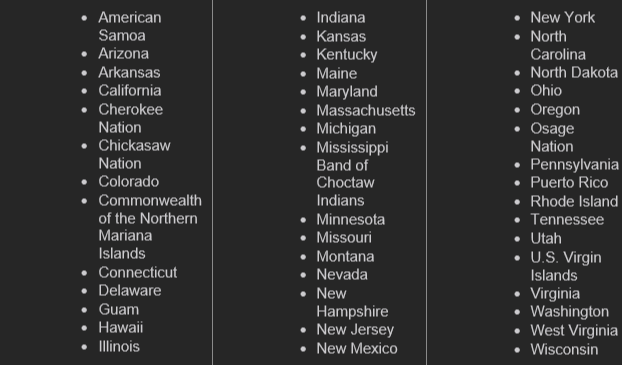
USDA estimates that, in total, the states, U.S. territories, and Tribes that have committed to launching the Summer EBT program in summer 2024 will serve close to 21 million children, providing a total of nearly $2.5 billion in grocery benefits. This is around 70% of the total population of children eligible for Summer EBT. USDA expects additional states and Tribes will provide Summer EBT in 2025.
Through this new program, states will provide families with $120 per eligible child for the summer to buy food at grocery stores, farmers markets or other authorized retailers – similar to how SNAP benefits are used. Participating Tribes will provide a benefit of the same amount that can be used to buy food at WIC-authorized retailers.
"Summer grocery benefits are becoming a reality for many communities across the nation and for tens of millions of children who will receive the nutrition they need to grow, learn, and thrive," said Agriculture Secretary Tom Vilsack. "We applaud all the leaders and partners who are stepping up to make the program's inaugural year a success. Together we're making progress in closing the summer hunger gap and ensuring children are nourished and healthy year-round."
Rigorous evaluations of a multi-year demonstration project showed that providing Summer EBT reduced child hunger and improved diet quality. Summer grocery benefits decreased the number of kids with very low food security by about one-third and supported healthier diets featuring more fruits, vegetables and whole grains.
The new, permanent Summer EBT program advances the goals of the Biden-Harris Administration's White House Conference on Hunger, Nutrition and Health to enhance food and nutrition security and improve food access and affordability. It was enacted on a bipartisan basis by Congress just over one year ago.
This is the inaugural year of the program, meaning states and Tribes that do not launch the program this summer will have future opportunities to opt-in. USDA's goal is for Summer EBT to be available nationwide as soon as possible. The Department is providing extensive assistance, trainings, tools and more to the states, U.S. territories and Tribes targeting a 2024 roll-out as well as to those planning for 2025 and beyond. Working with future implementers is a top priority.
Later this month, USDA Deputy Secretary Xochitl Torres Small will join state, U.S. territory and Tribal leaders, and partners from across the country in Baltimore to celebrate the positive difference this program will make for millions of children.
"No kid should have to spend their summer hungry, or without nutritious food," said Agriculture Deputy Secretary Torres Small. "Summer EBT is a giant step forward in meeting the needs of our nation's children and families throughout the year, and especially in the summer months."
Summer EBT is one of three key mechanisms that USDA is now using to tackle child hunger during the summer months. Families are encouraged to participate in all summer nutrition programs available to them. Summer meal sites provide free meals to families across the country, and many rural communities now offer to-go or home-delivered summer meals to increase access to this vital nutrition support.
For More Information
USDA's Food and Nutrition Service works to end hunger and improve food and nutrition security through a suite of 16 nutrition assistance programs, such as the school breakfast and lunch programs, WIC and SNAP. Together, these programs serve 1 in 4 Americans over the course of a year, promoting consistent and equitable access to healthy, safe and affordable food essentials to optimal health and well-being. FNS also provides science-based nutrition recommendations through the co-development of the Dietary Guidelines for Americans. FNS's report, "Leveraging the White House Conference to Promote and Elevate Nutrition Security: The Role of the USDA Food and Nutrition Service," highlights ways the agency will support the Biden-Harris Administration's National Strategy, released in conjunction with the historic White House Conference on Hunger, Nutrition, and Health in September 2022. To learn more about FNS, visit www.fns.usda.gov and follow @USDANutrition.
USDA touches the lives of all Americans each day in so many positive ways. In the Biden-Harris Administration, USDA is transforming America's food system with a greater focus on more resilient local and regional food production, fairer markets for all producers, ensuring access to safe, healthy and nutritious food in all communities, building new markets and streams of income for farmers and producers using climate smart food and forestry practices, making historic investments in infrastructure and clean energy capabilities in rural America, and committing to equity across the Department by removing systemic barriers and building a workforce more representative of America. To learn more, visit www.usda.gov.

DPH Biologicals, a leading biological company formed in 2018 focused on bringing best in class biologicals to broad acre farms, today announced a management-led buyout with a private investment group.
The company will continue to market under the DPH Biologicals brand and provide customers with the same high-quality products and service they have come to expect. "With proven science, robust field data, strong industry relationships and a focus on biologicals, we are proud of DPH Bio's robust and profitable growth the past several years. As the biologicals market grows, we believe farmers and producers around the world will increasingly demand biological products that work within existing management practices and offer multiple bottom-line benefits, beyond yield," said Mick Messman, DPH Bio president and CEO.
The full management team brings decades of experience in agricultural sales, marketing, research, product development, supply chain management and business strategy, both domestically and internationally, and led the company's rapid scale up and product portfolio expansion, building upon its flagship product - TerraTrove® SP-1®. The DPH Bio management team includes Mick Messman, Alex Cochran, Chris Feiden, Trey Soud, Brad Holzworth, Roberto Werneck and Cliff Watrin, and Mario Tenerelli as Latin America advisor.
"Our team has demonstrated business success in the ag industry and a commitment to deliver value to farmers. We saw the need for a company focused on developing and scaling biological technologies and began the transformation of DPH Bio in mid-2021. When ownership discussions started last year, the existing management team decided the time was right and we were ready and willing to fully invest in the company ourselves," Messman said.
Poised for Growth in 2024
2023 was DPH Bio's most successful year to date, with multiple milestones accomplished leading to a clear growth plan, Messman said, including:
● Launched a regenerative technology platform for biological products, RegenAphex™, a proprietary plant-based humus extract, representing a more sustainable and effective alternative to humic acid and synthetic fertilizers.
● EPA-registration and OMRI approval of BellaTrove Companion Maxx ST®, a biofungicide seed treatment labelled on multiple crops.
● Expanded sales of TerraTrove Residuce®, a unique biodigester product that breaks down crop residue and recycles nutrients, which is now used on over 1 million acres.
● Secured sales and distribution agreements with leading channel partners in the US and abroad and added more than 30 new retail partners in the US ag market.
● Advanced a pipeline of five novel biologicals, with initial sales beginning in 2024.
● Entered a multi-year research collaboration with University of Illinois Urbana-Champaign's Crop Physiology lab run by Dr. Fred Below.
● Re-organized the T&O and International businesses with national distribution agreements and an asset light fertilizer model.
With highly experienced scientists, agronomists and cross-functional teams based in Indianapolis, Ind. and Princeton, Ill., and territory managers located in key markets, DPH Bio will continue bringing its diverse and growing product line to customers around the world, including planned expansion into Brazil.
Customers can contact their sales representative with any questions or visit www.dphbio.com.
About DPH Biologicals
DPH Biologicals, LLC attracts, develops and scales technologies improving broad market access and simplifying the grower experience with biologicals. Based on investments in scientific research, field-testing, partner relationships and product development, and leadership-owned since 2024, DPH Bio yields success through science and relationships, standing at the leading edge of clarity, trust and proven, profitable solutions for agricultural biologicals. For more information, visit www.dphbio.com.
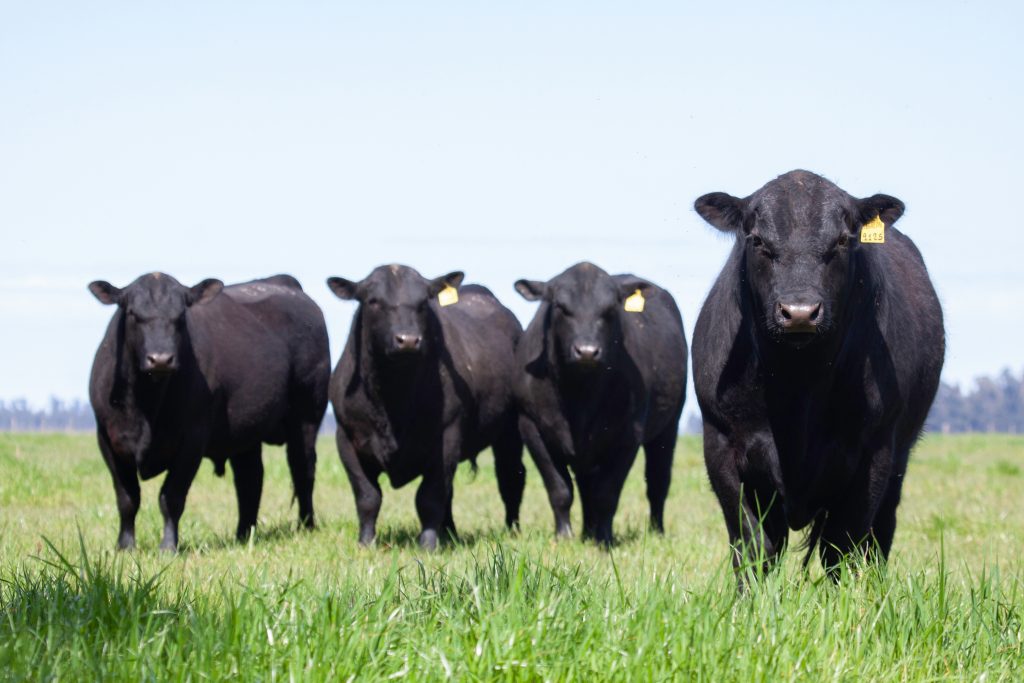
Senior Farm and Ranch Broadcaster, Ron Hays, is talking with CEO of the American Angus Association, Mark McCully. On the sidelines of the 2024 Cattlemen's Congress, Hays and McCully talk about a vision for the Angus breed for 2024 that the Angus industry Executive has.
As about 80 percent of the market share of the beef industry is Angus genetics, McCully said this means that Angus is essential.
"We have got to have those really good Angus females that can go back into these commercial herds and stick around for a long time and do a really great job for our commercial producers, and then we need genetics that the cattle feeder and packer are looking for."
Ultimately, McCully said it is critical to focus on the genetics the consumer seeks.
"That will be our continued charge, is making sure we have got Angus genetics that can do all of those things," McCully said. "We have got great diversity in the breed right now, and because of the tools and technology and data, we are better able to identify which genetics we plug into those different recipes better than we ever can before."
McCully also talked about the legacy of industry icon Jarold Callahan, who played an integral role in the execution of Cattlemen's Congress.
"If I am being honest, it really has not sunk in yet," McCully said.
Callahan's mark on the cattle industry comes down to his vision and perseverance, McCully said, as Callahan was a great leader and visionary.
"He was always thinking that far down the road, which I think led him to be a fantastic leader," McCully said. "It made Express (Ranches) what they were. I think, to me, Jarold was as multifaceted in this industry and new as much about all parts of it as anybody I knew."
The Beef Buzz is a regular feature heard on radio stations around the region on the Radio Oklahoma Ag Network and is a regular audio feature found on this website as well. Click on the LISTEN BAR for today's show and check out our archives for older Beef Buzz shows covering the gamut of the beef cattle industry today.
How can you recognize warning signs indicating financial distress on your farm? Although many farm proprietors and managers have a solid grasp of their farm business's profit dynamics, they frequently overlook the critical aspect of assessing financial resilience. The financial resilience of a business can be gauged by examining liquidity and solvency ratios. In fact, a majority of agricultural lenders, including commercial banks and institutions within the farm credit system, actively consider these ratios as part of their evaluation during the farm loan approval process.
To compute these ratios, you should initially create financial statements, such as the balance sheet and income statement. While the manager and/or owner might not be the ones directly creating these statements, it's crucial for them to comprehend the insights these statements offer regarding the business's financial health and ways to enhance weak financial performance. Emphasizing the importance of maintaining accurate records and regularly producing these statements is strongly recommended, as they prove beneficial during tax filings, loan applications, and gaining insights into the current financial status of the business.
Liquidity
Liquidity metrics assess a debtor's capability to settle existing debt commitments without seeking external funding. These metrics are primarily derived from components of the balance sheet's current assets and current liabilities. Current assets comprise assets easily converted into cash, like cash, bank accounts, investments, and inventories. Current liabilities consist of obligations due within a year, such as accounts payable, production loans, and current portions of noncurrent debt. The most commonly employed liquidity metric is the current ratio, expressed as:
Current Ratio = Current Assets/Current Liabilities
A higher liquidity ratio indicates that the dollar value of current assets surpasses the value of short-term debt obligations, which is favorable.
Solvency
While liquidity ratios focus on the present timeframe, solvency ratios assess a farm business's capacity to cover all liabilities with its total assets. Unlike liquidity ratios, it is necessary to consider the dollar values of both long-term and short-term assets and liabilities on the balance sheet. This includes the dollar value of farmland (a long-term asset) and farmland loans (a long-term liability), which often represent a significant portion of a farm's balance sheet. The most widely utilized solvency metric is the debt-to-asset ratio, expressed as:
Debt to Asset Ratio = Total Liabilities/Total Assets
In contrast to the current ratio, one must divide the dollar value of total liabilities (financial obligations) by the dollar value of total assets. A high debt-to-asset ratio may indicate insolvency, signaling that the value of total liabilities surpasses total assets.
Compare Your Numbers with Benchmarks
The Farm Financial Standards Council (FFSC) establishes benchmarks for these ratios, which are periodically updated, although not significantly. According to the FFSC, it is considered favorable to have a current ratio exceeding 2 and a debt-to-asset ratio lower than 0.6. It is highly recommended that farmers and ranchers assess their liquidity and solvency measures against these benchmarks and take corrective measures if their figures fall short. These can be done through, but not limited to, selling of farm assets that are not in use, raising equity capital through ownership restructuring, and renegotiating on long-term debt.
Additionally, it is wise to compare these numbers with national, regional, and specialty-specific averages, as some lenders may evaluate an applicant's information in relation to other peer groups when deciding on approvals. Individuals can compare their figures with peers based on specialty, region, size, and age group using the USDA Economic Research Service's report, accessible through the following link: https://my.data.ers.usda.gov/arms/tailored-reports
Also, it is a good idea to keep track of these ratios over time, to see whether the financial resiliency of one's business is improving or deteriorating.
Article courtesy of Southern Ag Today, Kim, Kevin, and Brian E. Mills. "Financial Ratios to Consider for Measuring Financial Resiliency of Your Farm." Southern Ag Today 4(2.3). January 10, 2024. Permalink
Mark Johnson, Oklahoma State University Extension Beef Cattle Breeding Specialist, offers herd health advice as part of the weekly series known as the "Cow Calf Corner," published electronically by Dr. Peel, Mark Johnson, and Paul Beck. Today, Johnson talks about preparing for winter calving.
Calving during the winter months can present some unique challenges. Cold and/or wet weather, higher birth weights, fewer hours of daylight and in most herds this is the time of year when we, as producers, are the primary source of nutrition provided in the form of harvested forage and supplemental feeds. What can we do to make calving in the late winter months as problem-free as possible? GET PREPARED!
Calving Kit and Facilities
Prior to Calving Season it is important to take inventory of our facilities. Our working pens, chutes and alley ways need to be in good working order. If we have a calving barn or indoor facility remember to check cameras, batteries and light bulbs. We want all facilities ready BEFORE we find ourselves assisting that first heifer in the calving process.
To be fully prepared, have the following list of supplies in a cooler, bucket or tool box:
- Colostrum and feeding bottle
- Flashlight and batteries
- OB Sleeves
- Non-detergent lubricant
- Antiseptic
- OB chains and calf puller
- Paper towels
- Rope halter
- Large cloth towel
Also, understand the three stages of bovine parturition (covered in past Cow-Calf Corner newsletters). It's important to know what to expect when a cow or heifer goes into labor in order to know when and how to provide assistance.
In regard to colostrum, sooner is better. If you come upon a newborn calf and are not certain it has nursed. Administer colostrum via tube feeder as soon as possible. Insuring an adequate amount of colostrum is ingested by newborns is cost effective and "an ounce of prevention is worth a pound of cure."
Account for Cold Weather
Cold, wet weather drives up cow nutritional requirements and cows should be fed accordingly. The Mesonet Cattle Comfort Advisor is an excellent tool for monitoring weather conditions and the impact they have on cattle. According to the Mesonet Cattle Comfort Advisor, cow energy requirements increase 1% for each degree the cattle comfort index is below 32 degrees F. This energy need will double to 2% if the animal is wet to the skin. In regard to new born calves, consider that in the birth process they are leaving the cozy environment of their mother's womb at a temperature of 101-102 degrees F and hitting the ground at temperatures as much as 100 degrees colder. Add in rain, snow, muddy ground or high winds and the situation can be catastrophic for newborns. While nature equips calves with a limited amount of brown adipose tissue which is burned internally to create heat for survival. Extreme cold can overwhelm the ability to create enough internal heat and hypothermia can occur. Calves suffering from hypothermia are more susceptible to naval infections, pneumonia and scours. Best management practices for cold weather calving include:
- Provide adequate wind breaks, shelter and bedding so cows can separate and calve in a warmer, dryer, protected environment.
- Plan ahead to provide the additional protein and energy needs of cows during the final trimester of pregnancy and the beginning of lactation.
- Sort first calf heifer from cows and manage accordingly. Heifers are inexperienced and more likely to need a higher level of attention during calving and the initial stages of claiming and raising a calf.
RON's Dave Lanning has a pre-opening look at today's agricultural Markets.
Click the audio tab below for today's report.
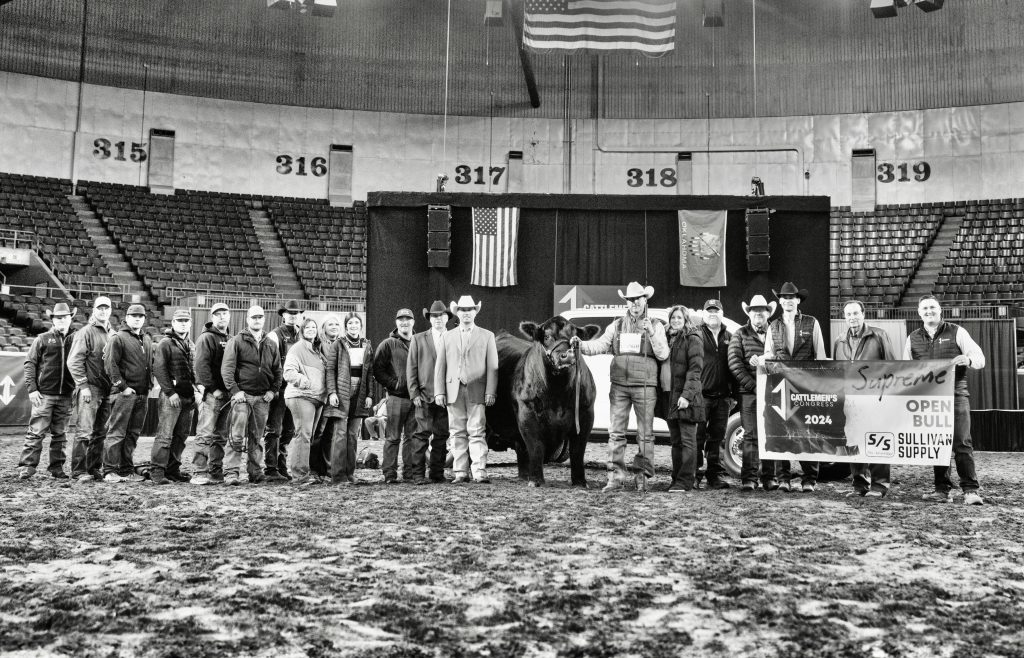
Simmental Champion Wins Supreme Bull Championship at 2024 Cattlemen's Congress
After eleven days of showing some of the best purebreds and composites in North America, over sixty champions were led in the Jim Norick Arena ring on Wednesday late afternoon to compete for the Supreme Champion honors of the fourth Cattlemen's Congress. They were judged the best of their breeds since December 31st. Each judge and his assistant examined the field and picked their best five in the three divisions to conclude the European heritage portion of what is already considered to be one of the premiere beef cattle shows in North America. The Champions that were exhibited represented 22 states and Canada.
The judges selected the last bull named champion of his breed in the show(selected Tuesday January 9th) to this point- TJSC Coping With Destiny 9K- the Simmental Champ(seen above) that is owned by a group that includes Jones Show Cattle, Elmore Cattle Services, Diamond J Simmentals, XTB Cattle Company and Minnaert Show Cattle.
Reserve Supreme Bull was the Limousin Bull Champ- owned by Thomas and Son Farms of Maryland. Third Place was the Angus Bull Champion- shown by Houston Feree of Sullican, Indiana- fourth bull in the Supreme drive was the Percentage Simmental Champ owned by Red ARiver Farms, Circle M Farms and Rocking P Livestock.
Both of the Female Supreme Champions came from the Angus show over this past weekend. The Open Supreme Female was Seldom Rest Sandy 2030- the Angus Champion owned by Jack Dameron of Towanda, Illinois.
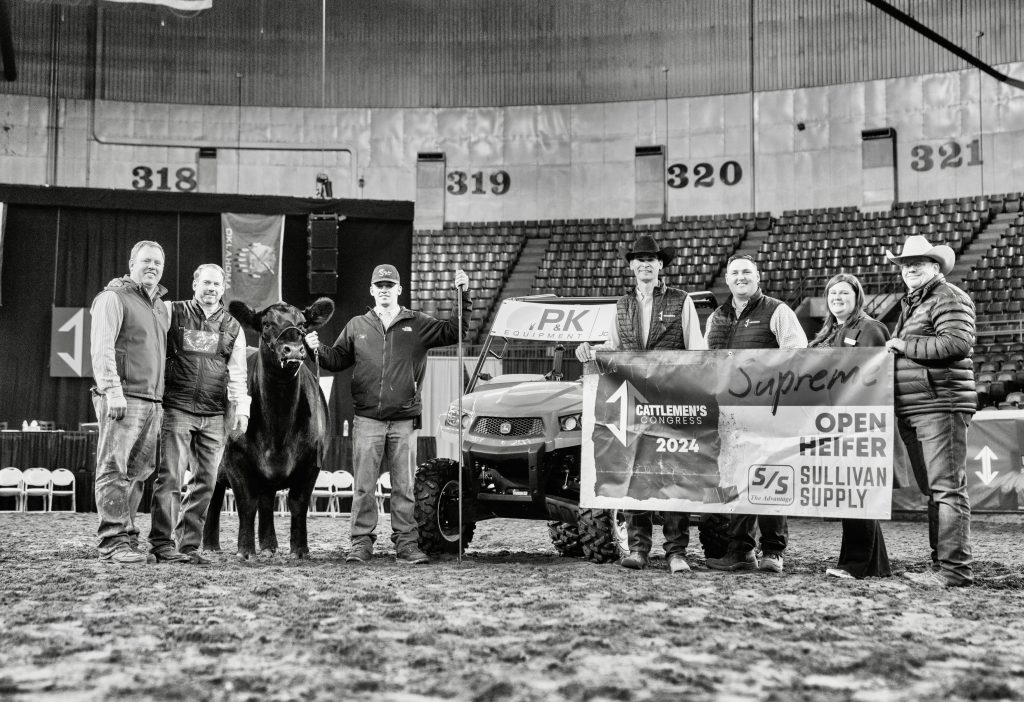
The other top Open Female Champions that placed in the Supreme drive included
Reserve Supreme- the Simmental Champion shown by Laramie Sassar of Edmond, Oklahoma.
Third- Charolais Champ shown by Sara Sullivan of Dunlop, Iowa
Fourth- The Maine-Anjou shown by Mcklay Gensini of Hennepin, Illinois
Fifth- the Balancer Female Champ shown by Braylen Schaeffer of Hagerstown, Indiana
Finally- the Junior Female Supreme Champion was also the Angus Champion of the 2024 Cattlemen's Congress- SSF Envious Blackbird 5022- owned and shown by Samantha Van Vorhis of Bowling Green, Ohio. (seen below)
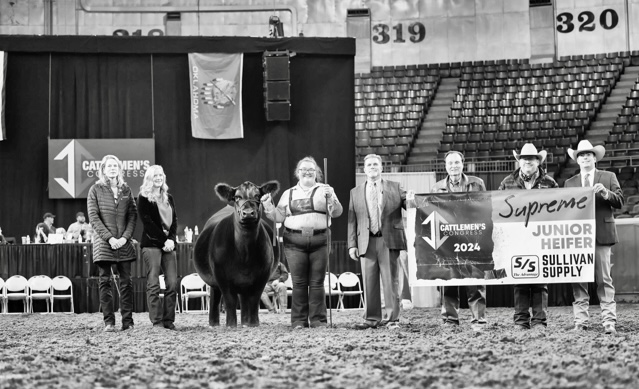
The Reserve Supreme Junior Female was the Maine Anjou Champ- owned by Mckay Gensini of Hennepin, Illinois.
The Third, Fourth and Fifth high junior female champs picked by the judges are all owned by one of the top junior showladies in recent memory- Sara Sullivan of Dunlop, Iowa. Sara's Chianina Champ was Third high- her Lim Flex Champ was placed Fourth High in the Junior Female Supreme Drive and her Charolais Champ was the fifth best of the show.
In addition- the Market Steer show was moved to Wednesday this year- and the Grand Champion Junior Market Steer was the top Exotic Division Champ- shown by Mason Grady of Texas. The Reserve Grand Champion Market Steer was exhibited by Kade Gensini of Illinois- they are shown together here in this picture below:
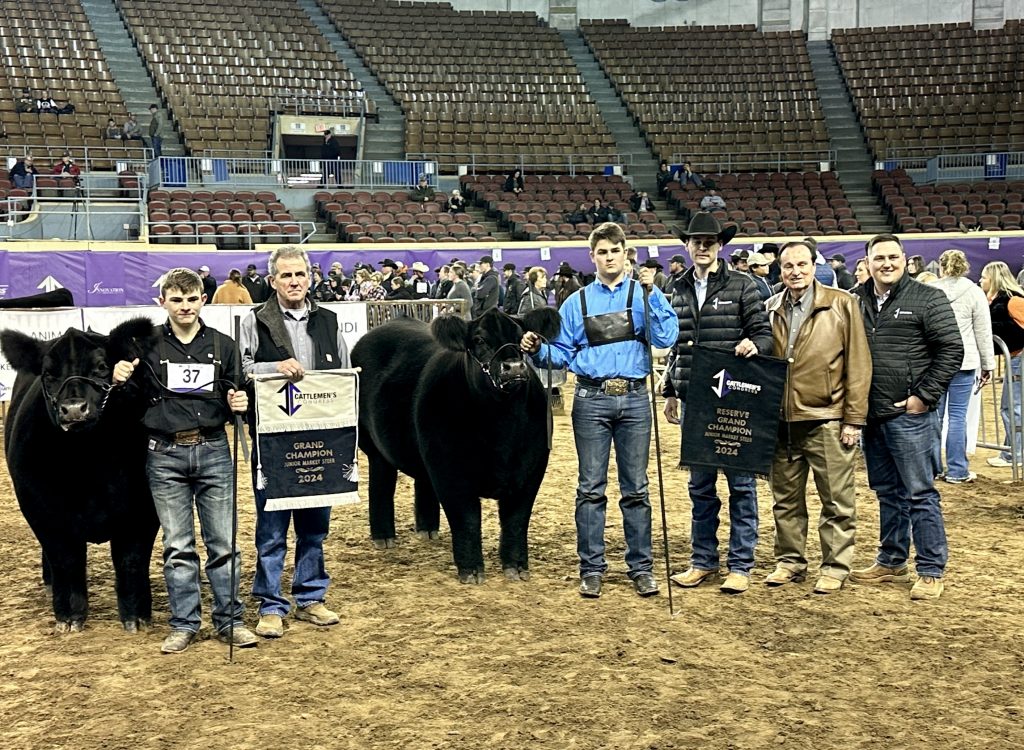
The final portion of Cattlemen's Congress continues through Thursday with the American breeds showing with the Supreme Champion selection of those breeds coming Thursday afternoon.

Rep. Tom Gann, R-Inola, has filed what he called "a pivotal bill aimed at safeguarding Oklahomans' freedom and privacy."
House Bill 2970 comes in response to what Gann termed are growing concerns over the Oklahoma Road User Charge (RUC) Task Force's controversial "Road User Charge" proposal.
"Under their Orwellian proposed plan, Oklahomans would be monitored on every mile they drive, and pay a tax for each of these miles," Gann said.
He said he believes this could lead to excessive government control over personal travel and play, and that he is echoing the worries that many citizens have expressed. He sees the proposal as unfairly penalizing motorists, especially those in rural areas of the state who do not have alternative options for commuting.
"It's quite inconceivable to me that in the near future, motorists might face variable-rate, per-mile fees for driving beyond a government-approved limit," Gann said, highlighting his concerns about the recommendations' potential to put government in charge of every motorist's driven mile.
Gann also raised alarm over the suggested requirement for surveillance infrastructure to track mileage. He said he fears this system could be exploited by state and federal authorities for various oppressive purposes, including targeting individuals with differing political views.
Gann said the first stage of the Oklahoma version of the Road User Charge plan – a pilot program and a task force established in 2021 by House Bill 1712– is already in motion. He said the next phase – voluntary participation – has been recommended by the task force for legislative consideration in 2025.
He said he believes a third phase – mandatory participation – may soon follow. He said he bases this observation on Oregon's version of the plan, where that state initially created a volunteer plan, but discussion in their Legislature has since turned to mandating participation.
Gann's bill seeks to repeal House Bill 1712, halting any future advancement of this initiative.
Gann, who voted against House Bill 1712 in 2021, said he believes the bills implications were not fully understood.
"House Bill 2970 is about reassuring Oklahomans that their Legislature won't enforce a socialist, Orwellian green agenda and a surveillance state here," Gann said. "This is also a chance for the Legislature to correct its course, realize its mistake and repeal House Bill 1712."
Gann said he also intends to update his bill in committee to withdraw Oklahoma's membership from the Western Road Usage Charge Consortium, in opposition to that organization's efforts to promote the road user charge system in Oklahoma and other states.
"House Bill 2970 represents a crucial step in protecting the rights and privacy of Oklahomans and ensuring government policies reflect the will of the majority of the people," Gann said.
A team of experienced OSU Extension specialists provides weekly herd management information to producers as far away as New Zealand, Australia and Mexico. (Photo by Todd Johnson, OSU Agriculture)
The Cow-Calf Corner weekly newsletter published by Oklahoma State University Extension beef management and livestock marketing specialists is celebrating 20 years with nearly 1,600 subscribers worldwide.
Established in 2003 by past OSU Extension animal reproduction specialist Glenn Selk, the newsletter features timely columns on herd management and market analysis for cow-calf producers. Much of the information is also shared in regular segments on SUNUP, the weekly television show of OSU Agriculture.
Cattle news based on research
Selk launched the newsletter with a small list of email addresses he first collected at an annual Oklahoma Cattlemen's Association convention. He intended to support cattle producers by providing research-based information on a relevant management topic each week. To complement the new publication, he recruited the expertise of Derrell Peel, OSU Extension livestock marketing specialist.
"I asked Derrell to join me and write a column on what influences the markets and the different aspects of helping producers predict what the future is going to hold," Selk said. "I wanted the information to help cattlemen and women make management decisions, purchase hay and buy or sell cows. I was thinking 'big picture' to benefit their operations."
Peel's columns, with an economic focus, cover a wide range of perspectives — from ranch-level management and marketing decision-making to national cattle market conditions, global beef and cattle trade.
"My intent is to provide producers with information to make sound and timely economic decisions and to understand market conditions that will help them be best positioned strategically to benefit from changing market situations," Peel said.
Weekly market updates
In the past 20 years, Peel has addressed numerous industry challenges and opportunities, discussing how difficult situations can often lead to positive outcomes in an operation.
"For example, we have experienced several droughts that are challenges for producers to manage through with limited forage, higher costs and forced liquidation, but they later turn into market opportunities as the industry recovers and rebuilds cattle inventories," Peel said. "The pandemic in 2020 was particularly hard due to the unprecedented shocks in beef and cattle markets. The newsletter provided a way to provide timely information to the industry in a period of tremendous uncertainty."
County Extension educators also receive the Cow-Calf Corner newsletter, and the weekly email continues to expand its readership. Educators share the information in their local newspaper columns, radio programs and other newsletters. It is printed and passed around feed stores, co-ops and community spaces frequently visited by producers.
"Our thought was we've got this information that is valuable to folks," Selk said. "We weren't selling anything. We were trying to get good, research-based information to as many people as possible."
Worldwide audience
The Cow-Calf Corner newsletter team has received feedback from readers across the U.S. as well as other countries, including Canada, Mexico, Brazil, Argentina, New Zealand and Australia.
"I have received follow-up from readers all across the country and around the world," said Peel. "The newsletter has led to several additional programs and invitations to speak outside the U.S."
"It's shocking how widely it's distributed in other Extension service newsletters and popular press groups," said Paul Beck, a regular contributor and OSU Extension beef nutrition specialist. "The 'Western Stockman' picks it up — a publication all the way out in the Pacific Northwest. Some information is Oklahoma-specific, but it has broad usage and implications."
The weekly topic is often based on feedback OSU Extension specialists receive from producers in real-time, answering critical questions that can affect herd health and safety. Management guidance on wheat pasture grazing can save producers thousands of dollars by preventing fatal herd hazards.
"Because it's a weekly newsletter, we can address wheat pasture bloat and even send out extra editions that cover risks such as prussic acid toxicity," Beck said. "We're able to answer questions quickly and change direction when putting together the newsletter to address emergencies."
Mark Johnson, Cow-Calf Corner columnist and OSU Extension livestock evaluation specialist, said readers send positive feedback on both short- and long-term management challenges they face daily.
"I believe the newsletter is important because we address timely topics that are of relevance to what is happening on a weekly basis," Johnson said. "For example, last summer and fall when Oklahoma was in a terrible drought, our newsletter was addressing how to mitigate heat stress, culling criteria for cows, benefits of early weaning, the importance of water, the benefits of retaining ownership and feeding non-traditional hays. Feedback from producers has been positive because we were getting out helpful information in a timely fashion relative to what cow-calf producers were dealing with on a daily basis."
Goal: 2,000 subscribers
After two decades of herd applications and research, the Cow-Calf Corner team hopes to achieve 2,000 subscribers and continue to serve as the world standard in cow-calf management.
"I can answer one person's question with a farm visit or phone call, but Cow-Calf Corner offers a lot broader reach when it needs to be shared quickly," Beck said.
Agricultural research throughout OSU's land-grant system is the foundation of the publication that supports not only local producers but also the global beef industry.
"The progression of Cow-Calf Corner focuses on helping people who are trying to make a living, produce food for the other 98% of the population and maintain their ranching operation so that it's healthy and financially sound enough to pass it on to the next generation," Selk said.
By Gail Ellis
OSU Extension uses research-based information to help all Oklahomans solve local issues and concerns, promote leadership and manage resources wisely throughout the state's 77 counties. Most information is available at little to no cost.
The national security threat and humanitarian risk posed by the crisis at the U.S.-Mexico border has brought our country to an important crossroads. It is far past time that we address President Joe Biden's self-made border disaster, support our customs and border patrol (CBP) agents and provide reasonable reforms to a broken immigration system.
Several of the president's first executive actions included dismantling policies put in place by the previous administration that significantly eased a stressed immigration system. These actions included halting construction of the border wall, ending the Migrant Protection Protocols or "remain in Mexico" program and restarting the dangerous "catch and release" program. In order to uphold the principles of a secure and prosperous nation, the Biden Administration must reverse course.
These ill-advised policies evidently encouraged a surge of migrants to swarm the border. In fact, since President Biden took office, there have been nearly 8 million illegal border crossings, including more than 6.7 million southern border encounters and 1.7 million known "gotaways" who evaded U.S. border patrol. In November 2023 alone, there were 242,418 migrant encounters at the southern border, more than a 200 percent increase from November 2020.
Furthermore, criminals have unfortunately exploited the situation at the border to the detriment of American citizens as well as other migrants. So far under President Biden's open border policies, hundreds of individuals whose names appear on the terrorist watchlist were stopped trying to escape into the U.S., including 169 in fiscal year 2023 alone, an all-time record. And so far in fiscal year 2023, CBP has arrested 35,433 aliens with criminal convictions or outstanding warrants nationwide, including 598 known gang members, 178 of those being MS-13 members. The unchecked flow of individuals, including those with criminal intent, endangers the safety of Americans and we must prioritize the protection of our homeland.
Those trafficking dangerous and deadly drugs have also taken advantage of the situation at the southern border. During President Biden's tenure, the flow of fentanyl into our country has increased at a nearly uncontrollable rate, leading to hundreds of thousands of overdoses across the U.S. Moreover, there were more fentanyl seizures in fiscal year 2023 than in fiscal years 2021 and 2022 combined. This alarming statistic is reason enough to establish full control of the southern border.
Finally, the humanitarian toll of this crisis cannot be overstated. Vulnerable migrants, including unaccompanied minors, face perilous journeys that often result in human trafficking or harm. The administration's inaction only leaves those seeking a better life in the shadows of a broken system. This shows the need for balanced reforms that address the root causes of immigration and work with our neighboring countries to create an orderly immigration system, but also respect the rule of U.S. law.
The unprecedented flow of migrants to the border, the uptick in dangerous and deadly drugs such as fentanyl into our country and the humanitarian crisis is a reminder of the consequences of misguided policies and lack of leadership. Congress must get serious about passing further legislation to address this crisis and hold the Biden Administration accountable for its failures. The well-being of our nation and safety of our citizens depends on a strong border.
If you are an Oklahoma Sorghum Grower, make plans to attend the annual meeting coming up on Friday, January 12, from 1-3 pm at the Chistom Trail Expo Center in Enid, Oklahoma.
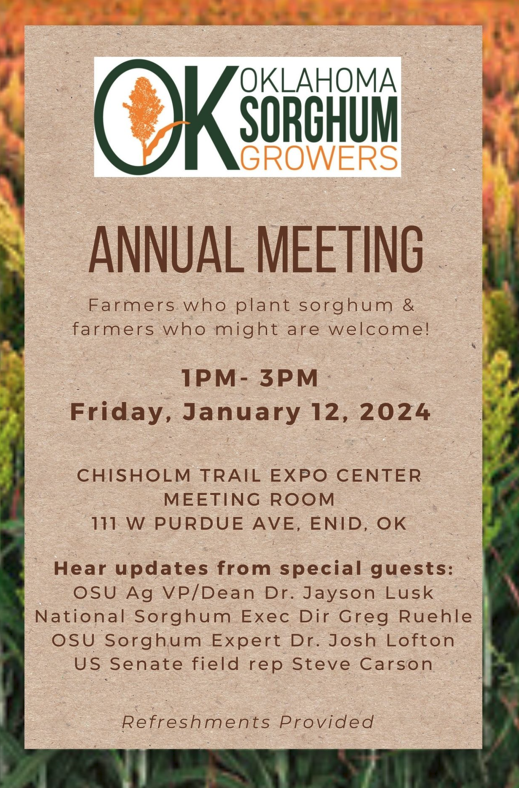
| ||||||||||||||||||||||||||||||||||||||||||||||||||||||||||||||||||||||||||||||||||||||||||||||||||||||||||||||||||||||||||||||||||||||||||||||||||||||||||||||||||||||||||||||||||||||||||||||||||||||||||||||||||||
|
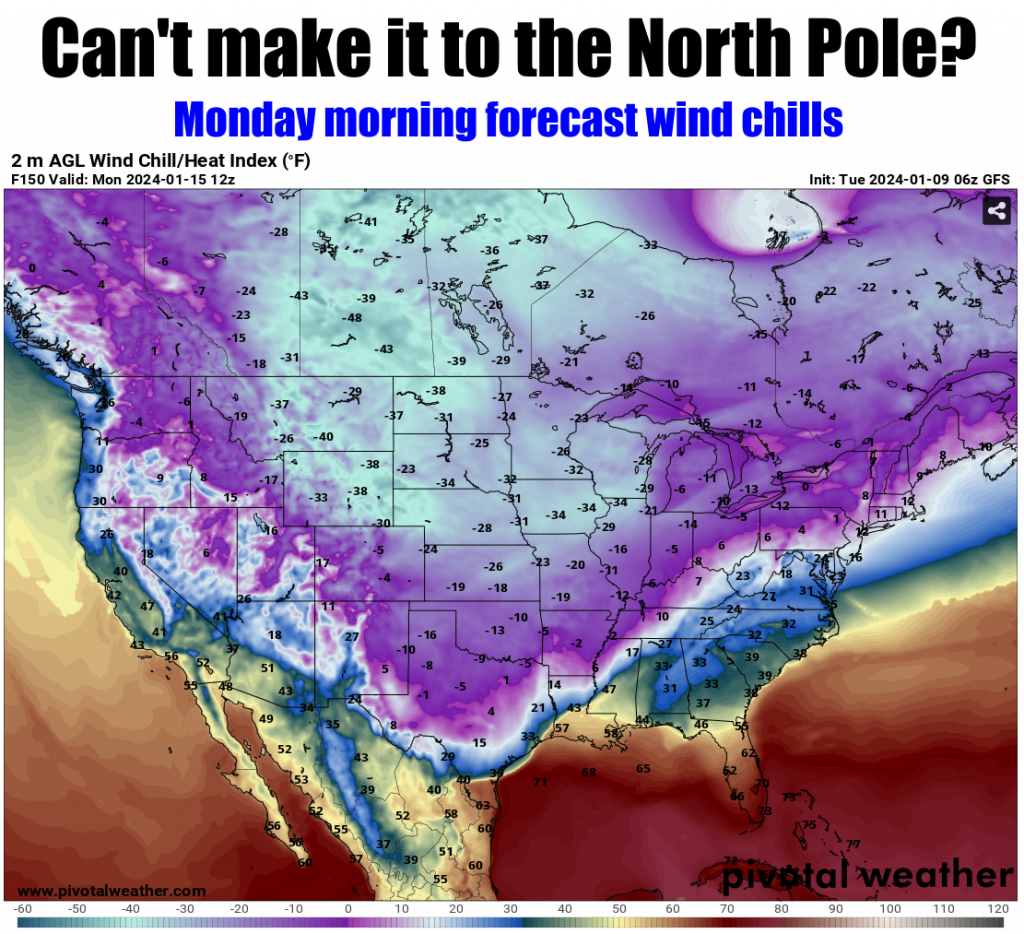
Farm Director, KC Sheperd, is talking with Oklahoma State Climatologist, Gary McManus, about weather coming into the state this week.
"We just had our fourth warmest December on record, and usually that spells trouble," McManus said. "If we ever have a warm December, usually the hammer is going to come down in January or February."
This blast of cold weather, McManus said, is only the beginning. Temperatures are expected to warm up on Wednesday, but after that, McManus said it will be back to those frigid temperatures.
On Friday, McManus said colder air will come in, followed by another blast on either Sunday or Monday.
"Probably on Monday, we are going to get the coldest air we have seen probably in a few years," McManus said. "Probably since February of 2021."
While McManus said he does not predict the upcoming weather to be as harsh and cold as February of 2021, it will still be windy and below freezing for multiple days in a row.
"There is a bit of a snow chance on Friday, but it looks like there is a possible widespread winter storm coming early next week, Sunday into Monday," McManus said. "But that is a lot iffier than the cold air."
McManus said it is too far out to say if snow and ice will be part of the equation, but there will be much colder temperatures.
This winter has turned out to be much wetter, just as McManus had predicted.
"The prediction for El Nino is for it to continue at least through early spring," McManus said.
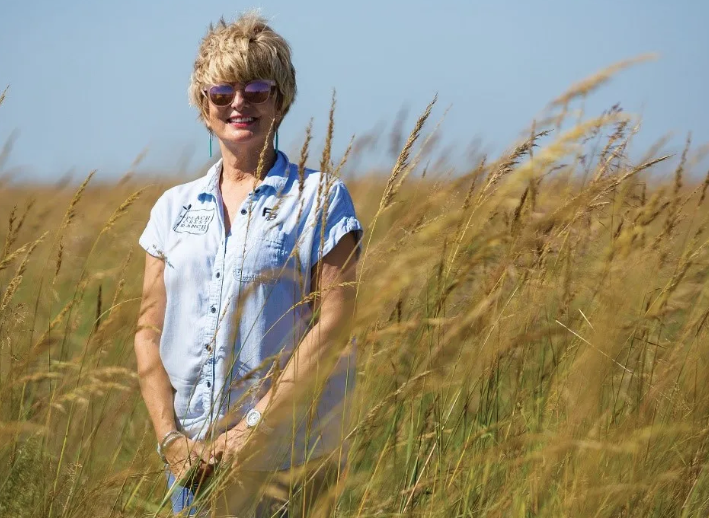
Susan Bergen focuses on building soil health and improving the land on her ranch.
The Oklahoma Department of Wildlife Conservation honors Oklahoma rancher Susan Bergen as its 2023 Landowner Conservationist of the Year. Bergen owns and manages cattle on 12,777 acres of tallgrass and mixed-grass prairie distributed over three tracts in portions of Cleveland, Johnston, Pontotoc, and McClain counties. The core of her ranching operation is an 11,500 acre property in the Arbuckle Plains that was purchased by her family in the late 1990s. Historically, this property was managed in a conventional way with continuous grazing and periodic herbicide application to control broadleaf forbs and shrubs. In 2012, Bergen embarked on a new approach to grazing and land management on her properties – one that uses restorative grazing to improve the structure and moisture retention of her ranch's soil, enhance plant diversity, and eliminate the use of pesticides.
Drawing on technical expertise from a variety of collaborators including the Noble Foundation, OSU Extension, and ODWC, she has developed and implemented a heavily monitored, rapid rotational grazing program. Her cattle are moved between grazing units every three to seven days and the cattle are shifted to a new unit as soon as the vegetation has been grazed to an average height of 8 to 10 inches. Each grazing unit is then rested for three to five months depending upon rainfall and plant growth. This frequent rotation provides for longer post-grazing recovery time for the prairie grasses and more closely mimics the historic grazing pattern of the mixed-grass and tallgrass regions. By maintaining taller vegetation, the grasses and forbs can sustain a greater root mass, which places more organic material in the soil to improve soil structure, retain moisture, and increase rainwater infiltration. Rather than conventional barbed wire fencing, Bergen uses a single strand of hotwire on easily moved posts to define the boundary of the grazing unit as the cattle are rotated.
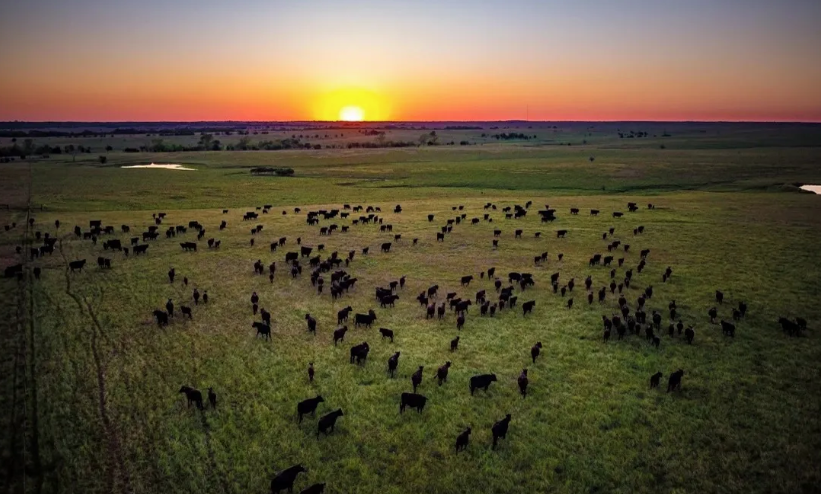
This rotational grazing system provides abundant cover for wildlife year-round and reduces competition between wildlife and cattle for forage and seeds. No herbicides have been applied on the ranch in 11 years and its forb diversity is continually increasing. The long rest periods between grazing events provide ample time for most forbs and grasses to flower and set seed each year, so although there are no food plots on the ranch, every grazing unit is producing seed and wildlife food. The ranch supports a complete community of grassland wildlife including northern bobwhite, black-tailed jackrabbits, and prairie-dependent birds such as dickcissel, grasshopper sparrow, and eastern meadowlark.
The ranch encompasses a portion of the headwaters of the Blue River on the east side and Pennington Creek on the west side. The protection of water quality in both of those biologically important watersheds is extremely important to Susan and she is proud of the fact that her ranch does not contribute pesticides, fertilizers, or sediment into either watershed. She is in the process of fencing off all of her ponds and streams to enhance riparian vegetation and further improve water quality. Rather than provide pond access to her cattle, she pumps water from her ponds and hauls it to large tanks that are moved with her cattle. In the riparian areas on her ranch, she selectively thins or removes prolific woody species such as eastern redcedar, elms, and honey locust, while retaining mast trees such as post oak, chinkapin oak, and pecan. The ranch's riparian habitats support resident birds such as wild turkeys, as well as tropical migrants including painted buntings, white-eyed vireos and yellow-billed cuckoos.
A few tracts within her ranch were farmed by the previous owners and had poor soil structure. She is carefully restoring native prairie habitat to those acres by applying thin layers of compost over the soil to reintroduce soil microbes and mycorrhizal fungi, and overseeding with non-invasive annual cover crops to increase organic material in the soil. Then a season later she drills native warm-season grass and forb seeds into the cover crop to jump-start the establishment of prairie habitat.
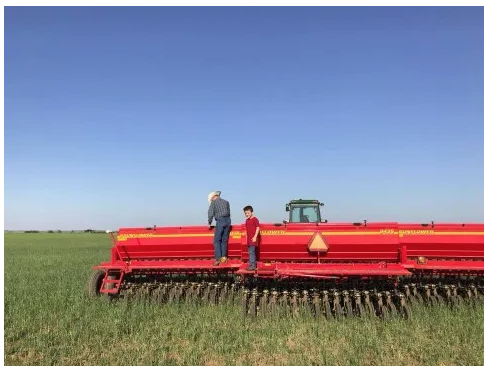
The Bergen ranch is a model for sustainable ranching that benefits the full spectrum of grassland and riparian wildlife while maintaining economic viability for the family.
Congratulations to Susan Bergen for being named the 2023 ODWC Landowner Conservationist of the Year.
Luke Bowman (left) and Maci Carter (right)
Farm and Ranch Broadcaster, Ron Hays, is featuring commentary from Radio Oklahoma Ag Intern, Maci Carter's interviews with various breed executives, including American Simmental Association's Luke Bowman and American Salers Association's Sherry Doubet.
Bowman is in the outreach department of the American Simmental Association and works primarily with SimGenetics.
"We might be the biggest breed (at Cattlemen's Congress)," Bowman said.
Bowman said that the Simmental breed has had quite the presence at Cattlemen's Congress, as over 500 head of Simmental and SimGenetics cattle were shown.
The location of the show is one factor contributing to the large numbers of Simmental cattle at the show, Bowman said, as it is a convenient spot for many producers.
"We get a lot more presence from folks that can't make it all the way to the National Western in Denver," Bowman said.
Carter also talked with the Executive Vice President of the American Salers breed, Sherry Doubet.
"This is our 49th year (as a breed association), and we are pretty excited to be part of the American cattle industry," Doubet said. "We are part of the International Genetics Solutions group, where we get all of our EPD work done, so we are just excited to be part of it."
For producers who are interested in performance data, Doubet said the Salers breed is primarily focused on EPDs. Doubet said Salers cattle are known for their outstanding maternal ability, structure in the feet and legs, and more.
"We are interested in selling bulls, and having private treaty bull sales, and selling commercial heifers," Doubet said. "The fact that we are part of the IGS program, the International Genetics Solutions program, is really important so that our EPDs are compatible with the other 19 breeds that are in the IGS system."
The Beef Buzz is a regular feature heard on radio stations around the region on the Radio Oklahoma Ag Network and is a regular audio feature found on this website as well. Click on the LISTEN BAR for today's show and check out our archives for older Beef Buzz shows covering the gamut of the beef cattle industry today.
Information about applying for Radio Oklahoma Ag Network's 2024 summer internship can be found at the bottom of the page.
The National Association of Farm Broadcasters has featured an article spotlighting our very own Maci Carter! Read below:
My radio internship has changed my life. My name is Maci Carter, and I'm originally from Marion, Ohio. Last fall, I started college at Oklahoma State University, double majoring in agricultural business and communications with a minor in agricultural leadership. Like most students, I was unsure about my future career. Luckily, the Oklahoma State Agricultural Communications Club hosted an Internship Night that led me to KC Sheperd and the Radio Oklahoma Ag Network team. To say radio scared me would be an understatement. However, after talking to KC Sheperd and my coworker, Reagan Calk, that night, I decided to try working this industry for one summer.
Once I joined Radio Oklahoma Ag Network in the summer of 2023, the most significant things I gained were confidence, connections, and technical skills. Since this was my first internship and "real world" job, I felt underqualified and lacked confidence in my abilities. My experience couldn't have been further from the opposite. This internship gave me confidence in my capabilities, taught me to rely on my skills, and helped me realize farm broadcasting is an industry in which I could thrive. It also connected me to the agricultural community beyond what I imagined. I'm so grateful my bosses and coworkers have fully immersed me in what it means to be a part of this industry and allowed me to attend all types of events with them over the summer. My technical skills also grew. Practicing writing articles, editing audio, and using microphones and software of all kinds gave me valuable knowledge that will set me ahead in my future classes and career opportunities.
The summer also left me with lots of unforgettable memories and positive experiences. My favorite memories include attending the World Pork Expo; getting my car stuck in Lahoma, Oklahoma, at a field day; and attending the Women in Ranching Conference at the Growing Paynes Farm in Mustang, Oklahoma. Each event allowed me to interact with individuals from all sides and sizes of industries.
Interviewing Scott Hays and Duane Stateler, the president and vice president of the National Pork Producers Council, at the World Pork Expo in Ames, Iowa, was unforgettable. Having the freedom from my bosses to attend alone and their confidence in me was so amazing to experience. Lahoma Wheat Day was the event where I conducted my first interview. If that wasn't memorable enough, it rained all day, leading to my car getting stuck in the field. What could've been disastrous turned into an unforgettable, fun memory as I experienced the hospitality and help of many producers and professors. They covered my hair from the rain and pulled out my car as I sat inside. Finally, experiencing the passion of the women at the Growing Paynes Farm is a distinctive memory from my internship. This was the first event I attended with the team, and it was so inspiring to see so many women of all ages wanting to gain skills and improve their farming operations. Their passion for agriculture was contagious and certainly started my internship on the right foot. In conclusion, my internship with Radio Oklahoma Ag Network was an amazing and valuable experience, one for which I'm beyond grateful. I gained incredible knowledge, experience, and connections that will take me far in this industry. I owe all of my success to the fantastic Radio Oklahoma Ag Network team and couldn't recommend this internship, or others like it, enough to aspiring students. This experience gave me a passion for broadcasting and media careers, and I think a career in this field may be in my future one day. Regardless, I'm so thankful for what I gained from my experience with Radio Oklahoma Ag Network.
We are on the lookout for an intern for the summer of 2024! Applicants can email resumes or questions to kc.sheperd@radiooklahoma.net ! See more information below:
Quietly, on September 29, 2023, the Securities and Exchange Commission, at the request of the New York Stock Exchange, proposed a rule to create a new type of company called a Natural Asset Company (NAC). According to the proposed rule, a NAC would "hold the rights to ecological performance," giving these companies license to control the management of both public and private lands through quantifying and monetizing natural outputs such as air and water. In other words, NACs would use the air you breathe as currency.
Under the guise of climate change, NACs would make this "control" mechanism profitable without the actual use of the land itself. By monetizing and leveraging the management of these natural outputs their war cry of "ecological performance" would fall under the rules of sustainable development. "Natural assets" would now belong to corporations that are potentially run by special interest groups such as The Nature Conservancy and the World Wildlife Fund, thereby requiring all production tied to the land to fall under the sustainability rules established by these non-governmental organizations.
It doesn't stop there. Land belonging to sovereign nations like the United States of America and private landowners can be subject to the control of NACs. For example, China could invest in a NAC which would effectively create their stakeholder position in a national or state park, placing them off limits for any kind of production or resource development. It is also possible that private landowners could involuntarily cede control of their land to NACs, such as through the rules of a conservation easement or other program that a current or previous landowner has participated or is participating in.
So, what is the motive behind all this? The answer is power and money, and...total control.
It appears the government intends to hand control over natural assets to the NACs as reports indicate that plans are underway to track the values of natural assets and place them on a federal balance sheet. It is also reported that a new accounting framework has been created by the Rockefeller-founded Intrinsic Exchange Group (IEG) because traditional NACs could not withstand the scrutiny required under general accounting principles, possibly leading to an artificially created economy four times larger than today's entire economy.
The IEG admits that "producing these essential goods and services and managing resources wisely is as valuable, or perhaps even more valuable, than food production." Without question, this is a part of the Biden administration's 30x30 agenda - a land grab designed to secure 30 percent of America's land and waters for conservation and preservation by 2030. Ultimately, this would allow the federal government, questionable investors, and perhaps international extremist groups to massively profit off of America's natural outputs while simultaneously gaining control over them.
In December, President Biden and Vice-President Harris announced an international partnership initiative called Landsat 2030 International Partnership Initiative. This partnership between the U.S. Geological Survey and NASA, both members of the Working Group for Biden's National Strategy to Develop Statistics for Environmental-Economic Decisions, will help them understand and track changes in the condition and economic value of land, water, air and other natural outputs. In short, it is satellite data collection on every square inch of earth and its sole purpose is to create an asset base for an investment product such as a NAC.
The American Stewards of Liberty group, however, recognized quickly that NACs are a direct threat to energy, mining, and agricultural production on land across America saying, "It is the fleecing of American's property rights, consolidation of power, and transfer of wealth on an international scale."
The SEC extended the public comment period for its NAC proposal to January 18, 2024.
In response to the recent comment period extension, Congresswoman Harriet Hageman (R-WY) stated, "I encourage all of you to weigh in on this potentially devastating effort to securitize our national heritage lands and private property rights! This development just goes to show that we should never give up, and that our voices do matter." Thirty-one members of the House of Representatives joined Hageman in a letter successfully demanding a longer comment period.
Representative Hageman and American Stewards of Liberty have worked closely with R-CALF USA on property rights issues in the past, each with the understanding that the foundation of liberty rests on the shoulders of private property rights. It is essential that Americans weigh in on the extended comment period by January 18.
Comments can be submitted here: https://www.sec.gov/rules/sro/sr-nyse-2023-09
More information about the NAC proposal can be found at https://americanstewards.us/.Shad Sullivan is the Region V Director and Private Property Rights Committee Chair of R-CALF USA, the nation's largest non-profit trade association exclusively representing cattle farmers and ranchers

Growth Energy, the nation's largest biofuels trade association, this week filed two petitions for rehearing with the Fifth Circuit Court of Appeals regarding the Court's 2023 decision on small refinery exemptions (SREs) under the Renewable Fuel Standard (RFS).
The RFS allows small refiners to request exemptions from the program's fuel blending obligations if they can demonstrate to the U.S. Environmental Protection Agency (EPA) that compliance with the RFS would impose a "disproportionate economic hardship." EPA has denied several of these requests over the past few years, reflecting numerous well-established analyses that have shown that refineries nearly always recoup their RFS compliance costs. However, in November, the Fifth Circuit sided with a group of six refineries, ruling that EPA improperly denied their SRE requests.
"As we noted in November, this lawsuit was never about the purported economic hardship faced by a small group of refineries—its ultimate goal was to allow those refineries not to comply with the law, and to block consumer access to lower-cost, lower-carbon fuel options at the pump," said Growth Energy CEO Emily Skor. "In its opinion, the Fifth Circuit made procedural and substantive errors and failed to consider the record, which demonstrates that EPA's decision to deny the refinery exemptions was correct and well within its authority."
"We hope that the rehearing petition will prompt the court to revisit and revise its opinion to allow EPA to continue to properly implement the nationwide SRE program, and ensure the integrity of the Renewable Fuel Standard, which spurs the production of American-made biofuels to bolster our rural economy, ensure national and energy security, lower carbon emissions, and save consumers money." Copies of the petitions are available here and here
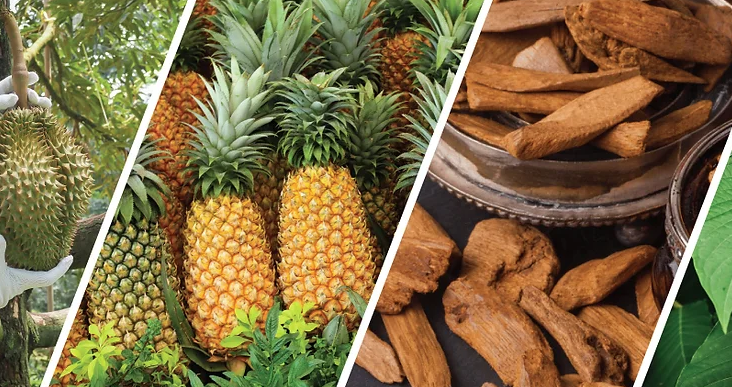
KK Strategies is excited to announce the launch of its new agricultural project based in the province of Phetchaburi in Thailand near Hua Hin. The project comprises of a mixture of different products with varying harvest time frames in order to maximize the projects yield generation. KK Strategies have kept specific details on the mixture of products confidential, but did confirm that durian, pineapples and kynam will be included at varying degrees amongst others products.
KK Strategies revealed its multi asset strategic approach which includes short, medium and long term products is aimed at consistently producing monthly income throughout the life of the project, beginning as early as the first 6 months. This is in contrast to traditional agricultural projects which tend to generate no income for the first couple of years and at best only produce income once a year.
Thailand was undoubtedly the most ideal location for our project. It is one of the world's largest producers and exporters of agricultural and forestry products, enjoys advantageous trade agreements and has extremely established processing and distribution networks. Additionally, some of the products within the projects portfolio due Thailand's specific policies are incapable of being grown profitably elsewhere.
Thailand is blessed with vast amounts of fertile soil, favourable weather and hardworking experienced farmers. The agriculture and forestry sector is one of its most important economic sectors, employing approximately 30% of the country's labour force. The agriculture sector in Thailand, including forestry and fishing contributes over 35 USD billion annually to GDP.
On a product level Thailand is ranked the worlds:
About KK Strategies (Thailand)
KK Strategies grows, manages and invests in some of the world's most rare, niche and valuable agricultural and forestry projects. Our multi asset strategy generates consistent attractive returns, while also helping develop solutions that solve global food, climate and biodiversity challenges. KK Strategies supply's produce of the highest quality for use by companies worldwide.

January 9, 2024 — Dairy producers and veterinarians can confidently implement mastitis treatment protocols against mastitis cases caused by Gram-negative bacteria with Spectramast® LC (ceftiofur hydrochloride) Sterile Suspension from Zoetis. Research from the University of California, Davis — published online in the Journal of Dairy Science (published in press Nov. 2, 2023) — showed that treatment of nonsevere (mild and moderate) cases of clinical mastitis caused by Gram-negative bacteria with Spectramast LC was effective in improving bacteriological and clinical cures, lowering mastitis recurrence, reducing use of supplemental therapy and minimizing mastitis-related culls and deaths.1
Conducted on three large dairy herds in California and using 415 nonsevere clinical mastitis cases caused by Gram-negative bacteria, the clinical trial compared outcomes between cows that received two-day intramammary treatment with Spectramast LC and cows that received no treatment. Results showed the effectiveness of two-day treatments with Spectramast LC was better than not treating. Specific findings from the research included:
"Early intramammary treatment of Gram-negative mastitis infections with Spectramast LC provides significant benefits compared with the option of not treating and assuming that cows would self-cure without consequence," said Dr. Daniela Bruno, DVM, PhD, Dairy Advisor for University of California, Davis.
A prudent strategy would be to treat all cases of Gram-negative mastitis with Spectramast LC, and not attempt to distinguish mild cases from moderate cases, the research suggested.
"A case of non-severe Gram-negative mastitis has the potential to become a severe infection that requires more aggressive treatment, adding costs and delaying return to productivity," said Juan Pedraza, DVM, Managing Veterinarian of Zoetis Dairy Technical Services. "Based on the research, you're looking at improved cure rates, lower treatment costs due to the reduction in use of supplemental therapy, and most importantly, helping keep cows healthy and productive members of the herd."
The dairy industry recognizes mastitis as one of the costliest disease conditions that dairy producers must manage. Gram-negative bacteria alone, especially coliforms like E. coli, Klebsiella spp., or Enterobacter spp., can pose a real threat to herd productivity, causing up to 35 percent of all intramammary infections on dairies.2,3 In one study, 66 percent of cultured samples initially tested negative but 34 percent actually were positive for a Gram-negative pathogen.3 Gram-negative bacteria can be elusive so it's important to evaluate what an appropriate treatment protocol could look like for Gram-negative mastitis cases to help improve cow wellness outcomes and mastitis-treatment-related costs for the dairy industry.
"We continue to invest in new, practical on-label solutions and support research that will advance mastitis management protocols so veterinarians, producers and parlor employees can use them with confidence," said Dr. Pedraza.
Spectramast LC offers extended therapy as its unique, flexible label for at least two and up to eight days to achieve a bacteriological cure for a broad spectrum of bacteria. In addition, the two-day pre-slaughter meat withdrawal for Spectramast LC is the shortest withhold time available, providing more options for greater management flexibility. Milk withdrawal time is 72 hours after the last treatment, regardless of how many days treatments are administered (2-8 days).
For more information about the study, check out the latest blog article. Talk to your Zoetis representative to learn more about mastitis treatment protocols with Spectramast LC.
About Zoetis
As the world's leading animal health company, Zoetis is driven by a singular purpose: to nurture our world and humankind by advancing care for animals. After innovating ways to predict, prevent, detect, and treat animal illness for more than 70 years, Zoetis continues to stand by those raising and caring for animals worldwide - from veterinarians and pet owners to livestock farmers and ranchers. The company's leading portfolio and pipeline of medicines, vaccines, diagnostics, and technologies make a difference in over 100 countries. A Fortune 500 company, Zoetis generated revenue of $8.1 billion in 2022 with approximately 13,800 employees. For more, visit www.zoetis.com.
# # #
IMPORTANT DIAGNOSTIC INFORMATION: SPECTRAMAST LC is intended for use in lactating dairy cattle only with the specified, labeled pathogens. To assure responsible antimicrobial drug use, it is expected that subclinical mastitis will be diagnosed using a positive culture, or other pathogen-specific test, in addition to any other, appropriate veterinary medical evaluation prior to treatment.
IMPORTANT SAFETY INFORMATION: People with known hypersensitivity to penicillin or cephalosporins should avoid exposure to SPECTRAMAST LC. Product requires a 72-hour milk discard period and a 2-day pre-slaughter withdrawal period following the last treatment. Use of this product in a manner other than indicated on the label, or failure to adhere to proper milk discard period, will result in violative residues. To view the full Prescribing Information, click here.
Attorney General Gentner Drummond will testify Wednesday to the U.S. House Homeland Security Committee as part of that panel's impeachment proceedings against Department of Homeland Security Secretary Alejandro Mayorkas. The action comes in the wake of Mayorkas' failure to secure the nation's southwest border.
Drummond was invited to testify due to his focus of ridding Oklahoma of the foreign nationals who have invaded the marijuana industry. He is expected to tell committee members how the recent influx of illegal immigrants into the U.S. has allowed criminal enterprises, primarily populated by Mexican and Chinese nationals, to jeopardize public safety through drug trafficking and other crimes.
"It is my honor and solemn duty to share with Congress how the porous border has grievously compromised the safety of Oklahomans," he said. "Criminal illegal immigrants truly pose a threat to communities all across our state. They are not content with only growing black-market marijuana. They are producing and distributing fentanyl, and they are engaging in sex trafficking and labor trafficking. I believe it is time for some accountability in Washington, D.C."
The Office of the Attorney General's Organized Crime Task Force, which Drummond established last May, already has investigated and is prosecuting more than 50 multi-jurisdictional criminal cases, many of which allegedly involve Mexican or Chinese drug syndicates.
The U.S. House Homeland Security Committee reports that it has recently concluded a comprehensive investigation into the causes, costs and consequences of the historic border crisis. Committee Chairman Mark E. Green (R-TN) said the American people demand accountability and noted the bipartisan vote to refer the Articles of Impeachment to his committee.
"For almost three years, the American people have demanded an end to the unprecedented crisis at the Southwest border, and they have also rightly called for Congress to hold accountable those responsible," Chairman Green said. "That's why the House Committee on Homeland Security led a comprehensive investigation into the causes, costs, and consequences of this crisis. Our investigation made clear that this crisis finds its foundation in Secretary Mayorkas' decision-making and refusal to enforce the laws passed by Congress, and that his failure to fulfill his oath of office demands accountability. The bipartisan House vote in November to refer articles of impeachment to my Committee only served to highlight the importance of our taking up the impeachment process—which is what we will begin doing this Wednesday."
Drummond is one of three state attorneys general invited to speak about how the border crisis has adversely impacted public safety.
The committee hearing, entitled "Havoc in the Heartland: How Secretary Mayorkas' Failed Leadership Has Impacted the States," begins at 9 a.m. CST and will be held in room 310 of the Cannon House Office Building.
The hearing will be livestreamed on YouTube and the Committee's website.
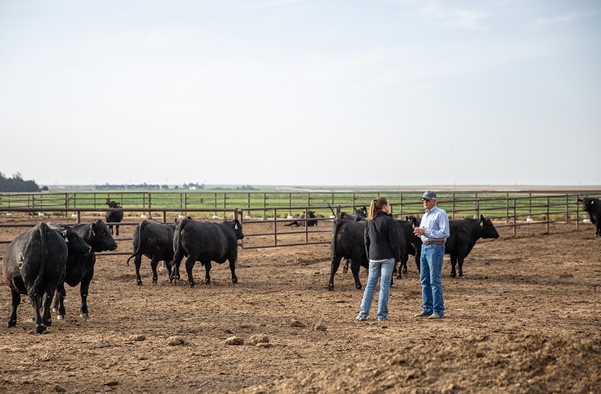
Mark Johnson, Oklahoma State University Extension Beef Cattle Breeding Specialist, offers herd health advice as part of the weekly series known as the "Cow Calf Corner," published electronically by Dr. Peel, Mark Johnson, and Paul Beck. Today, Johnson talks about planning for 2024.
Happy New Year! As we embark upon 2024, this week I suggest some plans to make now for a more successful 2024 in the cattle business. Cattle prices should remain strong this year. Educational opportunities, technologies and best management practices shared through this newsletter should permit great future opportunities for cow-calf producers. Don't get caught off guard and let opportunities pass you by. Answer the following questions as you make plans for 2024:
1 – Is your calving tool box stocked and ready? Don't be looking for your OB chains AFTER determining that first calf heifer needs help!
2 – Do you have colostrum on inventory?
3 – Are you prepared for the spike in your cowherd's nutritional requirements after calving and during cold, wet weather?
4 – What is your marketing plan for your next calf crop?
5 – Based on your answer to question 4, how should that impact your sire selection for the upcoming breeding season? Are you capturing the value of your genetics? Or is the lack of genetic potential limiting the profit potential of your operation?
6 – Has your grazing ecosystem recovered from drought? What are you doing to sustain the long-term health of your soil, plants and cattle?
7 – Are you capitalizing on the educational opportunities available to improve your management?
For example, OSU will host a "Blueprint for the Future – Part 2" on May 22 – 23, 2024 in Stillwater. The 2024 conference will address crossbreeding and gene editing and the impact these will have on the future of our industry. Please make plans to attend. More information on this conference is available at https://cattlemenscongress.com/conference/
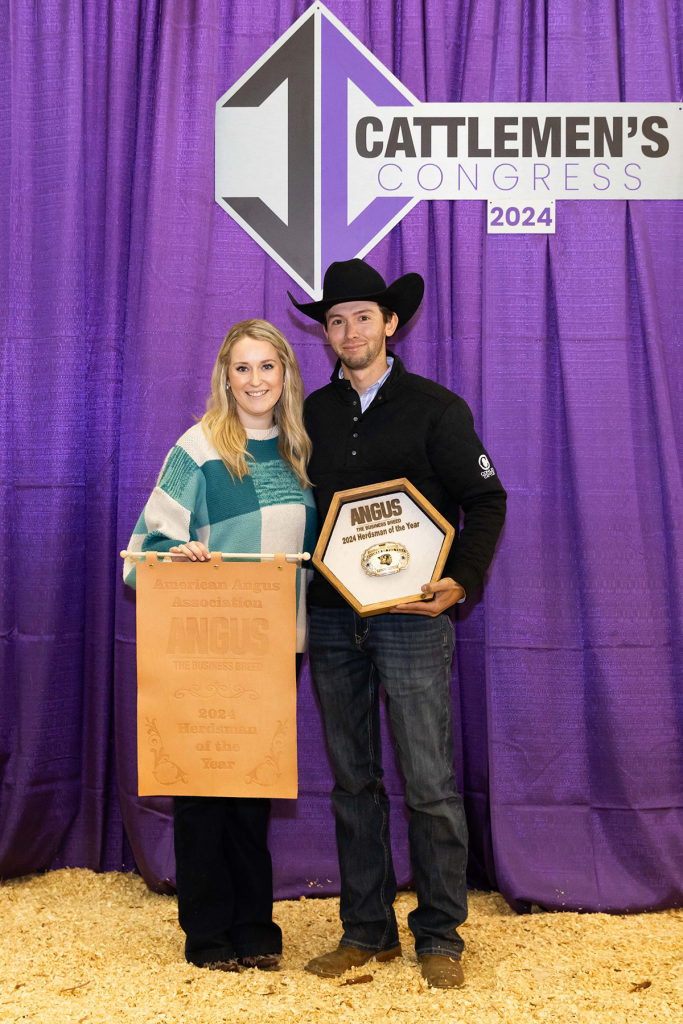
From left, pictured are Tailor Atkinson and 2024 Herdsman of the Year Cole Atkinson. The 2024 American Angus Association® Herdsman of the Year results were announced January 5 at the beginning of the Herdsman Social event during Cattleman's Congress in Oklahoma City.
| American Angus Association® recognizes Cole Atkinson of Conley Cattle as the 2024 Angus Herdsman of the Year, which is selected through a peer-voting process. In an elite field, where stockmen have tremendous respect for one another's character and their craft, there's the Herdsman of the Year award and the 2024 winner: Cole Atkinson of Conley Cattle. The award was presented on Jan. 5 at Cattlemen's Congress in Oklahoma City by the American Angus Association®. After his initial shock of the announcement had passed, Atkinson credited his success to those who work alongside him. "You're only as good as the people around you, and I've got the best crew around," he said. Atkinson from Sulphur, Oklahoma said he was surprised to be selected as Herdsman of the Year because of the caliber of other nominees. They were Miles Shout, Express Ranches; Dillon Stertzbach, Stertzbach Cattle Company; and Greg Van Zee, Udell Cattle Company. The 2024 nominees were slated by a committee of previous award winners, based on their devotion and skills spent improving a specific herd and the Angus breed. Atkinson began as a herdsman at Conley Cattle in May of 2019. There he is involved in all aspects of the ranch but spends most of his time managing the show barn, preparing cattle to show or sell. Conley Cattle hosts three sales a year, a fall and spring female production sale and a bull sale every February. Aside from sales, they manage around 250 Angus cows. Before starting at Conley Cattle, Atkinson received his associate degree from Northeastern Oklahoma A&M and bachelor's degree from Oklahoma State University in agricultural business. Each year, Atkinson said he enjoys attending the Roll of Victory (ROV) Angus shows and other major shows. In 2023, he had the Champion and Reserve Angus females at Cattlemen's Congress, and the heifer went on to be Supreme Champion Female at that show. One of Atkinson's most valued accomplishments was having the ROV Show Heifer and Show Bull of the year for the 2022-2023 season. Peers select the Herdsman of the Year award winner through voting, hosted by the Association. "Last year we revamped and elevated the Herdsman of the Year selection process," said Caitlyn Brandt, director of events and junior activities. "Since then, we've seen an increase in voting participation and an increase in anticipation for the results." To be eligible to vote, exhibitors must have entered at least one of the following shows in 2023: Cattlemen's Congress, National Western Stock Show, Western National Angus Futurity, Atlantic National, American Royal or North American International Livestock Exposition. Atkinson says there are many driving factors for why he is involved with the Angus breed. "The competition in the Angus breed is the highest level and sets the bar for the other breeds," he said. In addition to being detail-oriented and customer-minded, he said, "I'm also very driven by helping the youth. I truly enjoy helping the kids, especially looking back at role models I had as a kid that got me involved in the Angus breed and to where I'm at today." To learn more about Atkinson or the other three 2024 Angus Herdsman of the Year candidates, visit https://bit.ly/2024Herdsman. |
— Written by Sarah Kocher, Angus Communications
RON's Dave Lanning has a pre-opening look at today's agricultural Markets.
Click the audio tab below for today's report.
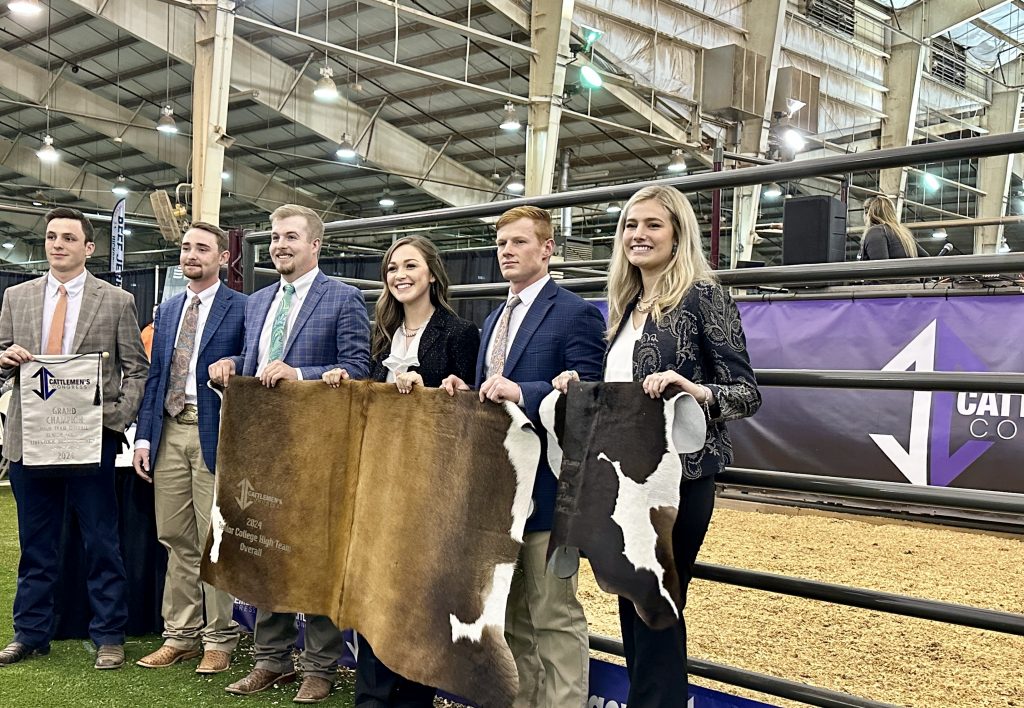
OSU Livestock Judging Team- Recognized as the Overall Team Champs in Livestock Judging at Cattlemen's Congress
It was close- but the Cowboys from Stillwater took home the overall top prize in the Collegiate Livestock Judging contest that was just renamed this past weekend at Cattlemen's Congress. On Saturday, the board of Directors that run Congress announced that from this point forward- the collegiate Livestock Judging Contest will now be called the Jarold Callahan Livestock Judging Contest at Cattlemen's Congress.
The team from Oklahoma State University was three points better than the Reserve Champs that came from Western Illinois University to claim the Senior Collegiate Division. This is a whole new set of team members that are following in the footsteps of the 2023 National Champion Livestock Judging Team from OSU. 2024 OSU team members include Ashylyn O'Brein, Braylon Spears, Jed Sidwell, Kale Campbell, Anna Hannon and Clay Brillhart.
Team rankings in the senior college division had OSU placing first, Western Illinois University reserve, Texas A&M placing third, Kansas State University fourth, Texas Tech fifth and the University of Arkansas sixth.
Ross Blumbaugh of Western Illinois was the high individual of the Contest- while OSU's Ashlyn O'Brein, Bryalon Spears and Jed Sidwell placed fourth, fifth and sixth high individuals respectively.
Helping OSU take home the top honors was their first place placing in Reasons.
The Champion in the Junior College Division was the team from Black Hawk College of Galwa, Illinois, while Reserve Champs was the team from Redlands Community College in El Reno, Oklahoma.
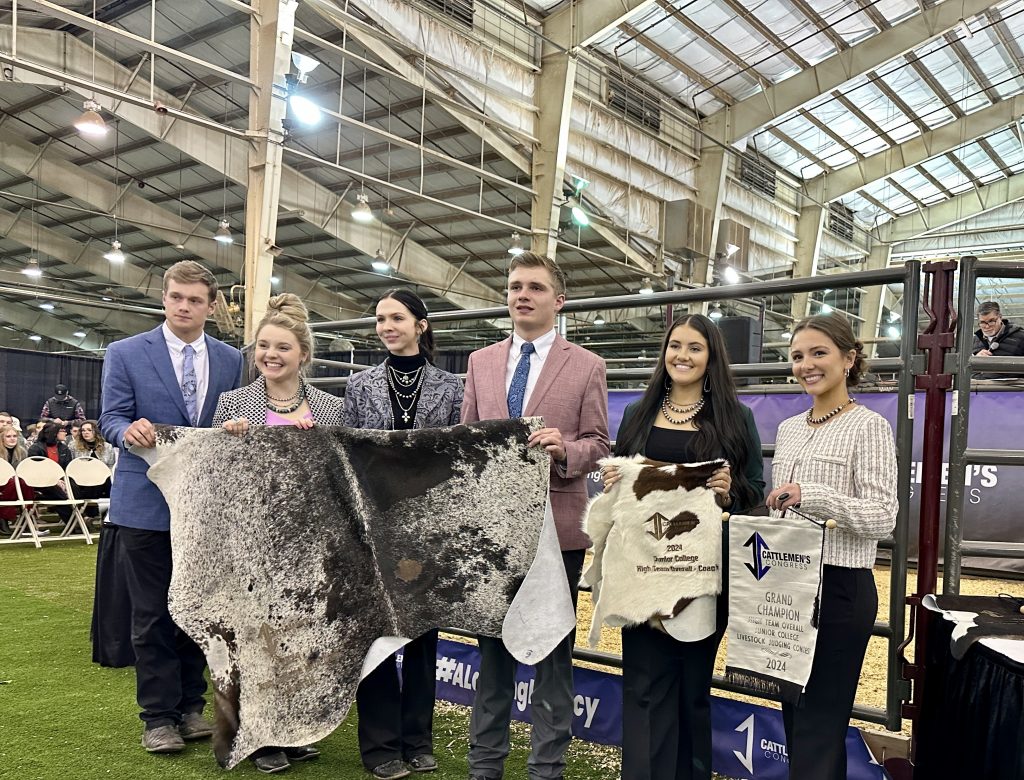
Johwynn Ayers, Emma Jackson, Preston Rhode, Gracie Cloud, Josie Doshier and Jack Johnson made up the team from Black Hawk. They are coached by former OSU Livestock Judging coach Dr. Blake Bloomberg, who after coaching at both OSU and Texas A&M, returned to his home state of Illinois to coach Black Hawk.
Johwynn Ayers of Black Hawk was the high individual in the JuCo division- Blake Janssen of Redlands was sixth high individual in the Juco ranks.
The Redlands team placing second overall includes Blake Janssen, Mason Allan, Chyann Emerson, Garrison Bass, Jack Habjan and Connor Pell. (Pictured below)
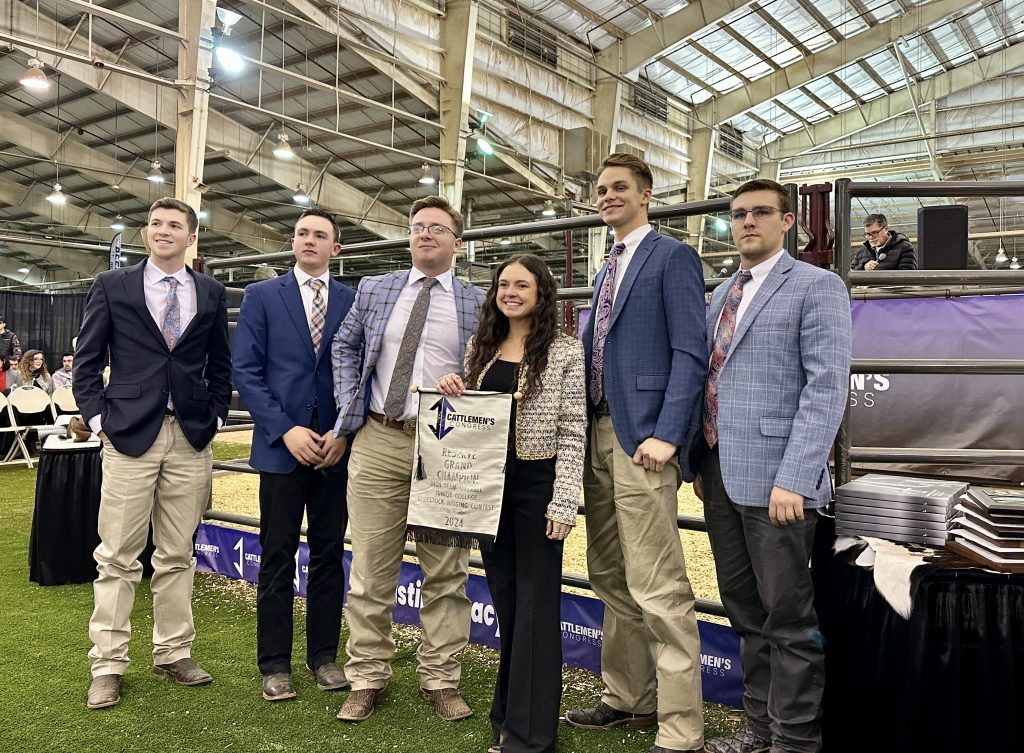
Details of the placings for the complete contest are available by clicking here(The Judging Card website). A total of 17 Senior teams and 21 Junior teams competed on Monday at the OKC Fairgrounds.
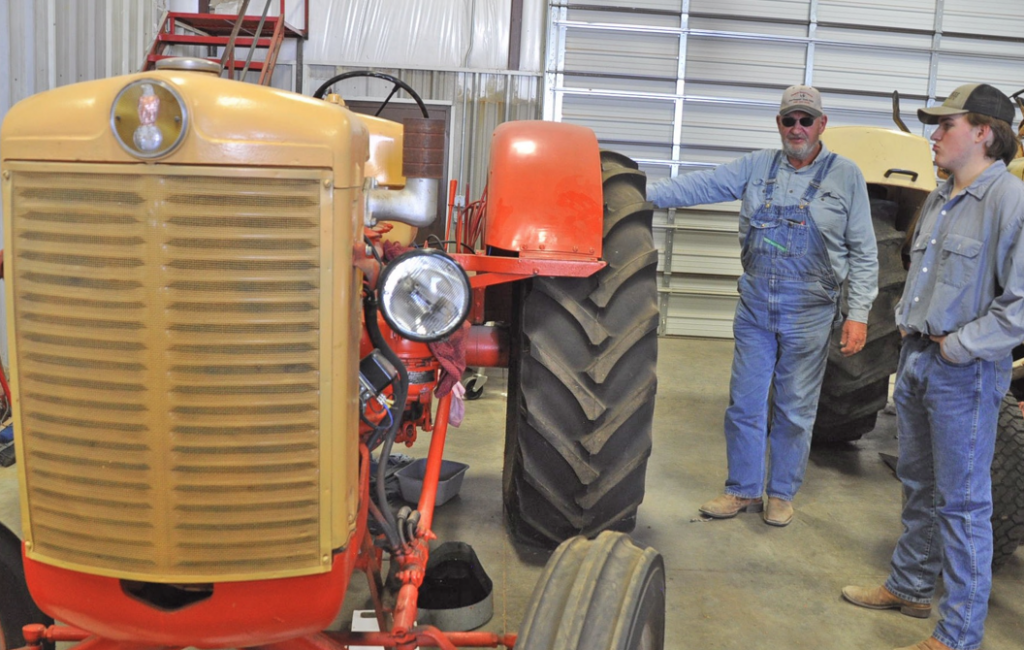
Joe Peeper gets a gleam in his eye whenever he sees the distinctive color combination of flambeau red, desert sunset and battleship gray or the metal insignia of Old Abe, the American eagle mascot that embellished every Case tractor in the early days before the company merged with International Harvester.
"These original tractors are neat because they're history. They'll never make them again," he said recently on his farm northwest of Enid, Oklahoma.
His brother Tom, a retired weed scientist at Oklahoma State University, collects old Case tractors too. "It's a fun hobby, and you meet a lot of nice people," Tom said by phone from his home in Stillwater. "It provides a common interest. Nowadays, when so many things divide us, sometimes we have to find things that connect us."
Family Tradition
Growing up at Apache, their dad owned the local Case dealership, buying and selling tractors and often using trade-ins to farm their own ground.
Back then, there were four implement dealerships in town, and farmers developed an affinity for certain makes and models.
One of Joe's prized relics from that era is the last model L to come off the Case assembly line in Racine, Wisconsin, in 1940. Only after he took possession of it from a widow near Red Rock — a deal ten years in the making — did he identify the serial number and recognize its significance.
Another tractor that's special to him is the 1962 Case model 830, called a Western Special, which he is now fixing up with his grandson, Zander, a Drummond FFA member. Zander hopes to enter it in Oklahoma Youth Expo's tractor restoration competition in March.
Together the two went up to Coldwater, Kansas, to retrieve it from a retired farm couple and drove away pleased with their find.
"The 830 line is pretty rare," Joe said. "We were happy when it started right up."
Fixing up an old tractor is a time-consuming project and can easily cost $1,000 or more, with parts and expertise increasingly hard to come by.
"There's only one man left in the country I'm aware of who makes the old dashes with the authentic gauges and instruments, and he's from Vineland, New Jersey," Joe said.
But preserving antique tractors is a worthwhile pursuit to enthusiasts who see it as a way to reconnect younger, more urban generations with the country's rural heritage.
Tractor shows remain as popular as ever and seem to draw an increasingly diverse audience, Tom observed.
Prior to Joe and his wife Mary Jo moving to the Enid area to farm with her father Clarence Miller in 1977, they lived in Missouri near his twin brother, Jim.
Jim started a Case tractor club, the Missouri Screaming Eagles, which has members from around the country.
Joe and Tom also support Oklahoma's Steam Threshing and Gas Engine Show, which is always held the first weekend of May in Pawnee.
Joe has more time to spend tinkering with tractors since he retired as a certified wheat seed dealer in 2021. That year the two-term past president of the Oklahoma Crop Improvement Association was able to sell his wheat for $10.50 a bushel over the scale and made the decision to step away from the demanding work involved in running a seed business.
Up until then, the Peepers raised and sold up to 60,000 bushels of high-quality seed wheat annually, which required walking every field at least once and sometimes twice a season to remove rye stalks by hand.
"You might find just a few plants, but the only way to get it out was to walk every acre," Joe said.
In spite of the enormous time commitment, he and his family enjoyed the work.
"You get satisfaction from providing a good quality product that contributes something good for society," he said.
Living History
Wheat genetic improvement has become increasingly sophisticated over the years, but Joe and Tom can recall the early days of wheat breeding in Oklahoma, when one of the state's most popular and enduring wheat lines, Triumph, began as an on-farm breeding experiment conducted by a very unusual man, Joseph Danne.
Danne had only an eighth-grade education, but he developed a keen interest in crop and livestock breeding that became his life's focus.
Tom was fortunate to meet the reclusive genius sometime in the mid-1950s when he was a boy around the age of 10.
He was with his dad when they stopped by Danne's farm south of El Reno to reserve seed for the following year. When they arrived, Danne was in a field behind a team of horses pulling a harrow. He walked over to the edge of the field to meet them and agreed to give them three bushels of seed if they would leave a few gunny sacks on the porch of his house.
"It was the only time in my childhood where I saw anyone farming with horses," Tom recalled. "I remember being amazed by how big they were and how patiently they stood."
It would take two years to grow out and multiply that seed before it could be sold to other farmers. But the seed was in high demand. At the time, most wheat was being grown on the same land year after year, leaving it prone to diseases and pests.
In addition, no commercial fungicides were available then, which drove the need for hardy, rust resistant wheat.
"My dad held Mr. Danne in very high esteem," Tom recalled. "He was one of my dad's true heroes, the most highly respected wheat breeder in the world at that time, as far as I knew."
When Danne passed away in 1959, he left his genetic material and research notes to Oklahoma State University. The program's ancestral heir, Triumph 64, is still familiar to most wheat geneticists and pathologists today as the source of a stacked array of stem rust resistance genes, including one in particular that continues to be used for breeding purposes, according to OSU's chief wheat geneticist Brett Carver.
Early Triumph, which came out in the 1940s, was grown for many years all across the country, proving Danne accomplished what he set out to do starting way back in the 1920s — improve the existing Turkey Red and Blackhull wheats by selecting plants that were earlier maturing, hardier and more productive.
"His legacy lives on," Carver said.
Wheat variety development is not an easy task. OSU's wheat breeding program encountered setbacks in the early days that demonstrated just how difficult it could be. Tom recounted one example, the much-heralded variety Concho. Developed during extreme drought years, upon its release in 1955 conditions turned wet, resulting in tall unruly plants that all fell over, he said.
Prior to the mid-1970s, Joe remembers walking through heads of wheat as tall as his armpits before semi-dwarf varieties made the straw easier to manage.
Joe recalls that in his dad's day there were just one or two good varieties. By the time he retired, OSU alone was offering more than 15, each with unique characteristics to fit a wide range of situations.
The acceleration of improved lines has largely been due to farmer investment in public wheat breeding through a voluntary check-off collected on every bushel of wheat sold. Certified seed also incurs a royalty that goes back into supporting further research and development.
The enhancements benefit everyone involved in the wheat industry, Joe said, but it does point to one of the biggest challenges facing agriculture, which is rising production costs and the necessity to take on more debt and greater financial risk.
When he started selling seed in the late 1980s, wheat sold for $2.50 to $3.50 a bushel, and he added another dollar to cover the extra costs of cleaning and storing it.
Now, seed wheat in the area sells for $15 a bushel, and market prices are highly variable.
"When I was starting out, the price didn't change more than 25 or 50 cents in a year," he recalled. "Now the market can change 50 cents in a day. And back then we were farming with fewer inputs."
Even with higher wheat yields, farming for a living is still a tough road. Joe has watched the number of commercial farms in his neighborhood dwindle, replaced by hobby farms and ranchettes. But he believes the key to success in agriculture remains the same as it's always been: hard work, attention to detail and commitment to producing a quality product.
For his part, Zander, who lives at the neighboring farmstead with Joe's daughter Christie, is optimistic about the future.
"I think there's lots of opportunities to do whatever I want to do," he said.
Historic Case tractors are sure to be a part of it.
Though Joe's son Danny now farms the home place with modern John Deere equipment, Zander remains "100 percent committed" to making sure the old Case brand is showcased and admired for many years to come.
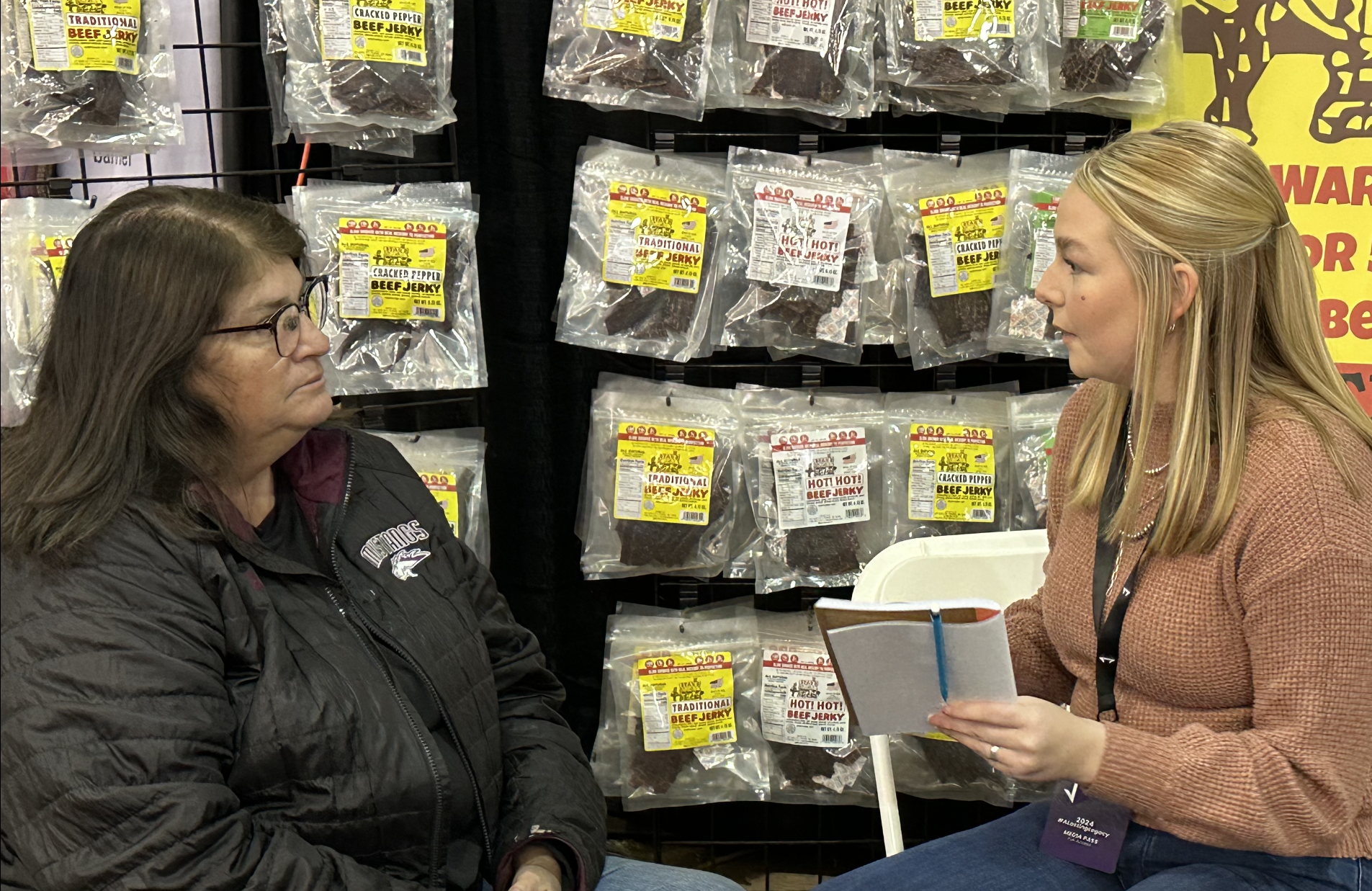
This week, the Cattlemen's Congress in Oklahoma City, Oklahoma is wrapping up. The event hosted cattle exhibitors from across the nation and many types of vendors. Radio Oklahoma Ag Network Intern, Maci Carter, had the opportunity to talk to Cheryl Johnson of Stan's Beef Jerky about her business and their experience at Cattlemen's Congress.
"Stan started this about 50 plus years ago," Johnson said. "He has done shows all over the United States. He's got eight different flavors and we got different sizes of bags, and it's all smoked."
Johnson explained that the man in the company's name, Stan, started this business over 50 years ago and is now 84. A friend of theirs, Tony, has since bought the business, but they still love to help and support.
"This is our first year here with Stan's Beef Jerky," Johnson said.
Being a vendor at Cattleman's Congress is a new venture for the business, but not unfamiliar territory for the family. Johnson explained that they like to refer to themselves as "cattle people" and they were excited when the opportunity to sell their product at the show came up.
"We have four flavors that are a tender cut because we turn the eye of the round a kind of a different way," Johnson said. "Then the old style is a little drier. That kind of beef jerky that people have ate in the past."
Johnson said one of her favorite parts of the job is seeing how others really like their flavors. She explained they do things a little differently to make some tender cut flavors and some of the older style beef jerky.
"Stan's is out of Yukon just right here by Oklahoma City," Johnson said.
While lots of vendors came from far and wide, Stan's is from our very own Yukon, Oklahoma. Johnson explained that Tony gets the beef from a ranch and it's been in Yukon for many years.
"We have them in EZ Go stores here in Oklahoma," Johnson said. "There's vendors up in Tulsa and they're just all over the United States."
If you're not able to stop into Cattlemen's Congress to try Stan's Beef Jerky for yourself, keep your eye open for them the next time you stop for gas.
| |||||||||||||||||||||||||||||||||||||||||||||||||||||||||||||||||||||||||||||||||||||||||||||||||||||||||||||||||||||||||||||||||||||||||||||||||||||||||||||||||||||||||||||||||||||||||||||||||||||||||||||||||
|
The U.S. Department of Agriculture (USDA)announced the appointment of 26 members to serve on the Cattlemen's Beef Promotion and Research Board. Twenty-five members will serve three-year terms and one member will serve a one-year term. The term of board members appointed to three-year terms start February 2024 and end February 2027.
Two of those members are Oklahomans Cheryl DeVuyst, Morrison, Okla., and Gaye Pfeiffer, Mulhall, Okla. Devuyst is a reappointment for a second three year term and Pfeiffer is a new appointment for her first three year term. She will take the place of Jimmy Taylor in February at the end of the CBB meeting in Orlando
Newly appointed members are:
The board is authorized by the Beef Promotion and Research Act of 1985 and is composed of 99 members representing 34 States and 5 units. Members must be beef producers or importers of beef and beef products nominated by certified producer organizations. More information about the board is available on the Agricultural Marketing Service (AMS) Cattlemen's Beef Board webpage.
Since 1966, Congress has authorized the development of industry-funded research and promotion boards to provide a framework for agricultural industries to pool their resources and combine efforts to develop new markets, strengthen existing markets and conduct important research and promotion activities. AMS provides oversight of 22 boards, paid for by industry assessments, which helps ensure fiscal accountability and program integrity.
AMS policy is that diversity of the boards, councils and committees it oversees should reflect the diversity of their industries in terms of the experience of members, methods of production and distribution, marketing strategies, and other distinguishing factors, including but not limited to individuals from historically underserved communities, that will bring different perspectives and ideas to the table. Throughout the full nomination process, the industry must conduct extensive outreach, paying particular attention to reaching underserved communities, and consider the diversity of the population served and the knowledge, skills, and abilities of the members to serve a diverse population.

The U.S. Department of Agriculture's Foreign Agricultural Service (FAS) is awarding more than $203 million to nearly 70 agricultural organizations to help expand export markets for U.S. food and agricultural products via the Market Access Program (MAP) and Foreign Market Development (FMD) program.
"Over the years we have seen the tremendous impact both MAP and FMD have on expanding U.S. exports to markets across the globe," said FAS Administrator Daniel B. Whitley. "For each $1 invested in export market development, U.S. agricultural exports have increased by more than $24. These programs provide a significant boost to the U.S. agricultural industry, which in turn helps strengthen the economy not just in rural communities, but across the entire United States."
Through MAP, FAS will provide $174.3 million for fiscal year 2024 to 68 nonprofit organizations and cooperatives. These organizations use the funds on consumer promotion, including brand promotion for small companies and cooperatives, and the funding is used extensively by organizations promoting fruits, vegetables, nuts, processed products and bulk and intermediate commodities. The average MAP participant provides more than $2.50 in contributions for every $1 in federal funding it receives through the program.
Under the FMD program, FAS will allocate $27 million for fiscal year 2024 to 20 trade organizations that represent U.S. agricultural producers. The program focuses on generic promotion of U.S. commodities, rather than consumer–oriented promotion of branded products. Preference is given to organizations that represent an entire industry or are nationwide in membership and scope. The organizations, which contribute on average more than $2.50 for every $1 in federal funding they receive through the program, will conduct activities that help maintain or increase demand for U.S. agricultural commodities overseas.
USDA has published the list of organizations that will receive fiscal year 2024 MAP awards and FMD awards. To learn more about MAP, FMD and other FAS programs, visit www.fas.usda.gov.
Late last year, USDA also announced a new fund that complements the fiscal year 2024 funds being announced today. The new Regional Agricultural Promotion Program (RAPP) will provide $1.2 billion to help exporters reach non-traditional markets and ensure continuity of relationships and trust in existing markets. RAPP complements MAP and FMD by encouraging exporters to establish, build and grow their presence in markets with increased demand for U.S. products and growing middle classes. Applications for the first tranche of RAPP funding, $300 million, are being accepted through February 2, 2024. Applicants will be able to apply for projects that last up to five years.
USDA touches the lives of all Americans each day in so many positive ways. In the Biden-Harris Administration, USDA is transforming America's food system with a greater focus on more resilient local and regional food production, fairer markets for all producers, ensuring access to safe, healthy and nutritious food in all communities, building new markets and streams of income for farmers and producers using climate smart food and forestry practices, making historic investments in infrastructure and clean energy capabilities in rural America, and committing to equity across the Department by removing systemic barriers and building a workforce more representative of America. To learn more, visit www.usda.gov.
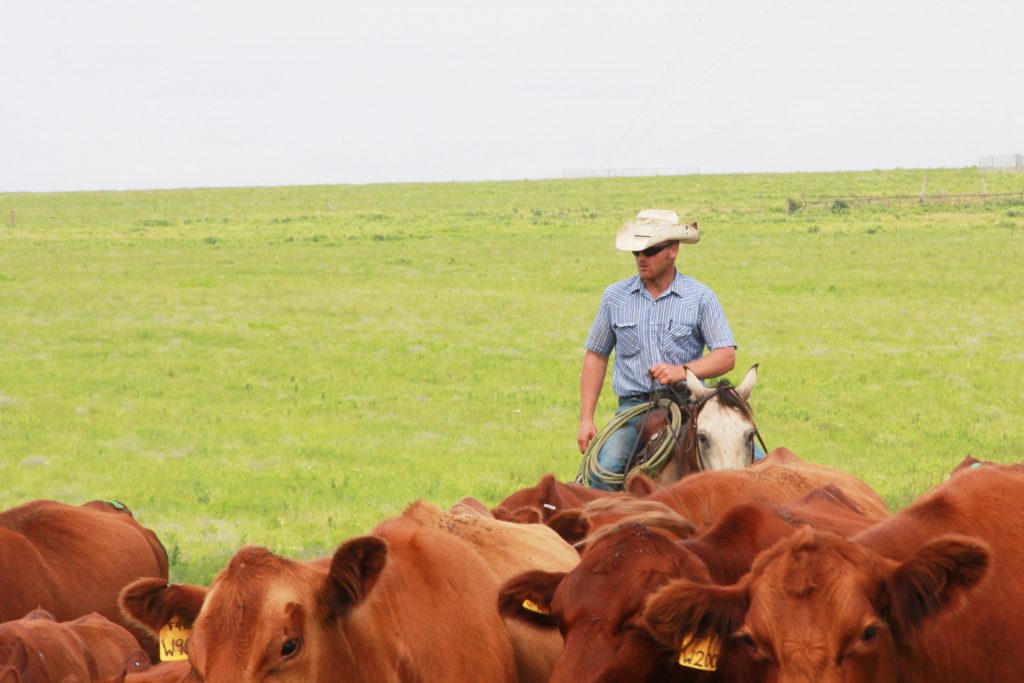
Dr. Derrell Peel, Oklahoma State University Extension Livestock Marketing Specialist, offers his economic analysis of the beef cattle industry as part of the weekly series known as the "Cow Calf Corner," published electronically by Dr. Peel and Mark Johnson. Today, Dr. Peel talks about production costs, cattle markets and more.
The majority of the cow-calf sector has been on the defense for the past two to three years due to adverse weather and production cost conditions. Widespread drought has forced significant herd liquidation and resulted in additional feed and other production costs. It appears that the beef cow herd has decreased by roughly 11 percent since the last cyclical peak in 2019 and has decreased perhaps six percent in just the last two years due to drought. USDA will release the January 1 cattle inventory numbers on January 31 and confirm herd changes in 2023. The drought resulted in record high hay prices in 2022 with only slight decreases in 2023. High prices for supplement feeds, fertilizer, fuel, and other production inputs have added to the cost challenges.
Going into 2024, production costs have eased somewhat, and drought conditions have improved in many regions; though considerable drought remains around the country. Many regions that have less drought or are recently removed from drought still need time for forage recovery or, particularly important in many areas, water recovery. With considerable uncertainty remaining about moisture and forage conditions for the coming growing season, many producers are logically taking a very cautious approach to animal stocking. Restocking drought-reduced cow herds will be a slower process in many situations.
On the other hand, some producers will be in a position to be more aggressive in 2024. Higher cattle prices and some moderation in production costs means higher profit potential and incentives to increase calf production. For some producers, this means retaining heifers or purchasing breeding females to restock to full production levels. Other producers, who are at full production capacity, can focus on maximizing calf production and sales in response to growing market incentives to increase cattle and beef production.
Cattle markets began transitioning in 2023. Though herd liquidation continued, beef production began to drop from the record 2022 level. Beef production will continue declining in 2024 and beyond. Beef cow herd liquidation will likely slow, perhaps stop in 2024; though there is little chance of any significant rebuild for a year or more. It will, of course, depend on weather and forage conditions in the coming year. The heifer retention needed to rebuild the herd will squeeze feeder supplies, feedlot production, cattle slaughter and beef production going forward. However, it is unclear how aggressive that process will be. Attempts for a faster herd rebuild will provoke bigger impact on cattle and beef prices; while a slower herd expansion will be less dramatic but will sustain tighter cattle and beef supplies, and higher prices, longer.
In general, cattle markets are encouraging more aggressive production. Individually, cattle producers may be able to respond immediately or may be forced to remain on the defensive due to physical or financial reasons. In all cases, producers should be thinking about how and when they can go on offense to take advantage of current and future market opportunities.

Under current law, if a person owes toll money, they are prohibited from renewing their vehicle registration until they pay their toll. Representative Annie Menz, D-Norman, filed HB2968, which would remove the ability of Service Oklahoma to deny renewal vehicle registration for unpaid tolls. Menz says her office has received feedback from constituents about this issue, and while she appreciates Service Oklahoma, it is time to make this adjustment.
"Imagine taking off work to stand in line at the tag agency to renew your vehicle registration, only to be told you can't because you owe money to OTA for tolls. Many people don't have to imagine that; they've experienced it," stated Menz.
"Because of this statute, tag agents have to send paying customers out of their doors because they can't collect tolls, and they aren't allowed to provide services to someone who owes maybe two dollars to OTA. At that point, a person has missed work for nothing and is now driving around without proper documentation."
Menz says that if these kinds of roadblocks stand, it just incentivizes people to continue driving without their registration up-to-date.
"Lawful drivers mean safer roads, and getting to work safely means being able to pay bills. This legislation is a commonsense adjustment for working families. I look forward to working with my colleagues on this effort." said Menz.
HB2968 will be available to be heard after the legislative session commences on Monday, February 5th.
OSU's Dr. Jayson Lusk (right) talking with the CEO of the American Angus Association, Mark McCully (left)
At Cattlemen's Congress, Senior Farm and Ranch Broadcaster Ron Hays caught up with the Vice President and Dean of the Division of Agricultural Sciences and Natural Resources, Dr. Jayson Lusk. Hays and Lusk talk about the show, his time at OSU, and more.
"It is a great place to come see some of our current students, hopefully some of our future students, and some of the top purebred breeders in the country," Lusk said.
Some of Oklahoma State University's bulls competed at Cattlemen's Congress, Lusk said, as the University aims to continue support of the purebred genetics industry.
Since accepting his position at OSU, Lusk said he is pleased with how welcoming the school has been.
"It has been a whirlwind, but I am learning more every day," Lusk said. "It has been a great experience."
Lusk said the current freshman class enrolled at OSU is the largest in the school's history. President of the University, Dr. Shrum, has a strategic plan underway to put into place, Lusk said, and the division of agriculture will also have a strategic plan that aligns with the University and prioritizes agriculture in the state.
"I don't want to pre-judge the outcome, but it would probably be a mistake if we didn't do something to really focus in on the two most important agricultural commodities in the state: beef and wheat," Lusk said.
Looking into the beef and wheat sector, Lusk said he would like to see work to make investments to prepare for the future.
"We have got a top-notch, world-class wheat breeding program that produces varieties that are grown on 70 percent of Oklahoma acres, but frankly, we are doing that out of 1940s-era technology and facilities," Lusk said. "If we really want to work toward a future and use modern science to continue to produce varieties of wheat that are healthy, that are disease resistant, we are going to need to think about that future."
Regarding cow-calf production, Lusk said Oklahoma is an important part of the supply chain, so focusing on what kinds of research and extension the university can continue to do to allow the state to continue to play that large role is essential.
"We are blessed in this state to have been able to maintain a system where we have county educators in all 77 Oklahoma counties, and we need to work to maintain that presence we have in people's lives and to make sure and continue to make sure we have the capacity to take the latest research and translate if for people both as it relates to agriculture production, but also health, STEM education and all of the things that are important today and to today's communities," Lusk said.

At the fourth Cattlemen's Congress, Senior Farm and Ranch Broadcaster Ron Hays had the chance to talk with the Executive Secretary and CEO of the American Shorthorn Association, Montie Soules, about the strengths of the Shorthorn breed.
"It has been a great event for our breed this year," Soules said. "We are right here within three head of what we had last year, and our sales have been extremely strong since we came here. I think last year, we had the highest grossing of all the breeds here, quite honestly."
In 2023, Soules said, the American Shorthorn Association saw some successful sales and new memberships.
"The great thing about when you get some new members is that they need to buy a few cows," Soules said. "That really helps the process and helps the membership."
Soules said registration has remained strong, as 2023 was the third consecutive year that the breed broke 15,000 registrations.
"We have developed a lot more commercial acceptance within our breed, which was a goal that we had set," Soules said.
More importantly, Soules said those who are using Shorthorn genetics for crossbreeding are seeing enhanced hybrid vigor. More Shorthorn bulls have been sold recently, Soules said, as many ranchers are crossing them with Angus or Hereford cows.
"The maternal side of our breed is what we like to brag about," Soules said. "We are working on giving some more performance data that would boost that maternal value, and it does give a lot of value to the industry."
Soules said it is important to keep a good blend of strong maternal traits along with some carcass traits.
"The commercial producer that we are going to sell these bulls to- they are going to want to keep the daughters back and harvest the bulls," Soules said.
One of the qualities that helps Shorthorn fit into this equation, Soules said, is genetics he has observed within the breed that other breeds do not have.
"These cattle will put fat and marbling into their beef before they put it on their back," Soules said. "That's value."
The Beef Buzz is a regular feature heard on radio stations around the region on the Radio Oklahoma Ag Network and is a regular audio feature found on this website as well. Click on the LISTEN BAR for today's show and check out our archives for older Beef Buzz shows covering the gamut of the beef cattle industry today.
There is a new blog post out at the Southern Plains Perspective. The Southern Plains Perspective is authored by Clay Pope- who farms with his wife Sarah. Read Below!
When it comes to conservation policy I generally like to brag on Oklahoma. Many people don't realize what a great job the Sooner State does when it comes to protecting natural resources on farm and ranch land. Whether it's reducing run-off in streams and rivers, controlling soil erosion or improving wildlife habitat, Oklahoma has a record of being a national leader in addressing these issues. It's a rare day when I point out how another state is doing a better job of helping farmers and ranchers deal with an environmental challenge.
Well, today is one of those days.
While perusing the internet last month for blog ideas, I came across a story describing a new program in the State of Missouri that's focused on helping agriculture producers adopt "climate smart ag practices." It's something I think Oklahoma and other Southern Plains States should seriously consider copying.
In September of 2022, The Center for Regenerative Agriculture at the University of Missouri received a $25 million grant from USDA to lead the Missouri Climate-Resilient Crop and Livestock Project (CRCL). This initiative is designed to assist Missouri producers in adopting a wide range of climate-smart conservation practices in the hope of creating a more resilient crop and livestock system.
Through a series of incentive payments, the CRCL project funds a specific set of practices with rates ranging from $20 an acre for planting and grazing cover crops to $250 an acre for sivolpasture (planting trees in pastures to expand woodland areas and provide shade for livestock). This initiative is being run by the University of Missouri in partnership with the Missouri Corn Growers Association, the Missouri Soybean Association, the Missouri Cattlemen's Association, various state agencies, and several Missouri agribusiness and non-profit groups.
Now don't get me wrong, I'm not advocating that we copy everything that Missouri is doing (sivolpasture as an example isn't a good fit for large portions of the Southern Plains) and to Oklahoma's credit there already have been some targeted efforts to fund practices such as cover crops. The Oklahoma Conservation Commission also has its state-wide cost share program that does provide assistance for some climate smart practices (although these practices also compete with other important conservation measures that might not fall under the climate smart umbrella). All of these are good efforts and I'm not trying to down-play them. I just think it might be time to consider an additional initiative focused specifically on encouraging climate smart ag.
What would happen if the state did something crazy like provide additional funding for a direct payment to producers who undertook and implemented (at least in part) a whole farm climate action plan? Instead of just cost-sharing on an individual practice like converting to no-till or clearing ceder trees as we do now, the state would also offer a per acre payment if you did multiple practices on your land to better harden your operation to extreme weather while also helping reduce greenhouse gases over a five-year period. What kind of buy in could we get if we provided additional direct support (not just cost-share) to ag producers who put in place at least part of a whole farm or ranch plan devoted to protecting their resource base?
The devil would be in the details and obviously the state can't fund everything, but imagine if we did more in this area (even on a limited basis)? Not only would we help better prepare our farms and ranches for climate change (while also fighting some of its root causes) we also would get the extra benefits of clean water, reduced wildfire danger, reduced soil erosion and improved wildlife habitat.
It's worth thinking about—after all, they are doing something like this in Missouri.
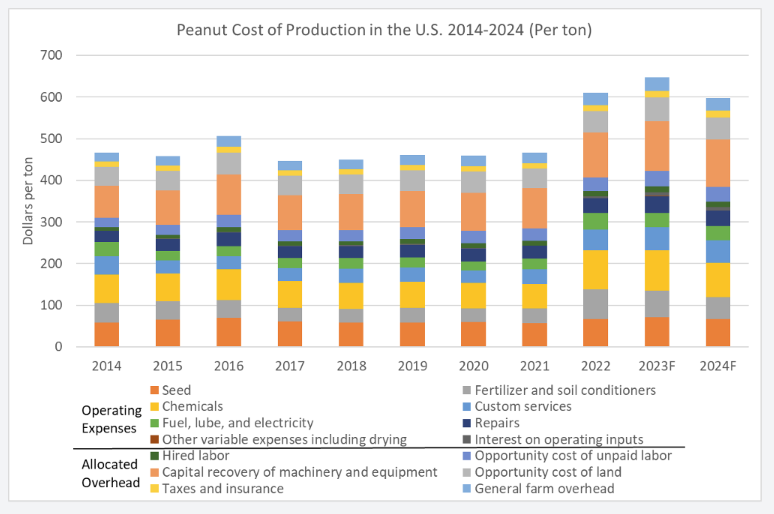
Marketing peanuts can be challenging for producers due to the lack of a futures market and relatively concentrated first buyers. This makes it even more important for producers to evaluate their cost of production to help control input costs and make strategic risk management decisions.
According to the USDA Commodity Cost and Returns for peanuts, the cost of production increased in 2022 and has stayed at this new higher level, much like other commodities. Figure 1 shows the 2024 forecasted operating cost of production at $336/ton. This covers such items as seed, chemicals, fuel, repairs, and interest. Meanwhile, allocated overhead includes general farm expenses that are allocated to the peanut operation, such as labor, the cost of machinery, and the opportunity cost of land. When including allocated overhead, the total cost of production is forecasted for 2024 at $598/ton, a 28% increase from 2014. These costs are slightly lower than the $648/ton total cost peak forecasted for 2023, but nowhere near the levels seen in earlier years.
In a Southern Ag Today article on December 4, 2023, it was shown that peanut prices are continuing to rise since the low in 2015. It was noted that the USDA expects prices to be about $550/ton for the 2023-2024 marketing year. This is still below the cost of production shown above.
The farm bill provides for a safety net for peanut producers with base acres through the ARC/PLC and Marketing Loan programs. These programs have statutory price levels that have not changed since the 2014 Farm Bill. For the PLC program, the statutory reference price is $535/ton. While the 2018 Farm Bill allowed for an escalation through the Effective Reference Price, that has not triggered for peanuts. Meanwhile, the Marketing Loan has been set at a rate of $355/ton. This does not provide a safety net at these higher cost levels. While Congress continues to debate the next farm bill, producers need to look at alternative marketing strategies and other ways to help mitigate the rising costs of growing peanuts. Cross hedging is a popular marketing strategy used to mitigate risk, but there is little empirical evidence that it is effective for peanuts. That leaves contracting, cost control, and crop insurance as the most viable risk management tools for peanut producers.
Article courtesy of Southern Ag Today, Rabinowitz, Adam. "Peanut Cost of Production, the Farm Bill, and Need for Risk Management." Southern Ag Today 4(2.1). January 8, 2024. Permalink
The Week
The national average for a gallon of gas dipped slightly by four cents since last week to $3.08. One reason could be lower demand, as fewer people are fueling up after the peak of holiday road travel. Today's national average is 14 cents less than a month ago and 20 cents less than a year ago.
In Oklahoma, the gas average is $2.61 today, down eight cents in the last week and 32 cents lower than one year ago.
According to new data from the Energy Information Administration (EIA), gas demand nosedived from 9.17 to 7.95 million b/d last week. Meanwhile, total domestic gasoline stocks increased substantially by 10.9 million bbl to 237 million bbl. Weak gas demand, alongside increased supply, has pushed pump prices lower. However, rising oil prices have limited price decreases. If gas demand remains weak, drivers will likely continue to see pump prices trickle downward.
CURRENT AND PAST GAS PRICE AVERAGES
Regular Unleaded Gasoline (*indicates record high)
| 1/5/24 | Week Ago | Year Ago | |
| National | $3.08 | $3.12 | $3.28 |
| Oklahoma | $2.61 | $2.69 | $2.93 |
| Oklahoma City | $2.53 | $2.62 | $2.92 |
| Tulsa | $2.61 | $2.68 | $2.93 |
| Le Flore-Sequoyah | $2.63 | $2.67 | $2.92 |
| Crude Oil | $73.75 per barrel (1/5/24) | $71.65 per barrel (12/29/23) | $73.77 per barrel (1/6/23) |
At the close of Friday's formal trading session, WTI increased by $1.10 to settle at $73.75. Oil prices have increased this week amid heightened tensions in the Middle East. Shipping disruptions in the Red Sea and the potential for tighter sanctions on Iran have led to market concerns that the oil supply could tighten and transportation costs could rise. Additionally, the EIA reported that total domestic commercial crude inventories declined by 5.5 million bbl to 431.1 million bbl last week.
The Weekend
"January is a bit of blah time of year, and gas prices are in the doldrums as well," said Rylie Fletcher, AAA Oklahoma spokesperson. "Barring some unexpected shock to the global oil market, gas prices will likely shuffle up and down a few cents for a while."
AAA has a variety of resources to help motorists save on fuel:
Next Weekend Gas Watch: Friday, January 12, 2024

NPB's dedication to retailer relationships leads to better representation for pork producers, such as yourself, and the products you raise. Hy-Vee, a regional supermarket chain with 280 locations across the Midwest & South, is a big supporter and advocate for the pork industry, thanks to the engagement and partnership built with NPB, Iowa Pork and other state pork associations.
The January/February 2024 issue of Hy-Vee's bi-monthly print & digital magazine shares a Pork Stir-Fry recipe using Hy-Vee Midwest Pork's boneless loin chop as part of its Protein-Packed main feature theme. The feature aligns seamlessly with NPB priorities, emphasizing pork as a high-quality, nutritious and affordable option.
Seasons is distributed to its primary customer base and PERKS rewards membership through direct mail and copies are always available in stores – 650,000 copies printed for each issue. The magazine is also available online at hy-vee.com/seasons.
Dr. David Fang, geneticist for USDA-ARS at the Cotton Fiber Bioscience Research Unit in New Orleans, is the 2023 Cotton Genetics Research Award recipient.
The announcement was made today during the 2024 Beltwide Cotton Improvement Conference, which convened as part of the National Cotton Council-coordinated 2024 Beltwide Cotton Conferences in Fort Worth. Fang, who was selected by the Joint Cotton Breeding Committee, received a plaque and a monetary award.
Dr. Jane Dever, Professor of Cotton Breeding and Associate Center Director for Texas A&M AgriLife Extension, one of Dr. Fang's nominators, said that he has made tremendous contributions to the development of molecular markers which have been made publicly available and are utilized in practical cotton breeding and realized potential in a population derived from crosses made by USDA-ARS colleagues. Dr. Fang also has constructed numerous genomic maps of cotton and identified numerous markers for various agronomic traits.
Each of Dr. Fang's nominators spoke to his work with the Multi-parent Advanced Generation Inter-Cross (MAGIC) population of cotton and the discoveries that have stemmed from his research. The population was created from crosses done by Drs. Jenkins and McCarty. Dr. Fang and his team in New Orleans have sequenced the genomes of the entire population and identified genes and genetic loci that control fiber quality and other agronomic traits Dr. Fang's research with the MAGIC population has spurred additional research and investigations related to disease resistance and drought and salt tolerance in cotton.
Dr. Kater Hake, former vice president of Agricultural & Environmental Research at Cotton Incorporated, another of Dr. Fang's nominators, spoke to his ability to construct and lead a cohesive team of researchers who have been highly successful and innovative. The work accomplished at Dr. Fang's lab has opened the doors for improvements in fiber quality for not only public breeders but commercial breeders as well.
Dr. Fang has authored or co-authored 121 scientific journal articles to date and five book chapters, and has served as editor for both Cotton and Cotton Fiber: Physics, Chemistry and Biology which were published in 2015 and 2018, respectively. Cotton provided a comprehensive update to all aspects of cotton research since the first edition was published in 1984 and Cotton Fiber: Physics, Chemistry and Biology was the first book to focus solely on cotton fiber.
Dr. Fang is a member of multiple scientific and professional societies and serves as an academic editor for seven international journals. He has received numerous awards throughout his career among them being named a Fellow by the Crop Science Society of America in 2023.
Dr. Fang earned his bachelor's degree from Jiangxi Agricultural University in China and his master's and Ph.D. from Huazhong Agricultural University in China. He was a molecular cotton breeder for Delta & Pine Land Company from 1998 to 2008 before joining USDA's Agricultural Research Service as a research geneticist in Stoneville, MS in 2008. In 2009, Dr. Fang transitioned to Research Leader at the Cotton Fiber Bioscience Research Unit in New Orleans, LA where he recruited a "world-class research team" focused on fiber quality improvements through plant breeding. The annual Cotton Genetics Research Award was established in 1961 by U.S. commercial cotton breeders to recognize and encourage basic research in cotton genetics, cytogenetics, and breeding. It is administered by the Joint Cotton Breeding Committee consisting of representatives of the NCC, the USDA, state experiment stations, Cotton Incorporated, and commercial breeders

A push for greater transparency might mean landowners have to supply more information to comply. On January 1st, the federal Corporate Transparency Act (CTA) went into effect. It could impact small businesses, corporations, and limited liability companies with the goal of stopping money laundering, the financing of terrorism, and tax fraud.
The International Association of Administrators analyzed the requirements of what information will be required.
Company Information
The CTA necessitates disclosure for what it defines as "beneficial owner information" or BOI.
Beneficial Owner Information
The Financial Crimes Enforcement Network (FinCEN) says that beneficial owner information "refers to identifying information about the individuals who directly or indirectly own or control a company." FinCEN will play a key role in implementation and enforcement of the CTA.
FinCEN laid out access and safeguard provisions of the CTA, which it describes as the "Access Rule."
"In accordance with the CTA, the Access Rule provides access to BOI to Federal agencies engaged in national security, intelligence, or law enforcement activity; State, local, and Tribal law enforcement agencies with court authorization; foreign law enforcement agencies, judges, prosecutors, and other authorities that meet specific criteria; financial institutions with customer due diligence requirements and regulators supervising them for compliance with such requirements; and U.S. Department of the Treasury (Treasury) officers and employees. Each category of authorized recipients is subject to security and confidentiality protocols aligned with applicable access and use provisions.
This Access Rule follows the final BOI Reporting Rule FinCEN issued on September 30, 2022, which requires certain corporations, limited liability companies, and other similar entities created in or registered to do business in the United States to report to FinCEN information about themselves, their beneficial owners, and, in some cases, their company applicants to help authorized BOI recipients protect national security, enforce laws, and promote other policy objectives identified in the CTA."
RELATED: The Financial Crimes Enforcement Network provides this detailed resource on the new provisions of the Corporate Transparency Act, along with a compliance guide and webinar on reporting requirements. Access those here.
Sole proprietorships and general partnerships are generally exempt from the new federal requirements, according to the International Association of Administrators. Also exempt are businesses that are already regulated, e.g., financial institutions, publicly traded companies, and insurance companies.
RELATED: The International Association of Commercial Administrators provides additional information on the Corporate Transparency Act, including important dates, reporting exemptions, and punishments for failure to comply. Check those out here.
"The purpose is to find out who is doing business in the United States," said U.S. Representative John Garamendi -- a Democrat who represents an area between San Francisco and Sacramento in northern California – told KGO-TV in San Francisco.
Garamendi, who has been in public service for half a century in various roles (California State Assembly, California State Senate, Deputy Secretary of the Interior and U.S. house of representatives)—supported the CTA and hopes that it provides more information to the public about business owners.
"The beneficial owners or the people who are receiving benefit from the corporation or from the LLC or partnership will have to disclose who they are," he explained.
"We had a lot going on in 2023," Micah Brown, staff attorney for the National Agricultural Law Center at the University of Arkansas, told American Farmland Owner. Brown reflected on what states have done to restrict foreign land ownership in the United States for certain countries.
But what's next? And what role could the U.S. Supreme Court play in determining whether foreign entities can own land in America?
Micah Brown will be a keynote speaker at the 17th Annual Land Investment Expo. Listen on Spotify, Apple Podcasts, AFO.com, or YouTube.

Philippines President Ferdinand Marcos Jr. signed an executive order extending reduced tariff rates on imported pork for the third consecutive year. The in-quota duty is to remain at 15%, while the out-of-quota rate is 25%.
In May 2021, in response to a shortage of pork caused by African swine fever (ASF), the Philippines lowered its import duties from 30% and 40%, respectively. It also increased the quota amount, known as the minimum access volume (MAV), to 254,210 metric tons (MT), from just 54,210 MT.
Under the lower tariffs and higher MAV, U.S. pork exports to the Philippines increased to a record $205 million in 2021, a nearly 79% hike. But after the increased quota amount expired on Jan. 31, 2022, exports fell that year to just under $135 million, and for 2023, they likely will be about $120 million. Those amounts were significantly higher than they historically have been.
Why it matters: The Philippines is an important Asian market for the U.S. pork industry. With more than 109 million people and a cultural preference for pork, the island nation is a top 10 market for U.S. pork exports. The country's lower tariffs on pork imports have helped spur significant increases in U.S. pork exports there.
NPPC's take: NPPC has been working with the U.S. and Philippines governments to expand access for U.S. pork to the Philippines market and help the Asian country deal with ASF.
RON's Dave Lanning has a pre-opening look at today's agricultural Markets.
Click the audio tab below for today's report.
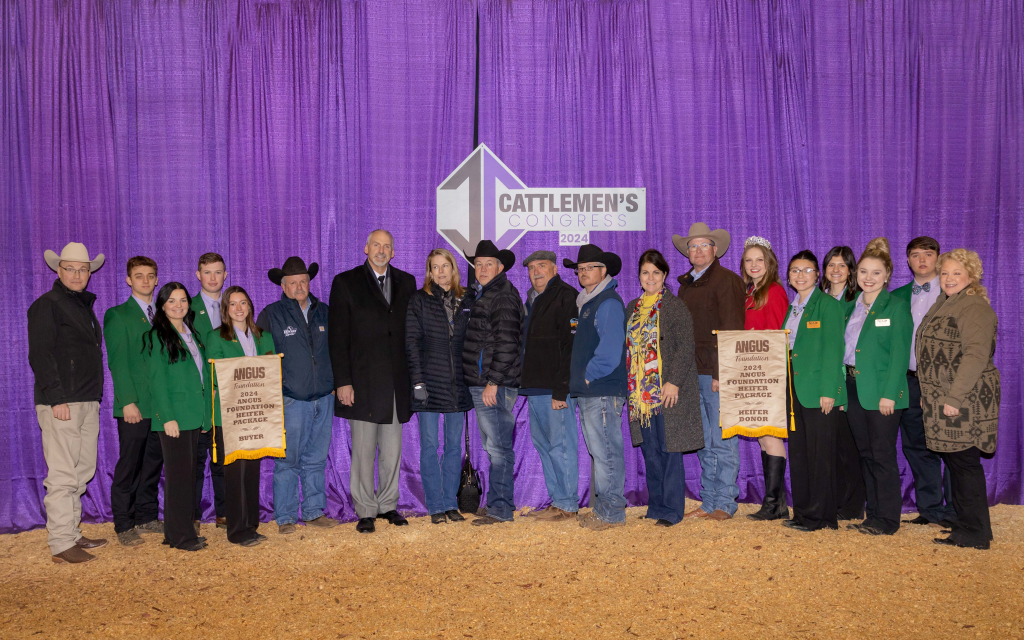
The 2024 Angus Foundation Heifer Package, donated by Yon Family Farms of Ridge Spring, S.C., was purchased by Express Ranches of Yukon, Okla. for $52,500 on January 5 at Cattlemen's Congress in Oklahoma City.
Express Ranches of Oklahoma purchases bred heifer Yon Sarah K1233 at the National Angus Bull Sale in Oklahoma City.
Express Ranches of Yukon, Oklahoma, purchased the Angus Foundation Heifer Package on Jan. 5 for $52,500 to continue the legacy of the Angus breed. The package, donated by Yon Family Farms of Ridge Spring, South Carolina, led off the National Angus Bull Sale during Cattlemen's Congress in Oklahoma City. Since 1980, the heifer package has been sold to generate unrestricted funds to further its mission of supporting education, youth and research for the breed.
Yon Family Farms generously donated Yon Sarah K1233 (AAA *20450734) for the 2024 Angus Foundation Heifer Package. The bred heifer is a maternal sister to both Yon Top Cut G730 (AAA +*19476453) and Yon Saluda (AAA +*20336998). Yon Sarah K1233 is safe in calf to Yon Toccoa F1054 (AAA +*19306162), with an anticipated due date of March 21, 2024. The heifer package also includes an Advanced Reproductive Technology Package from Trans Ova Genetics, trucking to the buyer donated by Lathrop Livestock Transportation and 30 days of mortality insurance donated by Jeanne Conover, Livestock Insurance Agent with Conover Auction Service.
Yon Family Farms is a first-generation seedstock operation whose focus is to provide high quality, value-added cattle to satisfied customers. They aim for their customers to believe that honesty, quality, service and value are synonymous with their name.
"We just appreciate the opportunity to give back in a small way," said Kevin Yon.
Kevin and Lydia Yon started the operation in 1996, and now work alongside their three children, Sally, Drake and Corbin, who each returned to the farm after attending college. The Yons host both a spring and fall production sale, selling around 425 registered Angus bulls and 200 females annually.
"The Yon family brought us an incredible female to offer for this year's heifer package," said Jaclyn Boester, Angus Foundation executive director. "Their generosity, coupled with the incredible support from Express Ranches, will help us continue creating opportunities for the next generation."
Funds raised through the sale of the heifer package will benefit the Angus Fund, which provides unrestricted dollars to further the Foundation's mission of education, youth and research. The Foundation supports a diverse set of efforts focused on ensuring a bright future for the breed. Academic scholarships, leadership conferences and cutting-edge research are among the many programs sustained by the Angus Fund.
The Angus Foundation Heifer Package has raised more than $2.9 million since the inception of the program. For more information about the Angus Foundation or the annual Angus Foundation Heifer Package Sale, visit AngusFoundation.org.
— Written by Peyton Schmitt, Angus Communications
About the Angus Foundation
Established as a 501(c)(3) organization in 1980, the Angus Foundation remains focused on its mission to support Angus education, youth, and research. The organization has distributed more than $4.2 million in youth scholarships since 1998 and has also invested more than $1.3 million in beef cattle research in the past decade.
For more information, contact the Angus Foundation at 816-383-5100.
At the 2024 Cattlemen's Congress, Senior Farm and Ranch Broadcaster, Ron Hays, caught up with the CEO of the American Angus Association, Mark McCully, and talked about the state of the Angus industry and the fourth year of Cattlemen's Congress.
"We are four years in, and it has really matured into a fantastic event," McCully said.
There are cattlemen from all over, McCully said, as he had the chance to visit with some producers who traveled from as far as Scotland to attend one of the cattle sales at the show. McCully said there are not only live cattle sales at the show but also sales for genetics in many different forms.
"Oklahoma City is a city that is easy to get around," McCully said. "This is a very exhibitor-friendly show."
Regarding the state of the Angus breed, McCully said ranchers remain optimistic, although herd rebuilding is going a little slower than many expected.
"I think the profitability scenario for commercial producers continues to be strong; they are going to be in the driver's seat for a while, and that always bodes well for the ability to invest in genetics," McCully said. "Angus genetics continue to fit that job description for calving ease, and as they start rebuilding and buying heifers back."
McCully said incredibly strong growth has been seen in the premium side of the beef market. Over 25 percent of the total cattle in the United States today are qualifying for the CAB program, McCully said, so it is a significant force in the marketplace.
"We continue to see the premiums on that product grow over Choice and, of course, Choice over Select," McCully said. "Prime is even on top of Certified Angus Beef, so the market signal continues to be awfully strong for cattle that can grade, which again, typically drives the value of marbling specifically."
To see the complete schedule of everything happening at the fourth Cattlemen's Congress, CLICK HERE.
The Beef Buzz is a regular feature heard on radio stations around the region on the Radio Oklahoma Ag Network and is a regular audio feature found on this website as well. Click on the LISTEN BAR for today's show and check out our archives for older Beef Buzz shows covering the gamut of the beef cattle industry today.
After a five-day suspension in late December, U.S. Customs and Border Protection resumed operations at the international railway crossing bridges in Eagle Pass and El Paso, Texas. These critical rail arteries, essential for shipping grain into Mexico, were temporarily closed to redirect CBP resources for efficiently processing an influx of migrants entering the U.S. at these points.
The agency, while prioritizing border security, is adapting plans, deploying resources, and working toward maintaining efficient trade and travel operations. The two crossings, and additional crossings as needed, will remain open for longer hours to help alleviate the backlog of rail commerce.
This development follows the advocacy of the Ag Transportation Working Group, of which ASA is a member, urging the U.S. Department of Homeland Security to reopen these critical grain shipment routes. Read the letter here.Why it matters: These routes constitute 45% of all rail cars moving to and from Mexico. According to the U.S. Soybean Export Council, approximately 70% of soybeans exported to Mexico rely on rail transportation. On average, the U.S. exports about 110,000 metric tons of soybeans and 33,100 metric tons of soybean meal per week to Mexico.
At the 2024 Cattlemen's Congress, Senior Farm and Ranch Broadcaster, Ron Hays, caught up with the President of the American Angus Association and Oklahoma Rancher, Barry Pollard. Pollard wears many hats, as he is also the owner of P&K equipment and a retired neurosurgeon.
Pollard said it has been a busy week as a trade show representative and sponsor at Cattlemen's Congress, and the crowd has been great. After the sudden passing of Jarold Callahan, Pollard talked about the impact Callahan had on the cattle industry and his instrumental place in Cattlemen's Congress.
"His leadership and his knowledge of the business, from beginning to end, was just fantastic," Pollard said. "He has been a guy that has been on the commercial end of it, he has feedlot experience and ownership, he has followed cattle all the way through, as well as seeing them in the show cattle arena..."
Pollard applauded Callahan's special ability to evaluate things in the present, look forward to the future, and see changes that needed to be made.
"He was truly a visionary in this business," Pollard said.
Regarding innovations in the cattle industry, Pollard also talked about the ability of commercial cattlemen to meet the changing needs of the consumer continuously.
"It is all about giving our commercial cattlemen the opportunity to have better cattle," Pollard said. "Put a better product out there in the grocery stores for the consumer public. The taste ability, the marbling of the animals and the carcass quality- that is what it is really all about and what the drive is."
Pollard said there are new chances each day to improve and produce a better product for the consumer. The sales offered at Cattlemen's Congress offer some routes of genetic progress for cattle producers.
Now that herd rebuilding is on the horizon, Pollard said producers have the chance to buy back better cattle than before.
"There are so many opportunities that are presented at these sales for you to be able to improve your herd, that make it a wonderful event and showcase of some of the finest cattle in the United States," Pollard said.
Through his involvement in the beef industry and as the owner of P&K equipment, Pollard said he is grateful to have the ability to work with great individuals. Success comes from service, Pollard added, which he believes is the key.
| |||||||||||||||||||||||||||||||||||||||||||||||||||||||||||||||||||||||||||||||||||||||||||||||||||||||||||||||||||||||||||||||||||||||||||||||||||||||||||||||||||||||||||||||||||||||||||||||||||||||||||||||||||||||||||||||
|
With rounds of accumulating snow forecast to impact parts of the Sooner State over the next several days – late this week and early next week – AAA Oklahoma is urging drivers to be prepared for the conditions and to remain cautious if out on the roads, while the auto club's roadside rescue fleet prepares for a busy period of assisting drivers.
AAA Oklahoma anticipates an increase in emergency roadside service calls as the wintry weather sweeps through and road conditions deteriorate, with slide-offs and crashes due to slick roads, battery/non-start problems and flat tires the main culprits. Last winter (Dec. 2022-March 2023), AAA Oklahoma Emergency Roadside Service crews assisted more than 58,000 motorists across the state.
AAA Oklahoma tips to prepare vehicles for winter weather
Hazardous storms and inclement weather are a factor in an average of nearly half a million crashes and more than 2,200 traffic crash deaths nationwide every winter, according to the AAA Foundation for Traffic Safety. AAA Oklahoma is encouraging drivers to have safety in mind if they must venture out on the wintry roadways.
"Ice and snow can cause significant safety problems by reducing visibility and making it difficult to maneuver or stop," said Rylie Fletcher, AAA Oklahoma spokesperson. "It's important for drivers to be cautious and take it slow if they have to get out on the roads."
On average, about one-third (32%) of crashes during the winter occur in adverse weather or road surface conditions, according to the AAA Foundation for Traffic Safety.
AAA Oklahoma tips for driving in snowy and icy conditions
More details are available in AAA's resource, "How to Go on Ice and Snow," found at https://exchange.aaa.com/wp-content/uploads/2012/12/AAA-How-to-Go-Ice-Snow.pdf.
Far too many drivers become stranded on the roadside this time of year. Nationwide, AAA handles an average of 600,000 emergency roadside assistance calls per week in the winter with the most common problems being dead batteries, extractions, towing and flat tires.
"Motorists should heed travel warnings and stay home unless they absolutely must venture out," AAA Oklahoma's Fletcher said. "AAA Oklahoma is reminding anyone who must drive on icy or snow-covered roads to be prepared for the conditions and to go nowhere – not even a short distance - without a full tank of gas, a fully charged cell phone (loaded with the AAA Mobile App or the AAA Roadside assistance number pre-programmed) and a fully stocked emergency kit."
AAA Oklahoma recommendations for winter emergency kit items to keep in your vehicle
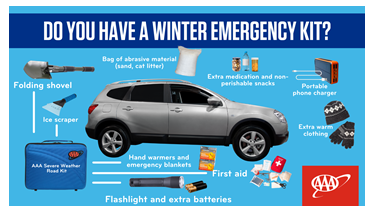
Oklahoma Agritourism has launched the Oklahoma Wine Trails passport program. The program will include nine regional wine trails with collectable stamps and prizes.
"Our new passport program is the perfect 'bite-sized' adventure to get folks out to our vineyards and wineries," said ODAFF Viticulture and Enology Coordinator Madi Franklin. "We hope by breaking up our 43 producers into regional trails, exploring our wine regions will be more approachable and easier to complete."
According to ODAFF, the passports are only available at the vineyard and winery locations.
Oklahomans who are a fan of Oklahoma wines can expect the passport program to make your tasting experience better with nine trails scattered around the state, the passports offer the opportunity to try local Oklahoma wine, meet passionate producers, see some incredible landscapes, and collect fun prizes. The Oklahoma Wine Trails passport program is your guide to a fun filled day or weekend trip in Oklahoma.
"By having nine different passports with only three to six stops each, the opportunity to win fun prizes is very doable," said Franklin. "Plus, you'll have more time to spend tasting a wide variety of wines and chatting with our wonderful producers."
Each wine trail boasts its own clever name, trail logo, and color scheme making each one a unique adventure and experience. The wine trail brochures with information about all 43 stops are available upon request from travelok.com or at a variety of tourist stops
Download the free app or check out our website to see the nine trails and stops:
App Website: https://explorer.oklahomawinetrails.com/
Agritourism Website: https://www.oklahomaagritourism.com/trails/wine-trails/

The National Cotton Council and its cooperating partners welcome all to the 2024 Beltwide Cotton Conferences January 3 through 5 in Fort Worth, Texas for three days of individual reports, panel discussions, hands on workshops and seminars are designed to provide attendees with information they need to help producers make key cotton production/marketing-related decisions.
A dynamic program, along with the opportunity to network with peers from across the Cotton Belt, separate this conference from all others in agriculture.
For more information, click here to see additional interviews
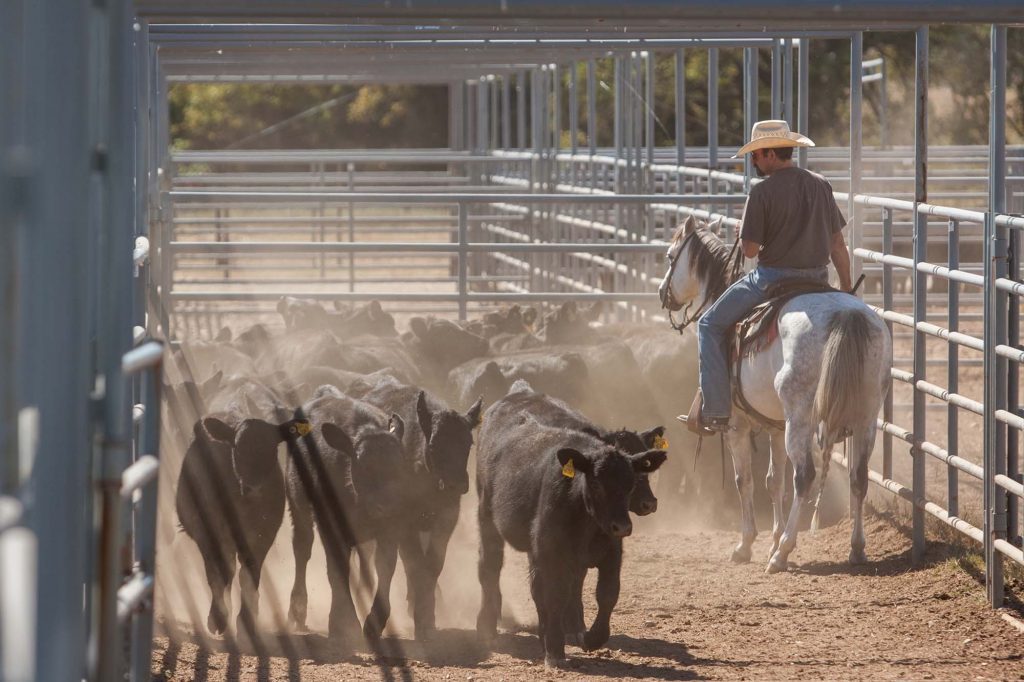
(Staff Photos by Rob Mattson/Samuel Roberts Noble Foundation) New calves are documented using EID/RFID ear tag technology at the Oswald Ranch in Ardmore, Okla., Tuesday afternoon, October 13, 2015.
Farm Director KC Sheperd is back talking with Bob Rodenberger, a partner with Stockman Oklahoma Livestock, as he gives the latest on the cattle markets.
After the holiday, Rodenberger said the feeder cattle market came back stronger, and the market for grazing calves is tremendous.
"We are still at record-level highs," Rodenberger said.
Although there is a smaller cow inventory, Rodenberger said carcasses are coming in 15 to 20 pounds more than they have for the last three years. When you factor that into 600,000 head killed each week, Rodenberger said it makes up for a lot of cattle.
"Total meat production is not as reduced as the total number of cows that we have reduced," Rodenberger said.
Rodenberger said that much of the state has seen some drought relief, but the eastern part of the state is still suffering.
"Once we fill up ponds and keep getting rain for soil moisture, and get in and have a good spring and a good summer, then I think we will start seeing some retention on heifers," Rodenberger said.

Rep. Justin Humphrey, R-Lane, today called for an independent investigation of the Oklahoma Department of Corrections to address his claims of an increase in violent assaults against inmates and staff. Humphrey chairs the House Criminal Justice and Corrections Committee.
"The Department of Corrections within the past year has seen an increase in violence against inmates and staff," Humphrey said. "Stabbings, assaults and rapes appear to have become a near daily occurrence. I am receiving multiple reports, like an inmate being tied up for approximately 12 hours and raped repeatedly. Another report is of inmates entering an employee's office and repeatedly stabbing an inmate in front of that employee.
"The reports of inmates or employees being attacked, beaten or stabbed have been overwhelming. The most recent attack was a video of an inmate attack at the Dick Conner Correctional Center shown on an Oklahoma City television station.
"It is my understanding that inmates videoed this attack and sent the video to the station director and the assaulted inmate's family members.
"I'm left asking how this can happen. When inmates become so bold that they will video their assault and mail that video to the family and director of a news station, then Oklahoma has lost control of its prison system.
"If this report is true, it clearly demonstrates the administration's catastrophic failure. The Department of Corrections cannot be trusted to investigate themselves. It is time Oklahomans demand a proper investigation into the numerous reports and allegations involving our Department of Corrections."
Humphrey said this is just the latest of bad news he's received about the department.
In his three years as chair of the Oklahoma House Criminal Justice and Corrections Committee, he said he's been instrumental in exposing a massive staff shortage as well as money that was obscured in the department's budget. He's also investigated whistleblower claims of the department covering up rapes and other crimes.
"Staff shortages and coverups place those within our prison system – both staff and inmates – in tremendous danger," he said.
Humphrey said his reporting of the staff shortage revealed the department had been overpaid by at least $43 million, which was initially concealed within the department's budget. Because of the revelation, he said he and others were able to ensure the $43 million went to pay for staff raises – all without the need to increase taxes or state appropriations.
"This does not appear to be the total amount of funding being obscured, however," Humphrey said.
"Oklahoma has closed prisons and has reduced the inmate population by approximately 6,000. Common sense would suggest significant savings. At the same time, the staff shortage has been reoccurring for years. Based on my calculations, the Department of Corrections should have undisclosed millions."
Humphrey said he also reported a whistleblower's claim that the department was covering up rapes. Despite two court opinions that agreed the whistleblower was wrongfully terminated, he said, and his own investigation before House Criminal Justice and Corrections Committee, he said the Department of Corrections and the state's attorney general have yet to take actions to reinstate the whistleblower or to investigate the rapes.
Humphrey also said he learned that inmates were being held in two-by-two-foot cells for days while reportedly being denied food, water and bathroom facilities. He said he received documentation that inmates were treated this inhumane way as a form of punishment. Despite very clear documentation, he said the Department of Corrections claims it was done to move inmates from cells and that inmates were not held in the small spaces for more than three days.
"If proven the department treated inmates in this manner and that the department intentionally ignored rapes, then unquestionably this would constitute civil rights and human rights violations," he said.
Humphrey plans to ask any investigators to also examine whether executive employees were wrongfully fired and replaced with inexperienced associates of the director. He also wants an examination of the director's training, experience and education to ensure it is commensurate with corrections work and that it warrants a $90,000 raise he said the current director recently received.
"It is my understanding this would bring the director's pay to approximately $275,000 per year. I understand $275,000 is nearly equivalent to the Texas Department of Criminal Justice director who I believe has a nearly $4 billion larger budget, has tens of thousands more inmates and has decades of correctional experience, training and education," Humphrey said.
On a final note, Humphrey said he received recent reports that the Department of Corrections found an extra $8 million in its budget, which it used to provide Christmas bonuses for employees.
"However, without notice, the department changed their evaluation process and many employees who had received good evaluations for years were told they did not meet standards and were denied the bonus," Humphrey said. "This seems extremely scandalous when you consider the qualifications of the director and the fact that he received a $90,000 raise this year."
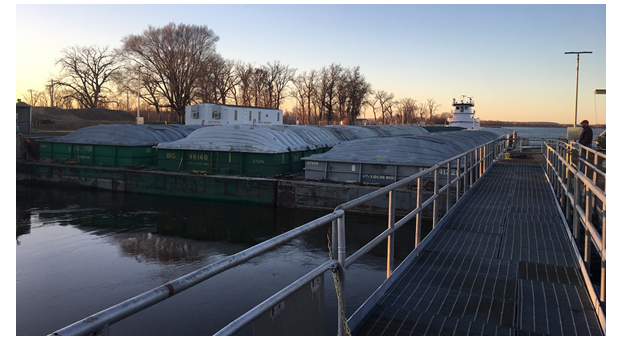
Soy growers are asking Congress to support inland waterways in the upcoming 2024 Water Resources Development Act.
Lawmakers are in the process of developing the 2024 WRDA, a critical piece of legislation that will shape U.S. waterway policies for the next two years. The House Transportation & Infrastructure Committee recently issued guidance for WRDA 2024 requests, with Congressional offices having until Friday, Jan. 12, to submit input.
ASA is urging Congress to ensure that inland waterways projects funded through the Bipartisan Infrastructure Law (Infrastructure Investment & Jobs Act) are completed in accordance with Congressional intent. Specifically, ASA is advocating for these projects to be funded entirely through 100% general revenue without relying on Inland Waterway Trust Fund dollars.
ASA state affiliates this week contacted their House delegation staff, asking them to communicate with the House T&I Committee in support of waiving the IWTF cost-share for the seven inland waterways construction and major rehabilitation projects funded by the Bipartisan Infrastructure Law. Additionally, ASA requests that these projects remain wholly funded at the federal level, not with IWTF funds, in the 2024 WRDA.
Background: The Bipartisan Infrastructure Law allocated funds for seven inland waterways construction projects. However, unforeseen cost overruns, attributed to increased supply and transportation costs, have left the appropriated funds insufficient to complete these projects. Without a specific provision in 2024 WRDA to waive the IWTF cost-share obligation for these projects, there is a significant risk of depleting the IWTF, thereby delaying essential capital improvement projects.Why it matters: The strength of America's farm economy relies on the efficiency of its inland waterways system. Investments in inland waterways infrastructure curbs delays along the system and prevents cargo from being diverted to more costly and less fuel-efficient modes of transport. Improvements to the nation's ports, inland waterways, locks, dams, flood protection and other water resources infrastructure allow soybean farmers to transport their crop and remain competitive in the global market.
Declining tax revenue from oil and gas production continues to push total gross receipts revenues down. Treasury receipts for the last 12 months total $16.96 billion, a decrease of $480 million, or 2.7 percent, when comparing revenue from the previous year. All tax sources in December total $1.41 billion. Continuing recent trends, revenue is down $88.3 million, or 5.9 percent, when comparing to December 2022. Revenue from the state's Gross Production Tax dropped to $102.9 million, down by 47 percent, when comparing to December 2022. However, when comparing November and December total month revenues show a rise of $116.2 million, or 8.9 percent.   |
The Oklahoma Business Conditions Index rebounded in December to a level above growth neutral. The December index came in at 50.5, compared to 43.2 in November. Numbers above 50 indicate the expectation of economic expansion over the next three to six months, but it should be noted that the index has been very volatile in recent months. According to the U.S. Bureau of Labor Statistics, the unemployment rate in Oklahoma was 3.3 percent for November, a modest uptick from 3.2 percent in October. Meanwhile, the national unemployment rate fell in November to 3.7 percent, down 0.2 percent from the previous month. As measured by the Consumer Price Index, the U.S. Bureau of Labor Statistics reports the annual inflation rate shrunk slightly to 3.1 percent in November. The energy component of the index continued to show a substantial decline over the year, dropping 5.4 percent below zero inflation, and the food index slipped below the overall inflation rate as well, ending the month at 2.9 percent. |
 As a timely, broad view of the state's economy the report releases in conjunction with the General Revenue Fund report. Providing information to state agencies for budgetary planning purposes, the General Revenue Fund acts as the state's main operating account and receives a portion of the state's gross receipts as well as state, city and county funds. |
 |
| 12-Month Period End Comparison Gross receipts total $16.96 billion, down $480.39 million or 2.8 percent versus 2022 total. |
Combined individual income tax and corporate income tax $6.04 billion, down $6.3 million or 0.1 percent. Individual tax of $5.1 billion, up $84.7 million or 1.7 percent. Corporate tax of $948.2 million, down $91.1 million or 8.8 percent. Combined sales tax and use tax–including city and county remittances–of $7.13 billion, up $258.9, million or 3.8 percent. Sales tax of $5.98 billion, up $161.2 million or 2.8 percent. Use tax, received on out-of-state and internet purchases, of $1.1 billion, up $97.7 million or 9.3 percent. Oil and gas gross production tax of $1.29 billion, down $698.3 million or 35.2 percent. Motor vehicle tax of $873.7 million, up by $3.4 million or 0.4 percent. Other sources, including 60 different revenues, of $1.63 billion, down by $38 million or 2.3 percent.  |
Monthly Comparison Gross receipts total $1.41 billion, down $88.3 million or 5.9 percent versus December 2022 . Income tax of $395.4 million, up $1.9 million or 0.4 percent. Individual tax of $372.9 million, down $7.3 million or 1.9 percent. Corporate tax of $114.8 million, up $9.2 million or 8.7 percent. Sales and use tax of $622 million, up $11.0 million or 1.8 percent. Sales tax of $507 million, down $1.0 million or 0.2 percent. Use tax of $115.2 million, up $12 million or 11.6 percent. Gross production taxes of $102.9 million, down $92.2 million or 47.3 percent. Motor vehicle taxes of $64.7 million, down $4.0 million or 5.9 percent. Other sources of $129.7 million, a decrease of $4.9 million or 3.7 percent.  Month-Over-Month Comparison Gross receipts total $1.41 billion, up $116.2 million, or 9 percent, versus November 2023. Increase in income tax of $92.3 million or 23.4 percent. Increase in sales and use tax of $27.2 million or 4.6 percent. Decrease in gross production taxes of $2.9 million or 2.7 percent. Increase in motor vehicle taxes of $500 thousand or 0.7 percent. Decrease in other sources of $900 thousand or 0.7 percent. Later this month, look for the Oklahoma Economic Report, providing a broader economic overview. View full PDF report below. Dec-23_GR.pdf |
RON's Dave Lanning has a pre-opening look at today's agricultural Markets.
Click the audio tab below for today's report.
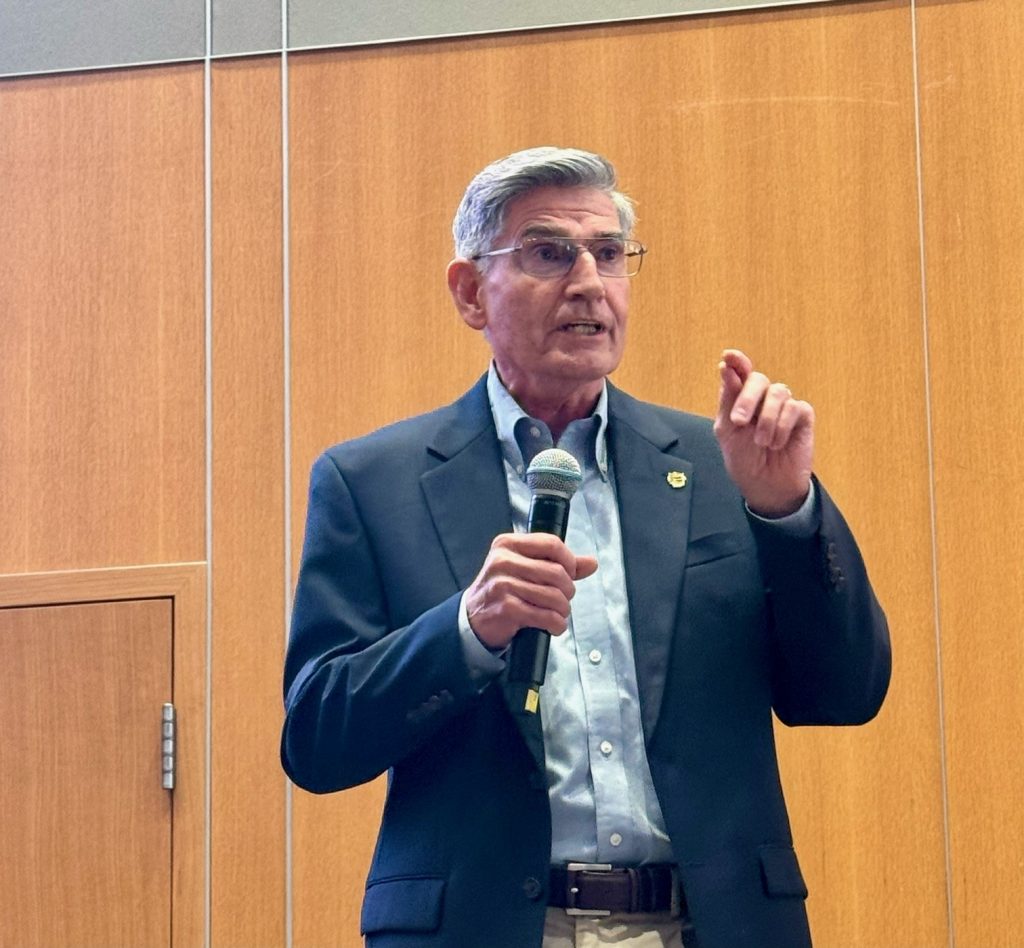
This Week on SUNUP is Oklahoma State University Extension grain market economist Kim Anderson. During this week's edition, Anderson talks about the latest crop prices.
Looking at wheat from Thanksgiving through New Year's, Anderson said, prices ranged from $5.35 to $6.03. Over a one-month time period, Anderson said that price movement is not too surprising.
Anderson said U.S. ending stocks are now around 22 percent below average, and the stocks-to-use ratio is around 16 percent below average.
"Our average price during harvest period is around $5.80; you can forward contract for $5.76," Anderson said. "That tells me wheat prices probably should be a little higher."
Anderson said the corn market was relatively stable from Thanksgiving to New Year's, with a 20-cent price movement. Now, Anderson said corn prices are around $4.49 and are headed lower.
"Corn prices, right now, are probably where they should be, given the situation, and as we go on out to the '24 crop, unless things change, maybe slightly higher prices," Anderson said.
Soybeans are still on a downtrend, Anderson said, and soybeans can be forward contracted for $11.70 for 2024 delivery.
"Bean prices are probably where we expect," Anderson said.
This week on SUNUP:
Watch SUNUP:
Saturday at 7:30 a.m. & Sunday at 6 a.m. on OETA (PBS)
YouTube.com/SUNUPtv
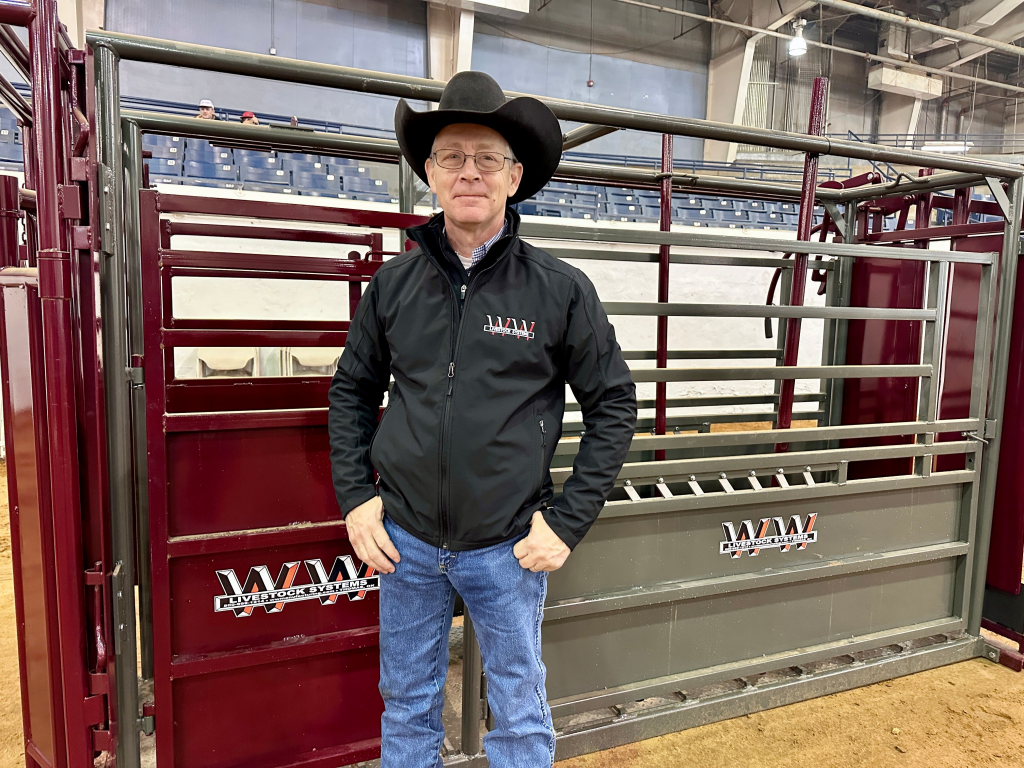
At Cattlemen's Congress, Senior Farm and Ranch Broadcaster, Ron Hays, had the chance to visit with the National Sales Manager of WW Livestock Systems, Sam Eck. Hays and Eck talk about year four of Cattlemen's Congress and WW Livestock Systems.
"WW started back in 1946 by the Webster family," Eck said. "We have been building quality livestock equipment and animal handling equipment since then. We started building squeeze chutes back in about 1960, and it has just continued to evolve to what it is today, where we have got about eight different models of squeeze chutes and about anything you need for animal containment."
One WW squeeze chute will be given to the winner of the Hereford pen show.
"We were contacted by the AHA last year to donate a chute to help generate some interest in this show, and we did it then, and they hit me again this year...," Eck said.
Eck said that building squeeze chutes is comparable to raising cattle because it is all about listening to what the consumer wants.
"It has got to be manufacturer-friendly, but it must also be something that fits the masses," Eck said.
While many manufacturers add extras to chutes, Eck said, WW takes pride in keeping equipment simple enough for anyone to operate.
WW Livestock manufacturing facilities can be found in Thomas, Oklahoma, Duncan, Oklahoma and in Livingston, Tennessee.
"We have got about 250 to 300 distributors around the country, and they sell everything from squeeze chutes to panels and gates to rodeo equipment, and hog and sheep pens for the fair and expo world," Eck said.
WW Livestock provided all of the panels for Cattlemen's Congress, Eck said, and is greatly involved in other shows and expos in Oklahoma and Texas.
Regarding the fourth year of Cattlemen's Congress, Eck said he sees the event as a great asset for the state.
"I feel like it is an important thing to keep here in Oklahoma for the agriculture industry," Eck said. "I think it is really important to give us producers in this state and surrounding areas a place to come and put our cattle on a big stage."

"Table for All: Pennsylvania Dairy Connects Communities" is the theme of the 33rd butter sculpture. The sculpture depicts members of the community gathering around the dinner table, connecting through a delicious bounty of food while celebrating the hard work of Pennsylvania's farmers.
Dairy farmer Walt Moore of Walmoore Holsteins in Cochranville, Pennsylvania, said, "Agriculture plays an important role in all of our lives, and I'm proud that the wholesome food we produce brings people together. This year's butter sculpture illustrates the important connection between farmers and their local communities. That is very meaningful to me because I love what I do as a dairy farmer."
The sculpture was constructed over several weeks by artists Jim Victor and Marie Pelton of Conshohocken, Pennsylvania, using more than 1,000 pounds of butter donated by Land O' Lakes in Carlisle, Cumberland County.
"Creating art that showcases the hard work of dairy farmers is an immense source of pride for us," said Jim Victor. "We also enjoy knowing that the sculpture tells an impactful story about the importance of agriculture," added Marie Pelton.
The butter sculpture is on display in the Farm Show's Main Hall. Following the Farm Show, the butter will be recycled on the Reinford Farm in Juniata County and converted into renewable energy in the farm's methane digester.
Half a million people are expected to visit the butter sculpture at the PA Farm Show during its eight-day run from January 6th through January 13th.
About American Dairy Association North East
The American Dairy Association North East (ADANE) is the local affiliate of the National Dairy Council® and the regional consolidation of three promotion organizations, including the American Dairy Association and Dairy Council, Inc., Mid-Atlantic Dairy Association and Pennsylvania Dairy Promotion Program. Committed to nutrition education and research-based communications, ADANE provides science-based nutrition information to, and in collaboration with, a variety of stakeholders committed to fostering a healthier nation, including health professionals, educators, school nutrition directors, academia, industry, consumers and media. Funded by dairy checkoff dollars from 9,000 dairy farm families in New York, New Jersey, Pennsylvania, Maryland, Delaware, and northern Virginia, ADANE works closely with Dairy Management Inc.™ to bring a fully integrated promotion program to the North East region. For more information, visit AmericanDairy.com.
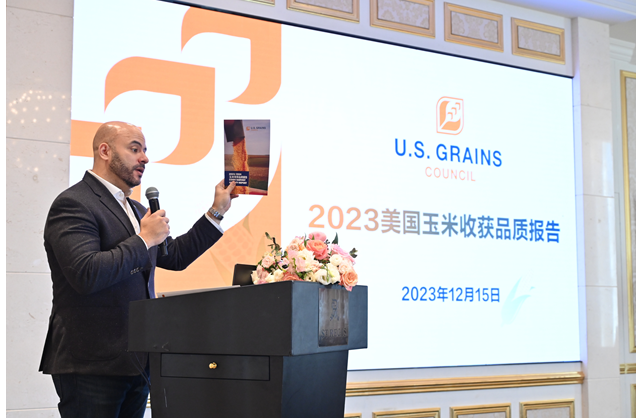
Pictured, U.S. Grains Council (USGC) China Director Manuel Sanchez highlights the Council's 2023/24 Corn Harvest Quality Report during a recent corn quality roadshow and seminar in Beijing and Guangdong Province.
To present the 2023/24 Corn Harvest Quality Report, discuss opportunities for sorghum and break down barriers to defend the market share of these coarse grain commodities in China, the U.S. Grains Council (USGC's) office in Beijing recently conducted a corn quality roadshow and seminar in Beijing and Guangdong Province.
In addition to reviewing the report, the seminar welcomed speakers who discussed the challenges and opportunities for corn globally; the current drought affecting the Panama Canal; and a 2023 U.S. sorghum harvest and market outlook.
"More than 60 traders and end-users from all over China attended our seminar to learn about the harvest quality of our 2023/24 U.S. corn crop and other critical topics affecting the global coarse-grain market," said Manuel Sanchez, USGC director in China.
Outside the seminar, the Council's team had the opportunity to meet one-on-one with COFCO International, in addition to Junjie and the Huaren Group.
"As one of the primary destinations for U.S. corn and sorghum, it's vital for the Council to engage with customers in China to share the latest market information," Sanchez said.
The market information presented by the Council during the roadshow provided customers with the most up-to-date fundamental conditions of the agricultural commodity markets. The information shared will act as a tool for customers to make buying decisions. "The 2023 calendar year was fruitful for the Council's Beijing office," Sanchez said. "We spearheaded or participated in more than 50 programs in the last 12 months, and we look forward to continuing our trade development efforts in 2024."
The time and effort U.S. farmers put into caring for the land makes for a story that is not shared often enough. A new video series produced by U.S. Wheat Associates (USW) aims to change that for overseas wheat buyers by focusing on how producers help feed the world while also acting as stewards of soil, water, and the environment.
USW's "Stories of Stewardship" project goes straight to the source. Five wheat farmers in five different states appear on camera, from their farms, to talk about their work to assure economic security for the next generation of farmers by leaving their land in better shape than it was when they started farming it.
A preview of the new, six-episode series can be viewed here. USW will debut the series at 12:00 p.m. Eastern Time, Jan. 10, 2024, with a Facebook Live event that can be viewed here.
Sustainable Production Across the U.S.
Episode 1 of Stories of Stewardship focuses on the variety of sustainable practices applied by the five farm families producing different classes of wheat across the wide range of growing conditions in the United States.
Five episodes will follow in January and February covering individual Stories of Stewardship from family farmers Tom Cannon, Blackwell, Okla., Ben and Stephanie Bowsher, Waynesfield, Ohio, Nick Jorgensen, Ideal, S.D., Art Schulteis, Colton, Wash., and Aaron Kjelland, Park River, N.D.
A Food Ingredient Produced Sustainably
"Consumers around the world want to know how their food is grown and U.S. wheat is definitely a food ingredient," said USW Vice President of Communications Steve Mercer. "Here at home, we know U.S. farmers work every day to nourish and improve the land and produce a sustainable source of high-quality wheat. The purpose of the Stories of Stewardship series is to share this information with international buyers, millers, wheat food processors, and consumers who value the quality and reliability of U.S. wheat."
In addition to the USW Facebook page, the Stories of Stewardship series can be seen on the USW website, Vimeo, X, and LinkedIn.
At the fourth Cattlemen's Congress, Senior Farm and Ranch Broadcaster, Ron Hays, caught up with the Executive Director of the North American Limousin Foundation, Mark Anderson, about the state of the Limousin breed.
This will be the third year in a row that NALF membership has met in Oklahoma City during Cattlemen's Congress for an annual meeting.
"This is one of our better shows for turnout," Anderson said. "We have a lot of members through the states of Texas, Oklahoma, Kansas, Missouri and other places, but this is close to home for a good portion of our membership, so it is very well attended. It has been a blessing."
Regarding the state of the Limousin breed, Anderson said it is the best it has been in the last five years. Anderson added that the genetic progress breeders have made over the past few years has been tremendous.
"We bring a lot of feed efficiency advantages in the cross and heterosis you get for these commercial feed yards; they make excellent cattle through a feed yard," Anderson said.
Among other successes the breed has seen over the last four or five years, Anderson said the Limousin marbling EPD has seen great improvements.
"We have never had the kind of tools to make genetics progress as fast as we have been able to in the last five years," Anderson said.
To see the complete schedule of everything happening at the fourth Cattlemen's Congress, CLICK HERE.
The Beef Buzz is a regular feature heard on radio stations around the region on the Radio Oklahoma Ag Network and is a regular audio feature found on this website as well. Click on the LISTEN BAR for today's show and check out our archives for older Beef Buzz shows covering the gamut of the beef cattle industry today.
The National Council of Farmer Cooperatives (NCFC) today announced that Becca Smith has been promoted to Senior Director of Member and Industry Relations. In this role, Smith will play a crucial role developing and maintaining strong relationships with both current and potential members and the broader industry. In addition, she will lead the Director Education Advisory Committee and organize director education programming at the NCFC annual meeting and in other venues throughout the year.
"I would like to congratulate Becca on her well-deserved promotion and the new job responsibilities that she has taken on," said NCFC President Chuck Conner. "She will play a critical role as NCFC looks to create increasing value for our members and as we look to work with like-minded beyond the co-op sector."
About NCFC
Since 1929, NCFC has been the voice of America's farmer cooperatives. Our members are regional and national farmer cooperatives, which are in turn consist of nearly 2,000 local farmer cooperatives across the country. NCFC members also include 17 state and regional councils of cooperatives. Farmer cooperatives allow individual farmers the ability to own and lead organizations that are essential for continued competitiveness in both the domestic and international markets.
America's farmer-owned cooperatives provide a comprehensive array of services for their members. These diverse organizations handle, process and market virtually every type of agricultural commodity. They also provide farmers with access to infrastructure necessary to manufacture, distribute and sell a variety of farm inputs. Additionally, they provide credit and related financial services, including export financing.
In the digital era, ecommerce has transformed the traditional shopping experience by offering online platforms to buy and sell everything from food to specialized services. Dairy MAX leveraged the new Gen Z-focused brand, Level Unlocked, to drive dairy sales through an ecommerce campaign on Instacart, an online grocery shopping and delivery platform. The activation is highlighted by a return on ad spend (ROAS) of $11.96, almost six times higher than the industry benchmark of $2.00. Sponsored display ads during National Ice Cream Month achieved ROAS of $20.27.
Ecommerce offers a dynamic platform to showcase dairy foods, and Dairy MAX's strategic decision to use Instacart meets consumers where they are. The Instacart campaign, which ran July through September, promoted dairy foods like cheese, chocolate milk and yogurt. Additionally, advertisements in July focused on National Ice Cream Month, promoting the sweet treat on the Instacart website and mobile app through in-line sponsored products and shoppable display ads.
"The buying power of Gen Z totals $360 billion," said Candace Bell, business development manager for Dairy MAX. "We harnessed that economic power for our dairy farm families, showcasing to Gen Z that dairy can be healthy, economical and fun."
Dairy MAX's integration of social media influencers, who actively promoted dairy on platforms like Twitter and Instagram, significantly contributed to the success of the campaign. These influencers' posts directed followers to the custom Level Unlocked Instacart landing page, converting social media engagement into dairy purchasers. Additionally, the esports influencers encouraged their fans to visit the Level Unlocked Instacart landing page to purchase dairy foods during gaming livestreams on Twitch. The campaign resulted in nearly $600,000 in dairy sales, with sponsored products and display ads garnering more than two million impressions.
The online grocery market has been steadily growing, driven by factors such as convenience, busy lifestyles and the desire to reduce the time and effort required for traditional in-store shopping. The pandemic accelerated this growth as more people turned to online shopping to avoid crowded stores, but the use of grocery ecommerce has proven to have staying power far beyond the pandemic. A 2023 survey conducted by Morning Consult revealed that 74% of Gen Z shoppers continue to opt for online channels when purchasing groceries, underscoring the lasting appeal of grocery ecommerce. Further, consumers trust individuals over brands. According to Matter Communications' 2023 Influencer Survey, 69% of consumers trust recommendations from an individual, including influencers, over that of a brand.
As Dairy MAX continues to navigate evolving consumer behavior, recognizing the significance of online platforms and individual voices is imperative for establishing trust and maintaining relevance. The success of this ecommerce initiative provides a valuable blueprint for future campaigns and calls for continued innovation in consumer engagement strategies.
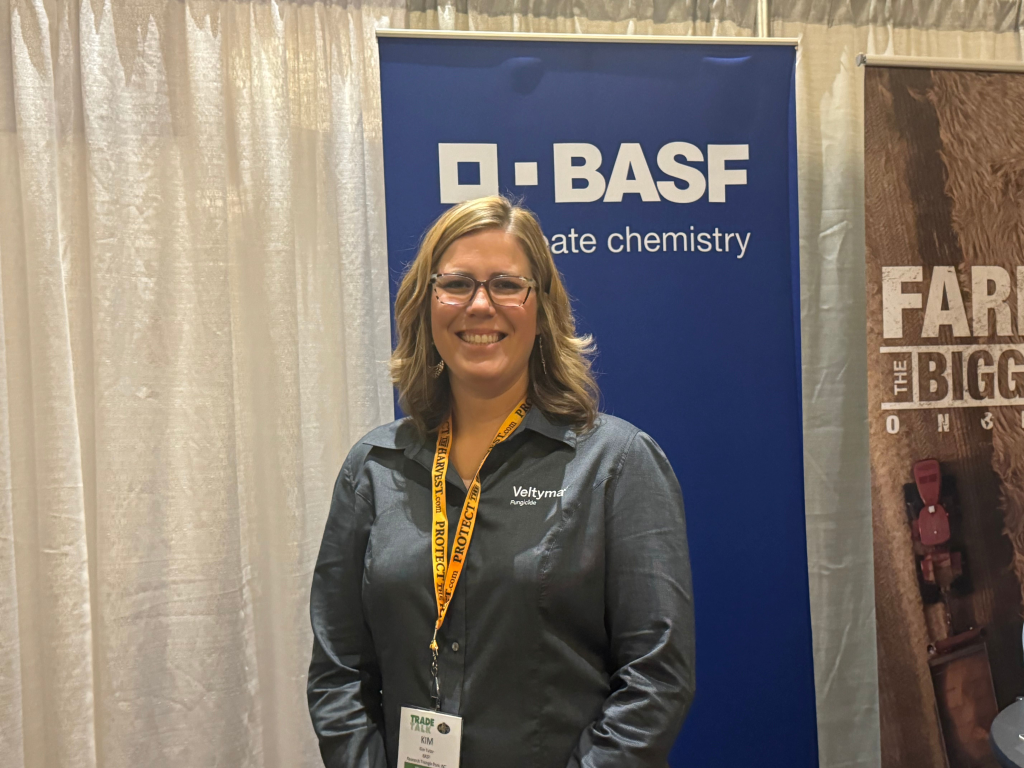
Farm Director, KC Sheperd, is talking with BASF Technical Marketing Manager Kim Tutor about fungicide options for farmers.
"BASF is committed to bringing marketing solutions to help growers solve everyday problems," Tutor said.
While Tutor's main focus is on fungicides for corn and wheat, she also talked about some options for soybeans.
"In general, this season in the Midwest, it was really hot and really dry," Tutor said.
While not many producers saw disease during the season, Tutor said there were "pockets" that received more moisture than others. Where there was more moisture, Tutor said, there was disease.
There are three things you need for disease, Tutor said, including the host, the pathogen, and the right environmental conditions.
"This year was the perfect example of that," Tutor said. "All it took was just a little bit of humidity or a little rain, and that map started to light up like a Christmas tree."
While it can be easy to wait and see if the disease comes, Tutor said it is important to have preventative applications ready beforehand. Fungicides are not only for disease control, Tutor said, but they also help mitigate environmental stress.
"We never know what kind of stress our crops are going to experience, but they are going to experience something," Tutor said.
BASF fungicide products help promote better gas exchange, root growth, cooler canopy temperatures, and more.
"You are going to get all of those environmental stress mitigation factors, those improvements in growth efficiency, you are going to help those plants continue to photosynthesize, which ultimately drives yield and ensures growers get a return on their investment," Tutor said.
Tutor also talked about some application options BASF offers for winter wheat in Oklahoma. Click the LISTEN BAR above the story to hear the full conversation!
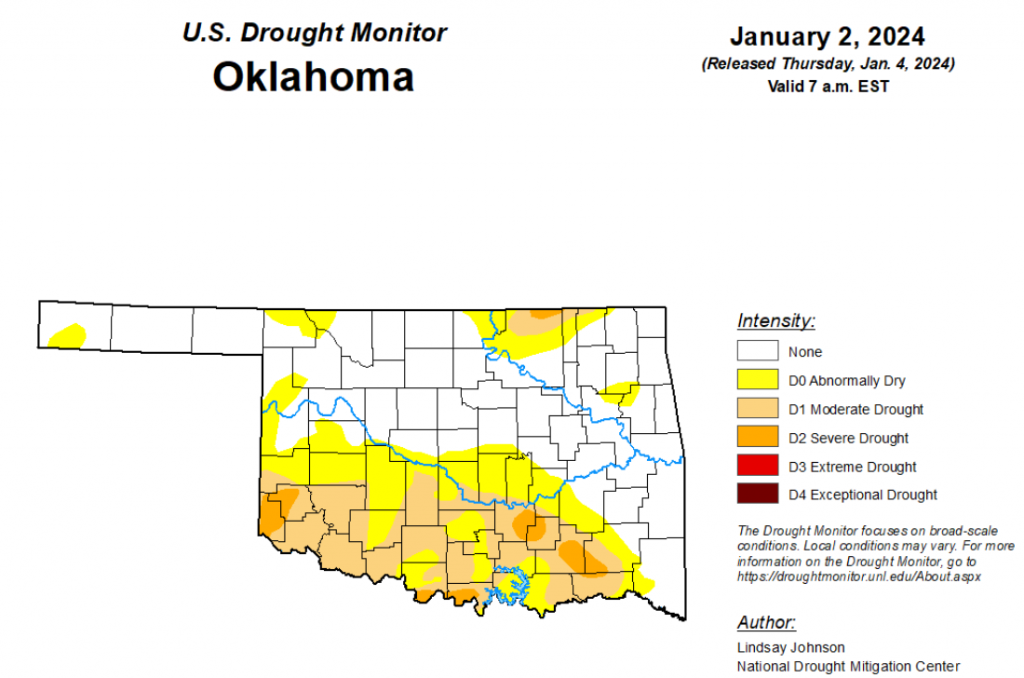
To view the latest Oklahoma drought map, CLICK HERE.
According to the latest Oklahoma drought monitor report, exceptional drought remains at zero percent, unchanged from the start of the calendar year.
Extreme drought or worse is at zero percent, unchanged from last week's percentage.
Severe drought or worse remains at 3.08 percent, unchanged from last week.
Moderate drought or worse remains at 21.64 percent, unchanged from last week's percentage.
Abnormally dry or worse conditions are now at 44.68 percent, improved from last week's 46.38 percent.
To view the United States Drought Map, click here.
According to the 6-to-10-day precipitation outlook map, the majority of the state is leaning above a 33 to 40 percent chance of precipitation through January 13. The far west side of the panhandle is leaning above a 40 to 50 percent chance of precipitation, and the southwest corner of the state is at a near-normal percent chance of precipitation through that January 13th date.
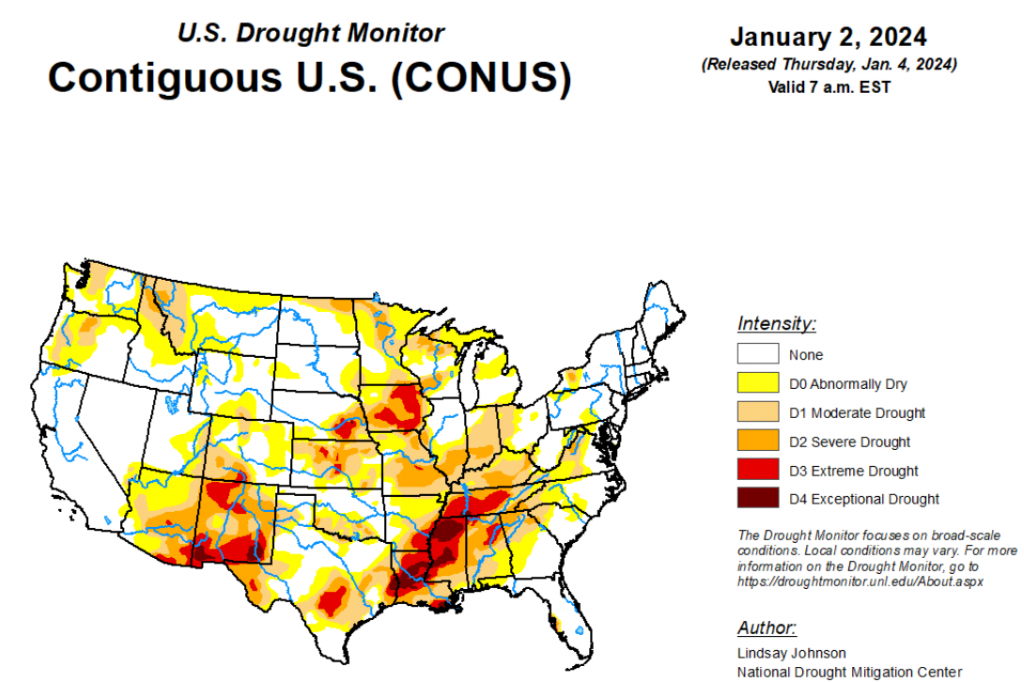
To view the United States Drought Map, click here.
According to the latest U.S. drought monitor, a large storm system brought rain and snow to the Pacific and Atlantic coasts along with rain and snow in the eastern High Plains and Midwest. The Northeast remained largely unchanged from last week, with minor improvements in western New York, Pennsylvania and central Maryland where precipitation was 150% to 300% of normal. Further south along the Mid-Atlantic, 150% to 300% of normal precipitation fell, bringing improvements in Virgina, North Carolina and South Carolina. The southern part of the Southeast did not benefit from any of the precipitation that fell elsewhere along the Atlantic coast, bringing further degradations to an already very dry part of the country. The South remained the same as last week, with small areas of deterioration from northeast Texas into southwestern Arkansas, and north and central Louisiana.
A small part of southeastern Louisiana and southern Mississippi saw minor improvements. The High Plains benefited from a rain and snow weather system that moved through the area before the new year. Northeastern Colorado into eastern Nebraska had some improvement. Northern Colorado and Wyoming experienced deterioration without the benefit of the precipitation that fell further east and low snow water equivalent (SWE). The north-central Midwest had some improvements from the same storm that benefited the High Plains. Central, eastern and southern Midwest largely missed precipitation, causing deterioration in eastern Ohio, southern Indiana and Illinois, and eastern and northern Kentucky where groundwater and streamflow remain low. The West saw few improvements, except for New Mexico. Lack of precipitation and low SWE in higher elevations have left areas of Montana and Arizona worse off than last week.
In the Southern Plains, little reprieve occurred across much of the South, with only 5% of normal precipitation falling. Western and central Texas remained unchanged, with a small improvement of Moderate Drought (D1) to Abnormally Dry (D0) conditions in the Panhandle. Parts of southeast Louisiana and Mississippi had small improvements with streamflows slightly improving. This is not the case for much of the South where short- and now long-term conditions continue to decline. Streamflow and groundwater continue to counteract what precipitation is received. Eastern Texas into western Louisiana and southwestern Arkansas saw 1-category degradations for all drought categories. Central Louisiana had Extreme drought (D4) conditions expand northward into Catahoula, Winn, Richland and Concordia parishes. Moderate Drought (D1) in northwest Louisiana extended west into eastern Texas and southwestern Arkansas. Mississippi stayed largely unchanged aside from the slight reduction of Moderate Drought (D1) in the far south. Tennessee saw improvements in the east, with improving soil moisture and benefits from the precipitation experienced in the Mid-Atlantic region. Central and eastern Tennessee, on the other hand, saw Severe Drought (D2) expand northward into Kentucky. Exceptional Drought (D4) was introduced in the South at the tri-boundary with Mississippi and Alabama due to the continued lack of precipitation for the past few months.
In the High Plains, a weather system bringing rain and snow moved through the High Plains midweek last week. Central and northern states experienced up to 400% of normal precipitation. Northeastern Colorado and eastern Colorado saw improvements in Exceptional (D4), Extreme (D3), and Severe (D2) drought conditions. These improvements are a continuation of improvements seen last week. The weather system that brought improvements to much of the High Plains largely missed north-central Colorado. Conditions worsened, introducing abnormal dryness and degrading from Abnormally Dry (D0) to Moderate Drought (D1). Northern Wyoming experienced similar conditions to Montana, leading to small Abnormally Dry (D0) and Moderate Drought (D1) expansions along the northern border with Montana.
In the West, much of the West remains status quo for the week. Precipitation fell across much of the Pacific coast from Vancouver southward into central California. Montana has not benefitted from the recent precipitation, causing small degradations along its border with Idaho, Wyoming and North Dakota. Precipitation continues to miss Arizona, mainly the north. Over the past few months Abnormal Dry (D0) conditions expanded northward into southern Utah. New Mexico did see improvements in Extreme (D3), Severe (D2) and Moderate (D1) drought conditions in the interior northwest.
Looking ahead, During the next five days (Jan. 2-7, 2024), more heavy precipitation is expected for the central and northern Pacific coast, with some areas of higher elevation also seeing some moisture. The Gulf Coast and southern Atlantic regions are expected to see heavy precipitation. This centers around southern Louisiana, Mississippi and Alabama.
The National Weather Service Climate Prediction Center's 6-10 day outlook (valid Jan. 3-9, 2024) favors above-normal precipitation for most of the country, with high probabilities found in the intermountain West, east of the Ohio and Mississippi River Valleys, Alaska and Hawaii. Only southern Texas is expected to have below-normal precipitation. There is an increased probability of below-normal temperatures west of the Rockies, particularly in the southwest. Following the precipitation trend, areas of probable heavy precipitation in the east also have the probability of being warmer than normal. The Northeast has the largest probability of having above-normal temperatures.
To view the 6-10 Day Precipitation Outlook Map, click here.
To view the 6-10 Day Temperature Outlook Map, click here.
To view the Monthly Drought Outlook Map, click here.
– Today, the Animal Agriculture Alliance announced the opening of registration for its 2024 Stakeholders Summit, themed "Ready, Set, Solve! Advancing Animal Agriculture." The 2024 Summit is set for May 8-9 in Kansas City, Mo. Register by March 8 for the lowest rates offering savings up to $100. Register here!
Dozens of speakers. Hundreds of perspectives. Countless ideas. And that's just at the starting line of the 2024 Summit. It's going to take a team to drive our future forward. It's going to take you, running alongside fellow stakeholders from across the food chain who know that putting in the work is the only way to transform today's challenges into tomorrow's solutions. Are you ready? Then take your spot at the 2024 Summit.
"The annual Stakeholders Summit is unique in its ability to bring together each link of the food supply chain to discuss emerging issues facing everyone from farmers and ranchers to retailers and food brands," said Hannah Thompson-Weeman, president and CEO, Animal Agriculture Alliance. "No matter where you sit in the supply chain, we're all seeking ways to advance animal agriculture and getting our goals across the finish line. There's no better place to discuss these challenges and opportunities than at the 2024 Summit where you're surrounded by peers and stakeholders."
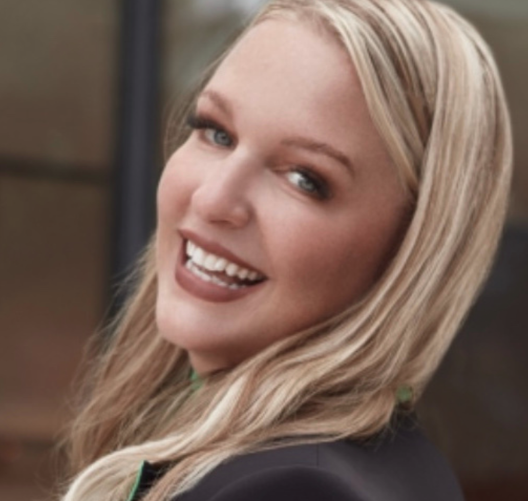
Amanda Lucey, CEO of The Partnership, a marketing and brand communications agency, will serve as moderator throughout the event. In her 20-year career, Lucey has personal experience in strategic public relations, marketing, branding, and corporate communications for clients, companies, and government institutions at a national and international level. She previously served as the director of communications and public relations for Dairy Alliance. She has held executive roles with U.S. and U.K. governments as vice consul, head of political, press and public affairs for the British Consulate General and as a media correspondent and director of communications for the U.S. government.
Thank you to our 2024 Summit sponsors: Farm Journal, Meatingplace, U.S. Poultry & Egg Association, Watt Global Media, Cargill, Zoetis, American Feed Industry Association, Merck, Dairy MAX, Farm Credit, National Pork Producers Council, Smithfield Foods, American Farm Bureau Federation, Cobb-Vantress, Inc., National Cattlemen's Beef Association, National Chicken Council, National Pork Board, Progressive Dairy, Trans Ova Genetics, Eggland's Best, and North Carolina Farm Bureau.
Get involved:
Show your support for the Alliance's outreach efforts by becoming an official Summit sponsor today! For more information on 2024 sponsorship opportunities still available, contact Logan Hall at lhall@animalagalliance.org.
Help us spread the word about Summit! If you refer a friend to attend the 2024 Summit who has never attended a previous Summit and they list your name as the person who recommended them when they register for the event, you'll both be entered in a drawing to win a $100 gift card! Each referral will count as one entry and there is no limit on the number of entries for referrers. We will give away two $100 gift cards during the Summit - one drawing for referrers and one drawing for those who were referred. All registrations for the in-person event with a referral listed made until online registration closes on May 3 will be entered. Both the referrer and the person referred must be registered to claim the gift card. Check the Summit website for the most up-to-date information. You can also follow the hashtag #AAA24 for periodic updates about the event on social media. For general questions about the Summit, email summit@animalagalliance.org or call (703) 562-5160.
The Masters of Beef Advocacy team is proud to present a new organizational program, The Center for Beef Advocacy.
The Center for Beef Advocacy (CBA), funded by the Beef Checkoff, is a one-stop platform built and designed for grassroots advocates to build community, refine communication skills, and equip you with the latest tools for your advocacy toolbox.
The CBA can be accessed using your same Masters of Beef Advocacy (MBA) login credentials. By logging into the www.centerforbeefadvocacy.com website, you can access the following:
If you are interested in elevating your story as an advocate and finding your place within Center for Beef Advocacy programming, please contact Chandler Mulvaney, Director of Grassroots Advocacy & Spokesperson Development at cmulvaney@beef.org.
As the whistle blows, referees across the nation are signaling for teams to take the fields. From elite college football players to those in pre-school and elementary soccer leagues, athletes of all skill levels are busy running, kicking and throwing balls across a variety of surfaces.
As they compete, players' bodies often are slammed, thrust and thrown across these surfaces. That's just one of the reasons researchers at Land-grant institutions across the nation are busy working to improve turfgrass to keep athletes safer. In addition, they also are studying how to help minimize negative environmental impacts from practices used to maintain these playing surfaces.
In the southern United States, research ranges from developing different varieties of grasses, to studies of underlayment and construction of stadium fields and community soccer pitches, golf courses, home lawns and more.
To grow and keep turfgrass beautiful and safe, researchers at Clemson University in South Carolina and North Carolina State University in Raleigh have written a playbook for managing sports fields. Best Management Practices for Carolina Sport Fields, written by Lambert "Bert" McCarty at Clemson and Grady Miller at North Carolina State contains research-based information and serves as a reference guide for sports field managers and students, as well as regulatory agencies worldwide.
"Information included in this book is the most current available and includes traditional and recent agronomic trends necessary to provide desirable, yet safe, playing conditions," McCarty said. "This information applies to natural grass fields as well as synthetic (turf) fields. It pertains to most fields and budgets, from professional to local parks and recreation fields, including football, soccer, baseball, softball, lacrosse and rugby."
While being a surface where players can "utilize their talents to the fullest extent," McCarty said sports fields also must be pleasing to look at.
"Television is an important part of the sports industry," he said. "Images viewers see on the field and on their television screens must be the best possible. If one patch of turf is out of place or discolored, someone will notice."
Large patches of diseased grass or discoloration from nutrient issues present an opportunity to provide guidance to turfgrass managers.
This is where Miller's expertise comes in. Miller earned his doctorate in turfgrass management at another southern region Land-grant institution, Auburn University in Alabama. As a distinguished professor of sustainability and an Extension turfgrass management specialist at North Carolina State, Miller is highly involved in turfgrass management. His research focuses on several areas including irrigation practices and turfgrass nutrition.
"Irrigation normally is just needed to supplement rainfall since the southern region of the United States usually gets adequate total rainfall amounts to meet the needs of turfgrass," Miller said. "However, there are times when rainfall frequency or distribution can result in drought-stressed turfgrasses."
This can be especially problematic in areas with sandy soils with low water-holding capacity.
"Periods of high heat can hasten water loss from plant surfaces," Miller said. "So, states such as Florida, with both sandy soils and high evaporative rates, rely heavily on irrigation for consistent turfgrass health. A heavier soil, or soil with a greater percentage of clay will have a greater capacity to hold water, so irrigation may not play as critical a role in maintaining turfgrass health."
Researchers at Oklahoma State University have developed and commercialized 10 turfgrass varieties with two more varieties expected to be released soon. The university's most recently released Bermudagrass variety, Tahoma 31, can be found on golf courses, football fields and soccer complexes nationwide, as well as in the stadiums and/or practice fields of the Philadelphia Eagles, the Washington Commanders, the Baltimore Ravens and the Chicago Bears.
Todd Tribble, athletic field superintendent at Oklahoma State, learned about turfgrass management as a Clemson University student studying under McCarty's tutelage. Although the distance between the two universities is about 1,000 miles, Tribble said knowledge he gained while studying at Clemson "directly" correlates to what he does to maintain turfgrass at Oklahoma State.
"Both universities are in (USDA Plant Hardiness) Zone 7," Tribble said. "So, the grasses we grow here are the same type of grasses grown at Clemson. Most day-to-day management tasks are very, very similar. The only real difference, possibly, is the amount of winterkill we see on bermudagrass here because our winters can sometimes be quite severe."
At the University of Tennessee Institute of Agriculture, researchers for the UT Center for Athletic Field Safety compare natural grass-playing surfaces to synthetic surfaces with the goal of improving athletic performance and reducing athlete injuries.
Distinguished professor of plant sciences John Sorochan, the center's director, also serves as a consultant to the National Football League (NFL) Players Association, the International Federation of Association Football (FIFA) and other groups associated with turf venues and their management. Sorochan has been selected to oversee a massive research and installation project for the 2026 FIFA World Cup, which has expanded to include 48 teams playing at 16 venues across Canada, Mexico and the United States.
Although they work with pro athletes and famous stadiums and fields, Sorochan and the UT turfgrass team find time apply their work to benefit athletes at all levels of skill. For example, they research how different balls bounce when they land on different grasses and have designed a device to test stresses involved when different sized shoes perform on different turfs.
University of Georgia turf research program faculty and research scientists are taking their turfgrass information to a new level by providing information to Spanish-speaking audiences abroad. Led by Alfredo Martinez-Espinoza, a professor in UGA's College of Agricultural and Environmental Sciences and a UGA Cooperative Extension Service plant pathologist, members of the UGA Turf Team recently were invited to develop a training and certification program to support the field managers of Mexico's premier soccer leagues as they prepare for the 2026 FIFA World Cup.
"This is the wonderful thing about working in applied science," said Martinez-Espinoza. "Our jobs are to filter through all the problems presented to us and pinpoint research-based, actionable solutions that can be taught so our clients are competent and prepared as a result of working with us."
So, whether it's someone tying on their cleats or watching their child blaze across a field, turfgrass scientists across land-grant institutions are working diligently to ensure the aesthetic appeal and performance of the turfs that are played on meet the highest standards. From community parks and front yards to NFL fields, from World Cup pitches, championship golf courses and Little League outfields, the safety, economic and social benefits of sports fields are enhanced by the fundamentals of turfgrass science research and development conducted at land-grant institutions.
On today's Cow-Calf Corner, Paul Beck, Oklahoma State University State Beef Cattle Nutrition Specialist, pays tribute to the life of Jarold Callahan.
We were notified on Christmas Eve that Jarold Callahan had unexpectedly passed away the previous day. He was the President of Express Ranches, a member of the OSU A&M Board of Regents, had served as Executive Vice President of the Oklahoma Cattlemen's Association, and was recognized as the 2023 inductee to the Saddle and Sirloin Portrait Gallery at the North American International Livestock Exposition in Louisville,KY. To me his biggest impact on the Beef Industry was his time as a faculty member and livestock judging coach at Northeastern Oklahoma Junior College and Oklahoma State University Department of Animal Science. The generation of students he affected in that role al industry leaders today. That the real legacy of a great man.
Jarold Callahan's obituary can be found at: https://www.highsmithfh.com/obituaries/Jarold-E-Callahan?obId=30190370
The recording of his Celebration of Life is available at:
https://www.youtube.com/live/KXesCvdjTv4?si=kk7izoIjBZOsE961

— Women in Ag Tech℠ (WiAT) is thrilled to announce its second in-person meeting January 21-22, 2024, co-located with The VISION Conference at the Renaissance Phoenix Glendale Hotel & Spa. WiAT continues to champion opportunities for women in agricultural technology and fostering a vibrant community through mentorship, idea exchanges, and collaboration.
The event promises an enriching experience for attendees, featuring a keynote address, panel discussions, and interactive sessions led by industry professionals. Lara L. Sowinski of CropLife Media Group will lead the meeting and a Special Agent with the Federal Bureau of Investigation will deliver the keynote "Cultivating Resilience: A Woman in Ag Tech's Insights on Food Safety, Cybersecurity, and Leadership in STEM." Lara shares, "Women in Ag Tech meetings aren't about just sitting and listening. Here, we come together as women to actively learn, engage, and support one another. It's a fresh and dynamic approach, setting us apart from the usual conference experience."
Guest speakers who are paving the way for women in ag technology include:
Key Agenda Highlights:
Women in Ag Tech offers various registration options. Attendees can opt for the Women in Ag Tech meeting only or combine it with The VISION Conference taking place on January 22-24. To learn more visit: https://www.thevisionconference.com/women-in-ag-tech/
Support for this initiative comes from leading organizations and sponsors committed to advancing women in ag technology. Chris Pernell, WiAT Business Director, noted, "This gathering is more than a conference; it's a movement. By amplifying the voices and contributions of women in agricultural technology, we are driving innovation, fostering collaboration, and shaping a more inclusive future."
Don't miss this opportunity to network, learn, and contribute to the future of ag tech. Secure your spot today and be part of this growing community!
For more information and registration details, visit the WiAT website or contact Chris Pernell Business Director.
About Women in Ag Tech℠:
Women in Ag Tech is an influential initiative dedicated to empowering women in agricultural technology. By fostering collaboration, mentorship, and innovation, the organization strives to create a more inclusive and equitable landscape for women professionals in the industry.
RON's Dave Lanning has a pre-opening look at today's agricultural Markets.
Click the audio tab below for today's report.
What is the Livestock Roadshow?
From beef to dairy to pork...being a livestock producer comes with inherently unique and difficult challenges, and you want to make sure you know what options are available to best protect your operation. Buying a livestock insurance policy is one risk management option. Producers should always carefully consider how a policy will work in conjunction with their other risk management strategies to insure the best possible outcomes.
To help livestock producers know what insurance resources are out there and answer any questions, RMA is hosting a series of workshops for producers to learn about updates and improvements to several livestock risk management products. The improvements and expansions are based on feedback from America's livestock producers.
Topics for RMA's Livestock Roadshow sessions include:
See dates and locations below!
| When | Details | For More Information |
| January 10, 2024 1 pm - 4 pm CT | Great Plains Career Tech 4500 S.W. Lee Blvd Lawton, OK 73505 | James Bellmon, Director Oklahoma City Regional Office rsook@usda.gov |
| January 11, 2024 9 am - 12 pm CT | Payne County Expo Center 4518 Expo Cr E Stillwater, OK 74075 | James Bellmon, Director Oklahoma City Regional Office rsook@usda.gov |
If you are not able to attend one of the sessions in-person, there will be a series of virtual sessions covering the same content discussed during the in-person sessions and you are welcome to login and attend online. Sessions will also be recorded and posted online for you to view on your own time.
Each week, Beltway Beef brings you the latest policy news affecting the U.S. cattle and beef industry. Hear from subject-matter experts, producers, and industry leaders on the topics that impact the business viability of farms and ranches across the country.
On this episode, U.S. Department of Agriculture Risk Management Agency (USDA-RMA) Administrator Marcia Bunger joins to discuss RMA's Livestock Roadshow. The Livestock Roadshow is a series of workshops happening across the country that are designed to educate producers on the various risk management products available to them. Topics for RMA's Livestock Roadshow sessions include Annual Forage, Dairy Revenue Protection, Livestock Gross Margin, Livestock Risk Protection, Pasture, Rangeland and Forage, and Weaned Calf Risk Protection. Virtual and in-person sessions will occur starting this month and continuing into March. For the full schedule, please visit rma.usda.gov.
Applications for Oklahoma Farm Bureau's 2024 Oklahoma Grassroots Rural & Ag Business Accelerators program year are now open until March 1 for rural Oklahoma and agricultural innovators looking to develop their enterprises and deepen their business understanding.
The Activate Oklahoma rural innovation pipeline provides resources and assistance for innovative rural Oklahoma businesses that have an innovation or product that will bring economic opportunities to rural Oklahoma.
The newly revamped AgCelerate Oklahoma agricultural innovation pipeline is for innovators who have innovations and technologies with an on-farm or production agriculture application that will help diversify opportunities for farmers. The AgCelerate pipeline prepares innovators to apply for the national AgLaunch365 agricultural business accelerator or participate in Activate Oklahoma.
Each innovation pipeline provides innovators with multiple training sessions that begin in April and May and run through September. The trainings include pipeline-specific boot camps that connect entrepreneurs with Oklahoma-focused business resources and curriculum to grow and expand their businesses. Additional training will follow the initial boot camps to provide a well-rounded experience for innovators.
Graduates of both Activate Oklahoma and AgCelerate Oklahoma will have the opportunity to pitch their ideas for an opportunity to receive equity investment from the program's partnering organizations. Both pipelines also prepare innovators for additional funding opportunities such as grants, loans and creative funding mechanisms.
Applications for both the Activate and AgCelerate pipelines are available on the Oklahoma Farm Bureau website at okfarmbureau.org/AcceleratorApp.
There is no cost to participate in either innovation pipeline, and successful candidates must attend all provided training sessions.
Successful applicants must have significant business operations in Oklahoma and be located in a community with a population of 50,000 or less.
The Oklahoma Grassroots Rural & Ag Business Accelerators program is a collaborative rural development effort between Oklahoma Farm Bureau and state and national partners. The program creates economic opportunities for rural Oklahomans and supports Oklahoma agriculture through innovation and business development for rural entrepreneurs. Partner organizations include AgLaunch Initiative, Ag Ventures Alliance, Oklahoma CareerTech, Oklahoma SBDC, Oklahoma i2E, Oklahoma Center for Advancement of Science and Technology, Oklahoma State University's Food and Agricultural Products Center, Noble Research Institute and Cortado Ventures.
| Last week's holiday-disrupted cattle harvest schedule proved to yield a very small total for the week with an estimated 508,000 head, down 5.6% on the same week a year ago. That suggests packers will need to fill their inventory due to this week's shortened slaughter from Monday's holiday. Further evidence of spotmarket, fed cattle demand came through in a sharp uptick in fed cattle values. Last week's fed steer price average of $172.24/cwt. was $2.98/cwt. higher than the week prior. The last week of the year often culminates in a brief, bullish fed cattle market and last week's action adds confirmation to the trend. |
 |
| Live cattle futures this Tuesday were also much higher as February becomes the front month on the CME board. The February contract was higher by more than $3.25/cwt. by mid-afternoon with April more than $2.00/cwt. higher. Given the recent depression in spot market fed cattle prices it appears to many market observers that a short-term bottom has been marked after a seven-week spiral dropping spot market values $16/cwt. Carcass cutout values were mixed in last week's report in what could be summarized as a sideways market. CAB tenderloin prices are rapidly retreating from their lofty record-highs with last week's $17.40/lb. wholesale price down 7% from the high in late November. Ribeye prices were also a bit lower last week but have only adjusted 2% from their December highs. Many of the end meat cuts pulled to dramatically lower prices in December as is the seasonal tendency. Last week's summary showed price stabilizing or slightly higher with the expectation for modestly firmer values in January. Consumer demand following the holidays tends to favor roasts as winter weather develops just as holiday spending hits home for many households with additional buildup of consumer credit card debt. |
| Carcass Quality Set to Climb Seasonally |
| With the arrival of the new year the beef market will rapidly adjust to changes in consumer buying habits. This will remove demand pressure from ribs and tenderloins, realigning the contribution of these most valuable beef cuts to a smaller percentage of carcass value. This expected shift seasonally tends to combine with rising carcass quality grade trends through March, narrowing price spreads between USDA quality grades and CAB branded product. In the past 5 years the Choice/Select spread has peaked at an average of $22/cwt. in early November, remaining in a range between $20 and $25/cwt. through the first week in December. This November/December timeline has defined the annual widest Choice/Select spread in the average 5-year data, although brief departures to even wider spreads can be noted in other months in given years. The largest CAB cutout premium over USDA Choice followed a similar fourth quarter high in 2022 but has been more common in the low supply/high demand period of early June in other recent years. |
 |
| The first quarter of 2024 promises to deliver higher average carcass quality grades, particularly as carcass weights remain record-large. The latest confirmed data places steer carcasses at 941 lb. for the week of December 11th, the record so far. The slowed pace of slaughter has yet to show any sustained increases as well. Unless this changes front-end cattle supplies will continue to be elevated along with average days on feed. These factors should couple with the typical seasonal pattern in the first quarter to track carcass quality to their highest annual levels by March. In March of 2023 CAB carcass certification topped out at 41% of eligible cattle, very near the record of 41.5% set in the same month of 2021. While we won't predict another record-high this year, the above trends are, so far, aligned to position the share of quality carcasses near the top of the historical range by the end of Q1. |
 |

Join friends of Oklahoma State University for a happy hour with Dr. Jayson Lusk, vice president and dean of OSU Agriculture.
Friday, January 5 | 1-2 PM
Hosted by
Oklahoma State University Foundation and Cattlemen's Congress
Cattlemen's Bar, Located in Barn 3, Oklahoma City Fairgrounds
Please contact Hillary Driskill with any questions about the happy hour at 405.385.5620 or hdriskill@osugiving.com
Senior Farm and Ranch Broadcaster, Ron Hays, is back talking with the Executive Vice President of the American Hereford Association, Jack Ward, about technology in the beef industry.
While genomic technology has been used frequently at the seedstock level, Ward said he sees potential for growth in the commercial industry and the feedlot sector to identify what kind of cattle and genetics will work best to reach the desired end-product that meets consumer demand.
The American Hereford Association put on a Junior Feed-Out program last year, Ward said, as it has given youth the chance to gain industry knowledge from all parts of the beef production chain. This program was opened up to commercial cattlemen as well, Ward said, and 1500 head of cattle on feed were genotyped, sire-identified and used for genetic evaluation.
"We track these cattle all the way through and were able to provide information not only about the cattle, but also about where the cattle came from, the husbandry practices of those people...," Ward said.
Some of the main goals of tracking this information, Ward said, are to provide the industry with identified genetics that are useful to the industry and to share a story with the producer.
Today, a third set of cattle is on feed in Nebraska, Ward said, and individual feed intake is collected, along with methane excretion, nitrogen excretion, and more. The project continues to focus on where the Hereford breed fits in the commercial industry, Ward added, and where it can fit in terms of sustainability.
From a genetic standpoint, Ward said the American Hereford Association is working to create a way to measure methane emissions as an EPD. While delivering a product of value to the consumer is a top priority, Ward emphasized a focus on continued profit for ranchers.
"It is a wonderful business, and it is changing all the time," Ward said. "It is exciting and keeps us all interested in what we are doing."
To listen to Part 1 of Ron's conversation with Jack Ward, CLICK HERE.
Herefords will be showing at Cattlemen's Congress Wednesday through Saturday of this week. To see the complete schedule of everything happening at the fourth Cattlemen's Congress, CLICK HERE.
The Beef Buzz is a regular feature heard on radio stations around the region on the Radio Oklahoma Ag Network and is a regular audio feature found on this website as well. Click on the LISTEN BAR for today's show and check out our archives for older Beef Buzz shows covering the gamut of the beef cattle industry today.

Fuel cost reductions and a shift in interim utility rates will add up to savings in the new year for Public Service Company of Oklahoma (PSO) and Oklahoma Gas & Electric Company (OGE) utility customers in Oklahoma.
PSO residential customers will start seeing an average fuel-cost reduction of $15.53 per month on their January bill. Additionally, PSO residential customers will receive a refund of $2.81 per month from January through April 2024. The refund is part of an overall rate adjustment case negotiated by Attorney General Gentner Drummond in November.
"During a time when customers are dealing with the rising cost of living, I'm pleased Oklahomans will see this relief on their energy bills this year," Drummond said.
Residential customers with OGE have begun seeing, on average, a 15-percent reduction to their monthly fuel bill, or a savings of about $21 per month. The Oklahoma Attorney General's Office notes these fuel savings should remain steady this year as long as natural gas prices don't fluctuate. The OGE cost reduction began in November 2023.
Photo credit: Brownfield Ag News
Recently, Radio Oklahoma Ag Network Intern, Maci Carter, visited with Makenzie Billings of the CME Group about the cattle markets and more.
"I am the manager of the livestock products at CME Group, but what we do at the exchange is we offer products for folks to come and manage their price risk," Billings said.
The cattle cycle is a little different this year, Billings said, as there has been some uncertainty.
"We are seeing folks come to our marketplace to lay off that risk," Billings said. "We have had record volumes- trading volumes- and open interest."
Billings also talked a bit about the Farm Bill.
"Unfortunately, there is not a lot we can do as far as the Farm Bill other than wait and see," Billings said. "The Farm Bill is always something that is great. It encourages folks to participate in our markets, so that is always something we are looking forward to."
| |||||||||||||||||||||||||||||||||||||||||||||||||||||||||||||||||||||||||||||||||||||||||||||||||||||||||||||||||||||||||||||||||||||||||||||||||||||||||||||||||||||||||||||||||||||||||||||||||||||||||||||||||||||
|

Members of the North American Limousin Junior Association flaunted their Limousin and Lim-Flex entries in the 2024 Cattlemen's Congress junior show. The show was held Tuesday, January 2 in Oklahoma City, Okla. Judge Shane Bedwell, Holt, Mo. evaluated the junior Limousin and Lim-Flex animals.
In the Junior Limousin show, Grand Champion Limousin Female was TASF CLAC Karma 639K ET exhibited by Ben Spencer, Gibbon, Neb. She is a 89 percent Limousin female born 4/3/2023 and sired by AUTO Lucky Guy 140D ET.
The Reserve Champion Limousin Female was exhibited by Memphis Peterson, Pukwana S.D. BOSS Lake Klarissa 239K ET is a Purebred Limousin female born on 3/12/2022 and sired by Cottage Lake Border Agent.
In the Junior Lim-Flex show, Grand Champion Lim-Flex Female was SSUL 2412K ET, exhibited by Sara Sullivan, Dunlap, Iowa. She is a 56 percent Lim-Flex female born 3/26/2022 and sired by RLBH Air Force One.
The Reserve Champion Lim-Flex Female was exhibited by Ben Spencer, Gibbon, Neb. J6 Caitlyn 685K ET is a 31 percent Lim-Flex heifer born 3/25/2022 and sired by SCC SCH 24 Karat 838.
A complete list of winners follows:
2024 Cattlemen's Congress Junior Lim-Flex & Limousin Shows
January 2, 2024
Oklahoma City, Okla.
Judge: Shane Bedwell, Holt, Mo.
Entries: 128 head
Grand Champion Limousin Female: TASF CLAC Karma 639K ET, 4/3/23, 89% Limousin, Homo Black, Homo Polled, sired by AUTO Lucky Guy 140D ET, out of AUTO Peyton 206Y, exhibited by Ben Spencer, Gibbon, Neb.
Reserve Champion Limousin Female: BOSS Lake Klarissa 239K ET, 3/12/22, Purebred, Double Black, Double Polled, sired by Cottage Lake Border Agent, out of AUTO Olga 498A, exhibited by Memphis Peterson, Pukwana, S.D.
Grand Champion Lim-Flex Female: SSUL 2412K ET, 3/26/2022, 56% Lim-Flex, Homo Black, Double Polled, sired by RLBH Air Force One, Out of WLR Eden ET, exhibited by Sara Sullivan, Dunlap, Iowa.
Reserve Champion Lim-Flex Female: J6 Caitlyn 685K ET, 3/25/2022, 31% Lim-Flex, Homo Black, Het Polled, sired by SCC SCH 24 Karat 838, out of SSTO Caitlyn 5818C ET, exhibited by Ben Spencer, Gibbon, Neb.
Limousin Junior Show Division Winners:
Division I champion: LFL Lexi 3088L ET, 5/24/23, 83% Limousin, Homo Black, Homo Polled, sired by Rattliff Jump Start 340J ET, out of LFL Hailee Jo 0093H ET, exhibited by Colt Parkinson, Levelland, Texas.
Division I Reserve: BOSS Lake MS Manuela 383L, 5/6/23, 88% Limousin, double black, double polled, sired by Ratliff Jurisdiction 435J ET, out of Cottage Lake Blue, exhibited by Bailey Reelsville, Ind.
Division II champion: TASF Legal Class 729L ET, 1/10/23, 81% Limousin, Homo Black, Homo Polled, sired by TASF Crown Royal 960C ET, out of TASF Extra Class 124E, exhibited by Jacee Parrish, Liberty, Texas.
Division II reserve: LJRJ MS Living The Dream ET, 3/3/23, 84% Limousin, Double Black, Polled, sired by TASF Crown Royal 960C ET, out SCAS Enchantress 940E, exhibited by Saylor Norvell, Tuttle, Okla.
Division III Champion: TASF Keep It Classy 681K ET, 9/21/2022, 82% Limousin, Homo black, double polled, sired by TASF Crown Royal, out of TASF Forever Classy, exhibited by Ben Spencer, Gibbon, Neb.
Division III reserve: BNTL KOKOMO 433K, 11/15/22, 81% Limousin, homo black, polled, sired by TASF Crown Royal 960C ET, out of MAGS Beach Comber, exhibited by Bentley London, Collinsville, Texas.
Division IV champion: SC Kiara 522K, 5/3/2022, 78% Limousin, double black, double polled, sired by Legacy's Hercules, out of SCAS Designer 922D, exhibited by Braxton Chaplin, Fredonia, Kan.
Division IV reserve: LLKT Kate 213K, 5/12/2022, 78% Limousin, homozygous black, homozygous polled, sired by CJSL Dauntless 6257D ET, out of LLKT Haddie 012H, exhibited by Cole Keeton, Wolfforth, Texas.
Division V champion: TASF CLAC Karma 639K ET, 4/3/23, 89% Limousin, Homo Black, Homo Polled, sired by AUTO Lucky Guy 140D ET, out of AUTO Peyton 206Y, exhibited by Ben Spencer, Gibbon, Neb.
Division V reserve: BOSS Lake Klarissa 239K ET, 3/12/22, 83% Limousin, Double Black, Double Polled, sired by Cottage Lake Border Agent, out of AUTO Olga 498A, exhibited by Memphis Peterson, Pukwana, S.D.
Lim-Flex Junior Show Division Winners:
Division I champion: Richardson's Legacy 309L, 4/14/23, 57% Lim-Flex, Double Black, sired by MAYC Gold Buckle 624G, out of MRRC Foxy 815F, exhibited by McKenna Richardson, Eureka, Kan.
Division I reserve: SHSK Lucy, 4/1/23, 43% Lim-Flex, Double Black, Homo Polled, sired by Conley No Limit, out of WLR Prada, exhibited by Dalton Miller, Treynor, Iowa.
Division II champion: SHSK Cruella Deville 301L, 1/19/2023, 34% Lim-Flex, Double Black, sired by KR Casino 6243, out of SHSK Barbara, exhibited by Danica Lowrey, El Dorado Springs, Mo.
Division II reserve: TCKK Loretta Lynn 315L, 3/15/2023, 54% Lim-Flex, Double Black, Double Polled, sired by MAYC Gold Buckle 624G, out of WLRR Grand Seduction ET, exhibited by McKenna Richardson, Eureka, Kan.
Division III champion: DLCN Kibbles 1025K, 10/25/2022, 57% Lim-Flex, Double Black, Double Polled, sired by MAYC Gold Buckle 624G, out of DLCN Nibbles 130C, exhibited by Sara Sullivan, Dunlap, Iowa.
Division III reserve: BRDG Google 05K ET, 11/22/2022, 75% Lim-Flex, Double Black, Double Polled, sired by Schilling Halas ET, out of Ratliff Google 911G ET, exhibited by Cal Pryor, Woodbine, Iowa.
Division IV champion: ELCX Kate 332K ET, 5/16/2022, 53% Lim-Flex, Het Black, Homo Polled, sired by ELCX Kings Landing 599 D ET, out of ELCX Extra Special, exhibited by Carter Kornegay, Tulsa, Okla.
Division IV reserve: TUBB MKNA Kamikaze 230K ET, 5/13/2022, 75% Lim-Flex, Homo Black, Double Polled, sired by TASF Crown Royal 960C ET, out of Ratliff Gabby 901G ET, exhibited by McKenna Richardson, Eureka, Kan.
Division V champion: SSUL 2412K ET, 3/26/2022, 56% Lim-Flex, Homo Black, Double Polled, sired by RLBH Air Force One, Out of WLR Eden ET, exhibited by Sara Sullivan, Dunlap, Iowa.
Division V reserve: J6 Caitlyn 685K ET, 3/25/2022, 31% Lim-Flex, Homo Black, Het Polled, sired by SCC SCH 24 Karat 838, out of SSTO Caitlyn 5818C ET, exhibited by Ben Spencer, Gibbon, Neb.

– Dairy MAX's award-winning, interactive Dairy Discovery Zone exhibit (DDZ) has successfully completed its 2023 tour. This year, the DDZ marked new milestones by debuting at the Greeley Stampede in Colorado, the State Fair of Oklahoma and the Heart O' Texas Fair and Rodeo, alongside continued appearances at the Colorado State Fair, New Mexico State Fair and the State Fair of Texas.
The Dairy Discovery Zone continues to be an extraordinary opportunity for people of all ages to immerse themselves in the world of dairy. Whether you're a curious child or a health-conscious adult, the exhibit provides a wealth of information and fun activities related to dairy production, nutrition, sustainability and more.
"The Dairy Discovery Zone is more than just an exhibit; it's a bridge connecting the modern family to the roots of dairy farming," says Adrian Castresana, Dairy MAX's director of consumer experience and events. "Our participation at these venues have given us an incredible opportunity to educate, engage and entertain fairgoers about the journey of dairy from farm to table, and this year marked the highest number of events and public engagements in DDZ history."
The tour kicked off the second half of 2023 at the internationally acclaimed Greeley Stampede (June 22 - July 4), a festival renowned for its rich tradition, drawing over 250,000 attendees from around the world. The animatronic cow continued to be a visual favorite for TV, as seen here on Denver's NBC Channel 9 Colorado & Company.
The DDZ's journey continued through the Colorado State Fair (August 25 - September 4) held in Pueblo, to the New Mexico State Fair (September 7 - 17) in Albuquerque, collectively attracting over 950,000 fairgoers. The New Mexico State Fair has consistently been in the top five ranked fairs in the nation.
The State Fair of Oklahoma (September 14 - 24), with 900,000 annual visitors, has grown to become one of the premier State Fairs in the nation and is located only a mile from downtown Oklahoma City. Here the DDZ exhibit was highlighted in The Oklahoman and featured on NBC Channel 4, reaching an additional 25,000 people and broadcast in more than 730,000 homes. Additional media coverage was captured in Oklahoma when the DDZ made national news on Yahoo! News.
The next stop was the State Fair of Texas (September 29 - October 22) where they welcomed more than two million fairgoers. Of those two million, 46,000 visitors stopped by to experience the Dairy Discovery Zone. National Farmer's Day (October 12) continued to be a highlight of the State Fair of Texas where Dairy MAX handed out cartons of white, chocolate and strawberry milk. Running concurrently with the State Fair of Texas, Dairy MAX was able to showcase the miniature DDZ exhibit for the Heart O' Texas Fair & Rodeo in Waco, Texas (October 5 - 15). Waco's CBS Channel 10 featured the interactive exhibit and one of their reporters "milking" June, the animatronic cow, for a live morning newscast during the fair.
The Dairy Discovery Zone continues to make an impact on communities across the region, serving as a vital platform for spreading awareness about the numerous benefits of dairy and the dedication of our farmers. Through its interactive and engaging format, the exhibit not only educates the public about the nutritional value of dairy products, but also sheds light on the meticulous care and hard work farmers invest in bringing these wholesome dairy foods from their farms to our tables. By bridging the gap between consumers and the agricultural community, the DDZ plays a crucial role in fostering appreciation and understanding of the contributions dairy farmers provide to our overall health and well-being.
"We're addressing misconceptions about dairy and highlighting the care, passion and dedication of our dairy farmers towards their animals, land and communities," Castresana adds. "With strategic partnerships and increased visibility through media coverage, we are nearing a significant milestone of reaching nearly three million engaged visitors."
As the Dairy Discovery Zone prepares for the 2024 season, it continues to be a testament to Dairy MAX's commitment to connecting communities with the dairy industry. For more information on the Dairy Discovery Zone and its upcoming locations, please visit DairyDiscoveryZone.com.
"The buck stops here," says Ty Marker, a seed dealer with Marker Ag, a Nebraska-based, independent retailer of farm products that's been in business for 25 years. "I'm only as good as the person who stands behind me, so I'm choosey about my affiliations. I need supplier partners who understand how our operation works and our needs."
Over the past 12 years, his dealership has delved into the wheat, rye, oats and grass seed markets. That led Marker to Renovo Seed™ and a partnership that has driven confidence in their direction forward and exploring new things. "Having the support system and personal relationship with Renovo Seed has been phenomenal. It has helped us grow."
Rising demand for additional cropping systems
Demand for additional cropping solutions has climbed in recent years amid an increase in forage prices, according to Marker. "Nebraska farmers are seeking alternatives for either selling a hay crop or a grazing option."
Casey Schroader, with Dakota Vision Ag based in South Dakota, says demand for these additional cropping solutions has increased over the past five years, with government conservation efforts contributing to rising interest in practices like cover cropping.
Looking beyond sales of corn hybrids and soybean varieties, Dakota Vision Ag's seed business has been split between forages and cover crops. "South Dakota has many cows and dairies, so a lot of forages go in purely for that purpose," Schroader explains. "The diversity of being able to go with hay millets and season-long grazing mixes is very useful."
In addition to meeting a rising need, these additional cropping solutions also function as a good touchpoint for the dealer. "We get to stay in contact with our customers season-long when dealing with these cover crops and blends," Schroader says.
Knowledgeable people an invaluable resource
Conservation programs and efforts are new territory for many producers, resulting in many questions about which product mixes to use and program terms. Having someone with the knowledge to answer those questions quickly is key.
"The people at Renovo Seed have been invaluable resources, simply explaining everything from products to seeding rates to planting dates," Schroader says. "The Renovo team has also been involved in research projects with South Dakota State University, working toward seed solutions for the unique challenges of our area, such as salt-tolerant alfalfas for our high-saline soils."
Marker has also been impressed with the knowledge and passion of his account manager. "Bringing a quality product and the service it requires helps set dealers and producers up for success."
Logistics critical in this market
Planting cover crops or forage mixes is largely weather dependent. Therefore, quick shipping and flexibility is key for dealers like Schroader and Marker. "I can rely on Renovo Seed to deliver, and I never question whether the quality will be good. That goes without question," Marker says.
Deeming Renovo Seed a "logistics rockstar," Marker praises the company's willingness to work through unique crop needs. "They understand being a smaller, independent business in a big, corporate world."
Diverse offerings for wide range of customers
Because his customer base ranges from a traditional producer to a progressive farmer interested in cutting-edge solutions, a diverse product line is a must for Marker. "Renovo Seed has offerings for about anyone," he says. "Their knowledge of those products and marketplace price points set the company apart."
Marker expects to sell a lot of alfalfa in 2024, in addition to the usual oats, millets, forages, sorghum, wheat, rye and triticale. Cover crops are also taking hold in his area of Nebraska.
Schroader's South Dakota customers range from cattle producers looking for forage to conservation-focused producers putting acres back into grass and using pollinator mixes. His top sellers include hay millet and rye. Producers have also been pleased with Renovo's All-American mix, which helps prepare seedbeds while fulfilling NRCS cover crop contracts.
Complete seed solution providers
"Renovo Seed makes it easy and profitable for dealers to add seed solutions that complement any portfolio, answering a growing need for streamlined logistics, support beyond the bag and a simplistic selling approach," says Matt Metzger, a sales account manager with the company. "Those additional cropping solutions enable dealers to bring true value to their customers and position them as complete seed solution providers. We're actively working to expand our dealer network."
Contact Renovo Seed to learn more about Renovo's tailored, profitable solutions and how to join their growing network of dealers.

The National Pork Producers Council (NPPC) and the National Pork Board (NPB) proudly unveil the dynamic lineup for the Pork Leadership Institute's (PLI) class of 2024. Each year, the PLI program selects a distinguished group of pork producers, and 2024 is no exception. Collaborating closely with state pork association executives and field representatives, NPPC and NPB have identified 19 outstanding individuals from across the nation to join this esteemed group.
The PLI Class of 2024:
Bryan Humphreys, NPPC's CEO, underscores the vital role of the PLI program, stating, "PLI is instrumental in shaping the success of pork producers by cultivating knowledgeable industry ambassadors and future leaders. Participation in PLI is not just an opportunity; it's a strategic imperative, as its graduates are empowered to articulate the compelling narrative of the pork industry — from local communities all the way to the heart of our nation's capital."
The comprehensive, yearlong PLI program comprises five sessions designed to provide a deep understanding of various aspects, including the federal legislative and regulatory process, the importance of international trade, the roles of national pork organizations and state pork associations, and contemporary challenges faced by producers. Additionally, participants undergo extensive media and communications training to emerge as effective grassroots advocates for the pork industry. The Pork Leadership Institute (PLI) stands as a cutting-edge joint training initiative by the National Pork Producers Council (NPPC) and the National Pork Board (NPB). Discover more about this transformative program at: Pork Leadership Institute.

Researchers at the University of Houston are training future agricultural scientists in new methods of protecting the world's food crops – which too often are left vulnerable to extreme weather events in these days of climate change.
Funded by a $995,805 grant from the U.S. Department of Agriculture, the team is expanding research knowledge and building a new curriculum for students, many from communities currently underrepresented among the agriculture industry's leadership.
"With this new project, we hope to expand opportunities in agricultural science and increase representation by opening doors for inspired scientists of many backgrounds," said Abdul Latif Khan, assistant professor of plant biotechnology at the UH Cullen College of Engineering's Division of Technology. He also is the project's principal investigator.
Frequent threats to the world's food supply stem from weather events, such as freezes, floods, prolonged heat waves and droughts. "For example, 10 or 15 years ago, droughts lasted 10 to 14 days. But now we experience droughts of one or two months," Khan said.
While plants can endure such harsh conditions for days, they cannot continue for weeks and months. Once they stop thriving, their growth slows and productivity diminishes. In addition, droughts and heat waves leave an indirect but lingering threat: As heat continues to evaporate moisture, salts concentrate in soil, creating a hyper-saline environment not favorable to existing crops.
These problems can hit hard as declining harvests decrease a farmer's income. Soil that is losing its fertility becomes more costly to maintain as agricultural land. When farming the land becomes a financial burden, the owner faces a dilemma. Ultimately, the only viable option might be to sell the land for housing developments or other commercial endeavors. Farm by farm, the loss of cropland contributes to global food insecurities.
"Climate change is affecting the entire earth, and it's leaving us with less land to produce food. By the beginning of the next century, the world food demand will be almost 30% to 35% higher than what we are growing now. To reach that higher level, we will need novel tools in our agriculture system that do two things: First, safeguard the soil system. And second, not lose our farms, which future generations will need to meet food demands," he said.
With climate change expected to spark even more extreme weather events on the planet, the need is dire for new, affordable, easy-to-use methods for farmers around the world to protect their crops. UH scientists are addressing the challenge with experiments in the Houston area.
"In our ongoing research, the overall objective is to improve plant growth and build plants' resistance against climate change. We're exploring two approaches. One is to adopt naturally relevant systems, the other involves synthetic biology or genetic engineering approaches to producing food," he said.
Research into climate-change effects on food crops is ongoing. By involving undergraduate and graduate students in the studies, researchers will share knowledge and new skills in food production and climate change biology. The new project activities will be initiated in February 2024.
Joining Khan as co-investigators are, from UH: Venkatesh Balan, associate professor of biotechnology; Yuheng Lin, assistant professor of biotechnology; Hyunseok Hwang, assistant professor of sociology; and Albert Flavier, instructional professor of biotechnology. Also joining the research team is Shuyang Zhen, of Texas A&M University.
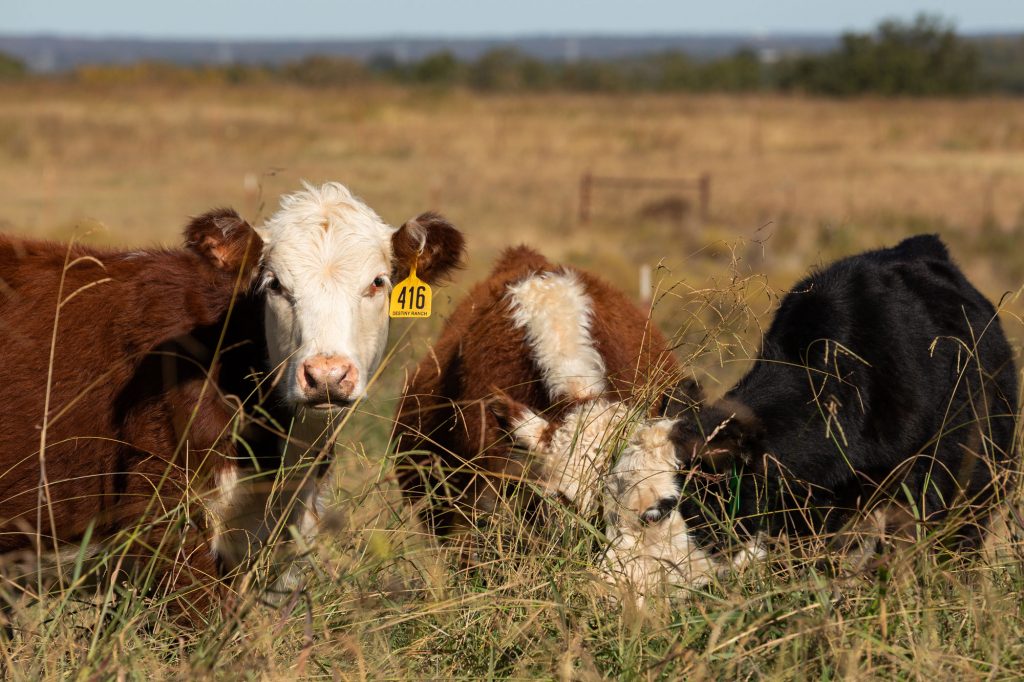
A common question asked each year by cattle producers is, "What should I do with my heifers? Should I raise them as replacements or sell them as weaned heifers?" This question is especially relevant in today's market of high prices and the inevitability that expansion will have to start at some point. The answer involves penciling out the expenses and deciding which option best suits an operation in the current market. Costs of developing heifers include the current value of weaned heifers (opportunity cost), variable expenses, breeding costs, fixed expenses, and absorption costs. The Replacement Heifer Calculator discussed in this article aims to serve as a guide in organizing each of these costs and can be used as an estimation tool to calculate what it may cost to develop heifers on a specific operation and if it is economical to do so. The calculator includes several key cost concepts, including:
As an example, current prices for weaned heifers in Florida have been well above $2.00 per lb. since April 2023 and are continuing to rise. Prices for replacement cattle, open or bred, can be expected to follow the same trend in Florida as the demand for and value of replacement cattle increases when expansion begins to occur. Understanding the full cost to develop heifers allows you to compare that cost to selling heifers at weaning and buying bred replacements. If the price of bred heifers is greater than the total cost to develop bred heifers, a potentially profitable investment has been made in your heifers. Of course, also important to the decision is your strategy for genetic development, which must be weighed against the value of weaned heifers, development costs, and the cost of purchased replacements. These decisions are all about the goals and risk management strategies of each operation. According to the example in Table 1, the total cost to develop 100 heifers is $172,250 or $1,722.5/hd. However, after considering the revenue of selling 10 open culls, the net development cost is reduced to a total of $150,650 or $1,673.89/hd for each of the remaining 90 bred heifers. The current value of young, bred replacement cattle with an average weight of 1,100 pounds is $1.54 per lb. or roughly $1,700/hd in Florida. Using the results of the example, you would save approximately $27/hd or a total of $2,430 if you raised your replacements (90) rather than buying them. Even though the price you would have received for selling weaned heifers is higher than the cost of development, the long-term outcome in this scenario suggests that the cost of development was worth the investment. With the value of female cattle expected to rise in the coming months due to inevitable expansion, raising your own replacements to rebuild your herd may be a more economical decision. Expenses can be overwhelming when looked at as a short-term lump sum. So, it is important to look at them as long-term investments when possible. To download the Replacement Heifer Cost Estimation Tool click here. The file will be located under 'calculators'.
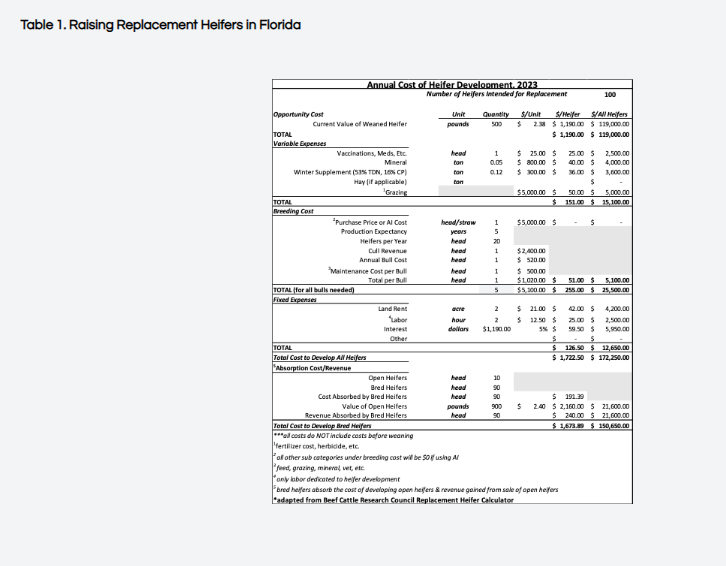
Article courtesy of Baker, Hannah. "What Should I Do With My Heifers?" Southern Ag Today 4(1.3). January 3, 2024. Permalink
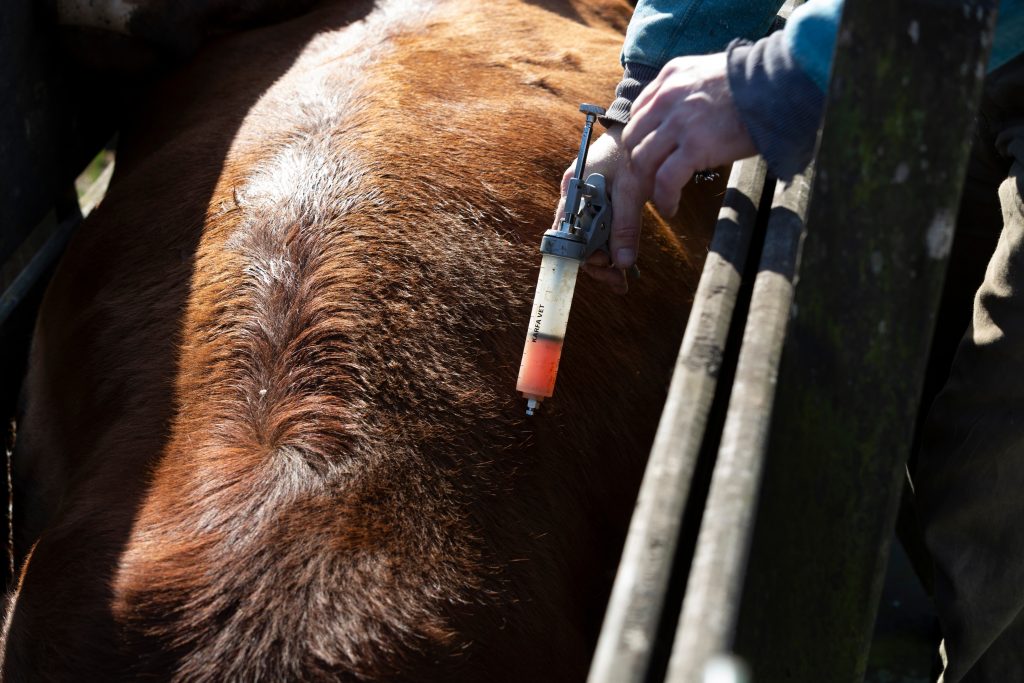
On today's Cow-Calf Corner, Rosslyn Biggs, DVM, Oklahoma State University State Extension Beef Cattle Specialist, talks about solving the shortage of veterinarians serving rural communities.
Veterinarians are critical to the success of rural communities and rural economies. Veterinarians support food and fiber animal industries, maintain the health of companion animals, identify zoonotic diseases, and play a critical role in disease surveillance to protect US agriculture. As cattlemen know, there is a growing challenge to food supply veterinary medicine. In particular, the number of veterinarians serving rural communities has declined during the last thirty years.
Oklahoma State University is committed to addressing challenges in rural communities including impacts to veterinary medicine and animal agriculture. The percentage of OSU graduates entering food animal or mixed animal practice is routinely higher than the national average. From the Class of 2023 respondents, 25% percent of OSU grads entered large or mixed animal practice while the national average historically fluctuates between 10-15%.
To fully address this multifaceted challenge, OSU CVM intends to create a Center for Rural Veterinary Medicine (CRVM). The CRVM represents a team-based approach to the study of rural veterinary medicine and associated challenges and shortages, and the development and implementation of strategies to address these challenges. The current vision for the program includes a service component in underserved/rural regions, as well as outreach programs to mentor youth in these regions to help prepare them for STEM careers, including veterinary medicine. One CRVM program, the Integrated Beef Cattle Program for Veterinarians, has already started.
The Integrated Beef Cattle Team, comprised of faculty from veterinary medicine, animal science, agricultural leadership, and agricultural economics was established with grant funding from the United States Department of Agriculture. Based on feedback from beef industry stakeholders, the team created a curriculum for a class of 20 Oklahoma veterinarians and 20 OSU veterinary students.
The program intends to enhance the sustainability of veterinary practices serving the Oklahoma beef cattle industry and surrounding region. Topic covered in the curriculum included leadership, communication, mentoring, practice management, welfare, stockmanship, mental health, and production medicine. A heavy emphasis has also been placed on connecting veterinarians, students, and industry leaders. Class III of this program will begin in January 2024.

Happy New Year, and what a year 2024 promises to be. Within dairy and throughout agriculture, the refrain that will be often repeated is that this will be the year of protein. In fact, it may be the first of many: If you look out over the next decade, the supply of animal protein in the world – that's beef, pork, poultry, and dairy -- comes nowhere near meeting the demand.
That means U.S. dairy's emphasis on exports and our international competitiveness will certainly be an area of focus. Dairy farmers and their cooperatives are extremely well positioned to do this: We're efficient, we can get high-quality products overseas competitively, and our processing capacity is expanding. Our innovation and technology in the dairy industry to expand international markets is second to none. NMPF can support these efforts by continuing our excellent partnership with the U.S. Dairy Export Council and by seeking sound policy that promotes the powerhouse potential of U.S. dairy.
Our Cooperatives Working Together Program will soon be in a position to bring significantly greater resources to bear in supporting market growth for U.S. dairy worldwide – just as our main competitors in New Zealand and Europe take a step back in large part due to regulatory constraints we in the United States have been able to avoid.
We also have room to grow our industry by increasing protein demand at home. A focus on the next generation is critical to achieving this. Last month, the House of Representatives took an important step toward boosting the next generation of milk drinkers by passing the Whole Milk for Healthy Kids Act, which would get whole and 2% milk back on school lunch menus. The vote was 330-99, which gives us high hopes in the Senate this year. Meanwhile, we know that the science behind the health benefits of dairy in all its compositions is only becoming more compelling – and that puts us in a great position as the Dietary Guidelines for Americans Committee meets to craft new nutrition standards that guide federal programs.
More demand for dairy protein and better health, in America and worldwide. If that's not enough to get an industry excited for the future, I don't know what could be.
Another critical topic for this year is risk management. USDA's Federal Milk Marketing Order hearing has been painfully slow, but it's incredibly important for U.S. dairy producers. Our NMPF game plan and team effort has been outstanding thus far, and we will follow the hearing to its conclusion. We will be prepared to respond as needed to whatever USDA proposes and ensure that the path forward is what's best for dairy.
A new Farm Bill is also on tap. We're comfortable this time around with the fundamental structure of the dairy safety net, but there are always improvements to be made, and we'll be seeking opportunities for positive change whenever they become available.
Of course, federal policy includes much more than just the Farm Bill. We're excited to see the evolution of greenhouse gas regulation and carbon markets in ways that benefit dairy farmers. We are pushing for faster approvals for feed additives that reduce methane emissions and put us on a path toward consistently improving our environmental footprint. We're excited to see billions of dollars of investment capital and new technology and innovation flow toward dairy, because it's not just farmers who believe in this industry's future – it's some of the world's brightest minds and savviest investors.
These are just some of the most immediate opportunities we can meet. Looking only slightly beyond 2024, we will again need to address tax policy and how we can stimulate investment and growth in all of agriculture and rural America. In addition to that are the ongoing, long-term fights where progress is slow, but real. Dairy is chipping away at the market share of plant-based imposter-dairy beverages and making headway with FDA in restricting the use of dairy terms. Our FARM program remains a world-leading customer assurance program that's protecting this industry from the wildly inaccurate claims of our detractors and competitors.
As NMPF's new president and CEO, I am duty-bound to defend this industry. And because of our farmer and co-op leadership and first-class staff, we defend it well. But 2024 is also exciting because of the great potential we in dairy have to take the initiative. We can attack as well as defend. 2024 is going to be a great year for this industry. Thank you for giving me the opportunity to share in the leadership of this journey.

Gregg Doud
President and CEO
National Milk Producers Federation
RON's Dave Lanning has a pre-opening look at today's agricultural Markets.
Click the audio tab below for today's report.
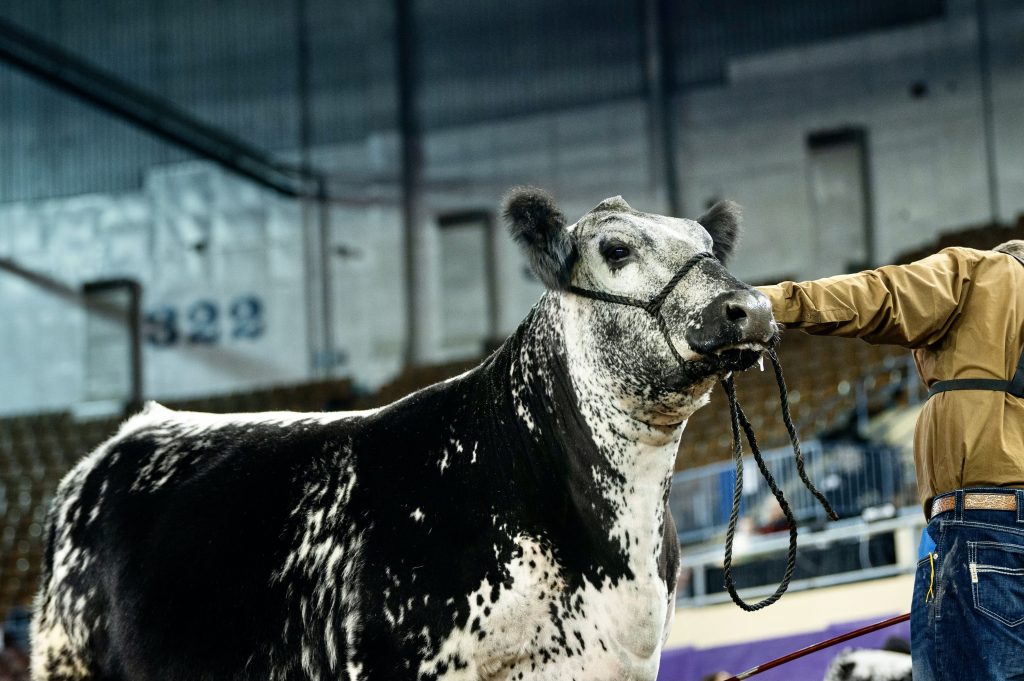
Speckle Park Show at Fourth Cattlemen's Congress in OKC
Their presence at Cattlemen's Congress has grown significantly from the third Congress to the fourth Congress- and producers who are cheerleaders for Speckle Park are excited about to tell fellow cattle producers about this relatively young breed. Cory Ducherer and Janice Harasymchuk are both from Saskatchewan Canada and are at Cattlemen's Congress to support American producers who have brought almost twice as many animals this year as last. Ducherer is actually a Charter member of the American Speckle Park Association that was formed in early 2021. Cory and his family have been involved with the breed in Canada since 1995 and have always been major advocates for the merits and advancement of the breed. His ranch, River Hill, has been involved in the establishment and development of the breed in many countries all over the world, including the United States.
Janice Harasymchuk is the current President of the Canadian Speckle Park Association and is an "At large" board member for the ASPA. They both visited with Senior Farm and Ranch Broadcaster Ron Hays after the Speckle Park Junior and Open Show on New Year's Day. Listen to that conversation by clicking on the Audio Button above.
Ducherer tells Hays that the breed originated from Canada and was bred from Black Angus, Shorthorn and British White Park bloodlines. Speckle Park has had a closed herd book since 2006 and that was when they were recognized as a Breed. Ducherer and other Canadians have spread the breed across their country and beyond- into Europe, the United States, Australia and even to South America.
While Speckle Park cattle are genetically black with varying amounts of white in specific patterns, the speckle pattern is preferred. Ducherer says Speckle Park is bred to produce a high quality end product. "The carcass is almost second to none- they are high marbling, easy doing, high yielding, very high feed conversion rates- you put less feed in and get more pounds out."
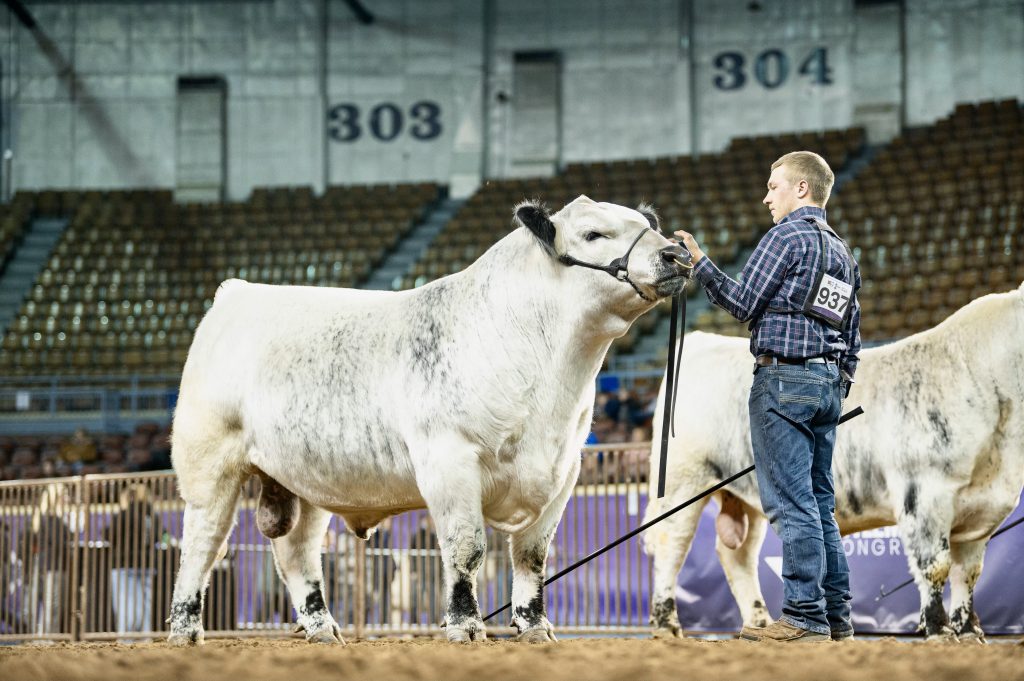
Harasymchuk says the eye appeal of the breed got her family's attention and "because they were a Canadian breed that was developed in Canada- we thought that was pretty cool, too. What we learned later is that they have a lot more to offer the beef industry- their maternal traits, their feed conversion, their docility- we just love everything about them."
Cattlemen's Congress is featuring 25 breeds of beef cattle in 2024 and is the largest beef cattle show in North America. Learn more about Cattlemen's Congress- click here for their website.
And click here for the schedule of the show- the sales and more that continue through January 11, 2024.
At the 2024 Cattlemen's Congress in Oklahoma City, Senior Farm and Ranch Broadcaster, Ron Hays, had the chance to catch up with the Executive Vice President of the American Hereford Association, Jack Ward, about the year 2023 for the Hereford breed.
"Our fiscal year ends in August, and so we came out of that year with our registration cow inventories kind of, very similar year-over-year, from a financial standpoint. Very healthy," Ward said. "We sold more pounds of Certified Hereford beef."
The National Junior Hereford Association has also seen growth in 2023, Ward added. In national AHA membership, Ward said there was growth year-over-year, and there was also an increase in prices for Hereford cattle.
"Hereford breeders are an incredible group of folks because they are such good cattlemen," Ward said. "They are good stockmen. They understand the importance of breeding cattle, from a genetic standpoint, that are strong. They understand technology, whether that be ultrasound or genomics, and because they are good stockmen, they understand what kind of cattle fit their environment and what their customers want and need."
Beef cattle producers are unique, Ward said, because they make their own decisions on a daily basis, and the success of their operation relies upon those decisions. In the next few years, Ward said he believes there will be a continued focus on capturing commercial data to help boost genetic reliability and potential.
"The independence and identity of producers is still a key part of our business, and I think it will continue to be," Ward said.
Herefords will be showing at Cattlemen's Congress Wednesday through Saturday of this week. To see the complete schedule of everything happening at the fourth Cattlemen's Congress, CLICK HERE.
The Beef Buzz is a regular feature heard on radio stations around the region on the Radio Oklahoma Ag Network and is a regular audio feature found on this website as well. Click on the LISTEN BAR for today's show and check out our archives for older Beef Buzz shows covering the gamut of the beef cattle industry today.

By R-CALF USA Marketing Director and True Grit Editor-in-Chief Jaiden Moreland
Sometimes I swear we sound like a broken record, and on some issues that broken record has been singing for two decades now. There's something to be said about being persistent, uncompromising, unwavering, and willing to continue to tackle the fight at hand. This year we've had some setbacks and standstills as we do each year, but in 2023 we've had several key wins and important progress has been made across all three branches of government that will lead to more successes for our members in 2024.
R-CALF USA advocated for, helped draft, and endorsed many pieces of legislation, most notably legislation to reform the checkoff programs and reinstate mandatory country of origin labeling or MCOOL for beef. A clear victory was achieved when the U.S. Department of Agriculture announced that the Agricultural Marketing Service must purchase meat for the national school lunch and nutrition assistance programs from animals that are born, raised, and slaughtered in the United States. Another victory involves the USDA's issuance of a proposed rule allowing the voluntary "Product of USA" or "Made in the USA" label claim only when the products are derived from animals born, raised, slaughtered and processed in the United States.
Yet another victory occurred when the Department of Justice and Federal Trade Commission released their new final 2023 Merger Guidelines. The new guidelines establish that protecting competition, even when efficiencies are claimed, is a primary goal of the nation's antitrust laws. The FTC also proposed changes to improve the premerger notification rules. Both actions are meaningful steps to restoring and strengthening competition in the cattle industry.
R-CALF USA led the nation's current focus on antitrust concerns by filing its national class action antitrust lawsuit against the "Big 4" beef packers in early 2019. In 2023, the R-CALF USA legal team was deeply involved in the discovery phase of our historic lawsuit. The filing of our lawsuit was soon followed by official investigations into our cattle markets by the DOJ, numerous state attorneys general, and the USDA, and those investigations are ongoing.
In 2023, industry stakeholders were reminded of R-CALF USA's representation of American sheep producers as the Protect American Lamb project was developed under the R-CALF USA Sheep Committee. The project caught the attention of worldwide media when it filed a petition for relief from excessive imports with the U.S. Trade Representative on behalf of the American sheep industry. The petition was then supplemented with numerous resolutions from county governments urging Congress and the Administration to halt the ongoing injury that excessive imports are causing the U.S. sheep industry. Over 120 domestic ewe/lamb producers, feeders, and packers have individually endorsed the petition and those producers control over 800,000 sheep and lambs, representing over 20% of the U.S. sheep and lamb inventory in the West. A bipartisan group of 14 Congressional members from eight states sent a letter to U.S. Trade Ambassador Katherine Tai urging her to favorably consider the petition.
Farm Bill
Early in 2023, R-CALF USA compiled a list of recommendations for the 2023 Farm Bill. Using a series of industry charts, we illustrated prolonged and steep declines in the cattle industry's competitive infrastructure, including its number of participants, size of its cattle herd, and availability of marketing outlets and opportunities. Recommendations included: reigniting competition in the beef supply chain by reinstating MCOOL; using legislation to force the packers to competitively bid for domestic cattle in the domestic market; putting an end to unfair market power between producers and highly concentrated packers by prohibiting anticompetitive practices; providing market transparency by requiring all cattle purchasing agreements to be in writing and publicly disclosed; making the beef checkoff program accountable to cattle producers; and addressing price-distorting trade deficits by requiring all federal beef expenditures to be for beef exclusively produced in the United States, which is what the USDA recently did for its federal nutrition assistance and school lunch programs. The 2023 Farm Bill has been delayed to September 30, 2024.
Meetings with Policy Makers
R-CALF USA took part in approximately 100 meetings with policy makers, including White House officials, U.S. Senators and Representatives and their staffers, and officials at the USDA, DOJ, USITC and the USTR. The meetings discussed MCOOL, antitrust and other competition issues, trade reform for both cattle and sheep, beef checkoff reform, reforms needed for local and regional meatpackers, the need to strengthen protections against foreign animal diseases, and the need to stop mandatory electronic animal identification.
Congressional Legislation
With a new session of Congress in 2023, R-CALF USA worked with many members of Congress and their staffers to advocate, help draft, and endorse 20 pieces of legislation in accordance with our member-voted policy. These bills included:
Public Comments, Letters and Statements
On behalf of its members, R-CALF USA submitted formal comments in several federal agency rulemakings, including to the USDA in two proposed rules to implement the Packers and Stockyards Act; to urge it to scrap the mandatory radio frequency identification or RFID rule; to withdraw its Paraguayan beef import proposal; and to implement mandatory "Product of USA" labeling reforms. We also joined comments submitted to the DOJ and the FTC last September in strong support of the now final merger guidelines and to the FTC supporting its premerger rule proposal.
Over the year, R-CALF USA wrote and joined several letters to Congress and other government agencies, starting with a letter urging the reintroduction of the American Beef Labeling Act. We called on Congress alongside 131 groups to restore accountability and transparency to commodity checkoff programs by supporting inclusion of the OFF Act in the 2023 Farm Bill.
We also joined a letter to the leadership of both congressional agriculture committees in response to opposition to the OFF Act from corporate industry trade and lobbying groups. Then in June, we joined 102 organizations in a letter sent to the U.S. House Committee on Appropriations urging Congress to remove a policy rider from its FY24 Agriculture Appropriations bill that would prevent USDA from finalizing essential rules to implement the Packers and Stockyards Act.
Following a USDA RFID proposal and a mysterious Chinese surveillance balloon, R-CALF USA expressed concern that perhaps all of the USDA-approved manufactures of the mandatory electronic surveillance devices were under Chinese control. We sent a letter to Secretary of Agriculture Tom Vilsack asking for the origins of all the manufacturers of the USDA-approved electronic eartag devices. Vilsack's bleak response to our letter was void of any information on the manufacturer origins of the devices that America's cattle producers would be forced to purchase if the proposed rule becomes final.
Throughout the many proposals, actions, and reforms; R-CALF USA issued statements against a USDA proposal for mandatory RFID and against the aerial slaughter of cattle in the Gila National Forest of New Mexico. R-CALF USA applauded the new origin requirements for USDA food purchases, and while we appreciated the voluntary "Product of USA" labeling reforms, we informed the USDA that independent cattle producers needed Congress to pass mandatory country of origin labeling or MCOOL for beef. We also addressed the growing concerns of mRNA vaccines in cattle. As beef imports rise, including imports from mRNA vaccine using countries, R-CALF USA believes this heightens the need for Congress to enact MCOOL.
Coalition and Local Involvement
In joint efforts to achieve meaningful reforms in the American cattle and sheep industries, R-CALF USA led and worked with numerous national coalitions. These groups from across America represent farm, ranch, consumer, and trade interests including Protect American Lamb; the Coalition for a Prosperous America; the MCOOL Coalition; OFF Act Coalition; Livestock Competition Coalition; Main Street Coalition (to address antitrust concerns in the grocery industry); and Merger Guidelines Coalition (to make recommendations to DOJ and FTC on reforming the old guidelines).
R-CALF USA also partners with over 20 state and local affiliated organizations. New additions to its affiliate list include the Iowa Stock Growers Association and the Calaveras County Cattlemen's Association in San Andreas, California. R-CALF USA and Protect American Lamb also worked with county governments in California, Colorado, Idaho, Montana, Nevada, South Dakota, Texas, and Utah to pass resolutions.
Events and Meetings
R-CALF USA made stops in South Dakota, Wyoming, South Carolina, Iowa, Oklahoma, Colorado, Texas, Nebraska, Washington, North Dakota, Ohio, Missouri, Minnesota and Washington, D.C., taking part in fundraisers, meetings, and events.
August featured R-CALF USA's National Convention and Trade Show "American Spirit" which focused on defending against ongoing consolidation, protecting private property rights, resolving price-depressing imports and soaring input costs, and curbing the globalized effort to control the food supply and the independent farmers and ranchers who produce it.
Other events included a webinar, local meetings, Facebook lives, college lectures, national conferences, and a meeting at the White House.
Rural America rallied in support of R-CALF USA by hosting fundraisers throughout the Midwest in Nebraska, Colorado, South Dakota, Wyoming, and Minnesota. As the only national organization who relies solely on membership dues and donations, we sincerely thank Crawford Livestock Market in Crawford, Neb. and Jack and Penny Dye of Hermosa, S.D.; La Junta Livestock Commission in La Junta, Colo. and Harold and Peggy Unwin of Pritchett, Colo.; Valentine Livestock Auction in Valentine, Neb. and Brett Galbraith of Wood, S.D.; Fort Pierre Livestock Auction in Ft. Pierre, S.D. and Dean and Delia Johnson of Fairburn, S.D.; Platte Livestock Market in Platte, S.D. and James Fulwider and Kevin Talsma of Iona, S.D.; Buffalo Livestock Marketing in Buffalo, Wyo. and Joe and Linda Foss of Buffalo; Creighton Livestock Market in Creighton, Neb. and Matt Paulsen of Niobrara, Neb.; Winner Livestock Auction Co. in Winner, S.D. and Lonnie and Pam Dreyer of Winner; and Tri-County Stockyards in Motley, Minnesota.
No Rancher Left Behind
As part of an ongoing campaign for rural mental health, R-CALF USA and member Coy Young continued promoting "No Rancher Left Behind." The campaign specifically features Wednesday evening virtual support group meetings every week at 7 pm Mountain time. NRLB was also featured at the 2023 National Convention and was featured in a documentary by More Perfect Union, "How Big Beef Is Killing America's Farmers."
In the New Year
In 2024, we will continue forging ahead to win important farm bill reforms, developing and passing vital legislation, placing pressure on necessary agencies, moving forward in our historic antitrust and beef checkoff lawsuits, and standing up for American ranching and farming families.
It can seem never-ending, every time you feel like you've made a little progress and have a good win, five more problems pop up and we're back to the drawing board to determine how to influence change. Despite the tremendous challenges faced when trying to change national policies, the alternative is unacceptable. We will make needed changes because we will keep fighting until we do. We are proud to fight alongside our pro-America, pro-rural America, pro-small business, and pro-family farm and ranch system of cattle and sheep production. We stand for liberty, freedom, and the right to own property. We and our members are real, honest, and we shoot straight. We are an uncompromising group focused on the issues affecting your family, your business, your community, and your legacy. Big wins take time, and one of the most important wins is that you have a group behind you who won't give up on their industry and who won't give up on you. Stand with us and fight for it. Stay engaged in the fight, know what is happening in your industry, or perhaps know what isn't happening, and fight for it. On behalf of the R-CALF USA Board of Directors and staff, Happy New Year. We look forward to working with you and fighting alongside you in 2024!
Dairy Management Inc., which manages the national dairy checkoff program, recently announced significant outcomes in 2023 on behalf of America's dairy farmers and importers.
"This past year, we built on our collective successes while defining the next chapter of the checkoff's history," said Barbara O'Brien, president and CEO of Dairy Management Inc. and the Innovation Center for U.S. Dairy, a voluntary organization that works across the dairy value chain to foster collaboration and progress to advance U.S. dairy's interest. "ASPIRE is the acronym for our strategic areas of focus (Sustainability, People, Innovation, Reputation, Exports) and staffs at local, national and international levels have worked together to deliver meaningful results and ensure funders see a whole new level of transparency and accountability for their investment."
Highlights include:
Sustainability:
Innovation:
Innovation Center for U.S. Dairy:
Advanced U.S. dairy's collective engagement and progress within the pre-competitive social responsibility areas important to consumers and customers, including:
Reputation:
Exports/International:
"I'm so proud to see the checkoff continue to prioritize outreach and engagement with farmers, ensuring that our voices are heard and reflected in all initiatives," said Virginia dairy farmer and National Dairy Promotion and Research Board Chair Joanna Shipp. "Our revitalized Annual Meeting and farmer-led board meetings are a testament to this commitment, offering opportunities for farmer interaction and feedback that is reflected in checkoff's local and national plans."
O'Brien added, "We had an amazing year of momentum and progress. The checkoff organization committed to building a culture of innovation and excellence, driven by a strong purpose to support farmers and deliver high-quality work. The focus for 2024 remains on delivering short-term demand and sales at the same time we're building the pipeline for future growth through science and innovation. And we'll continue to engage farmers from across the country—securing their input, listening to feedback, sharing the work and results in a way we know resonates."
For more information about the dairy checkoff, visit www.usdairy.com/for-farmers.
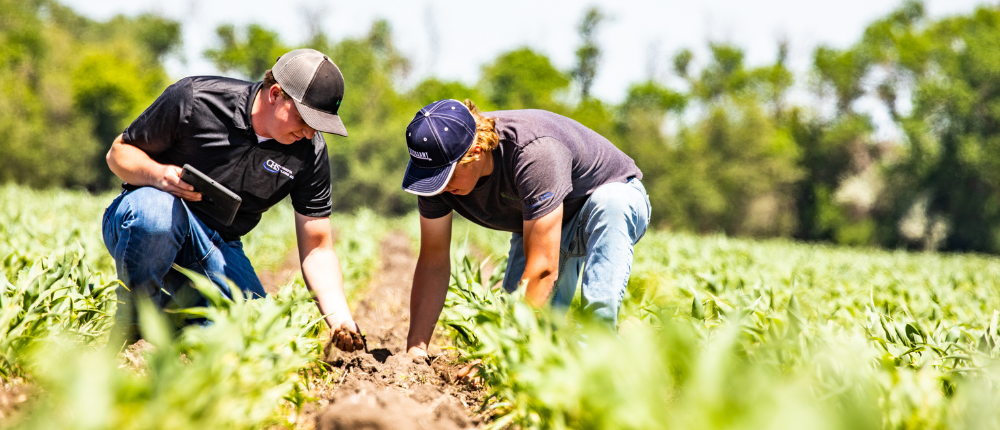
Photo from CHS Agronomy
Radio Oklahoma Ag Network Intern Maci Carter is visiting with CHS Agronomy product manager Tim Swanson about some of the latest innovations and opportunities in crop protection and nutrition.
CHS Agronomy supplies crop nutrients, crop protection, and specialized agronomy products and services to agricultural cooperatives and retailers across North America.
"Nitrogen stabilizers are really starting to tick up with the high prices," Swanson said. "Growers really just want to manage the investment and make sure that fertility is available for that growing crop."
Swanson said using a stabilizer is key to getting the most out of a nitrogen investment.
"Don't look at fertility as just a one-crop-thing," Swanson said. "Spread that over five or six years."
When it comes to making the best decisions in the growing season, Swanson said a good place to start is to look into what worked well the year prior, and where corrections need to be made. Making plans for the season can be difficult at times, Swanson said, due to variability.
"We can make our best plans here in November, but it all changes by the time spring comes around," Swanson said. "Really, I would just say make that plan again, have some reactionary plans, and communicate with your local agronomist."
Swanson said the volatility in the crop markets has died down, but there are still some areas to watch, such as demand.
"I think we won't have the same volatility we dealt with the last few years, but again, being prepared and sharing those plans with your CHS representative is going to help a lot," Swanson said.
| ||||||||||||||||||||||||||||||||||||||||||||||||||||||||||||||||||||||||||||||||||||||||||||||||||||||||||||||||||||||||||||||||||||||||||||||||||||||||||||||||||||||||||||||||||||||||||||||||||||||||||||
|
Three carbon projects initiated in 2021 and 2022 have issued nearly $3 million in carbon-asset payments to U.S. dairy farmers who used Agolin® Ruminant to create verified emissions reductions.
A verified emissions reduction is a carbon asset that can be used as an offset or within a value chain. It represents 1 tonne of greenhouse gas emissions equivalent that is either avoided or removed from the atmosphere through an intervention that has been independently verified as part of a carbon reduction project.
Agolin Ruminant is a proprietary blend of essential oils that improves milk production and feed efficiency in beef and dairy cattle. In 2018, it became the first feed additive certified by The Carbon Trust for methane reduction in ruminants. Today, Agolin Ruminant is included in the diets of more than 2 million dairy cows worldwide, and leading carbon methodology owners Verra and Gold Standard recognize it in their international climate protection project registries.
Concord Agriculture Partners has chosen Agolin Ruminant to create a new carbon inset project which guarantees that participating dairy producers will receive an industry-leading 85% of the gross value of the carbon asset.
Carbon inset projects focus on taking steps to avoid emissions, whereas carbon offset projects are designed to reduce or remove greenhouse gas emissions from the atmosphere to compensate for emissions produced elsewhere. By focusing on the purchase of insets and using global standards, Concord's project delivers increased market confidence and drives greater value for dairy producers.
Concord continues to work with value chain carbon buyers to ensure that they deliver the greatest value to the farmgate by helping companies throughout the agri-food value chain meet their ESG goals.
Alltech, a global leader in agriculture, acquired a majority interest in Agolin SA in May 2023. Founded in Switzerland in 2006, Agolin has developed and produced plant-based nutrition solutions that have been scientifically proven to improve herd performance, profitability and sustainability.
Agolin, now an Alltech technology, empowers farmers and ranchers to reach their sustainability and profitability goals while also supporting the performance of the cattle in their herds and supply chains. The synergistic use of Alltech and Agolin nutritional technologies leads to benefits such as improved animal welfare, greater feed efficiency and conversion, enhanced milk and meat production, increased profitability, and a reduced environmental footprint, including a boost in nitrogen efficiency.
Learn more at alltech.com/agolin.
ATTENTION CATTLEMEN and WOMEN!
You won't want to miss this great opportunity! Make sure to RSVP by Monday, January 15th, to secure your spot! Call our office if you have any questions.
4 County Beef Seminar coming up Wednesday, January 17th, from 9 am to 12 pm at the Custer County Fairgrounds, 1738 US Hwy 183 in Clinton Oklahoma.
There will be several great speakers on hand with Topics including cattle marketing and futures, cow/calf nutrition, and risk managment.
Derrell Peel, OSU Extension Livestock Marketing Specialist
Marty New, OSU Extension West Area Livestock Specialist
Dr. Rosslyn Biggs, DVM, Beef Cattle Extension Specialist
Lunch will also be served, but please RSVP So they will know how many to feed. You can RSVP by calling the Washita County OSU Extension Office at (580) 832-3356
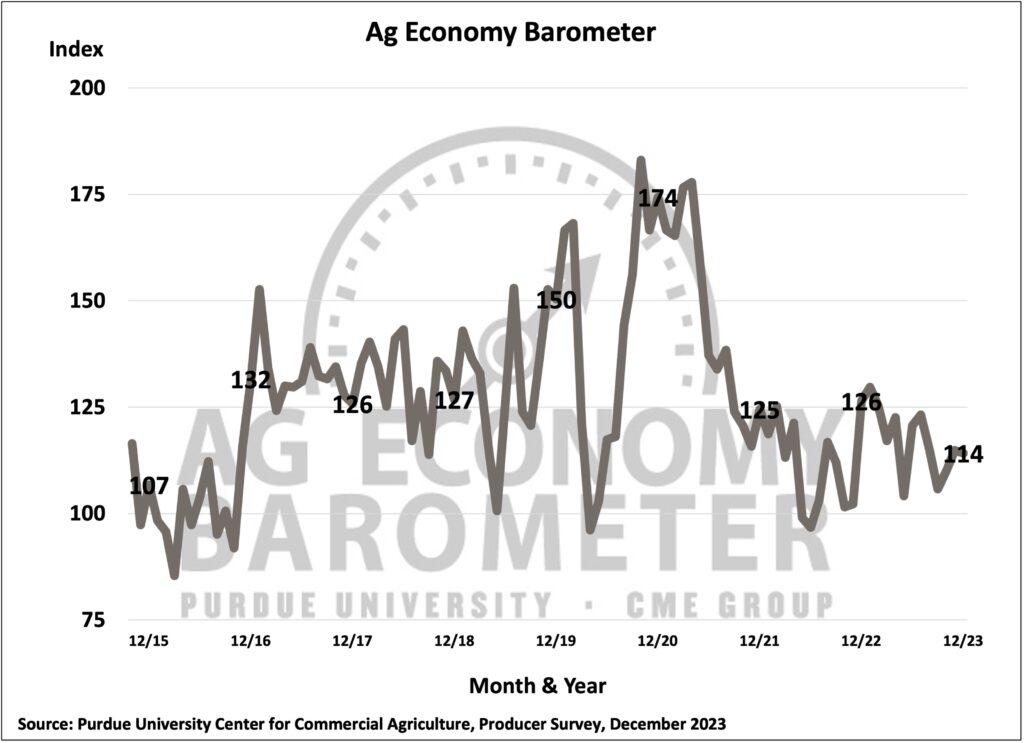
The latest report from the latest Purdue University/CME Group Ag Barometer indicates that U.S. farmers' inflation expectations have subsided while overall producer sentiment changed little.
The December barometer recorded a reading of 114, just one point lower than in November. Both sub-indices of the barometer, the Index of Current Conditions and the Index of Future Expectations, mirrored this slight decline, settling one point below their respective November figures at 112 and 115. Notably, farmers' inflation expectations for the upcoming year were markedly lower than those reported a year ago for 2023. This month's Ag Economy Barometer survey was conducted from Dec. 4-8.
Farmers reported another improvement in their farms' financial performance during the month of December. The Farm Financial Performance Index saw a 2-point increase compared to the previous month, marking a continued positive trend. Since late summer, the index has climbed 11 points, and at year-end, it was 21 points above the low point for 2023, which occurred in May.
"The shift in farmers' perception of financial performance during the fall quarter corresponds with USDA's (U.S. Department of Agriculture's) more optimistic 2023 farm income outlook released in late November, which was $10 billion higher than their previous forecast," said James Mintert, the barometer's principal investigator and director of Purdue University's Center for Commercial Agriculture.
The Farm Capital Investment Index reading of 43 was only one point above November's, but it marked a 13-point increase compared to the same period last year. Respondents endorsing the notion that now is a favorable time for substantial investments in their farm operation cited "higher dealer inventories" and "strong cash flows" as key factors supporting this perspective. While the percentage of respondents selecting "strong cash flows" as a rationale for investment rebounded from the previous month, it remained less popular than in July and August. Conversely, in December, the percentage of producers citing "higher dealer inventories" as a primary motivation for investment was more than double the proportion who expressed a similar sentiment in July.
"High input costs continue to be concerning for U.S. farmers, although a notable shift in concerns took place as 2023 unfolded," Mintert said.
Farmers concerned about the risk of lower prices for crops and livestock increased from 16% of respondents in January to over one-fourth (26%) by December. Number three on the list of concerns for the upcoming year was "rising interest rates," chosen by 24% of farmers in December's survey.
Producers' inflation expectations moderated, with 70% expecting inflation in 2024 to be less than 4%. By comparison, 50% of the producers anticipated an inflation rate of 6% or higher a year ago. When asked about interest rates, about one-third (34%) of respondents said they anticipate rates declining in 2024 while 22% expect no change in interest rates in the upcoming year.
Perspectives on farmland values weakened slightly in December compared to November. The Short-Term Farmland Value Index fell 4 points to a reading of 121, while the long-term index decreased by 2 points to 149. Compared to a year ago, the short-term index was down 3 points, while the long-term index was 9 points higher.
"The improvement in farmers' interest rate expectations since late 2022 could help explain the year-to-year rise in farmers' long-term farmland value expectations," Mintert stated.
Senior Farm and Ranch Broadcaster, Ron Hays, is talking with Grant Crawford of Merck Animal Health about the value of deworming. Dr. Crawford is an Associate Director for Cattle Technical Services at Merck.
"If you look at all of the different animal health technologies available for cattle, the one that provides the biggest return for anything on grass, whether it is a cow-calf pair or a stocker animal, the biggest return comes from deworming," Crawford said. "It makes some sense, because worms primarily live on grass. Once cattle are out on pasture in the summertime, they are picking up worms."
Among other things, Crawford said worms can cause irritation in the gut and decrease feed and nutrient intake in cattle.
"It predisposes cattle for more sickness and can slow down growth as well," Crawford said.
Crawford emphasized "strategic deworming," which is worming not set to a particular calendar date.
"We pick the key times of the year when we can get the biggest bang for our buck out of dewormers," Crawford said.
One of those times, Crawford added, is in the fall and early winter.
"If we can deworm right now, we are killing all of the worms in their gut that they picked up over the summertime," Crawford said. "They will be worm-free over the winter, which is really important for a gestating cow, because as they get into the third-trimester leading up to springtime calving, that is when a lot of that growth happens in that calf they are gestating."
Crawford said another strategic time to worm cattle is in the summertime.
"After cattle get turned out on green grass in the spring, they are going to start picking up worms again," Crawford said. "If we can come back with a dewormer in the summertime, that is very important."
In the summer, Crawford said is can be inconvenient to bring cattle in off pasture to deworm, so SAFE-GUARD offers a few deworming products that can be added to feed or consumed through mineral.
"Our dewormers are primarily SAFE-GUARD and Panacur, which are both fenbendazole as the active molecule there, described as white-wormers," Crawford said. "What we have found over time is that the pour-ons and injectables don't work as well as they used to. They have been used a lot over the years, but the efficacy of any pour-on or injectable dewormer is really somewhere around 50 to 60 percent as far as reducing fecal eggs."
Crawford said a "white wormer" such as SAFE-GUARD is 95 percent or more effective in decreasing fecal egg count, whether applied through feed or drench.
"Deworming is the biggest thing we can do to improve profitability in the cow-calf sector and the stocker sector," Crawford said. "It is important we use a quality dewormer."
The Beef Buzz is a regular feature heard on radio stations around the region on the Radio Oklahoma Ag Network and is a regular audio feature found on this website as well. Click on the LISTEN BAR for today's show and check out our archives for older Beef Buzz shows covering the gamut of the beef cattle industry today.
The 11th annual Red River Crops Conference for producers in southwestern Oklahoma and the Texas Rolling Plains regions will be held on Jan. 17-18 in Altus, Oklahoma.

The Oklahoma Cooperative Extension Service and Texas A&M AgriLife Extension Service collaborate each year to offer the event, alternating hosting duties between the two states.
The conference will be from 9 a.m.-2:30 p.m. on Jan. 17 and 9 a.m.-3:15 p.m. on Jan. 18 at the Jackson County Expo Center, 300 South Todd Lane.
Cost is $25 per person for one or both days. Lunch will be served each day, and preregistration is encouraged by Jan. 13 for meal counts.
The registration form can be found online at https://tx.ag/RedRiverCropsConf2024. Checks should be payable to the Red River Crops Conference and mailed to the Tillman County Oklahoma State University Extension office, 201 North Main St. #1, Frederick, OK, 79201.
Six Texas Department of Agriculture continuing education units will be available for Texas producers, including five general and one integrated pest management. Oklahoma producers will receive two continuing education units from the Oklahoma Department of Agriculture, Food and Forestry.
Presentations on Jan. 17 will highlight cotton. Topics and speakers include:
Presentations on Jan. 18 will highlight in-season and summer crops. Topics and speakers will be:
On today's Cow-Calf Corner, Paul Vining, OSU Extension OQBN Coordinator, talks about the importance of vaccinations.
In beef calf preconditioning programs, the importance of vaccinations to minimize respiratory illness, related to bovine respiratory disease (BRD), cannot be overstated. The Oklahoma Quality Beef Network (OQBN) Vac-45 program mandates that calves receive two vaccinations against respiratory pathogens, with at least one being a modified live viral (MLV) vaccine. MLV vaccines, containing weakened viruses, elicit a more robust immune response compared to killed viral (KV) vaccines, which use inactivated viruses.
Research findings suggest that administering respiratory vaccinations after calves have departed the ranch of origin does not significantly prevent BRD at the following stages of the beef supply chain. Hence, administering appropriate respiratory vaccines before sale and commingling is crucial for providing immunity during the stocker and feedlot stages of the beef supply chain.
A 2011 study conducted by Oklahoma State University consisted of 337 non-preconditioned, unvaccinated heifers sourced from Western Kentucky. These heifers underwent evaluation during a 63-day backgrounding period before entering the feedlot finishing phase. The results revealed that heifers not requiring treatment for BRD, those treated once, twice, and three times, displayed a greater average net value of $111.12, $92.51, and $20.62 above heifers considered chronically ill. These variations in net value primarily stemmed from differences in medical treatment costs and average daily gain (ADG).
Breaking down the medical costs, heifers treated for BRD once, twice, or three times, and those considered chronically ill, exhibited average higher costs of $9.63, $23.62, $35.71, and $35.34 compared to heifers that did not require BRD treatment. Furthermore, heifers treated for BRD once, twice, or three times, and those chronically ill, demonstrated ADGs that were 0.31 lbs., 0.93 lbs., 1.65 lbs., and 2.16 lbs. less than the ADG of heifers not requiring treatment for BRD.
In summary, proper vaccination against BRD-related pathogens during calfhood establishes robust immunity. This not only enhances calf welfare but also improves performance and overall value throughout the beef supply chain.
Table 1. Economic and production effects of BRD for heifers during a 63-day backgrounding period
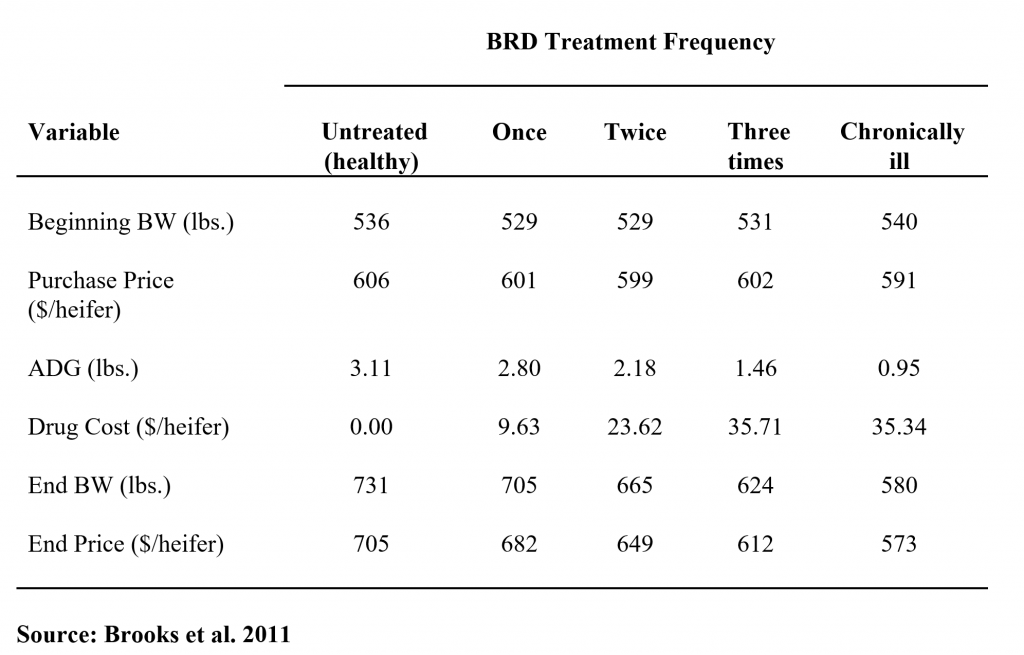
Reference:
Brooks, K.R., K.C. Raper, C.E. Ward, B.P. Holland, C.R. Krehibiel, and D.L. Step. (2011)
Economic effects of bovine respiratory disease on feedlot cattle during backgrounding and finishing phases. The Professional Animal Scientist. Vol. 27. Pg. 195-203. https://doi.org/10.15232/S1080-7446(15)30474-5
RON's Dave Lanning has a pre-opening look at today's agricultural Markets.
Click the audio tab below for today's report.
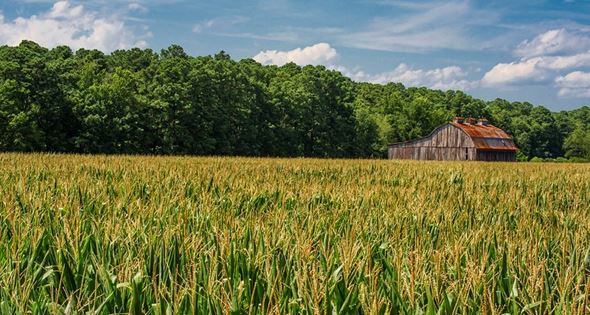
An important financial consideration for any business is the costs they incur during the year. Ultimately, it affects the amount of profit or loss that will be realized by the business. There are certain "costs of doing business" known as overhead. These are things that an organization will have to pay for but are not designated to any one activity. An example might be property taxes. The taxes are owed and necessary for the business to maintain its property and obligations but typically could not be solely attributable to one activity like raising livestock or producing a crop. Usually, the costs are known but sometimes take a backseat to direct input costs when it comes to evaluation. For a true look at profitability, overhead must be factored in. The good thing is it may present opportunities for the business to cut down on its overall spending.
Overhead expenses occur once a year, several times a year, or even more sporadically. The first step is making sure they are logged in the books and records of the business. They can be reviewed to make sure they are necessary, reasonable, and have ultimately been paid. Common overhead expenses include insurance, taxes, depreciation, utilities, office expenses, and salaries. This list may not be all-encompassing, and it is important to mention that any personal expenditures for these items are not included in farm profitability. Often, the business will have a bill or receipt that includes the amount. For others, it may be more of a calculation like depreciation or extracting the business use of utilities. The main goal is to account for all "costs of doing business".
Determining total overhead is the first step. Once that has been completed, a producer may want to allocate the overhead costs to their different enterprises. This is not necessarily a precise calculation but is up to the owner or business manager. Some may approach it from a revenue perspective. For instance, if cotton is 50% of total farm revenue, then 50% of overhead will be allocated to it. Another method may be according to labor hours. If the time spent on a particular crop is 50% of the total hours worked (by everyone on the farm), then 50% of the overhead will be allocated to that crop. Product mix and profit margins will be different on each farm, so it is up to them to determine what is most appropriate.
In reviewing the information, a farm may realize that there are opportunities to cut costs. While not advocating for a farm to run without its necessary expenditures, overhead may be where some costs can be scrutinized. Checking insurance rates every couple of years can provide the same coverage at a lower cost from a different carrier. Computer software and other subscription services may have promotions or discounts for being a continued customer. Perhaps there are subscription services that are going unused and could be cut out completely. If computer equipment is upgraded every couple of years, extending that out an additional year or two can defer the expense. Often, farmers may attend trade shows or conferences to pick up new information. Sometimes, the conference host or other farm organizations will provide a cost share for travel or reimbursement for the conference. The above are only a few ideas of cutting overhead costs. Individually, the costs may not account for much, but an effort to manage overhead can provide significant combined savings in the long run. If a farm is operating fairly lean from an input perspective, overhead may provide other opportunities to affect profitability. At the end of the day, revenues minus expenses determines net returns. Which expenses are reduced does not matter for the overall equation.
Article courtesy of Burkett, Kevin. "Look Out Overhead." Southern Ag Today 3(52.3). December 27, 2023. Permalink
Mark Johnson, Oklahoma State University Extension Beef Cattle Breeding Specialist, offers herd health advice as part of the weekly series known as the "Cow Calf Corner" published electronically by Dr. Peel, Mark Johnson, and Paul Beck. Today, Johnson talks about cattle grazing in Oklahoma.
In the final crop progress report of 2023 at the end of November, the Oklahoma wheat crop was rated 53 percent good to excellent with 7 percent poor to very poor. This compares to one year ago when the Oklahoma wheat crop was rated 31 percent good to excellent and 24 percent poor to very poor. Figure 1 shows that much of the major wheat belt in western and northwestern Oklahoma have received well above average precipitation in the past two months. The latest Drought Monitor shows that just 3 percent of the state has D2 level drought with no D3 and D4 conditions.
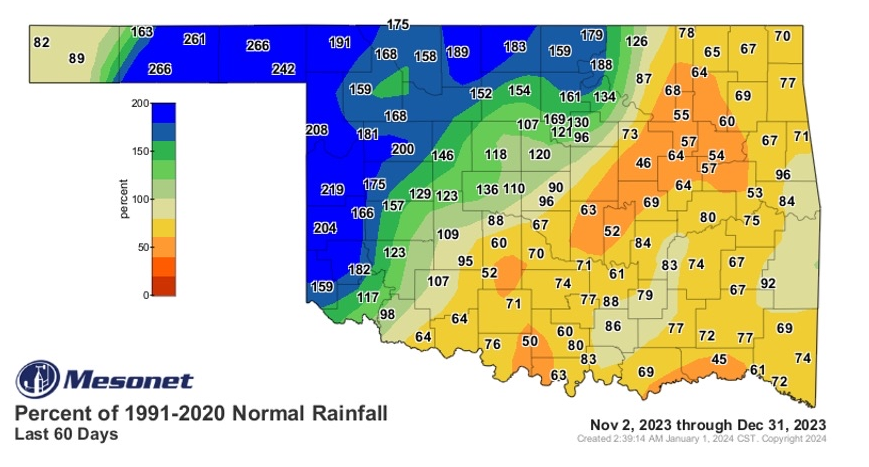
I recently traveled from Southeastern Colorado through the entire length of the Oklahoma Panhandle and the northwest part of the state. The majority of wheat fields looked very good with well-developed wheat stands, with just a few later planted fields with less growth.
Many fields are stocked with grazing cattle, including irrigated fields in the Panhandle and in Southeastern Colorado. The number of stocker cattle grazing winter wheat appears to be significantly larger than last year. In 2022, the estimated January 1 supply of feeder cattle outside of feedlots in Oklahoma (many of which are typically grazing wheat), was down 18.5 percent year over year and the lowest since 2014. Although overall cattle numbers now are less than one year ago, the January 1 feeder supply in Oklahoma may be larger year over year.
It is just an anecdotal observation, but it seemed that the number of stocker heifers on wheat in late December exceeded the number of steers. Although it appeared that cow-calf producers took advantage of strong prices to market both steer and heifer calves last fall, it is possible that decisions about whether stocker heifers on wheat will be feeders or replacements have not yet been made.

The state of Oklahoma received its first three made-in-Oklahoma electric vehicles from Canoo as an innovative part of the state's ongoing fleet modernization initiative. At a combined cost of $119,850, these three Lifestyle Delivery Vehicles (LDVs) are the first of their kind in the state fleet, with one each assigned to the Office of Management and Enterprise Services, the Department of Transportation and the Department of Corrections.
"For the first time in 17 years, vehicle manufacturing is back in Oklahoma," said Oklahoma Gov. J. Kevin Stitt. "As we find new efficiencies within the fleet, Canoo's new Oklahoma-made electric vehicles align perfectly with our fleet modernization goals, and I couldn't be more excited to see them on the roads. I'm grateful for the team at OMES who are working hard to deliver taxpayers more for their money while finding ambitious new ways to improve our fleet."
Fleet modernization is one of the governor's current top initiatives to realize efficiencies across the state. Following his executive order, OMES Fleet Management has worked closely with agencies to identify underutilized vehicles, downsize the state's overall fleet and explore ways to advance central fleet operations. In 2023 alone, agencies have voluntarily turned in a total of 917 vehicles that have been auctioned through State Surplus, saving Oklahoma taxpayers an estimated $11.7 million.
"I am proud of the savings and asset reductions we've made so far in our fleet effort," said John Suter, state chief operating officer and OMES executive director. "This progress positions us well to reinvest that money into future-focused, cost-effective vehicle options that better align with our goals."
While pushing hard to reduce waste, executive leaders have also sought ways to modernize vehicles within the fleet to drive better value and long-term returns on investment. One of these modernizations includes replacing outdated vehicles that are costly to maintain with environmentally friendly electric vehicles made right here in Oklahoma.
"Oklahoma is hub for the creation of new and innovative technologies, and Canoo is a global leader in electric vehicle development," said Lt. Gov. Matt Pinnell. "Beyond innovation, Canoo is creating over 1,300 jobs in Oklahoma, marking a significant economic impact for the state. I look forward to our continued partnership and am excited to welcome these new vehicles to the state."
The LDVs delivered to the State of Oklahoma are the first commercial motor vehicles built in-state since 2006 and the first to come out of Canoo's new assembly facility in Oklahoma City. Paired with the company's battery module manufacturing plant in Pryor, Oklahoma, Canoo is establishing roots in the "Sooner State," opening the door for greater economic development and employment opportunities for Oklahomans.
"Canoo is proud to bring motor vehicle manufacturing back to Oklahoma and create high-paying jobs," said Tony Aquila, investor, chairman and CEO of Canoo. "Our innovative LDV 130 delivery vehicles will work for Oklahomans and help state agencies improve fleet efficiency. Our vehicles are perfect for how the state uses vehicles today, and our advanced telematics and lower overall cost of ownership will continue to pay dividends down the road."
As the three Canoo LDVs are integrated into the government fleet pool, state leaders will continue to evaluate how the vehicles can best support agency missions and citizen services going forward.
U.S. Department of Agriculture (USDA) Rural Development Oklahoma State Director, Kenneth Corn today announced that the Oklahoma State Office is now accepting Rural Energy for America Program (REAP) Grant Applications.
A REAP grant is designed to aid small businesses or farms in rural Oklahoma with energy efficiency improvements or renewable energy projects. Millions of dollars has been allocated to be utilized for rural Oklahoma businesses and agriculture producers to apply for up to 50% financial assistance on an energy efficient improvement or renewable energy project. Past uses of the grant have included LED lighting, energy-efficient fans, improved refrigeration, solar power, and other energy efficient projects. Applicants must submit their grant package to the Oklahoma State Office no later than March 31, 2024.
"Small business owners and ag producers in Oklahoma who have utilized this grant program have seen almost immediate returns for their business because of the real cost savings from energy these programs can provide," Corn said. "President Biden is committed to not only restarting our economy through these programs, but also working to improve our climate by reducing the demand on our energy grid."
To learn more about the REAP process visit: https://www.rd.usda.gov/programs-services/energy-programs/rural-energy-america-program-renewable-energy-systems-energy/ok.
Stakeholders can also email the Oklahoma State Office for more information at: okenergy@usda.gov.
"The Biden-Harris Administration continues to demonstrate that investing in clean energy is an economic winner for the State of Oklahoma," Corn said. "I would encourage any small business owner or ag producer to contact our State Office, to see how they too can be a part of this economic growth by utilizing clean energy."
To subscribe to USDA Rural Development updates, visit the GovDelivery subscriber page.
Archives:
2026-11 | 2026-10 | 2026-09 | 2026-08 | 2026-07 | 2026-06 | 2026-05 | 2026-04 | 2026-03 | 2026-02 | 2026-01 | 2025-12 | 2025-11 | 2025-10 | 2025-09 | 2025-08 | 2025-07 | 2025-06 | 2025-05 | 2025-04 | 2025-03 | 2025-02 | 2025-01 | 2024-12 | 2024-11 | 2024-10 | 2024-09 | 2024-08 | 2024-07 | 2024-06 | 2024-05 | 2024-04 | 2024-03 | 2024-02 | 2024-01 | 2023-12 | 2023-11 | 2023-10 | 2023-09 | 2023-08 | 2023-07 | 2023-06 | 2023-05 | 2023-04 | 2023-03 | 2023-02 | 2023-01 | 2022-12 | 2022-11 | 2022-10 | 2022-09 | 2022-08