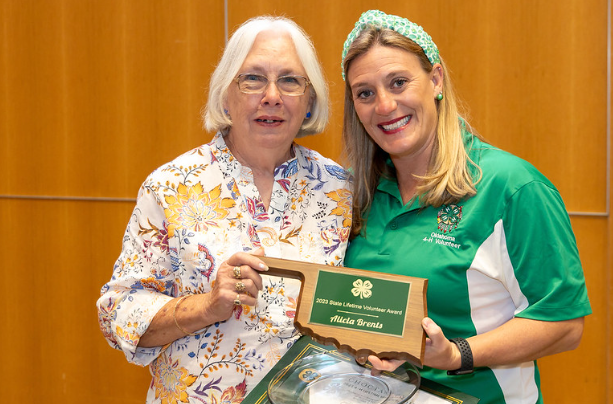
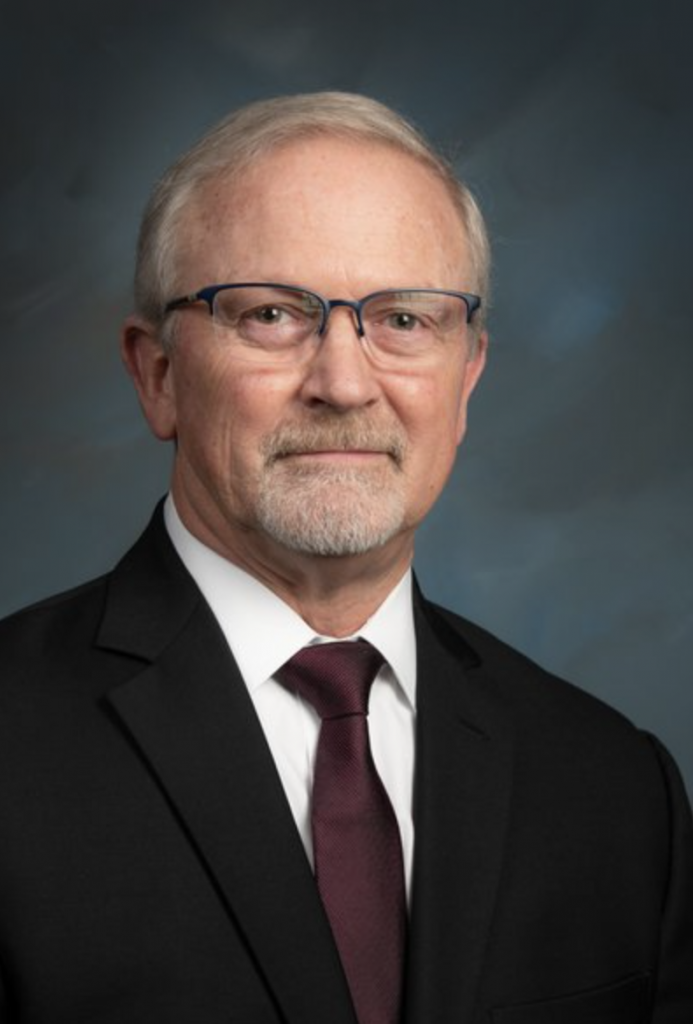
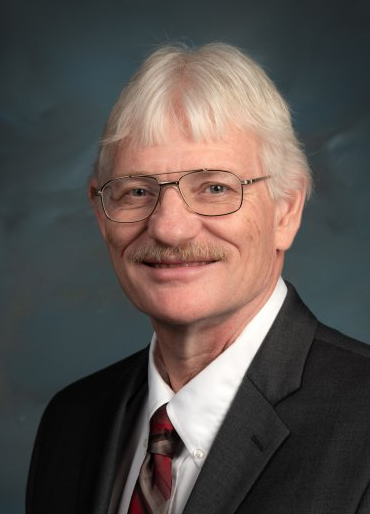
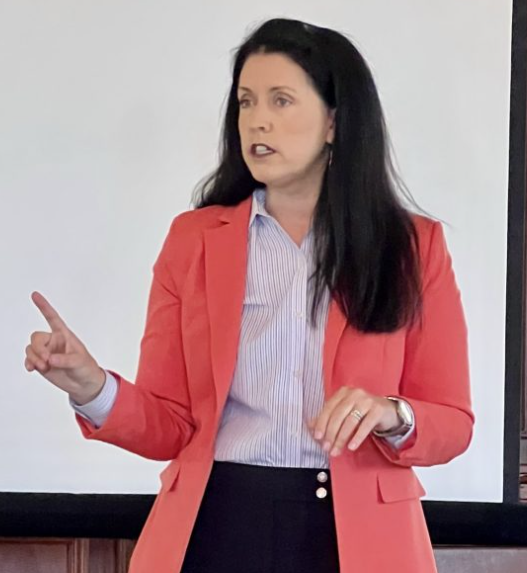
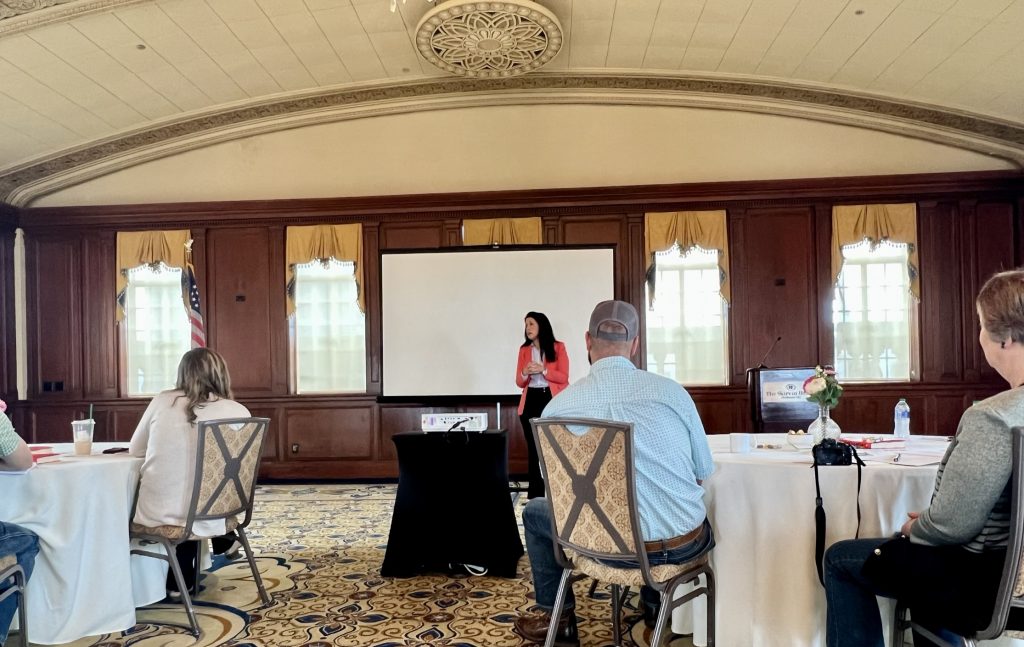
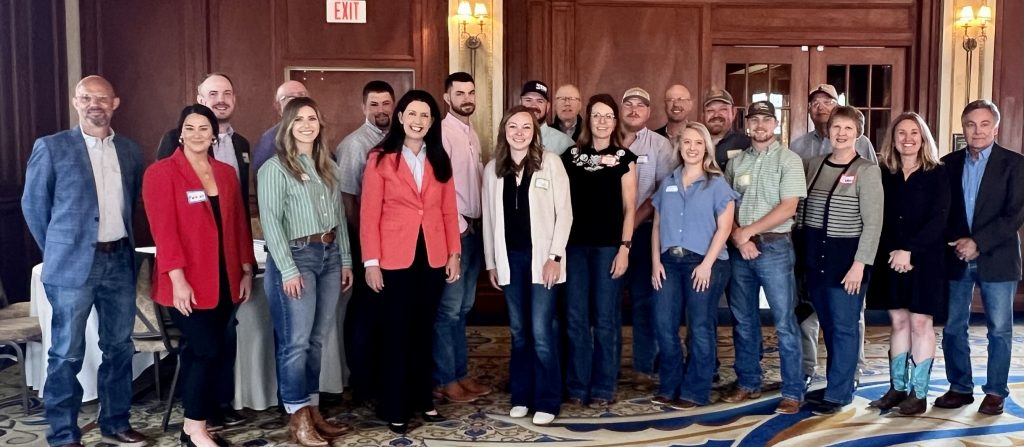
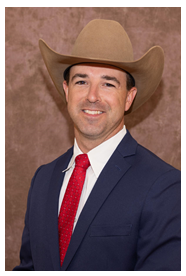
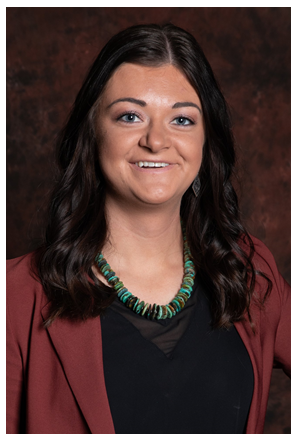
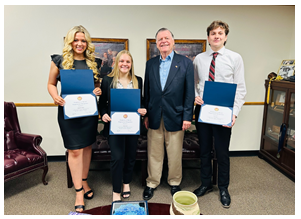
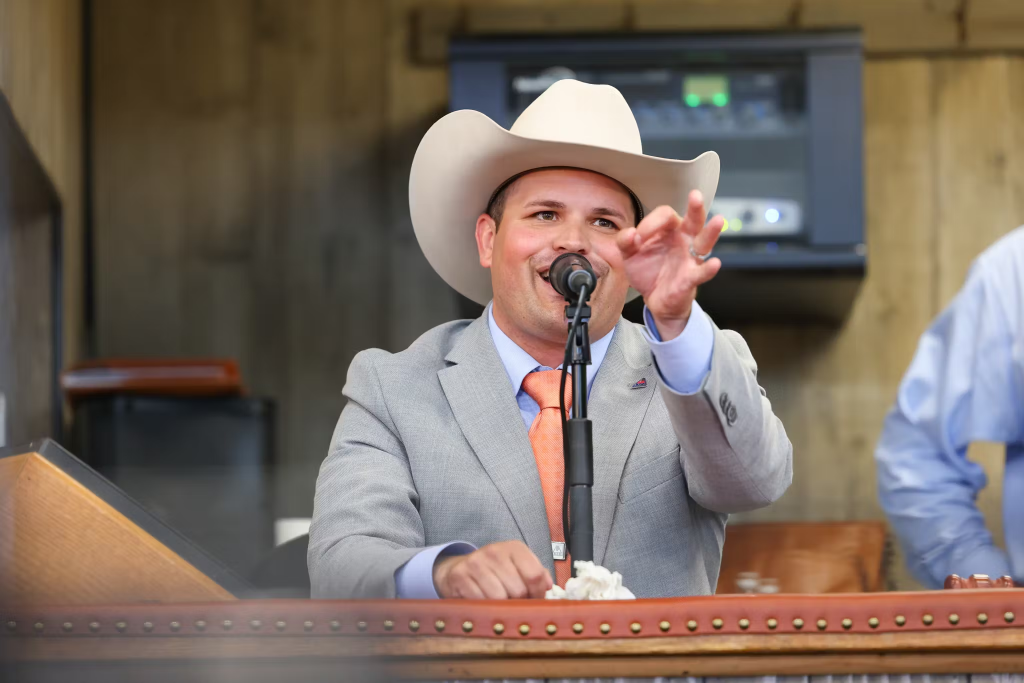
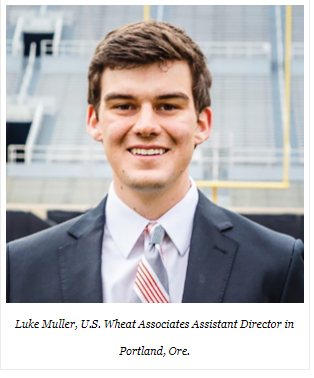
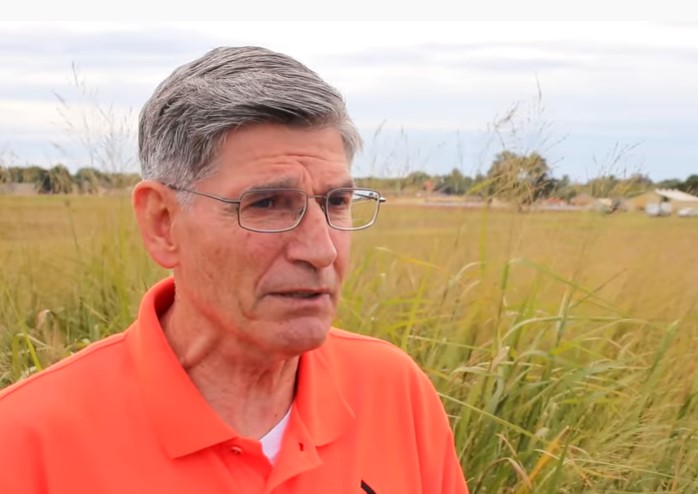
Alicia Brents, left, was recognized as the Oklahoma 4-H Volunteer of the Year during the 2023 4-H Parent/Volunteer Leader Conference at Oklahoma State University. Presenting the award is Missy Quintero, president of the 4-H Volunteer Board. (Photo by Mitchell Alcala, OSU Agriculture)
An educator by trade, and at heart, Alicia Brents saw the Oklahoma 4-H Youth Development program as a way to further her students' education. Not only did she teach in the classroom, but she volunteered in 1972 to become the Swink Public Schools 4-H volunteer leader. Fifty-one years later, she continues to serve the youth in Choctaw County as the leader of the Fort Towson 4-H Club.
Her dedication was honored at the 2023 4-H Parent/Volunteer Leader Conference at Oklahoma State University where she was named the Oklahoma 4-H Lifetime Volunteer of the Year. She was also recognized as the Southeast District and the Choctaw County Lifetime Volunteer of the Year. This award is presented to a volunteer leader with at least 10 years of service.
"Being a teacher and a 4-H leader go hand in hand, and I was looking for ways to further my students' education by getting them involved in different 4-H projects," Brents said. "4-H has so much to offer, and it all relates to classroom learning in some fashion."
She involved her students in meat, horse, land and forestry judging as a way to enhance what they were already learning in the classroom, as well as to provide hands-on learning opportunities. Brents even became a land judging coach. The various judging teams learned their lessons well and have won county, district, state and national competitions over the years.
"I studied and learned along with my students and club members," she said. "These experiences enhanced their school education and improved their public speaking skills. I enjoy getting a student who is timid or shy and seeing them excel at these contests."
Brents also enjoys offering opportunities for her club members to travel. Participating in a judging contest isn't just the contest itself. She makes the experience into an adventure and a time of discovery. When traveling, the group stops at different points of interest along the way.
"Some of my kids don't get to travel a lot, so this is a chance for them to broaden their horizons," Brents said.
Lucile Morehouse said she has learned so much under Brents' direction.
"Mrs. Brents has taught me about compass and pacing, forest evaluation, tree identification, insects and diseases. Last year I placed first high individual in the junior division forestry judging contest and I owe all of that to Mrs. Brents," Morehouse said. "I know that each year with her I'll learn more and more. She makes it fun and exciting."
Marty Montague, OSU Extension 4-H educator in Choctaw County, said Brents has taught hundreds of young people how to learn and apply that knowledge, not only for themselves but while working together as a team.
"Her 4-H members have won thousands of dollars in scholarships because of the work and effort this fine lady put in to make sure they were successful," he said. "To say Alicia Brents has been a mother to many of her 4-H'ers is an understatement. She has been more than that – sometimes being their father, banker, counselor and always their cheerleader. She'd go toe-to-toe with a grizzly bear to protect or defend a 4-H'er, no matter where they were from."
Montague, who has been with OSU Extension for 34 years, said he often reflects on his service and wonders if he could've done more.
"I can't say that about Alicia Brents' career as a 4-H adult volunteer," he said. "She never wavers or tires of trying to help her 4-H members."
Brents said she doesn't plan to step back from 4-H anytime soon.
"These 4-H'ers are my extended kids, just like my former students. Some of them call me Gran Gran like my grandkids do, and others call me on Mother's Day," she said. "I'm working on my third generation of 4-H'ers. I'll be around for a while."
OSU Extension uses research-based information to help all Oklahomans solve local issues and concerns, promote leadership and manage resources wisely throughout the state's 77 counties. Most information is available at little to no cost.-
In December, the Environmental Protection Agency (EPA) issued a proposed multiyear rule on renewable fuel requirements for the liquid fuel industry. On June 21, they issued a final version of thatrule rule that establishes RVO targets and percentage standards for 2023 to 2025 and modifies the RFS program. This Market Intel provides an analysis of the changes to the RFS standards and their potential impacts on farmers.
Background
The RFS program was established in 2005 and expanded under the Energy Independence and Security Act of 2007, which specified mandatory volumes of renewable liquid fuel use only through 2022 and required EPA to set levels after that. In this rule EPA is establishing final Renewable Volume Obligations (RVO) for 2023-2025 – volumes of fuels of various categories that the liquid fuel industry is required to incorporate into their supply to replace petroleum-based fuel for all categories under its authority. When determining RVOs for years after 2022, EPA must consider a variety of factors specified in the statute, including costs, air quality, climate change, implementation of the program to date, energy security, infrastructure issues, commodity prices, water quality and supply.
EPA was required by statute to release its 2023 RVO levels by November 2021. Pushed by legal action by Growth Energy, a national biofuels association, and a under a consent decree agreement reached in federal court between EPA and Growth Energy, the final rule was finally published on June 21.
What's in the Final Rule?
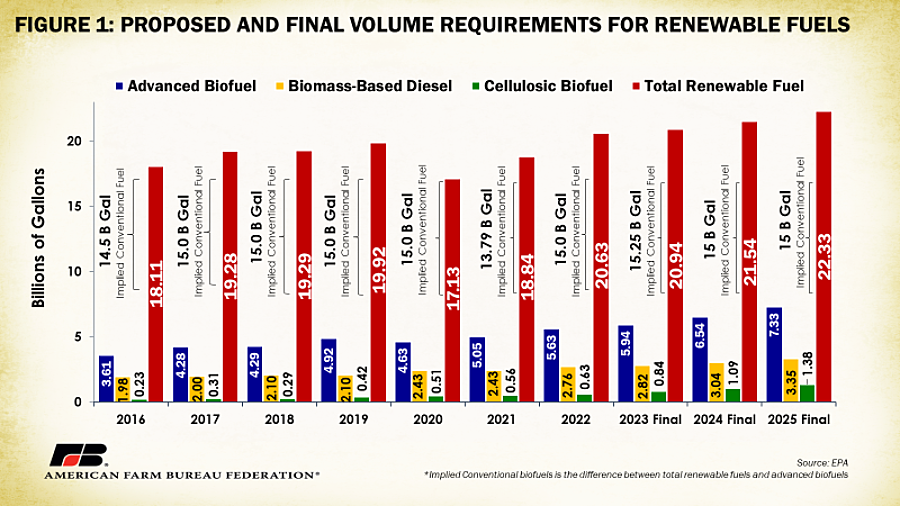
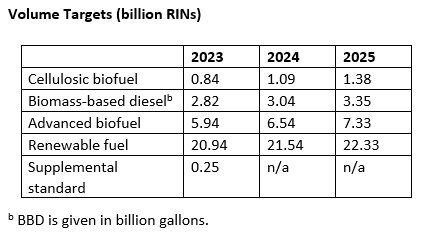
The final rule increases total renewable fuel volumes to 22.33 billion gallons by 2025, up 1.7 billion gallons, or 8%, from 2022. This includes an increase of 120 million gallons in 2023, another 600-million-gallon increase in 2024, and a final increase of 790 million gallons in 2025. Figure 1 illustrates the final volume requirements from 2016 to 2025 for all four categories of renewable fuels. We provided more detail on the renewable fuel categories and the content of the December 1 proposed rule in a previous Market Intel.
Biomass-based diesel: The final rule increases biomass-based diesel RVOs (which includes biodiesel, renewable diesel, heating oil and jet fuel) by 60 million gallons to 2.82 billion gallons in 2023, by 220 million gallons to 3.04 billion gallons in 2024, and by 310 million gallons to 3.35 billion gallons in 2025. The RVO is calculated by subtracting total advanced biofuel from total renewable fuel. According to a report by USDA's Economic Research Service, the United States had the capacity to produce over 4 billion gallons of biodiesel and renewable diesel from 83 plants on Jan. 1, 2022.
Advanced biofuel: The final rule increases the RVO for advanced biofuel (made from qualifying biomass other than cornstarch) by 310 million gallons in 2023, 600 million gallons in 2024, and 790 million gallons in 2025. The majority of growth in total renewable fuel comes from increases in the RVO for advanced biofuel.
Renewable (or implied conventional) fuel refers to biofuel, including ethanol, derived from starch feedstocks. The implied conventional biofuel requirement finalized by EPA is 15.25 billion gallons for 2023, and 15 billion gallons for 2024 and 2025. This was reduced from the proposed rule's 250-million-gallon implied conventional fuel supplement through 2025.
Renewable Identification Numbers under the Renewable Fuel Standard Program
Renewable Identification Numbers (RINs) are attached to each gallon of renewable fuel produced. This is a measure of energy contained in each gallon of renewable fuel produced relative to the energy contained in 1 gallon of ethanol. One gallon of biomass-based diesel contains about 150% of the energy contained in 1 gallon of ethanol, so each gallon produced yields 1.5 RINs. For the final rule, EPA adjusted the conversion factor for biomass-based diesel to 1.6.
e-RINs Removed From Final Rule
The rule proposed by EPA in December 2022 included the addition of a RIN-generating pathway for electricity made from renewable biomass and used as transportation fuel. The system was intended to provide greater beneficial use of landfills and digesters as a source for renewable energy. EPA decided not to move forward with e-RINS in the final rule, citing varied comments from stakeholders as the reason for this decision. EPA further attributes reductions in the cellulosic biofuel RVO to this decision.
Impacts on Corn, Soybean Oil and Soybeans
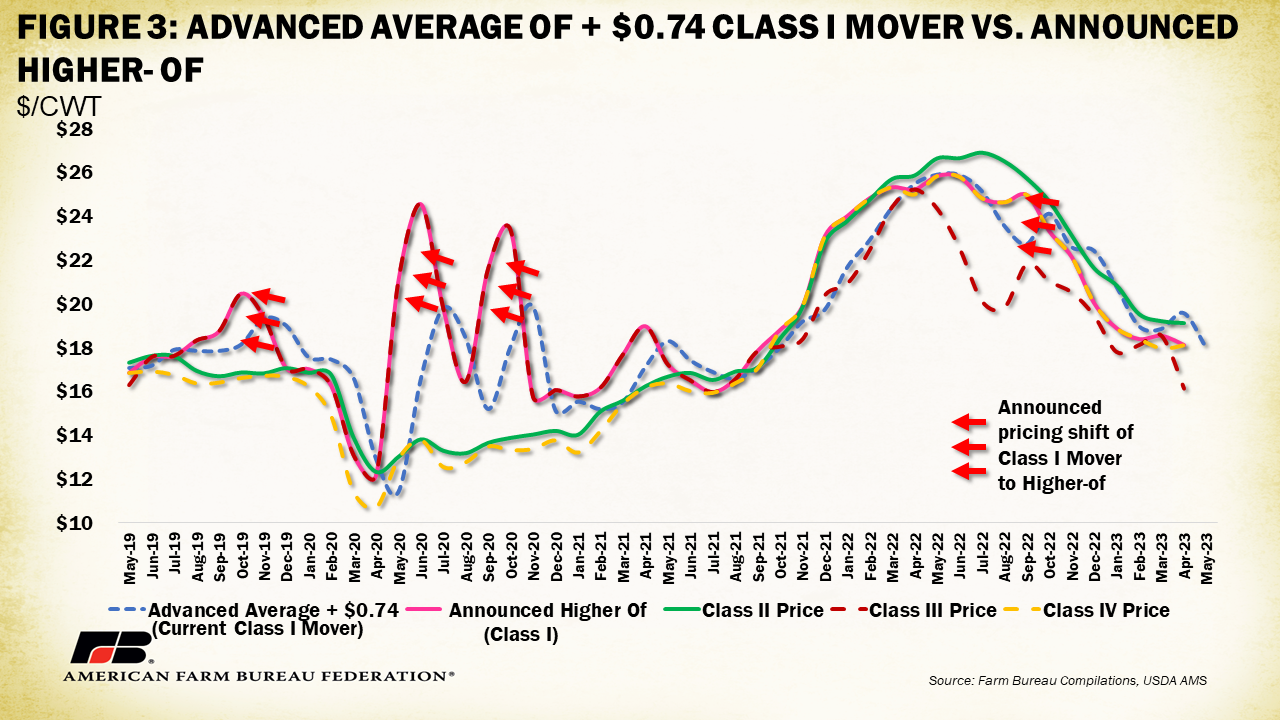
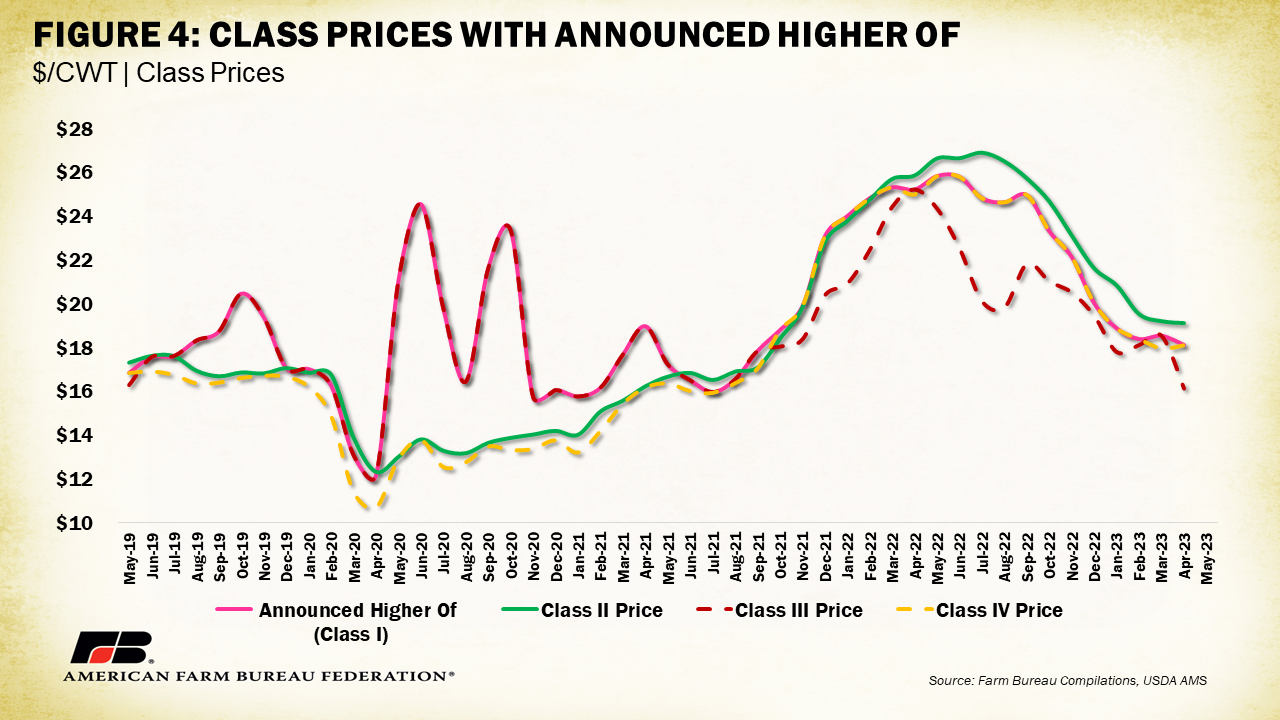
On the soybean side, U.S biomass-based diesel supplies (including imports) were about 3.1 billion gallons in 2021 and about 3.2 billion gallons in 2022. USDA now projects 12.5 billion pounds of soybean oil will be used to produce biodiesel during the 2023/24 marketing year, up nearly 8% over 2022. The use of soybean oil for biodiesel production as a percent of total consumption surpassed the use of corn for ethanol production in 2020 and has continued to climb (Figure 2). EPA's proposed rule sets RVOs for biomass-based diesel at 2.82 billion gallons for 2023, 3.04 billion gallons in 2024, and 3.35 billion gallons in 2025. According to the final rule, the 3.35-billion-gallon RVO for 2025 would be about 7.7% above 2022 supply levels and 3.7% above projected supplies for 2023/24. Figure 3 provides a comparison in RINs of the announced and current renewable diesel capacity compared to the RVO for biomass-based diesel, and the implied advanced gap (advanced gap = total advanced biofuels – cellulosic – biomass-based diesel). The 5.95-billion-RIN RVO falls far short of the U.S. capacity of 14.3 billion RINs. The RVO is increased significantly compared to the proposed rule, but it promises to lag behind renewable fuel production capacity, so it will limit the RFS' short- and medium-term positive price impact on RINs and biofuels and curb the biomass-based industry's policy-based incentive to grow. In the proposed rule, EPA included a 250-million-gallon supplemental increase over the 15-billion-gallon RVO for implied conventional fuel for 2024 and 2025. EPA did not include these additional gallons in the final rule, putting implied conventional fuel at 15 billion gallons for 2023, 2024 and 2025.
Key Takeaways
Renewable fuels have provided a significant and steady market for American growers. In the 2023/24 marketing year, 5.3 billion bushels of corn, nearly 37% of total U.S. consumption, are projected to be used by ethanol producers. At the same time, 12.5 billion pounds of soybean oil, the oil from over 1 billion bushels of soybeans, is projected to be used in biodiesel production (Figure 2).
The final volume increases raise the floor for demand in the biomass-based diesel and advanced biofuel sector; but as long as they lag behind capacity, they will not incentivize continued growth in a sector that has made a substantial contribution to corn and soy demand for American farmers, and to the overall sustainability of American energy supplies. The rule further reduces this floor through the removal of the 250-million-gallon supplemental conventional fuel requirement for 2023, 2024 and 2025, leading to lower corn demand and the implications that come with that.
On this Independence Day, as we celebrate the freedom we are all fortunate to share with our family and loved ones, we also reflect on our 247 year-long history and the immeasurable sacrifice undertaken for freedom to remain. Indeed, it is because of the unwavering dedication and sacrifice of the generations of U.S. service members that we may remain free.
As Americans, we enjoy so many liberties that many places throughout the world will never know. Although we live in an era of extreme divisiveness, we must remember that no matter what side of the aisle we are on or party affiliation, what brings us together is that we are all American. And because of the enduring promise of the pursuit of happiness and striving to become a more perfect union, we remain the country that most people want to come to.
However, the freedom we so cherish is paid for at a high price. From the Revolutionary War to present day, each generation of service members have answered the call to defend liberty and their courage and heroism certainly inspires us all. These remarkable individuals have shouldered the burden of defending our freedoms, often at great personal cost, and we should never forget that. The Fourth of July provides us with an opportunity to unite as a nation and extend our collective gratitude to these individuals who sign up to put themselves in harm's way for the sake of others.
As John Adams once declared, this day would be celebrated by future generations as the "great anniversary festival" with "pomp and parade...games, sports, guns, bells, bonfires and illuminations from one end of the continent to the other." As we enjoy and celebrate our nation's independence, let us honor the generations of service of those with valor, and may their legacy continue to inspire those for generations to come. Happy Fourth of July and God Bless America!
Congressman Tom Cole (OK-04) released the following statement after the U.S. Supreme Court ruled the Biden Administration does not have the authority to implement its student loan bailout plan in a 6 to 3 vote.
"When the Biden Administration issued its plan to erase a wide swath of certain federal student loan debts, it did so by circumventing Congress," said Cole. "The reality is that 'forgiving' student loans does not mean no one is paying for them, and this executive order would have been unfair to the millions of Americans who did not go to college to avoid these loans, or already paid their loans off. Since borrowers accepted this money from the federal government, a supposed cancellation of that financial commitment is actually just a transfer to the American taxpayer. I applaud the Supreme Court's decision in rejecting this mandate, returning the power back to Congress and standing with American taxpayers."
Listen to KC Visit with Allendale's Rich Nelson about the latest Grain Stocks and Acreage Report
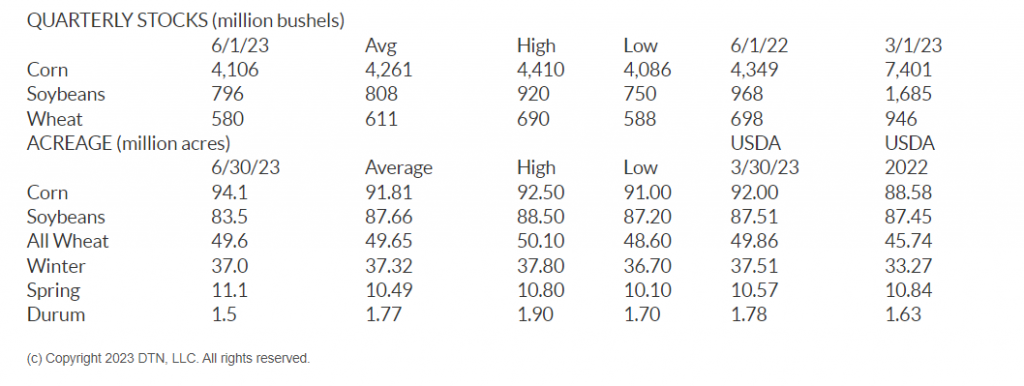
Today USDA released its Acreage and June 1 Grain Stocks reports. Grain Stocks is the quarterly report showing a count of remaining old crop as of June 1. For corn and soybeans this is what is left over after three quarters of usage. For wheat, which operates on a June 1 – May 31 marketing year, this ends the old crop year. There are no numbers showing old crop production or demand in this report. Changes implied by this report will be reflected on the next WASDE set for July 12. The second report, Acreage, is USDA's second major farmer survey of the year. 63,700 producers participated in today's report. Of note for this report, different than the March Prospective Plantings, this report held both a planted and harvested estimate.
Farm Director KC Sheperd spoke with Allendale's Rich Nelson about the latest numbers for Oklahoma, Texas and Kansas, and he said yield may be a discussion point going forward, "Not Major Changes on the planting issue here, especially for the hard red issue where we did see perhaps a bit better harvest acres than expected. I think that will have to come into play these next few weeks, especially as we can further move through harvest. And we're now also having a more serious discussion regarding yields here."
Nelson said on the Grain Stocks report wheat exports have had a rough season, "Keep in mind these numbers do include March- April- May very well known poor export sales, and I've got to say that also we understand the new crop sales. As an example, Thursday, we saw a record-low new crop sale for that specific week. So no change in the export sales problem. This would have implied surprisingly better feed use in that March, April, May period of all things."
When it comes to the Acreage report Nelson said the harvest acre totals will be a big discussion point, " That's a clear discussion point for us on these issues these next few weeks, maybe not for corn and soybeans in a dramatic issue. What I will say for wheat, the big surprise here for us is USDA dropped the planting numbers by 200,000, which was reasonable for wheat, but they raised the harvested acre estimate by 0.6. So They revised better."
USDA said farmers planted 94.1 million acres of corn, above the range of pre-report expectations. It's up 6% from last year, and above USDA's March Prospective Planting report estimate of 92 million acres. It's the third highest corn planting since 1944.
On soybeans, acreage is pegged at 83.5 million acres, 5% lower than last year. It's also below the range of pre-report estimates.
USDA said farmers planted 94.1 million acres (ma) of corn, above the range of pre-report expectations. It's up 6% from last year, and above USDA's March Prospective Planting report estimate of 92 million acres. It's the third highest corn planting since 1944 and the most since 2013. Harvested acreage, at 86.3 million acres, is also higher than last year.
On soybeans, acreage is pegged at 83.5 million acres, 5% lower than last year and the smallest in three years. It's also below the range of pre-report estimates.
All-wheat planted area is estimated at 49.6 ma, 9% higher than last year and right in line with pre-report estimates. Winter wheat acreage is up 11% from last year at 37 million acres and, of that, 25.7 ma of it hard red winter wheat, 7.66 ma is soft red winter wheat and 3.68 ma is white winter wheat. Farmers planted spring wheats on 11.1 million acres, with Hard Spring accounting for 10.5 million, as the trade expected.
2022/23: USDA counted June 1 US wheat stocks at 580 million bushels. That was under the 611 trade estimate (ALDL 621). This report wraps up the completed old crop marketing year. The Grain Stocks report is a quarterly count of old crop stocks. For wheat, this now officially ends the old crop year. USDA's prior estimate for ending stocks on the 6/9 WASDE was 598. With known data on exports, and usually minimal surprises for food use, this implies the feed/residual category in March-May was 70 million bushels over last year at this time.
2023/24: All-wheat planting was revised minimally lower than March to now 49.628. The trade trade estimate was 49.656 (ALDL 49.533). Winter wheat acreage had already been reported on the January Winter Wheat Seedings report and the March Prospective Plantings. Today's 37.005 million represented a decline of 0.5 from March. This is still sharply over 33.3 last year. The trade, given known planting problems, expected a slight decline to other spring acreage. USDA instead found 557,000 more to now 11.140. Harvested acres may be an area of interest given prior problems in hard red areas. Their 37.722 all-wheat harvested estimate would be over the 37.1 used on the June supply/demand. Wheat pricing has not been tied to the US balance sheet in recent months. This report would be seen as negative to hard red pricing.
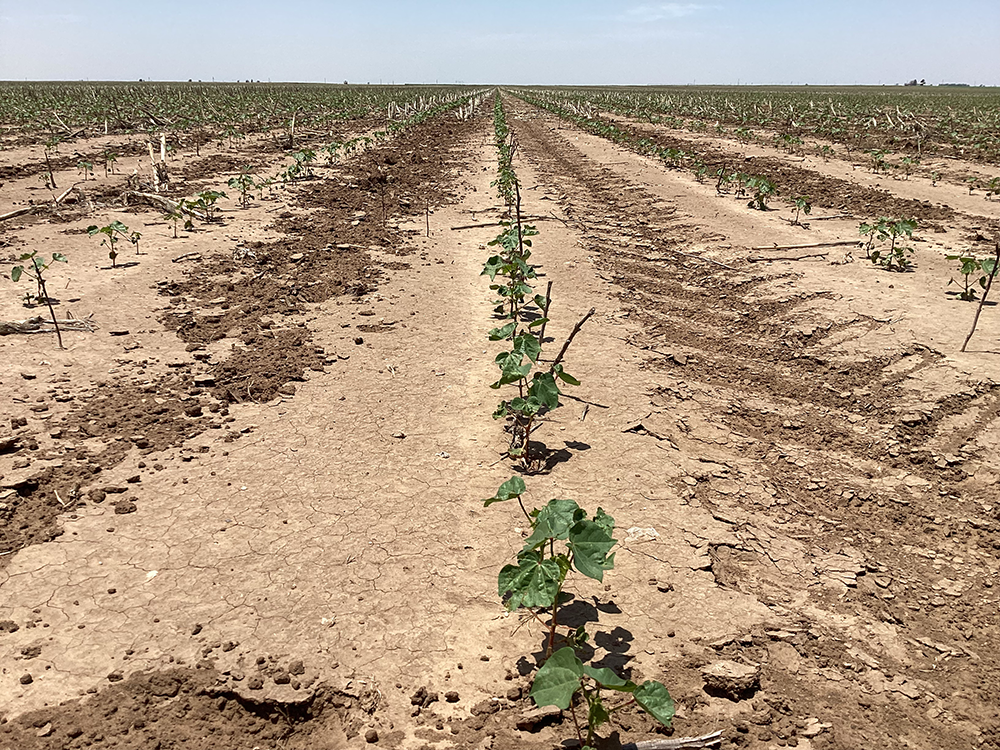
Cotton was planted on 11.1 million acres, 19% less than last year.
JUNE 1 GRAIN STOCKS
Corn stocks in all positions on June 1, 2023, totaled 4.11 billion bushels (bb), down 6% from June 1, 2022. The estimate was below pre-report estimates.
Of the total stocks, 2.22 bb are stored on farms, up 5% from a year earlier. Off-farm stocks, at 1.89 bb, are down 15% from a year ago. The March to May 2023 indicated disappearance or usage is 3.29 bb, compared with 3.41 bb during the same period last year.
Soybeans stored in all positions on June 1, 2023, totaled 796 million bushels (mb), down 18% from June 1, 2022. This number is also below pre-report estimates.
On-farm stocks totaled 323 mb, down 3% from a year ago. Off-farm stocks, at 473 mb, are down 26% from a year ago. Indicated usage for the March to May 2023 quarter totaled 891 mb, down 8% from the same period a year earlier.
Old crop all wheat stored in all positions on June 1, 2023, totaled 580 mb, down 17% from a year ago. The wheat estimate comes in at below pre-report estimates.
On-farm stocks are estimated at 124 mb, up 34% from last year. Off-farm stocks, at 456 mb, are down 25% from a year ago. The March to May 2023 indicated usage is 366 mb, up 11% from the same period a year earlier.
Old crop durum wheat stocks in all positions on June 1, 2023, totaled 28.0 mb, up 18% from a year ago. On-farm stocks, at 12.8 mb, are up 38% from June 1, 2022.
Off-farm stocks totaled 15.3 mb, up 6% from a year ago. The March to May 2023 indicated usage of 7.77 mb is up 18% from the same period a year earlier.
Listen to Ron Hays talk with Mary-Thomas Hart about the WOTUS rule.
Senior Farm and Ranch Broadcaster Ron Hays is visiting with National Cattlemen's Beef Association Chief Counsel Mary-Thomas Hart about NCBA's fight against the Biden Administration on the Waters of the U.S. rule.
The NCBA has joined a broad coalition suing the Biden Administration over their reluctance to move off their rule and rewrite the new WOTUS rule after the Supreme Court decision that did away with the significant nexus concept. NCBA and litigation partners filed a motion in the U.S. District Court for the Southern District of Texas asking the federal court to issue a nationwide vacatur of the 2023 Biden Administration's WOTUS definition.
"This is following the May 2023 unanimous opinion from the Supreme Court in Sackett v. EPA, where they found that the significant nexus test was a violation of the Clean Water Act," Hart said.
There is a lot of variation, Hart said, in how different groups of stakeholders read the impacts of the Supreme Courts' decision, even though it was a unanimous opinion.
"The EPA and Army Corps of Engineers have now said they believe they can make some small adjustments to the existing WOTUS decision and basically give us a direct final rule that will comply with this Supreme Court standard without going through notice and comment rulemaking and without providing the opportunity for substantive stakeholder involvement in that process."
Going to federal court, Hart said, is the best way to resolve the number of issues NCBA has with the Biden Administration.
"We filed a motion for summary judgment in federal court," Hart said. "We will now hear a response from the agencies who are also involved in that case, and that is just the process of briefing out this motion we have made with the court."
Hart said hopefully, NCBA will hear from the court in the upcoming months. EPA and the Army Corps of Engineers have indicated they would like to issue a direct final rule redefining WOTUS by September 1st.
"The Biden Administration's WOTUS definition is currently on hold in 27 states," Hart said. "So, for most of our producing states, they are not currently subject to the Biden Administration's WOTUS rule."
Instead of following the guidance from the Supreme Court, Hart said the Army Corps of Engineers has paused all activity on the new WOTUS rule, which halts progress when it comes to new infrastructure and more.
"I do think there is some sense of urgency, not only among stakeholders but within the agency as well, to get some resolution," Hart said.
The only way that would make the current WOTUS definition comply with the Supreme Court's latest ruling, Hart said, will be some major revisions.
"The significant nexus standard is the cornerstone of this definition, and without that, you undermine everything that is in that definition," Hart said.
The Beef Buzz is a regular feature heard on radio stations around the region on the Radio Oklahoma Ag Network and is a regular audio feature found on this website as well. Click on the LISTEN BAR for today's show and check out our archives for older Beef Buzz shows covering the gamut of the beef cattle industry today.
Congressman Josh Brecheen issued the following statement after the Supreme Court struck down Biden's student loan bailout in Biden v. Nebraska and defended religious liberty and the First Amendment in 303 Creative LLC v. Elenis.
The conservative victories come a day after the Supreme Court ruled that colleges cannot racially discriminate in admissions and reaffirmed that employers cannot discriminate against employees based on religion.
"In the last two days, conservatives have scored major wins, as the Supreme Court has ruled in favor of the First Amendment, religious liberty, and against racial discrimination," said Congressman Josh Brecheen. "American taxpayers should also applaud the fact the Supreme Court struck down President Biden's unconstitutional student loan bailout, which would have been a $400 billion+ transfer of wealth from the working class to some of the most well-off Americans. I am glad to see the Supreme Court stand up for freedom and Americans' constitutional rights. Today is a day for all Americans to celebrate."
Listen to Ron Hays talk with Mark Hodges about this year's wheat crop and harvest.
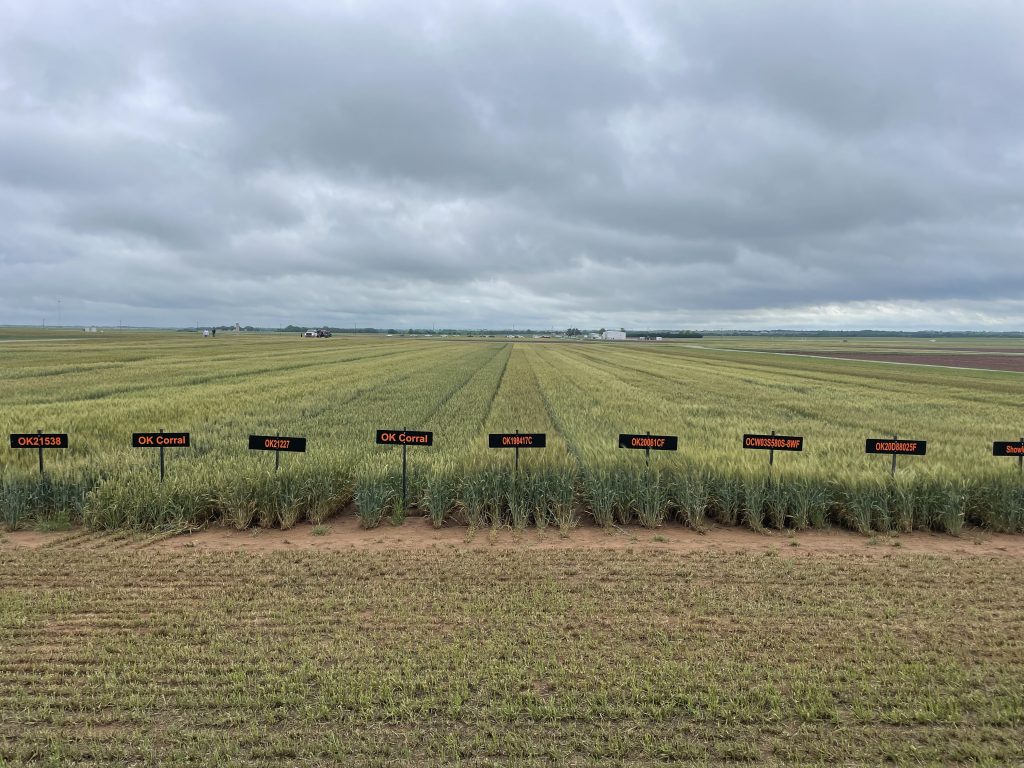
Senior Farm and Ranch Broadcaster, Ron Hays, is talking with Mark Hodges, the Executive Director of Oklahoma Genetics Inc., about this year's winter wheat crop and harvest.
"There is some good wheat out there in areas," Hodges said. "It is really a mosaic pattern because it doesn't necessarily relate to grazed and ungrazed, not that there was much to graze to start with."
Unfortunately, Hodges said, when it did start to rain, in many places, it only brought on weeds because of the time period. As quality data starts to come out, Hodges said there has been some great quality, but this crop has been very diverse in its range because of weather conditions.
With Oklahoma's outstanding genetics and wheat breeding team led by Dr. Carver at Oklahoma State University, Hodges said even in tough times, Oklahoma's winter wheat crop pushes the limits.
"Oklahoma has got the best wheat breeder in the world and the best breeding team in the world," Hodges said.
Regarding OGI wheat that will be sold and planted this next year, Hodges said one of the challenges is finding where the seed is available and how to get it to areas that do not have it.
"Until we get a better handle on what is available and not available, that is really the challenge right now, and being able to move seed," Hodges said.
Hodges added that he is feeling better about the availability of seed now that some rains have come in, as a few months ago, that was not the case.
"We would have been extremely challenged on seed supply," Hodges said. "I am not saying it is going to be a normal year by any stretch of imagination, but I do feel better than I did three months ago about it."
The wheat variety Hodges said he has heard is in demand the most lately is High Cotton, which is in limited supply.
"Dr. Carver is trying to distribute that in the state as best he can and address those who do want it and have the ability to produce it," Hodges said.
Thirty Missouri FFA members gathered in Jefferson City June 27-29 for the ninth annual Helping Youth Prepare for Excellence (HYPE) Academy. Sponsored by the Missouri Corn Merchandising Council, the three-day event focuses on advocacy and honing skills to be stronger voices for the agriculture industry.
Thirty high school seniors from across Missouri completed the ninth annual Helping Youth Prepare for Excellence (HYPE) FFA Academy June 27-29 in Jefferson City, Mo. Sponsored by the Missouri Corn Merchandising Council, the three-day academy is designed to inform and empower agriculture students to effectively engage in issues impacting today's industry.
"These FFA members have the potential to be the next leaders in agriculture," notes MCMC Chairman Brent Hoerr. "So much of our success is now tied to being able to engage in the tough conversations and issues that have the potential to help or hurt growers. Whether it be friends, neighbors, strangers online, or decision-makers, being able to tell our story and share our concerns is vital. Today's HYPE Academy helps students hone those skills and prepare them to be the voice of rural Missouri as they head into college and their careers."
Students learned how to effectively talk about their experiences in farming, overcome obstacles, and develop their communication and personal skills. Learning sessions included advocacy training, communication basics, and social media outreach. Students hear from farmers, industry representatives, social media influencers, and Congressman Mark Alford on how to effectively advocate on issues. The group also toured the Missouri Soybean Center for Innovation to learn more about the advancements and research being done on behalf of farmers.
HYPE Academy members rounded out their three-day advocacy training by participating in mock hearings in the Missouri State Capitol. Pictured: California FFA member Chase Schlup provides testimony to (l-r) Rep. Emily Weber, Rep. Willard Haley, and Rep. Jim Schulte.
Wrapping up the academy, participants put their skills into action during mock legislative hearings at the Missouri State Capitol. Students presented key issues to Missouri Sen. Barbara Washington and State Reps. Willard Haley, Jim Schulte, Emily Weber, Ashley Aune, Peggy McGaugh, and Doyle Justus. Students also had the chance to meet with Missouri Director of Agriculture Chris Chinn.
"This is a great opportunity for our members to gain confidence, and put another tool in their advocacy toolbox," noted Missouri FFA State Advisor Keith Dietzschold. "As seniors, these students are in a unique position to tell their story to a much broader audience in the next few years. We know these tools will not only serve them well, but agriculture as a whole and are grateful Missouri Corn continues to support this opportunity for students to grow."
The Missouri Corn Merchandising Council is an organization of corn growers dedicated to developing and expanding corn markets, educating growers and customers, and exploring new research opportunities. Learn more at www.mocorn.org. The National FFA Organization makes a positive difference in the lives of students by developing their potential for premier leadership, personal growth, and career success through agricultural education. Learn more about the HYPE Academy by contacting Missouri Corn Associate Director of Communications Hilary Black at (573) 893-4181 or hblack@mocorn.org.
Dan Basse of Chicago, Illinois, president of AgResource Company, has been elected chair of the Farm Foundation Board of Directors. Basse, who will serve a two-year term, succeeds Jerome Lyman, a retired executive of McDonald's Corporation.
"It is an exciting time for Farm Foundation as we celebrate our 90th Anniversary and look to accelerate our mission with the construction of an Innovation and Education Center on our recently purchased farm in Libertyville, Illinois," says Basse. Furthermore, Basse says that he is looking forward to closely working with Farm Foundation CEO Shari Rogge-Fidler to accelerate people and ideas in soil health and sustainability, farmer health, digital agriculture, and market access for US farmers. "There is much to accomplished, and thankfully, Farm Foundation is blessed with a deep and dedicated board and management team."
Cheri De Jong of Dalhart, Texas, principal owner of Natural Prairie Dairy and owner and CFO of AgriVision Farm Management, was elected vice chair of the 29-member board. Andrew LaVigne of Alexandria, Virginia, president and CEO of the American Seed Trade Association, was elected treasurer. The election took place at the board's June meeting.
Six New Board Directors Elected
Farm Foundation is an accelerator of practical solutions for agriculture that leverages the power of collaboration between food and agricultural stakeholders to advance agriculture in positive ways. As a 501(c)(3) charity, the organization applies its non-partisan, objective approach to a suite of projects and programs aimed at addressing both emerging and persistent issues facing farmers and the wider industry.
In addition, six new members have been elected to the board: Former United States Secretary of Agriculture Mike Johanns; Former United States Deputy Secretary of Agriculture Jewel Bronaugh; Michael Doane, global managing director, food and freshwater systems, The Nature Conservancy; James (Jimmy) Kinder, co-owner/operator, Kinder Farms; Cristina Rohr, managing director, food and agriculture, S2G Ventures; and Todd Van Hoose, president and CEO, Farm Credit Council.
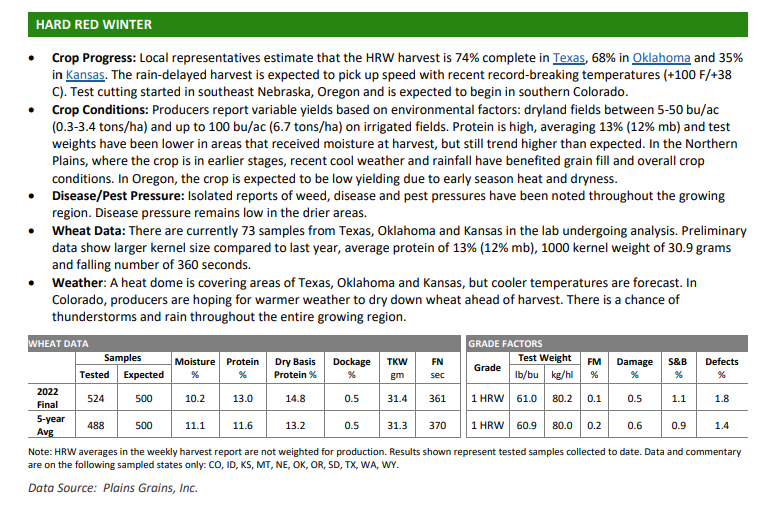
For the U.S., The 2023 winter wheat planted area is estimated at 37.0 million acres, down 1 percent from the previous estimate but up 11 percent from last year. Of the total planted acreage, approximately 25.7 million acres are Hard Red Winter, 7.66 million acres are Soft Red Winter, and 3.68 million acres are White Winter. Much of the Central Plains and Ohio Valley States are expecting increased planted acres from 2022. If realized, Utah will have a record low planted area.
Corn planted area for all purposes in 2023 is estimated at 94.1 million acres, up 6 percent or 5.52 million acres from last year. This represents the third-highest planted acreage in the United States since 1944. Compared with last year, planted acreage is expected to be up or unchanged in 43 of the 48 estimated States. Area harvested for grain, at 86.3 million acres, is up 9 percent from last year.
Soybean planted area for 2023 is estimated at 83.5 million acres, down 5 percent from last year. Compared with last year, planted acreage is down or unchanged in 21 of the 29 estimated States.
All cotton planted area for 2023 is estimated at 11.1 million acres, down 19 percent from last year. Upland area is estimated at 11.0 million acres, down 19 percent from 2022. American Pima area is estimated at 109,000 acres, down 40 percent from 2022.
OKLAHOMA ACREAGE:
In Oklahoma, 4.6 million acres of winter wheat were planted in 2023, up from last year's planted acreage of 4.3 million acres. In 2022, 2.45 million acres of winter wheat was harvested in Oklahoma, down from the 2023 estimate of 2.6 million acres.
In 2022, Oklahoma harvested 3.02 million acres of hay, down from this year's estimate of 3.54 million acres. Oklahoma is predicted to harvest the second largest acreage of hay, behind Texas at 4.7 million acres and ahead of Missouri at 3.2 million acres of hay.
Oklahoma planted less cotton this year, at 570,000 acres, below last year's planted number of 670,000 acres. In 2022, Oklahoma harvested 230,000 acres of cotton- this year's harvest estimates are not reported yet.
The state planted 370,000 acres of corn this year, ahead of last year's plantings of 350,000 acres. In 2022, Oklahoma harvested 200,000 acres of corn for grain. This year the state is estimated to harvest 330,000 acres of corn for grain.
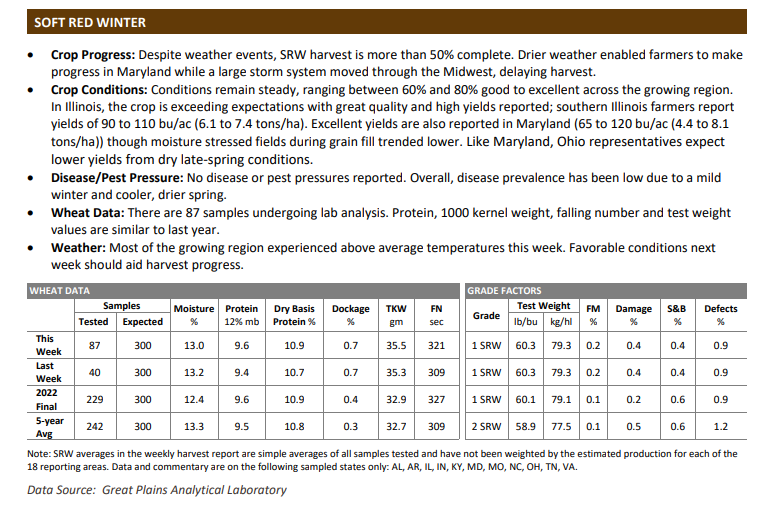
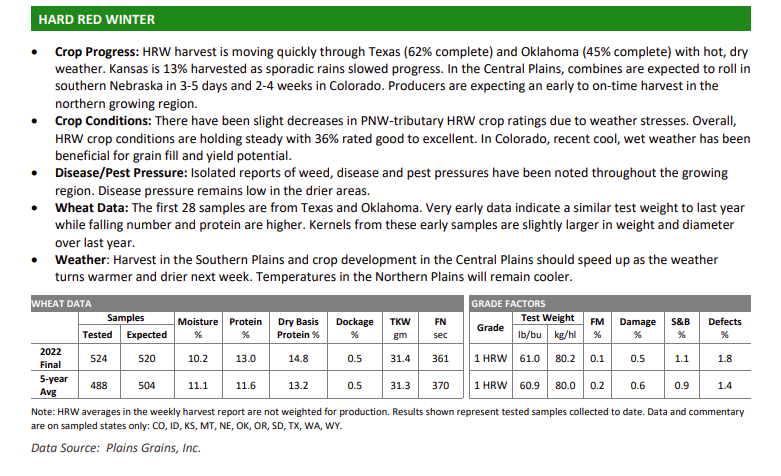
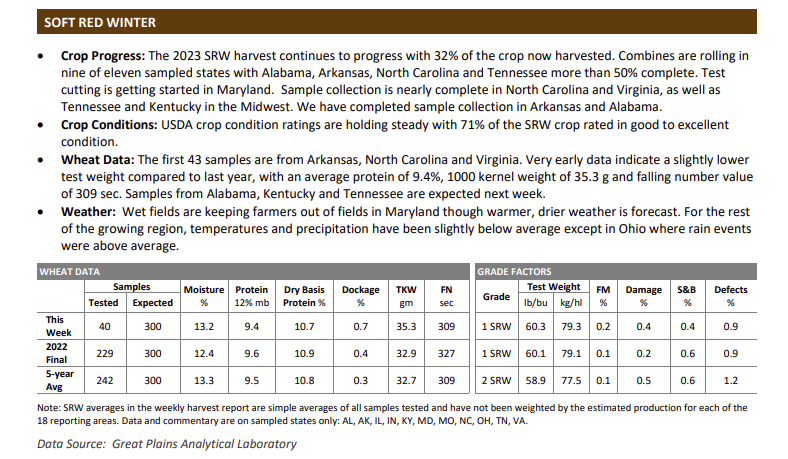
The HRW harvest is expected to accelerate as temperatures trend hot. SRW harvest continues to move forward with data from 87 samples available this week. Much needed precipitation fell across the HRS and northern durum growing region. In the Pacific Northwest, cooler temperatures are needed to stabilize the SW crop.
This Week's #WheatHarvest23 Round-Up Follow #WheatHarvest23 on social media for daily coverage throughout the U.S. wheat harvest season.
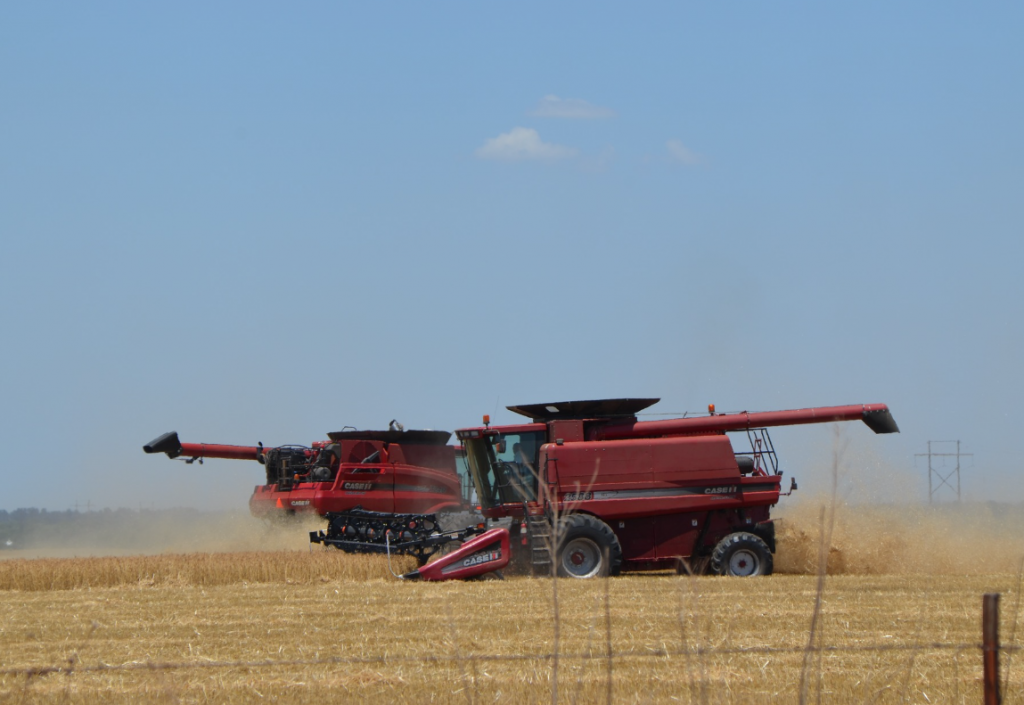
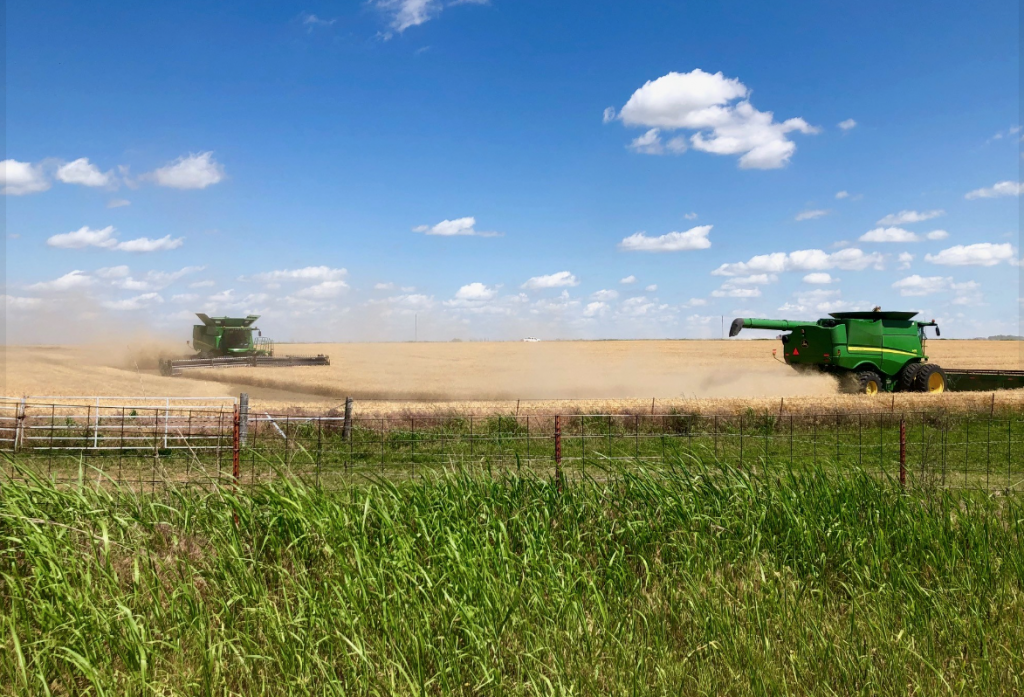
Winter Wheat Harvest in 'Full Swing.' This scene from the 2023 wheat harvest in southwest Kansas is courtesy of Alex Millershaski, who shared it on June 29. Weather continues to be a factor as harvest continues across the state. According to updates from Kansas Wheat, "early quality data from south central and central Kansas are showing good quality, with 60 pound test weights and above average proteins." .
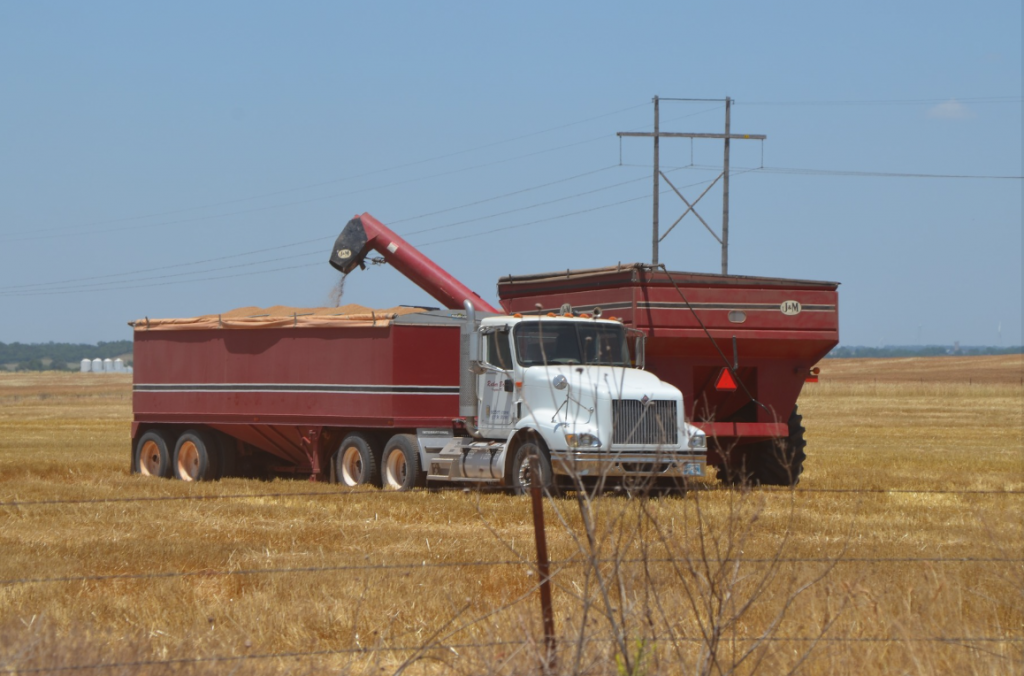
'Nearly' Nearing Completion in Oklahoma. This scene courtesy of the Peters Family Farm in Okarche, OK., shows the rush to "get thing done." According to the Oklahoma Wheat Commission's June 28 report, harvest was just under 70 % complete on that date.
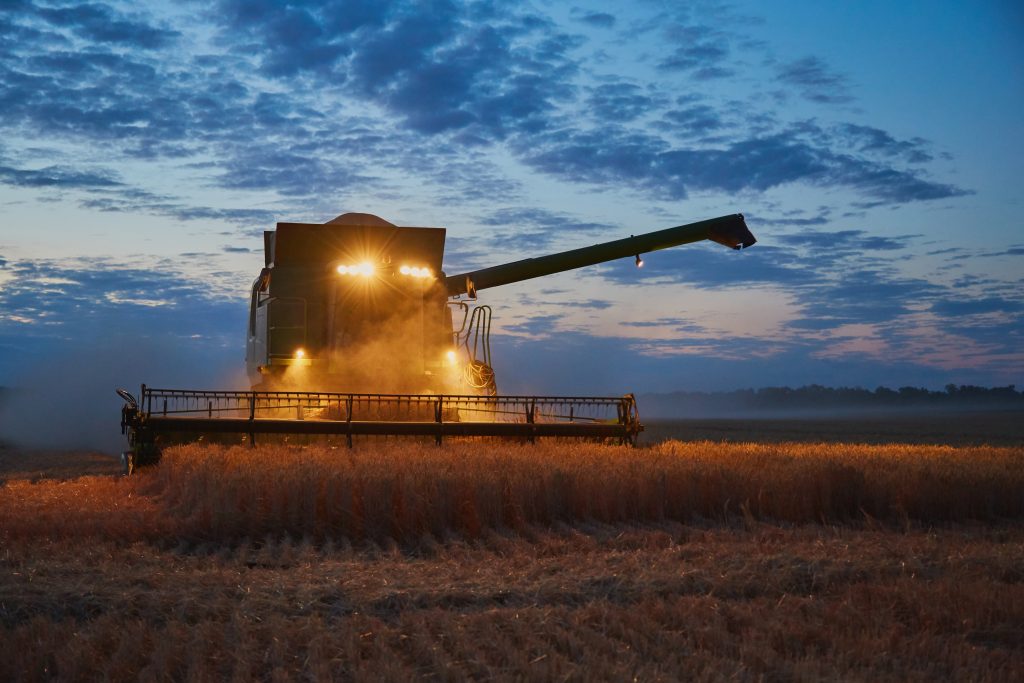
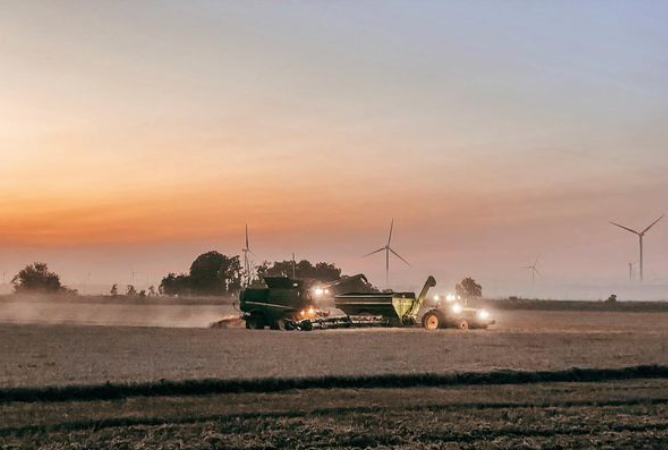
Evening harvest. This harvest scene captured in Oklahoma. According to the Oklahoma Wheat Commission, harvest continues to make progress in Central and Northern Oklahoma despite rains. Most of the harvest is complete in Northeast Oklahoma and is just starting on limited acres in the Panhandle region.
The 2023 'Harvest Sky' in Texas. Storms and rain have been a constant theme of this year's harvest.On June 28, Texas Wheat reported that harvest in that state was nearing 75% complete. Combining in the Panhandle portion is progressing quickly under hot, dry conditions.
A HRW start in Oregon. This from-the-combine-cab scene is from Erin Heideman, as the hard red winter wheat harvest began in that state.
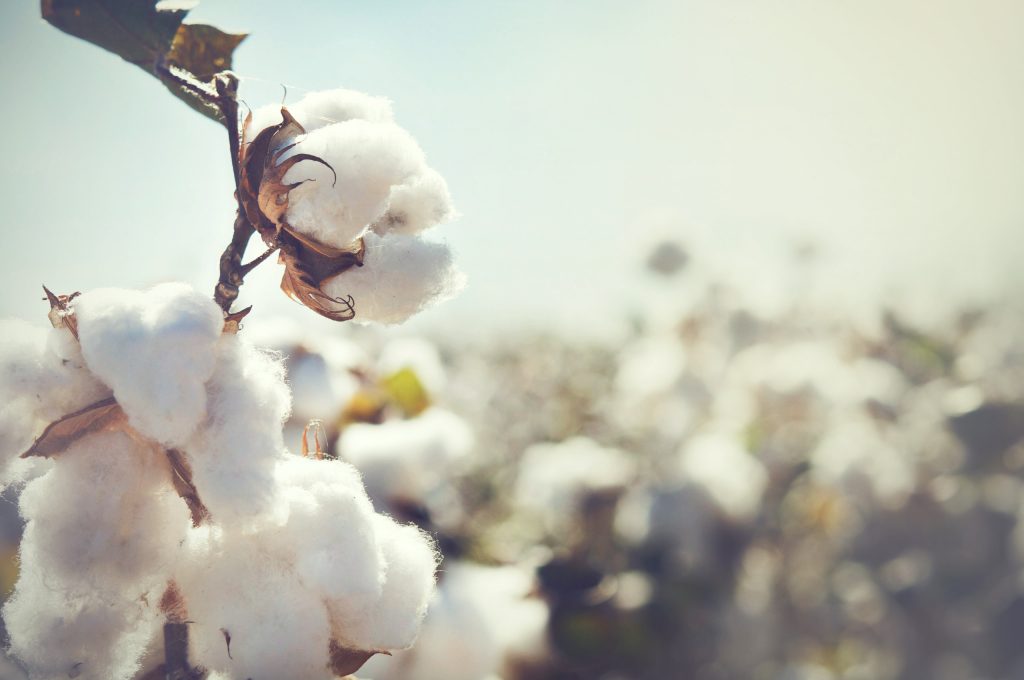
Cotton Incorporated needs your help. By taking the Natural Resource Survey, you'll help guide future research priorities and help document U.S. cotton production improvements. Only aggregated data from this survey will be used, and no individual grower data will be shared. This reoccurring survey helps to shape research direction and to complete cotton life cycle assessments. A similar version of this survey was previously administered in 2008 and 2014. Having a representative dataset of U.S. cotton production is critical to help tell our sustainability story and document continuous improvement in the industry. The survey should take 25 to 35 minutes to complete, and if you respond before July 31st, Cotton Incorporated will send you a cotton branded 30oz YETI Rambler cup.
On Friday, June 30, 2023, the National Association of Conservation Districts (NACD) announced the 2023 Urban and Community Conservation (UAC) grant initiative recipients. The grants are open to any conservation district or tribe within the US and its territories.
Twenty-nine conservation districts and tribes representing all seven of NACD's regions were awarded $1,295,735 in funding.
Examples of this year's projects include developing agricultural programs for special-needs children and young adults, establishing community food banks, an education program for small-acreage and subdivision residents, an outreach and education program that provides translation services to non-English speaking farmers and outreach support to veterans, as well as school and community garden projects.
Since 2016, NACD has led the efforts of this successful grant program in collaboration with the U.S. Department of Agriculture's (USDA) Natural Resources Conservation Service (NRCS) to help conservation districts build technical capacity within nontraditional agricultural systems.
Through the partnership, NACD has awarded over $7.75 million to 140 conservation districts and tribes in 39 states and Puerto Rico. As part of an ongoing effort to build capacity in the community-oriented agricultural space, NACD started offering UAC planning grants, for up to $10,000, in 2022.
"The Urban and Community Conservation grants are an integral part of our efforts to get conservation on the ground, and reach historically underserved communities," said Kim LaFleur, NACD President. "These projects enable grant recipients and their partners to address multiple resource concerns and important issues like local food access and security."
Group of Angus breeders make $15,000 gifts, challenging fellow members to give $150 to the "A Legacy Built" campaign.
A group of dedicated Angus breeders each pledged $15,000 to establish the "George Grant Challenge" in support of the Angus Foundation's "A Legacy Built" campaign. With 2023 marking 150 years since the arrival of the breed in the United States, the sustaining fund celebrates this milestone by asking donors to pledge $150 annually to continue the Angus legacy for the next 150 years. The Foundation set a goal of reaching 1,000 donations to "A Legacy Built" by December 31, 2023. The "George Grant Challenge" will double the impact of this goal by matching dollar-for-dollar the first 1,000 donations of $150 in 2023. Contributions to the campaign benefit the Angus Fund, which provides unrestricted dollars to support the Foundation's mission of education, youth and research.
Scottish Angus breeder George Grant brought the first Angus bulls to the prairies of Victoria, Kansas, with the dream to build a legacy — a legacy that went on to make a lasting impression on the beef industry. When crossed with Texas Longhorn cows native to the plains, Angus bulls sired high-quality calves which were well-suited to the region. These results demonstrated the Angus breed's initial value in the United States. Grant's legacy of Angus impact continues today through the positive effects of programs funded and conducted by the Angus Foundation. The "George Grant Challengers" pledged their gifts in honor of the person who introduced them to the Angus breed, served as a mentor or influenced their success. Like Grant, those who serve as leaders and encouragers for the next generation are influential in continuing the 150-year Angus legacy.
"It's with great pride that we recognize this group of dedicated Angus supporters," said Jaclyn Boester, Angus Foundation executive director. "Their leadership and commitment to match the first 1,000 gifts to "A Legacy Built" validates the need to focus on the future by building a long-term fund to sustain the Angus legacy. The challengers are a perfect testament to the Angus family's dedication to our breed."
George Grant Challengers: 44 Farms, Cameron, Texas – Bob & Dana McClaren
Belle Point Ranch, Fort Smith, Ark. – Mary Ann McMahon, Susan Taylor, Julie French
Connealy Angus, Whitman, Neb. – Jerry & Sharon Connealy
Daltons on the Sycamore, Altavista, Va. – Doug & Beverly Dalton
Pollard Farms, LLC, Enid, Okla. – Barry & Roxanne Pollard
Sydenstricker Genetics, Mexico, Mo. – Eddie & Connie Sydenstricker
"A Legacy Built" is intended to be a long-term, sustaining fund which seeks an affordable and impactful commitment of $150 annually or $12.50 monthly. Donors may also make a one-time contribution of $150 in 2023 to help meet the match provided by the Challengers and achieve the Foundation's goal of 1,000 donors by December 31.
"We're optimistic about the ways this campaign will impact the future of the breed," Boester said. "These generous gifts, both from our George Grant Challengers and our campaign supporters, ensure we sustain the Angus legacy our breeders have built."
To participate in the Legacy Built campaign, donations can be made online at bit.ly/ALegacyBuilt, mailed via check or even pledged at Angus events like the National Junior Angus Show or Angus Convention. For more details, contact Jaclyn Boester at JBoester@Angus.org.
Congressman Josh Brecheen introduced the Patriotism Not Pride Act, which would prohibit federal agencies from using taxpayer resources to promote Pride Month or any similar event. The bill also prohibits the display of flags representing gender identity or sexual orientation by agencies on federal property.
"Americans want to see the Stars and Stripes flown at our federal buildings, which thousands of Americans have died fighting to protect, not flags promoting sexual preference," said Congressman Josh Brecheen. "Our federal government should be promoting patriotism and love for our country, instead of advancing a far-Left social agenda."
"The American flag is symbolic of the freedoms and values of the United States of America on the world stage. Conversely, the LGBTQ flag promotes a sexual agenda and clearly lacks the dignity to be placed under an American flag. It is obvious that government buildings flying the flag that is connected to a sexual identity is offensive to the majority of Americans," said Congressman Glenn Grothman (R-WI), an original co-sponsor of the bill.
Original co-sponsors: Representatives Matt Rosendale, Marjorie Taylor Greene, Glenn Grothman, Andy Ogles, Barry Moore, Tim Burchett, Lauren Boebert, Anna Paulina Luna, Mary Miller, Eric Burlison, Alex Mooney, Gary Palmer, Bob Good, Michael Cloud, Nathaniel Moran, Ralph Norman, and Andy Biggs.
Last week, the Environmental Protection Agency released its final Renewable Volume Obligations for 2023, 2024, and 2025, which sets annual biofuel blending targets under the Renewable Fuel Standard. Soy growers are disappointed with the rule, as it does not accurately reflect the growth expected in the industry and falls far below the industry's current production.
For the first year of the rule, EPA did not make any increases to the biomass-based diesel category over the totals reflected in the draft rule released in December, despite ASA and others in the BBD industry sharing data demonstrating that the sector saw significant growth. For the years 2024 and 2025, EPA made only modest increases in the BBD and non-cellulosic advanced biofuels categories. EPA acknowledged that some of this growth resulted from updated feedstock availability projections based on data ASA shared.
"This announcement is a letdown for soy growers. It threatens the success of the biomass-based diesel industry by significantly dialing back annual increases in volume obligations and failing to account for the progress being made in biofuels investment and growth," said ASA Daryl Cates (IL) in a media release from the organization.
BBD is a vital domestic market for soybean farmers. The RFS has reduced U.S. dependence on foreign oil, reduced greenhouse gas emissions, and added value by increasing demand for soybeans and corn. Billions of dollars are being invested in biodiesel, renewable diesel, soybean crushing plants and other infrastructure to be able to produce more BBD.
EPA' modest blending requirements for trucking fuel could now upend projects that were expected to more than double production capacity of renewable diesel. ASA shared with the Wall Street Journal that, prior to EPA's December 2022 RVO proposal, plans were made for 21 new or expanded soybean crush facilities that would increase the country's crushing capacity by more than 30%, far above EPA's projected three-year RVO growth. The EPA final rule has put some of those facilities on hold.
Soy farmers were encouraged by EPA's 2022 volume target—which included the highest-ever number for total renewable fuels and specifically for biomass-based diesel since the renewable fuel standard was created—and were hopeful EPA would continue its support of the RFS. However, EPA's final rule will limit growth in soy-based biofuels over the next three years and leaves farmers and biofuels industry partners with concerns. Read ASA's release here.
John Linder, an Ohio corn grower and former president of the National Corn Growers Association, was elected today to serve as president of MAIZALL, an international farmer's organization that focuses on eliminating regulatory obstacles to innovation in agriculture. The group contains members from the U.S., Brazil and Argentina.
His one-year term begins on Monday, July 3. NCGA's leadership expressed enthusiasm over the news.
"John is a dedicated leader, and he will no doubt do an outstanding job leading MAIZALL," said NCGA President Tom Haag. "We are very proud to see a fellow corn grower take the lead at a group that does so much to advance the agenda of farmers in the international arena."
MAIZALL engages private sector stakeholders, national government officials and leaders from international organizations, such as the World Trade Organization and the Food and Agriculture Organization, to work towards alignment on regulatory barriers to trade.
Linder, who served as president of NCGA in 2020-21, said he looks forward to serving as president of the group.
"Trade is vital to American farmers," Linder said. "That's why as MAIZALL president I will work to encourage foreign governments and international organizations to embrace science-based regulatory decision-making that allows farmers to use all the innovate tools in their toolbox to feed and fuel the world."
The MAIZALL presidency rotates between countries each year.
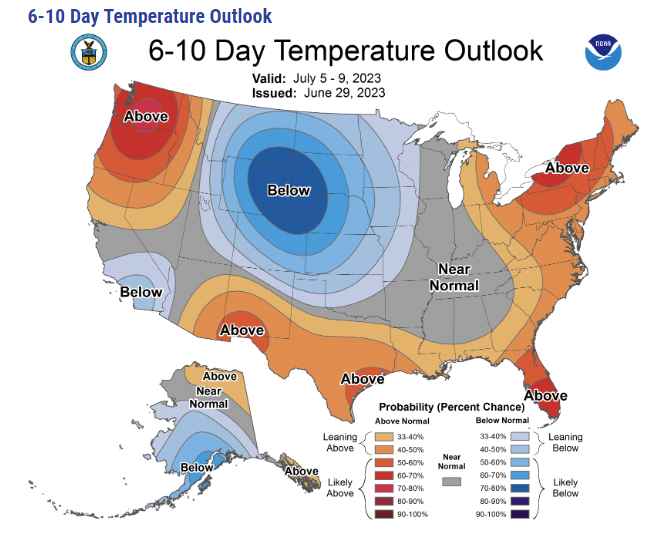
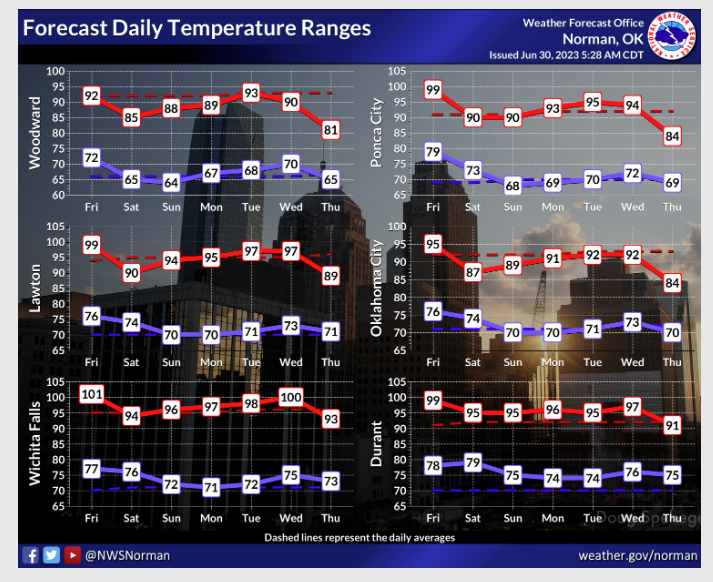
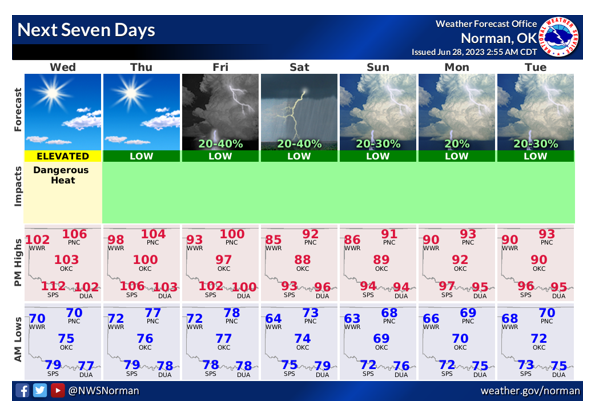
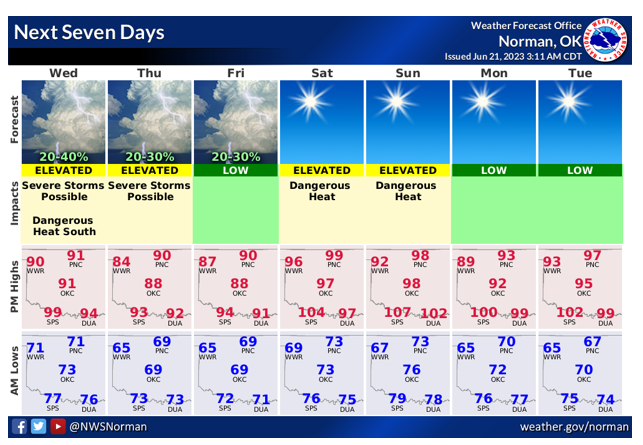
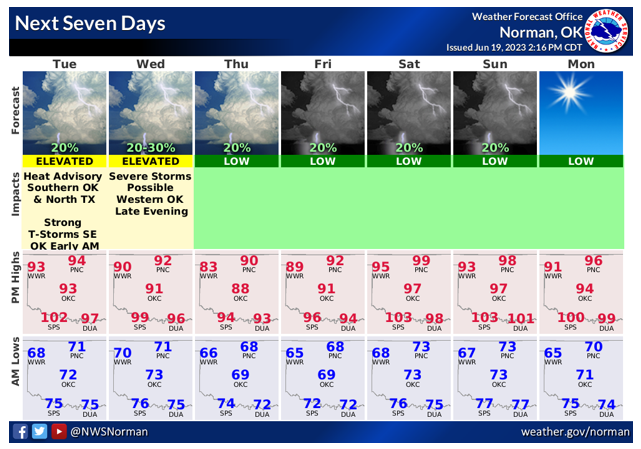
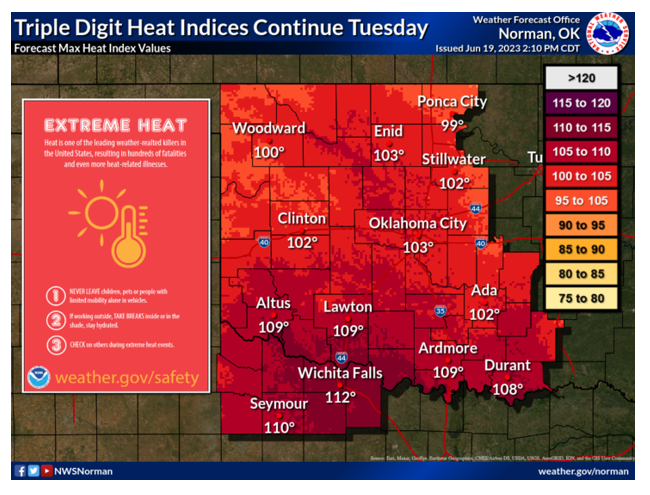
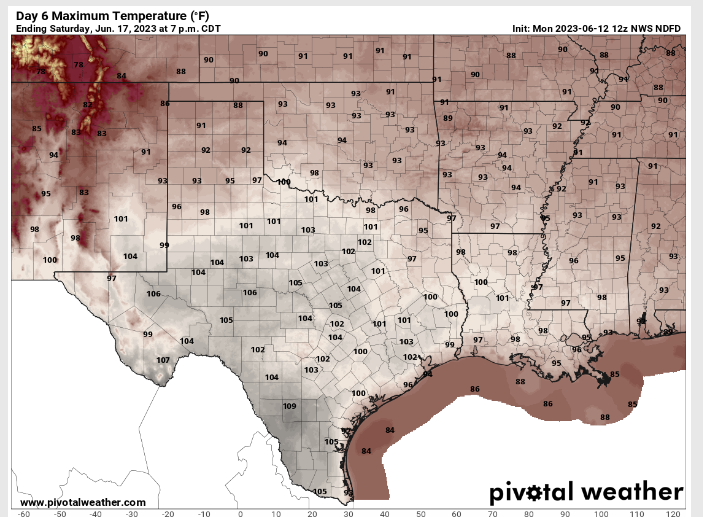
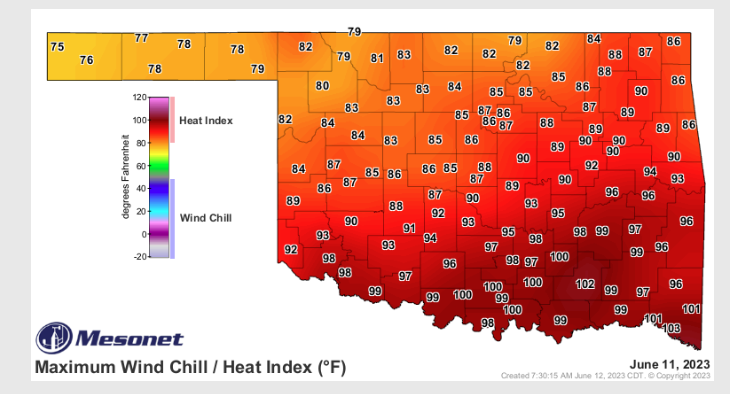
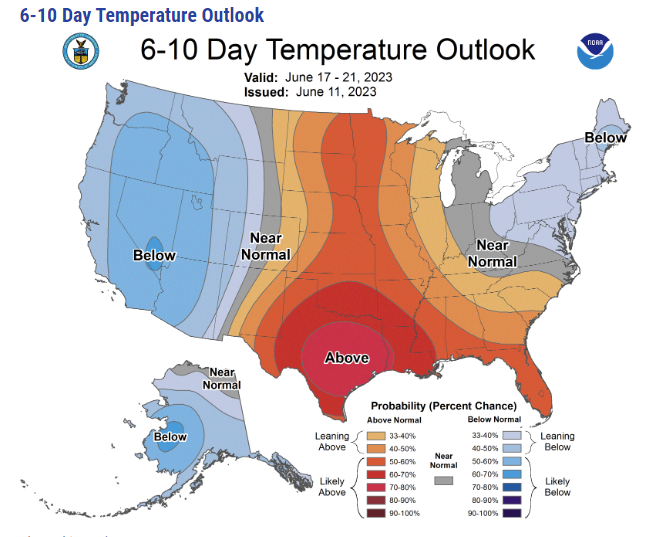
Hot, hot, and more hot. That seems to be the story from Texas these days, and it's becoming the theme in Oklahoma. Actually, it looks like it's becoming the theme throughout the entire South.
According to the National Weather Service, the extensive heat that has been hitting the Lone Star State will expand to multiple states over the next week. Temperatures in Oklahoma are expected to reach as high as 103 degrees before the end of the month. And while that pales in comparison to the 119 degrees reached earlier this month in Big Bend Park it is plenty hot with heat advisories and warnings being posted for Oklahoma, Arkansas, Louisiana, Alabama, Mississippi, New Mexico, and Arizona.
Yuck.
The term "heat dome" is starting to join "flash drought" in the popular imagination.
We know extreme weather is always right around the corner in the Southern Plains. We live in tornado alley. Our history is riddled with droughts, floods, blizzards, wildfires, and thunderstorms. What is becoming obvious, however is that what we always thought of as "extreme" weather is becoming more and more the norm. We really need to take steps to better prepare ourselves for the curve balls mother nature is throwing at us.
Listen to KC Sheperd talk with Bob Rodenberger about the latest in the cattle markets.
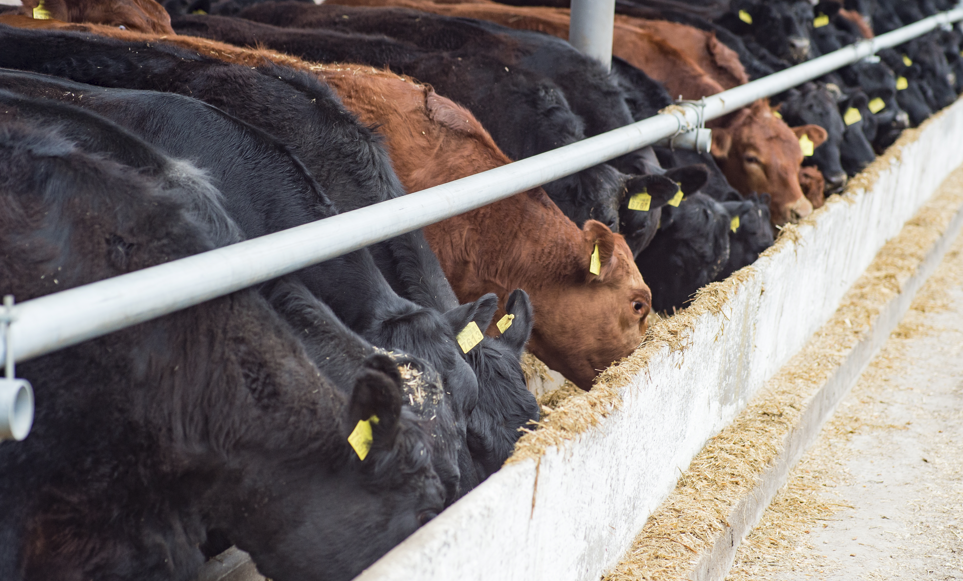
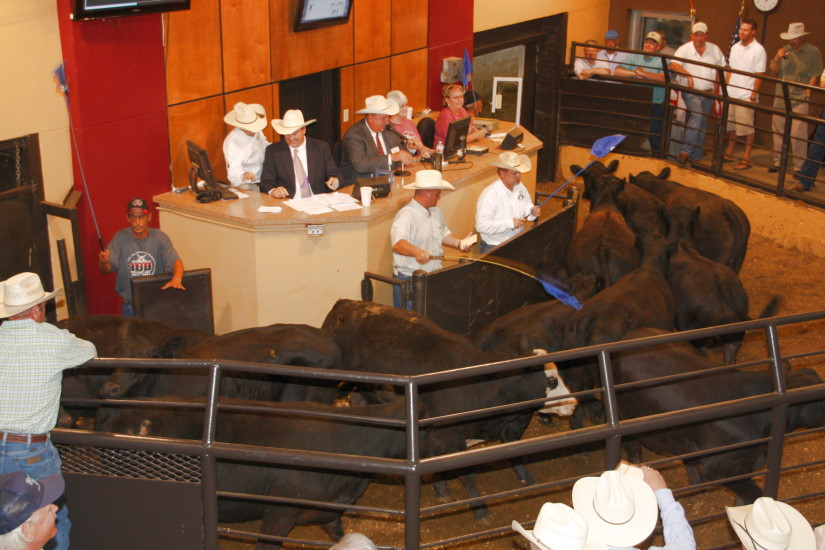
KC Sheperd, Farm Director, is back talking with Bob Rodenberger, a partner with Stockman Oklahoma Livestock Marketing, as he gives the latest on the cattle markets.
The feeder cattle market has continued to move higher, Rodenberger said, although the new crop calf market is starting to see some resistance. Heat and health issues have contributed to a lower calf market, Rodenberger said, but the market isn't super low by any means.
"The fat market is kind of at a stalemate," Rodenberger said. "The packers have got some bought up, and everybody is still wanting the old prices. In general, the market is in good shape."
It is going to be important to keep moving beef products, Rodenberger said, as higher prices might make it difficult for some to afford the beef product.
Following the 4th of July holiday week, Rodenberger said expects to see some bigger runs for those who weren't able to sell the week prior.
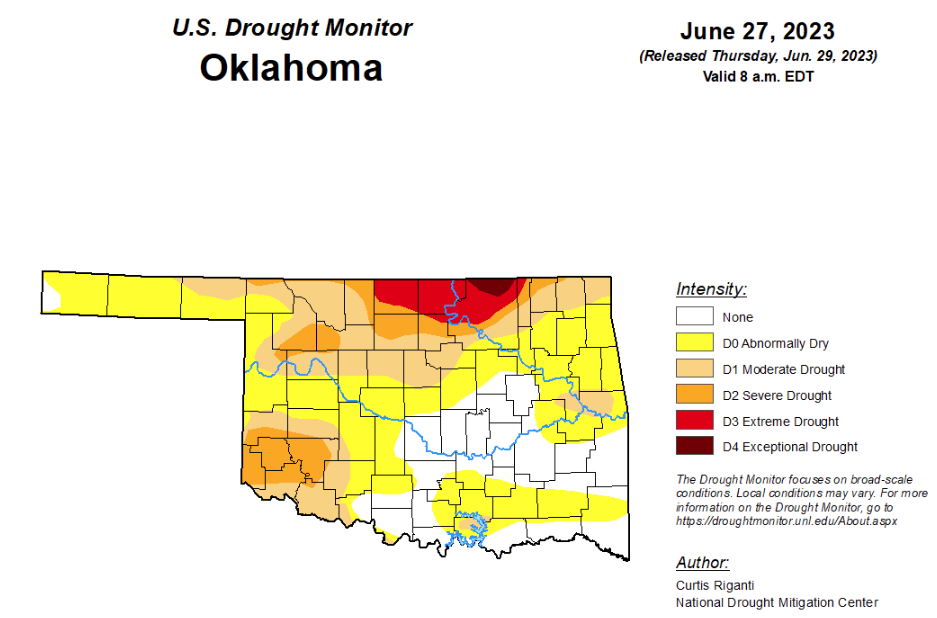
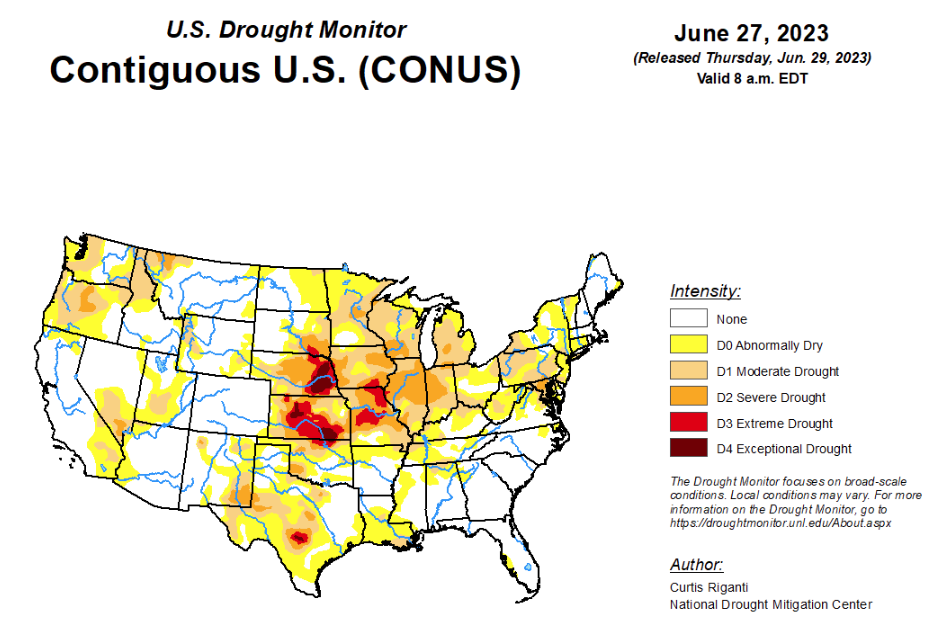
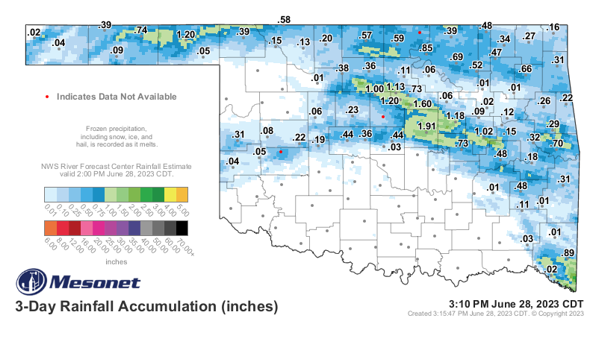
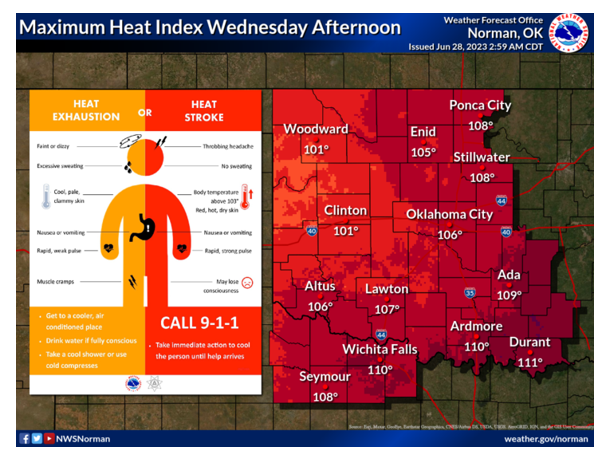
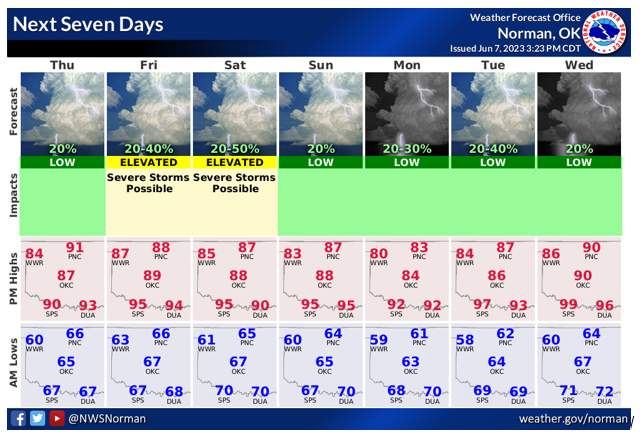
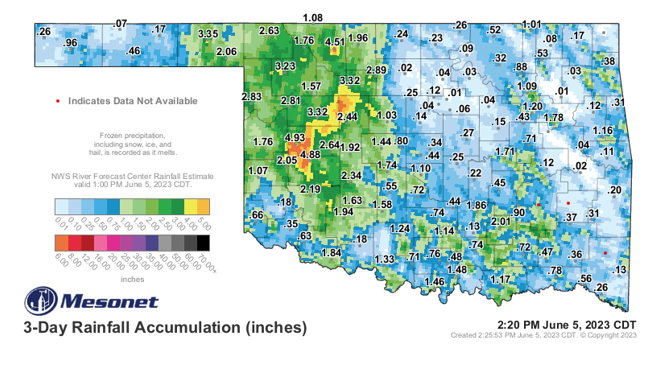
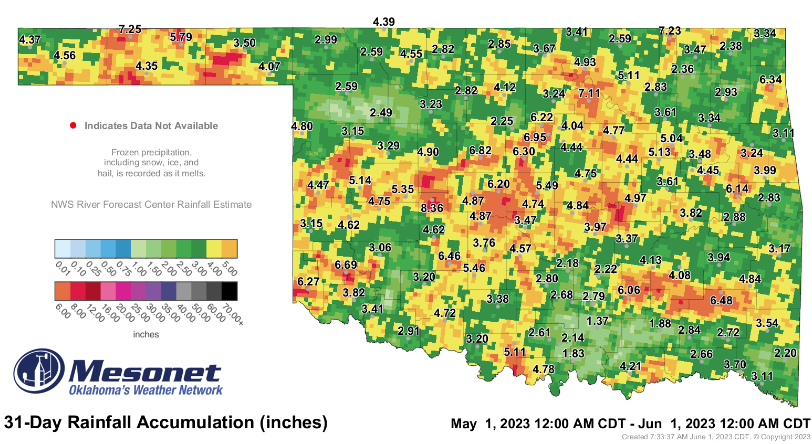
It's been HOT in Oklahoma the past week, but according to State Climatologist Gary McManus, cooler temperatures are on the way, "Watch for upper-90s to possibly a few triple-digits across the state, with heat index values up in the 110 range in far eastern OK. Then tomorrow, the rain and clouds move in, and we go back to the 80s for highs."
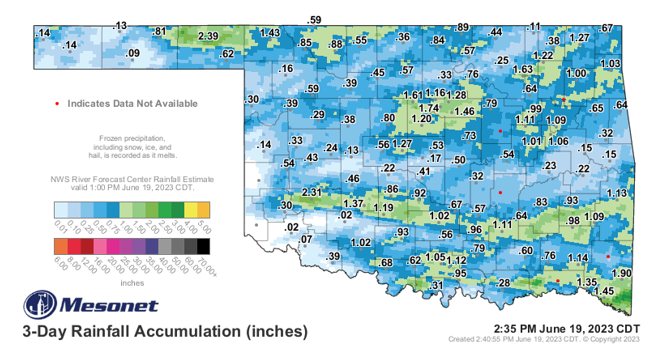
McManus says we will enter into a mild, rainy pattern with summer storms for the next 7+ days, which will be a nice break from the extreme heat.
McManus says the rainy period could also continue well into the following week, which means we will continue to see milder weather conditions.
House Agriculture Committee Ranking Member David Scott today released the below statement after U.S. Department of Agriculture (USDA) Secretary Tom Vilsack announced that USDA is making investments to increase independent meat and poultry processing capacity, expand market opportunities for farmers, and support a growing workforce in rural areas.
"Supporting our small meat and poultry producers and processors is key to increasing market competition, lowering costs for consumers, and improving resiliency in our domestic supply chain. I applaud the Biden-Harris Administration for these investments, which will expand opportunities for our farmers and bring jobs to rural America. I'm proud to have supported these funds, along with Agriculture Committee Democrats, by helping to pass the American Rescue Plan Act of 2021."
Across the country, the core constitutional objective for state governments during their legislative sessions is passing a state budget. The same is true for Oklahoma.
As the State Treasurer, I serve on the Board of Equalization (BOE), which is comprised of six statewide elected officials and one appointed official. The BOE provides an estimate of all revenue that's available to be appropriated for the upcoming fiscal year.
Using this estimate, the Governor presents an executive budget proposal during his State of the State address, House and Senate leaders hold committee hearings to consider additional spending requests, and then negotiations ensue.
The Oklahoma Constitution and statutes require the approval of a balanced budget for the next fiscal year. In order to provide some breathing room, appropriations are limited to no more than 95% of certified revenue estimates.
The wisdom of our forefathers is clear. Compared to many states, Oklahoma has stringent budgeting standards. These conservative principles are designed to prevent deficits and the accumulation of massive and unmanageable debts.
Reaching a consensus is never easy. The Governor and members of the House and Senate will usually have different ideas on how best to allocate the funds to move the state forward.
As a former State Representative, I fought for my constituents and communities and expected my colleagues to do the same. When our priorities were not aligned, we had to find a way to work together and iron out the differences. The back and forth of this year's budget negotiations show this tradition continues.
Since representatives of our government are free to express their differences of opinions, the final outcome is usually more reflective of the entire state's needs and goals. The approved budget makes record investments in education, reduces the tax burden on small businesses, and saves money for future rainy days and needed infrastructure investments.
No budget is perfect. Each elected official would craft something different if working alone. However, this is not how the system works, nor should it be.
The hard-won agreements of last session were accomplished within the parameters of our balanced budget requirements and will lay the foundation for a more secure future.
Tech Hub LIVE, the premier event for advancing tech-enabled agriculture, is thrilled to announce Dr. Alyssa Whitcraft as the keynote presenter for this year's event taking place July 24-26th in Des Moines, Iowa. Alyssa brings a wealth of knowledge about and expertise in the intersection of technology and agriculture, making her an ideal choice to address the audience of ag retailers, distributors, consultants, manufacturers, and other stakeholders in the ag supply chain, all committed to leveraging the latest tech innovations for practical business advantages on the farm.
Alyssa is a renowned figure in the field of agricultural technology. She has dedicated her career to harnessing the power of cutting-edge technologies to address the challenges faced by the agricultural industry and her work continues to be a driving force behind advancements in the industry. She is the Executive Director of NASA Acres and the immediate-past Deputy Director of NASA Harvest, respectively the U.S.-focused and global NASA consortia on food security and agriculture. NASA Acres, which officially launched in April 2023, is NASA's latest investment in agriculture. It builds on the successes of the NASA Harvest global consortium to advance solutions for agriculture in the U.S.
Alyssa also serves as the Executive Director of the Harvest Sustainable and Regenerative Agriculture Initiative, a non-profit forum that uses satellite data and other tools to build a robust evidence base for different agricultural management practices that balance environmental, economic, and social demands on agriculture. Additionally, Alyssa is the Programme Scientist for the G20 Global Agriculture Monitoring (GEOGLAM) Programme, where she works with the world's space agencies to justify and develop new satellite missions and data products for global agriculture monitoring.
Tech Hub LIVE, now in its third year, provides a platform for sharing knowledge, fostering collaboration, and showcasing the latest advancements in ag tech. With a focus on digital farming, robotics, precision agriculture, and data analytics, Tech Hub LIVE attracts a diverse audience of ag retailers eager to explore emerging technologies and gain a competitive edge.
Alyssa Whitcraft's keynote presentation is highly anticipated, as she will shed light on the transformative potential of space technologies and data-driven insights in agriculture. Her talk, titled "From Space to Soil: How NASA Data and Tools are Supporting a Revolution in Ag Tech," will delve into the groundbreaking research and applications that NASA Acres is spearheading to tackle the unique challenges faced by farmers and ag retailers today.
Attendees can expect to gain valuable insights into the latest trends, innovations, and best practices in the agricultural technology landscape. Alyssa's keynote address will provide a visionary perspective on how advancements in satellite imagery, data analytics, and remote sensing can revolutionize the way ag retailers operate, optimize resource utilization, and enhance sustainability practices.
Tech Hub LIVE Conference and Expo will take place on July 24-26th at the Iowa Events Center in Des Moines. With a diverse lineup of speakers, engaging panel discussions, and a bustling expo floor showcasing cutting-edge technologies, the event promises to be an unparalleled opportunity for networking, knowledge sharing, and business growth. Click here to view who's already registered and planning to attend.
Don't miss the chance to hear Dr. Alyssa Whitcraft share her invaluable insights and vision for the future of agricultural technology at Tech Hub LIVE. Register today (www.TechHubLIVE.com/register) and secure your spot at the must-attend ag tech event of the year.
About Tech Hub LIVE
Tech Hub LIVE Conference and Expo, powered by the CropLife Media Group™, the nation's leading voice for the ag retail industry, in collaboration with the Global AgTech Initiative and AgriBusiness Global brands, is the must-attend event for those developing and deploying the latest ag technologies to advance agribusiness. Tech Hub LIVE offers an innovative, forward-looking experience with an expansive range of features encompassing all segments of data-driven agriculture and attracts the largest gathering of ag retailers, distributors, consultants, manufacturers, and other stakeholders in the ag supply chain, all committed to leveraging the latest tech innovations for practical business advantages on the farm.
About Alyssa Whitcraft
Dr. Alyssa Whitcraft is a Geographer with extensive expertise in remote sensing, agriculture, and interdisciplinary development studies. Her work encompasses a wide range of activities including managing large-scale multinational projects to leading applied research on remote sensing of agriculture and the integration of Earth Observations into decision support systems. As the founding Executive Director of NASA Acres and the co-founding Deputy Director of NASA Harvest, respectively the U.S.-focused and global NASA Applied Sciences programs on food security and agriculture, Alyssa has made significant contributions to both national and global initiatives. Dr. Whitcraft is recognized for her tremendous impact and leadership with the G20 Global Agriculture Monitoring (GEOGLAM) Programme and Harvest Sustainable and Regenerative Agriculture Initiative (SARA). Growing up working in her family winery, Alyssa understands the challenges of farm and supply chain resilience in the face of climate change, extreme weather events, and land (mis)management on a personal level.
House Agriculture Committee Ranking Member David Scott today released the below statement after U.S. Department of Agriculture (USDA) Secretary Tom Vilsack announced that USDA is making investments to increase independent meat and poultry processing capacity, expand market opportunities for farmers, and support a growing workforce in rural areas.
"Supporting our small meat and poultry producers and processors is key to increasing market competition, lowering costs for consumers, and improving resiliency in our domestic supply chain. I applaud the Biden-Harris Administration for these investments, which will expand opportunities for our farmers and bring jobs to rural America. I'm proud to have supported these funds, along with Agriculture Committee Democrats, by helping to pass the American Rescue Plan Act of 2021."
The Oklahoma State Regents for Higher Education today set tuition and mandatory fee levels for Oklahoma's public colleges and universities. Tuition and mandatory fees for resident undergraduate students in 2023-24 will not increase at 13 institutions across the state system of higher education. For in-state undergraduate students, tuition and mandatory fees will increase an average of 1.5% statewide for the 2023-24 academic year.
"Keeping higher education affordable for the students we serve is a responsibility the State Regents take very seriously," said State Regents' chair Michael C. Turpen. "Oklahomans are impacted by inflation and other economic challenges, and the State Regents work to balance their needs with the operating requirements of our colleges and universities, who must maintain academic quality and student support services to continue building our state's educated workforce."
On average, a full-time Oklahoma undergraduate college student will pay $97.20 more for tuition and mandatory fees in 2023-24.
"Our top priority as a state system is strengthening Oklahoma's workforce while empowering individual Oklahomans to achieve their dreams," said Chancellor Allison D. Garrett. "Our higher education institutions are working to implement the bold goals outlined in Blueprint 2030, our new strategic plan. Oklahoma's public colleges and universities remain among the most affordable in the nation."
Oklahoma State University (Stillwater and Tulsa), Northwestern Oklahoma State University, the University of Science and Arts of Oklahoma, Carl Albert State College, Connors State College, Eastern Oklahoma State College, Murray State College, Oklahoma City Community College, Redlands Community College, Rose State College, Seminole State College, Tulsa Community College, and Western Oklahoma State College will not increase tuition and mandatory fees for resident undergraduate students.
The University of Oklahoma (Norman) will increase in-state tuition and mandatory fees by $283.30 annually for undergraduates.
Tuition and mandatory fee increases at the public regional universities average $173.89 annually for in-state undergraduates.
Oklahoma's public community colleges will increase in-state tuition and mandatory fee rates by an average of $19.50 annually.
State law requires tuition and mandatory fees to remain at levels below the average among comparable institutions. Oklahoma's public colleges and universities continue to keep tuition and mandatory fees well within those limits, at only 76.5% of the cost at peer institutions, despite significant increases in utilities, property insurance costs, and other operating expenses.
The law also requires the State Regents to make a reasonable effort to increase financial aid across the state system proportionate to any increase in tuition. Including new scholarship programs, tuition waivers and scholarships provided by state system institutions will increase 37.1% from FY 2023.In addition, the State Regents administer Oklahoma's Promise, a state scholarship program that allows high school students from middle- and low-income families to earn a college tuition scholarship. An estimated 15,000 students will earn the Oklahoma's Promise scholarship in 2023-24. Learn more at www.okpromise.org.
Listen to OSU's Kim Anderson talk about the grain markets.
This Week on SUNUP is Oklahoma State University Extension grain market economist Kim Anderson. During this week's edition, Anderson talks about the latest in the grain markets.
"I don't think the wheat market knows where it wants to go," Anderson said. "It is just going up and it is just going down."
Looking back into early May, Anderson said harvest delivery for wheat was at $6.95, then it moved up to $8.54. In June, Anderson said prices have been between $7.35 and $8.15, averaging at $7.71.
"You have got world production this year projected to be 29.4 billion bushels," Anderson said. "That is a new record. That is better than last year's record of 29 billion."
World ending stocks are sitting at 9.95 billion, which is up from last year's 9.8 billion, but still below average.
"U.S. total wheat production is at 1.67 billion bushels," Anderson said. "This is the third year in a row that U.S. wheat stocks have been between 1.6 and 1.7 billion. The average is about 1.8, so still below average."
There is adequate wheat around the world, Anderson said, but tight stocks in the U.S.
This Week on SUNUP:
SUNUP meets a sixth-generation farming family in Noble County as they fight to get ahead of the rain to harvest their wheat.
Mike Schulte, Oklahoma Wheat Commission executive director, discusses the overall wheat harvest progress in the state.
Wes Lee, OSU Extension Mesonet agricultural coordinator, shows just how hot the past few days have been. State climatologist Gary McManus discusses the topsoil conditions in the state.
Kim Anderson, OSU Extension grain marketing specialist, updates the latest movements in the crop markets.
Mark Johnson, OSU Extension beef cattle breeding specialist, gives a history lesson on the cattle industry.
Finally, Paul Vining, Oklahoma Quality Beef Network coordinator, explains how much or how little moisture should be in your hay.
Listen to KC Sheperd talk to Dr. Jayson Lusk about his return to OSU as Vice President and Dean of the Division of Agricultural Sciences and Natural Resources.
Farm Director, KC Sheperd, is visiting with new Vice President and Dean of the Division of Agricultural Sciences and Natural Resources at Oklahoma State University, Dr. Jayson Lusk.
Dr. Lusk will replace Dr. Thomas Coon and begin his duties early August of 2023. Up until 2017, Lusk said he served 13 years on faculty at OSU spending most of his time looking at consumer demand and food policy issues and studying meat and livestock markets.
"About the last three or four years I was at Oklahoma State, I started getting a lot more involved in public outreach about food and agriculture and engaging the broader public on issues around agricultural productivity and the importance of agricultural science and technology," Lusk said. "Through some of those conversations, I thought that maybe I could have an opportunity to have a bigger impact if I took on some more administrative roles."
When a department head job opened up at Purdue University, Lusk said he tool the opportunity to be in a leadership role at one of the largest agricultural economics departments in the country.
"So that is where I have been for the last six years, and it has been a great experience to be in that part of the world and to be head of one of the largest and most successful agricultural economics departments in the country," Lusk said.
Lusk said he is looking forward to getting back to OSU and learning what the challenges and needs are from students and faculty. Lusk added he has many goals as he joins the OSU family once again, as he also plans to continue support of projects from Dr. Coon such as the New Frontiers Ag Hall and improving the facilities on campus for students and researchers to better the lives of Oklahoma's farmers and ranchers.
"Really thrilled to come back to Oklahoma," Lusk said. "It feels like home, and I am excited to be there and look forward to engaging with everybody when I get into town."
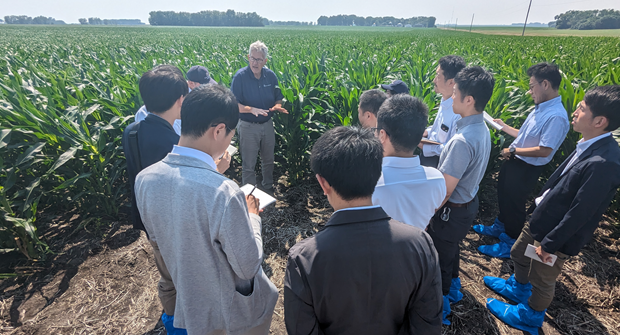
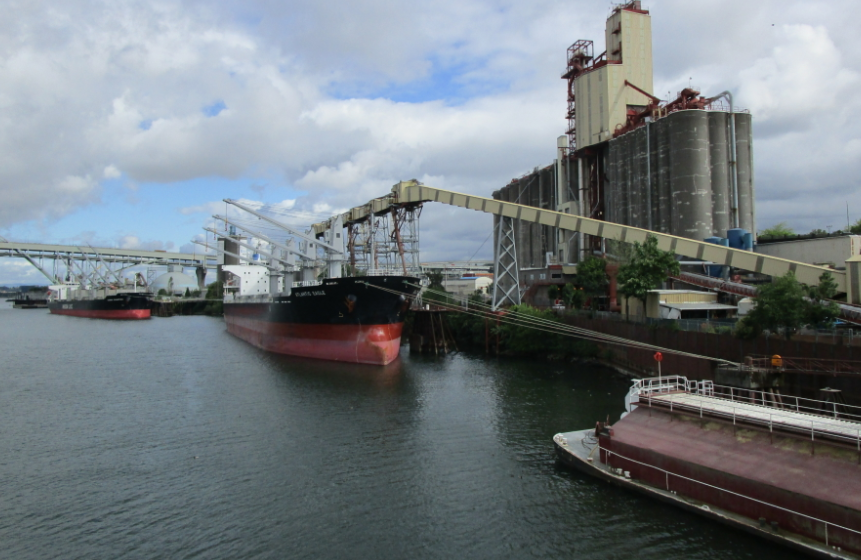
The U.S. Grains Council (USGC) hosted a team from Japan this week to highlight U.S. corn's advantages. While in the United States, the buyers visited the farm of Gary Prescher, vice chair of the Minnesota Corn Research and Promotion Council, while also visiting export facilities and a biotechnology company.
To showcase the quality of the current corn crop, along with U.S. corn production and supply, the U.S. Grains Council (USGC) hosted a team from Japan this week in the states. The group was comprised of relatively newer customers, so the Council used this opportunity to share the basics of corn production and distribution with buyers.
"The participants are feed millers and wet millers responsible for procurement, quality control and processing in their companies. They handle corn everyday but have not visited corn fields and distribution facilities," said Tommy Hamamoto, USGC director in Japan. "This experience is expected to enhance their understanding of U.S. corn and help them purchase U.S. corn with more confidence."
The team started its journey in Washington, D.C., at the Council's headquarters, where participants obtained an overview of grain and corn production, handling and exports. The team also discussed the Council's sustainability efforts, including the Corn Sustainability Assurance Protocol (CSAP), an effort to offer international corn buyers in export markets insights into U.S. corn production sustainability practices.
To witness production in practice, the team then traveled to Minnesota. While there, the buyers met with several Council members, ranging from a growers association to a biotechnology company to export facilities. These tours provided educational background on U.S. corn, highlighting the way U.S. growers and agribusinesses work together to produce and distribute the high-quality commodity.
"Through the combination of visits to farms, elevators and agricultural research facilities, the team understood the integrity and robustness of the U.S. corn industry," Hamamoto said.
The team closed out its trip by traveling to Seattle where the group visited an export elevator that sends corn directly to Japan.
By seeing firsthand the corn production process from ground to sea, the group of new buyers can return to Japan with a better understanding of the dedication the U.S. has to feeding and fueling its partners around the world through the high-quality corn crop grown in the states.
"The Council plans to continue inviting teams consisting of young-generation corn industry officials to the U.S. to keep Japan as a long-term loyal customer of U.S. corn even in the increasingly competitive global corn market," Hamamoto said.
As people exercise each day to promote their health, they tear down and use their muscles, so those muscles can grow back stronger. And research shows the more diverse and strategic such exercises are, the better the outcome in building muscle.
In a similar sense, the prescribed burning of native rangelands rejuvenates the land for it to come back stronger than before. Steven Smith, a Noble Research Institute wildlife and fisheries consultant, says it is an excellent tool to restart nature's clock. When the area grows back, the new growth is not only more nutrient-dense, but it is also more palatable for livestock and wildlife. Burning is also a relatively economical approach to brush management when compared to other options.
Steven Smith, a Noble Research Institute wildlife and fisheries consultant, uses a drip torch to start a prescribed burn at one of Noble's ranches.
A step back in time shows fire was an asset to the land long before prescribed burning became a common management practice. Another history lesson shows not all land is created equal, and different regions require different approaches.
"Very few environments did not have fire occur in some form or fashion," Smith says. "The difference is the frequency of fire."
The weather has a lot to do with how quickly an environment can regrow fuel for the next burn. For example, the Great Plains may have naturally burned every three to five years, whereas Florida fires may have occurred annually, or out West may have been only once a decade.
Today, burning pastures is used as a tool to enhance productivity of the land for both livestock and wildlife. Smith breaks the practice down into two categories — growing-season and dormant-season burns. Dormant-season burns typically occur from December 1 to April 30, while a growing-season or "summer" burn typically falls between June 1 and October 1.
WHY A SUMMER BURN?
Despite a dormant-season fire being more traditional, Smith says there is a case to be made for scheduling fire for the summer months.
"It's safer, and it adds some diversity to your burning program," he explains. "The third reason is, it is a little harder on encroaching brush."
In many areas of Oklahoma, March is a popular time to conduct prescribed burns on ranches. While that timing may have value for some, Smith argues it can be a dangerous time to burn because the weather is so volatile.
As residents of the Great Plains can attest, spring often comes with strong, unpredictable winds that rise up from passing weather systems — a recipe for disaster as far as fire is concerned. This is primarily caused by cold and warm fronts battling for position over the area. Smith says summer weather is more stable and likely to be hot and humid.
Beyond safety, summer burning allows land managers a larger span of time to schedule their burn. Because everything in agriculture hinges on the weather, and fires require multiple people, finding a time to burn can be a challenge. By having a larger window to work with, scheduling timely burns becomes more manageable, too.
For those who subscribe to a summer burn, Smith says they also enjoy a longer high-quality growing season. In a 2019 study done by Noble Research Institute, Smith and others determined July is a sweet spot for summer burns.
"Your forage in August can be pretty low quality," he explains, "It is probably averaging around 6% crude protein because it's already gone through its life cycle, so it's shutting down."
Just like Smith says, though, fire forces a plant to restart. With 17 years of experience under his belt, he has seen plants in August after a July burn contain up to 16% protein and still have respectable forage production. As a bonus, the burn hopefully helped battle brush encroachment.
He does caution that with later burns (late August thru September), forage production begins to decrease significantly. Even though the forage coming back is still of high quality, too much production is lost to come out even. The table below offers real numbers of those differences in the 2019 study, showing that the later the burn, the lower the forage yield was going into dormancy that winter.
Burn Date
Crude Protein (CP)
Total Digestible Nutrients (TDN)
Composite pounds per acre collected Nov. 8
Unburned
6.5
41.1
9,086
June 18
6.6
39.0
5,340
July 3
7.6
40.3
5,135
July 16
7.5
38.8
3,016
July 31
9.4
49.3
1,797
Aug. 15
6.6
39.5
1,489
Aug. 26
9.9
41.9
981
This table shows the results of an unburned control and five plots burned between mid-June and late August 2019 on native rangeland. Composite samples, consisting of grasses and forbs collected in a small sampling square, were taken on Nov. 8 and evaluated for crude protein (CP), total digestible nutrients (TDN) and estimated pounds per acre of forage.
WHAT IS RIGHT FOR YOU?
Just like muscles begin to respond less and less to repetitive exercise over time, using a summer burn every year is not necessarily the ticket either.
"You have to look at the ranch as a whole," Smith says. "You have to look at each pasture and determine if that's the right thing for that pasture."
In addition to timely burns, Smith highly encourages ranchers to implement adaptive grazing. Then, ensure the burn timing matches the grazing management plan. These tools are all synergistic and feed off each other for maximum success, and there are a lot of things to consider.
"Try to mimic what the historical fire frequency was in your area," Smith says, as a good place to start. "That's probably going to range anywhere from three to five years for the Great Plains states."
If management goals include controlling encroaching brush, a rancher may want to burn more frequently for a few years before settling into a normal rhythm. When planning burn timing and frequency for your ranch, Smith suggests doing online research to identify data-driven prescribed burning guides; enlisting help from knowledgeable, experienced neighbors who have done prescribed burns before; and checking in with industry consultants such as state wildlife departments, county Natural Resource Conservation Services offices, not-for-profit conservation groups and private burn contractors.
Just as in the muscle example, doing the same thing year after year will not optimize the plant diversity in native pastures. But implementing strategic burns over the course of many years, including some during the summer growing season, should pay diverse dividends in both forage and soil health.
Today the U.S. Department of Agriculture announced a $188 million investment through President Biden's Investing in America agenda to conserve some of the most economically and ecologically significant forestlands across the nation.
The funding will support 34 projects to conserve more than 245,000 acres of working forests that are critical to rural economies in 22 states and one island territory, as part of the agency's Forest Legacy program. $100 million of this funding comes from President Biden's Inflation Reduction Act, which provides an additional $250 million for similar projects next year, and $88 million comes from the Land and Water Conservation Fund.
"These forests, identified by state, tribal, and non-profit partners as vital to local communities, are critical to the health of our planet and the livelihoods of millions of Americans," said Agriculture Secretary Tom Vilsack. "As private forest landowners continue to face pressures to convert forests, the Forest Legacy program keeps working forests working. Thanks to President Biden's Investing in America agenda, we are ensuring that the most important forested landscapes continue to provide economic and social benefits to the communities that depend on them for their lives and livelihoods."
The Forest Service shared news about the fiscal year 2023 Forest Legacy investments earlier today at an event in Rangeley, Maine where Governor Janet Mills, and partners including The Nature Conservancy and Trust for Public Land, celebrated the completion of the Quill Hill to Perham project -- a nearly 14,000-acre Forest Legacy program project that supports wildlife habitat, recreation and contributes $6 million to the local sustainable timber economy.
America's public and private forests provide critical habitat for wildlife, support outdoor recreation, provide families with food and other resources, protect clean water, and are vital to forest products economies. They play a significant role in the local social and economic fabric, especially for disadvantaged and tribal communities, and support carbon sequestration and climate resilience.
States, with input and in coordination with tribes and non-profits, will use land easements and purchases to conserve the most ecologically and economically important forests that are under threat of being converted to non-forest uses.
The Inflation Reduction Act is part of the Biden-Harris Investing in America agenda to grow the American economy from the middle out and bottom up, by rebuilding our nation's infrastructure, driving over $470 billion in private sector manufacturing investments, creating good-paying jobs, and building a clean energy economy to tackle the climate crisis and make our communities more resilient.
For more on how the Forest Service works with states to conserve forestlands through this program, visit the Forest Legacy program webpage.
USDA touches the lives of all Americans each day in so many positive ways. In the Biden-Harris Administration, USDA is transforming America's food system with a greater focus on more resilient local and regional food production, ensuring access to healthy and nutritious food in all communities, building new markets and streams of income for farmers and producers using climate-smart food and forestry practices, making historic investments in infrastructure and clean-energy capabilities in rural America, and committing to equity across the Department by removing systemic barriers and building a workforce more representative of America. To learn more, visit www.usda.gov.
Senator Mullin just issued the following statement in response to the U.S. Supreme Court's rulings in Students for Fair Admissions Inc. (SFFA) v. President & Fellows of Harvard College and SFFA v. University of North Carolina:
Listen to Ron Hays talk with Michael Kelsey about the upcoming annual OCA Convention and Trade Show.
Senior Farm and Ranch Broadcaster, Ron Hays, is back talking with the executive vice president of the Oklahoma Cattlemen's Association, Michael Kelsey, with more information about the upcoming Annual OCA Convention and Trade Show.
There may be some discussion at the convention, Kelsey said, over how OCA's policy fits into policy at the national level. One example of policy discussions at the national level, he added, is increasing the Beef Checkoff at the federal level using the '96 commodity checkoffs act.
"The '96 act is a general commodity checkoff act," Kelsey said. "It is not specific to any one particular commodity."
While OCA's policy is supportive of the Beef Checkoff and increasing the Checkoff, Kelsey said it is not set on using the '96 act.
"It will be interesting to see where our membership comes into play and comes to rest on that topic as we move into NCBA," Kelsey said.
More policy topics will include the FDA's modification of antibiotic rules, Waters of the U.S., the Endangered Species Act and more. Aside from the jampacked trade show, Kelsey said this convention is also a great opportunity for cattle producers to network and socialize.
"There is no telling how many dollars of commerce is conducted in the hallways of conventions like this where cattle producers get together, and they start talking about their needs, their businesses, and discover that they have an opportunity to conduct business with somebody there, whether it be feedstuffs, obviously cattle, might be services, and all types of things," Kelsey said. "Those networking opportunities afford that."
The closing speaker, Matt Makens of Makens Weather, will talk about the impact El Niño will bring through 2023 and 2024.
"Matt is really easy to follow," Kelsey said. "What he says makes sense. He gives incredibly good foundations and data to support what he says."
To listen to part one of Ron's conversation with Michael Kelsey about the 2023 OCA Convention and Trade Show, CLICK HERE.
The Beef Buzz is a regular feature heard on radio stations around the region on the Radio Oklahoma Ag Network and is a regular audio feature found on this website as well. Click on the LISTEN BAR for today's show and check out our archives for older Beef Buzz shows covering the gamut of the beef cattle industry today.
Senator James Lankford (R-OK) today announced his plans to introduce legislation to address the eight-month delay for a passport due to a passport backlog of more than 3 million by making major improvements to passport processing at the Department of State.
"Oklahomans shouldn't have to face months-long delays because the State Department isn't processing passports quickly enough," said Lankford. "My office regularly hears from families who are forced to miss out on visiting loved ones or cancel vacations they saved for years to take due to the massive backlog. This has been a problem since 2020 that I have pushed the Department of State to resolve. This bill is designed to address the root cause of the breakdown and provide straightforward solutions to fix the current backlog and prevent it from reaching historic levels again."
This legislation builds on Lankford's years-long effort to improve passport processing time. In June 2020, after initially announcing the discovery of a major backlog on May 28, Lankford sent a letter to then-Secretary of State Mike Pompeo to ask why passport applications had not been completed since March 19, 2020—despite continuing to accept paid fees. After Lankford's inquiry, then-Secretary Pompeo made Passport Services "Mission Critical," which helped ease some of the backlog, putting the agency on a path to success.
However, once the Biden Administration took over, processing times began to lag far behind pre-pandemic levels, primarily due to State Department staff not operating at 100 percent capacity and the failure to fully reopen passport offices to the public. Lankford sent a letter demanding action when the problem worsened in 2021, and he sounded the alarm again in 2023.
Lankford's bill would address the current delays by:
Examining the failures of the last four years that caused the current backlog.
Establishing a 12-week processing time requirement and refuse any remote work requests until the timeline can be met.
Requiring procedures to avoid processing backlogs in the case of future national emergencies.
Developing a reserve workforce that can be reassigned to support Passport Services during high demand.
Improving the online status tool to provide more information to applicants.
Adding a chat feature to National Passport Information Center (NPIC) call line.
Initiating investigation into the quality of customer service, wait times, and technology failures of NPIC.
Expanding in-person appointments at regional passport offices.
Last night, the National Cattlemen's Beef Association (NCBA) and litigation partners filed a motion in the U.S. District Court for the Southern District of Texas asking the court to strike down the Biden administration's Waters of the U.S. (WOTUS) rule in light of the Supreme Court's decision in Sackett v. EPA.
"In Sackett v. EPA, the Supreme Court unanimously ruled that the EPA had overstepped its authority under the Clean Water Act," said NCBA Chief Counsel Mary-Thomas Hart. "A full rewrite of the Biden Administration's WOTUS definition is the only path to comply with the Sackett decision. NCBA is seeking summary judgement in our lawsuit against the Biden WOTUS rule and urging the Southern District of Texas to strike the rule from the books."
The Sackett case was not directly about agriculture, but the plaintiffs in the case were harmed by the EPA's overregulation on WOTUS. NCBA filed an amicus brief before the Supreme Court siding with the Sackett family in their lawsuit against the Environmental Protection Agency (EPA) and Army Corps of Engineers. Ultimately, points raised in NCBA's brief were incorporated in the justice's final opinion, demonstrating the importance of NCBA joining the fight on this issue.
Separate from the Sackett case, NCBA and a coalition of litigation partners also filed their own lawsuit against the Biden administration's WOTUS rule to block it from taking effect. NCBA secured injunctions in 27 states to temporarily halt the rule. Now, NCBA is filing a motion for summary judgement to ask the court to rule on vacating the full Biden administration WOTUS rule based on the Supreme Court's ruling in the Sackett case.
"NCBA has been fighting against overreaching WOTUS rules for years and this is just the latest example of how NCBA fights on every front from Congress to the courtroom," said Hart. "We are proud to be the voice of America's cattle producers in Washington."
According to the latest Oklahoma drought monitor, exceptional drought is unchanged from last week at .52 percent.
Extreme drought or worse is also unchanged from last week at 4.79 percent.
Severe drought or worse has improved from last week's 16.59 percent and is now at 14.26 percent.
Moderate drought or worse has improved from last week's 41.91 percent and is now at 36.08 percent.
Abnormally dry or worse conditions have worsened since last week, moving from 73.21 percent to 76.94 percent.
According to the 6-10-day precipitation outlook map, the entire state is leaning above a 40 to 50 percent chance of precipitation through July 8.
To view the United States Drought Map, click here.
According to the latest U.S. drought monitor, widespread changes were made across the country, with many degradations and improvements occurring. In the eastern U.S., mostly widespread improvements occurred following widespread heavy rains, though parts of New Jersey and Long Island that missed out on these rains saw conditions worsen. The Midwest and east-central Great Plains saw mostly worsening conditions and widespread crop stress and low streamflows after another week of mostly dry weather. A mix of improvements and degradations occurred in Texas, where recent precipitation amounts have varied widely. The northern Great Plains received widespread heavy rainfall this week, leading to large-scale improvements to ongoing drought and abnormal dryness. In the Pacific Northwest, a few areas saw above-normal precipitation and improving conditions, but larger parts of the region saw increasing evaporative demand, continued dry weather and lowering streamflows, leading to worsening conditions.
In the Southern Plains, much warmer than normal temperatures covered the western half of the region, especially across southwest Texas, where temperatures were at least 9 degrees above normal in many locations. Farther east, temperatures were near normal or cooler than normal, with readings coming in from 3 to 6 degrees below normal in eastern Tennessee. Recent rains in central Louisiana led to a shifting of a small area of moderate drought as short-term precipitation deficits shifted to the northeast. Short-term moderate drought developed in parts of northeast Arkansas and eastern Oklahoma, where short-term precipitation deficits grew and streamflow decreased. In north-central, central and southeast Texas, soil moisture and streamflow decreased amid growing precipitation deficits, leading to localized worsening in drought conditions or introduction of abnormal dryness. Farther west in Texas, a combination of precipitation this week and a re-evaluation of precipitation from recent weeks led to more improvements in the Texas Panhandle and in adjacent western Oklahoma, as well as improvements in a severe drought area south of Lubbock.
In the High Plains, this week's weather varied substantially across the High Plains region. Much of the Great Plains portion of the region, with the exception of eastern Nebraska and eastern Kansas, saw widespread precipitation, some of it heavy. Much of northwest Nebraska, eastern Wyoming, northeast Colorado, South Dakota and the southern half of North Dakota saw rainfall of at least 2 inches over the last week. In western Nebraska, eastern Wyoming and the Dakotas, this led to widespread improvements to the drought depiction in areas where the heaviest rains fell. Isolated heavy rains in central and western Kansas also led to localized improvements to ongoing drought areas. Meanwhile, conditions continued to worsen in southeast Nebraska, northeast Kansas and the Kansas City area, where mostly dry weather continued. Given continued decreases in soil moisture and groundwater, and growing short- and long-term precipitation deficits, exceptional drought was introduced in parts of the Omaha metropolitan area. North of Lincoln, Nebraska, hay production was reported to be about a third of normal for this time of year. Stress to other vegetation, including trees, also continued in southeast Nebraska this week.
In the West, with the exception of western portions of Washington and Oregon, much of the West region experienced near- or cooler-than-normal temperatures this week. Heavy rains fell in parts of southeast Montana, northwest Wyoming and adjacent portions of central Idaho and southwest Montana. These rains helped to alleviate long-term precipitation deficits and increase streamflows in these areas, leading to a reduction in coverage of ongoing drought and abnormal dryness. Adjacent to improvements in the Texas Panhandle, recent precipitation in northeast New Mexico has also helped to improve conditions there. Continued above-normal precipitation in parts of central and south-central Oregon has helped to alleviate long-term precipitation deficits and increase soil moisture, leading to localized shrinking of drought coverage. In southeastern and western portions of Washington, and in western Oregon, recent dry weather, low streamflows and increasing evaporative demand led to an expansion of drought and abnormal dryness in parts of these areas.
Looking ahead, through the evening of Monday, July 3, the National Weather Service Weather Prediction Center is forecasting widespread rain, locally heavy, to fall from southeast Wyoming and northeast Colorado eastward across Nebraska and northern Kansas, southern Iowa and northern Missouri, and farther east into the Midwest and Ohio River Valley. Rainfall amounts in central Illinois may exceed 3 inches locally. Widespread moderate and locally heavy rainfall amounts are forecast in parts of the Appalachian Mountains as well. Locally heavy rains are forecast in southern Florida during this period as well. West of the Continental Divide, mostly dry weather is expected.
Looking ahead to the period from July 4-8, the National Weather Service Climate Prediction Center forecast favors above-normal precipitation across much of the contiguous U.S., especially from eastern Idaho through Nebraska and northern Kansas. Below-normal precipitation is favored in Arizona and in western Washington and northwest Oregon. Below- or near-normal temperatures are favored in the northwestern Great Plains, while above-normal temperatures are likely in the south-central U.S., south Florida and the eastern Great Lakes, with warmer-than-normal temperatures slightly favored across much of the eastern and southern U.S., excluding southern California and the southern Appalachians. Warmer-than-normal temperatures are also strongly favored in the Pacific Northwest. Wetter-than-normal weather is favored across Alaska, except for the Panhandle, where below-normal rainfall is slightly favored. Warmer-than-normal temperatures are slightly favored in the north slope and Arctic Coast regions of Alaska, and in the far southeastern Alaska Panhandle. Cooler-than-normal conditions are favored across roughly the southwestern half of Alaska.
To view the 6-10 Day Precipitation Outlook Map, click here.
To view the 6-10 Day Temperature Outlook Map, click here.
To view the Monthly Drought Outlook Map, click here.
Our nation is at a turning point. China is expanding its influence, threatening our allies, and exploiting American weakness to achieve its goal of world domination.
To counter this threat, the Biden administration must do all it can to project U.S. strength on the world stage, regain energy independence, and equip American manufacturers with the resources and deregulation they need to support our nation and deter our adversaries. The reason is simple: U.S. strength is key for global stabilization.
Instead, under the current administration, the world has watched while China routinely exploits Joe Biden's weaknesses in global manufacturing, trade, and national security.
While hard-working Oklahomans view China as the predominant global threat and adversary, Joe Biden thinks otherwise. He said so himself.
From manufacturing to critical mineral supply, Joe Biden has increased our dependence on the Chinese Communist Party (CCP) at every turn. China currently dominates the global supply chain, and Joe Biden's tax hikes on American manufacturers have made our nation more dependent on China while stifling our economy.
Recently, Biden vetoed bipartisan legislation that would have protected our economy from Chinese solar companies which are actively circumventing U.S. trade laws. Biden's veto made clear his support for Chinese goods manufactured on the backs of slave labor, and his disinterest in building American independence from China.
Whether it be fear, cowardice, or appeasement that fuels Joe Biden's policy decisions, it's clear his view towards China puts Americans in harm's way. If Biden got his way, our country would be entirely dependent on China to feed, fuel, and power every inch of our nation.
However, the consequences of Biden's appeasement strategy don't stop there. The CCP is also actively exploiting and profiting from Joe Biden's open border disaster.
Record amounts of fentanyl have flowed from China to Mexico and into the United States since Joe Biden took office. Over the past two years, Border Patrol has seized 41,000 pounds of fentanyl – enough to kill the entire U.S. population 28 times over. This deadly drug surge threatens border towns and states across the country, including Oklahoma.
According to the Oklahoma Bureau of Narcotics, there were 47 fentanyl overdose deaths in 2019. In 2022, the number of deaths skyrocketed to 300. Our top priority must be the safety and security of our citizens, and that means securing our border and getting tough on bad actors like China who are weaponizing the border crisis. To remedy Joe Biden's national security, humanitarian, and public health crisis, the Biden administration must close our southern border and enforce immigration laws to reduce the dangers of Chinese fentanyl.
We also know that China is blatantly spying on the U.S. military and attempting to steal our national intelligence without significant consequence. Chinese nationals have purchased farmland near key military bases, including an Air Force Base in Grand Forks, North Dakota, traversed spy balloons across the entire country, and established a spy base and military training facility in Cuba. These acts are blatant threats to U.S. sovereignty, but the CCP knows that under a weak leader like Joe Biden, they have every reason to press ahead without consequence.
In addition to military and national intelligence, U.S. intellectual property (IP) is vulnerable to Chinese hacking. America loses about $360 billion annually because of China's IP theft. Not to mention, Tik Tok gives Communist China a front-row seat to the lives of roughly 150 million Americans. It has to stop.
In the absence of strong leadership from the United States, our enemies are emboldened, and Americans are less safe. When it comes to Chinese aggression, America needs peace through strength, not appeasement.
Senate Republicans stand united in our solutions to get tough on China. We must prioritize U.S. military strength, diversify the supply chain, ban China from purchasing U.S. farmland – especially near secure locations, and close the border to stop the flow of deadly fentanyl.
It's far past time for Joe Biden to get tough on China, work with Congress to bolster our national security, and project strength on the global stage. The world is watching.U.S. Senator Markwayne Mullin (R-OK) is a successful business owner and working cow-calf rancher serving Oklahoma on the Armed Services; Environment and Public Works; Health, Education, Labor, and Pensions; and Indian Affairs Committees. He is an enrolled member of Cherokee Nation and is the first Tribal citizen to serve in the U.S. Senate in nearly two decades.
Investments are Part of President Biden's Investing in America Agenda
U.S. Department of Agriculture (USDA) Secretary Tom Vilsack announced today that USDA is making investments to increase independent meat and poultry processing capacity, expand market opportunities for farmers and support a growing workforce in rural areas. The announcement comes on the heels of President Biden delivering a major address on "Bidenomics" —his vision for growing the economy from the middle out and bottom up by investing in America, increasing competition, and empowering workers.
"While American farmers and ranchers have been responding to the demand to produce more, their communities have struggled to see their share of the benefits," Vilsack said. "Under the leadership of the Biden-Harris Administration, USDA is committed to championing meat and poultry processers, increasing competition and lowering costs for working families. The announcement I'm making today highlights these producers and reflects the goals of President Biden's Investing in America agenda, which advances a sustainable vision of agriculture, prioritizes the needs of our producers and small businesses, promotes competition, strengthens our domestic agricultural supply chains and brings prosperity to people and places in rural parts of our country."
USDA's National Institute of Food and Agriculture is also providing seven awards totaling $4.5 million to community and technical colleges in seven states through the Meat and Poultry Processing–Agricultural Workforce Training (AWT) program. These investments will build a pipeline of well-trained meat processing workers and support safe workplaces with fair wages for workers.
Secretary Vilsack made today's announcement during a roundtable with producers and businesses in Des Moines, Iowa, and highlighted efforts under the Biden-Harris Administration to build more, new and better markets and strengthen farm and food businesses. This visit comes as officials from the Biden-Harris Administration are spending the next two weeks in communities across the country to demonstrate how President Biden's Investing in America agenda is delivering results and creating transformative new economic opportunities for families and businesses.
Some examples of projects in today's announcement include:
In Montana, Mountain West Economic Development will use a $15 million MPILP investment to support meat and poultry processing and slaughterhouse operations in Flathead Valley.
In Michigan, three independent businesses will use a $2 million MPPEP award to help construct and equip a meat and poultry processing and retail facility: Mighty Fine Poultry Processing, LLC will slaughter and process poultry; Retro Meats Company, LLC will process red meat; and Swift Run Market, LLC will also process and sell meat products. Together, these activities are expected to increase demand for animals, increase opportunities for producers, and improve processing operations.
Farmers Union Foundation, a charitable organization that provides resources for rural economic development, will use an $800,000 MPILP award to lend funds to independent small and medium sized meat processors in Minnesota, Montana, North Dakota, South Dakota, and Wisconsin.
Today's announcement will support projects in Colorado, Connecticut, Georgia, Indiana, Iowa, Maryland, Massachusetts, Michigan, Minnesota, Montana, New York, North Dakota, Ohio, South Dakota, Tennessee, Texas and Wisconsin.
Background
President Biden's Investing in America Agenda
President Biden's Investing in America agenda is growing the American economy from the bottom up and middle-out – from rebuilding our nation's infrastructure, to making our economy more diversified and resilient, to driving over $470 billion in private sector manufacturing and clean energy investments in the United States, to creating good paying jobs and building a clean-energy economy that will combat climate change and make our communities more resilient.
Through the American Rescue Plan, the Bipartisan Infrastructure Law, and the Inflation Reduction Act, the Biden-Harris Administration has made once-in-a-generation investments in rural America. These investments have provided USDA with an unprecedented number of resources to invest in rural communities and transform our food system —furthering the Biden-Harris Administration's whole-of-government efforts to promote fair competition, innovation, and resiliency across food and agriculture.
Meat and Poultry Processing Expansion Program (MPPEP)
The Meat and Poultry Processing Expansion Program (MPPEP), made possible by American Rescue Plan Act funding, provides grants to help eligible independent processors expand their capacity. USDA Rural Development designed the MPPEP to encourage competition and sustainable growth in the U.S. meat processing sector, and to help improve supply chain resiliency. To date in fiscal year 2023, USDA has awarded $171 million to 31 MPPEP projects that have created nearly 3,000 jobs in rural communities.
Meat and Poultry Intermediary Lending Program (MPILP)
The Meat and Poultry Intermediary Lending Program (MPILP) provides grant funding to intermediary lenders who finance the start-up, expansion, or operation of independent meat and poultry processing facilities. The objective of the MPILP is to strengthen the financing capacity for independent meat processors, and to create a more resilient, diverse, and secure U.S. food supply chain. To date in fiscal year 2023, USDA has awarded $186 million to 24 MPILP projects that supported economic growth in 14 states and Puerto Rico.
Meat and Poultry Processing–Agricultural Workforce Training (AWT) Program
Leaders across the beef, pork and poultry industries consistently share that an expanded, well-trained workforce is one of their most persistent needs. Safe and resilient meat and poultry supply chains require a skilled, credentialed and diverse workforce. The Meat and Poultry Processing–Agricultural Workforce Training (AWT) program, offered in Fiscal Year 2022 through the Agriculture and Food Research Initiative (AFRI) and made possible by American Rescue Plan Act funding, supports projects that develop, expand and standardize meat and poultry processing training programs at community and technical colleges, providing a well-trained future workforce.
Under the Biden-Harris Administration, USDA Rural Development provides loans, loan guarantees and grants to help expand economic opportunities, create jobs and improve the quality of life for millions of Americans in rural areas. This assistance supports infrastructure improvements; business development; housing; community facilities such as schools, public safety and health care; and high-speed internet access in rural, tribal and high-poverty areas. For more information, visit www.rd.usda.gov.
USDA touches the lives of all Americans each day in so many positive ways. Under the Biden-Harris Administration, USDA is transforming America's food system with a greater focus on more resilient local and regional food production, fairer markets for all producers, ensuring access to safe, healthy and nutritious food in all communities, building new markets and streams of income for farmers and producers using climate-smart food and forestry practices, making historic investments in infrastructure and clean energy capabilities in rural America, and committing to equity across the Department by removing systemic barriers and building a workforce more representative of America. To learn more, visit www.usda.gov.
Agricultural producers in State who have not yet completed their crop acreage reports after planting should make an appointment with their U.S. Department of Agriculture (USDA) Farm Service Agency (FSA) service center before the applicable deadline.
An acreage report documents a crop grown on a farm or ranch and its intended uses. Filing an accurate and timely acreage report for all crops and land uses, including failed acreage and prevented planted acreage, can prevent the loss of benefits.
How to File a Report
The following acreage reporting dates are applicable in State:
July 17, 2023: perennial grass, alfalfa, soybeans, corn and other spring-planted feed grains, CRP, all other crops
July 31, 2023: Hemp
To file a crop acreage report, producers need to provide:
Crop and crop type or variety.
Intended use of the crop.
Number of acres of the crop.
Map with approximate boundaries for the crop.
Planting date(s).
Planting pattern, when applicable.
Producer shares.
Irrigation practice(s).
Acreage prevented from planting, when applicable.
Other information as required.
Acreage Reporting Details
The following exceptions apply to acreage reporting dates:
If the crop has not been planted by the acreage reporting date, then the acreage must be reported no later than 15 calendar days after planting is completed.
If a producer acquires additional acreage after the acreage reporting date, then the acreage must be reported no later than 30 calendar days after purchase or acquiring the lease. Appropriate documentation must be provided to the county office.
If crops are covered by the Noninsured Crop Disaster Assistance Program, acreage reports should be submitted by the applicable state, county, or crop-specific reporting deadline or 15 calendar days before grazing or harvesting of the crop begins.
Producers should also report crop acreage they intended to plant, but due to natural disaster, were unable to because of a natural disaster.
Prevented planting acreage must be reported on form CCC-576, Notice of Loss, no later than 15 calendar days after the final planting date as established by FSA and USDA's Risk Management Agency.
FSA offers continuous certification for perennial forage. This means after perennial forage is reported once and the producer elects continuous certification, the certification remains in effect until a change is made. Check with FSA at the local USDA Service Center for more information on continuous certification.
New Option to View, Print and Label Maps on Farmers.gov
Producers with an eAuth account linked to their USDA customer record can now access their FSA farm records, maps and common land units by logging into farmers.gov. A new feature will allow producers to export field boundaries as shapefiles and import and view other shapefiles, such as precision agriculture boundaries. This will allow producers to view, print and label their own maps for acreage reporting purposes.
Producers who have authority to act on behalf of another customer as a grantee via form FSA-211 Power of Attorney, Business Partner Signature Authority, along with other signature types, or as a member of a business can now access information in the farmers.gov portal.
Producers can learn how to use the farmers.gov Farm Records Mapping functionality with this fact sheet and these video tutorials.
More Information
Producers can make an appointment to report acres by contacting their local USDA Service Center.
Wasn't long ago and you could travel throughout the western United States and one of your most common sightings would have been sheep...lots of sheep. For those of you that like data, 81 years ago, in 1942, the people population in the U.S. was about 135 million. And the sheep population was 56 million. That meant that for every 12 people, there were 5 sheep. And what that also meant was that America had lots of food.
Those sheep grazed the arid West converting grass, which is nondigestible for humans, to powerful protein while simultaneously clearing the underbrush to limit forest and prairie fires. But those sheep meant more than just an abundance of people food, and they provided more than just an ecological balance.
For starters, sheep and lambs are biblically significant and are mentioned hundreds of times in the Bible. They are traditional symbols for many religions, with God referred to as the Good Shepherd in the Jewish, Christian, and Muslim traditions.
Those protein and wool producing sheep were the economic cornerstones for western communities and were intrinsically interwoven in America's rural fabric, providing business opportunities and jobs and supporting schools, churches, Main Street businesses, hospitals, civic organizations, and the social infrastructure comprised of people engaged in meaningful enterprises.
But during the course of just over a generation, America destroyed all of that by destroying her commercial sheep industry, resulting in job losses and the hollowing out of rural communities in the West.
Now saying that America destroyed her commercial sheep industry in just over a generation is pretty brash...it's shocking. So now I need to prove it!
For clarification, I'm defining a commercial sheep operation as a full-time operation, and I use a flock size of at least 100 head as the smallest of the full-time commercial operations.
So, let's start just over a generation ago, in 1980. At that time there were still 13 million sheep roaming the range with over 17,000 commercial sheep operations. But today, the U.S. sheep inventory has fallen to just over 5 million sheep and lambs and only 3.6 million of them are in the West. And there's only about 6,800 commercial sheep operations left to shepherd them.
That's about a 63% reduction in the sheep inventory and a loss of 60% of all our commercial sheep operations. So, when a shrinking industry declines by more than half, it's safe to say the industry has been destroyed.
So now we need to determine if it's true that America destroyed her own commercial sheep industry.
Well, it's indisputable that America has exclusive authority to regulate imports. Even if she entered a free trade agreement to allow unlimited imports, that doesn't mean that America has relinquished her ultimate authority to regulate them.
So, let's see how well America regulated her sheep and lamb imports. In 1990, America produced over 90% of the lamb consumed in America, and imports provided just under 10%.
A decade later, in 2000, imports were beginning to skyrocket and America produced only 66% of the lamb consumed in America, with imports capturing 34% of the domestic market.
And then things went terribly wrong. A decade later, in 2010, American lamb was fast being displaced by imported lamb and America only produced 53% of the lamb consumed in America, with imports capturing 47% of the domestic market.
By the next decade, in 2020, the American sheep industry had been outsourced to foreign countries. That year America only produced 32% of the lamb consumed in America, with imports capturing a whopping 68% of the domestic market.
Sadly, last year was way worse. In 2022, America only produced 28% of the lamb consumed in America and imports captured an unbelievable 72% of the American market.
What's clear is that America failed to regulate imports and did nothing while imports quickly displaced American sheep production, which has destroyed America's commercial sheep industry.
So now let's answer the "Duh" question. How did foreign imports displace American lamb production? Well, foreign imports are way, way cheaper. In 2014, the U.S. Department of Agriculture said that foreign lamb carcasses were $55 per carcass cheaper than domestic carcasses and today it's worse. Over the past three years foreign racks of lamb were over $1,000 per cwt cheaper than domestic racks of lamb.
And how can foreign lamb be produced so much cheaper than domestic lamb? Here's just two reasons: Foreign sheep producers do not have to follow the same stringent production standards established by the United States and foreign currency values are misaligned, according a huge advantage to imports over U.S. produced lamb.
So, there it is. Unregulated imports are the death knell to the U.S. sheep industry and Congress has yet to lift a finger to change it. But stay tuned, we are in the process of formulating a solution to save our American sheep industry and to restore America's food security.
The Oklahoma Wheat Harvest continues to make progress in Central and Northern Oklahoma despite rains last night in several places. Most of the harvest is complete in Northeast Oklahoma and is just starting on limited acres in the Panhandle region. This report will only include the Central, Northern, Northeast and Panhandle locations as harvest has pretty much wrapped up in Southern Oklahoma.
Test weights in Central Oklahoma have been ranging all over the board as this region has been plagued with rains throughout harvest, but they are coming in lighter at 55 to 60 lbs. per bushel. The average for this region is 58 lbs., which is remarkable given everything the crop has been through. Yields are also all over the board ranging from the low 20's to the mid 30's with some higher yields reported on rare occasions. Producers are really having challenges getting the crop out in this region fighting mud and heavy weed pressures.
North Central Oklahoma test weights are still favorable with many locations reporting 60 plus for this region. Yields are projected at a 30 bushel per acre average overall. Weeds are also becoming more of an issue for producers in this area.
In Northwest Oklahoma quality varies depending on location with weights ranging from 57 lbs. to 60 lbs. per bushel. Most locations are reporting average yields in the high 20's with many acres abandoned due to the long-term drought. Weeds are also becoming an issue on the remaining wheat in several locations.
In Northeast Oklahoma the quality of both the Hard Red Winter wheat and Soft Red Winter wheat has been extremely favorable. Test weights are coming in at 61 to 63 lbs. with yields on Hard Red Winter Wheat being reported at 50 bushels per acre and Soft Red Winter Wheat being reported at 85 to over 100 bushels per acre in some instances.
In the Panhandle region harvest is beginning in some areas but will not take long as some locations say much of the wheat has been abandoned. Some irrigated yields are being reported at 50 to 60 bushels per acre on early cuttings. Much of the dryland wheat will not be harvested. A lot of the cutting going on in this region is also going to on-farm storage for seed purposes. Protein has been ranging from 10.5% to 14.5% in most locations with stronger proteins overall. The state average as of today for protein is figured at 13.3%. The Oklahoma Wheat Commission is calling harvest 68% complete.
Central Oklahoma
Hinton- Yields in the area are being reported from the low 20's to mid 40's. Test weights are averaging 59 to 61 lbs. per bushel. Protein was ranging from 12.5% to 13.5%. This region is 95% harvested.
El Reno - Yields in the area are being reported from the mid 20's to mid 40's depending on location and management practices. Some management intensive producers mentioned yields in the 50's. Test weights range from 58 lbs. to 60 lbs. per bushel. Protein is ranging from 12% to 14%. Producers are struggling a great deal with grass and weeds in this region. This region is 65% harvested.
Okarche - Yields are being reported in the low 20's to high 30's for the most part. Some management intensive producers are reporting higher yields in the low 40's. Test weights are ranging from 56 lbs. to 61 lbs. per bushel. Average test weight for the region is coming in at 59 lbs. per bushel. Protein is ranging from 12.5% to 13.5%. This region is 75% harvested.
Reeding/Piedmont - Test weights on what is being harvested are at 59 lbs. per bushel. Yields are being reported from the mid 20's to mid 30's. Protein was averaging 13% on early cuttings. This region is 75% harvested.
Hennessey- Test weights are ranging from 57 to 58 lbs. per bushel. Yields are favorable with the region looking at a 30 bushel per acre average. Producers are facing challenges with weeds and mud in this region and have had some challenges getting the crop out. This region is 30% harvested.
Northern Oklahoma
Loyal/Hitchcock/Okeene/Fairview - Test weights are ranging from 58 to 60 lbs. per bushel. Yields are ranging from the low 20's to mid 30's for the most part. A few management intensive producers mentioned higher yields in the mid to higher 40's. Overall yield average for the region should be in the high 20's. Protein is ranging from 13% to 14%. Producers are having to deal with terrible weed pressure now in several fields. Loyal, Okeene, Fairview regions are 50% harvested. Hitchcock region is considered 80% harvested due to more abandonment in the region.
Ringwood/Meno/Drummond - Test weights are ranging from 58 to 60 lbs. per bushel. Yields for this region are ranging from the mid 20's to mid 40's. The yield average for this region should be in the high 20's. Protein is ranging from 12% to 14%. This region is 30% harvested.
Lahoma - Test weights are ranging from 58 lbs. to 61 lbs. per bushel. Yields are being reported in the low to mid 30's. Proteins are ranging from 12% to 14%. This region is 70% harvested.
Burlington - Test weights in this region are mainly at 60 lbs. per bushel and above. With rains over the past few days, some have been lowered to 59 lbs. per bushel. Yields on wheat in this region are being reported from 25 bushels per acre to 35 bushels per acre with a few higher yields being reported in the low to mid 40's, but those instances are rare. Proteins are coming in at a 13% average for the region. A large amount of wheat in this region has been abandoned and was cut down for hay. This region is 90% harvested.
Shattuck - Test weights at this location have been reported at 58 lbs. to 62 lbs. per bushel depending on location and management practices. Dryland wheat in this area is reportedly making in the low 20's. Some irrigated wheat in this region is being reported to be making 60 bushels per acre. Protein is ranging from 12.5% to 14%. This region is 45% harvested.
Kremlin/Wakita/Renfrow - Yields for this region are being reported at a 30 to 35 bushel average, but a lot of wheat in the region has been abandoned due to severe drought. Test weights are still mostly 60 lbs. per bushel and above. Proteins are ranging from 12% to 14%. This region is 65% harvested.
Pond Creek/Hunter/Medford - Yields ranging from the low 20's to low 40's depending on location and management practices. Test weights are reported at 60 lbs. per bushel. Proteins ranging from 12% to 14%. This region is 65% harvested.
Tonkawa/Ponca City/Blackwell/Braman - Test weight for this region have been ranging from 58 lbs. to 60 lbs. per bushel. Producers reporting the wheat to be making 30 to 35 bushels per acre for the most part as an average in this region. Proteins are ranging from 13% to 14%. Producers are starting to face challenges with heavy weed pressure in this area. This region is 50% harvested.
Oklahoma Panhandle
Buffalo/Selman - Not much wheat has been taken in at these regions, as much of the crop has been abandoned due to the long-term drought. Most wheat harvested in the area is being utilized for seed wheat. Yields are ranging from the teens to high 20's. Test weights are 59 lbs. to 61 lbs. per bushel. Protein is averaging 13% to 14%. This area is 45% complete with harvest.
Hooker - Some dryland wheat has been taken in at this location over the last two days. Test weights were ranging from 60 to 63 lbs. per bushel. No yields have been reported. Proteins are ranging from 12% to 14%. Nothing as of recent is being reported on irrigated wheat being harvested, although one field in the region was reported to have made 60 bushels per acre. No percentage allocated to harvest completion as they are just getting started in this area.
Boise City - No harvest is being reported in this region. It is predicted harvest will begin in this region over the coming weekend for the wheat that will be harvested. Much of the wheat in this area has been abandoned due to the long-term drought this past year.
Northeast Oklahoma
Afton - 60% of the wheat reported at this location is Soft Red Winter Wheat, and the other 40% is Hard Red Winter. Harvest on both classes has been extremely high quality with favorable yields. Test weights on all wheat have been 60 lbs. and above with the majority of the wheat coming in at 62 lbs. to 63 lbs. per bushel. Yields on the Hard Red Winter Wheat are being reported at 40 to 50 bushels per acre. Yields on the Soft Red Winter Wheat are being reported at 80 to 100 bushels per acre. No proteins have been reported. Harvest in this region is 95-97% complete.
Miami - 95% of the wheat reported at this location is Soft Red Winter Wheat, the other 5% is Hard Red Winter Wheat. Harvest on both classes has been extremely high quality with favorable yields. Test weights on all wheat has been 60 lbs. and above with the majority of the wheat coming in at 62 lbs. to 63 lbs. per bushel. Yields on the Hard Red Winter wheat are being reported at 40 to 50 bushels per acre. Yields on the Soft Red Winter Wheat are being reported from 80 to 100 bushels per acre. No proteins have been reported. Harvest in this region is 90% complete.
Wheat Classes And What They Are Used For
Hard Red Winter (HRW) – A versatile wheat with excellent milling and baking characteristics for pan bread. Hard Red Winter wheat is also a choice for Asian noodles, hard rolls, flat breads, general purpose flour and cereal.
Soft Red Winter (SRW)- A versatile, weak-gluten wheat with excellent milling and baking characteristics suited for cookies, crackers, pretzels, pastries and flat breads.
Below, see the next 7-Day Forecast and 3-Day Rainfall Accumulation recorded by the Oklahoma Mesonet. The next Oklahoma Harvest Report will be published on Thursday, July 6, 2023 due to the 4th of July Holiday. A regional report will be published by Plains Grain Inc. on Friday, June 30, 2023.
$500 Million from Farm Bill Is Part of Broader Commitment from FSA and NRCS to Working Lands Conservation that Benefits Wildlife and Supports Agriculture and Rural Communities
Today, the U.S. Department of Agriculture (USDA) is announcing that it will expand its work on wildlife conservation by investing at least $500 million over the next five years and by leveraging all available conservation programs, including the Conservation Reserve Program (CRP), through its Working Lands for Wildlife (WLFW) effort. These commitments, which align with President Biden's Investing in America agenda, will ramp up the conservation assistance for farmers, ranchers, private forest owners and tribes with a focus on working lands in key geographies across the country as well as hiring for key conservation positions. The funding will help deliver a series of cohesive Frameworks for Conservation Action, which establish a common vision across the partnership of public and private interests and goals for delivering conservation resources in a given ecosystem, combining cutting-edge science with local knowledge.
The new funding includes $250 million from the Agricultural Conservation Easement Program (ACEP) and $250 million from the Environmental Quality Incentives Program (EQIP). Today's announcement builds off more than a decade of growing Farm Bill investments in wildlife habitat, and serves as a roadmap to leveraging both Farm Bill funding and the historic investments from the Inflation Reduction Act to guide conservation efforts. USDA's Natural Resources Conservation Service (NRCS) and Farm Service Agency (FSA) will coordinate this work through WLFW, which focuses on voluntary, locally-led efforts that benefit wildlife and agricultural communities.
"When you find a conservation approach that works, double down—and that's what we're doing with Working Lands for Wildlife," said Robert Bonnie, USDA's Under Secretary for Farm Production and Conservation, who briefed state leaders today at the Western Governors Association meeting in Boulder, Colorado. "America's farmers, ranchers, forest owners and tribes steward the majority of our nation's wildlife habitat, and our work with them has yielded enormous gains for sage grouse, longleaf pine, and other species and ecosystems. Working Lands for Wildlife is ready to go to the next level, and today's incorporation of the Conservation Reserve Program into its vision is a major leap forward. We pledge to keep building the policy, funding, and human capacity to deliver large-scale, working-lands conservation well into the future."
USDA is committed to investing a range of resources to implement WLFW Frameworks, including traditional Farm Bill and newly available funds from the Inflation Reduction Act. The Frameworks are an important part of NRCS's work to implement the Inflation Reduction Act, as wildlife habitat conservation in forests, grasslandsand sagebrush can also provide important carbon storage opportunities and climate-mitigation benefits. These dedicated funds will be invested alongside other USDA resources like CRP and leveraged by hundreds of conservation partners across the country.
Today's announcement will immediately benefit two of WLFW's newest priorities. In the western U.S., at least $40 million of EQIP and ACEP funding will go toward USDA's ongoing efforts to help conserve migratory big game habitat, allowing a continuation of an existing partnership with the state of Wyoming and an expansion to the neighboring states of Idaho and Montana. In 25 central and eastern U.S. states, an additional $14 million in new EQIP funding will be dedicated to conservation of bobwhite quail and associated species in the grasslands and savannas of the central and eastern U.S. Additionally, Inflation Reduction Act funding will also build outcomes for northern bobwhite recovery as over 3.5 million acres will help mitigate greenhouse gases.
Science and Staff Support Successful delivery of WLFW hinges on developing Frameworks and, with their guidance, delivering enough of the right conservation in the right places to generate desired outcomes. This requires scientists to help identify priorities, develop planning tools, and have enough staff available to work with producers to develop customized conservation plans while recognizing that each producer's operation is unique.
To meet these needs, USDA is committing new funding and human resources, including $30 million over five years to help implement the Farm Bill investments by bolstering the WLFW team's science and coordination capacity through partnerships. Additionally, WLFW will benefit from NRCS' hiring initiative meant to increase boots on the ground to assist producers, states, tribes and other partners to meet their climate and conservation goals.
Frameworks for Conservation Action WLFW Frameworks establish a common vision and conservation goals for a given ecosystem, combining cutting-edge science with the deep local knowledge held by landowners, states and tribes. With key priorities and threats identified, the Frameworks are then used to align and funnel multiple funding streams to maximize outcomes at large scales across state boundaries. Whereas historically NRCS has delivered WLFW, today's commitment unites NRCS and FSA to seamlessly deliver this focused, win-win approach to wildlife conservation.
As an illustration of the Frameworks' utility and impact, in the Sagebrush and Great Plains Grasslands ecosystems identified residential development, cropland conversion, invasive species, and woodland encroachment as key threats, and committed to addressing them across 11.5 million acres—an area five times the size of Yellowstone. Similarly, the Northern Bobwhite, Grasslands, and Savannas framework identified woodland encroachment, loss of prescribed burning, and climate change as major threats and WLFW set a goal of 7 million acres by 2027 across 25 central and eastern states.
Western Migratory Big Game: A strategy to maintain large and connected working lands in the West to help sustain some of our nation's iconic wildlife migrations.
Eastern Deciduous Forest: A strategy to achieve forest health and habitat restoration that benefits declining wildlife dependent on young forests.
Eastern Aquatic Connectivity: A strategy to guide restoration of rivers and wetlands to support habitat connectivity in watersheds with significant at-risk species.
Southeastern Pine Ecosystems: A strategy to establish and maintain native pines with cultural, ecological and economic value.
"The Conservation Reserve Program gives producers the tools and support to help integrate wildlife habitat and wildlife-friendly practices into the agricultural landscape," said FSA Administrator Zach Ducheneaux. "We're excited to partner with our sister agency and offer CRP's signup options as part of this broader, strategic effort to support long-term wildlife conservation."
"Working Lands for Wildlife is living proof that we can do better work when we work with our partners," said NRCS Chief Terry Cosby. "Partnerships have been the building blocks of success over the years, and we look forward to our continued work with partners to help grow and shape voluntary conservation on private lands."
About USDA's Working Lands for Wildlife WLFW is USDA's premier approach for conserving American working lands to benefit people, wildlife and rural communities. While NRCS and FSA work every day at all levels to assist producers, states, tribes and other conservation partners with their conservation priorities, WLFW steps in to facilitate their work on cross-cutting, national priorities that can only be addressed through coordination at an ecosystem scale.
Established in 2010, WLFW has teamed up with leading scientists and conservation partners as well as more than 8,400 producers to conserve or restore nearly 12 million acres of working lands, with tremendous benefits. WLFW has helped many sensitive species in their recovery, including the greater sage-grouse in the West, New England cottontail in the Northeast, golden-winged warbler in Appalachia and gopher tortoise in the Southeast. In large part because of the voluntary conservation efforts on private lands though WLFW, the U.S. Fish and Wildlife Service has in some cases determined that species listing under the Endangered Species Act (ESA) was no longer warranted thanks to recoveries made possible by these WLFW efforts.
Through WLFW, NRCS also partners with the U.S. Fish and Wildlife Service to provide participants with regulatory predictability under ESA. Similar to an insurance policy, predictability provides participating landowners with peace of mind that no matter the future legal status of a species, they can keep their working lands working with an approved conservation plan in place.
More Information To learn more about NRCS and FSA programs including opportunities related to these frameworks, landowners and operators can contact their local USDA Service Center.
USDA touches the lives of all Americans each day in so many positive ways. Under the Biden-Harris administration, USDA is transforming America's food system with a greater focus on more resilient local and regional food production, fairer markets for all producers, ensuring access to safe, healthy and nutritious food in all communities, building new markets and streams of income for farmers and producers using climate smart food and forestry practices, making historic investments in infrastructure and clean energy capabilities in rural America, and committing to equity across the Department by removing systemic barriers and building a workforce more representative of America. To learn more, visit usda.gov and Frameworks for Conservation Action.
USDA is an equal opportunity provider, employer and lender.
On Tuesday, June 27, 2023, the National Wheat Foundation and Maryland wheat grower Eric Spates, hosted a wheat farm tour for congressional staff and USDA employees. The attendees had the opportunity to explore the farm, witness the wheat harvesting process, and listen to speakers who specialize in the agriculture industry. The discussions centered around crucial topics such as risk management, conservation, pesticide programs, and environmental issues.
"Wheat harvest is an exciting time, no matter if you have experienced it 50 times or have never been in a wheat field before, being here on Spates' farm to see first-hand the fields and combine running is always a memorable experience, "Bernard Peterson, Chairman of the National Wheat Foundation and a Kentucky farmer. "Wheat accounts for 20% of the calories consumed in the world so it is an extremely important food crop. This tour emphasizes the Foundation's commitment to educating people about wheat and farming. We are thankful to Spates for having a real farm serve as a classroom during wheat harvest."
The objectives of the tour were focused on strengthening participants' appreciation for the intricacies of farming. It aimed to provide firsthand exposure to the meticulous stewardship practices concerning land, water, soil, air usage, and other vital natural resources crucial to the farm's success.
Eric Spates, a dedicated board member of various state and national farm organizations, including the National Association of Wheat Growers and Maryland Grain Producers Association, expressed appreciation to the attendees who joined the tour to learn about wheat. He emphasized the importance of raising awareness about the complex issues that impact farmers on a daily basis and how these issues can ultimately affect our food.
The National Wheat Foundation extends gratitude to all of the participants, speakers, and experts who contributed their time and knowledge to the event at Spates' farm. Special thanks are reserved for Eric Spates for his generous dedication and unwavering attention to making this tour a success.
Solinftec, a global leader in artificial intelligence solutions and agricultural farming practices, has commenced operations of its Solix AG Robotic platform in the American Midwest. To show the highlights of its spraying robot that eliminates weeds in its initial stage, the company will hold a field day during a WHIN event, Wabash Heartland Innovation Network, which will promote round tables on innovative solutions for broadband and digital agriculture. On the occasion, Solinftec will also launch an exclusive website for those interested in its robotic technology.
"Products that change the agribusiness business model need to have different access to farmers. Bearing in mind the projection of the product, the website should increase the scale of orders for the next 3 years", said Leonardo Carvalho, CGSO at Solinftec. "We will be the first agtech offering robotics in large-scale agriculture in an innovative way", added Guilherme Guiné, CEO of Solinftec in North America.
Since March and April, over twenty Solix Sprayer AG Robotics platforms have been delivered to major production groups in the grain belt. These robots have already been put into operation, resulting in a significant reduction in herbicide application. Guiné further highlighted this achievement, saying, "In one of our clients' properties, we observed a 97% decrease in herbicide volume during initial trials, particularly in areas heavily infested with weeds. This underlines our technology's ability to deliver precise applications, precisely where needed."
About Solix Sprayer
The Sprayer keeps the field clean and free of invasive plants while ensures sustainable production from pre-planting to harvest. The Solix Sprayer carries out the precise application of herbicides, allowing efficient control of weeds, preventing their spread, and competition for nutrients with the target crop. Another point of efficiency in relation to the sprayer model is its ability to avoid drift during herbicide handling, since, as it is a lighter machine and operates at a lower speed, it presents greater stability of the booms, while still respecting the recommended spacing between nozzles, normally 20 inches.
In addition to the weather function, the Sprayer works integrated with the ALICE platform, which can also provide the most appropriate wind speed recommendations and the best times for spraying crops. The Sprayer is powered by four solar panels that control its drive system and the spraying system, providing reports on crop capacity; weed identification and densities; insect identification, spray maps with entry analysis, and other map plans for data analysis for the 24/7 grower.
About Solinftec
Solinftec is a technology provider built exclusively for agriculture. Across 22 million acres and growing Solinftec's technology captures greater value in every corner of the field. Today, customers can predict upcoming conditions, solve problems and plan with efficiency previously unseen in agriculture. Solinftec, which is headquartered in Aracatuba, São Paulo, Brazil and West Lafayette, Indiana, USA, was founded in 2007 and now employs more than 800 individuals globally. As the operating system of the farm, Solinftec connects dots across the field and into the future. For more information, visit solinftec.com.
John Linder, an Ohio corn grower and former president of the National Corn Growers Association, was elected today to serve as president of MAIZALL, an international farmer's organization that focuses on eliminating regulatory obstacles to innovation in agriculture. The group contains members from the U.S., Brazil and Argentina.
His one-year term begins on Monday, July 3. NCGA's leadership expressed enthusiasm over the news.
"John is a dedicated leader, and he will no doubt do an outstanding job leading MAIZALL," said NCGA President Tom Haag. "We are very proud to see a fellow corn grower take the lead at a group that does so much to advance the agenda of farmers in the international arena."
MAIZALL engages private sector stakeholders, national government officials and leaders from international organizations, such as the World Trade Organization and the Food and Agriculture Organization, to work towards alignment on regulatory barriers to trade.
Linder, who served as president of NCGA in 2020-21, said he looks forward to serving as president of the group.
"Trade is vital to American farmers," Linder said. "That's why as MAIZALL president I will work to encourage foreign governments and international organizations to embrace science-based regulatory decision-making that allows farmers to use all the innovate tools in their toolbox to feed and fuel the world."
The MAIZALL presidency rotates between countries each year.
Each week, Beltway Beef brings you the latest policy news affecting the U.S. cattle and beef industry. Hear from subject-matter experts, producers, and industry leaders on the topics that impact the business viability of farms and ranches across the country.
On this episode, Nebraska rancher Barb Cooksley joins to share her perspective on Waters of the U.S. (WOTUS), the Farm Bill, sustainability, and other top issues in the cattle industry. Cooksley also details her operation's recovery from wildfire and the conservation practices she employs to steward the resources on her land. Cooksley is a leader in the National Cattlemen's Beef Association (NCBA) and Nebraska Cattlemen, and she currently serves as Vice Chair of NCBA's Property Rights and Environmental Management Committee.
The event will provide basic information on honey production as well as the care and maintenance of bees. Members of the public are welcome to learn about basic bee and hive care, equipment needs, bee types, hive diseases and health. The workshop will also cover making and selling honey and offer budget guidance on financially managing a beehive operation. Featured speakers include OSU Extension educators Josh Campbell, J.J. Jones and Olivia Toothman as well as beekeeper Steve Easom.
A $20 registration fee will cover the cost of lunch. To reserve a spot at the workshop, register through the online form or contact the Oklahoma County Extension office to submit payment information.
The event is sponsored by the Southern Risk Management Education Center. For more information, contact J.J. Jones at 580-332-7011 or jj.jones@okstate.edu.
OSU Extension uses research-based information to help all Oklahomans solve local issues and concerns, promote leadership and manage resources wisely throughout the state's 77 counties. Most information is available at little to no cost.
The U.S. Department of Agriculture (USDA) shepherded in the 2023 summer campaign of the Feds Feed Families program, a voluntary food drive that encourages federal employees to make in-kind contributions, including food, services, and time, to food banks and pantries of their choice. This year's theme is Fighting Hunger – Giving Hope.
"We're the richest country on earth. But even here, people are hungry, and people don't have enough food," said USDA Acting Deputy Secretary Kevin Shea at the official launch event in Washington on Monday that highlighted food and nutrition insecurity, the power of innovation, and the importance of donating to local food systems.
Shea added that one way federal employees can supplement government programs is by supporting food banks and pantries through the Feds Feeds Families campaign.
The Feds Feed Families campaign launched in 2009. In 2022, the program raised more than 8 million pounds of food and in-kind donations to food systems nationwide. In its 14th year, the program is nearing the goal of donating and delivering nearly 100 million pounds of food.
"USDA is the designated lead agency for Feds Feed Families. But we work together as a federal community to be successful on this campaign," said Andrea Simao, the 2023 Feds Feed Families National Chair.
The summer campaign was launched to help food banks meet the increased demand for food during summer break, when donations are typically lower and families with children do not have access to school meal programs.
Daryl Wright, vice president of Community Outreach for So Others Might Eat (SOME), a Washington D.C.-based non-profit that started as a soup kitchen in 1970 but has evolved to assist people experiencing poverty and homelessness, spoke about the importance of donating to area food banks.
Wright credits the Feds Feed Families initiative with empowering SOME to reach people in the city who are challenged with meeting basic food needs in part due to food deserts, or areas lacking access to affordable nutritious food.
"We have 89 full sales grocery stores, and only three of them are east of the river, where you have over 147,000 families competing [for] three grocery stores," Wright said.
Noting campaigns like Feds Feed Families are vital to getting essential food to people daily, Wright reported, "We were able to provide last year alone 27,000 pounds of food that [were] given to families in need within the communities."
Gary Oppenheimer, the founder and executive director of AmpleHarvest.org, a non-profit program that helps end food waste and hunger nationwide, gave a speech on food waste and the impact of gardeners' donations.
According to Oppenheimer, 40 percent of all households have people who garden - in their homes, communities, on rooftops, in container gardens – and they come from all walks of life.
Oppenheimer says that there are millions of people in this country who are food insecure to include minorities, families with children, veterans, and that these people have limited access to healthy food. According to him, they go to a food pantry, and may not always find fresh food.
"The kicker is that people who are gardening usually have surplus food, and there are people who need that food," Oppenheimer said, noting in the past food bank systems encouraged donations of non-perishable goods rather than fresh food, which likely prevented gardeners from donating their produce.
"All that surplus food would funnel to the food pantry, so that rather than that food going to waste, it can get to the pantry and then get to the families in the community," Oppenheimer said. "They are neighbors in communities living across the country - side by side."
With an innovative solution in mind, Oppenheimer launched AmpleHarvest.org in 2009. Today, it works as a cloud-based solution, connecting home and community gardeners directly with local food pantries that will accept their produce as donations. Nearly 8,069 local food pantries across all 50 states participate. AmpleHarvest.org is now rolling out a program specifically for Native American reservations. These efforts complement USDA's Farm to Food Bank Projects that have the goal of reducing food waste through the donation of food to emergency feeding organizations.
Katie Wolf of USDA's Partnerships for Data Innovations, which hosts FFF website's The Hub, gave an overview of the site. She shared new features to include an Events section which displays events taking place across the country, and a Recorded Donations Dashboard, which lists cumulative donations by department and agency.
Photos and the recorded livestream from Monday's launch event are available for viewing.
To learn more about the 2023 campaign, upcoming events, and enhancements to the Feds Feed Families website, visit The Hub.
Oklahoma State Election Board Secretary Paul Ziriax announced that the State Election Board recently published the results of post-election audits conducted in 2023 – including an audit of election results in all 77 counties for the State Question 820 held on March 7, 2023.
The post-election tabulation audits for the February 14, March 7, and April 4 elections were conducted by county election board secretaries from May 22 through May 25. The tabulation audits for the June 13 elections were conducted from June 21 through June 23.
Post-election audits were open to the public, and included a mix of Election Day, mail absentee, and "early voting" ballots.
Each of the post-election audits confirmed the accuracy of the certified election results. Ziriax also noted that two candidate-requested hand recounts were included in the April 4 audit report and provided additional verification of the consistency and accuracy of Oklahoma's voting process.
"It is unfortunate that we continue to hear some outlandish claims that Oklahoma elections are being determined by computer algorithms, 'phantom' voters, and other such nonsense," Ziriax said. "But the facts tell a different story: Oklahoma has one of the most accurate voting systems in the entire nation."
Two weeks ago fed steer prices reached a new record at $188.75/cwt. That was the culmination of a five week, high velocity climb taking the market $14.82/cwt. above the momentary setback the week of May 1.
That trajectory, fueled by strong demand and restricted head counts, was predestined to hit the seasonal ceiling. The only open questions were the precise timing of the rally's end and at what price.
The question was answered as quickly as one can say "seasonal trend", as spring holidays wrapped up with Father's Day and cutout values eyed the expected downturn. In the ensuing two weeks fed cattle values retreated by $6.54/cwt. to last week's $182.21/cwt. average.
The expectation for lower trending cutout values preceded the onset of the downturn, as the Choice cutout continued to rise until June 20, the week following the fed cattle market reversal.
One shouldn't overlook the importance of the weekly slaughter volume size plays in cutout values and cattle prices this season. Packers have seemingly done their diligence in slowing the slaughter pace in an effort to manage cattle cost. However, the cattle supply has dictated this scenario with fewer head available. Yet the smaller boxed beef volume has supported both a record cutout and fed cattle values for the period.
Last week's increased slaughter volume was a welcome reprieve with a 649K federally inspected total, bookending a six-week period averaging just 622K per week. That's 32,000 head per week fewer than that period a year ago, a 4.8% deficit. Packer margins are on the rise and slaughter volume should remain higher than the recent trend as a result.
Specific to fed cattle alone, the six-week average head count has run at 489K per week compared to 514K for the period in 2022, also a 4.8% reduction year on year.
Cutout Values Responsive to Conditions
Few things are entirely predictable in the cattle and beef markets but the summer seasonal price decline in fed cattle and cutout values are very common as we get closer to July.
The Choice cutout value chart depicts the alignment of the recent price downturn and averages from 2013 through 2022, excluding the 2020 pandemic year. The seasonal expectation is for a lower trend into summer until upticks in late July give way to a more notable demand bump ahead of Labor Day. Everything is on pace, and we'd anticipate fed cattle prices to follow suit. Of course, any number of factors can impact a seasonal trend.
Shifts in carcass quality trends are more interesting lately even as cutout values cool just a bit. The outlook for a sharp decline in Prime carcass counts we projected in late May has not been fully realized. There has been a dip in total quality, but so far it has materialized in the Choice grade instead. The Texas packers' average Choice grade has corrected from an erratic spike to 69% in May, dropping to 61% last week, 3.5 points below a year ago. Kansas Choice and Prime grades are holding even with last year while the Nebraska Prime grade has pulled out of a four-month deficit below the 2022 trend line, now 1.5 percentage points higher than a year ago.
The summary position for Prime is a national average of 8.8% versus 8.0% a year ago. With smaller slaughter head counts and carcass weights accounted for, the past six weeks are estimated at 1.2% more Prime carcass tonnage than a year ago. As well, the Prime cutout premium above Choice has diminished to $19.55/cwt., less than half of its position the same week in 2022. The current $346.76/cwt. wholesale Prime cutout value is 14.5% higher, year over year. The uptick in estimated product volume is very slight while the increased cutout price is significant. The resulting demand evaluation is quite strong for Prime.
At the same time, the last six weeks estimated Choice production is down 4.5%, year over year. The Choice cutout at $327.21/cwt. in the latest full-week data, up 25.2% compared to a year ago. So, the larger Choice price percentage increase is supported by a larger recent supply dip for Choice product than that seen for Prime.
CAB carcass supplies in the last six weeks are slightly higher than a year ago, up just 0.8%, or 1,000 head per week. The CAB cutout is up 21% in last week's data compared to a year ago, indicating robust demand growth in the face of steady supply. The CAB cutout premium over Choice is $16/cwt., versus $18/cwt. a year ago.
The U.S. Department of Agriculture (USDA) today announced it will establish a Tribal Advisory Committee and is requesting nominations for membership. The notice is among USDA's efforts to remove barriers to service for tribal governments, citizens, and tribal nations.
"Establishing the Tribal Advisory Committee is an important step towards ensuring tribal perspectives are well represented at USDA and positioned to inform how the Department meets its trust responsibility to tribes across the nation," said Agriculture Secretary Tom Vilsack. "I encourage applicants from across the country to apply and look forward to working with my counterparts on the Hill to appoint members who represent the diversity of voices across Indian Country."
Authorized in the 2018 Farm Bill, the Tribal Advisory Committee is tasked with providing advice and guidance to the Secretary of Agriculture on matters relating to tribal and Indian affairs.
As a federal advisory committee, the Tribal Advisory Committee will provide invaluable recommendations on USDA programs and policies, including through an annual report to Congress. Activities from this committee will not replace new and continuing consultation required by Executive Order 13175 and USDA's government-to-government relationship with tribes. This advisory committee will be supported by representatives from the USDA Office of Tribal Relations and the Assistant Secretary for Indian Affairs in the Department of the Interior, with the Office of Tribal Relations serving as administrative lead for this advisory committee.
USDA encourages nominations from federally recognized tribes, Alaska Native Corporations, tribal organizations that are arms and instrumentalities of tribes or democratically elected by their community, or national or regional organizations with expertise in tribal food and agriculture issues. Appointments for membership will be made by the Secretary of Agriculture and the Chair and Ranking Member of the House Committee on Agriculture; Senate Committee on Agriculture, Nutrition, and Forestry; and Senate Committee on Indian Affairs. All nominations are requested to follow the process identified in the Federal Register.
The nomination period for membership to serve on this advisory committee will be open through August 14, 2023. Specific information and nomination instructions are available in the Federal Register.
"While USDA will continue to consult with tribes on a regular basis, this Tribal Advisory Committee is an important partner in the Office of Tribal Relations mission of advising the Secretary on tribal issues," said Acting Director of Tribal Relations Deb DuMontier.
The Tribal Advisory Committee is required to meet at least twice a year and is expected to meet quarterly. Committee membership is expected to reflect diversity in expertise across regions, Indian tribes, and the agriculture industry, including subsistence and related cultural practices.
USDA touches the lives of all Americans each day in many positive ways. In the Biden-Harris Administration, USDA is transforming America's food system with a greater focus on more resilient local and regional food production and fairer markets for all producers. USDA is dedicated to ensuring access to safe, healthy, and nutritious food in all communities, building new markets and streams of income for farmers and producers. In order to reach these goals, USDA encourages the use of climate smart food and forestry practices. USDA is making historic investments in infrastructure and clean energy capabilities in rural America and is committed to equity across the Department by removing systemic barriers and building a workforce more representative of America. To learn more, visit www.usda.gov.
Listen to KC Sheperd's full conversation with Carl Josefy.
Farm Director, KC Sheperd, caught up with Carl Josefy, the Executive Director for the Jackson County FSA, and talked about deadlines producers need to be aware of, FSA programs, and more.
"We've got a hard deadline coming up on July 17th," Josefy said. "That will be the acreage reporting deadline for all spring and summer crops, your CRP (Conservation Reserve Program), your fruits and vegetables, pecans, grass acres, and any other cropland, even if you didn't utilize it for anything, it needs to be reported as idle so that all of your acres are reported for the year."
Another hard deadline, Josefy said, is July 14th.
"Friday, July 14 is the deadline for producers to sign up for the ERP (Emergency Relief Program) phase two and the PARP (Pandemic Assistance Revenue Program) programs," Josefy said. "ERP is the Emergency Relief Program phase two, which was intended for those producers who may or may not have gotten the payment under ERP phase one for disasters that occurred during 2021 and or 2022."
ERP is a revenue-based program, Josefy said, and producers will need to visit with their accountants, their CPA, an attorney, or whoever does their taxes to see if they qualify for that program.
"PARP is a program that is also a revenue program that is only applicable for the 2020 crop year," Josefy said. "It is also a program that looks at the loss of revenue when compared to 2018 and 2019, but it is it's only for the pandemic that has that occurred during 2020 when we first came out with the COVID issue and all the things that affected markets for livestock and crops."
The revenue that counts under one program, Josefy said, may not be the revenue that counts under another.
"There's a lot of detail in each program that producers need to know about, and the safest way to look at those would be to look at the fact sheets there that are available online or go into your local FSA county office and ask for the fact sheets that describe each one of those programs," Josefy said. "It varies from county to county, from state to state, so every producer needs to be on their own and look at those programs."
There have been some changes that are occurring for those producers who are reporting their acres by Monday, July 17th, Josefy said, because when producers report their summer crops, sometimes they have more acres or fewer acres of those summer crops than they did in the previous year.
"When they have that situation, sometimes that will affect their shares on their contract that they participate with the Agricultural Risk Coverage and Price Loss Coverage Program," Josefy said. "Again, that's a county-by-county producer-by-producer situation. There's no set way to look at that except to look at the number of acres reported when they come in to report those spring and summer crops."
Josefy encourages producers to get in touch with their local FSA office as soon as possible to meet those deadlines, which is critical for FSA eligibility as well as crop insurance.
"They have the same acreage reporting deadline as FSA, meaning that you've got to have your acreage reported with FSA and your crop insurance agent at the same time," Josefy said.
If a producer reports their acres with FSA, Josefy said the FSA can send that report to the crop insurance agent.
Josefy also talked with Sheperd about what producers need to do who have faced damage to their livestock due to storms.
"If you have that situation, the very first thing you need to do is document it and maybe even have a witness document it with you," Josefy said. "Documentation could include pictures and or video of the dead animals."
The loss needs to be recorded preferably within 15 to 30 days, Josefy said.
"You can call the office and just phone us right when you notice the loss occurred, and we'll document it, and then you've got a record," Josefy said. "Once that's occurred, then later on, you can provide us with your beginning inventory of your livestock."
Josefy offered plenty more insight on programs available for livestock and crop producers in his conversation with Sheperd. Click the listen bar above the story to listen to all the details!
Oklahoma Forestry Services is deploying an Urban Forest Strike Team to assist Tulsa Parks and Recreation to assist recovery efforts following last week's damaging storm. The team will facilitate data collection of tree damage and resulting debris for Federal Emergency Management Agency (FEMA) documentation. The Urban Forest Strike Team will be in place June 29 and June 30.
Team activities include digital data collection adhering to FEMA Public Assistance Program and Policy Guide (PAPPG) guidance for hazard mitigation and debris management. The team will also collect Geographic Information System (GIS) location data for trees impacted by the declared storm event.
The trees will be physically flagged according to a planned color scheme coordinated with City Staff. The flagging scheme will serve as cross reference with the GIS data for debris contractors. Upon completion of data collection, all data will be presented to the City staff in the form of GIS data, Excel spreadsheets, and a brief written report summarizing the data.
"It isn't just Tulsa that can benefit from the expertise being offered here," said Strike Force Team Leader and OFS Urban Forester Riley Coy. "Oklahoma Forestry Services is also available to assist with future storm mitigation planning for other affected communities and long-term canopy restoration efforts."
Yara North America and the U.S. Dairy Management Inc. (DMI) have launched a first-of-its-kind soil health collaboration. Yara brings world-class agronomic expertise to help accelerate learnings in regenerative agriculture practices that can benefit the dairy industry.
The partnership will complement the Dairy Soil & Water Regeneration (DSWR) project and explore the use of organic fertilizers derived from manure for the benefit of soil health and regenerative nutrient management practices. Trialing is underway at Yara's Incubator Farm in Auburn, Alabama, and benefits of manure-derived fertilizers in combination with mineral fertilizers will be evaluated to determine their positive impact on water use efficiency, nutrient use efficiency, and crop yield and quality.
"Supporting innovations and explorations centered around soil health, nutrient management and water regeneration are key as we work toward our ambition of growing a nature-positive food future," said Debbie Watts, VP, innovation and market development, Yara North America. "This cooperation with Dairy Management Inc. is a terrific example of Yara's commitment to participate in the transformation of the food system through actions that reduce emissions, protect nature and improve livelihoods. The dairy industry can look to Yara as a partner and valued contributing resource in agronomy and soil health expertise."
At Yara's Soil Health Incubator Farm, experiments will be conducted to parallel the outcomes of the DSWR soil health, nutrient management and environmental efforts. Insights and findings from these trials will be shared across the dairy industry and others involved in the U.S. Dairy Net Zero Initiative, focused on the industry's environmental stewardship goals of achieving GHG neutrality and improvements in water quality and quantity by 2050.
"We are delighted to add Yara to our diverse set of partners and greatly value the tools and insights they bring in soil health, regenerative agriculture and agronomy," said Lori Captain, executive vice president of global sustainability at Dairy Management, Inc. "Yara's global expertise, matched with dairy farmer experience, will help advance learning and scalability of sustainable practices."
Program aims to measure and improve the carbon footprint of the U.S. cotton industry.
Participating growers receive technical and financial support, among other benefits.
Applications will be approved on a first-come-first-served basis.
U.S. cotton growers can apply now through September 1, 2023 for the Climate Smart Cotton Program, a five-year initiative led by the U.S. Cotton Trust Protocol. The program aims to measure and improve the carbon footprint of the U.S. cotton industry while building on the four pillars of Climate Smart Agriculture (CSA) practices. Participating growers will receive technical and financial support as well as other benefits that can enhance their operations, profitability and environmental stewardship.
Applications will be approved on a first-come first-served basis. To be eligible growers must first complete enrollment in the Trust Protocol by September 1, 2023 and upload their 2023 bales by March 1, 2024. Growers are encouraged to get started today to secure a spot in the program and maximize benefits.
The program's goals are to:
Provide technical and financial assistance to U.S. cotton farmers
Advance adoption of CSA practices on 1.2M U.S. cotton acres
Produce 4.2M bales of Climate Smart Cotton™ over five years
Enroll 1,650 U.S. cotton farmers, including 330 farmers from historically underserved communities
Reduce CO2e emissions by 1.14M metric tons
"The U.S. cotton industry has long focused on continuous improvement and the launch of the Trust Protocol in 2020 provided the opportunity to prove and measure our sustainability outcomes," said Dr. Gary Adams, President of the U.S. Cotton Trust Protocol. "The Climate Smart Cotton Program takes our industry to the next step utilizing the Trust Protocol's foundational reputation and our program partners' expertise so that growers can learn, grow and explore new opportunities for reducing climate impacts, as well as resources to aid with implementation."
The Climate Smart Cotton Program brings together leaders and partners from supply chain outreach, academia and sustainability. Program partners include Cotton Council International, Cotton Incorporated, the Soil Health Institute, Texas A&M AgriLife Research, Agricenter International, Alabama A&M University and North Carolina A&T State University.
Growers can apply for the Climate Smart Cotton Program and enroll in the Trust Protocol at www.TrustUSCotton.org. For a step-by-step video on how to enroll, growers can click here. For assistance email info@trustuscotton.org.
ABOUT THE U.S. COTTON TRUST PROTOCOL
The U.S. Cotton Trust Protocol is a voluntary, farm level science-based sustainability program that is setting a new standard for delivering value to all stakeholders across the entire supply chain from farms to finished products. It is the only system that provides quantifiable, verifiable goals and measurement and drives continuous improvement in six key sustainability metrics – land use, soil carbon, water management, soil loss, greenhouse gas emissions, and energy efficiency. It is also the world's first sustainable cotton fiber program to offer article-level supply chain transparency to all members.
The Trust Protocol is overseen by a multi-stakeholder Board of Directors comprised of representatives from brands and retailers, civil society and independent sustainability experts as well as the cotton-growing industry, including growers, ginners, merchants, wholesalers and cooperatives, mills and cottonseed handlers.
Listen to Ron Hays talk with Michael Kelsey about the upcoming OCA Convention and Trade Show.
Senior Farm and Ranch Broadcaster, Ron Hays, is talking with the executive vice president of the Oklahoma Cattlemen's Association, Michael Kelsey, about the upcoming Annual OCA Convention and Trade Show.
The OCA's 71st Annual Convention and Trade Show will be held on July 21st and 22nd in Norman, Oklahoma at the Embassy Suites Convention Center. The theme of this year's convention, Kelsey said, is "Past Preserved Present Prepared," so the educational sessions featuring a variety of speakers will follow the same concept.
Donald Brown of the R.A. Brown Ranch will be the keynote speaker of the event, Kelsey said, talking about balancing production, survival, sustainability, and joy.
"We have got six educational sessions that are going to be powerful in addition to the learning lounges," Kelsey said. "The trade show will be set up and we have got a lot of different awards that we will be presenting both on our banquet Saturday night as well as the juniors will be presenting some awards. Lots of scholarships."
There will be a dynamic group of speakers at the sessions, Kelsey said, including Dr. Derrell Peel with a cattle market outlook, soil health consultant Stephen Swaffer talking on improving pasture and range health, and more.
"We have got Todd Wilkinson who is the NCBA president," Kelsey said. "He is going to be there and is going to give us an update with NCBA and all things going on there."
Also at the event, Kelsey said the Oklahoma Department of Agriculture, Food and Forestry will be having an open board meeting after lunch on Friday.
"It will be an official board meeting of the Department of Agriculture, the board, of course they will conduct their business, and it is just something for our membership and convention attendees to see," Kelsey said.
To see the full agenda for this year's OCA Convention and Trade Show, click here.
The Beef Buzz is a regular feature heard on radio stations around the region on the Radio Oklahoma Ag Network and is a regular audio feature found on this website as well. Click on the LISTEN BAR for today's show and check out our archives for older Beef Buzz shows covering the gamut of the beef cattle industry today.
Weekly, Oklahoma State University Extension Beef Cattle Nutrition Specialist Paul Beck offers his expertise on the beef cattle industry. This is a part of the weekly series known as the "Cow-Calf Corner." Today, he talks about using grain cubes in place of traditional supplements.
The quality of native range declines during the late summer drastically reducing performance of stocker calves during the late summer. The Oklahoma SuperGold Program was designed to meet protein, energy, and mineral deficiencies for steers grazing native range in the late summer using grain milling byproduct based supplements. Feeding 2.5 lb/day of a mid-protein (25% crude protein) supplement including an ionophore increases gains by 0.7 lbs/day adding a pound of gain for every 3.6 pounds of supplemental feed.
Recently an extruded distiller's grains cube has become available in the region. Research by Jordan Adams at Oklahoma State University showed that the extrusion process decreased the fiber content while increasing the crude protein, fat and TDN content of the distiller's grains; and increasing flexibility by enabling feeding directly on the ground.
A series of experiments by OSU graduate student, Zane Grigsby, on native grass prairie sites at the USDA Southern Plains Range Research Station near Fort Supply and the OSU Marvin Klemme Range Research Station near Bessie investigated using distiller's grain cubes in an Oklahoma SuperGold supplementation program for growing steers with mineral supplements containing ionophores offered free-choice in a separate complete mineral mix.
On average, supplementing with 2 pounds per day during the late summer increased gains of steers by 0.6 lbs/day, requiring 3.3 pounds of feed per pound of added gain. Feeding additional supplement increased gains but with decreasing supplemental efficiency. These higher feeding rates have the potential to increase stocking rates on pasture as we have seen with previous research. Supplementation of grazing calves during the late summer can be highly profitable even in years with high input costs.
A few weeks prior to harvest, farmers gathered on a gently sloping hill north of Hydro to view half-acre plots of wheat pivotal to providing insight and direction on the future of genetic improvement in the Southern Plains.
The field day was organized by Oklahoma Genetics Inc., the licensing agent for wheat varieties developed at Oklahoma State University, and hosted by OGI member Merlin Schantz, whose sons Aaron and Ben are the fifth generation on the family's Oklahoma Centennial farm.
Even though the variety trial didn't get planted until December of last year, later than most growers consider optimal, the plots were tall and growing vigorously. OSU's chief wheat breeder Brett Carver, who evaluates a staggering 300,000 data points when making his breeding selections, offers at least two varieties designed to fit a shortened growing season, along with nearly any other production scenario a grower might encounter.
Aaron Schantz explained why that's important. "Where we're following cotton, we have to push back the planting date, because we have to get the cotton out and prep the soil before we plant," he said. "So, for us, varieties that have quick early-season vigor really help."
Butler's Gold falls into that category. Another favorite on the Schantz farm is Smith's Gold.
"We're able to plant it late and get some cover on our soil, but we also have the option to plant it early, get some good grazing and still harvest it for grain," Aaron said.
Merlin was pleased by how quickly many of the other varieties had caught up. Two that stood out to him were Showdown, a dual-purpose standout released in 2018, and High Cotton, OSU's newest offering and an exceptional yielder with strong disease resistance and wide geographic adaptability.
OGI offers 17 varieties suited to a wide range of different planting priorities and conditions, which Carver highlighted at the field day.
Some of the unique offerings in the trial included Skydance, which has high nitrogen use efficiency that makes it ideal for organic production, and two new experimentals, yet to be named, that elevate milling and baking functionality to a whole new level.
Carver also talked about plans to release the first herbicide tolerant CoAxium variety specifically adapted to Oklahoma within the next year or two, as he finishes narrowing down 30 promising candidates. And he explained that OSU researchers are updating and refining recommended guidelines on when to remove cattle from wheat in the spring, based on a stage of maturity referred to as first hollow stem.
"We could be pulling cattle off too soon on some of these varieties," Carver said during the tour. "Our initial research was done in the 1990s at the Marshall Research Station, but that was on just one variety. I'm not sure it applies across the full genetic spectrum."
That's a big deal, according to Schantz. Every extra day of grazing can add profit for producers.
Later, in the shade of a large machine shed, he reflected on what he learned during the tour.
"I'm encouraged and excited about some of the work being done to improve the milling and baking qualities of our wheat," he said. "We've struggled in Oklahoma in the last 15 or 20 years with hard red winter wheat no longer always being the preferred milling wheat. So I think this work in particular is very important."
A history of support
OGI members like Schantz help test out varieties, provide feedback and multiply the seed to make it commercially available to other farmers.
Schantz has been a cooperator on OSU research ever since he and wife Lillian assumed the farm from his parents, who were forced into bankruptcy during the farm crisis of 1980s.
"Thirty-five years ago, when I started farming on my own, the OSU extension service was a great help, a great resource," he said. "We started a relationship with them doing on-farm research that has lasted for 30 years. I want to see my sons have the same opportunity."
The area's diversification and sophisticated crop rotations are somewhat unusual, and Schantz credits it to years of collaboration between local farmers and university researchers.
He hopes changing priorities will never overshadow or diminish OSU's commitment to its original land grant mission, believing support for research and extension is vital to ensuring agriculture has a bright future.
Over the years Schantz has done his own experimentation to find farming approaches that work in his area. Cotton is his primary crop, but he also has 250 acres in a peanut-wheat rotation that gets around six inches of supplemental irrigation during the growing season.
"Our peanuts all go on irrigated ground, and our seed wheat follows it. That's a really good rotation," he said. "In the peanut crop, we do a clean till operation before we plant and keep the fields clean all summer long, so it puts us in a really good position to have clean, high-quality seed wheat."
The family is currently expanding their cow-calf operation, and wheat that isn't raised for seed typically gets grazed during the winter.
"Wheat is western Oklahoma's mainstay, and I'd guess it always will be," he said.
When deciding what seed to plant, he sticks exclusively with varieties developed by OSU's public wheat breeding program.
Supporting OSU rather than a private seed company allows him to reinvest in the work of the university and ensures farmers like him are involved in the direction and oversight of the wheat breeding effort.
Along with that comes respect for seed certification rules and the royalties associated with them.
"Unless you're a licensed seed dealer and registered with Oklahoma Genetics Inc., you can't sell seed to your neighbor legally," he explained.
There's a good reason for that.
"The principle of why it was set up this way is to maintain an adequate availability of good quality seed to hopefully improve the quality of wheat being sold," he explained. "But, also, there has to be a funding mechanism for all of the research we saw during the tour, and those royalty payments help keep the research moving forward. That's what sustains the viability of the system."
Since the patent on Clearfield's herbicide tolerant wheat expired last year, he's concerned about rumors in the countryside falsely claiming growers can now save and sell the seed.
Clearfield varieties DoubleStop and Strad are two of the most widely planted in the state.
"The stewardship agreement growers sign didn't change at all. A non-seed producer can't save it back. That's against the law," Schantz said. "There can be serious consequences. There's a lawsuit pending right now against a Kansas producer who will likely lose his house over it."
"I don't want anybody to experience that, especially because they weren't aware of what the rules and guidelines are," he stressed.
Schantz typically sells seed wheat to around 25 to 30 customers, but the number could be higher this year. Due to drought, seed is likely to be in short supply and demand high.
"The fact that we have wheat under irrigation helps us be more consistent in our production," he said.
In response to the drought, OGI is taking steps in conjunction with the Oklahoma Crop Improvement Association to reduce any strain on supply. At the same time, growers can do their part by honoring the rules and protecting the integrity of patented varieties.
Royalties go toward supporting an ambitious wheat-breeding program that is increasingly moving toward customized designer wheat, which makes sense to Schantz in light of where agriculture seems to be headed.
"I really think in a lot of crops we will move to the place we'll be selecting varieties for a specific field or maybe even parts of a field," he said. "There's research going on right now in both corn and beans with planters that will actually plant two different varieties in different areas of the field. It's still in the research and development stage, but that concept is already out there. And I think it's very possible we may see that in other crops as well."
After the wheat field day concluded, Schantz drove a few miles down the road to where research technicians were planting a USDA Ag Research Service peanut demonstration trial on another part of his farm. As he watched the customized planter slowly traverse the field, he reflected on how it could open up yet another new market for area growers.
Under his feet, the soil was white sugar sand, but in the distance, it turned to black heavy loam.
"You can see the change as you look out across the field. The soil texture within half a mile is significantly different," he said. "Theoretically at least, each of these soils would be more suited to one variety rather than another."
Likewise, end-use buyers are looking for different characteristics when sizing up a crop.
"It's about producing a more specific quality to fit a specific market, whether it be fiber or feed grain or food for human consumption," he said. "With cotton, for example, different fiber qualities work better for different types of applications. The fiber in the sheets on your bed is different from the shirt on your back."
Wheat also ends up in different product formulations after it leaves the farm.
"The more diversified we can become on the production side, in terms of producing for a specific end market, potentially that's a net gain back to the farm," he said.
Oklahoma House Speaker Charles McCall, R-Atoka, today released the following statement after State Auditor and Inspector Cindy Byrd released the Federal Single Audit of expenditures made during SFY 2021 which includes pandemic funds. This annual audit is a federally-mandated examination of how the State of Oklahoma spends federal grant money and whether the State complied with federal regulations.
"After a cursory review of Auditor Byrd's report, I find her conclusions to be extremely troubling for our state and the hardworking taxpayers of Oklahoma.
As elected officials, our first duty is to represent our constituents and be good stewards of their hard earned money. The findings in the report show a pattern of irresponsible spending and questionable decision making that was not in the best interest of the Oklahoma taxpayer.
The Legislature was excluded from the appropriation process for these funds. The decisions on how and where to spend them was made unilaterally by the Executive Branch, resulting in little oversight and the documented misuses of taxpayer money.
Issues like the ones raised in the audit report are why my House colleagues and I insisted on a tax credit approach for parental choice rather than ESAs or vouchers, which can lead to misuse of funds, corruption and little to no accountability. The use of a tax credit avoids public funds being co-mingled with private funds, and provides for increased accountability in the process. Oklahomans expect their government to spend tax dollars transparently, accountably and free from waste, fraud and abuse. It is clear that was not the case with the funds scrutinized in the audit. The Oklahoma House of Representatives will continue to monitor the investigation to see what legislative actions need to be taken to avoid situations like this in the future."
On Tuesday, June 27, 2023, the U.S. Department of Agriculture (USDA) announced the expansion of the Working Lands for Wildlife (WLFW) program. Since 2010, more than 8,400 producers in 48 states have teamed up under WLFW to conserve and enhance nearly 12 million acres of working agricultural lands. These efforts have provided substantial benefits for wildlife including sage grouse, monarch butterflies, American black ducks, and many more sensitive wildlife species.
WLFW expansion includes close alignment of the Natural Resources Conservation Service (NRCS) and Farm Service Agency (FSA), centered around WLFW Frameworks for Conservation Action. These frameworks are biome-level conservation strategies rooted in the latest science and best practices. Their research and conservation tools are used to align stakeholders and prioritize conservation actions to achieve landscape scale objectives and benefit both people and wildlife.
Successful implementation of these frameworks relies on the locally-led conservation delivery system, which engages landowners and operators to identify the most appropriate set of conservation actions on their lands. NACD applauds USDA's commitment to working lands conservation, which includes:
$500 million over 5 years to support landscape scale restoration via NRCS' Environmental Quality Incentives Program (EQIP) and Agricultural Conservation Easement Program (ACEP).
Increased collaboration with the Farm Service Agency (FSA), which provides for greater alignment with the Conservation Reserve Program (CRP).
Capacity building across the partnership to ensure there are sufficient resources to successfully develop and implement ecologically appropriate frameworks in key biomes across the country. These include existing frameworks for the: Great Plains Grasslands Biome, Sagebrush Biome, and Northern Bobwhite, Grasslands, and Savannas. Four new frameworks will also be developed: Western Migratory Big Game, Eastern Deciduous Forest, Eastern Aquatic Connectivity, and Southeastern Pine Ecosystems.
"NACD is pleased that NRCS is expanding WLFW frameworks for conservation action and dedicating resources over the next five years," said NACD President Kim LaFleur. "This strategy will provide producers and land stewards in critical biomes across the country the opportunity to voluntarily implement conservation that enhances wildlife habitats. NACD and conservation districts look forward to working closely with USDA and other partners to advance landscape scale conservation."
Conservation districts, land operators, and partners can learn more about participating in the WLFW program by visiting the program's webpage and talking with their local NRCS staff.
The U.S. Food and Drug Administration (FDA) must end dairy product mislabeling by manufacturers of synthetic, cell-based "dairy" ingredients that are in violation of federal dairy Standards of Identity to prevent a repeat of the plant-based labeling fiasco that's created confusion among consumers and regulatory headaches at the agency, the National Milk Producers Federation (NMPF) said in a letter to the agency.
"Bored Cow's product takes water and adds what we believe to be one unidentified, lab-engineered 'whey protein' along with a highly processed concoction of food additives, preservatives, oil, sugar and several added vitamins, and claims to have created 'animal-free dairy milk.' It is baseless, preposterous and absurd to call the resulting product 'milk,'" NMPF President and CEO Jim Mulhern said in the letter. "In the interest of public health, the misleading labeling charade must end before it gets out of hand. FDA must act, and must do so now."
NMPF, which has repeatedly called on FDA to enforce its identity standards for milk as plant-based fakes have proliferated, has been warning the agency that lab-based milk imposters would be next on the horizon without agency action. Even as the agency is wrestling with draft guidance that finally acknowledges consumers' core concern over plant-based beverages – their false positioning as dairy equivalents in the face of glaring nutritional inferiority – lab-based imitators are following the plant-based playbook and plastering "milk" and other standardized dairy terms on products that in composition bear little resemblance to true dairy.
"As we have seen in the decades-long folly of plant-based beverage labeling, an ounce of prevention is worth oceans of cure," Mulhern wrote. "We ask the agency to exercise its well-established authority to prevent this company and others that seek to follow from leading consumers down what will become a superhighway of misinformation, absent your willingness to enforce the law." Consumers concerned with labeling integrity may visit NMPF's Call to Action on plant-based labeling here. For an in-depth discussion on lab-based "dairy" and its pitfalls, listen to this podcast. A copy of NMPF's full letter regarding Bored Cow, a brand offered by New York City-based Tomorrow Farms, is here.
Nutrition Adventure aims to clear beef industry misconceptions, connect dietitians with producers and provide applicable science and skills to dietitians nationwide. This three-day Beef Checkoff-funded program, held May 23-25, is co-hosted by the Kansas, Nebraska, Oklahoma and Missouri state beef councils.
Dietitians spanning from California to New York to Florida to Nebraska came to Kansas City for programming centered on beef, food inclusivity and food styling. Attendees were diverse in their specialties, ranging from university dining services to social media influencers.
Kansas Beef Council's Abby Heidari, Nebraska Beef Council's Mitch Rippe and Oklahoma Beef Council's Sheri Glazier gave a presentation on "What is Cool about Beef?" on the first day. This presentation was a crash course on the cattle industry and beef. Topics covered included beef nutrition, the meaning of various labels on beef products and the different beef cuts available. The day concluded with a "Chopped"-style culinary competition, where participants made meals featuring skirt and flank steaks.
Day two focused on connecting attendees with the beef industry directly. Participants started the day with a presentation about beef sustainability by Dr. Tryon Wickersham, a ruminant nutritionist and professor at Texas A&M University. Then, local beef producers from Leavenworth County joined the group for lunch before heading to Tailgate Ranch.
At Tailgate Ranch, Kirk Sours led a farm tour sharing the history of the land, current management practices and how drought has affected his operation. Afterward, a panel consisting of Shawn Tiffany, COO of Tiffany Cattle Co.; Dr. Angie Siemens, Vice President of Food Safety, Quality and Regulatory at Cargill; Dr. Dan Thomson, Veterinary Professor at Iowa State University; and Kirk Sours, cow-calf producer and owner of Tailgate Ranch sat down to have an open conversation with participants.
This panel was open to all questions from attendees. Topics included an explanation of how beef is processed, the panel's thoughts on alternative meat products and family involvement in the operation.
On the post-event survey, one participant noted they were comfortable recommending beef because they got to see first-hand how passionate producers and those in the beef industry were about raising cattle.
"I know colleagues when I get back are going to ask 'is [large scale cattle production] really sustainable', and the answer is yes," Breana Killeen, a participant from Vermont, said. "It was unbiased, with a lot of different perspectives, and they told us the truth."
Participants at the end reported feeling more comfortable with and knowledgeable about cattle management practices and beef nutrition.
To cap off Nutrition Adventure, attendees headed to Kauffmann Stadium for a food styling workshop with Jenn Davis. After the event, state beef council staff stayed to get a more in-depth lesson on styling burgers and steaks in hopes of improving consumer-focused efforts.
"What I really enjoyed about his event was that there were so many hands-on opportunities," Elise Compston, a participant from Alabama, said. "It was so informative and really went above and beyond other conferences that we as dietitians go to."
National FFA has developed Next Gen Conferences to give students the opportunity to explore a variety of career paths before they graduate high school. From June 27-July 1 in Raleigh, N. C., The Next Gen Conference: Power, Structural, and Technical Pathway will engage high school students from across the country in hands-on sessions, panels, and tours to explore emerging technologies, trends, regulatory issues, and products in careers related to fabrication.
During the week, students will develop a Future Ready Plan that will serve as a blueprint to guide them in taking their next steps after high school graduation.
"The Next Gen Conferences were developed to give our members an opportunity to explore careers in agriculture and future careers," said Ashli Weinrich, program specialist on the advocacy, literacy and ag based experiences team. "This summer conference will help us cultivate future leaders in the power, structure and technical pathway through a week of experiential learning, relevant education and networking."
Selected participants include: Dillion Huffman of Alaska; Azalia Harvey of Arizona; Zayd Bazor, Renny Boehm, Jackson Edson, Case Porter, Jacob Vargas, and Sawyer Tankersley of California; Ursula Porteus of Connecticut; Ryder Skinner of Delaware; Caleb Foster of Florida; Gabe Sartore, Carlton Redman, Cade Pierce and Hannah Carr of Indiana; Hayden Heyer of Iowa; Andrew Garman of Kansas; Jameson Pena Santos, Cash Lee, Thomas Epps, Brody Higgs and Mollie Goode of Kentucky; Jacob June of Michigan; Hayden Samuelson, Ryan Elstran, Kaden Kroll, Ben Leidenfrost, Caleb Diers and Klein Lachermeier of Minnesota; Russ Wagner of Mississippi; Aaron Carter, Clayton Jennings, Jaylynn Zerr and Taylor Myers of Missouri; Audrey Shutts, Landon Webb, Levi Webb and Riley Lavene of Nebraska; Andrew Curtis Szalach and Jack Beyer of New York; Russel Mclean of North Dakota; Jace Melugin, Kane McCullah and Adelyn McWhirt of Oklahoma; Noah Lee, Drew Rutledge and Carter Kennedy of Pennsylvania; Lyle Fulmer and Allie Taylor of South Carolina; Summer Bowman of Texas; Kara Wood of Virginia; Rem McBride and Kenny Gable of Washington; William Estep, Gavin Jennings and Cordell Bolyard of West Virginia; Brad Granahan, Sonya Merritt, Kole Peterson and Carter Vandervort of Wisconsin.
Andrew Garman of Kansas has always been interested in welding and fabrication – and has worked at a local welding and fabrication shop for his FFA supervised agricultural experience (SAE).
Rem McBride of Washington has worked on demolition derby cars, welding and fabricating roll cages and bumpers as part of his SAE.
Audrey Shutts of Nebraska has worked on small props and equipment for the local theater and other woodworking projects.
The National FFA Organization is a school-based national youth leadership development organization of more than 850,000 student members as part of 8,995 local FFA chapters in all 50 states, Puerto Rico and the U.S. Virgin Islands.
On June 22 and 23, the National Corn Growers Association (NCGA) welcomed growers and staff to this year's Women and Mentors retreat. The program focused on building a network of rising leaders, bringing women and mentors together to overcome workplace obstacles, and share their leadership journey to empower each other.
The third annual conference kicked off with a session on Quieting Your Inner Critic, with Randi Braun, which encouraged participants to put aside negative thoughts and experiences to lead with power and purpose. Over the two days, participants also heard from top women leaders at Bayer and Bunge and had an intensive workshop on constructive conflict. They closed out the conference with a presentation from Brooke Clay Taylor from the Rural Gone Urban Foundation on balancing obligations.
Attendees left encouraged to continue their networking experience in their newly formed cohort groups. These mentorship networks, formed during the conference, were designed to bring together women and male allies with shared experiences.
Listen to Ron Hays talk with Lance Zimmerman about Rabo AgriFinance's barbecue index.
Senior Farm and Ranch Broadcaster, Ron Hays, is talking with senior beef and cattle market research analyst at Rabo AgriFinance, Lance Zimmerman. Hays and Zimmerman talk about the 2023 barbecue index.
Rabo AgriFinance has developed a BBQ index, which is a read on the expense of enjoying barbecue this summer with family and friends.
"Sitting here in the heart of barbecue season, we are really in a place where if you look at the price of the basket of goods you typically have in a barbecue, they are up about 30-31 percent compared to where they would have been just a handful of years ago, pre-pandemic," Zimmerman said.
With all of the different factors in the economy today, Zimmerman said those higher prices are not a complete shock, but it is jarring to see those increases.
Looking at how much it might cost to prepare for a ten-person barbecue, Zimmerman said the price is close to 100 dollars. The items included in this calculation, Zimmerman said, include products like ground beef, chicken breast, buns, cheese slices, tomatoes, and more.
"Compared to about 2018, that is almost 25 dollars higher than where it was then," Zimmerman said.
The products leading the charge in the price increase, Zimmerman said, are sodas, burgers and buns, potato chips and chicken breasts.
These higher prices at the store are a product of movement in the cattle markets, Zimmerman said, but those higher boxed beef prices are especially significant.
"The boxed beef market, for all intents and purposes- we ought to just call it all-time highs," Zimmerman said. "Yes, the pandemic pricing in '21, the fall highs were a little higher, certainly '20 was, but that was a crazy time," Zimmerman said.
While the retailer and restaurants are having to inch their prices higher, Zimmerman said consumers still see value in the beef product.
"That value certainly still exists out there, and that is good news as we think about it as a beef industry that clearly where we are at in the cycle, we are going to have to keep asking the consumer to pay higher prices to continue to fuel and fund what should be over the next several years an industry that is seeking to rebuild," Zimmerman said.
Rabo AgriFinance includes beer in their index, which they found is the priciest item on a per-person basis. Five years ago, it would have cost 73 dollars for a ten-person barbecue. Today, that number has jumped to 97 dollars. (**Editors note: the reason Rabo Agrifinance's index has different results from AFBF's survey is because cost of beer is included in Rabo's calculations.)
The Beef Buzz is a regular feature heard on radio stations around the region on the Radio Oklahoma Ag Network and is a regular audio feature found on this website as well. Click on the LISTEN BAR for today's show and check out our archives for older Beef Buzz shows covering the gamut of the beef cattle industry today.
Bee hotels provide needed habitat for native bees in the landscape and can help protect the dwindling population of these important pollinators. (Photo by Shutterstock)
They may not be The Ritz Carlton, The Plaza or even a Holiday Inn, but bee hotels house important guests.
Native bees are among the many different welcome and necessary pollinators in landscapes.
"Native bees are the most important group of about 200,000 species of pollinators," said David Hillock, Oklahoma State University Extension consumer horticulturist. "They provide an important link to the environment by carrying pollen from one plant to another to ensure the growth of seeds and fruits. Some pollen is carried by the wind, but other pollen can be heavy and requires pollinators to move it. Pollination is responsible for nearly $20 billion worth of products annually."
When observing all of the fabulous plants in the landscape, remember the role pollination plays and think about what can be done to help native bees perform their job. Pollinators are also a key element in the agricultural industry, and the world's food supply would be smaller, less colorful and less nutritious without bees.
To help protect and increase the dwindling population of these pollinators, homeowners can build bee hotels, which are the insect equivalent of a birdhouse.
Also known as bee condos, bee houses or nest blocks, these structures provide nesting spaces for solitary bees or wasps in places where natural habitats may be scarce. These species make their homes in holes in dead wood, hollow plant stems or other nooks and crannies in the landscape because they don't excavate their own holes.
"Generally, a hotel provides shelter for its human guests for short stays, but bee hotels provide long-term accommodations," Hillock said. "You can construct a bee hotel using reed or bamboo. Other good materials include hollow stems from plants such as sunflowers, teasel, fennel, brambles, raspberries and elder."
A bee hotel mimics nesting habitat and provides shelter from weather and predators, said Andrine Shufran, OSU Extension specialist and director of OSU's Insect Adventure.
"The bee hotel serves a dual purpose," Shufran said. "First, it provides a place for native bees to lay eggs during the warm season and serves as their home during pollination. Second, it gives the bees a place to overwinter when the seasons change."
For those who want to build a bee condo or hotel, affix it waist or chest high on a tree, fence or wall near the pollen source. Shufran said bees commute between their habitat and the pollen source multiple times a day, so the closer together they are, the more time bees spend pollinating.
When installing it, choose a sunny spot in the landscape and have the bee hotel face the east so it gets the morning sun but won't get too hot later in the day.
Tilt the hotel slightly downward so moisture won't collect inside the tubes. It's a good idea to cover the front of the bee hotel with screening to keep out predators.
Shufran said bee hotels should be cleaned out during February or March, but timing is important.
"Cleaning them out too soon risks disturbing viable cocoons, while acting too late may disturb newly laid eggs," she said.
In early spring, place the overwintered hotels or occupied nesting material inside a dark container known as an emergence box. Cut a 3/8-inch hole near the bottom for the bees to crawl out and place it near the original outdoor location. More information about emergence boxes, management and overall maintenance is available online.
Aside from bee hotels, there are other ways gardeners can help boost the bee population.
"Native bees are five times better pollinators than honey bees, along with wasps and flies, so it's important to plant native flowers," Shufran said. "Native flowers are shaped to accommodate the bee's body, which makes it easy for them to reach the pollen. Although non-native plants are beautiful, they may not provide what bees need."
Shufran encourages people to research native bees and how humans can help elevate bee populations.
"What you learn, along with your children and grandchildren, can make a difference in the long run," she said. "Insects have been around for 500 million years. What we do today has a big impact on the future. Limiting the use of insecticides, planting native flowers and providing habitat for native bees has a big impact on our lives."
OSU Extension uses research-based information to help all Oklahomans solve local issues and concerns, promote leadership and manage resources wisely throughout the state's 77 counties. Most information is available at little to no cost.
Listen to Maci Carter talk with Dr. David Lalman about the recent storms and upcoming heat.Dr. David Lalman
Radio Oklahoma Ag Network Intern Maci Carter had the chance to visit with Dr. David Lalman, an OSU Extension Beef Cattle Specialist. Dr. Lalman and Carter discussed hardware disease with debris from the storm, other storm concerns, electricity battles within cattle production, and how to handle the heat as a producer this summer.
"Hardware disease is related to consuming or swallowing a sharp object," Lalman said. "You can imagine, if there's a piece of wire or a nail or something down in the bottom of that reticulum, and a strong muscular contraction comes along, what is going to happen. You can have a cut or even a puncture wound develop pretty rapidly, and obviously, that leads to some potentially serious health issues."
With debris littering many producers' fields after the storms this past weekend, Lalman said to watch out for hardware disease in your cattle. If sharp objects are consumed by the cattle, he added, serious health issues can follow.
"The main thing, I think, is for folks to try to remove the foreign material from their pastures or pens," Lalman said. "If the livestock are being kept in the pen, you know, that's the most practical thing they can do, if possible."
Understanding how dangerous this debris is in your pasture is very important. Lalman emphasized removing the debris as quickly and best you can to prevent more damage or health issues.
"The symptoms are, you're going to notice that that animal is feeling some pain," Lalman said. "The best thing to do is contact your veterinarian and make sure that they get to evaluate those animals."
Some of the symptoms that Dr. Lalman described for an animal with hardware disease is slow movement, hunched back, extended head and neck, laying off feed, and losing weight and body condition. Lalman said the best thing to do if you notice this is to contact your trusted veterinarian.
"It's not just potential of metal or sharp metal or wood objects, but also anything that the animal is tempted to chew on," Lalman said. "If there's a tarp, piece of string, or rope, a hand towel or plastic bag out in their pen or pasture all of a sudden that wasn't there before, they're going to be tempted to go check it out and maybe chew on it. If they swallow that, quote, foreign material, I mean, that leads to the potential for obstruction of the digestive tract, maybe even compaction."
Lalman compared cattle to puppies or toddlers, always wanting to put things in their mouths. He said keeping it out of reach as much as possible is the best thing to do.
"The combination of the storms and people losing electricity and the more intense heat that we're going to see over the next few days would be an important consideration," Lalman said. "I think of all the show animals that are being prepared now for their shows coming up."
With show cattle starting to hit the barns pretty hard, Lalman said he can imagine the struggle that some families are facing now if they lost power in the storm. Keeping those cattle cool and maintaining the care regiments that are in place is a battle without electricity.
"In general, the extremely hot weather we're going to have, you know, people just need to be thinking about how best to care for their animals," Lalman said.
Show cattle or not, Lalman stressed how hot weather maintenance is important for all cattle. He suggests shade, cool and clear water, and airflow to best combat the heat. With a hot summer ahead, Lalman said these three things will be crucial to prioritize.
Shawn Gray hired to serve Alabama, Arkansas, Louisiana and Mississippi.
The American Angus Association® welcomes Shawn Gray of Samson, Alabama, as the regional manager for Alabama, Arkansas, Louisiana and Mississippi. As a University of Florida graduate, Gray has spent his career diversifying his skillset in seedstock production, commercial backgrounding, nutrition, forage management and more.
"My background in seedstock, cow-calf, stocker/backgrounding and feedlot operations has provided me an understanding of the relationship between sectors," Gray said. "I plan to use this knowledge to be a resource for Association members in the Southeast."
Gray comes to the Association after spending nearly five years managing over 10,000 head of stocker cattle at Crimson Cattle Company.
Levi Landers, director of field services, said Gray's experience and complete understanding of the industry, specifically in the southeastern region of the country, make him a great fit for this role. "Gray's extensive industry tenure and diverse experiences will serve as a great asset to members in Region 13."
In the regional manager position, Gray will work with breeders to promote Angus cattle, consult on management practices, help locate Angus seedstock and inform cattlemen and women about Association programs and services. He will also advise producers on marketing opportunities available through the Association, including advertising in the Angus Journal, Angus Beef Bulletin and other avenues.
Gray begins serving Region 13 on July 5 and will hit the road attending Angus events. Contact Shawn Gray at sgray@angus.org or 352-425-9326.
Over the past two decades, the United States has been importing more and more avocados each year, underlining a growing obsession with the nutrient-dense fruit. Simultaneously, the U.S. and the rest of the world have been dealing with a growing environmental crisis spurred on by an over reliance on plastic. Could avocados—specifically avocado peels—provide a potential solution?
According to a study conducted by Srinivas Janaswamy, an associate professor in South Dakota State University's Department of Dairy and Food Science, and Shafaet Ahmed, a graduate research assistant working under Janaswamy's tutelage, the fibers of avocado peels could possibly be used to make biodegradable films—something that could ultimately replace plastic as a packaging material.
"Plastic's inability to biodegrade has amassed waste, known as white pollution, causing severe environmental damage," Janaswamy said. "Consequently, the demand for alternate, environment-friendly, biodegradable, clean and green plastic-replacing material is rising."
Janaswamy began this work over two years ago after receiving funding from the U.S. Department of Agriculture to create a strong, sustainable and flexible packaging material that biodegrades relatively quickly and is made from agricultural residues.
Shafaet Ahmed, a graduate research assistant working under Janaswamy's tutelage
While plastics are a desirable packaging material used in nearly every sector of American life, it takes nearly 700 years for plastic to biodegrade in the environment. Further, less than 20% of plastics are recycled. Plastic pollution is a worldwide problem, and finding potential solutions continue to be a focal point for researchers.
"We cannot even imagine our lives without plastic right now," Ahmed said. "From the morning until the evening, we are constantly using plastic. A viable alternative needs to be addressed, and biodegradable films from bio-based materials are a prudent choice." Cellulose extraction Previous research has found cellulose, an agricultural biomass, to have properties that make it a suitable replacement candidate for plastic. Cellulose is also widely available, with almost 700 billion tons produced annually. A large majority originates from fruit residue, like avocado peels, which are approximately 28% cellulose.
For this project, the researchers extracted cellulose fibers from the avocado peel to create a powdered peel extract. A "green" chemical modification process then improved the properties of the extract and made the film more suitable for packaging. The films had both strong and transparent properties.
"Our avocado peel fiber films are strong and biodegrade within 30 days at 22% soil moisture," Janaswamy said.
The films made by the research team were five times stronger than polyethylene, one of the most widely produced plastics in the world.
"The outcome opens up novel opportunities for developing plastic replacement and biodegradable packaging films," Janaswamy added.
The results of this research provide Janaswamy and Ahmed with future avenues for their work. They will now work to improve the properties of their films while also studying what role plasticizers may play in biodegradable packaging.
Funding for this project was provided by the USDA National Institute of Food and Agriculture. This study was published in an edition of the academic journal, Industrial Crops and Products, earlier this year.
The American Angus Association® welcomes Shawn Gray of Samson, Alabama, as the regional manager for Alabama, Arkansas, Louisiana and Mississippi. As a University of Florida graduate, Gray has spent his career diversifying his skillset in seedstock production, commercial backgrounding, nutrition, forage management and more.
"My background in seedstock, cow-calf, stocker/backgrounding and feedlot operations has provided me an understanding of the relationship between sectors," Gray said. "I plan to use this knowledge to be a resource for Association members in the Southeast."
Gray comes to the Association after spending nearly five years managing over 10,000 head of stocker cattle at Crimson Cattle Company.
Levi Landers, director of field services, said Gray's experience and complete understanding of the industry, specifically in the southeastern region of the country, make him a great fit for this role. "Gray's extensive industry tenure and diverse experiences will serve as a great asset to members in Region 13."
In the regional manager position, Gray will work with breeders to promote Angus cattle, consult on management practices, help locate Angus seedstock and inform cattlemen and women about Association programs and services. He will also advise producers on marketing opportunities available through the Association, including advertising in the Angus Journal, Angus Beef Bulletin and other avenues.
Gray begins serving Region 13 on July 5 and will hit the road attending Angus events. Contact Shawn Gray at sgray@angus.org or 352-425-9326.
Celebrating the 4th of July with a cookout will cost significantly more than two years ago, although prices have fallen slightly from record highs in 2022. Families will pay $67.73 to host an Independence Day cookout with 10 family members or friends, based on the 2023 American Farm Bureau Federation marketbasket survey.
The $67.73 grocery bill is down 3% from 2022, but still approximately 14% higher than prices were just two years ago. Last year set a record high since AFBF began the survey in 2013, and 2023 comes in as the second-highest cost. The cookout favorites include cheeseburgers, chicken breasts, pork chops, homemade potato salad, strawberries and ice cream, among other products.
"The slight downward direction in the cost of a cookout doesn't counter the dramatic increases we've seen over the past few years. Families are still feeling the pinch of high inflation along with other factors keeping prices high," said AFBF Chief Economist Roger Cryan. "Don't assume farmers come out as winners from higher prices at the grocery store either. They're price takers, not price makers, whose share of the retail food dollar is just 14%. Farmers have to pay for fuel, fertilizer and other expenses, which have all gone up in cost."
The marketbasket survey shows a year-to-year increase in the cost of hamburger buns, beef and potato salad, while there are drops in the cost of chicken breasts, lemonade and cookies.
The retail price for a package of eight hamburger buns increased 17% to $2.26. Homemade potato salad will cost $3.44, up 5% from 2022. The cost of 2 pounds of ground beef rose 4% to $11.54.
Several factors influence the increases. Drought conditions have increased the cost of feed and reduced the number of available cattle for the summer grilling season, driving up beef prices. Higher potato prices can be attributed to poor weather leading to a drop in production, and general inflation is driving up the price of processed foods like bread.
Our survey found one exception to the increased price of processed foods. A package of cookies will cost 10% less than 2022. The price of chicken breasts and eggs, which had reached record-high prices in 2022, are both lower. This is good news as the number of avian influenza cases has fallen, which has allowed chicken populations to recover. Lemonade is 16% less expensive, at $3.73, due to a drop in the cost of lemons.
Although historically high, the cost of the cookout breaks down to less than $7 per person. When put in a global context, Americans spend a smaller percentage of their income on food than any other country.
AFBF President Zippy Duvall said, "While the increased costs are difficult and have made it more challenging for some families to put food on the table, it's important to remember that America still has one of the most affordable food supplies in the world, which is due in part to strong farm bill programs. As we all celebrate the holiday, we encourage members of Congress to consider the contributions of the farm bill to our security and independence by ensuring a safe and abundant food supply."
The federal government's broader Consumer Price Index report for food at home shows an overall increase of 5.8% compared to a year ago. Farm Bureau's informal marketbasket survey examines only those foods commonly associated with summer cookouts.
The July 4th cookout survey is part of the Farm Bureau marketbasket series, which also includes the popular annual Thanksgiving Dinner Cost Survey of common food staples Americans use to prepare meals at home.
Volunteer shoppers across the country, including Farm Bureau members and others, collected data from 240 different stores in every state and Puerto Rico.
Individual Prices, AFBF 2023 Summer Cookout
2 pounds of ground beef, $11.54 (+4%)
2 pounds of chicken breasts, $8.14 (-9%)
3 pounds of pork chops, $14.37 (-6%)
1 pound of cheese, $3.53 (no change)
1 package of hamburger buns, $2.26 (+17%)
2 ½ pounds of homemade potato salad, $3.44 (+5%)
32 ounces of pork and beans, $2.44 (-3%)
16-ounce bag of potato chips, $4.53 (-4%)
13-ounce package of chocolate chip cookies, $3.90 (-10%)
½ gallon of ice cream, $5.29 (+3%)
2 pints of strawberries, $4.56 (+3%)
2 ½ quarts of lemonade, $3.73 (-16%)
AFBF is the nation's largest general farm organization with member families in all 50 states and Puerto Rico. Learn more at FarmBureau on Facebook or follow @FarmBureau on Twitter, @FarmBureau on Instagram, or @FarmBureau on TikTok.
Today, NAWG welcomes Jack Long as the new Government Relations Representative. Long is a recent graduate from Oklahoma State University, where he received a Master's in Agribusiness. Long is originally from Cole Camp, MO, and comes from a multigenerational farming operation. His upbringing in the agriculture industry has given him a deep-rooted passion for the industry and for the individuals who are a necessary part of it. He has worked for Cornerstone Government Affairs and the Oklahoma State Senate, which provided him with a fundamental understanding of policy and current issues within the wheat industry.
"We are excited to welcome Jack Long to our team as the new Government Relations Representative at NAWG," said NAWG CEO, Chandler Goule. "We look forward to seeing his positive impact as he builds strong relationships and navigates the world of government relations on behalf of NAWG."
Jack will play an important role in advocating for wheat growers on the Hill.
"I'm very excited for the opportunity to get started with the National Association of Wheat Growers," said Jack Long "I have worked alongside wheat growers all throughout my career and education and look forward to being an advocate for the wheat industry."
Mark Johnson, Oklahoma State University Extension Beef Cattle Breeding Specialist, offers herd health advice as part of the weekly series known as the "Cow Calf Corner" published electronically by Dr. Peel, Mark Johnson, and Paul Beck. Today, Johnson talks about the history of the beef cattle industry.
As we prepare to celebrate Independence Day, (hopefully with family, friends and delicious beef along with the fireworks), it seems appropriate to reflect on the history of the U.S. beef industry. The history is colorful, interesting and can be helpful in planning for future success.
How It Started
Although many breeds of cattle are in the United States, none are native to this country. The first cattle were introduced by explorers and settlers from Spain and England centuries ago. For over 200 years the U.S. cattle population was Longhorn based. Open range, the ability of the descendants of Spanish Longhorn cattle to thrive in a feral environment and their meat value eventually created an industry. By the end of the civil war the longhorns had reproduced exponentially and millions of head roamed the open ranges of the U.S.
Shorthorn cattle were first introduced from England to Virginia in 1783. The first herdbook to record ancestry of Shorthorn cattle was established by George Coates in 1822. The American Shorthorn Association was established in 1882. Henry Clay imported Hereford cattle from England to Kentucky in 1817. The American Hereford Association was established in 1881. The American Polled Hereford Association would later become established in 1900. George Grant imported Angus cattle from Scotland to Kansas in 1873 and the American Angus Association was established in 1883. James Davis imported the first Zebu cattle to South Carolina in 1849. Simmental cattle were introduced to the U.S. in 1896 but had little industry impact at that time.
Cattle Drives and the Chisholm Trail
After the civil war, trail drives began and one of the most romanticized eras in our nation's history was born. It was at this time that Americans acquired a taste for beef and the Chisholm Trail was considered to be one of the wonders of the western world. Herds with as many as ten thousand cattle were driven from Texas over the trail to Kansas. The trail acquired its name from Jesse Chisholm, who just before the Civil War had built a trading post in what is now western Oklahoma City. During the Civil War, while many Texans were away fighting for the Confederacy, descendants of the Spanish Longhorn cattle multiplied. By 1866 they were only worth four dollars per head in Texas. In the North and East they could be worth $40 – 80 per head. In 1866 some herds traveled the Shawnee Trail in eastern Oklahoma, but the woods and the region's rough terrain discouraged trail driving.
In 1867 Joseph McCoy built stockyards on the Kansas-Pacific railroad in Abilene, Kansas. He sent men south to encourage Texas cattlemen to send herds to his stockyards. He also encouraged cattle buyers to come to Abilene, where cattle would be waiting. Drovers followed assorted minor trails through south and central Texas northward to the Red River crossing and then joined the famous Chisholm Trail. After being driven north along the Chisholm Trail to Abilene, the cattle were shipped east to the beef packers and population centers.
Herds varied in size from 500 to 10,000; however, they usually averaged from 2,500 to 3,000 head. A rancher entrusted his herd to a trail boss, who would hire 10 to 15 cowboys, a cook and wagon, and a wrangler (horse handler) for the 100 to 150 horses. The trail boss would also provision the wagon and plan the drive. On the trail the cattle were watered in the morning, and then they slowly ate their way northward. The cowboys kept them from stopping, turning back, or leaving the herd. The herd would walk about ten miles per day, stopping only to water and eat. At night, the herd would stop at a watering hole and bed down. These herds were less than ten miles apart and were spaced so that each herd could spend the night at a watering point. At the Abilene railhead the trail boss would sell the cattle and horses, pay the cowboys, and return to Texas with the money for the owner, often repeating the trip year after year.
Eventually the Chisholm Trail would stretch eight hundred miles from South Texas to Fort Worth and on through Oklahoma to Kansas. The drives headed for Abilene from 1867 to 1871; later Newton and Wichita, Kansas became the end of the trail. The Cimarron cutoff on the north side of the Cimarron River allowed cattle to be driven to Dodge City, Kansas. From 1883 to 1887 herds headed up the trail to Caldwell, Kansas, making it the last great cow town on the trail.
The biggest cattle trailing years were 1871 and 1873. After 1881 the drives diminished considerably. The range was fenced in the Cherokee Strip after 1884, an 1886 Kansas quarantine law (against Texas fever) prohibited the entry of Texas bovines, and in 1887 a blizzard destroyed most of the range cattle industry. The Land Run of 1889 into the Unassigned Lands opened central Oklahoma to settlement, peopling the plains with farmers, who built fences and towns. These factors ended the trail-drive era. An estimated six million cattle had traveled the Chisholm Trail during its life, giving rise to many cowboy legends that survive to this day. By the end of the 1800s, the plains were being re-populated by the British breeds and the selection trend was for cattle with more muscle thickness.
Young Angus enthusiasts gather for a week of producer education and development.
Twenty-one American Angus Association® members from across the globe attended the 2023 Beef Leaders Institute (BLI) June 13-17. The annual event is hosted by the American Angus Association and funded by the Angus Foundation and Certified Angus Beef® brand (CAB®). BLI provides Association members the opportunity to experience the beef value chain from pasture to plate.
"It's truly a privilege to welcome a new Beef Leaders Institute class each year," said Mark McCully, Association CEO. "This unique experience fosters growth for attendees and provides an opportunity to connect with their fellow breeders."
Participants began the week at the American Angus Association in Saint Joseph, Missouri. While at the breed's headquarters, attendees met with staff to learn about the many departments and programs housed within the Association. Several Association employees offered insights, including Mark McCully; Kelli Retallick-Riley, Angus Genetics Inc. (AGI) president; and Clay Zwilling, Angus MediaSM president.
Attendees then hit the road, departing from Saint Joseph to further explore the production and processing sectors of the beef industry. They toured Tyson Fresh Meats in Dakota City, Nebraska, and Weborg Feedyards in Pender, Nebraska.
For the next leg of the trip, attendees traveled to Ohio to continue studying the beef value chain. While visiting Buckhead Toledo, Northwood, Ohio, participants experienced the preparation of value-added CAB® products. They explored the impact of genetics in the beef industry at STgenetics, Tiffin, Ohio.
The final days of the experience were spent in The Culinary Center at the CAB® brand's headquarters in Wooster, Ohio. From a "Taste the Difference," steak tasting to a hands-on beef fabrication demonstration in the meat lab, participants explored the specifications behind putting a CAB® steak on the dinner table. Their newly-gained knowledge was even put to the test as they prepared their own steaks with the assistance of world-class chef, Venoy Roggers, III.
During a week fully immersing themselves in the industry, the BLI class realized how the cattle they raise influence the industry well beyond their pastures.
"We're always selling bulls and you see the commercial people, but you don't really see what happens to the beef after it leaves," said Trevor Hinkle, an attendee from Nevada, Missouri.
"It's just a really interesting process to see what happens after it gets to the packer, leaves the packer, and how there's value made along the whole chain, and how many people are really working to do that. — it's a really eye-opening experience."
Hinkle said he's eager to take what he learned home and share it with his operation's customers. He expressed his gratitude for the knowledge, perspective and new friendships gained throughout the week.
"We are proud to support educational opportunities like Beef Leaders Institute for our members," said Jaclyn Boester, Angus Foundation executive director. "Providing experiences that prepare our breeders for success is a vital part of the Foundation's mission to ensure a bright future for the breed."
Providing continued education for the Angus membership is a priority for the Association. BLI is designed to equip members ages 25 to 45 with the resources to understand all segments of the beef industry. Attendees leave as stronger, more effective leaders for the Angus breed and beef industry. To learn more about BLI, visit www.angus.org/Event/BLIEntryForm. The 2024 application will be available in early November.
About the Angus Foundation Established as a 501(c)(3) organization in 1980, the Angus Foundation remains focused on its mission to support Angus education, youth, and research. The organization has distributed more than $3.9 million in youth scholarships since 1998 and has also invested more than $1.3 million in beef cattle research in the past decade.
For more information, contact the Angus Foundation at 816-383-5100.
Winter wheat headed for the U.S. reached 97 percent, up 3 percentage points from the previous year and even with the average. Winter wheat harvested reached 24 percent complete, down 15 percentage points from the previous year and down 9 points from the average. Winter wheat conditions rated 40 percent good to excellent, 32 percent fair and 28 percent poor to very poor. Last week's conditions rated 38 percent good to excellent, 33 percent fair, and 29 percent poor to very poor.
Corn silking in the U.S. reached 4 percent, even with the previous year and the average. Corn conditions rated 50 percent good to excellent, 35 percent fair and 15 percent poor to very poor. Last week's conditions rated 55 percent good to excellent, 33 percent fair, and 12 percent poor to very poor.
Soybeans emerged in the U.S. reached 96 percent, up 6 percentage points from the previous year and up 7 points from the average. Soybeans blooming reached 10 percent, up 4 points from the previous year and up 1 point from the average. Soybean conditions rated 51 percent good to excellent, 35 percent fair and 14 percent poor to very poor. Last week's conditions rated 54 percent good to excellent, 34 percent fair and 12 percent poor to very poor.
Winter wheat harvested reached 55 percent, down 32 percentage points from the previous year and down 24 points from normal. Winter wheat conditions rated 45 percent good to excellent, 33 percent fair and 22 percent poor to very poor. Last week's conditions rated 41 percent good to excellent, 36 percent fair, and 23 percent poor to very poor.
Corn emerged reached 92 percent, down 4 points from the previous year and down 1 point from normal. Corn silking reached 19 percent, up 3 points from the previous year and up 4 points from normal. Corn conditions rated 70 percent good to excellent, 28 percent fair and 2 percent poor to very poor. Last week's conditions rated 72 percent good to excellent, 26 percent fair and 2 percent poor to very poor.
Sorghum planted reached 66 percent, down 8 points from the previous year and from normal. Sorghum conditions rated 61 percent good to excellent, 38 percent fair and 1 percent poor to very poor. Last week's conditions rated 59 percent good to excellent, 40 percent fair, and 1 percent poor to very poor.
Soybeans planted reached 70 percent, down 4 points from the previous year and down 2 points from normal. Soybeans emerged reached 38 percent, down 17 points from the previous year and down 14 points from normal. Soybean conditions rated 72 percent good to excellent, 22 percent fair and 6 percent poor to very poor. Last week's conditions rated 65 percent good to excellent, 33 percent fair, and 2 percent poor to very poor.
Cotton planted reached 91 percent, down 2 points from the previous year and down 1 point from normal. Cotton conditions rated 76 percent good to excellent, 21 percent fair and 3 percent poor to very poor. Last week's conditions rated 82 percent good to excellent, 17 percent fair and 1 percent poor to very poor.
Peanut conditions rated 98 percent good to excellent, and 2 percent fair. Last week's conditions rated 98 percent good to excellent, 1 percent fair and 1 percent poor to very poor.
Hay: Scattered rain showers slowed cutting of hay. The first cutting of alfalfa hay reached 88 percent, down 6 points from the previous year and down 4 points from normal. The second cutting of alfalfa hay reached 34 percent, down 12 points from the previous year and down 15 points from normal. The first cutting of other hay reached 70 percent, down 6 points from the previous year and from normal.
Livestock conditions rated 63 percent good to excellent, 29 percent fair and 8 percent poor to very poor. Last week's conditions rated 62 percent good to excellent, 31 percent fair and 7 percent poor to very poor.
Pasture and range conditions rated 53 percent good to excellent, 30 percent fair and 17 percent poor to very poor. Last week's conditions rated 59 percent good to excellent, 28 percent fair and 13 percent poor to very poor.
Winter wheat coloring was 91 percent, behind 97 percent for both last year and the five-year average. Mature was 58 percent, well behind 84 percent last year, and behind 77 percent average. Harvested was 21 percent, well behind 54 percent last year, and behind 38 percent average. Winter wheat conditions rated 16 percent good to excellent, 31 percent fair and 53 percent poor to very poor. Last week's conditions rated 16 percent good to excellent, 30 percent fair and 54 percent poor to very poor.
Corn emerged was 96 percent, equal to last year, and near 97 percent average. Silking was 6 percent, near 8 percent both last year and average. Corn conditions rated 55 percent good to excellent, 35 percent fair and 10 percent poor to very poor. Last week's conditions rated 57 percent good to excellent, 33 percent fair and 10 percent poor to very poor.
Soybean planted was 93 percent, near 91 percent last year, and equal to average. Emerged was 85 percent, ahead of 80 percent last year, and near 83 percent average. Blooming was 4 percent, near 1 percent last year and 5 percent average. Soybean conditions rated 56 percent good to excellent, 34 percent fair and 10 percent poor to very poor. Last week's conditions rated 63 percent good to excellent, 31 percent fair and 6 percent poor to very poor.
Sorghum planted was 77 percent, behind 85 percent last year and 89 percent average. Headed was 3 percent, near 2 percent both last year and average. Sorghum conditions rated 52 percent good to excellent, 39 percent fair and 9 percent poor to very poor. Last week's conditions rated 63 percent good to excellent, 32 percent fair and 5 percent poor to very poor.
Cotton planted was 96 percent, near 98 percent last year and 99 percent average. Squaring was 29 percent, near 26 percent last year, and ahead of 22 percent average. Setting bolls was 2 percent. Cotton conditions rated 51 percent good to excellent, 37 percent fair and 12 percent poor to very poor. Last week's conditions rated 53 percent good to excellent, 38 percent fair and 9 percent poor to very poor.
Pasture and range conditions rated 31 percent good to excellent, 40 percent fair and 29 percent poor to very poor. Last week's conditions rated 34 percent good to excellent, 41 percent fair and 25 percent poor to very poor.
Winter wheat harvested reached 74 percent, down 5 percentage points from the previous year and down one point from the average. Winter wheat conditions rated 39 percent good to excellent, 29 percent fair and 32 percent poor to very poor. Last week's conditions rated 39 percent good to excellent, 29 percent fair and 32 percent poor to very poor.
Corn silking reached 67 percent, down 2 percentage points from the previous year and down 6 from the average. Corn conditions rated 63 percent good to excellent, 29 percent fair and 8 percent poor to very poor. Last week's conditions rated 70 percent good to excellent, 25 percent fair and 5 percent poor to very poor.
Cotton planted reached 93 percent, down 6 percentage points from the previous year and down 5 from the average. Cotton squaring reached 22 percent, down 6 points from the previous year and down 5 from the average. Cotton setting bolls reached 7 points, down 5 points from the previous year and down 3 from the average. Cotton conditions rated 32 percent good to excellent, 38 percent fair and 30 percent poor to very poor. Last week's conditions rated 30 percent good to excellent, 38 percent fair and 32 percent poor to very poor.
Sorghum planted reached 98 percent, even with the previous year and the average. Sorghum headed reached 51 percent, down 8 percentage points from the previous year and down 7 from the average. Sorghum conditions rated 57 percent good to excellent, 35 percent fair and 8 percent poor to very poor.
Peanuts pegging reached 3 percent, down 2 percentage points from the previous year and even with the average. Peanut conditions rated 54 percent good to excellent, 39 percent fair and 7 percent poor to very poor. Last week's conditions rated 57 percent good to excellent, 34 percent fair and 9 percent poor to very poor.
Pasture and range conditions rated 31 percent good to excellent, 26 percent fair and 43 percent poor to very poor.
The National Corn Growers Association (NCGA) today applauded the U.S. Department of Agriculture for agreeing to invest $500 million from the Inflation Reduction Act to increase the availability of domestic biofuels and to give consumers cleaner fuel options.
"We are appreciative of Secretary Vilsack and the Biden administration for continuing to recognize the many benefits of biofuels," said NCGA President Tom Haag. "Continued access to ethanol lowers fuel prices for drivers and increases our domestic fuel supply while reducing greenhouse gas emissions."
USDA also announced today that in July it will begin accepting applications for $450 million in grants through the Higher Blends Infrastructure Incentive Program, which was created to support the infrastructure needed to lower out-of-pocket costs for transportation fueling. The program also allows distribution facilities to install and upgrade biofuel-related infrastructure, such as pumps, dispensers and storage tanks, according to USDA.
"Increasing the availability of higher blends helps expand the retail infrastructure compatible with the future low-carbon, high octane, mid-level ethanol blends," Haag said. "That's why NCGA has invested in infrastructure for higher ethanol blends, partnering with ethanol associations to assist fuel retailers in applying for HBIIP grants."
There will be five application windows for HBIIP between July 1, 2023, and Sept. 30, 2024. A sixth application window will be opened if funding has not been exhausted. For more information, visit the HBIIP webpage here.
OSU Agriculture will honor recipients of the 2023 Champion for OSU Agriculture Award during a ceremony on Oct. 20. (Photo by OSU Agriculture)
By Mandy Gross
Oklahoma State University will honor individuals who have demonstrated a continuing commitment to agricultural sciences and natural resources.
Win and Kay Ingersoll and Jon Newell are recipients of the 2023 Champion for OSU Agriculture Award. The honorees will be recognized during the OSU Agriculture Honors ceremony on Oct. 20.
"These individuals embody the ideals and mission of OSU Agriculture and support our rich tradition and history of improving the quality of life for Oklahomans through science-based research," said Thomas G. Coon, vice president and dean of OSU Agriculture. "Each of the honorees makes us proud, and we look forward to recognizing them and celebrating their achievements."
Established in 2011, the Champion for OSU Agriculture Award recognizes individuals who are not graduates of the university's Ferguson College of Agriculture but who have brought distinction to the OSU Division of Agricultural Sciences and Natural Resources.
Ranching has been part of the Ingersoll family since 1915 when the late Win Ingersoll's great-grandfather, Robert McFarlin, started the McFarlin Ranch. The ranch was one of the first and largest Oklahoma ranches in the 1900s and continues to thrive today under the guidance of Win Ingersoll's widow, Kay, and the couple's family.
Both Win and Kay Ingersoll attended OSU in the early 1960s, where they reconnected before marrying in 1965. After their wedding, the couple took over the ranch as the fourth generation to manage operations. That family tradition has carried on to their daughters, Joleta Ingersoll and Wendy Keener, and Kay Ingersoll hopes it continues to her four grandchildren.
Agriculture and OSU had major impacts on the Ingersoll family as both daughters also graduated from the university. The Ingersolls joined the New Frontiers campaign, which continues to raise funds for the new teaching, research and Extension facility for OSU Agriculture. They also created an endowment to fund scholarships in the OSU Department of Natural Resource Ecology and Management and make their ranch available for wildlife research.
Before Win Ingersoll's passing in 2020, the couple decided to become Cornerstone Donors together, and now the Academic Suite on the first floor of the New Frontiers Agricultural Hall will pay homage to Kay Ingersoll's beloved husband.
Jon Newell, St. Louis, Missouri
Newell knew after his first science class in grade school that he wanted to be a scientist. He received both his bachelor's degree and doctoral degree in chemistry from OSU in 1963 and 1967, respectively. His emphasis was in biochemistry, which was based in the ag college, but his degrees were granted by the College of Arts and Sciences.
Newell spent 30 years working as a senior research manager and scientist at Anheuser-Busch Inc. He also received a business degree in 1990 and currently owns a commercial real estate rental business in Hemet, California.
One of Newell's most satisfying projects during his career was developing a method to make autolyzed yeast extract, a popular food ingredient used primarily as a flavor enhancer in processed foods such as broths, bouillons, soups, meats, sauces, dressings, ready-to-eat meals and snack foods.
Other successful projects included qualifying genetically modified canola oil to fry potatoes, implementing an instrumental method to measure frying oil stability and commercializing honey roast peanut butter.
Newell credits OSU for his success in attending a college he could afford and meeting friends with whom he still maintains contact today. He is honored to be recognized for the endowments he created in the OSU Department of Biochemistry and Molecular Biology and is motivated to continue funding scholarships in the future.
It's officially time for one of America's most popular activities: firing up the grill.
While steak and burgers have been the long-standing favorites, recent data reveals that Americans are getting slightly more adventurous with grilling, and perhaps healthier. There's been high Google search volume for grilling foods like salmon, asparagus, and zucchini within the last year.
In this study, the This Old House Reviews Team researched this question: "What foods do Americans want to grill?" We analyzed Google Trends data for "how to grill [food]" to reveal the top searches nationwide and by state. You can check out our Methodology section to learn more about how we gathered this data.
Main Findings
Salmon and ribs are the top two foods Americans are learning to grill in 2023.
Americans are still learning how to grill hot dogs. In two states (New York and Texas), hot dogs is the most commonly searched grill term.
Midwesterners eat their veggies—asparagus and corn are the two top-searched grill items for many of those states.
Southerners are the most creative in grilling, with 10 foods seeing a high search volume in Southern states—more than any other region.
Northeasterners want to grill a variety of seafood, with top searches including lobster, salmon, and tuna.
The Northeast featured a large variety of seafood, with a high search volume for how to grill salmon, lobster, and tuna. Not surprisingly, this was the only region where lobster was present.
Also unsurprising, the Midwest was the only region where Bratwurst—a type of German sausage—was one of the top-searched terms. There is a larger percentage of German-Americans living in the Midwest than in any other region, with more than 30% of the population identifying as German in six states: Wisconsin, North Dakota, South Dakota, Iowa, Nebraska, and Minnesota.
America's Heartland region also produces more corn than any other part of the country, so it checks out that corn is one of the most sought-after foods to learn how to grill. Surprisingly, asparagus was tied with corn, followed by zucchini and hamburgers.
Southerners are, comparatively, getting more creative on the grill. We found that 10 different foods saw a high how-to search volume in the South, compared to just eight in the Northeast, seven in the West, and six in the Midwest.
Ribs are most popular in Southern and Western states, with very high search volumes. In the South, ribs were the top-searched term, followed by tuna. Ribs came second to salmon in the West, both followed by steak.
Americans Are Leaning Into Healthier Grilling Options
The data reveals a growing trend for healthier options on the grill. Salmon was the top searched term (tied with ribs), followed by asparagus as the second-most searched. Zucchini, tuna, steak, and corn were in a four-way tie for the third-most-searched foods.
Tuna, pineapple, and eggplant also ranked within the top 10 most-searched terms. Squash, peppers, mushrooms, and lobster rounded out the top 16.
5 Ways To Up Your Grilling Game in 202
Trying new foods and recipes is a great way to improve your grill skills. But if you want to become a true grill master, try some of these tips:
Upgrade Your Grill
A great grill cook can grill on anything, but having a top-of-the-line grill can help. It might be time to upgrade if your grill is old, rusty, or simply not performing well. Check out our picks for the best gas grills of 2023.
Invest in the Right Tools
A metal spatula may come to mind when you think of grilling, but there are other grill tools you'll want to have on hand for the best results. Long-handled tongs help flip meats and veggies without getting too close to the flames and can also be used to clean and oil the grill. We also recommend using a meat thermometer to ensure the meat is cooked safely and to your liking.
Let It Warm Up First
This tip may vary depending on what you're grilling, but many experts recommend preheating the grill on medium heat for 10 to 15 minutes before cooking. If you haven't cleaned your grill from the last use, you may want to turn it on high to burn off grease residue.
Keep It Clean
Cleaning your grill is not only a safety issue due to the risk of grease fires, but it can also affect the taste of your food. If you don't have a grill brush, you can use tongs and a ball of aluminum foil to scrub food remnants off the grates. Of course, most of the particles will fall into the bottom of the grill, so you'll want to regularly take the grates out and remove all the residue to reduce flare-ups and continuous smoke.
Have Plenty of Fuel on Hand
Few things are worse than inviting people over for a cookout and running out of gas before you're done grilling. Buy a few extra propane tanks to avoid the mid-party dash to fill up a propane tank if you have a gas grill.
The Oklahoma Wheat Harvest made greater progress in areas over the weekend, even with continued rains in multiple regions throughout this past week.
Harvest in Southwest and South Central, Oklahoma is wrapped up for the most part although producers are still cutting in regions where they have been fighting rains. Harvest in Southwest, Oklahoma is 95% complete. In Central Oklahoma greater progress was made in most areas over the weekend. The OWC is now calling that region 60% complete in most places. In parts of Northwest Oklahoma, up by Burlington and Alva, harvest is 80% complete. As you move into North Central regions along the Hwy 81 corridor east up along I-35 around Tonkawa, Ponca City, Blackwell and Braman, that area is 35% complete. In Northeast Oklahoma in the Afton and Miami regions, that area is 85% to 95% complete depending on location.
In the Panhandle regions producers have been fighting untimely rains for wheat harvest in many places. No dryland wheat or irrigated wheat is being reported as being harvest in the Balko region. One field of irrigated wheat has been reported as being harvested south of Hooker and was making 55 bushels per acre on early cuttings, but no irrigated wheat has been reported as being taken in at elevators within that region. Some samples have been received on irrigated wheat at Hooker this morning and they were 17% moisture, so producers were hoping to get into the fields today. (No dryland wheat will be harvested in this region most likely.)
In Southern Oklahoma test weights at most locations have fallen a bit now ranging mostly at a 59 lbs. per bushel average for that region. In Central Oklahoma test weights are not as high ranging from 56 to 61 lbs. per bushel, but most coming in at 57 lbs. to 59 lbs. per bushel. Early reports from Northern Oklahoma across the state have test weights ranging from 60-62 lbs. per bushel, with a few lower test weights being reported at 58 lbs. per bushel. Quality has still been holding up on wheat in this area as the rains have not as impacted it as much as Central, Oklahoma.
In Northeast Oklahoma, the quality on both Hard Red Winter and Soft Red Winter wheat has been extremely favorable. Test weight coming in at 61 to 63 lbs. with yields on Hard Red Winter wheat being reported at 50 bushels per acre and on Soft Red Winter wheat being reported at 85 to over 100 bushels per acre in some instances.
Yields on wheat being taken in as harvest progresses in Southern Oklahoma are still favorable at this point, as the majority of the crop is now harvested in this region. Most are reporting 30 to 40 bushel per acre yields in Southern Oklahoma. In Central Oklahoma the yields are ranging from the low 20's to mid 30's, with some higher yields in the mid to high 40's depending on location. Yields being reported in Northern Oklahoma locations from elevator managers as most locations are just getting good starts have many locations calling for a 35 bushel per acre average, with a few management intensive producers mentioning some higher yields, but those instances are rare. Protein has been ranging from 10.5% to 14.5% in most all locations with stronger proteins overall. State average as of today for protein is being figured at 13.2%.
The Oklahoma Wheat Commission is calling harvest 57% complete.
This will be the last week Southern Oklahoma elevator regions will be reported for the 2023 harvest season as harvest in those regions for the most part is considered complete.
Here's the location by location details from the Oklahoma Wheat Commission as of June 26, 2023:
Southern Oklahoma
Grandfield/Chattanooga-Test weights have dropped some in this region due to rains and now are ranging from 59-61 lbs. per bushel. A large portion of this area was harvested with higher test weights so average on the area will still fall in the 60-61 lbs. per bushel range. Yields ranging mostly from 30 bushels to 50 bushels per acre. Grandfield region is 95% completed, Chattanooga region is 90% complete with harvest.
Devol- Yields reported from the low 30's to mid 50's. Test weights ranging from 61-64 lbs. per bushel. This region is 99% complete with harvest.
Frederick- Test weights in this region averaging 60 to 61 lbs. per bushel. Yields being reported from low 20's to mid 40's depending on location. Protein ranging from 10.5% to 12.5%, with the average for this region at 11.9%. This region is 99% complete with harvest.
Altus/Duke- Test weights ranging 59 lbs. to 62 lbs. per bushel. Yields reported from the high 20's to low 40's depending on location. Protein reported at 11.5%-12.5%. This region is 97% harvested.
Hobart/Roosevelt-Test weights reported at 58 lbs. to 60 lbs. per bushel. Yields ranging from the mid 20's to low 40's. Protein was reported at 12%-14%. This region is 90% harvested.
Lone Wolf- Test weights in the region are ranging from 57 lbs. to 61 lbs. per bushel. Average test weight at 59.5 lbs. per bushel. Yields being reported in the mid 20's to low 40's depending on location. This region is 90% harvested.
Rocky/Sentinel- Test weights are ranging from 57 lbs. to 60 lbs. per bushel, the average for the region is at 59 lbs. per bushel, as of today. Yields have been reported from low 20's to high 30's. This region is 90% harvested.
Central Oklahoma
Hinton- Yields in the area are being reported from the low 20's to mid 40's. Test weights are averaging 59 to 61 lbs. per bushel. Protein was ranging from 12.5% to 13.5%. This region is 75% harvested.
Okarche- Yields being reported in the low 20's to high 30's for the most part. Some management intensive producers reporting higher yields in the low 40's. Test weights ranging from 56 lbs. to 61 lbs. per bushel. Average test weight for the region coming in at 59 lbs. per bushel. Protein is ranging from 12.5% to 13.5%. This region is 65% harvested.
Reeding/Piedmont- Test weights on what is being harvested is at 59 lbs. per bushel. Yields being reported from the mid 20's to mid 30's. Protein was averaging 13% on early cuttings. This region is 65% harvested.
Northern Oklahoma
Lahoma- Test weights ranging from 58 lbs. to 61 lbs. per bushel. Yields being reported in the low to mid 30's. More progress was made in this region over the last two days. This region is 60% harvested.
Burlington- Test weights in this region mainly at 60 lbs. per bushel and above, with rains over the past few days some have been lowered now to 59 lbs. per bushel. Yields on wheat in this region being reported from 25 bushels per acre to 35 bushels per acre, with a few higher yields being reported in the low to mid 40's but those instances are rare. Proteins coming in at a 13% average for the region. A large amount of wheat in this region has been abandoned and was cut down for hay.
Shattuck- Test weights at this location reported at 58 lbs. to 62 lbs. per bushel depending on location and management practices. Dryland wheat in this area is reported as making in the low 20's, some irrigated wheat in this region reported to be making 60 bushels per acre. Protein is ranging from 12.5% to 14%. This region is 30% harvested.
Tonkawa/Ponca City/Blackwell/Braman- Test weight for this region have been ranging from 58.5 lbs. to 60 lbs. per bushel. Producers reporting the wheat to be making 30 to 35 bushels per acre for the most part as an average in this region. Proteins are ranging from 13% to 14%. This region is 35% harvested.
Oklahoma Panhandle
Balko/Guymon/Hooker- No wheat has been taken in at these locations. Producers have had untimely rains for wheat harvest in several regions of the Panhandle this past week. One irrigated field south of Hooker is being reported as harvested and the yields on that were reported at 55 bushels per acre. One sample was received in Hooker this morning at 17% moisture on irrigated wheat, so producers are hopeful to start harvesting late this afternoon or tomorrow. Most dryland wheat in the Panhandle will not be harvested. Some dryland wheat planned to be harvested in the Balko region.
Northeast Oklahoma
Afton- 60% of the wheat reported at this location is Soft Red Winter Wheat, and the other 40% is Hard Red Winter. Harvest on both classes has been extremely high quality with favorable yields. Test weight on all wheat has been 60 lbs. and above with the majority of the wheat coming in at 62 lbs. to 63 lbs. per bushel. Yields on the Hard Red Winter wheat being reported at 40 to 50 bushels per acre. Yields on the Soft Red Winter Wheat being reported at 80 to 95 bushels per acre. No proteins have been reported. Harvest in this region is 95-97% complete.
Miami- 95% of the wheat reported at this location is Soft Red Winter Wheat, the other 5% is Hard Red Winter wheat. Harvest on both classes has had extremely high quality with favorable yields. Test weight on all wheat has been 60 lbs. and above with the majority of the wheat coming in at 62 lbs. to 63 lbs. per bushel. Yields on the Hard Red Winter wheat being reported at 40 to 50 bushels per acre. Yields on the Soft Red Winter Wheat being reported at 80 to 95 bushels per acre. No proteins have been reported. Harvest in this region is 85% complete.
Wheat Classes and What They are Used For
Hard Red Winter-(HRW) wheat is versatile with excellent milling and baking characteristics for pan bread. Hard Red Winter wheat is also a choice for Asian noodles, hard rolls, flat breads, general purpose flour and cereal.
Soft Red Winter-(SRW) a versatile weak-gluten wheat with excellent milling and baking characteristics suited for cookies, crackers, pretzels, pastries and flat breads.
Editor's Note- We expect the next Wheat Harvest Report from the Oklahoma Wheat Commission to be available on Wednesday, June 28, 2023.
Funds Are Being Provided by President Biden's Inflation Reduction Act; USDA Awards First Round of Funding to 59 Infrastructure Projects.
U.S. Department of Agriculture (USDA) Secretary Tom Vilsack today announced that USDA plans to invest up to $500 million from President Biden's Inflation Reduction Act to increase the availability of domestic biofuels and give Americans additional cleaner fuel options at the pump.
"President Biden's Inflation Reduction Act is a historic investment that will expand clean energy, lower costs for Americans, and build an economy that benefits working families and small businesses," Vilsack said. "By expanding the availability of homegrown biofuels, we are strengthening our energy independence, creating new market opportunities and revenue streams for American producers, and bringing good-paying jobs and other economic benefits to rural and farm communities."
In addition, USDA announced today that in July the Department will begin accepting applications for $450 million in grants through HBIIP. These grants will continue to support the infrastructure needed to lower out-of-pocket costs for transportation fueling and distribution facilities to install and upgrade biofuel-related infrastructure such as pumps, dispensers and storage tanks.
Among the awards Secretary Vilsack announced today:
In Iowa, Kimmes Enterprises LLC will use a $510,500 grant to replace four E15 dispensers and four ethanol storage tanks at three fueling stations located in Carroll, Rockwell City and Baxter. This project is expected to increase annual sales of ethanol by approximately 635,000 gallons.
In Minnesota, Farmers Cooperative Oil Company will use a $623,500 grant to replace nine E85 dispensers, two B20 dispensers, two ethanol storage tanks and two biodiesel storage tanks at a fueling station in Barnesville. The project is expected to increase annual sales of biofuels by nearly 122,000 gallons.
In New York, Carmel Terminals Inc. will use a $1 million grant to install four 50,000-gallon B10 bioheat storage tanks, a 25,000-gallon B10 on-road biodiesel storage tank and a B100 biodiesel storage tank at a fuel distribution facility in Carmel. The funds also will be used to install piping, circulation lines, a heating system for biodiesel flow control, electronics and other equipment. This project is expected to increase annual sales of biodiesel by more than 16 million gallons.
Additional awards will be announced in the coming weeks.
In addition to today's announcements, EPA recently finalized the highest-ever biofuel production targets in our history, with growth in cellulosic biofuel, biomass-based diesel, advanced biofuel, and non-cellulosic advanced categories. This is a win for energy independence and for our rural economy, delivering stability and growth in this market for years to come.
Background: Higher Blends Infrastructure Incentive Program
HBIIP seeks to increase the availability of higher blends of ethanol and biodiesel derived from U.S. agricultural products by sharing the costs to build and retrofit biofuel-related infrastructure.
Grants cover up to 75% or $5 million of total project costs to help facilities convert to higher-blend fuels. The fuels must be greater than 10% for ethanol and greater than 5% for biodiesel.
The $450 million in new funds will be available quarterly starting July 1. Each quarter, $90 million will be available to support a variety of fueling operations:
Approximately $67.5 million will be made available to transportation fueling facilities, including fueling stations; convenience stores; larger retail stores that also sell fuel; and transportation, freight, rail and marine fleet facilities.
Approximately $18 million will be available to fuel distribution facilities, including terminal operations, depots and midstream operations.
Up to $4.5 million will be made available to home heating oil distribution facilities.
There will be five application windows for HBIIP between July 1, 2023, and Sept. 30, 2024. A sixth application window will be opened if funding has not been exhausted.
For more information, visit the HBIIP webpage, the Federal Register or Grants.gov. Those interested may also register to attend a webinar scheduled for July 6 at 3:30 p.m. ET.
Background: Inflation Reduction Act
This announcement is part of President Biden's Investing in America agenda to grow the American economy from the bottom up and the middle out by rebuilding our nation's infrastructure, driving over $470 billion in private-sector manufacturing investments, creating good-paying jobs, and building a clean-energy economy to tackle the climate crisis and make our communities more resilient.
The Biden-Harris Administration championed the Inflation Reduction Act to help provide new funding and unprecedented incentives to expand clean energy, transform rural power production, create jobs and spur economic growth. It is the largest single investment in rural electrification since the Rural Electrification Act of 1936.
Through the Inflation Reduction Act, the Administration is delivering on its promise to fight climate change and reduce greenhouse gas emissions across America.
It provides funding to USDA Rural Development to help eligible organizations invest in renewable energy infrastructure and zero-emission systems and make energy-efficiency improvements that will significantly reduce greenhouse gas emissions.
USDA Rural Development provides loans and grants to help expand economic opportunities, create jobs and improve the quality of life for millions of Americans in rural areas. This assistance supports infrastructure improvements; business development; housing; community facilities such as schools, public safety and health care; and high-speed internet access in rural, tribal and high-poverty areas. For more information, visit www.rd.usda.gov.
USDA touches the lives of all Americans each day in so many positive ways. In the Biden-Harris Administration, USDA is transforming America's food system with a greater focus on more resilient local and regional food production, ensuring access to healthy and nutritious food in all communities, building new markets and streams of income for farmers and producers using climate-smart food and forestry practices, making historic investments in infrastructure and clean-energy capabilities in rural America, and committing to equity across the Department by removing systemic barriers and building a workforce more representative of America. To learn more, visit www.usda.gov.
Growth Energy praised the U.S. Department of Agriculture's (USDA) release of $25 million of biofuels infrastructure grant awards today as well as the upcoming availability of $450 million in additional biofuels infrastructure funding. The funding, announced by USDA Secretary Tom Vilsack, can be used by retailers to expand access to higher ethanol blends like E15—a fuel made with 15% ethanol.
"Secretary Vilsack's announcement is great news for biofuel producers, retailers, and consumers," said Growth Energy CEO Emily Skor. "Over the last two summers, we've seen E15 prove itself again and again as a proven source of savings for working families and a shield against volatile fossil fuel markets. The grant funding announced today will help our retail partners to expand options at the pump so more American drivers can save money and reduce their carbon emissions."
Today's announcement builds on the USDA's past efforts to support sales of higher biofuel blends through the Higher Blends Infrastructure Incentive Program (HBIIP), which received a $500 million boost under President Biden's Inflation Reduction Act. Since 2014, Growth Energy has helped retailers across the country acquire $230 million in federal, state, and private grants that have gone toward making the necessary changes for them to offer E15 to their customers.
"These historic investments would not have been possible without the support of Secretary Vilsack and rural champions in Congress," said Jake Comer, Growth Energy's vice president of Market Development. "We're grateful for their efforts, and we look forward to working with them to tear down remaining barriers to higher ethanol blends, including outdated restrictions on summer sales of E15."
Listen to KC Sheperd talk with Ali Cude about the Mislabeled Jalepeños
Farm Director KC Sheperd had the chance to visit with Ali Cude about a recent jalapeño seed switch-up that has impacted the floral shop that she works for and many others nationwide.
Ali Cude is the office manager at Sedan Floral in Kansas. As some of her customer's jalapeño peppers are coming into bloom, Cude has been notified that the peppers are turning out yellow rather than traditional jalapeño green.
"The company is 75 years old," Cude said. "I don't think a mixup has ever been this big. This is a nationwide issue."
Cude reported that it's not just her shop that has been impacted by this mistake; the issue is nationwide. It all traces back to the seed producer who sold around the country, she added.
"There's nothing you can do at this point," Cude said. "But what we have been told by the vendor is that what they've sent us was a yellow jalapeño."
While Cude said this error is unfixable at this point, she can confirm that the product was still a jalapeño variation. She said some customers have confirmed the peppers are turning out just as hot as well.
"I just want to let people know what we found out," Cude said. "Pretty much the biggest thing with me is the our customers are so important. They mean the world to us. They're our number one priority, and I just wanted to get out there, and I wanted to address the issue."
Cude said her main priority in this big mix-up is to not lose the trust of her customers. She said Sedan Floral staff is trying to stay on top of the matter and do what it can to provide clarity for the customers who were impacted.
Cude said at the end of the day, these plants are still jalapeños and will still have great flavor!
For more information, visit Sedan FloralsFacebook.
Congressman Josh Brecheen will hold in-person town hall meetings on Wednesday, June 28 and Thursday, June 29. Constituents are invited to attend and share their thoughts and ask questions on policy issues impacting Washington, D.C. and Oklahoma.
Congressman Brecheen has so far held 36 in-person town halls throughout Oklahoma's 2nd Congressional District with more to be announced soon.
Schedule (all times Central):
Wednesday, June 28
8:30am - 9:30am Checotah Town Hall Checotah Senior Activity Center 611 North Broadway St. Checotah, OK 74426
2:00pm - 3:00pm Kansas Town Hall Northeast Technology Center Multipurpose Facility 450 N. Hwy 59 Kansas, OK 74347
4:00pm - 5:00pm Locust Grove Town Hall Locust Grove City Hall 109 E. Ross St. Locust Grove, OK 74352
6:00pm - 7:00pm Inola Town Hall Inola Senior Center 205 S. Broadway Ave. Inola, OK 74036
Thursday, June 29
8:00am - 9:00am Ramona Town Hall American Legion Post 334 400 Veterans Blvd. Ramona, OK 74061
2:30pm - 3:30pm Haskell Town Hall Haskell Community Center 110 E. Commercial Street Haskell, OK 74436
4:30pm - 5:30pm Morris Town Hall Morris Community Center 400 S. Hughes Ave. Morris, OK 74445
6:30pm - 7:30pm Okemah Town Hall Okfuskee County Historical Society 407 W. Broadway Street Okemah, OK 74859
AAA projects 50.7 million Americans will travel 50 miles or more from home this Independence Day weekend*, setting a new record for the holiday. Domestic travel over the long weekend will increase by 2.1 million people compared to 2022. This year's projection surpasses the previous July 4th weekend record set in 2019 of 49 million travelers.
In Oklahoma, AAA predicts over 470,000 residents will travel 50 miles or more from home over the holiday weekend (June 30 – July 4). This is an increase of 3.8% over 2022 and the highest number of travelers since 2019.
"The volume of travelers we expect to see over Independence Day is a definite sign that summer travel is kicking into high gear," said Rylie Mansuetti, spokesperson for AAA Oklahoma. "What this tells us is that despite inventory being limited and some prices 50% higher, consumers are not cutting back on travel this summer. Many of them heeded our advice and booked early, another sign of strong travel demand."
Across the Sooner State, nearly 402,000 people (85%) will drive to their destination, an increase of 2.4% over 2022. Nationally, this July 4th weekend is expected to set a new record for the number of Americans traveling by car for the holiday. AAA expects 43.2 million people will drive to their destinations, an increase of 2.4% over 2022 and 4% higher than 2019.
This summer, gas prices are well below what they were one year ago. The national average for a gallon of regular was $4.80 on July 4th, 2022. Gas prices have remained steady the past couple of months, with the national average hovering around $3.50 to $3.60 a gallon, thanks to the lower cost of oil.
Air travel is also expected to set a new record both nationally and in Oklahoma. AAA projects 4.17 million Americans will fly to their destinations Independence Day weekend, an increase of 11.2% over 2022 and 6.6% over 2019. The previous July 4th weekend air travel record of 3.91 million travelers was set in 2019. The share of air travelers in the overall holiday forecast this year is an impressive 8.2% - the highest percentage in nearly 20 years. In Oklahoma, over 48,000 will fly to their holiday destination, an increase of 11% compared to last year and the highest number on record.
Other modes of transportation are also on the rise this year. AAA expects 3.36 million people will travel by bus, cruise, or train over the long weekend, an increase of 24% over last year. While more travelers are turning to these modes this year, the number is not expected to surpass 2019's total of 3.54 million. In Oklahoma, other modes of transportation is up almost 16% compared to last year as over 20,000 travelers go by bus, cruise, train or a combination of modes.
2023 Projected Independence Day Holiday Travelers – Oklahoma
What happened: On Tuesday, June 20, swine veterinarians from around the country flew into Washington, DC to lobby Congress to secure funding for foreign animal diseases (FAD) prevention in the 2023 Farm Bill.
The subject matter experts highlighted the importance of the "three-legged stool", which includes the National Animal Vaccine and Veterinary Countermeasures Bank (NAVVCB), National Animal Health Laboratory Network (NAHLN), National Animal Disease Preparedness and Response Program (NADPRP) and the National Veterinary Stockpile (NVS).
Swine veterinarians received a farm bill debrief from NPPC staff, heard from Dr. Koren Custer, USDA APHIS' Assistant Director of Swine Health, on how funds from the 2018 Farm Bill were utilized, and Dr. Doug Ensley, Boehringer Ingelheim's Director of Veterinary Public Health provided an update on veterinary vaccine and countermeasures banks. After much discussion and conversation, participants went to meet with U.S. Senators and Representatives.
From left to right: Dr. Ashley Johnson, NPPC Director of Food Policy, Dr. Patrick Halbur, Dr. Meghann Pierdon, Dr. Rick Tubbs and Dr. Andrew Bowman.
Why is it important: The Western Hemisphere has detected an outbreak of African swine fever (ASF) – a highly contagious, viral and deadly disease with no vaccine or cure – for the first time in 40 years. If funding is not provided for preventative measures and programs to stop other FADs from entering the U.S., American agriculture is at risk.
The "three-legged stool" programs provide stability for producers and veterinarians when faced with challenges from FADs such as ASF, classical swine fever (CSF), foot-and-mouth disease and more.
NPPC's take: By prioritizing animal health and well-being, NPPC strongly supports and advocates for additional funding for FAD prevention and protection of the American food supply in the 2023 Farm Bill.
OSU Agriculture will honor recipients of the 2023 Distinguished Alumni Award during a ceremony on Oct. 20. (Photo by OSU Agriculture)
Oklahoma State University will honor six individuals who have brought distinctive credit to the university's Ferguson College of Agriculture and contributed significantly to society.
Lionel Bentley (posthumously), Heather Buckmaster, Gary Clark, Andy Cole, Eddie Fields and Terry Tippens have been named the 2023 Distinguished Alumni Award recipients. The honorees will be officially recognized during the OSU Agriculture Honors ceremony on Oct. 20.
"These individuals have had a tremendous impact on the Ferguson College of Agriculture and made significant contributions through their careers and to their communities, the state and the university," said Thomas G. Coon, vice president and dean of OSU Agriculture. "We are proud to honor this group of alumni with such an esteemed award."
Established in 1983, the Distinguished Alumni Award recognizes individuals whose accomplishments serve as a model for current and future Ferguson College of Agriculture students.
"As part of our land-grant mission, the Ferguson College of Agriculture takes pride in developing ethical leaders who are committed to service," said Cynda Clary, associate dean for the Ferguson College of Agriculture. "Our honorees live out this commitment every day through their words and actions. Our college and its students are fortunate to have these significant role models as examples of impactful service and excellence."
The late Bentley graduated with a bachelor's degree in agronomy with a focus on turf management from OSU in 1970. After serving in the Oklahoma National Guard from 1966 to 1972, Bentley began a career with the City of Norman, working first as an assistant park superintendent, then as director of the Parks and Recreation Department.
While serving as director, Bentley assisted in creating the Park Land Dedication Ordinance, requiring new residential development to allocate land for public parks. He also created the Norman Park Foundation, a private nonprofit that supports the development and improvement of public parks and recreation facilities in Norman.
Bentley retired from the City of Norman in 1984 to pursue the full-time operation of Bentley Turf Farms, a progressive, full-service turf establishment and erosion control company, which he owned and operated until his passing in 2022, the same year the company celebrated 40 years.
Bentley was a great supporter of the OSU turfgrass program. He was known as a turfgrass sod pioneer in Oklahoma, offering customers U-3 bermudagrass, Tifway bermudagrass and his own Gracemont bermudagrass. In addition to developing his turf-type tall fescue sod, he also was one of the first in the state to offer Myer Zoysia grass and El Toro Zoysia grass.
Bentley served as president of the Oklahoma Recreation and Parks Society. He also served as president of the Oklahoma Turfgrass Research Foundation in Norman and was inducted into its Hall of Fame in November 2021. He was a board member for the National Recreation and Park Association and the American Parks and Recreation Society.
As a director of the Norman Park Foundation, he made substantial private donations used to fund projects, including Westwood Park Golf Course and the development of Bentley Park. His work, dedication and support of public parks and recreation will benefit Oklahoma for years to come.
Bentley's wife, Lou, will accept the posthumous award in his honor.
Heather Buckmaster, Oklahoma City
Buckmaster, a third-generation OSU graduate, grew up on a wheat and cattle farm in Hydro. After receiving her bachelor's degree in agricultural economics with an emphasis on international business at OSU in 1991, she spent two years as a Peace Corps volunteer and agriculture Extension agent in Gambia, West Africa.
She returned to OSU and graduated with her master's degree in agricultural economics in 1996. Buckmaster then spent seven years as the director of marketing for the Colorado Beef Council, where she was responsible for advertising, food service and retail promotions, producer communications and sports marketing programs. Her efforts helped introduce new beef cuts and heat-and-serve beef products to Colorado consumers through retailers, broad-line distributors, steak purveyors and regional food service chains.
When the first case of bovine spongiform encephalopathy, a progressive neurological disorder of cattle, was announced in the U.S., Buckmaster played a key role in managing BSE crisis management activities in Colorado.
In 2005, Buckmaster moved back to Oklahoma to become the executive director of the Oklahoma Beef Council. She is well-known across the state by beef cattle producers as a champion for the industry. She oversees Oklahoma beef checkoff investments in the international marketplace through the U.S. Meat Export Federation and has coordinated international trade team tours as well as traveled to Ghana and Angola for market development programs.
Buckmaster led the successful launch of the Oklahoma Beef Quality Assurance certification program in partnership with OSU and the Noble Research Institute. She also helped create an initiative to integrate the Masters of Beef Advocacy program with Oklahoma FFA to create the next generation of beef advocates. As a result, Oklahoma leads the nation in beef advocacy graduates.
Gary Clark, Stillwater
Clark graduated with bachelor's and master's degrees in agricultural education from OSU in 1969 and 1972, respectively. He then went on to receive a Juris Doctor from the University of Texas in 1975 with honors.
Clark was a member of the OSU/Oklahoma A&M Board of Regents from 1993 to 2001, serving as chair from 1997 to 1998. He also served as vice president and general counsel for the OSU Foundation from 2004 to 2008. From 2008 until his retirement in 2021, he worked at OSU as senior vice president and general counsel.
Former OSU President Burns Hargis said no one is more "loyal and true" than Clark. Through his leadership and support of OSU, Hargis describes Clark as the wise counsel behind the scenes.
Clark continues to stay connected to his alma mater. Recently, Clark, a member of Alpha Gamma Rho, joined others in the brotherhood to name a space in honor of the fraternity in the New Frontiers building. The collective effort generated $267,000 toward the New Frontiers campaign goal to build a new facility for OSU Agriculture.
Andy Cole, Amarillo, Texas
Cole is an internationally recognized scientist whose contributions have impacted the beef cattle industry and furthered the understanding of animal health and livestock-environment interactions.
He received a bachelor's degree in agriculture with an animal science option and a minor in biology from West Texas State University in 1971, followed by a master's degree in animal science and a doctoral degree in animal nutrition with a minor in biochemistry from OSU in 1973 and 1975, respectively.
During his time at OSU, Cole received a National Science Foundation Fellowship and was named the OSU Outstanding Graduate Student in Animal Nutrition.
Following a one-year teaching appointment at Texas Tech University, Cole accepted a position at the U.S. Department of Agriculture Agricultural Research Service Conservation and Production Research Laboratory in Bushland, Texas, as a research animal nutritionist in 1976. He was promoted many times before becoming laboratory director in 2011. Even after retiring in 2015, Cole remains active in research around the U.S.
Cole supports students and programs in OSU's Department of Animal and Food Sciences. He created the Dr. N. Andy Cole Graduate Professional Development Scholarship in Animal Science, a travel scholarship for graduate students in animal nutrition. He also has committed to establishing the Dr. N. Andy Cole Endowed Professorship in Animal Nutrition and funding a student huddle room in the New Frontiers Agricultural Hall.
Eddie Fields, Wynona
Fields, a third-generation rancher in Osage County, is involved in nearly every aspect of the beef industry with a commercial cow/calf operation, a stocker yearling operation, a backgrounding yard, a purebred show cattle operation and a direct-to-consumer beef business.
Fields received a bachelor's degree in animal science from OSU in 1990. As president of Fields Ranch Inc. and Fields Land and Livestock LLC, he has learned to value soil, water and natural resources on his family ranch. His passion for agriculture led him to public office in the Oklahoma legislature.
Fields served in the Oklahoma State House of Representatives, representing District 36 from 2008 to 2010, and in the Oklahoma State Senate, representing District 10 from 2010 to 2018.
While in the Oklahoma legislature, he served as Senate assistant majority floor leader,
member and chair of the Senate Agriculture and Rural Development Committee, chair of the Senate Rules Committee, and vice chair of the Senate Energy and Appropriations committees. Fields also worked with OSU Ferguson College of Agriculture interns during his time in office.
Fields used his agriculture and ranching experience for critical lawmaking decisions and was a key advocate for funding OSU Extension and OSU Ag Research. He continues to support OSU and agriculture in the state.
Terry Tippens, Edmond
Tippens graduated with a bachelor's degree in agricultural economics from OSU in 1968 and a Juris Doctor from the University of Oklahoma in 1971. Tippens, of counsel at Fellers, Snider, Blankenship, Bailey and Tippens, has practiced law for more than 52 years, trying some of the largest business cases in Oklahoma.
Super Lawyers named Tippens one of the top 10 trial lawyers in Oklahoma, and he was recognized by Best Lawyers as the Bet-the-Company No. 1 Litigation Attorney in the state. He was inducted into the International Society of Barristers, consisting of top trial lawyers and barristers in the U.S. and Great Britain.
Tippens' passion for agriculture continued throughout his career, and he often was asked to represent OSU, donating more than $25,000 in gratis hours to the university. Not only is Tippens a successful lawyer, but he also is known for his creative and compelling agriculture literacy poetry, educating the public with the story of faith and animal agriculture. In addition, his love of agriculture and ranching is evident in the cow/calf operation he manages.
While at OSU, Tippens was a member of Alpha Gamma Rho, Alpha Zeta and Omicron Delta Kappa and has chosen to give back to the university that has benefited him so much.
Tippens is a major gift donor to the New Frontiers campaign and named the new agricultural economics department head office in memory of a mentor and former department head, James Plaxico. Also, Tippens and his family contribute to the Tippens Family Scholarship in OSU's Department of Agricultural Economics, supporting students and advocating for agriculture.
Mid-May, PCG's reporting focused primarily on the necessity of drought relief. By the end of May, fields in certain areas of PCG's 42 counties were flooding and planting was delayed. On June 9,
2023, we were concerned about heat units and the need for warmer temperatures. We saw temperatures come up to the high 90s for most of June 12 through the 16th. Now, with established stands and some squaring observations, we could use another rain.
And we may just get one, if historical data is anything to go by. According to historical rain data for Lubbock, anytime May has recorded five or more inches of rain, there has typically been good precipitation through June and the rest of the growing season. Hopefully that will be the case this crop year.
The cotton that did emerge and was not damaged by weather conditions has looked pretty good. "We have seen more uniform stands this year than we have in the past," added Kody Bessent, PCG CEO.
According to PCG Director of Field Services Mark Brown, the crop north of Plainview is suffering. Large storms, hail and tornadoes have hit the region hard. "We lost 1,400 more acres of cotton right after the Perryton tornado," said Quentin Shieldknight, producer in Hansford County.
Brown added that east of Lubbock, the situation is better. In his spot checks, Brown said he has seen cotton all over the board in terms of growth and development — from emergence to one true leaf all the way up to match-head squares. "If a producer has match-head squares in their field today, it's more than likely they'll have blooms by the July 15, which is pretty typical in a normal growing season," Brown added.
Dairy Defined Podcasts: Cheese-Name Fight Vital for Industry Podcast by NMPF
What's in a name? Quite a lot. In dairy, a name defines a taste and experience. And that's why European Union attempts to monopolize commonly understood cheese names poses a problem for consumers and cheese companies, as John Umhoefer, executive director of the Wisconsin Cheese Makers Association in Madison explains in the latest Dairy Defined Podcast.
"Our dairy farmers here in Wisconsin and other states, we can't go to Europe and sell a Parmesan cheese. We can't go to Europe and sell a cheese called feta," he said. "It's infuriating because those names are used worldwide and the cheeses are produced worldwide. But the EU has put up walls."
Umhoefer, joined by NMPF Senior Vice President for Trade Policy Shawna Morris, also discusses recent legal victories and a congressional effort to help U.S. producers stifle EU attempts to use cheese names as a trade barrier. The full podcast is here. You can also find the podcast on Apple Podcasts, Spotify and Google Podcasts.
Experts from Oklahoma State University Extension will share their knowledge with prospective grape and hop growers at the upcoming Growing Hops and Grapes in Oklahoma Field Day. (Photo by Shutterstock)
Prospective hop and grape growers, home brewers, microbrewery owners and those interested in trellising and specialty crops should plan to attend. The field day is free but registration is required by July 17.
Aaron Essary, OSU Extension horticulture and landscape architecture specialist, said Oklahoma has about 400 acres dedicated to growing grapes.
"There is interest in this growing industry, and this field day will help prospective growers learn more about grapevine management," Essary said. "Vineyard work is ongoing and requires daily attention. In order to be successful, vineyard operators should know it's a life-long commitment. This event will provide a broad overview of what's required for growing grapes in Oklahoma."
Grape topics include:
Trellis design
Planting
Training
Disease management
Harvest
Katie Stenmark, crop science doctoral student and graduate research assistant, said growing hops is a good way to diversify an agricultural operation.
"Hops is a new specialty crop in Oklahoma, and the number of hop acres needs to increase in order to meet the demand of the $699 million craft beer industry in the state," Stenmark said. "Potential growers will learn about production, harvesting and handling of hops in an established hopyard."
Hop topics include:
Cultivar selection
Trellis construction
Planting
First-year care
Irrigation
Training
Pest management
Harvest
Post-harvest handling
For more information about the Growing Hops and Grapes in Oklahoma Field Day, please contact Becky Carroll, OSU Extension fruit and pecan specialist, at 405-744-6139 or becky.carroll@okstate.edu.
OSU Extension uses research-based information to help all Oklahomans solve local issues and concerns, promote leadership and manage resources wisely throughout the state's 77 counties. Most information is available at little to no cost.
Dr. Derrell Peel, Oklahoma State University Extension Livestock Marketing Specialist, offers his economic analysis of the beef cattle industry as part of the weekly series known as the "Cow Calf Corner" published electronically by Dr. Peel and Mark Johnson. Today, Dr. Peel shares photos from his trip abroad.
I'm finishing up a study abroad trip with students from Oklahoma State University visiting Ireland and Scotland. Here are a few scenes of the expansive grasslands in Scotland that support livestock agriculture.
Sheep and cattle production are very important in Scotland.
We visited the Royal Highland Show...sort of a massive state fair...lots of agricultural
machinery and cattle...some familiar and some not so familiar. It's not often you see modern machinery against a backdrop of historical architecture.
Scotland has a vibrant agricultural industry that operates against a long and rich historical backdrop.
Agriculture Secretary Tom Vilsack announced on Friday that the Biden-Harris Administration is providing $2.7 billion to support American farmers, students who participate in school meal programs, and emergency food operations.
With funding made available through USDA's Commodity Credit Corporation, the Department will provide nearly $1.3 billion for states to purchase foods to be distributed to schools for their meal programs and nearly $1 billion for states to order commodities from USDA vendors for emergency food providers, like food banks and community kitchens, as they face high demand and supply chain disruptions. The investment is part of USDA's broader efforts to make nutritious food grown by American producers more accessible for families and students.
USDA is also making available up to $400 million for grants to support domestic fertilizer production capacity and lower costs for producers.
"American agriculture has continued to be resilient in the face of significant and unpredictable challenges," said Secretary Vilsack. "To help ease the burden of these challenges, USDA is taking action and providing additional support for producers and food program operators. Today's comprehensive set of investments will help producers by increasing commodity purchases for schools and emergency food providers and supporting expanded domestic fertilizer capacity to lower costs. Addressing these challenges will better prepare USDA, American producers, and the customers we serve for the future."
Food Purchases for School Meals:
USDA is providing nearly $1.3 billion to states and territories to purchase domestic foods to be distributed to schools, bringing the total amount of additional commodity support for school meals to nearly $3.8 billion since December 2021. This additional funding is needed to address elevated food and labor costs that will continue to affect school meal programs into the 2023-2024 school year, when schools will lose the added, temporary financial support Congress had authorized for the 2022-2023 school year in the bipartisan Keep Kids Fed Act of 2022.
Today's action is one of many USDA has taken to ensure schools have the support and resources they need to continue providing nutritious meals to help children grow, learn, and thrive.
Commodity Purchases for Emergency Food Providers:
To help support the millions of families in America facing food and nutrition insecurity, USDA is providing nearly $1 billion for commodity purchases from U.S. farmers to support the emergency food network. This comes as approximately 1 in 9 American households report they have sometimes or often not had enough to eat in the last week. The nationwide expiration of the pandemic-related SNAP Emergency Allotments, which temporarily provided approximately $3 billion in additional benefits to SNAP participants each month, has left families without assistance they have relied on for nearly three years. This latest round of funding, in addition to the nearly $1 billion previously provided in September 2022, will allow states to order American-grown commodities from USDA for emergency food providers. These investments and several other USDA actions to support emergency food providers will help them meet rising demand into FY24 and help ensure no one in America goes without the nutrition they need.
Funds to Increase Domestic Fertilizer Capacity:
USDA is making available up to an additional $400 million for grants to support domestic fertilizer production capacity through the Fertilizer Product Expansion Program (FPEP). Through FPEP, USDA provides grants to help eligible applicants increase or otherwise expand the manufacturing and processing of fertilizer and nutrient alternatives and their availability in the United States, as part of efforts to make available a more reliable and affordable source of nutrients required in the production of agricultural commodities by American farmers and bring production and jobs back to the United States, promote competition, and support American goods and services. USDA had previously allocated $500 million for these awards but has seen immense interest and demand in its first two rounds of funding, which received approximately $3 billion in applications. USDA also announced today that it is awarding $30 million in grants under the first round of FPEP and inviting public comments on 66 potentially viable projects under a second round of the program. More details can be found at this link. USDA touches the lives of all Americans each day in so many positive ways. Under the leadership of the Biden-Harris Administration, USDA is transforming America's food system with a greater focus on more resilient local and regional food production, promoting competition and fairer markets for all producers, ensuring access to safe, healthy and nutritious food in all communities, building new markets and streams of income for farmers and producers using climate-smart food and forestry practices, making historic investments in infrastructure and clean energy capabilities in rural America, and committing to equity across the Department by removing systemic barriers and building a workforce more representative of America. To learn more, visit www.usda.gov.
House Agriculture Committee Ranking Member David Scott released the below statement on June 23 after U.S. Department of Agriculture (USDA) Secretary Tom Vilsack announced that the Biden-Harris Administration is providing $2.3 billion to support American farmers, students who participate in school meal programs, and emergency food operations.
"Today's announcement is further evidence of what Democratic Members of the Agriculture Committee have long said: production agriculture and nutrition go hand-in-hand," said Ranking Member Scott. "With the critical funding announced today, we continue to walk the walk by supporting the farmers who produce our food and the people who need it most: our nation's children. For our nation to remain strong we must take care of each other, and that means ensuring no child in this country goes hungry. I thank Secretary Vilsack and the Biden-Harris Administration for staying laser-focused on the farmers who feed America and the schools and families who look after our most precious and vulnerable members of society, our kids."
With funding made available through USDA's Commodity Credit Corporation, the Department will provide nearly $1.3 billion for states to purchase foods to be distributed to schools for their meal programs and nearly $1 billion for states to order commodities from USDA vendors for emergency food providers, like food banks and community kitchens, as they face high demand and supply chain disruptions. The investment is part of USDA's broader efforts to make nutritious food grown by American producers more accessible for families and students.
Background
Food Purchases for School Meals:
USDA is providing nearly $1.3 billion to states and territories to purchase domestic foods to be distributed to schools, bringing the total amount of additional commodity support for school meals to nearly $3.8 billion since December 2021. This additional funding is needed to address elevated food and labor costs that will continue to affect school meal programs into the 2023-2024 school year, when schools will lose the added, temporary financial support Congress had authorized for the 2022-2023 school year in the bipartisan Keep Kids Fed Act of 2022.
Today's action is one of many USDA has taken to ensure schools have the support and resources they need to continue providing nutritious meals to help children grow, learn, and thrive.
Commodity Purchases for Emergency Food Providers: To help support the millions of families in America facing food and nutrition insecurity, USDA is providing nearly $1 billion for commodity purchases from U.S. farmers to support the emergency food network. This comes as approximately 1 in 9 American households report they have sometimes or often not had enough to eat in the last week. The nationwide expiration of the pandemic-related SNAP Emergency Allotments, which temporarily provided approximately $3 billion in additional benefits to SNAP participants each month, has left families without assistance they have relied on for nearly three years. This latest round of funding, in addition to the nearly $1 billion previously provided in September 2022, will allow states to order American-grown commodities from USDA for emergency food providers. These investments and several other USDA actions to support emergency food providers will help them meet rising demand into FY24 and help ensure no one in America goes without the nutrition they need.
Below is a list of all u-pick blackberry farms in the state. Some have already began harvesting and some are still a few weeks out. Be sure to check their individual pages for opening times and dates. Happy picking!
Fall Focus to be Held August 25-29 in Denver, CO For more information and to register, visit www.fallfocus.org.
Here are a few things you won't want to miss at this year's event: • A field day hosted by Colorado Simmental Association featuring live cattle displays, PAP demonstrations, feet and leg scoring demonstrations, and CSU Spur campus tours • An educational symposium featuring many industry experts and two topics: bovine congestive heart failure and sustainability in beef production • The Recognition Dinner highlighting this year's Lifetime Promoter and Golden Book award recipients • Town Hall and committee meetings with the ASA Board of Trustees featuring ASA staff presentations and discussion on critical issues
Date Agenda
August 25 Tours, demonstrations, and dinner at the National Western Center August 26 Educational symposium and Recognition Dinner August 27 Town hall meeting and committee meetings August 28-29 ASA Trustee board meeting
NPB and industry experts have been conducting an in-depth analysis of the retail meat case since 2012. By focusing on the quality and consistency of pork, as well as various meat case metrics, the National Retail Benchmarking study aims to improve the position of pork in the market.
Top 10 Things to Know About the National Retail Pork Benchmarking Study:
✅ The purpose: Analyzing the retail meat case, focusing on pork quality, consistency and positioning.
✅ Scope of the project: Retail and club stores in 16 major markets across the U.S.
✅ Evaluation metrics: Color, marbling, tenderness, juiciness and flavor.
✅ Japanese color score: Collecting this score and comparing to other subjective measurements helps determine the percentage of domestic loins that would qualify for export outside the U.S.
✅ Objective measurements: Objective color and tenderness evaluations are conducted using tools like the minolta colorimeter and slice sheer force.
✅ Cook loss: Examination of the loss of moisture during the cooking process. Moisture retention = juicy & tender.
✅ The study observes a decline in enhanced pork products, with over 95% of products being non-enhanced in recent data.
✅ Consistency improvements: Over the years, the project has shown a significant increase in subjective color consistency and improvement in Japanese color score.
✅ Tenderness and marbling: Increased tenderness and consistent marbling in the 2-3% range.
✅ Opportunities for the loin complex: The project highlights the importance of focusing on the loin complex, including consumer preferences, fabrication methods, labeling and education to enhance value and volume.
Click to watch a video of Dr. David Newman, SVP of market growth, discussing how his NPB team works to expand market growth in 3 key areas.
To support the next generation of agricultural professionals, National Farmers Union Foundation announced the 2023 recipients of its annual scholarship awards this week.
Every year, NFUF presents several scholarships to students in any area of study attending a two- or four-year accredited college, university, or technical school who have demonstrated academic excellence and a commitment to their communities.
"Education is the base of everything that we do here at National Farmers Union," said NFU President Rob Larew. "To secure a bright future for our organization and American agriculture, we need to ensure that young people have the educational resources they need to become tomorrow's leaders. NFU is proud to support these young minds as they further their education."
Molly Jennings of North Dakota received the Hubert K. & JoAnn Seymour Scholarship, a $2,000 scholarship award given in honor of the dedication and commitment to Farmers Union and family farming by Hubert and his wife JoAnn. Hubert K. Seymour was a leader in the Farmers Union organization throughout his life at both the state and national levels. He served the Illinois Farmers Union as secretary-treasurer for eight years and vice president for 12 years before he stepped down in 1990. He farmed full-time with his wife until his passing in 1994.
In addition, three Farmers Union members were each awarded a $1,500 Stanley Moore Scholarship, in memory of the award's namesake, a long-time Farmers Union member and visionary leader, including his roles as NFU Vice President and chairman of the NFU Insurance Companies board. The recipients of the Stanley Moore Scholarship are Tessa Kooij of Wisconsin, Natalie Beckendorf of Minnesota, and Megan Larson of North Dakota.
NFU also presented two $1,500 Minorities in Agriculture, Natural Resources and Related Sciences (MANRRS) scholarships, which were open to MANRRS members and their children. The initiative is part of a formal commitment between NFU and MANRRS to provide educational and leadership opportunities for young people of all racial and ethnic identities, develop federal policy priorities, and extend each other's reach within agricultural communities. Elijah McCray and Yevyn Williams, both of Alabama, are the recipients of this award. Applications for the 2024 scholarship awards open in December 2023. More information about the scholarships is available on the NFU website at NFU.org/education/scholarships.
Ron Hays Beef Buzzes with Lance Zimmerman and Rich Nelson on the June Cattle on Feed Report.
While USDA posted a headline in their June Cattle on Feed report that there is a three percent decline in total on feed numbers in this latest report- the number that jumped off the page to just about everyone was the five percent increase in placements in May 2023 versus a year ago.
According to USDA- Cattle and calves on feed for the slaughter market in the United States for feedlots with capacity of 1,000 or more head totaled 11.6 million head on June 1, 2023. The inventory was 3 percent below June 1, 2022. Placements in feedlots during May totaled 1.96 million head, 5 percent above 2022. Net placements were 1.88 million head. During May, placements of cattle and calves weighing less than 600 pounds were 380,000 head, 600-699 pounds were 295,000 head, 700-799 pounds were 480,000 head, 800-899 pounds were 505,000 head, 900-999 pounds were 215,000 head, and 1,000 pounds and greater were 80,000 head. Marketings of fed cattle during May totaled 1.95 million head, 2 percent above 2022.
Oklahoma Farm Report's Ron Hays talked with a pair of market analysts about the report- Lance Zimmerman, Senior Beef and Cattle Market Research Analyst, Rabo AgriFinance says that the placement number is concerning, at least in the short run. "The biggest shocker in the report is the May Placements number being five percent above a year ago," He points out that is well above the range of pre report guesses offered by analysts. While marketings were about as expected- it meant the on feed number was not as low as the trade was anticipating.
Hays also talked with Rich Nelson of Allendale- "Keep in mind we have had eight months in a row of lower than last year on these placements- and having a one or two month rebound is relatively reasonable."
Here is Ron's full conversation with Rich Nelson of Allendale about the latest Cattle on Feed Report
DTN Analyst ShayLe Stewart adds " sale barn receipts for May were up 29%, so higher placements shouldn't come as a shock to anyone. Secondly, sale barn receipts have been drastically lighter in June than they were in May, as some producers elected to market their calves early to capitalize on the market's strength when it was available to them. That could mean that by next month at this time, we will be looking at a new Cattle on Feed report showing lighter placements. The point is this: The market is going to ebb and flow, and placements are going to ebb and flow with the various changes in the cattle cycle and as producers make marketing decisions based on what prices are available to them."
While the Placements were up compared to last May- the on feed number is under that of a year ago- and in fact- total on-feed numbers as of June first totaled 11.552 million head, which is the lowest in six years. Many analysts believe that the strongest cash cattle prices of 2023 are still ahead of us in the third and fourth quarters.
During today's Heritage Fire Tour event in Minneapolis, Minn., the National Cattlemen's Beef Association, a contractor to the Beef Checkoff, will be debuting the very first episode of the docuseries, "Cattle Calling." Attendees will be among the first to experience this highly anticipated release that will provide consumers with an in-depth look at the cattle farming and ranching Industry.
The first episode of Cattle Calling focuses on Kinzie Burtrum and the Burtrum family (Burtrum Cattle, LLC of Oklahoma) as they work to ensure their ranch and their family thrives despite a complex and changing landscape. Follow along to see how this family adapts to care for the land and the cattle, and ensure their operation can continue. Cattle Calling continues the Beef Checkoff's ongoing emphasis on connecting with consumers and sharing the stories of beef producers. The video project aims to connect consumers with the cattlemen and women who are working to ensure they are adopting tools and technologies that help beef farmers and ranchers become more sustainable over time.
Clay and Kinzie on the ranch
The Heritage Fire Tour is a three hour live-fire event that centers around educational opportunities in the culinary field. The Beef. It's What's For Dinner. brand is excited to showcase all things beef during the event, from the video to burgers and steaks and everything in between.
Watch Episode 1 featuring Kinzie Burtrum Borgerding and her family by clicking on the video button below
Cattle Calling- Episode One- Showcasing Kinzie Burtrum and Burtrum Cattle LLC of Oklahoma
A report released earlier this month from the Legislative Office of Fiscal Transparency recommends that the Commissioners of the Land Office for the state of Oklahoma divest itself from land holdings in the coming years.
Overseen by a state board chaired by the governor, the CLO manages about $2.3 billion in state land, property assets and investments in an effort to maximize financial returns for local public school districts and higher education institutions. Within its holdings, the CLO has 750,000 surface acres and 1.2 million mineral acres, along with other securities.
In 2022, the agency distributed $91.5 million to public school districts and $30.9 million to higher education entities in the state.
The Legislative Office found that the Land Office's portfolio has "little impact" at this time given the state's nearly $4 billion education budget, could grow in the future.
"The impact of CLO's distributions is less due to investment strategy than it is to the growth in other state funding for education," the report states. "At current funding levels, CLO's trust fund corpus is unlikely to ever grow to a level that would make a significant impact on education funds, as the total value of all CLO's permanent educational trust funds — which includes common and higher education — is less than the state's annual legislative appropriations for common education alone."
LOFT analyzed the impact of the CLO on property taxes in Cimarron County, a panhandle county in which the CLO owns one-fifth of all agricultural land. In that analysis, LOFT determined that Cimarron County schools would be better off if the land were taxable.
"The county's two school districts would receive approximately $1.56 million more in annual funding than what it receives from CLO distributions if the land were generating tax revenue," the report states.
All told, LOFT found that if the CLO divested itself of land and that land became taxable, it would increase the CLO's distributions to public schools from about $122 million to about $175 million each year. Land owned by the CLO is not subject to property taxes and therefore does not generate tax revenue.
Click on the link below to read the full report as released by the oversight agency.
A more in depth report about the study can be read here on the NonDoc website.
Senators Joni Ernst (R-Iowa) and Debbie Stabenow (D-MI), members of the Senate Committee on Agriculture, are taking action to overhaul the current system that has allowed China's malign influence to threaten American food security and national security by buying up agricultural land in the United States.
According to the U.S. Department of Agriculture (USDA), foreign ownership and investment in U.S. agricultural land has nearly doubled over the last decade. While Iowa has laws on the books protecting its agriculture security from foreign investment, Ernst and Stabenow are taking action as a response to reports of China threatening America's food supply and posing an even greater national security risk by acquiring U.S. farmland near military installations.
"Food security is national security. China, our nation's number one pacing threat, is buying the farm and encroaching on land surrounding military bases. America needs to know how our foreign adversary has been allowed to use loopholes to attempt to exploit any potential vulnerability and assert control over our agriculture industry. I'm taking decisive action today to overhaul the system that has allowed this national security threat and work to combat our foreign adversaries, especially the Chinese Communist Party's malign actions in our own backyard," said Senator Ernst, who serves on the Senate Armed Services Committee and Committee on Agriculture.
"Food security is national security. This bill safeguards our nation's farmland and food supply by overhauling the system for federal oversight of foreign land ownership. There is nothing more basic to our nation's independence, safety and security than protecting our food supply from foreign ownership," said Senator Debbie Stabenow, Chairwoman of the Senate Committee on Agriculture.
The Foreign Agricultural Restrictions to Maintain Local Agriculture and National Defense (FARMLAND) Act will amend the Agricultural Foreign Investment Disclosure Act (AFIDA) of 1978, which was established to develop a nationwide system for collecting information on foreign ownership of U.S. agricultural land.
Specifically, it will increase reporting and transparency and strengthen oversight over the influence of our foreign adversaries by:
Updating the authority of the Committee on Foreign Investment in the United States (CFIUS) to better consider agriculture needs when making determinations affecting our national security,
Reviewing the purchase or lease by a foreign entity that exceeds $5 million or 320 acres of land over the last three years,
Giving Congress more oversight on the national security risks of foreign purchase and management of U.S. agricultural land,
Establishing greater USDA involvement in reviewing our foreign adversaries' acquisition of land by including the Secretary of Agriculture and Commissioner of the Food and Drugs on CFIUS,
Bolstering USDA's oversight and investigative actions by strengthening staff,
Developing a publicly available database of agricultural land owned by foreign persons and creating an audit,
Prohibiting participation for foreign-owned or operated land to participate in Farm Service Agency programs, and
Requiring CFIUS to consider retroactive divestment of real estate owned by foreign entities.
The latest hard red winter wheat harvest report from Plains Grains shows the three southern plains states have made limited progress in the latest week. Rains have slowed the combines across the region, with Texas now at 62% complete- Oklahoma at 45% complete and Kansas now active at 13% harvested.
There is still no quality data available from Plains Grains- they hope have lab results in the near future.
Agricultural Retailers Association (ARA) President & CEO Daren Coppock released the following statement in support of legislation introduced by Senate Homeland Security & Governmental Affairs Committee Chairman Gary Peters, D-Mich., to reauthorize the Chemical Facility Anti-Terrorism Standards (CFATS):
"ARA strongly supports Senator Peters' legislation to reauthorize the U.S. Department of Homeland Security's (DHS) Chemical Facility Anti-Terrorism Standards (CFATS) program for an additional 5 years.
"If Congress does not act by the end of July 2023, this program will expire and create regulatory uncertainty for agricultural retailers, manufacturers, and others regulated by this important DHS security program.
"The CFATS program, which was first authorized in 2007, is a coordinated effort between industry and DHS to protect high-risk chemical facilities from the threat of terrorists and other criminal acts.
"A long-term reauthorization provides our industry with the certainty it needs to make the necessary facility investments to mitigate security threats."
HotHog: New App to Manage Heat Stress Each year, the U.S. swine industry suffers significant revenue losses due to heat stress in pigs. As we enter the hot summer months, prioritizing the well-being of non-pregnant and gestating sows becomes vital for not only their welfare but their piglets.
To address this challenge, NPB funded research that showed how in-utero heat stress can negatively impact swine health and productivity throughout their entire lifespan. This research contributed to the development of an innovative app for producers called HotHog. Leveraging local weather data, this cutting-edge app accurately predicts the relative comfort or heat stress levels experienced by sows on an hourly, daily or weekly basis.
Producers can also proactively implement preventive measures to support pigs health, efficiency and performance:
• Make sure pigs have plenty of drinking water • Use fans or mists to cool animals • Schedule pig transportation during the cooler morning hours
Using the HotHog app and taking swift action based on its predictions allows you to promote the welfare of your pigs while also safeguarding your economic interests.
The Agriculture Workforce Coalition welcomes the formation of a House Agriculture Committee working group to explore solutions to the ag labor crisis being faced by farmers, ranchers and growers across the country. We would like to thank Chairman Thompson and Ranking Member Scott for their leadership in establishing this working group in a bipartisan way to address one of agriculture's most pressing issues and further thank Representatives Rick Crawford and Don Davis for showing their commitment to the producers they represent by co-chairing the group.
"The AWC looks forward to supporting the work of this group in any way and stands ready to provide any input as the process moves forward."
About the Agriculture Workforce Coalition
he Agriculture Workforce Coalition (AWC) unites over 70 organizations representing the diverse needs of agricultural employers across the country. AWC serves as the unified voice of agriculture in the effort to ensure that America's farmers, ranchers and growers have access to a stable and secure workforce. The steering committee of the AWC consists of: American Farm Bureau Federation, AmericanHort, Florida Fruit & Vegetable Association, National Council of Agricultural Employers, National Council of Farmer Cooperatives, National Farmers Union, National Milk Producers Federation, National Potato Council, USA Farmers, U.S. Apple Association, United Fresh Produce Association, and Western Growers Association. To learn more about AWC, visit our website at www.agworkforcecoalition.org.
Record-breaking high temperatures were set in Texas last week, accelerating harvest and crop maturity; the first 28 HRW samples from Texas and Oklahoma have arrived at the lab for testing. The SRW harvest is 32% complete and preliminary data is included in this week's report. Portions of the HRS region could use some precipitation, which is reflected in USDA crop condition ratings. The PNW SW crop would also benefit from rain. The northern durum crop is 98% emerged and is in good condition so far.
This Week's #WheatHarvest23 Round-Up Follow #WheatHarvest23 on social media for daily coverage throughout the U.S. wheat harvest season.
Beating the beating rains. This scene from the Kansas 2023 wheat harvest was captured by Kendal Peterson of Assaria, Kansas. Reports indicated there were many harvest delays across the state due to rain. "For some, however, rains arrived just in time to fill grain heads, resulting in better-than-expected final results," Kansas Wheat reported.
Making Progress in Oklahoma. This scene from Oklahoma shows a farmer "getting while the getting is good (and dry)." The Oklahoma Wheat Commission estimated the harvest to be 45% complete as of June 21.
A sunny day in Wheat Country. This early-harvest scene is courtesy of Kansas'Greg Peterson. According to USDA, the Kansas harvest was nearing 10% complete as of June 22. "Some decent test weights," were being reported.
Moving closer to the end. Texas Wheat reported that harvest in that state was nearing 70% complete this week. This evening unloading scene was taken in Waxahachie.
Rising sun? Setting sun? Either way, harvest is far from done! This Central Oklahoma harvest scene was captured by Daniel Crossley of Okarche.
All of the photos featured in this email link back to the original posts if available. Would you like to see your photo or video included in next week's USW Harvest Report? Tag U.S. Wheat Associates on social media or email it to ralphloos@uswheat.org.
Listen to Maci Carter talk with Lauren Minyard about this years Women In Ag Conference.
Radio Oklahoma Ag Network Intern Maci Carter had a chance to visit with Lauren Minyard about the Women in Ag Conference she is hosting in August. Minyard shared what topics to expect, who the event will be beneficial for, where to sign up and more.
Lauren Minyard
"This year's Women in Ag Conference will be made up of five different breakout sessions," Minyard said. "There are 20 different topics in total."
After reviewing last year's evaluations, Minyard tried to curate the best breakout lineup possible for the desires of the attendees. From crops to calf production, grapes and all things winery, chickens, and her personal favorite, wills and trusts, Minyard intends on covering a vast breadth of topics to cover as many interests as possible.
"This is open to anybody and everybody, so all ages, all skills," Minyard said. "You can be just starting out or you can be somebody who has been doing it for 20-30 plus years. It's really open to anyone who would love to come and we would love to have everyone there."
Just as the topics are diverse, people from all backgrounds and experiences are welcome at the Women in Agriculture Conference. Minyard is sure there will be something there for everyone.
"I am, as you know, a female and a woman, a mom, I also have a farm; it's really hard to be away overnight," Minyard said. "So, we took this conference this year down to one day, but I will say that I have it packed full."
Understanding the struggle herself of taking the time for the conference, Minyard has made some changes to the schedule this year. Rather than being a two day event like the past, the schedule has been cut to one day, however just as jam packed with information as ever.
"This year's Women in Ag Conference will be at the Hilton Garden Inn and Conference Center in Edmond," Minyard said. "It's going to be on Thursday, August 3, and it's going to start at eight o'clock in the morning, go till about 4:45 in the afternoon."
The cut off date to preregister is July 20th and the cost will be $65. If you miss the deadline, no worries. Minyard will take registration after that date, however the cost will be $100.
"If you need any information about conference, you know, you can check all our social media sites, and then we have a Women in Ag website, and that's where you can go to register and sign up."
Oklahomans seeking a grant or loan through the Agriculture Enhancement and Diversification Program have until July 3, 2023, to apply.
The AEDP is designed to develop or improve uses for agricultural products, expand Oklahoma's production of value-added products and to encourage diversified farming. The AEDP offers five different grant or loan opportunities, including:
Agriculture Event Grant
Farm Diversification Grant
Product Development and Research Grant or Loan
Value-Added Agriculture Grant or Loan
Veteran or Young Farmer Grant or Loan
Applicant proposals must clearly demonstrate the ability to directly benefit Oklahoma farmers and ranchers through the creation of new revenue streams.
Listen to KC and Bob Rodenberger discuss this week's Cattle Markets.
Cattle Markets started off with pretty regular Runs this week, according to Bob Rodenberger at Stockman's Livestock Auction in Apache.
Farm Director KC Sheperd visited with Rodenberger this morning and he said demand is still excellent, "There's still excellent demand for the very front-end premium base cattle. We've still got an excellent market, but we've backed off from where we were three weeks ago." Rodenberger said Harvest is also playing a role, "People in the middle of the harvest or if they've already harvested are working ground, I mean, but in general, the feeder market is good. The Fat market I mean, a week ago, they sold fats from 85 to 91. Now we backed off at now, but it's ebb and flow. Numbers are pretty much what they were a year ago. So, you know, in general, agriculture or the cattle market is still in good shape. People still can sell a 12 to $1,500 Calf in a 16 to $1,800 feeder steer, so what would be the matter with that?"
As we get into the summer months and triple-digit temps, it becomes tougher on the cattle in feed yards, "You're gonna see performance back off a little bit. I think that the overall kill weights have been down. So I mean, it's less tonnage. Hot weather is just tough on cattle in general, and you know, our people out back working at auctions with us, the heats tremendous on them, and everybody's tries to get through it."
Over the next couple of weeks, Rodenberger says next week's sales will be the last for a bit as everyone prepares for the 4th of July Holiday, "We'll have a dead week after this week, and things will just kind of come to a halt. It will Slow down, and people celebrate. Of course, you know, it's a good meat month, I mean, they're gonna grill hamburgers, hopefully."
To get in touch with Rodenberger and his team with questions about your cattle or the market in general, call 1-800-926-9696.
Listen to KC Sheperd talk with Steven Smith about regenerative ranching.
Farm Director KC Sheperd is talking with Noble Research Institute agricultural consultant, Steven Smith, about the upcoming Essentials of Regenerative Ranching courses coming up and about the importance of regenerative ranching.
This new in-person program offers a two-day course in several different locations on a few different dates throughout Oklahoma, Kansas, and Texas.
With plenty of conflicting information, it may be hard for ranchers to know where to begin when it comes to improving the health of soil and livestock. The upcoming conferences will talk about how to be a better steward of the land, while also focusing on profitability.
"What we are going to do is walk them through the six soil health principles, the four ecosystem processes, and then we will touch on some basic bookkeeping," Smith said. "It is pretty surprising how many people think their glovebox is their accountant, but they need to be a little more precise than that."
Producers will discover what limiting factors may be holding them back from achieving their agricultural goals, Smith said, and they will also talk about the basics of grazing management.
"We will spend the majority of the next day in the field," Smith said.
These conferences offer information to aid those who are new to regenerative ranching, Smith said, but they will also hold value for those who have been practicing regenerative ranching for decades.
"I think anybody from any experience level could enjoy this course," Smith said.
Smith also explained what regenerative ranching is and why it is important.
"Regenerative ranching in agriculture is the process of restoring degraded soils based on ecological principles," Smith said. "Basically, we are using mother nature, and we are not working against her. We are using what she has developed over millions of years to our advantage."
Steven Smith
Practicing regenerative ranching, Smith said, can actually reduce the cost of inputs such as fertilizers.
"We don't need all those expensive extras, and that in itself will save the producer some money," Smith said.
The most important thing producers can do to practice regenerative ranching, Smith said, is to evaluate their goals and resources. It is also critical that the type and number of livestock they have on a property is appropriate.
"Make sure that it fits their lifestyle and their time and their economic and finances," Smith said.
Smith said just because it might make sense on paper does not mean it will also make sense with a person's life and family goals.
"If you are just getting started, pick an area where you can start small, where if it does go wrong, it is okay, and it is not the end of the world, and you can expand from that," Smith said.
There will be a virtual follow-up Zoom meeting 30 days after the course, Smith said, that will allow participants to talk about how they have been utilizing regenerative ranching on their own operations and discuss their experiences with other participants.
To see dates, how to register, and to read more information about the upcoming Essentials of Regenerative Ranching events, click here.
Rep. Tracey Mann (R-KS) addresses the media during a June 22 press conference announcing the introduction of the American Farmers Feed the World Act of 2023,
U.S. Wheat Associates (USW) joined the National Association of Wheat Growers (NAWG) and other agricultural organizations at a June 22 press conference introducing the "American Farmers Feed the World Act of 2023," a bipartisan effort to "keep food in America's international food aid programs."
U.S. Representatives Tracey Mann (KS), John Garamendi (CA), Rick Crawford (AR), and Jimmy Panetta (CA) introduced the legislation, which aims to restore the original intent of the Food for Peace program without spending additional Farm Bill resources, all while safeguarding the interests of U.S. farmers.
A fact sheet on the American Farmers Feed the World Act of 2023 can be found here.
"America's international food aid programs have enjoyed bipartisan support for more than 65 years because they are simple, effective, and they feed millions of vulnerable people around the world each year," said Mann. "Through these programs, America fortifies our allies, counters the influence of foreign adversaries, creates new markets and trading partners, and stops wars before they start. For decades, America has purchased and donated American-grown commodities to execute our foreign assistance programs. Over time, however, transferring cash and purchasing commodities from foreign competitors with Food for Peace dollars has become the norm. This shift has diminished transparency and accountability, reduced the procurement and shipment of American-grown food for hungry people, and jeopardized more than six decades of bipartisan support for our international food aid programs. This bill puts a stake in the ground: it's a noble thing to feed hungry people, and we should use American commodities as we do it."
USW Director of Trade Policy Peter Laudeman provides the media with some background on USW's work and its support of legislation that would restore U.S. farmers' historic role in helping feed the world.
USW Director of Trade Policy Peter Laudeman represented USW in the effort to push the legislation forward. Speaking during the press conference, he lauded U.S. wheat farmers for their long history of supporting international food assistance programs.
"American wheat farmers produce some of the best, high quality, nutritious wheat in the world and it has been a tremendous frustration to our members to see their tax dollars supporting purchases of wheat and other commodities from their global competitors in recent years," Laudeman said. "The reforms in the American Farmers Feed the World Act of 2023 will ensure that more food gets to more people in need throughout the world, without spending any additional resources. American agriculture has played a critical role in addressing global hunger going back to the beginning of Food for Peace in 1954. We are excited to see this bill restore that role as Congress has always intended."
"The American Farmers Feed the World Act of 2023 allows us, American wheat farmers, to share our production and contribute to the fight against global hunger," said NAWG President and Oregon wheat farmer, Brent Cheyne. "This bipartisan legislation is a crucial step toward renewing the role of American agriculture in fighting global hunger. It demonstrates our commitment to providing food aid to vulnerable populations while supporting our farmers."
The American Farmers Feed the World Act of 2023 would restore the emphasis on U.S.-grown commodities to fight global hunger, rather than using American taxpayers' dollars to purchase food from America's competitors. It would also restore transparency by reducing overhead costs, preserving resources to purchase life-saving food, and protecting at least 50% of the budget for purchasing U.S.-grown commodities and delivering them to the destination country.
USW Board Member Brian Linin, a Kansas wheat farmer and a member of the Food Aid Working Group, said the measure is important to those who grow wheat.
"This legislation is an opportunity to make sure taxpayer dollars are spent in a manner that truly makes an impact on global hunger," said Linin. "Commodities produced by U.S. farmers should always be the first choice when it comes to international food aid programs."
Listen to Ron Hays talk with Jimmy Taylor about the Cattlemen's Beef Board.
Senior Farm and Ranch Broadcaster, Ron Hays, is talking with Rancher and Chairman of the Cattlemen's Beef Board, Jimmy Taylor. Hays and Taylor talk about the work that the Cattlemen's Beef Board has been doing to spread the word about the benefits of eating beef.
The Cattlemen's Beef Promotion Board is responsible for collecting and investing the dollar per head Beef Checkoff on behalf of the cattle industry. Taylor said volunteers who make up the beef board are committed to getting the most 'bang' for the dollar per head Beef Checkoff, and one of the things they struggle with is having many great ideas to invest in, but not enough dollars to spend.
The dollar per head Beef Checkoff is different than some of the other commodity checkoffs, in that it is a fixed amount that is collected each time an animal is sold.
"The Checkoff was born in the 1985 Farm Bill, and it was set at a dollar a head," Taylor said. "Well, there is no room for that to fluctuate, so as inflation happens and the dollar value changes, that dollar does not. So, we are operating on 1985 dollars. Our dollar today is worth about 41 cents of what it as in 1985." (Editor's Note- once lawmakers added the Checkoff into the Farm Bill- it was approved by a vote of cattle producers.)
Not only has the value of the dollar changed, Taylor said, but because of improved genetics, today's producers are producing the same amount of beef on about one-third fewer cows.
"We are trying to figure out ways to stretch that dollar and get the most bang for the buck and keep the same quality services that we have in years past, which gets tougher to do every year because of inflation and that dollar shrinking," Taylor said.
Taylor also talked about the role that education plays in the dollar per head Beef Checkoff.
"Education is a big part of what we do, especially when we get away from cow country, we send dollars from our area where there are a lot of cows and less people up to the northeast," Taylor said. "That is one of our projects that we do."
Educating consumers, doctors, health professionals, and more in that area about the nutritional value of beef, Taylor said, is a priority because of the large population.
The Beef Buzz is a regular feature heard on radio stations around the region on the Radio Oklahoma Ag Network and is a regular audio feature found on this website as well. Click on the LISTEN BAR for today's show and check out our archives for older Beef Buzz shows covering the gamut of the beef cattle industry today.
This Week on SUNUP is Oklahoma State University Extension grain market economist Kim Anderson. During this week's edition, Anderson talks about the world crop market and changes in those markets over the years.
"One factor that we cannot ignore is El Nino and La Nina," Anderson said. "That is weather patterns that go around the world and determine where crop conditions are good and where crop conditions are bad."
Anderson talked in depth about how the crop markets have changed over the years, and the involvement of countries such as Russia and China in those world markets. Today, Anderson said, Russia has a large influence on wheat prices.
"Brazil is the number one exporter of corn this year, and they have been the number one exporter and the most important exporter of soybeans," Anderson said. "Brazil effectively controls the price of beans."
On the manufacturing side, Anderson said China and India control the markets.
"How have Oklahoma farmers adapted to these changes," Anderson said. "What we have seen over the last 25 to 30 years is wheat acres and production declining in Oklahoma, corn acres and bean acres and production of these two crops increasing, and we have seen Oklahoma cropland be converted to pasture for beef production."
This week on SUNUP:
Dave Lalman, OSU Extension beef cattle specialist, gives advice on how to prevent hardware disease in cattle herds.
Wes Lee, OSU Extension Mesonet agricultural coordinator, says this heat wave may stick around for a little while. State climatologist Gary McManus updates the drought monitor map.
SUNUP's sister show, Oklahoma Gardening, demonstrates how to safely clean up damaged trees and how to tell whether its salvageable.
Kim Anderson, OSU Extension grain marketing specialists, discusses the impacts countries like Brazil have on crop markets.
Derrell Peel, OSU Extension livestock marketing specialist, joins SUNUP all the way from Scotland where he is currently on an agricultural tour of the country with OSU students.
Mark Johnson, OSU Extension beef cattle breeding specialist,
Each week, Beltway Beef brings you the latest policy news affecting the U.S. cattle and beef industry. Hear from subject-matter experts, producers, and industry leaders on the topics that impact the business viability of farms and ranches across the country.
On this episode, NCBA CEO Colin Woodall joins to provide his perspective on NCBA's recent policy wins. Woodall highlights the Supreme Court's recent decision on Waters of the U.S., the cattle industry's Farm Bill priorities, and the federal government's recognition that food security is national security. Woodall also explains how NCBA is responding to new proposed regulations on public lands ranchers and animal rights activists' attacks on the Beef Checkoff program. Additionally, Woodall emphasizes the value of NCBA membership and how to join.
The U.S. Department of Agriculture's (USDA) National Institute of Food and Agriculture (NIFA)today announced an investment in youth development projects to advance youth understanding of climate change and nutrition security challenges, while invigorating their interest in science, technology, engineering and math (STEM) education and careers.
This $39 million investment across five projects is made through NIFA's Youth Innovators Empowering Agriculture Across America (YEA) program, part of the Agriculture and Food Research Initiative (AFRI), the nation's leading competitive grants program for agricultural sciences.
"Young people will lead the future of food and agriculture. Youth development programs, like those supported through YEA, provide tremendous opportunities for young people that foster healthy relationships and build on their leadership strengths," said USDA NIFA Director Dr. Manjit Misra. "These projects exemplify NIFA's goals to strengthen and promote healthy youth development and give young people the tools they need to be catalysts for deep and lasting change in their communities."
YEA programs will lead to a reimagined youth development outreach system that will prepare young people for careers in agriculture and food sciences, and support youth programs like 4-H.
YEA projects also support AFRI priorities as outlined in the Farm Bill and USDA's priorities of addressing climate change via climate smart agriculture and forestry; advancing racial justice, equity, and opportunity; creating more and better market opportunities; tackling food and nutrition insecurity; and promoting workforce development.
The award recipients include:
The University of Maine will increase the number of youth studying food and agriculture, increase the capacity of communities to promote food and agriculture, and increase the capacity of the Cooperative Extension System, through the 4-H youth development program, to better connect with youth and parents from immigrant, refugee and asylum-seeking communities.
North Carolina Agricultural and Technical State University will leverage the strengths of the 1890 Land-grant University (LGU) System to prepare middle and high school-aged African American, Hispanic, and Native American youth with leadership skills necessary for agricultural-related careers.
North Carolina State University will improve STEM participation, persistence, and career readiness among Latino youth in North Carolina and Washington through the National Juntos Consortium and STEM agriculture pathways (AP) - a transformational, interdisciplinary, collaborative program that will increase opportunities for Latino youth to engage in STEM education and workforce activities; and enhance the skills, capacities and motivation of Latino youth to engage with STEM AP learning and career opportunities.
Ohio State University will launch an integrated project to engage youth and adults, particularly from diverse and historically underserved communities, to increase understanding of career and employment pathways in agriculture and food systems. The project will also inform culturally responsive practices to improve the reach and inclusion of more diverse audiences in LGU-led youth development programs.
Oregon State University will integrate racial justice, equity and opportunity frameworks in programs, training and evaluation. The project will leverage technology for data collection, evaluation, communication, marketing, professional development and data visualization of project outcomes and impacts.
NIFA invests in and advances agricultural research, education, and Extension across the nation to make transformative discoveries that solve societal challenges. NIFA supports initiatives that ensure the long-term viability of agriculture and applies an integrated approach to ensure that groundbreaking discoveries in agriculture-related sciences and technologies reach the people who can put them into practice. In FY2022, NIFA's total investment was $2.2 billion.
Visit our Twitter: @USDA_NIFA; LinkedIn: USDA-NIFA. To learn more about NIFA's impact on agricultural science, visit www.nifa.usda.gov/impacts.
CropLife America (CLA) supports the Agricultural Labeling Uniformity Act introduced today and sponsored by Representative Dusty Johnson (R-S.D.) and Representative Jim Costa (D-CA) that helps ensure pesticide product labels are uniform, backed by sound science, and approved by the U.S. Environmental Protection Agency (EPA). Please find our statement below.
"CropLife America supports the Agricultural Labeling Uniformity Act because the federal regulation of pesticides and the labels that guide the usage of these products are paramount to growing our food and keeping communities safe. EPA's career scientists thoroughly review and approve each pesticide, and while administrations come and go, career EPA employees with years of expertise continue to do this important work. It is also important to note that the current regulatory structure is set up to facilitate a 'team' approach between both federal and state regulators. EPA works to create a label that helps ensure a pesticide can be used safely, and state agencies work with EPA to monitor compliance on the ground," said Chris Novak, CropLife America president and CEO.
Dr. Jayson L. Lusk has been named the new vice president and dean of Oklahoma State University's Division of Agricultural Sciences and Natural Resources. Currently serving as a distinguished professor and head of the Agricultural Economics Department at Purdue University, Lusk will start his new role at OSU in August.
OSU Provost Jeanette Mendez said the extensive search process returned a strong pool of candidates.
"I am delighted that Dr. Lusk, a member of the Cowboy family, has chosen to return and lead the Division of Agricultural Sciences and Natural Resources," Dr. Mendez said. "Oklahoma State University is a national leader in agriculture, and I believe Dr. Lusk will continue to build on the strong foundation of retiring vice president and dean Dr. Tom Coon.
"As part of the systemwide strategy OSU unveiled in October 2022, the university has a focus on fighting food insecurity with the concept of using research to help 'nourish the world.' Dr. Lusk's background in partnering technology and agriculture dovetails perfectly with OSU's commitment to leveraging research and innovation to improve the world's food shortage issues."
Lusk worked at OSU from 2005 to 2017, first as an agricultural economics professor and Willard Sparks Endowed Chair and then as a regents professor. Since 2017, he has served Purdue University as a distinguished professor and head of the Agricultural Economics Department.
During his career, he's been a prominent advocate for agricultural research and innovation, publishing more than 270 articles in peer-reviewed journals and five books. Lusk's latest book, titled "Unnaturally Delicious," is a look at how science and technology can work with agriculture to improve worldwide food insecurity.
Lusk will begin his duties leading OSU Agriculture in August. This includes overseeing academic programs as well as Extension and agricultural research efforts on campus and statewide.
He also will lead the move-in and transition to the New Frontiers Agricultural Hall, a $115 million state-of-the-art teaching, research and Extension facility for OSU Agriculture. Construction is expected to be completed in the summer of 2024.
"I'm thrilled to have the opportunity to come home to a place where I worked for 13 years and help build on the foundation in place to move the college and our state forward," Lusk said. "It's an opportunity to make an impact and to make a difference. It's also a place where the students, faculty and staff are doing good things, and OSU Agriculture is well positioned with support of alumni and stakeholders to have an even bigger impact in Oklahoma and beyond."
Agricultural production, which includes crops, livestock and forestry, totals about $7.7 billion per year in Oklahoma.
"I'm excited to welcome Dr. Lusk back to OSU as the new vice president and dean of OSU Agriculture," said Blayne Arthur, Oklahoma Secretary of Agriculture and member of the OSU/A&M Board of Regents. "Dr. Lusk is well-known across the country and will bring a unique perspective and passion to this position. The work of OSU Agriculture faculty and staff, along with the leadership team, is essential to the success of the Oklahoma agriculture industry. I am looking forward to his return to Stillwater and seeing how Dr. Lusk's vision helps further Oklahoma agriculture."
Lusk earned a bachelor's degree in food technology from Texas Tech University and a doctorate in agricultural economics from Kansas State University. He held previous appointments at Mississippi State University and the French National Institute for Agricultural Research.
Lusk has received numerous awards including the Borlaug Communication Award from the Council for Agricultural Science and Technology and the Lou Ann Aday Award — Purdue University's most prestigious research award in the humanities and social sciences. He has served on the executive committee of the USDA National Agricultural Research, Extension, Education and Economics Advisory Board and has testified before the U.S. Congress on multiple occasions. He also is a fellow and past president of the Agricultural and Applied Economics Association.
Final export commitment data for marketing year (MY) 2022/23 that ended May 31 is now available, providing an overview of the year's export and demand trends.
In this article, we will look back on the MY 2022/23 demand trends and current MY 2023/24 data to provide context for the year to come as the world wheat market conditions continue to recover from the year's volatility.
Since the start of 2022/23, wheat prices and freight decreased, and currency markets stabilized following the steep price shock of Mr. Putin's unprovoked invasion of Ukraine. Despite the improved conditions, volatility and its consequences still reverberate through the U.S. and global wheat markets.
MY 2022/23 Year End Commercial Sales
Even with the year's price risk, when ordinary hard red winter wheat exported from the Gulf of Mexico averaged $10.70/MT FOB, Mexico, the Philippines, Japan, South Korea, and Taiwan remained among the top U.S. wheat importers in 2022/23 and have consistently been among the leading importers over the last five years.
As U.S. wheat competitiveness began to improve early in calendar 2023, China entered the market, ultimately surpassing Taiwan to claim the number five spot as their purchases surged 38% above the year prior. Moreover, China became the world's largest wheat importer with the June World Agricultural Supply and Demand Estimates (WASDE) putting Chinese wheat imports at a record 14.0 MMT.
Mexico, the Philippines, Japan, and South Korea have been consistently among the top five U.S. wheat importers. In 2022/23, China became the world's largest wheat importer, surpassing Taiwan to claim the fifth-place spot among U.S. wheat importers. Source: USW Commercial Sales Report/USDA Export Sales Data.
Hard red winter (HRW) wheat sales were 32% behind 2021/22, a function of high prices driven by drought and exacerbated by the war risks. Hard red spring (HRS) sales were up 4% following the drought in 2021/22 that severely diminished the crop and put exports at their lowest level since 2008/09. Soft red winter (SRW) sales were nearly even with the year prior and 9% above the five-year average as SRW remained competitive on the global market. Following drought-stressed production in 2021/22, white wheat exports were up 35% at 4.5 MMT and tracking SRW trends. Durum sales were up 109% due to improved production increased sales to Algeria and the European Union.
Some classes saw improved export sales year-over-year despite an overall reduction in demand. HRW wheat sales were 32% behind 2021/22, HRS was up 4%, SRW was nearly even with the year prior, white wheat was up 35% and durum was up 109%. Source: USW Commercial Sales Report/USDA Export Sales Data.
MY 2023/24 to Date
Demand has been relatively light so far in MY 2023/24 as many buyers delay purchasing decisions for more concrete information about the upcoming harvest and price fundamentals. Adding optimism for importers are recent rains in the U.S. Plains that have helped boost winter wheat crop ratings and rapid planting progress in HRS production areas.
Overall, U.S. wheat commercial sales are down 18% from last year's pace at 3.9 MMT. Even so, customers in Japan, South Korea, and Taiwan are ahead of their 2022/23 pace, and SRW commitments have surpassed last year's level by 18% given its competitive price advantage.
Year-to-date marketing year 2023/24 commercial sales total 3.9 MMT, down 18% from the year prior. Meanwhile, purchases in Japan are 2% ahead of last year, South Korea up 5% and Taiwan up 75%. Vietnam, Guatemala, Ecuador, and Peru have also surpassed last year's pace, highlighting how the market sentiment has shifted from a year ago. Source: USW Commercial Sales Report/USDA Export Sales Data.
New 2023/24 Estimates
Meanwhile, the June WASDE released on June 9 reported significant increases in world production estimates and ending stocks; however, the increases were unsurprising, leaving futures prices little changed.
World wheat production increased 10.4 MMT from the May estimates to 800.2 MMT on improved output in Russia, India, and the EU. World consumption increased by 4.4 MMT to 796.1 MMT, accounting for increased feed use in China, Russia, and India. Ending stocks increased to 270.7 MMT due to large projected stocks in India, Russia, and the EU. The estimates were also subdued on the domestic front, raising production by 100,000 MT, and increasing ending stocks by 200,000 MT with no other changes to the U.S. balance sheet.
Keep Up To Date
Though it is still very early in MY 2023/24, analyzing past trends and the monthly supply and demand updates helps provide context to aid purchasing decisions. Compared to this time last year, many influences have turned to favor wheat importers, though the war in Ukraine and weather patterns throughout the global wheat growing region add underlying risk. With risk still ever present, information is vital for planning and executing purchases. You can stay current on the latest reports via the U.S. Department of Agriculture and the U.S. Wheat Associates weekly Commercial Sales and Price Reports.
By U.S. Wheat Associates (USW) Market Analyst Tyllor Ledford
Approximately every five years, the beef cattle industry undergoes a National Beef Quality Audit (NBQA), funded by the Beef Checkoff, to help determine quality conformance of the U.S. beef supply. Reports detailing 2022 NBQA results are now available at www.bqa.org. The Market Cows and Bulls and Fed Cattle reports outline where the beef supply chain is making positive changes as well as areas for improvement.
"The NBQA gives us an idea of what we need to be focusing on as an industry," said Dr. Trey Patterson, CEO of Padlock Ranch and chair of the Beef Quality Assurance Advisory Group. "We can celebrate successes in safety, quality and efficiency and we can challenge ourselves on what we can do better."
Since 1991, the NBQA provides an understanding of what quality means to the various industry sectors, and the value of those quality attributes. This research helps the industry make modifications necessary to increase the value of its products.
The findings from the 2022 NBQA serve to improve quality, minimize economic loss, and aid in advancements in producer education for the U.S. beef industry. The 2022 NBQA provides valuable information about the production of live cattle into beef carcasses and serves as a benchmark for the beef industry.
The NBQA remains an important measure for the U.S. beef industry as it strives to improve quality and consumer demand. Results from the 2022 NBQA can be utilized by all segments of beef production to improve upon current management practices and implement innovative techniques ultimately enhancing consistency and quality of cattle and beef products across the U.S. beef supply chain.
For more information about the 2022 National Beef Quality Audit and to read the reports, visit the Beef Quality Assurance website at www.bqa.org. A special episode of Cattlemen to Cattlemen highlighting 2022 NBQA results is available at https://www.youtube.com/watch?v=M8N9FvdDa4k.
The U.S. Department of Agriculture (USDA) today announced its selection of 50 projects for potential award, totaling approximately $300 million. These innovative projects will help improve access to land, capital, and markets for underserved farmers, ranchers, and forest landowners. The Increasing Land, Capital, and Market Access (Increasing Land Access) Program, which is funded by President Biden's Inflation Reduction Act, works to increase access to farm ownership opportunities, improve results for those with heirs' property or fractionated land, increase access to markets and capital that affect the ability to access land, and improve land ownership, land succession and agricultural business planning.
"Land access, market access and capital are critical to the success of the hardworking producers who keep agriculture thriving," said Agriculture Secretary Tom Vilsack. "Underserved producers have not had access to the amount of specialized technical support that would increase opportunities to access and capital and benefit the launch, growth, resilience, and success of their agricultural enterprises. The Increasing Land Access Program is part of the Biden-Harris administration's commitment to advancing equity for all, including people who have been underserved, marginalized, and adversely affected by inequality, by providing the resources, tools and technical support needed to directly help local farmers and ensure we have a strong agricultural system across the country."
Examples of selectees for potential award include:
Community Development Corporation of Oregon will work to provide long term and sustainable land access to disadvantaged refugee and immigrant beginning farmers in Oregon's east Multnomah and Clackamas counties. A few of the goals of the project are to purchase the currently rented farm, reduce the net cost of the land through a conservation or working lands easement, and provide an equitable and engaging process of education and training about cooperative land ownership, finance concepts, and related USDA programs.
The Menominee Indian Tribe of Wisconsin will work to establish an equity capital fund to provide support for Tribal producers' land, equipment, and operational needs. Additionally, this project will work to provide targeted technical assistance to Tribal producers in developing comprehensive farm and food business plans, including conservation plans to support expanded production and access to the full suite of USDA and other support resources.
Workin' Rootz will work to increase access to land and capacity-building at five urban farms/community market gardens in Detroit which include Workin' Roots Farm, Love n' Labor, Foster Patch Community Garden, Love Earth Herbal, and Urban Bush Sistahs. These farms will serve as resource hubs by sharing infrastructure (tiller, lawn tractor, wash and pack, cooler storage, etc.) with other urban farmers and gardeners in their prospective neighborhoods.
Maine Farmland Trust will work with low-income farmers on access to low-interest capital for land purchase or business operations, farm upgrades and infrastructure investments that promote viability, technical assistance in the areas of real estate and business planning, and more.
Alabama A&M University, in collaboration with four other 1890 land grant universities (Southern University, Alcorn State University, Fort Valley State University, and Tennessee State University) and many other local organizations, will provide delivery of technical assistance to underserved farm populations in chronically and economically depressed communities of Alabama, Tennessee, and Mississippi to ensure the success of existing farmers and ranchers and to rapidly increase the numbers of small farm operators in the targeted communities.
The tentative selectees include national, regional, and local projects that cover 40 states and territories including Washington D.C., Puerto Rico, and the U.S. Virgin Islands. USDA will work with the selected applicants to finalize the scope and funding levels in the coming months.
These projects will likely result in the purchase of land, construction of farm infrastructure and other activities that could have potential impacts on environmental resources. USDA has developed a Programmatic Environmental Assessment for the Increasing Land Access Program to evaluate the program's overarching environmental impacts as they relate to the National Environmental Policy Act.
The environmental assessment is available online for public review. USDA is requesting comments on the program's potential impact on the environment. The feedback will be incorporated into the final assessment, as appropriate, prior to a decision.
USDA will consider comments received by Friday, July 14, 2023, at 5 p.m. EDT. Comments received after that date will be considered to the extent possible.
By mail at: Attn: Michael Mannigan, Grants Management Specialist, U.S. Department of Agriculture, Farm Service Agency, Outreach Office, 1400 Independence Ave., S.W., Washington, DC, 20250-0506
For more information, contact Michael Mannigan at Land.Access@usda.gov. Persons with disabilities who require alternative means for communication should contact the USDA Target Center at (202) 720-2600 (voice).
More Information
The Increasing Land Access Program was originally announced in August 2022 as part of a broader investment to help ensure underserved producers have the resources, tools, programs and technical support they need to succeed and is being funded by the Inflation Reduction Act.
The Increasing Land Access Program is part of USDA's commitment to equity across the Department and steps it has taken under Secretary Vilsack's direction to improve equity and access, eliminate barriers to its programs for underserved individuals and communities, and build a workforce more representative of America. Earlier in the year, the USDA Equity Commission, which is comprised of independent members from diverse backgrounds, released its interim recommendations to remove barriers to inclusion and access at USDA. The program is also an important component of the Department's and President Biden's vision to Advance Racial Equity and Support for Underserved Communities Through the Federal Government.
USDA touches the lives of all Americans each day in so many positive ways. In the Biden-Harris administration, USDA is transforming America's food system with a greater focus on more resilient local and regional food production, fairer markets for all producers, ensuring access to safe, healthy and nutritious food in all communities, building new markets and streams of income for farmers and producers using climate smart food and forestry practices, making historic investments in infrastructure and clean energy capabilities in rural America, and committing to equity across the Department by removing systemic barriers and building a workforce more representative of America. To learn more, visit www.usda.gov.
Listen to Ron Hays talk with Dr. Matt Spangler about cattle genomics.
Senior Farm and Ranch Broadcaster, Ron Hays, is talking about cattle genomics with professor of animal science and extension beef genetics specialist, Dr. Matt Spangler of the University of Nebraska-Lincoln.
"I think genomics does represent an exciting change in the ability to identify genetically superior beef cattle," Spangler said. "Really, it is a change that has occurred over the past ten to 15 years incrementally."
Now, Spangler said, producers have the ability to genotype young, non-parent animals and increase the accuracy of those genetic predictions to the same level as if the animals had already had over ten offspring.
"The benefit of that is being able to increase the accuracy of their EPD's but also decrease the generation interval- that is the average age of the parents when the next generation is born," Spangler said. "Those two things together allow beef cattle producers to make faster genetic change. I think a challenge or maybe a charge for our industry going forward is really refining what their objectives are."
For the commercial segment of the cattle industry, Spangler said a big goal would be utilizing the power of genetic technology to garner phenotypes.
"The weights, the actual carcass measurements, fertility measurements, to use back in our genetic evaluation systems to make sure we are continuing to make the next generation of cattle better, and by better, of course I mean producing products that the consumer demands and maintaining profitability through all segments of our industry," Spangler said.
The Beef Buzz is a regular feature heard on radio stations around the region on the Radio Oklahoma Ag Network and is a regular audio feature found on this website as well. Click on the LISTEN BAR for today's show and check out our archives for older Beef Buzz shows covering the gamut of the beef cattle industry today.
It seems that researchers from Mississippi State University and the University of Puerto Rico have been studying cattle that have shorter, shinier hair coats resulting from genetics derived from the Senepol cattle breed. Senepol cattle were first developed on the Caribbean Island of St. Croix and bred to withstand the island's tropical conditions. These cattle have shinier and shorter hair, that makes them more comfortable with high-heat environments and less susceptible to heat stress.
These researchers studied 84 Holsteins with this naturally occurring "slick" gene and found that the animals had lower body temperatures, lower respiration rates, and improved reproductive efficiency in tropical conditions compared to herd mates with traditional hair coats. With this information in hand, scientists from the U.S., New Zealand, and the U.K. successfully used CRISPR-Cas9 genome editing technology to successfully produce cattle with this "slick coat gene" first seen in the Senepol breed. Now semen from bulls that are homozygous for this gene through both genome editing and conventional breeding is currently available (there also is some information on work done by the University of Florida on this subject that you can read about here).
It also seems that a team of New Zealand researchers is exploring how gene editing can dilute the black hide color of Holstein cattle and make them less susceptible to heat stress. They conducted a study where they used gene editing to switch out the black gene in Holsteins with a semi-dominant color dilution phenotype from Highland and Galloway cattle. The calves that resulted from this work had spotted hide patterns typical of Holsteins, but instead of black, the darker areas of the calves' hide were a silvery gray color that would attract less heat and suffer less heat stress. Developers of this process often stress that gene-editing technology simply takes traits that are already present in the animals' genome and shares them with other animals to help accelerate the genetic progress of that trait in a herd population, although similar results could result from traditional selective breeding, albeit over a longer period of time.
The bottom line is that with the challenges we are continuing to see from extreme weather events (heat stress in livestock being among them), it's good to see research advancing that can help give agriculture producers additional tools to help better prepare for whatever comes our way.
Twelve U.S. cotton industry members were chosen for the National Cotton Council's 2023 Emerging Leaders Program.
Representing many of the industry's segments were: PRODUCERS – Trey Beyer, Portland, Texas; Ryan Johnson, Wilmot, Ark.; Nick Marshall, Baker, Fla.; John Newby, Athens, Ala.; Ross Rayner, Goodyear, Ariz.; Will Sanford, Prattville, Ala.; and Blake Wilbur, Tulare, Calif.; GINNER – David Hardin, Yuma, Ariz.; and Steve Sterling, Tuscumbia, Ala.; MERCHANT – Paula Price, Cordova, Tenn.; WAREHOUSER – Randy Squires, Hobart, Okla.; COOPERATIVE – Kevin Madding, Bakersfield, California.
Supported by a grant to The Cotton Foundation from Bayer, the Emerging Leaders Program provides participants with a better understanding of how the NCC carries out its mission of ensuring the U.S. cotton industry can compete effectively and profitably in the raw cotton, oilseed and U.S.-manufactured product markets at home and abroad.
Specifically, participants get an in-depth look at: 1) the U.S. cotton industry infrastructure and the issues affecting the industry's economic well-being; 2) the U.S. political process; 3) the NCC's programs as well as its policy development and implementation process 4) Cotton Council International's activities aimed at developing and maintaining export markets for U.S. cotton, manufactured cotton products and cottonseed products and 5) the role that Cotton Foundation members play in fostering a healthy U.S. cotton industry.
The Emerging Leaders Program, now in its eleventh year, also provides participants with professional development and communications training such as presentation and business etiquette
instruction for engaging with the news media, and utilizing social media tools and tactics.
The 2023 program members participated in sessions from June 18-22, in Memphis and St. Louis. They received an orientation to the NCC, media training, communication skills training, and an agribusiness briefing.
This is the second article in a multipart series following developments in Federal Milk Marketing Orders. The first, released in April 2023, can be accessed here.
If you're involved in the dairy markets or policy either directly or indirectly, now is a fairly exciting time. After many years of task forces, forums, meetings and discussions, the fruit (or shall we say milk?) of the industry's labor is the preliminary actions being taken by USDA to consider holding a Federal Milk Marketing Order hearing later this summer.
A quick recap of our last article: on March 28, both the International Dairy Foods Association (IDFA) and Wisconsin Cheesemakers Association (WCMA) submitted formal petitions to USDA for a federal order hearing to increase make allowances. In these original petitions, neither IDFA nor WCMA presented specific desired make allowance values, instead choosing to reference past studies (such as a 2021 Dr. Mark Stephenson cost-of-processing study) and ongoing Dairy Institute of California-based studies to inform future make allowance increases. USDA had 30 days (until April 29) to issue an action plan to complete a hearing within 120 days, request additional information from IDFA and WCMA, or reject their requests. Organizations representing dairy farmers, including the American Farm Bureau Federation, Edge Dairy Cooperative, and the National Milk Producers Federation (NMPF) all wrote letters objecting to the petitions submitted by IDFA and WCMA.
On April 28, USDA responded to IDFA's and WCMA's petitions with a request for additional information. Noting that specific make allowance values were not included in their original petitions, USDA requested additional information regarding specific make allowance values to be considered to assist the Secretary in deciding whether to initiate an FMMO rulemaking proceeding on this issue. This action punted the ball back to IDFA and WCMA on a Friday, and on the following Monday, May 1, the National Milk Producers Federation (NMPF) filed their own petition to USDA for a federal order hearing addressing five different pricing formula-related topics. This included increasing make allowances, returning to the "higher of" as the mover for Class I milk prices, updating milk composition factors, removing barrel cheese from the Class III price formula, and updating the Class I price surface. NMPF provided recommended values where applicable in their petition.
As described in the first article, AFBF does not support make allowance updates unless a mandatory survey of processor costs is in place and utilized. In reviewing 7 USC 608d(1) of the Agricultural Marketing Agreement Act, AFBF believes that USDA already has authority to collect and audit – on a mandatory basis – the processing and yield information needed to inform make allowances. AFBF does explicitly support, in principle, the four other recommendations of NMPF's petition, many of which were consensus items out of AFBF's October Federal Milk Marketing Order Forum. In a letter, AFBF urged USDA to accept NMPF's petition for a comprehensive FMMO hearing, asked USDA to solicit additional proposals for that hearing, and emphasized the department's authority to collect processing cost and yield data from dairy manufacturers. Numerous other state and national dairy organizations and cooperatives also submitted letters in support. Several groups, including Edge Dairy Cooperative, have pushed for a pause to any federal order hearing efforts until a farm bill is passed.
As with IDFA's and WCMA's petitions, USDA had 30 days to respond to NMPF's petition. On June 1 USDA did so by releasing a tentative action plan to hold a hearing pending final decision from the Secretary of Agriculture expected in late July. In the interim, USDA opened a short period for additional proposals to be submitted. This provided an opportunity for other stakeholders to comment on the already proposed changes while also adding additional topics for USDA to consider in a possible hearing. In this decision, USDA also recategorized new versions of IDFA's and WCMA's petitions, which were updated with additional numeric values, as additional proposals. USDA held a pre-hearing information session to allow submitters to explain their proposal(s), which were submitted by a June 14 deadline, and provide instructions on appropriate proposal etiquette. Proposals that needed to be updated or edited based on conversations from the virtual pre-hearing information session were due June 20. Secretary Vilsack will then decide whether or not to hold a hearing by late July, with a tentative hearing started by August 23. USDA has assured stakeholders that farmers will be able to participate and testify virtually throughout a possible hearing. USDA has also announced a possible hearing would take place in Carmel, Indiana.
Pre-Hearing Steps
Anticipated Timeframe
Additional Proposals Requested
Additional proposals must be received by 5:00 p.m. (ET), Wednesday, June 14, 2023
Virtual Pre-hearing Information Session
Friday, June 16, 2023 – 10:00 a.m. (ET)
Modified Proposals Due
Tuesday, June 20, 2023 – 5:00 p.m. (ET)
HearingNoticePublishedinFederal Register
Late July 2023
Tentative Hearing Start Date
August 23, 2023
AFBF policy includes FMMO priorities not included in NMFP's petition. The following sections outline these additional proposals AFBF submitted for consideration to USDA.
1. Adjusting yield factors if make allowances are updated (based on a mandatory survey)
As discussed, AFBF does not support make allowance adjustments unless data from mandatory and audited USDA surveys is used. As presented in part one, historically, voluntary research efforts have often been utilized to inform adjustments to make allowances. In one of the most recent studies, released in 2021, 80% of butter plants, 76% of cheddar cheese plants, 71% of dry whey plants and 40% of nonfat dry milk plants did not participate – which corresponded to 111 out of the 168 total plants (66%) not providing cost data. This means two-thirds of dairy manufacturing plants did not participate in a survey that could potentially be used to inform binding minimum pricing requirements for farmers.
The conversion of commodity prices into component prices within the FMMO pricing systems includes a yield factor in addition to the make allowance. The yield factor is an estimate of how much product can be produced from a certain quantity of milk components. As production and processing characteristics change both on the farm and in processing facilities, this estimated yield value can also change. Efficiency gains contribute to higher yields that would increase the value of producers' milk. To maintain fairness within the system, AFBF supports yield factors being adjusted at the same frequency make allowances are adjusted based on mandatory surveys of both costs and processing yields.
2. Paycheck transparency
As noted in part one, each milk handler, whether cooperative or proprietary, presents farmers' milk check calculations differently. In many cases, the values farmers see for their milk components (butterfat, protein and other solids), producer price differentials (PPDs), assortment of possible premiums, transportation deductions and any other market adjustment are very hard to compare. Farmers within the same county have reported completely opposite PPD values, wide-ranging and undefined market adjustments or vastly different component values. Farmers may also be unable to view whether or not – and how much of – their milk has been pooled. Additionally, there is currently a difference in the requirements of milk check disclosures for proprietary handlers and cooperative handlers. AFBF proposed requiring the same level of transparency across all producers, whether they are a cooperative member or not. AFBF also suggested that the information on milk checks be expanded to include a separation of pooled and non-pooled milk. This would help farmers better understand the relationship between their actual pay price and the price for their milk if they were paid the federal order minimum. If producers had milk pooled on different orders, those quantities of pooled and non-pooled milk on each order would also be reported on milk checks.
3. Reduce de-pooling
Under classified dairy pricing, handlers participating in an order have an obligation to the pooling function of federal orders based on how the milk is used (the Class price). In seven of the 11 federal orders dairy farmers are paid based on the component content of their milk via what is known as multiple component pricing. In this process the producer value of milk is determined monthly based on the cheese milk (Class III) component levels of fat, protein and other solids. The difference between the total pooled revenue from what handlers pay via the set Class price and the component value worth of producer's milk is denoted as the producer price differential. When the component value of milk in the pool is higher than revenue pooled from paid Class prices, deductions are applied to farmers in the form of a negative producer price differential. Dairy farmers became accustomed to negative PPDs during 2020 and 2021 with average all-market PPDs reaching over -$7 per hundredweight – showing up as a massive deduction on milk checks. This leads to handlers withdrawing milk from the pool. (Handlers of Class II, III and IV can de-pool. Class I handlers cannot.)
The most common of the many factors that contribute to the existence of negative PPDs are: Class III milk value rising above the butter-powder (Class IV) milk value, changes in utilization rates of milk due to production changes in an order, the advanced prices for Class II skim and Class I milk lagging behind rising Class III component prices, and changes in utilization due to de-pooling by handlers deciding to not pool milk in an order for one or more months by which de-pooling leads to more de-pooling.
a. Eliminate advanced pricing of Class I milk and Class II skim milk
One possible way to disincentivize de-pooling is removing the current use of advanced prices in Class I and II products. In the current regimen, weighted average prices from the first two weeks of each month are used to calculate advanced prices for the following month used to price Class I and Class II products. Advanced prices are announced by the 23rd of the month for the following month, while Class III and IV prices are not final until the fifth of the following month. For example, advanced prices are announced on June 22 for Class II skim milk and Class I milk delivered this July, while Class III and IV prices will not be final until August 2. This arrangement creates a long lag between when the advanced prices and current prices are announced for that same month and means that the advanced prices (Class II skim milk and components and Class I skim milk and butterfat) can be based on weekly data that is 25 to 40 days older, on average, than the basis for the "current" prices (Class II butterfat and all Class III and IV prices).
This means when market prices rally, announced prices are higher than advanced prices, and the PPD will be lower, and vice versa. For handlers tracking markets closely, this lag time creates an opportunity to de-pool milk from the order to benefit from the non-pooled value of possible rallied prices. When handlers de-pool as a result of comparatively high manufactured product prices, the resulting deficit in the order from lost pool value results in generally lower or negative PPDs for producers.
By removing advanced pricing, all commodity prices would be announced during the same month, removing any lag time within the pricing system. Combining this adjustment with a return to the "higher-of" Class I mover could further reduce price spreads that contribute to a higher probability of handlers de-pooling from the marketplace. Figures 1- 4 illustrate the current class price system, the current class price system including a shift to an announced Class I base pricing, the current class price system including a shift to announced Class I base pricing and a switch to the higher-of Class I mover, and what the class price system would have looked like with announced pricing and a switch to the higher-of Class I mover, respectively (all else held equal). Notably with both adjustments made, the Class I base price moves in tandem with the higher-of price between Class III and Class IV with no lag present.
Another impact would be the likely demand for bottlers and retailers to find opportunities to forward price. These opportunities exist in the marketplace, including off-exchange swaps, the use of derivatives based on Class III and IV futures and options, and the likely development of a Class I futures and options complex at the CME Group, based on an expected call for such from the industry.
b. Increase the Class II differential with drying/rewetting cost update; base on cost/yield survey
AFBF also proposed an increase in Class II differentials as a way to increase the minimum order value of Class II milk, increasing the average pool value in every order and reducing the likelihood of negative PPDs and attendant de-pooling. The Class II differential was initially developed during order reform to reflect the cost of drying and rewetting milk, to reflect the higher value of Class II milk without incenting processors to dry and rewet (Class IV) milk for Class II uses. The current differential sits at 70 cents and is added to the advanced Class IV skim milk pricing factor in the calculation of Class II milk. This value is out of date and no longer meets the purpose of incenting the availability of Class II milk.
Since many processors argue that powder is not rewetted for most uses, the minimum cost of rewetting is not an appropriate consideration for this calculation. For that reason, and for simplification, AFBF proposed adopting only the cost of drying in setting the Class II differential. This would ideally be based on a recent mandatory and audited cost and yield survey; in the interim, however, this could be updated using the current make allowance for nonfat dry milk (NDM), together with the current nonfat solids (NFS) yield factor and updated butterfat and nonfat solids tests for milk in the FMMOs. The cost of drying skim milk can be calculated then as:
$0.1678 x 0.99 x 9.4121 = $1.56
or
NDM make allowance x lbs. NDM/lb. NFS x avg. lbs. NFS/cwt. skim milk = cost of drying
The impact of this hypothetical change would increase the minimum order value of Class II milk by 86 cents per hundredweight, increasing the average pool value in every market and reducing the likelihood of negative PPDs and attendant de-pooling. There were 14.2 billion pounds of Class II milk pooled in 2022; in a static analysis, the value of pooled milk would be increased by $122 million. The $1.56 differential is lower than the lowest Class I differential ($1.60) so, combined with a return to the "higher-of" Class I price formula, it maintains Class I prices above Class II in every month.
4. Add 640-pound blocks to the Class III protein calculation and NDPSR survey
Per dairy mandatory price reporting regulations, USDA collects and releases sales information only for products used in Federal Milk Marketing Order milk pricing formulas via the National Dairy Products Sales Report (NDPSR). Each week USDA surveys dairy product manufacturers selling 1 million pounds or more of cheddar cheese, butter, dry whey and nonfat dry milk to determine the sales price and volume of dairy products sold.
The specific products and specifications are below:
Salted butter (80% butterfat), fresh or storage, in 25-kilogram and 68-pound boxes meeting USDA Grade AA standards.
Cheddar cheese in 40-pound blocks, colored between 6 and 8 on the National Cheese Institute color chart, meeting Wisconsin State Brand, USDA Grade A or better standards. Sales of cheddar cheese 4 to 30 days of age.
Cheddar cheese in 500-pound barrels, white, meeting Wisconsin State Brand, USDA Grade A or better standards. Sales of cheddar cheese 4 to 30 days of age.
Edible non-hygroscopic dry whey in 25-kilogram bags, 50-pound bags, totes and tankers meeting USDA Extra Grade standards. Dry whey must be less than 180 days old and must not be certified organic.
Non-fortified, nonfat dry milk in 25-kilogram bags, 50-pound bags, totes and tankers meeting USDA Extra Grade or USPHS Grade A standards. Nonfat dry milk must be less than 180 days old.
Notably, many dairy products sold are not included in the survey. One such product AFBF supports adding is 640-pound cheddar cheese blocks. There has been a pronounced shift from 40-pound blocks to 640-pound blocks in the marketplace. AFBF expects the addition of 640-pound blocks to the survey would strengthen price discovery, avoid the potential for block manufacturers to switch between sizes to avoid and re-enter the price survey, and avoid a possible data quality crisis of dwindling small block volume in the future.
5. Add unsalted butter to the butterfat and protein calculation and NDPSR survey
Adding unsalted butter to the butterfat and protein calculations and NDPSR survey parallels, in reasoning, the request to include 640-pound cheddar blocks. Previous analysis has demonstrated butter has the lowest representation in the NDPSR survey compared to total U.S. production, with under 15% of butter production captured in the survey between 2019 and 2021. The current survey excludes unsalted butter explicitly, likely because at the time of that decision unsalted butter was a low volume product. Currently, estimations place unsalted butter at about 40% of all butter sales, partially linked to increases in retail demand from bakery product manufacturers. AFBF believes including unsalted butter in the NDPSR would increase the survey price, making it more representative of the market value of all butter and likely increasing the price of butterfat for dairy farmers through its effect in the butterfat formula.
6. Consider make allowance adjustments for plants that balance the market
In dairy markets, balancing refers to efforts to offset excess supply during flush or high production times of year and buffer against shortages during short production months. Often this is partially accomplished by processing plants building large enough facilities to process higher quantities of milk in flush months and running at lower capacities during other parts of the year. During those lower supply short months these processors lack the benefits of economies of scale since much of their capacity goes unutilized. This includes less-than-fully utilized staff and a greater cost per pound of product manufactured under the same fixed overhead costs of full capacity. To help compensate plants for this effort important to promoting orderly marketing, AFBF has requested the exploration of variable make allowances for cooperatives and plants that balance the market.
In short, having make allowances that increase for plants that run less full would partially compensate seasonal balancing efforts. One potential concern, however, with this request is that plants could be incentivized to process less to benefit from higher make allowances, but this can be offset by basing calculations off of the true Class III and IV utilized volume in each plant.
7. Consider seasonal Class I differentials
Class I location differentials, fixed values ranging from $1.60/cwt to $6/cwt, are an important element of the Class I beverage milk price formula. Currently, every U.S. county is assigned a fixed Class I location differential based on the supply and demand characteristics of the region. To support production and marketing in milk-deficit regions, location differentials are added to the base value of Class I milk to determine the total class value. The current Class I differentials were established in 1998 with only a minor update in 2008. Many of the factors used to estimate differentials effectively have since changed, to the point that current differentials no longer ensure an adequate supply of milk to many plants. In addition to AFBF's support for increasing Class I differentials, as outlined in NMPF's petition, AFBF also proposed exploration of seasonal Class I differentials.
Milk supply and demand changes daily while milk prices and location adjustments are fixed on both a monthly and annual basis. For example, daily milk receipts at bottling plants fluctuate during the week with peak receipts early in the week and less milk received as the weekend approaches. Additionally, on a monthly basis milk supplies and demand are not always aligned. For example, in the Southeast marketing order, milk supplies exceed Class I demand during the first half of the year, but in the second half of the year milk supplies are not enough to meet local demand. Milk supplies can be like an ocean, ebbing and flowing in opposite directions depending on the month. Class I prices that are too high for the flush season can draw too much milk into a high Class I pool, without necessarily serving the market at all. Similarly, Class I prices that are too low in the late summer or early spring can fail to attract the basic needs of a market without balancing cooperatives bearing an undue burden. Seasonal Class I differentials can incent milk movement when and where it is appropriate, reduce pool riding and better supply short markets by setting the right price in the right place at the right time.
8. Extend 30-day limit to 45 days for nonfat dry milk in NDPSR
Currently, the NDPSR survey excludes products sold under the terms of a forward contract negotiated 30 or more days prior to the transaction, as well as any product sold for export. Today, a large share of nonfat dry milk and comparable skim milk powders manufactured in the U.S. are exported, and most of the product ships more than 30 days after the price is set by the buyer and seller. Some exporters believe that this is an unfair exclusion that leads them to face undue variation between the Class IV skim milk and nonfat solids price and their selling prices.
AFBF proposes that the limit of 30 days between setting a price and shipping out the product be lifted to 45 days for nonfat dry milk in the NDPSR in order to capture a wider array of prices. This change may be best handled through the notice and comment rulemaking to amend existing regulations in 7 CFR 1170 to conform to FMMO changes made in a hearing. However, AFBF believes that discussion of these topics during a tentative hearing would establish a sounder basis for future rulemaking.
Conclusion
USDA is in the process of making a final decision on whether or not to hold the first national Federal Milk Marketing Order hearing in over a decade. The proposals above outline the priorities of AFBF going into this rulemaking process and are aimed at ensuring farmers are paid fairly and accurately, minimizing de-pooling and promoting orderly marketing of milk.
According to the latest Oklahoma drought monitor, Exceptional drought has improved from last week's 1.45 percent and is now at .52 percent.
Extreme drought or worse has improved from last week's 5.85 percent and is now at 4.79 percent.
Severe drought or worse has improved significantly from last week, moving from 25.38 percent to 16.59 percent.
Moderate drought or worse improved from last week's 49.25 percent to this week's 41.91 percent.
Abnormally dry or worse conditions worsened, moving from last week's 65.01 to this week's 73.21.
According to the 6-10-day precipitation outlook map, the majority of the state is standing at a near-normal chance of precipitation through July 1. The southern border is leaning below a 33 to 40 percent chance through that date.
To view the United States Drought Map, click here.
According to the latest U.S. Drought Monitor report, much of the lower 48 states experienced near to below-normal temperatures this week, with the exception of parts of the northern Great Plains, Upper Midwest, southern Texas, and parts of the Lower Mississippi Valley. Large portions of southern Texas experienced excessive heat this week, with daytime high temperatures averaging well above 100°F for several locations. A mean frontal boundary draped across much of the lower 48 states resulted in periods of heavy rainfall across portions of the western Great Plains and Intermountain West, leading to improvements to drought conditions across much of the western half of the lower 48 states. The only exception was in the northern Cascades in Washington, where below-normal precipitation led to worsening drought conditions. Heavy rain also fell across parts of the Southeast, with many locations across the Deep South receiving in excess of 5 inches of rainfall, leading to improvements to abnormally dry and moderate drought conditions from central Mississippi southeastward to Florida. Toward the end of the weekend, a slow-moving storm system traversing eastward across the Middle Mississippi and Ohio Valleys resulted in additional periods of heavy rainfall across portions of the eastern U.S. However, much of the Mississippi and Ohio Valleys and the Northeast experienced a mix of worsening and improving drought conditions based on antecedent dryness and where the heaviest rain fell, respectively. Another round of deterioration was warranted again this week across much of the Midwest and eastern Great Plains, where below average precipitation continued to add to precipitation deficits that go back several months.
In the Southern Plains, several rounds of heavy rainfall associated with clusters of thunderstorms traversed portions of the Southern region from Oklahoma to Mississippi, leading to targeted improvements to abnormal dryness (D0) and drought conditions. Additional improvements to the drought depiction are also warranted across portions of the Texas Panhandle, where drought indicators have continued to improve due to well above average (in some cases record) rainfall over the past 60 days. Conversely, targeted degradations are warranted across parts of the Lower Mississippi and Tennessee Valleys, where short-term dryness continues to increase. Excessive heat, especially during the latter portions of the week, helped to exacerbate dryness across portions of southern Louisiana and coastal areas of eastern Texas, where 30-day rainfall deficits continue to increase.
In the High Plains, much of the Northern Plains received below average rainfall this week, adding to short-term precipitation deficits. In conjunction with the below average weekly rainfall, above normal temperatures and high winds (typical for this region) only acted to exacerbate worsening drought conditions by increasing evaporation from soils and vegetation. As a result, widespread degradation of abnormal dryness (D0) and drought was warranted this week across the Dakotas. Degradation was also warranted farther southward, extending across the eastern Great Plains all the way to Kansas, despite more seasonal daytime high temperatures this week. Conversely, across western portions of the High Plains region, another round of improvements is warranted, as yet another week of above normal rainfall (with many areas receiving upwards of 2 inches of rainfall, with locally higher amounts) was observed across many areas, leading to improvements to long-term drought conditions.
In the West, another week of above normal rainfall across many areas of the Intermountain West resulted in widespread, yet targeted improvements to long-term drought conditions, assisted by near and below normal average high temperatures for the week. The only area that experienced worsening drought conditions was across parts of the northern Cascades in Washington, where year-to-date precipitation deficits have continued to climb (in excess of 12 inch deficits), and this is following a predominantly below average 2022-2023 winter rainy season. Soil moisture, groundwater levels, and stream flows continue to decline.
Looking ahead, according to the Weather Prediction Center (WPC), over the next 6 days (June 22 - 27) above normal temperatures are forecast to dissipate and become more seasonal across the Great Lakes and Middle and Upper Mississippi Valley, and become confined to the south-central U.S. Parts of the Southern Plains could see record heat this week, as temperatures are likely to soar well above 100°F for many locations, with the potential for some locations to exceed 110°F. Much of the remainder of the lower 48 states is likely to experience seasonal to below normal temperatures. WPC predicts above normal precipitation across portions of the Central and Northern Plains and Upper Midwest, with the potential for several areas to receive in excess of 3 inches of rainfall. Above normal rainfall is also expected across much of the Eastern U.S., associated with a lingering storm system helping to usher in moisture from the western Atlantic.
During the next 6 to 10 days (June 27 - July 1), the Climate Prediction Center (CPC) favors near to below normal temperatures across much of California and the central Great Basin. Near to below normal temperatures are also predicted across much of the northern tier states from the Northern Plains to the Great Lakes, and southeastward into the Mid-Atlantic. Above normal temperatures are favored in the Pacific Northwest and New England. Above normal temperatures are strongly favored across the south-central U.S., with the potential for record heat across portions of the Southern Plains and Lower Mississippi Valley. Near and above normal precipitation is favored across much of the lower 48 states. However, below normal precipitation is more likely across the Four Corners region, extending eastward into the Southern Plains and Lower Mississippi Valley.
To view the 6-10 Day Precipitation Outlook Map, click here.
To view the 6-10 Day Temperature Outlook Map, click here.
To view the Monthly Drought Outlook Map, click here.
Today, Representatives Tracey Mann (R-KS-01), John Garamendi (D-CA-08), Rick Crawford (R-AR-01), and Jimmy Panetta (D-CA-19) introduced the American Farmers Feed the World Act of 2023. NAWG applauds this bipartisan effort to keep the food in America's international food aid programs as Congress looks to reauthorize the Farm Bill in 2023. As part of this legislation, Congress would restore the original intent of the Food for Peace program without spending additional Farm Bill resources, all while safeguarding the interests of American farmers.
"The American Farmers Feed the World Act of 2023 allows us, American wheat farmers, to share our production and contribute to the fight against global hunger," said National Association of Wheat Growers President and Oregon wheat farmer, Brent Cheyne. "Wheat is a staple whole grain that accounts for roughly 20 percent of calories consumed globally, and U.S. wheat farmers produce the best, highest quality wheat that helps feed the world. Over the years, we have witnessed a shift away from utilizing American commodities in food aid programs, which has eroded transparency, accountability, and bipartisan support. As we look toward reauthorizing the Farm Bill later this year, this bipartisan legislation is a crucial step toward renewing the role of American agriculture in fighting global hunger. It demonstrates our commitment to providing food aid to vulnerable populations while supporting our farmers over that of foreign ag competitors."
The Act focuses on transparency and accountability by ending the program's reliance on cash transfers overseas and reducing programmatic overhead costs. By preserving resources to purchase life-saving food, this legislation would ensure that at least 50 percent of the budget is allocated to acquiring American-grown commodities and delivering them to the destination country.
The American Farmers Feed the World Act of 2023 ensures American wheat growers continue to play a pivotal role in feeding the world and making a positive impact on global food security. NAWG will continue to work with industry and Capitol Hill to support this legislation's inclusion in the 2023 Farm Bill. Wheat growers are encouraged to help support the bill by contacting their Congressmembers through NAWG's campaign. Additional information can be found on this fact sheet.
About NAWGNAWG is the primary policy representative in Washington D.C. for wheat growers, working to ensure a better future for America's growers, the industry and the general public. NAWG works with a team of 20 state wheat grower organizations to benefit the wheat industry at the national level. From their offices on Capitol Hill, NAWG's staff members are in constant contact with state association representatives, NAWG grower leaders, Members of Congress, Congressional staff members, Administration officials and the public.
American Cotton Shippers Association ("ACSA"), aMemphis based trade association primarily made up of cotton merchants, today announced thepromotion of Shea Ishee to Vice President. Ms. Ishee will have an integral role in all associationactivities including member service, operations, policy development and advocacy.
"Shea has been a key part of our success, and we were thrilled to promote her to this well-deserved position. Our team and the membership of ACSA are lucky to have such a committed advocate working on their behalf," said Buddy Allen, President and CEO of ACSA. Ms. Ishee joined ACSA in 2020 as Director of Information Management and quickly displayed leadership, oversight and management of several key association functions that led to this promotion.
Ms. Ishee earned both her undergraduate degree in Environmental Economics and Managementand her master's degree in Agricultural Economics from Mississippi State University. Sherepresents Women in Cotton on their Americas Working Group and has been nominated by industry leadership to serve on the Agricultural Technical Advisory Committee to the United States Department of Agriculture.
The American Cotton Shippers Association (ACSA) is a trade association primarily made up of cotton merchants founded in 1924. Collectively, our members handle the vast majority of U.S. cotton production and foreign growths traded globally. Our services consist of merchandising, delivery logistics, and risk management.
NIFA Director Dr. Manjit K. Misra speaking at NextGen event. USDA image.
The U.S. Department of Agriculture today announced a $262.5 million investment in institutions of higher education to foster the next generation of diverse agricultural professionals across the nation. This program is funded by President Biden's Inflation Reduction Act, which aims to lower costs for American families, expand access to markets to producers from all backgrounds and communities, build a clean energy economy and strengthen American supply chains.
"Each generation of agricultural professionals faces new challenges as we feed our world's growing population, and the future generations give me hope that we will rise to the occasion to meet these challenges with opportunity," said Agriculture Secretary Tom Vilsack. "We need to ensure our youth have the education and training they need to accelerate the development of an agricultural system that is climate-smart, sustainable, profitable and equitable. This historic investment from the Biden-Harris Administration in our nation's minority-serving institutions brings us closer to building a workforce that represents the richness and diversity of all the communities we serve."
The National Institute of Food and Agriculture's (NIFA) "From Learning to Leading: Cultivating the Next Generation of Diverse Food and Agriculture Professionals Program" (NextGen) will enable eligible institutions, from New York to the Northern Mariana Islands, to build and sustain the next generation of food, agriculture, natural resources and human sciences workforce. This includes efforts to strengthen USDA's workforce through enhanced educational support, experiential learning and exposure to early career opportunities. Eligible institutions include: 1890 Land-grant Universities, 1994 Tribal Colleges and Universities, Hispanic-serving Institutions (HSI), Alaska Native-serving and Native Hawaiian-serving Institutions and institutions of higher education located in the insular areas, as well as their partners. The $262.5 million investment will provide training and support to more than 20,000 future food and agricultural leaders through 33 project partners.
"The vision we have at NIFA is to feed and nourish all Americans and create economic opportunity for more American families. Equity and diversity are the two central elements in this vision. One goal of the NextGen program is to identify, inspire and prepare our youth, particularly in underrepresented communities, to be the next generation of hunger fighters and agricultural problem solvers. This is the right thing to do and the right time," said NIFA Director Dr. Manjit K. Misra.
To track and report the benefits and impacts of the NextGen program, NIFA is partnering with the Intercultural Development Research Association. In addition to this effort, USDA announced the release of two new public dashboards allowing users the unprecedented ability to access high-level data about agricultural research funding investments and applicants to track the status of their grant applications.
The NextGen program is part of USDA's commitment to equity across the Department and steps it has taken under Secretary Vilsack's direction to improve equity and access, eliminate barriers to its programs for underserved individuals and communities, and build a workforce more representative of America. Earlier in the year, the USDA Equity Commission, which is comprised of independent members from diverse backgrounds, released its interim recommendations to remove barriers to inclusion and access at USDA, including by strengthening research, Extension, and teaching in the food and agricultural sciences at all minority-serving institutions. The NextGen program is also an important component of the Department's and President Biden's vision to Advance Racial Equity and Support for Underserved Communities Through the Federal Government.
Each project will be funded for a period of five years. Examples of awarded projects include:
1994 Tribal Land-grant Institutions
Fond du Lac Tribal and Community College's project is a collaborative effort between Fond du Lac Tribal and Community College and Leech Lake Community College, bringing together two 1994 Land-grant Colleges to build sustainable educational and experiential systems to prepare Tribal college students to enter agricultural and STEM workforces. ($9 million)
Hispanic-serving Institutions
Luna Community College (LCC), a Hispanic-serving Institution in Las Vegas, New Mexico, will implement the Luna Initiative for Food, Agriculture, Natural Resources and Human Sciences (FANH) Training and Education (LIFTE) Project, which will address recruitment, enrollment and retention issues of students pursuing academic degrees or noncredit training programs in the Luna Agriculture and Natural Resource Development Center. LIFTE will also expand its training of FANH professionals to increase the workforce required to restore, rebuild and re-invigorate forests, farm/range lands and waterways catastrophically damaged during the worst wildfire in New Mexico history, which occurred within LCC's serving area in the summer of 2022.
1890 Historically Black Land-grant Institutions
North Carolina A&T State University in Greensboro, North Carolina, in partnership with Tuskegee University, University of Arkansas at Pine Bluff, Virginia State University, Florida A&M University, Fort Valley State University, University of Maryland at Eastern Shore, and North Carolina State University will implement the "System Approach to Promote Learning and Innovation for the Next GenerationS (SAPLINGS)" of Professionals and Leaders in Food, Agriculture, Natural Resources and Human Sciences program with a goal of training 6,134 grade 5-12 students, 326 grade 5-12 educators, and 5,871 college students; reach 980 families; engaging more than 30 partners; and enhancing underrepresented minority student enrollment, retention and graduation rates at 1890 LGUs to grow the next generation of diverse workers, leaders and innovators for food, agriculture, natural resources and human sciences (FANH) careers.
USDA Secretary Tom Vilsack addressing Next Gen event. USDA image.
"It is welcome news to America's pig farmers and consumers that California recognized the challenging situation the July 1 Proposition 12 implementation date will have on our industry and food supply. Granting six months of additional relief for products in the supply chain allows grocery stores to remain stocked so the 40 million Californians have uninterrupted access to affordable, safe and nutritious pork products, especially with rising food prices.
"We appreciate Governor Newsom, Attorney General Bonta, and the California Department of Food and Agriculture for their efforts over the past month to find a solution to achieve a smoother transition for the entire pork value chain, including our foreign trading partners.
"While this temporary solution does not solve the challenges and uncertainty California Proposition 12 brings to our industry, NPPC looks forward to working with Congress to find a permanent solution to this problem."
House Agriculture Committee Ranking Member David Scott announced the following additions to the Democratic staff of the House Agriculture Committee:
Clark Ogilvie will serve as Special Counsel for the Agriculture Committee. With over two decades of experience on Capitol Hill, this is his third return to the Committee having served in various roles from 2005-2014 and 2018-2019, which included work on three Farm Bills. In addition to his time on the Committee, Ogilvie worked at the Commodity Futures Trading Commission for six years, almost half of that time (2014-2017) as Chief of Staff. He also served two years (2021-2023) as General Counsel for the Farm Credit Administration. Born and raised in Memphis, TN, he earned his B.A. from Rhodes College and J.D. from George Washington University.Ari Perlmutter will serve as a Policy Analyst for the Committee and handle conservation and forestry policy. He previously worked in the Office of Congresswoman Kim Schrier (WA-08) covering agriculture, environment, nutrition, and labor issues. Ari is from Seattle, Washington, and earned a B.A. from McGill University in Montreal, Canada, where he studied political science.
The Oklahoma Wheat Harvest made slight progress in Northern Oklahoma over the past couple days, and many areas in Southern and Central Oklahoma have been dealing with mud and rain in several locations late Saturday night and early Sunday morning. As of this morning, heavy showers were moving across Northern and Central Oklahoma, in several places. Harvest in most parts of Northern Oklahoma, until the rains this morning is 20% to 30% completed depending on location. Some harvest is being reported on early cuttings of irrigated wheat in the Panhandle, but a lot of the wheat in this region is still green, and producers are hopeful to get a good start early or the middle of next week. (A large amount of the dryland wheat in the Panhandle has been terminated and will not be harvested due to the severe drought, and a lot of irrigated wheat has been laid down for hay.) In Southern Oklahoma test weights at most locations have fallen a bit now ranging mostly at 60 lbs. per bushel average for that region. In Central and West Central regions, test weights are ranging from 55-60 lbs. per bushel. (The average in that Central and West Central region is still holding on in that 58 to 59 lbs. per bushel range) but if rains continue it is predicted that might change. Early reports from Northern Oklahoma across the state have test weights ranging from 60-62 lbs. per bushel, with a few lower test weights being reported at 58 lbs. per bushel. This is on reports of wheat before the rains coming through Northern Oklahoma today.
Yields on wheat being taken in as harvest progresses in Southern Oklahoma still favorable at this point, as the majority of the crop is now harvested in this region. Most are reporting 30 to 40 bushel per acre yields in Southern Oklahoma. In Central Oklahoma the yields are ranging from the low 20's to mid 30's, with some higher yields in the mid to high 40's depending on location. Yields being reported in Northern Oklahoma locations from elevator managers, as most locations are just getting good starts, have many locations calling for a 35 bushel per acre average, with a few management intensive producers mentioning some higher yields, but those instances are rare. Protein has been ranging from 10.5% to 14.5% in most all locations with stronger proteins overall. State average as of today for protein is being figured at 12.8%. The Oklahoma Wheat Commission is calling harvest 45% complete.
Southern Oklahoma
Grandfield/Chattanooga-Test weights have dropped some in this region, due to rains and now are ranging from 59-61 lbs. per bushel. A large portion of this area was harvested with higher test weights so average in the area will still fall in the 60-61 lbs. per bushel range. Yields ranging mostly from 30 bushels to 50 bushels per acre. Grandfield region is 95% completed, Chattanooga region is 85% complete with harvest.
Devol- Yields reported from the low 30's to mid 50's. Test weights ranging from 61-64 lbs. per bushel. This region is 99% complete with harvest.
Frederick- Test weights in this region averaging 60 to 61 lbs. per bushel. Yields being reported from low 20's to mid 40's depending on location. Protein ranging from 10.5% to 12.5%, with the average for this region at 11.9%. This region is 99% complete with harvest.
Altus/Duke- Test weights ranging 59 lbs. to 62 lbs. per bushel. Yields reported from the high 20's to low 40's depending on location. Protein reported at 11.5%-12.5%. This region is 90% harvested.
Hobart/Roosevelt-Test weights reported at 59 lbs. to 62 lbs. per bushel, this is up until the heavy rains this past weekend. Producers have still been fighting mud from heavy rains this weekend in this area. Yields ranging from the mid 20's to low 40's. Protein was reported at 12%-14%. This region is 70% harvested.
Lone Wolf- Test weights in the region are ranging from 57 lbs. to 61 lbs. per bushel. Average test weight at 59.5 lbs. per bushel. Yields being reported in the mid 20's to low 40's depending on location. This region is 70% harvested.
Apache- This region has been fighting untimely rains for the entire harvest season but producers have managed to get more harvesting done before this weekend, although rains on Saturday evening/Sunday morning have slowed them down again. Test weight before the rains this weekend dropped some but still are at a 60 lb. per bushel average. Yields have been ranging from 25 to 40 bushels per acre. One management intensive producer reported higher yields ranging from 65 to 70 bushels per acre. Proteins are ranging from 11.5% to 13%. This region is 55% harvested.
Rocky/Sentinel- Rains over the weekend have stopped producers once again, and many producers have struggled to make progress in this region with the mud and high humidity. Test weights are ranging from 58 lbs. to 60 lbs. per bushel, the average for the region is at 59.5 lbs. per bushel, as of today. Yields have been reported from low 20's to high 30's. This region is 75% harvested.
Central Oklahoma
Hinton- Yields in the area are being reported from the low 20's to mid 40's. Test weights are averaging 60 to 61 lbs. per bushel. Protein was ranging from 12.5% to 13.5%. This region is 37% harvested.
Greenfield- Producers in this area have been able to get into the fields after the untimely rains last weekend since the ground is sandier in this region and is able to carry the combines. A lot of wheat was abandoned in this region for hay, but on what is being harvested the area is looking at a 30 bushel average. Test weights have dropped now ranging from 55 lbs. to 61 lbs. per bushel. Right now the region is at a 59 lbs. per bushel average. Protein is ranging from 12.5% to 13.5%. This region is 70% harvested.
Okarche- Harvest in this region made some progress late last week and some on Saturday, but rains have delayed producers from getting back into fields. Yields being reported in the low 20's to high 30's for the most part. Some management intensive producers reporting higher yields in the low 40's. Test weights ranging from 58 lbs. to 59 lbs. per bushel. Protein is ranging from 12.5% to 13.5%. This region is 30% harvested.
Reeding/Piedmont- Heavy rains over the weekend are delaying producers once again in this area. Test weights on what is being harvested is at 59 lbs. per bushel. Yields being reported from the mid 20's to mid 30's. Protein was averaging 13% on early cuttings. This region is 20% harvested.
Northern Oklahoma
Lahoma- Test weights on early cuttings are 60 lbs. per bushel and above. Early yields being reported in the low to mid 30's. More progress was made in this region over the last two days. This region is 25% harvested.
Kremlin/Wakita/Renfrow- Early cuttings taken in at this location have test weights at 60 lbs. per bushel and above. Early yields for the region are being reported at a 30 to 35 bushel average, but a large amount of wheat has been abandoned due to the severe drought. Protein is ranging from 12-13%. This region is 20% harvested.
Pond Creek/Hunter/Medford- Early cuttings have been taken in at these locations and harvest is just getting a good start. Yields ranging in the low 20's to low 40's depending on location and management practices. Test weights reported at 60 lbs. per bushel and higher. Proteins are ranging from 12-13%. This region is 20% harvested.
Alva- Producers in this region got anywhere from ½ inch to an inch of rain this morning depending on location. Test weights up to this point have been 60 lbs. per bushel or above. Yields are being reported in the low 20's to mid 30's, with some management intensive producers mentioning some yields in the mid 40's to low 50's but those instances are rare. Protein being reported at 12.5%. This region is 30% harvested.
Shattuck- Producers were just getting started in this area over the weekend and then were hindered by rains on Saturday evening. Early cuttings coming in at 62 lbs. per bushel on test weight. No yields being reported, although a lot of wheat in the region will not be harvested due to the drought. This region is 12% harvested.
Oklahoma Panhandle
Guymon/Hooker- Some wheat being harvested south of Hooker with early cuttings being reported. This was irrigated wheat with a 63.5 lbs. per acre test weight. No yields being reported on early cuttings. A lot of the irrigated wheat in this region is still green but producers are hopeful to get into fields over the weekend or the beginning of next week.
Northeast Oklahoma
Afton- 60% of the wheat reported at this location is Soft Red Winter Wheat, and the other 40% is Hard Red Winter. Harvest on both classes has been extremely high quality with favorable yields. Test weight on all wheat has been 60 lbs. and above with the majority of the wheat coming in at 62 lbs. to 63 lbs. per bushel. Yields on the Hard Red Winter wheat being reported at 40 to 50 bushels per acre. Yields on the Soft Red Winter Wheat being reported at 80 to 95 bushels per acre. No proteins have been reported. Harvest in this region is 75% complete.
Miami- 95% of the wheat reported at this location is Soft Red Winter Wheat, the other 5% is Hard Red Winter wheat. Harvest on both classes has had extremely high quality with favorable yields. Test weight on all wheat has been 60 lbs. and above with the majority of the wheat coming in at 62 lbs. to 63 lbs. per bushel. Yields on the Hard Red Winter wheat being reported at 40 to 50 bushels per acre. Yields on the Soft Red Winter Wheat being reported at 80 to 95 bushels per acre. No proteins have been reported. Harvest in this region is 60% complete.
Wheat Classes and What They are Used For
Hard Red Winter-(HRW) wheat is versatile with excellent milling and baking characteristics for pan bread. Hard Red Winter wheat is also a choice for Asian noodles, hard rolls, flat breads, general purpose flour and cereal.
Soft Red Winter-(SRW) a versatile weak-gluten wheat with excellent milling and baking characteristics suited for cookies, crackers, pretzels, pastries and flat breads.
We also want to let our producers in Lawton, OK and neighbors in Perryton, TX, know that they continue to be in our thoughts and prayers this week and in the days ahead!
Below, see the next 7 day forecast and 4-Day Rainfall Accumulations recorded by the Oklahoma Mesonet. The next Oklahoma Harvest Report will be published on Monday, June 26, 2023, and a regional report will be published by Plains Grain Inc. on Friday, June 23, 2023.
Today, the U.S. Environmental Protection Agency (EPA) issued a final rule under the Renewable Fuel Standard (RFS) program that establishes the biofuel volume requirements for 2023 to 2025. This final rule builds on the RFS program's progress over the previous two years and reflects the Biden-Harris Administration's commitment to strengthen the nation's energy independence, advance low-carbon fuels, and support agricultural communities.
The final rule strengthens U.S. energy security by reducing reliance on foreign sources of oil by roughly 130,000 to 140,000 barrels of oil per day over the time frame of the final rule, 2023–2025. The final rule also discusses EPA's intent to monitor the ongoing implementation of the RFS program and its impacts on domestic refineries, which have a critical role to play in our energy security.
"From day one, EPA has been committed to the growth of renewable fuels that play a critical role in diversifying our country's energy mix and combatting climate change, all while providing good paying jobs and economic benefits to communities across the country," saidEPA Administrator Michael S. Regan. "Today's final rule reflects our efforts to ensure stability of the program for years to come, protect consumers from high fuel costs, strengthen the rural economy, support domestic production of cleaner fuels, and help reduce greenhouse gas emissions."
The Set Rule establishes the biofuel volume requirements and associated percentage standards for cellulosic biofuel, biomass-based diesel (BBD), advanced biofuel, and total renewable fuel for 2023–2025. It also completes EPA's response to a court remand of the 2016 annual rule by establishing a supplemental volume requirement of 250 million gallons of renewable fuel for 2023. The final volume targets are as follows:
The Set Rule includes steady growth of biofuels for use in the nation's fuel supply for 2023, 2024, and 2025. The Energy Independence and Security Act (EISA) of 2007 does not specify statutory volumes after 2022, and EPA in this rule is establishing final biofuel volume targets for all categories under the "set" authority provided by the Clean Air Act. When determining biofuel volumes for years after 2022, EPA must consider a variety of factors specified in the statute, including costs, air quality, climate change, implementation of the program to date, energy security, infrastructure issues, commodity prices, water quality, and supply.
This final rule increases U.S. energy security by reducing U.S. oil imports by roughly 130,000 to 140,000 barrels of oil per day over the time frame of the final rule, 2023–2025. The anticipated value of the energy security benefits to the US economy ranges from $173-$192 million per year over the time frame of the final rule.
In addition to setting the volume requirements, EPA is finalizing several regulatory changes intended to expand the use of biogas under the program while, at the same time, putting in place provisions that will improve the operation of the RFS program.
The final rule follows a robust engagement strategy and reflects comments from a diverse set of stakeholders on the potential economic impacts of the program. EPA is committed to successful implementation of the program and intends to use all available data and tools to monitor the implementation of the RFS program and its impacts. For example, EPA will within 45 days meet with the Commodity Futures Trading Commission (CFTC) to make sure existing agreements between EPA and CFTC are sufficient to monitor renewable identification numbers (RINs) trades for potential market manipulation. In addition, EPA has identified a clear set of market indicators – from the costs to consumers of transportation fuel to the stability of fuel supplies and domestic refining assets – that it will continue to monitor in real time to ensure successful implementation.
EPA continues to assess the comments received on proposed regulations governing the generation of Renewable Identification Numbers (RINs), which are RFS compliance credits, for electricity made from renewable biomass that is used for transportation fuel (eRINs). The EPA will continue to work on potential paths forward for the eRIN program, while further reviewing the comments received on the proposal and seeking additional input from stakeholders to inform potential next steps on the eRIN program. Learn more information on the Set Final Rule.
Chairwoman Stabenow released the following statement on the Biden Administration's biofuels announcement:
"Today's announcement will provide stability and growth for the Renewable Fuel Standard into the future. This rule provides market certainty for an industry that will be vital to our efforts to confront the climate crisis. Biofuels are a low-carbon solution that lowers prices, grows rural economies, and plays a critical role in increasing U.S. energy security. With this rule, the Biden Administration is setting the highest-ever biofuel volume requirements under the RFS program, reaffirming their commitment to addressing the climate crisis and providing a stable biofuels market for our farmers. While there is always room to continue to grow this sector, I applaud the Administration for continuing to move us toward a homegrown energy future."
Today, EPA released its final RFS biofuels volumes for 2023-2025. The final Renewable Volume Obligations (RVOs) mandate the amount of biofuels – such as corn ethanol and soy biodiesel – that must be blended into U.S. transportation fuels each year.
The final announcement today is another stark reminder of how the RFS has failed consumers, taxpayers, and the climate.
The RFS was created in the 2005 energy bill and expanded in the 2007 energy bill with goals of better energy security and less greenhouse gas (GHG) emissions. The RFS required 36 billion gallons of biofuels to be consumed by 2022.
EPA's final rule announced today, however, will require just 20.94 billion gallons to be blended into U.S. transportation fuel – like gasoline and diesel – this year. In other words, just 58 percent of Congress's original biofuels target will be met in 2023.
The failure of the cellulosic ethanol industry to get off the ground – despite decades of hefty taxpayer subsidies – is a primary reason why actual biofuels consumption is significantly lower than Congress once envisioned. The final 2023 cellulosic biofuels mandate will represent just five percent of the target Congress in 2007. Cellulosic biofuels were intended to be derived from non-food-based biofuels like perennial grasses and corn residues, the types of fuels President Bush touted in his 2006 State of the Union address.
Instead, the RFS will primarily be filled with food-based biofuels that increase food prices, distort markets, and worsen climate change. Biofuels like biomass-based diesel (derived primarily from soybeans) and corn ethanol have also siphoned tens of billions in taxpayer subsidies since the 1970s. The Inflation Reduction Act (IRA) kept special interest subsidies flowing.
It's about time the U.S. biofuels industry was allowed to stand on its own two feet – without taxpayer support.
To read TCS's joint comments to EPA on the proposed biofuels volumes earlier this year, please click here.
American Farm Bureau Federation President Zippy Duvall commented today on the House Agriculture Committee formation of a bipartisan Agricultural Labor Working Group to address pressing issues facing farmers.
"AFBF appreciates Chairman GT Thompson and Ranking Member David Scott for coming together to investigate the labor challenges facing America's farmers and ranchers. Labor is one of the biggest limiting factors facing agriculture, and farmers need a system that provides long-term stability. We are committed to engaging with the newly formed working group to address meaningful H-2A reform and a reasonable wage rate that enables farmers and their employees to continue meeting the needs of America's families."
The U.S. Department of Agriculture today announced a $262.5 million investment in institutions of higher education to foster the next generation of diverse agricultural professionals across the nation. This program is funded by President Biden's Inflation Reduction Act, which aims to lower costs for American families, expand access to markets to producers from all backgrounds and communities, build a clean energy economy and strengthen American supply chains.
"Each generation of agricultural professionals faces new challenges as we feed our world's growing population, and the future generations give me hope that we will rise to the occasion to meet these challenges with opportunity," said Agriculture Secretary Tom Vilsack. "We need to ensure our youth have the education and training they need to accelerate the development of an agricultural system that is climate-smart, sustainable, profitable and equitable. This historic investment from the Biden-Harris Administration in our nation's Minority-serving Institutions brings us closer to building a workforce that represents the richness and diversity of all the communities we serve."
The National Institute of Food and Agriculture's (NIFA) "From Learning to Leading: Cultivating the Next Generation of Diverse Food and Agriculture Professionals Program" (NextGen) will enable eligible institutions, from New York to the Northern Mariana Islands, to build and sustain the next generation of food, agriculture, natural resources and human sciences workforce. This includes efforts to strengthen USDA's workforce through enhanced educational support, experiential learning and exposure to early career opportunities. Eligible institutions include: 1890 Land-grant Universities, 1994 Tribal Colleges and Universities, Hispanic-serving Institutions (HSI), Alaska Native-serving and Native Hawaiian-serving Institutions and institutions of higher education located in the insular areas, as well as their partners. The $262.5 million investment will provide training and support to more than 20,000 future food and agricultural leaders through 33 project partners.
"The vision we have at NIFA is to feed and nourish all Americans and create economic opportunity for more American families. Equity and diversity are the two central elements in this vision. One goal of the NextGen program is to identify, inspire and prepare our youth, particularly in underrepresented communities, to be the next generation of hunger fighters and agricultural problem solvers. This is the right thing to do and the right time," said NIFA Director Dr. Manjit Misra.
To track and report the benefits and impacts of the NextGen program, NIFA is partnering with the Intercultural Development Research Association. In addition to this effort, USDA announced the release of two new public dashboards allowing users the unprecedented ability to access high-level data about agricultural research funding investments and applicants to track the status of their grant applications.
The NextGen program is part of USDA's commitment to equity across the Department and steps it has taken under Secretary Vilsack's direction to improve equity and access, eliminate barriers to its programs for underserved individuals and communities, and build a workforce more representative of America. Earlier in the year, the USDA Equity Commission, which is comprised of independent members from diverse backgrounds, released its interim recommendations to remove barriers to inclusion and access at USDA, including by strengthening research, extension, and teaching in the food and agricultural sciences at all minority-serving institutions. The NextGen program is also an important component of the Department's and President Biden's vision to Advance Racial Equity and Support for Underserved Communities Through the Federal Government.
Each project will be funded for a period of five years. Examples of awarded projects include:
1994 Tribal Land-grant Institutions
Fond du Lac Tribal and Community College's project is a collaborative effort between Fond du Lac Tribal and Community College and Leech Lake Community College, bringing together two 1994 Land-grant Colleges to build sustainable educational and experiential systems to prepare Tribal college students to enter agricultural and STEM workforces. ($9 million)
Hispanic-serving Institutions
Luna Community College (LCC), a Hispanic-Serving Institution in Las Vegas, New Mexico, will implement the Luna Initiative for Food, Agriculture, Natural Resources and Human Sciences (FANH)Training and Education (LIFTE) Project, which will address recruitment, enrollment and retention issues of students pursuing academic degrees or noncredit training programs in the Luna Agriculture and Natural Resource Development Center. LIFTE will also expand its training of FANH professionals to increase the workforce required to restore, re-build and re-invigorate forests, farm/range lands and waterways catastrophically damaged during the worst wildfire in New Mexico history, which occurred within LCC's serving area in the summer of 2022.
1890 Historically Black Land-grant Institutions
North Carolina A&T State University in Greensboro, North Carolina, in partnership with Tuskegee University, University of Arkansas at Pine Bluff, Virginia State University, Florida A&M University, Fort Valley State University, University of Maryland at Eastern Shore, and North Carolina State University will implement the "System Approach to Promote Learning and Innovation for the Next GenerationS (SAPLINGS)" of Professionals and Leaders in Food, Agriculture, Natural Resources, and Human Sciences program with a goal of training 6,134 grade 5-12 students, 326 grade 5-12 educators, and 5,871 college students; reach 980 families; engaging more than 30 partners; and enhancing underrepresented minority student enrollment, retention, and graduation rates at 1890 LGUs to grow the next generation of diverse workers, leaders, and innovators for food, agriculture, natural resources and human sciences (FANH) careers.
USDA touches the lives of all Americans each day in so many positive ways. In the Biden-Harris administration, USDA is transforming America's food system with a greater focus on more resilient local and regional food production, fairer markets for all producers, ensuring access to healthy and nutritious food in all communities, building new markets and streams of income for farmers and producers using climate smart food and forestry practices, making historic investments in infrastructure and clean energy capabilities in rural America, and committing to equity across the Department by removing systemic barriers and building a workforce more representative of America. To learn more, visit www.usda.gov.
The U.S. Department of Agriculture (USDA) and the National Aeronautics and Space Administration (NASA) signed a memorandum of understanding today strengthening the collaboration between the two agencies, including efforts to improve agricultural and Earth science research, technology, and agricultural management, and the application of science data and models to agricultural decision making.
The agreement affirms the two agencies' interest in continuing their longstanding partnership on mutually beneficial collaborative activities furthering education, communication, and outreach activities to inspire the youth in America to pursue careers in STEM and agriculture. This partnership will build on NASA's Bridge Program to foster workforce development partnerships with higher-education partners including Tribal and Minority Serving Institutions and the USDA's newly launched NextGen program, which invests $262.5 million to cultivate the next generation of diverse food and agriculture professionals.
"From the heavens to the Heartland, NASA and the Department of Agriculture are reaffirming our commitment to getting essential data in the hands of America's farmers and preparing future generations to lead and strengthen America's agriculture industry," said NASA Administrator Bill Nelson. "As the climate continues to change, NASA's Earth observation data will only grow more critical to our nation's effort to create more climate-resilient food systems, helping our farmers develop more sustainable farming and aquaculture practices."
The agencies intend to explore opportunities to improve crop performance to meet Earth and space-based goals, including activities in support of NASA's Artemis program, which includes landing the first woman and the first person of color on the Moon, and establishing long-term lunar exploration for preparation of human exploration of Mars.
"From ensuring that future generations are able to reach new heights as they pursue careers in STEM and agriculture, to providing producers with critical data and improving global agricultural practices, USDA is honored to strengthen our partnership with NASA," said U.S. Secretary of Agriculture Tom Vilsack. "We recognize the critical interface between planet-wide food security, climate change, and space, and together we are advancing cutting edge innovation, research, and workforce development to tackle some of Earth's greatest challenges."
Space exploration cooperation with the USDA includes plant-related research on the International Space Station and other space and ground platforms that have led to new ways to improve American and global agriculture, protect the environment, and help improve human health.
This memorandum of understanding will build on the partnership between USDA and NASA starting in 2015. Examples of recent and ongoing efforts include:
USDA National Institute of Food and Agriculture (NIFA) and NASA, along with North Carolina Agricultural and Technical State University, an 1890 land grant university, partnered to send 16 young people to NASA Space Camp in 2022. Held at the U.S. Space & Rocket Center in Huntsville, Alabama, these week-long camps give youth the chance to learn robotics, teamwork, leadership and critical thinking skills and experience real-world STEM applications.
USDA National Agricultural Statistics Service (NASS) and NASA created a free online tool called Crop-CASMA to help farmers and researchers use soil data to track droughts and floods, plan crop planting, and forecast ag yields. USDA incorporates the data into NASS's weekly crop progress reports to inform farmers and farm managers operational decisions and strategic plans.
USDA Agricultural Research Service (ARS) and NASA scientists are developing a hyperspectral imaging system to monitor plant health for astronauts to use in plant growth chambers for their pick-and-eat crops – such as fresh salad greens – to eat during future space missions. ARS and NASA are also teaming up to discover other ways to grow sustainable, fresh food during space travel, such as plants that have the potential to continually flower and produce.
By the end of June in most years, more than half of the forage needed for the year has been produced in the Plains states. Make a contingency plan to enact if you're coming up short.
Ranchers should constantly monitor their available forage — for both grazing and hay production (if they insist on haying), their stocking expectations and rainfall to ensure that their forage production will meet the needs of their grazing livestock. By the end of June, most ranchers will have already produced more than half of the year's available forage.
Create a contingency plan for years when your ranch's forage production is coming up short — and if you don't have one there is no time like the present to make one — says Hugh Aljoe, Noble Research Institute director of ranches, outreach and partnerships.
PLAN AHEAD
"If you wait till June 30 to identify that your production is lacking, you're probably already behind," Aljoe says. By June 1, Plains states ranchers on average should have already produced 30% of their annual forage, and by June 30, over half — 60%, to be more correct.
"If you don't have about 60-65% of your needed forage, we probably should start enacting contingency plans that we've already identified," Aljoe says. But what should these mid-summer forage production benchmarks look like, and how can producers measure them?
Aljoe simply says by June 1, ranchers in the plains should have over 100 reserve herd days in front of them and, by the end of June, have enough forage for at least 200 reserve herd days. Reserve herd days are the number of days your existing total number of cattle (herd) can graze on existing forage reserves, including standing pasture and stored forage such as hay – total grazeable forage for the existing herd of cattle – assuming no additional growth and leaving the residual required to sustain the plants and soil organisms.
Looking back can often help producers assess their needs looking forward. According to Aljoe, in an average year, cattle shouldn't have to be fed hay except during periods of inclement weather, nor should they be asked to "hustle," grazing plant residues because the leaves have already been grazed. Some can justify planning for a couple of months of hay feeding, but one needs to be sure it is cost-effective to do so. Supplementation is usually required during the winter. So every month that the cows are fed hay or made to hustle beyond planned or optimal grazing means that cattle were overstocked by at least 8.3%. So, ranchers who fed five months of hay in a year where they planned to feed two months were overstocked by about 25%.
This makes stocking rate the most critical decision a rancher makes, and it has lasting effects.
REDUCE YOUR STOCKING RATE
One of the most straightforward contingency plans is simply reducing your stocking rate. While many ranchers hesitate to reduce cattle numbers in the middle of breeding season, Aljoe suggests parting with outliers in herd performance.
"If you've got animals that are not very productive, those with a bad eye or udders, those that are not sound or are lame, and those that calve late," Aljoe says, start there. "You can also move off some older cows that don't have as much life left."
While many ranchers have already marketed young stock, parting with backgrounding cattle or younger cattle can also help reduce the stocking rate during dire times. And calves still on the cow can be weaned earlier than usual to reduce nutritional demand on the dams.
As the breeding season wraps up, run a pregnancy check after 30 days to cull the open cattle. Still, as Aljoe says, the forage contingency plan is even more critical if a rancher hesitates to adjust the stocking rate during a summer breeding season.
As a rule of thumb, Aljoe recommends ranchers carry only 80% of their total stocking capacity. This means that they should only be overstocked once every five to seven years, not to mention that extra forage reserves in good years can add some marketing options for cattlemen.
"We tend to be a little optimistic, but alas, most of the time, we'd be much better off most of the time, if we were stocked at what I call 80% of carrying capacity," he says. "That extra forage gives you the opportunity to carry your calf crop on after weaning, which is a better market most of the time."
FILLING THE GAPS
If reducing the stocking rate isn't ideal, and forage is found lacking by the end of June, Aljoe says ranchers can fill in the gaps. It can be costly, but some forage crop pasture, such as sudangrass, sorghum, pearl millet or other grazing cover, can provide a short-term solution if we can time planting ahead of a good rain. By the end of June, we often find ourselves in a summer slump with few rainfall chances. Ideally, we would have anticipated this situation earlier and planted in early June. A late summer planting can provide early fall grazing, but rain is still the key factor to making this work.
Ranchers using grazeable cover crops should be mindful of using that forage efficiently. One simple way to manage forage use is to control or limit the grazing time. Allow the cattle into a portion of the field that will meet their grazing needs for the day, and move them daily. By intensively managing grazing in this way, ranchers reduce the amount of forage that gets walked down by livestock, increase the amount of regrowth and increase the number of days they can graze that land.
"If you're going to spend the money on it (cropland pasture), you want to make sure you utilize it effectively and efficiently," Aljoe says.
With El Nino's effects expected to take hold this fall, the promised moisture may make investing in an early winter grazing crop worthwhile as well. Additionally, stockpiling as much forage as possible helps stretch the available grazing. Keep cattle off stockpiled grass until after the first frost. In Aljoe's experience, bermudagrass is great for stockpiling, because ranchers can easily graze it through late summer, pull livestock off to let it regrow in early fall, and start using it after the first freeze, which will ensure it keeps its forage quality through early winter.
When stretching a slim supply of forages, Aljoe stresses efficiency and management.If ranchers are afraid their forages might be lacking, they can make some quick and simple moves to bolster their forage supply in early summer, such as applying a limited amount of starter fertilizer if nutrient levels are low and perhaps herbicide to pastures with an abundance of weeds relative to grass – which is admittedly a short-term fix. Most important is being more strategic in their management – an approach that can have long-term positive effects and be as easy as grazing pastures earlier in the growing season that have livestock water issues in the summer.
"We've seen and observed on our own ranches and working with other producers that when you start managing your grazing to where you are providing daily or every-other-day grazing allocations to the livestock, the efficiencies that are accrued allow us to have grass for a lot longer," Aljoe says.
Today, U.S. Senators Markwayne Mullin (R-OK), Roger Marshall (R-KS), and Pete Ricketts (R-NE) will introduce the Preserving Choice in Vehicles Act to limit the Environmental Protection Agency (EPA) from issuing Clean Air Act (CAA) waivers for state policies seeking to ban or otherwise limit the sale of internal combustion engines. This legislation would preserve consumer choice and maintain competition in the automotive markets by ensuring Americans have access to reliable and affordable vehicles.
In August 2022, the California Air Resources Board adopted its Advanced Clean Cars II (ACCII) regulation that would require all light-duty vehicle sales to qualify as "zero emission" by 2035, but cannot enforce it unless EPA approves a waiver for California to do so. In March 2023, California was granted two EPA waivers to implement more stringent medium and heavy-duty vehicle emission standards than what is federally mandated. This bill follows California's anticipated application to EPA for another waiver to implement its ACCII regulation to ban the sale of new vehicles with internal combustion engines by 2035. Representative John Joyce (PA-13) introduced the companion bill in the U.S. House of Representatives.
U.S. Senators John Barrasso (R-WY), Ted Cruz (R-TX), Kevin Cramer (R-ND), Dan Sullivan (R-AK), Roger Wicker (R-MS), and John Hoeven (R-ND)joined Mullin, Marshall, and Ricketts in cosponsoring this legislation.
"California's waivers are not about clean energy, they are about control," said Sen. Mullin. "Democrats want to control every aspect of Americans' lives – including what car they drive. If it were about clean energy, banning tailpipe emissions in favor of electric vehicles that strain an unstable grid is not the solution. This bill will ensure Americans can choose what vehicle is best for themselves and their families and allow that choice to dictate the market. Capitalism has already proven that internal combustion engine vehicles continue to contribute to the overwhelming majority of vehicle purchases in America. Not to mention, America is less secure when we are dependent on foreign adversaries for critical mineral supply. I will not sit back and allow the federal government to make purchasing choices for consumers in Oklahoma, especially when our national security is at stake."
"Gavin Newsom's hand-picked California bureaucrats have no business restricting the choices of Nebraska consumers," saidSen. Ricketts. "California's waiver restricts freedom, shrugs off the cost of electric vehicles while families are struggling, ignores supply chain and infrastructure challenges, and disregards American biofuels. I am proud to join this effort to bring some sanity to these detached-from-reality policies."
"If Joe Biden thinks he can send his climate demagogues to Kansas and tell us which cars we can drive, he's in for a rude awakening," saidSen. Marshall. "Our legislation is all about protecting consumer choice and, ultimately, free market competition that drives down costs. A failing state like California, whose economy is in the gutter, has crime-filled cities, and people fleeing in record numbers, should not be advising policies for anyone, especially Kansans- it's just that simple."
"California's reckless waiver request would have far-reaching consequences for consumers across the United States. Congress must act now to pass the Preserving Choice in Vehicle Purchases Act and avoid forcing consumers to purchase electric vehicles that fail to meet their needs," said Rep. Joyce. "Thank you to Senator Mullin for leading this important legislation in the Senate."
The Preserving Choice in Vehicles Act is endorsed by the following stakeholders: American Trucking Association (ATA), American Farm Bureau (AFB), National Association of Small Trucking Companies (NASTC), Heritage Action, Owner-Operator Independent Drivers Association (OOIDA), Specialty Equipment Market Association (SEMA), American Motorcyclist Association, Tire Industry Association, American Exploration & Production Council (AXPC), American Petroleum Institute (API), Oklahoma Farm Bureau (OFB), Magellan, Illinois Corn, Phillips 66, Permian Basin Petroleum Association (PBPA), HF Sinclair, Oklahoma Pork Council, CVR Energy, ASAP Energy, The Petroleum Alliance of Oklahoma, National Propane Gas Association (NPGA), and the American Fuel and Petrochemical Manufacturers (AFPM).
"ATA believes we must set national, achievable, and realistic targets and timelines along the way to our shared goal of zero emissions. Those efforts must be made through a lens of technology neutrality, allowing innovation to provide a wide range of solutions that meet the diverse needs of the trucking industry. To that end, we thank Senator Mullin for calling attention to the unachievable timelines being proposed by California. Setting a patchwork of regulations will disrupt the nation's supply chain and force motor carriers to purchase costly, early stage equipment and operate it in an environment with insufficient infrastructure support. Moving forward, ATA will continue working with Senator Mullin, other champions in Congress, coalition partners in industry, and federal regulators to set achievable emissions goals for the trucking industry." – Bill Sullivan, Executive Vice President of Advocacy for the American Trucking Association.
"The Petroleum Alliance of Oklahoma applauds U.S. Senator Markwayne Mullin for introducing this bill. Once again, the elites in California and their allies in the Biden administration are trying to force their preferences on working families nationwide without any understanding of the very real negative consequences their actions will have in the heartland of America and nationwide." – Brook A. Simmons, President of Petroleum Alliance of Oklahoma.
"California should not be setting policy for America - that is the responsibility of Congress. It's no surprise we're seeing small-business truckers leaving the state in droves for opportunities elsewhere. Vehicle reliability and affordability are top priorities for OOIDA members. We have yet to see proof that electric commercial motor vehicles are a realistic option for trucking businesses, especially small-business truckers, considering the price tag and lack of charging infrastructure. OOIDA and our 150,000 members thank Senator Mullin for championing this commonsense legislation to protect small-business truckers across America from California's creeping overreach. – Todd Spencer, President of OOIDA.
"There are over 200,000 propane vehicles on American roads today, which provide clean, affordable, and reliable solutions to power school buses, medium- and heavy-duty vehicles, and fleets. The Preserving Choice in Vehicle Purchases Act is an essential piece of legislation that ensures Americans maintain access to propane vehicles, which are a practical low-carbon solution in the transportation sector nationwide. The National Propane Gas Association and its more than 2500 members are proud to support this commonsense legislation and applaud Senator Mullen's actions to protect consumer choice." – Steve Kaminski, President and CEO of National Propane Gas Association.
"Oklahoma Farm Bureau applauds Sen. Markwayne Mullin for his effort to protect the use of gasoline- and diesel-powered motor vehicles through the Preserving Choice in Vehicle Purchases Act. This measure will not only ensure American agriculture producers will continue to have access to affordable, reliable transportation methods but will also protect our nation's food supply from overburdensome transportation costs that could eventually be felt by the consumer at the grocery store." – Rodd Moesel, President of Oklahoma Farm Bureau.
"California and the EPA are making huge assumptions about what kinds of vehicles trucking wants and needs. Their unrealistic political directives could leave America without reliable, cost-efficient commercial vehicles. NASTC proudly supports the Preserving Choice in Vehicle Purchases Act to ensure our trucking industry doesn't suffer avoidable disruption." – David Owen, President of The National Association of Small Trucking Companies.
"We welcome Sen. Mullin's efforts to safeguard Americans' freedoms from intrusive government policies that jeopardize access to affordable and reliable vehicle options. Congress should work expeditiously to pass the Preserving Choice in Vehicle Purchases Act to ensure all Americans have the freedom to purchase a vehicle that fits both their needs and their budget." – Amanda Eversole, API Executive Vice President and Chief Advocacy Officer.
"In the 1970s, Congress established uniform fuel efficiency standards for the auto industry and has reinforced those standards by prohibiting states from imposing different requirements for new vehicles covered by these federal rules. The Biden administration, California and other blue states are now collaborating to circumvent the intent of Congress by abusing the Clean Air Act to grant waivers to these states. These waivers will mandate a sales ban on combustion engine vehicles by 2035, instead favoring "zero-emission vehicles" and removing consumers' ability to choose the right vehicle for them. Fortunately, Senator Mullin has introduced legislation that would prevent the EPA from issuing a waiver to allow for this sales ban to take effect. Senators who favor freedom and believe in standing up for the American consumer should join Senator Mullin in blocking the Biden administration's radical automotive policy." – Ryan Walker, Vice President of Government Relations, Heritage Action.
"Both California's unlawful attempt to ban sales of new gasoline and diesel cars and trucks and EPA's own proposal to outlaw the vast majority of these vehicles will leave consumers with fewer affordable vehicle options to meet their needs; both will increase costs for taxpayers and electricity users; and both will sacrifice U.S. energy security—which is built on American-made and American-grown liquid fuels—in a gift to China. AFPM appreciates the leadership of Senators Mullin, Ricketts, and Marshall in introducing legislation to protect consumers and U.S. energy security by prohibiting EPA from issuing California a Clean Air Act waiver which the state needs if it's going to move forward with a ban on sales of new gasoline and diesel vehicles. Congress never intended to make California a superstate. California does not have authority to ban traditional cars and trucks or to impose its bans on 40% of the country. We hope this legislation and its companion bill in the House receive swift consideration and passage." – Chet Thompson, President and CEO, American Fuel and Petrochemical Manufacturers.
"SEMA believes that vehicle owners should not be directed toward a specific technology, but rather be allowed to choose the type of vehicle that best serves them. The automotive aftermarket has a forward-looking vision that embraces new technology to make vehicles cleaner and more efficient, which includes hydrogen, electric, alternative fuels, and continuing to improve the internal-combustion engine. SEMA thanks Sen. Mullin for introducing this important bill." – Mike Spagnola, President and CEO of the Specialty Equipment Market Association.
Fox News carried the exclusive on this announcement. Click here to read.
Background:
The Clean Air Act (CAA) is the U.S.'s primary federal air quality law that authorizes the Environmental Protection Agency (EPA) to regulate greenhouse gas (GHG) emissions from cars and trucks.
Section 209(a) preempts states from adopting and enforcing their own motor vehicle emission regulations.
Section 209(b) allows states to petition for a waiver from the prohibition to enforce stricter motor vehicle emission regulations than the federal government if specific requirements are met, including demonstrating that the waiver is needed for "compelling and extraordinary conditions."
Section 177 allows a state to follow another state's granted waiver policies if the standards are identical and the lead state has a valid waiver.
This legislation restricts EPA from issuing any waiver for new regulations to ban the sale of internal combustion engines and revokes CAA waivers granted from January 1, 2022 to the enactment date of this bill.
House Agriculture Committee Ranking Member David Scott today released the following statement in response to the U.S. Environmental Protection Agency (EPA) issuing a final rule under the Renewable Fuel Standards (RFS) program that establishes the biofuel volume requirements for 2023 to 2025.
"EPA's announcement today finalizing the volume obligations for 2023-2025 provides important certainty and insight into the future of the Renewable Fuel Standard as we move beyond the volume requirements set in statute.
"While I know our biodiesel industry would have preferred for biomassed-based diesel to more accurately represent the production capacity growth we see represented in today's markets, I appreciate the increases that were made and the Administrator's willingness to incorporate feedback from industry experts and stakeholders.
"Finally, I want to thank the Biden-Harris Administration and EPA Administrator Regan for working to get the RFS back on track, and for their continued faith in leveraging our American produced biofuels to reduce our carbon emissions while lowering fuel prices." The final rule strengthens U.S. energy security by reducing reliance on foreign sources of oil by roughly 130,000 to 140,000 barrels of oil per day over the time frame of the final rule, 2023–2025. The final rule also discusses EPA's intent to monitor the ongoing implementation of the RFS program and its impacts on domestic refineries, which have a critical role to play in our energy security.
Nearly one-third of Missouri's economy is tied to agriculture. Now, as part of a partnership that evolved from a statewide effort to help agricultural producers scale their businesses, the Missouri Agriculture, Food and Forestry Innovation Center (MAFFIC) has launched with support from a two-year, $1.3 million USDA grant. The center draws on agricultural business development expertise at the University of Missouri and the Missouri Agricultural and Small Business Development Authority (MASBDA).
Filling a vital role in supporting the state's many diverse agribusinesses, MAFFIC helps producers level up their business acumen, so they can confidently turn raw ideas into viable businesses or further grow established, successful businesses. Experts at MAFFIC advise clients on everything from best business practices — including finding a product's market, offering tips for keeping financial records and understanding a product's cost of goods — to food safety.
With a staff of 13 advisers knowledgeable in a variety of subjects, MAFFIC serves as a valuable, free resource for agricultural producers working to take their value-added agricultural businesses to the next level. To date, the center has already worked with 65 small business owners who develop niche goods including wood products, farm-finished meat, honey and elderberry products. A group of industry leaders provide oversight and input by serving as a board of directors for the center.
Agricultural entrepreneurs interested in exploring or expanding value-added businesses can learn more about the center, find resources and request technical assistance at missouriaginnovation.com.
The Environmental Protection Agency released its final Renewable Volume Obligations for 2023, 2024, and 2025, which sets annual biofuel blending targets under the Renewable Fuel Standard. Soy growers are expressing disappointment, as the rule does not accurately reflect the growth expected in the industry and falls far below the industry's current production.
The 2023 finalized rule made zero increases to the 2023 volumes compared to the draft rule. For 2024 and 2025, EPA made modest increases compared to the draft rule.
The total volumes for 2025 represent just over a 20% growth over the 2022 biomass-based diesel RVOs previously set by EPA. However, these totals match current production levels and do not actually account for growth in the industry. The Energy Information Administration predicts an increase in BBD production of over 800 million gallons in 2023 alone. The final rule offers RFS volume increases of just 590 million gallons over the course of three years.
"This announcement is a letdown for soy growers. It threatens the success of the biomass-based diesel industry by significantly dialing back annual increases in volume obligations and failing to account for the progress being made in biofuels investment and growth," said American Soybean Association President Daryl Cates, a soybean grower from Illinois. "Farmers and biomass-based diesel producers face real, concerning consequences from low RFS volumes that do not reflect current production and demand, and we're disappointed in this lack of support for the industry."
ASA has steadily called on EPA and the administration to raise volumes to a level that will continue to support growth of the biofuels industry.
Biomass-based diesel is a vital domestic market for soybean farmers. The RFS has reduced U.S. dependence on foreign oil, reduced greenhouse gas emissions, and added value by increasing demand for soybeans and corn. Billions of dollars are being invested in biodiesel, renewable diesel, soybean crushing plants and other infrastructure to be able to produce more BBD.
The expanded crush capacity companies have announced for the next three years would increase soybean oil supplies by about 5.5 billion pounds. This translates into about 700 million gallons of renewable diesel, far above EPA's three-year RVO growth of only about 590 million gallons. Adding growth from other feedstocks to the announced crush expansion creates a feedstock-abundant situation.
"EPA's final rule undercuts these investments, and the market may not be able to absorb the expected future production," Cates said. "It's also a huge, missed opportunity for a low-carbon fuel to reduce greenhouse gas emissions and scale back the country's reliance on imported oil."
Soy farmers were encouraged by EPA's 2022 volume target—which included the highest-ever number for total renewable fuels and specifically for biomass-based diesel since the renewable fuel standard was created—and were hopeful EPA would continue its support of the RFS. However, EPA's final rule will limit growth in soy-based biofuels over the next three years and leaves farmers and biofuels industry partners reeling.
Listen to Ron Hays talk with OSU's Paul Beck about dairy beef.
Senior Farm and Ranch Broadcaster, Ron Hays, is talking with Oklahoma State University Extension Beef Cattle Nutrition Specialist, Paul Beck, about the rise of dairy beef.
"A 100 percent dairy steer is very low in value," Beck said. "So, the dairies have treated those like they are a biproduct or just kind of a waste. There has been a change in some reproduction technologies that our dairies are taking advantage of where they can use sexed semen to produce heifer calves out of only their best cows to make their replacements."
Some dairies have begun to breed a beef-type bull to their mediocre cows, Beck said, because they need a pregnancy to restart lactation.
"That has given us a large availability of some beef-dairy crosses that are very superior to a 100 percent dairy animal in beef production, performance, efficiency, and they are keeping a lot of the high-quality meat characteristics that we would see with a dairy calf," Beck said.
The industry has become increasingly more interested in the beef-dairy cross, Beck said, and how to utilize those cattle in beef production systems.
"At Oklahoma State, we have been doing some research with beef on dairy crosses," Beck said.
The research at OSU, Beck said, is looking at how to incorporate those cattle into the finishing period, whether that means going directly to finish on feed or putting them out on grass as stocker cattle.
"We were able to finish these calf-feds in about 312 days, taking them from 280 pounds up to close to 1400 pounds in that time," Beck said.
When those calves were put out on pasture and raised them for five or six months to gain a couple hundred pounds, Beck said, the feeding period to get those cattle up to about 1400 pounds was cut down to 180 days. Those cattle, Beck said, graded 94 percent Choice.
"A lot of people are interested in it because we are low on cow herd numbers and this is going to be four of five million available calves coming from the dairies that will need to go somewhere, so they have the potential to be used in a stocker program," Beck said.
Beck said the research continues as these cattle will be tried in several different production systems in the near future.
The Beef Buzz is a regular feature heard on radio stations around the region on the Radio Oklahoma Ag Network and is a regular audio feature found on this website as well. Click on the LISTEN BAR for today's show and check out our archives for older Beef Buzz shows covering the gamut of the beef cattle industry today.
The U.S. Environmental Protection Agency today released final volume requirements under the Renewable Fuel Standard for 2023, 2024 and 2025, providing for annual growth in total renewable fuel volumes, although with lower conventional biofuel volumes than EPA had proposed.
For 2023, EPA set an implied 15.25-billion-gallon requirement for conventional ethanol, which includes a supplemental 250 million gallons a prior court decision required EPA to restore to the RFS. For 2024 and 2025, EPA holds the implied conventional volume level at 15 billion gallons, despite proposing 15.25 billion gallons for those two years.
"Today's final RFS volumes came in below levels EPA proposed for conventional biofuels for 2024 and 2025, holding ethanol volumes steady at 15 billion gallons," said NCGA President Tom Haag. "A multi-year RFS volume rule offers stability and certainty for renewable fuels. However, when it comes to addressing pressing energy, environmental and economic challenges, EPA's final rule falls short of the emission reductions and cost-saving benefits the higher proposed ethanol volumes would have provided."
Separate from the volumes, Haag noted corn growers appreciate that EPA did not finalize a proposal to create a new program to generate RFS credits from automakers for electricity from renewable biomass, referred to as e-RINS.
"NCGA and its members strongly urged EPA to separate its e-RIN proposal from the RFS volumes because the proposal was wholly inconsistent with the way the RFS functions for other fuels and created an unlevel playing field across the RFS," said Haag.
The RFS requires annual volumes of renewable fuels, such as ethanol, be used in the fuel supply to reduce emissions, expand and diversify the supply, improve energy security and lower costs.
The 2023-2025 volume is EPA's first RFS rule based on qualitative environmental, economic and agricultural factors listed in the statute, rather than specific volumes in law. The new process allows EPA greater latitude, which the agency used to build on the strong baseline of the 2022 RFS volumes.
House Agriculture Committee Ranking Member David Scott today delivered the following statement at a full Committee hearing entitled, "Closing the Digital Divide in Rural America" Watch the full hearing here.
[As prepared for delivery]
Thank you, Mr. Chairman, for convening today's hearing. Expanding high-speed, reliable, and affordable broadband access in rural America is a top priority of mine in this farm bill. I appreciate the opportunity to once again join forces with you, Chairman Thompson, to highlight its importance and chart a path to bring high-quality internet service to every part of rural America.
High-speed, reliable, and affordable broadband is something most of us here count on daily to stay in touch with loved ones, conduct business, schedule appointments, make purchases, and to stay informed. Beyond day-to-day uses, broadband has the potential to address other long-standing inequities through expanding access to healthcare, educational, and workforce development opportunities. Broadband has become an integral part of our daily lives, but there are too many areas in rural America that go without.
USDA has a long history of serving rural America through ensuring they have access to the resources and investments necessary to support modern infrastructure going back to 1935 when the Rural Electrification Administration was created under the Department of Agriculture to bring electricity to rural areas. The REA now operates under the Rural Utility Service moniker, reflecting that the agency provides an array of loans, grants, and loan guarantees to deliver broadband in addition to electricity and drinking water to rural communities.
Since its enactment just before the 2018 Farm Bill, the ReConnect program administered by USDA has delivered a total of $3.86 billion to create or improve high-speed internet access to rural customers. As the primary program used to deliver broadband funding to rural America, I look forward to working with my House and Senate Agriculture Committee colleagues to codify and provide permanence for this program through the upcoming 2023 Farm Bill.
As we consider changes to broadband programs in the 2023 Farm Bill, it is my priority to ensure that these programs support delivery of high-speed, reliable, and affordable broadband that can support modern uses such as telehealth, precision agriculture, distance learning or remote work opportunities, as well as many potential future uses not yet imagined. To ensure responsible and effective use of the historic federal investments in broadband, any investments made must support future-proof and scalable broadband networks. That means establishing progressive standards for speed, as well as including considerations for the affordability of broadband service and overall network capacity.
Finally, I'd like to discuss Federal agency coordination. The Bipartisan Infrastructure Bill signed into law provided $65 billion for broadband, with the bulk of that going to NTIA's bead program. As implementation of that program is ongoing, it's of utmost importance that any federal agencies working to expand broadband coverage establish open lines of communication and continue to coordinate resources and projects. As the only Federal agency with the sole mission to serve rural America, USDA Rural Development must take a leading role in expanding high-speed internet to each and every rural community.
I look forward to hearing from the distinguished panel of witnesses that sits before us today on these issues and any other thoughts you all may have to improve USDA broadband programs and deliver high-quality broadband to rural communities.
Vive Crop Protection Inc. continues to grow its US sales team with the addition of three new regional sales managers: Dennis Philpot, Great Lakes Regional Sales Manager; Jay Holmdal, Eastern Regional Sales Manager; and Nichole Drake, Pacific Northwest Regional Sales Manager.
"I am thrilled to welcome these new additions to the Vive sales team! From East Coast to West Coast, these sales managers are delivering strong industry relationships and thorough agronomic backgrounds that will help drive the awareness and adoption of Vive's Precision Chemistry™ solutions to our customers," says Darren Anderson, CEO of Vive Crop Protection.
Dennis Philpot works from his home base in Michigan. He comes to Vive from The Andersons, where he worked as a Specialty Products Territory Manager. Philpot will be responsible for covering Michigan, Ohio, and Northern Indiana. A graduate of Michigan State University, he holds a B.S. in Agricultural Economics and Agribusiness/Agricultural Business Operations.
Jay Holmdal comes to Vive from Corteva Agriscience, where he worked as the Northeast Regional Sales Manager for Alforex Seeds. Prior to that, he worked in various positions in the crop protection and row crop seed business at Dow AgroSciences. Holmdal, based from his home in New Jersey, will be covering Maine to North Carolina. A South Dakota State University graduate, he holds a B.S. in Agricultural Education and a master's degree in Agronomy.
Nichole Drake comes to Vive from TKI, where she worked as the Crop Vitality Specialist. Based from her home in Idaho, she will be responsible for covering Northern Idaho, Oregon, Washington, and Montana. Drake attended Oregon State University and is a graduate of Treasure Valley Community College.
From left to right: Jay Holmdal, Eastern Regional Sales Manager; Nichole Drake, Pacific Northwest Regional Sales Manager; Dennis Philpot, Great Lakes Regional Sales Manager.
About Vive Crop Protection
At Vive, we create Precision Chemistry™ that simplifies crop production and delivers real results to growers. Powered by Vive's patented Allosperse® Delivery Technology, we optimize conventional and biological crop inputs for improved product performance from the jug to the field. Learn more at vivecrop.com.
Whether you're a grill master or a first-time barbecue cook, food safety should always be part of your routine to ensure a healthy and happy Fourth of July.
"Recent USDA consumer behavior studies have shown that individuals don't always properly wash their hands or use a food thermometer," said USDA Under Secretary for Food Safety Dr. Emilio Esteban. "Show your family and friends that you're a true grill master by cooking food to a safe temperature and washing your hands after handling raw meat and poultry."
Ensure your food is safe to eat this Fourth of July by following these food safety steps:
Clean: Scrub the grill clean before use. Clean utensils and plates before they touch food. No access to a faucet? Carry bottled water, soap and paper towels. Wash your hands before and after handling raw meat and poultry. Follow proper handwashing steps to stop bacteria from spreading from your hands to your meal. Make sure to wet hands, lather with soap, scrub for 20 seconds, rinse and dry.
Separate: Avoid cross contamination. Separate raw meat and vegetables by using different cutting boards. Place raw meat or poultry on one plate and cooked meat and poultry on another. Don't use the same utensils to place raw meat and poultry on the grill and take cooked food off.
Cook: Use food thermometers to ensure your grilled food is ready. Insert the thermometer through the side of the patty until the probe reaches the center. Color is never a reliable indicator of doneness. Cook food to a safe minimum internal temperature by using a food thermometer:
Cook whole cuts of meat to 145 F with a three-minute rest time.
Cook fish to 145 F.
Cook ground meats to 160 F.
Cook poultry (ground or whole) to 165 F.
Although frozen products may appear to be pre-cooked or browned, treat them as raw food and cook thoroughly. Products labeled as "Cook and Serve," "Ready to Cook" and "Oven Ready" must be cooked.
Chill: Bacteria multiply rapidly between 40 F and 140 F — aka the Danger Zone. Perishable food should be consumed or refrigerated within two hours (one hour if outdoor temperatures are 90 F and above).
For more food safety information, call the USDA Meat and Poultry Hotline at 1-888-MPHotline (1-888-674-6854), email MPHotline@usda.gov or chat live at ask.usda.gov from 10 a.m. to 6 p.m. Eastern Time, Monday through Friday.
USDA touches the lives of all Americans each day in so many positive ways. In the Biden-Harris Administration, USDA is transforming America's food system with a greater focus on more resilient local and regional food production, fairer markets for all producers, ensuring access to safe, healthy and nutritious food in all communities, building new markets and streams of income for farmers and producers using climate smart food and forestry practices, making historic investments in infrastructure and clean energy capabilities in rural America, and committing to equity across the Department by removing systemic barriers and building a workforce more representative of America. To learn more, visit www.usda.gov.
The U.S. Department of Agriculture today announced a $262.5 million investment in institutions of higher education to foster the next generation of diverse agricultural professionals across the nation. This program is funded by President Biden's Inflation Reduction Act, which aims to lower costs for American families, expand access to markets to producers from all backgrounds and communities, build a clean energy economy and strengthen American supply chains.
"Each generation of agricultural professionals faces new challenges as we feed our world's growing population, and the future generations give me hope that we will rise to the occasion to meet these challenges with opportunity," said Agriculture Secretary Tom Vilsack. "We need to ensure our youth have the education and training they need to accelerate the development of an agricultural system that is climate-smart, sustainable, profitable and equitable. This historic investment from the Biden-Harris Administration in our nation's Minority-serving Institutions brings us closer to building a workforce that represents the richness and diversity of all the communities we serve."
The National Institute of Food and Agriculture's (NIFA) "From Learning to Leading: Cultivating the Next Generation of Diverse Food and Agriculture Professionals Program" (NextGen) will enable eligible institutions, from New York to the Northern Mariana Islands, to build and sustain the next generation of food, agriculture, natural resources and human sciences workforce. This includes efforts to strengthen USDA's workforce through enhanced educational support, experiential learning and exposure to early career opportunities. Eligible institutions include: 1890 Land-grant Universities, 1994 Tribal Colleges and Universities, Hispanic-serving Institutions (HSI), Alaska Native-serving and Native Hawaiian-serving Institutions and institutions of higher education located in the insular areas, as well as their partners. The $262.5 million investment will provide training and support to more than 20,000 future food and agricultural leaders through 33 project partners.
"The vision we have at NIFA is to feed and nourish all Americans and create economic opportunity for more American families. Equity and diversity are the two central elements in this vision. One goal of the NextGen program is to identify, inspire and prepare our youth, particularly in underrepresented communities, to be the next generation of hunger fighters and agricultural problem solvers. This is the right thing to do and the right time," said NIFA Director Dr. Manjit Misra.
To track and report the benefits and impacts of the NextGen program, NIFA is partnering with the Intercultural Development Research Association. In addition, to this effort, USDA announced the release of two new public dashboards allowing users the unprecedented ability to access high-level data about agricultural research funding investments and applicants to track the status of their grant applications.
The NextGen program is part of USDA's commitment to equity across the Department and steps it has taken under Secretary Vilsack's direction to improve equity and access, eliminate barriers to its programs for underserved individuals and communities, and build a workforce more representative of America. Earlier in the year, the USDA Equity Commission, which is comprised of independent members from diverse backgrounds, released its interim recommendations to remove barriers to inclusion and access at USDA, including by strengthening research, extension, and teaching in the food and agricultural sciences at all minority-serving institutions. The NextGen program is also an important component of the Department's and President Biden's vision to Advance Racial Equity and Support for Underserved Communities Through the Federal Government.
Each project will be funded for a period of five years. Examples of awarded projects include:
1994 Tribal Land-grant Institutions
Fond du Lac Tribal and Community College's project is a collaborative effort between Fond du Lac Tribal and Community College and Leech Lake Community College, bringing together two 1994 Land-grant Colleges to build sustainable educational and experiential systems to prepare Tribal college students to enter agricultural and STEM workforces. ($9 million)
Hispanic-serving Institutions
Luna Community College (LCC), a Hispanic-Serving Institution in Las Vegas, New Mexico, will implement the Luna Initiative for Food, Agriculture, Natural Resources and Human Sciences (FANH)Training and Education (LIFTE) Project, which will address recruitment, enrollment and retention issues of students pursuing academic degrees or noncredit training programs in the Luna Agriculture and Natural Resource Development Center. LIFTE will also expand its training of FANH professionals to increase the workforce required to restore, re-build and re-invigorate forests, farm/range lands and waterways catastrophically damaged during the worst wildfire in New Mexico history, which occurred within LCC's serving area in the summer of 2022.
1890 Historically Black Land-grant Institutions
North Carolina A&T State University in Greensboro, North Carolina, in partnership with Tuskegee University, University of Arkansas at Pine Bluff, Virginia State University, Florida A&M University, Fort Valley State University, University of Maryland at Eastern Shore, and North Carolina State University will implement the "System Approach to Promote Learning and Innovation for the Next GenerationS (SAPLINGS)" of Professionals and Leaders in Food, Agriculture, Natural Resources, and Human Sciences program with a goal of training 6,134 grade 5-12 students, 326 grade 5-12 educators, and 5,871 college students; reach 980 families; engaging more than 30 partners; and enhancing underrepresented minority student enrollment, retention, and graduation rates at 1890 LGUs to grow the next generation of diverse workers, leaders, and innovators for food, agriculture, natural resources and human sciences (FANH) careers.
USDA touches the lives of all Americans each day in so many positive ways. In the Biden-Harris administration, USDA is transforming America's food system with a greater focus on more resilient local and regional food production, fairer markets for all producers, ensuring access to healthy and nutritious food in all communities, building new markets and streams of income for farmers and producers using climate smart food and forestry practices, making historic investments in infrastructure and clean energy capabilities in rural America, and committing to equity across the Department by removing systemic barriers and building a workforce more representative of America. To learn more, visit www.usda.gov.
Growth Energy CEO Emily Skor issued the following statement after the U.S. Environmental Protection Agency (EPA) released its final renewable volume obligations (RVOs) for 2023-2025 under the Renewable Fuel Standard (RFS), also known as the Set.
"The RFS remains one of America's most successful clean energy policies, but, yet again, its full potential as a climate solution remains untapped. EPA's decision to lower its ambitions for conventional biofuels runs counter to the direction set by Congress and will needlessly slow progress toward this administration's climate goals.
"We should be expanding market opportunities for higher blends like E15, not leaving carbon reductions on the table.
"While the final rule offers a modest improvement in advanced volumes, EPA inexplicably failed to extend that recognition to conventional biofuels. The bioethanol industry has more than adequate supply to meet the higher volumes that were originally proposed in December 2022. Choosing not to put that supply to good use in decarbonizing the transportation sector runs counter to this administration's previously-stated commitments and undermines the goal of reaching net-zero by 2050."
Background
Under the terms of a consent decree with Growth Energy, EPA was required to finalize the RVOs for 2023-2025 by June 14, 2023. At EPA's request, Growth Energy consented to a one-week delay in the deadline and the final volumes were released publicly this morning. In EPA's final rule:
-Total RVO gallons increase by 1.37 billion gallons (BG) from 2023 to 2025. -Total advanced D5 RIN gallons increase by 1.37BG from 2023 to 2025. -Bio-based diesel D4 RIN gallons remain unchanged from the proposal in 2023. -Cellulosic gallons reflect the removal of approximately 1.8BG of eRINs, which have been removed from the final rule, and the increase of non-eRIN cellulosic volumes, primarily for biogas. -Total non-cellulosic advanced gallons increase by 850 million gallons (MG) between 2023 and 2025. -Implied conventional gallons remain flat at 15BG each year of the proposal (with 250MG in 2023 for ACEI remand). Note that in EPA's original proposal, conventional gallons would have increased to 15.25 BG in 2024 and 2025.
Dallmann East River Dairy sits on the border of Calumet and Manitowoc counties in Brillion, WI. Nick Dallmann, his sister Lindsay Hansen, and their parents Dan and Shirley are all involved on the farm. Nick's grandparents started the farm in 1964 with 80 acres of land and 15 cows. The Dallmanns now farm about 3,300 acres of cropland and have nearly 5,000 animals on site, milking 2,700 cows every day.
The dairy's commitment to sustainability has grown over time. "Sustainability is one of those things that you can see coming down the pipeline—you can see certain environmental things, like erosion, starting to happen and you can predict some of the new regulations," Nick Dallmann said. "We've found that just doing our part to be good stewards helps us stay ahead of all that." For more Farmer Focus stories, check out NMPF's Sharing Our Story page.
House Agriculture Committee Ranking Member David Scott (GA-13) and Chairman Glenn "GT" Thompson (PA-15) released the following joint statement after announcing the formation of the bipartisan Agricultural Labor Working Group, focusing on the workforce issues faced by the nation's agricultural producers:
"The Committee on Agriculture has heard loud and clear from producers across the nation that one of the biggest challenges confronting the agriculture industry is a lack of reliable labor. Though not directly in our committee's jurisdiction we have a responsibility to be a voice in Congress on the issues and policies impacting farmers and ranchers. This is a complex problem that deserves the focused attention of the Members who hear from producers every day rather than the partisan grandstanding that has plagued these efforts in the past."
Members of the working group have been selected from current Committee members and aim to represent every sector and geographical region of American agriculture.
Congressmen Rick Crawford (AR-01) and Don Davis (NC-01) will co-chair the working group. The working group will:
Seek input from stakeholders, employers, and workers, particularly emphasizing the H-2A visa program for nonimmigrant agricultural workers.
Produce an interim report detailing the program's shortcomings and the impacts on food security.
File a final report with recommendations to address the flaws within the program.
"I hear from farmers and producers daily about their need for more workers to ensure they can grow the food that feeds all of us. I look forward to working with my fellow Co-Chair, Representative Rick Crawford, and the other Members of the Agriculture Labor Working Group to come together and craft bipartisan solutions to the labor issues that farmers and producers face. I thank Chairman Thompson and Ranking Member Scott for appointing me to serve as one of the Co-Chairs of the bipartisan Agriculture Labor Working Group," said Rep. Davis.
"A robust agriculture industry starts with a strong and healthy workforce. However, due to a labor shortage, American farmers are increasingly turning to overseas workers to fill positions on the farm. Unfortunately, this is not an easy process because our visa policies and regulations have become convoluted and burdensome. Reforms are desperately needed to address this pressing issue. I look forward to working with my colleagues to on both sides of the aisle to find commonsense solutions that help our farmers and producers better staff the farm to help feed and clothe the world," said Rep. Crawford.
The final report of the working group will provide a comprehensive suite of potential solutions that can inform and be utilized in subsequent legislative efforts.
Today, Clean Fuels Alliance America expressed extreme disappointment with the Environmental Protection Agency's final Renewable Fuel Standards for 2023, 2024 and 2025. EPA finalized moderate increases in the biomass-based diesel and non-cellulosic advanced volumes each year but did not increase the overall renewable fuel market. EPA failed to change biomass-based diesel volumes for 2023 despite the rapid increase in U.S. production of biodiesel, renewable diesel and sustainable aviation fuel during the first months of the year.
"EPA is undercutting the certainty that our industry hoped for from a three-year RFS rule," said Kurt Kovarik, Vice President of Federal Affairs with Clean Fuels. "U.S. clean fuel producers, oilseed processors, fuel distributors and marketers have all made significant investments to grow the industry rapidly over the next several years. The industry responded to signals from the Biden administration and Congress aiming to rapidly decarbonize U.S. fuel markets, particularly aviation, marine, and heavy-duty transport, and make clean fuels available to more consumers. The volumes EPA finalized today are not high enough to support those goals."
"Clean Fuels appreciates the bipartisan support of Representatives, Senators and Governors who asked EPA to ensure that final volumes supported achievable, aggressive growth of advanced biofuel volumes," Kovarik added. "It is a shame that EPA failed to fully consider the data provided by other federal agencies and industry experts demonstrating the upward trajectory of our industry."
"Worst of all, EPA ignores the hundreds of millions of gallons of biodiesel, renewable diesel and sustainable aviation fuel generated in the first half of 2023," Kovarik continued. "In past years when EPA set RFS volumes after the statutory deadline and after the compliance year is nearly half over, the agency properly accounted for available gallons and RINs." EPA's Public Data for the Renewable Fuel Standard shows that qualifying biomass-based diesel production increased by more than 30% -- or 400 million gallons – in the first five months of 2023, compared to the same period in 2022. The Energy Information Administration's Short Term Energy Outlook for June 2023 projects increases in U.S. production of biodiesel and renewable diesel of more than 800 million gallons in 2023 and 900 million gallons in 2024. In the final rule released today, EPA increases RFS volumes for these fuels by only 590 million gallons over the three-year period: 60 million gallons in 2023, 220 million gallons in 2024, and 310 million gallons in 2025.
On today's Cow-Calf Corner, Rosslyn Biggs, DVM, Oklahoma State University State Extension Beef Veterinarian, talks about core vaccines for cattle.
The American Association of Bovine Practitioners (AABP) provides guidance to their membership on vaccination guidelines identifying core vaccine for all cattle. The establishment of bovine core vaccines was created based on the major infectious agents that require protection in all types of cattle. The list is in no way permanent and will be regularly reviewed. Future changes to core vaccine recommendations may occur based on new scientific research, veterinary feedback, and evolving production practices. Veterinarians and producers alike are required to follow applicable federal and state regulatory regulations.
The core guidelines help establish a set of minimum requirements, however, there is no one-size-fits-all vaccination plan applicable to every farm and ranch. Specific, unique operation or herd vaccination plans, established by producers and veterinarians, insure the development of the best herd protection. A specific vaccination plan will be based on factors such as animal immune status, disease risk, biosecurity, and management availability. The best vaccine options will be those that provide protective immune coverage for diseases of concern balanced with a defined management timeline and expense.
The following bovine vaccines are considered core vaccines according to AABP guidelines for all beef and dairy cattle:
■ Clostridial Vaccines (C. hemolyticum and tetani are not considered core, but are considered risk-based)
The AABP guidance also outlines vaccines that should be evaluated for inclusion into operation specific vaccination protocols based on risk of disease and benefits of vaccination. Cattle type, disease risk, operation location, biosecurity practices, and herd history are all factors considered when evaluating risk based agents such as Brucella abortus (Bangs) and Mannheimia haemolytica.
Producers are encouraged to sit down with their veterinarian and discuss vaccination protocols on a regular basis. The AABP vaccination guidelines are intended to help with this conversation. Specific, unique vaccination protocols customized to the operation, and even further to individual types of cattle on the farm or ranch, provide the best immunization coverage. When designing a plan, remember to include a periodic review schedule. Update the plan regularly with your veterinarian to take advantage of new scientific findings and economic solutions as disease threats continue to evolve.
Below, Rosslyn Biggs, DVM, OSU Extension beef cattle specialist, takes an in-depth look at handling and administering vaccines. This segments originally aired Jan. 22, 2022.
Federal legislation introduced by an Oklahoma congressman has many of the state's farmers and ranchers hopeful for a reprieve from a new antibiotic regulation.
The Stop Government Overreach in Ranching Act was introduced to Congress June 12 by Congressmen Josh Brecheen (R-OK) and Eric Burlison (R-MO). American Farmers & Ranchers (AFR) Cooperative is supportive of this legislation, which would reverse the Food & Drug Administration's (FDA) Guidance for Industry (GFI) #263.
Effective June 11, 2023, FDA GFI #263 requires farmers and ranchers to obtain a prescription to purchase commonly used livestock antibiotics, such as penicillin, oxytetracycline, gentamicin, sulfa-based antibiotics and many other antibiotics previously available over-the-counter. The proposed legislation would repeal GFI #263 and prohibit the FDA from issuing a similar restriction.
The new over-the-counter antibiotic restriction follows several years of frustration created by the FDA's Veterinary Feed Directive, a 2015 rule that requires farmers and ranchers to obtain a veterinary prescription to purchase medicated feed for livestock. As the population of large animal veterinarians continues to decrease, farmers and ranchers have found obtaining a feed prescription progressively more difficult. Many of the large animal veterinarians still practicing are hesitant to write the prescriptions for various reasons. Some farmers and ranchers are concerned the new over-the-counter antibiotic restrictions will lead to the same complications they've experienced with medicated feed. When they need the antibiotics most, they may not be able to get them.
"Our cattle producers have been shocked by the news that they would be unable to purchase over the counter the same antibiotics they have used safely for decades," said AFR Cooperative President Scott Blubaugh. "The sentiment from our farmers and ranchers has been clear and unanimous—It's an unnecessary added expense and will be an undue burden on producers. Our livestock producers have years of experience managing these antibiotics; they know what their animals need to thrive. We applaud Rep. Brecheen's trust in farmers and ranchers and his work to roll back this burden on American agriculture."
American Farmers & Ranchers Cooperative is a membership services organization established in 1905 as Oklahoma Farmers Union. AFR provides educational, legislative and cooperative programs across the state and serves as a watchdog for Oklahoma's family farmers and ranchers and rural communities. The organization is actively supportive of the state's agricultural industry and rural population with membership consisting of farmers actively involved in production agriculture and non-farmers adding their voice in support of AFR principles.
We in agriculture need to block out the noise and move forward with a vision that works to solve the critical problems facing our country," said American Agri-Women (AAW) President Heather Hampton+Knodle. "Agriculture is on the front lines of challenges such as dealing with climate extremes, food security, national security, and worldclass telecommunications to enable further advancements in natural resource management." Yet, agriculture receives approximately 1% of federal discretionary funding each year. And less than one quarter of a percent of total spending.
AAW's recent work builds on concepts the group published in 2022 that included fundamentals like well-funded, flexible crop insurance; revitalizing research infrastructure that has outlived its intended life; access to markets and inputs including credit to pay for exponential increases in inputs and equipment; and modernizing aging utilities for water and underserved telecommunications in rural areas.
Additions to the vision include using export programs to secure global supply chain logistics for inputs and exports; increasing programs to support rural, large livestock veterinarians; and workforce development for the timber industry.
AAW envisions a Farm Bill that tailors programs to support a robust and self-sufficient food and agriculture sector based on ownership of private property because it leads to innovation and continual increases in production to feed, clothe and fuel our domestic population and much of the world.
AAW supports food programs as part of the Farm Bill. In order to feed people with programs such as SNAP and school lunches, investments begin at the farm level with critical components for managing risk such as crop insurance and access to credit; research and innovation that is transferred to farms and value-added processing in rural areas; symmetrical connectivity and data transfer for real-time decision making and communications; conservation programs that emphasize the health of working lands rather than discourage their wise use.
Hampton+Knodle said, "We need healthy and vibrant rural communities where we can train qualified minds and hands to enact the vision. The Farm Bill is needed for food security and national security as well as playing roles in maintaining a positive trade balance in agriculture and sustaining rural economies throughout the U.S. Given the importance of agriculture to solving key problems in nutrition, trade, energy, and conservation, AAW believes Congress should increase baseline funding for the Farm Bill."
American Agri-Women (AAW) promotes the welfare of our national security through safe and reliable food, fiber and energy supply. Since 1974, AAW members have worked together to educate consumers, advocate for agriculture, and offer networking and professional development opportunities. Go to the AAW website for more information and to join www.americanagriwomen.org. Find AAW on social media at: Facebook.com/AgriWomen/, Twitter.com/Women4Ag/ (@Women4Ag) and Instagram.com/americanagriwomen/ (@americanagriwomen). #standupspeakout4ag
As remote work options have become more prevalent, many vehicles remain idle for extended periods, which can strain vehicle batteries more than daily use.
Summer heat is upon us, and AAA urges motorists to maintain a healthy car battery and charging system to avoid unexpected breakdowns.
Regular maintenance and preparedness are essential to prevent vehicle breakdowns. Alongside examining tires, lights, belts, hoses, fluids and windshield wipers, special attention should be given to the battery.
Last summer in Oklahoma, AAA responded to over 80,000 calls for Emergency Roadside Service. Nearly 18% of those calls were for battery replacement.
"Many drivers underestimate the impact of extreme temperatures on car batteries," says Jason Cravens, Battery Service and Sales Manager for AAA Club Alliance. "While the winter cold is a well-known battery killer, summer heat can be even more damaging. If your battery is over three years old, it's essential to have it checked sooner rather than later to ensure it can handle the upcoming heat."
"Extended periods of inactivity can lead to a weakened battery," says Cravens. "When a vehicle sits idle, the battery loses charge, and the internal chemistry is negatively affected. To prevent battery degradation, start your vehicle at least once a week and take it for a short drive to recharge the battery fully."
Warm summer temperatures can cause battery fluid evaporation and cable issues, posing additional challenges. Neglecting basic car care can lead to roadside breakdowns, which may cause inconvenience and expose drivers and passengers to increased risk in extreme heat conditions. By proactively maintaining the battery and charging system, drivers can ensure their safety and reduce the likelihood of unexpected breakdowns.
"While certain warning signs like slow cranking or illuminated warning lamps are indicators of a battery issue, not all failing batteries show obvious symptoms," says Cravens. "To avoid a dead battery situation, it's crucial to have your battery tested regularly, especially if it is approaching the typical lifespan of three to five years."
AAA Battery Care Tips
1. Time: Use a maintenance charger like AAA's Battery Tender to keep the battery fully charged and extend its service life, especially for cars driven on short trips or parked for extended periods.
2. Heat and Vibration: High temperatures accelerate battery degradation and can physically damage internal battery components. In hot climates, batteries typically last around three years. Properly securing batteries with hold-down hardware minimizes the effects of vibration and prolongs battery life.
4. Other Considerations: Malfunctioning charging systems, over- or under-charging, and allowing the battery to go completely dead can all reduce battery lifespan.
5. Weak Battery Warning Signs: Slow cranking, illuminated Battery/Charging warning lamp and dim headlights (particularly at idle) can indicate a weak battery. Regular battery inspections and testing are essential, especially for batteries over three years old.
6. Choosing the Right Battery: Follow the vehicle manufacturer's recommendation for the type (conventional or AGM). Match the original equipment's group number for a secure fit, clearance and no cable/terminal problems. Consider physical size, terminal configuration and CCA or Ah rating to ensure proper fit and function. Avoid installing a battery with lower CCA or Ah ratings than recommended by the manufacturer.
9. Quality and Warranty: Purchase batteries from reputable sellers with fresh stock and extended full-replacement warranties.
10. Finding Quality Auto Repair: Plan ahead by finding a AAA Approved Auto Repair facility and technician you can trust. AAA.com/AutoRepair provides information on approved facilities that meet AAA's high standards, ensuring ongoing performance and offering benefits to AAA members.
Many AAA Car Care locations or AAA Approved Auto Repair shops will perform a free battery evaluation to help drivers understand the condition of their vehicle's battery and charging system. This thorough examination provides insights into the remaining battery lifespan and identifies any necessary repairs or replacements for other components. Additionally, whether stranded on their driveway or on the roadside, AAA Members can have a Mobile Battery Service Technician deliver and install a new battery on-the-spot.
"It's crucial for drivers to be proactive when it comes to battery health," says Cravens. "Regular battery testing helps detect any underlying issues before they escalate, allowing drivers to avoid the inconvenience and potential risks of a sudden breakdown."
To enhance preparedness, AAA recommends saving emergency numbers, including roadside assistance providers, into your cell phone and maintaining a backup written list of these contacts in your vehicle's glove compartment.
Additionally, equipping yourself with a well-stocked emergency kit and becoming familiar with the use of safety flares, warning triangles and other essential emergency equipment is crucial for efficiently handling unexpected situations.
U.S. corn and soybean conditions fell for a second week in a row during the week ended Sunday, June 18, according to USDA NASS' weekly Crop Progress report released Tuesday. The report, which is normally released on Mondays, was delayed this week due to the Juneteenth holiday.
Already stressed crops could see more pressure for at least part of this week, as a couple of ridges of high pressure in the upper atmosphere are combining to bring widespread heat and dryness from Texas through the Great Lakes.
Winter wheat headed for the U.S. reached 94 percent, up 4 percentage points from the previous year and up one point from the five-year average. Winter wheat harvested reached 15 percent, down 8 percentage points from the previous year and down 5 points from the average. Winter wheat conditions were rated 38 percent good to excellent, 33 percent fair, and 29 percent poor to very poor. Last week's conditions rated 38 percent good to excellent, 31 percent fair, and 31 percent poor to very poor.
Corn emerged in the U.S reached 96 percent, up 2 percentage points from the previous year and the average. Corn conditions rated 55 percent good to excellent, 33 percent fair, and 12 percent poor to very poor. Last week's conditions rated 61 percent good to excellent, 31 percent fair, and 8 percent poor to very poor.
Soybeans emerged in the U.S. reached 92 percent, up 11 percentage points from the previous year and the five-year average. Soybean conditions rated 54 percent good to excellent, 34 percent fair and 12 percent poor to very poor. Last week's conditions rated 59 percent good to excellent, 32 percent fair and 9 percent poor to very poor.
Winter wheat harvested reached 40 percent, down 26 points from the previous year and down 14 points from normal. Winter wheat conditions rated 41 percent good to excellent, 36 percent fair, and 23 percent poor to very poor. Last week's conditions rated 40 percent good to excellent, 35 fair, and 25 percent poor to very poor.
Corn planted reached 95 percent, unchanged from the previous year but up 1 point from normal. Corn emerged reached 83 percent, down 5 points from the previous year and down 3 points from normal. Corn silking reached 8 percent, up 4 points from the previous year and up 2 points from normal. Corn conditions rated 72 percent good to excellent, 26 percent fair and 2 percent poor to very poor. Last week's conditions rated 71 percent good to excellent, 26 percent fair and 3 percent poor to very poor.
Sorghum planted reached 50 percent, down 8 points from the previous year and down 9 points from normal. Sorghum conditions rated 59 percent good to excellent, 40 percent fair, and 1 percent poor to very poor. Last week's conditions rated 46 percent good to excellent, 38 percent fair, and 16 percent poor to very poor.
Soybeans planted reached 62 percent, down 2 points from the previous year and from normal. Soybeans emerged reached 30 percent, down 9 points from the previous year. Soybean conditions rated 65 percent good to excellent, 33 percent fair, and 2 percent poor to very poor.
Peanuts planted reached 95 percent, up 18 points from the previous year and up 10 points from normal. Peanut conditions rated 98 percent good to excellent, and 2 percent fair. Last week's conditions rated 98 percent good to excellent, 1 percent fair and 1 percent poor to very poor.
Cotton planted reached 81 percent, up 5 points from the previous year and up 3 points from normal. Cotton conditions rated 82 percent good to excellent, 17 percent fair and 1 percent poor to very poor. Last week's conditions rated 97 percent good to excellent and 3 percent fair.
Hay: The first cutting of alfalfa hay reached 82 percent, down 2 points from the previous year and down 3 points from normal. The second cutting of alfalfa hay reached 20 percent, down 2 points from the previous year and down 12 points from normal. The first cutting of other hay reached 61 percent, down 6 points from the previous year and from normal.
Livestock conditions rated 62 percent good to excellent, 31 percent fair and 7 percent poor to very poor. Last week's conditions rated 66 percent good to excellent, 27 percent fair and 7 poor to very poor.
Pasture and range conditions rated 59 percent good to excellent, 28 percent fair and 13 percent poor to very poor. Last week's conditions rated 59 percent good to excellent, 29 percent fair and 12 percent poor to very poor.
Winter wheat coloring was 80 percent, behind 92 percent last year and 90 percent for the five-year average. Mature was 40 percent, well behind 64 percent last year, and behind 52 percent average. Harvested was 8 percent, behind 23 percent last year and 16 percent average. Winter wheat conditions rated 16 percent good to excellent, 30 percent fair and 54 percent poor to very poor. Last week's conditions rated 4 percent good to excellent, 30 percent fair, and 56 percent poor to very poor.
Corn emerged was 91 percent, near 92 percent last year and 93 percent average. Corn conditions rated 57 percent good to excellent, 33 percent fair and 10 percent poor to very poor. Last week's conditions rated 56 percent good to excellent, 33 percent fair and 11 percent poor to very poor.
Soybeans planted was 90 percent, ahead of 81 percent last year, and near 86 percent average. Emerged was 80 percent, ahead of 68 percent last year and 71 percent average. Soybean conditions rated 63 percent good to excellent, 31 percent fair and 6 percent poor to very poor. Last week's conditions rated 59 percent good to excellent, 33 percent fair and 8 percent poor to very poor.
Sorghum planted was 63 percent, behind 69 percent last year and 75 percent average. Headed was 2 percent, near 1 percent both last year and average. Sorghum conditions rated 63 percent good to excellent, 32 percent fair and 5 percent poor to very poor. Last week's conditions rated 57 percent good to excellent, 33 percent fair and 10 percent poor to very poor.
Cotton planted was 88 percent, behind 98 percent last year and 96 percent average. Squaring was 16 percent, near 12 percent last year, and ahead of 10 percent average. Setting bolls was 1 percent. Cotton conditions rated 53 percent good to excellent, 38 percent fair and 9 percent poor to very poor. Last week's conditions rated 47 percent good to excellent, 39 percent fair and 14 percent poor to very poor.
Pasture and range conditions rated 34 percent good to excellent, 41 percent fair and 25 percent poor to very poor. Last week's conditions rated 26 percent good to excellent, 37 percent fair and 37 percent poor to very poor.
Winter wheat harvested reached 62 percent, down 7 percentage points from the previous year and even with the five-year average. Winter wheat conditions rated 39 percent good to excellent, 29 percent fair and 32 percent poor to very poor. Last week's conditions rated 36 percent good to excellent, 32 percent fair and 32 percent poor to very poor.
Corn emerged reached 96 percent, down 1 percentage point from the previous year and even with the average. Corn silked reached 62 percent, up 1 point from the previous year and even with the average. Corn dough reached 20 percent, up 3 points from the previous year and up 4 points from the average. Corn conditions rated 70 percent good to excellent, 25 percent fair and 5 percent poor to very poor. Last week's conditions rated 77 percent good to excellent, 20 percent fair and 3 percent poor to very poor.
Cotton planted reached 84 percent, down 11 percent from the previous year and down 9 points from the average. Cotton squaring reached 17 percent, down 5 points from the previous year and down 3 points from the average. Cotton setting bolls reached 5 percent, down 4 points from the previous year and down 1 point from the average. Cotton conditions rated 30 percent good to excellent, 38 percent fair and 32 percent poor to very poor.
Peanuts planted reached 86 percent, down 4 points from the previous year and down 1 point from the average. Peanut conditions rated 57 percent good to excellent, 34 percent fair and 9 percent poor to very poor. Last week's conditions rated 42 percent good to excellent, 40 percent fair and 18 percent poor to very poor.
Sorghum planted reached 95 percent, up 1 point from the previous year and down 1 point from the average. Sorghum headed reached 49 percent, even with the previous year and down 2 points from the average. Sorghum conditions rated 50 percent good to excellent, 38 percent fair and 12 percent poor to very poor. Last week's conditions rated 53 percent good to excellent, 42 percent fair and 5 percent poor to very poor.
Soybeans planted reached 87 percent, even with the previous year and down 3 percentage points from the average. Soybeans emerged reached 78 percent, even with the previous year and down 2 points from the average. Soybeans blooming reached 21 percent, down 3 points from the previous year and down 4 points from the average. Soybean conditions rated 54 percent good to excellent, 34 percent fair and 12 percent poor to very poor. Last week's conditions rated 52 percent good to excellent, 41 percent fair, and 7 percent poor to very poor.
On Thursday, U.S. Cattlemen's Association (USCA) Director Emeritus Leo McDonell will testify on behalf of U.S. cattle producers at a Senate Finance Committee hearing examining cattle supply chains and deforestation of the Amazon rainforest.
International trade is an outsized factor in the domestic cattle market. McDonnell, of Columbus, Montana, will urge legislators to investigate how production practices in the Brazilian beef industry harm the U.S. beef industry.
USCA looks forward to working with both Congress and the U.S. Customs and Border Protection (CBP) agency to address illegal deforestation, along with the use of forced and child labor, in the Brazilian beef supply chain.
Other witnesses at the hearing will include Jason Weller, Chief Sustainability Officer, JBS; Rick Jacobsen, Manager of Commodities Policy at the Environmental Investigation Agency; and Dr. Ryan C. Berg, Center for Strategic and International Studies. The hearing will be held on Thursday, June 22 at 10:00am Eastern in 215 Dirksen.
Senate Pro Tem Greg Treat, R-Oklahoma City, today signed an executive order declaring a state of emergency for eastern Oklahoma after storms ravaged parts of the state over the weekend, leaving some still without power.
The pro tem was notified he was acting governor by the Governor's Office around 1 p.m. today.
He began reviewing the documents the governor's office prepared at 1:40 p.m. and signed it before 2 p.m. – prior to the governor's press release calling on the pro tem to sign the state of emergency.
Pro Tem Treat has yet to hear directly from Governor Kevin Stitt regarding the emergency declaration, but has been in communication with Tulsa Mayor G.T. Bynum.
The pro tem became acting governor today as both Governor Kevin Stitt and Lieutenant Governor Matt Pinnell are both currently out of state. He signed the executive order within the hour of finding out he was acting governor.
According to the Oklahoma Constitution, when both the governor and lieutenant governor are out of state, the power then falls to the Senate President Pro Tempore.
The state of emergency is for Choctaw, Creek, Delaware, Harper, Mayes, Pawnee, Payne, Rogers, Tulsa and Wagoner counties.
Pro Tem Treat said he acted immediately upon being informed he was acting governor.
"I personally witnessed the damage and devastation of the storms as I drove back to Oklahoma City from Catoosa yesterday," Pro Tem Treat said. "It was clear that people in eastern Oklahoma are struggling and need all the support the state can give them during this time. Impacted Oklahomans are still without power and heat indexes are exceeding triple digits. This action will relax laws and regulations on the shipping of goods for emergency use, allow agencies to have more purchasing powers, among other measures in order to bring much needed relief. It also automatically triggers the state's price gouging statute that way Oklahomans aren't being taken advantage of by individuals who are trying to charge more than necessary for goods and services. Our thoughts and prayers continue to be with our neighbors as they continue to recover after this storm."
The executive order will remain in effect for 30 days and can be found on the Secretary of State's website.
Today, Representatives Mike Gallagher (R-WI) and Jared Huffman (D-CA) introduced the Naturally Offsetting Emissions by Managing and Implementing Tillage Strategies (NO EMITs) Act, a bill aimed at supporting farmers in improving soil health. American Farmland Trust (AFT) applauded the bipartisan bill's introduction and its inclusion of one of AFT's top Farm Bill priorities: establishing a federal match for state and Tribal soil health programs. Introduction of the No EMITs Act comes just days after AFT released a white paper outlining the need for this kind of federal matching program, and urging Congress to build up locally-led programs that supplement and fill gaps in NRCS conservation support.
"In recent years, states have begun creating innovative soil health programs that fill current gaps in support and help producers voluntarily adopt soil health practices in locally-tailored ways," said Tim Fink, Policy Director for American Farmland Trust. "But with limited state budgets, these programs struggle to keep pace with producer interest and demand. Creating a new federal program to match state and Tribal funding would help leverage existing soil health programs and incentivize others to create programs of their own."
Soil health is a key strategy to support farm viability, increase resilience to extreme weather, promote food security, and address environmental concerns. But soil health practice adoption is not sufficiently widespread—for example, in 2017, cover crops were planted on just 6% of eligible acres. NRCS programs are the main form of support to help producers successfully adopt soil health practices, but these popular programs are oversubscribed, address a wide range of resource concerns, and leave gaps, such as supporting equipment purchases that enable producers to adopt soil health practices.
"This approach would leverage federal funding, build on local leadership and innovation, and incentivize the creation of new state and Tribal programs that fit local soils, local climate, and local needs," Fink said. "AFT applauds Representatives Gallagher and Huffman for their leadership in introducing this legislation at such a critical time."
The proposal to create a federal match for state and Tribal soil health programs in the Farm Bill has broad support from across the country—American Farmland Trust coordinated a memo of support that was signed by 6 state agencies; 9 conservation district associations; and stakeholders from across sectors in 29 states, including the farm, food, environment, conservation, public health, research, education, and environmental justice sectors. The Food and Agriculture Climate Alliance (FACA) also supported this policy in their 2023 Farm Bill Recommendations.
While back in the Fourth District of Oklahoma, one of the top concerns I hear from constituents is the crushing weight of increasing overreach, overregulation and red tape from the federal government, which does not allow families and small businesses to flourish and succeed. Unfortunately, the Biden Administration has not taken note, and while forcing its progressive policies on the nation, President Joe Biden and Democrats have instead abused regulatory power and have produced egregious regulation after regulation.
The Constitution clearly articulates that Congress holds lawmaking power. However, President Biden and his administration have circumvented Congress over and over again. In fact, President Biden finalized regulations adding more than $200 billion in new regulatory costs in his first year as president, which was more than quadruple the costs added during President Barack Obama's first year, and more than $1 trillion in new regulations in 2022.
To reassert the legislative authority of Congress, last week House Republicans passed the Regulations from the Executive in Need of Scrutiny (REINS) Act of 2023. In an era of expanding government regulations, this legislation puts the American people first by requiring congressional approval for major and costly regulations, offering a necessary check on the regulatory state. This legislation would define a "major rule" as any federal rule or regulation that may result in an annual effect on the economy of $100 million or more, a major increase in costs or prices for consumers, individual industries, government industries, government agencies or geographic regions or significant adverse effects on competition, employment, investment, productivity, innovation or the ability of U.S.-based enterprises to compete with foreign-based enterprises.
Excessive and burdensome regulations hinder economic growth and innovation. The REINS Act recognizes the detrimental impact of regulatory overreach and offers a business- and economy-friendly solution. By subjecting major regulations from unelected officials to congressional approval, this bill gives the power back to the American people and those they elect. Members of Congress will be able to evaluate the potential economic consequences and ensure that proposed regulations strike the right balance between protecting public interests and promoting economic growth.
An overregulated United States is bad for families, businesses and the economy, and federal agencies currently wield significant power to shape policy without sufficient public scrutiny. The American people who foot the bill while complying with these excessive regulatory burdens deserve congressional debate and consideration – not an unnamed bureaucrat in an agency office unilaterally passing on unfunded mandates. The REINS Act is a crucial step towards reining in excessive regulations, promoting economic growth, protecting individual liberties and ensuring the American people are heard in the regulatory process.
Listen to KC Sheperd talk with Mariah Reimer about OCA and OCF upcoming events.
Farm Director KC Sheperd is talking with the Executive Director for the Oklahoma Cattlemen's Foundation, Mariah Reimer, about upcoming events for the Oklahoma Cattlemen's Association and Foundation.
"It is just a terrific opportunity for like-minded individuals in agriculture, which an emphasis on cattle, of course, but it really gives you a big picture of our industry as a whole," Reimer said. "You get four sessions, which are two days each session. You go across the state, you meet with businesses, you meet with leaders in our industry, and you just get to network."
The OCA Cattlemen's Leadership Academy (CLA) is targeted at beef producers ages 25 – 40. The program is designed to develop young members through industry exposure, education, and communication.
"You get to make those connections and see where you can make a difference in our state as a whole, and especially with agriculture and the cattle industry," Reimer said.
Each year 20 OCA member/beef producers are selected through an online application process to participate. There is a minimal cost to participate; meals and lodging are covered by CLA Sponsors.
Our staff has been working extremely hard and diligently to put that together for our members and for those in our state," Reimer said. "It not only is an opportunity for everyone to join together, but there are workshops, educational seminars, and of course, our trade show vendors which are great supporters of our industry and our association and foundation."
The Oklahoma Cattlemen's Foundation will also be hosting the second annual Oklahoma's Best Beef Competition on October 21 at the Oklahoma National Stockyards. Exhibitors must apply to compete for the title of Oklahoma's Best Beef by August 1st.
"The neat twist on this event is not only do you have the people's choice award where consumers can come directly to you, and they learn about your beef and learn about your ranch and they learn about why you do what you do, but you also are judged by sanctioned judges and they award first, second and third," Reimer said.
Reimer said the event is a great way to showcase what ranchers do each day in a unique manner.
"We take as many applications," Reimer said. "They do close August 1st. We don't have a minimum. Last year, we did take ten finalists, and this year we are wanting to take more."
All Ranches are open to apply, but the top teams voted on by committee will be selected to compete and be paired with Oklahoma 'Celebs!' Possible 'Celebs' include the Governor, Lt. Governor, Secretary of Agriculture, or Oklahoma Legislatures.
All Proceeds from the event will go to the Oklahoma Cattlemen's Foundation and Cattlemen's Leadership Academy.
The 2024 Commodity Classic trade show floor opened to new exhibitors today at 9:30 a.m. CT. Commodity Classic's "New Frontiers in Agriculture" will be held February 28 through March 2, 2024, in Houston, Texas.
"The 2023 Commodity Classic in Orlando was our biggest event to date, and our show just keeps getting bigger and better every year," said Brandon Wipf, a South Dakota farmer, ASA member, and co-chair of the 2024 Commodity Classic. "You could just feel the positive energy coming from the farmers and exhibitors who were excited to connect in person at agriculture's premier event."
Fellow 2024 co-chair Brandon Hunnicutt, a Nebraska farmer and NCGA member, echoed Wipf's comments. "With over 10,000 attendees in Orlando, we're excited to see our attendance grow in 2024. Houston is a first-time location for Commodity Classic, and we have a lot of exciting things planned that are unique to this venue."
Beginning this morning at 9:30 a.m. CT the application and contract became available on the Commodity Classic website at www.CommodityClassic.com. Companies who wish to exhibit in 2024 should complete these documents as soon as possible to secure the best space as available on the floorplan.
For information on exhibiting at the 2024 Commodity Classic — including the trade show floor plan, booth costs, and show statistics — visit www.CommodityClassic.com and click on the "For Exhibitors" tab on the main menu.
Listen to Ron Hays talk with Katelyn McCullock about the cattle markets and more.
Senior Farm and Ranch Broadcaster, Ron Hays, is talking with the Director and Senior Agricultural Economist at the Livestock Marketing Information Center, Katelyn McCullock. Hays and McCullock talk about wholesale boxed beef trade, the cattle futures markets and more.
"The cash side of things closed Friday, really strongly at $3.43 for Choice and $3.10 for Select," McCullock said. "This has been an incredible market to watch as well. Just a week ago, we were closer to $3.32 on the Choice side."
The underlying fundamentals of these prices, McCullock said, are largely supply driven.
"We have had this note of strong demand that has also pulled those cattle prices through and so we have got both sides of supply and demand getting cattle prices in the same direction right now," McCullock said.
One thing that will be watched closely, McCullock said, is post 4th of July sales.
"I don't expect it to be a large reset, but it wouldn't be out of the question to see that price come down some," McCullock said.
McCullock also talked about fed cattle prices and feeder cattle prices.
"We have a little bit lower prices on the fed side and on the feeder side, heading into summer," McCullock said. "I think your feeder prices are going to be pretty sticky as long as it continues to rain. There is a little bit of worrisomeness, I guess with the dryness in the corn belt, but absent of that, feed cost outlook looks good."
Demand from cattle feeders looks strong, McCullock said, especially with such strong fed cattle price out there.
"The margins are there to continue to pay for feeder cattle," McCullock said. "The worry would be, I guess, how much does the fed cattle market reset here."
As for the fed cattle futures market, McCullock said, it has been below the cash cattle market.
"They are anticipating a little lull in the market as well," McCullock said.
McCullock urges cattle producers to prioritize grass levels and forage capabilities this summer.
"That is going to be what enables people to, if they are interested in expanding, to move quickly and kind of get ahead of that huge rush on what bred animals are probably going to do in the next couple of years," McCullock said.
The Beef Buzz is a regular feature heard on radio stations around the region on the Radio Oklahoma Ag Network and is a regular audio feature found on this website as well. Click on the LISTEN BAR for today's show and check out our archives for older Beef Buzz shows covering the gamut of the beef cattle industry today.
Since 2008, AFMC has highlighted the key role farmers markets play in communities across the nation while celebrating the farmers, staff and volunteers that make markets possible. While they have long served as pillars of local food in urban centers and town squares, in recent years, farmers markets have gained the national recognition they deserve as essential businesses that power farmers and communities to thrive.
"In many regions, farmers markets have been vital to keeping existing farms in business, enabling new farms to get started, and creating jobs and opportunity in these communities," said John Piotti, American Farmland Trust president and CEO. "At AFT, we believe that every farmers market in America is special in its own way, helping to connect farmers to customers, customers to healthy food, and the community to the local food system."
The 15th annual AFMC will run between June 19 and September 18, 2023, on markets.farmland.org. The summer-long event is a fun competition that helps farmers markets across the country earn national recognition and local prestige. Markets can join the celebration and encourage their customers to vote, an excellent marketing tool and a pathway to winning a piece of the $15,000 prize pool.
In 2023, AFT has increased the total cash prizes to $15,000 and expanded the awards to cover the top five markets nationally (compared to the top three in past years). The breakdown of prize money is as follows: $5,000 for first, $2,500 for second, $1,500 for third, $750 for fourth, $250 for fifth, and $100 to 1st in each state. In addition to the prize money, the top markets also receive national and local press coverage, complimentary American Farmland Trust and Farmers Market Coalition memberships, I Love My Farmers Market stickers, No Farms No Food gear, a free one-year subscription to Farmers Market Metrics, and other surprises!
The AFMC also identifies the top markets in each state and in the Northeast, Southeast, Midwest, Southwest, and Pacific regions.
"Across the country, farmers markets are at the heart of their communities," said Ben Feldman, Executive Director at Farmers Market Coalition. "Through constant innovation and iteration, farmers markets are a driving force for positive chances at the individual, community, and societal level. If you care about farm viability, environmental stewardship, community engagement, or just want to eat the best fruits and vegetables around, farmers markets are the place for you. The Farmers Market Coalition is thrilled to continue our partnership with American Farmland Trust to support this celebration of farmers markets."
"Overland Park Farmers Market had the honor of being recognized as the #1 farmers market in the nation in 2022. The recognition elevated our market, on a national level, and contributed to 2021 being the best year our market has had in its 42 years of being open," said Kristina Stanley, Recreation Supervisor for the Overland Park Farmers Market in Overland Park, KS. "We became a destination that offered unique experiences and a hot spot for people to live, work and play. The Overland Park Farmers' Market is the focal point and heart of this vibrant and diverse neighborhood where all are welcome. And that is the greatest achievement in receiving this award."
The AFMC database and interactive map on markets.farmland.org is one of the largest listings of farmers markets in the United States, containing more than 7,000 entries. Help us make sure our information is as current as possible. If you see a market listed that is no longer active, please email us at marketinfo@farmland.org and ask us to remove it.
For additional information, photos, videos, and other assets you are free to use, please review the 2023 AFMC communications toolkit.
Oklahoma State University Extension will host the AgricultHer Women in Ag Conference June 30 from 8:30 a.m. to 4 p.m. at Eastern Oklahoma State College Student Center Ballroom in Wilburton.
The conference registration deadline is June 14. Those interested in participating can obtain a registration form from their local county office or register online. The $30 registration fee includes a T-shirt and lunch.
The event will provide hands-on learning and networking opportunities for women in agriculture along with a trade show for participants. Vendors are requested. Conference topics include farm safety for women and children, ag marketing, farm stress and mental health.
Afternoon breakout sessions will cover:
Cattle birth
Fecal egg counts in livestock
Forage quality and supplementation
Beekeeping
Raised bed gardening
Backyard poultry
Penny Raspotnik-Jones has attended women in agriculture conferences in the past and sees the value in connecting with female peers. She said it's taken generations to acknowledge female agriculturists' contributions to the industry.
"My inspiration is my grandmother, who took our ranch over in the 1950s when my grandpa was killed in a coal mining accident," Raspotnik-Jones said. "She ran it until my dad came back from college to help her. Everybody said she couldn't do it, but she proved them wrong."
Today, Raspotnik-Jones manages the same registered Angus cattle ranch with her husband near Hartshorne in Latimer County. She has been involved in the family's cattle operation since she was young.
She said connecting with other women in a male-dominated field boosts women's confidence, giving them freedom to make management and financial decisions.
"A lot of women like to do business with other women, and I hope to meet some potential customers," Raspotnik-Jones said. "The event is also an opportunity to learn from other women that may be doing the same thing I'm doing or involved in another facet of agriculture."
In 2003 Dr. Bill Raun and Dr. Jim Schepers arranged the first NUE. conference in Stillwater OK.
The focus of the meeting was a discussion of current management strategies and presentations on potential methods to improve NUE. The meeting had 24 researchers and industry specialist from Oklahoma, Nebraska, Colorado, Kansas, Virginia, Iowa, Maryland, and Brazil. Last year UNL hosted the meeting which included 170 attendees with 37% were graduate students. To this date the conference organizers have been able to work with industry to provide this event at no cost to all who attend. For years this meeting was known for the lively discussion that spurred enthusiastic research and discovery.
Mark Johnson, Oklahoma State University Extension Beef Cattle Breeding Specialist, offers herd health advice as part of the weekly series known as the "Cow Calf Corner" published electronically by Dr. Peel, Mark Johnson, and Paul Beck. Today, Johnson talks about the comparison and contrast between a sweep tub and a bud box.
In a cattle working facility, the function of the crowding area, often called a "tub" is to funnel cattle into alleyway on the way to the squeeze chute or loadout. The crowding area must be designed and located so cattle can be easily moved into this area from a common sorting alley that is fed by holding pens. There are two commonly used systems that offer differing advantages which we cover this week.
Sweep Tub
The circular crowding area, with totally enclosed sides and crowding gate, is effective because the only escape route visible to the animal is through the alleyway leading to the squeeze chute or loadout. To further encourage cattle to exit crowding area, the solid crowding gate is intermittently moved toward a closed position. This effectively restricts the cattle to a successively smaller area as they move into the alleyway. A roughened concrete floor is desirable to provide an all-weather surface and for ease in cleaning. This design of cattle working facilities is to use circular crowding areas and working chutes. The circular designs take advantage of cattle's tendency to circle and crowd toward the outside of a curved passage. The curved crowding area and working chute encourages cattle to move in a continuous flow toward the squeeze chute. Solid enclosures shield the animals' vision from distractions outside the working area while focusing their attention on moving out of the crowding tub. When a balky animal needs to be prodded, it is only a short walk from the squeeze chute to any location along the curved working alleyway. Consequently, cattle can normally be worked in less time with a curved alleyway than with a straight one. The crowding alley also should be curved with totally enclosed sides. Cattle move more freely because they cannot view the cattlemen or squeeze chute until they approach the palpation cage or rear gate of the squeeze chute. Sloping sides in the working alleyway confine the animal's feet and legs to a narrow path which, in turn, reduces balking. Sloping sides also reduce the capability of an animal to turn around in the crowding alley. Sloping sides are well matched to cow-calf operations because varied sizes of cattle can be worked efficiently in the same system. Recommended width for the bottom of the alleyway is 16 inches with the top at 28 inches. Emergency release panels can be constructed as movable crowding alley side panels that can be opened. An important consideration is that the cattle handler does not need to been inside the sweep tub. The handler works from the outside of the tub and alleyway while processing the cattle.
Bud Box
The same concepts regarding the alleyway leading to the squeeze chute or loadout still apply. The primary difference is the way in which cattle are coaxed into the alleyway. The Bud Box is a rectangular pen in which the alleyway leading to the chute is placed at a right angle at the point of entry. The design is simple and with proper handling techniques can be highly effective. Cattle are brought into the box and the position of the handler along the opposite side of the box stimulates cattle to move by the handler and into the alleyway. The gate that is closed behind the cattle as they moved past the alley forms the box. The Bud Box requires a basic understanding of cattle handling principles and may require additional training for inexperienced producers. The effectiveness of the design and the manner in which cattle flow into the alley is the result of the cattle handling skills and the attitude of the handler. Proper use of the box requires the cattle handler to be inside the box with the cattle.
The Bud Box contrasts the large, circular, sweep systems described above. The absence of large fabricated bends make it easier to construct. The box typically has open sides and does not require crowding gates which reduces the material cost and footprint of the facility. A typical box is 12 feet wide and 20 feet long. It is closed on one end with a gate at the other end. A Bud Box can be constructed and deconstructed from portable panels. Accordingly it offers the advantage of being tried on a temporary basis.
Summary
The decision of incorporating a Sweep Tub or Bud Box into your cattle working system should be based on considering a number of factors determining what is the best fit for your budget and type of operation. There are numerous YouTube videos available on the web showing examples of working cattle through, and the construction of, both sweep tubs and Bud Boxes.
References:
A.J. Tarpoff, et. al., Designing a Bud Box for Cattle Handling, Kansas State University Agricultural Experiment Station and Cooperative Extension Service.
Ken Apple, Raymond L. Huhnke and Sam Harp. Modern Corral Design. Oklahoma State University Cooperative Extension Service.
Below, Mark Johnson, OSU Extension beef cattle breeding specialist, explains how to properly manage cattle facilities on SunUpTV's Cow-Calf Corner from June 17, 2023.
The convention and trade show is a can't miss event for Oklahoma cattle producers and industry partners. Join us during this 2-day event for education, networking, and more. The event is a family-friendly event, so bring the whole crew! Below you will find more information about registration, hotel room block, and more.
All ages can create, capture, or write to participate in the Youth Contests! Winners are recognized during the OCA / OCW/ OJCA Joint Opening Session. All submissions are displayed at convention - and the voting continues! Convention attendees select People's Choice award during the event. Don't miss out on this opportunity! Click graphic above to get more information and register!
Entries are due June 30, 2023
NCBA RANCHER'S RESILIENCE GRANT
We proud to offer the Ranchers Resilience Grant to attendees of the OCA Convention and Trade Show. This grant is designed to support cattle producers' attendance at impactful education events. It is made possible by a partnership between the National Cattlemen's Foundation and Cargill Protein and is administered by the National Cattlemen's Beef Association.
Applications are due July 7, 2023
For more information and applications, click here.
Oklahoma Wheat harvest made slight progress this week as producers were in fields off and on again as rains came late last week and over the weekend. Harvest is still taking place from the Oklahoma/Texas line to the Oklahoma/ Kansas line, but heavy rains in parts of Southwest Oklahoma as well as in Central and Northern Oklahoma had everyone at a standstill yesterday, with hopes that producers will be back in the fields by this afternoon or late tomorrow depending on location. Harvest is just getting a good start in Northern Oklahoma from 81 HWY east to the I-35 corridor we are calling that region now 15% harvested. As you go further into Northwest Oklahoma around Cherokee and Alva they are calling harvest 5 to 10% complete. Shattuck just received a few loads over the weekend and no harvest is being reported in the Panhandle regions, out by Guymon or Hooker as of today. It is thought some dryland harvest might begin the end of this week in the Panhandle but the wheat in that region is further behind. (A large amount of the dryland wheat in the Panhandle has been terminated and will not be harvested due to the severe drought, and a lot of irrigated wheat has been laid down for hay.) In Southern Oklahoma test weights at most locations are still falling in the ranges of 60-62 lbs. per bushel. In Central and West Central regions, test weights are ranging from 57-60 lbs. per bushel. Early reports from Northern Oklahoma across the state have test weights ranging from 60-62 lbs. per bushel, with a few lower test weights being reported at 58 lbs. per bushel.
Yields on wheat being taken in as harvest progresses in Southern Oklahoma still favorable at this point, as the majority of the crop is now harvested in this region. Most are reporting 30 to 40 bushel per acre yields in Southern Oklahoma. In Central Oklahoma the yields are ranging from the low 20's to mid 30's, with some higher yields in the mid to high 40's depending on location. Yields being reported in Northern Oklahoma locations from elevator managers as most locations are just getting good starts have many locations calling for a 35 bushel per acre average, with a few management intensive producers mentioning some higher yields, but those instances are rare. Protein has been ranging from 10.5% to 14.5% in most all locations with stronger proteins overall. State average as of today for protein is being figured at 12.8%.
The Oklahoma Wheat Commission is calling harvest 43% complete.
Grandfield/Chattanooga-Test weights have dropped some in this region, due to rains and now are ranging from 59-61 lbs. per bushel. A large portion of this area was harvested with higher test weights so average on the area will still fall in the 60-61 lbs. per bushel range. Yields ranging mostly from 30 bushels to 50 bushels per acre. Grandfield region is 95% completed, Chattanooga region is 75% complete with harvest.
Devol- Yields reported from the low 30's to mid 50's. Test weights ranging from 61-64 lbs. per bushel. This region is 99% complete with harvest.
Frederick- Test weights in this region averaging 60 to 61 lbs. per bushel. Yields being reported from low 20's to mid 40's depending on location. Protein ranging from 10.5% to 12.5%, with the average for this region at 11.9%. This region is 99% complete with harvest.
Altus/Duke- Test weights ranging 59 lbs. to 62 lbs. per bushel. Yields reported from the high 20's to low 40's depending on location. Protein reported at 11.5%-12.5%. This region is 85% harvested.
Hobart/Roosevelt-Test weights reported at 59 lbs. to 62 lbs. per bushel, this is up until the heavy rains this past weekend. Yields ranging from the mid 20's to low 40's. Protein was reported at 12%-14%. This region is 70% harvested.
Lone Wolf- Test weights in the region are ranging from 57 lbs. to 61 lbs. per bushel. Average test weight at 59.5 lbs. per bushel. Yields being reported in the mid 20's to low 40's depending on location. This region is 70% harvested.
Apache- This region has been fighting untimely rains for the entire harvest season but producers have managed to get more harvesting done before this weekend. Test weight before the rains this weekend dropped some but still are at a 60 lb. per bushel average. Yields have been ranging from 25 to 40 bushels per acre. One management intensive producer reporting higher yields ranging from 65 to 70 bushels per acre. Proteins are ranging from 11.5% to 13%. This region is 55% harvested.
Rocky/Sentinel- Rains over the weekend have stopped producers once again, but they are hopeful they will be back in the fields late this afternoon. Test weights are ranging from 58 lbs. to 60 lbs. per bushel, the average for the region is at 59.5 lbs. per bushel, as of today. Yields have been reported from low 20's to high 30's. This region is 75% harvested.
Hinton- Yields in the area are being reported from the low 20's to mid 40's. Test weights before the rains this weekend were averaging 60 to 61 lbs. per bushel. Protein was ranging from 12.5% to 13.5%. This region is 35% harvested.
Okarche- Harvest in this region made some progress late last week and some on Saturday, but rains have delayed producers from getting back into fields. Yields being reported in the low 20's to high 30's for the most part. Some management intensive producers reporting higher yields in the low 40's. Test weights ranging from 58 lbs. to 59 lbs. per bushel. Protein is ranging from 12.5% to 13.5%. This region is 30% harvested.
Reeding/Piedmont- Heavy rains over the weekend are delaying producers once again in this area. Test weights on what is being harvested is at 59 lbs. per bushel. Yields being reported from the mid 20's to mid 30's. Protein was averaging 13% on early cuttings. This region is 20% harvested.
Lahoma- This location is just getting started with some wheat being taken in over the weekend before the rains on Saturday evening. Test weights on early cuttings are 60 lbs. per bushel and above. Early yields being reported in the low to mid 30's. This region is 5% harvested.
Kremlin/Wakita/Renfrow- Early cuttings taken in at this location have test weights at 60 lbs. per bushel and above. Early yields for the region are being reported at a 30 to 35 bushel average, but a large amount of wheat has been abandoned due to the severe drought. Protein is ranging from 12-13%. This region is 15% harvested.
Pond Creek/Hunter/Medford- Early cuttings have been taken in at these locations and harvest is just getting a good start. Yields ranging in the low 20's to low 40's depending on location and management practices. Test weights reported at 60 lbs. per bushel and higher. Proteins are ranging from 12-13%. This region is 15% harvested.
Cherokee- This location just got started over the weekend before the rains on Saturday evening. Early cuttings have test weights at 60 lbs. per bushel and higher for the most part, with a few loads coming in at 58 lbs. per bushel. Yields on early cuttings reported from the mid 20's to mid 30's. Some higher yields are anticipated, but the majority of the crop is predicted to come in at around 30 bushels per acre. (A large amount of the wheat in this area was laid down for hay) No proteins being reported on early cuttings. This region is 5% harvested.
Shattuck- Producers were just getting started in this area over the weekend and then were hindered by rains on Saturday evening. Early cuttings coming in at 62 lbs. per bushel on test weight. No yields being reported, although a lot of wheat in the region will not be harvested due to the drought. This region is 5-10% harvested.
Guymon/Hooker- No wheat has been taken in at these locations. Elevator operators in Guymon and Hooker think some wheat might be ready for harvesting by the end of this week.
We also want to let our producers in Lawton, OK and neighbors in Perryton, TX that they are in our thoughts and prayers this week and in the days ahead!
Below, see the next 7 day forecast and 3-Day Rainfall Accumulations recorded by the Oklahoma Mesonet. The next Oklahoma Harvest Report will be published on Wednesday, June 21, 2023, and a regional report will be published by Plains Grain Inc. on Friday, June 23, 2023.
Today, the Public Lands Council (PLC) launched a grassroots campaign regarding the Bureau of Land Management's (BLM) proposed rule "Conservation and Landscape Health." The proposed rule would create significant, concerning changes to the BLM's authority to manage the nation's public lands and would open the door to removing livestock grazing from the range.
"The BLM must follow the law in managing our nation's public lands for multiple use and sustained benefits for all," said PLC Executive Director Kaitlynn Glover. "Public lands grazing is an important conservation tool that protects these landscapes and is integral to national food security. We must remind the BLM that grazing is an essential use of our nation's public lands and I hope you will join us in sending a letter to the agency leadership underscoring their responsibility to be good partners – especially since they've fallen short in this rule."
The letter is available here. While the form requires an address in addition to a name and contact information, only the signers' name, city, and state will be added to the proposed rule public comment docket. Questions regarding the letter may be directed to Hunter Ihrman (hihrman@beef.org). The letter will close when the agency stops accepting public comment on the rule, which is currently scheduled for July 5, 2023.
Dr. Derrell Peel, Oklahoma State University Extension Livestock Marketing Specialist, offers his economic analysis of the beef cattle industry as part of the weekly series known as the "Cow Calf Corner" published electronically by Dr. Peel and Mark Johnson. Today, Dr. Peel talks about beef trade.
For the first four months of the year, beef exports are down 9.0 percent year over year from record exports in 2022 following a 12.0 percent decrease in April compared to last year. With beef production falling, a relatively strong dollar and some global macroeconomic weakness, a decrease in exports has been expected. Thus far in 2023, South Korea is the largest beef export destination, outpacing Japan in the months of March and April to achieve a 23.3 percent share of total beef exports. South Korea, along with Mexico were the only major beef export markets to be larger year over year in April.
Beef exports to Japan were lower in March and April, including a 27.0 percent year over year decrease in April. For the January to April period, beef exports to Japan are down 7.3 percent year over year. Japan has a 22.7 percent share of total beef exports for the January through April period. Beef exports to the combined market of China/Hong Kong were down 3.6 percent in April and are down 8.8 percent year over year for the first four months of the year. China/HK remains the third largest beef export market with a 19.0 percent share of total beef exports thus far in 2023.
Beef exports to Mexico were up 5.6 percent in April and are up 14.9 percent year over year for the year to date. Mexico represents 9.5 percent of total beef exports thus far in 2023, up from an 8.0 percent share for the year 2022. Canada is the number five market for U.S. beef exports, down 10.5 percent so far this year and holding a 7.5 percent share of total beef exports.
Beef imports were up 0.4 percent year over year in April but are down 2.1 percent for the January through April period compared to last year. Beef imports are likely to increase in 2023 as beef supplies in the U.S. decrease and prices increase. The same strong dollar that is a headwind for beef exports tend to make U.S. markets more valuable.
Canada is the largest source of beef imports, with a 25.7 percent share of total imports. April beef imports from Canada were down 4.7 percent but are up 4.6 percent for the year to date. Brazil jumped out to an early lead in January, claiming the bulk of the "other country" quota, but has dropped sharply since then. April beef imports from Brazil were down 12.9 percent year over year and leaving the year-to-date total down 11.7 percent year over year. Brazil currently has a 19.6 percent share of total imports. Mexico is the third largest source of beef imports with an 18.1 percent share of the total. Beef imports from Mexico are declining with April imports down 11.6 percent and imports down 13.8 percent thus far in 2023. Imports of beef from New Zealand and Australia both jumped sharply in April with imports from New Zealand up 40.2 percent and from Australia up 35.9 percent year over year. So far this year, beef imports from New Zealand represent 13.4 percent of total imports with Australia accounting for 12.0 percent of the total. Beef trade remains generally robust and supportive to the U.S. market despite the changes that are occurring in the U.S. beef market.
Below, Derrell Peel, OSU Extension livestock marketing specialist, explains how drought improvements have impacted beef prices on SunUpTV from June 10, 2023.
Thanks to Daniel Crossley in Okarche, Oklahoma for the photos of wheat harvest taking place in Central, Oklahoma on Thursday afternoon and evening this week!
Listen to KC Sheperd talk with Paul Paplow about a wheat harvest update.
Farm Director KC Sheperd is back talking with Paul Paplow from U.S. Custom Harvesters about a wheat harvest update. A few weeks ago, when Sheperd and Paplow spoke, Paplow said wheat harvest was taking place in Wichita Falls, TX, and Walters, Oklahoma.
Now, Paplow is harvesting in Kiowa, Kansas. So far in Kansas, Paplow said yields are better than expected. Next, Paplow said he will be harvesting in Pratt, Kansas.
"In Kiowa, we have lost about a third of our acres that were zeroed out because of drought, but what we have combined has been in-between the 30- and 40-bushel range," Paplow said.
In Walters, Oklahoma, Paplow said there was an average of just under 40 bushels per acre.
"I probably have about four days left in Kiowa," Paplow said. "We probably have close to a week left in Anthony. For time-wise, I'd say we are pretty close to normal in the time frame. I'd say as we get to western Kansas, we are going to be a little bit later than normal."
After some recent rains, Paplow said they may be dealing with some mud issues in the fields that may slow down harvest.
"Hopefully, it is not any worse than I expect, and we can still move and be efficient," Paplow said.
As U.S. Custom Harvesters services, the entire U.S., Paplow said everything he has cut so far has been trending better conditions and quality than expected.
To listen to KC Sheperd's conversation with Paul Paplow from May 31, CLICK HERE.
On June 15th, U.S. Senator Markwayne Mullin (R-OK) delivered the opening statement and questioned witnesses during a Senate Environment and Public Works (EPW) Committee hearing on the impacts of plastic production and disposal on underserved communities.
In his remarks, Mullin, the Ranking Member of the Chemical Safety, Waste Management, Environmental Justice, and Regulatory Oversight Subcommittee, brought attention to the essential role plastics play in Americans' everyday lives. From live-saving medical devices to clean food and drinking supplies, Mullin emphasized the vital role of U.S. plastics manufacturing which fuels American jobs and reduces our reliance on adversaries like China who have far dirtier environmental practices.
Mullin also stressed the significance of separating radical leftist policies guised under "environmental justice" from the important right all Americans can agree on: everyone deserves clean air and water and access to reliable energy sources that will help create a cleaner, healthier, and safer future.
Click here for a video of Mullin's opening remarks.
As we discuss plastics, I do want to say, I think understanding the plastics that we have and the reliability that plastics bring and the amount of technology that we use plastics in, I would say everybody in this committee thinks this is an important topic...I think we can all agree this is something we have got to pay attention to, but how do we do it without making us more reliant on other countries, how do we do this without limiting the ability for us to continue moving forward and society as a whole because everybody here relies on plastics.
Everyone has plastics either on your feet or on your clothes, everybody here that has a cell phone has plastic. Everybody that was driven here by either the metro or by a vehicle. every Electric vehicle our there cannot be produced without plastics. Everyone that goes to bed, wakes up in the morning and dries off with a towel – that's on plastics. Everybody that goes grocery shopping and buys their food – that's on plastics. It's not as though we can just limit it, it's how can we do it better. We have to have an open conversation, how can we do it better? I don't believe we have a plastic problem; we have a recycling problem.
We have to learn how to make recycling valuable where it allows us to use that as a value base. If we ignore that issue, you are ignoring that reality. What is going to replace plastics? If someone had a solution for that we would probably already be there. But there isn't.
I would like to first start by thanking our witnesses here today for attending this Subcommittee Hearing, including Mr. Kevin Sunday and Mrs. Donna Jackson.
Today's hearing highlights an originally novel idea called "Environmental Justice" that has been transformed away from its original intent of helping poor or marginalized communities specific needs, into a social movement Democrats have taken over to push progressive policies forward under the guise of social and racial equity.
Something I want to make clear, is that we don't have a plastic problem, we have a plastic handling problem.
I think all of us on this committee can agree to this: everyone deserves clean air and water and access to reliable energy sources that will help create a cleaner, healthier, and safer future.
What is missing from this discussion, is the critical role the U.S. plays in manufacturing essential plastic materials that are used in medical applications, helps deliver our clean water, and keeps our food fresh.
Some witnesses today might make statements that plastics are harmful to your health, but they ignore the fact that plastics are already heavily regulated in the U.S. and have to go through intensely rigorous standards guided by science to be used in application, especially when it comes in contact with your food or medicine.
When it comes to facility siting for these companies, they are not just investing in the buildings or the land, they are investing in the communities by providing jobs, health care plans, and economic growth for the surrounding area.
These benefits provide widespread opportunity for access and stability in rural states like Oklahoma.
These are not short-term investments either, and it is in the manufacturing companies' interest to ensure good relationships with the communities around them, not only because it is the right thing to do, but because the labor pool is likely coming from within these very communities.
Instead of halting infrastructure projects or manufacturing development that results in U.S. job loss and more reliance on countries like China to produce critical materials needed for modern life, why would we not revert our focus to improving circularity.
As I mentioned in our previous plastics subcommittee hearing, circularity means plastic reuse which is most productive through innovative technologies such as advanced recycling.
If we oppose a science-based solution that makes it possible to capture and reuse large volumes of used plastic that is currently going unrecycled, do we really care about plastic waste?
The first regular session of the 59th Oklahoma legislature adjourned sine die on Friday, May 26, and the halls of the state Capitol have once again grown quiet.
Throughout the nearly four-month legislative session, Oklahoma Farm Bureau members and staff worked hard to make the voice of rural Oklahoma heard at 23rd and Lincoln. In a session overtaken largely by education funding discussions, OKFB members still saw success in several key agricultural areas.
Landowner Advocacy
OKFB was pleased to see the passage of HB 1962 by Rep. Carl Newton and Sen. Darcy Jech. This bill allows persons between the ages of 14-17 who live on or work for a farm in Oklahoma to apply for a farm permit to operate Class D motor vehicles. Teenagers with this special driver's permit will be allowed to drive to and from the farm, drive to conduct farm-related business and drive to school.
Farm Bureau members were quick to take action and encourage their legislators to vote "yes" on HB 2053 by Rep. David Hardin and Sen. Brent Howard in late May when the Senate-amended bill returned to the House and eventually back to the Senate for secondary votes.
HB 2053 clarifies who qualifies as an interested party in a groundwater permit application protest. Those appealing a groundwater permit based solely on the industry or entity applying to use the water are no longer considered an interested party, and such claims would be considered frivolous – opening the protestor up to court sanctions.
Oklahoma's Future
Farm Bureau members placed a high priority on the future of rural Oklahoma and sought increased funding and expansion for the Oklahoma State University College of Veterinary Medicine and the Oklahoma Emergency Drought Commission this year.
Rep. Kevin Wallace and Sen. Chris Kidd worked to create the Oklahoma State University Veterinary Medicine Authority Act through HB 2863. This would ensure the OSU veterinary medicine program has a dependable source of funding and a more efficient and effective way to carry out its mission and purpose through an authority similar to that of the medical schools at OSU and the University of Oklahoma.
Through HB 2863, the OSU veterinary medicine program will receive $79 million for capital improvements and a recurring $14 million for operations. HB 2863 made its way through both chambers but was vetoed by Gov. Kevin Stitt. The veto was overridden by the legislature on May 25.
The Oklahoma Emergency Drought Commission grew as a result of HB 1847 by Rep. John Kane and Sen. Grant Green. This measure adds two new members to the commission – one appointed by the Speaker of the House and one appointed by the Senate President Pro Tempore. The expansion of the commission now permits two commission members to meet and discuss ideas outside of official meetings without violating the Open Meetings Act.
Additionally, the Emergency Drought Commission received $17 million to address previously unapproved applications as well as $20 million for future projects.
Farm Bureau members also saw the passage of SB 488 by Sen. Brent Howard and Rep. Kenton Patzkowsky. This measure requires the Oklahoma Wheat Commission to assess a fee upon all wheat sold by Oklahoma producers through commercial channels. The bill will effectively remove the current two-cent-per-bushel checkoff assessment from Oklahoma Statute and allow the OWC to determine the amount in the future.
Medical Marijuana
The beginning of March brought about the race to legalize recreational marijuana through State Question 820, and OKFB members stood adamantly opposed to the measure with specific policy against recreational marijuana. OKFB partnered with other state businesses and entities to form a coalition against SQ 820 and hosted a press conference at the OKFB home office in early March. The state question failed in all 77 counties after the March 7 vote, leaving medical purposes as the only marijuana use legal in the state of Oklahoma.
The state Capitol continued to see medical marijuana legislation throughout the legislative session, including HB 2095 by Rep. Jon Echols and Sen. Lonnie Paxton. HB 2095 authorizes the Oklahoma Medical Marijuana Authority to permanently revoke the license of any medical marijuana business that intentionally fails to pay excise tax on their sales. Additionally, it authorizes OMMA to enter into cooperative agreements with the Oklahoma Bureau of Narcotics, Oklahoma State Bureau of Investigation and Oklahoma Attorney General to investigate and enforce violations of the law.
HB 2095 also grants the powers and authority of a peace officer to OBN, OSBI and OAG when enforcing medical marijuana laws, makes it unlawful for a medical marijuana grower to employ undocumented immigrants and limits medical marijuana grower licenses to one per property.
Since the legalization of medical marijuana in 2018, foreign ownership of land has been a top-of-mind concern for Farm Bureau members as the initial lack of regulation on the medical marijuana industry brought a storm of fly-by-night and illegal marijuana activity to rural Oklahoma. OKFB members were pleased to see the passage of SB 212 by Sen. David Bullard and Rep. Justin Humphrey, which will prohibit any non-U.S. citizen from owning land in Oklahoma as an individual or as part of a business entity or trust.
Gov. Kevin Stitt signed SB 913 by Sen. Darcy Jech and Rep. Anthony Moore into law in late April, which will require marijuana growers to submit a $50,000 bond when applying for a license to cover any cleanup or restoration costs incurred in the case of facility abandonment. SB 913 also allows the Oklahoma Medical Marijuana Authority to increase the bond amount if they believe potential costs would exceed $50,000.
With the close of the 2023 legislative session, Farm Bureau members now turn their attention to the upcoming grassroots policy development season to prepare for 2024. County Farm Bureaus across the state will gather throughout the summer and fall to begin discussing legislative priorities and crafting resolutions that have the potential to become future OKFB policy.
For more information about this year's legislative session or the upcoming policy development season, contact the OKFB public policy team at (405) 523-2300.
Top Legislation Monitored by OKFB
Bill Number
Author(s)
Subject
Status
HB 1456
Rep. Kenton Patzkowsky Sen. Grant Green
Designates State Board of Agriculture as Oklahoma's official plant pest and disease control agency
Signed by governor
HB 1847
Rep. John Kane Sen. Grant Green
Expands Emergency Drought Commission
Signed by governor
HB 1921
Rep. Lonnie Sims Sen. Dave Rader
Hazard mitigation districts
Was not considered by House
HB 1962
Rep. Carl Newton Sen. Darcy Jech
Allows persons ages 14-17 to apply for a Class D motor vehicle farm permit
Signed by governor
HB 2053
Rep. David Hardin Sen. Brent Howard
Groundwater permit protests
Sent to governor
HB 2095
Rep. Jon Echols Sen. Lonnie Paxton
Medical marijuana licensing and regulation enforcement
Signed by governor
HB 2239
Rep. Mike Dobrinski Sen. Darcy Jech
Creates the Terry Peach North Canadian Watershed Restoration Act
Sent to governor
HB 2293
Rep. John Pfeiffer Sen. Darcy Jech
Creates the Oklahoma Flood and Drought Management Task Force
Signed by governor
HB 2863
Rep. Kevin Wallace Sen. Chris Kidd
Creates Oklahoma State University Veterinary Medicine Authority Act
Veto overridden
SB 212
Sen. David Bullard Rep. Justin Humphrey
Foreign ownership of land
Signed by governor
SB 475
Sen. Lonnie Paxton Rep. Jon Echols
Controlled dangerous substance licensing and registration protocol
Signed by governor
SB 488
Sen. Brent Howard Rep. Kenton Patzkowsky
Removes per-bushel limitation on Oklahoma Wheat Commission fees
Oklahoma Farm Bureau is excited to host three summer events for members ages 35-55 during the Generation Bridge Summer Series throughout July and August.
The Generation Bridge program is geared toward farmers, ranchers and agriculturalists in the middle of their career and want to expand their agricultural knowledge, connections and leadership experience.
The three events – July 18 in Morrison, July 25 in Elk City, and August 3 in Oklahoma City – will provide members with the opportunity to enjoy conversations, make connections and create community with like-minded producers.
Morrison – July 18 – Vintage Steakhouse
Generation Bridge members can travel Morrison and enjoy an award-winning meal at the Vintage Steakhouse July 18 at 6p.m.
Elk City – July 25 – Mountain Man Axe Throwing
Mountain Man Axe Throwing will host members for an evening of connection with other farmers and ranchers July 25 at 6 p.m.
Oklahoma City – August 3 – OKC Dodgers Stadium
Gather your family to enjoy a OKC Dodgers baseball game for the final summer series event August 3 at 7 p.m. on the patio.
All events are free to Farm Bureau members ages 35-50. Fill out the online form to register here. Lodging will not be provided, but members can take advantage of exclusive discounts from OKFB member benefit partners, which can be found at okfarmbureau.org/benefits.
For more information, contact Holly Carroll at holly.carroll@okfb.org or at (405) 523-2300.
Listen to Ron Hays talk with John Stika about Certified Angus Beef
Senior Farm and Ranch Broadcaster, Ron Hays, is talking with the president of Certified Angus Beef, John Stika, about consumer research for CAB.
Stika said through research, he has learned that consumers like to use Certified Angus Beef as a centerpiece of celebration with family, friends, work colleagues, and more.
"We love to say that beef is the protein of celebration, and you know, as we see inflation, as we see, maybe the amount of money spent on going on family vacations this summer, we don't know for sure, but in the recession, we saw consumers back off on some travel, and we might see that similarly here moving forward," Stika said. "What we know is they still want to get together; they still want to celebrate family, and they want to celebrate important events."
Beef is typically the focal point of a good meal between family, friends, and more, Stika said, so it is critical that a product is provided that meets those high expectations.
"We have just got to make sure we provide them with a product that doesn't disappoint when they spend their hard-earned dollars on our products to again celebrate those special occasions, or again, just a great meal on a Wednesday night," Stika said.
As beef cow numbers have been lower at the start of this year and supplies will be tighter, Stika said, these next few years will be an opportunity for CAB to drive equity in the CAB brand so that when supplies return to normal, the brand will have increased power and volume.
"End users and consumers alike will be able to benefit from that in the long haul," Stika said.
The CAB program is going to continue to become more and more important, Stika said, as consumers continue to relate to brands that reflect their values. Consumers are interested in knowing more about the product they purchase at the store, Stika said, so in the next few years, he sees the gap becoming more narrow between producers and consumers when it comes to understanding how the product is made.
"It is going to continue to expand, and the most successful ones will be those that find a way to align with this evolving set of demands that consumers have," Stika said.
The Beef Buzz is a regular feature heard on radio stations around the region on the Radio Oklahoma Ag Network and is a regular audio feature found on this website as well. Click on the LISTEN BAR for today's show and check out our archives for older Beef Buzz shows covering the gamut of the beef cattle industry today.
Listen to Maci Carter talk with Andrew Bailey about pressing pork issues.
At this year's World Pork Expo, Radio Oklahoma Ag Network Intern Maci Carter had a chance to visit with Andrew Bailey, the Science & Technology, Legal Counsel for the National Pork Producers Council. Bailey and Carter talked CRISPR, African Swine Fever, and Custom and Border Patrol.
"One issue we've been working on for several years is the idea of, how do you regulate gene editing of livestock," Bailey said. "You know, with new gene editing tools, like CRISPR, you can make very precise edits in an animal's genome that might take, you know, even decades to do through conventional breeding, but there's just not really a clear regulatory pathway for that technology."
Bailey said that a regulatory pathway is needed, and NPPC is advocating for the USDA to take hold of the matter. Being the agency with knowledge of the agricultural industry, Baily said the hope is that they can help the promise of this technology play out.
"The three biggest priorities that NPPC has for the Farm Bill is what we'd call the three-legged stool of animal health," Bailey said. "That's the National Animal Vaccine Bank, the National Animal Disease Preparedness and Response Program and the National Animal Health Labs."
With ASF being at the top of mind for many involved in the pork industry, Bailey said that having these three parts in play is vital for the success of the industry. The goal is to have all the pieces come together with the next Farm Bill so that the industry can be prepared to effectively and efficiently handle animal health emergencies as they arise.
"Well, one new thing this year is Customs and Border Protection is actually here," Bailey said. "These are ag specialists who are, you know, at our ports of entry every day across the U.S., interdicting, you know, meat and plants, fruits, sometimes animals, insects that could come in, and not just impact the pork industry, but all of American agriculture."
Bailey said he was happy to share that the Customs and Border Protection, or the Beagle Brigade, was in attendance at the World Pork Expo. He said he believes they are the first line of defense, and he especially appreciates them in a time of high ASF levels coming across our borders from China and East Asia.
This Week The start of summer is nearly here, and drivers are finding prices far lower than last year. Lackluster demand and low oil costs are keeping gas prices relatively stable. The national average for a gallon of gas remained stable since last week at $3.58, which is $1.43 less than a year ago. In Oklahoma, the gas average is $3.20 today, down one penny in the last week and $1.47 lower than one year ago.
According to new data from the Energy Information Administration (EIA), gas demand decreased slightly from 9.22 to 9.19 million b/d last week. Meanwhile, total domestic gasoline stocks increased by 2.1 million bbl to 220.9 million bbl. Lower gas demand amid increasing supply has helped to limit pump price increases. If demand remains tepid, pump prices will likely fluctuate moderately through next week.
CURRENT AND PAST GAS PRICE AVERAGES
Regular Unleaded Gasoline (*indicates record high)
06/16/23
Week Ago
Year Ago
National
$3.58
$3.58
$5.01
Oklahoma
$3.20
$3.21
$4.67
Oklahoma City
$3.21
$3.25
$4.72*
Tulsa
$3.13
$3.13
$4.53
Lawton
$3.01
$3.00
$4.46
Le Flore / Sequoyah
$3.16
$3.14
$4.63
Crude Oil
$71.70 per barrel (06/16/23)
$70.17 per barrel (06/09/23)
$109.56 per barrel (06/17/22)
At the close of Friday's formal trading session, WTI crude oil settled at $71.70, up 2% on the week. Oil prices had declined the previous two weeks due to market concerns about the U.S. Federal Reserve resuming interest rate increases, which could tip the economy into a recession. If a recession occurs, oil demand and prices will likely decline.
The Weekend
"We may be in a bit of a demand lull heading into the July Fourth holiday," said Rylie Mansuetti, AAA Oklahoma spokesperson. "Drivers are benefitting financially, with 20 gallons of gas costing nearly $30 less than last year. And with the cost for oil low, drivers will find pump prices that are flat or drifting slightly lower for now."
AAA has a variety of resources to help motorists save on fuel:
National Sorghum Producers led a June fly-in to Washington, D.C., holding 21 meetings over two days with House and Senate Members and staff to reiterate sorghum farmers' farm bill priorities. The group also met with the new Acting Chief of Staff with USDA NRCS and the EPA Office of Transportation and Air Quality. Thanks to Amy France, NSP Vice-Chair from Scott City, Kansas, and former NSP Chairman JB Stewart of Keyes, Oklahoma, for leading this month's engagement with many key policy makers on the Hill. Also participating on this fly-in were Aly Ghormley of Madisonville, Texas, and Joshua Strine of Caledonia, Ohio, who were both recipients of the National Sorghum Foundation Bill Kubecka Memorial Scholarship.
House Agriculture Committee Chairman Thompson Provides Farm Bill Update, Says "No Better Return on Investment" Than Farm Policy
Washington farm journalist Jim Wiesemeyer sat down with the Chairman of the House Agriculture Committee, Congressman G.T. Thompson (R-PA), on Wednesday to discuss the 2023 Farm Bill. Chairman Thompson reiterated the confidence he has in Speaker McCarthy and other House leaders, stating, "Speaker McCarthy has been a great ally in the farm bill process so far. He understands the seriousness, the logistics to make it happen, what's needed. One important point is: We've never had Republican leadership rowing in the same direction when it comes to a farm bill as it now is with Speaker McCarthy, Scalise, Stefanik and Whip Emmer. We're working together on everything from member education to future whip operations." Chairman Thompson has consistently shared his vision for a Farm Bill that is "bipartisan, bicameral, highly effective, and on time." He elaborated more on the timing of the legislation with Wiesemeyer, stating, "An extension is short sighted, and it really falls short of us making the refinements needed... We're going to be on course to do this by what I've always committed to – completing a farm bill on time. We've made the case again that a successful farm bill enhances our farm safety net for our producers and a baseline funded bill does not mean that we can't make program improvements. But I'm not rooting for the extension. We must invest in the safety net for our farmers and ranchers." The full interview with Chairman Thompson may be found here.
House Appropriations Committee Advances Agriculture Appropriations Bill
This week, House Speaker Kevin McCarthy (R-CA) resolved the impasse presented by a handful of Members over disagreements over the Fiscal Responsibility Act, which allowed House business to proceed. Amongst that business is the appropriations process, which began in earnest this week. The House Appropriations Committee gathered on Tuesday to consider the first of twelve funding bills. On Tuesday, the Committee advanced the FY 2024 Military Construction, Veterans Affairs, and Related Agencies appropriations bill favorably. On Wednesday, the Committee considered the FY 2024 Agriculture, Rural Development, Food and Drug Administration, and Related Agencies appropriations bill. The bill's report language includes important direction on a number of topics, including urging USDA to provide inflation adjustment to Administrative and Operating expense (A&O) reimbursement and equitable relief for specialty crop policies under crop insurance without a renegotiation of the Standard Reinsurance Agreement (SRA). House Agriculture Appropriations Subcommittee Chairman Andy Harris (R-MD), stated, "This legislation supports critical ag research and plant and animal health programs, invests in rural communities, expands access to broadband, provides nutrition assistance to those in need, and ensures that American consumers have a safe food and drug supply." The full report language may be viewed here. The agriculture appropriations bill reported favorably out of the Committee on Thursday morning. Although the two appropriations bills were favorably reported by the Committee, they were approved on party line votes, making House floor consideration a challenge. Read more here.
Deadline Extended for EPA to Issue Final Set Renewable Volume Obligations Under Renewable Fuel Standard, Groups Urge Agency to Increase Targets
The Environmental Protection Agency (EPA) and the White House Office of Management and Budget (OMB) have held a number of stakeholder meetings over the past few weeks to hear feedback on the Agency's proposed biofuel blending targets for 2023, 2024, and 2025. Initially, EPA was required to announce the final rule by June 14, but an agreement with Growth Energy this week allows for a one-week extension on the deadline. EPA must now deliver its final Renewable Volume Obligations (RVOs) by June 21. Growth Energy CEO, Emily Skor, stated, "After discussion with EPA leadership, Growth Energy consented to this new deadline to finalize the RVOs. We fully expect EPA to comply with the new deadline and look forward to a robust final rule that strengthens the RFS and enhances the biofuels industry's ability to decarbonize the transportation sector." Meanwhile, other stakeholders have urged EPA to increase the blending targets, stating that the current proposed numbers "would almost flatline demand". Read more here.
USDA-FSA Announces Over 1 Million Acres Accepted in Conservation Reserve Program General Signup
USDA's Farm Service Agency (FSA) on Wednesday announced the acceptance of over 1 million acres in the Conservation Reserve Program (CRP) General signup. According to a release, "This is one of several signups that USDA's Farm Service Agency (FSA) is holding for the program. The results for CRP General signup reflect the continued importance of CRP as a tool to help producers invest in the long-term health, sustainability, and profitability of their land and resources." FSA Administrator, Mr. Zach Ducheneaux, stated, "Today's announcement is one of many enrollment and partnership opportunities within CRP, including opportunities through our working lands Grassland CRP, Continuous CRP, and Conservation Reserve Enhancement Program (CREP). USDA will continue working to ensure producers and landowners have the information they need to take advantage of the options that work best for their operations." Read more here.
BASF Agricultural Solutions launched a pilot sponsorship of Plantation Park Heights Urban Farm (PPHUF) in Baltimore, Maryland at this year's Juneteenth Celebration (17th June 2023) and tandem launch of the AgriHood Baltimore Farmers Market. "Promoting agriculture education and training the next generation of farmers is a priority for BASF," said Max Moncaster, BASF Manager of Public and Government Affairs Manager, Agricultural Solutions North America.
The pilot mission is to support PPHUF's summer 2023 programming and identify future alignment opportunities. "We are excited about this summer's pilot sponsorship from BASF," said Farmer Chippy, founder of PPHUF. Internal Plantation Park Heights was founded with the goal of transforming the quality of life for the Park Heights community by creating the nation's first "AgriHood," where agriculture and food production can provide healthy meals, education, and employment opportunities for those who were left out prior to COVID-19. "It takes a village to transform our food system. BASF is joining a great group of community partners, including the U.S. Department of Agriculture, Maryland Farm Bureau, University of Maryland, Morgan State University, and Rite Aid to be a part of that village. BASF's expertise we believe will play a critical role in our current and future operations," said Farmer Chippy.
BASF's presence at the event included a booth with agriculture-focused activities and giveaways geared toward school aged children. In addition to a butterfly coloring project, kids visiting the booth were introduced to a vegetable growing kit that provides all the resources they need to grow tomatoes and bell peppers at home over the summer.
"PPHUF is cultivating a new talent pipeline for the agriculture industry which aligns BASF's award-winning STEAM education programs: Kids Lab, Tech Academy and Teen's lab which all provide hands-on learning helping students become the innovators and leaders of the future. BASF is grateful for the opportunity to fully support this endeavor," said Moncaster.
BASF will continue to partner with PPHUF to onboard new farmers at each farmers market during the summer 2023 season. In addition, BASF is committed to supporting the activities and programs for kids on Wednesday evenings (3:30pm - 7:30pm) at Druid Hill Park and Saturdays (4:00pm - 9:00pm) at the Plantation Park Heights Urban Farm.
About BASF's Agricultural Solutions division
Farming is fundamental to provide enough healthy and affordable food for a rapidly growing population while reducing environmental impacts. Working with partners and agricultural experts and by integrating sustainability criteria into all business decisions, we help farmers to create a positive impact Internal on sustainable agriculture. That's why we invest in a strong R&D pipeline, connecting innovative thinking with practical action in the field. Our portfolio comprises seeds and specifically selected plant traits, chemical and biological crop protection, solutions for soil management, plant health, pest control and digital farming. With expert teams in the lab, field, office, and in production, we strive to find the right balance for success — for farmers, agriculture, and future generations. In 2022, our division generated sales of €10.3 billion. For more information, please visit www.agriculture.basf.com or any of our social media channels.
– Dairy plays a vital part in the diets of millions of Americans. The average person in the United States consumes approximately 276 pounds of dairy in a year. However, despite its undeniable impact on society, dairy is often misunderstood by a significant percentage of the population.
What is (or at least should be) known, though, is dairy is among the most essential industries in agriculture today. From the technological innovations that help with the actual milking of the cow, such as robotic milkers, to the economic impact of the dairy industry, all the way to the efforts being undertaken by the industry to be more environmentally sustainable, it's important to recognize – and celebrate – the benefits of dairy.
Benefit No. 1 – Today, the U.S. dairy industry produces more milk than in 1944 with 16 million fewer cows.
The U.S. is one of the largest producers of dairy and dairy-related products in the world. American dairy farmers produced more than 226.6 billion pounds of milk. For comparison's sake, almost 80 years ago, the U.S. produced 116 billion pounds of milk. That is an increase of over 107 billion pounds, all while milking 16.2 million fewer cows.
Innovations within the industry have allowed for these gains in productivity. New technologies, such as modern parlor systems, or even the newer robotic milkers, have made milking easier than ever. This, paired with the new advancements in monitoring and maintaining a cow's health throughout her lifetime, has allowed for such a significant increase in production. Simply stated, cows today are healthy, happy and productive.
Benefit No. 2 -- The U.S. dairy industry accounts for 3.5% of GDP. For comparison, the entire automotive industry accounts for 3%.
With all the dairy being produced, the industry plays a vital part in the U.S. economy. Contributing over $752 billion to the U.S.'s annual GDP, it accounts for nearly 3.5% of US GDP. For comparison's sake, the auto industry accounts for 3% of total U.S. GDP. That $752.93 billion is a direct result of the over 3 million jobs accounted for by the industry. These jobs rage from manufacturing dairy related equipment, to the actual running and management of dairy farms, all the way to the processing of dairy to create some of everyone's favorite treats like cheese and ice cream. These jobs account for more than $41.6 billion in wages that go toward supporting all of the people and their families that rely on the dairy industry as a source of income.
Benefit No. 3 – Dairy farmers across the U.S. are using a number of innovations to be environmentally friendly.
With the gains in productivity and contributions to the U.S. economy, the dairy industry has continued to find ways to leverage these technologies that have resulted in these productivity gains to also reduce the industry's environmental footprint. Over the last 15 years, dairy has managed to reduce its GHG footprint by 17%, water usage by 10%, land use by 26%. And feed use by 15%.
Technology, genetics and more efficient farming practices are the biggest contributors to all the gains. All aspects of raising and milking cattle have seen these improvements, from the production of feed, to the milking and managing of the cattle, all the way down to the actual handling of the manure. There are even new technologies to allow farmers to capture methane and convert it into electricity. That manure can also be used as organic fertilizer. One 750-lb. dairy cow can produce enough manure fertilizer to cover 2,700 acres.
Benefit No. 4 -- 97% of the over 34,000 U.S. dairy farms are family-owned and operated.
All the gains can be associated with innovation. However, a common misconception is that dairy is mainly large, corporate farms, and that is why they are able to utilize all these technologies. Contrary to that conception, 97% of the over 34,000 US dairy farms are family owned and operated. These families work night and day to produce one of the most essential and pivotal products for the American diet.
Benefit No. 5 -- Dairy is an excellent source for the essential nutrients needed for life.
The end product of all their hard work, dairy, actually contains 18 out of the 22 essential nutrients that are needed for life, and USDA recommends two or three servings of it a day. The health benefits don't end there, either. Consuming dairy can also help with heart health, lowering blood pressure, and can help provide a possibly reduced risk of type-2 diabetes.
All in all, the dairy industry has come a long way since the days of a farmer going down to the barn with a milk pale and a stool. Nowadays, farmers can remotely monitor a cow's health, use robots to milk the cows, and even generate electricity from the manure. This has led to a number of gains in productivity and environmental sustainability, all while the dairy industry continues to produce some of the most nutritious foods available. The impact the dairy industry has on the lives of the majority of Americans is undeniable, and it is something that should be applauded.
So, as AEM recognizes an industry that feeds the world, embraces technological innovation and advancement, as well as plays a vital role in our U.S. economy by accounting for over 3 million domestic jobs, the association asks its members to do their part and show their support during National Dairy Month.
About the Association of Equipment Manufacturers (AEM)
AEM is the North America-based international trade group representing off-road equipment manufacturers and suppliers with more than 1,000 companies and more than 200 product lines in the agriculture and construction-related industry sectors worldwide. The equipment manufacturing industry in the United States supports 2.8 million jobs and contributes roughly $288 billion to the economy every year.
The search committee that has been looking for the replacement to Dr. Tom Coon who officially retires next month from his position as Dean and Vice President of the Division of Agricultural Sciences and Natural Resources at Oklahoma State University has found their man.
It was announced on Friday by OSU President Kayse Shrum and Provost Jeanette Mendez at the OSU/A&M Board of Regents meeting that the Committee has selected Dr. Jayson Lusk to succeed Dr. Coon in early August- subject to final approval from the board this coming week.
According to an email circulated by Mendez- "Dr. Jayson L. Lusk is currently serving as Distinguished Professor and Head, Department of Agricultural Economics, at Purdue University, a position he has held since separating from Oklahoma State University in June 2017. As you may remember, Dr. Lusk arrived at Oklahoma State in March 2005 as a tenured Professor and holder of the Willard R. Sparks Endowed Chair. Over the next twelve years, Lusk served as a distinguished member of the Agricultural Economics faculty, earning the honorary title of Regents Professor in 2013. Dr. Lusk has spent a significant portion of his professional career at land-grant institutions, is recognized as a preeminent scientist and advocate for agricultural research and innovation and has received national recognition for his research, including the Lou Ann Aday award, Purdue University's most prestigious research award in the humanities and social sciences. The Lusk family is very excited about rejoining the OSU and Stillwater communities, and Dr. Lusk is expected to transition to OSU on or about August 7, 2023. "
During his time at Oklahoma State University- Dr. Lusk led a project that surveyed consumers about their attitudes on meat purchases at both the retail and restaurant levels. The Food Demand Survey conducted by Dr. Lusk featured the opinions of a thousand plus consumers monthly.
In 2016- Lusk and the Oklahoma Farm Report's Ron Hays sat down in his office in Ag Hall on campus in Stillwater- and they discussed some of the many topics that Lusk has tackled on his blog (still being updated these many years later from his vantage spot at Purdue) and in a multitude of national media appearances during his time on the OSU Ag Economics faculty team. Lusk has been interviewed and has written opinion pieces for organizations like NPR, Fox Business News, Wall Street Journal, New York Times and Time. Dr. Lusk said in that conversation that the issues he talks and writes the most about it seems are Animal Ag issues and GMOs.
You can hear that 2016 conversation that described his work at OSU as he neared the end of his tenure in Stillwater before taking on the role of the Department Chair of Ag Economics at Purdue. Click on the link below:
Ron Hays talks with Dr. Jayson Lusk in 2016 about his work in the Ag Economics Department at OSU- including his monthly Food Demand Survey that garnered national attention
Here is the Bio that Provost Mendez provided those receiving her email announcing Dr. Lusk as the Dean and Vice President in waiting:
Jayson Lusk is Distinguished Professor and Head of the Agricultural Economics Department at Purdue University. He earned a BS in Food Technology from Texas Tech and a PhD in Agricultural Economics from Kansas State. He held previous appointments at Mississippi State and Oklahoma State Universities and the French National Institute for Agricultural Research.
Lusk is a preeminent agricultural scientist and a prominent advocate for agricultural research and innovation. He has been interviewed and published editorials in outlets such as the New York Times, Wall Street Journal, USA Today, and the Washington Post, and has appeared on numerous network and national cable television shows. Lusk has published more than 270 articles in peer reviewed journals, including several of the most cited papers in the agricultural economics profession. He has authored five books, the latest being Unnaturally Delicious.
Additionally, Lusk has received numerous awards including the Borlaug Communication Award from the Council for Agricultural Science and Technology and the Lou Ann Aday award, Purdue University's most prestigious research award in the humanities and social sciences. He has served on the executive committee of the USDA National Agricultural Research, Extension, Education, and Economics (NAREEE) Advisory Board and has testified before the U.S. Congress on multiple occasions. He is a fellow and past president of the Agricultural and Applied Economics Association.
The June 16th hard red winter wheat harvest report shows three states now with harvest underway. Using harvest completion stats from USDA or other agencies- Plains Grains says Texas is now at 42 percent complete- Oklahoma at 35% complete and Kansas just starting at 1% done. (Editor's note- Mike Schulte with the Oklahoma Wheat Commission feels that we closer to 39% harvested in Oklahoma through today.)
The quality stats that Plains Grains is famous for may start becoming available next week- the first samples of the 2023 season have not arrived at the lab.
You can review the full report released by Plains Grains by opening and reviewing the PDF below.
The U.S. Department of Agriculture (USDA) is now accepting nominations for county committee members for elections that will occur later this year. Additionally, USDA's Farm Service Agency (FSA) is unveiling a new GIS tool to make it easier for producers to participate in the nomination and election processes for county committee members, who make important decisions on how federal farm programs are administered locally.
All nomination forms for the 2023 election must be postmarked or received in the local FSA office by Aug. 1, 2023.
"Producers serving on FSA county committees play a critical role in the day-to-day operations of the agency, and they serve as the eyes and ears for the producers who elected them," said FSA Administrator Zach Ducheneaux. "In order for county committees to be both effective and equitable in their decision-making at the local level, they must reflect the full diversity of American agriculture. I am excited that we have another opportunity through this year's nominations and elections cycle to make our committees more inclusive, and in turn, better equipped to best serve all our customers. I encourage you to consider serving the farmers, ranchers and producers in your community on your local FSA county committee, and I thank you in advance for your public service."
Elections will occur in certain Local Administrative Areas (LAA) for members. LAAs are elective areas for FSA committees in a single county or multi-county jurisdiction and they may include LAAs that are focused on an urban or suburban area.
Customers can locate their LAA through a new GIS locator tool available at fsa.usda.gov/elections.
"Based on feedback from stakeholders, including the USDA Equity Commission, we are unveiling this new tool to make it easier for producers to effectively participate in the process," Ducheneaux added. Agricultural producers may be nominated for candidacy for the county committee if they:
Participate or cooperate in a USDA program; and
Reside in the LAA that is up for election this year.
A cooperating producer is someone who has provided information about their farming or ranching operation to FSA, even if they have not applied or received program benefits. Individuals may nominate themselves or others and qualifying organizations may also nominate candidates. USDA encourages minority producers, women and beginning farmers or ranchers to nominate, vote and hold office.
Nationwide, more than 7,700 dedicated members of the agricultural community serve on FSA county committees. The committees are made up of three to 11 members who serve three-year terms. Committee members are vital to how FSA carries out disaster programs, as well as conservation, commodity and price support programs, county office employment and other agricultural issues.
Urban and Suburban County Committees The 2018 Farm Bill directed USDA to form urban county committees as well as make other advancements related to urban agriculture, including the establishment of the Office of Urban Agriculture and Innovative Production. FSA established county committees specifically focused on urban agriculture. The urban county committees will work to encourage and promote urban, indoor and other emerging agricultural production practices. Additionally, the new county committees may address areas such as food access, community engagement, support of local activities to promote and encourage community compost and food waste reduction.
Urban committee members are nominated and elected to serve by local urban producers in the same jurisdiction. Urban county committee members will provide outreach to ensure urban producers understand USDA programs and serve as the voice of other urban producers and assist in program implementation that support the needs of the growing urban community.
The 17 county committees for urban agriculture are located in:
More Information Producers should contact their local FSA office today to register and find out how to get involved in their county's election, including if their LAA is up for election this year. To be considered, a producer must be registered and sign an FSA-669A nomination form. Urban farmers should use an FSA-669-A-3 for urban county committees. These forms and other information about FSA county committee elections are available at fsa.usda.gov/elections.
Election ballots will be mailed to eligible voters beginning Nov. 6, 2023.
To learn more about FSA programs, producers can contact their local USDA Service Center. Producers can also prepare maps for acreage reporting as well as manage farm loans and view other farm records data and customer information by logging into their farmers.gov account. If you don't have an account, sign up today.
USDA touches the lives of all Americans each day in so many positive ways. In the Biden-Harris administration, USDA is transforming America's food system with a greater focus on more resilient local and regional food production, fairer markets for all producers, ensuring access to safe, healthy and nutritious food in all communities, building new markets and streams of income for farmers and producers using climate smart food and forestry practices, making historic investments in infrastructure and clean energy capabilities in rural America and committing to equity across the department by removing systemic barriers and building a workforce more representative of America. To learn more, visit usda.gov.
USDA is an equal opportunity provider, employer and lender.
During the week of June 19 – 25, 2023, the U.S. Department of Agriculture (USDA) is recognizing National Pollinator Week through the continued commitment and support for pollinator health and research. Pollinator species, such as bees, other insects, birds and bats play a critical role in producing more than 100 crops grown in the United States. Honey bee pollination alone adds more than $18 billion in value to agricultural crops annually.
"Our world's ecosystem and food supply greatly rely on pollinators – without them, many of our nation's crops wouldn't be able to produce as many fruits, nuts or vegetables resulting in lower supplies and higher prices," said Agriculture Secretary Tom Vilsack. "This week and every week, it is critically important that we continue to encourage the protection of pollinators and their habitats. Fewer pollinators harm both farm income and nutrition security for many Americans. Healthy pollinator populations are essential to the continued success and well-being of agricultural producers, rural America and the entire U.S. economy."
USDA recognizes the critical role pollinators play in agriculture and supports pollinator health through research, data collection, diagnostic services, monitoring, pollinator habitat enhancement programs and pollinator health investments. USDA will release the "2023 Annual Strategic Pollinator Priorities Report" later this year outlining USDA pollinator research and programmatic priorities, focusing both on managed and wild pollinators. Identifying pollinator research priorities and practices enables USDA, partners and communities to make informed decisions when supporting pollinator health in the agricultural systems, ecosystems and economies that depend on pollinators.
Last month, USDA released a three-year Science and Research Strategy, which establishes a framework to transform the U.S. food system and support our Nation's farmers, ranchers, producers and foresters. The framework includes efforts focusing on pollinator health research, education and Extension priorities. This year's Annual Strategic Pollinator Priorities Report reflects input from Tribal and Hispanic/Latino community members and complements the USDA Science and Research Strategy. USDA is committed to ensuring our scientific research priorities reflect the needs of the diverse communities we serve.
To celebrate National Pollinator Week, USDA will host a pollinator exhibits exposition on Friday, June 23, 2023 (no rain date scheduled), from 10:00 a.m. to 2:00 p.m. (EDT) on the Jaime L. Whitten lawn, on Jefferson Drive, SW between 14th and 12th Street, SW (next to the Smithsonian Metro Station), in conjunction with USDA's Farmers Market. The event is an opportunity for the public to explore and learn about pollinator health and how these powerhouses feed the world.
USDA touches the lives of all Americans each day in so many positive ways. USDA is transforming America's food system with a greater focus on more resilient local and regional food production, fairer markets for all producers, ensuring access to safe, healthy and nutritious food in all communities, building new markets and streams of income for farmers and producers using climate smart food and forestry practices, making historic investments in infrastructure and clean energy capabilities in rural America, and committing to equity across the Department by removing systemic barriers and building a workforce more representative of America. To learn more, visit www.usda.gov.
By Kenneth Corn- Oklahoma State Director, USDA Rural Development
I'm a passionate proponent of homeownership. There is simply no better tool for a family to generate generational wealth than through the blessings of being a homeowner. In rural Oklahoma, I know many of our fellow neighbors struggle with the uncertainties of how to obtain that elusive first home. There is simply no better feeling knowing that you are providing a safe, and secure setting for the family and yet so many don't know where to look or how to unlock that elusive door into homeownership.
It simply doesn't have to be this way. Thankfully in my role as State Director, I have seen the incredible ways Rural Development has been that key for so many new homeowners in Oklahoma. USDA RD has two programs that can directly finance homeownership for our fellow Oklahomans. We also have another program where nonprofits can assist low income Oklahomans into their first home. The bottom line is there is certainly a path to home ownership, and I want to make sure we are providing our Oklahoma partners with the tools needed to unlock this elusive rural homeownership benefit.
The first program is probably our most popular USDA rural homeownership tool, and that is our Section 502 Guaranteed Loan Program, which assists approved lenders in providing low- and moderate-income households the opportunity to own adequate, modest, decent, safe and sanitary dwellings as their primary residence in eligible rural areas. Eligible applicants may purchase, build, rehabilitate, improve or relocate a dwelling in an eligible rural area with 100 percent financing. The program provides a 90 percent loan note guarantee to approved lenders to reduce the risk of extending 100 percent loans to eligible rural homebuyers. One of the best benefits of this loan is that there is no down payment required! Often a down payment is one of the biggest barriers to homeownership and USDA wants to uplift our Oklahoma neighbors – not put extra financial burdens on our rural communities.
To apply for this loan, first find a financial institution that processes USDA RD loans. I have found that most local banks in Oklahoma that extend mortgages utilize USDA, but nearly any bank that does mortgages usually utilizes this service. Next, we need to determine qualifications. For RD's purposes applicants must:
Agree to personally occupy the dwelling as their primary residence
Be a U.S. Citizen, U.S. non-citizen national or Qualified Alien
Buy in an eligible rural area, USDA's eligibility site allows applicants to enter a specific address to determine suitable areas
The next program we offer is one of my favorite programs, and that is our Section 502 Direct Loan Program. This USDA loan assists low- and very-low-income applicants obtain decent, safe and sanitary housing in eligible rural areas by providing payment assistance to increase an applicant's repayment ability. Payment assistance is a type of subsidy that reduces the mortgage payment for a short time. The amount of assistance is determined by the adjusted family income. Additional benefits of this program allow for a 33–38-year payback period, requires no down payment and has interest rates lower than any other commercial lender. Currently, the direct loan rate as of June 1, 2023, sits at four percent. As you can tell by these benefits this program is simply unmatched by any other homeowner program. Ultimately these loan funds, if approved, can be used to help low-income individuals or households purchase homes in rural areas. Funds can be used to build, repair, renovate or relocate a home, or to purchase and prepare sites, including providing water and sewage facilities.
As you can imagine our Direct Loan Program, has stricter requirements than through a commercial lender. USDA RD requires applicants to:
have an adjusted income that is at or below the applicable low-income limit for the area where they wish to buy a house and they must demonstrate a willingness and ability to repay debt
Be without decent, safe and sanitary housing
Be unable to obtain a loan from other resources on terms and conditions that can reasonably be expected to meet
Agree to occupy the property as your primary residence
Have the legal capacity to incur a loan obligation
Meet citizenship or eligible noncitizen requirements
Not be suspended or debarred from participation in federal programs
Applicants can determine their eligibility status by calling our State Office at 405-742-1070 and they can also utilize USDA's Eligibility site to help review if they may or may not qualify for RD assistance in this program. Because this program has complex rules, I would encourage anyone who thinks they might qualify for this or is unsure to call our Oklahoma RD Team. I have staff who are not only knowledgeable about these programs but are motivated to help their fellow Oklahomans on their journey to homeownership.
The final USDA RD program that I would like to talk about is geared towards nonprofit organizations like Habitat for Humanity. USDA recognizes that nonprofit organizations and of course our incredible Tribal partners are outstanding stakeholders on our goal of providing affordable and safe housing for Oklahomans. Knowing the importance these organizations play Rural Development provides Mutual Self-Help Housing Technical Assistance grants to help these organizations carry out local self-help housing construction projects. Grant recipients supervise groups of very-low- and low-income individuals and families as they construct their own homes in rural areas. The group members provide most of the construction labor on each other's homes, with technical assistance from the organization overseeing the project. To see if an organization qualifies, I encourage them to call our State Office at 405-742-1070.
In addition to these amazing rural homeownership paths, RD also assists age 62+ and low-income rural homeowners with repair loans and grants. This is called our Section 504 Home repair Program and can be a valued lifeline for elderly neighbors who need a helping hand. Eligibility can be determined through our RD Staff by calling 405-742-1070.
As you can see the elusive nature of first-time homeownership in rural Oklahoma doesn't have to be a mirage. I am fully committed to helping my fellow Sooners neighbors, so if you have any question about these programs or concerns anyone can reach out to me at: Kenneth.Corn@usda.gov.
Listen to Maci Carter talk with Rupert Claxton about the international pork market.
At this year's World Pork Expo, Radio Oklahoma Ag Network Intern Maci Carter had the chance to visit with Rupert Claxton, the meat director of Gira Foods. Claxton and Carter discussed economic hardships for the industry, movements away from pork, turning the pork markets around, and more.
"We've got this huge inflationary surge, that's taking away people's disposable income," Claxton said. "So, at a global level, people don't have the money in their pocket to go and buy food and meat that they had, and when they look at their choices, they tend to downgrade on meat very early on in that process."
Claxton said that with his job, he gets the opportunity to travel internationally and look at the meat industries from many angles. His observations have been that COVID created a huge hurdle, and in the recovery of that, downgrading meats has been a large result.
"We know if we look at the sustainability agenda, the animal welfare agenda that's being pushed, that we're seeing some of the younger generations off to eat less meat," Claxton said. "So yeah, I think we're getting very near the top end of what a US consumer will eat at a per capita level, and the industry has to start to think about how to address what it does next, and how it goes off for that consumer."
While the U.S. is the number one consumer of meat around the world, Claxton said he wonders how much more American consumers will intake. With a moral change in public views, Rupert thinks the industry needs to start considering that it could max out on what buyers will want.
Claxton said that the U.S. is very competitive in pork exports, however, there is some competition with Canada, Europe, and Brazil. They each have their own edge working to their advantage, but the U.S. is still a big player.
"As we've seen that disposable income squeezed, we see people trade down the kind of meat that they buy," Claxton said. "In poor parts of the world, we see people changing the frequency with which they're eating meat, so they're not having meat with every main meal, but they may be going from five days a week to three days a week, two days a week, and in some cases stopping completely."
With economic upsets around the world, Claxton said meat intake is changing. Trading down meat products is certainly taking place, he added, and even in more extreme measures if we look beyond U.S. borders.
"The industry standpoint, for a long time, has been not to engage on this, because they understand that it's really hard to communicate with the anti-meat lobby," Claxton said. "It's about changing the topic at a rate at which the industry can move and comply with. So, for me, the key is for the industry to be part of the conversation."
Claxton said that when it comes to anti-meat and sustainability movements, being a part of the conversation is vital. The anti-meat industry will not win, he added, but if the conversation can be guided and if it can meet the new needs of consumers, then the damages can be minimized.
"We're in a really difficult patch today," Claxton said. "But I think in six months' time and heading out into the next 12 months, then it looks a little bit better. But it's all about cost control. There are lots of moving pieces; the detail is going to be what makes it or breaks it. But I think that the industry will come through this."
Last week, the National Cattlemen's Beef Association Young Cattlemen's Conference (YCC) program concluded its successful relaunch after a three-year hiatus. This year's class included 71 leaders from across the nation and every segment of the beef industry. After nine days of intensive leadership training and a five-city tour which showcased every facet of the beef industry, these leaders completed their trip with a full day of representation in Washington, D.C. The event, which is sponsored by Corteva Agriscience, Elanco, Farm Credit, Five Rivers Cattle Feeding, John Deere, Tyson and NCBA, is designed to give participants exposure to the full supply chain. Completion of YCC prepares participants to serve as leaders within their state associations in addition to being advocates for NCBA and the beef community.
The 2023 class began its journey in Denver, Colo., with classroom sessions designed to provide background knowledge about NCBA and the work it conducts on behalf of its members and the beef community. In Denver, participants took part in leadership development sessions, media training, and hands-on demonstrations of the work NCBA does as a contractor to the Beef Checkoff. The group also made a visit to Greeley, Colo., to tour Five Rivers Cattle Feeding's Kuner Feedyard and enjoyed an evening with Trent Johnson and the outstanding staff at Greeley Hat Works.
"The challenges facing cattle and beef producers increase every day. Part of NCBA's role, and an important part of our success, is the ability to identify and develop leaders while also preparing them to meet these challenges head-on. YCC is a crucial part of this process and we are thankful to each of our sponsors for helping us conduct this important program," said Wyoming cattle producer and NCBA president-elect Mark Eisele, who also participated in the trip. "Developing the next generation of leaders is just one of the ways that NCBA continues to protect and enhance the cattle business. The YCC program helps participants develop their leadership skills, while also exposing them to the full value chain in a way that not many producers get to experience."
Eisele noted that the YCC experience allows participants to return to their respective state and breed associations and serve in a wide variety of leadership roles. Many participants then rise to national roles at NCBA and other industry associations, so the background knowledge they gain during this trip helps prepare them for that future in leadership.
"Providing knowledge, information and leadership skills is an important function for NCBA and one we take seriously," Eisele said.
In Nebraska and Ohio, YCC participants had the opportunity to visit Tyson Food's Dakota City beef processing plant, the headquarters of Certified Angus Beef and Wendy's restaurants. Stops in these locations allowed the group to gain a better understanding of the full beef value chain, from processing through marketing and consumer outlets for beef. The 2023 YCC class finished its itinerary in Washington, D.C., where participants learned how NCBA's policy work impacts their operations and the broader industry. After an in-depth policy issue briefing from NCBA's lobbyists and staff experts, participants took to Capitol Hill, visiting more than 200 congressional offices to advocate for industry policy priorities.
"Over the past nine days, each member of the class has had the opportunity to better understand the cattle and beef industries and the complex relationships that represent the industry today. In addition, each of us has made connections and had experiences that will benefit us now and in the future. The leadership skills and the knowledge we've gained will allow each of us to continue on our leadership journey and provide us with ways that we can give back to the industry that we love," said 2023 YCC Chair Jake Feddes, a Montana cattle producer. "Visiting the offices of our elected officials in Washington, D.C., to advocate for the issues that affect us, was particularly meaningful for our class and we're proud of the impact we had on Capitol Hill. After spending time with each of these talented individuals, I'm absolutely confident that the future of the beef industry is bright."
Gabriel Connealy of Whitman, Neb., represented the Angus breed at the 2023 National Cattlemen's Beef Association's Young Cattlemen's Conference, June 1-9. Each year the Angus Foundation selects one cattleman to represent the breed at the conference. (Photo courtesy of NCBA.)
Gabriel Connealy, Whitman, Neb., represents the Angus breed at the NCBA's Young Cattlemen's Conference.
Gabriel Connealy of Whitman, Nebraska, represented the Angus breed at the National Cattlemen's Beef Association's (NCBA) 2023 Young Cattlemen's Conference (YCC), June 1-9. Each year, the Angus Foundation selects and sponsors an individual to attend the conference. Originally selected in 2020, Connealy's trip was postponed several years due to the COVID-19 pandemic.
The group of over 70 cattlemen from across the nation convened in Denver, starting the conference at the NCBA office and concluding the trip in Washington, D.C., with a visit to Capitol Hill. Throughout their travels, attendees explored the beef value chain from pasture to plate, including stops at Five Rivers Cattle Feeding, Nebraska Cattlemen's Association, Tyson Foods beef plant, Certified Angus Beef and Wendy's Global Headquarters. Connealy said he enjoyed the variety of stops, from gaining an eye-opening new perspective at Wendy's to visits he was more familiar with.
"Visiting Certified Angus Beef (CAB) is a highlight of any trip, and it was great to see the reactions of other participants who were unfamiliar with CAB," Connealy said.
YCC is designed to broaden experiences for the cattlemen that attend. "Personally, I had little experience or knowledge of the policymaking or lobbying portion of our industry — the D.C. aspect of the trip was especially beneficial."
Connealy is well versed in both involvement and history within the Angus breed. Growing up in Nebraska on his family's Angus seedstock operation, Connealy Angus, he developed a passion for the industry and desire to assist the family business. This led him to obtain his bachelor's degree in finance and later his master's degree, with an emphasis in animal breeding and genetics, from the University of Nebraska-Lincoln (UNL). In addition to managing the family herd of 3,000 registered Angus cows, Connealy is a member of NCBA, has served as an Angus Convention voting delegate and played an integral role in the startup of his local Grant County Nebraska Farm Bureau chapter. His hunger for knowledge and dedication to the industry made YCC the ideal learning opportunity. Connealy emphasized the uniqueness of this experience, which allowed him to connect with and learn from fellow cattlemen from a variety of backgrounds.
"Truly, the highlight of the trip was the other participants from around the nation," Connealy said. "I was exposed to aspects of our industry that I knew little about, and made many friends that I hope to keep in touch with and trade lessons with for years to come."
The Angus Foundation selects a young cattleman to represent the breed at the conference annually through an application process. Emphasis is placed on applicants' leadership experiences and American Angus Association® and beef industry involvement. The attendee's trip is fully underwritten through the Angus Fund, which provides unrestricted support for the Foundation's mission to advance Angus education, youth and research.
"I'm honored and humbled to be able to represent the Angus breed and Angus Foundation at YCC," Connealy said. "I'd like to give a sincere thank you to the Association and the Foundation for the opportunity. There are many great young people in our breed, and I would encourage each and every one of them to apply for YCC."
"We are fortunate to have had someone with as much passion and dedication as Gabriel representing the Angus breed at YCC," said Jaclyn Boester, Angus Foundation executive director. "We're very proud to provide this support as he expands his industry knowledge and leadership, and we're thankful for the generous donors that allow us to do so."
Applications to represent the Angus breed at the 2024 YCC will be due in January of the upcoming year. To learn more about this opportunity and the work of the Angus Foundation, visit www.AngusFoundation.org.
Last night, severe weather events, including a tornado, strong winds and severe hail, caused significant damage across the Sooner State. With hailstones reaching golf ball size in diameter, vehicles in affected areas undoubtedly faced damage. AAA Oklahoma, a leading provider of insurance and automotive services, is here to address the common question on many vehicle owner's minds: Does car insurance cover hail damage?
Hail is a solid precipitation consisting of balls or irregular lumps of ice. Formed during storms with strong updrafts, hailstones can range in size from a half-inch to four inches in diameter. The National Oceanic and Atmospheric Administration (NOAA) reported over 4,000 major hailstorms in the United States in 2022, causing more than $1 billion in property damage.
Hail damage coverage depends on your car insurance policy. Comprehensive coverage protects your vehicle in various circumstances, including hail and storm damage, vandalism and theft. Comprehensive coverage typically carries a deductible, and policyholders are responsible for that portion of the claim. On the other hand, basic liability or collision coverage does not protect your vehicle from hail damage.
"It's crucial for car owners to carefully review their insurance policies to understand the extent of their coverage," says Rylie Mansuetti, spokesperson for AAA Oklahoma. "Adding comprehensive coverage can provide the necessary protection against hail damage and other risks, ensuring peace-of-mind during severe weather events."
If your vehicle sustains hail damage, AAA recommends vehicle owners take their car to a trusted repair facility, such as one of the more than 7,000 AAA Approved Auto Repair facilities across North America even if the damage seems minimal. Hail can cause major dents and break windows, potentially reducing your car's value. Auto body shops have the expertise to remove dents and cover scratches, ensuring your vehicle is restored to its original condition.
Additionally, it is crucial to address windshield or window damage promptly. Even small cracks can compromise your safety and the structural integrity of the vehicle. Seek immediate repairs from a professional to avoid further complications.
Hail Damage Prevention Tips
Seek shelter: If possible, park your car in a garage or under covered parking to shield it from hail.
Utilize tall buildings: If shelter is unavailable, park close to a tall building, positioning your vehicle on the opposite side of the storm's direction. The building will act as a shield, diverting hail and strong winds away from your car.
Cover with blankets: If no shelter or tall buildings are accessible, cover your vehicle with blankets. Secure them with duct tape or another fastener to prevent them from being blown away by high winds during hailstorms.
Consider specialized car covers: In areas prone to frequent hailstorms, investing in specialized car covers designed for hail protection can provide an extra layer of defense.
"As severe weather events become more frequent, car owners must be proactive in protecting their vehicles," says Mansuetti. "Preventive measures can help minimize hailstorm damage."
Listen to Ron Hays talk with Ben Hale and Justin Dodson at the WLAC in Arcadia.
Recently, Senior Farm and Ranch Broadcaster, Ron Hays, had the chance to visit with some of the Oklahomans that were on hand at the World Livestock Auctioneer Championship held in Arcadia, Florida.
Ben Hale currently serves as the president of the Livestock Exchange, which is the group of commission firms at the Oklahoma National Stockyards. Hale's family owns Western Livestock Commission at ONSY, and they also operate the Comanche Livestock Market, the Woodward Livestock Market, and they have a livestock market in Knoxville, Iowa.
"We gripe about the packer, how much control they have of it, and the reason they have it is because there is no competition," Hale said. "I know people like to forward contract cattle and sell them in the country, but the problem is, if we don't have options, you don't know what your cattle are worth in the country."
For the business to remain successful for generations to come, Hale said the auction method must continue to be utilized. Without selling cattle through live auction, Hale said there will come a time when cattle cannot be priced.
"I want to keep it competitive and keep it local," Hale said.
Hays also had the chance to talk with Justin Dodson, an auctioneer who lives in Welch, Oklahoma, and sells in Missouri and Kansas. Dodson has been involved with the World Livestock Auctioneer Championship contest for many years.
This year, for the 14th time, Dodson was a top ten finalist in the contest. Dodson said the auctioneer business was not easy to get into at first.
"One thing that helped me, though, is I had a background in cattle," Dodson said. "That was a big plus. It takes years of practice to hone your skills."
Each auctioneer's "filler words" are different, Dodson said, and a big part of his development was finding the right filler words that were clear and easy to hear.
Dodson said there is more to just "sounding good," and it is important to have value and clarity in what is being said.
"I wanted to be a crystal-clear auctioneer where someone who comes to the livestock auction maybe once a year or maybe never before, hopefully they can understand what I am saying," Dodson said.
The Beef Buzz is a regular feature heard on radio stations around the region on the Radio Oklahoma Ag Network and is a regular audio feature found on this website as well. Click on the LISTEN BAR for today's show and check out our archives for older Beef Buzz shows covering the gamut of the beef cattle industry today.
This week, teams from around the world have gathered in Texas for the Export Sorghum event. Pictured, a team of buyers from Southeast Asia and South Korea visit The Andersons facilities to learn more about the sorghum export process while in south Texas.
EPA announced a one-week delay to its rollout of the final renewable volume obligations, which set annual biofuel blending targets under the RFS, including proposed RVOs for 2023, 2024, and 2025.
EPA and Growth Energy filed a notice with the court agreeing to extend the June 14 deadline that was set by consent decree to June 21, which was quickly shared in various media reports.
In December, EPA announced blending mandates at a level that would essentially curtail growth in soy-based biofuels over the next three years, drawing surprise and concern from ASA and others in the biofuels industry. ASA called the draft set rule "deeply disappointing for the biofuels industry" and has continued emphasizing how significantly dialing back volume obligations threatens the integrity of the RFS and producers.
ASA Chief Economist Scott Gerlt told Bloomberg this week that EPA's proposed numbers would "almost flatline demand despite growth in the industry."
Last week, ASA joined Clean Fuels Alliance America and other industry stakeholders on a letter urging President Biden to ensure that EPA substantially boosts the biomass-based diesel and advanced biofuels volumes in the RFS for 2023, 2024 and 2025.
Biomass-based diesel is a vital domestic market for soybean farmers. The RFS has reduced U.S. dependence on foreign oil, lowered fuel prices, reduced greenhouse gas emissions, and added value by increasing demand for soybeans and corn.
ASA continues its call on EPA to support growth of the biofuels industry by raising volumes to a level that accounts for actual production, the significant investments made in soybean crush facilities, and the role of biobased diesel in lowering carbon emissions.
Congressman Tom Cole (OK-04) and Representative Sharice Davids (KS-03), Co-Chairs of the Congressional Native American Caucus, released the following statement after the United States Supreme Court ruled in favor by a 7-2 vote to uphold the Indian Child Welfare Act (ICWA) and the law's preference for Native tribes when Indian children are adopted. The ruling provides that the law does not discriminate on the basis of race and does not impose a federal mandate on states.
"Since 1978, the Indian Child Welfare Act has protected vulnerable children from being taken from their tribal communities and culture during custody or guardianship proceedings," said the co-chairs. "This landmark decision rightly upholds protections for Native children and reaffirms the sovereign rights of tribal governments. We applaud the Supreme Court in rejecting these challenges and standing with Native American children and their right to remain in their own cultures."
Background:
Established in 1978, ICWA instituted minimum federal standards for the removal of Native children from their families such as requiring state courts to notify tribes when these children are placed outside of their own reservation and created requirements for foster and adoption placements for Native children. Such requirements also included first preference be given to a member of the child's extended family, then other members of the tribe, then a home with a different tribal family if the first two options were unavailable. Cole and Davids both previously joined members in signing onto bipartisan and bicameral amicus and en banc briefs defending ICWA's constitutionality.
Livestock Marketing Association (LMA) in cooperation with BlockTrust Network, Mobile Cattle Marketing, Petaluma, Calif., Humboldt Livestock Auction Yard, Humboldt, Calif., Turlock Livestock Auction Yard, Turlock, Calif., Cattlemen's Livestock Market, Galt, Calif., and Blue Grass Stockyards, Lexington, Ky., are conducting a pilot project to determine how blockchain technology offered by BlockTrust Network may allow LMA member livestock marketing businesses to leverage voluntary data capture of cattle moving through the auctions.
The first of a series of sales will kick off on June 17 in Petaluma, Calif., conducted by the Mobile Cattle Marketing Group and featuring 1,500 fancy calves and yearlings. Additional sales are scheduled for July 8 and July 22.
"We see opportunity in discovering how the decentralized database technology, like that offered by BlockTrust Network, may help our member livestock auctions capture greater value for auction customers while also protecting the privacy and rights of the farmer/rancher, the livestock auction and each additional stop along the supply chain" said Kristen Parman, Vice President Membership Services for LMA. "We know that livestock auctions have access to a tremendous amount of information about their customer's herd management practices that result in top quality calves coming to auction, and we want to help auctions and auction customers translate that information in to improved value."
For each animal that is voluntarily electronically identified and enrolled into the BlockTrust Network, a record is created on the Blockchain; this record can contain as much, or as little additional data as desired and in this pilot project that information will be managed and controlled at the discretion of the participating auction. An example of additional data would be records containing health events or routine examinations, nutrition information, or animal demographics.
The participating auction and consignors can then access a web portal where the participant can securely access the data on the network that they have permission to see. As more animals go through the supply chain, and matches are made, more data will become available.
Results from the pilot project will be reviewed to determine all costs and changes in value that can be attributed to the BlockTrust Network enrollment with full results reported back to LMA's leadership for future member service development.
On Wednesday, the U.S. House Appropriations Committee passed its agriculture appropriations bill for 2024. The $17.8 billion spending package, which proposes annual funding levels for the U.S. Department of Agriculture (USDA), follows the March release of the Biden administration's budget for the same year.
While the package included spending cuts for multiple USDA programs, House appropriators showed their support for small businesses by holding funding for the Rural Microentrepreneur Assistance Program (RMAP) stable. The program, which provides loans and technical assistance to rural entrepreneurs, is slated to receive $6 million–the same amount allocated for 2023.
"RMAP is an essential tool for small businesses across the country," said Kalee Olson, policy associate with the Center for Rural Affairs. "We're pleased to see members of the House Appropriations Committee recognize its value."
While funding for RMAP remained intact, the Center is disappointed that other programs important to rural communities will face spending cuts if the proposed legislation becomes law. The House budget includes $776.892 million for Conservation Technical Assistance (CTA)—a decrease of $24 million from 2023. CTA funds Natural Resources Conservation Service field staff who help agricultural producers develop and implement conservation plans.
"Many farmers and ranchers are eager to implement practices on their operations that are good for natural resources," Olson said. "NRCS staff funded by CTA play an essential role in producers' efforts to improve soil health and water quality."
Other programs facing spending cuts include Farming Opportunities, Training, and Outreach and the Local Agriculture Market Program. These programs provide funds for training and services that benefit beginning and underserved producers, as well as local and regional food systems.
The Senate Appropriations Committee's version of the bill is expected next week.
The National Cotton Council (NCC) has scheduled tour dates and locations for the 2023 Producer Information Exchange (P.I.E.) Program.
Now in its 35th year, the program has enabled more than 1,200 U.S. cotton producers to go to Cotton Belt regions different than their own where they learn about their peers' innovative production practices.
Sponsored by BASF through a grant to The Cotton Foundation, the P.I.E. program has a goal of helping U.S. cotton producers maximize production efficiency and improve yields and fiber quality by: 1) gaining new perspectives in such fundamental practices as land preparation, planting, fertilization, pest control, irrigation and harvesting; and 2) observing diverse farming practices and the unique ways in which other resourceful producers have adopted new and existing technology. A unique program benefit is that the participants get to interact with the producers they visit on the tours and with producers from their own region that they travel with during the week.
During the week of August 13-18, producers from the Southwest and West will see Mid-South farming operations in Arkansas, Louisiana and Mississippi. The second tour, set for August 20-25, will enable Southeast and Mid-South producers to travel to the Southwest and observe farming operations in south Texas.
The NCC's Member Services staff, in conjunction with local producer interest organizations and BASF, conducts the P.I.E. program, including participant selection.
Each week, Beltway Beef brings you the latest policy news affecting the U.S. cattle and beef industry. Hear from subject-matter experts, producers, and industry leaders on the topics that impact the business viability of farms and ranches across the country.
On this episode, Nevada Director of Agriculture J.J. Goicoechea joins to discuss his concerns with the Bureau of Land Management's (BLM) proposed "conservation" rule that would open the door to removing livestock grazing from our nation's public lands. A fourth-generation cattle producer operating on both his family's private land and public land, Goicoechea explains how the proposed rule runs counter to the BLM's mission of fostering multiple use on public lands. Goicoechea also recently testified before Congress on the proposed rule, and he shares additional insight on the State of Nevada's and industry's concerns with the proposed rule. Finally, Goicoechea explains some of the benefits that public lands ranching provides to the environment.
Listen to Kim Anderson talk about the grain markets.
This Week on SUNUP is Oklahoma State University Extension grain market economist Kim Anderson. During this week's edition, Anderson talks about the latest in the grain markets.
Wheat prices have been moving around quite a bit this week, Anderson said, and finally stabilized. Anderson said he does not see that stability lasting very long.
"We are back down around $7.45 for harvest-delivered wheat," Anderson said.
World wheat production is at a record 29.4 billion bushels, Anderson said, coming from a 29-billion-bushel record last year.
"We have lots of wheat around the world, so you look back at that price and it indicates to me there is some downside pressure there," Anderson said.
Russia has plenty of wheat to put on the export market, Anderson said, which puts pressure on prices.
Wes Lee, OSU Extension Mesonet agricultural coordinator, compares Oklahoma's current soil moisture with last year's. State climatologist Gary McManus shows the improvements in the latest drought monitor map.
On Wednesday, the U.S. House Appropriations Committee passed its agriculture appropriations bill for 2024. The $17.8 billion spending package, which proposes annual funding levels for the U.S. Department of Agriculture (USDA), follows the March release of the Biden administration's budget for the same year.
While the package included spending cuts for multiple USDA programs, House appropriators showed their support for small businesses by holding funding for the Rural Microentrepreneur Assistance Program (RMAP) stable. The program, which provides loans and technical assistance to rural entrepreneurs, is slated to receive $6 million–the same amount allocated for 2023.
"RMAP is an essential tool for small businesses across the country," said Kalee Olson, policy associate with the Center for Rural Affairs. "We're pleased to see members of the House Appropriations Committee recognize its value."
While funding for RMAP remained intact, the Center is disappointed that other programs important to rural communities will face spending cuts if the proposed legislation becomes law. The House budget includes $776.892 million for Conservation Technical Assistance (CTA)—a decrease of $24 million from 2023. CTA funds Natural Resources Conservation Service field staff who help agricultural producers develop and implement conservation plans.
"Many farmers and ranchers are eager to implement practices on their operations that are good for natural resources," Olson said. "NRCS staff funded by CTA play an essential role in producers' efforts to improve soil health and water quality."
Other programs facing spending cuts include Farming Opportunities, Training, and Outreach and the Local Agriculture Market Program. These programs provide funds for training and services that benefit beginning and underserved producers, as well as local and regional food systems.
The Senate Appropriations Committee's version of the bill is expected next week.
U.S. Department of Agriculture (USDA) Secretary Tom Vilsack announced today that USDA is making investments that will create new and better markets for agricultural producers and food businesses in 19 states across rural America.
"The Biden-Harris Administration and USDA are standing up for America's farmers and ranchers by expanding processing capacity, creating fairer markets, more revenue streams and market opportunities which help bring down food costs for families at the grocery store," Secretary Vilsack said. "We are partnering with entrepreneurs in rural areas to build brighter futures, connect business owners to new markets and create good jobs for generations to come. These investments reflect the goals of President Biden's Investing in America agenda to rebuild our economy from the bottom up and middle out and make our communities more resilient."
USDA is making investments worth $320 million to strengthen food supply chains and create more opportunities for producers and entrepreneurs in 19 states: Alabama, California, Connecticut, Iowa, Idaho, Kentucky, Massachusetts, Michigan, Minnesota, Montana, North Carolina, North Dakota, New Hampshire, New York, Ohio, Oklahoma, Pennsylvania, Texas and Virginia. For example:
In the Midwest, family-owned businesses, like a meat market and a bison processing facility, will expand their production capabilities, maintain the highest quality control possible and save jobs.
In the Northeast, a local, innovative greenhouse facility will be able to grow salad greens year-round in a hydroponic environment.
In the South, food supply chain businesses, like a berry processor, will purchase equipment to expand production capacity for their businesses.
And in the West, a plant-based yogurt manufacturer and a cold storage facility will support resilience in the supply chain and expand sustainable options for consumers.
The Food Supply Chain Guaranteed Loan program supports new investments in infrastructure for food aggregation, processing, manufacturing, storage, transportation, wholesaling and distribution to increase capacity and create a more resilient, diverse and secure U.S. food supply chain. This program is authorized under Section 1001 of the American Rescue Plan Act.
The Meat and Poultry Intermediary Lending Program (MPILP) provides grant funding to intermediary lenders who finance – or plan to finance – the start-up, expansion or operation of slaughter, or other processing of meat and poultry. The objective of MPILP is to strengthen the financing capacity of independent meat processors and create a more resilient, diverse and secure U.S. food supply chain. This program was authorized by Section 751 of Consolidated Appropriations Act of 2021.
The Business and Industry Loan Guarantee Program helps improve rural economic health by increasing access to business capital, allowing commercial lenders, like banks and credit unions, to offer affordable financing to eligible rural businesses. This program was authorized by the Consolidated Farm and Rural Development Act.
The Rural Economic Development Loan and Grant Program provides funding for rural projects through local utility organizations. USDA provides zero-interest loans to local utilities which they, in turn, lend to local businesses for projects that will create and retain employment in rural areas. This program is authorized by the Rural Electrification Act of 1936.
Under the Biden-Harris Administration, USDA Rural Development provides loans, loan guarantees and grants to help expand economic opportunities, create jobs and improve the quality of life for millions of Americans in rural areas. This assistance supports infrastructure improvements; business development; housing; community facilities such as schools, public safety and health care; and high-speed internet access in rural, tribal and high-poverty areas. For more information, visit www.rd.usda.gov.
USDA touches the lives of all Americans each day in so many positive ways. Under the Biden-Harris Administration, USDA is transforming America's food system with a greater focus on more resilient local and regional food production, fairer markets for all producers, ensuring access to safe, healthy and nutritious food in all communities, building new markets and streams of income for farmers and producers using climate-smart food and forestry practices, making historic investments in infrastructure and clean energy capabilities in rural America, and committing to equity across the Department by removing systemic barriers and building a workforce more representative of America. To learn more, visit www.usda.gov.
Listen to KC Sheperd talk with Dr. Coon about his time at OSU.
Farm Director, KC Sheperd, is talking with the vice president and dean of the Division of Agricultural Sciences and Natural Resources, Dr. Thomas Coon, about his upcoming retirement.
Looking back on his career over the years, Coon talked about the journey that led him to Oklahoma State University.
"I was on the faculty at the University of Missouri early in my career, went to Michigan State, was there 25 years, had served as extension director for nine years, and qualified for retirement there," Coon said. "Our kids were out of high school, they were in college, and OSU came knocking."
Passing up retirement from Michigan State, Coon said he chose to take the step and join the OSU family.
"They decided they wanted to give me a try, and the rest is history," Coon said.
One of the things that stuck out to Coon about OSU agriculture, he said, was the overwhelming support and positive attitude from the faculty, students, alumni, and those that OSU agriculture serves.
Coon has had the chance to be part of many different projects and renovations for OSU agriculture, including New Frontiers Ag Hall, the university's equine center, the dairy center, and more.
"We have been able to do that in spite of budget cuts," Coon said. "We have been able to do that because people support this college, and the industry supports us, and we have been frugal with the resources we have."
Although many significant improvements have been made during his time at OSU, Coon said there is still work to be done.
"I hope my successor sees it that way," Coon said.
The National Corn Growers Association's Corn Board has elected Ken Hartman Jr. to become the organization's next first vice president for the new fiscal year, which begins October 1, 2023.
Hartman is a fifth-generation farmer who operates a grain farm along with his wife, Anita, daughter, Amanda, and mother, Joann in Waterloo, Illinois. Together, they have also raised specialty crops such as tofu soybeans and white corn, while also being early adopters of precision farming technologies. His daughter Alexis is a financial analyst for Waste Management in California and Ashley works for John Deere in Waterloo, Iowa.
"I'm honored to serve America's corn farmers in a new way with NCGA," said Hartman. "I look forward to working with my fellow officers as we tackle issues that are critically important to corn growers and rural America."
Hartman currently chairs the NCGA Finance Committee. He also served as co-chair of the 2023 Commodity Classic committee.
Hartman was honored by Prairie Farmer magazine with the Master Farmer award in 2021 for his exceptional agricultural production skills as well as his commitment to family and service.
On October 1, Tom Haag of Minnesota becomes chairman, and the current first vice president, Harold Wolle of Minnesota, becomes NCGA president. In October 2024, Wolle becomes chairman, and Ken Hartman becomes president.
Senator James Lankford (R-OK) joined Senator John Barrasso (R-WY) to introduce the Pay Less at the Pump Act to lower energy prices for American families by repealing the $10.5 billion "Superfund Tax" on American energy production.
"As I predicted, the so-called 'Inflation Reduction Act' was just a front for progressives to slip through Congress many of their Green New Deal priorities, including a 'Superfund Tax' on oil and gas," said Lankford. "Families, farmers, and many forms of agriculture, industry, and business in my state rely on oil and gas for everyday work. Biden's own experts admit that by 2050—as far out as they're willing to predict—we will need at least as much traditional energy as we use now. So the fantasy that he can tax his way into a renewable-only economy is only hurting Americans. We should work on lowering prices for Oklahoma families, not punishing them with more taxes."
"Hardworking families in Wyoming are paying the price for the Democrats' war on American energy. Across the country, Americans are feeling the pain every time they go to fill up their gas tanks," said Barrasso. "Reckless and out-of-touch taxes like this make already skyrocketing energy costs even higher, at a time when Americans can least afford it. We must repeal this tax and put forward proposals that unleash American energy and lower costs for Wyoming families."
Cosponsors of this legislation include Senators John Thune (R-SD), Cynthia Lummis (R-WY), Marsha Blackburn (R-TN), Jim Risch (R-ID), Mike Lee (R-UT), Tim Scott (R-SC), and John Hoeven (R-ND).
The bill repeals the "Superfund Tax" on crude oil and imported petroleum products that was reinstated in the Democrats' reckless tax-and-spend bill. This tax leads to higher prices for families and businesses. Upon reinstatement of the long-expired tax, the tax was raised from its original 9.7 cents per barrel, to a new rate of 16.4 cents per barrel. Additionally, the tax was indexed to inflation, meaning higher tax burdens in future years.
This bill has received support from the American Fuel and Petrochemical Manufacturers, the American Petroleum Institute, and the Petroleum Association of Wyoming.
The American Farm Bureau Federation submitted multiple recommended reforms of Federal Milk Marketing Orders today to the U.S. Department of Agriculture and encouraged the department to move forward with a long-overdue hearing on federal milk pricing. The goal is to modernize milk pricing, protect dairy farmers from unfair treatment and ensure consumers have access to affordable fresh milk and dairy products.
The proposals were submitted in response to USDA's tentative action plan to hold a hearing, which was released after AFBF joined the National Milk Producers Federation in urging the department to move forward with a hearing.
"The time is now for USDA to hold a hearing to modernize Federal Milk Marketing Orders. Our dairy farmers deserve transparency and a fair price for their milk," said AFBF President Zippy Duvall. "We appreciate Secretary Vilsack's actions thus far, including calling for the dairy industry to come together and find solutions, which we were proud to do last October with our FMMO Forum in Kansas City. The discussions that took place at that Forum, along with policies formed during our grassroots policy development process, have been incorporated into our proposed reforms. We look forward to continuing these conversations with the Secretary and others in the dairy sector."
In addition to eight new proposals created through AFBF's grassroots policy, AFBF also submitted comments and refinements to the five reforms submitted by NMPF. AFBF's proposals include adjusting yields and make allowances based on a mandatory and audited survey; creating and implementing universal milk check transparency requirements, including clarification of the value of pooled milk; and eliminating advanced pricing of Class I milk and Class II skim milk, and their components.
For the full text of AFBF's suggested reforms and an explanation of each, click here. They are the result of over three years of work by AFBF farmer members, which culminated in the FMMO Forum convened by AFBF in October. At the Forum, representatives from NMPF, dairy cooperatives, processors, state dairy associations and dairy farmers from across the country met for two days to find common ground on modernizing FMMOs.
In addition to submitting modernization reforms, AFBF reiterated that USDA does have authority under the Agricultural Marketing Agreement Act to collect and audit – on a mandatory basis – the processing and yield information needed to inform make allowances. USDA must decide by late July whether or not to move forward with hearing proceedings. A virtual pre-hearing information session will be held on June 16.
According to the latest Oklahoma drought monitor, Exceptional drought is unchanged from last week at 1.45 percent.
Extreme drought or worse has improved from last week's 9 percent and is now at 5.85 percent.
Severe drought or worse has improved significantly from last week, moving from 35.72 percent to 25.38 percent this week.
Moderate drought or worse improved slightly from last week's 50.56 percent and is now at 49.25 percent.
Abnormally dry or worse conditions worsened slightly, moving from last week's 64.59 percent to this week's 65.01 percent.
According to the 6-10-day precipitation outlook map, the panhandle through central Oklahoma is leaning above a 33 to 40 percent chance of precipitation through June 24. The remaining part of the state, further east, including the northeast corner and southeast corner, is standing at a near-normal chance of precipitation through that date.
To view the United States Drought Map, click here.
According to the latest U.S. drought monitor, above normal precipitation and below normal temperatures resulted in another week of targeted improvements across portions of the Intermountain West, adding to recent precipitation totals that have continued to improve long-term drought conditions. The exception is the Pacific Northwest, where below normal precipitation and above normal temperatures resulted in worsening drought conditions along the northern Cascades. There is a mix of improving and worsening drought conditions across the Great Plains. Improvements are mainly confined to the western Great Plains, where widespread 7-day rainfall totals exceeded 200 percent of average for the week, further adding to short-term precipitation surpluses. From the eastern Great Plains to the Eastern Seaboard, 7-day rainfall surpluses are more scattered in nature, leading to only modest improvements in areas seeing the heaviest amounts. In areas that received below normal rainfall this week, drought worsened, as rainfall deficits continue to increase.
In the Southern Plains, several locations across Louisiana, Mississippi, and Tennessee experienced degradation this week, as the frontal boundary draped across the southern tier states did not result in enough precipitation to stave off degradation for those experiencing antecedent dryness. This is also the case in portions of central Texas and parts of the middle Red River basin, where targeted degradations are also warranted. However, farther westward across western portions of the Southern Plains, pockets of heavy rainfall continued to add to 60-day precipitation surpluses, particularly for parts of the Texas and Oklahoma Panhandles. Rainfall has been plentiful in these areas in recent weeks and months. For example, Amarillo Texas recently set a new record of 20 days with measurable precipitation during May; the previous record being 15 days. In addition, Lake Meredith, located north of Amarillo has reached 45.8 percent of its capacity, its highest since 2001, according to Texas Water Development Board data.
In the High Plains, although much of the High Plains region received above-normal precipitation this week, the region as a whole is a tale of 2 halves. Improvement to the drought depiction is warranted across western portions of the Central and Northern Plains, where 7-day precipitation totals exceeded 200 percent of average across most areas, adding to precipitation surpluses in recent weeks and improving long-term drought indicators. Conversely, deteriorating conditions are warranted across eastern parts of the High Plains region where heavy, convective rainfall was not enough to overcome predominantly near and above normal temperatures and high rates of evaporation from the soils and vegetation (known as evapotranspiration). For example, parts of South Dakota reported evapotranspiration rates from crops averaging around 0.25 inches per day, which varied slightly depending on the type of crop, essentially eliminating the effects of beneficial rainfall for several locations.
In the West, the Intermountain West is the beneficiary of another week of widespread above normal precipitation for many locations, with large portions of the Four Corners region, the Great Basin, and the southern and central Rockies also experiencing below normal temperatures. Improvements are warranted in locations where long-term drought indicators, such as groundwater, continue to improve. In addition, the above-normal snowpack from the active winter rainy season across much of the West continues to keep stream flows near and above average. Unfortunately, degradations are warranted across parts of the Cascades in the Pacific Northwest, which experienced a near- to below-average winter rainy season, which has been exacerbated by below average precipitation since that time. Soil moisture and groundwater continue to decline and 7 to 14 day average stream flows have fallen into the bottom 30 percent (and in many cases, the bottom 10 percent) of their historical distributions. In addition, above average temperatures this week (4 to 10°F above normal) have acted to accelerate this deterioration.
Looking ahead, according to the Weather Prediction Center, over the next 6 days (June 15 - 20) warm temperatures are forecast to build across central portions of the lower 48 states, with cooler temperatures forecast across much of the Intermountain West and the West Coast leading up to June 20. Generally seasonal temperatures are likely east of the Mississippi River. Rainfall is forecast across a large swath of the lower 48 states from the Pacific Northwest to the Southeast, and northward along the East Coast. In the Southeast, heavy precipitation (in excess of 5 inches) is forecast for parts of the Deep South and the central and eastern Gulf Coast region.
During the next 6 to 10 days (June 20 - 24), the Climate Prediction Center favors below normal temperatures across the western third of the lower 48 states, and across parts of the Mid-Atlantic coast and Appalachians. Above normal temperatures are favored for the Great Plains, Mississippi River Valley, Great Lakes, interior Northeast, and southern Florida. Above normal precipitation is indicated across northwestern and north-central portions of the lower 48 states, and across the Southeast and Mid-Atlantic states. Below normal precipitation is weakly favored across parts of southern Texas and extending into the Four Corners region, parts of the Midwest, and northern New England.
To view the 6-10 Day Precipitation Outlook Map, click here.
To view the 6-10 Day Temperature Outlook Map, click here.
To view the Monthly Drought Outlook Map, click here.
Listen to Ron Hays talk with Amanda Radke about advocating for animal agriculture.
Senior Farm and Ranch Broadcaster, Ron Hays, is talking with South Dakota rancher and animal agriculture advocate, Amanda Radke about the threats animal rights groups pose to agriculture.
At the Livestock Marketing Association's annual convention, Radke gave a presentation about how to tackle these issues and stay protected in the livestock industry.
"These animal rights activists and environmental extremists are dedicated to attacking us through lobbying, legislation, litigation, and media campaigns," Radke said. "They are relentless."
Radke said there are many organizations, including but not limited to PETA, HSUS and ASPCA, that have mastered appealing to people's emotions to check off goals on their agendas.
"Most of us in agriculture are just trying to do what needs to be done," Radke said. "Take care of the land and the livestock and feed people."
Radke said these groups put animal agriculture in a vulnerable position, so knowing who industry adversaries are is a good way to stay ahead.
"Sometimes in agriculture, we think we can just get to the table and negotiate with these people, and we can compromise, but we have everything to lose while they have everything to gain," Radke said. "We really need to learn in agriculture to have a backbone and to kind of hold firm where we are at and know that we have the science to back up our production practices, because once they get their tentacles in us, it is like a losing slope. It is a slippery slope, and that is what we are seeing in California."
When producers do not advocate for their livelihood, Radke said animal activist groups are given the upper hand.
"We, unfortunately, have to add that to our daily job, is to go out there and fight for ourselves because no one else will fight harder for the American farmer and rancher than the producer themselves," Radke said.
Many precautions must be taken in the hiring process on ranches, Radke said, and being careful who is allowed on a property as some individuals with ulterior motives aim to find ways to exploit a false narrative.
"The biggest thing for me is just showing people where your heart is, being active in your community and trying to build up those relationships so that if negative things do come up in the news, they kind of know, 'Hey, my farmer I know in my town is not anything like what is being painted in the media,'"
An easy way to reach members of a community, Radke said, is to simply volunteer to go into a classroom and read a book about agriculture.
"I write books that teach kids about where their food comes from, and I go into schools all over the country, and it is amazing," Radke said. "I am often the first farmer these kids have ever met."
Learn more about Amanda Radke and visit her website by clicking the link below:
The Beef Buzz is a regular feature heard on radio stations around the region on the Radio Oklahoma Ag Network and is a regular audio feature found on this website as well. Click on the LISTEN BAR for today's show and check out our archives for older Beef Buzz shows covering the gamut of the beef cattle industry today.
–American Agri-Women (AAW) members can apply now for the "AAW's Road to Influence" personal and leadership development program. The group is making history with this unique program that is for women only, from across the nation, from a variety of backgrounds in farming, agribusiness, ranching, forestry and the food industry.
AAW's President Heather Hampton+Knodle said, "We are not tied to one state or emphasizing one set of issues. It is not a "one hit wonder" one-day event. We are investing in the growth and evolution of women so they can lead meaningful conversations and progress in their homes, work, communities, and the industry."
The 14-month program will launch in August in conjunction with AAW's LEAP: Leading, Empowering and Aspiring to Progress event in Reno, Nevada which is open to all AAW members. As they travel the AAW Road to Influence, participants will explore three phases: a deep dive into themselves to identify and manage blindspots and strengths; maximizing working in teams; and enacting a program or initiative to advance the AAW mission. The program will integrate virtual meetings with intervals of three to four in-person seminars that culminate with graduation at the 2024 AAW Convention in Wisconsin.
Applications are due by June 21st to the AAW Leadership Development Team Lead, Sara Reid Herman.
The packet and membership information can be found at the organization's website, www.americanagriwomen.org. About American Agri-Women
American Agri-Women (AAW) promotes the welfare of our national security through safe and reliable food, fiber and energy supply. Since 1974, AAW members have worked together to educate consumers, advocate for agriculture, and offer networking and professional development opportunities. Go to the AAW website for more information and to join www.americanagriwomen.org. Find AAW on social media at: Facebook.com/AgriWomen/, Twitter.com/Women4Ag/ (@Women4Ag) and Instagram.com/americanagriwomen/ (@americanagriwomen). #standupspeakout4ag
One year ago today, the Oklahoma gas price average reached $4.67 per gallon, setting an all-time record high. Gas prices in the state have dropped 31% since last year, with today's gas price average sitting at $3.21 per gallon.
This year, recession fears due to high inflation, somewhat curbed by ten straight Federal Reserve interest rate hikes, have pushed crude oil prices lower. When the price of crude oil drops, gas prices typically follow, as more than half the cost of a gallon of gasoline is made up of crude oil costs. Crude oil prices have dropped 40% to 50% since last June when the commodity was trading at about $120 per barrel. By comparison, the price of a barrel of West Texas Intermediate (WTI) crude has been trading in recent weeks in the upper $60s or low $70s per barrel.
There are factors that could push gas prices higher this summer – a hurricane that shuts down major U.S. refineries, war or geopolitical issues elsewhere in the world that could impact crude oil supply, or increased demand for gasoline and other energy sources. But if none of these instances occur, gas prices are not expected to reach the levels they did last summer.
"This time last year, gas prices were above $4.50 in many areas of Oklahoma, causing motorists to adjust driving and spending habits," said Rylie Mansuetti, spokesperson for AAA Oklahoma. "Today gas prices are more than $1 per gallon less than this time last year, fueling the return of the Great American Road Trip and what is likely to be the busiest summer travel season we've seen in years. If Memorial Day weekend was any indication, significantly lower gas prices are driving travel plans as the summer travel season kicks into high gear."
CURRENT AND PAST GAS PRICE AVERAGES – June 15, 2023
Regular Unleaded Gasoline (*indicates record high)
06/15/23
Week Ago
Month Ago
Year Ago
National
$3.59
$3.56
$3.54
$5.01 ($5.02 high hit on 6/14/22)
Oklahoma City
$3.23
$3.25
$3.21
$4.72*
Tulsa
$3.14
$3.01
$3.08
$4.54*
Le Flore-Sequoyah
$3.16
$3.14
$3.16
$4.65*
Lawton
$3.01
$3.00
$2.92
$4.49 ($4.51 high hit on 6/12/22)
AAA Gas Saving Tips
Get your vehicle checked out. Perform regular car maintenance at the intervals recommended by the vehicle manufacturer in the owner's manual or as indicated by the in-car maintenance reminder system. Did you delay regular maintenance during the pandemic because you were driving less? Now is the time to get it looked at. Find a AAA Approved Auto Repair Facility here.
Keep tires properly inflated. Under-inflated tires can decrease your gas mileage by approximately 3 percent. Not to mention, properly inflated tires are safer and last longer. Check pressure in all four tires every two weeks with an accurate, hand-held air pressure gauge.
Know your octane. Do not purchase mid-grade or premium gas unless your owner's manual specifically recommends it. According to AAA research, Americans waste more than $2.1 billion annually on premium gas in vehicles designed to run on regular fuel. AAA found no benefit to using premium gas instead of regular-grade fuel. At the time of the study, 70% of U.S. drivers owned a vehicle that required only regular gasoline.
Avoid idling. Idling gets zero miles per gallon. Letting your vehicle idle for more than 10 seconds uses more gas than shutting it off and restarting. Don't start your car until you are ready to go. The engine actually warms up more quickly once the car is operating, and will stay warm after stopping. Avoid drive-up windows - park and go inside instead.
Observe the speed limit. Gas mileage decreases rapidly at speeds above 60 mph. Each 5 mph you drive over 60 mph is like paying an additional $0.15 per gallon of gas. Using cruise control on the highway helps you maintain a constant speed and, in most cases, will save gas.
Drive sensibly. Aggressive driving (speeding, rapid acceleration and braking) wastes gas. It can lower your gas mileage by 33 percent at highway speeds and by 5 percent around town.
Consolidate trips. Combining errands into one trip saves you time and money. Several short trips taken from a cold start can use twice as much fuel as a longer multi-purpose trip covering the same distance when the engine is warm. With a little planning, you can avoid retracing your route and reduce the distance you travel as well. You'll not only save fuel, but also reduce wear and tear on your car.
Minimize drag. Drag reduces fuel efficiency. Driving with the windows open, using roof- or rear-mounted racks and carrying heavy loads increase vehicle drag. A roof rack or carrier provides additional cargo space and may allow you to meet your needs in a smaller, more fuel efficient car. However, a loaded roof rack can decrease your fuel economy by 5 percent. Reduce aerodynamic drag and improve your fuel economy by using a removable rack and placing items inside the trunk whenever possible. Avoid carrying unnecessary items, especially heavy ones. An extra 100 pounds in the trunk reduces a typical car's fuel economy by 1-2 percent.
AAA has a variety of resources to help motorists save on fuel:
-- Josh Allen is a household name best known for his touchdowns on Sunday nights—but he's also a farmer.
That's the premise behind the new Like a Farmer video series, presented by AgAmerica, available on all major streaming platforms and YouTube starting today.
"We're missing targeted programming for the backbone of the American economy—farmers! There isn't anything out there focused on showcasing all the different people who not only have a passion for agriculture and land ownership but take an active role in it. --Pat Spinosa, Like a Farmer host
During its pilot season, Like A Farmer will host big names, who you might know for their contributions to country music, pop culture, or sports. But what most viewers might not know about is each guest's passion for agriculture.
Since his roots growing up on a cattle and citrus farm, series host, Pat Spinosa, has had a particular passion for shining a light on the American farmer. He hopes that by showcasing household names who share his passion for rural America, he can help celebrate the American farmer and educate the American people about the importance of the heartland of our nation.
In the premiere episode, Josh Allen equates training for the Bills opening season with his hard-earned grit growing up on his family farm.
"The stuff I'm doing is hard—working out, keeping your body in shape...but it's not harder than moving an irrigation pipe in 115 degrees."
Tune into Like a Farmer with Josh Allen to hear about:
Allen's love for the Bills Mafia community
Where to get Allen's favorite wings in Buffalo
Allen's surprising hidden talent
The new crop Allen is growing on the farm that he calls a "superfood"
The show is sponsored by AgAmerica, a financial institution for rural America focused on supporting farmers, ranchers, and landowners throughout all stages of their business. In addition to Like a Farmer, Spinosa has championed initiatives within the company such as AgAmerica Giving, focused on educating the next generation of farmers, and the AgAmbassador Program, which partners with influencers from different industries to build a network of support for farmers.
About Like a Farmer: Like a Farmeris a podcast and video series that spotlights accomplished individuals from diverse industries and their inspiring stories of overcoming adversity and achieving success. Pat Spinosa interviews everyone from household names to local celebrities while they celebrate the culture and lifestyle of rural America.
About sponsoring entity AgAmerica: As a trusted financial lender for farmers, ranchers, and landowners across the nation, AgAmerica provides financial resources and counseling to help sustain the future of agriculture with a mission to keep farmland in the hands of farmers. The AgAmbassador Program is a key part of our mission to connect influential brands with rural communities. In partnering with AgAmerica and the Like a Farmer podcast, partners gain unique opportunities to build brand awareness and create authentic connections with the heartland of America. With our extensive network and industry experience, we are committed to driving real results and making a positive impact for all involved.
Angus Foundation's "George Grant Challengers" pledge to help sustain the breed's 150-year legacy Group of Angus breeders make $15,000 gifts, challenging fellow members to give $150 to the "A Legacy Built" campaign.
A group of dedicated Angus breeders each pledged $15,000 to establish the "George Grant Challenge" in support of the Angus Foundation's "A Legacy Built" campaign. With 2023 marking 150 years since the arrival of the breed in the United States, the sustaining fund celebrates this milestone by asking donors to pledge $150 annually to continue the Angus legacy for the next 150 years. The Foundation set a goal of reaching 1,000 donations to "A Legacy Built" by December 31, 2023. The "George Grant Challenge" will double the impact of this goal by matching dollar-for-dollar the first 1,000 donations of $150 in 2023. Contributions to the campaign benefit the Angus Fund, which provides unrestricted dollars to support the Foundation's mission of education, youth and research.
Scottish Angus breeder George Grant brought the first Angus bulls to the prairies of Victoria, Kansas, with the dream to build a legacy — a legacy that went on to make a lasting impression on the beef industry. When crossed with Texas Longhorn cows native to the plains, Angus bulls sired high-quality calves which were well-suited to the region. These results demonstrated the Angus breed's initial value in the United States. Grant's legacy of Angus impact continues today through the positive effects of programs funded and conducted by the Angus Foundation. The "George Grant Challengers" pledged their gifts in honor of the person who introduced them to the Angus breed, served as a mentor or influenced their success. Like Grant, those who serve as leaders and encouragers for the next generation are influential in continuing the 150-year Angus legacy.
"It's with great pride that we recognize this group of dedicated Angus supporters," said Jaclyn Boester, Angus Foundation executive director. "Their leadership and commitment to match the first 1,000 gifts to "A Legacy Built" validates the need to focus on the future by building a long-term fund to sustain the Angus legacy. The challengers are a perfect testament to the Angus family's dedication to our breed."
George Grant Challengers: 44 Farms, Cameron, Texas – Bob & Dana McClaren
Belle Point Ranch, Fort Smith, Ark. – Mary Ann McMahon, Susan Taylor, Julie French
Connealy Angus, Whitman, Neb. – Jerry & Sharon Connealy
Daltons on the Sycamore, Altavista, Va. – Doug & Beverly Dalton
Pollard Farms, LLC, Enid, Okla. – Barry & Roxanne Pollard
Sydenstricker Genetics, Mexico, Mo. – Eddie & Connie Sydenstricker
"A Legacy Built" is intended to be a long-term, sustaining fund which seeks an affordable and impactful commitment of $150 annually or $12.50 monthly. Donors may also make a one-time contribution of $150 in 2023 to help meet the match provided by the Challengers and achieve the Foundation's goal of 1,000 donors by December 31.
"We're optimistic about the ways this campaign will impact the future of the breed," Boester said. "These generous gifts, both from our George Grant Challengers and our campaign supporters, ensure we sustain the Angus legacy our breeders have built."
To participate in the Legacy Built campaign, donations can be made online at bit.ly/ALegacyBuilt, mailed via check or even pledged at Angus events like the National Junior Angus Show or Angus Convention. For more details, contact Jaclyn Boester at JBoester@Angus.org.
To learn more about the Angus Foundation and its mission, visit www.AngusFoundation.org.
Congressman Tom Cole (OK-04) released the following statement after the House passed H.R. 277, the Regulations from the Executive in Need of Scrutiny (REINS) Act of 2023. This legislation would require congressional approval of any major rule or regulation that has an economic impact of $100 million or more annually.
"The Biden Administration has forgotten where legislative authority lies as directed by the Constitution," said Cole. "While forcing their progressive vision onto the nation, executive departments and agencies have largely seized the role of legislating. In fact, the Biden Administration's record pace of new rules and regulations has imposed $1 trillion in new incurring costs, which has been burdensome on American families and small businesses and delayed our economy from fully recovering. The American people who foot the bill while complying with these excessive regulatory burdens deserve congressional debate and consideration – not an unnamed bureaucrat in an agency office unilaterally passing on unfunded mandates. For this reason, I was proud to support the House passage of the REINS Act to return the lawmaking power to Congress."
Last week, Cole made extensive remarks on the legislation in a Rules Committee meeting. Video here and transcript here.
As demand for clean energy increases, many state and local governments are prudently discussing the impact future solar development will have on agricultural lands.
Because large-scale solar requires considerable land use, a new report from the Center for Rural Affairs (produced for NCAT's AgriSolar Clearinghouse) aims to provide decision-makers and others an overview of policy approaches they can take to combine solar with agriculture—a practice known as agrisolar or agrivoltaics.
Heidi Kolbeck-Urlacher, policy manager for the Center and author of the report "Policy Approaches for Dual-Use and Agrisolar Practices," said clean energy and agriculture do not require an either/or approach.
"Combining agriculture and solar energy systems on the same land creates both economic and environmental benefits," she said. "This includes offering new income streams to local farmers, improving soil health, and increasing beneficial pollinators. It can also expand siting opportunities for solar deployment."
Agrivoltaics practices can include solar co-located with crops, grazing, beekeeping, pollinator habitat, aquaculture, and farm or dairy processing.
The report also examines the amount of land expected to be impacted by the rapid increase in solar development, and the opportunities available to encourage or facilitate keeping this land in agricultural dual-use through policy mechanisms at the federal, state, and local levels.
"Through thoughtful planning, decision-makers can craft policies that allow communities to take advantage of the economic benefits of solar development, such as increased tax revenue, while at the same time preserving the agricultural values of the local community," Kolbeck-Urlacher said.
To learn more, view and download the "Policy Approaches for Dual-Use and Agrisolar Practices," report at cfra.org/publications or through NCAT's AgriSolar Clearinghouse, agrisolarclearinghouse.org.
This material is based upon work supported by the U.S. Department of Energy's Office of Energy Efficiency and Renewable Energy (EERE) under the Solar Energy Technologies Office Award Number DE-EE0009372.
On Wednesday night the Pacific Maritime Association (PMA) and the International Longshore and Warehouse Union (ILWU) announced a tentative agreement on a six-year contract. The agreement, which covers all of the West Coast ports, must still be ratified by both sides.
A joint statement by PMA and ILWU notes the agreement was reached with assistance from Acting Secretary of Labor Julie Su.
U.S. Meat Export Federation (USMEF) President and CEO Dan Halstrom issued this statement:This is tremendous news for U.S. red meat exporters and their overseas customers. While the ratification process will take some time, the tentative agreement will restore stability and confidence in the performance of the West Coast ports, and this is absolutely essential for our industry. USMEF thanks the parties for their flexibililty and Acting Labor Secretary Julie Su for making this matter a top priority
The American Farm Bureau Federation signed a memorandum of understanding with CLAAS of America, providing even more farmers and ranchers the right to repair their own farm equipment. The MOU follows similar agreements AFBF entered with John Deere, CNH Industrial Brands (which includes Case IH and New Holland), AGCO and Kubota. Combined, the five MOUs cover approximately three quarters of the agricultural machinery sold in the United States.
"The memorandum of understanding with CLAAS demonstrates AFBF's continued commitment to ensure farmers have access to the tools they need to keep their farms running, and America's families fed," said AFBF President Zippy Duvall. "Farmers and ranchers are more dependent on technology than ever before and they asked us to find a private-sector solution to the right to repair issue. This agreement is another step toward guaranteeing timely repairs for farmers regardless of the equipment they use."
Eric Raby, senior vice president, Americas, for CLAAS said, "CLAAS is delivering on our continuing promise to provide solutions that improve our customers' businesses, as their success and our success go hand in hand. We are pleased to announce our MOU with AFBF solidifying for farmers the right to repair."
The agreement creates a framework for farmers and independent repair facilities in all 50 states and Puerto Rico to access technical manuals, tools and product guides to self-diagnose and self-repair machines, while respecting intellectual property and legislated legal requirements of the manufacturer. It also reconfirms the ability to lease diagnostic tools, purchase products and parts from CLAAS dealers.
The 3,630-acre ranch, which contains elevations of over 1,800 ft. is located on the fringe of San Antonio, just northwest of the Scenic Loop Road. It is well positioned within the high-growth, northwestern San Antonio corridor to Boerne, as well as easily accessed via Austin. The property adjoins the large Rancho Sierra lands, owned by the General Land Office, as well as being contiguous to, or close by, other key investment, private, and development holdings.
With developments continuing on all sides, as well as the roads, access, and general advancements in all-around area connectivity opening up, the property not only offers continued options for idyllic private family recreational use minutes from downtown or across the state, but additional strategic investment and development centric possibilities in whole or part.
"Since first introducing Mt. Solitude Ranch to the marketplace in 2022, intentionally absent a public price, we have been engaged with a series of ongoing development interests and options, as well as having received several expressions of interest and overtures from private individuals," stated Icon Global's Bernard Uechtritz.
"While the owners would love to find the next private generational stewards to enjoy the ranch, it is hard to ignore some of the development and conceptual interests that we've looked at. After reviewing some recent interactive modeling as well as fielding continued interest from the private sector, we have decided to advance the ball and publicly set the goalposts for all, by announcing a price point that is in line with the current market.
As commercial and residential metroplex development and connectivity continues its advance, the price will only go up accordingly while its inherent long-term investment value also continues to accrue," he said.
San Antonio's (Bexar County) population grew from 1.44 million people in 2020 to 1.48 million in 2023. Bexar County and its four adjoining counties comprise the ninth fastest-growing region in the country according to the US Census.
Today, the National Cattlemen's Beef Association (NCBA) thanked members of the House Appropriations Committee for advancing the Fiscal Year 2024 Agriculture, Rural Development, Food and Drug Administration appropriations bill, which will provide funding for essential programs that support cattle producers while defending against overreaching regulations.
"We are pleased the House Appropriations Committee showed such strong support for a number of cattle industry priorities, including protecting producers' ability to capture premiums by nullifying USDA's overreaching Packers and Stockyards rules and lowering cattle producers' cost burden in implementing animal disease traceability," said NCBA Senior Director of Government Affairs Tanner Beymer. "NCBA thanks Chairwoman Granger and Chairman Harris for their leadership and urge swift adoption of this bill on the House floor."
The bill is a win for cattle producers and would defund the U.S. Department of Agriculture's harmful Packers and Stockyards rules. These rules would open cattle producers to frivolous complaints and lawsuits and, if implemented, would harm cattle producers' ability to capture premiums from their high-quality cattle.
Additionally, the bill would provide $10 million for the purchase of electronic identification (EID) tags and related infrastructure to support the implementation of animal disease traceability. Several other industry priorities are included in the legislation such as reports on cell-cultured meat, the Cattle Contracts Library Pilot Program, and the Asian Longhorned Tick, and funding for the National Animal Health Laboratory Network, feral swine eradication, and healthy dog importation screenings.
The bill now goes to the full House of Representatives for consideration. NCBA urges both the House and the Senate to support these key agricultural provisions.
Agriculture Secretary Tom Vilsack announced today the U.S. Department of Agriculture (USDA) is accepting more than 1 million acres in this year's Conservation Reserve Program (CRP) General signup. This is one of several signups that USDA's Farm Service Agency (FSA) is holding for the program. The results for CRP General signup reflect the continued importance of CRP as a tool to help producers invest in the long-term health, sustainability, and profitability of their land and resources. The signup's results include nearly 22,000 acres in Oklahoma.
"This year's General CRP signup demonstrates the value and continued strength of this voluntary conservation program, which plays an important role in helping mitigate climate change and conserve our natural resources," said Steve Kouplen, State Executive Director of Oklahoma. "Today's announcement is one of many enrollment and partnership opportunities within CRP, including opportunities through our working lands Grassland CRP, Continuous CRP, and Conservation Reserve Enhancement Program (CREP). USDA will continue working to ensure producers and landowners have the information they need to take advantage of the options that work best for their operations."
Offers for new land in this General CRP signup totaled about 295,000 acres nationwide. Producers submitted re-enrollment offers for 891,000 expiring acres, reflecting the successes of participating in CRP longer term. The total number of CRP acres will continue to climb in the coming weeks once FSA accepts acres from the Grassland CRP signup, which closed May 26. Additionally, so far this year, FSA has received 761,000 offered acres for the Continuous CRP signup, for which FSA accepts applications year-round.
The number of accepted acres that are enrolled in General CRP will be confirmed later this year. Participating producers and landowners should also remember that submitting and accepting a CRP offer is the first step, and producers still need to develop a conservation plan before contracts become effective on October 1, 2023. Each year, during the window between offer acceptance and land enrollment, some producers ultimately decide not to enroll some accepted acres, without penalty.
General CRP Signup
The General CRP Signup 60 ran from February 27 through April 7, 2023.
Through CRP, producers and landowners establish long-term, resource-conserving plant species, such as approved grasses or trees, to control soil erosion, improve soil health and water quality, and enhance wildlife habitat on agricultural land. In addition to the other well-documented benefits, lands enrolled in CRP are playing a key role in climate change mitigation efforts across the country.
In 2021, FSA introduced improvements to the program, which included a new Climate-Smart Practice Incentive to increase carbon sequestration and reduce greenhouse gas emissions. This incentive provides an annual 3, 5, or 10 percent incentive payment based on the predominant vegetation type for the practices enrolled – from grasses to trees to wetland restoration.
Other CRP Signups
Grassland CRP is a working lands program that helps producers and landowners protect grassland from conversion while enabling haying and grazing activities to continue. Lands enrolled support haying and grazing operations and promotes plant and animal biodiversity. Lands are also protected from being converted to uses other than grassland. This year's signup for Grassland CRP ran from April 17 through May 26.
Continuous CRP, in which producers and landowners can enroll throughout the year. Offers are automatically accepted provided the producer and land meet the eligibility requirements and the enrollment levels do not exceed the statutory cap. Continuous CRP includes the State Acres for Wildlife Enhancement (SAFE) Initiative, the Farmable Wetlands Program (FWP), and the Conservation Reserve Enhancement Program (CREP). In CREP, which is available in certain geographies, partnerships with States, Tribes, and other entities are leveraged for participants to receive a variety of added incentives and flexibilities. Also available is the Clean Lakes Estuaries and Rivers (CLEAR) initiative. CLEAR30, a signup opportunity under that initiative available nationwide, gives producers and landowners across the country the opportunity to enroll in 30-year CRP contracts for water quality practices.
More Information
To learn more about FSA programs, producers can contact their local USDA Service Center. Producers can also prepare maps for acreage reporting as well as manage farm loans and view other farm records data and customer information by logging into their farmers.gov account. If you don't have an account, sign up today.
USDA touches the lives of all Americans each day in so many positive ways. Under the Biden-Harris Administration, USDA is transforming America's food system with a greater focus on more resilient local and regional food production; fairer markets for all producers; ensuring access to safe, healthy and nutritious food in all communities; building new markets and streams of income for farmers and producers using climate smart food and forestry practices; making historic investments in infrastructure and clean energy capabilities in rural America and committing to equity across the Department by removing systemic barriers and building a workforce more representative of America. To learn more, visit usda.gov.
USDA is an equal opportunity provider, employer and lender.
In the past two weeks, fed cattle values have inflated at a rapid pace as packers continue to discover bullish feedyards and fewer market-ready cattle that will hit the higher percentages of Certified Angus Beef and Prime. As the feeding sector marked another record-high market average price, with steers in the six-state region averaging $188.56/cwt., competition in that area was very stout last week.
The price spread from north to south has narrowed a bit in the past couple of weeks as southern feedyards caught up to the packing sector's position, demanding values a few dollars closer to prices attained in Nebraska and Iowa. Kansas negotiated steer prices averaged $185.52/cwt. while Nebraska and Iowa averages were each $190/cwt. and change. Texas feedyards sold just 5,092 steers at an average $184.56/cwt.
Besides record-high prices, the notable news in fed cattle last week was the large amount (95,200 head) that packers collectively purchased last week in negotiated cash and grid formats. Over 30% of these cattle were purchased for forward delivery in 2-4 weeks. Packers consequently increased their purchased inventory; and given their smaller head count, needs will likely be harder to trade with this week. A steady to lower market is the most obvious prediction for this week, with all other factors remaining equal.
The heat has turned to white-hot in the boxed beef trade with daily advances last week giving us reason for pause. Urner Barry's Choice cutout value increased by $17.79/cwt. last Monday through Friday, a 6% move. The CAB cutout, reported weekly, shows the latest weekly average change at $26.62/cwt., an 8.6% move higher. This widened the CAB-Choice cutout spread to $26.45/cwt. on the week.
It's a bit difficult to reconcile the sharply higher price spread but the Choice cutout average for the week is $5 to $6/cwt. cheaper than Friday's quote. This erratic price behavior brings to mind that we don't know the load count volume on CAB product sold in last week's market but it causes us to consider that it may be quite small with shorter availability driving the price action briskly.
A review of the cuts increasing the most in price last week reveals what one might expect in the buying period ahead of Father's Day. The final spring holiday featuring steak items on the grill pushed ribeyes, short loins, strip loins and sirloins to lofty levels. The latter three items hit 52-week highs last week. However, end meats didn't lag behind much as higher values were seen across the carcass with course grinds the only CAB item at steady prices.
Marbling Resilient, Premiums Tempered
In the last Insider, we looked closely at the timing of carcass weight and marbling annual lows. The spotlight was the near-term probability of the national average Prime percentage falling dramatically. This supposition fits nicely given that carcass weights continue to decline in latest data and that Nebraska packers have been pursuing Kansas cattle to ship north. Nebraska's supply of cattle that will grade up-to-par with boxed beef sales commitments have tightened.
With all of this said, the northern quality grade is only materially slipping as compared to the quality-rich years of 2020 and 2021. Compared to a year ago the Nebraska Prime and Choice grades combined are only 0.66 percentage points behind the same week last year. In fact, the latest Nebraska Prime grade share is currently higher than this time last year by half of a percentage point at 8.7%. The deficit at Nebraska packing firms resides in the Choice grade, giving up 2.2 percentage points to the increase in Prime and "Other" (no-rolls). Notably, the latest Kansas Choice and Prime grade combined average is 2.1% higher than a year ago with Texas packers down 1.3% in the same year-on-year comparison.
There are packing plants in many more states than the "big three" but we'll just efficiently summarize by stating that the national average Prime grade average of 9.0% is almost 1 point higher than a year ago, which marks the third highest point ever behind the two backlog years of 2020-2021.
Nuances in carcass quality trends are moderately interesting outside of major shifts, but they do have implications. Despite recent spikes in boxed beef values the response in quality price spreads between grades and Certified Angus Beef carcasses has not been as dramatic as we might have expected. Yes, the CAB cutout premium over Choice jumped to $26.45/cwt. in the weekly average data, but small sales volume on small slaughter totals makes for big changes on light movement. Last week's CAB cutout was matched this Monday by the Choice cutout, so throw some of the price quotes out and watch the weekly trends to get the best feel for the market.
Packers have not adjusted their grid premiums outside of the expected range for this time of year. This proves true of this week's reported premiums featuring Prime at just $16.08/cwt. over Choice, CAB at $4.45/cwt. over Choice, and Select a $19.15/cwt. discount to Choice. All of these are well within seasonal expectations for the current period and slightly narrower than a year ago. Exceptional quality premiums are not a theme in this record-high fed cattle market but above average cattle have never been a liability.
Oklahoma Wheat harvest continues to move along in different areas depending on rain amounts and when producers can get into fields. Harvest is taking place from the Oklahoma/Texas line to the Oklahoma/ Kansas line. More progress has been made along the I-35 corridor up into Kansas on early cuttings, with producers just getting started in the Goltry/Helena areas, and Burlington/Alva regions of North Central and Northwest Oklahoma. No harvest has been reported at elevator locations taking place from Shattuck up into the Panhandle regions of Balko and Hooker. It is thought some dryland harvest might begin in those Panhandle regions over the weekend or the beginning of next week. (A large amount of the dryland wheat in the Panhandle has been terminated and will not be harvested due to the severe drought.) In Southern, Oklahoma test weights at most locations are still falling in the ranges of 60-62 lbs. per bushel. In Central and West Central regions, test weights are ranging from 58-60 lbs. per bushel. Early reports from Northern, Oklahoma across the state have test weights ranging from 60-62 lbs. per bushel.
Yields on wheat being taken in as harvest progresses in Southern Oklahoma still favorable at this point. Most are reporting 30 to 40 bushel per acre yields in Southern Oklahoma. In Central Oklahoma the yields are ranging from the low 20's to mid 30's with better wheat being reported in the Greenfield and Hinton areas. No yields have been reported in the Northern Oklahoma locations from elevator managers as most locations are just getting good starts. Some producers are mentioning yields to be ranging in the low 20's to low 40's depending on location. Early reports show the wheat to be fairing better along the Northern I-35 corridor than the wheat in Northwest Oklahoma, west of 81 Hwy. (Initial reports indicated the wheat was estimated to be doing better in South Central and Southwest Oklahoma and it appears those estimates are following what has been predicted.) Protein has been ranging from 10.5% to 13.5% in most all locations with stronger proteins overall. State average as of today for protein is being figured at 12.1%. The Oklahoma Wheat Commission is calling harvest 35% complete.
Grandfield/Chattanooga-Test weights have dropped some in this region, due to rains and now are ranging from 59-61 lbs. per bushel. A large portion of this area was harvested with higher test weights so average on the area will still fall in the 60-61 lbs. per bushel range. Yields ranging mostly from 30 bushels to 50 bushels per acre. Grandfield region is 70% completed, Chattanooga region is 55% complete with harvest.
Devol- Yields reported from the low 30's to mid 50's. Test weights ranging from 61-64 lbs. per bushel. Moisture is 12.5%. This region is 98% complete with harvest.
Frederick- Test weights in this region averaging 60 to 61 lbs. per bushel. Yields being reported from low 20's to mid 40's depending on location. Protein ranging from 10.5% to 12%, with the average for this region at 10.9%. This region is 80% complete with harvest.
Altus/Duke- Test weights ranging 59 lbs. to 62 lbs. per bushel. Early yields reported from the high 20's to low 40's depending on location. Protein reported at 10.5-12.5% This region is 60% harvested.
Hobart/Roosevelt-Early loads received last week had test weights reported at 59 lbs. to 62 lbs. per bushel. Yields ranging from the mid 20's to low 40's. Protein was reported at 12%-14%. This region is 50% harvested.
Lone Wolf- Harvest is just getting started in this region. Test weights in the region are ranging from 57 lbs. to 61 lbs. per bushel. Average test weight at 59.5 lbs. per bushel. Yields being reported in the mid 20's to low 40's depending on location. This region is 50% harvested.
Apache- This area continues to be plagued with rains and high humidity which has made harvesting difficult; but, producers in the region have managed to make progress. Test weight before the rains Monday and Tuesday were ranging from 60 lbs. to 62 lbs. per bushel. Yields have been ranging from 25 to 40 bushels per acre. One management intensive producer reported a couple yields ranging from 65 to 70 bushels per acre. Proteins are ranging from 11.5% to 12.5%. This region is 25% harvested.
Rocky/Sentinel- Producers have also been dealing with on and off rains all week in this region. Over the weekend great strides were made before rains on Monday and Tuesday. Test weights are ranging from 58 lbs. to 60 lbs. per bushel, the average for the region is at 59.5 lbs. per bushel, as of today. Yields have been reported from low 20's to high 30's. Producers have been parked in this region but are hopeful to get back into the fields today. This region is 35% harvested.
Hinton- Harvest in this region made great progress before the rains that came thru on Monday and Tuesday. Yields in the area are being reported from the low 20's to mid 40's. Test weights before the rains this week were averaging 62 lbs. per bushel. Protein was ranging from 11.5% to 12.5%. This region is 10% harvested.
Okarche- Harvest in this region made progress in some areas before the rains on Monday and Tuesday. Yields being reported in the low 20's to high 30's for the most part. Some management intensive producers reporting higher yields in the low 40's. Test weights ranging from 58 lbs. to 59 lbs. per bushel. Protein is ranging from 11.5% to 12.5%. This region is 8% harvested.
Reeding/Piedmont- Some early test cutting has begun in this region. Test weights on early cuttings averaging 59 lbs. per bushel. No yields have been reported. Protein was averaging 12.9% on early cuttings. This region is 1% harvested.
Kingfisher/Omega- Harvest has just begun in this region, test weights ranging from 57 lbs. to 60 lbs. per bushel, with average on early cuttings in the region at 59 lbs. per bushel. Yields ranging from the mid 20's to low 40's depending on management practices and location. Proteins ranging from 12.5% to 13.5%. This region is 1% harvested.
Goltry/Helena- These locations have taken in some grain and are just getting started, but producers got rained out yesterday and are hopeful to get back into the fields late this afternoon. A lot of the wheat in this region will never be harvested due to issues from the drought. On the wheat being harvested early reports of yields are ranging from low 20's to low 30's. Test weights are ranging from 60.5 lbs. to 62 lbs. per bushel. Early proteins reported at 12% to 14%.
Kremlin/Wakita/Renfrow- Locations have not accepted anything that have been harvested at the time of this report. Producers are hopeful to start trying late this afternoon in these locations.
Pond Creek/Hunter/Medford- Early cuttings have been taken in at these locations and harvest is just getting a good start. Yields ranging in the low 20's to low 40's depending on location and management practices. Test weights reported at 60 lbs. per bushel and higher. No proteins have been reported for this region.
Burlington- This location took in two loads yesterday and producers are hopeful to get a good start in this region today as custom harvesting crews are starting to arrive.
Alva- Some test cuttings are going on in this region. Early test weights reported at 60 to 61 lbs. per bushel. No yields are being reported, early protein reports at 13%.
Shattuck- No wheat has been taken in at this location, producers are hoping to get started this weekend or the beginning of next week, if they can miss the predicted rains over the weekend.
Perryton, TX/Balko/Hooker- No wheat has been taken in at these locations. Elevator operators in Perryton and Balko are hoping to start taking in dryland wheat in some locations over the weekend or next week.
Below, see the next 7 day forecast and 3-Day Rainfall Accumulations recorded by the Oklahoma Mesonet. The next Oklahoma Harvest Report will be published on Monday, June 19, 2023, and a regional report will be published by Plains Grain Inc. on Friday, June 16, 2023
Listen to KC Sheperd talk with Blayne Arthur about the latest on Oklahoma Agriculture.
At the American Simmental Association STYLE (SimGenetics Training for Young Leaders and Entrepreneurs) Conference, Farm Director KC Sheperd talked with Ag Secretary Blayne Arthur about the recent legislative session and promoting agriculture in the state of Oklahoma.
"I think something that, from the ag world, that we get pretty comfortable with is talking to each other and not having those conversations with our consumers or just the rest of the population about why we do what we do, especially on the animal protein side of things," Arthur said. "We are so excited that they are having this event and really growing some additional leaders in their association. We are looking forward to good things to come from them."
Regarding the ranching conditions for producers in Oklahoma, Arthur said many producers are grateful for recent moisture, but pond levels are still lower than many would prefer.
"We are just in June, so we need that moisture to hopefully keep coming," Arthur said. "It gets hot here in the summers."
There is no question, Arthur said, that because of the severity of the drought, it will take a significant amount of rainfall for conditions to return to normal.
As the recent Oklahoma legislative session has now been wrapped-up, Arthur said there were plenty of positive discussions involving agriculture in the state.
"Certainly, had some really good things in our perspective in regard to the medical marijuana industry, and making hopefully some better strides there," Arthur said. "I think there is some good work being done and still lots of things that I think need to be addressed."
Another big highlight of the legislative session, Arthur said, was the discussion of less regulation on ag producers.
"We want to pull back regulation on producers," Arthur said. "We want to let producers do business the way they need to do them. Very appreciative of the legislature."
The legislature directed some additional dollars to the Emergency Drought Commission, Arthur said, and expanded the commission for more representation across the state.
"Legislature was very good to agriculture this year, and we certainly always appreciate Governor Stitt's support," Arthur said.
Arthur also talked about progress involving the need for more large animal veterinarians.
"President Shrum at Oklahoma State University has really engaged on some of the challenges that we have with large animal practitioners," Arthur said. "The legislature was very generous and setting up that new entity and directing some significant dollars to help us really strengthen the College of Veterinary Medicine there at OSU, and my ultimate goal is to get as many large animal practitioners out those doors as we possibly can."
As Arthur is also the Vice President of the National Association of State Departments of Agriculture (NASDA), she talked about her latest work on that front. Arthur said she will have the ability to serve as President of NASDA in September.
"Later in the year, we will have a big trip to Indonesia with USDA, and really, our goal and focus behind that is taking our ag products to the world," Arthur said. "We do live in this global market and want to make sure we are having good conversations with folks."
In Arthur's travels internationally and within the U.S., she said she has found that people love agricultural products that are produced in the state of Oklahoma.
"We want to find those markets for them and do all we can," Arthur said. "At the end of the day, we want producers to be profitable, and that is a big part of the discussion."
Have you gotten your Oklahoma Beef Passport yet? If not, don't wait. This great promotion runs through September 30.
With your Oklahoma Beef Passport you can visit Oklahoma restaurants, order beef, earn points and then you'll be eligible to win prizes! The passport is all digital so it will be available at the touch of a button. The prizes include a Pit Boss grill, YETI cooler, gift cards to buy BEEF, and grilling supplies.
Click the link below to sign up for your passport and check out the list of great Oklahoma restaurants participating. If you have questions, please email us. We can't wait for you to be part of the Oklahoma Beef Passport!
To sign up for the Oklahoma Beef Passport, click here.
Listen to Ron Hays talk with Greg Hanes about promoting beef to today's consumer.
Senior Farm and Ranch Broadcaster Ron Hays is back talking with the current Chief Executive Officer of the Cattlemen's Beef Board, Greg Hanes, about promoting beef to today's consumer.
Marketing and promotion of the beef product has changed dramatically over the years, Hanes said, as social media now plays a large role in helping to see insight into which consumers are being reached.
"It makes it much easier to leverage those messages and target very specific groups and change their behavior," Hanes said. "That is where I think we have seen really good results where these targeted groups are buying more beef and consuming more and expanding their knowledge of it."
On the flip side, Hanes said, because much of the advertising such as Beef Checkoff promotions, are not seen by producers, many producers have questioned the effectiveness of these promotions. These efforts are still successful and reaching the correct audience, Hanes said, but producers are not that audience.
"That is because we assume they are eating the beef, so they are not seeing it," Hanes said. "I can assure you that it is going to those consumers who are buying it."
The Beef Checkoff focuses on many different targets when marketing, Hanes said, including those metropolitan areas with a lot of people and not many cattle producers. Urban areas provide many protein options, Hanes said, so it is important to remind people that beef is a great choice.
"We put a lot of effort and resources in the last few years really on kind of that evaluation and review of the programs," Hanes said. "No matter how good a program is, it always can get better, and things are changing."
Each program within the Beef Checkoff, Hanes said, has goals in place to make sure they stay on track.
"We are also doing what we call a kind of deeper dive, third party evaluations of programs, so we are going in each year and picking kind of two, three or four areas to really dive in and see what is working here, what we can learn from it and what we can improve," Hanes said.
The Beef Buzz is a regular feature heard on radio stations around the region on the Radio Oklahoma Ag Network and is a regular audio feature found on this website as well. Click on the LISTEN BAR for today's show and check out our archives for older Beef Buzz shows covering the gamut of the beef cattle industry today.
Vive Crop Protection Inc. is pleased to announce Doug Baumann's promotion to Chief Technology Officer. Since joining Vive in the fall of 2022, Baumann has ensured that Vive continues to deliver grower-first performance and design through the company's commitment to Precision Chemistry™.
Under his leadership, Vive is on the path to having the highest velocity innovation engine in agriculture. With a goal of putting a Vive product on every acre, Baumann's scope of responsibility now includes Research, Development, Regulatory, and Manufacturing.
"I joined Vive because of the transformational power of the Allosperse® nano-polymer platform," says Baumann. "It has incredible potential to improve crop protection when coupled with our Precision Chemistry design philosophy."
Under Baumann's guidance, Vive is expanding its R&D facilities in Mississauga as part of a corporate expansion which will increase Vive's headquarters by 50%. The expansion includes new laboratories for plant science, microbiology, application technology, and space for 40 scientists.
"Doug has been an integral part of our team since he joined Vive and I'm thrilled to promote him into this role," says Darren Anderson, CEO of Vive. "Doug's ability to combine novel technology and innovation with a keen sense of market needs will continue to drive us towards a world-leading product portfolio."
Baumann, who has been "living the science life since '99," holds a BS in Engineering Chemistry from Queen's University and a PhD in Biomedical and Chemical Engineering from the University of Toronto, where he was a Fellow at Massey College.
An experienced R&D leader with a strong record of achievement in the agrochemical industry, Baumann brings significant experience in crop protection to Vive from his time at CYTEC (now Solvay) and Syngenta. He was born in St. Catharines, Ontario, where he spent summers working in the orchards and greenhouses of the Niagara Peninsula.
Listen to Maci Carter talk with Duane Stateler about the latest news in the pork industry.
At this year's World Pork Expo, Radio Oklahoma Ag Network Intern Maci Carter had the chance to visit with the Vice President of the National Pork Producers Council, Duane Stateler. Stateler and Carter discussed Proposition 12, WOTUS, the pork market, and more.
"Of course, the Farm Bill is coming up," Stateler said. "We're trying to get that last of the three-legged stool passed for the Beagle Brigade. We asked for funding to get more FMD, you know, vaccines available for us, you know, to build that bank up."
Stateler said there is a lot happening in the industry right now, from the Farm Bill to Beagle Brigade, and vaccines.
"Prop 12 is going to take effect in California July 1st, and I don't know whether we're going to really know exactly how it's going to look until 11:59 on June 30th," Stateler said. "We are working hand in hand with California because we don't want disruption. As everybody knows, our markets are in a bad place right now, so we're looking for a smooth transition."
As pork producers did not receive the verdict they hoped for in terms of Proposition 12, Stateler said that NPPC is doing all it can to make this transition as smooth as possible. While it is still largely up in the air, Stateler said NPPC understands how tough of a position the industry is in and is hoping to make the best of this.
"This has been about 25 years since we've seen the market go, you know, depressed for as long as what's been," Stateler said. "We can't go much longer at this because we're going to start losing some producers, and unfortunately, the first ones to go normally are the smaller producers, which only leads to more integration, and the last thing that the general public wants to hear."
Stateler said the state of the market is one of the biggest hardships facing the industry currently, and without a turnaround soon, things are not looking good down the road.
Stateler also shared how the recent WOTUS ruling has impacted pork producers. He emphasized that many people do not understand what goes into the sustainability cycle that is hog production, and this ruling is making everyone's job much easier.
"It's been was a major lift off our backs on the pork producers," Stateler said. "This brings a little bit of common sense back to things."
With a lot going on in the industry, Stateler emphasized that NPPC will continue to fight for what's best. There have been many successes achieved, and some hard battles lost, but he said they will continue to fight to keep pork on the plate.
"As the Pork Producer Council, it's our due diligence to see that we can work to prevent more things like Prop 12 that disrupt, you know, the system as far as for getting it on the plate," Stateler said. "We've had a lot of major wins this year. We've gotten funding for the Beagle brigade, long-term funding for that, and protection for our industry, and some of those things, you know, have been overshadowed, but that's what we'll do."
On today's Cow-Calf Corner is Bob LeValley, Oklahoma Beef Quality Assurance Coordinator, talking about total quality management.
One aspect of "quality" is providing products that meet or exceed expectations and established requirements. Established product requirements in the beef industry may differ somewhat from one segment of the industry to the next, but there are some common expectations fundamental to each.
The commercial cow/calf operator sells weaned calves, cull cows and bulls. Weaned calves should possess performance, health and potential carcass characteristics that satisfy stocker operators and cattle feeders, while meeting food safety requirements. Culled breeding stock must meet the food safety and carcass characteristic requirement of market cow and market bull processors.
As products of stocker operations, feeder cattle should meet the requirements of cattle feeders for performance, health, potential carcass characteristics and food safety. Fed cattle must meet the expectations of beef processors for health, carcass attributes and food safety. Commodity beef products must meet requirements of beef purveyors for fat cover, marbling, carcass size, safety, and lack of defects such as injection site blemishes, dark cutters, etc. Beef sold to the consumer, must meet expectations for both food safety and eating satisfaction.
The common theme is that quality in the beef industry includes and goes well beyond food safety. Animal performance, health, carcass characteristics and eating satisfaction, are often the result of various and cumulative management decisions, many of which go all the way back to the cow/calf operation.
The Beef Quality Assurance program focuses on many of the "quality" factors that producers will influence in each production segment of the industry. By doing so, it helps to assure consumers that that cattle shipped from a beef production unit are healthy, wholesome, and safe. To become a BQA certified producer, complete the on-line certification program at www.BQA.org or contact your OSU Extension educator, or the Oklahoma Beef Council for information on an in-person certification program near you.
The U.S. Department of Agriculture (USDA) announced today that it is implementing a multi-step effort aimed at strengthening the substantiation of animal-raising claims. This action builds on the significant work USDA has already undertaken to protect consumers from false and misleading labels and to implement President Biden's Executive Order on Promoting Competition in the American economy.
"Consumers should be able to trust that the label claims they see on products bearing the USDA mark of inspection are truthful and accurate," said Agriculture Secretary Tom Vilsack. "USDA is taking action today to ensure the integrity of animal-raising claims and level the playing field for producers who are truthfully using these claims, which we know consumers value and rely on to guide their meat and poultry purchasing decisions."
Animal-raising claims, such as "grass-fed" and "free-range," are voluntary marketing claims that highlight certain aspects of how the source animals for meat and poultry products are raised. These claims must be approved by USDA's Food Safety and Inspection Service (FSIS) before they can be included on the labels of meat and poultry products sold to consumers. FSIS most recently updated its guideline on these claims in 2019.
FSIS has received several petitions, comments, and letters from a wide range of stakeholders asking the agency to reevaluate its oversight of animal-raising claims, specifically, how they are substantiated. In addition, the veracity of "negative" antibiotics claims (e.g., "raised without antibiotics" or "no antibiotics ever") has come into question.
FSIS, in partnership with USDA's Agricultural Research Service (ARS), will be conducting a sampling project to assess antibiotic residues in cattle destined for the "raised without antibiotics" market. The results of this project will help inform whether FSIS should require that laboratory testing results be submitted for the "raised without antibiotics" claim or start a new verification sampling program.
FSIS will also be issuing a revised industry guideline to recommend that companies strengthen the documentation they submit to the agency to substantiate animal-raising claims. The agency plans to strongly encourage use of third-party certification to verify these claims.
Together these actions will be used to guide potential rulemaking on animal-raising claims. USDA looks forward to continued engagement with stakeholders as it works to ensure these claims meet consumer expectations.
USDA touches the lives of all Americans each day in so many positive ways. In the Biden-Harris Administration, USDA is transforming America's food system with a greater focus on more resilient local and regional food production, fairer markets for all producers, ensuring access to safe, healthy, and nutritious food in all communities, building new markets and streams of income for farmers and producers using climate smart food and forestry practices, making historic investments in infrastructure and clean energy capabilities in rural America, and committing to equity across the Department by removing systemic barriers and building a workforce more representative of America. To learn more, visit www.usda.gov.
Congressman Tom Cole (OK-04) released the following statement following House passage of H.J. Res 44, a resolution arising under the Congressional Review Act to disapprove of the Bureau of Alcohol, Tobacco, Firearms and Explosives' (ATF) rule that forces millions of law-abiding gun owners, many of them disabled veterans, to dispose of or register their firearms with stabilizing braces.
"The government should protect, rather than restrict Americans' Constitutional rights, and that includes those rights under the Second Amendment," said Cole. "Stabilizing pistol braces were designed to help disabled veterans shoot firearms that they would otherwise be unable to hold, stabilize or aim. Even the Obama-era ATF recognized the legitimate function of these devices. The Biden Administration's reversal of a decade of precedent is a clear violation of the Second Amendment and the constitutionally protected rights of law-abiding and responsible gun owning Americans. I was proud to join every member of the Oklahoma delegation in cosponsoring this important resolution and applaud its passage in the House."
Earlier this week, Cole made extensive remarks on the resolution in a Rules Committee meeting. Video here and transcript here.
Furthering skills through industry experience for six interns.
Investing in tomorrow's professionals is an important part of the culture at the American Angus Association®. This summer, the team at the Association welcomes six interns to contribute to multiple departments and entities including Angus MediaSM and Angus Genetics Inc. (AGI). Throughout the program, interns will work alongside industry experts to advance skills, expand their professional network and be immersed in the cattle industry. Interns come from across the globe and bring various backgrounds to the Association. Brooklyn Botterman joins the Association as one of two events and junior activities interns. Hailing from Genoa, Illinois, Botterman is a junior studying agricultural communications, with specific interests in event management and marketing, at Iowa State University. She is also pursuing a minor in animal science. Botterman grew up showing beef cattle and swine, which she exhibited at the local, state and national levels. She was also actively involved in 4-H and FFA, where she advanced her passion for agriculture.
"The hands-on experience in event management will be invaluable," said Botterman.
Botterman said she looks forward to exploring the different roles and responsibilities within the Association while traveling and working with youth exhibitors. "I hope to create memories, relationships and skills that I can carry into my future at Iowa State and in my professional career." Maddie Templeton, from Van Buren, Arkansas, will also serve as an events and junior activities intern. She is a senior at the University of Arkansas majoring in agricultural leadership with minors in agricultural communications and event management. Templeton didn't grow up showing cattle but exhibited other species of livestock and has a passion for the cattle industry. Her love for cattle, combined with her interest in event management led her to this internship. She wants to learn more about the Angus breed and gain experience in planning and organizing events.
"Being an events coordinator for a company within the agricultural industry is my dream," Templeton said. "When I discovered this internship, I knew I had to apply; I am so blessed to be working for such a prestigious breed association in the area that I love." Pedro Ramos joins the Association as the AGI intern and will help the team with research focused on using phenotypic, pedigree and genomic information to improve livestock production. Originally from Rio de Janeiro, Brazil, Ramos has been working on beef cattle breeding projects for several years. He is currently a Ph.D. student at the University of Viçosa-Brazil and has recently joined the animal breeding and genetics group at the University of Georgia as a research scholar. Previously, Ramos received his master's degree from the University of Viçosa-Brazil in animal breeding and genetics and veterinary medicine. He looks forward to gaining experience and expanding his knowledge in Angus genetics and breeding while conducting industry-critical research.
"I believe this internship will provide an unparalleled experience in my life," Ramos said. "I am eager to develop a comprehensive understanding of the process involved in providing genetic evaluation and other services to breeders and hope to foster positive relationships and contribute to the company's success." Taylor Edwards will join Angus Media as the Angus Beef Bulletin editorial intern. Originally from Brierfield, Alabama, Edwards is a senior studying agricultural communications with a minor in animal science at Auburn University. Edwards grew up on a small commercial cow-calf operation which fueled her passion for the beef industry and provided her insight on the needs of commercial cattlemen. She was encouraged to apply for this internship after interning with a former Angus employee at a NCBA Stockmanship and Stewardship event. Through this internship, Edwards hopes to expand her digital knowledge and learn more about the process of creating and hosting a podcast. She also strives to encourage others to promote the industry through their personal experiences.
"I am looking forward to using my skills and background to share information with commercial cattlemen through the Angus Beef Bulletin," said Edwards. "I've been blessed with the best team and look forward to absorbing as much as I can from everyone at Angus." Elizabeth Rosson, of Louisa, Virginia will also join Angus Media as the editorial intern for the Angus Journal. Rosson will be a senior at Oklahoma State University where she is dual majoring in agricultural communications and animal science. Her passion for the beef industry began on her family's sixth-generation operation, Quaker Hill Farm, where they run approximately 850 head of Angus cattle. Growing up in the Angus family, she developed a deep appreciation for the Angus brand and for those who stand behind it. This summer, she looks forward to expanding her knowledge of editorial writing and media. She is also excited to learn about other producers in the industry and to tell their stories.
Rosson said she wants to take this summer as an opportunity to push her limits and expand her horizons. "As an Angus intern, I am surrounded by some of the most knowledgeable and experienced individuals in the industry, making it the best place to learn and grow." Katelyn Engel will serve the Association as the communications intern. Originally from Galesburg, Illinois, Engel is a junior at the University of Illinois where she is studying agricultural communications and pursuing a minor in food and agribusiness management. Her dedication to the Business Breed began on her family's farm where they raise purebred Angus cattle and a variety of crops. This passion for the cattle industry expanded with her involvement in agricultural organizations and extracurriculars where she took on many leadership roles. This summer, Engel looks forward to gaining professional development and strengthening her communications skills of design, photography, video production and writing.
"I am beyond excited to be part of the talented and dedicated communications team here at Angus," Engel said. "It is truly an honor to be given the opportunity to expand my horizons through building new relationships and developing my skillset."
– Written by Katelyn Engel, Angus Communications intern
In comments submitted to the U.S. Department of Agriculture (USDA) Food Safety and Inspection Service (FSIS), R-CALF USA expressed general support of the agency's proposal for new requirements for the voluntary "Product of USA" label but urged the USDA to take additional steps for mandatory reforms.
On March 6, 2023, USDA released a proposed rule for new requirements to allow the "Product of USA" label only on beef and other products when they are derived from animals born, raised, slaughtered and processed in the United States. According to USDA, this rule aims to "prevent consumer confusion and help ensure that consumers understand where their food comes from."
However, under this rule, the use of the "Product of USA" label will continue to be voluntary.
In its comments, R-CALF USA stated it appreciates FSIS's efforts to partially comply with the Tariff Act of 1930 and the Federal Meat Inspection Act. The group noted the proposed rule only partially corrects a decades-old mistake that has caused irreparable injury to American cattle producers and consumers. The group reaffirmed that the only way to correct this is for USDA to champion before Congress the reinstatement of mandatory country of origin labeling (MCOOL) for beef to ensure all beef sold at the grocery store, both foreign and domestic, is labeled as to its country of origin.
R-CALF USA expressed that all U.S.-origin qualified products, such as imported products that are sliced in the U.S., should include a label that leads with the foreign country of origin of the product itself. It also stated that products that are only partially domestic, such as beef from cattle born in a foreign country and raised and slaughtered in the U.S., the label should include the foreign country where the animal was born followed by the United States designation for where it was later raised and harvested.
The group's comments also included that all additional ingredients in multi-ingredient products should be derived from animals born, raised, slaughtered, and processed in the United States, and that the USDA should expressly state that the only documentation required for verifying an authorized labeling claim for beef is a declaration that the live animal bore no import markings when presented for slaughter at a U.S. slaughter plant. "We appreciate the effort to put an end to the long-standing, egregious practice of voluntarily mislabeling foreign beef as a Product of the USA," said R-CALF USA CEO Bill Bullard. "We still strongly urge the USDA to persuade Congress to fully reinstate MCOOL for beef so all beef sold at retail will be labeled as to its country of origin in more accurate and understandable labels for consumers."
More than 150 farmers and ranchers from across the country traveled to Washington, D.C., to meet directly with lawmakers and discuss priorities for the 2023 farm bill. The American Farm Bureau Federation Advocacy Fly-In included remarks from Senate Agriculture Committee Chairwoman Debbie Stabenow (D-Mich.), House Agriculture Committee Chairman Glenn "GT" Thompson (R-Penn.) and Senate Agriculture Committee Ranking Member John Boozman (R-Ark.). House Agriculture Committee Ranking Member David Scott (D-Ga.) sent a video message.
"It's crucial that lawmakers hear directly from the people who are affected by farm policy," said AFBF President Zippy Duvall. "America's farmers and ranchers are dedicated to growing the food, fuel and fiber families across the nation rely on. We know how important the farm bill is to maintaining a secure and sustainable food supply. I'm confident the personal stories shared by our members will help inspire lawmakers to support and swiftly pass a new farm bill."
Agriculture Committee leaders spoke before the group fanned out across Capitol Hill. They discussed the challenges they'll face in getting the farm bill passed this year and urged attendees to speak with as many elected leaders as they can, both in Washington and when members of Congress return home. They stressed the value of personal connections and stories of direct impact, including through the Advocacy Fly-In.
Chairwoman Stabenow said, "I was glad to join Chairman Thompson, and Ranking Member Boozman at the Farm Bureau's 2023 Advocacy Fly-In. I look forward to working with the Farm Bureau, as I always have, to pass a bipartisan farm bill that reflects the diversity of American agriculture, provides strong, responsible risk management tools for our nation's farmers, supports our rural communities, and continues vital nutrition assistance programs on which millions of Americans rely."
Chairman Thompson said, "To have an effective farm bill, we must reach across the aisle and the Capitol. Conversations like the one we had here today highlight the importance of bipartisan and bicameral work to support our nation's farmers, ranchers, foresters, producers and consumers."
Rep. Scott said, "Today's discussion with the American Farm Bureau Federation is critical to ensuring the next farm bill adequately supports America's diverse agriculture industry. The farm bill contains programs and policies that support the well-being of America as a whole, from coast to coast and from farmers to families. I am committed to working with my colleagues across the aisle to pass a bipartisan farm bill that gives America's farmers the reassurance they need to continue ensuring America's position as a world-leading producer of food and fiber, and to ensuring we continue our fight against poverty and hunger with a strong nutrition title."
Sen. Boozman said, "I am grateful for the opportunity to join with my colleagues at the Farm Bureau's 2023 Advocacy Fly-In. This is the perfect time for members to be in Washington to make their voices heard on the farm bill. There is simply no substitute for speaking directly with lawmakers about the impact decisions made in Washington have on your livelihoods at home. I'm a firm believer in the idea that the best ideas come from the ground up."
Attendees were informed there are 260 members – more than half of Congress – who have never worked on a farm bill, making personal stories of impact even more important. AFBF members also discussed other pressing issues facing agriculture, including the impact of the recent Sackett v. EPA decision by the Supreme Court, as well as the need for Congress to address agricultural labor reform.
Listen to KC Sheperd talk with Josh Brecheen about his latest work in D.C. for agriculture.
Farm Director, KC Sheperd, is talking with Congressman Josh Brecheen about his latest work in Washington, D.C., to allow the voices and needs of ag producers to be heard.
On Monday, Congressman Josh Brecheen and Congressman Eric Burlison (R-MO) introduced the Stop Government Overreach in Ranching Act. This legislation would reverse FDA guidance, "GFI 263," which restricts the use of commonly used livestock antibiotics, such as penicillin, LA 200/300 (oxytetracycline), sulfa-based antibiotics, gentamicin, and a host of other antibiotics that are often bought at local feed stores. This new FDA guidance will require a veterinarian to first issue livestock owners a prescription prior to use starting June 11, 2023.
Reps. Brecheen and Burlison's bill would repeal this FDA guidance and prohibit the agency from issuing a substantially similar guidance or rule.
Brecheen said this action by FDA will lead to situations where producers have the inability to administer mediation in a timely fashion in emergency situations if they run out of medication last minute.
"Tomorrow may be too late," Brecheen said. "It is foolishness, it is overregulation, and we are filing a bill to stop it."
The next step, Brecheen said, will be gaining support for this bill. Similar to climate-related issues, Brecheen added this administration is aiming to place burdens on American ranchers that other parts of the world do not face.
"Like climate change, it is based on fear of the unknown," Brecheen said. "They are claiming antibiotic resistance."
The producers are the ones who will be burdened, Brecheen said, not the value-added side.
"I am adamant that you need to be calling your member of Congress and help us out," Brecheen said.
Brecheen also talked about the DRIVE ACT to protect ranchers, farmers, and truckers from Biden Overreach.
Congressman Josh Brecheen introduced the Deregulating Restrictions on Interstate Vehicles and Eighteen-Wheelers (DRIVE) Act, which would prohibit the Federal Motor Carrier Safety Administration (FMCSA) from implementing any rule or regulation requiring vehicles over 26,000 pounds that are engaged in interstate commerce to be equipped with a speed limiting device set to a maximum speed. The rule would negatively impact both the agricultural and trucking industries and include vehicles like semi-trucks, livestock trailer/truck combos, grain trucks, and other large commercial vehicles.
FMCSA's proposed rule to require speed limiters on commercial vehicles with a gross weight over 26,000 pounds will add extra transportation costs to the private sector and make our roads less safe. Brecheen said the problem this administration is trying to tackle can be handled within state speed limits, instead of imposing additional regulations for the ag and trucking industries.
"I would say I have an extensive ag pedigree, but holistically what I came up here to do is to change the culture that continues to gobble up more power and authority away from state authority," Brecheen said.
Brecheen also talked about the 2023 Farm Bill and said while most of the Farm Bill is generally based on food stamps, he would like to see more work requirements and some reforms to the SNAP program
"No longer should we have 20 percent of our food stamp population be unhealthy foods like desserts and cakes," Brecheen said. "You as a taxpayer are not only paying for that on the front end, but you are paying for that on the back end."
The U.S. Cattlemen's Association (USCA) will meet in Reno, Nevada this July 10-11, 2023 at the Silver Legacy Casino Resort for its inaugural Summer Business Meeting.
The USCA Board of Directors, Committee leaders, and other active association members will discuss organizational business and trending issues facing the U.S. cattle industry. Topics to be addressed include modernizing the Beef Checkoff program, the Bureau of Land Management's proposed Public Lands rule, and more.
The Summer Business Meeting will also host an "Organizational Bootcamp" workshop to provide training and insight on how USCA members can continue building a strong, untied voice for U.S. cattle producers on Capitol Hill. Attendees will work on their recruitment and fundraising skills, as well as reviewing the organization's foundational bylaws.
USCA would like to extend an invitation to the 2023 Summer Business Meeting not only to its producer members, but also to other cattlemen and women who have an interest in strengthening the U.S. cattle industry. The Summer Business Meeting will provide a forum for producers to add their voice to these important industry conversations.
Jacob Massey, from Petersburg, Tenn., was named champion at the 2023 World Livestock Auctioneer Championship (WLAC). The championship, now in its 59th year, was held at Arcadia Stockyard in Arcadia, Fla., and presented by the Livestock Marketing Association (LMA).
"I really don't have the words, but I want to thank the man above for giving me the ability and the talent to get to do what I love every week," Massey said. "You always have that dream of being a champion, but I was not expecting to hear my name called that night." Massey earned his spot to compete in this year's competition by making the top 10 at the qualifying event held at Windsor Livestock Auction Co., Inc. in Windsor, Mo. The other contestants also qualified through three qualifying events with the 31st semi-finalist being the reigning Calgary Stampede International Livestock Auctioneer Champion.
Dean Edge of Rimbey, Alta., earned Reserve Champion honors, and Sixto Paiz from Portales, N.M., was named Runner-Up Champion.
Other top 10 finalists were Andy Baumeister, Goldthwaite, Texas; Leon Caselman, Long Lane, Mo.; Dakota Davis, Waukomis, Okla.; Justin Dodson, Welch, Okla.; Brennin Jack, Virden, Man.; Wade Leist, Boyne City, Mich.; and Curtis Wetovick, Fullerton, Neb.
Additional semi-finalists were Neil Bouray, Webber, Kan.; Shannon Davis, Winnsboro, Texas; Philip Gilstrap, Pendleton, S.C.; Michael Imbrogno, Turlock, Calif.; Marcus Kent, Dunnellon, Fla.; Lynn Langvardt, Chapman, Kan. (High Score Interview); Ed Leist, Gaylord, Mich.; Lane Marbach, Victoria, Texas; Brandon McLagan, Elmer, Mo.; Jeremy Miller, Fairland, Okla.; Daniel Mitchell, Cumberland, Ohio; Ben Morgan, Organ Cave, W.Va.; Chris Pinard, Swainsboro, Ga.; Jack Riggs, Glenns Ferry, Idaho; Troy Robinett, Decatur, Texas (Rookie of the Year); Jay Romine, Mt. Washington, Ky.; Ethan Schuette, Washington, Kan.; Jeff Showalter, Broadway, Va.; Andrew Sylvester, Wamego, Kan.; Seth Waldroup, Westminster, S.C.; and Tim Yoder, Montezuma, Ga.
As the new champion, Massey will spend the next year traveling the country, sharing his auctioneering skills with other livestock auction markets and acting as a spokesperson on behalf of the livestock marketing industry and LMA.
"I've always enjoyed going to different markets, even if I'm not auctioneering," Massey said. "When we take family vacations, and I find out there's a barn in the area, we'll make a point to stop just so I can visit. I love the industry and I love cattle auctions, so I'm really looking forward to visiting and selling at markets I've never been to and meeting new people."
Massey regularly sells for Mid-South Regional Livestock Center, LLC in Unionville, Tenn. and two United Producers, Inc. locations in Columbia and Fayetteville, Tenn.
A one-hour highlight show from the 2023 competition will air on RFD-TV June 29, with starting times based on local listings. WLAC fans can mark their calendars for the 2024 World Livestock Auctioneer Championship, which will be held June 12-15, 2023, at Oklahoma National Stockyard in Oklahoma City.
U.S. Department of Agriculture (USDA) Rural Development Oklahoma State Director, Kenneth Corn, announced today more than $50 million in grants and loans to connect thousands of rural residents, farmers and business owners in eastern Oklahoma and the Panhandle to reliable and affordable high-speed internet.
Connecting all communities across the United States to high-speed internet is a central part of President Biden's Investing in America plan to rebuild the American economy from the bottom up and middle out by rebuilding the nation's infrastructure, which is driving more than $470 billion in private sector manufacturing investments and creating quality paying jobs. More than $700 million will be made available across the country for establishing high-speed internet connections across rural America.
"High-speed internet connections are becoming essential for businesses, hospitals and schools to conduct day-to-day business in rural Oklahoma," Corn said. "Broadband expansion is such a critical need here in Oklahoma to keep our rural communities connected and providing rural Oklahomans the same opportunities for economic growth as their peers in urban areas. Thanks to President Biden's Bipartisan Infrastructure Law, we are seeing his promise to rural Oklahoma delivered to rebuild our economy."
Under the President's Investing in America agenda, the Bipartisan Infrastructure Law includes $65 billion to connect everyone to high-speed internet through the Internet for All initiative. USDA is connecting more people to high-speed internet in this fourth funding round of the ReConnect Program. Since the beginning of the Biden-Harris Administration, the Department has invested in 142 ReConnect projects that will bring high-speed internet access to 314,000 rural Americans.
Today's announcement includes more than $50 million in USDA investments in Oklahoma for:
Panhandle Telephone Cooperative, which will receive a $21.665 million grant and $21.665 million loan to provide high-speed internet in the Oklahoma Panhandle and Eastern New Mexico
Canadian Valley Telephone Company, which will receive a $4.997 million grant and $4.997 million loan to provide high-speed internet in eastern Oklahoma
"The positive impacts of these broadband investments will be felt by my fellow Oklahoma neighbors for decades to come," Corn said. "More and more we are finding that essential services for healthcare, banking and education need to rely on high-speed internet to continue to afford our citizens the ability to utilize those services. I am grateful that the Biden-Harris Administration recognizes that not only do these commonsense investments generate economic opportunities, but also helps our rural communities to remain a place where families want to live, work, and continue to raise generations of future Oklahomans."
USDA touches the lives of all Americans each day in so many positive ways. Under the leadership of the Biden-Harris Administration, USDA is transforming America's food system with a greater focus on more resilient local and regional food production, fairer markets for all producers, ensuring access to safe, healthy and nutritious food in all communities, building new markets and streams of income for farmers and producers using climate-smart food and forestry practices, making historic investments in infrastructure and clean energy capabilities in rural America, and committing to equity across the Department by removing systemic barriers and building a workforce more representative of America. To learn more, visit https://www.rd.usda.gov/ok.
Listen to Maci Carter talk with Holly Cook about the latest news in the pork industry.
At the World Pork Expo in Des Moines, Iowa, Radio Oklahoma Ag Network Intern, Maci Carter, had the opportunity to visit with Holly Cook, staff economist at National Pork Producers Council. Cook talked with Carter, covering the profitability challenges in the pork industry, trade markets, labor issues, and more.
"It's a very challenging time in the pork industry," Cook said. "Right now, in terms of profitability, we have prices that are about 20 percent below where they were a year ago, due to some changes in demand, and at the same time, we have record high production costs."
Cook said production is only getting more expensive, and with the average prices producers are receiving, it is understandably a hard time in the industry.
"We've seen just a very slight increase in pork production this year, about .6 percent increase year to date," Cook said. "We've seen demand soften from where it was before, which has led to a lower price for our animals. And as I mentioned, we've seen inflation take a toll on producers as well."
Cook said the factors that placed the pork market in this position are the increases in the cost of production and softening in demand from consumers. Cook added this has led to the most negative profit margins the pork industry has seen in the last 20 years.
"Exports are a critical component of total pork demand in the U.S.; they account for about a quarter of our production," Cook said. "So far this year, we've seen exports serve as sort of a bright spot. We're up about 9 percent year to date in terms of export volumes, and that equates to about 155,000 U.S. jobs. So, the existence of pork exports is very important to our industry."
Cook said while there are some large challenges in the industry currently, exports are still looking great.
"We've seen positive increases in our top markets, including Mexico, the Dominican Republic, and a lot of other markets as well," Cook said. "And so we've also seen growth in those pork variety meat exports, which are up more than 40 percent this year.
With some export numbers coming out earlier that day, Cook said that we have exported more than two billion dollars worth of pork and created some great revenue from exporting the parts of the hogs that aren't as widely consumed in the U.S.
"One thing I would highlight is the labor issue that we continue to face in the pork industry," Cook said. "We continue to see the wage offerings in our industry increased while we struggled to find workers. So, I just really can't understate the importance of a solution on labor and how that may be able to come through agricultural visa reform."
Cook said the labor struggle is not a new battle, however, it is one that still needs a solution. Cook also emphasized how badly the labor issue needs to be resolved for the pork industry.
Livestock guardian dogs play a valuable role in protecting small ruminants while they graze. Here are selection and training tips from a specialist in helping ranchers choose and train a successful guardian.
Livestock guardian dogs are the ultimate predator protection for a ranch's small ruminants. Yet raising an effective guardian requires some know-how. Bill Costanzo, a livestock guardian dogs research specialist at Texas A&M AgriLife Center – San Angelo, studies what makes a guardian dog successful in its ranching role.
Costanzo has learned many ways to set up a pup for success, but in most cases, the essential basics are starting with good genetics, a sound training and socialization program, and some patience.
START WITH GOOD GENES
"The most important thing is to buy from reputable breeders with a working line of dogs who have livestock," Costanzo says. "See the parents of that litter of puppies working."
Often when ranchers call with problem puppies — especially those who are biting or chasing the livestock — Costanzo finds those dogs are not from purebred livestock guardian-dog stock. The presence of any show-dog lines or outside genetics, such as herding-dog genes, results in pups lacking the natural guardian instinct needed to be successful. In the worst cases, it produces dogs which have instincts and behaviors naturally antagonistic to their guardian roles, such as herding, chasing and biting.
While there are more differences between individual dogs than among the breeds, Costanzo notes there are still breed tendencies. Maremmano Sheepdogs tend to stay close and tight to the herd, while Anatolian Shepherd Dogs are known to work the perimeter and thrive in large territories. Akbash guardian dogs often show little tolerance for other dogs, while the Great Pyrenees are gentle giants more accepting of non-working dogs on the ranch. Kangal Shepherd Dogs and Komondors (Hungarian sheepdogs) have the tenacity to protect the flock against larger predators, but they may also be more aggressive to strangers.
Breed tendencies aside, much of an individual's success comes from temperament and training. This is why picking the perfect puppy is of the utmost importance.
PICK YOUR PUPPY WELL
Once they have identified a litter of pure lines out of working parents, ranchers should visit the pups if possible. During that visit, note their parents, ensure that the puppies are being exposed to the same species of livestock you want them to protect, and interact with the litter to pick the pup with the best livestock guardian dog temperament.
Costanzo picks from the litter by looking for a curious puppy that still takes its job seriously.
"I am looking for the puppy that comes up to you, investigates you, gets a couple of pets, walks off and lays down," he says. "I don't want the pup that stays in front of me all the time — those dogs will crave human contact. I also don't want the pup that doesn't come up to me at all. That pup will be hard to catch in the field. It will be shy all the time and stay away from you."
While many anecdotes tout the difference between male and female livestock guardian dogs, Costanzo has seen little difference between the genders. With intact males, their added roaming and aggression often cancel out any increased guarding ability. So, gender is less important to Costanzo when picking a pup than are the individual's disposition, health and adaptability for their environment, such as choosing a shorter-haired breed for a sweltering climate.
Once the pup is selected, make arrangements with the breeders to pick up the puppy at 8 weeks old. Puppies weaned too early miss out on valuable lessons for how to act around other dogs, but waiting until the puppy is much older than that can hinder the bonding process. Costanzo's research suggests the window in which pups best bond with the rancher's chosen livestock starts at 5 weeks of age and closes a little before 14 weeks. In Costanzo's experience, pups already bonded with the seller's herd, or long-yearling livestock guardian dogs who join a new ranch well into the training process, are less likely to stay with their new herd, so he always suggests starting your own dog.
USE THESE STARTING STEPS
To train your 8-week-old puppy, Costanzo suggests starting with a bonding pen. In his experience, a 60-by-60-foot bonding pen with some sort of electrical fencing around the perimeter to help keep the puppies in works best. Costanzo puts four to six head of stock in the bonding pen along with the young pup, and he rotates the livestock regularly so that the puppy won't get too attached to any specific animal. Dogs attached to a particular animal or animals may roam if that animal is later sold or culled.
Costanzo suggests ranchers who plan to use the dog to protect multiple species of livestock fill the bonding pen with examples of each species. At Texas A&M AgriLife Center – San Angelo, he places a hair sheep, wool sheep, meat goat and angora goat with each new pup.
This ensures the growing livestock guardian dog doesn't get used to any specific species more than others. To do so can pose a problem for ranchers who plan to graze multiple species. If their dogs aren't used to a certain species, such as cattle, they may be flighty or attempt to chase them to protect their herd, so be sure to match bonding species with your operation.
Once the pup has spent a month in the bonding pen with a small, diverse herd, you can move him or her into a 1-acre pen — with solid fencing reinforced with an electrical fencing system — until they are 6 months old. At 6 months of age, livestock guardian dogs are ready to protect their first pasture smaller than 30 acres. By the time they are 10 months old, dogs can cover 50-100 acres and protect the herd from small predators — coyotes, bobcats and foxes, especially when raised in pairs or paired with older, more experienced dogs.
SOCIALIZE FOR SUCCESS AND SAFETY
While you may have heard it's best not to touch or socialize a livestock guardian dog pup, Costanzo says human socialization is one of the most important parts of the training process. Not only should you be able to catch your dog to move it from pasture to pasture or administer any necessary veterinary care, but unsocialized livestock guardian dogs are a liability.
Unsocialized dogs may be impossible to catch and care for or, even worse, may be aggressive. This creates a risk for your ranch by owning dogs that may bite hikers, hunters, stockmen, new workers, et. al., or that could pose a health risk to stock if you're not able to handle the dog for proper healthcare.
"I'm very pro-socialization. In my opinion, you should be able to go out in your pasture, and you should be able to catch and call your dog," Costanzo says. "Just because you socialize that puppy, you know, three or four times a week, doesn't mean they're going to end up at your back porch or headquarters all the time. We studied the dogs that were more socialized versus less socialized. Those more socialized dogs have not ended up at ranch headquarters any more than the less socialized dogs."
Costanzo says each livestock guardian dog should know its name and the commands "come," "no" and "stay." In addition to these basic commands, the dog should be able to walk on a leash and stand tethered. This allows you to not only easily lead your dog but also keep it out of the way while working stock.
PATIENCE AND PRACTICE PAY OFF
All good things take time, and training a good livestock guardian dog is no different. Costanzo says it takes about two years to tell if your dog will make the cut. Along the way, each will likely go through puppy phases and challenges, which should be met with fair and stern discipline. For example, if a puppy shows up at ranch headquarters on its own, it should be promptly returned to its field.
Costanzo and his team use GPS trackers to help manage their many livestock guardian dogs spread out across several ranches, and they have successfully used electrical fencing as a training aid for dogs that like to roam.
But, even with a good guardian pedigree and a solid upbringing, not every dog is meant for the job. In Costanzo's work, about 25% of the dogs that start training essentially flunk out of the program and are better suited as pets or outside ranch dogs with fewer responsibilities.
Like most things ranching-related, creating good guardian dogs takes good genetics, the right know-how, quite a bit of trial and error, and some luck. Yet, the resulting livestock guardian is a worthy investment that can protect your small ruminant investment for many years.
GUARDING NOBLE'S SMALL RUMINANTS
With Noble Ranches exploring new ways to manage ranchlands by grazing multiple species, ranch managers had to find a way to protect their small ruminants from predators. Kevin Pierce, ranch manager, has had great luck with livestock guardian dogs. To date, there have been no cases of predation in the flock of sheep Pierce manages with the dogs.
"We've had the sheep since last summer, close to the bank of the Red River. There are many predators down there, and we have had no trouble with them," Pierce says.
Initially, the flock was looked after by two older dogs that were bonded to and accompanied the flock to Noble after its purchase. But, as these dogs aged, the ranch managers were tasked with bonding new puppies. That pair of pups are now well started and have been successfully protecting the flock of sheep, according to Pierce. But, as he says, using livestock guardian dogs requires a particular brand of stockmanship to care for and train them while learning their individual personalities.
"I think some people have the mindset that they can have these dogs, and they can just put a self-feeder out there," Pierce says. "But I think you must treat your dog like any other animal and take care of it. They're working for you, and they have an essential job to do."
Want to learn how to build a movable feeding system helps keep your guardians' nutrition close to their work as the herd is moved from one grazing paddock to another? Read In the Field: Movable Feeding Station for Guardian Dogs.
Listen to Ron Hays talk with Greg Hanes about the latest from the Cattlemen's Beef Board.
Senior Farm and Ranch Broadcaster, Ron Hays, is talking with the current Chief Executive Officer of the Cattlemen's Beef Board, Greg Hanes. Hanes and Hays talk about the latest Cattlemen's Beef Board efforts.
With tighter supplies and higher prices due to lower stocks, and exchange rate headwinds, Hanes said demand has remained strong.
"If you look domestically, we have got some of the new marketing campaigns playing on the Beef. It's What's For Dinner. that are going to be launching here this summer as we are starting grilling season," Hanes said.
Part of the marketing, Hanes said, involves linking a person's daily eating experience as a special occasion each day.
"Demand is still at record levels even with tighter supplies and a little higher prices," Hanes said.
As times are constantly changing, Hanes said there is an ongoing effort to research and stay ahead of consumer trends and wants.
"We have the National Beef Quality Audit that is just being wrapped up now, and we are getting those initial results," Hanes said. "This is really useful information to help drive the industry on how we can improve the quality of the product for the consumers. On the quality side, it seems like we are doing pretty good, but it is interesting to see that some of the issues that are showing up are more on kind of the people side like the handling and things like that."
Hanes also talked about how the focus of the NBQA has changed over recent years, as consumers are wanting to know more about the beef product and how it is produced each year.
"Producers have done a really good job of adopting this and putting those practices into place, which has really helped, but what we are seeing is consumers always want to know more and more," Hanes said.
Producers have an increased concern for how animals are handled and knowing more about who is raising them, Hanes said, so now is a good opportunity for the beef industry to step up and show the producer their story.
"Using this as a method with corporations so they can see what the producers are doing, and directly to those consumers, so it is that kind of BQA quality seal..." Hanes said.
The Beef Buzz is a regular feature heard on radio stations around the region on the Radio Oklahoma Ag Network and is a regular audio feature found on this website as well. Click on the LISTEN BAR for today's show and check out our archives for older Beef Buzz shows covering the gamut of the beef cattle industry today.
Summer is a favorite time for children to be outside, riding bikes and scooters, and enjoying a whole host of outdoor summertime activities.
But with more children on or near the roadways, the threat of motorists speeding through neighborhoods, driving distracted and ignoring traffic signals can turn a child's carefree summer into a tragedy. When children haven't learned safe road-use habits, the threat of injury becomes even greater.
"Whether riding their bikes, scooters or hoverboards, enjoying a walk or other outdoor fun, summer brings more children outside," says Rylie Mansuetti, public affairs manager, AAA Oklahoma. "Unfortunately, with more kids in and near the roadways, there's a greater likelihood of children suffering traffic-related injuries and deaths. Behaviors of both motorists and children can be a recipe for tragedy when safety takes a backseat."
Statistics show that traffic-related child fatalities peak during the summer months. In the 10-year period from 2012 to 2021, there were a total of 3,334 traffic-related fatalities of children aged 14 and younger nationwide during the months of June, July and August. Fatalities during those three months accounted for 29.4% of all traffic-related child fatalities for the year, according to the National Highway Traffic Safety Administration (NHTSA). While the majority of victims were vehicle occupants, over 16% of child fatalities were pedestrians and nearly 6% were riding bicycles or other pedal-powered transport.
In that same 10-year period, there were 66 traffic-related fatalities of children aged 14 and under in Oklahoma during the months of June, July and August, accounting for over 3% of all traffic-related fatalities during those months, according to NHTSA.
Motorized devices bring new challenges
Micromobility devices, such as e-bikes, motorized scooters and hoverboards, have grown in popularity in recent years. In addition to using these devices at home, a growing number of motorized scooter and e-bike rental vendors have popped up in cities across the country, making micromobility devices available for rent as well.
A favorite of children and teens alike, these new forms of transport have also increased risk of childhood injuries, particularly fractures, scrapes, cuts and bruises to elbows and forearms. Unfortunately, there is also the risk of more serious injury―or worse―particularly if a child isn't wearing a helmet and protective gear.
From 2017 through 2021, micromobility devices were responsible for 267,700 visits to the emergency department, with 40% of those patients aged 14 and under, according to the U.S. Consumer Product Safety Commission. Nearly 70% of hoverboard incidents involved children aged 14 and under, while this age group accounted for about 20% of incidents involving motorized scooters. There were 6 fatalities of children under the age of 18 resulting from the use of micromobility devices during the five-year period. Four of those deaths involved use of a hoverboard, with two involving motorized scooters, including a rental.
Teach children to be safe around traffic Nearly 1,000 bicyclists of all ages are killed and over 130,000 injured each year in traffic collisions, according to the Centers for Disease Control. Children aged 14 and under are especially at risk during summer months. AAA recommends that parents take time now to teach their children about staying safe while playing in areas near traffic or using the roadways.
Wearing a properly fitted bicycle helmet reduces the risk of head injury by up to 88%, yet less than half of children 14 and under wear a bike helmet regularly. Children should also wear helmets when using scooters, hoverboards and similar devices.
Here are some tips for parents and caregivers to keep children safe on bikes, micromobility devices and other small-wheeled transport:
Wear a helmet. Be sure the helmet fits properly and is replaced as the child grows. Parents should model safe behavior by also wearing a helmet whenever they ride a bicycle or micromobility device. Provide your child with additional safety gear, such as wrist guards, elbow pads and knee pads, as appropriate for the device they will use.
Children younger than 10 years old are safer riding in areas away from traffic. At that age, they are not consistently able to make the decisions necessary to safely ride unsupervised in the street.
Be sure the bicycle is a good fit. Bikes with the same wheel size can vary greatly in overall size. Young children should be able to sit on the seat and have both feet on the ground. As the child becomes more experienced in understanding how to use brakes to stop the bike, they should be able to sit on the bike and still have their tip toes touch the ground.
Check brakes and tire pressure. Just as you do with your vehicle, be sure to check the brakes and tire pressure on your child's bicycle. Teach older children how to make these checks so they get in the habit of checking before they ride.
Help your child see and be seen. Make your child as visible to others as possible, with bright colored clothing and use of reflectors, reflective tape or markings, or flashing lights on equipment.
Teach your child basic traffic rules. Older children who are riding in roadways should ride in a bike lane or as far to the right as possible, with the flow of traffic. Bicyclists riding in the street must obey all traffic signs, signals and lane markings. Be sure your child knows traffic hand signals and uses their left arm when signaling so they are most noticeable to vehicles. They should keep both hands on the handlebars except when using signals.
Always ride single file in traffic. If your child will be riding in a group, they should always ride single file in the bike lane or far to the right when on a roadway.
Be sure your child can operate equipment safely. Be sure children are developmentally mature enough to understand how to operate any motorized devices. Younger children should be supervised by an adult at all times.
Cross intersections safely. Children are safer if they walk their bicycles across the street in the crosswalk, following applicable traffic signals, especially in large intersections.
Never run into the street. If a ball rolls into the street, not to run after it. Instead, teach children to stop, then look and listen to the left, the right and left again before entering the street.
Stay on sidewalks when walking. Remind children not to walk or play in the street. Stop at the curb or edge of the road before crossing. Obey traffic signals and signs. If there are no traffic signals, look and listen for traffic to the left, then to the right and then to the left again before crossing and stay in the crosswalk.
Be aware near driveways. Children should be reminded to stay alert when crossing driveways. Watch and listen for vehicles entering or leaving the area. Children should be told never to play in or around parked vehicles.
Motorists need to stay focused on safety
"Helping children to be safe around roadways and vehicles is only one component of ensuring all children have a safe summer," Mansuetti says. "Motorists need to stay aware behind the wheel and follow the rules of the road as well. Unfortunately, the period between Memorial Day and Labor Day―the '100 Deadliest Days'―are also the most dangerous for children."
AAA has the following reminders for motorists:
Phone down. Motorists should double down on their focus on the roadways and not be distracted by their phones, vehicle technology, eating or other distractions.
Buckle up. Be sure all occupants of a vehicle buckle up every time, no matter the distance of the trip. Children should be in size-appropriate child safety seats and older children should be correctly buckled with the vehicle's safety belts. For children 12 and under, the backseat is where it's at―children this age are safer there.
Slow down. In residential areas, as well as around parks and playgrounds, motorists are more likely to encounter children using roadways or playing near traffic areas. Stay at or below the speed limit and watch for children biking, crossing the street or darting out between parked cars.
Look before you back. Be aware of small children before moving your vehicle, particularly when backing from a driveway. The smaller the child, the more likely you will not see them. Always ensure all children have exited the vehicle when parked, then lock your doors. You will not only deter thieves, but prevent small children from getting trapped in a hot car.
Give them space. When you pass a bicyclist of any age, give them three or more feet of space. It's not only the safe thing to do, it's the law.
"Summer is a great time for children to enjoy the outdoors. But motorists, parents and caregivers all need to do their part in helping ensure a safe summer for all," says Mansuetti.
"Growing wheat is getting harder in a warming world," was the headline of a story I came across the first week of June. Needless to say, with the outlook of dismal wheat crops in both Oklahoma and Kansas thanks to the drought, this definitely caught my eye.
The article referenced a new study published recently in the journal NPJ Climate and Atmospheric Science that suggested heat waves and temperature spikes (and along with them the damage they can cause to wheat crops) are becoming more normal in the central part of the United States.
According to the study-
"Previous analyses of the possibility of global breadbasket failures have extrapolated risks based on historical relationships between climate and yields. However, climate change is causing unprecedented events globally, which could exceed critical thresholds and reduce yields, even if there is no historical precedent. This means that we are likely underestimating climate risks to our food system. In the case of wheat, parts of the USA and China show little historical relationship between yields and temperature, but extreme temperatures are now possible that exceed critical physiological thresholds in wheat plants."
The study goes on to say that extreme temperatures that we would have expected to happen once every 100 years back in 1981 now happen roughly once every six years. This means (according to this study) that Midwest, extreme temperatures that used to have a 1% chance of occurring in 1981 now have a 17% chance to occur. That means increased chances of drought and reductions in grain production due to the impact temperature fluctuation has on vernalization.
According to the authors, "local stakeholders might perceive their risk to be lower than it really is. We find that there is a high potential for surprise in these regions if people base risk analyses solely on historical datasets."
If that isn't concerning enough, another study published last month in the Journal Nature showed that moving forward, flash drought risk over cropland is expected to increase globally, with the largest increases projected across North America. If you are unfamiliar with what a flash drought is (you shouldn't be if you follow this blog) The National Integrated Drought Information System (or NIDIS) defines a flash drought as:
"The rapid onset or intensification of drought. It is set in motion by lower-than-normal rates of precipitation, accompanied by abnormally high temperatures, winds, and radiation. Together, these changes in weather can rapidly alter the local climate.
Higher temperature increases evapotranspiration—the process by which water is transferred from the land to the atmosphere by evaporation from the soil and by transpiration from plants—and further lowers soil moisture, which decreases rapidly as drought conditions continue."
Add to this the predicted weather pattern variations we are expected to see as the climate continues to change-more violent, intense rainstorms followed by extended dry periods (think flash drought)-the weather related challenges that Southern Plains agriculture can expect in the future are more likely than not to increase.
We also need to continue developing crop varieties that can better withstand drought and other environmental stresses like the current work being undertaken by the USDA Agricultural Research Service in Manhattan, Kansas. We need to improve our seed varieties to give us the tools necessary to deal with these growing challenges. In the near future, we hope to have some of the researchers working in this area on our podcast to talk about this important effort.
The times are changing. We need to do what we can now to get ready for the challenges we are going to see moving forward.
Claudia Adcock, studio production intern, helps produce videos and photos for the brand.
A strong skillset, positive attitude and leap of faith led four students to a summer of learning with Certified Angus Beef (CAB) as communications interns. Working on an array of projects, the four build their skills while preparing for careers in the beef and related industries.
Kylee Sellnow, CAB communications manager, says these opportunities should nurture their skills with real-world practice across the beef business from pasture gate to consumer plate.
"We are thrilled to welcome four young professionals to the brand's communications team this summer, and excited for the energy each brings to their roles," Sellnow says. The past 2019 CAB intern adds, "From public relations, copywriting and design, to photography, videography and social media, each will have the chance to develop the diverse abilities that prepare them for a career."
Returning as studio production intern, Claudia Adcock, senior in digital media at Ashland University from Orrville, Ohio, competes on the women's tennis team but also enjoys wedding photography and videography.
"I truly am excited to be back with the team and getting to experience and try new projects," she says. "I love the community here and the drive everyone has. This is like no other workplace and it has been one of my favorite places to work."
Savannah Peterson, public relations intern, assists in media monitoring and pitching brand messages to various news outlets.
Her summer projects include editing videos for social media and events, as well as assisting with video and photo shoots both on- and off-site.
Savannah Peterson joined as public relations intern. The Gothenburg, Neb., senior in agricultural communications and journalism at Kansas State University (K-State) grew up on her family's fifth-generation farm and ranch with row crops, a commercial cow herd and feedlot. Eager to move to a different part of the country, Peterson says she most looks forward to working with brand-ambassador chefs.
"I was so excited to be selected for this internship because the brand has so much respect within the beef industry, which I am most familiar with," she says. "The public relations role gives me a chance to work more with the end users of beef, such as chefs and consumers."
Peterson will focus on monitoring brand mentions and generate media pitches and pitching strategies.
Will Todd, communications intern, works with graphic designers and digital media on consumer and partner-facing projects.
Returning as studio production intern, Claudia Adcock, senior in digital media at Ashland University from Orrville, Ohio, competes on the women's tennis team but also enjoys wedding photography and videography.
"I truly am excited to be back with the team and getting to experience and try new projects," she says. "I love the community here and the drive everyone has. This is like no other workplace and it has been one of my favorite places to work."
Her summer projects include editing videos for social media and events, as well as assisting with video and photo shoots both on- and off-site.
Savannah Peterson joined as public relations intern. The Gothenburg, Neb., senior in agricultural communications and journalism at Kansas State University (K-State) grew up on her family's fifth-generation farm and ranch with row crops, a commercial cow herd and feedlot. Eager to move to a different part of the country, Peterson says she most looks forward to working with brand-ambassador chefs.
"I was so excited to be selected for this internship because the brand has so much respect within the beef industry, which I am most familiar with," she says. "The public relations role gives me a chance to work more with the end users of beef, such as chefs and consumers."
Peterson will focus on monitoring brand mentions and generate media pitches and pitching strategies.
: Maddy Rohr, producer communications intern, helps engage cattlemen audiences by sharing stories and key messages to increase supply for the brand.
Communication intern Will Todd builds on his degree in culinary arts by pursuing an advertising and graphic design bachelor's at Ohio's Columbus College of Art and Design. The Columbus native's longtime interest in food led to his development of a food blog featuring recipes, food photography and engaging stories with each post.
"Food is something that can bridge gaps and create bonds, and I'm glad I get to be a part of that," Todd says. "Creating content for a company so highly esteemed within the beef industry is an honor."
He looks forward to using social media to engage with consumers with storytelling and design to promote the brand. Additionally, he will write copy for marketing materials, create graphic design content, and take photos for the brand's consumer-facing social media, website and campaign efforts.
Serving as producer communications intern, Maddy Rohr is a senior in agricultural communications and journalism at K-State from Elbert, Colo. She grew up on a registered Angus and Charolais seedstock ranch, developing a passion for the cattle industry and now eager to learn and explain how CAB serves Angus producers.
"The internship opportunity combines my interests in cattle and communications is so exciting," Rohr says. "I enjoy telling producers' stories and advocating for beef, so I'm excited to grow with one of the most recognized brands in the industry."
Rohr will engage with Angus producers through written stories and content creation for the brand's rancher-facing social media, website and email copy.
Eager to get started, all four interns are busy checking items off their to-do list while adding to their list of experiences for the future.
Mark Johnson, Oklahoma State University Extension Beef Cattle Breeding Specialist, offers herd health advice as part of the weekly series known as the "Cow Calf Corner" published electronically by Dr. Peel, Mark Johnson, and Paul Beck. Today, Johnson talks about things to keep in mind when handling and managing cattle.
For many spring calving herds, branding and working calves is soon approaching. Typical best management practices includes giving the first round of vaccinations when calves are 2 – 4 months of age. This is often when we think about facilities, either improving what we have or building something new because cattle handling can be time consuming and complicated. Because of this it is important that corrals and facilities are constructed to confine cattle safely and efficiently for close observation and to perform routine health and management procedures. To accomplish these goals, the corral and working facility design must be matched to the specific beef cattle operation. Detailed planning is important to ensure that the corral and working facility meet these needs as well as providing for efficient future expansion. As well, an important consideration during planning is to develop a design that accommodates your desired cattle working procedures while making efficient use of labor, reducing animal stress and minimizing the risk of injury to both humans and cattle.
Basic Components
The basic components of a cattle working facility include:
Holding pens/Sorting alley
Crowding area (Sweep Tub or Bud Box)
Working Chute (Alleyway)
Squeeze chute and head gate
Loadout chute
The holding/sorting pens serve as the initial catch pens for cattle. Cattle are then sorted and processed to a crowding area for purpose of sending through an alleyway leading to a loadout chute or squeeze chute and head catch. The squeeze chute is the part of the system where health and management procedures would be administered.
Cattle Behavior
Efficient corral design results in a means to work cattle with less labor, additional safety and greater ease. When cattle behavior is considered in designing a working system, it results in improved corral and working system plans. Several basic principles of cattle behavior include:
Cattle want to see you
Cattle want to go around you
Cattle want to be with other cattle
Cattle want to return to where they have been
Cattle process one main thought at a time
Accordingly, once the gate has been closed on a group of cattle being held in a lot, their first and strongest desire is to find their way out. Understanding basic behavior principles results in good corral designs made to take advantage of cattle's natural instincts.
Location
If building from scratch, the first consideration is location. Corrals should be easily accessible by trucks and trailers under adverse weather conditions and handy to most pastures for easy movement of cattle into the facilities. For convenience, working facilities should be placed along a central fence line in an area where several fence lines and pastures converge. Drainage is another important consideration when selecting a site for working facilities. The site should be well drained to avoid mud and sanitation problems caused by standing water. On some sites, it may be best to haul in gravel or other fill materials to raise the level of the site for better drainage. While some slope is desirable, avoid steep slopes where manure runoff could cause water pollution problems. Avoid sites that are directly adjacent to neighboring residences, where dust, flies, noise, and odor might be an issue during times of high use.
A properly designed cattle working system is a long-term investment that should be thoroughly considered and planned before construction. Proper planning can result in a facility well suited for your operation and free of "built-in" problems. A good working system benefits cattle and humans alike, and can improve the productivity and profit potential of your operation. Some excellent reference materials are listed below to help get started in planning and thinking through the building process.
References:
A.J. Tarpoff, et. al., Designing a Bud Box for Cattle Handling, Kansas State University Agricultural Experiment Station and Cooperative Extension Service.
Ken Apple, Raymond L. Huhnke and Sam Harp. Modern Corral Design. Oklahoma State University Cooperative Extension Service.
Below, Mark Johnson, OSU Extension beef cattle breeding specialist, discusses personal safety considerations when handling cattle on SUNUPTV Cow-Calf Corner from May 28, 2022.
On Monday, Congressman Josh Brecheen and Congressman Eric Burlison (R-MO) introduced the Stop Government Overreach in Ranching Act. This legislation would reverse FDA guidance, "GFI 263," which restricts the use of commonly used livestock antibiotics, such as penicillin, LA 200/300 (oxytetracycline), sulfa-based antibiotics, gentamicin, and a host of other antibiotics that are often bought at local feed stores. This new FDA guidance will require a veterinarian to first issue livestock owners a prescription prior to use starting June 11, 2023.
Reps. Brecheen and Burlison's bill would repeal this FDA guidance and prohibit the agency from issuing a substantially similar guidance or rule.
"This FDA guidance by unelected bureaucrats only adds expense and hardship upon those of us involved in production agriculture. If you have a calf that develops pneumonia or scours, you ought to be able to address it in keeping with 80 years of proven livestock antibiotic use, without having to get a permission slip thanks to a suit-laden bureaucrat in a cubicle. What happens if I discover a sick animal and it is not possible to obtain a script from a vet due to the distance, availability of the vet, and the clinics typical closing time? Before this guidance, I could have gone to the local feed store five minutes down the road. This guidance will steal valuable time in treating sick animals and reduce inexpensive options. It will result in vets being forced to charge for their time, overloaded with requests from frustrated neighbors, and more costs for scripts and antibiotics—all the while, knowledgeable ranchers and farmers will keep buying the same antibiotics they always have for decades. The only winner here will be the feel-good bureaucracy appeasing leftist World Health Organization grand ideals," said Brecheen.
GFI 263 is part of a larger effort by the FDA and the World Health Organization to reduce antimicrobial resistance across the globe. While some countries do not have the same level of regulation on agricultural antibiotic use, many countries, such as China, do not play by the same rules. China, for its part, is the largest consumer of agricultural antibiotics and out-doses the United States eight-to-one. Even scientists who are in favor of heavy restrictions and want to lessen animal protein consumption worldwide admit that "global enactment" of restrictions will "only go so far," and that "current reforms will have limited success."
"Similar to radical climate ideology adherence, this administration will place burdens on American ranchers while many other parts of the world do not play by the same rules," Brecheen concluded.
"Ranchers work hard to take care of their livestock. Yet, Washington bureaucrats continue to add guidances and regulations that make caring for their livestock increasingly more difficult. The Stop Government Overreach in Ranching Act will repeal the FDA's burdensome guidance and give back to ranchers the ability to make their own decisions about their livestock. It's time Washington start trusting our ranchers and farmers, and this bill is a strong step in the right direction," said Burlison.
"Our cattle producers have been shocked by the news that they would be unable to purchase over the counter the same antibiotics they have used safely for decades. The sentiment from our farmers and ranchers regarding the veterinary feed direction has been clear and unanimous—It's an unnecessary added expense and will be an undue burden on producers. Our livestock producers have years of experience managing these antibiotics; they know what their animals need to thrive. We applaud Rep. Brecheen's trust in farmers and ranchers and his work to roll back this burden on American agriculture," said American Farmers & Ranchers/Oklahoma Farmers UnionScott Blubaugh.
The Oklahoma Farm Report wrote an exclusive report on the bill, which you can check out here.
Agriculture Secretary Tom Vilsack announced today the U.S. Department of Agriculture (USDA) is accepting more than 1 million acres in this year's Conservation Reserve Program (CRP) General signup. This is one of several signups that USDA's Farm Service Agency (FSA) is holding for the program. The results for CRP General signup reflect the continued importance of CRP as a tool to help producers invest in the long-term health, sustainability, and profitability of their land and resources.
"This year's General CRP signup demonstrates the value and continued strength of this voluntary conservation program, which plays an important role in helping mitigate climate change and conserve our natural resources," said FSA Administrator Zach Ducheneaux. "Today's announcement is one of many enrollment and partnership opportunities within CRP, including opportunities through our working lands Grassland CRP, Continuous CRP, and Conservation Reserve Enhancement Program (CREP). USDA will continue working to ensure producers and landowners have the information they need to take advantage of the options that work best for their operations."
Offers for new land in this General CRP signup totaled about 295,000 acres nationwide. Producers submitted re-enrollment offers for 891,000 expiring acres, reflecting the successes of participating in CRP longer term. The total number of CRP acres will continue to climb in the coming weeks once FSA accepts acres from the Grassland CRP signup, which closed May 26. Additionally, so far this year, FSA has received 761,000 offered acres for the Continuous CRP signup, for which FSA accepts applications year-round.
The number of accepted acres that are enrolled in General CRP will be confirmed later this year. Participating producers and landowners should also remember that submitting and accepting a CRP offer is the first step, and producers still need to develop a conservation plan before contracts become effective on October 1, 2023. Each year, during the window between offer acceptance and land enrollment, some producers ultimately decide not to enroll some accepted acres, without penalty.
General CRP Signup
The General CRP Signup 60 ran from February 27 through April 7, 2023.
Through CRP, producers and landowners establish long-term, resource-conserving plant species, such as approved grasses or trees, to control soil erosion, improve soil health and water quality, and enhance wildlife habitat on agricultural land. In addition to the other well-documented benefits, lands enrolled in CRP are playing a key role in climate change mitigation efforts across the country.
In 2021, FSA introduced improvements to the program, which included a new Climate-Smart Practice Incentive to increase carbon sequestration and reduce greenhouse gas emissions. This incentive provides an annual 3, 5, or 10 percent incentive payment based on the predominant vegetation type for the practices enrolled – from grasses to trees to wetland restoration.
Other CRP Signups
Grassland CRP is a working lands program that helps producers and landowners protect grassland from conversion while enabling haying and grazing activities to continue. Lands enrolled support haying and grazing operations and promotes plant and animal biodiversity. Lands are also protected from being converted to uses other than grassland. This year's signup for Grassland CRP ran from April 17 through May 26.
Continuous CRP, in which producers and landowners can enroll throughout the year. Offers are automatically accepted provided the producer and land meet the eligibility requirements and the enrollment levels do not exceed the statutory cap. Continuous CRP includes the State Acres for Wildlife Enhancement (SAFE) Initiative, the Farmable Wetlands Program (FWP), and the Conservation Reserve Enhancement Program (CREP). In CREP, which is available in certain geographies, partnerships with States, Tribes, and other entities are leveraged for participants to receive a variety of added incentives and flexibilities. Also available is the Clean Lakes Estuaries and Rivers (CLEAR) initiative. CLEAR30, a signup opportunity under that initiative available nationwide, gives producers and landowners across the country the opportunity to enroll in 30-year CRP contracts for water quality practices.
More Information
To learn more about FSA programs, producers can contact their local USDA Service Center. Producers can also prepare maps for acreage reporting as well as manage farm loans and view other farm records data and customer information by logging into their farmers.gov account. If you don't have an account, sign up today.
USDA touches the lives of all Americans each day in so many positive ways. Under the Biden-Harris Administration, USDA is transforming America's food system with a greater focus on more resilient local and regional food production; fairer markets for all producers; ensuring access to safe, healthy and nutritious food in all communities; building new markets and streams of income for farmers and producers using climate smart food and forestry practices; making historic investments in infrastructure and clean energy capabilities in rural America and committing to equity across the Department by removing systemic barriers and building a workforce more representative of America. To learn more, visit usda.gov.
USDA is an equal opportunity provider, employer and lender.
Winter wheat headed for the U.S. reached 89 percent, up 4 percentage points from the previous year and up one point from the five-year average. Winter wheat harvested reached 8 percent, down one percentage point from the previous year and the average. Winter wheat conditions rated 38 percent good to excellent, 31 percent fair, and 31 percent poor to very poor.
Corn emerged for the U.S. reached 93 percent, up 6 percent from the previous year and the average. Corn conditions rated 61 percent good to excellent, 31 percent fair, and 8 percent poor to very poor.
Soybeans planted in the U.S. reached 96 percent, up 9 points from the previous year and up 10 points from the average. Soybeans emerged reached 86 percent, up 18 points from the previous year and up 16 points from the average. Soybean conditions rated 59 percent good to excellent, 32 percent fair and 9 percent poor to very poor.
Winter wheat harvested reached 28 percent, down 2 points from the previous year but up 2 points from normal. Winter wheat conditions rated 40 percent good to excellent, 35 fair, and 25 percent poor to very poor. Last week's conditions rated 36 percent good to excellent, 37 percent fair, and 26 percent poor to very poor.
Corn planted reached 89 percent, unchanged from the previous year and unchanged from normal. Corn emerged reached 79 percent, unchanged from the previous year and unchanged from normal. Corn silking reached 5 percent, up 5 points from the previous year and up 3 points from normal. Corn conditions are rated 41 percent good to excellent, 26 percent fair and 3 percent poor to very poor.
Sorghum planted reached 44 percent, up 1 point from the previous year but down 1 point from normal. Sorghum conditions rated 46 percent good to excellent, 38 percent fair, and 16 percent poor to very poor.
Soybeans planted reached 54 percent, up 1 point from the previous year but down 3 points from normal. Soybeans emerged reached 21 percent, down 7 points from the previous year.
Peanuts planted reached 84 percent, up 26 points from the previous year and up 15 points from normal. Soybean conditions rated 61 good to excellent, 37 percent fair and 2 percent poor to very poor.
Cotton planted reached 66 percent, up 5 points from the previous year and up 7 points from normal. Cotton conditions rated 97 percent good to excellent and 3 percent fair.
Hay: The first cutting of alfalfa hay reached 72 percent, up 12 points from the previous year and unchanged from normal. The first cutting of other hay reached 50 percent, down 3 points from the previous year and down 5 points from normal.
Livestock conditions rated 66 percent good to excellent, 27 percent fair and 7 poor to very poor. Last week's conditions rated 59 percent good to excellent, 29 percent fair and 13 percent poor to very poor.
Pasture and range conditions rated 59 percent good to excellent, 29 percent fair and 12 percent poor to very poor. Last week's conditions rated 53 percent good to excellent, 35 percent fair and 12 percent poor to very poor.
Winter wheat headed was 97 percent, near 99 percent last year and 98 percent for the five-year average. Harvested was 1 percent, near 2 percent both last year and average. Winter wheat conditions rated 14 percent good to excellent, 30 percent fair, and 56 percent poor to very poor. Last week's conditions rated 12 percent good to excellent, 23 percent fair and 35 percent poor to very poor.
Corn planted was 96 percent, equal to last year, and near 95 percent average. Emerged was 86 percent, near 82 percent last year, and equal to average. Corn conditions rated 56 percent good to excellent, 33 percent fair and 11 percent poor to very poor. Last week's conditions rated 51 percent good to excellent, 39 percent fair and 10 percent poor to very poor.
Soybeans planted was 88 percent, well ahead of 67 percent last year, and ahead of 75 percent average. Emerged was 76 percent, well ahead of 54 percent last year, and ahead of 57 percent average. Soybean conditions rated 59 percent good to excellent, 33 percent fair and 8 percent poor to very poor. Last week's conditions rated 57 percent good to excellent, 37 percent fair and 6 percent poor to very poor.
Sorghum planted was 49 percent, near 52 percent last year, and behind 54 percent average. Sorghum conditions rated 57 percent good to excellent, 33 percent fair and 10 percent poor to very poor.
Cotton planted was 81 percent, behind 95 percent last year and 91 percent average. Squaring was 8 percent, equal to last year, and near 4 percent average. Cotton conditions rated 47 percent good to excellent, 39 percent fair and 14 percent poor to very poor.
Pasture and range conditions rated 26 percent good to excellent, 37 percent fair and 37 percent poor to very poor. Last week's conditions rated 18 percent good to excellent, 37 percent fair and 45 percent poor to very poor.
Winter wheat harvested reached 42 percent, down 9 points from the previous year and down 4 points from the average. Winter wheat conditions rated 36 percent good to excellent, 32 percent fair and 32 percent poor to very poor. Last week's conditions rated 29 percent good to excellent, 34 percent fair and 37 percent poor to very poor.
Corn planted reached 97 percent, down one point from the previous year and down two from the average. Corn emerged reached 92 percent, down 3 points from the previous year and down 2 from the average. Corn silked reached 59 percent, up one point from the previous year and up 7 points from the average. Corn dough reached 10 percent, up 6 points from the previous year and up 7 from the five-year average. Corn conditions rated 77 percent good to excellent, 20 percent fair and 3 percent poor to very poor. Last week's conditions rated 73 percent good to excellent, 23 percent fair, and 4 percent poor to very poor.
Cotton planted reached 72 percent, down 16 points from the previous year and down 10 from the average. Cotton squaring reached 12 points, down 5 points from the previous year and down 3 from the average. Cotton conditions rated 30 percent good to excellent, 47 percent fair and 23 percent poor to very poor.
Peanuts planted reached 76 percent, down 6 points from the previous year and down 3 from the average. Peanut conditions rated 42 percent good to excellent, 40 percent fair and 18 percent poor to very poor.
Sorghum planted reached 92 percent, up 3 points from the previous year and down 1 point from the average. Sorghum headed reached 42 percent, even with the previous year and down 4 points from the average. Sorghum conditions rated 53 percent good to excellent, 42 percent fair and 5 percent poor to very poor. Last week's conditions rated 55 percent good to excellent, 41 percent fair and 4 percent poor to very poor.
Soybeans planted reached 82 percent, up 2 points from the previous year and down 3 points from the average. Soybeans emerged reached 65 percent, even with the previous year and down 5 points from the average. Soybeans blooming reached 10 percent, down 2 points from the previous year and down 4 points from the average. Soybean conditions rated 52 percent good to excellent, 41 percent fair, and 7 percent poor to very poor. Last week's conditions rated 48 percent good to excellent, 44 percent fair, and 8 percent poor to very poor.
House Agriculture Committee Ranking Member David Scott today released the below statement after U.S. Department of Agriculture (USDA) Secretary Tom Vilsack announced $714 million in grants and loans to connect thousands of rural residents, farmers, and business owners across 19 states to reliable, affordable high-speed internet. Connecting all communities across the United States to high-speed internet is a central part of President Biden's Investing in America agenda to rebuild our economy by rebuilding our nation's infrastructure, which is driving over $470 billion in private sector manufacturing investments and creating good-paying jobs.
"Reliable high-speed internet access is crucial for businesses to access and compete in markets, improve education attainment, and provide for the health, safety, and well-being of our communities," said Ranking Member Scott. "The digital divide is real and it hurts rural America. Rural residents are twice as likely as urban ones to lack high-speed internet at home and the majority of people who do not have internet access live in rural areas. The historic $700 million investment in closing the digital divide in rural America will create jobs, allow our farmers to use the latest precision agricultural technology, empower rural businesses to get goods and services to market, and connect rural students with education. I applaud the Biden-Harris Administration for its efforts to ensure rural America can take full advantage of all the opportunity that access to reliable high-speed internet provides."
Under President Biden's Investing in America agenda, the Bipartisan Infrastructure Law includes $65 billion to connect all of America to high-speed internet through the Internet for All initiative. USDA is connecting more people to high-speed internet in this fourth funding round of the ReConnect Program. Since the beginning of the Biden-Harris Administration, the Department has invested in 142 ReConnect projects that will bring high-speed internet access to 314,000 rural Americans.
Today's announcement includes $714 million in USDA investments in Alaska, Arkansas, Arizona, California, Georgia, Idaho, Kansas, Kentucky, Minnesota, Missouri, Montana, New Mexico, Ohio, Oklahoma, Oregon, South Carolina, Tennessee, Utah and Washington.
Background: ReConnect Program
Applicants to ReConnect Program funding must serve a rural area that lacks access to service at speeds of 100 megabits per second (Mbps) download and 20 Mbps upload. Applicants must also commit to building facilities capable of providing high-speed internet service with speeds of 100 Mbps (download and upload) to every location in the proposed service area. Additionally, to ensure that rural households that need internet service can afford it, all awardees will be required to apply to participate in the Bipartisan Infrastructure Law's Affordable Connectivity Program (ACP). The ACP offers a discount of up to $30 per month towards internet service to qualifying low-income households and up to $75 per month for households on qualifying Tribal Lands.
Background: Bipartisan Infrastructure Law
President Biden forged consensus and compromise between Democrats, Republicans and Independents to demonstrate our democracy can deliver big wins for the American people. After decades of talk on rebuilding America's crumbling infrastructure, President Biden delivered the Bipartisan Infrastructure Law – a historic investment in America that will change people's lives for the better and get America moving again. The Bipartisan Infrastructure Law provides $65 billion to ensure every American has access to affordable, reliable high-speed internet through a historic investment in broadband infrastructure deployment. The legislation also lowers costs for internet service and helps close the digital divide, so that more Americans can take full advantage of the opportunities provided by internet access.
Rep. Mike Dobrinski, R-Okeene, today praised the enactment of legislation that establishes a pilot program to explore solutions to the red cedar infestation throughout the state, beginning with a concentration on the North Canadian Watershed.
House Bill 2239 creates the Terry Peach North Canadian Watershed Restoration Act, named after former Oklahoma Secretary of Agriculture Terry Peach who died last year. It was signed into law by the governor Friday.
"Eastern red cedars and other invasive trees are harming our environment and our economy," Dobrinski said. "This program will help us determine solutions to protect our water supply, our grazing lands and wildlife habitats, and will help us reduce the risk of wildfires."
Dobrinski credited and thanked other lawmakers for their help on the legislation including Reps. Carl Newton, R-Cherokee, and Kenton Patzkowsky, R-Balko; Sens. Darcy Jech, R-Kingfisher, Roland Pederson, R-Burlington, and Casey Murdock, R-Felt; as well as former state Sen. Don Williams; and Trey Lam, executive director of the Oklahoma Conservation Commission.
Lam said of the legislation, "Oklahoma has taken a big step in the long process of addressing invasive cedars with the passage of the Terry Peach North Canadian Watershed Restoration Act. The Oklahoma Conservation Commission appreciates the leadership of Representative Dobrinski and Senator Jech for taking real-world, on-the-ground, action to protect the lives and natural resources of Oklahomans."
Lam said the rapid growth of cedar brush intensifies drought, reduces water levels and fuels intense wildfires every year. While there is no one single short term solution, the three-prong approach of research, eradication by utilizing prescribed burning and mechanically creating brush-free zones around communities and rural infrastructure – starting in the North Canadian River Basin – will provide the Conversation Commission a framework for attacking cedars and invasive brush across the state.
Included in the budget for the Oklahoma Conservation Commission this year is an appropriation of almost $3.3 million to start the cost-sharing pilot program. Dobrinski said he's confident the investment will produce a return on investment. The commission will work in cooperation with landowners, state agencies and other political subdivisions and cost-share expenses incurred in the program.
HB2239 passed with an emergency clause, making it effective immediately.
U.S. Department of Agriculture (USDA) Secretary Tom Vilsack today announced $714 million in grants and loans to connect thousands of rural residents, farmers and business owners in 19 states to reliable, affordable high-speed internet. Connecting all communities across the United States to high-speed internet is a central part of President Biden's Investing in America agenda to rebuild our economy from the bottom up and middle out by rebuilding our nation's infrastructure, which is driving over $470 billion in private sector manufacturing investments and creating good-paying jobs.
"High-speed internet is a key to prosperity for people who live and work in rural communities," Secretary Vilsack said. "Thanks to President Biden's Bipartisan Infrastructure Law, we can ensure that rural communities have access to the internet connectivity needed to continue to expand the economy from the bottom up and middle out and to make sure rural America remains a place of opportunity to live, work, and raise a family."
Under the President's Investing in America agenda, the Bipartisan Infrastructure Law includes $65 billion to connect everyone to high-speed internet through the Internet for All initiative. USDA is connecting more people to high-speed internet in this fourth funding round of the ReConnect Program. Since the beginning of the Biden-Harris Administration, the Department has invested in 142 ReConnect projects that will bring high-speed internet access to 314,000 rural Americans.
Today's announcement includes $714 million in USDA investments in Alaska, Arkansas, Arizona, California, Georgia, Idaho, Kansas, Kentucky, Minnesota, Missouri, Montana, New Mexico, Ohio, Oklahoma, Oregon, South Carolina, Tennessee, Utah and Washington. Some examples include:
In the South:
The Home Telephone Company is receiving a ReConnect Program grant to connect nearly 4,000 people, 49 businesses, 46 farms and two educational facilities to high-speed internet in Berkeley County, South Carolina.
The Decatur Telephone Company will connect 5,400 people, 257 farms, 74 businesses and four educational facilities to high-speed internet in Benton County, Arkansas.
In the West:
The North-State Telephone Co. will deploy a fiber-to-the-premises (FTTP) network connecting 1,490 people, 64 businesses and 43 farms in Wasco County, Oregon, to high-speed internet.
The Cal-Ore Telephone Company will connect 757 people, 45 businesses, 14 farms and four educational facilities to high-speed internet in Modoc and Siskiyou counties in California.
Both companies will make monthly internet service affordable by participating in the Federal Communications Commission's Affordable Connectivity Program.
In the Midwest:
Missouri's Goodman Telephone Company Inc. will connect nearly 7,000 people, 206 farms, 140 businesses and two educational facilities to high-speed internet in McDonald and Newton counties.
The Craw-Kan Telephone Cooperative Inc. in Kansas will connect 4,189 people, 821 farms, 149 businesses and three educational facilities to high-speed internet in Bourbon, Cherokee, Crawford, Labette and Neosho counties.
Applicants to ReConnect Program funding must serve a rural area that lacks access to service at speeds of 100 megabits per second (Mbps) download and 20 Mbps upload. Applicants must also commit to building facilities capable of providing high-speed internet service with speeds of 100 Mbps (download and upload) to every location in the proposed service area. Additionally, to ensure that rural households that need internet service can afford it, all awardees will be required to apply to participate in the Bipartisan Infrastructure Law's Affordable Connectivity Program (ACP). The ACP offers a discount of up to $30 per month towards internet service to qualifying low-income households and up to $75 per month for households on qualifying Tribal Lands.
Background: Bipartisan Infrastructure Law
President Biden forged consensus and compromise between Democrats, Republicans and Independents to demonstrate our democracy can deliver big wins for the American people. After decades of talk on rebuilding America's crumbling infrastructure, President Biden delivered the Bipartisan Infrastructure Law – a historic investment in America that will change people's lives for the better and get America moving again.
The Bipartisan Infrastructure Law provides $65 billion to ensure every American has access to affordable, reliable high-speed internet through a historic investment in broadband infrastructure deployment. The legislation also lowers costs for internet service and helps close the digital divide, so that more Americans can take full advantage of the opportunities provided by internet access.
USDA Rural Development provides loans and grants to help expand economic opportunities, create jobs and improve the quality of life for millions of Americans in rural areas. This assistance supports infrastructure improvements; business development; housing; community facilities such as schools, public safety and health care; and high-speed internet access in rural, tribal and high-poverty areas. For more information, visit www.rd.usda.gov.
The 2023 VitaFerm® Junior National Hereford Expo (JNHE) is making the Mad Dash to Madison Wis., for a Hereford Bash, July 8-14. "Mad Dash to the Hereford Bash," will be held at the Alliant Energy Center, and the National Junior Hereford Association (NJHA) is excited to announce 2,051entries from 802 junior members are preparing to dash north for one of largest junior beef breed events of the year.
Excitement is at a high level as exhibitors from 38 states and Canada plan to participate in more than just another livestock show. NJHA members look forward to competing in educational and leadership programs throughout the week-long event, ranging from the future professionals contest, Hereford Bowl, speech and sales competitions to the Bridging the Gap College and Career Fair. Alongside these contests, the Hereford Youth Foundation of America awards $29,000 in scholarships to deserving junior members who applied and went through a rigorous interview process in May.
New to the Hereford Bash will be the selection of the top five females in the bred-and-owned show, made possible by the newly established GKB Cattle Youth Endowment. In addition to the top five selection, the grand champion bred-and-owned female will win a trailer courtesy of GKB Cattle and Gary and Kathy Buchholz, Desdemona, Texas.
"Thanks to our long-time industry partners like VitaFerm and the generosity of donors like GKB Cattle, the Junior National Hereford Expo gets more special with each passing year and memories from the event are treasured by Hereford families for a lifetime," says Amy Cowan, American Hereford Association director of youth activities and foundation. "From the relationships to the leadership development and the champion handshakes, this year's event is setting the stage to be remembered as the greatest Hereford Bash of all time."
This event also hosts the NJHA Annual Meeting for its membership and the election of new directors to the NJHA board of directors. This year, nine applicants have applied to be a candidate for the NJHA board of directors, and will begin the process of interviewing and campaigning before arrival in Madison, with hopes of receiving a coveted maroon jacket from a retiring board member. Gates open at 2 p.m. on Saturday, July 8 and the public is invited to watch the shows underway in Veterans Memorial Coliseum, starting Tuesday, July 11 at 8 a.m. through Friday, July 14. For a complete schedule please visit Hereford.org/youth.
For more information about the VitaFerm Junior National Hereford Expo or the National Junior Hereford Association, visit hereford.org/youth.
Listen to KC Sheperd talk with Luke Bowman about the latest from the ASA.
At the American Simmental Association STYLE (SimGenetics Training for Young Leaders and Entrepreneurs) Conference, Farm Director KC Sheperd talked with the Director of SimGenetic Development at the American Simmental Association, Luke Bowman, about the conference and the latest from the ASA.
Luke Bowman
"The American Simmental Association has done a really great job of growing our program, which is kids 21 and under," Bowman said. "The folks that serve under our board of trustees generally are about 55 or older. We want to do a better job of creating the next generation of leaders, which are folks between 25 to 45. So, we have developed a conference built around leadership and connecting the segment of the industry in which we worked to help them get a better understanding of where they exist and why they exist."
Bowman said the conference brought in individuals from all over, as people traveled from states such as Oregon, Alabama and more.
Bowman recently traveled to Australia to work with breeders and breed societies on understanding American genetics and how to increase trade.
"Simmental cattle are really evolving around the world, and Australia, outside of the U.S. and Canada, has about the most aggressive population of breeders there are," Bowman said. "They are really interested in American genetics."
Throughout the world, SimGenetics membership is up on the ASA side, Bowman said, and Simmental numbers and bull transfers are up.
"Sale average price for our cattle is really good," Bowman said. "Things are good in the Simmental business."
The focus and mission of ASA, Bowman said, is to serve the commercial producer.
"That is different from a lot of other breed societies that just want to promote strictly their breed," Bowman said. "We think if we serve the commercial producer, everything else with the breed will develop and come along the way, and therefore, market share will continue to grow."
Simmental cattle are unique from most traditional breed societies and associations, Bowman said, because the ASA has an open herd book where they accept the loss of percentage cattle.
"So, really, about half of our population that we register every year is a purebred Simmental, but the other half are percentage cattle," Bowman said. "So, they are black and polled, different from what they used to be 40 years ago."
SimAngus is a large part of the ASA operation, Bowman said, so developing and embracing the crossbred composite cow, has allowed the ASA to flourish.
"In the gulf coast states and here in the southern plains, Simbrah cattle continue to be the 'flavor' for folks who want to grow in the hot climates but also in the show ring," Bowman said.
Bowman said the structural integrity of SimGentics has improved significantly over the years.
"We are considered a continental breed, so we are known for muscle and shape," Bowman. "Also, we are one of the highest maternal terminal breeds there are. The females have lots of volume and a maternal look. The overall balance of the breed is why we are reaching the heights we are at today."
ASA is also working on the sustainability front.
"We have an index called the All-Purpose Index, which is a combination of balanced EPDs," Bowman said. "This is focused on the most profitable cattle."
Lower input animals with higher yields are most profitable, Bowman said, so ASA is focused on promoting the utilization of the API.
"Fall Focus is a great symposium educational piece we put on for our membership and the commercial producers," Bowman said. "This year is going to be in Denver, Colorado. We are looking at heart failure in cattle. This is something the beef industry does not like to talk about the death rates because of heart conditions in feedlot animals."
Experts will be invited to discuss these issues in the feedlot sector to help develop more research and discussion on this topic in the beef cattle sector.
STYLE Conference Attendees with Ag Secretary Blayne Arthur
Dr. Derrell Peel, Oklahoma State University Extension Livestock Marketing Specialist, offers his economic analysis of the beef cattle industry as part of the weekly series known as the "Cow Calf Corner" published electronically by Dr. Peel and Mark Johnson. Today, Dr. Peel talks about rebuilding the cow herd.
The story of what will happen in the beef cattle industry has been clear for some time. Drought- forced beef cow herd liquidation has made the beef industry smaller than it needs or planned to be. There will be strong market incentives to rebuild herd inventories when it is possible to do so. Recent improvement in remaining drought regions in the central and southern Great Plains likely means that herd liquidation is ending. Residual drought remains a risk and drought could redevelop but the arrival of El Niño likely means that additional drought impacts will be minimal. Nevertheless, the beef cow herd is almost surely decreasing in 2023 meaning that the January 1, 2024 level is expected to be the low from which the industry will rebuild. However, we can now think about the timeline going forward as cattle numbers stabilize and the industry transitions to herd expansion.
The first step to stabilizing the beef cow herd is the reduction of beef cow slaughter and a lower rate of cow culling. Following record beef herd culling in 2022, beef cow slaughter is down 11.5 percent so far in 2023, a sign that herd liquidation is slowing. However, I suspect that, until recently, the decrease in total beef cow slaughter was masking some continued liquidation in the drought areas of the plains. The current rate of beef cow slaughter, if it persisted for the entire year, would result in a herd culling rate of nearly 11 percent for the year...too large to indicate herd expansion. Beef cow slaughter is expected to decrease more sharply in the second half of the year.
The definitive indication of herd expansion will be signs of heifer retention. Right now, no such signs exist, though I suspect that some heifer retention is beginning. In fact, heifer slaughter thus far in 2023 is fractionally higher than last year's elevated level. Of course, the reduced heifer feedlot placement that follows increased heifer retention will show up as lower heifer slaughter only after several months. The July Cattle inventory report may be the first sign that shows an increased inventory of beef replacement heifers. The report will be released July 21, 2023. Heifer slaughter is expected to start declining in the second half of the year.
The January 1, 2023 inventory of beef replacement heifers, consisting of bred heifers calving this year and replacement heifer calves to breed for 2024 are both at very low levels. The bred heifer inventory is the lowest since 2011 and the inventory of replacement heifer calves is the lowest in the 23 years of data available. The number of replacement heifers is not enough to prevent more herd liquidation this year and likely not enough to do more than stabilize the beef cow herd in 2024. The big push for heifer retention will likely begin with weaning heifers this fall. These heifers will be bred in 2024, calve in 2025 and begin to increase beef production in 2026. It doesn't seem possible to speed up the timeline.
In the meantime, heifer retention and reduced beef cow slaughter will reduce cattle slaughter and beef production. In the last herd expansion that began in 2014, total cattle slaughter in 2015 dropped to the lowest levels since 1963, resulting in the lowest beef production since 1993. We can expect analogous reductions in cattle slaughter and beef production in 2024 and 2025 at least. Increased heifer retention will pull feedlot inventories down sharply and keep them low for the expected three years of heifer retention that will be needed for the next herd expansion. With drought seemingly on its heels, the process of herd rebuilding is poised to begin.
Listen to Ron Hays talk with Chelsea Good of the Livestock Marketing Association.
During the annual Livestock Marketing Association meeting, Senior Farm and Ranch Broadcaster, Ron Hays, talked with the vice president of government and industry affairs at the Livestock Marketing Association, Chelsea Good, about Livestock Mandatory Reporting and potential cattle industry fraud.
"I have a lot of faith in our partners in Congress, that they care about LMR just like we do," Good said. "I would love a five-year extension- a full reauthorization. Thankfully it has not lapsed. It has taken rides under the appropriations bills."
It is unclear what the future holds for LMR, Good said, but it must be made clear to Congress that reauthorization of LMR needs to be a main priority. Although some organizations would like to see some changes within LMR, Good said LMA does not have a wish list there in terms of LMR adjustments.
"Our perspective has been that it is working well, and that is important data in the industry, and we want to say, 'Just keep it reauthorized,'" Good said.
"That is what the bankruptcy filing says is about 100 million dollars," Good said. "A really unfortunate situation. Brian McClain was doing business in a couple of different ways."
Good said she believes that McClain was a livestock dealer but failed to register as such.
"It is frustrating that we have been told that USDA had requested that he register, and he refused to do so, and nothing happened with that," Good said.
Good said that McClain was taking in investors and possibly offering them a rate of return that was not reasonable.
"It is really sad, but some of those investors started showing up, and it turns out there were way less cattle than there were investors," Good said.
Good recommends that Livestock sellers who do not receive timely payment from a dealer file a claim of dealer statutory trust. While USDA did not warn livestock sellers of this promptly after the McClain incident, Good said the industry managed to get the word out.
"There was some pretty clear evidence that we have a situation here and if USDA was really doing their job, they would have gotten that notice to industry out a lot quicker," Good said. "Hopefully, the industry did USDA's job for them and kind of spread the word well enough that most people that had dealer statutory trust claims were able to timely file those claims."
Good said the dealer statutory trust has an enforcement section that requires that USDA steps in when it as the best interest of unpaid sellers or when the dealer is not handling trust assets appropriately. In these circumstances, USDA will either step in or appoint someone.
"We really had to hammer them to get them to appoint somebody as that trustee and it took them, I think a month to do it," Good said. "They didn't do a great job of following where cattle went. I had members that were being asked to sell McClain Farm's cattle after Mr. McClain had passed away. They were being told what to do with those proceeds not by USDA, but other people that maybe didn't have the appropriate legal advice for them."
USDA had to be pushed to provide guidance for those individuals, Good said, and thankfully the member markets kept money in the custodial accounts and waited for that advice.
"We have got a lot of work to do to get USDA up to speed and doing the things that Congress told them to do under this dealer statutory trust law," Good said.
The Beef Buzz is a regular feature heard on radio stations around the region on the Radio Oklahoma Ag Network and is a regular audio feature found on this website as well. Click on the LISTEN BAR for today's show and check out our archives for older Beef Buzz shows covering the gamut of the beef cattle industry today.
Oklahoma State University Extension will partner with the Oklahoma Department of Environmental Quality and the U.S. Department of Agriculture-Rural Development to host a free Oklahoma Environmental Law Enforcement Training Seminar on June 22 in Tulsa. (Photo by Shutterstock)
This CLEET-accredited training will take place from 8:30 a.m. to 5 p.m. June 22 at the Greenwood Chamber Conference Room, 122 N. Greenwood Ave. Space is limited, and pre-registration is required. Eight hours of law enforcement credit is available. To register, contact Keima Borsuah, OSU Extension assistant state specialist with the Solid Waste Management Program, at 405-744-9827.
"Illegal dumpsites continue to be a problem across Oklahoma, especially along Oklahoma's backroads," Borsuah said. "They're unsightly, dangerous and have a negative impact on the environment by contaminating the soil, groundwater, drinking water, wells and streams. They can also have a negative impact on property values."
Seminar topics include:
What is environmental crime?
Who investigates environmental crimes?
Hazardous waste
Open burning
Overview of environmental crime statutes
Safe Drinking Water Act
Participants will receive the following:
Expertise in environmental crimes investigations involving solid and hazardous waste, air and water pollution, open burning and agency jurisdiction issues.
Knowledge in identifying resources for improving local law enforcement programs.
Networking opportunities with others involved in environmental law enforcement.
Chad Keller, senior environmental specialist with the Department of Environmental Quality, will instruct the class. Keller has been with the DEQ for 29 years and serves as a sergeant in the Criminal Investigation Unit.
OSU Extension uses research-based information to help all Oklahomans solve local issues and concerns, promote leadership and manage resources wisely throughout the state's 77 counties. Most information is available at little to no cost.
The Rain has been a much-needed blessing across the state, especially in areas without rain in months.
According to State Climatologist Gary McManus, Oklahomans should enjoy the rain because the Oklahoma heat is headed this way, "Summer is coming, whether you're ready for it or not. We see the tell-tale signs of an upper-level death ridge over the Southern Plains, with its sinking, compressing air and accompanying greatly increased odds of above normal temperatures."
McManus says high temps are expected as we go through the week, and we may even see triple-digit temps hit the state by the weekend.
Oklahoma has seen some hot days, but we have not cracked triple digits yet. McManus said it 'felt' like one hundred, but we've only hit the high 90s so far across the state.
The six to 10-day forecast shows above normal temps for Oklahoma, Texas, and Kansas.
To read more from Gary McManus on his Mesonet click here:
Legislation was signed this week to stop the proliferation of illegal purchases of Oklahoma land by aliens and non-U.S. citizens since the legalization of medical marijuana. Sen. David Bullard, R-Durant, authored Senate Bill 212 to keep such individuals from directly or indirectly, through a business entity or trust, owning land in the state, unless otherwise authorized by law.
"While there is more work to do, SB 212 is an important step to help us shut down the foreign buy-out of our state by communist China and cartels," Bullard said. "I'm proud of the work we have put into shutting this down, and I am thankful for Representative Humphrey for his hard work and dedication to this cause as well as the Governor for signing it into law."
Currently, it is illegal for non-U.S. citizens to acquire or own land in Oklahoma, and if they acquire it "by devise or descent," they must dispose of it within five years. SB 212 addresses the common practice of foreigners using "straw owners", which can be individuals, businesses, or trusts, to fraudulently complete real estate transactions to get around the law. It requires any deed recorded with a county clerk to include an affidavit signed by the person or entity coming into title attesting that the individual, business entity, or trust is lawfully obtaining the land and that no funding source is being used in the sale or transfer that violates any state or federal laws. The bill further requires an affidavit before a county clerk may record any deed. The attorney general will create a separate affidavit for individuals and business entities or trusts to comply with the new law. Businesses engaged in regulated interstate commerce in accordance with federal law are exempt from this prohibition.
Rep. Justin Humphrey, R-Lane, is the House principal author of the legislation.
"Anything we can do to stop the drug cartels and the Chinese Communist party from operating illegally in our state, we are going to try to do. This bill helps us stop illegal straw sales of our farmland to these bad actors. I'm grateful to Senator Bullard for his work on this and the governor for his signature, making this law," Humphrey said.
Following Debt Ceiling Resolution, Internecine Feud Derails House Floor Action, Chairman Thompson Underscores Importance of Keeping Farm Bill Bipartisan
Last weekend, President Biden officially signed into law the bipartisan Fiscal Responsibility Act to raise the debt ceiling while trimming between $1.5 trillion and $2.1 trillion in government spending. Leaders of both the House and Senate Agriculture Committees applauded the measure and noted that the provisions in the Fiscal Responsibility Act may well have eased the path forward for the farm bill. However, this week, the House of Representatives hit a speed bump as a handful of Members – roughly the same who delayed Rep. Kevin McCarthy's (R-CA) ascension to the Speakership – derailed House floor business because they were upset with the debt ceiling legislation because it was not identical to the House-passed measure.
Nevertheless, House Agriculture Committee Chairman, Congressman G.T. Thompson (R-PA), told reporters that he was "not worried" about what the disagreement means for the farm bill. Chairman Thompson stated, "The farm bill's going to be a strong bipartisan, bicameral bill. There will always be folks who will wind up voting against it. But the fact is, I think it's going to pass with a healthy margin. We just have a lot of work to do between now and whatever point it is voted on the House floor. So, to me, this is not disruptive to the farm bill in any way... What I hear from the Speaker is I've got the Speaker's trust for all 12 titles of the farm bill." Read more here.
EPA Withdraws Plan to Include Electric Vehicles in Renewable Fuel Standard
According to reports, the Environmental Protection Agency (EPA) will officially "abandon" its plan to include Electric Vehicles (EVs) in the proposed biofuel blending targets under the Renewable Fuel Standard (RFS). In early May, it was reported that the Administration was considering removing EVs from the proposal due to concerns about the legality of the plan. Earlier this year, ethanol proponents strongly urged EPA to reconsider the inclusion. The White House is currently the reviewing the EPA's proposed biofuel blending targets for 2023, 2024, and 2025. A final rule is on track to be announced on June 14. Neither the EPA nor the White House provided comments on the report. Read more here and here.
Senate Budget Committee Hosts Hearing on "Changing Agricultural Landscape", Hears from Key Witness on Importance of Crop Insurance
The Senate Budget Committee convened on Wednesday morning for a hearing entitled, "Cultivating Stewardship: Examining the Changing Agricultural Landscape". As reported last week, Brandon Willis, served as a key witness on the panel. Willis, who works with National Sorghum Producers' D.C. representative Combest, Sell & Associates as a senior policy consultant and previously as the Administrator of the Risk Management Agency (RMA) and as a Senior Advisor to Secretary Tom Vilsack in the Obama Administration, demonstrated the vital importance of a robust farm safety net, particularly through the Federal Crop Insurance Program. More from the hearing, including Willis's full opening statement and testimony, may be viewed here.
House Agriculture Committee Hosts Hearing on Digital Assets Spot Markers, Announce Market Structure Proposal
The House Agriculture Committee on Tuesday convened for a hearing entitled, "The Future of Digital Assets: Providing Clarity for Digital Asset Spot Markets". A recording of the hearing and all materials may be viewed here. In advance of the hearing, House Agriculture Committee Chairman, Congressman G.T. Thompson (R-PA), and House Financial Service Committee Chairman, Congressman Patrick McHenry (R-NC), announced a digital asset market structure proposal, "providing a statutory framework for a digital assets intended to provide clarity, fill regulatory gaps, and foster innovation." Read more here.
USDA Announces Additional Key Staff Appointments
USDA on Wednesday announced six new appointments for senior staff positions at the Department. One of those appointments was Carlton Bridgeforth, a former Democratic staffer for the House Agriculture Committee who also is a former member of the United Sorghum Checkoff Program board of directors and a graduate of Leadership Sorghum. During that time worked full-time at Bridgeforth Farms were he is a partner; in this role, he managed commodity contract pricing, crop input costs and inventory, supply chain logistics and business development. Bridgeforth has been appointed Senior Advisor for Research, Education, and Economics. Read more here.
Texas & Southwestern Cattle Raisers Association wrapped up its two-day Summer Meeting in Marfa Friday, where 200 members learned about key issues impacting the cattle industry and conducted important business for the association.
Attendees heard from Melissa Hamilton, Texas & Southwestern Cattle Raisers Association executive director of government relations, for an 88th Regular Session of the Texas Legislature recap. Other speakers included: Dr. Andy Schwartz, Texas' state veterinarian who shared updates to ongoing traceability efforts to combat disease outbreak in cattle and deer; Parks Brown, partner at Uhl, Fitzsimons, Burton, Wolff and Rangel PLLC, who provided an overview of carbon sequestration and alternative energy markets; Dr. Sara Wycoff, wildlife veterinarian at Texas Parks & Wildlife Department, who shared the latest on Chronic Wasting Disease in Texas deer populations; and Brett Stuart, founder and president of Global AgriTrends, who discussed global imports and exports effect on the American beef supply.
In addition to a robust lineup of speakers, Texas & Southwestern Cattle Raisers Association Board of Directors convened for the second time this year. Texas & Southwestern Cattle Raisers Association will meet again Sept. 25-27 at its Policy Conference in College Station.
For the first time since 2021, domestic gasoline demand was over 9 million barrels daily for a third straight week. Yet despite the robust numbers, pump prices barely budged as the low cost of oil is countering a spike for now. The national average for a gallon of gas dipped two cents since last week to $3.58 today, $1.39 lower than one year ago. In Oklahoma, the gas average is $3.21 today, down a penny in the last week and $1.34 lower than one year ago.
According to new data from the Energy Information Administration (EIA), gas demand increased slightly from 9.1 to 9.22 million barrels per day last week. Meanwhile, total domestic gasoline stocks rose by 2.7 million barrels to 218.8 million barrels. Although gas demand increased, increasing stocks and fluctuating oil prices have contributed to limiting increases.
At the close of Friday's formal trading session WTI crude oil settled at $70.17, down 2% on the week and marking the second straight weekly decline. Oil prices fell as Chinese economic data raised doubts about demand growth after Saudi Arabia's decision last weekend to cut output.
The Weekend
"It appears that our seasonal surge in driving may be kicking off a bit before the official start of summer," said Rylie Mansuetti, spokesperson for AAA Oklahoma. "But the low cost for oil appears to mitigate any increases at the pump, which is good news for drivers."
AAA has a variety of resources to help motorists save on fuel:
Did you know that beef can be imported to the U.S. and still be labeled as a product of the USA?
USDA's proposed rule on "Product of USA"labeling seeks to address this problem by allowing voluntary "Product of USA" or "Made in the USA" labeling only for products derived from animals born, raised, slaughtered, and processed in the United States.
While this label is no substitute for mandatory Country-of-Origin labeling, it is an important improvement to the current voluntary standards. USDA Secretary Tom Vilsack announced this new rule during NFU convention in March 2023.
USDA wants to hear from farmers and consumers about these improved voluntary labels. You can submit a comment using #FairnessforFarmers advocacy tool!
Clinton Ray Fleming was arrested by special rangers for embezzling more than $46,000.
Clinton Ray Fleming of Cushing, Oklahoma was arrested on felony charges for an embezzlement scheme to steal more than $46,000. The arrest is the result of an investigation led by Texas & Southwestern Cattle Raisers Association (TSCRA) Special Rangers Cody Hyde and Brad Oliver.
The arrest is built upon a case that Fleming stole $9,550 worth of saddles and tack and sold five registered Quarter Horses valued at more than $28,500 all belonging to his former employer. The investigation revealed Fleming accepted an additional $8,620 as payment for three different registered Quarter Horses and their training, but he never delivered them. Shortly after, Fleming ceased all communication with both victims and fled the area.
Fleming was located by Texas & Southwestern Cattle Raisers Association Special Ranger Hyde working on a ranch near Farmersville. Hyde and Oliver obtained consent to search the ranch and recovered $3,950 of his former employer's tack. Fleming was taken into custody on a felony warrant. He was transported to McKinney and booked in the Collin County jail to later be extradited back to Oklahoma.
The eight horses and some tack have yet to be recovered. The missing horses include a 3-year-old sorrel mare, a dun stallion colt, another sorrel mare, a 10-year-old bay mare, two 5-year-old grey dapple mares, a 4-year-old bay roan and a 6-year-old grey mare.
TSCRA Special Rangers continue to investigate and request potential victims who believe they may have been subject to Fleming's scheme or individuals with information about the case contact the Operation Cow Thief tip line at 817-916-1775 or Special Ranger Hyde at 918-315-2925.
Texas & Southwestern Cattle Raisers Association would like to thank the Payne County Sheriff Joe Harper, and the Payne County District Attorney's office for their joint efforts in this investigation to successfully bring the case to prosecution.
Attorney General Gentner Drummond praised the governor and state Legislature today for approving a suite of legislation this year to help law enforcement crack down on Oklahoma's plethora of illegal marijuana grow operations. Gov. Stitt today signed the last of the marijuana-related bills.
"These measures are a much-needed tool to help law enforcement agencies combat the illegal marijuana operations across our state that are jeopardizing public safety and harming our communities," Drummond said. "Shutting down these illegal operations is my top priority. I am thankful our lawmakers have provided more support to law enforcement officials that, in turn, will help us better protect all Oklahomans."
Oklahoma has experienced a massive increase of marijuana farms since the legalization of medical marijuana in 2018. While many grow businesses abide by the law, the Oklahoma Bureau of Narcotics and Dangerous Drugs Control (OBN) estimates that nearly half of the 6,299 grow operations in Oklahoma are illegal. These illegal grows are often operated by Mexican drug cartels and Chinese nationals whose illicit activities also include human trafficking, sex trafficking and the distribution of deadly drugs such as fentanyl.
Bills recently signed into law include:
SB 212 by Sen. David Bullard and Rep. Justin Humphrey
This bill prohibits foreign ownership of land except for businesses engaging in interstate commerce. It takes effect Nov. 1.
SB 475 by Sen. Lonnie Paxton and Rep. Jon Echols
This measure allows the OBN to suspend the controlled dangerous substances registration of any person without a hearing when it is determined there is imminent danger to public health or safety. It also allows a penalty to be assessed for non-compliance and allows the OBN to assist the Attorney General with any prosecution for violation of the Uniform Controlled Dangerous Substances Act. It takes effect today.
SB 813 by Sen. Jessica Garvin and Rep. T.J. Marti
This law authorizes the Oklahoma Medical Marijuana Authority to operate a quality assurance laboratory to conducting compliance testing of medical marijuana. The effective date was June 1.
Bills signed into law earlier this year include:
HB 2281 by Rep. Echols and Sen. Paxton
This measure defines a straw party and prohibits distributing any controlled dangerous substance on behalf of any person through a straw person/party. It was effective May 11.
HB 2095 by Rep. Echols and Sen. Paxton
This legislation provides the Attorney General's office, along with OBN and the Oklahoma State Bureau of Investigation, full enforcement authority over the medical marijuana laws of the state. It allows the Attorney General to subpoena business documents, conduct unannounced on-site inspections, seize and destroy illegal products and to enter memoranda of understanding with other law enforcement agencies to create a coordinated approach to eradicating illegal grow operations. It extends the moratorium on new grow licenses through 2026 to allow law enforcement additional time to shut down illegal grows. It takes effect Nov. 1.
SB 913 by Sen. Darcy Jech and Rep. Anthony Moore
This bill requires all grow operations to hold a $50,000 bond except for those who have owned their land for five years. The bond may be recalled if the property has been abandoned, the license has been revoked or in response to a violation of law. The bond will be used to address any necessary remediation of the property. It took effect April 20.
2010 World Champion Semifinal Contestants at the Oklahoma National Stockyards Sale Arena
The Livestock Marketing Association announced Saturday night at the 2023 Convention in southwest Florida that the 2024 LMA Convention and World Livestock Auctioneer Championship will be where it was in 2010- the Oklahoma National Stockyards.
Ron Hays talks with Joe Barbour of LMA and Ben Hale of the Livestock Exchange at ONSY about the announcement to hold the 2024 LMA/WLAC in Oklahoma CityLooking back at the 2010 Contest in the ONSY Sale Arena
Oklahoma Farm Report's Ron Hays covered the 2010 World Championship and was on hand for the 2023 LMA/WLAC events in Punta Gorda and Arcadia this past weekend- and talked with LMA Regional Rep for Oklahoma, Arkansas and southern Kansas, Joe Barbour. Barbour has been working with officials in Oklahoma City about the 2024 event and told Hays about the plans to date
Dates for the 2024 LMA Convention and 60th WLAC Contest- June 12-15, 2024
Semifinals, Finals and Awards Banquet- Saturday June 15, 2024
Convention Hotel- Omni, downtown OKC
Regional Qualifiers leading up to Oklahoma City Contest- Wyoming, Minnesota and Kentucky
Oklahoma National Stockyards Officials at the 2023 awards banquet promised a great event- with the plans to have 10,000 head of cattle on hand that Saturday to put the 31 contestants to the test that will deliver the 2024 Champion by the end of that day.
2010 World Champion Kyle Shobe of Montana at the Awards Banquet in OKC June 19, 2010
The 2023 World Champion, Jacob Massey of Tennessee, is expected to serve as the Master of Ceremonies for the Interview and Auction events.
WLAC 2023 Champion Jacob Massey Being Interviewed for RFD-TV Special to Air June 29th
Ron Hays talks with Jacob Massey- 2023 WLAC after he was awarded with the top honors of the 2023 contest
They started the week with 31 semifinalists from across the US and Canada. Saturday night- the best of the 2023 best was selected- the Livestock Marketing Association announced the 2023 World Livestock Auctioneer Champion is Jacob Massey of Petersburg, Tennessee. For more than a decade, Massey has participated in the contest. In 2022- he was the Runnerup Reserve Champion(3rd Place) in the contest that saw Will Epperly of Iowa named the World Champ. Saturday night- Epperly declared that Massey was one that would succeed him over the next twelve months.
Left to right- World Champ Jacob Massey- Reserve Champ Dean Edge and Runner Up Champ Sixto Paiz
Massey receives $6,000 in Cash, the use of a GMC pickup for the coming year and more. The Reserve World Champion hails from Canada- Dean Edge of Rimbey, Alberta. The third place finisher-the Runner Up Champion is Sixto Paiz of Portales, New Mexico.
Rookie of the Year was Troy Robinett from Decatur, Texas- while the High Interview Score Award was presented to Lynn Langvardt of Chapman, Kansas.
Two of these award winners have ties back to the Oklahoma. Third Place Finisher Pais sells weekly for the Western Oklahoma Livestock Market in Clinton and also at the Woodward Livestock Market.
Robinett travels each week to Durant, Oklahoma and sells for the Durant Livestock Market.
2023 World Champion Jacob Massey in the block on Saturday at the Arcadia Stockyards, Arcadia, Florida
Massey tells Hays after he was named the World Champion "I knew from an early age that I wanted to be a livestock auctioneer. I got my first job right out of high school and I'm still there selling every week- and I sell at three markets weekly now."
Massey, in his truck that proclaims him the 2023 World Champion, will travel across the country and he says that he looks forward to seeing the wide variety of livestock markets that make up the cattle industry landscape. And, he tells Hays that he looks forward to having a big part in the 2024 Auctioneer Contest at the Oklahoma National Stockyards in Oklahoma City.
World Champion Pickup on Display at the Arcadia Stockyards on Contest Day
Listen to Maci Carter talk with Scott Hays about the latest pork industry news.
At the World Pork Expo, Radio Oklahoma Ag Network Intern Maci Carter had the chance to visit with the President of the National Pork Producers Council, Scott Hays. Hays talks to Carter about the 2023 Farm Bill, biosecurity, Proposition 12, WOTUS, and more.
"The Farm Bill is well underway, and I had the opportunity to go out a couple of weeks ago and testify on the Farm Bill and got to explain to Congress what is going on in the industry and talk about the need for prevention and preparedness when it comes to foreign animal disease," Hays said. "We got a vaccine bank approved in the last Farm Bill five years ago, and we asked for continued funding of that."
Hays said NPPC also talked to Congress about exports and a few funding mechanisms that deal with exports.
"We need that," Hays said. "We have several free trade agreements in place that are very important to the pork industry, but there is maintenance to be done on those. We need to make sure that our partners are living up to the agreement."
There are some countries that receive U.S. pork that do not have free-trade agreements in place, Hays said, so work needs to be done in those countries to lower tariffs and implement a more level playing field for U.S. products.
As farms are always working on biosecurity, Hays said NPPC is engaging in conversations with the industry about biosecurity as an industry as a whole.
"We could be our own worst enemy with moving virus around," Hays said. "The industry is always working on that. I don't have any hard numbers on me, but just from visiting with producers and being around the industry, it seems like we had a better winter this year than we did last year."
California's Proposition 12 continues to be a big challenge for pork producers, Hays said, as the industry did not receive the verdict they hoped for.
"What we are doing in the short term, is we are working with California to try to make the startup go as smooth as we can because it is important that we continue to move product in there for producers," Hays said. "We don't need a backlog of products."
The new WOTUS ruling also has an important impact on pork producers, Hays said, because they need the right to manage their farms.
"We don't need a 'one size fits all' ruling or certainly a huge overreach for activists out of D.C. to tell us how to manage our farms," Hays said. "When it comes to a pig farm, we have a tremendous asset and that is the manure from the pigs. We need to be able to apply that on the farms the way we know how it needs to be done."
The June World Agricultural Supply and Demand Estimates (WASDE) and Crop Production reports were both released on Friday. Focusing on South American crop production, USDA raised Brazil's current corn production 2 million metric tons (mmt) and soybean production by 1 mmt while lowering Argentina's corn and soybean production each by 2 mmt as well.
Farm Director KC Sheperd visited with Allendale's Rich Nelson and he said USDA left a lot of questions for future reports, "Corn stocks annual crop side they were raised by 15 million bushels. Or 35 million bushels. Now, there's 1.45 range pretty much what the trade was expecting, and they did leave the new crop numbers unchanged. So still staying with trend yield, which is not unusual for this time of year, as well as harvested acres unchanged. Soybeans, same type of story, in this case, they saw a 15 million bushel increase in stocks now 230, And they as they always do from pretty much on this June report. They left this soybean acreage as well as yields unchanged."
Nelson said when it comes to Wheat, the report showed a larger movement in terms of discussion, "We did see the all wheat production number in this case raised by 6 million bushels 1.665. They add a little bit to this discussion for hard red wheat based on these recent rains, adding 9 million bushels they are estimating. "
When it comes to Cotton, Nelson said it has been a topic of conversation on the last few reports, "For this month's report we did see USDA raise the production estimate now going from 15.5 million bales now 16.5 And they chose to add a little bit to ending stocks. 3.3 million bales last month now 3.5. So they did reflect some of the discussion point about a better production picture but a lot of people noting that they really didn't hit it full steam."
Click here to listen to KC Visit With Allendales Rich Nelson about this month's Wasde
USDA's domestic projection of a 1.665 bb new-crop wheat was a slight increase from 1.659 bb in the May report, with average yield set at 44.9 bushels per acre, a slight increase from 44.7 bushels per acre in May. New-crop ending stocks are expected to land at 562 million bushels.
Food, seed, and residual use for new crop is unchanged from May at 1.112 bb, with exports also unchanged at 725 mb.
U.S. farm gate prices were pegged at $7.70, a decrease from $8.00 in the May estimate.
Winter wheat production is forecast at 1.14 bb, up 1% from the May 1 forecast and up 3% from 2022. As of June 1, the United States yield is forecast at 44.9 bushels per acre, up 0.2 from last month but down 2.1 bushels from last year's average yield of 47.0 bushels per acre.
Hard red winter production, at 525 mb, is up 2% last month. Soft red winter, at 402 mb, is down 1% from the May forecast. White winter, at 209 million bushels, is down 1% from last month. Of the white winter production, 10.3 mb are hard white and 199 mb are soft white.
Globally, USDA pegged new-crop wheat production at 800.19 mmt, up from 789.76 mmt in May, with ending stocks at 270.71 mmt, up slightly from 264.34 mmt last month.
USDA estimates Canada's wheat crop at 37.0 mmt, Europe at 140.5 mmt and Argentina at 19.5 mmt.
Ukraine's wheat crop is estimated at 17.5 mmt, while Russia's crop is estimated at 85.0 mmt.
On China, USDA estimates the nation's wheat crop at 140.0 mmt after the Henan province was hit by heavy rains.
CORN
The major change for corn in the June report was lowering old crop (2022-23) exports by 50 million bushels (mb) to 1.725 billion bushels (bb) for the year.
That was the key adjustment raising old-crop ending stocks to 1.452 bb, up 35 mb from May.
Carryover increased the 2023-24 new crop total supply by 35 mb to 16.742 bb.
USDA made no other changes to new-crop supply and demand until the ending stocks, which were increased 35 mb to 2.257 bb for the 2023-24 crop.
USDA stuck with its production forecast at a record 15.265 bb despite some early concerns about drought. USDA projects farmers will plant 92 million acres with a record yield of 181.5 bushels per acre.
On the demand side, USDA projects the 2023-24 Food, Seed and Industrial use at 6.735 bb. Ethanol use is forecast at 5.3 billion bushels. Total domestic use is forecast at 12.385 bb. Exports for the new crop are pegged at 2.1 bb.
The farmgate price for the 2023-24 crop is projected at $4.80 a bushel, the same as last month.
Globally, beginning stocks for the 2023-24 new crop were raised slightly to 297.55 million metric tons. Production globally was increased 3.14 mmt to 1,222.17 mmt. Global exports were bumped up 2.5 mmt to 197.76 mmt. Global ending stocks for the new crop are forecast at 313.98 mmt, up 1.08 mmt.
Looking at global 2022-23 crop, Brazil's production was raised 2 mmt to 132 mmt and exports were increased 2 mmt to 55 mmt. Argentina production was lowered 2 mmt to 35 mmt because of drought concerns, and Argentina's exports lowered to 23 mmt as well. Ukraine's production held firm at 27 mmt and Ukraine's exports were raised 1.5 mmt to 27 mmt.
SOYBEANS
USDA estimates domestic new-crop (2023-2024) soybean production at 4.51 bb, based on 87.5 million planted acres and projected average yield of 52.0 bushels per acre.
USDA set domestic old-crop (2022-2023) soybean ending stocks at 230 mb. New-crop ending stocks were estimated at 350 mb, 15.0 mb higher than the May estimate.
The agency estimates the average farm-gate price for new-crop soybeans at $12.10 per bushel.
Globally, USDA set Brazil's 2022-2023 soybean crop at 156 mmt. The agency also estimates Argentina's soybean crop at 25.0 mmt.
Global old-crop world soybean ending stocks were pegged at 101.32 mmt. USDA estimates new-crop ending stocks at 123.34 mmt, an increase from 122.5 mmt in May's report.
LIVESTOCK
Friday's WASDE report was supportive for the beef and cattle markets, although it didn't share much new news to speak of. Beef production for 2023 was raised slightly as throughput is expected to remain snappy on both fed and non-fed cattle classes. Beef production for 2023 grew by 165 million pounds from last month's report.
Quarterly steer prices were raised from last month as relentless beef demand and thin supplies continue to push the cash market to new all-time highs. For 2023, the second quarter is estimated to average $179, which is $7.00 higher from last month, the third quarter is expected to average $173, which is $9.00 higher than last month, and the fourth quarter is expected to average $174, which is $5.00 higher than last month. There were no changes made to beef imports or exports compared to a month ago. 2023 beef imports are expected to total 3,501 million pounds, and exports are expected to total 3,224 million pounds.
Friday's WASDE report could be viewed as neutral for the hog and pork markets. Pork production for 2023 was slightly lower, although processing speeds continue to be vigorous, carcass weights have declined. Pork production for 2023 was decreased by 5 million pounds from last month's report.
Quarterly hog prices remained unchanged from a month ago expect in the second quarter of 2023, which saw a $1.00 price increase to now average $57, the second quarter remained steady at $60 and the third quarter remained steady at $55.
Pork imports remained steady at 1,069 million pounds, but 2023 exports did increase by 300 million pounds to now total 6,803 million pounds.
Click here to listen to Ron Hays talk with Congressman Frank Lucas about 2023 Farm Bill, WOTUS and more.
Senior Farm and Ranch Broadcaster, Ron Hays, is talking with Congressman Frank Lucas about Waters of the U.S., the 2023 Farm Bill, and more.
"The Sackett v. EPA decision made a dramatic difference," Lucas said. "Basically, what the Supreme Court ruled was that the federal government, the Environmental Protection Agency, could only interpret the rule in wetlands when they were 'as a practical matter indistinguishable from the Waters of the U.S.' So, they can't go after the ponds, and they can't go after the mudhole in your backyard. The federal government only has responsibility for waters that are navigable and are attached to waters that are navigable."
After President Obama started the process of redefining WOTUS many years ago, then President Trump came in and instigated a rule change to try and undo what Obama had put through.
"Then, President Obama's Vice-President, now President Biden comes in to go back down that path," Lucas said. "So, a long, complicated struggle, but a really big step in the right direction from the Supreme Court in Sackett v. EPA."
With the actions that have taken place by the Supreme Court regarding the new WOTUS rule, Lucas said he does not believe the Biden Administration will attempt to try and make any more changes.
"They are not going to be able to pass a law that would undo the Supreme Court ruling," Lucas said.
This new ruling, Lucas said, is a big win for those who care about private property rights and the state regulation of issues versus federal regulation.
Lucas also gave an update on the 2023 Farm Bill process.
"One of the most important things we had to do was pass a piece of legislation dealing not only with the debt ceiling but setting spending levels for the next few years," Lucas said. "Until we knew how much money we would have available in the Farm Bill, we couldn't really begin to write the meat of the bill. That legislation is now passed, and it has been signed into law."
Lucas said he believes it is possible to finish the 2023 Farm Bill in 2023, but there are only a few weeks left in June to legislate, followed by a few weeks in July and then a traditional August work period.
"Then that brings us around to September, and we are starting to get down towards the end of the year," Lucas said. "Do not be surprised, as has been the case in almost all the farm bills in recent history, if we wind up with an extension. But we are now on track, and I am hopeful."
Lucas talked with Ron about the detailed steps that will need to take place to give farmers what they will need in this next farm bill, as he said he would rather have a one-year extension than have a weak Farm Bill for the next five years.
"If it helps facilitate a strong five-year Farm Bill, then yes, I will take an extension," Lucas said. "After all, we got the '14 Farm Bill literally two years after the previous bill was set to come to an end. We had to do the extensions, but it ultimately got us to the '14 bill that became the base bill in '18 that I believe will be the base bill then in 2023 or 2024, depending on what happens."
As Lucas is also the Chair of the House Science, Space, and Technology Committee in the 118th Conference, he said the main thing he is working on now is the reauthorization of the weather app.
"That is the primary focus for the National Weather Service," Lucas said.
The Biden-Harris Administration today announced that the U.S. Department of Agriculture is investing more than $43 million to expand innovative uses of wood, including as a construction material in commercial buildings, as an energy source, and in manufacturing and processing input for wood products used in framing homes, making paper products and more.
Made possible in part by President Biden's Bipartisan Infrastructure Law and the Inflation Reduction Act, these funds are being invested in 123 projects nationwide through Community Wood Grants and Wood Innovations Grants - longstanding Forest Service grant programs that promote innovation in wood products and renewable wood energy economies. Since 2015, the Wood Innovations and Community Wood Grant programs have provided more than $93 million to 381 recipients to support wood products and wood energy projects.
"With crucial funding through the Investing in America agenda, the Biden-Harris Administration is committed to supporting the wood products and wood energy economies that are the lifeblood of so many people, especially for tribal and disadvantaged rural communities," said Agriculture Secretary Tom Vilsack. "By building more sustainably, we are able to address the ongoing wildfire crisis and lower risks to our communities, while also creating new markets for the excess and hazardous wood we need to remove from our fire-prone western landscapes and creating jobs and wealth in rural communities along the way."
Funded proposals under these USDA grant programs expand and retrofit wood energy systems and wood products manufacturing facilities and develop markets for innovative uses of mass timber and renewable wood energy. Projects also help to restore healthy forests and reduce wildfire risk, protecting communities, infrastructure and resources while curbing climate change. Grant recipients include for-profit entities, state and local governments, tribes, school districts, community-based non-profit organizations, institutions of higher education, and special purpose districts.
One of the funded proposals under the Community Wood grant program includes $1.2 million to commission a 3-megawatt thermally led wood energy facility operated by Hat Creek Bioenergy in Burney, California. This facility will provide renewable, biomass-based energy to the community and contribute to a diversified energy mix.
Another funded proposal under the Wood Innovations grant program includes more than $300,000 for Tahoe Forest Products, based in Carson City, Nevada. Tahoe Forest Products operates a sawmill alongside the Washoe Development Corporation, an affiliate of the Washoe Tribe of Nevada & California, to reduce fuels on public and private land by milling logs commercially. Tahoe Forest Products supports work to salvage and clean up areas impacted by devastating wildfires by offering a convenient location to deliver salvaged timber, while supporting local employment opportunities, including for tribal members.
This announcement is part of President Biden's Investing in America agenda to grow the American economy from the bottom up and the middle out by rebuilding our nation's infrastructure, driving over $470 billion in private sector manufacturing investments, creating good-paying jobs, and building a clean energy economy to tackle the climate crisis and make our communities more resilient.
The investments announced today directly support the Forest Service's 10-year strategy to address the wildfire crisis in the places where it poses the most immediate threats to communities. Healthy, resilient forests depend on a healthy forest products economy, and the Forest Service is investing in projects that source wood from activities that reduce risks to communities, like fuels treatments and mechanical thinning.
USDA touches the lives of all Americans each day in so many positive ways. In the Biden-Harris Administration, USDA is transforming America's food system with a greater focus on more resilient local and regional food production, fairer markets for all producers, ensuring access to safe, healthy, and nutritious food in all communities, building new markets and streams of income for farmers and producers using climate smart food and forestry practices, making historic investments in infrastructure and clean energy capabilities in rural America, and committing to equity across the Department by removing systemic barriers and building a workforce more representative of America. To learn more, visit www.usda.gov.
Five students have been selected to receive $2,500 scholarships from the Livestock Marketing Association (LMA) Scholarship Program. The official announcement of the recipients occurred today during the 2023 LMA Annual Convention and World Livestock Auctioneer Championship (WLAC).
The 2023 LMA Scholarship recipients are Schyler Angell, Paris, Mo.; Kylee Dodd, Indiahoma, Okla.; Faith Geistweidt, Fredericksburg, Texas; Tucker Stagemeyer, Page, Neb.; and Sophie Varner, Bristow, Okla.
The LMA Scholarship Program was created to invest in the next generation of young people who plan to use their career to advocate for the advancement of the livestock marketing industry. The application process included submission of an essay, course transcripts, and a letter of recommendation from an active LMA member.
"The applications exceeded our expectations this year," said LMA President Mark Barnett. "We were hoping that this scholarship would be something our organization could do to support the next level of leaders in our industry, and I'm certain that's what it has done and will continue to do."
A total of 98 applications were submitted this year – the first year of the LMA Scholarship Program.
The Livestock Marketing Association (LMA), headquartered in Overland Park, Kan., is North America's leading, national trade association dedicated to serving its members in the open and competitive auction method of marketing livestock. Founded in 1947, LMA has more than 800 member businesses across the U.S. and Canada and remains invested in both the livestock and livestock marketing industries through support, representation and communication efforts. For more information, visit www.LMAWeb.com.
U.S. winter wheat production is forecast at 1.14 billion bushels, up 1 percent from the May 1 forecast and up 3 percent from 2022. As of June 1, the United States yield is forecast at 44.9 bushels per acre, up 0.2 bushels from last month but down 2.1 bushels from last year's average yield of 47.0 bushels per acre.
Hard Red Winter production, at 525 million bushels, is up 2 percent last month. Soft Red Winter, at 402 million bushels, is down 1 percent from the May forecast. White Winter, at 209 million bushels, is down 1 percent from last month. Of the White Winter production, 10.3 million bushels are Hard White and 199 million bushels are Soft White.
According to the Drought Monitor, Kansas led the Nation on May 30 with nearly 57 percent of the state experiencing extreme to exceptional drought (D3 to D4). Correspondingly, Kansas led the Nation on May 28 with 51 percent of its rangeland and pastures rated very poor to poor, followed by Nebraska at 43 percent. Additionally, late-spring rainfall on the central and southern Plains largely arrived too late to benefit winter wheat. On May 28, more than two-thirds (69 percent) of the winter wheat in Kansas was rated in very poor to poor condition, followed by Nebraska (51 percent) and Texas (40 percent).
OKLAHOMA:
Oklahoma winter wheat production is forecast at 53.8 million bushels, down 22.6 percent from 2022 production at 68.6 million bushels. As of June 1, Oklahoma's yield is forecast at 25 bushels per acre, up 2 bushels per acre from last month but down 3 bushels per acre from last year's average of 28 bushels per acre.
Oklahoma is forecasted to harvest 2.2 million acres of winter wheat in 2023, down from the 2022 area harvested of 2.5 million acres.
KANSAS:
Kansas winter wheat production is forecast at 191.4 million bushels, down 21.6 percent from 2022 production at 244.2 million bushels. As of June 1, the Kansas yield is forecast at 29 bushels per acre, even with last month, but down 8 bushels per acre from last year's average of 37 bushels per acre.
Kansas is forecasted to harvest 6.6 million acres of winter wheat in 2023, even with last year's harvested acres.
TEXAS:
Texas winter wheat production is forecast at 60 million bushels, up 35 percent from 2022 production at 39 million bushels. As of June 1, the Texas winter wheat yield is forecast at 30 bushels per acre, up 2 bushels per acre from last month and even with last year's average of 30 bushels per acre.
Texas is forecasted to harvest 2 million acres of winter wheat in 2023, up significantly from 2022 harvested acres of 1.3 million acres.
View the latest USDA Crop Production Report below:
Auction during the 2023 NJAS to raise funds for Angus education, youth and research. The Angus Foundation will host its annual silent auction during the National Junior Angus Show (NJAS) in Grand Island, Nebraska. Proceeds from the silent auction grow the Angus Fund, which provides unrestricted support for the Foundation's education, youth and research mission. For over 15 years, the silent auction has raised money to provide funding for programs ranging from youth scholarships and leadership events to Angus research," said Jaclyn Boester, Angus Foundation executive director. "Generous donations and support from our Angus family are the key to the silent auction's continued success." Items donated to the Foundation for the silent auction may come from individual Angus supporters, farms, companies, or state Angus associations. Donation examples include paintings, gift baskets, books, cattle supplies, jewelry, clothing and Angus collectibles. The state junior Angus association with the highest selling item will receive $100.
Items offered in the silent auction will be varied and unique. Historic publications with rare turn of the century advertisements, framed artwork, wine and even beef from the space shuttle Discovery's trip into space are a few items that have piqued the interest of a wide range of bidders in years past. At the 2022 NJAS in Kansas City, Missouri, the silent auction hit record-setting heights, raising over $17,000. These funds support scholarships and events including the Leaders Engaged in Angus Development (LEAD) Conference, Beef Leaders Institute (BLI) and breed-improvement research initiatives.
For the second year, the silent auction will be hosted online at https://anguslive.com/auctions with bidding opening July 3 and closing July 8 at 9:00 a.m. (CST). Lots will be available to view online prior to the auction.
To donate an item, please contact the Angus Foundation at 816-383-5100. Donations must be received by July 1. For more information about the silent auction, visit www.angusfoundation.org. – Written by Katelyn Engel, Angus Communications intern
Congressman Tom Cole (OK-04) today announced the names of four high school students from the Fourth District of Oklahoma who received and accepted appointments to one of the United States military service academies. The United States service academies provide for the undergraduate education and training of commissioned officers for the United States Armed Forces. The U.S. Military Academy at West Point, the U.S. Naval Academy, the U.S. Air Force Academy and the U.S. Merchant Marine Academy all require a congressional nomination to be considered for appointment. Cole previously nominated these students for appointment consideration.
"I am proud to congratulate this impressive group of young leaders on their appointment to one of our nation's esteemed military academies," said Cole. "Like the generations that came before them, they have selflessly answered the call to serve our nation and defend the freedom we all cherish today. This is an extraordinary achievement, and I was glad to be part of this process."
The list below includes the names, hometowns and high school information of the students, as well as the academies to which they have accepted appointments:
U.S. Air Force Academy
Alayna Cecrle, Oklahoma City – Westmoore High School Avery Walls, Blanchard – Blanchard High School
U.S. Military Academy at West Point
Makenzie Lehman, Blanchard – Community Christian School*
Ian Leroux, Lawton – MacArthur High School*
*Note: Makenzie Lehman and Ian Leroux were both offered appointments to the U.S. Naval Academy as well.
While not all four students could attend, three of the Fourth District appointees met with Congressman Cole in his Norman office last week. Pictured above (left to right): Makenzie Lehman, Alayna Cecrle and Ian Leroux.
High resolution photo is available for download here.
Today the U.S. Department of Agriculture (USDA) announces the deployment of a tool to assist industry and small disadvantaged entities in identifying potential opportunities for selling their products and services to USDA.
USDA's Procurement Forecast lists the types of anticipated solicitations that small businesses, small disadvantaged businesses, women-owned businesses, HUBZone businesses, service-disabled veterans, and other businesses may be able to participate in contracts with USDA, or through subcontracting opportunities. USDA's Office of Contracting and Procurement (OCP) and Office of Small and Disadvantaged Business Utilization (OSDBU) collaborated in the development of the tool.
"USDA values the contributions of small business entities and continues to champion initiatives to make contracting opportunities more accessible to eligible firms, as well as remove barriers faced by underserved individuals and communities," said OCP Director Donald Baker. "The release of this procurement tool will enhance competition in contracting for those interested in supplying goods and services to the Department."
USDA has eleven organizations that issue solicitations for anticipated purchases tied to the procurement forecast. The solicitations listed within the forecast are all over the simplified acquisition threshold. Using the tool, interested parties can search USDA's procurement forecasts, filter the results, manipulate the display (sort, hide, move, and freeze columns), and download the results in Excel or CSV. Currently, forecast data for FY 2023 to 2025 is available.
This collaborative effort complies with Public Law 100-656, the Business Opportunity Development Reform Act of 1988, which amended the Small Business Act to place new emphasis on acquisition planning. The law requires agencies to compile and make available small business contracting opportunities.
"We are increasing our efforts to provide useful information, tools, resources, and the opportunity to engage with small, disadvantaged businesses across the country. We are meeting small businesses where they are, with our road shows, thereby providing maximum opportunity for them to participate in the USDA procurement process," said OSDBU Director George A. Sears.
Until now, businesses were limited to accessing procurement opportunities through the federal-wide System for Award Management (SAM).
"Not only does this new tool maximizes opportunities to participate in USDA's contracting process, but it also provides greater transparency, increases accuracy, adds additional data fields, and allows for more frequent updates to the data," said Sears.
The U.S. Department of Agriculture (USDA) today published a notice in the Federal Register seeking public comment on an update to the report titled Quantifying Greenhouse Gas Fluxes in Agriculture and Forestry: Methods for Entity Scale Inventory.The report provides farmers, ranchers and forest landowners with methods and tools to assess the greenhouse gas (GHG) footprint of their operations. The update improves methods outlined in the report to increase their accuracy, provides new methods that allow users to quantify the GHG benefits of additional management practices, and introduces several improvements to make the report more user-friendly. See the update to the report and provide comments.
The report was originally published in 2014 in response to Section 2709 of the Food, Conservation, and Energy Act of 2008, which directed USDA to "establish technical guidelines that outline science-based methods to measure the environmental service benefits from conservation and land management activities in order to facilitate the participation of farmers, ranchers and forest landowners in emerging environmental services markets."
The update to the report brings to bear the expertise of more than 60 authors, including USDA scientists, university researchers, and experts from nongovernment environmental organizations and research institutions to develop consistent metrics for estimating changes in GHG emissions and carbon sequestration for farm, ranch and forest operations. These estimation methods are the foundation for COMET-Farm, an online carbon and greenhouse gas accounting system developed by USDA and Colorado State University, and helps farmers and ranchers create a farm-scale GHG inventory and provides them with a range of management scenarios that, if implemented, could reduce GHG emissions from their operations.
The update ensures the report and USDA's farm-scale GHG accounting tools continue to reflect the state of the science, providing guidance to farmers, ranchers and forest landowners interested in quantifying the GHG benefits of management changes in their operation. The guidance and tools will also help USDA assess the benefits of current and future conservation programs and initiatives.
USDA has been a leader in conducting regional and national GHG inventories for decades, and its scientists have a long history of collaborative research with universities to advance the scientific understanding of agriculture's role in helping to mitigate and adapt to climate change.
See how a researcher and his family restored soil health, native grasses and diverse forages to abused and neglected land. Today, herds of sheep, goats and now bison continue the process as they graze under regenerative management.
When Kevin Lynch bought a dilapidated dairy farm in southern Oklahoma in 2011 it epitomized the need for regenerative management.
"When I first bought my place, it was in bad shape," says Lynch, an agricultural research associate with the Noble Research Institute. "Bare soil, nothing but weeds, no grass hardly at all. It had definitely been abused."
Back then, "regenerative ranching" – today central to the mission at Noble — wasn't in his vocabulary. Now, 12 years later, Lynch can say he's seen first-hand how using ecological processes has restored his degraded grazing lands.
STARTING SMALL THEN GOING BIG
Lynch's primary livestock of choice for the past 30 years has been small ruminants. When he went home each day from his job at Noble studying small grains and grasses, he applied what he learned to how he grazed his sheep and goat herds. Over the years, he developed his land into pastures with a variety of cool- and warm-season native and introduced grasses. More recently, he began incorporating cover crops to add even more diversity above and below ground.
When his son, Dusty Baker, began looking to transition from a decade-long career as a teacher and coach in 2018, they made plans to add more diversity to the land, this time in the form of a less-common large ruminant: bison.
They started with five bison at Lynch's place and put together working facilities to accommodate the larger animals. After years of developing the soil and grass, they implemented a three-pasture rotational system to use the variety of plants available. In the past three years, Lynch says he's stopped using commercial fertilizer completely, a move he attributes to the use of cover crops to maintain a living root in the soil at all times, and to carefully managed grazing. He's also seen marked improvements in his soil's organic matter.
In 2021, Baker and his wife, Marisa, bought an additional acreage and started using the regenerative process themselves.
"When we got here, there was a lot of woody encroachment on this property," Baker says. "Wild blackberry, lots of cedar, lots of dead growth that had been sitting there for a while. The goal was to open the prairie up and let the native plants come back in."
In October 2022, Baker oversaw a prescribed burn on 70 acres of the new property, a targeted disturbance to help kick-start ecological processes. Once the new grass reached the minimal post-burn height requirements, the now 50-bison herd began grazing it in late spring, 2023, as part of the grazing management plan.
MANAGING BISON GRAZING WITH THE BASICS
Managing grazing for bison is not much different than for cattle, sheep or goats, Lynch says. The planning still hinges on observation and adaptation.
While bison and cattle have similar forage requirements in terms of the amount of forage required by one animal unit for one month (animal unit month), Lynch says bison grazing habits are more akin to those he's observed in sheep or goats.
"Bison are certainly more of a variety grazer. They like tall or short grasses as their primary diet, but they will also eat a lot more forbs and other growth as it's available," Lynch says. "They do get out there and go. They don't tend to camp out on the 'candy' grass like a cow will if you let them."
Their big hooves aerate the soil and pump seeds into the ground, and they leave behind plenty of recycled nutrients. Still, the adage, "It's not the cow, it's the how" rings just as true for bison as it does for any other livestock.
"You still have to have the right stocking rates and the right grazing systems and the right management in place," Lynch says. He measures forage availability before pasture moves to assess proper turnout timing.
One challenge with bison is the equipment needed to handle them, including a larger chute with a crash gate, sturdy working facilities and a walled-in stock trailer. Fencing is not as big an issue as some might assume. Baker says they've found six strands of barbed wire on 7-foot T-posts will do the job, and he knows other bison ranchers who can safety do with less.
On the other hand, he sees a reduction in hands-on labor as the benefit on the other side of the equation.
"Bison are an extremely hardy animal. You don't have to worry about them in the winter, you're not out pulling calves," Baker says. "God made a very tough animal here, and a unique one, that has helped manage this landscape for a long, long time. With our practices, they can keep doing what they're best at."
Dusty Baker of Cross Timbers Bison Ranch, with part of the grazing herd on his Sulphur, Oklahoma, farm.
BUILDING DIVERSE BUSINESSES
Baker gained experienced working with bison years ago, working at the Chickasaw National Recreation Area near his hometown of Sulphur, Oklahoma. He learned about caring for the animals and their natural behaviors, but he also picked up another important realization: the public is extremely interested in these animals.
"We really saw a niche," Baker says. "People are very curious about bison. They like to see them out here, and it can be hard to find bison meat in the store."
The Bakers started a YouTube channel in 2019 for their Cross Timbers Bison Ranch, followed by other social media platforms to share information about their ranch and the animals. Over time, the pages have attracted a large following – more than 192,000 YouTube subscribers, nearly 140,000 TikTok fans and growing numbers on other platforms, too. This sizeable audience not only set them up to launch a direct-to-consumer bison meat and merchandise business to their fans in 2022, but the social media platforms can also be monetized as their own enterprises.
"That's an investment, too," Baker says. It takes time and a lot of effort to build a following and consumer base, just like it takes time to regenerate land using ecological processes.
Baker did his first Haney soil tests on the post-burn grazing unit recently and is looking forward to analyzing the results, then monitoring recovery after its first graze. "I'm just ready to see how the native grasses respond in this environment," he says. "Good rains this spring have really allowed that pasture to explode and recover well."
Listen to Ron Hays talk with Chelsea Good about livestock marketing.
At the annual Livestock Marketing Association meeting, Senior Farm and Ranch Broadcaster, Ron Hays, caught up with the vice president of government and industry affairs at the LMA, Chelsea Good, about industry conversations regarding livestock marketing.
"Our government affairs committee worked with Congress really hard over the years to get a dealer statutory trust passed into law, so a lot of what we talked about was Packers and Stockyards and their enforcement of that," Good said.
Good said the LMA is not pleased with the USDA at the moment.
"There have been some default situations where I think that they have an enforcement responsibility to come in and take an accounting of livestock and make sure that the unpaid sellers are first in line," Good said. "They haven't always been living up to their requirements there, so that was a big part of the discussion last night is we have given Packers and Stockyards a better tool to make sure unpaid sellers of livestock to a livestock dealer are made closer to whole. Now we are going to have to put their feet to the fire and make sure they actually are doing what they are supposed to do there."
Regarding the USDA looking into revising some rules, Good said the USDA has mainly been focused on the GIPSA (Grain Inspection, Packers and Stockyards Administration) competition rules that have been tried for over a decade and have not succeeded.
"Nobody cares about competition more than a livestock auction," Good said. "But why don't we get a little more creative."
Auctions would like to invest in small and medium-sized packers, Good said, but legally, those auctions cannot do so.
"There is a stated Packers and Stockyards prohibition that keeps an auction owner from owning or investing in packing capacity," Good said.
As the Farm Bill currently does not have a livestock title, Good said there are some livestock priorities that would be appropriate in the Farm Bill under a miscellaneous title.
"When I talk about livestock priorities, I am talking about the animal health provisions," Good said. "We are supportive of the FMD (Foot and Mouth Disease) vaccine bank, and we are supportive of the NADPRP (National Animal Disease Preparedness and Response Program) program that provides funds for emergency management."
Good said LMA is also supportive of utilizing electronic tags, but there needs to be long-term solutions, so the cost of those tags does not fall on producers.
"If USDA wants to move to requiring electronic tags for those currently covered animals, they need to find a way to pay for those," Good said.
The Beef Buzz is a regular feature heard on radio stations around the region on the Radio Oklahoma Ag Network and is a regular audio feature found on this website as well. Click on the LISTEN BAR for today's show and check out our archives for older Beef Buzz shows covering the gamut of the beef cattle industry today.
Listen to KC Sheperd talk with Bob Rodenberger about the cattle markets.
KC Sheperd, Farm Director, is back talking with Bob Rodenberger, a partner with Stockman Oklahoma Livestock Marketing, as he gives the latest on the cattle markets.
Rodenberger said the cattle markets are better than ever at the moment.
"There is nothing negative about the market," Rodenberger said. "It is positive. Old school- I am nervous when we get these levels, not to say we won't get higher."
Feeder cattle continue to get higher, Rodenberger said, and the calf market continues to move up as well.
"There is a demand for inventory," Rodenberger said. "People want to keep inventory."
While many producers have plenty of grass now because of recent rains, Rodenberger said those rains will need to continue, or the water is going to run out, and ponds will be empty again.
Rodenberger also said many people are buying replacement cows now that they have more grass.
"Just ride the ride, and it is a good ride right now," Rodenberger said.
There are still plenty of cattle available for the packer now, Rodenberger said, but those feeder cattle numbers are going to continue to drop.
"The calf crop, 2023 going into 2024 will be less, and that is when we are going to see fewer feeder cattle available," Rodenberger said. "We haven't seen heifer retention yet, and that is what will maintain this market."
Easy recipes help the whole family celebrate dad this year.
The best Father's Day gifts are handmade, so celebrate the special dads in your life by creating a memorable culinary experience that suits their style, taste and love of the grill. The Oklahoma Beef Council has you covered with beef recipes that are sure to make Father's Day special and show how much you care.
"There is no better way to celebrate dads this Father's Day, than with beef on the grill," said Heather Buckmaster, executive director of the Oklahoma Beef Council. "Get the family involved and make one of these great beef recipes, sure to please everyone's taste buds."
Dads will love Grilled Cowboy Steaks, with a rub that tastes like you are eating on the open range. The flavorful taste of the juicy steak, the sizzle of the grill, and being surrounded by loved ones will give dad the gift of escape.
For dads who are more old-school, try the Burgers with Grilled Onions recipe, a classic ground beef burger topped with grilled onions. This beefy burger brings a bold taste that will give dad and the whole family a bigger kick than even his best dad joke.
Looking for a summer favorite that is sure to satisfy the reliable, traditional dad in your life? Try this Classic Beef Kabobs recipe. The kids can help by washing the vegetables and threading beef and veggies on the skewers (depending on the kids' ages), leaving small spaces between pieces. The seasoned, tender steak is mouthwatering and the grilled veggies bring out the delicious sirloin flavor that much more.
One of the 31 Semifinalists at the World Livestock Auctioneer Contest- Dakota Davis of Waukomis
Ron Hays talks with Dakota Davis on the sidelines of the LMA Convention in Punta Gorda, Florida
The 59th World Livestock Auctioneer Championship (WLAC) is set to take place on Saturday, June 10 in conjunction with the Livestock Marketing Association's (LMA) Annual Convention June 7-10, 2023, in Punta Gorda and Arcadia, Fla.
A total of 31 semi-finalist auctioneers will compete in the championship event. The auctioneering contest will begin with the interview portion of the competition where each WLAC semi-finalist must clearly establish and demonstrate their knowledge of the livestock marketing industry. The second part of the competition will take place during a live sale at Arcadia Stockyard in Arcadia, Fla., where contestants will sell cattle to actual bidders in the seats.
One of those semi finalists is from Waukomis, Oklahoma. Dakota Davis is no stranger to the contest, as he tells Senior Farm and Ranch Broadcaster Ron Hays that he first competed in 2019 - ended up second to dead last. In 2021- he made the national semis again- as well as becoming a finalist and placed fifth nationally that year.
He did not qualify in 2022 but here in 2023- went to the West Virginia qualifier and is back as a national semifinalist at the contest this weekend.
Dakota is regularly selling cattle at the Enid Livestock Market on Thursdays.
You can listen to Ron and Dakota by clicking on the Listen Bar above.
Two other Oklahomans are in the national semifinals- Justin Dodson of Welch and Jeremy Miller of Fairland. In addition, Troy Robinett of Decatur, Texas is the cattle auctioneer at the Durant Livestock Market in Durant.
If you are interested in viewing WLAC, tune into the live, online broadcasts. The interviews will be on Friday, June 10, and can be viewed live on www.LMAauctions.comor the LMA Facebook Live starting at 3:00 p.m. (ET). The auctioneering competition will be at Arcadia Stockyard beginning at 8:00 a.m. (ET) and will also be streamed on www.LMAAuctions.com and LMA Facebook Live.
Listen to Kim Anderson talk about the latest in the grain markets.
This Week on SUNUP is Oklahoma State University Extension grain market economist Kim Anderson. During this week's edition, Anderson talks about the latest in the grain markets.
China is in the middle of their wheat harvest, Anderson said, and they have been dealing with heavy rains and hail.
"A good third of their crop is lying down on the ground," Anderson said. "It is sprouting, and they are looking at losing a significant amount of wheat."
The biggest news is Russia's wheat crop, Anderson said, as their production numbers continue to increase.
"Argentina, of course, has some drought," Anderson said. "They have gotten rain. Their production is questionable."
Recent rains in Oklahoma have helped those good to excellent winter wheat crop conditions increase significantly over the past few weeks.
"A couple of weeks ago, I was at a harvest price average of $7.75," Anderson said. "I think I am going to lower that to $7.50. If you look at this volatile range, it is about plus or minus 75 cents, so that gets us $6.75 to $8.25 with an expected of $7.50."
This week on SUNUP:
Brett Carver, OSU wheat genetics chair, continues his wheat variety discussion from the 2023 Wheat Field Day at Lahoma.
Wes Lee, OSU Extension Mesonet agricultural coordinator, discusses how western Oklahoma benefited from the recent rains.
Derrell Peel, OSU Extension livestock marketing specialist, explains how drought improvements have impacted beef prices.
Kim Anderson, OSU Extension grain marketing specialist, looks back at how wheat prices have fluctuated from February until now.
Mark Johnson, OSU Extension beef cattle breeding specialist, talks with Frank Mitloehener, University of California-Davis Extension air quality specialist, about the positive impact the cattle industry can have on climate change.
SUNUP has information about the first-ever confirmed case of chronic wasting disease in Oklahoma.
Darren Scott, OSU food scientist, discusses the process of making vegetable oil.
Finally, SUNUP takes a look at a special wheat herbicide trial that aims to keep weeds out of fields.
Senator James Lankford (R-OK) today participated in a Senate Finance Committee hearing entitled, "Consolidation and Corporate Ownership in Health Care: Trends and Impacts on Access, Quality, and Costs," in which he pressed the witness panel about issues with rural access to health services, health care facility consolidation, and regulatory structures that prevent medical professionals from providing care in their communities. Lankford continues to make sure that the federal government is not incentivizing hospital consolidation and therefore pushing certain health services into urban areas only and increasing the cost of care. Oklahomans deserve reasonable access to the health care services they want and need, whether they are a retiree on a ranch in Kingfisher, Oklahoma, or a school teacher in Hollis, Oklahoma.
Lankford remains a strong advocate for addressing health care access deficiencies in rural Oklahoma and around the nation. As he mentioned in the hearing, Lankford introduced his Rural Hospital Closure Relief Act, which would support financially vulnerable rural hospitals facing risk of closure. Lankford announced a huge win late last year for rural hospital access in Oklahoma and around the nation after the Centers for Medicare and Medicaid Services (CMS) announced its Rural Emergency Hospital (REH) rule. The rule, among other things, redefined a "primary" road for purposes of establishing the distance a hospital must be from another hospital to receive CMS' Critical Access Hospital (CAH) designation.
Witnesses on the panel included Zack Cooper, Ph.D, Associate Professor of Public Health and Associate Professor of Economics at Yale University; R. Shawn Martin, Executive Vice President and Chief Executive Officer at the American Academy of Family Physicians; Karen Joynt Maddox, MD, MPH, Associate Professor of Medicine at Washington University; Chris Thomas, FACHE, President and Chief Executive Officer of Community Hospital in Grand Junction, CO; and Caroline Pearson, Executive Director, Peterson Center on Healthcare in New York, NY.
Excerpt Lankford: It is interesting, my state in Oklahoma, we have 4 million people, 2 million of those live in urban areas, 2 million of those live in rural areas. And for our rural hospitals, some consolidation of administrative functions have been beneficial actually, to have back office somewhere else and so they can focus on patient care in a very small community. I've also seen some other areas where a management company comes in, takes over a rural hospital, runs it, and then drops it. And it's had major consequences in my state as well. So I've seen both sides of this and know that we've got to have some oversight in the process on this, so that we don't have rural hospitals especially that face consolidation and then just be abandoned at the end of the day as well.
Attorney General Gentner Drummond has joined a coalition of 19 states challenging the Environmental Protection Agency decision allowing California to illegally ban trucks. The ban forces truckers to buy electric trucks and regulates trucking out of existence through mandating net-zero emissions standards.
The Biden Administration gave California the authority to force most buses, vans, trucks and tractor-trailers to be electric by 2035. Currently, only 2 percent of heavy trucks sold in the U.S. are electric.
The prohibition on traditional trucks is part of the Biden Administration's extreme climate change agenda hiking prices for businesses and consumers. Costs for electric trucks already start at about $100,000 and can reach the high six figures. And even worse – California's new regulations are setting the standard for the rest of the country. Eight other states already have adopted California's truck ban, and more are considering it.
That makes California a major decision-maker for the future of the national trucking industry. That state's truck ban will not only increase costs, but it will devastate the demand for liquid fuels, such as biodiesel, and eliminate trucking jobs across the nation.
"Extreme climate change crusaders are willing to do any amount of damage to the fossil fuels industry, regardless of the negative impact to Oklahomans and millions of other Americans," Drummond said. "I am pleased to join my colleagues across the nation in continuing the fight against the ceaseless federal overreach of the Biden Administration."
California's Advanced Clean Trucks regulation is in violation of the Clean Air Act and other federal laws.
The lawsuit, which is led by Iowa, has also been joined by Alabama, Arkansas, Georgia, Kansas, Kentucky, Indiana, Louisiana, Mississippi, Missouri, Montana, Nebraska, North Dakota, Ohio, South Carolina, Utah and West Virginia.
April exports of U.S. pork achieved gains in a wide range of markets, according to data released by USDA and compiled by the U.S. Meat Export Federation (USMEF). Beef exports were below the very large totals posted a year ago, but export value per head of fed slaughter was the highest in eight months.
Pork exports climb to Mexico, Korea, ASEAN and Australia
Propelled by another month of widespread growth, April pork exports totaled 243,789 metric tons (mt), up 15% from a year ago, while value increased 10% to $660.1 million. April exports to South Korea were the largest in nearly four years, while exports also trended higher to leading market Mexico and to the ASEAN, the Dominican Republic, Australia, Taiwan and China/Hong Kong. Export value per head slaughtered ($67.56) was the highest since May 2021.
For January through April, pork exports climbed 14% to 960,480 mt, valued at $2.62 billion (up 13%).
"International demand continues to be a positive for the entire pork supply chain," said USMEF President and CEO Dan Halstrom. "While Mexico remains a star performer for U.S. pork, it's really encouraging to see growth in many markets. Latin American demand has remained strong while the momentum for U.S. pork into the Asia Pacific region has also been increasing. This is critical for maximizing carcass value and generating revenue for an industry that is facing difficult economic conditions."
April beef exports increase to Mexico, Korea, Europe and Africa
April beef exports were 10% below last year at 111,416 mt, while value fell 18% to $859.5 million. However, the share of production exported was steady with last year and export value per head of fed slaughter ($441.70) was the highest since July.
Beef exports continued to gain momentum in Mexico in April, while exports also increased to South Korea, Europe and Africa. Exports to China/Hong Kong were relatively strong in April but shipments to Japan were down significantly.
Through the first four months of 2023, beef exports were down 8% in volume (437,910 mt) and were 21% lower in value ($3.21 billion) compared to last year's record pace.
"With U.S. beef supplies tightening, it's difficult to keep pace with the remarkable export totals posted in the first half of 2022, but exports continue to account for a similar share of production as last year's record," Halstrom said. "The rebound in travel and tourism – which is now gaining momentum in Asia – and related foodservice opportunities continue to support beef demand. In some countries we have also seen a recent easing of the inflationary pressure on consumers' discretionary income."
Halstrom added that for both beef and pork exports, it is imperative that West Coast port terminal operators reach a contract agreement with longshoremen.
"While there has been no formal strike or lockout, sporadic work stoppages on the West Coast are a major concern for exporters and their international customers," Halstrom said. "This is especially true for companies shipping chilled beef or pork to Asia. For that business, reliability and timeliness are paramount."
April lamb exports trend lower
Exports of U.S. lamb muscle cuts totaled 153 mt in April, down 13% from year ago, while export value fell 20% to just over $1 million. Exports to Mexico more than doubled to 54 mt, but these gains were offset by lower shipments to the Caribbean.
Through April, lamb exports were still 22% ahead of last year's pace at 817 mt, with value up 10% to $4.7 million. Exports trended higher to Mexico, the Netherlands Antilles, the Bahamas, Guatemala and Canada.
A detailed summary of the January-April export results for U.S. beef, pork and lamb, including market-specific highlights, is available from the USMEF website.
Listen to Reagan Calk's full conversation with Sorghum United's Nate Blum.
Associate Farm Editor, Reagan Calk, had the chance to visit with the head of Sorghum United, Nate Blum, about innovations in the sorghum industry and the Global Sorghum Conference taking place this week in France.
With around 70 active members on every continent, Blum describes Sorghum United as a grassroots organization that involves each part of the value chain from researchers to the consumer.
"This is a global sorghum conference in every sense of the word," Blum said. "There are people here from all over the world, and many of our team members at Sorghum United who live in some of these places are here, so it is really nice for us to be able to get together."
The conference is heavily focused on research, Blum said, and brings in researchers from around the world. There have been many conversations about consumer product development at the conference as well, Blum added.
"I know Kansas State has had a big impact on this conference, as a matter of fact," Blum said.
A big topic of conversation around the world, Blum said, is the different uses of sorghum for food, fuel, and fiber. An example Blum provided is the Texas company, Milex, which manufactures a natural blow-in insulation made from grain sorghum.
Blum also said a company in Pennsylvania is working on marketing a ready-to-eat microwavable bowl of sorghum made with different flavors.
"The fastest growing market in the U.S. is for pet food, but snack food isn't far behind," Blum said.
Because of the many nutritional benefits of sorghum, Blum said there are many opportunities for sorghum-based snack foods to take off in the future. Blum added that the Nebraska Food for Health Center published two papers last year showing research on how sorghum can help to rebalance the human gut microbiome.
"These grains are among the first that mankind cultivated," Blum said. "So why wouldn't it make sense that our gut microbiome would evolve along with those grains?"
One of the big jobs at Sorghum United, Blum said, is developing value-added markets for sorghum growers all around the world.
"Empowering entrepreneurs in places that are maybe economically disparaged in the creation of small business incubators and through education and allowing them to work directly with local farmers to create those value-added products through direct contracting," Blum said.
Blum also talked about the adaptability of sorghum as a crop. Sorghum grows best in a warmer climate, Blum added, but that does not mean it cannot grow successfully further north. He also mentioned that sorghum has a shorter growing season than many crops.
"It uses about one-third of the water of other crops, and it is a lot cheaper to buy the seed than it is for comparable crops," Sorghum said.
Sorghum is always a good addition to a cropping system that can provide many environmental benefits, Blum said, as it helps to break up the compaction layer in the soil.
"We can talk about environmental sustainability all day long, but when we are talking about the farm, and farmers and their businesses, it first has to be economically sustainable," Blum said. "So environmental sustainability, I think, happens as a biproduct of economic sustainability."
From a soil health aspect, Blum said grain sorghum has a larger root biomass than comparable crops.
"What that means is that it leaves more biology in the soil after harvest, but it also goes down six feet or more," Blum said.
Because sorghum can break through the compaction layer, Blum said research from Kansas State University has shown that when other crops, such as corn, are planted after sorghum, there is an average of eight percent increase in yield for the following crop.
Blum said Sorghum United is working on a few projects that will be primary sources of funding. One of those projects is a series of books that will be available for purchase on Amazon soon.
"The characters are based on posters that we have on display in Rome at the United Nation's FAO (Food and Agriculture Organization) as part of the international year of millets," Blum said.
A big challenge, Blum said, is that everywhere in the world, sorghum is referred to as something different. In the books, the names of the characters portray the different names for sorghum around the world, to help individuals understand that sorghum goes by many names, but it is the same grain.
Posters that include the "Sorgho Squad" are available for free download on the Sorghum United website in several different languages. These captivating posters offer an array of educational information about sorghum.
"We hope that educators will take the advantage and print them off and use them as they see fit," Blum said. "The first book should be available digitally on Amazon within the next week."
The name of the first book, Blum said, is "From the Ruins Comes Jowar." There are four total books in the series, Blum said, and they are somewhat of a graphic novel style, and offer captivating illustrations as well as plenty of educational value for all ages.
"The artist we use is very much that kind of an art style like you would find in a comic book," Blum said. "We wrote them, so they are accessible to children, but we also wrote them, so they are entertaining for adults too."
Sorghum United also moderates a global grassroots network of professionals in the sorghum and millets industry. The group includes experts in all roles of the value chain, including researchers, seed dealers, farmers, processors, and consumers. To find the group on WhatsApp, click here.
Forty-six county Farm Bureaus and four county Women's Leadership Committees across the state along with Oklahoma Farm Bureau donated nearly $20,000 to food banks, food pantries, meal assistance programs and after school programs in Oklahoma.
The OKFB Community Food Assistance Matching Program, which is in its third year, connects county Farm Bureaus with their communities through donations to local food assistance programs, and OKFB matches up to $100 for each county donation – doubling the impact of the gift.
County Farm Bureaus that donated to local food banks include Adair, Alfalfa, Atoka, Beaver, Bryan, Caddo, Canadian, Coal, Comanche, Cotton, Craig, Creek, Ellis, Garfield, Grady, Greer, Jackson, Johnston, Kingfisher, Latimer, Leflore, Lincoln, Logan, Marshall, Mayes, McIntosh, Murray, Muskogee, Noble, Nowata, Okfuskee, Oklahoma, Okmulgee, Ottawa, Pawnee, Payne, Pottawatomie, Pushmataha, Rogers, Seminole, Stephens, Texas, Tillman, Washington, Washita and Woodward.
Comanche County WLC, Creek County WLC, Garfield County WLC and Noble County WLC also participated in the matching program.
The program serves as an opportunity for farmers and ranchers to help members of their local communities through the very products our state's agriculturalists grow and raise each and every day.
Visit okfb.news/45Uaib2 to view county donation photos. For more information about the Community Food Assistance Matching Program, contact Rebekah Nash at (405) 523-2300.
According to the Oklahoma Mesonet, the Climate Prediction Center has issued an "El Nino Advisory," which means that El Nino conditions have been observed and are expected to continue. Recent rains the state has received don't have anything to do with El Nino, said State Climatologist Gary McManus.
To have a full El Nino declaration, McManus said many more factors will need to come into play.
According to the latest Oklahoma Drought Map, Exceptional drought has improved again this week, now at 1.45 percent. (Last week was at 2.7 percent.)
Extreme drought or worse has improved significantly, moving from last week's 24.9 percent to this week' 9 percent.
Severe drought or worse has improved as well, moving from last week's 43.18 percent to this week's 35.72 percent.
Moderate drought or worse has worsened slightly, moving from last week's 50.44 to this week's 50.56 percent.
Abnormally dry or worse conditions have also worsened, moving from last week's 62.87 percent to this week's 64.59 percent.
According to the 6-to-10-day precipitation outlook map, the majority of the state is standing at a near-normal chance of precipitation through June 17. The northern border of the state, especially the northeast corner, is learning above a 33 to 40 percent chance of precipitation. The far southwest corner of the state is leaning below a 33 to 40 percent chance of precipitation through that June 17 date.
To view the United States Drought Map, click here.
According to the latest U.S. drought monitor report, heavy rains fell this week across some of the western parts of the Central and Southern Great Plains, especially in the Texas Panhandle and western Oklahoma and Kansas, leading to widespread improvements to ongoing drought in the western Great Plains. Heavy rains in the central and southern Florida Peninsula also led to improvements to ongoing drought and abnormal dryness in the southwest Florida Peninsula. Widespread degradations occurred in the Midwest and western portions of the Northeast, amid very dry and warm recent weather. In the West, some minor improvements occurred in parts of Nevada, Utah and Idaho, where high streamflows and large precipitation amounts from the winter into May led to a reassessment of conditions. Degradations were made in a few parts of western Montana and northwest Washington, where precipitation deficits mounted amid declining soil moisture and streamflow.
In the Southern Plains, relatively dry weather occurred this week in Arkansas, Tennessee, Mississippi and east-central and northeast Oklahoma. Farther west, in the Texas Panhandle, northwest Oklahoma and the eastern Oklahoma Panhandle, the recent wet pattern continued, and widespread 2- to 5-inch rains fell, with localized higher amounts. Widespread improvements were made to the drought and dryness depiction in this region, where soil moisture improved and precipitation deficits lessened. The rest of Texas saw a mixture of a few improvements and degradations, as heavier precipitation amounts around the state were more spotty. Farther east in eastern Oklahoma and northern Arkansas, abnormal dryness and moderate drought were introduced or expanded in areas that have recently seen growing short-term precipitation deficits, declines in soil moisture, and lowering streamflows.
In the High Plains, heavy rains fell over parts of the Colorado, Kansas, Nebraska and southeast Wyoming plains again this week, leading to widespread one-category improvements in areas with increasing soil moisture and lessening precipitation deficits. After recent heavy rains, some improvements were also made in northeast and east-central Kansas. In eastern Nebraska, some heavier rains fell, but these were quite spotty, so drought areas remained mostly unchanged. Conditions improved in a small area southeast of Lincoln where rainfall amounts locally exceeded 4 inches. North of Omaha, extreme drought expanded slightly, as soil moisture and precipitation deficits worsened alongside poor streamflow. During May, Lincoln and Omaha both received much less than an inch of rainfall, and much of Saunders County received less than an inch of rain as well. Omaha's May total of 0.17 inches of rain came in as the driest May on record there. In South Dakota, moderate and severe drought increased in coverage in the southeast, where short-term precipitation deficits mounted amid decreased streamflow and soil moisture. Rolling corn was reported north of Mitchell, and very dry soils were reported in far southeast South Dakota, where impacts to agriculture and need for irrigation are quickly ramping up.
In the West, small-scale improvements were made in parts of southern and central Idaho, Nevada and northwest Utah, where high streamflows and large precipitation amounts from the winter into May led to a reassessment of conditions. Moderate and severe drought increased in coverage in northwest Montana and northwest Washington, where short-term precipitation deficits were occurring amidst low streamflow and decreasing soil moisture. In Oregon, a tight gradient in temperature and precipitation anomalies has been present recently, resulting in worsening conditions in the north and west portions of the state, while conditions have improved in the southeast part of Oregon. In some areas, streamflow and snow cover has quickly decreased as a result of early melt off and recent dry weather. Due to heavy rains associated with a storm system responsible for the heavy rain in the southern Great Plains, some improvements were also made in the plains of east-central New Mexico.
Looking ahead, for June 8-13, an inch or more of rain is forecast from the Pacific Northwest to the western interior, then across the central Plains, northern parts of the Southeast, and much of the Midwest. Local amounts up to or exceeding 3 inches of rain is forecast in northern and central Montana and the northern Rockies of Colorado. Far southern Florida may also see an inch or so of rain during this period. A quarter inch or more can be expected in the northern Plains into the western Midwest, the Northeast and the South from Texas to Florida. Little to no precipitation is predicted for the lower four-corners area and Pacific West Coast.
For the period from June 13-17, the National Weather Service Climate Prediction Center forecast favors below-normal precipitation across parts of the south-central and southeast United States, especially the central and western Gulf Coast areas into southwest Texas and southern New Mexico. Above-normal precipitation is favored in the Intermountain West and Great Basin, and with lesser confidence also favored from the Central Great Plains eastward into the Ohio Valley, Mid-Atlantic, and Northeast. Below-normal precipitation is favored in the Great Lakes vicinity. Above-normal precipitation is favored in most of Alaska, with the exception of the far southern reaches of the southeast Panhandle, where below-normal precipitation is more likely. Temperatures in Alaska are likely to be below normal in most areas, excluding the far north, with the highest forecast confidence centered over south-central and southeast Alaska. In the Lower 48, cooler-than-normal temperatures are favored in the Southwest and Intermountain West, excluding southeast New Mexico, and in the Upper Ohio River Valley. Warmer-than-normal temperatures are more likely in the north-central and northwest United States, especially in Minnesota and surrounding states, and from Texas and Oklahoma southeast into southern Alabama and Georgia and all of Florida.
To view the 6-10 Day Precipitation Outlook Map, click here.
To view the 6-10 Day Temperature Outlook Map, click here.
To view the Monthly Drought Outlook Map, click here.
Listen to Ron Hays talk with Mark Barnett from LMA.
Senior Farm and Ranch Broadcaster, Ron Hays, is talking with the president of the Livestock Marketing Association, Mark Barnett, about marketing to today's consumer.
Barnett has one more year as president of the LMA, as he is serving a two-year term. He operates a cattle livestock auction market on the Kentucky-Tennessee line.
"The best thing to say about the business right now is that the cattle market is good," Barnett said. "Commission will be better if you are operating on commission."
Cattle numbers are down, Barnett said, which contributes to those higher prices.
"Probably, our feed is going to get a little bit better priced in the next year or so, and that will help us some, but our numbers in our area probably have changed, and I would say our numbers are probably not going to change back to those numbers we had 10 to 15 years ago," Barnett said. "The land use has changed. The concern for us is producers are getting older."
Barnett said he has many long-time customers that he started with that have informed him they are on their last crop, or last sale recently.
"Land is valuable to the point where they can sell it and probably too valuable to run the cattle on," Barnett said. "So, it is a concern for us in our business, as we see some of those that step out. We don't have that young generation that wants to step in and do some of the things they have done over the years."
Barnett also talked about changing technology impacting different auction markets across the country.
"If you don't change with the times, the times will move on by you," Barnett said. "It is in the marketing just like it is in the farming. The better job you do, the better you are paid, now."
It is critical now to share agriculture's story, Barnett said, as today's consumer needs to be reminded that their food is safe, whereas decades ago, that was not an issue.
"We have become very conscientious about the way we raise our cattle and the way we handle them," Barnett said. "We know that as that consumer changes demographics and age, we have to be more transparent."
The Beef Buzz is a regular feature heard on radio stations around the region on the Radio Oklahoma Ag Network and is a regular audio feature found on this website as well. Click on the LISTEN BAR for today's show and check out our archives for older Beef Buzz shows covering the gamut of the beef cattle industry today.
May 31 doesn't get the attention of other noteworthy days like "Christmas" or "Independence Day." It's not a Federal or State Holiday. As a general rule, there are no parades or major celebrations to mark its passing. There are no big holiday sales or televised events.
All that said, May 31 is a day that deserves at least some special attention by most of us because it's on this day each year that we recognize the important role that dams and dam safety play in the lives of many (if not most) Americans.
In a way, I guess that's a good thing. We have a tendency not to think about dam safety unless something is amiss. Years ago, when I worked with the Conservation Districts in Oklahoma, we coined the term "Silent Sentinels" to describe the state's system of more than 2,100 USDA upstream flood control structures—they do their job, hold back the water, and you never hear from them...unless there is a problem. At that point, they can make a lot of noise—if you're not thinking about them, everything must be fine, right?
Well, maybe.
While we can be proud of the fact that USDA and its sister agencies in the Federal Government and the various States (and with them countless local communities and sponsors) are working to maintain the integrity of our water impoundment infrastructure, we would do well to remember that May 31 actually marks the day that 2,220 people lost their lives in the 1889 South Fork Dam failure near Johnstown, Pennsylvania.
According to the Federal Emergency Management Administration (FEMA) "The collapse of the South Fork Dam was a tragedy and is not an isolated incident. As we observe and reflect on the South Fork Dam tragedy 133 years later, we encourage you to understand the continued importance of dam safety, the roles various parties play, current issues, and why investment in this infrastructure is urgently needed." Unfortunately, you can't sit back and forget about dam safety and the important part these structures play, both in holding back flood water and in providing water resources for human consumption; functions that are both becoming more and more critical as we deal with more extreme swings in weather.
On today's Cow-Calf Corner, Paul Vining, OSU Department of Animal and Food Sciences Graduate Research Assistant talks about moisture impacts on hay quality.
Cutting and bailing hay sometimes becomes a "hurry up and wait" process, while waiting on passing rain showers. Hay should be baled when it has dried to the point of containing approximately 14-18% moisture. Bailing hay that contains elevated moisture may lead to an excessive amount of heat and possibly combustion then fire. Excessive moisture content allows for increased growth of bacteria and fungi. The presence of oxygen causes these microorganisms to go through chemical reactions which release heat. This continuous heat release increases hay bale temperature, which causes a risk of combustion and the possibility of fire. Even when fire is avoided excessive moisture content will cause a substantial loss of dry matter and decrease hay quality.
Hay Temperature and Fire Risk
If hay must be baled during unfavorable conditions a hay thermometer (36-inch compost thermometer) is a useful tool for measuring hay bale temperature. If hay reaches an internal temperature of approximately 135ᵒF, it is recommended to remove it from the barn. For these suspect bales, check the temperature twice per day and do not place the bales back inside the barn until the temperature has fallen to at least 120ᵒF.
Image. Hay Thermometer Indicating Elevated Bale Temperature
Elevated hay moisture levels (>18%) will decrease hay quality. Hay bales go through a "sweat" following cutting and baling. During this period heat is generated by the increased activity of microorganisms that consume forage sugar and starch. Increased hay moisture content allows for an increase in microbial activity, leading to greater consumption of forage nutrients and a reduction in forage quality. A study conducted at the University of Kentucky evaluated the daily hay temperature and ambient temperatures of two cuttings of alfalfa. The fall cutting was baled at 20% moisture and the spring cutting was baled at 16% moisture. The spring cutting, baled at 16% moisture slowly increased in temperature for 20 days after baling but never reached 120ᵒF. The fall cutting (20% moisture) spiked to 140ᵒF 3 days after baling and returned to a baseline temperature around day 8. The initial spike in temperature for the fall cutting due to increased moisture content would have caused a reduction in forage quality.
Hay does not have to be bone dry to make quality hay without risk of hay fire or heat damage to nutritive quality. Baling excessively dry hay makes bales with low density and contributes to loss of leaves and quality losses. But when moisture is too high, spontaneous heating is problematic for hay quality and risk of hay fires.
Reference
Hancock, D.W. 2012. HAY MOISTURE: HOW DRY IS DRY ENOUGH? Hay & Forage Grower. The University of Georgia. https://georgiaforages.caes.uga.edu HFG1306
Today, Clean Fuels Alliance America and 75 industry stakeholders delivered a letter to President Joe Biden, urging him to ensure that the Environmental Protection Agency substantially increases the biomass-based diesel (BBD) and advanced biofuels volumes in the Renewable Fuel Standards for 2023, 2024 and 2025. Clean Fuels was joined in the letter by several national industry associations and their members, including American Soybean Association, 22 state soybean associations, Diesel Technology Forum, National Energy and Fuels Institute, National Oilseed Processors Association, North American Renderers Association, and U.S. Canola Association.
The letter points out that EPA's proposed volumes fall far below the industry's current production and, if finalized, would undermine investments in the industry's expansion. EPA is expected to finalize the RFS volumes by June 14. The letter is available for download on cleanfuels.org.
"The proposed RFS volumes simply do not provide sufficient market space for the fuels that are produced and available now to help numerous industries decarbonize their transportation footprint," the letter states. "The low volumes threaten the ability of new market sectors, like marine and aviation, to decarbonize in the near term."
"The undersigned have asked EPA to annually increase the biomass-based diesel volumes by 500 million gallons. Given the demonstrated increase in production in the first four months of this year, the request is very conservative," the letter continues. "As your administration reviews the RFS rule for 2023, 2024, and 2025 before its final release on June 14, we ask that you ensure a true upward trajectory for the program's volumes to further facilitate the growth of homegrown, low-carbon, advanced biofuels."
Kurt Kovarik, Vice President of Federal Affairs with Clean Fuels, added, "Our members, agriculture partners, and fuel users have all made significant investments to grow the industry, and those investments are already paying off. In the first months of 2023, the clean fuels industry increased biodiesel and renewable diesel production by more than 200 million gallons." "EPA must follow through on its promise of an upward trajectory for RFS volumes," Kovarik continued. "As capacity and production grows, the economic benefits will increase – unless EPA fails to get the RFS volumes right."
Listen as KC visits with Suzie Reece of Southwest Dairy about Oklahoma's Dairy Farmers. KC also talks about white-tailed deer in the Oklahoma Panhandle that tested positive for chronic wasting disease
Oklahoma Wheat harvest continues in Southern Oklahoma, as light rains have scattered across the state in several places since Monday afternoon. Some places have received 2/100ths while others have received over 1 ½ inches depending on location. (It has been reported some places in Southwest Oklahoma might have received 1 and 3/10ths of moisture and on the other side of a town or county no rain was received at all.) Despite the rain, several locations in Southern Oklahoma are still reporting good quality wheat on what is being taken in. Heavier rains have brought test weights down some. Most locations are still reporting averages to be 60 lbs. per bushel or higher. Several locations down in South Central Oklahoma are reporting ranges still from 61-65 lbs. per bushel.
Moisture has been ranging from 11.5-13%. Yields on wheat being taken in as harvest progresses has been favorable to this point. Most are reporting 30 to 40 bushels per acre depending on the location. (Several instances of 50 bushel wheat being reported where timely rains were received.) Some high management intensive producers in rare instances have reported yields in the mid 70's to low 80's. (Keep in mind the reporting on the yield is still mainly being reported on the region in the state that is predicted to a have the best wheat.) Elevator managers have some concerns as harvest progresses further North that the test weight and quality will not be as favorable since we continue to receive larger amounts of moisture in these regions. Protein averages are being reported in a wide range from 10.5% to 13.5% depending on location. Some have reported protein to be as high as 15.5% on few select fields. Average for all areas being reported is 11.5% to 12.5%
The Oklahoma Wheat Commission is calling Oklahoma Wheat harvest 20% complete.
Eldorado-Test weights raining from 60 to 66 lbs. per bushel. Yields being reported from low 30's to low 50's depending on location. Protein ranging from 10.5% to 14%. This region is considered 60 to 65% complete with harvest.
Grandfield/Chattanooga-Test weights ranging from 61-64 lbs. per bushel. Moisture reported at 12.5%. Yields ranging mostly from 30 bushels to 50 bushels per acre. Grandfield region is 60% completed, Chattanooga region is 35% complete with harvest.
Devol- Yields reported from the low 30's to mid 50's. Test weights ranging from 61-64 lbs. per bushel. Moisture is 12.5%. This region is 65% complete with harvest.
Frederick- Test weights in this region averaging 61 lbs. per bushel. Yields being reported from low 20's to mid 40's depending on location. Protein ranging from 10.5% to 12%, with the average for this region at 10.9%. This region is 65% complete with harvest.
Altus/Duke- Test weights ranging 59 lbs. to 62 lbs. per bushel. Early yields reported from the high 20's to low 40's depending on location. Protein reported at 10.5-12.5% This region is 20% harvested.
Hobart/Roosevelt-Early loads received last week had test weights reported at 59 lbs. to 62 lbs. per bushel. Yields ranging from the mid 20's to low 40's. Protein was reported at 12%-14%. This region is 20% harvested.
Lone Wolf- Harvest is just getting started in this region. Early test weights were not as high in the region and ranging from 57 lbs. to 61 lbs. per bushel. No yields being reported.
Apache- This area continues to be plagued with rains and high humidity which has made harvesting difficult. Only 3 loads have been reported taken in as of today in this region. Test weight on the wheat was averaging 60 lbs. per bushel. No yields or proteins have been reported.
Rocky/Sentinel- Early test cuttings took place last week but heavy rains have delayed harvest in both the Sentinel and Rocky areas this week. Test weights on early cuttings ranged from 58 lbs. to 62 lbs. per bushel. No yields have been reported.
Hinton- Wheat harvest has just started today in this region as producers missed rains that were received in other parts of the state last night. Test weights averaged 61.4 lbs. per bushel on the first few loads taken in. No yields reported. Protein was averaging 13.4%.
Greenfield- Wheat harvest has started in this region and continues today as producers missed rains surrounding the majority of this area last night. Generally, wheat harvest starts 5 to 10 days later in this area than other parts in the central regions of Oklahoma, but that will not be the case this year. Test weights in this region so far are ranging from 60 lbs. to 61 lbs. per bushel. No yields and proteins have been reported on early cuttings.
Below, see the next 7 day forecast and 3-Day Rainfall Accumulations recorded by the Oklahoma Mesonet. The next Oklahoma Harvest Report will be published on Monday, June 12, 2023, and a regional report will be published by Plains Grain Inc. on Friday, June 9, 2023
Listen to Ron Hays talk with Will Epperly about his livestock auctioneer experience
At the 2023 Livestock Marketing Association Convention, Senior Farm and Ranch Broadcaster, Ron Hays, had the chance to visit with Will Epperly, who is the 2022 World Livestock Auctioneer Champion. This weekend, the 2023 World Livestock Auctioneer Champion will be selected.
Will Epperly, from Dunlap, Iowa, was named the 2022 World Livestock Auctioneer Champion at the 58th annual competition held at Shipshewana Auction & Trading Place, Shipshewana, Ind., and presented by the Livestock Marketing Association.
"Ironically, the last 12 months have been fun, but it took me 12 years to win this contest," Epperly said.
Epperly said he has dreamed of becoming the World Livestock Auctioneer Champion since he was a young child.
"My father had taught me long ago to set a goal and how you are going to achieve that goal and to never quit and never give up," Epperly said. "I live by that today. I never give up and I never quit when I set my mind to something. I find some way around it no matter what."
Epperly said he believes auctioning is the best way to sell, no matter what the product is.
"I think the auction way is the only way," Epperly said.
In his travels, Epperly said he has learned about the different values of cattle depending on location. Vaccination styles and grading programs also differ depending on region, he added.
"Maybe some cattle that will come into my country that would be discounted would be popular in the southern part of the region just because they are a little more heat tolerant," Epperly said. "With us, you have to be ready for the cold because you never know when it is going to hit."
Epperly owns his own livestock market in Dunlap with two other individuals.
"We sell about 105,000 head per year," Epperly said. "We market predominantly feeder cattle and bred cows. We do have a fat cattle auction every Tuesday, which we have seen grow quite a bit with the market the way it has been, and how high this market is."
When packers must compete over a product that is sought after, Epperly said records will continue to break.
"We have seen it in the country when they have to be a little more aggressive, but they are not as aggressive as they would be in an auction setting, so that is why it is so important to get more of these live cattle traded through the auction way," Epperly said.
The national herd is down, Epperly said, and selling by auction is a good way to build it and see those high prices last longer.
"I want to see the action way last on, where I can look on here from the great beyond and say, 'I had a part in that,'" Epperly said.
The World Livestock Auctioneer Championship interview process will start on Friday at 3 p.m. eastern time and can be watched live on Facebook. The live-action round will be on Saturday at 8 a.m. eastern time in Arcadia, she added, and can also be watched on Facebook.
Special rangers arrest Angel Bazaldua for failing to pay for two loads of goats.
Angel Bazaldua of Uvalde County, was arrested on felony theft charges for failing to pay for two loads of goats from the Southwest Livestock Exchange. The arrest is the result of an investigation led by Texas & Southwestern Cattle Raisers Association Special Ranger Joe Aguilar Jr.
In May 2022, Bazaldua purchased 272 goats from the Southwest Livestock Exchange. The following week, he purchased an additional 388 goats from the same auction barn. To take possession of the second load of goats, the auction requested Bazaldua first pay for the initial livestock purchase. Bazaldua wrote a check for $35,000. Within days, the bank alerted the auction owners Bazaldua ordered a stop payment for the check.
An investigation led by Texas & Southwestern Cattle Raisers Association led to Bazaldua's arrest for third degree felony theft totaling $79,420.
U.S. Department of Agriculture (USDA) Rural Development Oklahoma State Director, Kenneth Corn, attended the ribbon cutting today for the Cleveland Area Hospital's expanded regional health clinic. Oklahoma Rural Development provided a grant of $574,200 to assist Cleveland Area Hospital administrators expand services and complete necessary upgrades to provide modern and state-of-the-art health care for the rural Keystone Lake Region.
The funds provided for this facility were made possible under the American Rescue Plan Act, where Emergency Rural Health Care Grants advanced ideas and solutions to solve regional rural health care problems to support the long-term sustainability of rural healthcare in Oklahoma.
"When President Biden signed the American Rescue Plan Act (ARPA) into law, he intended the program to not just stabilize the economy from the devastating impacts of COVID-19, but to give America a fresh start to rebuild our Nation from the bottom up and middle out," Corn said. "Now just two short years later we are seeing some of the fruits of this economic impact from the Emergency Rural Health Care Grants provided under ARPA."
Emergency Rural Health Care Grant funds have been utilized in Oklahoma to improve infrastructure with modern day electronics and network capabilities, stabilize and expand access to rural health care, and provide emergency responders with new life-saving equipment and vehicles.
"The positive impacts of Emergency Rural Health Care Grant funds will be felt by Rural Oklahomans for decades to come," Corn said. "These critical investments in rural health care, which were made possible by the Biden-Harris Administration, will ensure my neighbors across Oklahoma are no longer left behind when it comes to the basic human right of access to health care."
USDA touches the lives of all Americans each day in so many positive ways. Under the leadership of the Biden-Harris Administration, USDA is transforming America's food system with a greater focus on more resilient local and regional food production, fairer markets for all producers, ensuring access to safe, healthy and nutritious food in all communities, building new markets and streams of income for farmers and producers using climate-smart food and forestry practices, making historic investments in infrastructure and clean energy capabilities in rural America, and committing to equity across the Department by removing systemic barriers and building a workforce more representative of America. To learn more, visit https://www.rd.usda.gov/ok.
Grain and farm supply cooperatives are facing sharply higher property insurance premiums due to the increasing frequency and severity of weather-related disasters. U.S. property and casualty insurers have responded to the increase in natural catastrophe claims by raising prices, increasing deductibles and tightening coverage terms and conditions. For agribusinesses, insurance expense growth has outpaced total operating expense growth by a wide margin since 2021.
According to a new report from CoBank's Knowledge Exchange, commercial property insurance rates will remain elevated for the next 12-18 months, as insurers attempt to make up for recent year losses and pursue rate adequacy in an environment of higher costs. The CoBank report outlines strategies grain and farm supply cooperatives can evaluate to mitigate higher costs for insuring grain elevators, input storage buildings and other facilities.
"Over the past three years, cooperatives and their property-casualty insurers have faced a perfect storm of excessive property losses due to floods, tornados and a host of severe weather events," said Kenneth Scott Zuckerberg, lead farm supply and biofuels economist for CoBank. "And those losses have come during an inflationary period when the costs for labor and building materials needed to repair physical structures were much higher."
In 2022, the cost of U.S. weather and climate disasters totaled $170 billion. That's up from $155 billion in 2021 and $114 billion in 2020. The magnitude of three consecutive years of above-average losses has driven one Omaha-based underwriter of property insurance for grain and farm supply cooperatives to exit the market. Other agribusiness insurers have restricted coverage.
Zuckerberg estimates that U.S. agribusinesses paid 40% to 60% more in risk-adjusted premiums so far this year. And cooperatives that experienced property losses between 2020 to 2022 saw rates increase by as much 100%, along with higher deductibles and lower total coverage limits.
"While there's no silver bullet solution, there are steps cooperatives can take to manage their premiums," said Zuckerberg. "Improving internal loss control and purchasing property coverage through a hybrid insurance program are among the options co-ops can evaluate in consultation with their accounting, legal and risk management advisors."
Cooperatives may be able to reduce property insurance costs by deploying newer analytic software programs that enhance internal risk management and improve loss control. These programs give cooperatives more ability to document improved risk management and negotiate coverage that closely aligns with their exposure, rather than the broader industry at large.
Participating in a hybrid insurance program created and managed by a specialty carrier or broker is another option available to cooperatives. Hybrid programs blend the benefits of traditional and non-traditional insurance. The non-traditional component of these programs gives cooperatives the opportunity to exercise greater control over their own risk management practices and the ability to self-insure more risk. The traditional component provides the security of using an established insurance company that has consistent reinsurance support and less capital intensity.
CoBank is a cooperative bank serving vital industries across rural America. The bank provides loans, leases, export financing and other financial services to agribusinesses and rural power, water and communications providers in all 50 states. The bank also provides wholesale loans and other financial services to affiliated Farm Credit associations serving more than 76,000 farmers, ranchers and other rural borrowers in 23 states around the country.
CoBank is a member of the Farm Credit System, a nationwide network of banks and retail lending associations chartered to support the borrowing needs of U.S. agriculture, rural infrastructure and rural communities. Headquartered outside Denver, Colorado, CoBank serves customers from regional banking centers across the U.S. and also maintains an international representative office in Singapore.
Listen to KC Sheperd talk with Suzie Reece about Oklahoma's Dairy Industry.
At the Oklahoma Department of Agriculture, Food, and Forestry, Farm Director KC Sheperd had the chance to talk with Suzie Reece of Southwest Dairy.
For the first stop of the Oklahoma Ag in the Classroom Bedlam Road trip, Reece had the chance to bring her milk cow, "Snickers," to ODAFF and provide a demonstration on milking.
"Snickers and I travel the state and teach about the dairy industry," Reece said. "This program is paid for by dairy farmers that are hard at work on their farms, milking cows so that we have milk and dairy products to purchase at the grocery store."
Most of the milk consumed by Oklahomans, Reece said, is produced locally.
"There are dairy farms in every state in the United States producing milk for people who live there," Reece said. "I am representing the dairy farmers here in the state, including Braums, and going to schools and teaching about how dairy farmers are working hard to produce that milk for us to have the luxury of going to the grocery store and purchasing."
The most frequently asked question Reece said she is asked when traveling is, "Why is your cow so skinny?"
Travelers do not see many dairy cows when driving down the highway in Oklahoma, Reece said, because they do not graze out on pasture, but instead are close to the dairy barn so they can be milked throughout the day.
"These cows naturally stay thin, because they are genetically bred to produce milk instead of putting on the muscle mass and bulk and weight that beef cattle are," Reece said. "People are often shocked when they see the ribs and the hip bones on a dairy cow, but that is just natural characteristics."
If a dairy cow has a lot of fat, Reece said that is not desirable because it means they are most likely not doing a great job of producing milk.
"On dairy farms, we control their temperature," Reece said. "Fans and misters are used on hot summer days, and we put sides on the barns to keep them warm in the winter. We have cleanout systems that clean up after them."
The expert panel focused on policy priorities, including the 2023 Farm Bill, labor, international trade and foreign animal disease.
The National Pork Producers Council (NPPC) hosted a policy panel today at the 2023 World Pork Expo. NPPC board officers and experts discussed the pork industry's current priorities vital to protecting producers' livelihoods and ensuring pork production remains a pillar of the U.S. economy.
"Advocating for reasonable public policy, expanding exports, protecting our animals from foreign animal diseases and defending efforts to restrict what we do all help keep our farms successful," said NPPC President and fifth-generation pig farmer Scott Hays of Missouri. "Despite facing economic headwinds, pig farmers have always prevailed in difficult times to put safe and affordable food on the table."
Preparing for and preventing foreign animal diseases, addressing the agricultural labor shortage, and increasing pork exports are some of the top public-policy issues for pork producers.
Protecting the safety of the food supply in the farm bill
Andrew Bailey, NPPC legal counsel, science and technology, discussed how the renewal of key farm bill programs addressing animal disease prevention and management of foreign animal disease (FAD) risks are vital to protecting the U.S. pig herd, which include:
National Animal Vaccine and Veterinary Countermeasures Bank
National Animal Health Laboratory Network
National Animal Disease Preparedness and Response Program
National Veterinary Stockpile
Dr. Anna Forseth, NPPC director of animal health, shared the industry's progress on six priorities to prepare for a FAD. These include – harmonizing state and federal response, on-farm preparedness, surveillance, U.S. SHIP indemnity and international trade.
"Pork producers are facing an increasing threat from foreign animal disease, such as African swine fever, and the potential impacts cannot be overstated," said Hays. "Farm bill programs and funding support critical prevention and preparedness measures to protect producers and consumers by minimizing risks to the U.S. pork supply."
An active trade agenda supports producers and the U.S. economy
U.S. pig farmers have built a reputation for providing high-quality, affordable, and safe pork products globally. Maria C. Zieba, NPPC vice president of international affairs, highlighted the importance of international markets for the industry. Opening new and expanding existing markets through trade agreements, investment framework agreements and market access deals is vital to its success.
NPPC is focused on bilateral market access negotiations in Southeast Asia, and its inclusion in the Indo-Pacific Economic Framework, which encompasses 13 countries and 1.5 billion consumers and through the U.S.-Taiwan Initiative on 21st-Century Trade.
Visa reform needs to address the labor shortage
Christina Banoub spoke about the ongoing labor shortage negatively impacting all links of the food supply chain, particularly in the pork industry. NPPC supports expanding the H-2A visa program that will allow access to year-round labor for agriculture, including pig farming.
Despite higher wage offerings and competitive benefits, pig farm employment has declined since 2021. As a result, the U.S. pork industry is dependent on foreign-born workers, but current visa programs fail to meet the workforce needs of farmers. We are in dire need of expansion of the H-2A visa program.
NPPC CEO Bryan Humphreys commented that recent policy successes and disappointments will impact producers for years to come. With the Supreme Court's decision upholding California Proposition 12, another NPPC priority is working with the California Department of Food and Agriculture to ensure a smooth transition for farmers and consumers who want to continue buying pork at California grocery stores and restaurants.
"As our industry faces challenging economic conditions, producers need certainty and peace of mind in other areas of their businesses.," said Humphreys. "As the global voice for the U.S. pork industry, NPPC speaks up to shape policy that will allow producers to focus on what they do best — provide consumers with the safest and the most wholesome and nutritious pork products found anywhere on the planet."
Policy papers and additional resources are available at www.nppc.org/wpxmedia for more detailed information.
The National Milk Producers Federation's Board of Directors today unanimously voted to name Gregg Doud, a globally recognized agricultural leader, as its next president and CEO, succeeding Jim Mulhern, who is retiring at the end of the year.
"Dairy farmers across the nation are pleased to endorse a true champion of agriculture, someone who both understands the hard work we do and the opportunities and challenges we face both here and abroad," said Randy Mooney, chairman of the NMPF Board. "NMPF has long been blessed with leadership that's been able to take its advocacy for dairy to a higher level. We strongly believe that Gregg Doud more than amply provides the expertise, the background, and the passion we will need as we navigate a challenging, but promising, new era."
Doud has served in numerous leadership roles in trade association and government work in his more than 30-year career in agricultural policy and economics, most recently at Aimpoint Research, a global intelligence firm specializing in agriculture and food. From 2018 to 2021 he served as Chief Agricultural Negotiator for the U.S. Office of the Trade Representative, appointed by President Donald Trump and confirmed by the Senate, where he led numerous successful efforts to create a fair, prosperous environment for U.S. agricultural exports, including the U.S.-China "Phase One" agreement and the USMCA negotiations.
Before that role, he served as president of the Commodity Markets Council, a trade association for commodities exchanges and industry counterparts; as senior professional staff on the Senate Agriculture Committee; and as chief economist for the National Cattlemen's Beef Association, among other roles.
Doud said that as the organization's next leader, he's excited to engage on critical issues facing dairy farmers. "From the policy arena to new technologies, there are many great new opportunities for dairy producers at home and internationally," he said. "It is a tremendous privilege to have the opportunity in these exciting times to lead NMPF, one of Washington's oldest, most prestigious and well-respected agricultural trade associations."
Doud was born and raised on a 1,000-acre grain, hog and cattle farm near Mankato, KS. He is a graduate of Kansas State University, where he earned a bachelor's degree in animal science and a master's in agricultural economics. He remains actively engaged in production agriculture through partnership in a cow-calf operation and lives with his wife and two children on their horse farm in Lothian, MD. Doud will begin official work at NMPF in September as its chief operating officer before assuming the role of president and CEO upon Mulhern's retirement.
As beef advocates, we know that a summer BBQ isn't complete without beef! And beef would not be beef without cattle farmers and ranchers. While grilling season kicked off last month on National Beef Burger Day, it is just the beginning! This month we want you to continue sharing how your family celebrates meaningful moments with beef, grilling season inspiration, and highlighting your efforts on the farm/ranch to produce great-tasting beef!
Read below for more ideas on how to get started this month. Let us know what you are highlighting this month by sharing your posts and memes in the MBA Facebook group and tagging Beef. It's What's For Dinner. in your social media posts.
Don't forget to check out Beef. It's What's For Dinner. grilling basics for the perfect BBQ!
If you're looking for a new recipe to enjoy this summer, Beef. It's What's For Dinner. has some wonderful recipes. These are a few from BeefItsWhatsForDinner.com:
Grilled Cowboy Steaks - You'll love this Beef Ribeye Steaks recipe with a rub that tastes like you're eating on the open range. Try this recipe with other steaks on the grill as well.
House Agriculture Committee Ranking Member David Scott today delivered the following statement at a full Committee hearing entitled, "The Future of Digital Assets: Providing Clarity for Digital Asset Spot Markets." Watch the full hearing here.
[As prepared for delivery]
Thank you, Mr. Chairman.
This hearing comes at a momentous time.
We just finished saving our country from default, so now we can turn to the future.
We are about to start working in earnest on the next farm bill.
My Democratic colleagues and I have said, and will continue to say, we stand united against efforts to take food away from children, families, or any vulnerable Americans – in the farm bill or any legislation.
We can surely find areas that we can work together to improve the program. I know the Chairman's priorities: innovation, employment, integrity, and health opportunities.
We also care about these issues.
On innovation: we can use innovation to improve program access, improve application processing time, or create more intuitive and integrated applications.
On employment: we can provide additional support to help participants get and retain jobs.
We can provide work supports, like transportation and child care assistance, which research has shown time and time again does more to encourage employment than punitive time limits.
And we can ensure that education – something critical to job readiness – is incentivized in addition to training programs.
On integrity: we can combat EBT skimming, so no one loses their benefits because of a fraudulent actor, and ensure SNAP recipients have the same theft protections as credit and debit card holders.
On health: we can incentivize healthy eating and improve SNAP nutrition education. Incentives work! Look at the GusNIP program's great impact on fruit and vegetable consumption.
We know how important SNAP is to low-income Americans, retailers, and American agriculture.
42 million Americans currently receive SNAP.
248,000 retailers participate in SNAP, providing jobs in nearly every community, urban and rural.
In 2019, 55.6 billion dollars in benefits were redeemed at superstores, supermarkets, specialty stores, farmers markets, and convenience stores.
The Economic Research Service found that 1 billion dollars spent in SNAP generates an additional 32 million dollars in income for U.S. agriculture.
That is in addition to the 1.5 billion dollar increase in gross domestic product that comes with every 1 billion dollars in SNAP spending. We are talking about a 1.5 times return on investment in the American economy here.
For these economic reasons and for the moral imperative, we have as Americans to care for one another. As a Christian, feeding the hungry is mentioned many times in the Bible. Mathew 25:35, Isaiah 58:10, James 2:14-18, Proverbs 28:27, I can go on! 1st John 3:17-18, Luke 3:11, Proverbs 31:20, Proverbs 22:9, Proverbs 19:17, Mathew 14:15-21. I'll stop there not because that is all of them, but because I couldn't even list each instance in the five minutes I have for an opening statement.
Because it is the right thing to do, and because of all these reasons, I will stand firm against taking food away from families and children. I will fight against efforts to take away the right and dignity to choose what foods a family can purchase with SNAP benefits.
I hope that we can come together to craft a bipartisan nutrition title that keeps food on the tables of Americans in need and supports our Nation's farmers.I yield back.
Click here to listen to Ron Hays talk with John Stika about improvements in the cattle industry.
During Cattlemen's Conference, Senior Farm and Ranch Broadcaster, Ron Hays, is talking with the president of Certified Angus Beef, John Stika, about room for improvement in the cattle industry.
"As we talk about genetics, to make genetic progress, you have to begin to find those sires and those genetic lines that move you forward," Stika said.
Ranchers have to tackle the task of putting consumers' needs first while also managing their own profitability, Stika said, as economically important traits come into play alongside consumer-important traits in raising beef cattle.
"We can still do better," Stika said. "I think we can still continue to put more into marbling."
Stika said the cattle industry has not reached its maximum potential just yet.
"I say that because of the economics that are there," Stika said. "We have really doubled the volume of Certified Angus Beef certified cattle out there over the last several years, and yet the premiums paid continue to go up. I think that speaks to the demand that is there for quality for our brand, for Prime, and for other brands as well."
It is critical to select for multiple traits, Stika said, to ensure traits are not being left behind. The cattle industry has come a long way, he added, since the 1991 National Beef Quality Audit.
"When one out of every four steaks was tough, and today, tenderness really isn't a concern, we have done such a great job as an industry to address those challenges that we had early on," Stika said.
Cattlemen's Conference has helped to speak to the power of information, Stika said, when it comes to improving the beef industry from all sides.
"If we measure and we know the areas where we are falling short as an industry, I think the beef cattle industry is as good an example of any producers who come together with solutions to move the business forward in a way that increases demand and hopefully continues to drive that profitability at the ranch level," Stika said.
Because beef prices are higher and consumers continue to purchase, Stika said that is proof that consumers love beef products.
"They are again driving home the point that it is not a price-point decision alone, that they make when they buy beef," Stika said. "It is a price in relation to value decision. Even at these prices, beef continues to move off the shelf. In many places across food service and retail, and I think it just reiterates the point that we can't take our eye off of the quality aspect of this business because if we back up there, then we are going to be in a position where consumers may not be willing to buy our product."
The Beef Buzz is a regular feature heard on radio stations around the region on the Radio Oklahoma Ag Network and is a regular audio feature found on this website as well. Click on the LISTEN BAR for today's show and check out our archives for older Beef Buzz shows covering the gamut of the beef cattle industry today.
"We commend House Agriculture Committee Chairman Glenn 'GT' Thompson, R-PA, and Rep. Kim Schrier, D-WA, for their bipartisan Whole Milk for Healthy Kids Act to help increase kids' access to milk's vital nutrients.
"Good nutrition is a cornerstone of kids' health and development, and milk plays an unparalleled role in providing the nutrients kids need to grow and thrive. However, most kids and adolescents do not meet the daily dairy intake recommendations made in the Dietary Guidelines for Americans. Kids take more milk, and drink more milk, in school when they have options they like. A growing body of evidence shows that dairy foods at all fat levels have a neutral or positive effect on health outcomes, ranging from lower prevalence of obesity and diabetes to reduced heart disease risk and healthy cholesterol levels.
"The House Education and the Workforce Committee's approval of the Whole Milk for Healthy Kids Act is a significant step toward expanding the popular, healthy milk options schools can serve to improve their students' nutrient intake."
15 students from across Oklahoma have been selected to serve on the 2023-24 Oklahoma Agriculture Youth Council. The council is hosted by the Oklahoma Department of Agriculture, Food and Forestry.
The AYC was created in 2019 by Sec. Blayne Arthur to develop future agricultural leaders by teaching professional skills, exposing members to diverse agricultural operations, and offering short-term job experience in agriculture fields. The 2023-24 group will receive industry exposure and experimental learning during multiple sessions throughout the upcoming school year.
The 2023-24 Agriculture Youth Council members are:
Ruby Bell, Bristow
Alexa Bouziden, Fairview
Ryne Crosthwait, Stillwater
Katie Eisenhauer, Arcadia
Rylan Harris, Hobart
Cooper Kline, Chandler
Tabrey Lierle, Hydro
Aubrie McEndoo, Stillwater
Titus Montgomery, Red Oak
Ashlee Purvine, Fay
Cora Sullivan, Lawton
Blake Weeks, Shawnee
Grace Wright, Byars
Elle Yates, Stillwater
Emma Yates, Stillwater
Council members will meet once a month during their year-long term. AYC sessions will include visits to Oklahoma agricultural companies and organizations, opportunities to learn about the legislative process, and job shadows with industry professionals.
We are excited to announce the Oklahoma Cattlemen's Foundation will be hosting the second annual Oklahoma's Best Beef Competition, which will take place on October 21st.
Apply to compete for the title of Oklahoma's Best Beef by grilling it out with your ranch's own prime cuts of local quality steak, which will be showcased to the public during Stockyards Stampede at Stockyards City.
On today's Cow-Calf Corner, Rosslyn Biggs, DVM, OSU State Extension Beef Cattle Veterinarian, talks about the results from a USDA NASS survey focussing on biosecurity practices on farms and ranches in Oklahoma.
Infectious diseases are a constant threat for producers. Additionally, industry wide, foreign animal diseases threaten the national herd, the supply chain, and critically important international trade. Biosecurity seeks to prevent diseases before they occur, along with limiting the impact of an outbreak.
In early 2022, a group of OSU researchers began looking for ways to better assist producers with biosecurity practices and biosecurity plans and launched a survey to Oklahoma cattlemen.
The survey focused on understanding Oklahoma producers' farm and ranch biosecurity practices. USDA National Agricultural Statistics Service (NASS) administered the survey. Over 1400 responses were received representing a significant percentage of cow-calf producers in the state.
The purpose of the survey was to learn how much cow-calf producers know about biosecurity and to learn why some biosecurity practices are more widely adopted than others. Among other questions, the survey asked producers about their individual biosecurity practices, why they do or do not use certain practices, disease knowledge, and if they have a biosecurity plan.
Initial results revealed that improvement could be made in many areas. For example, producers were asked the basic question "How familiar are you with this definition of biosecurity?" Of the total respondents, 31% indicated "I have never heard of it." Only 13% of total participants responded, "I understand biosecurity and have implemented principles of biosecurity on my farm/ranch."
Survey results will be used to evaluate biosecurity practices by adoption rate, barriers to implementation, cost effectiveness, and applicability to cow-calf operations. Future Extension programming will help educate producers and their teams, including veterinarians, on cost effective, easy to implement biosecurity practices. This programming, along with additional survey results, will be shared in the coming months.
The impact and value of this project's results go far beyond just cow-calf producers and veterinarians. Policy leaders and animal health officials need this critical information. This project also benefits other entities in the supply chain including feedlots, meat-packing facilities, processing workers, and beef consumers.
The U.S. Department of Agriculture (USDA) today announced the names of individuals who will hold senior staff positions in Washington, D.C.
Rudy Soto has been appointed Acting Director of External and Intergovernmental Affairs
Rudy Soto has served as USDA's Rural Development State Director for Idaho since January 2021. In this role, Soto has been instrumental in promoting economic development, increasing access to healthcare, and improving infrastructure in Idaho's rural communities. Before that, Soto served as a legislative staffer in the U.S. House of Representatives, covering energy, environment, agriculture, and tribal affairs. Previously, he worked for Western Leaders Network, a nonprofit organization of local and tribal elected officials across the Interior West focused on protecting public lands, water, and air. Soto was born and raised in Nampa, Idaho, and is a proud member of the Shoshone Bannock Tribes of the Fort Hall Reservation and a veteran of the United States Army National Guard. He earned a bachelor's degree from Portland State University.
Tom O'Halleran has been appointed Senior Advisor for the Natural Resources Conservation Service
Previously, O'Halleran served as the U.S. House Representative for Arizona's 1st Congressional District from 2017 to 2023. He served on the House Committees on Agriculture from 2017-2022 and Energy and Commerce from 2019-2022. During his time in Congress, O'Halleran developed water policies for Arizona and other Western states and supported legislation that invested in education, veteran services, tribal communities, and health care. Before being elected to the U.S. House of Representatives, he served in the Arizona Senate, representing the 1st Legislative District from 2007 to 2009. In this role, he served as Chair of the Higher Education Committee and was Vice Chairman of the Health Committee. O'Halleran also served in the Arizona House of Representatives from 2001 to 2007. From 1966 to 1975, he served with the Chicago Police Department, then became a member of the Chicago Board of Trade, serving two terms on its board of directors. O'Halleran was born and raised in Chicago, IL.
Cindy Axne has been appointed Senior Advisor for Rural Engagement, Delivery and Prosperity
Before joining USDA, Axne served as the U.S. House Representative for Iowa's 3rd Congressional District from 2019 to 2023. She served on the House Committees on Agriculture and Financial Services and Co-Chaired the Congressional Rural Caucus. During her time in Congress, Axne supported legislation that helped Iowa's local producers and farmers and joined the Rural Broadband Task Force to ensure Iowans could access high-speed internet. Her legislation, the Sergeant Ketchum Rural Veterans Mental Health Act, was signed into law in 2021, expanding access to care for rural veterans. Before being elected to the U.S. House of Representatives, she served as Principal at Axne Consulting Group. Prior, Axne held multiple senior-level positions for the State of Iowa in the Department of Natural Resources, Department of Management, and Department of Administrative Services. She earned a Bachelor of Arts in Journalism from the University of Iowa and a Master of Business Administration from Northwestern University – Kellogg School of Management.
Carlton Bridgeforth has been appointed Senior Advisor for Research, Education, and Economics
Before joining USDA, Bridgeforth worked for the U.S. House of Representatives Committee on Agriculture starting in March 2018. In this role, he advised Chairman David Scott (D-GA), House Agriculture Committee members, and staff on issues pertaining to the General Farm Commodities and Risk Management Subcommittee and the Commodity Exchanges, Energy, and Credit Subcommittee. Bridgeforth is a Partner at Bridgeforth Farms, where he worked full-time from 2012-2018; in this role, he managed commodity contract pricing, crop input costs and inventory, supply chain logistics, and business development. Concurrently, he was appointed to the United Sorghum Checkoff Program and the Agricultural Technical Advisory Committee for Trade. Before returning to the farm in 2012, Bridgeforth worked in New York at Bank of America and Deutsche Bank. He earned a Bachelor of Arts degree from Morehouse College.
Yvonne Hsu has been appointed Chief of Staff for Rural Housing Service
Before joining USDA, Hsu was the Chief Policy and Government Affairs Officer for the National Asian-Pacific American Women's Forum. In this role, she was responsible for the development and implementation of the organization's advocacy strategy to build power for Asian American and Pacific Islander women and girls. She has previously worked for the National Council of State Housing Agencies, the U.S. Department of Housing and Urban Development during the Obama Administration, and for Representatives Katherine Clark (D-MA) and Adam Schiff (D-CA). Hsu is a 1.5-generation immigrant with fifteen years of housing policy, nonprofit, and government experience. She earned a Bachelor of Arts in Sociology and History from the University of California, Riverside.
Greg Jaffe has been appointed Senior Advisor for Regulatory Affairs
Most recently, Jaffe worked for several months as Co-Director of the Breakthrough Institute's Washington, D.C. office on food and agriculture policy. Before that, Jaffe worked for many years managing the Center for Science in the Public Interest's (CSPI) Biotechnology Project, which addressed the scientific issues, government policies, and corporate practices surrounding biotechnology innovations in food and agriculture. While at CSPI, Jaffe worked extensively with USDA, the U.S. Food and Drug Administration (FDA) and the U.S. Environmental Protection Agency (EPA), including as a member of USDA's Advisory Committee on Biotechnology and 21st Century Agriculture and FDA's Veterinary Medicine Advisory Committee. Previously, Jaffe worked for seven years as a Trial Attorney for the U.S. Department of Justice's Environment and Natural Resources Division and four years as Senior Counsel for the U.S. Environmental Protection Agency, Air Enforcement Division. He earned a Bachelor of Arts in Biology and Government from Wesleyan University and a Juris Doctor from Harvard Law School.
Promotions
In the Office of Communications, Marissa Perry has been promoted from Press Secretary to Deputy Communications Director, and Allan Rodriguez has been promoted from Deputy Press Secretary to Press Secretary. Both Perry and Rodriguez have supported USDA's Office of Communications since 2021.
Vive Crop Protection Inc. is pleased to announce the extension of its Series C financing round. Current investors that contributed to the round include the Business Development Bank of Canada (BDC), Export Development Canada (EDC), Urbana Corporation, Co-operators, Emmertech, Lex Capital, and iSelect.
Vive raised $26M USD in its initial Series C, and an additional $8.4M USD in this extension, for a total of $34.4M USD.
Vive will use the funds to invest in R&D efforts, including a laboratory expansion and headcount growth; expand into underserved markets in North America; and ramp up its marketing and demand generation capabilities.
"This continued support of our investors, especially in a challenging equity market, demonstrates the strong belief that Vive's potential is unlimited," says Darren Anderson, CEO of Vive Crop Protection. "We are excited to scale the business as we expand our facilities and bring more products to the North American market."
Vive's proprietary Allosperse® Delivery Technology is a nanoscale, polymer-based delivery system that improves the targeting and performance of both conventional and biological active ingredients, enhancing farmers' ROI and their sustainability profile.
"Vive is one of the fastest-growing companies across all sectors, not just in agriculture, and has an incredibly high-performing team," says Kyle Scott, Managing Director of Emmertech. "We see an exciting growth trajectory ahead; the future of Vive has never been brighter, and we are thrilled to be a part of the journey alongside them."
Teachers around the country are sharing the word about agriculture and agricultural education. More than 70 agricultural education teachers are sharing the message of agriculture as part of the National Teacher Ambassadors for FFA program.
The program began in 2016 and provides teachers with the tools to share information about FFA and agricultural education with their communities. Teachers selected for the program receive intensive training in June and July to learn and collaborate on educational resources. Similar to last year, this year's training will be virtual.
Throughout the year, the ambassadors will present workshops and work with teachers nationwide to brainstorm and share ideas. The ambassadors will also serve as a voice of the organization to teachers. They will, in turn, provide feedback from those in the educational field to the National FFA Organization. Eleven ambassadors have also been selected to serve as mentor ambassadors — providing support to others and feedback to the organization throughout the year.
"Through this program, we equip teachers with the tools they need to be successful in not only developing future leaders but also in telling their stories," said Sarah Dickinson, senior educational consultant for the program and events division at National FFA. "Our ambassadors play a key role in communications for us. They share information in the field, and they let us know what challenges they face every day."
Those selected to serve as teacher ambassadors include:
Alabama Allison Heald Allison Kincer Ryan McNaughton Arkansas Jacob Marek California Jason Ferreira Carla Parlato-Butler Florida Stacy Young Shelby Ball Georgia Nancy Sell April Davis Illinois Cassie Perrin Indiana Laura Crosby Cameron Frazier Iowa Melanie Bloom Kansas Laura Miller Kentucky Brittany Elliott Jacob Ball Jourdan Palmeri Magen Woods Louisiana Corey Alleman Alyssa Stelly Kalyn Yount Maryland Leasa Guddera Michigan Jennifer Woods Victoria Yackle Mississippi Catherina Avent Millie McKinney Missouri Tim Davis New Hampshire Carrie Hough New Jersey Robin McLean Deanna Miller New Mexico Leslie Clark New York Tanya Nickerson North Carolina Brooke Clapp Keonte Edmonds Heather Smith North Dakota Bailey Hawbaker Callahan Anderes Lemar Ohio Katie Black Stephanie Jolliff Lori Romie Jeremy Ryan Oregon Madison Hynes Pennsylvania Melanie Berndtson Puerto Rico Kenneth Barbosa South Carolina Audrey Cathcart Libby Templeton Tennessee Shana Boteler Jessica Brown Kyle Gehring Jessica Ross Texas Leigh Ann Freeman Cheryl Handy Ashlee Lawson Shannon Mulkey Utah McKayla Plewe Virginia Kaila Anglin Emily Bucklew Mackenah Roberts Melissa Sease West Virginia Julie Sions Allyson Lewis Wisconsin Jennifer Russell
Those selected to serve as regionally based mentor ambassadors include:
Alabama Jeff McKinney Arizona Aleah Shook Idaho Katie Cooper Iowa Bridget Mahoney Kansas Kim Clark Kentucky Kristan Wright Montana James Pierce New Jersey Tiffany Morey Texas Charlotte Main Kasey Naylor Wisconsin Emma Huber
The National FFA Organization is a school-based national youth leadership development organization of more than 850,000 student members as part of 8,995 local FFA chapters in all 50 states, Puerto Rico and the U.S. Virgin Islands.
Incomments submitted to the U.S. Department of Agriculture (USDA) Animal and Plant Health Inspection Service (APHIS), R-CALF USA requested the agency immediately withdraw its proposal to allow the importation of fresh (chilled or frozen) beef from Paraguay.
Historically, the United States has not engaged in trade of beef from Paraguay because APHIS has considered Paraguay to be a country affected with foot-and-mouth disease (FMD). The government of Paraguay has requested that the U.S. allow fresh Paraguayan beef to be imported into the United States.
In response to this request, APHIS conducted a risk analysis, with the most recent on-site visit to Paraguay being nearly 10 years ago, in 2014. The USDA has proposed a rule seeking to allow the importation of fresh beef from Paraguay.
In its comments, R-CALF USA urged APHIS to withdraw its proposed rule on the grounds that it will cause an unnecessary and avoidable risk of introducing FMD into the United States, and subject U.S. consumers to beef from cattle that were not raised in compliance with United States' more stringent production standards.
The group also noted the proposal would cause undue financial and economic injury to U.S. cattle farmers and ranchers and their communities, accelerate the ongoing contraction of the U.S. cattle industry, accelerate the deforestation of Paraguay, and deprive U.S. citizens of the protections due to them by their sovereign government.
The group also stated that because APHIS' risk evaluation methodology is incapable of accurately assessing the risk for FMD outbreaks in countries with histories of FMD, the proposal should be withdrawn. "Several times since 1997 APHIS had underestimated the risk for the reemergence of the disease in countries that are not free of FMD," said R-CALF USA CEO Bill Bullard adding, "For example, the agency was dead wrong about the risks in Uruguay, Argentina, South Africa, South Korea and Japan."
Helena Agri-Enterprises reports surprising nutrient deficiency trends from more than 150,000 Extractor® tissue samples taken in multiple crops across the country over the last three years. Potassium tops the list as the most deficient nutrient in corn, cotton and soybeans, while boron is the nutrient to watch in wheat. Derek Emerine, National Agronomist for Helena, says the results call for growers to examine their own fields to ensure nutritional prescriptions are on point throughout the season.
"It's important to pull tissue samples on your own farm," says Emerine. "A tissue sample gives you the facts you need to prioritize better throughout the season, but it's not just a foliar solution. Depending on your results, it also allows you to shift your focus with commodity-based fertilizers applied in the fall or spring to address needs in the field proactively."
While the majority of the 150,000 plus tissue samples analyzed by Helena since 2020 came from corn, cotton, soybeans and wheat, a significant amount of fruit and specialty vegetable crops were also monitored. In addition to potassium, deficiencies in certain secondary nutrients stood out in the results, including magnesium in corn, zinc in cotton, sulfur in soybeans, and copper in wheat.
"When we look at very large data sets, we start to see trends emerge, no matter if you're in Alabama or Iowa," says Emerine. "That's the importance of looking at this data from a national level. Yes, certain nutrients will be more or less of a concern in certain geographies. But, if the overall data is pointing in one direction, it's probably something we should all pay attention to now."
Emerine and the team of agronomists at Helena use data from the Extractor tissue analysis program to measure crop health in-season and provide custom recommendations to growers based on plant need. Extractor is part of Helena's AGRIntelligence® platform that has supported growers with precision technology for over 20 years. With Extractor, tissue samples are taken from targeted locations in the field at key uptake periods. The data can also be georeferenced for correlations with soil and yield tests to create a complete picture of performance from season to season.
The ultimate goal of tissue sampling is to guide decision making. While certain nutrients will always be an issue, Extractor can find other missing links that have been overlooked historically. To measure crop health in your field, visit HelenaAgri.com to find your local Helena representative, who can help you create an Extractor program that's right for your operation. To hear more insights from Derek Emerine, National Agronomist for Helena, listen to episode 32 of the FieldLink Podcast on YouTube or wherever you listen.
A white-tailed deer in the Oklahoma Panhandle has tested positive for chronic wasting disease (CWD).
A Texas County landowner reported the deer to the Oklahoma Department of Wildlife Conservation after witnessing it behaving abnormally. The deer was recovered near Optima and testing was conducted.
This marks the first case of CWD in a wild deer in Oklahoma.
"While this is unfortunate news, it is not unexpected since CWD has already been detected in every state that borders Oklahoma. We will be working through our response plan to ensure we can monitor potential spread and keep our state's deer herd healthy," said Jerry Shaw, Wildlife Programs Supervisor with ODWC.
CWD is an always-fatal neurological disease that affects the brains of deer, elk, moose, and other members of the cervid family, creating holes that resemble those in sponges. It's important to note that CWD transmission from wild animals to people or to livestock has never been documented
The Wildlife Department has conducted CWD monitoring on hunter-harvested deer and elk, and road-killed deer, since 1999. This case marks the first time the disease has been detected in laboratory testing of tissue samples from more than 10,000 wild deer and elk from throughout Oklahoma.
The Wildlife Department will continue monitoring for evidence of this disease within Oklahoma's borders and will release additional information, including ways deer and elk hunters can help with detection and mitigation, as hunting seasons approach.
Additional guidelines or management plans will be distributed and well-advertised if determined necessary to further protect Oklahoma's deer and elk populations.
Young Angus exhibitors from across the country exhibited 122 entries at the 2023 Atlantic National Regional Preview Junior Angus Show, May 27 in Timonium, Md. Chris Wojciechowski, Middlebrook, Va., evaluated the 65 owned females, 25 bred-and-owned females, 10 bred-and-owned bulls, one cow-calf pair and 21 steers before selecting champions.
Austin Nowatzke, Michigan City, Ind., claimed grand champion bred-and-owned bull honors with BNWZ Paisley 2143. He's a January 2022 son of PVF Insight 0129. He first claimed junior calf champion.
Weston Haag, Plymouth, Ind., owns the reserve grand champion bred-and-owned bull, HAAG Blackout 2321. He's a September 2021 son of Silveiras Style 9303. He first won senior calf champion.
Kelly Spicer, Mount Airy, Md., led the grand champion owned female, SSF DS Lady 2262. The February 2022 daughter of EXAR Blue Chip 1877B first won early junior calf champion.
SCC SFC Phyllis 215 won reserve grand champion owned female honors. Suter Clark, Gretna, Va., owns the January 2022 daughter of SCC SCH 24 Karat 838 that first won reserve early junior calf champion.
SCC LaFrentz Phyllis 240 claimed third place overall owned champion female for Mercedes Ferree, Sullivan, Ind. The April 2022 daughter of Silveiras Style 9303 first claimed late junior calf champion.
Alyson Friesen, Arnett, Okla., led the fourth place overall owned champion female, Seldom Rest Bardot 1030. The February 2021 daughter of Silveiras S Sis GQ 2353 first won junior champion.
Oakley Sandy 2123 claimed fifth place overall owned champion female for Sadie Poole, Staunton, Va. The October 2021 daughter of SCC SCH 24 Karat 838 first claimed senior calf champion.
Allison Davis, Shelbyville, Tenn., led the grand champion bred-and-owned female, AED Rita 037H. The December 2020 daughter of PVF Blacklist 7077 first won senior champion.
DDA Northern Miss 2211 won reserve grand champion bred-and-owned female honors. Reese Anderson, Chrisman, Ill., owns the April 2022 daughter of PVF Blacklist 7077 that first won junior calf champion.
Oakley Sheza Queen 2270 ET claimed third place overall bred-and-owned champion female for Rob Oakley, Livingston, Tenn. The October 2022 daughter of EXAR Classen 1422B first claimed fall calf champion.
Piper Cates, Modoc, Ind., led the fourth place overall bred-and-owned champion female, SSF Sandy O252. The October 2022 daughter of M C SSF Night Sky 9088 first won reserve fall calf champion.
AED Rita 135J claimed fifth place overall bred-and-owned champion female for Allison Davis. The December 2021 daughter of Gateway Follow Me F163 first claimed reserve senior calf champion.
Victoria Meyer, Centre Hall, Pa., led the grand champion cow-calf pair. SCC Phyllis 011 is a January 2020 daughter of BCII Wrigley 0516. A March 2023 bull calf sired by SCC SCH 24 Karat 838 completes the winning pair.
Burns Fireball 2252 won grand champion steer. Blair Heath, Cooksville, Md., owns the April 2022 son of SCC SCH 24 Karat 838.
Isabelle Jonas, Damascus, Md., owns the reserve grand champion steer. SDF Style Me is a February 2022 son of Gateway Follow Me F163.
CCF Leonard 622 won grand champion bred-and-owned steer. Ella Michael, Fishersville, Va., owns the June 2022 son of Conley Express 7211.
Conner Grim, Dover, Pa., owns the reserve grand champion bred-and-owned steer champion. Shady Dell Lenny 37 is a March 2022 son of Gateway Follow Me F163.
###
A complete list of winners follows:
2023 ATLANTIC NATIONAL REGIONAL PREVIEW JUNIOR ANGUS SHOW
TIMONIUM, MARYLAND
Total number shown: 122
Judge: Chris Wojciechowski, Middlebrook, Va.
BRED-AND-OWNED FEMALES25Shown
Fall Heifer Calf Champion: Oakley Sheza Queen 2270 ET
Exhibitor: Rob Oakley, Livingston, Tenn.
Reserve Fall Heifer Calf Champion: SSF Sandy O252
Exhibitor: Piper Cates, Modoc, Ind.
Summer Heifer Calf Champion: Clarksboy SSR Sandy 2090
Exhibitor: Suter Clark, Gretna, Va.
Reserve Summer Heifer Calf Champion: FairOaks Susan 210
Exhibitor: Samuel Jordan, Savannah, Mo.
Junior Heifer Calf Champion: DDA Northern Miss 2211
Exhibitor: Reese Anderson, Chrisman, Ill.
Reserve Junior Heifer Calf Champion: Oakley Pin Up Gal 2235
Exhibitor: Rob Oakley, Livingston, Tenn.
Senior Heifer Calf Champion: AED Rita 135J
Exhibitor: Allison Davis, Shelbyville, Tenn.
Reserve Senior Heifer Calf Champion: Hill Valley Burgess 148
Exhibitor: Clara Henderson, East Troy, Wis.
Intermediate Champion Heifer: DA Proven Queen 113
Exhibitor: Kelly Spicer, Mount Airy, Md.
Reserve Intermediate Champion Heifer: NONE
Senior Champion Female: AED Rita 037H
Exhibitor: Allison Davis, Shelbyville, Tenn.
Reserve Senior Champion Female: NONE
Fifth Place Overall Bred-and-Owned Female: AED Rita 135J
Exhibitor: Allison Davis, Shelbyville, Tenn.
Fourth Place Overall Bred-and-Owned Female: SSF Sandy O252
Exhibitor: Piper Cates, Modoc, Ind.
Third Place Overall Bred-and-Owned Female: Oakley Sheza Queen 2270 ET
Exhibitor: Rob Oakley, Livingston, Tenn.
Grand Champion Bred-and-Owned Female: AED Rita 037H
Exhibitor: Allison Davis, Shelbyville, Tenn.
Reserve Grand Champion Bred-and-Owned Female: DDA Northern Miss 2211
Exhibitor: Reese Anderson, Chrisman, Ill.
OWNED FEMALES65Shown
Fall Heifer Calf Champion: Seldom Rest Sandy 2207
Exhibitor: Anne Dameron, Towanda, Ill.
Reserve Fall Heifer Calf Champion: SCC Phyllis 2101
Exhibitor: Houston Ferree, Sullivan, Ind.
Summer Heifer Calf Champion: Conley DT Sandy 2900
Exhibitor: Mercedes Ferree, Sullivan, Ind.
Reserve Summer Heifer Calf Champion: Beaver Creek Scaara H238
Exhibitor: Kolton Grim, Thomasville, Pa.
Late Junior Heifer Calf Champion: SCC LaFrentz Phyllis 240
Through the Dairy Discovery Zone exhibit, Dairy MAX takes the amazing world of dairy on the road allowing consumers to experience the dairy industry and learn about dairy foods in an engaging way.
This spring thousands of people were able to get hands-on experience learning how their favorite dairy foods journey from the farm to their table by visiting the Dairy Discovery Zone (DDZ) exhibit. Traveling thousands of miles between festivals, stock shows and rodeos held in Colorado and Texas, the DDZ was able to create memories with over 150,000 fans of all ages through interactive dairy education and entertainment...better known as edutainment.
Kicking off 2023 in Colorado, the DDZ joined the 117th annual National Western Stock Show held January 7-22. The 16-day event is one of Colorado's preeminent tourist destinations and largest agricultural trade show reaching 700,000 in total attendance. This year the DDZ was positioned in Stadium Hall below the Ag Adventure area allowing 3,000 students to tour and interact with the exhibit and close to 30,000 National Western fans overall. National Western is home to a wide array of agricultural adventures including sheep shearing, pony rides, vet 101 and a barnyard petting farm. The Dairy Discovery Zone added its own piece of agricultural entertainment with touchscreens and games creatively illustrating where dairy comes from, how it fuels your body and how dairy farmers care for their animals and the environment. Dairy Discovery Zone event goers were able to journey back in time and enjoy the nostalgic feel of the fully restored 1965 milk truck, counterbalanced with new age technology through the Journey of Milk digital game, YUM exhibit and 360 virtual reality farm tours.
Following its stay in Colorado, the DDZ traveled south to warmer weather in San Antonio, Texas. The San Antonio Stock Show & Rodeo, held February 9-26, showcased a variety of entertainment from pig races, BMX shows, agricultural demonstrations and live music. The San Antonio Stock Show & Rodeo has grown to be one of the largest, most prestigious single events in the city of San Antonio, with approximately 1.5 million visitors entering the fairgrounds each year. The DDZ spent 18 days interacting with over 75,000 people and 6,000 school tours while being strategically positioned near fan-favorite Dan Dan the Farmer Man at Buckaroo Farms in the agriculture and livestock education area. Along with the YUM exhibit, Journey of Milk game and fan-favorite 360 virtual reality dairy farm tour, San Antonio fans were also able to try their hand at "milking" Bella, the animatronic dairy cow.
Next stop for the DDZ was the capitol of Texas. Since 1938, Rodeo Austin has expanded from a small stock show featuring just 16 animals to one of Austin's premier events with an overall attendance reaching 900,000. Rodeo Austin is a year-round nonprofit funded by a month-long real western experience held March 10-25. This year's event featured one of America's top ProRodeos with action-packed competitions, a Texas-sized carnival and fair, Kids Town petting zoo, livestock show, concerts and a variety of other special attractions. The DDZ exhibit set up and gave tours near the high-traffic carnival area to more than 41,500 fans and 10,000 students on school tours. These kids were able to sit in the driver seat of the Divco Milk Truck, sign up for a chance to win free milk for a year and challenge their classmates to a friendly dance competition in the Rockstar Farm exhibit.
Following Austin, the DDZ journeyed to the Coastal Bend for the 85th annual Corpus Christi Buc Days event May 4-14. Originating in 1938, Buc Days is Corpus Christi's longest running festival and welcomes an estimated 200,000 people to the American Bank Center to enjoy the rodeo, carnival, parade, petting zoo, BBQ, live music and now the Dairy Discovery Zone. In its first time traveling to Buc Days, the DDZ exhibit engaged with over 9,500 festival goers within the high-traffic shops at Treasure Island, which also brought crowds for the highly anticipated pig races and stunt dog shows. The DDZ taught fans of all ages fun facts about dairy and how to build a virtual reality dairy farm, tested their dancing ability, handed out dairy-themed prizes and registered event goers for their chance to win free milk for a year!
"The Dairy Discovery Zone truly hit the road strong in 2023. We made intentional strides to improve our presence, adjusting our footprint location within each venue, adding the new 360 Virtual Farm Tour, and increasing our media outreach," said Adrian Castresana, director of consumer experience and events for Dairy MAX. "All of these tactics contributed to an increase in fairgoer visits by 175%. We look forward to building on this success the second half of the year by completing the DDZ experience with our fourth exhibit, which will be showcased at one of our new venue stops this June, the Greeley Stampede."
The DDZ exhibit caught media attention this spring with numerous online and print news outlets in each market and was broadcast in the Austin market on ABC and FOX and the Coastal Bend market on KIII TV. Along with mainstream media, social media influencers shared the excitement around the DDZ exhibit by creating authentic content for their followers by encouraging attendance. The influencers were strategically chosen due to their high number of followers and engagements with family-friendly content. The increased media activity, coupled with additional events for 2023, brings more awareness and participation to the Dairy Discovery Zone and amplifies the Dairy MAX message. For more information about the Dairy Discovery Zone exhibit and where it may be traveling next, visit DairyDiscoveryZone.com.
The Grilled Cheese Burrito, whose creation was supported by a dairy checkoff food scientist and quickly gained iconic status with Taco Bell fans, has become a permanent menu item.
The burrito launched in July of 2020 as a limited-time offer, a Taco Bell strategy to keep its menu fresh and exciting for an audience that's always expecting something new.
But Mike Ciresi, a Dairy Management Inc. (DMI) senior dairy scientist who works with Taco Bell, said the burrito's popularity forced the issue. It was brought back three times on a limited basis, but the chain decided it earned a permanent place because of strong customer feedback.
"We work on so many projects but this one hit the sweet spot with Taco Bell, its brand and its consumers," Ciresi said. "This is another proof point that adding dairy in unique ways that resonates with consumers can deliver a home run. This success inspires us to work on the next innovative cheese-centric menu item at Taco Bell."
Indeed, the Grilled Cheese Burrito highlights dairy. It features a blend of mozzarella, cheddar and pepper jack cheeses in addition to reduced-fat sour cream, seasoned beef, rice, crunchy red strips and chipotle sauce. A layer of cheese is then grilled around the tortilla to offer a truly special experience for Taco Bell fans and cheese lovers.
Heather Mottershaw, Vice President of Pipeline Innovation and Product Development for Taco Bell, agreed the overwhelming positive feedback made it an easy decision to keep the Grilled Cheese Burrito on menus in more than 7,000 U.S. restaurants.
"Highlighting cheese is a long-term core equity of Taco Bell's business model and this burrito brings this to life for us," Mottershaw said. "This is another great example of how dairy is enhancing our menu and we are grateful to Mike, the checkoff team and America's dairy farmers for their innovative spirit and teamwork in getting us to this moment."
Taco Bell has made the Grilled Cheese Burrito a focus of its television and digital media strategy aimed at reaching the Gen Z audience by working with up-and-coming music artists. One spot features bludnymph, whose song "Feast" is played in a spot promoting the burrito. The artist has more than half a million TikTok followers.
"It's really about making the Grilled Cheese Burrito part of culture and part of making something bigger than just a new product launch," said Nancy Gannon, Vice President of Global Innovation Partnerships for DMI. "It's now Gen Z saying, 'have you heard that great song that played on the Grilled Cheese Burrito commercial? I also tried the burrito and it's awesome,' so it becomes this marriage of cultural conversations."
For more information about the dairy checkoff, visit www.usdairy.com.
Listen to KC Sheperd talk with Izabella Michitsch about the upcoming LMA Convention and more.
Farm Director KC Sheperd is talking with the Director of Events at the Livestock Marketing Association, Izabella Michitsch, about the upcoming LMA convention and more.
LMA is a membership-based trade association that services livestock markets. Michitsch said LMA provides the opportunity for producers to get the best value for their livestock through true price discovery.
LMA has over 800 members across the United States and Canada.
"We are currently here in Arcadia, Florida, setting up for our auctioneer contest, which will take place Saturday, June 10," Michitsch said. "Really excited, but before that, we are actually going to be in Punta Gorda at the Charlotte Harbor event and conference center for our annual meeting of our members throughout the United States."
This year's conference, Michitsch said, has a little over 400 registrants.
"During the Wednesday, Thursday, and Friday morning portions, we have meetings, and keynote speakers," Michitsch said. "It is just a good time to network and meet people from all across the United States that are part of our Livestock Marketing Association."
The World Livestock Auctioneer Championship interview process will start on Friday at 3 p.m. eastern time and can be watched live on Facebook. The live-action round will be on Saturday at 8 a.m. eastern time in Arcadia, she added, and can also be watched on Facebook.
"The convention has not been to Florida since, I believe, the 60s," Michitsch said.
Attendees can expect plenty of networking, learning opportunities about a broad array of topics, Michitsch said, and of course, fun.
The champion of the auctioneer championship, Michitsch said, wins a cash prize of $6,000, and for a year, the champion will have the chance to travel with LMA for special appearances. The champion will also be awarded a truck with the LMA logo to drive for a full year.
"They also get a belt buckle, they get a briefcase we that give them, and then they get some other smaller items," Michitsch said. "A knife, a golden gavel from Worldwide College of Auctioneering, and a money clip."
Although the champion of the auctioneering contest will receive many prizes, Michitsch said the most valuable prize is the title.
"Once you get that title, it is really just a group of the elite auctioneers of the industry," Michitsch said.
Listen to Ron Hays talk with Glynn Tonsor about meat demand.
Senior Farm and Ranch Broadcaster, Ron Hays, is visiting with Kansas State University Extension Livestock Market Economist, Dr. Glynn Tonsor, about meat demand.
Tonsor talks about meat demand as being a three-legged stool. The first leg, Tonsor said, is international meat demand, followed by retail domestic demand, and demand away from home, domestically.
The most recent numbers on export demand based on information from the USDA, Tonsor said, support the statement that foreign demand for U.S. beef is continuing to slip.
"Year-over-year, we have had declines since July," Tonsor said. "My main thesis on why we have had a decline in foreign demand for U.S beef is a pause in macroeconomic activity uncertainty in general around the world. It is kind of a mixed bag of whom you ask if the next 12 months are going to be that way or not."
Most people believe that inflation has improved globally, Tonsor said, so there is a chance interest rates are at their peak.
"Potentially, we are hitting that peak on interest rates and some federal reserve parallels around the world might start loosening their monetary policy, which historically stimulates economic activity and then ultimately maybe some buying power," Tonsor said. "If the U.S. dollar weakens further compared to foreign currencies, that makes our beef cheaper on the global market, so that is possible as well."
Tonsor said that of domestic retail categories tracked, specifically ribeye steak, ground beef, pork chops and bacon, demand was up in May compared to April. Tonsor tracks eight categories of domestic retail, and those were up in May of 2023 compared to May of 2022.
"That is a very new statement," Tonsor said. "For several months, I have been talking about year-over-year declines, and what that is getting at is domestic demand by most of my estimates, peaked sometime in 2022, but fortunately, here in May of 2023, the grocery channel at least- retail channel we are tracking- were higher in May of 2023 than May of 2022."
Domestic away-from-home demand, which is specifically dinner meals, Tonsor said, was up in May versus April.
"There is more clear demand strength month-over-month basis here for the beef and pork from the grocery store channel than there was through the food service channel in May," Tonsor said.
Going forward, Tonsor said consumers' expectations of meat prices have lowered year-over-year.
"Expectations for higher meat prices are there, but the rate of those increases, indeed, has moderated a lot in the last few months," Tonsor said.
To view the latest Meat Demand Monitor, click here.
The Beef Buzz is a regular feature heard on radio stations around the region on the Radio Oklahoma Ag Network and is a regular audio feature found on this website as well. Click on the LISTEN BAR for today's show and check out our archives for older Beef Buzz shows covering the gamut of the beef cattle industry today.
NMPF President and CEO Jim Mulhern announced Tuesday he will retire from his position at the end of this year, concluding a decade of service leading the organization and capping a 45-year career in U.S. agricultural and dairy policy.
"Directing the policy efforts of the nation's dairy farmers and their cooperatives has been the highlight of my professional career," said Mulhern, who was asked to lead the organization in 2013 and guided NMPF through two completed farm bills, the COVID-19 crisis, and an ever-quickening pace of change in an industry that in some ways is unrecognizable from that he entered in 1979, when he began his career working for a Midwest dairy cooperative. After coming to Washington to work on Capitol Hill in 1982, he began his first stint with NMPF in 1985, directing the organization's government affairs activities and shaping NMPF strategy in the face of earlier farm crises.
He returned to Capitol Hill in 1990, to serve as chief of staff to Wisconsin Sen. Herb Kohl. Following that, he was a partner at Fleishman-Hillard, an international communications firm, and managing partner of Watson/Mulhern LLC, a life sciences communications and public affairs firm that focused on food and agriculture policy challenges.
While his work included providing expert strategic counsel to numerous Fortune 500 companies and working extensively in government relations, issues and crisis management, media relations, and litigation communications, the Portage, WI, native always considered the dairy industry his professional home.
"My hope, all those years ago when I first came to Washington, was to make a difference and remember where I came from. Being part of the agricultural policy community here in Washington and working with and on behalf of many great people in the dairy community across the country has enabled me to achieve both goals," Mulhern said.
Mulhern leaves NMPF in a commanding position, with the organization spearheading a once-a-generation update of federal milk marketing orders and advancing both a fairer economic and regulatory environment for dairy farmers and a more transparent marketplace for consumers amid the proliferation of plant-based dairy imposters. Through its partnerships with the U.S. Dairy Export Council and others, NMPF has supported policy changes to boost dairy exports, which are reaching records; and through its stewardship of the National Dairy FARM Program, it is enhancing dairy's leadership agricultural sustainability and animal care.
"Dairy farmers have numerous reasons to be thankful for Jim Mulhern's leadership at NMPF," said Randy Mooney, a Rogersville, MO dairy farmer and chairman of NMPF's Board of Directors. "Jim has been a leader, a visionary, and a friend to dairy, and through that, a leader in agriculture. The combination of his depth of knowledge, his energy, and his unflagging passion for dairy producers is impossible to replace, but we all will know that his influence and achievements will resonate in this industry for years to come."
The topic of naming a new top executive at NMPF will be discussed at NMPF's Board Meeting this week in Arlington, VA.
LG Seeds National Agronomy Leader Kirsten Garriott encourages farmers to get out in their fields and scout crops throughout the growing season.
Whether you're looking for threats or opportunities to push yields, scouting adds value
Scouting fields and monitoring crops throughout the growing season arms farmers with the information they need to make the best management decisions and stay on top of potential yield threats. Whether you're in the season's garden spot or facing weather challenges, there's value in crop scouting, says LG Seeds National Agronomy Leader Kirsten Garriott.
"Scouting from the windshield won't maximize your opportunity to find problems or capitalize on high yield potential," says Garriott. "The more often farmers are in their fields, the more they'll learn about what's going right with their management plan and what changes need to be made."
Garriott also emphasizes that although scouting isn't a new idea, there are a host of modern technologies available to make scouting more effective and potential problems easier to identify. "A boots-on-the-ground approach has long been a cornerstone of in-season scouting, but technologies like field health imagery, NDVI [Normalized Difference Vegetation Index], soil genotyping and others can really help enhance the process."
To help farmers with staging and scouting decisions, LG Seeds has published a corn scouting guide. The guide helps farmers determine when certain diseases, pests or nutrient deficiencies are likely to appear.
Scattered regional issues in 2023 While planting was mostly timely across the heart of the Corn Belt, Garriott says some farmers' seed sat in the ground for a few weeks before it emerged. She urges those farmers to scout for seedling blight issues.
Garriott says farmers on the Plains have experienced different challenges. Where conditions have been extremely dry, farmers should be on watch for physiological plant responses to drought stress. "Stress response and the consequences of fallow ground should be top of mind," she says. "Conversely, where some areas have received ample rainfall for the first time in several years, farmers should be on the lookout for disease and pest issues they may not have seen in a while."
Another agronomic issue generating some buzz comes from Texas, where farmers are dealing with southern corn rootworm, an emerging threat for the state that's also battling northern corn leaf blight. Texas has seen an increase in corn-on-corn acres, and southern corn rootworm overwinters well there. As a result, demand for the SmartStax® and Duracade® traits that control the pest is on the rise.
"LG Seeds is in a leading position when it comes to combating this pest. We offer unique, high-yielding germplasm with the Duracade® trait that has strong agronomics and performs well under a variety of management systems," Garriott says.
Another area drawing attention is California. The state's lengthy drought was broken by historic rainfall this spring, resulting in replants and some acreage shifts from other crops to corn. "California may face some agronomic issues they haven't seen in a while as a consequence of the rainfall they received at the start of the season," Garriott predicts. "It's impossible to know it all, which is why it's so important to actively scout fields and consult with your local LG Seeds agronomist."
Seize opportunities to capture even more yield Farmers in areas where crops are off to strong starts should make sure fertility isn't a limiting factor. "Finding nothing except good-looking corn when you're scouting is just as important and impactful as finding something unusual," Garriott says. "Even if a field looks status quo, I encourage farmers to think about what they can do to intentionally manage toward top-end yield potential. Can you y-drop more nitrogen or is there a micronutrient opportunity? Look for anything that can take you up a level on that yield pyramid."
Regardless of how your crops are faring, scouting is important. And so is putting what you find to work. "Data without action is meaningless," Garriott points out. "If you see something unusual, lean on your trusted crop advisors to help you make decisions that'll improve the outcome of the crop."
Listen to KC Visit with Melody Aufill. Professional Development Coordinator with Ag in the Classroom about their Road trip, and upcoming Summer Conference
Oklahoma Ag in the Classroom will be traveling to several different locations today through Thursday for their Bedlam Series Summer Road Trip. Farm Director, KC Sheperd caught up with the professional development coordinator for Oklahoma Ag in the Classroom, Melody Aufill, at the Oklahoma Department of Ag, Food and Forestry, which is the first stop of the trip.
The day kicked off with Suzie Southwest Dairy giving a dairy cow milking presentation in front of ODAFF.
"We are so excited to take 51 teachers with us to do ag bedlam," Aufill said.
The group will spend some time in Norman at the University of Oklahoma, Aufill said, and then travel to Stillwater for Oklahoma State University. Other stops on the trip include but are not limited to a horseshoeing school, OSU's FAPC, and the Beef Purebred Center.
Aufill said the trip is a good opportunity to introduce many teachers to agriculture. The teachers attending the trip are from all around the state, teaching all grade levels, Aufill added.
"Some of them have a background in agriculture, and some of them do not," Aufill said. "We are excited to introduce them to all things ag."
The Oklahoma Ag in the Classroom was introduced in the 90s, Aufill said, and provides lessons and resources for all teachers in all grade levels.
"The main thing that we do is professional development, so we can teach the teachers how to teach students about agriculture even if they do not have a background in agriculture," Aufill said. "Our lessons and resources provide that information, and all of the resources that we have for teachers are free to request online."
Aufill also talked about the upcoming Oklahoma Ag in the Classroom conference coming up on July 25. Farm Director, KC Sheperd, will be attending the conference as the keynote speaker for the event.
"Hopefully, we will have around 300 teachers," Aufill said. "You can register online."
To sign up for the 2023 Oklahoma Ag in the Classroom Summer Conference, click here.
The Fiscal Responsibility Act, which was just signed into law, will do just what it is named to do – restore fiscal sanity in Washington. With Democrats in control of the presidency and the Senate, this bill is not only a good compromise but also a great first step to get the government back on track and away from the out-of-control and inflationary spending Democrats and President Joe Biden have steamrolled through the past two and a half years.
Since taking office, President Biden and congressional Democrats have increased the 10-year spending trajectory by $10 trillion, causing the United States to reach the statutory debt ceiling more quickly than expected. Even after that, President Biden and Democrats refused any constraints to spending more and more money. Their needless delays to come to the table and work out a sensible and responsible deal to raise the debt limit certainly put our country in a vulnerable position. However, by passing the Fiscal Responsibility Act, House Republicans are keeping the promise to the American people of cutting spending year-over-year.
This legislation lifts the debt ceiling through January 1, 2025, while putting in place a series of fiscal reforms that will save taxpayers money. For the first time in history, we are pairing a debt ceiling increase with a year-over-year decrease in spending. Spending less in fiscal year 2024 than in fiscal year 2023 is something that has never happened before and will be accomplished while preserving funding for our national defense and ensuring veterans get the care they need and deserve.
In addition, this legislation includes a provision that enacts the first-ever mechanism to limit new spending resulting from the executive branch's regulatory processes. Specifically, if a proposed administrative action would increase spending by over $100 million a year, the head of that executive agency would also have to propose one or more additional actions that would reduce spending by an equivalent or greater amount. If such a requirement had been in place since the beginning of the President Biden's term, nearly $1.5 trillion in spending would have been avoided.
The Fiscal Responsibility Act would also claw back $28 billion in unspent COVID-19 pandemic relief money that is no longer needed, which is the largest rescission in history. Finally, it includes major reforms to work requirements for federal assistance programs to incentivize able-bodied adults without dependents to rejoin the workforce and contribute to their communities and includes real permitting reform that will speed up the approval process for infrastructure and energy projects. At the end of the day, the American people expect lawmakers on both sides of the aisle to work together for the good of the country, and that is exactly what this bill achieves. This bill is the result of negotiations between President Biden and House Republicans. It is not a perfect bill, but it does represent a compromise that is necessary in divided government. We agreed that the United States cannot and will not default on our national debt, but we also put forward clear, commonsense and responsible savings that will bring reckless spending under control
Mark Johnson, Oklahoma State University Extension Beef Cattle Breeding Specialist, offers herd health advice as part of the weekly series known as the "Cow Calf Corner" published electronically by Dr. Peel, Mark Johnson, and Paul Beck. Today, Johnson talks about profitability of creep feeding.
This week we revisit the question of the profitability of creep feeding. As a general rule of thumb, in most circumstances involving a commercial cow/calf operation, creep feeding is not cost effective. That being said, managing your cattle operation as a business enterprise should always be based economics. Evaluating the current cost of inputs versus the value those inputs create is the only logical way to accurately assess profit potential. In the case of creep feeding versus profitability this gets interesting because:
Creep feeding can increase weaning weights from 20 - 80 pounds but typically the value of added weight gain will not cover the added feed, labor and equipment needed unless feed is exceptionally inexpensive and (or) when value of added weight gain is exceptionally high.
It is worth noting that currently, feed is relatively expensive AND the value of added weight gain is exceptionally high.
In a summary of 31 experiments where calves had unlimited access to creep feed, average increased calf weaning weight was 58 pounds. Average creep feed conversion was nine pounds of additional feed to one pound of added calf weight gain.
Conversion efficiency can range from 3 to 20 pounds of feed required per pound of added weight gain. High-quality, abundant forage results in very poor feed conversion because one high-quality feed (forage) is being replaced by another. Similarly, the greater the plane of maternal nutrition, the poorer the conversion of creep feed to calf gain. In OSU fall-calving experiments, efficiency of creep feed conversion to calf gain is quite good because native range forage quality is low and cows are in a maintenance to negative energy balance (losing weight). Results have been around 4.5 to 5 pounds creep feed:gain when fall-calving cows are getting around 5 pounds of supplemental feed. However, the more supplement the cow is fed, the poorer the creep feed conversion. Situations that reduce calf nutrient availability improves the efficiency of creep; low milk production, low quality forage, overgrazed pastures and thus low forage availability, drought, fall-calving, etc. Of course, the opposite is true as well. In general, limiting creep intake improves creep feed conversion substantially. This is especially true with low-quality forage and protein-rich creep feeds limited to 2 to 3 pounds of intake per day.
Flesh condition of calves that are marketed at weaning can lead to discounts. The longer calves are exposed to unlimited creep consumption and the lower the forage quality, the more they want to eat. If calves are fed free choice creep for 90 days or longer, there is a risk of over-conditioning leading to a market discount. On the positive side, if heavy creep-fed calves go straight to the feed yard for finishing, carcass weights and in most studies, marbling scores are improved.
Heavier weaned calves are worth less $ per pound. Typically prices fall $10 - 20/cwt as calves get heavier.
Calves prefer milk first, palatable creep feed second, then forage. Therefore, creep feeding does not take pressure off of the cows. Don't make the assumption that calves consume less milk, and therefore, cows produce less milk and thus have more nutrients available for maternal tissue maintenance or even weight gain. This is simply not true. Most experiments that track cow weight change and calf milk intake show that calves consume all the milk available whether they are fed creep fed or not. Creep feeding simply does not change or improve cow weights or body condition.
Consider that the intensity of creep feed and forage consumption is elastic and opposite. The lower the quality of the forage, the more creep feed and less forage calves want to consume and vice versa.
Producers should make the decision of whether or not to creep based on economics. A simple, quick "Cowboy Math" example based on current economics follows:
Assuming a creep ration is purchased at $400/ton (or $.20/pound) and calves would convert at 10:1 feed to gain ratio, the cost of adding one pound of weaning weight is $2. At this point in the cattle cycle, the value of weaned calves is expected to be well over $2/pound this fall. Will that margin cover the additional labor, cost of a creep feeder, etc.? What is the current condition of your pasture? Will forage be sparse for your spring born calves from now until weaning?
Consider these concepts and the answers to these questions based on your operation. It will help you decide if creep feeding your spring calves offers profit potential this year.
Reference: Creep Feeding. Cow-calf Corner. 2021
Below, Dr. Mark Johnson and Dr. David Lalman discuss creep feeding options on SUNUPTV Cow-Calf Corner from July 17, 2021.
Crop development: 82 percent of winter wheat was headed nationwide as of Sunday, up 10 percentage points from the previous week and still 1 point behind than the five-year average.
Four percent of the crop was harvested as of Sunday, slightly behind last year's 5 percent and equal to the five-year average.
Nationwide, winter wheat was rated 36 percent good to excellent, up 2 percentage points from 34 percent the previous week and ahead of last year's rating at this time of 30 percent good to excellent.
Winter wheat harvested reached 15 percent, up 1 point from the previous year and up 7 points from normal. Wheat conditions rated 36 percent good to excellent, 37 percent fair and 26 percent poor to very poor. Last week's conditions rated were 30 percent good to excellent, 43 percent fair and 27 percent poor to very poor.
Corn planted reached 86 percent, up 4 points from the previous year and up 2 points from normal. Corn emerged reached 64 percent, down 5 points from the previous year and down 6 points from normal. Last week's conditions rated 71 percent good to excellent, 26 percent fair and 3 percent poor to very poor.
Sorghum planted reached 32 percent, unchanged from the previous year but down 4 points from normal.
Soybeans planted reached 40 percent, down 1 point from the previous year and down 9 points from normal. Soybeans emerged reached 18 percent, down 1 point from the previous year.
Peanuts planted reached 50 percent, up 7 points from the previous year but down 1 point from normal.
Cotton planted reached 46 percent, down 5 points from the previous year but up 3 points from normal.
Hay: The first cutting of alfalfa hay reached 43 percent, unchanged from the previous year but down 12 points from normal. The first cutting of other hay reached 36 percent, unchanged from the previous year but down 8 points from normal.
Livestock conditions rated 59 percent good to excellent, 29 percent fair and 13 percent poor to very poor.
Pasture and range conditions rated 53 percent good to excellent, 35 percent fair and 12 percent poor to very poor. Last week's conditions rated 45 percent good to excellent, 39 percent fair and 16 percent poor to very poor.
Winter wheat headed was 93 percent, behind 98 percent last year, and near 96 percent for the five-year average. Winter wheat conditions rated 12 percent good to excellent, 23 percent fair and 35 percent poor to very poor. Last week's conditions rated 10 percent good to excellent, 21 percent fair and 69 percent poor to very poor.
Corn planted was 91 percent, near 92 percent last year, and equal to average. Emerged was 75 percent, equal to last year, and near 76 percent average. Corn conditions rated 51 percent good to excellent, 39 percent fair and 10 percent poor to very poor.
Soybeans planted was 80 percent, ahead of 63 percent last year and 62 percent average. Emerged was 62 percent, ahead of 44 percent last year and 45 percent average. Soybean conditions rated 57 percent good to excellent, 37 percent fair and 6 percent poor to very poor.
Sorghum planted was 31 percent, behind 39 percent last year, and near 32 percent average.
Pasture and range conditions rated 18 percent good to excellent, 37 percent fair and 45 percent poor to very poor. Last week's conditions rated 15 percent good to excellent, 34 percent fair and 51 percent poor to very poor.
Winter wheat headed harvested reached 29 percent, down 5 percentage points from the previous year and down 3 points from the average. Winter wheat conditions rated 29 percent good to excellent, 34 percent fair and 37 percent poor to very poor. Last week's conditions rated 23 percent good to excellent, 37 percent fair and 40 percent poor to very poor.
Corn planted reached 94 percent, down 3 percentage points from the previous year and the average. Corn emerged reached 87 percent, down 6 points from the previous year and down 4 from the average. Corn conditions rated 73 percent good to excellent, 23 percent fair and 4 percent poor to very poor. Last week's conditions rated 75 percent good to excellent, 21 percent fair, and 4 percent poor to very poor.
Sorghum planted reached 85 percent, even with the previous year and down 3 points from the average. Sorghum headed reached 39 percent, up 1 point from the previous year and down one from the average. Sorghum conditions rated 55 percent good to excellent, 41 percent fair and 4 percent poor to very poor.
Soybeans planted reached 69 percent, down 2 percentage points from the previous year and down 9 from the average. Soybeans emerged reached 45 percent, down 18 percent from the previous year and down 20 from the average. Soybean conditions rated 48 percent good to excellent, 44 percent fair, and 8 percent poor to very poor.
Range and pasture conditions rated 41 percent good to excellent, 32 percent fair, and 26 percent poor to very poor. Last week's conditions rated 39 percent good to excellent, 35 percent fair, and 27 percent poor to very poor.
Oklahoma Wheat harvest has moved steadily in most regions of Southern Oklahoma this past week. Rains have hindered progress in other parts of the South Central and Western regions. The rains in Central and Northern Oklahoma this past week along with the high humidity continue to delay ripening in those places. Test weights for the most part remain favorable on what is being taken in, although some areas are reporting lower test weights where the crop has been more stressed. Several locations are reporting 60-64 lbs. per bushel. Some lower test weights are being reported in the mid to high 50's but overall the state average is still coming in between 60-61 lbs. per bushel.
Moisture has been ranging from 12-13%, with most wheat being taken in at around 12.5%. Early yields being reported in Southern Oklahoma are ranging from the low 20's to the mid 50's depending on location and management practices. Some high management intensive producers in rare instances have reported yields in the mid 70's to low 80's. (Keep in mind this is in an area that received timely moisture in the Grandfield-Devol region. This area is predicted to have the best overall crop conditions for Oklahoma this year.) Protein averages are being reported in a wide range from 10.5% to 12.5% depending on location. Some have reported protein to be as high as 15.5% on few select fields.
The Oklahoma Wheat Commission is calling Oklahoma Wheat harvest 15% complete.
Grandfield/Chattanooga- Producers in parts of this region were rained out this weekend, but are hopeful to get back into the fields late this afternoon. Test weights ranging from 61-64 lbs. per bushel. Moisture reported at 12.5%. Yields ranging mostly from 30 bushels to 50 bushels per acre. Grandfield region is 50% completed, Chattanooga region is 20% complete with harvest.
Devol- This area has made great progress over the past week and combines continue to move. Yields reported from the low 30's to mid 50's. Test weights ranging from 61-64 lbs. per bushel. Moisture is 12.5%. This region is 50% complete with harvest.
Frederick- Test weights in this region averaging 61 lbs. per bushel. Yields being reported from low 20's to mid 40's depending on location. Protein ranging from 10.5% to 12%. This region is 60% complete with harvest.
Tipton- This area suffered more from drought than other areas in South Central, Oklahoma. Yields are being reported from the low 20's to low 40's depending on location. Test weight has been lower on some fields, but the average for the region is 59.5 lbs. per bushel. Moisture was reported at 12 to 12.5%. Protein is reported at 12% to 12.5%. This area is 65% to 70% harvested.
Altus- Harvest continued to move in this region over the weekend, some producers were delayed with light rain showers. Test weights ranging 57 lbs. to 62 lbs. per bushel. Early yields reported from the high 20's to low 40's depending on location. This region is 40% harvested.
Hobart/Gotebo- Harvest was slowed this past week due to rains, producers are hopeful to get back into the fields late this afternoon or tomorrow. Early loads received last week had test weights reported at 60 to 62 lbs. per bushel. Yields ranging from the mid 20's to low 30's. This region is 15% harvested.
Lawton- This region has made great progress over the past week. Test weight was 60 lbs. to 62 lbs. per bushel on wheat being harvested. Yields ranging from mid 30's to mid 50's. This region is 50% complete with harvest.
Rocky/Sentinel- Early test cuttings took place last week and the wheat is ready to be harvested at Sentinel but heavy rains have delayed harvest in both the Sentinel and Rocky areas this week. Test weights on early cuttings ranged from 58 lbs. to 62 lbs. per bushel. No yields have been reported. This area is 5% complete with harvest.
Apache- No wheat has been taken in at the location as of today. Test cuttings took place late last week, with a sample close to 13.5%. Heavy rains over the weekend hindered producers from getting started in this region. West of town received 2 inches and other areas East of town received ¼ inch of rain.
Below, see the next 7 day forecast and 3-Day Rainfall Accumulations recorded by the Oklahoma Mesonet. The next Oklahoma Harvest Report will be published on Wednesday, June 7, 2023, and a regional report will be published by Plains Grain Inc. on Friday, June 9, 2023
NMPF strongly opposes legislation introduced today by Senators Mike Lee, R-UT, and Bob Menendez, D-NJ, and Representatives Adrian Smith, R-NE, and Don Beyer, D-VA, that would increase U.S. vulnerability to infant formula supply disruptions by increasing U.S. reliance on imported formula and formula inputs. The legislation would unilaterally and permanently remove tariffs and tariff rate quotas on infant formula and infant formula base powder, resulting in job loss and foreign dependence.
"This bill would make American families more reliant on foreign companies for their infant formula supply and puts in place new one-way-street trade conditions that would harm dairy farmers, cooperatives and processors," said Jim Mulhern, president and CEO of NMPF. "Instead of weakening our domestic infant formula sector and putting American jobs at risk, we ask that Congress work with us to reinforce and expand our domestic production capacity.
"We strongly support two-way dairy trade," Mulhern said. "That's why we advocated for passage of existing U.S. free trade agreements and why we've been vocal proponents of resuming trade negotiations to expand dairy trade opportunities; but we vehemently object to putting unilateral import expansion on the backs of American dairy farmers."
This bill is a misguided response to the dire shortages of infant formula that occurred last year after a temporary production crisis at a large U.S. formula manufacturing plant. In response to that short-term, unique emergency, NMPF supported the 2022 Formula Act and did not oppose passage of the subsequent 2022 Bulk Infant Formula to Retail Shelves Act, which increased import access at a time of acute need. Both laws rightfully expired at the end of 2022, once U.S. production had recovered to pre-crisis levels.
FDA noted in May 2023 testimony to the House Oversight Committee that formula stocking levels are now higher than those seen prior to last year's temporary crisis, making the legislation introduced today all the more nonsensical.
"American dairy farmers and dairy cooperatives are committed to ensuring a robust, dependable supply of infant formula for American families," said Randy Mooney, NMPF chairman and a dairy farmer near Rogersville, MO. "The United States can absolutely more than meet domestic demand, and should in fact be positioning itself as a net-exporter of infant formula. The U.S. dairy industry is a proven leader in providing milk powder, whey, lactose and cheese to consumers all around the world – infant formula should be no different." Mulhern said that "the idea that the best way for the United States to secure a dependable supply of infant formula is through foreign companies and an unreliable global supply chain is simply wrong. Congress should focus its efforts instead on better supporting the American companies, workers, and farmers who supply nearly all of this country's formula and formula ingredient needs. Those steps should include reforms to WIC program procurement; ensuring new domestic formula firms have the support needed to gain market authorization; and negotiating new trade agreements to expand export opportunities for American-made formula and other dairy products."
Discover what the future of agriculture holds at the 2024 American Farm Bureau Convention in Salt Lake City, Utah! Our Farm Bureau family—from the grassroots to leadership—is involved in every facet of agriculture and that's part of the strength of our federation. That's also the inspiration behind our 2024 convention theme: New Frontiers.
At the 2024 American Farm Bureau Convention, we'll explore some of agriculture's new frontiers and hear from experts who are helping to blaze the trail. Gather with your Farm Bureau family in this gorgeous, scenic destination and get the inside scoop when it comes to policies and perspectives that will affect your farm or agribusiness in the coming year and for generations to come.
Don't miss the innovative ag tours throughout Utah, exciting keynote speakers, educational workshops and so much more at the 2024 American Farm Bureau Convention! Registration opens in early October! Stay tuned for more exciting announcements as the adventure takes shape and consider joining us for the chance to look beyond the horizon at the future of agriculture.
Today, the U.S. District Court for the Eastern District of Washington issued an order granting a permanent injunction to resolve pending litigation against Cody Easterday (Consent Order). Easterday had previously been charged by the Commission for engaging in fraud in connection with the sale of more than 200,000 head of "ghost" cattle—which did not, in fact, exist—to Tyson Fresh Meats, Inc. (Tyson), a beef processor and part of a corporate family that together constitute one of the largest food suppliers in the world, as well as with making false statements to the Chicago Mercantile Exchange (CME) and violating exchange-set position limits.[1] As a result of Easterday's fraud, Tyson paid him and his feedyard, Easterday Ranches, Inc. (Easterday Ranches), more than $233 million to which they were not entitled.[2]
Easterday's fraud arose out of his need to cover for losses of more than $200 million he incurred over a ten-year period through speculative trading in the cattle futures markets.[3] In order to cover margin calls, he devised a scheme to cause Easterday Ranches to submit false invoices to Tyson for reimbursement of the costs associated with procuring the "ghost" cattle he never actually purchased and caring for "ghost" cattle that did not actually exist.[4] At the same time, in connection with his speculative futures trading, he made false statements to the CME that Easterday Ranches had a larger cattle inventory than it in fact had to obtain a hedge exemption for permission to exceed its speculative position limits that would otherwise have applied, and to avoid disciplinary action; because these statements were false, Easterday also caused Easterday Ranches to violate CME's position limits without a valid hedge exemption.[5]
Easterday Ranches filed a Chapter 11 bankruptcy petition in February 2021, and subsequently settled the Commission's litigation against it, including imposition of a restitution obligation of $233 million and a civil monetary penalty of $30 million.[6] Approximately 18 months after the CFTC filed its civil action, Easterday entered a guilty plea to one count of wire fraud arising from the same conduct, for which he was sentenced to 132 months in prison and restitution of $244 million.[7] Easterday has now resolved the Commission's litigation against him with the entry of this Consent Order. The Consent Order includes an injunction against future violations, trading and registration bans, and a civil monetary penalty of $1 million.
I support this settlement because it appropriately penalizes Easterday for his conduct, while recognizing the already significant consequences imposed against him as a result of the criminal action and the bankruptcy of Easterday Ranches (which ultimately returned approximately $65 million to victims of his scheme). I particularly note that the settlement bars Easterday from future violations of the Commodity Exchange Act and Commission regulations, and also from trading in commodity interests or applying for registration with the Commission.
I commend efforts of the staff of the CFTC's Division of Enforcement who pursued this litigation, including Benjamin E. Sedrish, Joseph Patrick, Ashley J. Burden, Allison V. Passman, Margaret Aisenbrey, William Janulis, Scott Williamson, and Robert T. Howell.
More than $32,000 in stolen feed, hay and equipment has been recovered and returned to the lawful owner.
Texas & Southwestern Cattle Raisers Association (TSCRA) Special Rangers Bo Fox and Robert Pemberton, along with local Anderson County investigators, recovered 225 bales of alfalfa, 10 tons of livestock feed and other livestock related equipment, amounting to over $32,000 of stolen property.
During an intensive fraud investigation, information led special rangers and Anderson County officials to a residence near Cayuga. While inspecting the residence, hay, feed and equipment were discovered that matched the description of previously reported stolen property to Texas & Southwestern Cattle Raisers Association and the Hubbard Police Department.
Further investigation revealed the Anderson County landowners were victims of fraud. The assets were acquired through fraudulent credit card transactions, then sold to the Anderson County landowners through an online sale. The Anderson County landowners were not charged, and the property found was returned to its lawful owner.
Texas & Southwestern Cattle Raisers Association in partnership with other local investigators continues the search to identify those responsible for stolen property. Anyone with information about this case is urged to come forward.
The Essentials of Regenerative Ranching program offers a dynamic blend of in-depth classroom learning, hands-on field exercises and peer networking opportunities. Photo credit Noble Research Institute/Rob Mattson
Noble Research Institute announces the launch of Essentials of Regenerative Ranching, a new program designed to help ranchers monitor and improve the health of their land, livestock and livelihood. Essentials provides producers with practical tools, hands-on experience and guidance to break free from the cycle of high inputs and low returns. The first in-person Essentials course will be held July 11-12, 2023, at Tarleton State University in Stephenville, Texas. Registration for the event opens to the public today.
Farmers and ranchers navigate uncertainty from weather, fluctuating market prices and skyrocketing inputs. Many producers are seeking new skills and tools that offer greater control and reduce their operational uncertainty. While regenerative ranching can help mitigate or avoid some of these issues altogether, ranchers may struggle to find reliable information about implementation or fail to receive the ongoing support they need for lasting success.
In response to these challenges, Noble Research Institute designed Essentials of Regenerative Ranching to offer farmers and ranchers guidance in using core principles and proven monitoring methods. This program allows them to overcome obstacles, become more informed problem solvers and more resilient to the highs and lows of the industry. By participating in this program, ranchers join a community of like-minded producers who are shaping the future of ranching and leaving a lasting impact on their land and families.
"If I had known what I learned in this course when I started my regenerative journey, I could have avoided some key mistakes," said Tana McCarter, a rancher and Essentials alumna. "I left with the tools I needed to monitor my soil health and financial progress. I'll now have the right data to make informed decisions on how to meet my regenerative goals."
The Essentials of Regenerative Ranching program gives producers the hands-on experience and tools they need to monitor and improve the health of their soil. Photo credit Noble Research Institute/Rob Mattson
"Program participants gain working knowledge and experience in monitoring and improving the health of their soil, grazing livestock more strategically and making informed financial decisions," said Hugh Aljoe, Noble Research Institute's director of ranches, outreach and partnerships. "We use a mix of classroom and field work to send producers home with the tools they need to begin making changes on their ranch."
The first in-person training will be offered July 11-12, 2023, at Tarleton State University in Stephenville, Texas. Registration is open now at www.noble.org/essentials-of-regenerative-ranching. Seating is limited, so early registration is recommended.
"The course is well-suited for ranchers of all experience levels and all types and sizes of operations," Aljoe added. "No matter your situation, this program will transform the way you think about your ranch."
Dr. Derrell Peel, Oklahoma State University Extension Livestock Marketing Specialist, offers his economic analysis of the beef cattle industry as part of the weekly series known as the "Cow Calf Corner" published electronically by Dr. Peel and Mark Johnson. Today, Dr. Peel talks about the beef cattle markets.
Summer temperatures are not the only thing heating up as we move into June. Beef and cattle markets are rising in recent weeks as well. Tighter supplies of beef and cattle are dominating market fundamentals and will continue to do so.
Choice boxed beef prices finished last week at $309.93/cwt., up $6/cwt. from the Friday before Memorial Day. Boxed beef prices had previously peaked in late April but decreased through May with holiday buying completed. The increase in Choice boxed beef prices into June suggests that post-Memorial Day beef demand remains strong. With few exceptions, wholesale beef cut prices are higher year over year and the Choice boxed beef price is 14.8 percent higher than this time last year.
Beef supplies continue to tighten with beef production down year over year every week this year except one week in January. For the first 20 weeks of the year, beef production is down 4.8 percent year over year. Total cattle slaughter is down 2.8 percent so far this year compared to last year, with fed slaughter down 2.4 percent and total cow slaughter down 4.1 percent year over year. However, heifer slaughter remains 0.6 percent higher year over year for the year to date and total female (heifer plus cow) slaughter so far this year accounts for 52.4 percent of total cattle slaughter. Beef cow slaughter is down 11.2 percent thus far in 2023 but is partially offset by a 4.7 percent increase for the year to date in dairy cow slaughter. Steer carcass weights have averaged 12.8 pounds lighter year over year, while heifer carcasses are averaging 15.2 pounds lighter this year. Cow carcass weights are lighter this year by 9.8 pounds on average.
Cash fed cattle prices traded higher last week with an average live price of $181.26/cwt., including some high-grading cattle trading as high as $190/cwt. late in the week. Fed prices decreased some after the early April peaks in an apparent seasonal decline but are now moving counter-seasonally higher.
Feeder cattle prices continue a strong uptrend with prices for lightweight stocker calves advancing the most. Oklahoma auction prices for 400-pound steers, Medium/Large #1, averaged $309.70/cwt. for the week ending June 2. All steers below 925 pounds were priced over $200/cwt. Steer prices are higher year over year by over 54 percent for animals under 600 pounds and nearly 40 percent higher for those over 600 pounds. Medium/Large, #1 heifers up to 750 pounds, also brought more than $200/cwt. Slaughter cow prices ranged from $114.93/cwt. for high dressing Breaking cows to $85.30/cwt. for low dressing Lean cows. The price for average dressing Boning cows was $103.16/cwt.
Recent improvement in drought conditions increases the odds that heifer retention will begin in earnest in the second half of the year. Increased heifer retention, combined with reduced cow culling will increasingly squeeze cattle slaughter for the remainder of the year and into 2024 and beyond.
Below, Derrell Peel, OSU Extension livestock marketing specialist, discusses recent rains and how they may impact herd rebuilding. He says though pastures are looking green in drought-stricken areas, more rain is needed for better grazing prospects on SUNUPTV from May 27, 2023.
Listen to Ron Hays talk with Paul Beck about wheat pasture graze out in Oklahoma.
Senior Farm and Ranch Broadcaster, Ron Hays, is talking with Oklahoma State University Extension Beef Cattle Nutrition Specialist Paul Beck about the value of wheat pasture. The southern plains offers wheat farmers who also run cattle an additional opportunity to harvest their wheat crop annually. Harvest for grain is the way that is the most common cash harvest method- but in the hard red winter belt from north Texas, throughout Oklahoma and into southern Kansas- fall planting of the crop allows producers to turn cattle out into the growing wheat fields and harvest via grazing in late fall into the winter season. Pounds of fresh forage grazed by stocker cattle are turned into pounds of gain worth up to several hundred dollars of live weight when those calves are marketed as yearlings.
"Wheat pasture is an awesome resource for us," Beck said. "It has been really short the last couple of years due to the drought conditions. We are seeing the cattle that are coming into town from some of these graze-out wheat fields, and the performance has been really good this year coming off from these wheat pasture calves."
Most calves in the U.S. are born in the spring, Beck said, so there is an abundance of calves available in the fall during weaning to go out to graze wheat pasture.
"There are not a lot of other forage resources that are green and growing, and high in quality during the fall and winter," Beck said. "That gives the wheat producers in Oklahoma a pretty good competitive advantage in buying calves that would be seasonally low in price in the fall, and then marketing them at a point in the spring when they are generally higher in value."
Looking at the vegetative state of wheat in the fall and early spring, Beck said wheat pasture can provide close to 30 percent crude protein and is 85 percent digestible.
"Based on that, we should see gains of up over three pounds per day," Beck said. "More likely, we are going to see gains of about two to two and a half pounds a day for those calves on wheat pasture."
Because of the hay shortage this year, Beck said many producers used wheat pasture for their cows instead of stocker calves.
"Cows can really put on a lot of condition when they are grazing wheat pasture, so it is a great resource for that when it becomes an emergency," Beck said.
Beck said he recommends that producers let their wheat reach six to eight inches of above-ground growth before they turn cattle out to graze.
"It is going to quit growing when it gets colder in late December and early January," Beck said. "That gives us a little bit of a stockpile. I try to get the stocking rate set to where we have three to five pounds of forage dry matter per pound of calf that we put out."
The Beef Buzz is a regular feature heard on radio stations around the region on the Radio Oklahoma Ag Network and is a regular audio feature found on this website as well. Click on the LISTEN BAR for today's show and check out our archives for older Beef Buzz shows covering the gamut of the beef cattle industry today.
American Farmland Trust today released two new white papers that further illustrate its priorities to increase adoption of conservation practices in the next Farm Bill. These priorities include the creation of a federal match to help states and Tribes build up their soil health programs, and increased support for farmer-to-farmer education to accelerate adoption of conservation practices.
"AFT's is working this Farm Bill to keep land in farming, keep farmers on the land, and to help farmers adopt sound farming practices," said Tim Fink, AFT's Policy Director. "Increasing adoption of soil health practices is a win-win for farmers and for the communities they serve. These practices can increase profitability and benefit water quality while also helping build resilience to and combat climate change. The white papers released today outline innovative and cost-effective ways for Congress to support farmers and ranchers build soil health in their fields."
Creating a Federal Match for State and Tribal Soil Health Programs in the Next Farm Bill urges Congress to build up locally-led programs that supplement and fill gaps in NRCS conservation support. For example, many state programs fund purchases of soil health equipment—a key barrier to adoption that farmers report facing and which NRCS does not fund. Since the last Farm Bill, states have been leading the way, creating new policies and programs that help producers improve their soil health. These locally-led programs are tailored to meet the needs of producers, are popular and often oversubscribed, and they invest in innovations that can inform NRCS program implementation and future Farm Bills.
"AFT sees that state programs are an essential complement to NRCS's work, and the Farm Bill should help to build existing programs up and jumpstart the creation of programs in states where they do not yet exist," said Samantha Levy, AFT's Conservation and Climate Policy Manager. "Creating this match program, which already has broad and bipartisan support, would leverage federal funding, help states and tribes develop new programs, create innovative new models for advancing conservation, and build upon grassroots leadership."
Improving On and Increasing Access to Conservation Programs in the Next Farm Bill focuses on how programs like the Environmental Quality Incentives Program (EQIP), the Conservation Stewardship Program (CSP), and the Regional Conservation Partnership Program (RCPP) can continue their work supporting voluntary, locally-led conservation while ensuring equitable access for farmers. In addition to recommendations to provide sustainable conservation funding, increase technical assistance capacity, streamline program implementation, increase equitable access, and better track outcomes, this paper details an AFT priority in the Farm Bill to augment farmer-to-farmer education in conservation.
Levy continued, "Ask any farmer where they get their information about adopting conservation practices on their farm or ranch and nine times out of ten they will say, 'another farmer.' In our focus on financial and technical assistance, we often overlook this critical piece. Farmers are innovators, and they trust other farmers to best answer the questions about what worked and what didn't. Supporting more of those types of interactions among peers is key to ensuring successful long-term adoption of conservation practices, and improving farm viability and resilience in the face of a changing climate."
AFT also recommends Congress establish an Office of Small Farms at USDA to support lower-acreage producers, and the white paper includes other recommendations to continue increasing equitable access to USDA conservation programs.
These white papers and recommendations were informed by 16 Farm Bill workshops AFT conducted in 2022 with farmers, service providers, and others across the U.S. These recommendations are part of a broader AFT Farm Bill policy agenda that includes critical policy recommendations to protect farmland and help current and aspiring producers run viable operations and access land. AFT also recently released its Smart Solar Farm Bill agenda to ensure a smart solar buildout that supports rural vitality as the U.S. transitions to renewable energy.
The nation's largest student-led organization will focus on civic engagement, leadership and community impact
For more than 50 years, thousands of FFA members from across the country have converged in our nation's capital each summer to engage with legislators, hone civic engagement and leadership skills, and create community impact projects to take back to their cities and towns.
The National FFA Organization's Washington Leadership Conference (WLC) will take place from June 6-July 22 at the Omni Shoreham, with six weeklong sessions for FFA members to choose from. More than 2,000 FFA members from throughout the country are expected to attend the 2023 conference, the second-largest student experience that National FFA hosts each year, only behind the National FFA Convention & Expo that draws more than 70,000 attendees.
FFA members will spend the week under the guidance of agricultural and leadership professionals, facilitators, and FFA staff who will guide them through workshops, seminars, small group activities, and visits to national landmarks such as the National Mall, Arlington National Cemetery, Smithsonian Museums, and the U.S. Capitol. Each day of the conference focuses on a different principle taught through the context of our nation's capital: exploration, encouragement, advocacy and service.
FFA members will have the unique opportunity to participate in congressional visits during the week with legislators from their states. Members can share concerns and challenges from their communities and discuss agricultural-related legislation.
Living to Serve The capstone of the conference is the development of a Living to Serve Plan, a civic engagement project that participants will implement in their communities after returning home.
To develop this Living to Serve Plan, members are asked to analyze the needs of their communities before attending WLC. Students can lean on their FFA chapter advisors to implement the plan upon returning home. Examples of projects in recent years include promoting agricultural literacy, bringing attention to abuse, collecting and distributing shoes to individuals in Haiti, and creating a hunger awareness plan.
WLC Living to Serve Success Stories
Nadia Walker, an officer of the Nicholas County FFA in the Licking River Region in Kentucky, attended WLC in the summer of 2022. During her time in Washington, D.C., she created her Living to Serve Plan around establishing a food pantry after her community was hit by a devastating flood, the worst natural disaster to hit the area in recorded history.
"I always knew I wanted to make a difference, but I never truly knew how," says Walker. "When I attended WLC, I saw that even I could make a change. After attending WLC, The Hive Pantry came to life."
Walker's pantry was placed in the lowest income area of the county and prioritized providing nutritional, preservable food.
Another student who attended WLC in 2022 was Natalee Bray, an officer of the Pike Valley FFA in Kansas. Her Living to Serve Plan was to create a Safety Day with her local elementary school in partnership with Progressive Ag, where she taught more than 150 students about agricultural and farm safety.
The 2023 Washington Leadership Conference is sponsored by Merck Animal Health, Syngenta, Farm Credit, PepsiCo, Rabo AgriFinance and Growth Energy. For more information, visit FFA.org/WLC.
The National FFA Organization is a school-based national youth leadership development organization of more than 850,000 student members as part of 8,995 local FFA chapters in all 50 states, Puerto Rico and the U.S. Virgin Islands.
During a site tour on Friday, June 2, Congresswoman Valerie Foushee (NC-04) met with BASF company leaders in Research Triangle Park (RTP) to affirm the company's longstanding impact on the STEM workforce in North Carolina and beyond.
"With an eye towards future generations, BASF is leading the way in sustainability and innovation and is building a diverse STEM workforce here in the Fourth District," said Congresswoman Valerie Foushee (NC-04).
BASF Agriculture Solutions has been a part of the Research Triangle Park community since September 1986 and has been involved in federal policy decisions relevant to agriculture for decades.
"I'm very proud of the work that BASF does. North Carolina is the 9th fastest growing state in this country, and we are on the cutting edge of what drives the economy, particularly as it relates to innovation and in agriculture," said Congresswoman Foushee. (Video link)
Congresswoman Foushee spoke firsthand with Paul Rea, Senior Vice President of BASF Agricultural Solutions - North America.
"BASF is really excited about the future of agriculture and that future is really going to be dependent on education and that's why this facility here in RTP in North Carolina is so critically important. We have over a thousand people here that are dedicated to discovering new technologies that farmers are going to need in the coming decades so they can farm more sustainably, improve their yields and productivity for everyone, because we all enjoy three meals a day," said Paul Rea, Senior Vice President of Agricultural Solutions, North America BASF.
BASF remains committed to providing solutions for a world in need. Learn more about our efforts to support farmers executing the Biggest Job on Earth here: https://agriculture.basf.us/
About BASF's Agricultural Solutions division
Farming is fundamental to provide enough healthy and affordable food for a rapidly growing population while reducing environmental impacts. Working with partners and agricultural experts and by integrating sustainability criteria into all business decisions, we help farmers to create a positive impact on sustainable agriculture. That's why we invest in a strong R&D pipeline, connecting innovative thinking with practical action in the field. Our portfolio comprises seeds and specifically selected plant traits, chemical and biological crop protection, solutions for soil management, plant health, pest control and digital farming. With expert teams in the lab, field, office, and in production, we strive to find the right balance for success — for farmers, agriculture, and future generations. In 2022, our division generated sales of €10.3 billion. For more information, please visit www.agriculture.basf.com or any of our social media channels.
About BASF
BASF Corporation, headquartered in Florham Park, New Jersey, is the North American affiliate of BASF SE, Ludwigshafen, Germany. BASF has approximately 16,000 employees in North America and had sales of $25.7 billion in 2022. For more information about BASF's North American operations, visit www.basf.com/us.
At BASF, we create chemistry for a sustainable future. We combine economic success with environmental protection and social responsibility. More than 111,000 employees in the BASF Group contribute to the success of our customers in nearly all sectors and almost every country in the world. Our portfolio comprises six segments: Chemicals, Materials, Industrial Solutions, Surface Technologies, Nutrition & Care and Agricultural Solutions. BASF generated sales of €87.3 billion in 2022. BASF shares are traded on the stock exchange in Frankfurt (BAS) and as American Depositary Receipts (BASFY) in the United States. Further information at www.basf.com.
Where is the conservation partnership on Climate change? Climate Conversations in Oklahoma help shed some light on the matter:
This last fall the USDA Southern Plains Climate Hub and Oklahoma State University (OSU) embarked on a series of "climate conversation" presentations at the five area meetings of the Oklahoma Association of Conservation Districts (OACD). In addition, as part of this effort, OSU Ag Policy Extension Specialist Dr. Amy Hagerman conducted a pre- and post- presentation survey to find out what the opinions and attitudes were of those in attendance on the subject of climate change and the role that conservation programs can play in helping ag producers both to mitigating climate change while also adapting to the extreme weather that climate change exacerbates.
What follows is a story that we wrote for our monthly newsletter concerning this effort—if you want to skip ahead and look at the actual survey, you can find it here. You can also find a link to our latest podcast interview we did with Dr. Hagerman about this effort here (link provided once podcast approved and posted)
What's the level of understanding and attitude of frontline USDA Natural Resource Conservation Service (NRCS) personnel and their partners at the Local Conservation Districts and State Conservation Agencies when it comes to climate change and agriculture? That's the underlying question that the USDA Southern Plains Climate Hub (Hub) and Oklahoma State University (OSU) set out to answer at a series of meetings this past fall.
Working together, OSU and the Hub undertook a series of "climate conversations" at the five area meetings held throughout the state in the month of November by the Oklahoma Association of Conservation Districts (OACD). The conversations consisted of a presentation on climate change and its current and anticipated impact on agriculture and how conservation programs and practices can help farmers and ranchers cope with this critical issue. OSU and the Hub also conducted two surveys—one before the presentation and one after—to help determine what the opinions of the attendees were on climate change, their knowledge level on the issue and their understanding of the role conservation plays in helping agriculture deal with our changing climate.
"We wanted this effort to be a true conversation and not just be a bunch of presenters talking to an audience," said Dr. Amy Hagerman, Extension Specialist and Associate Ag Econ Professor at Oklahoma State University. "By having not just the presentation about climate change and agriculture but also the two surveys and the general give and take of questions and answers, we got a real feel for where the NRCS and its partners in Oklahoma were when it comes to this critical issue."
With questions ranging from what the attendees thought about climate change and what weather changes, they have personally seen to what they knew about how conservation programs could be used to help both adapt to climate change while helping mitigate some of its root causes. Dr. Hagerman said the pre-presentation survey was designed to determine what those taking the survey understood about climate change and conservation before they heard any information from OSU and the Hub.
After the initial survey, Dr. Hagerman then made a presentation outlining information about climate change, including the impacts it's having (and is anticipated to have) on agriculture and how conservation practices and programs can be utilized by farmers and ranchers to both adapt to and mitigate climate change. After the presentation, the audience was asked to fill out another survey asking many of the same questions as before to determine what impact, if any, the presentation had on their opinions and knowledge level. The second survey also asked what additional information or tools those in attendance felt they needed.
According to Dr. Hagerman, the results of the survey showed that climate change was something that those in attendance were taking seriously.
"When we looked at the data, we found that over 70% of those who responded believed that the climate was likely or very likely changing," Dr. Hagerman said. "We also found that well over half of the respondents were concerned to very concerned about the impact climate change would have on Oklahoma. These numbers all went up after the presentation. This tells us that the individuals at the meeting both take climate change seriously and are open to hearing more information on the subject."
When asked what conservation programs were critical to helping agriculture producers deal with climate change in their area, Dr. Hagerman said that water, especially water for livestock, was extremely important to survey respondents.
"Obviously the drought water is on a lot of people's minds," Dr. Hagerman said. "But it was clear that water for livestock and grazing were top concerns when it came to priorities in their area. There was definitely a theme with this issue in the survey."
Another area that stood out in the survey, especially among the district directors and producers in attendance, was the need for conservation planning and technical assistance to help farmers and ranchers deal with the challenge of climate change.
"While conservation planning was important to everyone who participated in the survey, this was highest on the list of the agriculture producers in attendance," Dr. Hagerman said. "It definitely shows the desire on the part of farmers and ranchers to have that one-on-one local information from their local service center personnel to help them understand what they can do on their own land to address ongoing and future conservation challenges."
Dr. Hagerman said that taken in total, these conversations were helpful and provided a good snapshot of where the conservation partnership is when it comes to climate change.
"We feel that the results of this survey provide leadership at USDA a clearer picture as to where the conservation partnership of NRCS, local districts and state conservation agencies are on the issue of climate change and agriculture," Dr. Hagerman said. "It's our hope that NRCS can use this information to address producer needs and provide their employees and partners the tools and information they need to deal with this critical issue." A full copy of the report is available at the USDA Southern Plains Climate Hub website (https://www.climatehubs.usda.gov/hubs/southern-plains/climate-conversations-oklahoma-conservation-district-staff).
Now that corn planting is mostly in the rearview, attention turns to growing season climate conditions and what that means for corn production in 2023.
Planting Progress & Crop Conditions
The USDA reports 92% of corn is thought to be planted as of May 28, 2023, a notable jump from 81% a week prior and ahead of the 84% five-year average. In most states planting progressed very quickly. In other states, where planting initially progressed more slowly, corn planting has now surpassed or nearly caught up to the five-year average.
With 72% of corn estimated to be emerged, the USDA reported 2023 corn conditions for the first time this week with 69% rated Good or Excellent (G/E) and 5% rated Poor or Very Poor (P/VP). In comparison, the first weekly corn crop condition ratings were 73% G/E with 4% P/VP in 2022, and 72% G/E with 5% P/VP in 2021. The three largest corn producing states – Iowa, Illinois, and Nebraska – all have notably lower estimated G/E as compared with the first condition ratings a year ago.
Abnormally Dry Areas Expand Across the Corn Belt
While drought conditions across the United States have improved notably over the past year, the trend across the corn belt is reversing. Based on the U.S. Drought Monitor released on June 1, 2023, just 19.0% of the contiguous U.S. is in D1 to D4 drought conditions, compared to 49.3% a year ago. However, when the abnormally dry "D0" drought is also included the improvement is less notable and trending in the opposite direction. Currently 50.1% of the mainland is in D0-D4 drought, a jump from 40.6% a week ago. While in recent years drought conditions have impacted parts of the corn belt, the current situation is largely across the entire corn belt. The Midwest region that includes three of the four largest corn producing states jumped to 66.2% in D0 to D4 drought from 27.0% a week ago. Meanwhile corn producing states from the high plains to Texas continue to battle areas of severe drought that persist in addition to widespread abnormally dry areas.
Climate Patterns and Corn Yields
In March, the National Oceanic and Atmospheric Administration (NOAA) reported the end of La Niña, a phase of the recurring climate patterns in the tropical Pacific that influence climate patterns in various parts of the world including the United States. While currently in the transition phase, in May NOAA forecast a greater than 90% chance of El Niño conditions developing within the next couple of months. El Niño tends to bring favorable growing conditions for crops in the Midwest, so it is a welcome transition for farmers after three growing seasons of La Niña, all of which were at or below trendline yield years for U.S. corn. Since 1990, most years with an El Niño dominated growing season have had corn yields above trendline, often exceeding a standard deviation above trend and never lower than a standard deviation below trend. Corn yields in years with a La Niña dominated growing season tend to be near or below the trendline.
What Does This Mean for U.S. Corn Production?
Here are three takeaways related to climate conditions and U.S. corn production in 2023.
The USDA is projecting what would be a record 181.5 bushel per acre corn yield for 2023. While this is notably higher than the U.S. average of recent years, the USDA bases this on a weather-adjusted trend yield assuming normal planting progress and summer growing season. When paired with anticipated acres, this results in a near peak level production estimate of 15.3 billion bushels. The transition to El Niño supports the possibility of a record yield, but notably, at least part of the 2023 growing season is occurring in a neutral phase. Depending on when El Niño conditions officially materialize, the pattern may be too late to have the normal expected influence on plant growth or the critical pollination period for corn. However, the U.S. has already achieved normal planting progress overall and has achieved trendline yield in many neutral years as well.
The USDA process for crop progress survey is a subjective process in which approximately 3,600 respondents from across the country estimate the progress of crop development, crop conditions, and producer activity. While certainly a valuable and worthy source of weekly reporting, it does not necessarily capture the magnitude of acres unplanted or transitioned to another crop which is a real possibility in some areas of severe drought conditions. The USDA June 30th Acreage report will provide insight as to if, or to what extent, such changes occurred and how many corn acres are planted.
For the areas of the corn belt that have transitioned to abnormally dry in the past week, the dryness is supporting a strong root system and is not necessarily having a negative impact on the corn at this point. The recent NOAA most likely outlook for the upcoming month indicates most of the northern and eastern corn belt will remain warmer and dryer than normal throughout June. Their forecast for drought conditions shows improvement in the western corridor of the corn belt and development of drought in the Midwest and western corn belt. The severity of these changes may impact corn production and will be something to watch this summer.
Glenn "GT" Thompson (PA-15), Chairman of the House Committee on Agriculture, and Patrick McHenry (NC-10), Chairman of the House Financial Services Committee, released a discussion draft providing a statutory framework for a digital assets intended to provide clarity, fill regulatory gaps, and foster innovation.
"For months, our committees haveworked collaboratively to establish a viable regulatory framework for digital assets necessary toprotect consumers and promote American innovation. Today's release of the discussion draft brings us one step closer to bringing regulatory certainty to these novel and emerging technologies," said Chairman Thompson. "This historic joint effort with the House Committee on Financial Services aims to close existing authority gaps between the CFTC and SEC and bolster U.S. leadership in financial and technological innovation."
"This discussion draft is the first step toward delivering on Republicans' commitment to develop clear rules of the road for the digital asset ecosystem," said Chairman McHenry. "Our goal is to strike the appropriate balance between consumer protection and encouraging responsible innovation. This is the product of an unprecedented joint effort between the House Financial Services and Agriculture Committees, which gives us a better shot at striking that balance. I encourage stakeholders and market participants to provide constructive feedback to help us improve our legislation."
"There is a lot of confusion surrounding digital assets. Our bill establishes a functional framework to fill the gaps in the regulatory process between the CFTC and the SEC," said Chairman of the Subcommittee on Commodity Markets, Digital Assets, and Rural Development, Dusty Johnson (SD-AL). "This is not only beneficial for digital asset firms, but for consumers and digital asset owners. I'm grateful for the teamwork of the Ag and Financial Services Committee on this bill and to ensure America remains the leader in financial and technological innovation."
"Legislation from Congress is needed to protect U.S. consumers and investors, as well as to preserve America's role as a global leader in finance, technology, and innovation," said Chairman of the Subcommittee on Digital Assets, Financial Technology and Inclusion, French Hill (AR-02). "The discussion draft from the House Financial Services and Agriculture Committees represents a common approach to digital asset regulation that would bring existing consumer and investor protections to digital asset-related activities and intermediaries under the principle of 'same risk, same regulation.' We look forward to public feedback on this discussion draft."
Make your voice heard at National Farmers Union's 2023 Legislative Fly-In in Washington, DC from September 11-13, 2023! A longtime Farmers Union tradition, the Fly-In is an opportunity for Farmers Union members from around the country to gather in the nation's capital, speak directly with their elected representatives in the House and Senate, and engage with federal agencies like the USDA.
As Congress works toward the 2023 Farm Bill, Fly-In will be a great opportunity to talk to federal officials when agriculture is top of mind in D.C. Learn more about last year's policy priorities and advocacy tips at the link below. Updates on 2023 Fly-In will be posted there in the weeks to come! You can also contact your state Farmers Union division for more information on signing up to attend.
House, Senate Pass Debt Ceiling Agreement, Heads to President for Signature, Could Ease Pathway for Farm Bill
President Biden and House Speaker Kevin McCarthy (R-CA) on Saturday announced that they had reached an agreement on the debt ceiling. The House on Wednesday passed the legislation by a wide bipartisan margin of 314-117. On Thursday evening, the Senate took up the resolution, where it passed 63-36. Following the Senate's vote, President Biden stated, "No one gets everything they want in a negotiation, but make no mistake: this bipartisan agreement is a big win for our economy and the American people." Among its provisions, the deal suspends the federal government's borrowing limit until January 1, 2025. It would keep nondefense, discretionary spending roughly flat in the 2024 fiscal year and increase it by one percent the following year. The bill matches Biden's proposed defense budget of $886 billion and allots $704 billion for nondefense spending. The bill also requires Congress to approve all twelve annual appropriations bills by September 30 of each year or face a snapback to spending limits from the previous year, which would mean a one percent cut. The deal rescinds between $50 and $70 billion in unspent COVID funds and redirects $10 billion per year for the first two years away from the IRS and towards other needs. It requires the Administration to end the pause on student loan repayments and also imposes a statutory administrative PAYGO requirement that requires the Administration to pay for administrative decisions that cost money. Finally, the deal eases energy production permitting. All in all, the bill is estimated to save $1.5 trillion over the next 10 years, though some say the savings is as high as $2.1 trillion. House Agriculture Committee Chairman, Congressman G.T. Thompson (R-PA), applauded the legislation, stating, "The Fiscal Responsibility Act is a sensible proposal to begin to regain control of the American economy by simplifying and streamlining onerous permitting processes, limiting costly and excessive regulatory actions, and expanding access to employment and training for those in need. It's about time Washington took steps to get our country's fiscal house in order." The Ranking Republican Member on the Senate Agriculture Committee, Senator John Boozman (R-AR), stated," While not perfect, this agreement represents important progress in putting our country on a sustainable fiscal path while honoring our financial obligations and supporting seniors and veterans... I know there is more work to be done, and I will continue advocating for more responsible budgets along with my colleagues, but this is a good start." Another major provision included in the final agreement included certain work requirements for assistance programs such as SNAP for able bodied adults without dependents. The final agreement will phase in higher age limits for work requirements, from age 49 to age 54. This provision getting addressed through the debt ceiling debate should be a major step forward for Farm Bill progress, as SNAP work requirements were a key point of contention in negotiations in both the 2014 and 2018 Farm Bills. Read more here.
Report: House Agriculture Committee Leaders Considering Modifying Reference Prices Using Relative Input Costs for Various Crops
House Agriculture Committee Chairman, Congressman G.T. Thompson (R-PA), and House General Farm Commodities, Risk Management and Credit Subcommittee Chairman, Congressman Austin Scott (R-GA), are reportedly considering modifying reference prices based upon relative input costs. Chairman Thompson stated, "Farming is a business. It's not what you bring in, it's what you're left with after you pay your bills. Every commodity is different, right? Some commodities are starting to get to the point where they're above water and there's others that are probably still struggling with [the] inflation we have right now." Chairman Scott shared a similar sentiment with reporters recently, stating that "commodities that require more input costs probably are the ones that need the reference price [increase] the most." The report cites Dr. Bart Fischer, a Farm Bill veteran and current Co-Director of the Agricultural and Food Policy Center (AFPC) at Texas A&M University. Dr. Fischer and his colleagues at AFPC are key advocates for updating cost of production figures, but also recognize that each commodity group may have different requests and that Congress must continue to be sensitive to the unique needs of each group. Read more here.
USDA Extends Application Deadline for ERP Phase II, Pandemic Assistance Revenue Program, Cites "Learning Curve" as Cause for Extension
USDA's Farm Service Agency recently announced an extension for applications in both ERP Phase II and the Pandemic Assistance Revenue Program (PARP), pushing the deadline to July 14, in a tell-tale sign that the program hasn't performed as well as intended. Farm Service Agency Administrator, Zach Ducheneaux, stated, "Farm Service Agency recognizes that there is a learning curve for producers applying for our new revenue-based programs and we want to make sure producers have the time they need to apply for assistance." Paul Neiffer, Tax Expert and Contributor to AgWeb, stated, "We had heard from various tax preparers being behind in getting these applications done for their farm clients. The FSA continues to tout how easy these applications are but we are the first to admit that it is not a simple matter to calculate these claims when crop insurance, federal payments, and livestock related revenue is involved. This new deadline should give farmers sufficient time to get these claims calculated, but we believe most farmers will find they do not qualify for much since their Allowable Gross Revenue has not fallen enough to qualify." Read more here.
EPA Finds No PFAS Residues in Tested Pesticides, Rebutting Previous Reporting in Journal of Hazardous Materials
EPA on Tuesday announced the conclusion of a study in which ten pesticides were evaluated for the presence of "per- and polyfluoroalkyl substances (PFAS)," which are often referred to as "forever chemicals" and linked to serious health concerns. The Journal of Hazardous Materials previously published ten pesticides that reportedly contained PFAS residues. However, EPA's Tuesday announcement rebutted those findings. According to the release, "EPA did not find any PFAS in the tested pesticide products, differing from the results of a published study in the Journal of Hazardous Materials. EPA is also releasing its newly developed and validated analytical methodology used in the testing process alongside the summary of its findings. EPA is confident in the results of this newly released method, which is specifically targeted to detect the presence of PFAS in pesticide products formulated with surfactants." Read more here.
USDA Trade Official to Lead Trade Mission to Japan, Joined by Producers, Agriculture Groups, State Agriculture Officials
USDA Undersecretary for Trade and Foreign Agricultural Affairs, Alexis Taylor, announced on Tuesday that she would lead an agricultural trade mission to Japan next week. The group consists of producers, leaders from agriculture groups and state-level agriculture officials. Undersecretary Taylor stated, "As one of the world's leading economies, Japan is an important market for U.S. food and agriculture exports. It is an incredible honor to lead this delegation as we work to expand our bilateral trade relationship even further." According to the announcement, "Japan is the fourth-largest market for U.S. food and agricultural exports. In 2022, U.S. exports matched the previous record, totaling $14.6 billion, with exports of soybeans, dairy and other products reaching new highs. The United States is vital to ensuring food security in Japan, with nearly a quarter of all Japan's food and agricultural imports coming from U.S. exporters." The trade mission will take place from June 5 through 8. Read more here.
Following the U.S. Memorial Day holiday on May 29, wheat futures ended the week mixed. Futures dipped mid-week, with some contracts reaching lows not seen since 2020. July 2023 CBOT soft red winter (SRW) futures were up 3 cents on the week, closing at $6.19/bu after touching a 30-month low on Tuesday. KCBT HRW futures were down 7 cents, at $8.12/bu. HRS futures were down 10 cents at $8.08/bu. CBOT corn futures were up 5 cents at $6.09/bu. CBOT soybean futures were up 15 cents, at $13.53/bu.
Basis ended the week down for nearly all classes and export regions, as seasonal pressure weighs on the market. HRS basis was unchanged in the Gulf and down in the Pacific Northwest (PNW). Little interest in selling from the farmer and low demand made for an unexciting week, though the PNW basis softened some as exporters repositioned themselves to incentivize buying interest. HRW basis was down in the Gulf and the PNW, weighed by a lack of demand and harvest campaigns beginning in Texas and Oklahoma. The PNW HRW and Gulf HRS spread continues to widen as production prospects remain optimistic in Montana. SRW basis and SW prices continue to decrease, in line with competitor prices though dryness in the SRW and SW growing regions lent some support.
The USDA crop progress report ranked winter wheat as 34% good or excellent, up 3 points from last week and up 5 points from the previous year. Winter wheat rated as fair was 31%, and winter wheat rated poor to very poor was 35%. Winter wheat headed was 72%, up 11 points from last week and practically even with the 5-year average. You can read more about the current wheat harvest progress here.
Spring wheat planting progress has been rapid, with 85% of the crop planted as of May 28, up 21 points from the previous week and hovering near the five-year average. Spring wheat emergence is 57%, a 25-point increase from last week.
Commercial Sales
For the week ending May 25, 2023, net U.S. commercial wheat sales of 466,537 metric tons (MT) were reported for delivery in 2023/24, above trade expectations of 200,000 to 450,000 MT. Year-to-date 2023/24 commercial sales total 2.6 million metric tons (MMT), 21% behind the 2022/23 pace. USDA expects 2023/24 U.S. wheat exports of 19.73 MMT, and commitments to date are 13% of total projected exports.
Areas in Nebraska, western Kansas, and eastern Colorado received two to 10 inches of rain, causing flooding in some areas. Dryness expanded in Washington and Oregon after a month of hot temperatures. Above-normal temperatures will persist in the Northern Plains and PNW, while showers are expected in the Texas Panhandle, southern Kansas, Colorado, and Montana.
The effectiveness of the Black Sea Grain Initiative continues to be questioned as Russia pushes for the transit of ammonia through the Ukrainian port of Pivdennyi in exchange for the continuation of the agreement. Ukraine has repeatedly accused Russia of purposefully impeding inspections by the Joint Coordination Center, which Russia denies. The inspection pace for vessels departing the Black Sea has slowed, and reports indicate that 50 ships await inspection in Turkey.
Heavy rains in China's major wheat-growing province, Henan, stalled harvest campaigns and may damage the 2023 crop according to trade media. The forecast predicts more rain over the weekend.
Russian wheat prices continue to soften as harvest approaches and global demand weakens. According to IKAR, Russian wheat prices dropped to $230.00/MT from $242.00/MT the week prior.
According to FranceAgriMer, wheat ratings hover at record-high levels, demonstrating the potential for an above-average crop in Europe. An estimated 93 percent of the crop sits in good to excellent condition, well above last year's 69 percent.
Baltic and U.S. Dollar Indices
The Baltic Dry Index (BDI), which assesses the average cost of shipping raw materials such as grains, coal, and iron ore, experienced a 21% decrease during the week, ending at 919. The market still awaits increased vessel demand from China, though the uptick has not yet materialized.
The U.S. Dollar Index finished the week steady at 104.0. Market sentiment remains mixed regarding the likelihood of an interest rate increase at the June Federal Reserve policy meeting. Economic signals remain mixed. Despite increased employment in Friday's payroll data, the unemployment rate rose to 3.7% from a 53-year low of 3.4% in April.
Despite the surge in travel over the long Memorial Day weekend, the national average for a gallon of decreased by one cent since last week to $3.56 per gallon. In Oklahoma, the gas average is $3.22 today, down two cents in the last week and $1.04 lower than one year ago.
According to new data from the Energy Information Administration (EIA), gas demand decreased from 9.43 to 9.1 million b/d last week. Lower demand has helped to cap increases in pump prices. Meanwhile, total domestic gasoline stocks dropped slightly to 216.1 million bbl. If gas demand declines, drivers will likely see pump prices fall.
At the close of Friday's formal trading session WTI crude oil settled at $71.75. Oil futures settled higher on Friday, but U.S. and global crude benchmarks still posted losses for the week. Oil prices initially fell this week before the passage of the U.S. debt ceiling bill, and a strong U.S. May employment report saw prices recoup some of those losses later in the week. Attention has turned toward the OPEC+ meeting in Vienna this weekend, and the most likely outcome is for production policy to be left unchanged, they said.
The Weekend
"Although millions hit the road last weekend, gasoline demand fell," said Rylie Mansuetti, spokesperson for AAA Oklahoma. "Meanwhile, the cost for a barrel of oil dropped below $70 per barrel. Pump prices could dip further as the start of summer approaches."
AAA has a variety of resources to help motorists save on fuel:
The Oklahoma Pork Council and Oklahoma Blood Institute (OBI) teamed up the week before Memorial Day to host one of OBI's largest blood drives of the year.
In addition to nine participating donation centers throughout the state, mobile donation trailers were strategically placed in the Holdenville and Hennessey areas to allow two key pork producing communities to get involved.
In total there were 1,068 donations in OBI centers and 39 donations in mobile centers, collectively saving 3,300 lives across Oklahoma!
OBI considers the week leading up to Memorial Day one of the most critical times each year to restock the state's blood bank in preparation for the unfortunate accidents that happen over the weekend.
The start to summer tragically leads to an increased need for blood each year as outdoor activities and travel commence. This elevated need continues through August according to blood bank officials.
To help meet this timely demand and save lives, the Oklahoma Pork Council sponsors the Pre-Memorial Day Blood Drive with OBI each May.
During the first day of this year's Oklahoma Pork blood drive many familiar faces could be seen in the donation chair including Secretary of Agriculture Blaine Arthur, Deputy Commissioner of Agriculture JanLee Rowlett, Oklahoma Pork board member Brett Ramsey and brother Greg Ramsey of Blue & Gold Sausage Co.
"I was encouraged to make my first blood donation as part of the Oklahoma Pork Council's annual Pre-Memorial Day Blood Drive and have become a regular donor since then," said Deputy Commissioner Rowlett. "I appreciate Oklahoma pork producers for their work in taking care of people--by producing pork, donating blood, and in countless other ways they lead and give back to their communities."
Thanks to the generosity of pork producers, donors across the state who participated in Oklahoma Pork's beloved annual drive received a free pulled pork lunch, a free "Body by Bacon" shirt, and free tickets to an Oklahoma City attraction of their choice.
2023 marks the 17th year OBI and the Oklahoma Pork Council have teamed up to save lives during the impactful two-day event.
Thank you to the more than 1,000 donors who helped make this drive a success. Pork producers take great pride in this longstanding partnership to help Oklahomans in need.
Early 2023 harvest in Jackson County southwest of Altus
Only two states in the hard red winter wheat belt have significant wheat(enough to have a percentage assigned to the harvest) as we hit this first weekend in June. Plains Grains reports that Texas now has 18% of their hard red winter wheat harvested, while Oklahoma has gotten started with 3% of the crop now cut.
For further details from Plains Grains as of this past Friday- look at the PDF below
U.S. Secretary of Agriculture Tom Vilsack issued the following statement regarding today's announcement by the Office of the U.S. Trade Representative (USTR) that the United States has requested dispute settlement consultations with Mexico under the United States-Mexico-Canada Agreement (USMCA). These consultations are in regard to Mexico's agricultural biotechnology policies.
"USDA supports success for all farmers, and that means embracing fair, open, science- and rules-based trade. In this spirit, the USMCA was written to ensure that producers in all three countries have full and fair access to each other's markets," said Agriculture Secretary Tom Vilsack. "We fundamentally disagree with the position Mexico has taken on the issue of biotechnology, which has been proven to be safe for decades. Through this action, we are exercising our rights under USMCA while supporting innovation, nutrition security, sustainability, and the mutual success of our farmers and producers."
Today's announcement is the latest action USDA and USTR have taken to address the United States' concerns with Mexico's biotechnology policies. In March, USDA and USTR requested technical consultations with Mexico under the Sanitary and Phytosanitary Measures (SPS) Chapter of the USMCA.
Texas & Southwestern Cattle Raisers Association (TSCRA) selected 24 young beef industry leaders to attend the 2023 Cattle Raisers Roundup, a 5-day educational program for emerging sophomore, junior and senior high school students.
2023 participants include:
Kaci Atchison, Harker Heights
Ireland Bailey, Bryan
Sadie Bassham, Colorado City
Luke Bauer, Red Rock
Weston Brooks, China
William Chloupek, Dallas
Orian Gaston, Corsicana
Carson Gattis, Georgetown
Kailee Glover, Bowie
Ava Harborth, New Berlin
Katie Harlow, Dallas
Kaylin Jacobs, Brenham
Cooper Mau, Columbus
Harper Mau, Columbus
Casey Miller, Water Valley
Ruth Nieto, Raymondville
Brandon Perkins, Irene
Jake Pfeuffer, Christoval
Owen Sanders, Cedar Park
Turner Sanders, Huntington
Karlie Schneider, Marion
Wes Shaw, McLean
Ryleigh Whitaker, Ranger
Kylie Whitley, Madill, Oklahoma
The 2023 program includes visits to Austin, Victoria, Corpus Christi and San Antonio. Attendees will participate in progressive, thought-provoking activities including tours of cattle operations, beef processing facilities, and legislative offices. The program incorporates interactive educational sessions simulating real-world experiences.
The U.S. Trade Representative (USTR) today requested a formal dispute panel be established to resolve Mexico's unscientific plan to ban genetically modified white corn, a clear violation of the United States-Mexico-Canada Agreement (USMCA). The Missouri Corn Growers Association (MCGA), alongside other state and national organizations, has been a vocal advocate in pushing back on this glaring trade infringement. MCGA President Clint Stephens, a corn grower from Advance, Mo., issued the following statement.
"MCGA is thankful USTR moved forward with this formal dispute panel. Given the transportation advantages, Mexico represents a critical market for Missouri corn farmers. For months, corn farmers have led the charge to push back on a ban based on politics and not science. While it is unfortunate that we have reached the point requiring a formal dispute, the U.S. cannot allow this violation to go unchecked. Mexico's policy runs counter to USMCA and threatens to cause severe economic harm to Missouri farmers and stifle innovation that promotes food security. MCGA stands firm that USMCA must be enforced in its entirety.
"We are grateful to Missouri's congressional delegation for their efforts to keep pressure on the issue and seek resolution. While the formation of a dispute panel by USTR is a key milestone, the entire process could take more than a year to resolve, adding uncertainty in the corn market for the 2024 planting season. MCGA will continue working closely with Missouri's political leaders, industry partners, the U.S. Department of Agriculture, and USTR to reach an expedited conclusion."
The U.S. Trade Representative announced today that it is filing a dispute settlement under the U.S.- Mexico-Canada Agreement in response to the steps Mexico has taken to ban biotech corn for human consumption.
The National Corn Growers Association (NCGA), which along with affiliated state associations, has been leading calls for the Biden administration to act, praised the development.
"Mexico's actions, which are not based on sound science, have threatened the financial wellbeing of corn growers and our nation's rural communities," said NCGA President Tom Haag. "We are deeply appreciative of Ambassador Katherine Tai and USTR for moving this process forward and thankful for the efforts of Secretary Tom Vilsack and members of Congress for standing up for farmers in such a meaningful way."
Under USMCA, once a dispute settlement is filed, a group of objective experts will be empaneled to hear the case and make final determinations based on the commitments both parties signed as part of the free trade agreement.
The dispute stems from a 2020 decree by Mexican President Andrés Manuel López Obrador that sought to ban imports of biotech corn beginning in January 2024. Mexico issued a revised decree in February of this year that banned biotech corn for human consumption effective immediately, and left the door open for a future ban on biotech corn for feed.
Mexico is a top market for corn, the number one agricultural export from the U.S., which has led to strong concerns over how the ban would impact U.S. farmers, rural economies and food security for the people of Mexico.
Given the high stakes, NCGA and corn grower leaders across the country began sounding the alarm last fall and have been calling on the Biden administration to initiate a dispute settlement under USMCA.
Today, the U.S. Trade Representative requested formal dispute settlement consultations under the USMCA regarding Mexico's Presidential Decree on genetically modified corn. We are very thankful to Ambassador Tai for taking this important and necessary step with our number one importer of U.S. corn. The decree violates Mexico's obligations to use science and risk-based policies to regulate biotechnology in a transparent way and threatens the mutually beneficial trading relationship our two countries have had for decades.
The U.S. Grains Council strongly supports the U.S. government's action today as the decree explicitly bans the export of biotech white corn to Mexico and we appreciate U.S. Secretary of Agriculture Vilsack for always insisting that genetically modified crops are science-based, sound and safe.
The result of this decree as written will be to raise corn prices in Mexico, further exacerbating food security issues there, while also trying to block biotechnology as an important tool U.S. farmers can use to sustainably feed the world. We will do all in our power to support the U.S. government's consultations so free and fair trade of corn between the United States and Mexico continues as was agreed to in USMCA.
The U.S. Grains Council develops export markets for U.S. barley, corn, sorghum and related products including distiller's dried grains with solubles and ethanol. With full-time presence in 28 locations, the Council operates programs in more than 50 countries and the European Union. The Council believes exports are vital to global economic development and to U.S. agriculture's profitability.
Before you get ready for a great weekend, I wanted to take a moment to quickly update you on the outcome of the debt limit conversation in Washington, DC, this week and why I opposed the bill to raise the debt limit.
The United States is one of only two nations in the world that has a legislative "debt ceiling" vote. The debt ceiling is a moment when government leaders in Washington, DC, and the American people could have a serious conversation about the direction of our debt and how our tax dollars are spent—since we are currently overspending more than $1 trillion a year.
Our spending is not sustainable, and everyone knows it. But we also recognize that we are the United States of America. We should never fail to pay our debts.
Five months ago on January 19, Treasury Secretary Janet Yellen sent a letter saying that we had reached our $31.4 trillion borrowing limit as a nation, and she used "extraordinary measures," which are accounting tricks to shuffle money around accounts, until the Treasury ran out of options this week.
Until the last couple of weeks, President Biden rigidly maintained that we should just raise the debt limit with no reforms and we would talk about ways to cut spending later. I have said throughout my time in Congress that any debt ceiling increase needs to come with reforms and spending reductions to change the direction of our over spending. I have voted for debt ceiling increases in the past when they were accompanied by spending reforms or concrete spending reductions.
We cannot fix everything at once, but we can at least get started. What we cannot do during a debt ceiling vote is maintain the status quo.
After three months of delay, President Biden eventually came to the negotiating table with leadership in the House of Representatives and their staffs to discuss legislation to raise the debt ceiling. Last weekend we saw the final product of those negotiations. When I read the first summary of the debt ceiling proposal last weekend, it appeared that we had made some spending progress.
But when the 99 pages of text were released, I was very disappointed.
Instead of cutting spending, as advertised, this bill actually increased spending and even created new funds for future spending. There are also numerous waivers and exceptions that make the bill's permitting, work requirements, and other policy changes easy for the Administration to ignore. During the debate on the floor last night, a Democratic Senator privately said to me that he could not believe that this bill was going to pass with all the loopholes in it for the Administration.
I do not want the United States to fail to pay our debts on time, but I also do not want our nation to ignore the real future consequences of our overspending year after year.
I voted against the bill, but it passed the Senate and now heads to the President's desk.
No rational person—Democrat or Republican—believes the federal government is perfectly efficient and there's no spending we can cut. Washington overspending is saddling future generations with more and more debt, and unfortunately this bill does not significantly change the direction of federal spending.
A few weeks ago, I released my Federal Fumbles waste book (CLICK HERE to check out Volume 7 of Federal Fumbles). There are 50 examples of wasteful spending that are the tip of the iceberg of federal waste in the past year.
We should come to the table like adults and have the hard conversation about our skyrocketing $31.4 trillion debt. I hope you will join me in continuing to focus on how we can actually reduce our debt and deficit. Please continue to send me your ideas and solutions on ways to address these issues together.
You can CLICK HERE to watch or listen to a video of my remarks on the Senate floor yesterday where I laid out the specific areas of the bill that were concerning to me and more on why I opposed it.
United Soybean Board (USB) Chief Executive Officer, Polly Ruhland, will leave her position effective December 31, 2023. Ruhland, who led the organization for the past six years, played a pivotal role in driving significant organizational changes and establishing a solid foundation for the future of USB.
During the past six years, the United Soybean Board undertook a transformative journey marked by numerous accomplishments and milestones, including developing and implementing a comprehensive strategic plan, which buttressed USB's commitment to innovation, sustainability, and market development.
Ruhland's service includes hiring and training a staff of talented professionals whose expertise and passion have been instrumental in advancing USB's initiatives and programs. Additionally, Ruhland managed a significant governance restructuring, ensuring streamlined decision-making processes and enhanced collaboration among board members and staff.
"Polly has been a visionary leader for USB during a very transformative time," says Meagan Kaiser, Chair of the United Soybean Board. "A true servant-leader, her biggest contribution and lasting legacy is building a first-class staff that we can rely on. She inspires me and other farmer leaders to think big picture and will leave the board in a better place than when she started. We are grateful for her dedication to the U.S. soybean industry and American agriculture."
Under Ruhland's leadership, the organization initiated and executed a robust evaluation program, ensuring that USB's activities align with its strategic goals and deliver meaningful results for soybean farmers.
Embracing technology as a catalyst for progress, USB created and adopted several innovative technology solutions to enhance efficiency. These solutions empowered USB to optimize its operations, data management, fiscal stewardship and communication channels, benefiting the soybean industry.
Kaiser will form a search committee to identify a new Chief Executive Officer. The committee will commence its search after USB's July board meeting to have a new CEO by the end of 2023. The search committee will identify a visionary leader who builds upon the board's successes and continues driving the USB's mission forward.
The United Soybean Board remains steadfast in its commitment to advancing the soybean industry and supporting the needs of soybean farmers across the United States. As it looks toward the future, the organization is confident in its ability to navigate the upcoming transition and embark on a new chapter of growth and success.
About United Soybean Board: United Soybean Board's 77 volunteer farmer-leaders work on behalf of all U.S. soybean farmers to achieve maximum value for their soy checkoff investments. These volunteers create value by investing in research, education and promotion with the vision to deliver sustainable soy solutions to every life, every day across the three priority areas of Infrastructure & Connectivity, Health & Nutrition, and Innovation & Technology. As stipulated in the federal Soybean Promotion, Research and Consumer Information Act, the USDA Agricultural Marketing Service has oversight responsibilities for USB and the soy checkoff. For more information on the United Soybean Board, visit unitedsoybean.org.
Listen to KC Sheperd visit with Bob Rodenberger at Stockman's Livestock Auction about this week's cattle market.
Farm Director KC Sheperd visited with Bob Rodenberger, a partner with Stockman Oklahoma Livestock Marketing, to get his insight on this past week's cattle market.
Due to it being Memorial Day Weekend, there were no sales on Monday and Tuesday. However, Rodenberger said that didn't stop the markets for the rest of the week.
"The markets are good," Rodenberger said. I mean, it just continues to get a little bit better every week. We got rain around again. Couldn't ask for things to be better. We need a good rain to get some runoff and then we'll be set pretty good."
Bob said the market had become stagnant around $70 to $71 for the last three to four weeks, but they've reached $77 to $80 now on Texas fat cattle.
"I thought we had a bigger run the week before with people anticipating that, and I think we'll have, you know, I would think we'd have 8,500 to 9,500 this coming Monday because, you know, holiday," Rodenberger said. "Everybody's kind of in between."
Rodenberger said with the holiday weekend, we can expect a bigger run next week, just as the week prior was larger in anticipation.
"I think we really stay where we're at. Domestic demand is good," Rodenberger said. "And we just got to keep selling this hamburger meat, and this thing will stay good."
Bob recommends taking measures to prevent troubles if there are any unforeseen complications in the future, especially while the market's good.
The Association of Equipment Manufacturers (AEM) issued the following statement praising the Iowa State Legislature's creation of the Dairy Innovation Fund after Governor Kim Reynolds signed the bill into law:
"This is a great day for Iowa's dairy farmers, who are always finding ways to do more with less. The creation of the Dairy Innovation Fund provides a much-needed boost to dairy farmers and ensures that they can continue to invest in the technologies that will keep the state's dairy industry competitive," said Kip Eideberg, AEM senior vice president of government and industry relations. "AEM would like to thank Senator Dan Zumbach and Representative Norlin Mommsen for shepherding this bill through the legislative process as well as the Iowa House and Senate leaders for their tireless work in securing passage of this important legislation."
The FY2024 budget, which included the funding to create the Dairy Innovation Fund, was signed by Governor Reynolds on June 1. The program will make available new technologies and equipment to Iowa's dairy farmers through low interest loans and grants. With the help of the Dairy Innovation Fund, dairy farmers will be able to access critical financial resources that can lead to cost improvements and increased efficiency through the usage of modern dairy technology. AEM helped secure passage of the legislation through a comprehensive advocacy campaign, including meetings with lawmakers and an earned media campaign. Chad Huyser, president of Lely North America and member of AEM's Dairy Leadership Group, authored an op-ed in the Oskaloosa Herald calling for the bill's passage.
"Iowa's dairy farmers are twelfth in the nation for dairy production, and the establishment of the Dairy Innovation Fund will ensure our farmers remain competitive and at the cutting edge of dairy equipment and technology," said Pat Weiler, AEM Government and Public Affairs Committee Chair and president and CEO of Iowa-based equipment manufacturer Weiler. "This will benefit the local economy and support the equipment manufacturing industry, which continues to revolutionize the way farmers approach operations. Precision agriculture is a game-changer for both dairy farmers and the equipment manufacturing industry, paving the way for a more sustainable future."
Listen to Maci Carter talk with Dr. Jeff Goodwin at the Cattlemen's Conference.
At this year's Cattlemen's Conference, Blueprint for the Future, Radio Oklahoma Ag Network Intern, Maci Carter, had the chance to visit with Dr. Jeff Goodwin of Texas A&M about enhancing the soil health of grazing lands.
Soil health, said Goodwin, is really about understanding the soil's capacity to continue functioning, support, and work as a living ecosystem.
Goodwin shared that soil is much more than just a medium for our crops or grasses; it is a living ecosystem. The health of these ecosystems plays a vital role in the productivity of the soil.
"From a soil health perspective, it really is sort of pinned on our ability to sequester or increase the accumulation of organic matter in our soils," Goodwin said. "As we start to build and repair these ecological processes, we start to see the sort of core four ecosystem processes start to get better. They also provide sort of these feedback loops that really help the ecosystem function at its best pace."
Goodwin said increasing organic matter is the best way to make soils more resilient. He added that the increase raises infiltration capabilities, increases drought resilience, and it repairs some of the ecological processes, which will provide feedback and continue to improve the ecosystem's productivity.
"We can see how much we're grazing, and how much we're utilizing a pasture," Goodwin said. "What we can't see are the exudates, the sugars, starches, and carbohydrates that are being released and feeding the biology underground. But we see increased productivity, and increased diversity when we start to manage based on these soil health principles. All those things are representative of functional rangeland systems. And so we're just trying to kind of mimic that on these other land uses."
Goodwin explained that the four ecological processes that impact soil health mostly take place where we can't see them. However, taking sustainable practices and mimicking the rangeland systems that have been in place for years can give proven benefits.
"We can't control the depth of the soil, the topography, or the type or kind of texture that you have. But we can control our land cover. We can control the management that we apply to the land." Goodwin said. "Context truly drives the situation. Not only does the strategy have to fit the landscape, it has to fit the livestock and the cattle that you're managing, but it has to fit the rancher, the manager on the land. If it doesn't fit all three, it's probably not going to work."
Goodwin explained that context is everything when planning soil health practices in any given area. There is a lot of context out of anyone's control, such as topography, weather, economic positions, etc. However, the approach can be controlled. Finding something that meets all the different context areas for any given situation will impact its effectiveness.
At the end of the day, Goodwin said, profitability is key. If we don't position our producers to be in a profitable position first, the stewardship, most of the time, doesn't follow.
"Getting that sort of foundational component set up within the ranching enterprise and ensuring that we're moving towards a profitable position by reducing our inputs and, you know, spreading our fixed costs," Goodwin said. "All of those things matter from a profitability perspective, and we have to balance or optimize profitability and sustainability."
Goodwin explained that profitability is a huge priority, however, soil health is also a tool to increase profitability. He said soil health could be the key to quick recovery and resilience to hardship and can help ranchers move towards a more profitable position in many ways, as long as profitability and sustainability can be balanced.
"Go dig a hole, you know, go look," Goodwin said. "Observation is a key driver in what we do, and take a look at and develop some baselines. Take some soil samples. Get with somebody that understands what they're doing. Ask those questions. Keep asking questions. We can still have positive ecological returns by balancing stocking rates and monitoring our timing, intensity, frequency, and duration. Those four things can help us provide the rest and recovery that really drives the success in a grazing system."
The advice that Dr. Goodwin has for anyone hoping to get their start in more sustainable grazing practices is to observe what you have, get data to back it, and not stop asking questions. Not every issue requires the same solution, so take a step back and consider the timing, intensity, frequency, and duration when making management decisions.
Listen to Jack Ward talk about integrity in the beef industry.
Senior Farm and Ranch Broadcaster, Ron Hays, is back featuring comments from Radio Oklahoma Ag Network Intern, Maci Carter's interview with Executive Vice President of the American Hereford Association, Jack Ward, talking about Cattlemen's Congress.
One aspect of Cattlemen's Conference, a blueprint for the future of the beef cattle industry, was about practicing ethical behavior and integrity. Ward put together a synopsis at the end of the conference about what was said.
Marketing and sales have changed significantly over the last 20 years, Ward said, as there is more utilization of online and video sales.
"Over two million head of feeder cattle in '22 were sold through video sales," Ward said. "When you start doing that, and buyers or consumers aren't necessarily seeing the product before they buy them, you have to be very honest with them upfront. Ethics and integrity are so vital."
The bottom line, Ward said, is putting integrity and ethics at the very highest level when doing business. Ward also talked about how technology has progressed in the industry over the years, aiding in genetic advancements.
"When I came to Hereford (American Hereford Association) 20 years ago, we were running genetic evaluations twice a year," Ward said. "It took about three weeks to get the data put together and cleaned up to put into the evaluation and took another few days to actually run the evaluation and then to look at it afterwards."
Today, Ward said AHA along with many other beef breed associations run genetic evaluations weekly.
"Within those genetic evaluations, we not only have pedigree information and phenotypic information, but we also have progeny information, and now genomics- a set of markers that go in there," Ward said. "It is all used at the same time, simultaneously, and we do those weekly."
Dr. Frank Mitloehner of the University of California, Davis, who was the keynote speaker at the event, emphasized being an advocate for the cattle industry.
"We had a great keynote speaker looking at this area of sustainability and how the consumer's mindset is towards animal agriculture and being an advocate for it," Ward said.
Ward said that the industry will continue to receive pressure to produce more with less, so advocating for that product is critical.
"You have got to be at the table," Ward said. "You need to have somebody at the table to share that story."
The Beef Buzz is a regular feature heard on radio stations around the region on the Radio Oklahoma Ag Network and is a regular audio feature found on this website as well. Click on the LISTEN BAR for today's show and check out our archives for older Beef Buzz shows covering the gamut of the beef cattle industry today.
Congressman Tom Cole (OK-04) today announced the 2023 winners of the Congressional Art Competition for the Fourth District of Oklahoma. Assisting with the judging of all entries and helping select the first-place winner and determine four finalists for the "People's Choice" contest was Dr. Victor Koshkin-Youritzin, Professor Emeritus of Art History at the University of Oklahoma.
Leah Crowson of Norman has been named the first-place winner. Crowson attends Norman High School, where she studied art with Ms. Tauri Sims and recently completed the 12th grade. Crowson's artwork will be on display at in the Cannon Tunnel of the U.S. Capitol Building as part of the grand prize for the next year along with other winners of the Congressional Art Competition from other districts across the country. Additionally, Crowson has been invited to attend a reception for all 1st place winners in the nation's capital in the coming months.
"I am delighted to congratulate Leah Crowson for being selected as the Fourth District winner of the 2023 Congressional Art Competition," said Cole. "Leah submitted another outstanding piece last year, which was chosen in the 'People's Choice' contest. I was glad to see her submit another piece this year and win! Her painting is beautifully detailed, a tribute to her incredible talent."
Crowson titled her winning piece Cathedral and used watercolor, acrylic and ink.
"I was inspired by the history and symbolism of stained-glass windows which have been used in religious and secular contexts for centuries," said Crowson. "I was also drawn to the beauty and intricacy of stained glass itself which often feature vibrant colors and intricate designs. I was challenged to capture in watercolors the complex interplay of light, color and form that characterizes stained glass."
"Leah is a very talented artist with a great attention to detail as well as drawing and shading skills that are just phenomenal," said Sims. "I have been lucky enough to have had her in Art 1 her freshman year, and then again, in her senior year in AP Art. She has always been very talented, but it has been a joy to see her grow as an artist and a person through the years. I am very proud of her and her accomplishments."
"People's Choice" Winners Recognized in Norman Office
To determine the two runner-up winners, Cole's office conducted a "People's Choice" contest online. It was promoted through Cole's social media channels with votes collected on an online form over the course of one week. Out of the almost 1,000 votes cast, artwork created by Sam Dominguez and Miranda Wrobel received the most. Both students' artwork will hang in Cole's Norman office for one year.
"Each year, many talented high school artists from the Fourth District submit their artwork for consideration for the Congressional Art Competition," said Cole. "While only one piece can make its way to D.C., I am proud to recognize other artists by hosting the 'People's Choice' competition. Congratulations to Sam Dominguez and Miranda Wrobel for being selected as this year's runners-up. I look forward to having their incredible works of art hang in my Norman office for the next year."
Sam Dominguez of Moore received the most votes for his artwork titled Enfocado (Focused), and it was created digitally. Dominguez attends Southmoore High School, where he studies art with Heather Bradbury and just completed the 11th grade.
"The piece is of the majestic clouded leopard," said Dominguez. "The clouded leopard, an endangered species, had a beauty to it and thought this photo would help improve my ability to draw anatomy and my use of colors. So I recreated the leopard from scratch through my medium of digital art. For this experimental piece I stepped away from my usual monochromatic scheme and used color."
"Sam Dominguez is a talented artist," said Bradbury. "He has found a niche with his digital art. I have enjoyed watching Sam's skill grow this year."
Miranda Wrobel of Norman received the second-most votes for her drawing titled Jumbled Mind, and it was created using pencil. Wrobel attends Norman High School, where she studies art with Melissa Mayo and just completed the 10th grade.
"I wanted this piece to make people think," said Wrobel. "In my art, I like to show moments of transformation, even confusion, about our human condition. We all go through feelings of uncertainty when we think about who we are, who we've been in the past and who we'll be in the future. Really, this piece could be interpreted in a variety of ways, which is why I think people can connect with it."
"I have been awestruck by Miranda's level of talent for only being in the 10th grade this year," said Mayo. "Her skills and creativity are outstanding, and it has been so exciting to see what she creates each time she gets a new piece of paper out."
Prizes Courtesy of Fourth District Sponsors and Southwest Airlines
This year, Fowler Automotive and the Chickasaw Nation of Oklahoma generously sponsored prizes for all three winners of the Congressional Art Competition. The first-place winner will receive a $2,000 Visa gift card for expenses in Washington, D.C. when she comes to see her artwork on display. The "People's Choice" winners will each receive $500 gift cards for purchasing more art supplies.
Courtesy of Southwest Airlines, the first-place winner and a guest will receive free airfare to Washington, D.C. for the national winners' reception and award ceremony expected sometime this year.
About the Congressional Art Competition
Each spring, the Congressional Institute sponsors An Artistic Discovery, a nationwide competition for high school students interested in the arts and looking for an opportunity to showcase their creativity. The annual contest recognizes and encourages artistic talent of young constituents across the nation, including those living in Oklahoma's Fourth Congressional District.
Sporadic, sometimes heavy rains continued across much of the HRW growing region, slowing harvest progress in Texas; harvest has begun in Oklahoma. In Alabama, 14% of the SRW crop is now harvested and test cutting has begun in Arkansas and Tennessee. HRS and durum farmers made excellent progress with planting, well ahead of last year's slow pace. The SW conditions in the PNW remain quite good. New crop data is expected by mid-June.
This Week's #WheatHarvest23 Round-Up Follow #WheatHarvest23 on social media for daily coverage throughout the U.S. wheat harvest season. Read the full Harvest report HERE:
Thanks to this quick cellphone snapshot, we have our first scene from the 2023 Oklahoma wheat harvest. It features Zeller Farms cutting wheat near Chattanooga on May 30. To the west, farmers in Frederick reported test weights ranging from 60 to 62 pounds per bushel. An early report on yields with one small patch was reported at 43 bushels per acre. This region is where USDA is reporting that less than 10% of the wheat crop is in good condition.
A hopper being emptied on May 29 in Wingate, Texas. According to USDA, the Texas winter wheat harvest was 18% complete as of May 31, compared to 20% at the same time in 2022. The five-year average is 21%.
As evening sets in, the 2023 wheat harvest remains steady in this field near Waxahachie, Texas, which is located just south of Dallas. According to Texas Wheat, harvest is well-underway in Central Texas, with test weights averaging 58 to 59 pounds per bushel and yields ranging from 25 to 50 bushels per acre.
BT Harvesting submitted this May 31 shot from the 2023 wheat harvest in Wilbarger County, Texas. The North Texas county is just west of Wichita Falls, a part of the Lone Star State here harvest kicked into high gear this week.
Rain and moisture delayed harvest progress in west-central Texas, but this May 30 harvest shot from Winters shows that combines are up and running again. Meanwhile, to the south, Texas Wheat reports that harvest in the Rio Grande Valley and along the Coastal Bend have mostly wrapped up.
As we reported last week, the U.S. Supreme Court delivered a favorable opinion in the much-anticipated WOTUS case, Sackett v. EPA. After more fully reviewing the opinion, ASA's D.C. office has boiled down key takeaways for soy growers:
Topline:
The Clean Water Act (CWA) now "extends to only those wetlands that are 'as a practical matter indistinguishable from waters of the United States.'"
For wetlands to be jurisdictional, they must: (1) be adjacent to a "relatively permanent body of water connected to traditional interstate navigable waters" and (2) have a "continuous surface connection with that water, making it difficult to determine where the 'water' ends and the 'wetland' begins."
"Waters of the United States" (WOTUS) are therefore:
Traditional interstate navigable waters (e.g., oceans, rivers, lakes)
Relatively permanent bodies of water connected to traditional interstate navigable waters
Wetlands that have a continuous surface connection with either (a) or (b)
This is an unequivocal win for farmers. Features like prairie potholes and ephemeral streams are very clearly no longer jurisdictional and will not require a federal CWA permit pending guidance related to now-required changes to the federal rulemaking (see below).
Takeaways:
The Sackett holding was not unanimous. All nine justices did agree the significant nexus test is flawed, yet they actually issued a majority opinion and three concurring opinions that vary dramatically in their interpretation.
The Sackett holding is not limited to wetlands.
The majority concluded the term "waters" encompasses "only those relatively permanent, standing or continuously flowing bodies of water forming geographical features that are described in ordinary parlance as streams, oceans, rivers, and lakes."
The majority acknowledged that at least some "adjacent wetlands" qualify as WOTUS, but they must qualify as a WOTUS in their own right by being "indistinguishably part of a body of water that itself constitutes 'waters' under the CWA."
Although the court was only looking at the test for wetlands, there was no way to answer the question of what wetlands are jurisdictional without simultaneously answering what defines the other WOTUS the wetlands must be part of. Wetlands must be part of either traditional interstate navigable waters or relatively permanent bodies of water connected to such traditional interstate navigable waters.
The ASA-opposed "significant nexus" test is gone.
All nine justices rejected this test, under which the government previously regulated wetlands that were ecologically, rather than physically, connected to navigable waters.
The majority held that the CWA never mentions the significant nexus test, so EPA has no statutory basis to impose it.
The majority rejected the various policy arguments about the ecological consequences of a narrow definition of WOTUS, which "significant nexus" sought to address, noting that "the CWA does not define the EPA's jurisdiction based on ecological importance, and we cannot redraw the Act's allocation of authority."
"Adjacent" cannot mean "near" or "neighboring." To be jurisdictional, wetlands must not be separated from other WOTUS.
"Adjacent wetlands" can only mean those that are indistinguishably part of another WOTUS.
The majority's definition of when wetlands are part of another WOTUS seems to require a surface water connection. Temporary interruptions are reasonable (e.g., during low tide or drought) but any barrier between a wetland and WOTUS severs jurisdiction, with the caveat that a "landowner cannot carve out wetlands from federal jurisdiction by illegally constructing a barrier on wetlands otherwise covered by the CWA."
The majority opinion leaves many questions unanswered—e.g., how brief an interruption in surface connection must be for wetlands to remain jurisdictional; whether continuous surface connections can be established by ditches, swales, pipes, or culverts; how difficult must it be to discern the boundary between a water and a wetland. The agencies may try to address these questions in a future rulemaking or guidance document.
Sackett does not allow for jurisdiction over ordinarily dry (ephemeral) features.
The majority saw nothing in the CWA that would allow the government to assert jurisdiction over the vast territory it had previously claimed as a WOTUS, some that includes wetlands and other that is generally dry.
Sackett does not explain what "relatively permanent" means (see #2 above), so it is unclear just how long water must be flowing or standing to constitute "relatively permanent flow." The agencies will likely continue to exploit this ambiguity moving forward to try to characterize as many features as having "relatively permanent" flow as possible—but it seems unlikely they could satisfy the Sackett majority's relatively permanent test.
Sackett does not clarify what it means for a relatively permanent water to be "connected to" a traditional, interstate navigable water.
In formulating the test for jurisdiction, the majority describes "a relatively permanent body of water connected to traditional interstate navigable waters." However, the Sackett majority does not clarify what it means to be "connected to" or when such connections are so tenuous as to sever jurisdiction. Again, the agencies will likely try to capitalize on this ambiguity to pull in as many relatively permanent features as possible, regardless of distance from a traditional interstate navigable water.
What's Next?
The court remanded the matter back to the Ninth Circuit court for further proceedings consistent with this opinion.
The holding is inconsistent with the most recent "Revised Definition of 'Waters of the United States'" rule that took effect in March, as well as the pre-2015 CWA regulatory regime, both of which refer to "significant nexus" and both of which are in effect in different states.
ASA expects to see further activity in the courts, as stakeholders sue the government for leaving the existing rule in place.
ASA also expects the agencies (EPA and the U.S. Army Corps of Engineers) to rewrite the new rule, although that likely will not happen quickly.
For now, ASA urges farmers to celebrate the Supreme Court decision but also take a cautious approach to managing land and waters that may have ever been considered a WOTUS.
What They're Saying:
In a news release from the Congressional Western Caucus this week, ASA and other ag industry leaders reacted to the Supreme Court decision on Sackett v. EPA. Illinois soybean grower and ASA President Daryl Cates said:
"SCOTUS' decision is a clear win for farmers, and the American Soybean Association is pleased the ongoing question at stake—what wetlands are considered WOTUS—will be more clearly answered for our country's farmers; jurisdiction of the Clean Water Act will be less burdensome to those trying to successfully and responsibly maintain their farm operations; and landowners will be better able to identify a WOTUS without costly expert help, an onerous agency process, and risk of severe penalties for not knowing the jurisdictional status of their own property."
Senator James Lankford (R-OK) voted to oppose the bill to raise the debt limit. Despite Lankford's "no" vote, the bill passed the Senate and now heads to the President's desk for signature. Lankford spoke on the Senate floor in opposition to the bill earlier today.
"Washington overspending is saddling future generations with more and more debt. Unfortunately this bill does not significantly change the direction of federal spending," said Lankford. "I've voted for debt ceiling increases in the past when they were accompanied by spending reforms or concrete spending reductions. But instead of cutting spending, as advertised, this bill actually increases spending. There are also numerous waivers and exceptions that make the bill's permitting and other policy changes easy for the Administration to ignore. We should come to the table like adults and have the hard conversation about our skyrocketing $31.4 trillion debt."
Senator Debbie Stabenow released the following statement on Senate passage of the bipartisan bill to avoid default:
"It was absolutely critical for our economy and our families that we avoided default. I'm pleased that this agreement protects the important steps that we've taken over the last two years to rebuild America, bring jobs home, lower the costs of health care and tackle the climate crisis."
"I am however deeply disappointed by the changes that were agreed to relating to the Supplemental Nutrition Assistance Program. As Chair of the Agriculture, Nutrition, and Forestry Committee, it is my intent to produce a bipartisan Farm Bill that protects critical nutrition and food assistance programs for all Americans, including children, families and seniors. And as far as I am concerned, the issue of work requirements is settled for this Congress."
"We will not further erode the dignity of Americans who simply need a little help – about $6 a day – to buy food."
The Association of Equipment Manufacturers (AEM) released the following statement after Congress sent a bipartisan bill to President Biden's desk that will raise the debt ceiling, stave off default, and preserve the full faith and credit of the United States.
"Equipment manufacturers salute the members of Congress who reached across the aisle to secure a bipartisan agreement to lift the debt limit. Passage of bipartisan legislation avoids a devastating default that would have crippled our economy, sunk our credit rating, and hurt American job creators," said Kip Eideberg, AEM senior vice president of government and industry relations. "The legislation also paves the way for meaningful reforms to our broken permitting system, which will unleash critical infrastructure projects and secure lasting American energy security and independence. Equipment manufacturers urge Congress to build on the bicameral, bipartisan momentum to advance policies critical to the industry: supporting America's farmers and ranchers, improving the country's immigration system, and ensuring that the U.S. tax code provides the incentives for businesses to invest in the research and development of new products and ideas."
U.S. Senator Markwayne Mullin (R-OK) released the following statement after voting YES on H.R. 3746, the Fiscal Responsibility Act:
"I've been in business since I was 19 years old, and in business, you must be willing to negotiate," said Senator Markwayne Mullin. "The fact is, Speaker McCarthy and House Republicans successfully negotiated the largest deficit reduction bill in American history while only controlling one seat of government — without letting Democrats raise any taxes. That's a huge victory. This legislation secures work requirements, cuts funding for Biden's IRS army, slashes COVID funding, and imposes top-line spending caps while fully funding veterans, Social Security, and Medicare. Today, we passed a historic and necessary bill to begin getting America's fiscal house in order. Tomorrow, our fight continues to cut spending, shrink the size of government, and bring fiscal sanity to Washington."
Western Oklahoma growers, we need your feedback! Oklahoma Local Agriculture Collaborative and Oklahoma Farmers Market Network are asking Western Oklahoma Growers to Complete the survey below to share your ideas & recommendations for our upcoming Western OLAC Workshop.
If you are interested in helping plan this event, please leave your contact information on the form. We are starting to plan the 2023 Western Oklahoma Local Ag Collaborative Workshop. We strive to provide relevant information through this workshop, but need your help on identifying what that may be. Your feedback is valuable and we appreciate you taking the time to complete this form.
U.S. Wheat Associates (USW) has hired Luke Muller as Assistant Director of its West Coast Office in Portland, Ore. Muller, who began his new role on May 30, comes to USW with a broad set of skills and experience in agricultural research and economics.
Raised on his family's wheat, cotton, sorghum, canola, soybean and alfalfa farm in southwestern Oklahoma, Muller has a bachelor's degree in Plant and Soil Sciences and Agribusiness from Oklahoma State University (OSU). He earned a master's degree in Agriculture, Food and Resource Economics at Michigan State University (MSU).
Muller worked as a Research Assistant in MSU's Department of Agriculture, Food, and Resource Economics, where his duties included investigating fungal and insect effect on crops in the Midwest. He also served as a consultant for the Food and Agriculture Organization of the United Nations in Rome, Italy. His work and study abroad offered an opportunity to see firsthand how other countries develop sustainable food chains through technology, research, and policy.
"Luke's expertise in agricultural economics, coupled with his understanding of wheat farming and his excellent communication skills, will undoubtedly strengthen our efforts to support and promote the US wheat in the overseas market," said Steve Wirsching, Vice President, and Director of USW's West Coast Office.
Muller has been active on the local, state and international levels, serving in leadership roles focused on food security and sustainability.
"I really look forward to helping U.S. Wheat Associates in a variety of ways, and I think my educational background in agriculture and experience in research and farming will help me excel in the role," said Muller. "My knowledge of agriculture has been shaped by different countries and through peer-reviewed research. But I also have a personal connection to farming."
The National Milk Producers Federation applauds USDA for today proposing its "Action Plan" to move toward a national hearing based on NMPF's proposal to modernize the Federal Milk Marketing Orders. The largest representative of U.S. dairy farmers and farmer-owned dairy processors is eager to begin the next phase of creating a federal order system that better reflects today's market conditions and dairy producer needs.
"We're gratified that USDA recognizes the comprehensive nature of our proposal and are looking forward to it being considered in full, because the whole of our plan adds up to more than the sum of its individual parts," said NMPF President and CEO Jim Mulhern. "We will bring the same level of dedication and preparation to this part of the process that we did in drafting our own plan, which included more than 150 meetings and wide consultation across dairy producers and the entire industry."
NMPF's Federal Milk Marketing Order proposal, detailed here, offers comprehensive solutions that recognize the needs of today's dynamic industry. While the complexity of the process will require detailed discussions, the unity seen among dairy producers supporting NMPF's proposal, which the organization's Board of Directors approved unanimously, puts adoption on a positive path moving forward, since producers vote for Federal Orders Mulhern said.
Randy Mooney, NMPF chairman and dairy farmer near Rogersville, MO, called the proposal's strong momentum a testament to the power of dairy farmers, through their cooperatives, to undertake bold initiatives that advance their industry. Farmers will continue to lead as modernization moves forward, Mooney said. "Dairy producers have proven throughout this process that, with unity and careful attention to each other's needs, we can achieve impressive things," he said. "Dairy's strength comes from its farms, and producers ready to face challenges and seize opportunities. We're excited to begin the formal hearing process."
Listen to Kim Anderson talk about 2023 wheat harvest on SUNUP.
This Week on SUNUP is Oklahoma State University Extension grain market economist Kim Anderson. During this week's edition, Anderson talks about Oklahoma's wheat harvest.
As the 2023 wheat harvest is underway, Anderson said the wheat is coming in looking relatively good.
"There are three problems with this harvest," Anderson said. "One- production is well below average. Two- wheat prices have fallen off about $1.25 cents over the last week. Three- the farmers are selling this limited amount of wheat into a volatile market."
Within 12 trading days, Anderson said $1.10 was lost, and it took 37 trading days to get that $1.10 back.
"In 11 trading days, we took $1.35 off of it," Anderson said. "In 10 trading days, we added $1.60 back to that price, and then in ten trading days, we got back down to $7.25 where we are right now."
Anderson said the best way to sell wheat in this volatile market is to stagger it into the market and sell it over time.
"Pick a day where you want to have all your wheat sold and set specific days you want to sell a certain percentage of it in that time," Anderson said.
This week on SUNUP:
With the first day of summer approaching fast, SUNUP is looking back at some of its favorite summertime topics starting with Justin Talley, OSU Extension livestock entomologist, who has information on how to keep those pesky Oklahoma insects away.
Dwayne Elmore, OSU Extension wildlife specialist, discusses poison ivy and how to control the plant.
Laura Goodman, OSU Extension rangeland specialist, explains how to identify poison hemlock and the dangers of coming in contact with it.
Kim Anderson, OSU Extension grain marketing specialist, says the wheat harvest in Oklahoma has begun and shares information on how the crop is looking so far.
SUNUP takes a look back at a western Oklahoma tradition, hunting rattlesnakes.
Barry Whitworth, OSU Extension southeast area food and animal quality health specialist, discusses how to keep our pets cool in the hot days of summer.
Marley Beem, OSU Extension aquaculture specialist, explains the difference between weeds and algal blooms in ponds.
Davis brings a wealth of credit and leadership experience to Oklahoma AgCredit. Since April 2022, Davis has offered agribusiness and farm business consulting services to agricultural financing institutions. Previously, Davis served as Executive Vice President of CoBank's Farm Credit Banking Group since 2018. He was responsible for delivery to 22 affiliated Farm Credit associations with the banking services and products offered to Farm Credit partners by CoBank. Davis joined CoBank as Chief Credit Officer in 2017. CoBank is a cooperative bank serving agribusinesses, rural infrastructure providers and Farm Credit associations throughout the United States, including Oklahoma AgCredit.
Before CoBank, Davis was Chief Credit Officer for Farm Credit Services of America, the largest association in the Farm Credit System, where he also had roles as Senior Vice President - Credit and as Director of Credit Underwriting. Additionally, Davis served as Chief Credit Officer for Kansas-based Frontier Farm Credit and held senior credit positions at several Farm Credit institutions in Missouri earlier in his career.
"The Board of Directors welcomes the vast knowledge Mr. Davis has to offer Oklahoma AgCredit, both from his previous CoBank roles as well as his Farm Credit association experience," said Board Chairman Gary Bledsoe. Acting CEO Steve Davenport is returning to his Chief Credit Officer responsibilities. The Board appreciates Davenport's commitment to perform CEO duties in addition to his CCO role during April and May 2023 while the Board worked to identify the next CEO following the resignation of former CEO Patrick Zeka at the end of March 2023.
"We are eager for employees to begin working with Mr. Davis to continue providing excellent lending experiences to borrowers," Bledsoe said. Davis shares that enthusiasm, saying "I am very grateful for the opportunity to lead Oklahoma AgCredit through its next steps in delivering exceptional service and value to our members."
Josh Cooper is the newest addition to the National Corn Growers Association (NCGA) accounting department. Having just finished his junior year at University of Missouri – Columbia, Josh is studying accountancy and will receive both his bachelor's and master's degrees in the spring of 2025. While at school, Josh became a member of Theta Chi fraternity where he had the opportunity to be involved with homecoming activities as well as sponsoring a miracle child through a charity called MizzouThon. In his spare time, Josh enjoys playing basketball and hanging out with friends.
"Accounting, HR and Administration Director Marie Nelson piqued my interest in working within the world of corn as it is an industry that I do not know much about," said Cooper. "I am grateful for the opportunity to work with everyone at NCGA and learn more about the ag industry this summer."
While interning with NCGA this summer, Josh will be focusing on accounts payable, accounts receivable, journal entries, bank and account reconciliations.
Luke Muller, U.S. Wheat Associates Assistant Director in Portland, Ore.
U.S. Wheat Associates (USW) has hired Luke Muller as Assistant Director of its West Coast Office in Portland, Ore. Muller, who began his new role on May 30, comes to USW with a broad set of skills and experience in agricultural research and economics.
Raised on his family's wheat, cotton, sorghum, canola, soybean and alfalfa farm in southwestern Oklahoma, Muller has a bachelor's degree in Plant and Soil Sciences and Agribusiness from Oklahoma State University (OSU). He earned a master's degree in Agriculture, Food and Resource Economics at Michigan State University (MSU).
Muller worked as a Research Assistant in MSU's Department of Agriculture, Food, and Resource Economics, where his duties included investigating fungal and insect effect on crops in the Midwest. He also served as a consultant for the Food and Agriculture Organization of the United Nations in Rome, Italy. His work and study abroad offered an opportunity to see firsthand how other countries develop sustainable food chains through technology, research, and policy.
"Luke's expertise in agricultural economics, coupled with his understanding of wheat farming and his excellent communication skills, will undoubtedly strengthen our efforts to support and promote the U.S. wheat in the overseas market," said Steve Wirsching, Vice President and Director of USW's West Coast Office.
Muller has been active on the local, state and international levels, serving in leadership roles focused on food security and sustainability. "I really look forward to helping U.S. Wheat Associates in a variety of ways, and I think my educational background in agriculture and experience in research and farming will help me excel in the role," said Muller. "My knowledge of agriculture has been shaped by different countries and through peer-reviewed research. But I also have a personal connection to farming."
U.S. Wheat Associates' (USW) mission is to "develop, maintain, and expand international markets to enhance wheat's profitability for U.S. wheat producers and its value for their customers." USW activities in more than 100 countries are made possible through producer checkoff dollars managed by 17 state wheat commissions and cost-share funding provided by USDA's Foreign Agricultural Service. USW maintains 15 offices strategically located around the world to help wheat buyers, millers, bakers, wheat food processors and government officials understand the quality, value and reliability of all six U.S. wheat classes. For more information, visit www.uswheat.org.
Today, U.S. Senators Markwayne Mullin (R-OK) and Tina Smith (D-MN) introduced the bipartisan Promoting Regulatory Independence, Mastery, and Expansion (PRIME) for Meat Processing Act to foster greater Tribal control over meat processing operations in Indian Country. If passed, the bill would extend Tribal government's self-governance authority to the Food Safety and Inspection Service (FSIS) at the U.S. Department of Agriculture (USDA).
Specifically, The PRIME Act would amend the Indian Self Determination and Education Assistance Act of 1975 (ISDEAA) to provide Tribes with the opportunity to enter self-governance contracts with the FSIS for meat processing inspection, keeping processing local and available and facilities running smoothly and safely.
"Oklahoma is home to four of the twelve Tribal meat processing facilities in the United States," said Senator Mullin. "Given their operation in rural areas, these facilities are often booked for months, or even years in advance, leaving few processing options for Tribal producers. The extension of self-governance authority to the Food Safety Inspection Service at the USDA will help Tribes expand production, capacity, and support a reliable food supply in their communities. Thank you to Senator Smith for joining me on this important legislation."
"Supporting Native farmers and producers helps expand access to healthy Indigenous foods and spur economic development in Minnesota and around the country," said Senator Smith. "Tribal Nations in Minnesota have been working to restore buffalo herds on their lands, but meat processing options are often limited. This bipartisan legislation would help keep processing options local and available by expanding Tribal control over meat processing operations in Indian Country. This kind of self-governance policy helps federal dollars work more efficiently for the people they serve."
This legislation is endorsed by the Native Farm Bill Coalition, Inter-Tribal Agriculture Council, and Inter-Tribal Buffalo Council.
Self-governance contracting, pursuant to ISDEAA (i.e., P.L. 93-638), allows Tribal Nations to administer federal programs within their own communities.
Self-governance contracting, or "638 contracting," has been widely regarded as one of the single-most effective policies that respects and upholds the government-to-government relationship between the federal government and Indian Tribes.
In the 2018 Farm Bill, Congress expanded 638 contracting authority to the USDA by creating a pilot program for tribes to administer the Food Distribution Program on Indian Reservations (FDIPR).
Expanding "638" authority elsewhere within the USDA is a natural progression and builds upon the success Indian Country has seen since the 2018 Farm Bill.
As the summer driving season picks up, consumers will benefit from uninterrupted access to higher ethanol blends at the pump thanks to recent action by the U.S. Environmental Protection Agency.
Consumers would have lost the choice of lower-cost, higher blends of ethanol, referred to as E15 and often marketed as Unleaded 88, beginning today; however, EPA is using its authority to maintain consumer access.
The National Corn Growers Association (NCGA) has praised the development.
"Continued access to higher ethanol blends as summer demand for travel rises not only lowers fuel prices for drivers and increases our domestic fuel supply, but also reduces emissions," said National Corn Growers Association President Tom Haag. "We appreciate EPA and Administrator Regan for taking this commonsense action. We also appreciate the strong support from USDA Secretary Tom Vilsack and bipartisan members of Congress."
A comparison of pump prices from more than 550 retail stations during the past year shows drivers saved at least 25 cents per gallon with E15. In addition to being lower in carbon emissions, E15 has lower volatility than regular fuel, and using E15 results in lower evaporative and exhaust emissions, which is important during the summer driving season.
Drivers looking for retailers offering E15 and other higher ethanol blends can use the Get Biofuel or E15/E85 Prices online tools to find stations near them or along their summer travel route. E15 is approved for all 2001 and newer vehicles, nearly all vehicles on the road today.
To ensure drivers maintain full market access to the choice of E15, NCGA has called on EPA to finalize a plan developed by Midwest governors that would permanently extend access to E15. The organization
Today, Texas & Southwestern Cattle Raisers Association opened the application window for the 2024 National Cattlemen's Beef Association's Young Cattlemen's Conference.
The Young Cattlemen's Conference is hosted by National Cattlemen's Beef Association in partnership with state affiliates. Nominees from across the U.S attend the 8-day day program, set for June 1-8, focused on developing young leaders in the beef industry. Attendees will begin the program in Denver, traveling to Nebraska, Ohio and Washington, D.C. Producers and professionals will better their understanding of all segments of the industry while expanding their professional network. The Young Cattlemen's Conference has been a proven success in developing beef industry leaders with more than 1,000 graduates from the program.
Texas & Southwestern Cattle Raisers Association will select up to three applicants to attend the summer 2024 conference. Applicants must be 25 to 50-year-old active, good standing members of Texas & Southwestern Cattle Raisers Association and National Cattlemen's Beed Association. Applications are due August 1, 2023. Additional details including submission instructions are accessible at https://tscra.org/what-we-do/young-cattle-raisers/.
As part of an 18-state coalition, Attorney General Gentner Drummond is suing the Biden administration over its proposed new "Circumvention of Lawful Pathways" rule.
"The Biden Administration's continued lack of a responsible and coherent immigration policy along our southern border is having disastrous consequences," Drummond said. "This would-be rule only serves to compound the problem encouraging and allowing even more illegal immigration. I am proud to stand with attorneys general from across the country to oppose this misguided and harmful rule."
The federal government has characterized the new rule as a means for continuing to regulate immigration since the expiration of the Centers for Disease Control and Prevention's (CDC) Title 42 public health order. That policy gave authorities greater ability to bar illegal immigrants from crossing the border during the COVID-19 pandemic.
In reality, however, the new rule simply worsens the problem by redefining previously illegal border crossings as "lawful pathways."
In addition to Oklahoma, the Indiana-led lawsuit is also joined by Alaska, Arkansas, Florida, Idaho, Iowa, Kentucky, Mississippi, Missouri, Montana, New Hampshire, North Dakota, South Carolina, Tennessee, Utah, Virginia and Wyoming.
Each week, Beltway Beef brings you the latest policy news affecting the U.S. cattle and beef industry. Hear from subject-matter experts, producers, and industry leaders on the topics that impact the business viability of farms and ranches across the country.
On this episode, NCBA Chief Counsel Mary-Thomas Hart joins to discuss the Supreme Court's unanimous decision in the case Sackett v. EPA, which delivered a critical win to the cattle industry on the issue of "Waters of the United States" (WOTUS). The decision strikes down the significant nexus test that the federal government used to determine what features should be regulated as a WOTUS, delivering more certainty for cattle producers making changes on their land. NCBA filed an amicus brief in the case and has the led the fight against WOTUS for decades.
NMPF strongly opposes legislation introduced today by Senators Mike Lee, R-UT, and Bob Menendez, D-NJ, and Representatives Adrian Smith, R-NE, and Don Beyer, D-VA, that would increase U.S. vulnerability to infant formula supply disruptions by increasing U.S. reliance on imported formula and formula inputs. The legislation would unilaterally and permanently remove tariffs and tariff rate quotas on infant formula and infant formula base powder, resulting in job loss and foreign dependence.
"This bill would make American families more reliant on foreign companies for their infant formula supply and puts in place new one-way-street trade conditions that would harm dairy farmers, cooperatives and processors," said Jim Mulhern, president and CEO of NMPF. "Instead of weakening our domestic infant formula sector and putting American jobs at risk, we ask that Congress work with us to reinforce and expand our domestic production capacity.
"We strongly support two-way dairy trade," Mulhern said. "That's why we advocated for passage of existing U.S. free trade agreements and why we've been vocal proponents of resuming trade negotiations to expand dairy trade opportunities; but we vehemently object to putting unilateral import expansion on the backs of American dairy farmers."
This bill is a misguided response to the dire shortages of infant formula that occurred last year after a temporary production crisis at a large U.S. formula manufacturing plant. In response to that short-term, unique emergency, NMPF supported the 2022 Formula Act and did not oppose passage of the subsequent 2022 Bulk Infant Formula to Retail Shelves Act, which increased import access at a time of acute need. Both laws rightfully expired at the end of 2022, once U.S. production had recovered to pre-crisis levels.
FDA noted in May 2023 testimony to the House Oversight Committee that formula stocking levels are now higher than those seen prior to last year's temporary crisis, making the legislation introduced today all the more nonsensical.
"American dairy farmers and dairy cooperatives are committed to ensuring a robust, dependable supply of infant formula for American families," said Randy Mooney, NMPF chairman and a dairy farmer near Rogersville, MO. "The United States can absolutely more than meet domestic demand, and should in fact be positioning itself as a net-exporter of infant formula. The U.S. dairy industry is a proven leader in providing milk powder, whey, lactose and cheese to consumers all around the world – infant formula should be no different." Mulhern said that "the idea that the best way for the United States to secure a dependable supply of infant formula is through foreign companies and an unreliable global supply chain is simply wrong. Congress should focus its efforts instead on better supporting the American companies, workers, and farmers who supply nearly all of this country's formula and formula ingredient needs. Those steps should include reforms to WIC program procurement; ensuring new domestic formula firms have the support needed to gain market authorization; and negotiating new trade agreements to expand export opportunities for American-made formula and other dairy products."
Listen to KC Sheperd's full conversation with State Climatologist Gary McManus.
Farm Director, KC Sheperd caught up with State Climatologist Gary McManus and talked about conditions in the state of Oklahoma as the state says, "goodbye" to La Niña.
Areas north and west of the I-44 corridor that have missed some good rains, McManus said, are finally seeing some moisture.
"We've had these long-term deficits and horrific drought conditions across that part of the state, and they are getting rainfall," McManus said. "Now, it's not always the greatest amount of rainfall in all areas due to the convective nature of the thunderstorms that we get. They don't rain, you know, over a large uniform area. But there are a lot of places across northern and western Oklahoma getting, you know, four or five, six inches of rainfall just through May alone."
McManus also talked about how those moisture deficits are impacting farmers and ranchers. Long-term impacts, McManus said, include ponds and stock tanks still needing more water to fill.
"By and large, the soil moisture has at least recovered to some degree, enough for planting and enough to get those plants to green up and to get the wheat crop back in shape," McManus said. "But for those farm ponds and reservoirs, in a lot of cases, are still lacking that good rainfall."
The start to improved conditions will be getting soil moisture recharged so future rains will run off and fill those ponds, McManus said, but summer heat is approaching quickly.
Last year, for the first ten days of June, McManus said the state received a good amount of rainfall, and the weather was cooler than normal. On June 11, McManus said the rain stopped, and the heat came in.
"It was miserable for months and months all the way through until we passed October, really, when the rain started to come back, and we recovered a little bit," McManus said. "This year is acting that same way. Of course, we don't know what the summer is going to do when we get to June 11, to be that exact, or on any other date as we go out further into June, so we don't have to expect what happened last year to occur again this year, but it is something that we have to keep in mind."
Rainfall can shut off quickly in an Oklahoma summer, McManus said, and heat can build up fast. La Niña has ended, he added, and as the months progress, the strength of El Niño will be more evident. El Niño strengthens the subtropical Jetstream, McManus said, which allows for storm systems to come across with more moisture and energy.
"It does lead to wetter than normal conditions for much of Oklahoma," McManus said. "There is a little bit of a caveat there. If you have the weak to moderate El Niño, it can mean drier than normal conditions, if you just look at the average overall. So, we certainly want that to be stronger, or in the super strong category."
Even if an El Niño is in a stronger category, McManus said the moisture an area receives depends on many different factors coming together.
"At the very least, it is not La Niña, which does tend to bring us drier and warmer than normal conditions, which is really what we have seen in the last three cool seasons here in Oklahoma," McManus said.
Regarding wheat harvest, McManus said he has heard of some wheat being harvested earlier than normal.
"At least for the next week, it does look like we are going to have a lot of moisture, especially across the far western counties," McManus said. "Of course, there is not a lot of wheat left in some of those counties to even harvest, but as we get over into the central part of the state, it looks a little bit more on the drier side."
There is still some moisture in that central part of the state, McManus said, just not as much as others.
Listen to Jack Ward talk about the recent Cattlemen's Conference.
At the recently completed Blueprint for The Future Cattlemen's Conference, many key players in the seed stock and commercial cattle industry spoke about building success in the cattle industry.
Senior Farm and Ranch Broadcaster, Ron Hays, is featuring comments from Radio Oklahoma Ag Network Intern, Maci Carter's interview with Executive Vice President of the American Hereford Association, Jack Ward, and talked about the two-day program.
Overall, Ward said he was impressed with the way the conference was put together.
"We have done a good job in U.S. beef production," Ward said. "We produce more pounds of beef with fewer cows."
The needle continues to move in terms of quality, Ward said, and in producing the kind of product that a consumer is willing to pay more for.
"I was very impressed with the very beginning of the conference when we had the folks from the Noble Foundation come and talk to us about the value of soil health, regenerative grazing, and the importance of that. I think that was brought to full fold over the last two or three years in terms of some of the areas that dealt with drought."
A big topic of the conference was about genetics, Ward said, and how to utilize genetic tools for future success.
"We had quite a bit of conversation in terms of ethics and honesty with a set of panelists that are seed stock breeders, sale managers and folks that judge shows," Ward said. "I thought that was really an intriguing panel of discussion and obviously looking at where we are in terms of trends, Dr. Peel came in and gave us some market outlook for the next few years."
From a price standpoint, Ward said the cattle industry should be in good shape for the next few years.
Ward also talked about the importance of staying ahead of what the consumer wants from the industry. As carcass weight and quality have been pushed hard, Ward said some question whether some efficiencies have been given up in the process.
"The consumer is first," Ward said. "They need to know they are buying a high-quality product, but then after that it has got to be backed with information, and transparency."
Today's consumer wants transparency, Ward said, and wants to see the way the product is handled and managed.
"It was an interesting conference, and it took a lot of different turns, but at the end of the day, keeping that consumer in mind and what they want is going to be vital to us," Ward said.
The Beef Buzz is a regular feature heard on radio stations around the region on the Radio Oklahoma Ag Network and is a regular audio feature found on this website as well. Click on the LISTEN BAR for today's show and check out our archives for older Beef Buzz shows covering the gamut of the beef cattle industry today.
On today's cow-calf corner, Rosslyn Biggs, DVM, OSU Extension State Beef Cattle Veterinarian is talking about the value of a secure beef supply and biosecurity.
One of the greatest threats to United States' agriculture is the potential introduction of foot and mouth disease (FMD). FMD is a highly contagious viral disease found in multiple countries around the world. Symptoms of FMD include a fever and blister like lesions on the mouth, udder and feet of cloven hooved animals. FMD occurs in both domestic livestock and wildlife.
Managed movement of livestock through permitting during an FMD outbreak would be essential in maintaining commerce activities and preserving animal welfare. The Secure Beef Supply Plan, a project funded by the USDA, focuses on these types of movement by encouraging individual producers to develop continuity of business plans now.
Producer participation in the Secure Beef Supply is voluntary. Cattle operations that choose to participate in the Secure Beef Supply Plan will be better prepared to request a movement permit once movement is allowed in an outbreak and may see benefits of reducing other disease outbreaks.
In a recent biosecurity survey by Oklahoma State University researchers, only 15.43% of Oklahoma cow-calf producers knew the recommendations of the Secure Beef Supply and had started any level of implementation on their operation.
To begin participation in the Secure Beef Supply Plan, producers should request a premise identification number from their state animal health official. In Oklahoma premises numbers can be requested through the State Veterinarian's office.
Next producers should develop an enhanced biosecurity plan. Initially, a biosecurity manager should be identified. The biosecurity manager should work closely with the operation's veterinarian to create a written operation-specific biosecurity plan.
This plan builds on the operation's current biosecurity practices and elevates those measures specifically to prevent the introduction of FMD to the premises. A Secure Beef Supply biosecurity plan includes the identification of items such as lines of separation and personnel training specific to FMD.
Another part of the plan involves preparing operation personnel to monitor cattle and other susceptible species for signs of FMD. Additionally, records must be maintained for all movement on and off the operation of animals, germplasm, people and equipment. The contingency plan also addresses how the operation will continue to function during periods of restricted movement.
The Secure Beef Supply Plan offers extensive resources including training and templates to assist producers in preparing for a potential FMD outbreak at www.securebeef.org
According to the latest Oklahoma Drought Map, Exceptional drought has improved from last week, moving from 5.68 percent to this week's 2.7 percent.
Extreme drought or worse has improved slightly, moving from last week's 25.09 to 24.99 percent.
Severe drought or worse is unchanged from last week's 43.18.
Moderate drought or worse conditions are also unchanged from last week's 50.44 percent.
Abnormally dry or worse conditions have worsened from last week, moving from last week's 60.14 percent to this week's 62.87 percent.
According to the 6-10-day precipitation outlook map, the majority of central and eastern Oklahoma is leaning above a 33 to 40 percent chance of precipitation through June 10. The panhandle and southwestern Oklahoma are leaning above a 40 to 50 percent chance of precipitation. The far northeast corner stands at a near-normal chance of precipitation.
To view the United States Drought Map, click here.
According to the latest U.S. Drought Monitor, the upper-level circulation over the contiguous U.S. (CONUS) during this U.S. Drought Monitor (USDM) week (May 24-30) was dominated by three features: a trough over the West, a ridge that extended from the southern Plains to the Great Lakes, and a cutoff low over the Southeast. This pattern resulted in targeted areas of precipitation, some of it heavy, while large parts of the CONUS received little to no precipitation. Pacific weather systems moved across the West, but their fronts stalled out when they ran into the ridge over the Plains. The northwesterly flow associated with the trough inhibited precipitation across parts of the West, so the week was wetter than normal only from the Great Basin to northern Rockies. A southerly flow over the Plains was created between the western trough and eastern ridge. This flow funneled Gulf of Mexico moisture across the Plains. The moisture fed thunderstorms and weather complexes that developed along the stalled-out fronts and dry lines, resulting in above-normal precipitation across western portions of the Great Plains from Texas to Montana. Several inches of rain fell with some of these thunderstorms, resulting in localized flooding. The ridge inhibited precipitation, so a large part of the country from the Mississippi River to the Northeast received little to no precipitation. The exception to this was the Southeast, where the cutoff low pulled in Gulf and Atlantic moisture to spread above-normal precipitation across much of Florida and the Carolinas to Appalachians. Weekly temperatures averaged cooler than normal from the southern Plains to East Coast, but they were warmer than normal across the northern Plains and northern parts of the West. Abnormal dryness or drought spread across a large part of the Midwest and Northeast, and in parts of the Pacific Northwest, Puerto Rico, and Hawaii. Drought or abnormal dryness contracted across the Florida peninsula, across large areas in the western Great Plains, and in northwest Puerto Rico.
In the Southern Plains, western parts of the South region were wet, while eastern parts were mostly dry. Extreme eastern Tennessee received some rain from the Southeast's cutoff low, but dry conditions dominated across Arkansas, Louisiana, Mississippi, and Tennessee. D0 expanded in parts of these states. Heavy rain inundated parts of western Texas and Oklahoma, causing contraction of abnormal dryness and moderate (D1) to exceptional (D4) drought. Over 5 inches of rain was recorded at several stations in the Texas panhandle. Soils were wet, streamflow was high, and 6-month precipitation deficits were erased across much of the Texas panhandle. D3 (extreme drought) expanded in Oklahoma just east of where it rained. May 28 USDA data revealed 40% of the winter wheat crop in Texas was in poor to very poor condition.
In the High Plains, locally heavy rain fell over western parts of the High Plains region while eastern parts had a dry week. Several stations in southwest Nebraska received over 5 inches of rain during this USDM week, with 10 inches reported near McCook. The rain replenished soil moisture, but caused extensive flooding. The rain caused a 2-category improvement in drought conditions in southwest Nebraska. Two inches or more of rain fell in localized parts of northeast Colorado, western Kansas, northeast Wyoming, and the western Dakotas, prompting pullback of abnormal dryness or moderate to exceptional drought. But continued dry conditions in the eastern portions of the region resulted in expansion of abnormal dryness or moderate drought in the Dakotas, abnormal dryness to extreme drought in eastern Kansas, and severe to exceptional drought in eastern Nebraska. Based on May 28 USDA data, 69% of the winter wheat crop in Kansas and 51% in Nebraska was in poor to very poor condition, and more than 40% of the topsoil moisture was short or very short in Nebraska (57%), Kansas (50%), and South Dakota (46%). More than two-thirds of the subsoil moisture was short or very short in Nebraska (75%) and Kansas (68%).
In the West, half an inch of rain fell over parts of northern California and from Nevada to the northern Rockies, with much of Montana receiving 2 or more inches. Eastern parts of New Mexico were soaked by 2 to locally over 4 inches of rain, with over 7 inches recorded near Texico. But the rest of the southern third of the West region, and most of Oregon and Washington, received little to no precipitation. D1-D3 were pulled back in eastern New Mexico, and D0-D2 were trimmed in Montana. But D0 expanded in parts of Oregon and Washington where the last 30 days have been unusually warm and dry, soils were drying, and streamflow was decreasing, and D0-D1 expanded in Yellowstone National Park and adjacent southwest Montana. May 28 USDA data revealed 60% of the topsoil moisture in Oregon, 52% in New Mexico, and 48% in Washington was short or very short.
Looking ahead, for June 1-6, an upper-level ridge will dominate the middle part of North America, bringing above-normal temperatures to the north central states and Pacific Northwest. Upper-level troughs and closed lows will cover much of the West and New England, bringing cooler-than-normal temperatures to New England and southern parts of the West to the southern Plains. Like the last 7 days, a southerly flow of Gulf of Mexico moisture will feed showers and storms that develop from the Rockies to the Mississippi River during the next 7 days. An inch or more of rain is forecast from the southern Plains to northern Rockies, with locally 4 inches or more from the Texas panhandle to southern Kansas, and locally 2 inches or more in parts of Colorado to Montana. A fourth of an inch or more can be expected from California's Sierra Nevada to the Great Basin, across the northern Plains to Mississippi Valley, in the Tennessee Valley, across the Gulf of Mexico coast, and along the Appalachians to Northeast. New England may see over an inch of rain, while much of the Florida peninsula will be inundated with another 2+ inches of rain. Little to no precipitation is predicted for the eastern Great Lakes to Ohio Valley, the interior Southeast, and southern and western portions of the West.
For June 6-14, a warmer-than-normal pattern is likely for the Pacific Northwest to western Great Lakes, the northern half of Alaska, and the Alaska panhandle, with cooler-than-normal temperatures across southern portions of the West, the southern Plains, and from the Appalachians to New England. Odds favor wetter-than-normal conditions across the West, southern Plains, western portions of the central to northern Plains, and the southwest half of Alaska, with drier-than-normal conditions across the Great Lakes, Upper Mississippi Valley, Ohio Valley, and northeast Alaska.
To view the 6-10 Day Precipitation Outlook Map, click here.
To view the 6-10 Day Temperature Outlook Map, click here.
To view the Monthly Drought Outlook Map, click here.
The National Dairy Farmers Assuring Responsible Management (FARM) Program Excellence Awards are back for the third year. The prestigious awards recognize farms and evaluators who demonstrate excellence in their engagement with the FARM Program.
Awards are presented in four categories: Animal Care & Antibiotic Stewardship, Environmental Stewardship, Workforce Development and FARM Evaluator.
"We are so proud of the farms that participate in our program areas and our dedicated evaluators, and we believe it is important to publicly recognize the people that make the FARM Program so successful," Emily Yeiser Stepp, executive director of the FARM Program, said. "These awards are given to dairies and evaluators who exemplify on-farm social responsibility principles every day and each year I am blown away by the outpouring of support for the nominees from their peers."
Farms or FARM evaluators can be nominated by fellow dairy farmers, members of their communities, extension, cooperative or processor staff, veterinarians, themselves or others. Nominations are open until 11:59 p.m. PDT Aug. 1 and should be submitted using the online form on the FARM website.
Nominated farms must have a current FARM Program evaluation in the respective category area and must be in good standing with the program. Evaluators who are nominated must be FARM Program certified in any of the program areas as of June 1, 2023. The awards are judged by a committee of FARM Farmer Advisory Council members and other subject matter experts.
Winners in each category will receive a hotel room and travel for two individuals to attend the Dairy Joint Annual Meeting Nov. 13-15 in Orlando, Florida, where the winners will be celebrated during a luncheon. Visit the FARM Excellence Awards page for more details.
Caption: Attend Feeding Quality Forum to discover leading management practices crafted for market-focused and solution-oriented cattlemen raising beef with consumer demand in mind
Consumer demand signals spur progress in the cattle business, but producers must be proactive when making changes in their marketing strategy.
Join cattle feeders, cow-calf producers and industry professionals for the latest trends, hot topics and key solutions at the 18th annual Feeding Quality Forum (FQF), hosted by Certified Angus Beef (CAB). The event will be at the Graduate Lincoln hotel in Lincoln, NE, on Aug. 22 and 23, 2023.
"Feeding Quality Forum presents experts on relevant topics for progressive cattlemen from the ranch to the feedyard," says Bruce Cobb, CAB executive vice president of production. "If your goal is to raise the best fed cattle in the market, then this event brings together solution-oriented producers and industry professionals to do so."
Speakers will bring forward practical solutions and beef demand insights for all attendees to apply when they get home to their operation.
Register at FeedingQualityForum.com. Early registration is $125 for those who sign up before June 30. From July 1 to August 4, registration costs $250. Student registration is $50.
Caption: Register for half price ($125) through June 30, 2023, for the Certified Angus Beef Feeding Quality Forum.
What to Expect
This year will offer a morning tour for attendees to see how premium beef drives value through the entire supply chain. The pre-event session will visit Sysco Lincoln, a CAB-licensed distributor, to see the ins and outs of serving the foodservice sector of the supply chain. It has limited capacity for 45 attendees and costs $50 in addition to registration. The main agenda begins at 1:00 p.m. and presenters will focus on the market, stewardship and beef grading. Tuesday's speakers include: Dan Basse, AgResource Company, sharing a global market update.A panel featuring Hugh Aljoe, Noble Research Institute; Jesse Fulton, University of Nebraska Panhandle Research and Extension; and John Schroeder, Darr Feedlot, discussing stewardship practices.A panel discussion with T.J. and Tifini Olson, Round the Bend Steakhouse, and Lane Rosenberry, Sysco Lincoln, on how they leverage premium beef brands to create loyal customers. The evening program will recognize the 2023 Industry Achievement Award recipient, Steve Hunt. Hunt's vision and leadership at U.S. Premium Beef built a sustainable business model for cattlemen to target for greater financial rewards, benefitting the entire beef supply chain from rancher to consumer. He joins the ranks of such industry legends as Randy Blach, Paul Engler, Topper Thorpe, Lee Borck, Larry Corah, John Matsushima and Bob Smith, who have also been recognized for their contributions to the feeding industry.
Wednesday offers a half day of additional education starting with insights from the packer for the upcoming supply challenges. Other topics will highlight cattle health at the feedyard, demand drivers and tools to enhance quality. Glen Dolezal, Cargill Protein, will share the packer perspective for the current cattle market environment.Lily Edwards-Callaway, Ph.D., Colorado State University, and A.J. Tarpoff, Ph.D., Kansas State University, will go over survey results on heat stress in the feedyard.
Nevil Speer, Turkey Track Consulting, will share trends and predictions for capturing more value for calvesA panel of Performance Livestock Analytics customers moderated by Justin Sexten, Ph.D., Precision Animal Health group at Zoetis. "We're embracing the hard conversations to bring solutions to producers to help them navigate a business that's always changing," Cobb says. "We do that by bringing together a network of market-focused individuals, who hopefully continue the conversations when they get home."
Congressman Tom Cole (OK-04), Vice Chairman of the House Appropriations Committee, released the following statement after voting in favor of H.R. 3746, the Fiscal Responsibility Act.
"President Biden and Democrats' needless delays to negotiate a responsible deal to raise the debt limit certainly put our country in a dangerous position," said Cole. "Indeed, failing to responsibly raise the debt ceiling at all would be disastrous and would devastate the American economy. The Fiscal Responsibility Act is a product of compromise and reflects the realities of divided government, all the while accomplishing real reductions in spending. By passing this bill, House Republicans are keeping the promise to the American people of cutting spending year over year while giving an appropriate increase to defense spending and without cutting money for veterans.
"In addition, this legislation would claw back $28 billion in unspent COVID-19 pandemic relief money that is no longer needed, which is the largest rescission in history. Finally, it includes major reforms to work requirements for SNAP and TANF to incentivize able-bodied adults without dependents to rejoin the workforce and contribute to their communities, blocks the president's demand for $5 trillion in new taxes and includes real permitting reform that will speed up the approval process for infrastructure and energy projects. At the end of the day, the American people expect lawmakers on both sides of the aisle to work together for the good of the country, and that is exactly what this bill achieves."
Earlier this week, Cole delivered extensive remarks on the legislation in a Rules Committee meeting and on the House floor. Rules committee meeting video here and transcript here. Floor remarks video here and transcript below.
I rise today in support of the rule, and the underlying legislation.
Mister Speaker, today's legislation has been a long time coming. An agreement like the one we are considering today could and should have been in place much earlier. Instead, President Biden dithered and refused to negotiate with House Republicans, pushing us right up to the very brink of a catastrophic default.
From day one, Speaker McCarthy and House Republicans tried to get President Biden and Congressional Democrats to come to the negotiating table. But for months, they refused. Over and over again, President Biden refused to meet with Speaker McCarthy to discuss the debt limit and the budget. He insisted, over and over again, that it was his way or the highway. And he told us, over and over again, that the only thing he would accept was a clean debt ceiling increase. It was that or nothing.
Of course, it's easy to understand why President Biden wouldn't want to talk about cutting spending. Just look at the spending record he has amassed. Since he took office, President Biden and Congressional Democrats have increased the 10-year spending trajectory by ten trillion dollars. They did this by passing a partisan reconciliation bill that spent one point nine trillion dollars, and then by passing another partisan reconciliation bill that added up to six hundred billion dollars in new spending. And President Biden himself issued executive orders that added one point five trillion dollars in spending, including his reckless and unconstitutional four hundred billion dollar plan to cancel student loan debt.
When you lay it out like that, it's easy to see how we reached the statutory debt ceiling so quickly, and it's easy to see why President Biden and Congressional Democrats wouldn't want any barriers to spending more and more money. They want the gravy train to keep flowing and the spending to keep increasing, which will ultimately lead the nation further and further into debt.
But House Republicans disagreed. And last month, we acted. We passed the Limit, Save, Grow Act, a bill that responsibly lifts the debt ceiling, and changes the trajectory of future spending downward. We agreed that the United States cannot, should not, and will not default on our national debt, but we also put forward clear, commonsense, and responsible savings that will bring reckless spending under control.
And what did Democrats do? Nothing. Not a thing. Not a single House Democrat voted to lift the debt ceiling. Not a single House Democrat voted to save trillions of dollars over the next ten years. Our friends in the Senate, which is controlled by Democrats, refused to take up the Limit, Save, Grow Act. And to this day, the Senate has refused to pass any bill lifting the debt limit. Not one.
But House Republicans have. For all the posturing on the other side of the aisle, I would remind everyone that House Republicans are the only ones who have taken concrete action to avoid a default. And President Biden's refusal to negotiate for so long was what brought us so close to the brink of a catastrophic default in the first place.
But having said all that: today we are bringing a bill to the floor that will resolve this crisis. This bill is the result of negotiations between President Biden and House Republicans. It is not a perfect bill. But it does represent a compromise between the administration and Congress that is necessary in divided government. Nobody got everything they wanted. But the end result is a truly historic bill.
Consider what the bill does. It responsibly lifts the debt ceiling through January 1, 2025. In exchange, it also puts in place a series of fiscal reforms that will save taxpayers money. For the first time in history, we are pairing a debt ceiling increase with a year-over-year decrease in spending. We will be spending less in fiscal year 2024 than we are in fiscal year 2023, something that has never happened before. And we accomplish that goal while preserving funding for our national defense and ensuring our veterans get the care they need and deserve.
We have also clawed back twenty-eight billion dollars in unspent COVID pandemic relief dollars that are no longer needed, the largest rescission in history. We have cut one point four billion dollars that President Biden and Congressional Democrats want to give to the IRS for new agents. We will cap future spending at just one percent growth per year for the next six years. And we accomplish all this without including any new taxes or new government programs, rejecting President Biden's demands to charge hard-working Americans five trillion dollars more.
But that is not all this bill does. It includes real policy victories that will improve the lives of everyday Americans. The bill includes the first major reforms to work requirements for SNAP and TANF, ensuring that we can help lift people on these programs out of poverty and into the workforce. The bill also includes major permitting reform provisions, reducing approval times for essential infrastructure and energy projects.
None of this would have happened but for President Biden's decision to come to the table to negotiate. And none of this would have happened but for House Republicans doing the responsible thing and insisting on fiscal reforms. Together, we are doing something good for the nation. We are avoiding a devastating default on the national debt. And we are enacting needed fiscal reforms to put us on a more sustainable spending path.
Congressman Frank Lucas (OK-03) released the following statement: Congressman Frank Lucas (OK-03) released the following statement after the U.S. House of Representatives passed H.R. 3746, The Fiscal Responsibility Act.
"House Republicans have warned President Biden and the Democrats of the consequences of their unsustainable spending spree. Since President Biden took office, House Democrats have increased the 10-year spending trajectory by $10 trillion. Republicans understand the imperative to rein in spending and defend the full faith and credit of the United States. Today's vote to responsibly raise the debt ceiling and enact significant spending cuts saves American families and the U.S. economy from severe economic hardship," said Congressman Lucas. "Our national debt stands at $31.8 trillion, a symptom of Washington's fiscal irresponsibility. The Fiscal Responsibility Act includes important polices and reforms that will cut spending and strengthen our economy, a necessarily step to ultimately put our fiscal house in order." ###
On March 23, 2023, ABC News ran a story titled "Paraguay launches corruption probe of former president: Paraguay's attorney general has launched a criminal investigation into U.S. allegations that a former Paraguayan president and the current vice president were involved in corruption and had ties to terrorists."
So, in the wake of U.S. allegations of corruption in the Paraguayan government, take a wild guess what our infinitely wise U.S. Department of Agriculture (or USDA) proposed for Paraguay.
Well, just as it had mistakenly done for Brazil shortly before Brazil was caught violating food safety standards and shipping tainted beef around the world, the USDA decided to trust the Paraguayan government to not cut food safety corners in the production of beef destined for the United States.
You see just four days after the ABC News story, the USDA proposed to open the U.S. market to imports of fresh and chilled beef from Paraguay, a country the United States does not consider free of foot-and-mouth disease (or FMD), which is among the most contagious diseases affecting cattle, hogs, and sheep.
The last outbreak of FMD in the United States occurred in 1929, which arrived in the U.S. from Argentina.
Now the USDA predicts that an FMD outbreak in the United States today would cause losses of between $37 billion and $42 billion over a 15-year period.
In sum, FMD is an industry debilitating disease expected to cause tens of billions of dollars in losses to the U.S. cattle industry, and Paraguay is known to not be free of FMD. But that didn't stop the USDA from pushing its proposal to allow Paraguayan beef into the United States even though beef is a vector for the spread of FMD.
We submitted formal comments regarding the USDA's proposal to allow Paraguayan beef into the United States, calling the action reckless and irresponsible because it will knowingly expose the largest segment of American agriculture – the U.S. cattle industry – to an unnecessary and avoidable risk of introducing FMD into the United States.
And then there's this: Americans are growing increasingly impatient with South America's inability to curb the deforestation of rainforests and other fragile ecosystems.
Now news articles abound with claims of uncontrolled deforestation in Paraguay, with at least one relating to how Paraguay's environmental laws are being ignored. It seems the Paraguayan Chaco region is among the top five of the highest rates of deforestation in the world.
And what's driving this high deforestation rate in Paraguay? Well, those same news articles attribute it to demand for Paraguayan beef and the leather from the country's cattle.
So, what should USDA expect of its proposal that will further increase demand for Paraguayan beef by granting access to the largest beef consuming nation in the world – which is the United States of America? More deforestation, of course!
And what of all this talk from the government about climate change? Well, I guess it just doesn't apply to deforestation in Paraguay.
I almost forgot...the USDA predicts that in return for accepting an unnecessary and avoidable disease risk, and for contributing to the deforestation in South America, U.S. cattle farmers and ranchers will be rewarded with annual losses of between $12 and $23 million.
But wait, there has to be a good reason for USDA to do this, right? Apparently if your head is nearly touching the clouds in a high-ranking position within the USDA you'd think the agency's reason was a good one.
Here it is: The reason the USDA has made this stupid proposal is because it had to because the World Trade Organization headquartered in Geneva said so.
The USDA stated the United States was a part of the World Trade Organization and therefore was compelled to base its decision regarding Paraguay's request to gain access to the U.S. beef market on what the agency called scientific principles and guidelines.
It seems causing economic injury to America's cattle producers and contributing to the deforestation of Paraguay aren't on the WTO's approved list of scientific principles and guidelines.
The USDA obviously missed the memo about looking out for America's best interests. Instead, the agency is still chasing the failed globalization model: the one that said America will prosper if she offshores our manufacturing to China, our pharmaceutical production to India, our food production to developing countries, and lets America's middle class dry up and blow away. That's what we did and that was an abject failure. The winds have changed for most of us and we're beginning to demand that Congress adopt policies to help rebuild our American economy. But the USDA's Paraguayan stunt is an example of refusing to let go of what did not and does not work for America. In fact, it's proof that dinosaurs still roam the earth.
American Farmland Trust (AFT) celebrated today's introduction of the bipartisan Agrivoltaics Research and Demonstration Act of 2023. Introduced by Senator Martin Heinrich (D-NM) and Senator Mike Braun (R-IN), the legislation would establish a framework for the U.S. Department of Agriculture (USDA) to define and evaluate agrivoltaics to better incorporate the practice of pairing solar energy generation with agricultural production into USDA programs. It would also authorize USDA to create a network of research and demonstration sites. The bill's introduction comes less than a week after AFT released its recommendations to Congress to advance a Smart Solar buildout in the upcoming Farm Bill that benefits rural communities and protects farmland and farm viability.
"We applaud Senator Heinrich and Senator Braun for their forward-thinking leadership in introducing this bill," said Tim Fink, Policy Director for American Farmland Trust. "As the essential transition toward renewable energy accelerates across the country, it must be done in a way that strengthens rural communities and minimizes the footprint on our most productive farmland. This legislation would help advance the potential for agrivoltaics to do both."
According to the Department of Energy, achieving the goal of a decarbonized electric sector by 2050 will require converting 10.4 million acres of land to solar energy generation. Farmland is often favored by solar developers, particularly high-quality farmland, because it is flat, sunny, cleared, and near energy infrastructure. In fact, recent AFT modeling revealed that 83% of new solar energy development is likely to take place on farmland if additional policy steps are not taken, with half of that on the nation's best land for producing food and crops.
Alongside state and local governments, the federal government—and especially USDA—has an important role to play in minimizing this conversion of farmland and ensuring the solar buildout strengthens rural communities. To accomplish this, AFT has developed four "smart solar principles" for policymakers, developers, and communities to follow:
Prioritize siting on the built environment and marginal land
Safeguard the ability for land to be used for agriculture
Grow agrivoltaics for agricultural production and solar energy
Promote equity and farm viability
Agrivoltaics refers to the practices of integrating solar energy generation and farming on the same piece of land, which could potentially reduce displacement of agricultural production from farmland as a result of solar development. The concept has been gaining attention in land-constrained countries like Japan and Germany as well as in states like Massachusetts and New Jersey.
"If included in the Farm Bill," Fink said, "the Agrivoltaics Research and Demonstration Act would secure USDA's role in advancing this innovation alongside the Department of Energy, AFT, and other partners across the country. Together, we are seeking ways to reduce displacement of farming from productive land as a result of solar energy development."
AFT's Farm Bill smart solar platform urges Congress to direct and empower USDA agencies—including the Natural Resources Conservation Service, Rural Development, and research agencies—to provide the guidance, support, and leadership that will enable state and local decision makers to put AFT's full suite of Smart Solar principles into action. In addition to recommending the actions in this bill, the platform urges Congress to direct USDA to develop guidance to ensure that land converted to solar can be returned to agricultural use, that the Rural Energy for America Program serve as a model for Smart Solar deployment, and that additional research be conducted to advance Smart Solar. The platform also recommends that the Farmland Protection Policy Act be strengthened to better track conversion of agricultural land to solar development and minimize the footprint of federally-funded utility-scale solar projects on our most productive farmland.