Ag News Archives for 2022-10

First Oklahoma Winter Wheat Condition Rating for 2023 Crop Rates 11 Percent Good to Excellent

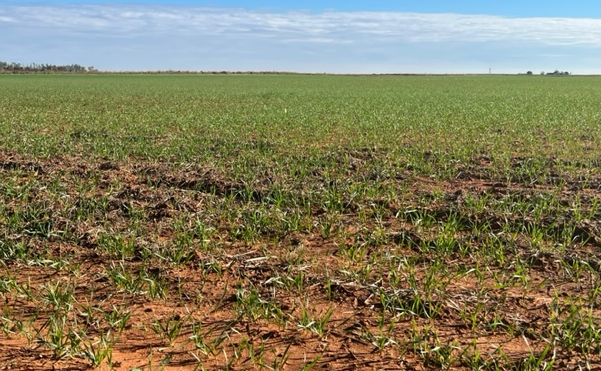
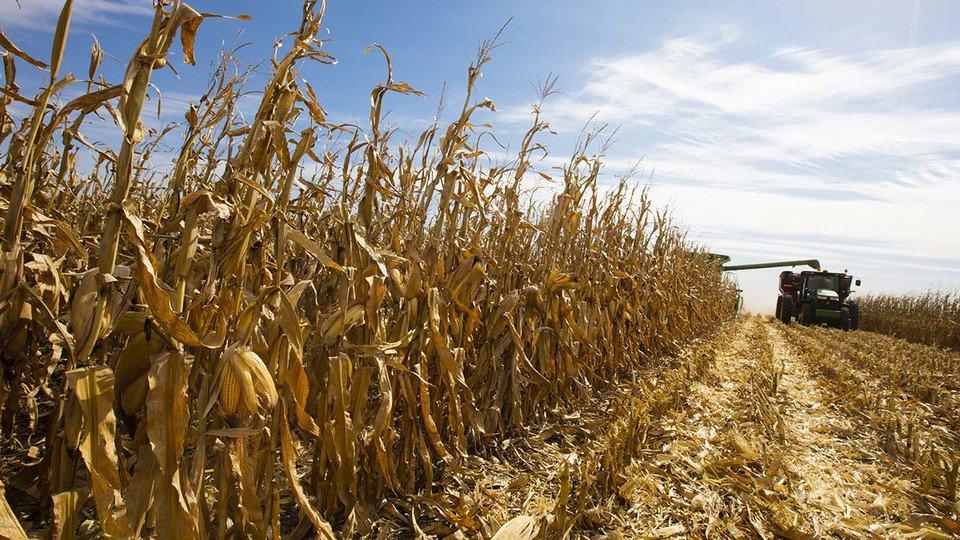
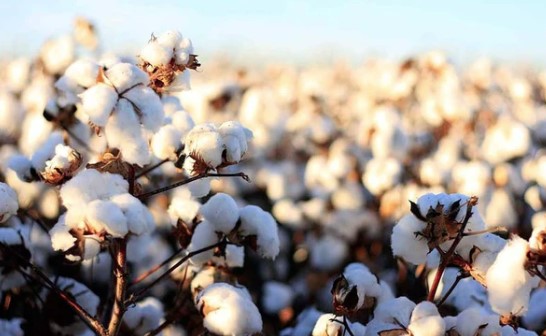
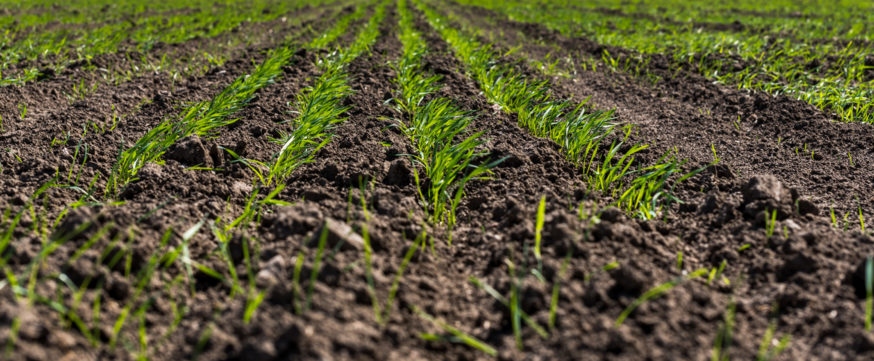
Mon, 31 Oct 2022 16:06:36 CDT First Oklahoma Winter Wheat Condition Rating for 2023 Crop Rates 11 Percent Good to Excellent Dry conditions this fall in the winter-wheat-producing Southern Plains are already taking a toll on the newly planted 2023 crop, USDA NASS reported in its weekly Crop Progress report. However, some parts of the region could receive some beneficial rains later this week. Nationwide Winter Wheat: Winter wheat planted in the U.S. reached 87 percent, up one percentage point from the previous year and up 2 points from the average. Winter wheat emerged reached 62 percent, down 3 percentage points from the previous year and down 4 points from the average. Winter wheat conditions for the states reported rated 8 percent good to excellent, 37 percent fair and 35 percent poor to very poor. This time last year, nationwide winter wheat was rated 45 percent good to excellent, 34 percent fair and 21 percent poor to very poor. Nationwide Cotton: Cotton bolls opening for the U.S. reached 96 percent, up 2 percentage points from the previous year and the average. Cotton harvested reached 55 percent, up 11 percentage points from the previous year and up 8 points from the average. Nationwide Corn: Corn harvested in the U.S reached 76 percent, up 3 percentage points from the previous year and up 8 points from the average. To view the U.S. Crop Progress Report, click here. Oklahoma: Winter wheat planted reached 84 percent, up 1 point from the previous year but down 1 point from normal. Winter wheat emerged reached 62 percent, down 4 points from the previous year and down 9 points from normal. Winter wheat conditions rated 11 percent good to excellent, 53 percent fair and 36 percent poor to very poor. (This is the first-week winter wheat conditions are accounted for in USDA's weekly report.) Cotton harvested reached 29 percent, down 1 point from the previous year but unchanged from normal. Cotton conditions rated 6 percent good to excellent, 29 percent fair and 65 percent poor to very poor. (Since last week, good to excellent cotton conditions have improved by 1 percent and poor to very poor has increased by 7 points.) Corn harvested reached 92 percent, up 1 point from the previous year and up 5 points from normal. Soybeans dropping leaves reached 90 percent, up 2 points from the previous year and up 6 points from normal. Soybeans harvested reached 50 percent, up 3 points from the previous year and up 8 points from normal. Soybean conditions rated 19 percent good to excellent, 44 percent fair and 37 percent poor to very poor. (Since last week, good to excellent soybean conditions have improved by 6 percentage points and poor to very poor conditions have decreased by 6 points.) Sorghum harvested reached 64 percent, up 1 point from the previous year and up 2 points from normal. Peanuts mature reached 95 percent, up 3 points from the previous year and up 3 points from normal. Peanuts harvested reached 59 percent, up 16 points from the previous year and up 5 points from normal. Peanut conditions rated 84 percent good to excellent and 16 percent fair. Hay: The fifth cutting of alfalfa hay reached 50 percent, up 9 points from the previous year and up 22 points from normal. The fourth cutting of other hay reached 45 percent, up 31 points from the previous year and up 33 points from normal. Range, Pasture and Livestock: Pasture and range conditions were rated 4 percent good to excellent, 16 percent fair, and 80 percent poor to very poor. Since last week, good to excellent pasture and range conditions have improved by 2 percentage points, but poor to very poor conditions have increased by 3 points. Livestock conditions rated 20 percent good to excellent, 53 percent fair and 27 percent poor to very poor. Since last week, good to excellent livestock conditions have decreased by 10 percentage points and poor to very poor conditions have increased by 6 points. To view the Oklahoma Crop Progress Report, click here. Kansas: Winter wheat planted was 87 percent, down 3 points from the previous year and down 1 point from the average. Winter wheat emerged was 58 percent, down 11 percentage points from the previous year and down 9 from the average. Winter wheat conditions rated 24 percent good to excellent, 34 percent fair and 42 percent poor to very poor. Cotton bolls opening reached 95 percent, down 1 percentage point from the previous year and up 1 point from the average. Cotton harvested reached 50 percent, up 40 percentage points from the previous year and up 38 points from the average. Corn harvested reached 90 percent, up 1 percentage point from the previous year and up 7 points from the average. Soybeans harvested reached 79 percent, up 12 percentage points from the previous year and even with the average. Sorghum harvested reached 68 percent, down 2 points from the previous year and up 11 points from the average. To view the Kansas Crop Progress Report, click here. Texas: Winter wheat planted reached 84 percent, up 6 percentage points from the previous year and up 9 points from the average. Winter wheat emerged reached 55 percent, even with the previous year and down 1 point from the average. Winter wheat conditions rated 4 percent good to excellent, 31 percent fair and 65 percent poor to very poor. Cotton bolls opening reached 95 percent, up 3 points from the previous year and the average. Cotton harvested reached 48 percent, up 4 points from the previous year and up 5 from the average. Cotton conditions rated 13 percent good to excellent, 17 percent fair and 70 percent poor to very poor. Corn harvested reached 97 percent even with the previous year and up 7 percentage points from the average. Corn conditions rated 17 percent good to excellent, 31 percent fair and 52 percent poor to very poor. Soybeans harvested reached 80 percent, down 9 percentage points from the previous year and down 4 points from the average. Soybean conditions rated 13 percent good to excellent, 24 percent fair and 63 percent poor to very poor. Peanuts mature reached 75 percent, up 9 percentage points from the previous year and up 14 points from the average. Peanuts harvested reached 55 percent, up 10 percentage points from the previous year and up 12 from the average. Peanut conditions rated 30 percent good to excellent, 51 percent fair and 19 percent poor to very poor. Range and Pasture: Range and pasture conditions rated 14 percent good to excellent, 29 percent fair and 57 percent poor to very poor. To view the Texas Crop Progress Report, click here.
Oklahoma Grain Elevator Cash Bids as of 2 p.m. October 31, 2022

Mon, 31 Oct 2022 15:10:49 CDT Oklahoma Grain Elevator Cash Bids as of 2 p.m. October 31, 2022


Oklahoma Grain Elevator Cash Bids as of 2 p.m. October 31, 2022


The U.S. Department of Agriculture and the Oklahoma Department of Agriculture are now putting the Daily Cash Grain Report into a PDF format - we are saving that PDF and archiving them for today's specific report. To see today's update, click on the PDF report link at the bottom of this story.

In addition to the PDF of the daily report, you can also listen to the Cash Grain Report by calling 405-621-5533. Push 2 for the grain report.


Click here: 04886_OklaCashGrain10312022.pdf


New Southern Plains Perspective Blog Post: Oklahoma Gets Rain!

Mon, 31 Oct 2022 14:26:01 CDT New Southern Plains Perspective Blog Post: Oklahoma Gets Rain!


New Southern Plains Perspective Blog Post: Oklahoma Gets Rain!


There's a new blog post out on the Southern Plains Perspective by Clay Pope. Read Below!


We got rain!!! I had over an inch and half in my gage last week!   Some folks in Southern Oklahoma got more than that! Great news, at least in Oklahoma, right?


Wrong.


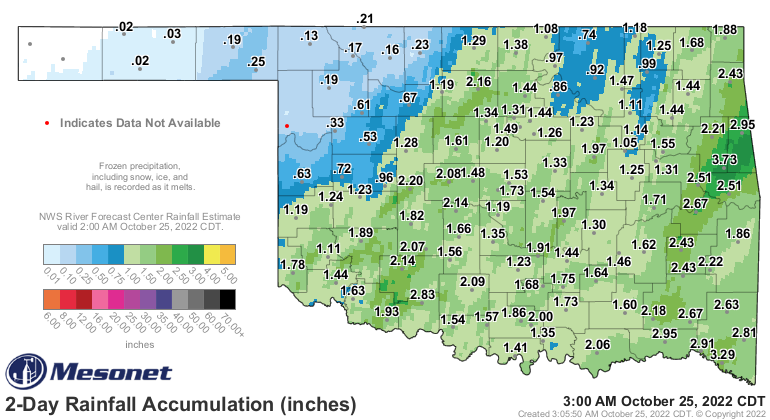
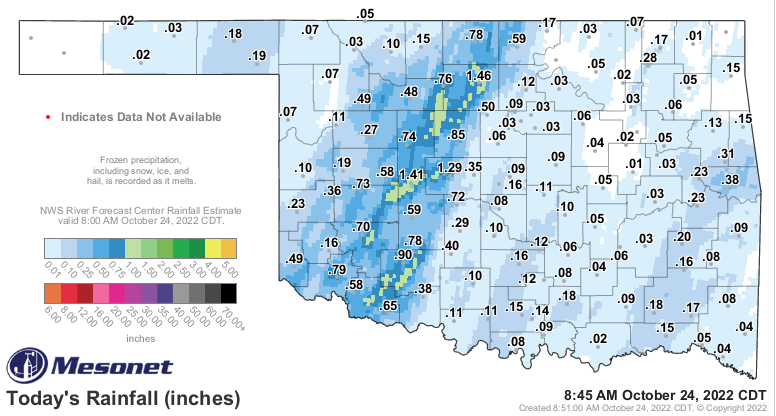
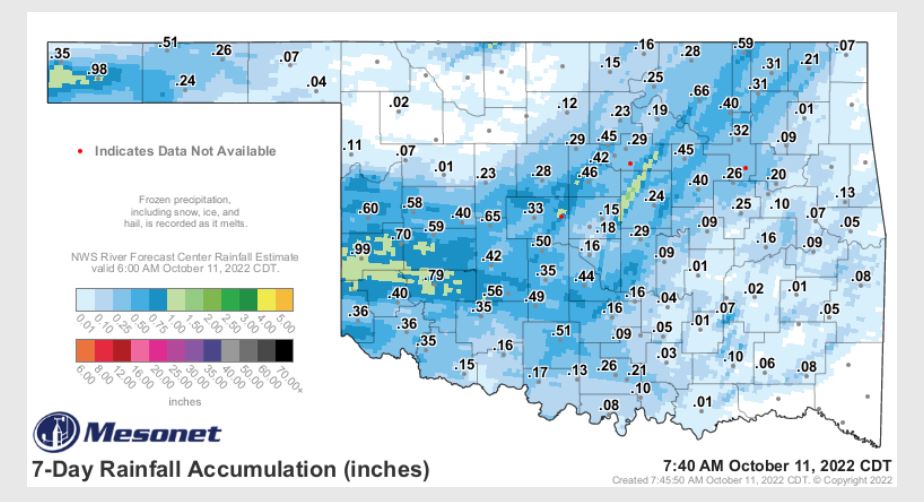
Leave it to our good friends at the Oklahoma MESONET to come up with stats showing us how, even with last week's rain, how dry it is in all of Oklahoma.....


And, as they so "helpfully" point out, the drought actually started much earlier than June 29 of this year.....so they showed us the stats for the last 365 days.......


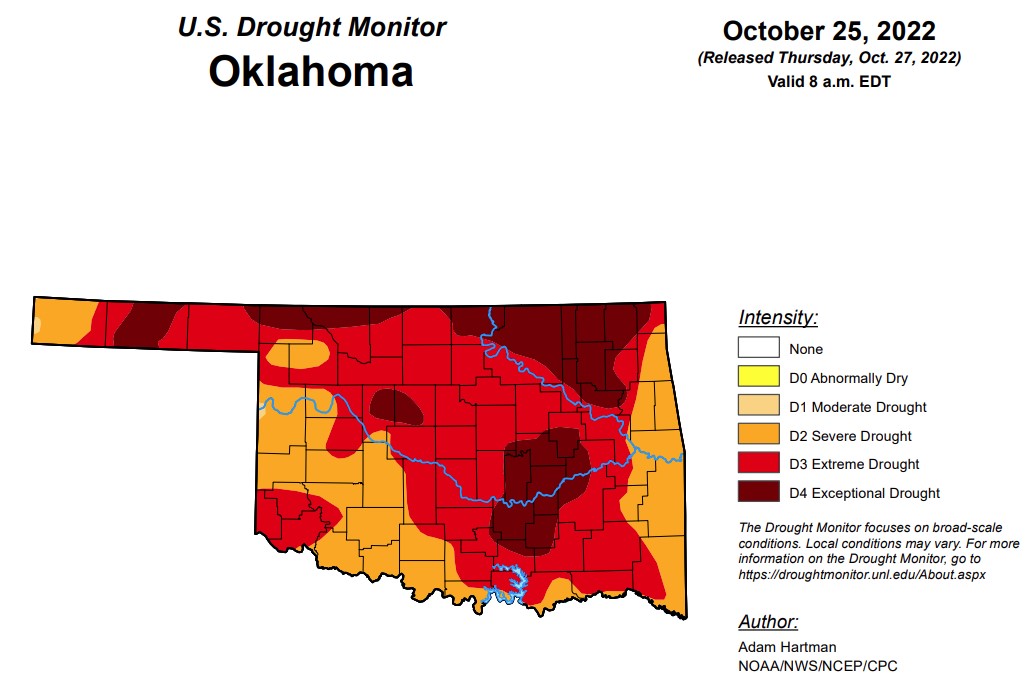
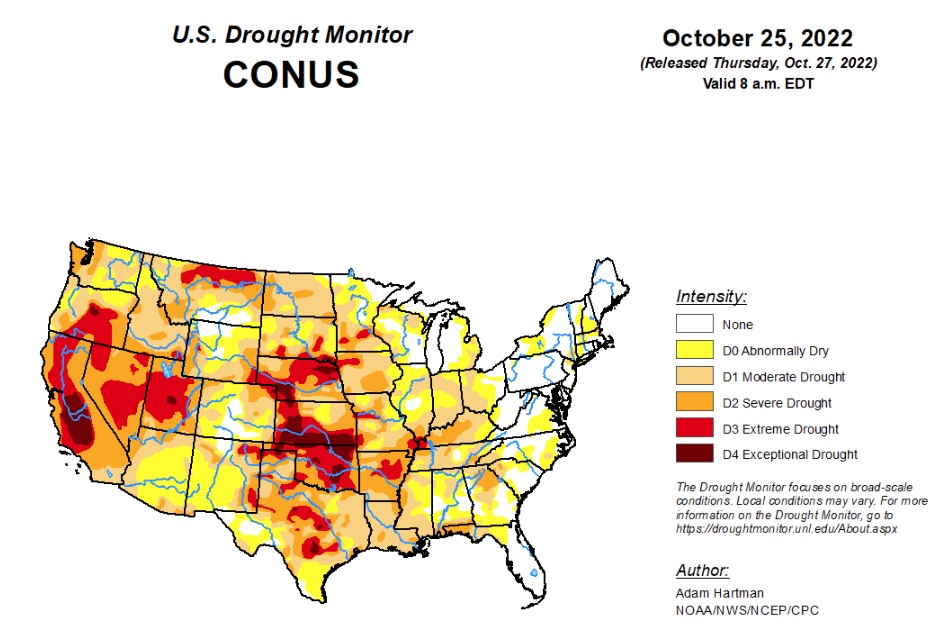
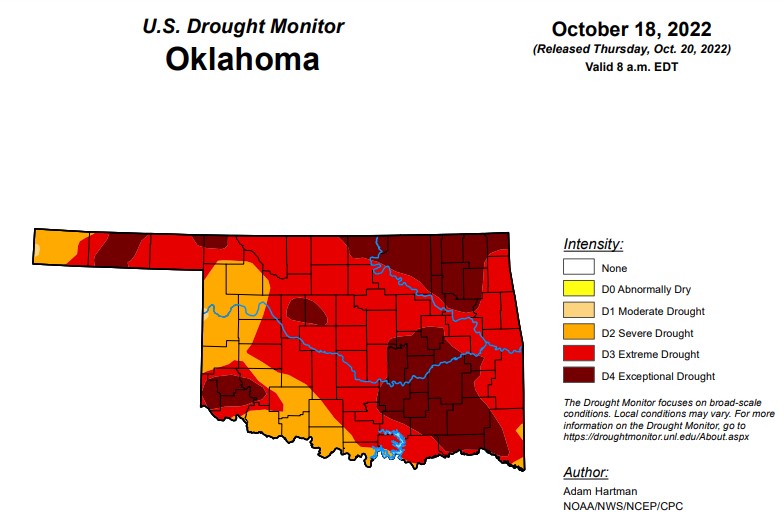
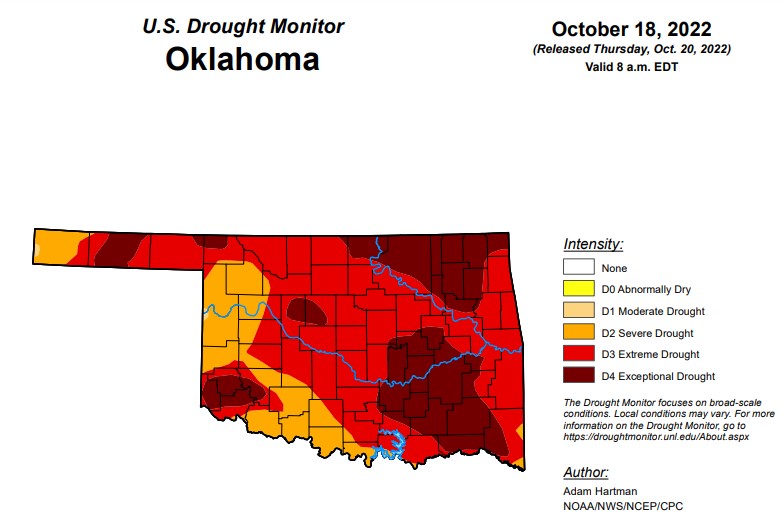
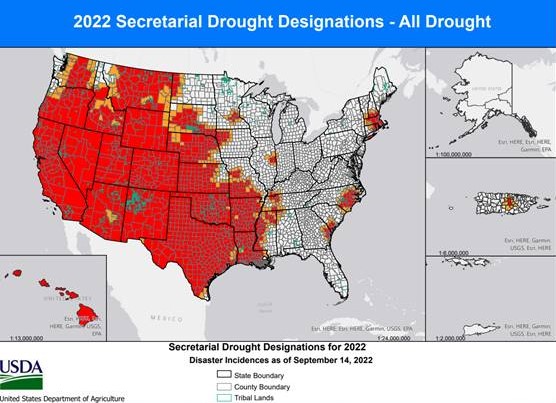
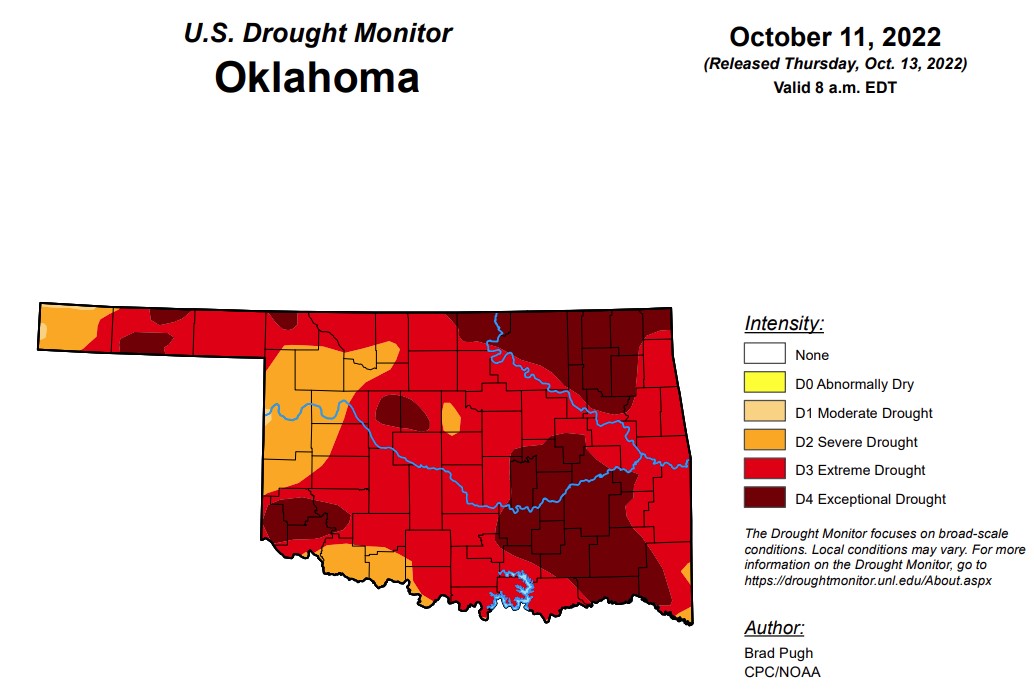
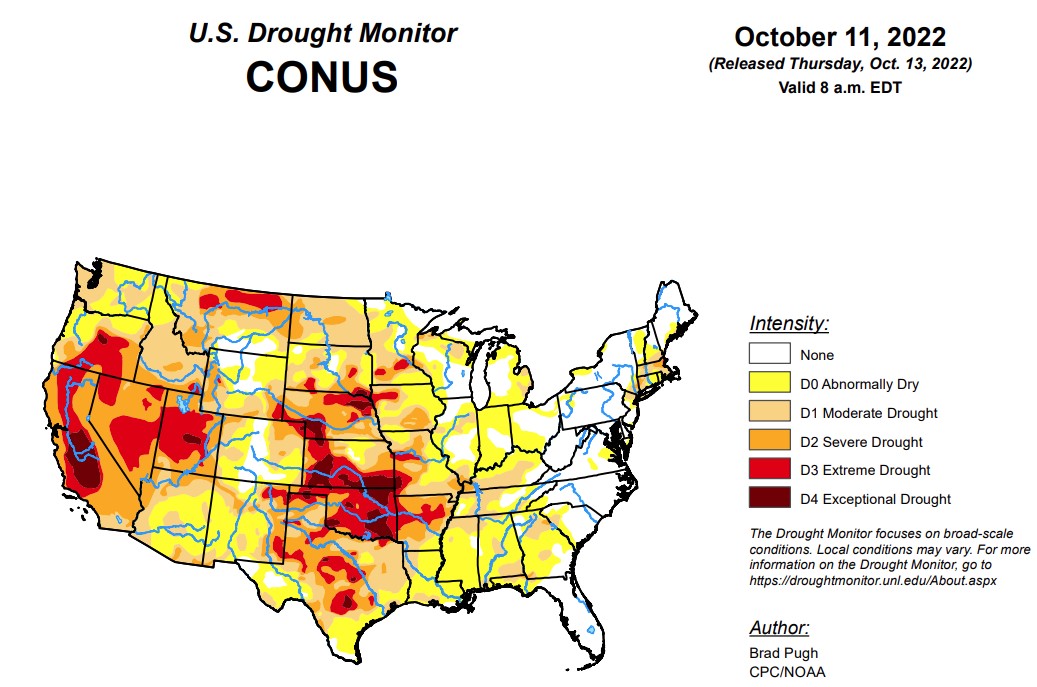
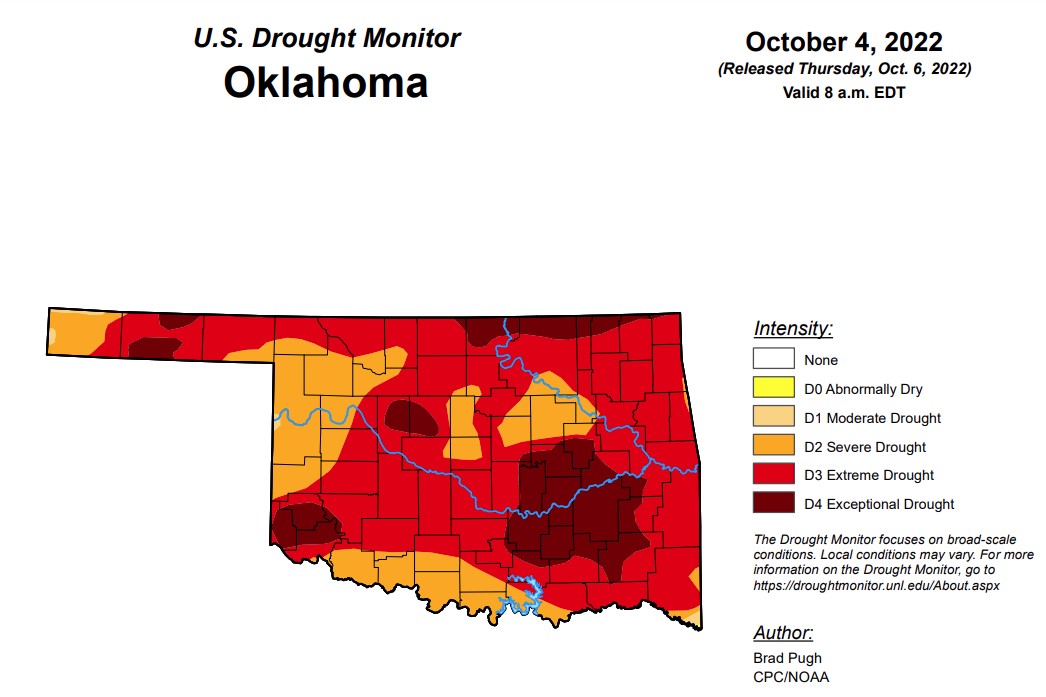
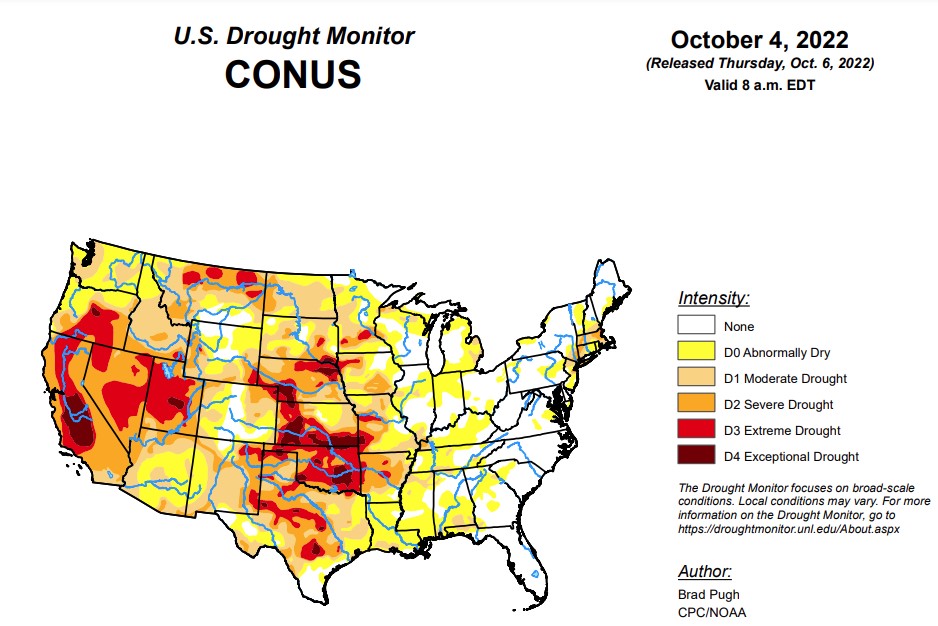
And while I am still happy for the rain (even though the MESONET folks remind me how behind we are here in Oklahoma on moisture) I take a look at the drought monitor and see just how bad it still is, especially in Northern Oklahoma and Southern Kansas-remember, the darker the color, the worse the drought conditions.......

That is not a good look......


Still, conditions in Texas are better than they were earlier this summer and the folks in parts of Southwest Oklahoma have seen an improvement.   Even with that little bit of positive news we have to remember that with the onset of a "triple dip" La Nina this drought could very well just be getting started.


Successful Farming Magazine put out a drought story just last week titled "U.S. IS DRIEST IN A DECADE, AS DROUGHT MOVES EASTWARD." This article discussed how we are in for a "triple dip" La Nina for the first time since 2012.   We all remember 2012, right?


The story went on to say that an article penned by Rippey for the Journal Weather and Climate Extremes said that the 2012 drought was a "once-in-a-generation crop calamity" that grew out of back-to-back La Niña weather patterns and caused $30 billion in damages, mostly agricultural. La Niña weather patterns typically bring drier-than-usual weather to the U.S. southern tier. The summer of 2012 was the second hottest in U.S. history, trailing only 1936, and the driest since 1988, another drought year.


"More than one-quarter of the corn and sorghum was lost to the drought," wrote Rippey. More than three-fourths of the U.S. cattle herd and two-thirds of hay territory was in drought.


The article went on to say that a week ago, NOAA forecasters said the United States would go through its third La Niña winter in a row, suggesting little relief for winter wheat or low water on the Mississippi.


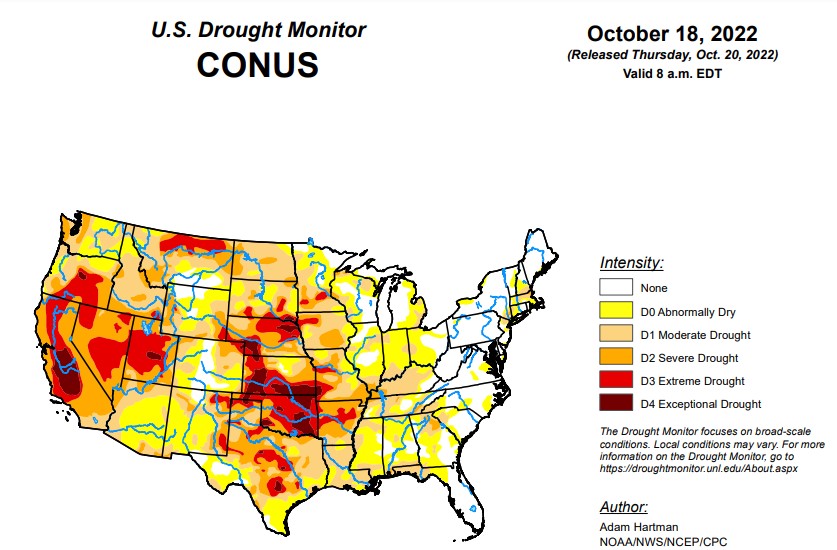
The story quoted Jon Gottschalck of NOAA's Climate Prediction Center as saying "Drought conditions are now present across approximately 59% of the country, but parts of the western United States and southern Great Plains will continue to be the hardest hit this winter. With the La Niña climate pattern still in place, drought conditions also may expand to the Gulf Coast."


Lovely.


Again, as a reminder, if you have not checked in with your local USDA Service Center to see what kind of drought assistance is available, you need to do so!   Not only is there help available from USDA (we wrote about some of this in an earlier blog ), but some states have taken action on drought assistance too (Oklahoma for example, has engaged its emergency drought fund).   You also can check out a couple of videos we did a while back with some of the folks at NRCS with some tips on dealing with dry conditions here and here.


I promise next week I'll write about something else....maybe.


To view this blog post at the Southern Plains Perspective, click here.

To view more blog posts, podcasts and content at the Southern Plains Perspective, click here.


New Southern Plains Perspective Blog Post: Oklahoma Gets Rain!
   

OSU Agriculture Celebrates Distinguished Group During 2022 Honors Ceremony

Mon, 31 Oct 2022 13:39:51 CDT OSU Agriculture Celebrates Distinguished Group During 2022 Honors Ceremony


OSU Agriculture Celebrates Distinguished Group During 2022 Honors Ceremony


Oklahoma State University recently honored a distinguished group of individuals who have brought distinction to the Ferguson College of Agriculture and have demonstrated a continuing commitment to agricultural sciences and natural resources.


During the OSU Agriculture Honors ceremony on Oct. 28, the Division of Agricultural Sciences and Natural Resources, comprised of the Ferguson College of Agriculture and two state agencies – OSU Extension and OSU Ag Research – recognized honorees of the 2022 Distinguished Alumni and Champion for OSU Agriculture awards.


"The awards celebrated during OSU Ag Honors are the most prestigious honors the division can bestow on an individual," said Thomas G. Coon, vice president and dean of OSU Agriculture. "Each and every one of our honorees demonstrate how much we depend upon collaborations and the work of others to fulfill our land-grant mission. They make us more successful in inspiring students, making new discoveries and serving our fellow Oklahomans."
John Fenderson of Stillwater, Jeff Hilst of Tulsa, Lenny Hughes of Richardson, Texas, Karen Eifert Jones of Waukomis, Tammy Lee of Bandera, Texas, and Patsiann Nix Smith of Tahlequah were honored as 2022 Distinguished Alumni Award recipients.


Established in 1983, the Distinguished Alumni Award recognizes individuals whose accomplishments serve as a model for current and future Ferguson College of Agriculture students.


In addition, Elizabeth Logan of Haskell, Carl Whitcomb of Stillwater and Joe Williams of Stillwater were honored as 2022 Champions for OSU Agriculture.
Established in 2011, the Champion for OSU Agriculture Award recognizes individuals who are not graduates of the Ferguson College of Agriculture but who have brought distinction to the division.


Lyndall Stout, OSU Agricultural Communications Services director and host of the television show SUNUP, served as the event's master of ceremonies.
"The OSU Ag Honors ceremony is always one of my favorite nights to celebrate the incredible honorees and learn more about them through special videos telling their life stories," she said. "The 2022 recipients are among an impressive group of honorees, and we appreciate the opportunity to celebrate their achievements."


Visit OSU Agriculture Honors to learn more about this year's honorees in addition to past recipients of the Distinguished Alumni and Champion for OSU Agriculture awards.


Farm Groups Rally Against SEC Proposal to Report Climate Data

Mon, 31 Oct 2022 13:34:53 CDT Farm Groups Rally Against SEC Proposal to Report Climate Data Big agricultural groups say a proposal from the Securities and Exchange Commission requiring companies to report their carbon footprint could drive small farmers out of business. Skeptics say it is more likely to be a boon for the consulting business. The proposal, unveiled by the SEC in March and not yet finalized, would require publicly traded companies to disclose their greenhouse-gas emissions, as well as the risks their business faces from climate change. Most controversially, some large companies would also have to provide an estimate of the emissions from their suppliers and consumers. Agriculture companies and farm groups have said the burden of generating those estimates would get passed on to small private farmers and drive up food costs. Supporters say those claims are misleading, and that large public companies will likely rely on consultants to crunch the numbers. The SEC proposal is backed by environmentalists and some fund managers who hope more transparency about climate data will help people make more informed investment decisions. The agriculture industry's pushback aligns it with some other sectors opposed to the SEC proposal, including auto manufacturers and oil producers. Other industries with a smaller carbon footprint and more liberal-leaning workforce, including the tech and financial industries, have been broadly supportive of the proposal. Meat processor Tyson Foods Inc. said the proposal could have a chilling effect on innovation, and wants any rule to include stronger legal protections for larger companies with sprawling supply chains where calculating emission estimates is difficult. Seed and pesticide maker Corteva Inc. said the requirement would ultimately result in higher prices at the grocery store. "If Corteva were required to impose emission tracking requirements on our distributors or consumers, we could effectively drive small and midsize farmers out of business," the company said in a letter to regulators. David Haase, a fourth-generation corn and soybean farmer 90 miles south of Chicago, said he isn't sure how companies will broadly track carbon-emissions data at the farm level. Mr. Haase said he expected that companies would either have to pay farmers for the management tools to record the necessary information or it would be an extra expense to the farmer. "I would assume farmers will absorb a big part of that cost," he said. Supporters of the proposed rule said that big food and agricultural companies are hiding behind politically sympathetic small farmers. They note that only publicly held companies would be responsible for the new requirements and that many already collect similar data voluntarily. "The publicly traded companies are shedding crocodile tears right now for small farmers, when they are really trying to protect themselves from disclosing all of the information, which is readily available and ascertainable for the large companies to obtain," said Sen. Ed Markey (D., Mass.). He said agribusiness was "the loudest" opponent to the rule. Under the proposal, large companies would be required in certain cases to report not just their own emissions, but also those generated by suppliers and customers—known as scope 3 emissions. Scope 1 emissions are those generated directly by the company, and scope 2 covers emissions from purchased energy. Regulators say they intend to require an estimate of emissions from suppliers and customers only if they are considered "material," or significant to investors, or if the company has outlined specific targets for them. The SEC proposes some legal protection for companies around the estimates, but some businesses are pushing to beef them up. The SEC is considering narrowing the proposal in the face of anticipated legal challenges from business groups and isn't expected to vote on it until next year, according to an SEC official. Meanwhile, trade groups including American Farm Bureau Federation and the National Corn Growers Association are rallying their members against the rule. They say requiring companies to calculate such emissions is a daunting task given the nature of farming. "A farm isn't a smokestack," said Mary-Thomas Hart, chief counsel at the National Cattlemen's Beef Association. "You can't put a monitor in and get steady emissions data." Supporters of the rule point out that the SEC would simply require companies to generate estimates and would allow companies to use standard models or industry averages when making their estimates. "This is a very workable rule," said Steve Suppan, senior policy analyst at the Institute for Agriculture and Trade Policy. "Agribusinesses have basically gone to farm organizations, which have panicked their members into thinking this rule will apply to them." SEC Commissioner Gary Gensler told lawmakers last month that it isn't the SEC's intent to force public companies to demand more information from farmers as a condition of doing business with them. If Republicans take back control of the House in November, lawmakers said they would give priority to trying to block parts of the SEC proposal. "My effort is to protect those folks at the beginning of the supply chain who potentially will have all this pushed down on them to meet someone else's corporate compliance requirements," said Rep. Frank Lucas (R., Okla.). Mr. Lucas is leading legislation backed by more than 100 House Republicans that would prohibit the SEC from requiring publicly traded companies to disclose greenhouse-gas emissions from scope 3 emissions coming from farms and ranches. The debate over disclosing broad emissions data arises as agriculture comes under increased environmental scrutiny. A study published in Nature Food in March 2021 estimated that emissions tied to the food system make up about one-third of total global greenhouse-gas emissions. Cattle, for example, are a big source of methane, an especially potent greenhouse gas. Minnesota farmer co-op CHS Inc., a farm cooperative and major grain shipper and retailer of seeds and chemicals, said it has begun committing resources and formulating how it will partner with its customers and suppliers to meet the SEC's rules when they are completed. Ethanol producer Green Plains Inc. has started planning for how it would work with the corn growers who supply it by giving them the measurement tools needed to assess what their emissions might be, said Chief Executive Todd Becker. Many businesses have already started collecting data on their environmental impact and new companies have popped up to help them do so. Strong Roots, a plant-based frozen foods company based in both New York and Ireland, puts the amount of carbon per kilogram that each product requires on the front of each package. Strong Roots tracks its annual carbon usage, currently 908 metric tons, with the help of CarbonCloud, a Swedish firm that helps food companies calculate their carbon footprint. - Paul Kiernan contributed to this article. Credit: The Wall Street Journal

New USDA Reports Show Continued Impact of Drought on Cattle Supplies

Mon, 31 Oct 2022 13:24:31 CDT New USDA Reports Show Continued Impact of Drought on Cattle Supplies


New USDA Reports Show Continued Impact of Drought on Cattle Supplies


The latest Farm Bureau Newsline Podcast talks about the impacts of Drought on Cattle Supplies.

Data released this month from the Department of Agriculture shows drought is having an impact on cattle markets. Micheal Clements and American Farm Bureau Federation Economist Bernt Nelson shares more from the Cattle on Feed report.

" I think we can really call this report bullish, with total cattle on feed coming in right around 11.4 million, down one percent from this time in 2021. Placements are a little bit over two million head, this is four percent below this time last year in 2021.Said Nelson.

Placements were down the most in drought-stricken states. "This is likely due to some tighter calf supplies along with higher feed and input costs amplified by the drought conditions. We've seen marketings for fed cattle totaling 1.86 million head for September, this is four percent above this time in 2021. Now, when we really see marketing high and placements become lower over a longer drawn out period of time, this really signals that lower cattle supplies are in the future."

Additionally, USDA's Livestock Slaughter Report shows higher beef slaughter numbers.

To hear the complete conversation between Clements and Nelson, click or tap below:


ASA/WISHH & USSEC Join USDA East Africa Trade Delegation

Mon, 31 Oct 2022 13:10:26 CDT ASA/WISHH & USSEC Join USDA East Africa Trade Delegation


ASA/WISHH & USSEC Join USDA East Africa Trade Delegation


The American Soybean Association's World Initiative for Soy in Human Health Program and U.S. Soybean Export Council representatives join the U.S. Department of Agriculture's agribusiness trade mission in Nairobi, Kenya, and Zanzibar, Tanzania on Oct. 31 - Nov. 4. Their participation reinforces the importance of U.S. soy protein for trade, development and food security in sub-Saharan Africa.


WISHH Chair Roberta Simpson-Dolbeare, an Illinois soybean farmer, is one of the six U.S. soy organization representatives on the trade mission led by USDA Deputy Secretary Jewel Bronough. "Kenya was one of the first countries where U.S. soybean growers sent WISHH to start building relationships there when we founded WISHH 22 years ago. It is exciting to see this wise, long-term investment has taken root through WISHH's strategic partnerships with producers of high-quality soy-based foods and feeds," said Simpson-Dolbeare.


USSEC Executive Committee Member Lance Rezac, a Kansas soybean farmer and United Soybean Board director, also joins the trade delegation. "With Kenya having recently authorized the import of GMO plant material, this mission is an especially important opportunity to engage with key stakeholders and share the insights on U.S. Soy's value and reliability," said Rezac, "U.S. Soy farmers are proud of the high-quality, sustainable product we grow and hope to help foster improved protein sources in the region, whether it's through direct soy food consumption or through animal agriculture."


WISHH and USSEC have collaborated on market access for the region. Joining the two farmer-leaders are WISHH Executive Director Gena Perry and New Business Lead Austin Leefers, along with USSEC Executive Director of Market Access & Strategy Rosalind Leeck.


According to the July 2022 USDA report, Opportunities for U.S. Feed Ingredients and Processed Products in Kenya, "Soybean meal has had the most consistent growth and is expected to increase further as livestock capacity increases. Grains for feed are mostly domestically produced. However, as the price of feed production increases, Kenya is expected to look outside of domestic products to supplement demand. In 2021, soybean meal reached its second-highest imports in history at $1 million, a 97% increase from 2017. Soybean imports have been minimal and volatile but offer potential. Over the past five years, imports have ranged between $30 thousand (2021) to $8.5 million (2020) with million-dollar soybean imports coming from Ukraine"


About WISHH: WISHH connects trade and development across global market systems. Visionary U.S. soybean growers lead WISHH's work, which improves global food security and builds economic growth through the power of soy protein for human foods and livestock and aquaculture feeds. WISHH's strategic partnerships span 28 countries in sub-Saharan Africa, Asia and Latin America. Connect with WISHH at www.wishh.org and https://www.linkedin.com/company/wishh


About USSEC: The U.S. Soybean Export Council (USSEC) focuses on differentiating, elevating preference, and attaining market access for the use of U.S. Soy for human consumption, aquaculture, and livestock feed in 80+ countries internationally. USSEC members represent the soy supply chain including U.S. Soy farmers, processors, commodity shippers, merchandisers, allied agribusinesses, and agricultural organizations. USSEC is funded by the U.S. soybean checkoff, USDA Foreign Agricultural Service (FAS) matching funds, and industry. Please visit https://ussec.org/ for the latest information, resources, and news about USSEC and U.S. Soy internationally.


Hard Red Spring Crop Makes Strong Recovery, Shows Positive Quality Characteristics

Mon, 31 Oct 2022 12:54:41 CDT Hard Red Spring Crop Makes Strong Recovery, Shows Positive Quality Characteristics


Hard Red Spring Crop Makes Strong Recovery, Shows Positive Quality Characteristics


The 2022 U.S. HRS crop recovered from last year's historic drought. This crop has many positive attributes, including higher supply levels, strong grading characteristics, little to no DON and sound kernel characteristics. Overall protein is lower, but over half of the crop still has protein levels of 14% (12% mb) or higher. While dough strength shows weaker than last year, buyers will find a crop that compares well with the five-year average. Buyers can buy with confidence, but diligent contract specifications are still the best way to get the quality demanded.

The Season in Review

PLANTING varied across the region, with a timely mid-April start and finish in western and southern areas, compared to a historically late start and sluggish progress across central and eastern areas. Excessive soil moisture pushed final planting into mid-June over a large area, about three weeks behind normal.

Crop EMERGENCE was hindered in parts of the region due to a prolonged cold, wet spring. By June, conditions shifted to warm and dry, benefiting the overly wet areas and later planted crops, but drier, western areas experienced some crop stress. The growing season was favorable with adequate moisture and no excessive heat, promoting strong yield potential, except for drier western areas.

HARVEST began later than normal, but by August, warm, dry conditions allowed for rapid progress and accelerated development of the later planted fields. Favorable conditions continued into September, allowing for a quick harvest; harvest in parts of the region extended into early October.

PRODUCTION of the U.S. HRS crop, at 12.1 MMT, is up 50%, following last year's severe drought.

2022 Crop Highlights

The average GRADE for the 2022 HRS harvest survey is U.S. No. 1 Northern Spring (NS); 97% of Eastern Region samples and 85% of Western Region samples grade U.S. No. 1.

Average TEST WEIGHT is 62.1 lb/bu (81.6 kg/hl), higher than 2021 and 5-year averages.

Overall, the crop has lower VITREOUS KERNEL LEVELS (DHV), averaging 74% compared to 80% in 2021 but higher than the 5-year average. Average DHV is higher for Western samples at 88% but lower for Eastern samples at 59% due to lower protein and lack of stress during the growing season.

PROTEIN averages 14.3% (12% mb), below 2021 and 5-year averages due to higher yields in areas and less stress during the growing season.

DON levels were near zero due to minimal disease pressures.

Average 1000 KERNEL WEIGHT (TKW) is 30.4 g, above 2021 and similar to the 5-year average.

A dry harvest produced a very sound crop with an average FALLING NUMBER of 386 sec.

Flour and Dough Data

BUHLER LABORATORY MILL FLOUR YIELD averages 66.2%, slightly higher than 2021 but lower than the 5-year average. Lab mill settings are not adjusted to account for kernel parameter shifts between crop years and a wider variance in TKW and kernel size may have impacted milling yield.

Average FLOUR ASH is 0.49%, equal to 2021 but significantly lower than the 5-year average of 0.53%.

WET GLUTEN averages 34.5%, notably lower than 2021 and 5-year averages.

AMYLOGRAPH values average 724 BU, down from 2021 but up notably from the 5-year average.

DOUGH PROPERTIES suggest a weaker, more extensible crop as compared to last year. Dough property values are more in line with five-year average values.

The average LOAF VOLUME is 938 cc, lower than 2021 and 5-year averages; Western area averages 940 cc and Eastern area averages 937 cc.

Average BAKE ABSORPTION is 71.4%, significantly higher than 2021 and 5-year averages.

BREAD SCORES are similar to 2021 and the 5-year average.


National Dairy FARM Program Announces 2022 Excellence Award Winners

Mon, 31 Oct 2022 12:13:49 CDT National Dairy FARM Program Announces 2022 Excellence Award Winners


National Dairy FARM Program Announces 2022 Excellence Award Winners


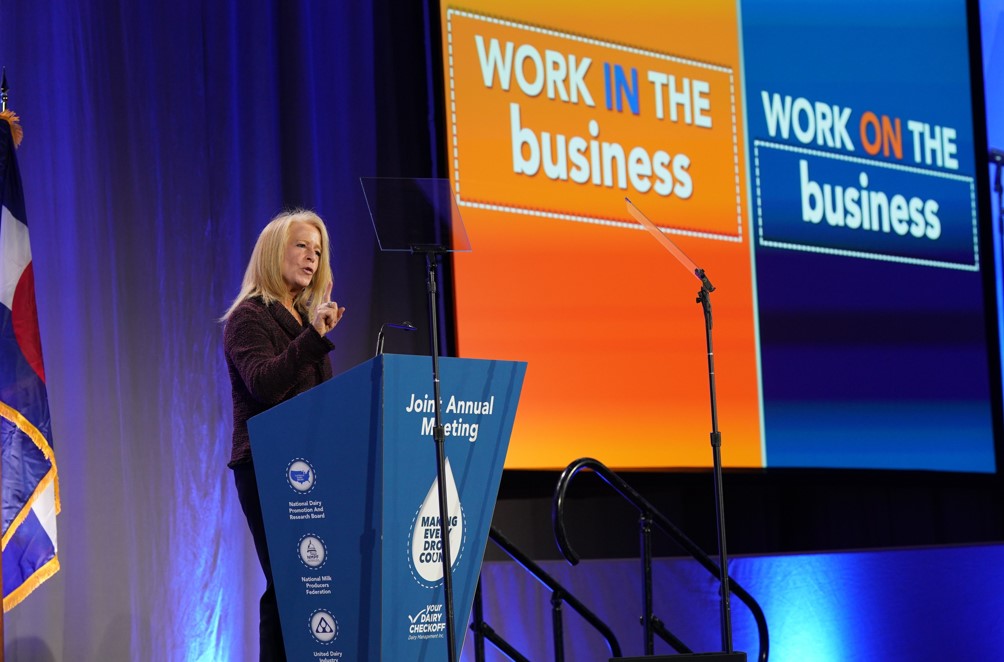
The National Dairy Farmers Assuring Responsible Management (FARM) Program last week announced the winners of the second annual FARM Excellence Awards.


Through these awards, the FARM Program recognized three farms and one evaluator who go above and beyond industry standards through their commitment to innovation and continuous improvement. The 2022 FARM Excellence Award recipients are:


• Animal Care & Antibiotic Stewardship — MVP Dairy, LLC (Danone North America)
• Environmental Stewardship — Kibler Dairy Farms, Inc. (Dairy Farmers of America)
• Workforce Development — Double A Dairy, LLC (Glanbia Nutritionals)
• Evaluator of the Year — Ruth McCuin (Agri-Mark, Inc.)


"The 2022 FARM Excellence Awards winners are a truly special group that embraced FARM Program principles and have raised the bar for what is possible in our industry," Vice President of the FARM Program Emily Yeiser Stepp said. "They're great models for on-farm social responsibility."


Winners were announced Tuesday, Oct. 25 at the 2022 Joint Annual Meeting of the National Dairy Board, the National Milk Producers Federation and the United Dairy Industry Association in Aurora, Colorado.


The FARM Excellence Awards were created in 2021 to celebrate farms that are dedicated to continuous improvement in one or more FARM Program areas, and a FARM Program evaluator for their exceptional care and attention to the farms they evaluate. The awards are judged by FARM Farmer Advisory Council members and other subject matter experts. Farms and evaluators can be nominated by fellow dairy farmers and evaluators, members of their communities, extension, cooperative or processor staff, veterinarians, or other industry professionals.


More information about the FARM Excellence Awards and the 2022 award winners is available on the FARM Excellence Awards page. Hi-res award winner images are also available for download, here.


About the Winners


MVP Dairy, LLC, is in Celina, Ohio and patrons of FARM participant Danone North America. MVP Dairy was awarded the 2022 FARM Excellence Award in Animal Care & Antibiotic Stewardship for their constant efforts to create the ideal environment for their cows, prevent potential illnesses and reduce the use of medications by following the FARM facility guidelines and best management practices.


Kibler Dairy Farms, Inc. is in Warren, Ohio, and is a member of Dairy Farmers of America. Kibler Dairy Farms was awarded the 2022 FARM Excellence Award in Environmental Stewardship for their focus on conservation practices and water quality initiatives to lower their environmental impact.


Double A Dairy, LLC is in Jerome, Idaho, and patrons of FARM Program participant Glanbia Nutritionals. Double A Dairy was awarded the 2022 FARM Excellence Award in Workforce Development for their commitment to employees by prioritizing new employee onboarding, focusing on continuous improvement, and implementing a formal safety program.


Ruth McCuin, field service supervisor and FARM Program coordinator for Agri-Mark, Inc., was awarded the 2022 FARM Evaluator Excellence Award for her superior commitment to the farms she represents and the help she provides in ensuring everyone is working toward continuous improvement.


Voters Encouraged to Mail Absentee Ballots as Soon as Possible

Mon, 31 Oct 2022 12:08:01 CDT Voters Encouraged to Mail Absentee Ballots as Soon as Possible


Voters Encouraged to Mail Absentee Ballots as Soon as Possible


The Secretary of the State Election Board is encouraging voters who have requested absentee ballots to mail those ballots back as soon as possible to ensure they are received by their County Election Board before the deadline. "While our county election boards work closely with local post offices to ensure that every mail ballot makes it into the hands of election officials by 7 p.m. on Election Day, we encourage voters to follow United States postal guidelines and mail ballots at least seven days prior to the election." said Secretary Paul Ziriax. "Voters should consider the amount of time needed to vote their ballot, as well as the distance the ballot has to travel," he added.


Absentee ballots that are returned by mail must be received by the voter's County Election Board no later than 7 p.m. on Election Day. The United States Postal Service recommends that voters mail their absentee ballots no later than Tuesday, November 1.


Meanwhile, voters who requested a "standard" absentee ballot (yellow affidavit) have the option to hand deliver their voted ballot to their County Election Board during regular business hours. Ballots must be returned no later than the Monday prior to the election. A valid proof of identity is required when dropping off your absentee ballot and your affidavit must be notarized. Voters are reminded that it is against the law to submit an absentee ballot on behalf of another person.


Voter with questions or concerns regarding their absentee ballot should contact their County Election Board as soon as possible. Voters can track their absentee ballot using the OK Voter Portal. Voters should note that the portal will indicate whether or not an absentee ballot has been counted after the election, once all data has been entered by the County Election Board.


Cattle Feeders Hall of Fame Announces 2023 Inductees

Mon, 31 Oct 2022 10:27:36 CDT Cattle Feeders Hall of Fame Announces 2023 Inductees


Cattle Feeders Hall of Fame Announces 2023 Inductees


14th Annual Banquet in New Orleans on Jan. 31


Cattle Feeders Hall of Fame inductees and industry award winners will be honored on Jan. 31, 2023, during the 14th annual banquet, which precedes the 2023 Cattle Industry Convention and NCBA Trade Show in New Orleans, Feb. 1-3. The Cattle Feeders Hall of Fame was established in 2009 to honor the exceptional visionary men and women who have made lasting contributions to the cattle-feeding industry.


Hall of Fame inductees for 2023 include Jerry Adams with Adams Land and Cattle in Broken Bow, Nebraska, and the late Ed Barrett of Barrett Crofoot Feedyards in Hereford, Texas. Thomas "Dee" Likes, former CEO of the Kansas Livestock Association, will receive the Industry Leadership Award, and Terry Wegner with Drinnin West Cattle Co. will receive the Arturo Armendariz Distinguished Service Award.


"Cattle feeders continue to play a key role in making the United States the world's most efficient producer of safe, quality beef," said Cliff Becker, senior vice president, Farm Journal, and Cattle Feeders Hall of Fame board member. "The 2023 inductees exemplify the visionary leaders who have made lasting contributions to the cattle-feeding industry."


Attendees of the Cattle Feeders Hall of Fame banquet will find it convenient to stay in the Big Easy for the Cattle Industry Convention and NCBA Trade Show, which starts the next day. The annual convention features important industry meetings, motivational speakers, valuable education, entertainment, a massive trade show, producer recognition and much more.


Cattle Feeders Hall of Fame banquet tickets are $200 per person in addition to convention registration. All proceeds from banquet ticket sales and corporate sponsorships benefit future Hall of Fame initiatives.


For more information about the 2023 Cattle Industry Convention and NCBA Trade Show and to purchase tickets to the Cattle Feeders Hall of Fame banquet, visit convention.ncba.org. For more information about the Cattle Feeders Hall of Fame and 2023 inductees, visit www.cattlefeeders.org.


OSU's Dr. Peel gives an Oklahoma Cattle Market Update

Mon, 31 Oct 2022 10:24:03 CDT OSU's Dr. Peel gives an Oklahoma Cattle Market Update


OSU's Dr. Peel gives an Oklahoma Cattle Market Update


Mondays, Dr. Derrell Peel, Oklahoma State University Extension Livestock Marketing Specialist, offers his economic analysis of the beef cattle industry. This analysis is a part of the weekly series known as the "Cow Calf Corner" published electronically by Dr. Peel and Mark Johnson. Today, Dr. Peel gives an Oklahoma cattle market update.


In the 14 weeks from mid-July to mid-October, the volume of feeder cattle in the combined weekly cattle auction summary was up 19.7 percent year over year, an increase of over 66,000 head. As expected, larger summer volumes resulted in smaller volumes for the fall. The feeder volume the past two weeks has been down by 6.1 percent compared to the same period last year. Feeder volumes are expected to be smaller through November.


Feeder cattle prices at Oklahoma auctions increased counter-seasonally through the summer to August peaks nearly equal to the spring seasonal peaks before dropping through September into early October. A sharp decrease in Feeder futures contract prices over this period was the major factor in the cash market decrease. Since mid-October, Feeder futures prices and cash auction have moved higher.


For the week ending October 28, the combined auction price of 480-pound, M/L, No. 1 steers was $190.08/cwt. ($912.38/head) and the price of 781-pound steers was $176.20/cwt. ($1376.12/head). This is an increase in value of $463.74/head and a $1.56/pound value of gain for 301 pounds of gain. Of course, it takes time to add weight to feeder cattle and the value of gain is even higher given Feeder futures prices for next spring. Feeder futures prices reflect a higher trending feeder market in the coming months. Current March Feeder futures imply a price of $183/cwt. for the 780-pound steer and a value of gain $1.71/pound in March for the 480-pound steer purchased now. Drought has reduced the availability of wheat pasture and other forages and makes it difficult for stocker producers to take advantage of these attractive stocker margins and arbitrage the markets in the typical fashion. Some producers may be considering more creative backgrounding programs to take advantage of the current feeder market situation.


The volume of cull cows in Oklahoma auctions continues to run well above last year. The volume of cull cows and bulls in auctions has averaged double the level of one year ago since mid-July and has been higher nearly every week of the year. This increase has added roughly 50,000 head of cull cows above year ago levels in the seven federally reported Oklahoma auctions. Other cull cows are marketed through smaller auctions and directly to cow packers. These numbers contribute to the national total of beef cow slaughter up nearly 13 for the year to date through mid-October. Cull cow prices dropped about 25 percent from late August to mid-October but did increase slightly last week.   Average dressing Breaker cows were priced at $71.99/cwt.; Boning cows at $67.26/cwt. and Lean cows at $60.82/cwt.


Market fundamentals are generally positive for cattle markets going forward. Improved futures prices, stronger boxed beef and fed cattle prices are all supportive for feeder cattle markets. Cattle slaughter is still running large but should taper off toward the end of the year. Unless unexpected external market pressure develops, cattle prices are expected to finish the year strong and the highest prices of the year may be recorded before the end of the year.   


Below, listen to Dr. Derrell Peel discuss the effect of recent rains on livestock markets on SunUp TV from October 29, 2022.


Low Water Levels in the Mississippi River Result in Abnormally Weak Soybean Basis

Mon, 31 Oct 2022 09:39:05 CDT Low Water Levels in the Mississippi River Result in Abnormally Weak Soybean Basis


Low Water Levels in the Mississippi River Result in Abnormally Weak Soybean Basis

Click here: 1


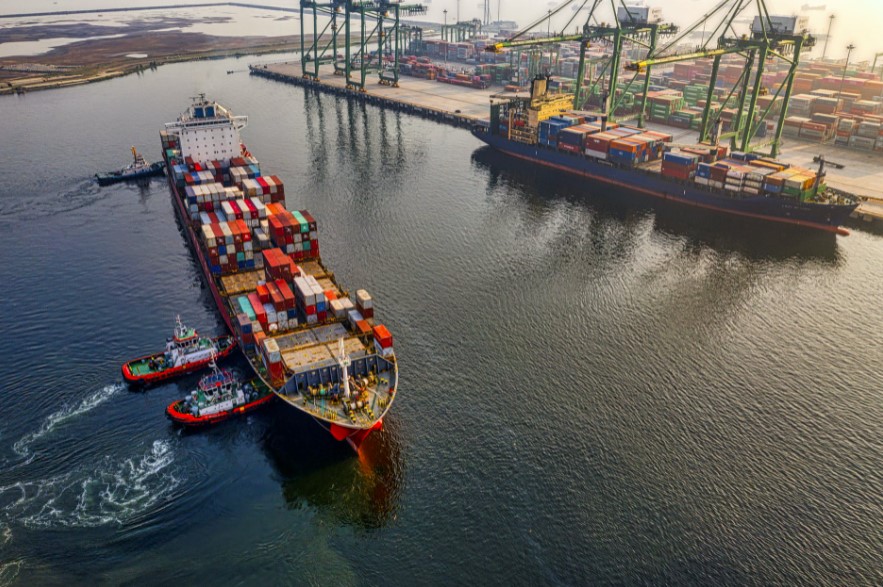
Low water levels in the Mississippi River have caused grain barge rates to increase, which causes grain buyers at local grain elevators to reduce their bids for grain delivered. When water levels drop in the marine highway system, barge drafts are reduced (U.S. Army Corps of Engineers, 2022). A barge draft is the distance between the waterline and boat, or the barge hull structure, and increases with the amount of weight present on the barge. The average barge with a draft of 9 feet can hold 1,500 tons of grain which equates to about 59,000 bushels of corn, 55,000 bushels of soybeans, and 53,500 bushels of rice (USDA-AMS, 2022). Each reduced foot of draft results in 150-200 fewer tons, or anywhere between 5,500 to 7,500 bushels depending on the crop, of grain capacity on a barge (Iowa Soybean Association, 2022). If barge drafts decrease for vessels carrying grain, this means the cost to transport grain downriver, or the grain barge rate, increases since it takes more barges to move the same amount of grain.

Barge freight rates are established by the U.S. Inland Waterway System using a percent of tariff system. Barge freight rates for the Mississippi River at New Madrid, Missouri near Memphis, Tennessee have skyrocketed since the beginning of September (USDA-AMS, 2022). The 3-year average percent of tariff rate indicates weekly barge freight rate tends to oscillate around 400 percent of tariff, or about $12.56/ton. In October 2022, the barge freight rate averaged 2400 percent of tariff, or $75.36/ton, which means the cost to transport grain from Memphis to the port of New Orleans was roughly six times higher than average. The increase in transportation cost is usually reflected in lower cash grain bids at country grain elevators which results in a weakened basis, which is the local cash price received by farmers at the country elevator less the futures price established by the Chicago Board of Trade.
?
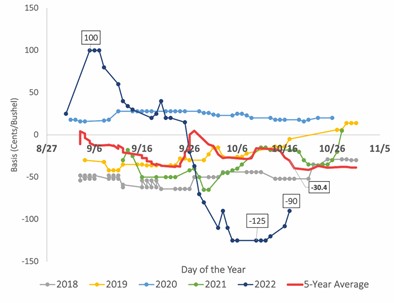
In a technical report recently published by the Fryar Price Risk Management Center of Excellence, Biram, et al. (2022) provide a detailed analysis of how increased barge freight rates weaken basis. Here, we provide a snapshot of how soybean basis has fluctuated in typical harvest months for Helena, Arkansas for the previous five years and show how significant the impact of the low water levels in the Mississippi River has been in recent weeks (Figure 1). As of October 18, 2022, new crop soybean basis at Helena, Arkansas is abnormally low at 90 cents under the front month soybean futures contract (ZSX2) which is nearly 200% below the five-year average during the months of September and October (i.e. 30.4 under). Additionally, basis is relatively more volatile than the five-year average with the strongest basis in this time frame of 100 cents over ZSX2 on September 6, 2022, to the weakest basis of 125 cents under the week of October 5, 2022. The strong basis in early September is primarily due to tight pre-harvest stocks.

We now provide immediate and near-term implications for risk management. In the immediate term, a producer should consider storing grain until the winter months where current cash bids for delivery appear to have stronger basis and to consider the benefit of higher prices at a future delivery date relative to storage costs. Based on historical USDA-AMS data, basis typically improves by 50 cents between harvest months and winter months. Looking to the 2023 growing season, producers should consider revenue insurance such as RP and RP-HPE or to engage in forward contracting which allows a producer to take advantage of stronger basis in the summer months prior to harvest. While revenue crop insurance provides price protection based on futures market prices, it can allow a producer the opportunity to be more aggressive with their forward contracting as they can price more bushels confidently with an additional layer of non-production risk protection (i.e. elevator fees and non-delivery). These tools may be used independently or jointly, and the best risk management strategy for a producer considering these tools may differ across farms.

Credit: Southern Ag Today


John Deere updates 7R Tractor Steering Offerings

Mon, 31 Oct 2022 09:20:11 CDT John Deere updates 7R Tractor Steering Offerings John Deere announced updates and new options for its lineup of 7R Tractors that improve operator comfort, ride and driving performance during transport. Updates include new Reactive Steering and increased steering capacity. These mid-year updates for 2023 7R Tractors benefit commercial hay growers, livestock producers, and row-crop and small-grains farmers. They are an ideal size to maneuver around tight spaces such as barnyards or they can be easily paired with John Deere planters or tillage tools for work in the field. "All 7R customers will benefit from the increased steering capacity thanks to the updated, 50% larger hydraulic components in the steering system," said Ryan Jardon, marketing manager for John Deere. "Customers using larger front tires or heavy front implements, such as loaders or mowers, will appreciate the tractor's ability to maneuver around in tight quarters and at low speeds." When compared to previous 7R models, Jardon said the improvements make it easier to use them to cut hay, and to move material when equipped with a John Deere loader. "They also provide excellent maneuverability that comes in handy when cleaning livestock pens and barns," Jardon said. In addition, 7R Tractors can be equipped to operate triple-mounted mower conditioners and large square balers that require extra PTO and hydraulic power. "Customers who use these tractors for transport purposes, such as hauling manure or forage, told us they wanted their tractor to drive more like their car or truck," Jardon said. New, optional Reactive Steering is available and provides a modern automotive experience on the road that makes it easier to drive in a straight line with less effort. This is the first time this option is being offered on John Deere Tractors. Reactive Steering assists in returning the tractor's steering wheel to neutral (center/straight ahead),providing an enhanced transport and roading experience for the operator. Other available steering options include ActiveCommand SteeringTM 2 (ACS2), which reduces the amount of steering input required in field applications, improving operator comfort and preventing oversteering when a quick steering reaction is made. Eight models are available from 210- to 350-rated engine horsepower and include the 7R 210, 7R 230, 7R 250, 7R 270, 7R 290, 7R 310, 7R 330 and 7R 350. John Deere also has partnered with PTG to offer a central tire inflation system for select 7R Tractors as an allied agreement. This system helps operators ensure tire pressure is optimized, regardless of the task at hand: e.g., higher pressures on the road, and lower pressures in the field. Updated 7R Tractors and options are now available to order. For more information about these updates, visit John.Deere.com or your local John Deere dealer.

Beef Remains Valued Product for Consumers as it Allows Them to Stretch their Dollar

Mon, 31 Oct 2022 09:16:01 CDT Beef Remains Valued Product for Consumers as it Allows Them to Stretch their Dollar


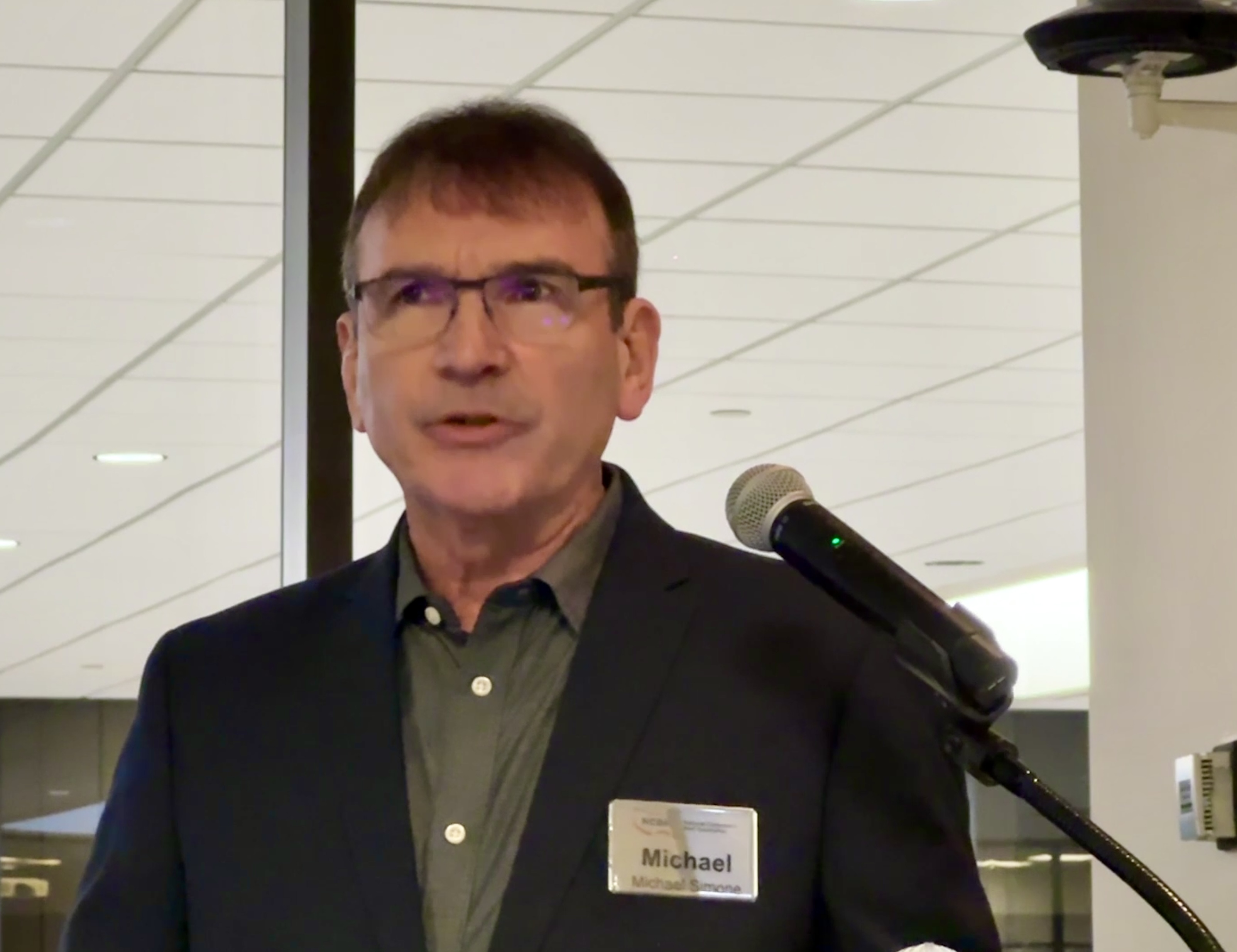
Senior Farm and Ranch Broadcaster, Ron Hays, is visiting with the Executive Director of Market Research and Intelligence for the National Cattlemen's Beef Association, Mike Simone, about the mind of the consumer. Simone works on behalf of the Beef Checkoff and has an extensive understanding of what the consumer is thinking when it comes to beef.

"We have an ongoing survey called the consumer beef tracker," Simone said. "It is online 365 days a year, and we are reaching about 6,000 consumers annually and about 500 per month. We also do a lot of other ad-hoc surveys throughout the year as well."

Many of these surveys, Simone said, cover everything from consumption and shopping trends to perceptions of raised and grown and willingness to pay.

Faced with inflation and COVID-19 factored in, Simone talked about how today's consumer is different from a few years ago

"COVID, obviously shaped a lot of different shopping habits and consumption habits, and a lot of those are continuing now because it is financial constraints," Simone said. "We are seeing more shopping online, which started during Covid, and that has continued to this day as projected to be about 10 percent this year, and 20 percent within five years of the total grocery shopping market."

Up to 44 percent of consumers are communicating that they are buying beef as part of an online beef purchasing experience, Simone said, and many have a great experience doing so.

"Satisfaction levels are in the 75 to 85 percent range, and if they had concerns about freshness or safety or expiration dates or things like that, once they go through that experience and have a good experience with that, it typically generates an incremental purchase or repeats business in that regard," Simone said.

Currently, Simone said two of the biggest factors in consumer purchasing are value and versatility.

"That is one of the strengths that beef provides, is that you can do so much with it," Simone said. "So many different kinds of meals. You can freeze it. We see a lot of that going on as well- people stocking up and freezing beef."

An advantage of using beef, Simone said, is that it is a versatile product that can be used from taco night to steak night. Beef, Simone said, allows the consumer to stretch their dollar during difficult financial times.

Simone also indicated that consumers have started to shift attitudes in regard to frequenting restaurants.

"They are still doing that, but we do see consumers are telling us they are planning to cut back," Simone said. "Even about half are telling us within the next six months to save money, and they are not going to dine out as much."

The percentage of consumers ordering online is strong, Simone said, but it has started to taper back.

To access material on the research Simone refers to, click here.


Click the LISTEN BAR below to listen to Mike Simone talking about the mind of the beef consumer.

The Beef Buzz is a regular feature heard on radio stations around the region on the Radio Oklahoma Network and is a regular audio feature found on this website as well. Click on the LISTEN BAR below for today's show and check out our archives for older Beef Buzz shows covering the gamut of the beef cattle industry today.


Listen to Mike Simone on Beef Consumer Trends

click to play audio or right-click to download

Keeping Cows Maternal- Breeders explore strategies for cattle that 'do it all'

Mon, 31 Oct 2022 09:11:43 CDT Keeping Cows Maternal- Breeders explore strategies for cattle that 'do it all'


Keeping Cows Maternal- Breeders explore strategies for cattle that 'do it all'


A cow that can have a calf all on her own has become so commonplace it's a trait that's easy to take for granted.


"One of our biggest success stories is calving ease. Obviously tracking calving dystocia events at birth and weighing those calves have allowed Angus to have a lot of success in the calving ease debate," says Kelli Retallick-Riley, president of Angus Genetics Inc. (AGI®).


But the "maternal" discussion is far more complex than a healthy live birth, she says, and seedstock producers are using more data and knowledge to create better dams each year.


Retallick-Riley joined breeders Chad Denowh, Gartner-Denowh Angus, and Joe Lowe, Oak Hollow Angus, on The Angus Conversation podcast to discuss what it takes to have cows that work where they live and work further down the line.


"The cows are kind of the employee," Lowe says. "They have to show up. It's our job to take care of the cow. It is the cow's job to take care of the calf." He and his father raise Angus seedstock near Smiths Grove, Kentucky, where they use both genomics and phenotype to select for good mothers.


"If they can walk, if they can slick off and they can breed — those are the three non-starters if they don't in our environment," he says, noting many of his customers deal with fescue pressure.


Both he and Denowh have been early adopters of programs that help turn data into answers, such as the American Angus Association's Maternal Plus record keeping system.


"We want the cows to look the part first and foremost, but they also have to have the structure, the leg structure, the udder structure, to hold up and stay in these herds for a long amount of time," says Denowh, who is the sixth generation on his family's Sidney, Montana, ranch. "Everybody up in this country culls their open cows, and if they don't stay in the herd, they don't make you money."


His family adopted the Angus Herd Improvement Records (AHIR®) program when it came out in the 1970s, so they have more than 50 years of trends to draw on.


"We work a lot with efficiency and raising a good calf in a timely manner," Denowh says.


Both cattlemen work at having a calf crop that is in demand, no matter the intended marketing.


"There's a lot of guys that don't think you can have maternal and carcass together — sure you can, it just takes longer," Denowh says.


Sometimes that means not using the top carcass bull if it doesn't meet certain maternal parameters. He's seen mature cow weights stay moderate while pushing growth and he's made improvements in calving ease while also improving marbling.


"I don't think they're antagonistic at all, any of the traits. I think you just have to find out which traits are most important to you and have a program and stick to it," Denowh says.


The best cows are those you hardly notice.            


"Everyone says the best cow's the one you don't know she's there until she's six, and you look down and she's got two daughters in the herd," Lowe observes.


Retallick-Riley and her team at AGI continues to use the Association's database — the largest single beef breed database in the world — to find ways to better characterize maternal genetics. That will allow them to create additional selection tools, such as cow fertility or regionally adapted expected progeny differences (EPDs).


Since calving ease EPDs came out in 2005, the breed has steadily added additional traits that aid in cow herd selection, such as docility, heifer pregnancy, hair shed, foot angle and claw set.


"We've been spoiled because we have great members who really take care of their cow herd. They cull hard," Retallick-Riley says. "They really get rid of those problem animals in those problem areas, but we're here to help them figure out which animals they need to remove from the herd sooner, and that's really where our genetic tools can come in."


To listen to the whole conversation on maternal function, subscribe to The Angus Conversation on your favorite podcast platform or visit TheAngusConversation.com.


-   Written by Miranda Reiman, Angus Media


Storm System later this Week Could bring Soaking Rains To Oklahoma

Mon, 31 Oct 2022 09:04:21 CDT Storm System later this Week Could bring Soaking Rains To Oklahoma


Storm System later this Week Could bring Soaking Rains To Oklahoma


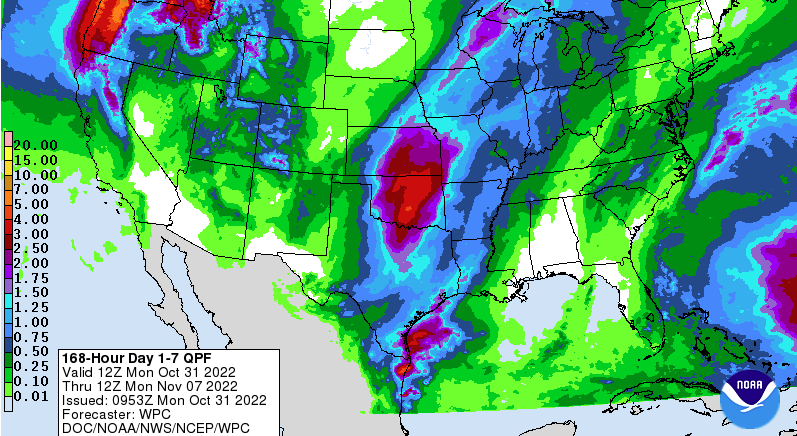
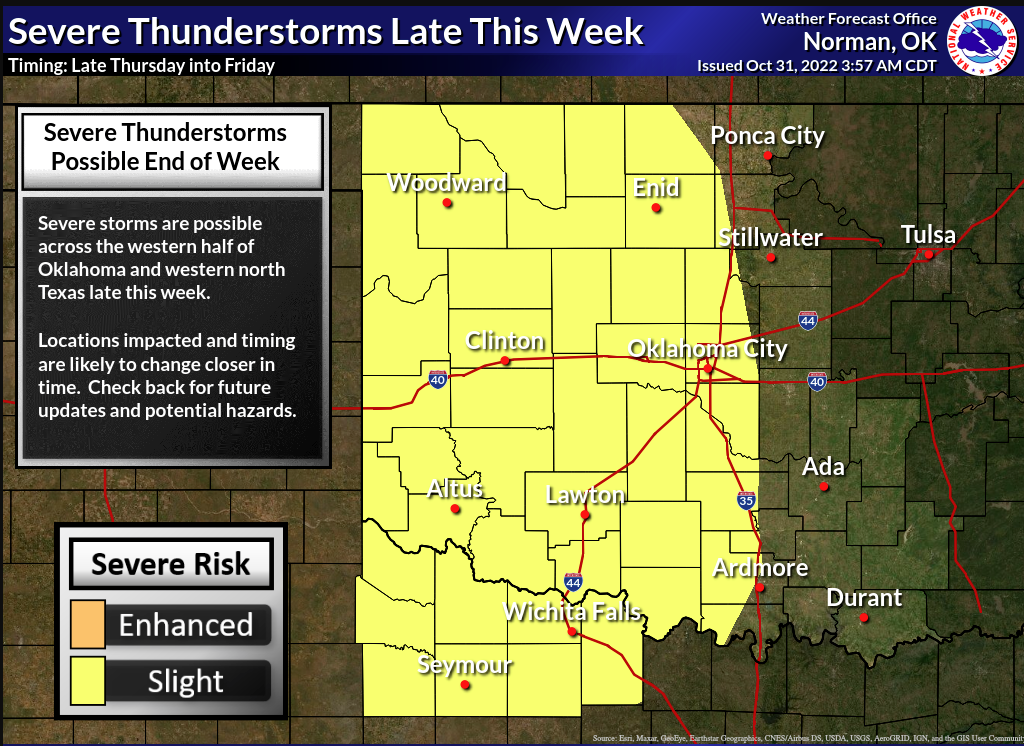
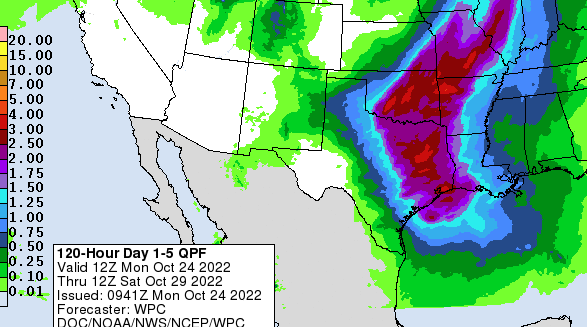
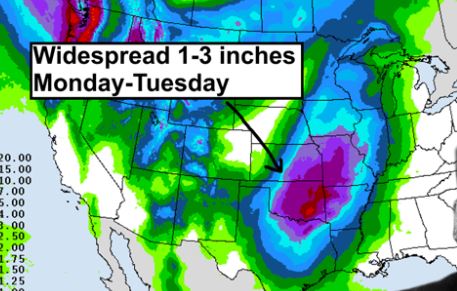
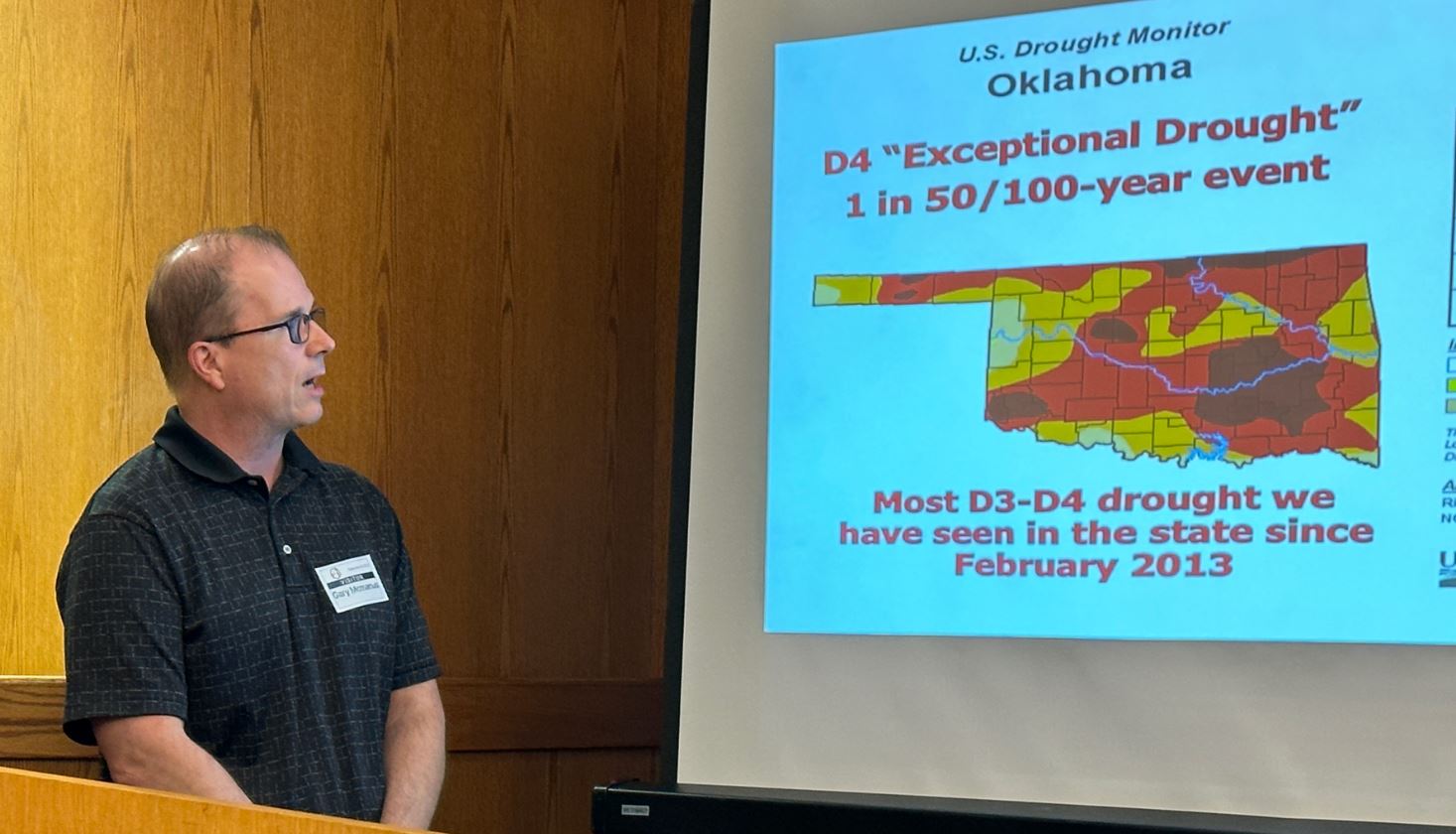
State Climatologist, Gary McManus says we may see some big drought improvements as an upper low moves into the West and kicks up our southerly winds, bringing lots of Gulf Moisture (and warmer air) up our way. McManus says "We'll have a dryline and front to deal with as we get into Thursday and Friday, so a focus for severe storms. Then as that upper low swings out over us, the threat turns more towards heavy rain on Saturday."

Severe potential appears most likely across portions of the TX    Panhandle into northwest OK and western KS beginning Thursday evening into the overnight hours as stronger height falls and increasing ascent spreads eastward into western portions of the central/southern Plains. Forecast soundings indicate thermodynamic and shear profiles favorable for organized cells capable of all severe hazards. On Friday, the surface front is forecast to move slowly eastward across western TX/OK. A combination of heavy rain and severe potential is expected, with greatest relative severe    potential likely focused across southern portions of OK into western/central TX near and south of a surface low.

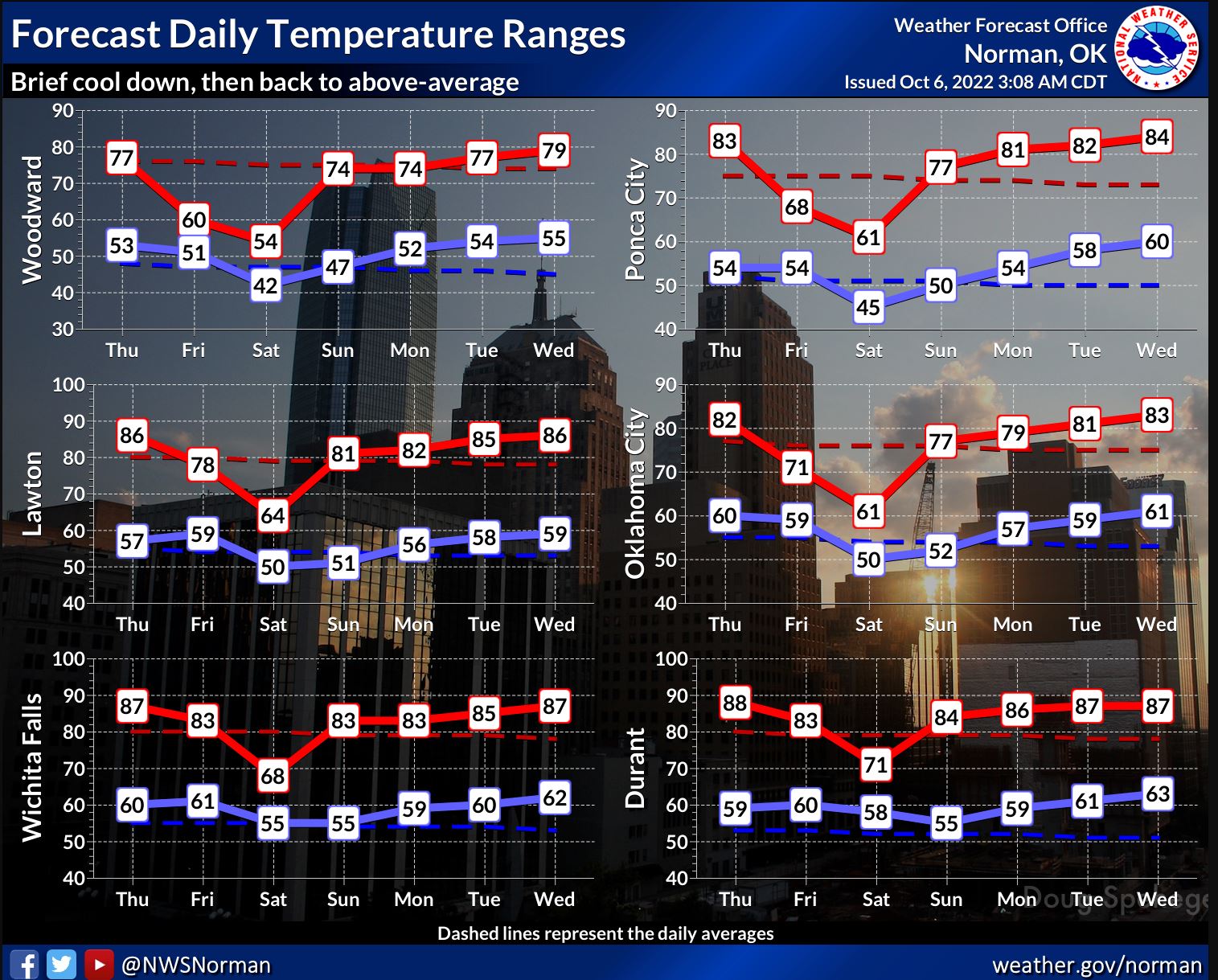
McManus says there's still a lot to sort out, but we will have another week of temperatures 10-15 degrees above normal as that wind machine kicks in, and the added moisture should help us stay pretty warm in the mornings.

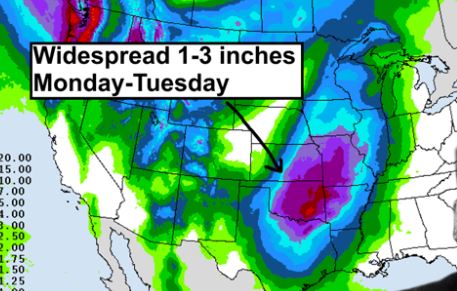
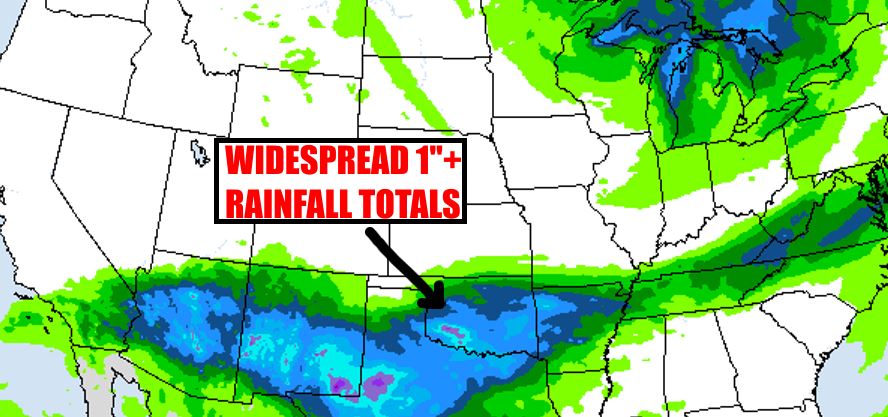
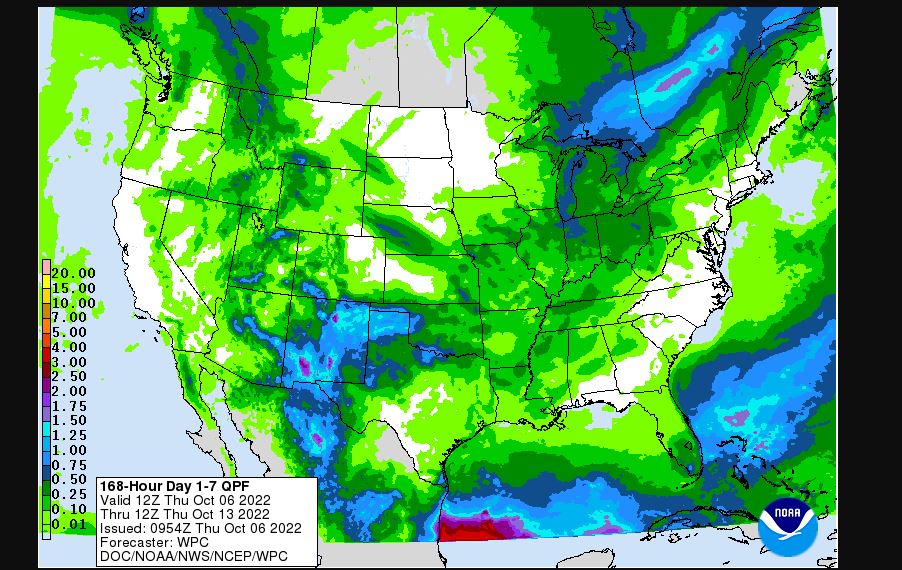
As the storm system moves closer, he says things could and probably will change, but so far the rainfall map looks wet for this weekend possibly bringing some Soaking rain into the state starting Thursday and ending on Sunday.

Current rain projections show widespread 2"-4" of rain which would hopefully bring some Big drought improvement across the state. We may see Severe Weather, so McManus says to prepare for that, but so far maps look hopeful for a good rain.

Keep Praying for Rain!


Storm System later this Week Could bring Soaking Rains To Oklahoma


This Halloween Many Thanks to the Great Pumpkin States!

Mon, 31 Oct 2022 08:54:21 CDT This Halloween Many Thanks to the Great Pumpkin States!


This Halloween Many Thanks to the Great Pumpkin States!


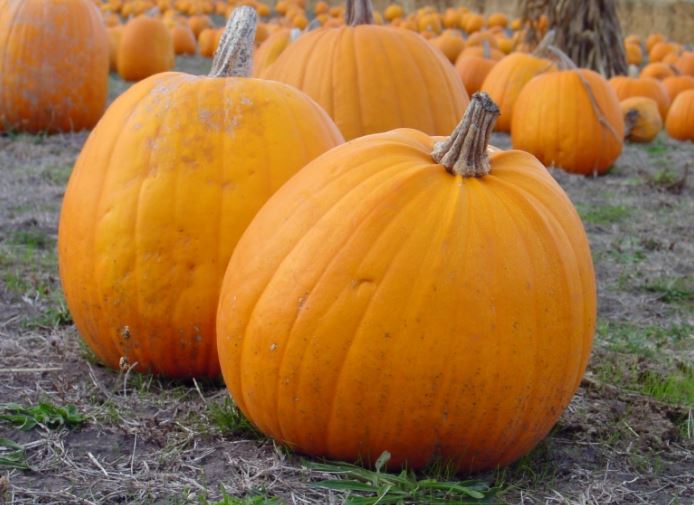
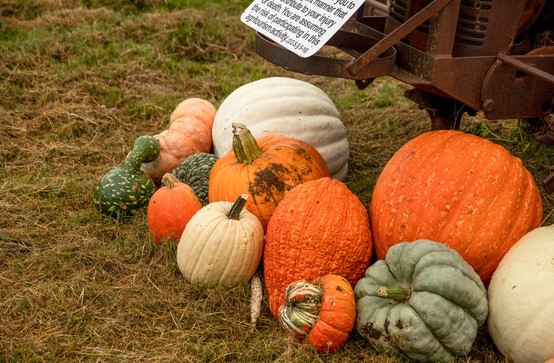
American farmers make sure that Halloween decorations across the country include everyone's favorite orange gourd, annually producing about 1.5 billion pounds of pumpkins on 66,000 acres each year.

Farmers in Illinois grow the most pumpkins of any state, and other top producers include California, Indiana, Michigan, Texas, and Virginia. So, if you're looking for the Great Pumpkin, there's a good chance it came from one of those six states, as 40% of U.S. pumpkin production comes from them.

USDA is tracking weekly pumpkin prices and more at this link


Consider Tax implications when Making business Decisions during Drought

Mon, 31 Oct 2022 08:47:57 CDT Consider Tax implications when Making business Decisions during Drought


Consider Tax implications when Making business Decisions during Drought


As Oklahoma's severe drought continues, many farmers and ranchers are faced with tough business decisions, especially when it comes to selling off livestock earlier than anticipated.

With the withering forage growth and high cost of purchasing and transporting supplemental feed and forage, livestock sale barns around the state and country have seen exponential growth this year in sales numbers as producers are forced to sell some – if not all – of their herd.

Oklahoma State University assistant professor and agriculture and food policy specialist Amy Hagerman advises producers to consider potential tax implications of these and other weather-related business decisions.

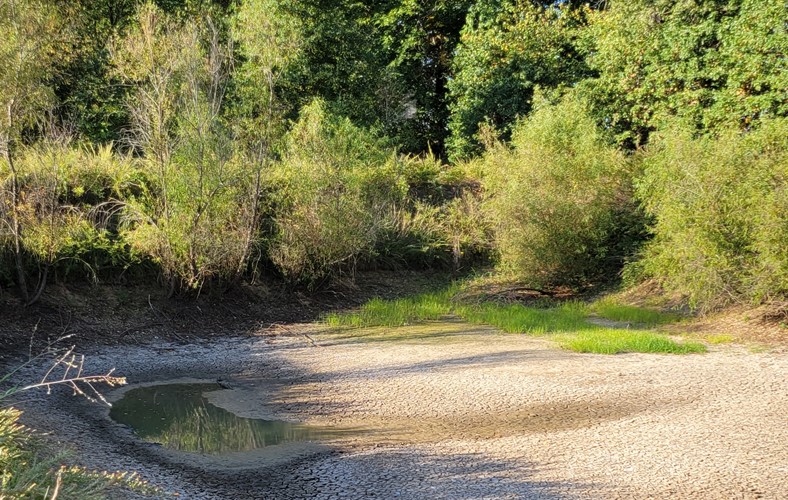
"As producers make a myriad of decisions on their operation in response to the drought, it is important to think about the long term as well as the short term," Hagerman said. "Now is a good time to think about where you want to take your operation in the future. This includes making near-term investments in the operation like a pond clean-out or digging a new pond, but it also includes long-term decisions like how many head to carry forward and what type of genetics to bring in for replacements."

Hagerman said these decisions can have tax implications beyond the 2023 filing season and encourages producers to visit with their tax professionals early.

Click here to see a tax resource for producers written by J.C. Hobbs, OSU associate extension specialist, detailing many hypothetical situations and the tax implications of each.

OSU Extension provides an extensive selection of fact sheets on tax information and other agricultural topics. Click here to view an alphabetical list of fact sheet topics.


Sorghum Checkoff Selects Leadership Sorghum Class VI

Mon, 31 Oct 2022 08:27:38 CDT Sorghum Checkoff Selects Leadership Sorghum Class VI


Sorghum Checkoff Selects Leadership Sorghum Class VI


The United Sorghum Checkoff Program selected 15 members to Leadership Sorghum Class VI, a program designed to develop the next generation of sorghum leaders and industry advocates.


Leadership Sorghum Class VI will consist of 15 farmers from 8 states. Those selected include:

• Jimmy Diamond from Akron, Colorado
• Jeremiah Nicholson from Dodge City, Kansas
• Clint France from Scott City, Kansas
• Brad Haynes from Hays, Kansas
• Henry Martin III from Texico, New Mexico
• Lee Dunn IV from Edenton, North Carolina
• Brad Brainard from Enid, Oklahoma
• Ashley Tucker from Enid, Oklahoma
• David Hunsberger from Mifflintown, Pennsylvania
• Hunter Bevill from Claude, Texas
• Nicole Johnson from Canyon, Texas
• David Barrett from Sinton, Texas
• Trey Beyer III from Portland, Texas
• Jessica Robertson from Robstown, Texas
• Joel Huesby from Touchet, Washington


Participants of the Leadership Sorghum program will begin their experience with Session I in December at the annual Sorghum Checkoff board meeting. For more information about the Leadership Sorghum program, visit leadsorghum.com.


Dave Nichols Receives Innovation and Excellence Faculty Award

Mon, 31 Oct 2022 08:22:40 CDT Dave Nichols Receives Innovation and Excellence Faculty Award


Dave Nichols Receives Innovation and Excellence Faculty Award


Dave Nichols, K-State University Animal Science & Industry professor emeritus, has been awarded the 2022 Mark and Eva Gardiner Innovation and Excellence Faculty award. Arguably one of the most recognizable "faces of K-State", Nichols' exemplary 40-year career as an educator taught more than 15,000 students. In addition to his responsibilities as a teaching professional, he advised nearly 2,800 students throughout his tenure.


Nichols was raised on a commercial beef, swine and farming operation in Indiana. He earned a bachelor's degree from Purdue University and master's and doctorate degrees from K-State. In 1981, Nichols was hired as a K-State extension specialist. In 1983, he transitioned to a teaching and research position. Dave Nichols served as the Animal Science and Industry undergraduate teaching coordinator from 1998 until June 2021. Throughout his career, Dave Nichols has been recognized for outstanding achievements and his altruistic contributions to K-State for more than four decades.


Mark and Eva Gardiner, who with their family own and operate Gardiner Angus Ranch near Ashland, Kansas, established the award in 2019 to recognize faculty in the K-State College of Agriculture who are excelling through innovative teaching, research or extension that positively impact the global food system. Mark Gardiner made the following comments. "Recognizing Dave Nichols with this award takes into consideration professional and personal friendships that span two generations. I first met Dave as a K-State student. He also taught and advised our sons. Gardiner Angus Ranch has partnered on many beef industry projects in the past 40 years, beginning with Dave's relationship with Henry Gardiner. Dave has made it his life's mission to challenge students to think, act and pursue careers with the goal to make the beef business better. Dave Nichols is the perfect example of why Eva and I created this award. His innovations and teaching excellence are unparalleled. His commitment to agriculture, loyalty to Kansas State University and passion for youth are unmatched. His friendship over decades is priceless."


Gardiner Angus Ranch is a family-owned and operated beef operation that produces registered and commercial Angus cattle. The original ranch was homesteaded near Ashland, Kansas, in 1885 by Henry Gardiner's grandfather. Today, Gardiner Angus Ranch is one of the largest registered Angus seedstock and commercial operations in America and continues to make genetic advancements using only artificial insemination and embryo transfer.

Story Credit: Drovers
   

John Deere updates 7R Tractor Steering Offerings

Mon, 31 Oct 2022 09:20:11 CDT John Deere updates 7R Tractor Steering Offerings


John Deere updates 7R Tractor Steering Offerings


John Deere announced updates and new options for its lineup of 7R Tractors that improve operator comfort, ride and driving performance during transport. Updates include new Reactive Steering and increased steering capacity.


These mid-year updates for 2023 7R Tractors benefit commercial hay growers, livestock producers, and row-crop and small-grains farmers. They are an ideal size to maneuver around tight spaces such as barnyards or they can be easily paired with John Deere planters or tillage tools for work in the field.


"All 7R customers will benefit from the increased steering capacity thanks to the updated, 50% larger hydraulic components in the steering system," said Ryan Jardon, marketing manager for John Deere. "Customers using larger front tires or heavy front implements, such as loaders or mowers, will appreciate the tractor's ability to maneuver around in tight quarters and at low speeds."


When compared to previous 7R models, Jardon said the improvements make it easier to use them to cut hay, and to move material when equipped with a John Deere loader. "They also provide excellent maneuverability that comes in handy when cleaning livestock pens and barns," Jardon said. In addition, 7R Tractors can be equipped to operate triple-mounted mower conditioners and large square balers that require extra PTO and hydraulic power.


"Customers who use these tractors for transport purposes, such as hauling manure or forage, told us they wanted their tractor to drive more like their car or truck," Jardon said. New, optional Reactive Steering is available and provides a modern automotive experience on the road that makes it easier to drive in a straight line with less effort. This is the first time this option is being offered on John Deere Tractors. Reactive Steering assists in returning the tractor's steering wheel to neutral (center/straight ahead),providing an enhanced transport and roading experience for the operator.


Other available steering options include ActiveCommand SteeringTM 2 (ACS2), which reduces the amount of steering input required in field applications, improving operator comfort and preventing oversteering when a quick steering reaction is made.


Eight models are available from 210- to 350-rated engine horsepower and include the 7R 210, 7R 230, 7R 250, 7R 270, 7R 290, 7R 310, 7R 330 and 7R 350.


John Deere also has partnered with PTG to offer a central tire inflation system for select 7R Tractors as an allied agreement. This system helps operators ensure tire pressure is optimized, regardless of the task at hand: e.g., higher pressures on the road, and lower pressures in the field.


Updated 7R Tractors and options are now available to order. For more information about these updates, visit John.Deere.com or your local John Deere dealer.


Dairy Defined Podcast: Chairman Mooney Highlights Dairy's Strengths

Mon, 31 Oct 2022 08:14:51 CDT Dairy Defined Podcast: Chairman Mooney Highlights Dairy's Strengths


Dairy Defined Podcast: Chairman Mooney Highlights Dairy's Strengths


NMPF Chairman Randy Mooney, a dairy farmer outside Rogersville, MO, said the spirit of collaboration and facing challenges head on, embodied in the cooperative model, will give dairy strength in the years to come. He spoke on Oct. 25 at NMPF's annual meeting in Denver.


"This is an exciting time in our industry," Mooney said. "What we do on our farms and in our communities is important, how we do it is important, and it's important that we stay at the forefront of this revolution, never settling for status quo, thinking differently, and seizing the opportunities."


For more about the value cooperatives provide, NMPF has a page here. The full podcast is here. You can also find the podcast on Apple Podcasts, Spotify, Google Podcasts and Amazon Music.


NCBA's Beltway Beef Podcast: The Inside Scoop on Beef Sustainability

Mon, 31 Oct 2022 08:11:23 CDT NCBA's Beltway Beef Podcast: The Inside Scoop on Beef Sustainability


NCBA's Beltway Beef Podcast: The Inside Scoop on Beef Sustainability


Each week, NCBA's Beltway Beef brings you the latest policy news affecting the U.S. cattle and beef industry. Hear from subject-matter experts, producers, and industry leaders on the topics that impact the business viability of farms and ranches across the country.


On this episode, NCBA Chief Counsel Mary-Thomas Hart and Senior Director of Sustainability Dr. Samantha Werth join to discuss the science that confirms the cattle industry's sustainability. Thanks to generations of continuous improvement, the cattle industry has substantially reduced greenhouse gas emissions while more efficiently providing a nutritious protein and supporting the economy in rural communities. Hart explains how the cattle industry's sustainable practices connect to advocacy in Washington, while Werth explains all the environmental, economic, and societal benefits of beef. Learn more about the cattle industry's sustainability at ncba.org/sustainability.


Listen to the podcast by clicking here.


Your Central Region Vice President of the National FFA- Karstyn Cantrell of the Skiatook FFA Chapter

Sun, 30 Oct 2022 20:05:41 CDT Your Central Region Vice President of the National FFA- Karstyn Cantrell of the Skiatook FFA Chapter


Your Central Region Vice President of the National FFA- Karstyn Cantrell of the Skiatook FFA Chapter

Click here to listen to audio


Karstyn Cantrell of the Skiatook FFA Chapter heard her name called on Saturday afternoon in the final moments of the 2022 National FFA Convention and Expo- and that meant that she will be one of six national officers for the National FFA organization over the next twelve months. Cantrell was selected this week to serve as the Central Region National Vice President of the 580,000 member organization.

Each year during the National FFA Convention and Expo, six students are elected by delegates to represent the organization as national officers. Delegates select a President, Secretary and Vice Presidents from the country's Central, Eastern, Southern and Western Regions.
Throughout their year of service to the National FFA Organization, the officers will interact with business and industry leaders; corporate sponsors; government and educational officials; state FFA leaders; the general public and thousands of FFA members. The team will led personal growth and leadership training conferences for FFA members throughout the country and help set policies that will guide the future of FFA and the next generation of leaders.

After the final gavel of the convention- Senior farm and ranch broadcaster Ron Hays talked for a few moments with Karstyn- who said her heart was still beating fast from hearing her name called in the final conventions General Session. She added that she felt at peace throughout the week as she engaged with the nominating committee in a variety of settings. She had the advantage over other candidates in that she was a national officer candidate last year- and that experience allowed her to understand that she needed to prepare for a poential year of service instead of just preparing for the process of being interviewed and compared to the other candidates.

Cantrell says that she was able to show the Nominating Committee the "real me." As for who that is- "I told the nominating committee that I'm Karstyn and that when you look at me you see someone who production agriculture and the ag industry has shaped into someone who is outgoing and professional and polished but also poised. You know, I walk with that purpose and that humble attitude because of the way that ag industry and the FFA have shaped me."

She told Hays earlier that growing up on a fourth-generation cow-calf operation, that she feels lucky to have deep family roots within the agriculture industry. The transition to being involved in the FFA at a young age, she added, was seamless.


Early on in her FFA career, Cantrell said she learned the value of saying "yes" after listening to advice from a peer in her chapter.


"She told me to simply say yes," Cantrell said. "Anytime there was a sign-up on the board asking if we wanted to participate in contests or camps or conventions, I always took that piece of advice and said 'yes.'"


You can hear their complete conversation by clicking on the Listen Link below.


You can go back to just before the National Convention and hear their earlier conversation and read more by clicking here.


Click here for the National FFA release detailing information of all six national officers that will be serving together over the next year- taking a year off from college in the process.


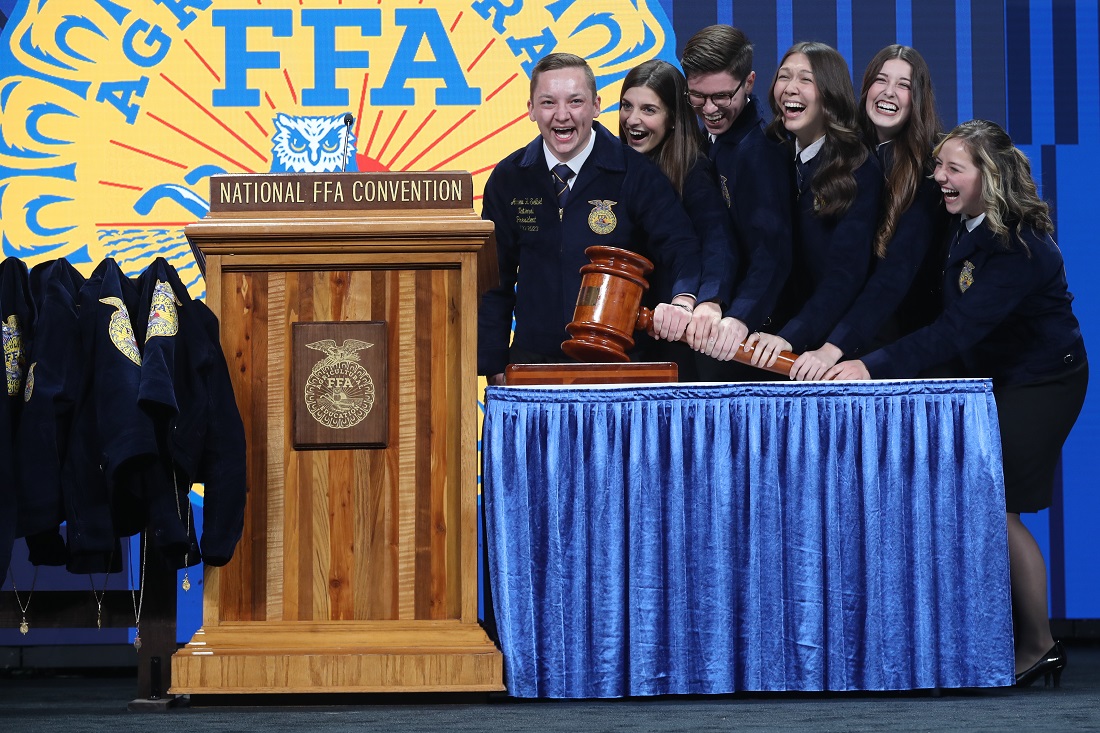
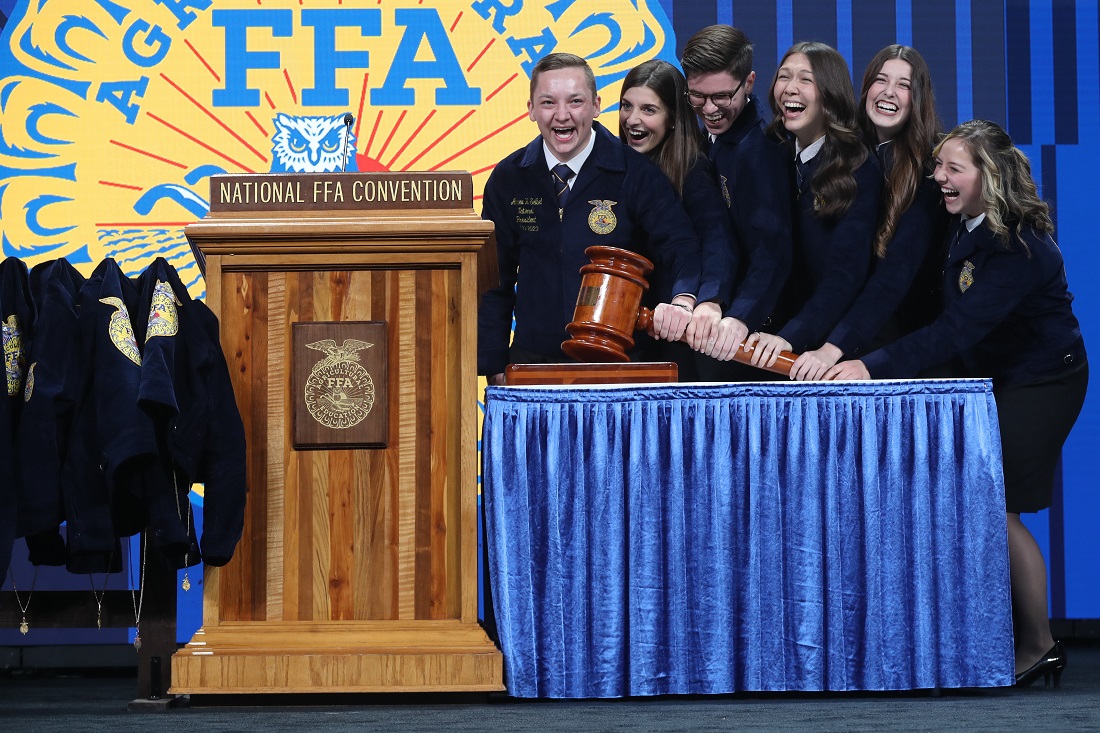
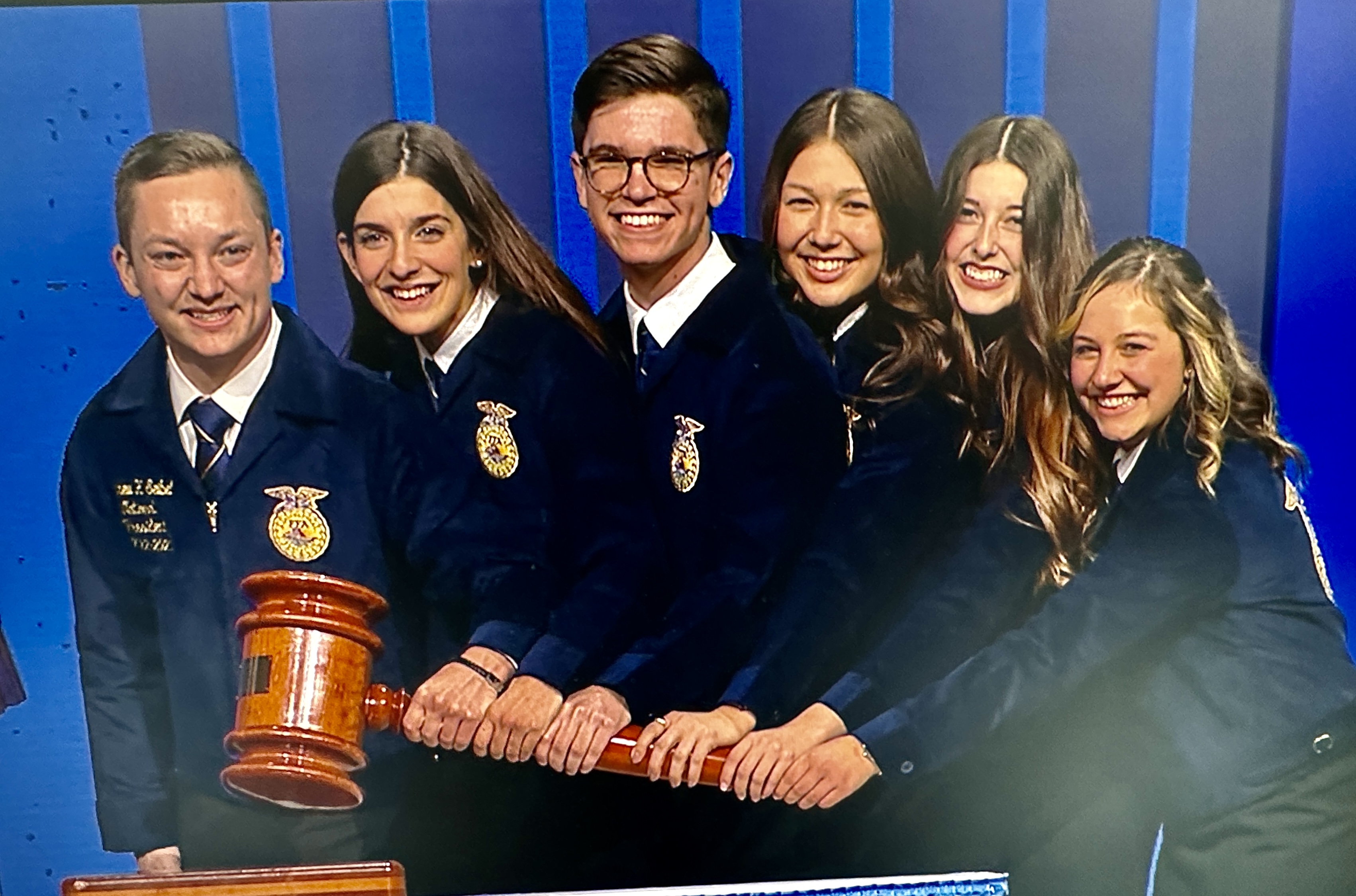
The picture above shows Karstyn Cantrell second from the right as the new National Officers hold the gavel.


Ron Hays talks with Karstyn Cantrell about being elected as a National Officer of the FFA

click to play audio or right-click to download

Your Central Region Vice President of the National FFA- Karstyn Cantrell of the Skiatook FFA Chapter

Sun, 30 Oct 2022 20:05:37 CDT


Your Central Region Vice President of the National FFA- Karstyn Cantrell of the Skiatook FFA Chapter

Click here to listen to audio


Karstyn Cantrell of the Skiatook FFA Chapter heard her name called on Saturday afternoon in the final moments of the 2022 National FFA Convention and Expo- and that meant that she will be one of six national officers for the National FFA organization over the next twelve months. Cantrell was selected this week to serve as the Central Region National Vice President of the 580,000 member organization.

Each year during the National FFA Convention and Expo, six students are elected by delegates to represent the organization as national officers. Delegates select a President, Secretary and Vice Presidents from the country's Central, Eastern, Southern and Western Regions.
Throughout their year of service to the National FFA Organization, the officers will interact with business and industry leaders; corporate sponsors; government and educational officials; state FFA leaders; the general public and thousands of FFA members. The team will led personal growth and leadership training conferences for FFA members throughout the country and help set policies that will guide the future of FFA and the next generation of leaders.

After the final gavel of the convention- Senior farm and ranch broadcaster Ron Hays talked for a few moments with Karstyn- who said her heart was still beating fast from hearing her name called in the final conventions General Session. She added that she felt at peace throughout the week as she engaged with the nominating committee in a variety of settings. She had the advantage over other candidates in that she was a national officer candidate last year- and that experience allowed her to understand that she needed to prepare for a poential year of service instead of just preparing for the process of being interviewed and compared to the other candidates.

Cantrell says that she was able to show the Nominating Committee the "real me." As for who that is- "I told the nominating committee that I'm Karstyn and that when you look at me you see someone who production agriculture and the ag industry has shaped into someone who is outgoing and professional and polished but also poised. You know, I walk with that purpose and that humble attitude because of the way that ag industry and the FFA have shaped me."

She told Hays earlier that growing up on a fourth-generation cow-calf operation, that she feels lucky to have deep family roots within the agriculture industry. The transition to being involved in the FFA at a young age, she added, was seamless.


Early on in her FFA career, Cantrell said she learned the value of saying "yes" after listening to advice from a peer in her chapter.


"She told me to simply say yes," Cantrell said. "Anytime there was a sign-up on the board asking if we wanted to participate in contests or camps or conventions, I always took that piece of advice and said 'yes.'"


You can hear their complete conversation by clicking on the Listen Link below.


You can go back to just before the National Convention and hear their earlier conversation and read more by clicking here.


Click here for the National FFA release detailing information of all six national officers that will be serving together over the next year- taking a year off from college in the process.


The picture above shows Karstyn Cantrell second from the right as the new National Officers hold the gavel.


Stillwater FFA Claims Five Champions in National Agriscience Fair- More Than Any Other Chapter or State in the US

Sun, 30 Oct 2022 19:58:17 CDT Stillwater FFA Claims Five Champions in National Agriscience Fair- More Than Any Other Chapter or State in the US


Stillwater FFA Claims Five Champions in National Agriscience Fair- More Than Any Other Chapter or State in the US


The Stillwater FFA Chapter captured more National Championships in the National FFA Agriscience Fair i Indianapolis then any other Chapter in the United States- and the five National Championships that were claimed by Stillwater make Oklahoma the top state in the nation in national winners in the Agriscience Fair. Behind Oklahoma- Florida and Texas each claimed four National titles here in 2022.


The National FFA Agriscience Fair recognizes students who gain real-world, hands-on experiences in agricultural enterprises. Students use scientific principles and emerging technologies to solve complex problems related to agriculture, food and natural resources. The agriscience fair is for middle and high school students. Students compete in one of six categories in the agriscience fair and under one of the six divisions- either individually or in a team.


The five National winners that represented the Stillwater FFA Chapter include:


Food Products and Processing Systems: Division 1
Esther VanOverbeke of the Stillwater FFA Chapter in Oklahoma (Pictured above)


Food Products and Processing Systems: Division 4
Trinity Blocsh and Aubrie McEndoo of the Stillwater FFA Chapter in Oklahoma


Power, Structural and Technical Systems: Division 3
Kaylee McAlister of the Stillwater FFA Chapter of Oklahoma


Social Science: Division 1
Lauren Crosthwait of the Stillwater FFA Chapter in Oklahoma


Social Science: Division 6
Emily Merideth and Emma Nelson of the Stillwater FFA Chapter in Oklahoma


These eight national award winners were a part of the some 2,000 Oklahoma FFA members that were a part of the Oklahoma FFA delegation at the 2022 National FFA Convention and Expo. Click here to learn more about the Oklahoma FFA Association.


Stillwater FFA Claims Five Champions in National Agriscience Fair- More Than Any Other Chapter or State in the US

Sun, 30 Oct 2022 19:58:14 CDT


Stillwater FFA Claims Five Champions in National Agriscience Fair- More Than Any Other Chapter or State in the US


The Stillwater FFA Chapter captured more National Championships in the National FFA Agriscience Fair i Indianapolis then any other Chapter in the United States- and the five National Championships that were claimed by Stillwater make Oklahoma the top state in the nation in national winners in the Agriscience Fair. Behind Oklahoma- Florida and Texas each claimed four National titles here in 2022.


The National FFA Agriscience Fair recognizes students who gain real-world, hands-on experiences in agricultural enterprises. Students use scientific principles and emerging technologies to solve complex problems related to agriculture, food and natural resources. The agriscience fair is for middle and high school students. Students compete in one of six categories in the agriscience fair and under one of the six divisions- either individually or in a team.


The five National winners that represented the Stillwater FFA Chapter include:


Food Products and Processing Systems: Division 1
Esther VanOverbeke of the Stillwater FFA Chapter in Oklahoma (Pictured above)


Food Products and Processing Systems: Division 4
Trinity Blocsh and Aubrie McEndoo of the Stillwater FFA Chapter in Oklahoma


Power, Structural and Technical Systems: Division 3
Kaylee McAlister of the Stillwater FFA Chapter of Oklahoma


Social Science: Division 1
Lauren Crosthwait of the Stillwater FFA Chapter in Oklahoma


Social Science: Division 6
Emily Merideth and Emma Nelson of the Stillwater FFA Chapter in Oklahoma


These eight national award winners were a part of the some 2,000 Oklahoma FFA members that were a part of the Oklahoma FFA delegation at the 2022 National FFA Convention and Expo. Click here to learn more about the Oklahoma FFA Association.


Meet Your 2022 National Proficiency Award Winner in Beef Production- Luke Gallagher of Altus FFA

Sun, 30 Oct 2022 13:28:27 CDT Meet Your 2022 National Proficiency Award Winner in Beef Production- Luke Gallagher of Altus FFA


Meet Your 2022 National Proficiency Award Winner in Beef Production- Luke Gallagher of Altus FFA

Click here to listen to audio


Two Oklahoma FFA Members brought home National Championships in the Agricultural Proficiency Awards as they were announced at the National FFA Convention in Indianapolis during the final week of October.


Luke Gallagher of the Altus FFA Chapter in Oklahoma began his supervised agricultural experience by purchasing 15 cows and two bulls, raising the calves, and selling them. He applied to the U.S. Department of Agriculture Beginning Farmer Program in 2021, helping him purchase 320 acres and 361 backgrounded stocker-steers. Knowing that he bears for the financial responsibility for this operation has elevated his interest in market forces, costs, expenses, and management practices.


The Agricultural Proficiency Awards honor FFA members who, through their Supervised Agricultural Experiences have developed specialized skills that they can apply toward their future careers. Students can compete for awards in 47 areas covering everything from Agricultural Communications to Wildlife Management. Each award area has two categories, placement and entrepreneurship- although in some award area- those two categories are combined.


Placement proficiency awards are given to those whose SAEs are related to employment, apprenticeships, or internships at an agribusiness or agriculture-related organization. Entrepreneurship proficiency awards are given to those whose SAEs are related to ownership of an agribusiness or agriculture-related organization. Proficiency awards are given out at the local, state and national levels.


The awards were given out in Indianapolis during the 95th National FFA Convention & Expo, with the winners announced during onstage ceremonies in several of the General Sessions at Lucas Oil Stadium


After receiving the national championship award- Luke talked with FFA broadcast intern Laura Wuebker about the contest and his success. Listen to Luke Gallagher by clicking on the link below.


Luke Gallagher was one of more than 2,000 Oklahoma FFA members that were a part of the National FFA Convention and Expo in Indianapolis the last week of October. Learn more about Oklahoma FFA by clicking here for the state association website.


Laura Wuebkerr talks with national winner Luke Gallagher in Indy at National FFA Convention

click to play audio or right-click to download

Meet Your 2022 National Proficiency Award Winner in Beef Production- Luke Gallagher of Altus FFA

Sun, 30 Oct 2022 13:28:23 CDT


Meet Your 2022 National Proficiency Award Winner in Beef Production- Luke Gallagher of Altus FFA

Click here to listen to audio


Two Oklahoma FFA Members brought home National Championships in the Agricultural Proficiency Awards as they were announced at the National FFA Convention in Indianapolis during the final week of October.


Luke Gallagher of the Altus FFA Chapter in Oklahoma began his supervised agricultural experience by purchasing 15 cows and two bulls, raising the calves, and selling them. He applied to the U.S. Department of Agriculture Beginning Farmer Program in 2021, helping him purchase 320 acres and 361 backgrounded stocker-steers. Knowing that he bears for the financial responsibility for this operation has elevated his interest in market forces, costs, expenses, and management practices.


The Agricultural Proficiency Awards honor FFA members who, through their Supervised Agricultural Experiences have developed specialized skills that they can apply toward their future careers. Students can compete for awards in 47 areas covering everything from Agricultural Communications to Wildlife Management. Each award area has two categories, placement and entrepreneurship- although in some award area- those two categories are combined.


Placement proficiency awards are given to those whose SAEs are related to employment, apprenticeships, or internships at an agribusiness or agriculture-related organization. Entrepreneurship proficiency awards are given to those whose SAEs are related to ownership of an agribusiness or agriculture-related organization. Proficiency awards are given out at the local, state and national levels.


The awards were given out in Indianapolis during the 95th National FFA Convention & Expo, with the winners announced during onstage ceremonies in several of the General Sessions at Lucas Oil Stadium


After receiving the national championship award- Luke talked with FFA broadcast intern Laura Wuebker about the contest and his success. Listen to Luke Gallagher by clicking on the link below.


Luke Gallagher was one of more than 2,000 Oklahoma FFA members that were a part of the National FFA Convention and Expo in Indianapolis the last week of October. Learn more about Oklahoma FFA by clicking here for the state association website.


Meet Your 2022 National Proficiency Award Winner in Agriscience Animal Systems- Raigan McKee of Oologah FFA

Sun, 30 Oct 2022 13:29:35 CDT Meet Your 2022 National Proficiency Award Winner in Agriscience Animal Systems- Raigan McKee of Oologah FFA


Meet Your 2022 National Proficiency Award Winner in Agriscience Animal Systems- Raigan McKee of Oologah FFA

Click here to listen to audio


Two Oklahoma FFA Members brought home National Championships in the Agricultural Proficiency Awards as they were announced at the National FFA Convention in Indianapolis during the final week of October.


Raigan McKee of the Oologah FFA Chapter in Oklahoma has spent three years researching the use of specific treatments to improve biosecurity measures taken by livestock producers. She began her research after visiting a commercial hog operation and became interested in the measures taken to keep the facility free from infectious diseases. She compared a commercial grade disinfectant against regular soap and water to determine if there was a significant impact on the bacteria collected from samples.


The Agricultural Proficiency Awards honor FFA members who, through their Supervised Agricultural Experiences have developed specialized skills that they can apply toward their future careers. Students can compete for awards in 47 areas covering everything from Agricultural Communications to Wildlife Management. Each award area has two categories, placement and entrepreneurship- although in some award area- those two categories are combined.


Placement proficiency awards are given to those whose SAEs are related to employment, apprenticeships, or internships at an agribusiness or agriculture-related organization. Entrepreneurship proficiency awards are given to those whose SAEs are related to ownership of an agribusiness or agriculture-related organization. Proficiency awards are given out at the local, state and national levels.


The awards were given out in Indianapolis during the 95th National FFA Convention & Expo, with the winners announced during onstage ceremonies in several of the General Sessions at Lucas Oil Stadium


After receiving the national championship award- Raigin talked with FFA broadcast intern Michelle Stangler about the contest and her success. Listen to Raigin McKee by clicking on the link below.


McKee was one of more than 2,000 Oklahoma FFA members that were a part of the National FFA Convention and Expo in Indianapolis the last week of October. Learn more about Oklahoma FFA by clicking here for the state association website.


Michelle Stangler talks with national winner Raigan McKee in Indy at National FFA Convention

click to play audio or right-click to download

Meet Your 2022 National Proficiency Award Winner in Agriscience Animal Systems- Raigan McKee of Oologah FFA

Sun, 30 Oct 2022 13:29:31 CDT


Meet Your 2022 National Proficiency Award Winner in Agriscience Animal Systems- Raigan McKee of Oologah FFA

Click here to listen to audio


Two Oklahoma FFA Members brought home National Championships in the Agricultural Proficiency Awards as they were announced at the National FFA Convention in Indianapolis during the final week of October.


Raigan McKee of the Oologah FFA Chapter in Oklahoma has spent three years researching the use of specific treatments to improve biosecurity measures taken by livestock producers. She began her research after visiting a commercial hog operation and became interested in the measures taken to keep the facility free from infectious diseases. She compared a commercial grade disinfectant against regular soap and water to determine if there was a significant impact on the bacteria collected from samples.


The Agricultural Proficiency Awards honor FFA members who, through their Supervised Agricultural Experiences have developed specialized skills that they can apply toward their future careers. Students can compete for awards in 47 areas covering everything from Agricultural Communications to Wildlife Management. Each award area has two categories, placement and entrepreneurship- although in some award area- those two categories are combined.


Placement proficiency awards are given to those whose SAEs are related to employment, apprenticeships, or internships at an agribusiness or agriculture-related organization. Entrepreneurship proficiency awards are given to those whose SAEs are related to ownership of an agribusiness or agriculture-related organization. Proficiency awards are given out at the local, state and national levels.


The awards were given out in Indianapolis during the 95th National FFA Convention & Expo, with the winners announced during onstage ceremonies in several of the General Sessions at Lucas Oil Stadium


After receiving the national championship award- Raigin talked with FFA broadcast intern Michelle Stangler about the contest and her success. Listen to Raigin McKee by clicking on the link below.


McKee was one of more than 2,000 Oklahoma FFA members that were a part of the National FFA Convention and Expo in Indianapolis the last week of October. Learn more about Oklahoma FFA by clicking here for the state association website.


Caleb Horne of Morrison FFA Wins National Championship in Prepared Public Speaking at 2022 National FFA Convention

Sun, 30 Oct 2022 12:53:27 CDT Caleb Horne of Morrison FFA Wins National Championship in Prepared Public Speaking at 2022 National FFA Convention


Caleb Horne of Morrison FFA Wins National Championship in Prepared Public Speaking at 2022 National FFA Convention

Click here to listen to audio


Caleb Horne from the Morrison FFA Chapter in Oklahoma was named the National Champion in the Prepared Public Speaking LDE Contest with his speech about carbon sequestration. Horne believes that it is imporant to educate farmers and consumers about this topic.


The top four individuals received cash awards to recognize their success in the event. The prepared public speaking LDE is designed to recognize outstanding FFA members for their ability to prepare and present a factual speech on a specific agricultural issue in a well thought-out and logical manner in a competitive setting. Members prepare and deliver an eight to ten minute speech from memory and respond to five minutes of questions. The event is just one way FFA members can develop their ability to communicate in a powerful, organized and professional manner.

Horne won the state of Oklahoma's Prepared Public Speaking Contest at the Oklahoma FFA Convention in Tulsa this past spring- earning him the right to represent Oklahoma at the National Convention in Indianapolis. He spoke on the efforts in the US to provide farmers financial incentives in the carbon sequestration arena. You can listen to Caleb Horne's presenation as one of the Final Four speakers at the National Level this past week. Click on the listen link below.


Listen to Caleb Horne give his speech and answer questions in the Final 4 at Indy

click to play audio or right-click to download

Caleb Horne of Morrison FFA Wins National Championship in Prepared Public Speaking at 2022 National FFA Convention

Sun, 30 Oct 2022 12:53:23 CDT


Caleb Horne of Morrison FFA Wins National Championship in Prepared Public Speaking at 2022 National FFA Convention

Click here to listen to audio


Caleb Horne from the Morrison FFA Chapter in Oklahoma was named the National Champion in the Prepared Public Speaking LDE Contest with his speech about carbon sequestration. Horne believes that it is imporant to educate farmers and consumers about this topic.


The top four individuals received cash awards to recognize their success in the event. The prepared public speaking LDE is designed to recognize outstanding FFA members for their ability to prepare and present a factual speech on a specific agricultural issue in a well thought-out and logical manner in a competitive setting. Members prepare and deliver an eight to ten minute speech from memory and respond to five minutes of questions. The event is just one way FFA members can develop their ability to communicate in a powerful, organized and professional manner.

Horne won the state of Oklahoma's Prepared Public Speaking Contest at the Oklahoma FFA Convention in Tulsa this past spring- earning him the right to represent Oklahoma at the National Convention in Indianapolis. He spoke on the efforts in the US to provide farmers financial incentives in the carbon sequestration arena. You can listen to Caleb Horne's presenation as one of the Final Four speakers at the National Level this past week. Click on the listen link below.


Karstyn Cantrell of Skiatook FFA Elected One of Six National Officers of the FFA for 2022-23

Sat, 29 Oct 2022 15:00:06 CDT Karstyn Cantrell of Skiatook FFA Elected One of Six National Officers of the FFA for 2022-23


Karstyn Cantrell of Skiatook FFA Elected One of Six National Officers of the FFA for 2022-23

Click here to listen to audio


Karstyn Cantrell of the Skiatook FFA Chapter heard her name called on Saturday afternoon in the final moments of the 2022 National FFA Convention and Expo- and that meant that she will be one of six national officers for the National FFA organization over the next twelve months. Cantrell was selected this week to serve as the Central Region National Vice President of the 580,000 member organization.

Each year during the National FFA Convention and Expo, six students are elected by delegates to represent the organization as national officers. Delegates select a President, Secretary and Vice Presidents from the country's Central, Eastern, Southern and Western Regions.
Throughout their year of service to the National FFA Organization, the officers will interact with business and industry leaders; corporate sponsors; government and educational officials; state FFA leaders; the general public and thousands of FFA members. The team will led personal growth and leadership training conferences for FFA members throughout the country and help set policies that will guide the future of FFA and the next generation of leaders.

After the final gavel of the convention- Senior farm and ranch broadcaster Ron Hays talked for a few moments with Karstyn- who said her heart was still beating fast from hearing her name called in the final conventions General Session. She added that she felt at peace throughout the week as she engaged with the nominating committee in a variety of settings. She had the advantage over other candidates in that she was a national officer candidate last year- and that experience allowed her to understand that she needed to prepare for a poential year of service instead of just preparing for the process of being interviewed and compared to the other candidates.

Cantrell says that she was able to show the Nominating Committee the "real me." As for who that is- "I told the nominating committee that I'm Karstyn and that when you look at me you see someone who production agriculture and the ag industry has shaped into someone who is outgoing and professional and polished but also poised. You know, I walk with that purpose and that humble attitude because of the way that ag industry and the FFA have shaped me."

She told Hays earlier that growing up on a fourth-generation cow-calf operation, that she feels lucky to have deep family roots within the agriculture industry. The transition to being involved in the FFA at a young age, she added, was seamless.


Early on in her FFA career, Cantrell said she learned the value of saying "yes" after listening to advice from a peer in her chapter.


"She told me to simply say yes," Cantrell said. "Anytime there was a sign-up on the board asking if we wanted to participate in contests or camps or conventions, I always took that piece of advice and said 'yes.'"


You can hear their complete conversation by clicking on the Listen Link below.


You can go back to just before the National Convention and hear their earlier conversation and read more by clicking here.


Click here for the National FFA release detailing information of all six national officers that will be serving together over the next year- taking a year off from college in the process.


The picture above shows Karstyn Cantrell second from the right as the new National Officers hold the gavel.


Ron Hays talks with Karstyn Cantrell about being elected as a National Officer of the FFA

click to play audio or right-click to download

Oklahoma Grain Elevator Cash Bids as of 2 p.m. October 28, 2022

Fri, 28 Oct 2022 15:18:12 CDT Oklahoma Grain Elevator Cash Bids as of 2 p.m. October 28, 2022


Oklahoma Grain Elevator Cash Bids as of 2 p.m. October 28, 2022


The U.S. Department of Agriculture and the Oklahoma Department of Agriculture are now putting the Daily Cash Grain Report into a PDF format - we are saving that PDF and archiving them for today's specific report. To see today's update, click on the PDF report link at the bottom of this story.

In addition to the PDF of the daily report, you can also listen to the Cash Grain Report by calling 405-621-5533. Push 2 for the grain report.


Click here: 04823_OklaCashGrain10282022.pdf


National FFA Announces Winners for National FFA Agriscience Fair

Fri, 28 Oct 2022 15:15:33 CDT National FFA Announces Winners for National FFA Agriscience Fair


National FFA Announces Winners for National FFA Agriscience Fair


The National FFA Organization has announced the 2022 National FFA Agriscience Fair winners for Power and Structural and Technical Systems. The winners were recognized today during the fifth session of the 95th National FFA Convention & Expo.

The National FFA Agriscience Fair recognizes students who gain real-world, hands-on experiences in agricultural enterprises. Students use scientific principles and emerging technologies to solve complex problems related to agriculture, food and natural resources. The agriscience fair is for middle and high school students. Students compete in one of six categories in the agriscience fair and under one of the six divisions-either individually or in a team.

The winners are:

Power, Structural and Technical Systems: Division 3
Kaylee McAlister of the Stillwater FFA Chapter of Oklahoma

Power, Structural and Technical Systems: Division 1
Cyler Robinson of the Fort White Middles FFA Chapter of Florida

Power, Structural and Technical Systems: Division 2
Evan McKinney and Marshall Bussey of the Fort White Middle FFA Chapter of Florida

Power, Structural and Technical Systems: Division 4
Londyn Carroll and Jaci Darr of Eastland FFA Chapter of Eastland FFA Chapter of Texas

Power, Structural and Technical Systems: Division 5
Colin Manfredo of the Sanger FFA Chapter in California

Power, Structural and Technical Systems: Division 6
Rianna Quinn Mueller and Jacob Lansing of Blanchester Great Oaks FFA in Ohio

The National FFA Organization is a school-based national youth leadership development organization of more than 850,000 student members as part of 8,995 local FFA chapters in all 50 states, Puerto Rico and the U.S. Virgin Islands.


National FFA Announces Proficiency Winners During the National FFA Convention & Expo

Fri, 28 Oct 2022 15:11:35 CDT National FFA Announces Proficiency Winners During the National FFA Convention & Expo


National FFA Announces Proficiency Winners During the National FFA Convention & Expo


Nine winners of the 2022 Agricultural Proficiency Awards were named during the fifth session of the 95th National FFA Convention & Expo on Friday, Oct. 28, which is being held in Indianapolis.


Agricultural Proficiency Awards honor FFA members who, through supervised agricultural experiences (SAEs), have developed specialized skills that they can apply toward their future careers. Students compete in areas ranging from agricultural communications to wildlife management. Proficiency awards are also recognized at local and state levels and provide recognition to members exploring and becoming established in agricultural career pathways.


Today, awards were announced for nine of the 45 categories during the fifth general convention session.


These recipients are:

Forest Management and Products
Joshua Shaver


Joshua Shaver of the West Rowan FFA Chapter in North Carolina works for his family business, Shaver Wood Products. He joined the operation in 2011, helping to manage 45 acres of lumber mill where treated and untreated lumber are produced to sell wholesale to companies on the east coast and internationally. He helps operate all the necessary equipment for the operation including drying kilns, computer-operated saws for dimensional lumber production, forklifts, wheel loaders and more. Joshua is supported by his uncle, Chad.


Fruit Production – Entrepreneurship/Placement
Clark Simmons


Clark Simmons of the Penn Yan FFA Chapter in New York is the third generation to work on his family farm. When he was only ten years old, he started working by replacing broken posts that hold the trellis for the grapes. He learned to prune and trellis the grapes depending on the variety. Simmons was certified through the Environmental Protection Agency, trained for pesticide safety and to be a handler. This certification includes pesticides, fungicides and insecticides. Simmons is supported by his parents, Julie and Daren.


Goat Production – Entrepreneurship/Placement
Sunny Cowley


Sunny Cowley of the Canyon FFA Chapter in Texas owns a show goat herd consisting of 46 head, allowing her to experience all aspects of raising goats from breeding to marketing. Her top priorities are to maintain the health of her animals through proper nutrition, daily care and facilities maintenance. Cowley breeds nannies that she owns to bucks that she leases to have kids to sell and, potentially, for her to show. Cowley is supported by her parents, Mandy and Kelby.


Grain Production – Entrepreneurship/Placement
Joan Tovar-Martinez


Joan Tovar-Martinez of the Sumter County FFA Chapter in Georgia is a farmhand at a local operation farming 25,000 acres that farm Pioneer and DeKalb corn. He is responsible for driving tractors during the planting and harvest seasons, checking irrigation systems, and completing maintenance and repairs on the farm equipment. When stored corn needs to be loaded and transported, he assists in the record-keeping processes to ensure that records are as accurate as possible, including truck weights, load weights, and harvest locations. Tovar-Martinez is supported by his parents, Dulce and Wenceslao.


Landscape Management – Entrepreneurship/Placement
Jared Weigandt


Jared Weigandt of the New Bremen FFA Chapter in Ohio works for Sidney Lawn and Landscape, a business owned by his father. He is the mechanic and landscape co-foreman, involved in seeding lawns, installing landscapes, lawn maintenance tasks, erosion control and fertilizer applications. Weigandt is supported by his parents, Lisa and Jeffery.


Nursery Operations – Entrepreneurship/Placement
Devin Boyer


Devin M. Boyer of the Franklin County FFA Chapter in Georgia works at Broad River Blooms in his home county. When he began his work, the farm was merely an overgrown field. However, he's helped that land transform into a field of raised beds used to produce bulbs and tubers, and nursery decorative trees and shrubs. The bulbs and tubers are harvested, sold and shopped to enthusiasts nationally. The tubers that are produced are primarily dahlia species. Boyers has constructed eight 25-foot raised beds that hold ranunculus and dahlias. Boyer is supported by his parents, Jamie and Michael.


Outdoor Recreation – Entrepreneurship/Placement
Carson Crary


Carson Crary of the Choteau FFA Chapter in Montana works for a guest ranch and outfitting business in his home state. With five guest cabins and a main lodge, the operation leads traditional back country trips into Montana's Bob Marshall Wilderness during the summer. Guests ride horses, and all the gear and camp equipment is maintained. Provided crew includes a lead guide, cook, two packers and a fifth wheel. Crary is supported by his parents, Danielle and Dusty.


Poultry Production – Entrepreneurship/Placement
Jackson Lohr


Jackson Lohr of the Broadway FFA Chapter in Virginia works for the family's poultry farm, which raises broilers under contract for Pilgrim's at a capacity of 190,000 birds. The farm consists of one double deck, a mid-sized flat house, and two large flat houses, which Lohr can set up without any instructions. He assists with clean out and litter management keeping the nutrient management plan in compliance with state and local regulations. Lohr is supported by his parents, Jackie and Stephen.


Service-Learning – Entrepreneurship/Placement
Grace DiGiovanni


Grace Constance DiGiovanni of the McCook Central FFA Chapter in South Dakota attended a national youth healthy living summit and became inspired to promote health and wellness in her community. Backpacks containing food are distributed to students in her school each time there is a three-day weekend, ensuring that food insecurity is limited. DiGiovanni prepares recipe cards in collaboration with 4-H, based on the food included in the backpacks. DiGiovanni is supported by her parents, Corey and Randy.


The National FFA Organization is a school-based national youth leadership development organization of more than 850,000 student members as part of 8,995 local FFA chapters in all 50 states, Puerto Rico and the U.S. Virgin Islands.


NCGA Announces 2023 Action Teams

Fri, 28 Oct 2022 13:36:52 CDT NCGA Announces 2023 Action Teams


NCGA Announces 2023 Action Teams


The National Corn Growers Association (NCGA) announced the slate of new and returning farmer leaders who will serve as members of its action teams and committees beginning on January 1, 2023. These volunteer farmers will actively shape the future of their industry by guiding programs and carrying out the policies and priorities that drive the association.


Current 2022 teams, committees and members will remain in place until the beginning of the new calendar year.


Leadership for NCGA's seven major teams in 2023 will be:


Ethanol Action Team: Kelly Nieuwenhuis, chair; Rick Gruber, vice chair; Bob Hemesath, board liaison.

Market Development Action Team: Troy Schneider, chair; Denny Vennekotter, vice chair; Randy DeSutter, board liaison.

Member and Consumer Engagement Action Team: Dan Nerud, chair; James Kanten, vice chair; Dan Wesely, board liaison.

Production Technology Access Action Team: Patty Mann, chair; John Pickler, vice chair; Jed Bower, board liaison.

Risk Management Action Team: Bill Leigh, chair; Richard Preston, vice chair; Gary Porter, board liaison.

Stewardship Action Team: Bryan Biegler, chair; Mikayla Colehour, vice chair; Kelly Harsh, board liaison.

Sustainable Ag Research Action Team: Jason Lewis, chair; Mike Berget, vice chair; Brian Thalmann, board liaison.


Click here for a full list of teams and members. The action teams and committees will have their first set of meetings in St. Louis in January.


AFR Cancels Live Agriculture and Rural Issues Forum, Encourages Candidates to Respond to Questions in Alternative Format

Fri, 28 Oct 2022 12:09:12 CDT AFR Cancels Live Agriculture and Rural Issues Forum, Encourages Candidates to Respond to Questions in Alternative Format


AFR Cancels Live Agriculture and Rural Issues Forum, Encourages Candidates to Respond to Questions in Alternative Format


American Farmers & Ranchers (AFR) Cooperative has canceled its upcoming gubernatorial candidate forum, originally scheduled for Nov. 2 at the Tulsa Stockyards, a hub of agriculture business serving eastern Oklahoma farmers and ranchers.
Through the event, AFR pursued a true nonpartisan forum for the two major party gubernatorial candidates to answer questions about real rural issues that AFR members and other rural Oklahomans see as important. To apply full transparency to that goal, AFR wanted to give both major party candidates an opportunity to speak on rural issues.
We now know this goal cannot be achieved at the date and time set for the event. Neither party candidate could sufficiently accommodate a mutual time and, as election day inches closer, finding a date and time to accommodate both candidates will be nearly impossible.
This loss of an additional live forum on agriculture and rural issues is disappointing for rural Oklahomans in the eastern part of the state where the forum was scheduled. All Oklahomans deserve an opportunity to hear answers to questions on topics that will affect them in the years to come.
In the spirit of transparency and equal access to information for all Oklahomans, AFR would like to give all candidates for governor an opportunity to answer the planned forum questions on their own time. Provided prior to the event, these questions focus on timely and important topics that could impact agriculture and Oklahoma's rural communities throughout the next gubernatorial term.
The forum questions are listed below. We encourage candidates to answer them in the format in which they feel most comfortable. AFR will publish candidate answers in a free and accessible online location.
1. Oklahoma's farmers and ranchers have been experiencing a severe drought over the past few months. What would your administration do to support agricultural producers during this and similar catastrophic events?
2. We have seen consolidation across all industries over the last 50 years, with agriculture experiencing some of the most. This consolidation has led to decreased competition, loss of market access, inability to repair equipment, and many more problems for farmers and ranchers. We're here in the Tulsa Stockyards-Cattle markets have been some of the hardest hit. What would your administration do to help ease the burden of consolidation for our state's farmers and ranchers?
3. The issue of foreign ownership of land has been a hot topic over the last couple of years. Foreign ownership of land in Oklahoma is already against the law based on the Oklahoma Constitution. What else would your administration do to enforce this law?
4. The Oklahoma Legislature passed numerous bills in the last legislative session to further regulate the medical marijuana grow industry in the state of Oklahoma. Do you think these policies are sufficient to protect rural landowners and farmers and ranchers?
5. The Covid-19 Pandemic spurred a rebirth of Oklahoma's small-scall meat processing industry. What can you do to support these businesses and farmers' and ranchers' ability to market their meat directly?
6. Although adequate high-speed internet is as vitally important as electricity and water in today's society, many Oklahomans still lack access. Many of our rural communities and small-town businesses still do not have access to the high-speed internet that well help them compete with their urban counterparts. What can you do to help them access this vital utility?
7. The Oklahoma Legislature just assigned millions in federal pandemic relief funds to expand access to healthcare facilities and mental health services in rural areas of our state. How would your administration further increase rural health access and support rural healthcare through the current mental health crisis and future challenges?
8. Recent Oklahoma wildfires have grown so large they've burned thousands of grazeable acres and required numerous fire departments to contain. Virtually all fire response in rural Oklahoma is done by volunteer service. What can the state do to support volunteer fire departments and potentially alleviate these wildfire events?
9. Recently school vouchers have been a contentious issue in the state of Oklahoma, particularly for rural areas. Do you support school vouchers and what do you think they mean for rural schools?
10. For decades, Oklahoma's rural communities have experienced decreasing populations. This population decline has led to loss of community infrastructure, lack of economic opportunity and general blight. What is your plan to rebuild rural Oklahoma and help its communities recover and thrive?
AFR Cooperative is a nonpartisan membership services organization established in 1905 as Oklahoma Farmers Union. AFR provides educational, legislative and cooperative programs across the state and serves as a watchdog for Oklahoma's family farmers and ranchers and rural communities. The organization is actively supportive of the state's agricultural industry and rural population with membership consisting of farmers actively involved in production agriculture and non-farmers adding their voice in support of AFR principles.


Rusty Rumley Emphasizes Steps Before Signing an Energy Lease and Debunks Misconceptions on Foreign-Owned Land

Fri, 28 Oct 2022 11:59:43 CDT Rusty Rumley Emphasizes Steps Before Signing an Energy Lease and Debunks Misconceptions on Foreign-Owned Land


Rusty Rumley Emphasizes Steps Before Signing an Energy Lease and Debunks Misconceptions on Foreign-Owned Land

Click here to listen to audio


At the American Society of Agricultural Consultants Annual Conference, Farm Director, KC Sheperd, got the chance to visit with the Senior Staff Attorney at the National Agricultural Law Center, Rusty Rumley, about energy leases and foreign ownership of agricultural land in the United States.

"Some of the hot topics that we are working on right now are the 2023 Farm Bill- we are looking at development there," Rumley said. "We have had a lot of interest in environmental laws such as Waters of The United States. We are seeing movement for foreign ownership of ag land, and increasingly, we are seeing a lot of interest in solar developments."

There has been quite a bit of development in Oklahoma, Rumley said, especially on the wind side in the last decade.

"We probably are going to be seeing a lot more solar going forward," Rumley said, "With the Inflation Reduction Act that was signed into law back in August of this year, there is a lot of money out there for renewable energy."

Over the next ten years, Rumley said he expects to see much further development of renewable energy, particularly solar.

"For the landowners, if you are careful in signing the contract and you put a lot of forethought, and you use a good attorney to make sure that you are signing a good deal, these can be pretty lucrative for the landowner," Rumley said.

Rental rates for energy leases can range from 400 to 1600 dollars an acre, Rumley said, so over the course of many years a landowner can see a significant cash flow come in.

"These are long-term leases, so it is going to be really important that you look at all the potential ramifications before you sign it," Rumley said.

With the average ag of the American farmer being around 58 years old, Rumley said in many cases, it will be the kids or grandkids that will be dealing with the lease in the future.

"It is really important that you think this through not just for your own sake but for your kids and grandkids sake as well," Rumley said.

One important part of the lease to pay special attention to before signing, Rumley said, is who is paying for decommissioning the project at the end of the lease.

"A lot of the ones I have seen don't have that kind of language in there, but there is nothing stopping the landowner from reaching out to the company and saying, 'hey, there is nothing in here about cleanup- let's figure something out on this type of language.'"

Rumley also talked about the increase in foreign ownership of agricultural land.

Long-term leases, Rumley said, fall under the umbrella of foreign-owned land, so many wind projects that have investors from the Netherlands or Italy are classified as foreign owned land.

"Those long-term energy leases are also considered foreign-owned land under the AFIDA (Agricultural Foreign Investment Disclosure Act) Statute, so we really don't know how much of it truly is foreign-owned," Rumley said.

Land may be owned and farmed by American farmers, Rumley said, but if there are a few wind turbines or solar panels on that property owned by foreigners, the land is classified as foreign-owned land.

There are many misconceptions, Rumley said, about who owns a majority of the foreign-owned land.

"A lot of the land here in the United States is owned by the Canadians," Rumley said. "Specifically, forest land."

With the modern economy we have, Rumley said it is hard to determine who owns what.

"Land is sometimes owned by individuals, but a lot of times it is owned by companies such as LLCs or corporations," Rumley said. "Who is going to be shareholders of those corporations? Are there subsidiaries of those corporations? You know, you have a bank that takes a farm in foreclosure. Well, if some of the shareholders of that bank are foreign entities, now you have foreign-owned land because you have got foreign investors of the bank that hold it."


Click the LISTEN BAR below to hear KC Sheperd and Rusty Rumley talking about the latest issues in ag law.


click to play audio or right-click to download

Early Voting for General Election Begins Earlier This Year

Fri, 28 Oct 2022 11:46:17 CDT Early Voting for General Election Begins Earlier This Year


Early Voting for General Election Begins Earlier This Year


An extra day of early voting has been added for the November 8 General Election this year thanks to new legislation enacted in 2021, the Secretary of the State Election Board reminded voters today. "For the first time ever, early voting will begin on the Wednesday prior to the General Election, adding an extra day for voters to cast their ballots," said Secretary Paul Ziriax.


Voters can now cast their in-person absentee ballot at their early voting location on Wednesday, November 2 through Friday, November 4 from 8 a.m. to 6 p.m. or on Saturday from 8 a.m. to 2 p.m. No excuse is needed to cast an in-person absentee ballot, but voters should be prepared to show proof of identity when they check in with election workers.


Voters wishing to vote early must vote at an early voting location in the county where they are registered to vote. Early voting locations/dates/times are available on the State Election Board website.


Sample ballots are available through the OK Voter Portal. The election list can be found on the State Election Board website.


Voters with questions should contact their County Election Board.


Preserving Beef Export Market is Critical to Maintaining High-End Cattle

Fri, 28 Oct 2022 10:58:42 CDT Preserving Beef Export Market is Critical to Maintaining High-End Cattle


Preserving Beef Export Market is Critical to Maintaining High-End Cattle

Click here to listen to audio


KC Sheperd, Farm Director, is visiting with Bob Rodenberger, a partner with Stockman Oklahoma Livestock Marketing, as he talks about the cattle markets this week and what he expects to see in the upcoming weeks.

After recent rains, Rodenberger said producer sentiment has risen significantly. At the stockyards this week, Rodenberger said runs were normal when compared to a year ago, but the calf market had a lot more interest in weaned calves.

"There are wheat prospects out there right now," Rodenberger said.

Rodenberger said he is optimistic about the market, and there has been a lot of demand, especially for weaned calves.

Cow runs are still strong, Rodenberger said, and have yet so slow. Many producers with no water, he added, don't have the option to keep their cattle.

Rodenberger said he has heard from a few producers that ponds are filling up slightly, but it is going to take more to make a significant difference. Rodenberger added that he expects runs next week to reflect the current week, so there are not too many changes.

"We had a little over 8,000 there Monday," Rodenberger said. "I think we will pretty much see the same deal. It will be just 70 percent calves, 30 percent feeder cattle, and I think the market will just be steady of what we have seen Monday."

Rodenberger said it is critical to preserve the export market to maintain high-end cattle. The premium end is what is selling, he added.


Click the LISTEN BAR below to listen to KC's full conversation with Bob Rodenberger as he gives his weekly update of the cattle markets.


click to play audio or right-click to download

2023 Hereford Feedout Program Accepting Enrollments

Fri, 28 Oct 2022 09:47:07 CDT 2023 Hereford Feedout Program Accepting Enrollments


2023 Hereford Feedout Program Accepting Enrollments


There is only one way to know how genetics perform in the feedlot and on the rail — follow them through the finishing period and the packing house. That's the impetus behind the American Hereford Association (AHA) Hereford Feedout Program (HFP).


"I think it's the best, most reliable way of acquiring actual carcass data and performance of your cattle," says Tom Heidt of K7 Herefords, Lockridge, Iowa. "It was a chance to compare my calves with others from across the country."


Heidt enrolled cattle in the 2022 HFP for the first time. "The data verified the points I'm emphasizing in my breeding program," he says.


Heidt's cattle were above pen average for average daily gain, carcass weight and marbling. There was an outlier, though, one that didn't achieve expectations. "That data aids me in making a cow culling decision," he says.


Likewise, Lee Elzemeyer, a Hereford breeder from Richmond, Ind., explains, "I enrolled cattle because I wanted to get the carcass data back and attribute how those cattle perform going back to their dam and sire. As a producer it is important for us to know which animals produce the highest quality meat while also looking at other traits that can add premiums to the final product." Elzemeyer participated in the HFP for the second time last year.


"Anyone in the beef business is in the carcass business because they all end up on the rail. If you're not paying attention to carcass data, I think the time will come that you'll be left behind," Heidt says.


Convenient, cost-effective opportunity

The HFP, facilitated by HRC Feed Yards, Scott City, Kan., enables Hereford breeders and their commercial customers to send as few as five head to put on feed and discover how they perform. When finished, these cattle are marketed to National Beef Packing Company, LLC as candidates for Certified Hereford Beef.


HRC Feed Yards also feeds cattle for the National Junior Hereford Association (NJHA) Fed Steer Shootout, which provides similar performance discovery for juniors, in addition to an educational program about the cattle feeding and beef packing sectors.


Enrollments in the 2022 programs totaled 761 head from participants in 21 states.


"From the beginning our goal has been to provide breeders and junior members the opportunity to better understand the cattle feeding industry through a real-world experience," explains Trey Befort, AHA director of commercial programs. "The information participants receive on their cattle has become a foundation for the future success of the Hereford breed as producers strive to breed cattle that will perform for commercial producers."


To participate in the 2023 programs, participants are encouraged to enroll by November 1, 2022. All cattle will be delivered to HRC Feed Yards from December 10 – 14, 2022. To properly prepare cattle for the feedlot, interested participants are encouraged to review and follow the suggested preparation protocol developed by HRC Feed Yards.


More information, the enrollment form and the specific protocol for the Hereford Feedout Program can be found here, https://hereford.org/genetics/breed-improvement/feedout-program/. To learn more about the NJHA Fed Steer Shootout visit https://hereford.org/youth/njha-fed-steer-shootout/.


Contact Trey Befort, tbefort@herefordbeef.org or Lee Mayo, General Manager at HRC Feed Yards, lee@hrcfeedyards.com with any questions about the programs.


Meet the Speakers for the OKFB's Annual Meeting Nov 11-13th

Fri, 28 Oct 2022 09:41:04 CDT Meet the Speakers for the OKFB's Annual Meeting Nov 11-13th


Meet the Speakers for the OKFB's Annual Meeting Nov 11-13th


Oklahoma Farm Bureau is excited to announce the speakers for the annual meeting Nov. 11-13 at the Embassy Suites and Convention Center in Norman.

At the three-day convention, the organization will recognize member achievements, set grassroots policy, elect leaders and hear from state and industry leaders. Below, meet several of the speakers Farm Bureau members will hear from during the meeting.

American Farm Bureau Vice President Joby Young | General session Friday, Nov. 11 at 1:30 p.m.

Young joined AFBF in July, where he serves as chief of staff – managing across departments and working closely with state Farm Bureaus to achieve organizational goals.

He was a partner at Horizons Global Solutions LLC, a consulting firm where he advised clients in the food and agriculture sectors. Young also previously served as Chief of Staff in a variety of USDA offices and mission areas, including the Office of Congressional Relations and Rural Development, before becoming the Chief of Staff to the Deputy Secretary and ultimately serving in that role for the entire department under the Secretary of Agriculture. He also served as a Chief of Staff in the U.S. House of Representatives.

Congressman Markwayne Mullin | General session Friday, Nov. 11 at 1:30 p.m.
Congressman Markwayne Mullin is currently serving his fifth term in office for Oklahoma's Second Congressional District.

Mullin currently serves on the House Energy and Commerce Committee, including the Subcommittee on Communications and Technology, Subcommittee on Health, and on Environment and Climate Change. Mullin also serves on the House Permanent Select Committee on Intelligence as Ranking Member of the Subcommittee on Intelligence, Modernization, and Readiness and as a member of the Subcommittee on Defense Intelligence and Warfighter Support and the Subcommittee on Strategic Technologies and Advanced Research.

LeAnn Hart | Worship service and breakfast Sunday, Nov. 13 at 8:45 a.m.
Hart was born in South Louisiana. She was raised rodeoing and working hard on a dairy farm, always dreaming about being a cowgirl. It was at the young age of eight years old that she dedicated her life to the Lord, although she found out the world has a way of weathering your faith from time to time.

After graduating high school and going to a semester of college she soon realized school really wasn't her thing. Given the opportunity for an audition at Dollywood, she made the trip all the way to Pigeon Forge, Tennessee and got the job at the age of 18. The years that she spent in Tennessee gave her the confidence that she needed on stage, but she soon realized her platform might come with a little different presentation. Making the move to Oklahoma and marrying JW Hart, the Iron Man and PBR bull rider, would prove to be one of the greatest tests of all.

Find all of the OKFB Annual Meeting details here.


Stitt Campaign Calls Out Hofmeister Over Last Minute Plans for a Second Rural Forum in Tulsa

Fri, 28 Oct 2022 09:38:31 CDT Stitt Campaign Calls Out Hofmeister Over Last Minute Plans for a Second Rural Forum in Tulsa


Stitt Campaign Calls Out Hofmeister Over Last Minute Plans for a Second Rural Forum in Tulsa


After Democrat candidate Joy Hofmeister declined to participate in a Gubernatorial forum hosted in Lawton on rural issues and moderated by a rural radio reporter, Hofmeister teamed up with AFR to stage a political stunt in urban Tulsa.


"Democrat Joy Hofmeister is trying to save face for not showing up in rural Oklahoma for a gubernatorial forum about rural issues moderated by a rural radio host, Ron Hays, and sponsored by the Oklahoma Farm Bureau and Cattlemen's Association," said Donelle Harder, campaign manager. "Now, after the fact, she is agreeing to talk about rural Oklahoma but only in Tulsa, for Tulsans to attend, with a Tulsa reporter? Laughable. Governor Kevin Stitt has been confirmed for weeks to speak and take questions at the Oklahoma County Commissioners general session, and we asked Hofmeister's sponsor, AFR, to adjust the time by a couple hours but they declined and pushed ahead. Oklahomans see through these political games and know that Democrat Joy Hofmeister would be devastating for rural Oklahoma with her big-government Biden mandates."


source- Stitt for Governor Campaign


Hugh Aljoe Provides Methods to Begin and Maintain Good Land Stewardship

Fri, 28 Oct 2022 09:30:18 CDT Hugh Aljoe Provides Methods to Begin and Maintain Good Land Stewardship


The concept of being a good steward of your land is not new to cattle producers. Today, we use a little different terminology. Senior Farm and Ranch Director is featuring part two of comments from the Noble Research Institute's Director of Producer Relations, Hugh Aljoe, about land stewardship.

"None of us can argue about the importance of land stewardship and soil health," Aljoe said. "So, when we begin to think what it takes in order to rebuild the soil and have potential to improve production on these soils, we have got to take care of the plants, the soil itself and then whatever organisms or life that is within the soil."

Having adequate plant material in the soil is important, Aljoe said because aside from feeding livestock, organisms in the soil must also be fed.

"There is typically a lot more organisms than we ever have thought, but those organisms are what allows for our biology to improve, to enhance our soil organic matter that improves our soil aggregation, and overall improves our productive capabilities within the soil itself," Aljoe said.

Aljoe urges producers to use the least amount of land possible to support their livestock to maintain the integrity of that land so that when the drought ends, that leftover forage has the opportunity to flourish.

"That one area that you feed on; it may take a little bit to recover, but on the positive side, there is a lot of organic material that is being deposited on that," Aljoe said. "In essence, we don't want to degrade the entire land resource. Minimize degradation."

For those not practicing soil health principles on their ranch currently, Aljoe says starting is simple.

"Take an area that is pretty productive and go in there, and if nothing else, manage for the rest and recovery of those plants," Aljoe said. "What you want to do is when you graze it, you don't want to graze until you have full expression of the plant every time that you go in there to graze."

After the plants have fully recovered, Aljoe said producers can improve soil health by minimizing days livestock are on those plants and practicing principles such as rotational grazing.

"You only want to graze the top half, preferably the top third if it is early in the growing season," Aljoe said. "Then, let it fully express itself again before you come in there and graze it again. Ultimately whether you take a third or you take half, you still want to allow it to fully recover itself for as long as you can throughout the growing season and you will end up growing much more grass than you would if you just turned them in and continuously grazed."


Click the LISTEN BAR below to listen to Hugh Aljoe talking land stewardship.

The Beef Buzz is a regular feature heard on radio stations around the region on the Radio Oklahoma Network and is a regular audio feature found on this website as well. Click on the LISTEN BAR below for today's show and check out our archives for older Beef Buzz shows covering the gamut of the beef cattle industry today.


Listen to Hugh Aljoe on Land Stewardship

click to play audio or right-click to download

Biden-Harris Administration signs $50 Million Agreement with National Wild Turkey Federation for Innovative, Long-Term National Master Stewardship Agreement

Fri, 28 Oct 2022 09:05:45 CDT Biden-Harris Administration signs $50 Million Agreement with National Wild Turkey Federation for Innovative, Long-Term National Master Stewardship Agreement


Biden-Harris Administration signs $50 Million Agreement with National Wild Turkey Federation for Innovative, Long-Term National Master Stewardship Agreement


Today, the Biden-Harris Administration announced that the U.S. Department of Agriculture's Forest Service and the National Wild Turkey Federation (NWTF) have signed a landmark 20-year national master stewardship agreement.


This first-of-its-kind agreement paves the way for these partner organizations to work together to address the wildfire crisis in the West and promote healthy forests across the U.S. It also includes an initial $50 million commitment from President Biden's Bipartisan Infrastructure Law as well as regular agency appropriations and other sources.


"This agreement reflects our strong, long-standing relationship with the National Wild Turkey Federation and its four decades of forest restoration work on national forests and grasslands," USDA Forest Service Chief Randy Moore said. "Larger wildfires, more frequent natural disasters, and other disturbances that continue to threaten the health of the nation's forests and grasslands, and the wildlife habitat they provide, means the work we do together is even more vital."


When Agriculture Secretary Tom Vilsack announced the Forest Service's wildfire crisis strategy at the beginning of this year, the NWTF began to identify areas where they could assist. Using funding made possible by this agreement, the NWTF will develop regional projects to protect communities, reduce wildfire risk, and improve forest health, wildlife habitat, and water quality on national forests and grasslands.


This agreement is the largest in the NWTF's 50-year history and is one of the first long-term agreements of its kind between the Forest Service and a conservation partner. The NWTF is the largest and longest-serving nongovernmental partner involved in Forest Service stewardship agreements. A master stewardship agreement will expand funding and partnership opportunities with other federal and state agencies, Tribes, as well as with the timber industry, municipal water providers, and volunteers.


"Our partnership with the Forest Service is central to our mission," said Kurt Dyroff, co-chief executive officer of the National Wild Turkey Federation. "Wild turkeys, as well as other wildlife, rely on healthy habitats and healthy forests for their long-term sustainability. Likewise, hunters rely on the same for a quality and successful hunting experience. Our work focuses on the shared values of water, forests/wildlife habitat, recreation, and resilient communities. This partnership enables us to make greater investments at a greater scale to keep forests healthy, water clean and stop critical habitat loss."


"This long-term master stewardship agreement builds on a 40-year history of successful regional conservation partnerships between the NWTF and the Forest Service that have delivered on our organization's mission of conserving habitat for wild turkey and preserving our nation's hunting heritage," said co-CEO Becky Humphries. "NWTF is proud to work with the Forest Service to enhance habitat and make America's forests healthier and safer, and to accelerate the pace and scope of this vital work."


The NWTF's work under this new agreement includes vegetation management and prescribed fire, aiming to improve forest health and fish and wildlife habitat while reducing wildfire risk. Through the agreement the NWTF will also support Forest Service efforts to promote commercial use of forest products, including transporting wood fiber from over-supplied areas to areas it can be used.


The NWTF will ensure investments are designed equitably and inclusively and support underserved communities and diverse partners.


About the National Wild Turkey Federation

Since 1973, the National Wild Turkey Federation has invested over half a billion dollars into wildlife conservation and has positively impacted over 22 million acres of critical wildlife habitat. The NWTF has also invested over $8.5 million into wild turkey research to ensure the wild turkey population remains healthy. The organization continues to deliver its mission by working across boundaries on a landscape scale to increase clean and abundant water, healthy forests and wildlife habitat, resilient communities, and robust recreational opportunities across the U.S. With the help of its dedicated members, partners and staff, the National Wild Turkey Federation will continue its work to provide Healthy Habitats and Healthy Harvests for future generations.


ASA & Others Urge POTUS to Work with Rail Unions

Fri, 28 Oct 2022 09:02:47 CDT ASA & Others Urge POTUS to Work with Rail Unions


ASA & Others Urge POTUS to Work with Rail Unions


ASA this week signed a rail coalition letter with 321 other local, state and federal trade associations urging President Biden to continue working with railroads and rail unions during the ratification process of a tentative labor agreement to ensure there is no interruption to rail service.


Railroads and rail worker unions reached the tentative agreement in September, preventing a potential strike or lockout that would have ultimately caused significant economic damage to already unsteady U.S. supply chains.


Each union is required to have its membership ratify the deal. If even one union does not reach a labor agreement, it is possible that all 12 unions will strike in solidarity. As of now, six of the 12 unions have ratified and two have rejected the agreement, causing concern that others will follow and cause a shutdown of the entire freight rail system. The two largest unions representing rail workers will vote on the agreement on Nov. 17.


"It is paramount that these contracts now be ratified, as a rail shutdown would have a significant impact on the U.S. economy and lead to further inflationary pressure," groups urge in the coalition letter.


The groups urge the White House to continue helping the process forward in a positive direction. If a deal is not ratified by all 12 unions, per the tentative agreement reached in September, Congress will be provided a window to act and prevent a potential stoppage. View the letter here.


Congressman Lucas Announces October Town Hall Meetings in Western Oklahoma

Fri, 28 Oct 2022 08:58:41 CDT Congressman Lucas Announces October Town Hall Meetings in Western Oklahoma


Congressman Lucas Announces October Town Hall Meetings in Western Oklahoma


Congressman Frank Lucas (OK-03) will hold town hall meetings in Harmon, Greer, Washita, and Roger Mills Counties on Monday, October 31st and Thursday, November 3rd. Residents around the locations are invited to attend and share their thoughts on current events in Washington, DC and across Oklahoma.


Lucas will be discussing recent work in Congress, taking questions about issues important to constituents of the Third Congressional District, and seeking input on legislation currently before Congress.


Monday, October 31, 2022


Harmon County Town Hall Meeting

10:00- 11:00 a.m.
Hollis Civic Center
208 W Jones St.
Hollis, OK 73550


Greer County Town Hall Meeting

1:00- 2:00 p.m.
Mangum City Hall
201 N. Oklahoma Ave.
Mangum, OK 73554


Washita County Town Hall Meeting

3:30- 4:30 p.m.
Washita Theatre
111 S. Market St.
Cordell, OK 73632


Thursday, November 3, 2022


Roger Mills County Town Hall Meeting
2:00- 3:00 p.m.
Washita Battlefield National Historic Site
18555 Hwy 47A
Cheyenne, OK 73628


USDA Launches Loan Assistance Tool to Enhance Equity and Customer Service

Fri, 28 Oct 2022 08:55:40 CDT USDA Launches Loan Assistance Tool to Enhance Equity and Customer Service


USDA Launches Loan Assistance Tool to Enhance Equity and Customer Service


The U.S. Department of Agriculture (USDA) launched a new online tool to help farmers and ranchers better navigate the farm loan application process. This uniform application process will help to ensure all farm loan applicants receive equal support and have a consistent customer experience with USDA's Farm Service Agency (FSA) regardless of their individual circumstances.


"USDA recognizes more must be done to ensure all customers have equal access to our programs and services," said FSA Administrator Zach Ducheneaux. "The Loan Assistance Tool is another example of USDA taking accountability and ensuring we update our existing systems, processes, and policies to make them equitable for all customers. The tool will help loan applicants better understand the application process and gather the needed documents before the process even begins."


USDA experiences a high rate of incomplete or withdrawn applications, particularly among underserved customers, due in part to a challenging and lengthy paper-based application process. The Loan Assistance Tool is available 24/7 and gives customers an online step-by-step guide that supplements the support they receive when working in person with a USDA employee, providing materials that may help an applicant prepare their loan application in one tool.


Farmers can access the?Loan Assistance Tool by visiting?farmers.gov/farm-loan-assistance-tool and clicking the 'Get Started' button. From here they can follow the prompts to complete the Eligibility Self-Assessment and start the farm loan journey. The tool is built to run on any modern browser like Chrome, Edge, Firefox, or the Safari browser, and is fully functional on mobile devices. It does not work in Internet Explorer.?


The Loan Assistance Tool is the first of multiple farm loan process improvements that will be available to USDA customers on farmers.gov in the future. Other improvements and tools that are anticipated to launch in 2023 include:


- A streamlined and simplified direct loan application, reduced from 29 pages to 13 pages.

- An interactive online direct loan application that gives customers a paperless and electronic signature option, along with the ability to attach supporting documents such as tax returns.

- An online direct loan repayment feature that relieves borrowers from the necessity of calling, mailing, or visiting a local Service Center to pay a loan installment.


Background

USDA provides access to credit to approximately 115,000 producers who cannot obtain sufficient commercial credit through direct and guaranteed farm loans. With the funds and direction Congress provided in Section 22006 of the Inflation Reduction Act, USDA is taking action to immediately provide relief to qualifying distressed borrowers whose operations are at financial risk while working on making transformational changes to loan servicing so that borrowers are provided the flexibility and opportunities needed to address the inherent risks and unpredictability associated with agricultural operations.


USDA touches the lives of all Americans each day in so many positive ways. In the Biden-Harris administration, USDA is transforming America's food system with a greater focus on more resilient local and regional food production, fairer markets for all producers, ensuring access to safe, healthy and nutritious food in all communities, building new markets and streams of income for farmers and producers using climate smart food and forestry practices, making historic investments in infrastructure and clean energy capabilities in rural America, and committing to equity across the Department by removing systemic barriers and building a workforce more representative of America. To learn more, visit usda.gov.

USDA is an equal opportunity provider, employer and lender.


Chef who Bested Bobby Flay Loves High Oleic Soybean Oil

Fri, 28 Oct 2022 08:43:50 CDT Chef who Bested Bobby Flay Loves High Oleic Soybean Oil


Chef who Bested Bobby Flay Loves High Oleic Soybean Oil


Chef Chad Rosenthal used high oleic soybean oil in his cooking demonstration of his signature dish, Motel Fried Chicken, for more than 300 attendees of the 2022 Columbus Food Truck Festival. Rosenthal beat famous chef Bobby Flay with Motel Fried Chicken on Flay's series, "Beat Bobby Flay."

Farmers have planted high oleic soybeans since 2011, and like many innovations, it takes time to develop into a consumer product. The soy checkoff invested time and research to bring high oleic soybeans to market, and the contributions are starting to pay dividends. As chefs and restaurants search out quality ingredients, they demand more high oleic soybean oil, one of the markets expected to continue to grow in the coming months and years.

"I like high oleic soybean oil for a lot of reasons," says Chef Rosenthal. "Chefs don't want to use oils that change the flavors of the food we prepare. My customers want healthier plates and restaurants want to be able to say that we are using clean ingredients. High oleic soybean oil fills both needs. Having no trans fats and being heart healthy are key qualities, and the oil does not break down as fast, meaning it does not have to be replaced as often, which helps us control our costs."

Heart-healthy foods and clean ingredients have risen in popularity as people seek out such options. In the United States, a recent survey found that 64% of respondents say they try to choose foods made with clean ingredients, according to the International Food Information Council's (IFIC) June 2021 survey From "Chemical-sounding" to "Clean": Consumer Perspectives on Food Ingredients. High oleic soybean oil is positioned well to fill this thriving consumer demand.

John Motter, a soybean farmer from Ohio and former USB Chair, attended the food truck event to talk to patrons about high oleic soybeans from a farmer's perspective.

"Events like these are fun because I love to talk to consumers about how and why we farm the way that we do," Motter says. "After each cooking demonstration, I had people come up to me to ask questions. They really want to learn about how soybeans are grown."

Chef Rosenthal and Motter spent time after each cooking demonstration discussing the benefits of high oleic soybean oil and how this product is produced, its benefits in cooking, and its growing use in the food and restaurant industry.

"People want to be healthy and consume clean ingredients and restaurants want quality cost-effective ways to meet that demand. Using high oleic soybean oil is one of the ways to achieve both," said Chef Rosenthal. "I tell people in the restaurant business all the time that they need to consider high oleic — the benefits are too good to pass up."

Motter sees a bright future for high oleic soybean oil and the soybean industry as demand continues to increase.

"High oleic soybean oil has seen growth in recent years. Each day we are learning more about what we can do with this oil and are constantly creating more demand," Motter added. "To meet the growing demand for high oleic soybean oil, I encourage more farmers to plant high oleic soybean varieties. As demand grows, we will certainly need more farmers growing these soybeans and the economics continue to get better."

The bottom line for high oleic soybean oil is clear: demand is growing and the future of this product is on an upward trajectory. Consumers are seeking out a cooking oil with good fats and U.S. soybean farmers have invested their checkoff dollars to help meet that need.


National FFA Announces Proficiency Winners During 95th National FFA Convention & Expo

Fri, 28 Oct 2022 08:20:56 CDT National FFA Announces Proficiency Winners During 95th National FFA Convention & Expo


National FFA Announces Proficiency Winners During 95th National FFA Convention & Expo


Nine winners of the 2022 Agricultural Proficiency Awards were named during the fourth session of the 95th National FFA Convention & Expo on Friday, Oct. 28, which is being held in Indianapolis.


Agricultural Proficiency Awards honor FFA members who, through supervised agricultural experiences (SAEs), have developed specialized skills that they can apply toward their future careers. Students compete in areas ranging from agricultural communications to wildlife management. Proficiency awards are also recognized at local and state levels and provide recognition to members exploring and becoming established in agricultural career pathways.


Today, awards were announced for nine of the 45 categories during the fourth general convention session.
These recipients are:


Diversified Crop Production – Entrepreneurship


Ty Steffen

Ty Steffen of the Newark FFA Chapter in Illinois grows onions, potatoes, peppers, broccoli, eggplant, tomatoes, cauliflower, beets, spinach and more as part of his diversified crop production. As the sole operator, he takes charge of fertilizing, weeding, tilling, harvesting and selling crops at several farmers markets. He also sells at craft shows and an honor hay rack in his community. Steffen is supported by his parents, Tracy and Joe.


Diversified Crop Production – Placement

Logan Bennett

Logan Jack Bennett of the Colquitt County FFA Chapter in Georgia works 2,500 acres of farmland, growing cotton, peanuts, sweet potatoes, bell peppers, squash, zucchini, cabbage, broccoli and more. He also helps manage 10 acres of greenhouses. When he began, his tasks included simple maintenance on machinery, sanitizing the packing shed, and operating tractors. As his experiences grew, so did his responsibilities. Bennett is supported by his parents, Jennifer and Brett.Diversified


Diversified Horticulture – Entrepreneurship/Placement

Trenton Jones

Trenton Jones of the Higginsville FFA Chapter in Missouri works at The Greenhouse at C&M Farms and also owns his own houseplant store, Trent's Tropicals. He provides high-quality indoor and outdoor plants at affordable prices while helping to raise agriculture awareness. He started his endeavors by selling plants through Facebook. He's since learned much more about the business, taking charge of all tasks including watering and fertilizing, pest prevention, propagation, creating designs using plants in landscapes and containers, and more. Jones is supported by his father, Chris.


Diversified Livestock Production – Entrepreneurship/Placement

Connor Pence

Connor Pence of the Veribest FFA Chapter in Texas owns and operates a breeding goat herd and commercial cattle herd in addition to raising market goats, market lambs, and market swine. When he was just three years old, his grandparents started him out with five does. His desire to produce higher quality goats led to his acquisition of better genetics in his goat projects. Today, his breeding goat project consists of 40 head of does and their offspring. Pence is supported by his parents, Denise and Cory.


Environmental Science and Natural Resources Management – Entrepreneurship/Placement

Lauren Poole

Lauren Marie Poole of the Winfield FFA Chapter of Louisiana has served as a Youth Conservation Corps member at the U.S. Forest Service (USFS) in her area. She worked with various employees during her time at the USFS, including wildlife biologists, to help manage red-cockaded woodpecker preservation. She also worked with groundskeepers and landscapers to help maintain portions of Kisatchie National Forests, campgrounds, boat launches and office areas. Poole is supported by her parents, Barbara and Glen.


Equine Science – Entrepreneurship

Wyatt Allen

Wyatt Allen of the Benjamin Russell FFA Chapter in Alabama is part-owner of 5A Ranch. He raises horses to participate in team roping throughout the country, currently managing 14 head of horses. He purchases horses at an early age, ensuring they are from a good bloodline. He spends four to five hours each day riding and training the horses, providing quality healthcare, and providing a specialized diet that allows the horses to compete at high levels. Allen is supported by his father, Ed.


Equine Science – Placement

Ellie Williams

Ellie Jane Williams of the Northwest Whitfield FFA Chapter in Georgia works for a 53-acre, 12 stall operation, providing hunter-jumper boarding, lessons, and sales with more than 40 horses on property. The operation specializes in breeding, training horses and riders to be competitive in jumping, movie industry involvements, and treatments. Williams assists with scheduling lessons, vet appointments, breeding, sales appointments, and help set the farm's show schedules. Williams is supported by her parents, Tatum and Graham.


Fiber and/or Oil Crop Production – Entrepreneurship/Placement

Thomas Rindfuss

Thomas Rindfuss of the Wynford FFA Chapter in Ohio works for his family's farm, producing 620 acres of soybeans from early spring tillage through fall harvest. Throughout the year, he performs multiples tasks, from welding to driving tractors to installing waterways. He also helps with marketing the crop, choosing varieties and grain storage. Rindfuss is supported by his parents, Shelley and Mike.


Forage Production – Entrepreneurship/Placement

Jay McClure

Jay McClure of the Hugoton FFA Chapter in Kansas works for the family farm, producing $1.2 million of forage crops in seven irrigated cycles in 2021. He is tasked with maintaining and repairing all haying equipment and supervising two employees who help with harvesting. He's also charged with irrigation timing and watering amounts, each set with the goal of producing 7 1/2 tons of forage per acre over the five cuttings of the season. McClure is supported by his parents, Karen and Joel.


The National FFA Organization is a school-based national youth leadership development organization of more than 850,000 student members as part of 8,995 local FFA chapters in all 50 states, Puerto Rico and the U.S. Virgin Islands.


National FFA Announces Proficiency Winners During 95th National FFA Convention & Expo

Fri, 28 Oct 2022 08:20:53 CDT


National FFA Announces Proficiency Winners During 95th National FFA Convention & Expo


Nine winners of the 2022 Agricultural Proficiency Awards were named during the fourth session of the 95th National FFA Convention & Expo on Friday, Oct. 28, which is being held in Indianapolis.


Agricultural Proficiency Awards honor FFA members who, through supervised agricultural experiences (SAEs), have developed specialized skills that they can apply toward their future careers. Students compete in areas ranging from agricultural communications to wildlife management. Proficiency awards are also recognized at local and state levels and provide recognition to members exploring and becoming established in agricultural career pathways.


Today, awards were announced for nine of the 45 categories during the fourth general convention session.
These recipients are:


Diversified Crop Production – Entrepreneurship


Ty Steffen

Ty Steffen of the Newark FFA Chapter in Illinois grows onions, potatoes, peppers, broccoli, eggplant, tomatoes, cauliflower, beets, spinach and more as part of his diversified crop production. As the sole operator, he takes charge of fertilizing, weeding, tilling, harvesting and selling crops at several farmers markets. He also sells at craft shows and an honor hay rack in his community. Steffen is supported by his parents, Tracy and Joe.


Diversified Crop Production – Placement

Logan Bennett

Logan Jack Bennett of the Colquitt County FFA Chapter in Georgia works 2,500 acres of farmland, growing cotton, peanuts, sweet potatoes, bell peppers, squash, zucchini, cabbage, broccoli and more. He also helps manage 10 acres of greenhouses. When he began, his tasks included simple maintenance on machinery, sanitizing the packing shed, and operating tractors. As his experiences grew, so did his responsibilities. Bennett is supported by his parents, Jennifer and Brett.Diversified


Diversified Horticulture – Entrepreneurship/Placement

Trenton Jones

Trenton Jones of the Higginsville FFA Chapter in Missouri works at The Greenhouse at C&M Farms and also owns his own houseplant store, Trent's Tropicals. He provides high-quality indoor and outdoor plants at affordable prices while helping to raise agriculture awareness. He started his endeavors by selling plants through Facebook. He's since learned much more about the business, taking charge of all tasks including watering and fertilizing, pest prevention, propagation, creating designs using plants in landscapes and containers, and more. Jones is supported by his father, Chris.


Diversified Livestock Production – Entrepreneurship/Placement

Connor Pence

Connor Pence of the Veribest FFA Chapter in Texas owns and operates a breeding goat herd and commercial cattle herd in addition to raising market goats, market lambs, and market swine. When he was just three years old, his grandparents started him out with five does. His desire to produce higher quality goats led to his acquisition of better genetics in his goat projects. Today, his breeding goat project consists of 40 head of does and their offspring. Pence is supported by his parents, Denise and Cory.


Environmental Science and Natural Resources Management – Entrepreneurship/Placement

Lauren Poole

Lauren Marie Poole of the Winfield FFA Chapter of Louisiana has served as a Youth Conservation Corps member at the U.S. Forest Service (USFS) in her area. She worked with various employees during her time at the USFS, including wildlife biologists, to help manage red-cockaded woodpecker preservation. She also worked with groundskeepers and landscapers to help maintain portions of Kisatchie National Forests, campgrounds, boat launches and office areas. Poole is supported by her parents, Barbara and Glen.


Equine Science – Entrepreneurship

Wyatt Allen

Wyatt Allen of the Benjamin Russell FFA Chapter in Alabama is part-owner of 5A Ranch. He raises horses to participate in team roping throughout the country, currently managing 14 head of horses. He purchases horses at an early age, ensuring they are from a good bloodline. He spends four to five hours each day riding and training the horses, providing quality healthcare, and providing a specialized diet that allows the horses to compete at high levels. Allen is supported by his father, Ed.


Equine Science – Placement

Ellie Williams

Ellie Jane Williams of the Northwest Whitfield FFA Chapter in Georgia works for a 53-acre, 12 stall operation, providing hunter-jumper boarding, lessons, and sales with more than 40 horses on property. The operation specializes in breeding, training horses and riders to be competitive in jumping, movie industry involvements, and treatments. Williams assists with scheduling lessons, vet appointments, breeding, sales appointments, and help set the farm's show schedules. Williams is supported by her parents, Tatum and Graham.


Fiber and/or Oil Crop Production – Entrepreneurship/Placement

Thomas Rindfuss

Thomas Rindfuss of the Wynford FFA Chapter in Ohio works for his family's farm, producing 620 acres of soybeans from early spring tillage through fall harvest. Throughout the year, he performs multiples tasks, from welding to driving tractors to installing waterways. He also helps with marketing the crop, choosing varieties and grain storage. Rindfuss is supported by his parents, Shelley and Mike.


Forage Production – Entrepreneurship/Placement

Jay McClure

Jay McClure of the Hugoton FFA Chapter in Kansas works for the family farm, producing $1.2 million of forage crops in seven irrigated cycles in 2021. He is tasked with maintaining and repairing all haying equipment and supervising two employees who help with harvesting. He's also charged with irrigation timing and watering amounts, each set with the goal of producing 7 1/2 tons of forage per acre over the five cuttings of the season. McClure is supported by his parents, Karen and Joel.


The National FFA Organization is a school-based national youth leadership development organization of more than 850,000 student members as part of 8,995 local FFA chapters in all 50 states, Puerto Rico and the U.S. Virgin Islands.


Former Checkoff CEO Naczi Honored with Lyng Award

Fri, 28 Oct 2022 08:15:26 CDT Former Checkoff CEO Naczi Honored with Lyng Award


Former Checkoff CEO Naczi Honored with Lyng Award


The National Dairy Promotion and Research Board (NDB) honored Rick Naczi as the 2022 recipient of the Richard E. Lyng Award for his contributions and distinguished service to dairy promotion.


Naczi, former CEO of the American Dairy Association North East (ADANE), was recognized at the Joint NDB/National Milk Producers Federation/United Dairy Industry Association Annual Meeting in Aurora, Colo.


The award is named for former U.S. Department of Agriculture Secretary Richard E. Lyng, who played a critical role in implementing policies that led to the establishment of NDB more than 35 years ago. The Lyng Award honors leaders who have made a significant contribution to dairy promotion that benefits the entire industry.


Naczi started his career in dairy promotion as an intern in 1980 at Milk Promotion Services Inc. (MPSI) and joined the organization in 1981 the day after graduating from the University of Connecticut with a degree in animal science. He worked in retail marketing and training for eight years at MPSI.


In 1990, Naczi joined American Dairy Association and Dairy Council, Inc. (ADADC) as vice president of operations and shortly thereafter became CEO. While dedicating himself full time to the farmers of ADADC, Naczi also held senior level management positions at Dairy Management Inc. (DMI), including roles in school marketing and sustainability. He played a pivotal role in helping transition the checkoff from using consumer-facing advertising to partnering with organizations and companies, including McDonald's, Domino's, Taco Bell and the NFL.


Naczi also was instrumental in combining three Northeast regional dairy promotion organizations into ADANE. The merger consolidated farmers' checkoff investments and brought even greater efficiencies to the region's already successful programs.


"No matter what role Rick held, he was adamant about making sure that everything he did was in the dairy farmers' best interests, and he built many personal connections with us along the way," said Alex Peterson, Missouri dairy farmer and NDB chair. "He was part of a lot of changes in dairy promotion for 40 years and it wasn't always easy, but with a smile on his face and a positive attitude, the results greatly benefited our checkoff investment."


As part of the Richard E. Lyng Award, the NDB will contribute $2,500 in Naczi's name to the Dawn Houppert Memorial Scholarship, given to a college student who is a current or former New York dairy ambassador and has completed one year of post-secondary education. The scholarship was developed in memory of Houppert, who worked for ADANE for more than two decades, including managing the dairy princess program for 10 years. She died in a car accident soon after her retirement from ADANE.


For information about the dairy checkoff, visit www.usdairy.com/for-farmers.


National FFA Announces Winners for National FFA Agriscience Fair

Fri, 28 Oct 2022 08:10:52 CDT National FFA Announces Winners for National FFA Agriscience Fair


National FFA Announces Winners for National FFA Agriscience Fair


The National FFA Organization has announced the 2022 National FFA Agriscience Fair winners for animal and environmental services and natural resource systems. The winners were recognized today during the third session of the 95th National FFA Convention & Expo.

The National FFA Agriscience Fair recognizes students who gain real-world, hands-on experiences in agricultural enterprises. Students use scientific principles and emerging technologies to solve complex problems related to agriculture, food and natural resources. The agriscience fair is for middle and high school students. Students compete in one of six categories in the agriscience fair and under one of the six divisions-either individually or in a team.

The winners are:

Food Products and Processing Systems: Division 1
Esther VanOverbeke of the Stillwater FFA Chapter in Oklahoma


Food Products and Processing Systems: Division 2
Brody Fisher and Brynlee Cody of the Florence FFA Chapter in Texas

Food Products and Processing Systems: Division 3
William Lima Joy of the St. Helena FFA Chapter in California

Food Products and Processing Systems: Division 4
Trinity Blocsh and Aubrie McEndoo of the Stillwater FFA Chapter in Oklahoma


Food Products and Processing Systems: Division 5
Libby Knipper of the Beckman Catholic FFA Chapter in Iowa


Food Products and Processing Systems: Division 6
Chloe Pulliam and Carah Pulliam of the Franklin County FFA Chapter in Georgia


The National FFA Organization is a school-based national youth leadership development organization of more than 850,000 student members as part of 8,995 local FFA chapters in all 50 states, Puerto Rico and the U.S. Virgin Islands.


National FFA Announces Winners for National FFA Agriscience Fair

Fri, 28 Oct 2022 08:10:49 CDT


National FFA Announces Winners for National FFA Agriscience Fair


The National FFA Organization has announced the 2022 National FFA Agriscience Fair winners for animal and environmental services and natural resource systems. The winners were recognized today during the third session of the 95th National FFA Convention & Expo.

The National FFA Agriscience Fair recognizes students who gain real-world, hands-on experiences in agricultural enterprises. Students use scientific principles and emerging technologies to solve complex problems related to agriculture, food and natural resources. The agriscience fair is for middle and high school students. Students compete in one of six categories in the agriscience fair and under one of the six divisions-either individually or in a team.

The winners are:

Food Products and Processing Systems: Division 1
Esther VanOverbeke of the Stillwater FFA Chapter in Oklahoma


Food Products and Processing Systems: Division 2
Brody Fisher and Brynlee Cody of the Florence FFA Chapter in Texas

Food Products and Processing Systems: Division 3
William Lima Joy of the St. Helena FFA Chapter in California

Food Products and Processing Systems: Division 4
Trinity Blocsh and Aubrie McEndoo of the Stillwater FFA Chapter in Oklahoma


Food Products and Processing Systems: Division 5
Libby Knipper of the Beckman Catholic FFA Chapter in Iowa


Food Products and Processing Systems: Division 6
Chloe Pulliam and Carah Pulliam of the Franklin County FFA Chapter in Georgia


The National FFA Organization is a school-based national youth leadership development organization of more than 850,000 student members as part of 8,995 local FFA chapters in all 50 states, Puerto Rico and the U.S. Virgin Islands.


USDA Awards Delaware Nation and Oklahoma Women in Ag Association with Urban Agriculture and Innovative Production Grant, Part of Broader $14.2 Million Investment

Fri, 28 Oct 2022 08:08:10 CDT USDA Awards Delaware Nation and Oklahoma Women in Ag Association with Urban Agriculture and Innovative Production Grant, Part of Broader $14.2 Million Investment


USDA Awards Delaware Nation and Oklahoma Women in Ag Association with Urban Agriculture and Innovative Production Grant, Part of Broader $14.2 Million Investment


The U.S. Department of Agriculture (USDA) is investing $14.2 million in 52 grants that support urban agriculture and innovative production, including access to fresh fruits and vegetables in Oklahoma City and Anadarko. This investment, which includes American Rescue Plan Act funds, will enable grant recipients like Oklahoma Women in Ag Association and Delaware Nation to increase food production and access in economically distressed communities, provide job training and education, and allow partners to develop business plans and zoning proposals. These grants build on $26.3 million in projects funded since 2020 and are part of USDA's broad support for urban agriculture through its Office of Urban Agriculture and Innovative Production (OUAIP).


"This competitive grant program has already had tremendous impacts for communities across the country, including right here in Oklahoma, and we look forward to co-investing in bold ideas to support agriculture in the urban landscape while also empowering local communities to provide fresh, healthful foods," said Amanda Mathis, Natural Resources Conservation Service (NRCS) Acting State Conservationist in Oklahoma. "This grant program is part of our broad support for urban agriculture, local and regional food systems and underserved communities."


In Oklahoma City the National Women in Ag Association will be working on the issues of transportation, affordability, and access to fresh, whole food in food desert communities. In Anadarko, the Delaware Nation will install and utilize the integrated greenhouse/garden, orchard, and apiary facility to produce fresh fruits, vegetables, and honey for tribal members. In addition, sell some of these products to consumers in the area at affordable prices, helping others gain access to fresh food while generating revenues to cover ongoing costs at our production facilities.


Urban Agriculture and Innovative Production Grants

The Urban Agriculture and Innovative Production (UAIP) competitive grants program supports a wide range of activities through two types of grants, planning projects and implementation projects. Today's announced recipients include 18 planning projects and 34 implementation projects. The grant to Oklahoma Women in Ag Association and Delaware Nation is for a planning and an implementation project.


The planning projects will initiate or expand efforts of urban and suburban farmers, gardeners, citizens, government officials, schools and other stakeholders. These grantees will target areas of food access, education, business and start-up costs for new farmers, urban forestry, and policies related to zoning and other needs of urban production. Having more capacity to gather, process, move and store food in different geographic areas of the country will provide more options for producers to create value-added products and sell locally, which will support new economic opportunities and job creation in underserved communities. Additional regional capacity also will give consumers more options to buy locally produced products—helping ensure food is available to consumers—and reduce the climate impact of our food supply chain.


The implementation projects will accelerate urban, indoor and other agricultural practices that serve multiple farmers and improve local food access. They may support infrastructure needs, emerging technologies, education and urban farming policy implementation.


In total, projects were funded in 27 states. For a complete list of grant recipients and project summaries, visit Urban Agriculture | USDA.


More Information

OUAIP was established through the 2018 Farm Bill. It is led by NRCS and works in partnership with numerous USDA agencies that support urban agriculture and innovative production. These grants are part of a broader USDA investment in urban agriculture. Other efforts include:


• Creating and managing a Federal Advisory Committee for Urban Agriculture and Innovative Production to advise the Secretary on the development of policies and outreach relating to urban agriculture.

• Renewing the People's Garden Initiative, which celebrates collaborative gardens across the country and worldwide that benefit their communities by growing fresh, healthy food and supporting resilient, local food systems using sustainable practices, and providing greenspace.

• Providing cooperative agreements that develop and test strategies for planning and implementing municipal compost plans and food waste reduction plans.

• Investing in risk management education to broaden reach of crop insurance among urban producers.

• Organizing 17 FSA urban county committees to make important decisions about how FSA farm programs are administered locally. Urban farmers who participate in USDA programs in the areas selected are encouraged to participate by nominating and voting.


Today's announcement supports the Biden-Harris Administration's broader work to strengthen critical supply chains as directed by Executive Order 14017 America's Supply Chains.


Learn more at usda.gov/urban. For additional resources available to producers, download our Urban Agriculture at a Glance brochure or visit farmers.gov/urban.


USDA touches the lives of all Americans each day in so many positive ways. Under the Biden-Harris administration, USDA is transforming America's food system with a greater focus on more resilient local and regional food production, fairer markets for all producers, ensuring access to safe, healthy and nutritious food in all communities, building new markets and streams of income for farmers and producers using climate smart food and forestry practices, making historic investments in infrastructure and clean energy capabilities in rural America, and committing to equity across the Department by removing systemic barriers and building a workforce more representative of America. To learn more, visit usda.gov.


O'Brien Delivers First-Year Outcomes: A Refreshed Checkoff Strategy

Fri, 28 Oct 2022 08:03:02 CDT O'Brien Delivers First-Year Outcomes: A Refreshed Checkoff Strategy


O'Brien Delivers First-Year Outcomes: A Refreshed Checkoff Strategy


Dairy Management Inc. (DMI) CEO Barbara O'Brien is modernizing the checkoff strategy with a fresh organizational structure and a new three-year plan and budget that delivers immediate results and lays ground for long-term benefits for farmers and importers.


O'Brien's spoke to more than 750 dairy farmers and industry representatives attending the 2022 joint annual meeting of the United Dairy Industry Association, National Dairy Promotion and Research Board and National Milk Producers Federation held outside of Denver, Oct. 25-26.


The DMI priorities are based on the acronym ASPIRE - driving action through sustainability, people, innovation, reputation and exports. Although they are not new areas of work, they provide a checkoff-wide framework for focus and shared outcomes, said O'Brien, who was named CEO in October 2021. She said the priorities are based on feedback she gathered from farmers and other industry leaders during her first 100 days leading DMI.


O'Brien translated farmer guidance into imperatives for the 2023-25 unified plan, which allows the checkoff to adapt to marketplace unknowns and evolving consumer expectations, including:


· Reduced complexity with more focused programming - doing more with less

· Clearly defined outcomes and accountabilities

· A focus on projects that drive the biggest impacts for dairy

· Strategies that work with and through the value chain and other partners for added impact


Dairy A Powerhouse Category

Despite the complexity of a fast-changing world, O'Brien said the future for U.S. dairy is strong and used data points to support her claim including recent USDA per-capita consumption totals of 667 pounds, a 15-pound increase from 2019. She said 96 percent of U.S. households contain dairy in some form and over the last two years, dairy's been the top edible aisle at retail, outpacing snacks, carbonated soft drinks, sport and energy drinks and meat. She also pointed to the checkoff-founded U.S. Dairy Export Council's success in helping to find international destinations for about 18 percent of U.S. milk production.


"Customers and consumers around the world are voting with their dollars to include dairy foods and beverages on their menus, as a key ingredient in their products, and in their homes," O'Brien said.


She highlighted other checkoff bright spots from the year, including a new partnership with Raising Cane's to address growth opportunities for chicken and cheese in the fast-growing QSR channel. O'Brien said there's huge upside growth as there are roughly 3 billion chicken sandwiches produced by the top five U.S. chains every year, but about 2.3 billion of those are produced without a slice of cheese. Raising Cane's is a popular destination for Gen Z consumers and the partnership also will focus on dairy-based beverages, sides and sauces.


Other 2022 highlights include:

· Taco Bell introducing extensions of its line of Freeze products that use real dairy creamer and relaunching the Grilled Cheese Burrito, products created by dairy checkoff food scientists.

· Assembling a team of social media influencers whose reach or followers exceeds any major traditional U.S. print or broadcast outlet. The efforts include sparking the recent butter board craze that included a TikTok video, which has generated millions of views.

· A continued partnership with gaming and YouTube icon Jimmy Donaldson - aka MrBeast - who has more than 100 million followers and launched a contest that includes his observations of farm stewardship based on a recent farm visit.

· Double-digit sales growth (18 percent over the last 52 weeks) for dairy on Amazon, which DMI has worked with for four years at no cost and continues to rely on checkoff experts for counsel in areas related to marketing and product insights.

· The second-year launch of Undeniably Dairy's "Reset Yourself with Dairy" campaign series targeted to Gen Z consumers. The work features humorous content appearing on Gen Z channels, which have generated more than 255 million views to help grow the relevance of dairy's wellness benefits.


Checkoff Investments Lay Ground for Next Decade

O'Brien said the checkoff plan includes "doubling down" in research with a renewed investment in health and wellness, product research and development and environmental science. This commitment resulted in a 5-year collaboration with the renowned Mayo Clinic announced earlier this year that O'Brien said complements decades of research led by National Dairy Council.


The checkoff is working with Mayo's scientists, physicians and others to conduct research focused on milkfat and dairy's benefits related to chronic disease as well as exploring new claims opportunities around immunity, calm, energy and digestive health.


Digital technology and data also play an increased role in the business, O'Brien said. The checkoff is digitizing its health and wellness science and bringing artificial intelligence and new social listening technology to marketing communications and media buying efforts.


Sustainability and farmers' longtime commitment to environmental stewardship is another checkoff focus, O'Brien said. DMI's work includes more than 140 on-farm research projects involving large-and small- scale operations to continue proof-building efforts. Continued third-party and partner investment includes more than $4 million in the Greener Cattle initiative, a multi-national study of the most promising interventions to reduce enteric emissions. And in addition to a $10 million investment from the Foundation for Food and Agriculture Research (FFAR), there's another $13 million from partners in the Dairy Soil and Water Regeneration program focused on soil management practices and manure-based products.   


"This work is all about U.S. dairy as an environmental solution backed by science and proof and economically beneficial for farmers, markets and society," O'Brien said.


O'Brien said her first year as CEO has been rewarding and she and the DMI team are invigorated by the organization's new direction.


"It's been an exceptional time to serve as DMI's CEO, and an exceptional opportunity to be empowered by farmers to look comprehensively at the checkoff business to ensure our staying power and impact for the next decade," she said. "Truly, I am honored and inspired by the support I have felt from farmers across the country during my first year."


For more information about the dairy checkoff, visit www.usdairy.com


National FFA Alumni and Supporters Announce Top Honors

Fri, 28 Oct 2022 07:57:31 CDT National FFA Alumni and Supporters Announce Top Honors


National FFA Alumni and Supporters Announce Top Honors


At the 95th National FFA Convention & Expo today, the National FFA Alumni and Supporters recognized several individuals and chapters with top honors for their service.

At the National FFA Foundation's Celebration Dinner, three individuals were presented with Outstanding FFA Alumni and Supporters Achievement Awards. Each recipient is awarded $500 to donate to the FFA alumni chapter or state FFA alumni association of their choice.

Glenn Howell of the West Carteret FFA Alumni and Supporters in North Carolina received the award for his dedication to the organization. Howell was the 2020-21 president of the North Carolina FFA Alumni Association. During his term, the value of grants awarded to FFA chapters by the alumni association doubled. Howell also served on the North Carolina FFA Board of Directors, helping to further agricultural education in the state. In the past, he was a North Carolina FFA state officer and North Carolina FFA camp director, and he taught agriculture for more than 30 years.

As an alumni member of the Granton FFA Alumni and Supporters in Wisconsin, Charlotte Johnson has been instrumental in the recruitment of new alumni and the continued engagement of existing members. Johnson has been an officer in the alumni chapter for the last six years, including serving as president. As an alumni member, she has participated in numerous community service events such as helping deliver meals to low-income families during the holidays. Johnson continues to be an exceptional mentor, volunteer and advocate for Granton FFA.

Clyde Johnson, a member of the West Bend Hawkeye FFA Alumni and Supporters in Iowa, has made a positive impact serving as chairperson of the Iowa FFA Alumni and Supporters membership committee. As an advocate, he has also served on the Iowa Governor's Council on Agriculture Education, which provided ideas, suggestions and community feedback from across the state to the governor and legislature.

Winners from three other categories were presented during the third general session of the National FFA Convention & Expo today.

The Outstanding FFA Alumni and Supporters Chapter Award went to Bell FFA Alumni and Supporters in Florida. The chapter was recognized for excellence in business operations, alumni and supporter member development, advocacy, student development, agricultural education and FFA program development. Among their achievements, Bell FFA Alumni and Supporters created a mentorship program to teach and train prospective leaders for the chapter. The scholarship committee raised money to support five scholarships for graduating FFA members and five lifelong learning scholarships. The chapter was also able to help fund the need for a new animal science teaching laboratory, raising a total of $23,300 for the program.

The Outstanding FFA Alumni and Supporters State Association Award recognizes states for their work in growing quality programs. This award is judged on a state's efforts in local FFA Alumni and Supporters chapter development and retention, FFA Alumni and Supporters member benefits, advocacy, Team Ag Ed and business operations.

Wisconsin FFA Alumni and Supporters received this year's Outstanding FFA Alumni and Supporters State Association Award for their dedication to FFA and agricultural education. At the 2022 Wisconsin FFA Alumni and Supporters Convention, where more than 250 members attended to help celebrate 50 years of alumni membership, they held nine innovative breakout sessions to assist individual members in personal and professional growth. The association gave a total of 24 grants totaling $14,400 to send FFA student members to the National FFA Organization's Washington Leadership Conference.

The Outstanding Corporate FFA Alumni and Supporters Chapter Award was presented to BASF FFA Alumni and Supporters. Based in the Southern region, the chapter has created a platform to communicate and share with its more than 60% of membership located remotely. Planning by the leadership team includes establishing dates, identifying members to highlight and key focus for quarterly meetings. BASF helped source $28,000 for chapter grants and supervised agricultural experience (SAE) programs in Idaho and California. The chapter has also interacted with 18 states to help support and promote state FFA officer training.

The National FFA Organization is a school-based national youth leadership development organization of more than 850,000 student members as part of 8,995 local FFA chapters in all 50 states, Puerto Rico and the U.S. Virgin Islands.


National FFA Alumni and Supporters Announce Top Honors

Fri, 28 Oct 2022 07:57:28 CDT


National FFA Alumni and Supporters Announce Top Honors


At the 95th National FFA Convention & Expo today, the National FFA Alumni and Supporters recognized several individuals and chapters with top honors for their service.

At the National FFA Foundation's Celebration Dinner, three individuals were presented with Outstanding FFA Alumni and Supporters Achievement Awards. Each recipient is awarded $500 to donate to the FFA alumni chapter or state FFA alumni association of their choice.

Glenn Howell of the West Carteret FFA Alumni and Supporters in North Carolina received the award for his dedication to the organization. Howell was the 2020-21 president of the North Carolina FFA Alumni Association. During his term, the value of grants awarded to FFA chapters by the alumni association doubled. Howell also served on the North Carolina FFA Board of Directors, helping to further agricultural education in the state. In the past, he was a North Carolina FFA state officer and North Carolina FFA camp director, and he taught agriculture for more than 30 years.

As an alumni member of the Granton FFA Alumni and Supporters in Wisconsin, Charlotte Johnson has been instrumental in the recruitment of new alumni and the continued engagement of existing members. Johnson has been an officer in the alumni chapter for the last six years, including serving as president. As an alumni member, she has participated in numerous community service events such as helping deliver meals to low-income families during the holidays. Johnson continues to be an exceptional mentor, volunteer and advocate for Granton FFA.

Clyde Johnson, a member of the West Bend Hawkeye FFA Alumni and Supporters in Iowa, has made a positive impact serving as chairperson of the Iowa FFA Alumni and Supporters membership committee. As an advocate, he has also served on the Iowa Governor's Council on Agriculture Education, which provided ideas, suggestions and community feedback from across the state to the governor and legislature.

Winners from three other categories were presented during the third general session of the National FFA Convention & Expo today.

The Outstanding FFA Alumni and Supporters Chapter Award went to Bell FFA Alumni and Supporters in Florida. The chapter was recognized for excellence in business operations, alumni and supporter member development, advocacy, student development, agricultural education and FFA program development. Among their achievements, Bell FFA Alumni and Supporters created a mentorship program to teach and train prospective leaders for the chapter. The scholarship committee raised money to support five scholarships for graduating FFA members and five lifelong learning scholarships. The chapter was also able to help fund the need for a new animal science teaching laboratory, raising a total of $23,300 for the program.

The Outstanding FFA Alumni and Supporters State Association Award recognizes states for their work in growing quality programs. This award is judged on a state's efforts in local FFA Alumni and Supporters chapter development and retention, FFA Alumni and Supporters member benefits, advocacy, Team Ag Ed and business operations.

Wisconsin FFA Alumni and Supporters received this year's Outstanding FFA Alumni and Supporters State Association Award for their dedication to FFA and agricultural education. At the 2022 Wisconsin FFA Alumni and Supporters Convention, where more than 250 members attended to help celebrate 50 years of alumni membership, they held nine innovative breakout sessions to assist individual members in personal and professional growth. The association gave a total of 24 grants totaling $14,400 to send FFA student members to the National FFA Organization's Washington Leadership Conference.

The Outstanding Corporate FFA Alumni and Supporters Chapter Award was presented to BASF FFA Alumni and Supporters. Based in the Southern region, the chapter has created a platform to communicate and share with its more than 60% of membership located remotely. Planning by the leadership team includes establishing dates, identifying members to highlight and key focus for quarterly meetings. BASF helped source $28,000 for chapter grants and supervised agricultural experience (SAE) programs in Idaho and California. The chapter has also interacted with 18 states to help support and promote state FFA officer training.

The National FFA Organization is a school-based national youth leadership development organization of more than 850,000 student members as part of 8,995 local FFA chapters in all 50 states, Puerto Rico and the U.S. Virgin Islands.


Tuttle FFA Wins National Livestock Judging Contest at 2022 National FFA Convention

Fri, 28 Oct 2022 04:28:07 CDT Tuttle FFA Wins National Livestock Judging Contest at 2022 National FFA Convention


Tuttle FFA Wins National Livestock Judging Contest at 2022 National FFA Convention


Oklahoma has had a strong history at the National FFA in the LIvestock Judging contest- and here in 2022 at the 95th National FFA Convention and Expo- more history was made as Oklahoma claimed the National Championship and the high individual of the Livestock Evaluation Career Development Event.

The Oklahoma team from Tuttle FFA are the National Champions at the National FFA Convention in 2022- team members include Brody Scroggins, Laney Harriman, Destyn Emerson, & Chyann Emerson. Their advisor is C. L. McGill.

Teams from Texas, Illinois, Wyomingh and Indiana round out the top five Livestock Judging teams in America at the contest in Indianoplis.

High individual of the contest overall was Destyn Emerson of Tuttle.


Over 2,000 Oklahoma FFA members are attending the 95th National FFA Convention and Expo this week- many like the Tuttle FFA team- are in Indy to compete for national recognition.

Pictured above is the winning team as being honored on the stage during the second general session of the convention- left to right- Brody Scroggins, Laney Harriman, Destyn Emerson, & Chyann Emerson (advisor C.L. McGill)


Tuttle FFA Wins National Livestock Judging Contest at 2022 National FFA Convention

Fri, 28 Oct 2022 04:28:04 CDT


Tuttle FFA Wins National Livestock Judging Contest at 2022 National FFA Convention


Oklahoma has had a strong history at the National FFA in the LIvestock Judging contest- and here in 2022 at the 95th National FFA Convention and Expo- more history was made as Oklahoma claimed the National Championship and the high individual of the Livestock Evaluation Career Development Event.

The Oklahoma team from Tuttle FFA are the National Champions at the National FFA Convention in 2022- team members include Brody Scroggins, Laney Harriman, Destyn Emerson, & Chyann Emerson. Their advisor is C. L. McGill.

Teams from Texas, Illinois, Wyomingh and Indiana round out the top five Livestock Judging teams in America at the contest in Indianoplis.

High individual of the contest overall was Destyn Emerson of Tuttle.


Over 2,000 Oklahoma FFA members are attending the 95th National FFA Convention and Expo this week- many like the Tuttle FFA team- are in Indy to compete for national recognition.

Pictured above is the winning team as being honored on the stage during the second general session of the convention- left to right- Brody Scroggins, Laney Harriman, Destyn Emerson, & Chyann Emerson (advisor C.L. McGill)


Feeder Steers and Heifers Mostly Steady, Steer and Heifer Calves Higher at Woodward Livestock Auction

Fri, 28 Oct 2022 03:23:16 CDT Feeder Steers and Heifers Mostly Steady, Steer and Heifer Calves Higher at Woodward Livestock Auction


Feeder Steers and Heifers Mostly Steady, Steer and Heifer Calves Higher at Woodward Livestock Auction


Woodward Livestock Auction
Thu Oct 27, 2022


AUCTION
This Week             2,788
Last Reported       3,254
Last Year               2,446

Compared to last week: Feeder steers and heifers mostly steady. At least 45 day weaned steer calves with shots 3.00 to 5.00 higher with unweaned or short weaned steer calves up to 15.00 higher. Heifer calves 5.00 to 10.00 higher. Demand was moderate. Quality average. Supply included: 100% Feeder Cattle (45% Steers, 48% Heifers, 7% Bulls). Feeder cattle supply over 600 lbs was 46%.

FEEDER CATTLE
STEERS - Medium and Large 1 (Per Cwt / Actual Wt)
Head        Wt Range        Avg Wt        Price Range        Avg Price
4                325-330           326         212.00-228.00        223.95
6                330-340           336         212.00-220.00        216.65 Unweaned
21              350-392           378         211.00-226.00        214.75
16              363-383           368               225.00               225.00 Unweaned

17              403-442           421         208.00-211.00        209.45
22              431-438           435         203.00-205.00        203.37 Unweaned
35              455-496           483         175.00-205.00        187.79
14              457-472           467         195.00-203.00        197.00 Unweaned

72              501-541           509         171.00-196.00        188.90
46              508-542           519         161.00-182.00        175.66 Unweaned
92              554-588           572         172.00-193.00        184.69
61              550-599           563         164.00-184.00        176.45 Unweaned

99              600-648           623         179.00-186.00        183.19
34              607-648           625         169.00-182.00        174.55 Unweaned
75              650-698           668         166.00-183.00        177.77
77              655-698           679         151.00-167.00        163.53 Unweaned

30              702-741           721         162.00-178.00        170.33
49              708-748           734         161.00-162.00        161.51 Unweaned
32              761-798           790         162.00-182.00        172.93
57              753-798           786         157.00-169.50        164.34 Unweaned

13              828-830           828         166.00-167.00        166.77
12                  808               808                161.00              161.00 Unweaned

14              906-927           921         162.00-172.50        169.55

7                   1037            1037               150.00               150.00

For the complete market report from USDA Market News click on the PDF link below:

Click here: 04785_WoodwardLivestock_10282022.pdf


Raigan Mckee of Oologah and Luke Gallagher of Altus Take Top Honors in FFA Proficiency

Thu, 27 Oct 2022 19:06:02 CDT Raigan Mckee of Oologah and Luke Gallagher of Altus Take Top Honors in FFA Proficiency


Raigan Mckee of Oologah and Luke Gallagher of Altus Take Top Honors in FFA Proficiency


Eight winners of the 2022 Agricultural Proficiency Awards were named during the third session of the 95th National FFA Convention & Expo on Thursday, Oct. 27, which is being held in Indianapolis

Agricultural Proficiency Awards honor FFA members who, through supervised agricultural experiences (SAEs), have developed specialized skills that they can apply toward their future careers. Students compete in areas ranging from agricultural communications to wildlife management. Proficiency awards are also recognized at local and state levels and provide recognition to members exploring and becoming established in agricultural career pathways.

Today, awards were announced for eight of the 45 categories during the second general convention session.

These recipients are:

Agriscience Research - Animal Systems
Raigan McKee


Raigan McKee of the Oologah FFA Chapter in Oklahoma has spent three years researching the use of specific treatments to improve biosecurity measures taken by livestock producers. She began her research after visiting a commercial hog operation and became interested in the measures taken to keep the facility free from infectious diseases. She compared a commercial grade disinfectant against regular soap and water to determine if there was a significant impact on the bacteria collected from samples. McKee is supported by her parents, Amy and Clint.

Agriscience Research - Integrated Systems
Garren Hamby


Garren Thomas Hamby of the Eagleville FFA Chapter in Tennessee conducts research that is tied to his other enterprises, including a livestock operation called Hoofstock Ventures and a strategy/marketing consultancy called agEXCEDE. With the former, he focused on analyzing advanced reproductive technologies. For the latter, his research involved conducting primary and secondary market analysis for resell. Hamby is supported by his parents, Patricia and Jaye.
Agriscience Research - Plant Systems

Brennan Elszy


Brennan Elszy of the Hanford FFA Chapter in California has conducted two research projects in plant and soil sciences. His first project tested the effectiveness of Chloropicrin soil fumigation on managing nematode populations in orchard soils that were previously planted with an orchard crop. His second effort focused on growth patterns in pruning species trees that were planted in fumigated soils to determine which fumigant more effectively mitigated prunes replant syndrome caused by nematode populations present in the soil. Elszy is supported by his parents, Kristi and William.
Beef Production - Entrepreneurship

Luke Gallagher


Luke Gallagher of the Altus FFA Chapter in Oklahoma began his supervised agricultural experience by purchasing 15 cows and two bulls, raising the calves and selling them. He applied to the U.S. Department of Agriculture Beginning Farmer Program in 2021, helping him purchase 320 acres and 361 backgrounded stocker-steers. Knowing that he bears for the financial responsibility for this operation has elevated his interest in market forces, costs, expenses and management practices. Gallagher is supported by his parents, Tatum and Ryan.
Beef Production - Placement

Lizzie Schafer


Lizzie Catherine Schafer of the Taylorville FFA Chapter in Illinois works for her family farm, producing 120 head of Angus cattle and focusing on performance tested bulls, breeding females, show heifers, and profitable feedlot cattle. This experience has given her the opportunity to work with other cattle producers from across the nation and gain hands-on experience with the latest technologies in bovine reproduction. Schafer is supported by her parents, Suzanne and Aaron.
Dairy Production - Entrepreneurship

Carrie Rhoades


Carrie Rhoades of the Ansonia FFA Chapter in Ohio is a seventh-generation dairy farmer, raising her own herds of dairy replacement heifers, milking cows and dairy show cattle. She has a labor exchange agreement with her father to pay for the feed, rent and other necessities for her projects. Her responsibilities include feeding the heifers, giving the calves milk, providing grain and water, bedding pens and hutches, dehorning newborn calves, and tagging and tattooing heifers. Rhoades is supported by her parents, Leslie and Douglas.

Dairy Production - Placement
Anthony Agueda


Anthony Agueda of the Hughson FFA Chapter in California grew up on a third-generation dairy farm. His involvement with the operation began the summer before his freshman year. On 600 acres and with a milking herd of 2,200 cows, his responsibilities have steadily grown over the year. Agueda works to maintain animal facilities, analyze feed rations and nutritional intake, and oversee milking. Agueda is supported by his parents, Diane and Tony.

Diversified Agricultural Production - Entrepreneurship/Placement
Justin Duenke


Justin Duenke of the Audrain County R-VI FFA Chapter in Missouri has a supervised agricultural experience in multiple areas including beef, grain, oil crops and forage production. His placement is on a third-generation family farm consisting of row crops, Haflinger draft horses, a commercial cow-calf operation, and backgrounding feeder cattle. Duenke performs various duties related to all aspects of the farm, from cattle and corn to horses and hay. Duenke is supported by his parents, Vicki and Mike.

The National FFA Organization is a school-based national youth leadership development organization of more than 850,000 student members as part of 8,995 local FFA chapters in all 50 states, Puerto Rico and the U.S. Virgin Islands.


Oklahoma Grain Elevator Cash Bids as of 2 p.m. October 27, 2022

Thu, 27 Oct 2022 15:06:50 CDT Oklahoma Grain Elevator Cash Bids as of 2 p.m. October 27, 2022


Oklahoma Grain Elevator Cash Bids as of 2 p.m. October 27, 2022


The U.S. Department of Agriculture and the Oklahoma Department of Agriculture are now putting the Daily Cash Grain Report into a PDF format - we are saving that PDF and archiving them for today's specific report. To see today's update, click on the PDF report link at the bottom of this story.

In addition to the PDF of the daily report, you can also listen to the Cash Grain Report by calling 405-621-5533. Push 2 for the grain report.


Click here: 04775_OklaCashGrain10272022.pdf


Resources Look at Carbon Impact of Conservation Practices

Thu, 27 Oct 2022 15:02:36 CDT Resources Look at Carbon Impact of Conservation Practices


Resources Look at Carbon Impact of Conservation Practices


For farmers across the nation, implementing conservation practices into existing row-crop operations has played a key role in maintaining healthy agricultural soils.

"Producers making these investments have seen improved soil structure and water holding capacity, a decrease in soil erosion, and improved bottom line," said Kayla Bergman, policy manager for the Center for Rural Affairs.

Advanced technology is showing farmers that practices such as cover crops, extended crop rotation, no-till, and reduced tillage, increase the organic carbon of the soil while still being used for production.

The carbon impact of those practices are detailed in a series of fact sheets released today by the Center for Rural Affairs.

Bergman said high levels of organic matter and organic carbon are an important indicator of healthy soil.

"Fertile soils in the region are susceptible to soil organic carbon loss due to land management practices," she said.

"Cover crops, extended crop rotation, no-till, and reduced tillage allow farmers to produce crops while maintaining healthy soils and sequestering carbon."

Bergman said programs, such as the Conservation Stewardship Program and Environmental Quality Incentives Program, provide farmers with both technical and financial assistance to get started. The programs are administered by the U.S. Department of Agriculture's Natural Resources Conservation Service.

For more information and to download the "Carbon Impact of Conservation Practices" fact sheets, visit cfra.org/publications.


No Big Moves in Commodity Markets This Week, but Talk of Low Diesel Storage

Thu, 27 Oct 2022 14:59:38 CDT No Big Moves in Commodity Markets This Week, but Talk of Low Diesel Storage


No Big Moves in Commodity Markets This Week, but Talk of Low Diesel Storage

Click here to listen to audio


This Week on SUNUP is Oklahoma State University Extension grain market economist Kim Anderson. During this week's edition, Anderson talks about the commodity markets, factors influencing prices and more.

Anderson said this week there have not been any big moves in the markets.

The wheat market is continually moving lower, Anderson said and is around 9 dollars now. Looking at the corn market, Anderson said prices are moving sideways.

"The range from $7.36 to $7.68, currently around $7.60," Anderson said. "Really sideways corn movement."

Soybeans are moving sideways as well, Anderson said, as soybean prices have ranged from 14 dollars to $13.30 in the past month.

"Those prices, again, are just moving sideways, and that just tells you not much movement in the market," Anderson said. "Now with cotton, you go back two months, we had $1.18 cotton, we are down to around 76 cents now. You go back a week; we were around 85 (cents) and dropped off- came up just a little bit."

43 percent of U.S. cotton acres are predicted to be abandoned, Anderson said, and cotton production is estimated to decline by 21 percent.

"But if you look at the world cotton production, it is right at average, so we have cotton in the world- we just don't have it in the United States," Anderson said.

Recent rains in many parts of the state, Anderson said, will not have any impact on prices or forward contracting, but it will make life easier for farmers.

"It increases the odds they are going to have bushels to sell, and it is going to let them sleep at night, and when you sleep at night, you make better decisions," Anderson said.

Ukraine is still gaining some territory, Anderson said, and Russia is having some issues regarding Putin's war efforts.

"November 19 is the deadline for allowing Ukraine to export agricultural products, and Russia has got the make a decision on that," Anderson said.

This week, Anderson said there has been talk of a diesel shortage in the markets.

"They are talking about the levels of diesel in storage haven't been this low since 2008," Anderson said. "The reason for that is we were importing Russian oil that was coming into the gulf refineries, and they were refining diesel. That oil has been cut off, so we have less diesel being refined, and we are running into a diesel shortage."

This doesn't mean farmers and truckers cannot get diesel, Anderson said; it just means they are going to have to pay a higher price for it.

"If you need a large amount of it, you better plan ahead on getting that diesel," Anderson said.


This week on SUNUP:

• Amanda De Oliveira Silva, OSU Extension small grains specialist, says the recent rain may have saved the wheat crop for a lot of producers.
• Wes Lee, OSU Extension Mesonet coordinator, discusses how the rain impacted the soil moisture map. State climatologist Gary McManus shows us the improvement in the drought picture.
• Derrell Peel, OSU Extension livestock marketing specialist, says even though the recent rain won't help the hay situation, it could help with wheat pasture and other cool season forage prospects.
• Mark Johnson, OSU Extension beef cattle breeding specialist, discusses bull selection.
• Kim Anderson, OSU Extension grain marketing specialist, says cotton prices continue to take a hit.
• Becky Carroll, OSU Extension fruit and nut specialist, explains why the recent freeze could be a problem for a lot of pecan growers.
• Finally, Rosslyn Biggs, OSU Extension beef cattle specialist, discusses a program to address the veterinarian shortage in rural communities.


Join us for SUNUP:
Saturday at 7:30 a.m. & Sunday at 6 a.m. on OETA (PBS)
YouTube.com/SUNUPtv
SUNUP.okstate.edu


click to play audio or right-click to download

AFR Agriculture and Rural Issues Gubernatorial Forum

Thu, 27 Oct 2022 15:48:49 CDT AFR Agriculture and Rural Issues Gubernatorial Forum


AFR Agriculture and Rural Issues Gubernatorial Forum


American Farmers & Ranchers (AFR) Cooperative will host a gubernatorial candidate forum Wednesday, Nov. 2, at 2 p.m. at the Tulsa Stockyards.

The event will focus on Oklahoma's agriculture and rural communities.

Democratic candidate Superintendent Joy Hofmeister is confirmed for the event. Republican incumbent candidate Gov. Kevin Stitt is invited, but not yet confirmed.

The event is free and open to the public. All Oklahomans interested in agriculture and rural issues are encouraged to attend.


Pratz Joins Oklahoma Cattlemen's Association as Editor of the Oklahoma Cowman Magazine

Thu, 27 Oct 2022 12:53:33 CDT Pratz Joins Oklahoma Cattlemen's Association as Editor of the Oklahoma Cowman Magazine


Pratz Joins Oklahoma Cattlemen's Association as Editor of the Oklahoma Cowman Magazine


Oklahoma Cattlemen's Association (OCA) announces the new editor of the Oklahoma Cowman Magazine will be Colton Pratz. His responsibilities include coordinating and overseeing all Cowman strategies, selling advertisements, and representing OCA and the Cowman at cattle sales throughout the state.


"We are excited to announce Colton Pratz joining the OCA team as Editor of the Oklahoma Cowman." said Michael Kelsey, OCA Executive Vice President. "Colton brings great experience and talent to this position and I am confident he will continue the outstanding momentum of service and quality that is the Oklahoma Cowman."


Following his agricultural roots, Pratz attended Redlands Community College and Oklahoma State University. During his time at OSU, he graduated with a bachelor's degree in animal science on the business track.


"I look forward to and am excited to work with the members of the OCA, said Pratz. "I think the Oklahoma Cowman Magazine is one of the most premier livestock publications. I plan to uphold the reputation the Cowman Magazine has gained with the same standards that the previous editors before myself have."


The OCA is the trusted voice of the Oklahoma Cattle Industry and works to protect and empower Oklahoma cattlemen today, to serve tomorrow. OCA is the only voice that speaks solely for the cattlemen of Oklahoma and represents beef producers in all 77 counties across the state. The OCA officers, board of directors and membership encourages you to join us in our advocacy efforts to ensure less government intervention, lower taxes and a better bottom line. For more information about OCA membership, the theft reward program or activities call 405-235-4391 or visit wwww.okcattlemen.org.


OK Pork Councils Bacon & Bourbon coming up on Novemeber 4th

Thu, 27 Oct 2022 12:39:34 CDT OK Pork Councils Bacon & Bourbon coming up on Novemeber 4th


OK Pork Councils Bacon & Bourbon coming up on Novemeber 4th


The Oklahoma Pork Council is having the Bacon and Bourbon Event coming up on Friday, November 4th from 6:00 to 10:00 pm.

The event will be held at VAST, 333 West Sheridan Avenue, 49th FloorOklahoma City, OK, 73102United States.

Join us for an amazing 5 course meal. Each course will feature some type of pork and will be perfectly paired with bourbon. Doors open at 6:00 for cocktail hour, dinner served at 7 p.m.

If you would like to purchase tickets, click here:


Korean Journalists Visit A U.S. Wheat Industry Open For Business

Thu, 27 Oct 2022 12:07:08 CDT Korean Journalists Visit A U.S. Wheat Industry Open For Business


Korean Journalists Visit A U.S. Wheat Industry Open For Business


It was an unusually calm morning at Blown Away Ranch outside Ione, Oregon. Dozens of wind turbines surrounding Deacon and Erin Heideman's farm operation were still as we pulled up to their tidy, welcoming homestead. A mastiff dog named Duke greeted us first. He was as big as a calf, but quickly let us know we were welcome.

I was travelling in the Pacific Northwest (PNW) with two Korean journalists doing research for an article on how U.S. wheat is developed, grown and transported to flour mills, bakeries and consumers in South Korea. U.S. Wheat Associates (USW) and the wheat commissions in Washington, Idaho and Oregon welcomed the opportunity to show these reporters the wholesome, reliable nature of our export supply system.

South Korean flour millers have imported U.S. wheat for more than 50 years. Over the past 10 years, the average import volume is almost 1.3 million metric tons (MMT) per year including soft white (SW) and Western White, hard red spring (HRS), and hard red winter (HRW).

In Washington's Palouse Country

I met Mr. Changsup Song and Mr. Haewook Kim on a Monday afternoon at the Washington Grain Commission (WGC) office in Spokane, Wash. They had spent the morning learning about the Washington wheat industry with WGC CEO Glen Squires and Vice President Mary Palmer Sullivan. They also saw how up-country elevators like High Line Grain Growers near Cheney, Wash., load train cars with SW wheat bound for river terminals and export elevators.

On the drive from Spokane to Pullman, Wash., we braved the tight curves on the drive up Steptoe Butte to take in the panoramic view of Washington's iconic Palouse Country. Here and there we could see the dust from a few farmers still planting winter SW in mid-October. Away from irrigated land around rivers, dry land farmers in the region plant into fields that have lain fallow for a full year to increase available moisture and improve organic matter in the soil.

On the Washington State University (WSU) campus in Pullman, the journalists saw how WGC invests money from wheat farm families in new variety research and development. At the recently expanded breeding lab, Dr. Aaron Carter, Professor, O.A. Vogel Endowed Chair in Winter Wheat Breeding and Genetics, WSU, and Dr. Kim Garland-Campbell, Research Geneticist, USDA-ARS, explained how their work serves both farmers and end-users. Field testing proves the yield potential of each new line. The functional quality of flour from the varieties is first tested in cooperation with the USDA's Agricultural Research Service Western Wheat Quality Laboratory on the WSU campus where Research Biologist Dr. Alecia Kiszonas hosted our tour.

How the Wheat is Moved

Our little team moved on to Lewiston, Idaho, where Song and Kim interviewed Genesee wheat farmer and Idaho Wheat Commissioner Joe Anderson. Their questions focused on the varieties Anderson plants and about the risk management tools available to PNW farmers. A stop at the Lewis and Clark Terminal showed how farmers deliver truckloads of grain that is segregated by protein level, stored and then loaded onto barges for the journey down the Snake River to the Columbia River and export elevators in the Portland, Ore., area. The Port of Lewiston is the most inland port on the U.S. west coast.

Our long drive from Lewiston, through Washington State's Tri-Cities, to Portland featured the truly unique vistas along the Columbia River and the wheat country of northern Oregon.

Our visit with the Heideman family gave Song and Kim additional insight into dry-land wheat farming, while enjoying fresh, homemade cake baked with flour from the family's operation. The chance to ride and talk with Deacon Heideman as he planted soft white wheat was a highlight for the journalists. The photo at the top of this page is from the ranch's website.

"We are a family farm raising wheat for a global market, working diligently to be sustainable. Our desire is to share our slice of heaven with others while maintaining our farming heritage so that we can pass it to the next generation in a better state." – The Heideman Family, Blown Away Ranch, Ione, Oregon

Outside of Grass Valley, Ore., USW Past Chairman Darren Padget discussed how PNW farmers help ensure they produce the best quality wheat possible by publishing a Preferred Variety List based on yield potential and functional quality. His family had completed harvest and winter wheat planting by the time our team arrived, but Darren was able to show Song and Kim the operation's seeding, application and harvesting equipment.

Assuring Quality and Supply

In Portland, Ore., after a briefing with the USW West Coast Office team and the Oregon Wheat Commission, the journalists visited the Wheat Marketing Center, offering an impressive look at how farmers invest a part of their own incomes into demonstrating the diversity and quality of U.S. wheat to domestic and overseas customers.

At the regional USDA Federal Grain Inspection Service (FGIS) office, experienced inspector Jimmy Pan offered a complete demonstration of how the agency independently inspects wheat at vessel loading to certify that the quality of the wheat loaded matches the quality stated in the customer's import contract.

Even as the world's wheat buyers face a lot of uncertainty in today's market, USW, the farmers we represent and our state wheat commission members were happy to open up our system, processes and quality to these Korean journalists. We believe that transparency contributes to world food security and economic stability.

We also believe Mr. Song and Mr. Kim left the United States with assurance that the U.S. industry will remain an open, dependable supplier of the highest quality wheat in the years ahead.

USW thanks every organization that helped make arrangements for this important team event.

By USW Vice President of Communications Steve Mercer.


NCC Elects New Officers; Mountaire's Kevin Garland Installed as Chairman

Thu, 27 Oct 2022 11:55:57 CDT NCC Elects New Officers; Mountaire's Kevin Garland Installed as Chairman


NCC Elects New Officers; Mountaire's Kevin Garland Installed as Chairman


The National Chicken Council (NCC) has installed the four officers that will guide the organization through 2023. The installation took place at NCC's 67th Annual Conference in Washington, D.C. Kevin Garland, CEO of Mountaire Farms, will serve as 2022-2023 Chairman.

Mountaire has been in the Cameron family for over 100 years. Kevin succeeded his father-in-law, Ronnie Cameron, as CEO of Mountaire. Kevin has spent the entirety of his career building and leading industrial businesses. Prior to Mountaire, Kevin spent over 25 years in private equity as a Managing Partner at The Sterling Group in Houston and at Enron Corporation. He began his career in investment banking at Stephens Inc. Kevin received a B.A. from Rhodes College and an M.B.A. with honors from Vanderbilt University. Kevin and Sherrill Garland have been married since 1990 and they have three children. Kevin and Sherrill are personally committed to supporting faith-based organizations that help the poor and disadvantaged children.

Perdue Farms' Chief Executive Officer Randy Day will serve as Vice Chairman. Randy leads the company's senior leadership team, which includes Perdue Foods, Perdue AgriBusiness, and Perdue Farms corporate functions. He was named CEO in March of 2017, after serving as Chief Operating Officer. Randy began his professional career with Perdue Farms in 1980, holding various positions of increasing responsibility in the company's two operating divisions, Perdue Foods and Perdue AgriBusiness. He received his bachelor of science degree in biology from Western Maryland College, earned a master's degree in poultry nutrition from the University of Maryland-College Park, and completed the Advanced Management Program at the Harvard Business School. Randy and his wife Debbie reside in Salisbury, Maryland. They have three children and six grandchildren.

New to the 2022-2023 officer corps is Bill Griffith, Chief Operations Officer at Peco Foods, who will serve as NCC Secretary-Treasurer. Bill has more than 25 years of management experience in the food industry and is known for his strong reputation for innovation, sustainability and quality. Prior to joining the Peco, he worked for Keystone Foods U.S. where he served as President from 2016-2019 and also held roles of VP of Global Safety and Quality Assurance, and VP of Safety and Quality Assurance. In addition to nine years with Keystone, Bill had a successful tenure at Perdue Foods, overseeing food safety, quality and regulatory compliance. Preceding his time at Perdue, he was a microbiologist at Tyson Foods where he established a global reputation as an innovator in food safety technology. He holds two degrees from Virginia Polytechnic Institute and State University: a B.S. in Biology and a B.A. in Chemistry. Bill resides in Tuscaloosa, Alabama with his wife Sonja. They have two children, Shrader and Will.

In addition to the three new officers, Mike Brown was elected to a twelfth term as President of NCC. .

"This past year was riddled with challenges for our industry – COVID-19, hurricanes, record inflation, soaring input costs, and new government regulations," said Brown. "2023 will present new challenges, but also opportunities. With the depth of experience brought forth by this new slate of leadership, I fully expect us to continue to rise up to them all."


Implement Soil Health Practices Now to Increase Forage Production when Rains Come

Thu, 27 Oct 2022 15:14:14 CDT Implement Soil Health Practices Now to Increase Forage Production when Rains Come


The Noble Research Institute continues its work to emphasize regenerative ranching, and that includes utilizing soil health principles. Senior Farm and Ranch Broadcaster, Ron Hays, is featuring comments from the Noble Research Institute's Director of Producer Relations, Hugh Aljoe, about drought and soil health.

Utilizing soil health principles on rangelands, Aljoe said, will improve water retention rates on those soils, which is valuable during drought conditions periodically on the Southern Plains.

"The management we do now will determine how well and how rapidly we can recover after the drought," Aljoe said.

Soils managed well and protected during the drought, Aljoe said, will have the ability to infiltrate and store more water when the rain comes.

"Oftentimes, when we have seen this occur in the past, these pastures that have been managed well during drought increase a productive potential, typically to a new level," Aljoe said.

Being proactive and managing pastures well before and during drought, Aljoe said, can improve overall forage production by 30 to 50 percent in some areas. Another benefit to taking care of those pastures, Aljoe said, is that improving water retention rates will help prepare for the winter season.

"It takes grass to grow grass," Aljoe said.

Maintaining live grass plants over the winter and through the drought, Aljoe said, will be beneficial when spring rains come and help more forage grow. The key, Aljoe said, is to have a plan in place before drought occurs.

"The best time to plan for drought is when you have rain and the best time to plan for rain is when you have drought," Aljoe said.

Producers should have an idea of what they will do if they do not receive the average moisture they expect during seasonal months in the spring.

Most forage production comes by the middle of July, Aljoe said, so without a good start in the spring, forage production can be expected to be slow, and recovery will be difficult. Another principle for regenerative ranching, Aljoe said, is not to overgraze permanent pastures.

"What we want to try to do is manage the soil surface whether we are managing the plants themselves, or the material that has been deposited from the plants through our grazing activities," Aljoe said. So, it is important that we don't graze all the plants, to begin with."

Particularly with perennial plants, Aljoe said it is critical not to overgraze so that the soil has a cover.

"That slows the water down and allows more infiltration to occur when rain events come," Aljoe said.


Click the LISTEN BAR below to listen to Hugh Aljoe talking about soil health and drought.

The Beef Buzz is a regular feature heard on radio stations around the region on the Radio Oklahoma Network and is a regular audio feature found on this website as well. Click on the LISTEN BAR below for today's show and check out our archives for older Beef Buzz shows covering the gamut of the beef cattle industry today.


click to play audio or right-click to download

Oklahoma Drought Monitor Shows a Substantial Decrease in Exceptional Drought and Extreme Drought or Worse Since Last Week

Thu, 27 Oct 2022 09:53:16 CDT Oklahoma Drought Monitor Shows a Substantial Decrease in Exceptional Drought and Extreme Drought or Worse Since Last Week


Oklahoma Drought Monitor Shows a Substantial Decrease in Exceptional Drought and Extreme Drought or Worse Since Last Week


After recent rainfalls, significant improvements have been seen in both exceptional drought and extreme drought categories. According to the Oklahoma Mesonet, another big storm system is predicted to move in from the west next week across the Southern Plains.


In Oklahoma, exceptional drought is at 21 percent, down from last week's 29.7 percent.

Extreme drought or worse is now at 70.2 percent, down over 10 percentage points from last week's 82.2 percent.

Severe drought or worse is unchanged from last week at 99.8 percent.

Moderate drought or worse and abnormally dry or worse conditions remain unchanged from last week at 100 percent.


According to the 6-10-day precipitation map for Oklahoma through November 5, all but the Southeastern corner of the state is likely above 50 to 60 percent of precipitation. The Southeastern part of the state shows is leaning above a 40 to 50 percent chance of rain.


­To view the Oklahoma Drought Map, click here.


According to the latest U.S. Drought Monitor Report, a large shift in the weather pattern occurred this week across the lower 48 states. Early in the week, low pressure exited the Great Lakes region, allowing temperatures to gradually moderate during the latter half of the week across portions of the eastern contiguous U.S. (CONUS). In the western CONUS, high pressure broke down as a strong storm system moved into the Pacific Northwest heading into the weekend. As this storm system moved eastward into the Great Plains through the weekend and leading up to Tuesday, October 25, many locations across the western and central CONUS experienced above-normal precipitation, with cooler than normal temperatures in the system's wake. However, with surface high pressure early in the week followed by southerly flow ahead of the storm system, warm temperatures dominated much of the central CONUS for the week as whole, with above-normal average temperatures also extending northeastward into the Great Lakes and Northeast. Unfortunately, given the expanse of drought and abnormal dryness across the U.S., antecedent dryness led to another week of degradations for many not receiving rainfall, even in areas where temperatures were cooler than normal this week. Warm conditions and high winds further exacerbated conditions in drier areas across the Great Plains. Fortunately, in areas seeing the heaviest rainfall amounts, particularly across the Southern Plains and Ozarks, some improvements were also warranted.


To view the United States Drought Monitor Report, click here.


In the Southern Plains, a storm system moving out of the Rockies and intensifying across the Southern Plains dropped in excess of 2 inches of rainfall in a large swath from northeastern Texas to the western Ozarks, warranting 1-category improvements across many of these locations. In surrounding areas that received heavier precipitation amounts, improvements were more targeted in nature, as amounts were not enough to eliminate 90-day deficits. Farther eastward, from the Lower Mississippi Valley to the Tennessee Valley, antecedent dryness and a drier than normal week resulted in another round of widespread 1-category degradations.


In the High Plains, above-normal temperatures, below-normal precipitation, and periods high winds resulted in degradations to ongoing D1 (moderate) to D4 (exceptional) drought across the Central Plains, east of the Front Range. Stock ponds for cattle remain low to non-existent and pastures are providing marginal feed, with supplemental feed required for many. Conversely, the storm system that moved across the Intermountain West during the weekend dropped heavy precipitation across the higher elevations of Wyoming and Colorado and parts of the Northern High Plains from Montana eastward to North Dakota. Unfortunately, even though several areas experienced in excess of 1 inch of precipitation (greater than 1.5 inches for many locations across the Northern High Plains), short to long-term drought indicators did not show many signs of improvement by Tuesday, October 25. Only surface soil moisture showed some improvement, with sparse 7-day average stream flows also improving, corroborated by ground reports. As such, given the lack of response in the indicators, much of the Northern High Plains remain unchanged this week.


In the West, a strong storm system moved into the western U.S. heading into the weekend and moved across the Intermountain West leading up to Tuesday, October 25. Many locations across the Pacific Northwest, Great Basin, and the Rockies received in excess of 0.5 inches of rainfall, with the heaviest amounts (greater than 1 inch, with locally higher totals) concentrated across the Pacific Northwest, Idaho, and Montana. Precipitation was not enough to improve drought conditions in the Pacific Northwest but was enough to halt another week of degradation along the windward slopes of the Cascades and Coastal Ranges. Only areas east of these ranges, in the rain shadows, experienced some targeted degradations. Farther south, D2 (severe) drought degraded to D3 (extreme drought) north of San Francisco, where USGS 28-day average stream flows have fallen below the 2nd percentile of the historical distribution, CPC soil moisture indicates D4-equivalent (exceptional drought) conditions, and the long-term objective drought blend depicts D3 conditions. Elsewhere, localized and targeted improvements were made across the Intermountain West, based on 7-day precipitation totals and improvements short-term precipitation deficits.


Looking ahead, During the next five days (October 27-31), the storm system that brought heavy rainfall to parts of the Southern Plains will bring rainfall to parts of the eastern Great Lakes and Northeast before exiting the U.S. The pattern will remain active across the remainder of the CONUS. However, much of the precipitation potential will be across the Southern Plains, extending eastward across parts of the Deep South, associated with a low pressure system that is forecast to intensify over the Southern Plains by the weekend before moving eastward through the remainder of the week. The Pacific Northwest is also expected to remain active through Monday, October 31. Additionally, near to below-normal temperatures are expected across the West Coast and much of the Southern Tier of the CONUS, along the predicted storm track. Farther north from the Northern Plains to the Northeast, predominantly above-normal temperatures are forecast due to a lesser influence from the storm track farther south.

The Climate Prediction Center's 6-10 day outlook (valid November 1-5) predicts increased chances of below-normal temperatures and above-normal precipitation across the western half and two-thirds of the CONUS, respectively, associated with mean mid-level low-pressure. Meanwhile, mid-level high pressure favors above-normal temperatures from the Great Plains to the East Coast and drier than normal conditions from the Mississippi Valley eastward. In Alaska, a southerly storm track favors predominantly above-normal precipitation and is forecast to keep temperatures cooler than normal.


To view the 6-10 Day Precipitation Outlook Map, click here.
To view the 6-10 Day Temperature Outlook Map, click here.
To view the Monthly Drought Outlook Map, click here.


Oklahoma Drought Monitor Shows a Substantial Decrease in Exceptional Drought and Extreme Drought or Worse Since Last Week


USDA Announces Early Release of Select Commodity Tables for Agricultural Projections to 2032

Thu, 27 Oct 2022 09:14:50 CDT USDA Announces Early Release of Select Commodity Tables for Agricultural Projections to 2032


USDA Announces Early Release of Select Commodity Tables for Agricultural Projections to 2032


On November 7, 2022, at 3 p.m. EST, the U.S. Department of Agriculture (USDA) will release selected tables from the upcoming USDA Agricultural Projections to 2032 report prepared in support of the President's annual budget process as defined in the Budget Control Act. These tables will include 10-year projections for major U.S. crops and livestock products and will be followed in February 2023 by USDA's Agricultural Projections to 2032 report that will include a full discussion of the commodity supply and use projections, and projections for farm income and global commodity trade.


These projections, commonly referred to as the "USDA Baseline," assume that current laws affecting federal spending and revenues remain in place throughout the projection period, and do not attempt to predict global policy or political outcomes, abnormal weather events, or other external shocks that could affect market outcomes. Instead, they reflect USDA's assessment of how markets would evolve under current conditions, existing laws, and normal weather patterns. Rather than serving as a prediction of the future, they are intended to serve as a neutral benchmark for measuring the effects of proposed legislation or external developments that could have enduring effects on agricultural markets.


These projections use the October 12, 2022, World Agricultural Supply and Demand Estimates (WASDE) report as the starting point, and macroeconomic forecasts developed in August 2022.


The data will be simultaneously posted in MS Excel tables to the Office of the Chief Economist's (OCE) website at www.usda.gov/oce/commodity-markets/baseline and will be uploaded to the Economic Research Service's (ERS) Baseline database at USDA ERS - Agricultural Baseline Database.


USDA touches the lives of all Americans each day in so many positive ways. Under the Biden-Harris Administration, USDA is transforming America's food system with a greater focus on more resilient local and regional food production, promoting competition and fairer markets for all producers, ensuring access to safe, healthy and nutritious food in all communities, building new markets and streams of income for farmers and producers using climate-smart food and forestry practices, making historic investments in infrastructure and clean energy capabilities in rural America, and committing to equity across the Department by removing systemic barriers and building a workforce more representative of America. To learn more, visit www.usda.gov.


USCA 15th Annual Meeting and Cattle Producer's Forum Coming Up

Thu, 27 Oct 2022 08:54:46 CDT USCA 15th Annual Meeting and Cattle Producer's Forum Coming Up


USCA 15th Annual Meeting and Cattle Producer's Forum Coming Up


This December 8-10, the U.S. Cattlemen's Association will host its 15th Annual Meeting and Cattle Producer's Forum in Nashville.

The Annual Meeting brings together USCA members, supporters, and industry leaders to review the past year's successes and determine policy goals for the year ahead. With significant progress being made on cattle market reform legislation this year, the Annual Meeting will be a critical time to reflect and prepare for the next Congressional session.


Thursday, December 8

2:00pm - 6:00pm: Board of Directors Meeting
· Discussion of long-term strategic goals and bylaws revisions.
· Annual business meeting of the Board of Directors.
5:00pm - 7:00pm: New Member Orientation


Friday, December 9

7:00am - 10:00am: Registration

8:00am - 12:00pm: Policy Committee Meetings:

· 8:00am - 11:00am: Marketing & Competition
· 8:00am - 11:00am: Independent Beef Processors
· 9:00am - 11:00am: Transportation / Public Lands & Environment
· 9:00am - 11:00am: Labeling / Trade
· 10:00am - 12:00pm: Animal Health & ID / Checkoff

12:00pm - 1:00pm: Networking Lunch

1:00pm - 2:00pm: How to Get the Most Out of Your Membership

2:00pm - 4:00pm: Annual Meeting of Members: Policy Resolutions and other business as needed.

Dinner on Your Own


Saturday, December 10

7:00am - 10:00am: Registration

8:30am: Welcome & Introductions

8:45am - 9:15am: "Are you a Gate Opener or a Gate Keeper?" with Markie Hageman, Girls Eat Beef, too.

9:15am - 10:00am: Setting the Stage: What's Up in Washington, D.C.     

10:00am - 12:00am: Producer Profitability Workshop, hosted by Corbitt Wall.

12:00pm - 1:00pm: Beef Luncheon, featuring Trey Wasserburger, Sustainable Beef LLC, North Platte, Nebraska

1:00pm - 1:15pm: Sponsor Updates

1:15pm - 2:00pm: Exploring the findings of USCA's Beef Checkoff-funded projects: the Meat Demand Monitor and A Strategy for Improving Consumer Perception of Beef and Beef Production Systems

2:00pm - 3:00pm: Consumer Perspectives: Bitcoin, Beef, and Decentralized Systems

3:00pm - 4:00pm: Producer Townhall, hosted by Jim Mundorf of Lonesome Lands: How do you envision the future of the U.S. cattle industry? What are the industry's current blind spots?

4:00pm - 5:30pm: Power Hour and Live Auction

Dinner on Your Own


To register click here.


Biden-Harris Administration Provides $759 Million to Bring High-Speed Internet Access to Communities Across Rural America

Thu, 27 Oct 2022 08:02:40 CDT Biden-Harris Administration Provides $759 Million to Bring High-Speed Internet Access to Communities Across Rural America


Biden-Harris Administration Provides $759 Million to Bring High-Speed Internet Access to Communities Across Rural America


U.S. Department of Agriculture (USDA) Secretary Tom Vilsack today announced that the Department is providing $759 million to bring high-speed internet access (PDF, 204 KB) to people living and working across 24 states, Puerto Rico, Guam and Palau. Today's investments include funding from President Biden's Bipartisan Infrastructure Law, which provides a historic $65 billion to expand reliable, affordable, high-speed internet to all communities across the U.S.


"People living in rural towns across the nation need high-speed internet to run their businesses, go to school and connect with their loved ones," Vilsack said. "USDA partners with small towns, local utilities and cooperatives, and private companies to increase access to high-speed internet so people in rural America have the opportunity to build brighter futures. Under the leadership of President Biden and Vice President Harris, USDA is committed to making sure that people, no matter where they live, have access to high-speed internet. That's how you grow the economy – not just in rural communities, but across the nation."


The $759 million in loans and grants comes from the third funding round of the ReConnect Program. As part of today's announcement, for example:


• North Carolina's AccessOn Networks Inc. is receiving a $17.5 million grant to connect thousands of people, 100 businesses, 76 farms and 22 educational facilities to high-speed internet in Halifax and Warren counties in North Carolina. The company will make high-speed internet service affordable by participating in the Federal Communications Commission's (FCC) Lifeline and Affordable Connectivity Programs. This project will serve socially vulnerable communities in Halifax and Warren counties and people in the Haliwa-Saponi Tribal Statistical Area.

• Tekstar Communications is receiving a $12.6 million grant to deploy a fiber-to-the-premises network to connect thousands of people, 171 farms, 103 businesses and an educational facility to high-speed internet in Douglas, Otter Tail, St. Louis, Stearns and Todd counties in Minnesota. Tekstar will make high-speed internet affordable by providing its "Gig for Life" service, where households that sign up for internet will not have their internet prices raised as long as they stay at the same address and continue service. Tekstar also will participate in the FCC's Lifeline and Affordable Connectivity Programs.

• In Colorado, the Eastern Slope Rural Telephone Association is receiving an $18.7 million grant to deploy a fiber-to-the-premises network connecting thousands of people, 898 farms, 110 businesses and 17 educational facilities to high-speed internet in Adams, Arapahoe, Cheyenne, Crowley, Elbert, Kiowa, Kit Carson, Lincoln and Washington counties. The company will make high-speed internet affordable by participating in the FCC's Affordable Connectivity Program.


USDA is making 49 awards in Alaska, Alabama, Arkansas, Arizona, California, Colorado, Georgia, Iowa, Idaho, Illinois, Kansas, Kentucky, Michigan, Minnesota, Mississippi, Missouri, North Carolina, New Mexico, Oklahoma, Oregon, South Dakota, Texas, Washington, Wyoming, Puerto Rico, Guam and Palau. This list includes awards to the Cheyenne River Sioux Tribe, the Pawnee Nation of Oklahoma, and the utility authorities for the Navajo Nation and the Tohono O'odham Nation. Many of the awards will help rural people and businesses on Tribal lands.


In 2022, the Department has announced $1.6 billion from the third round of ReConnect funding.


Background: ReConnect Program


To be eligible for ReConnect Program funding, an applicant must serve an area that does not have access to service at speeds of 100 megabits per second (Mbps) (download) and 20 Mbps (upload). The applicant must also commit to building facilities capable of providing high-speed internet service with speeds of 100 Mbps (download and upload) to every location in its proposed service area.


To learn more about investment resources for rural areas, visit www.rd.usda.gov or contact the nearest USDA Rural Development state office.


Background: Bipartisan Infrastructure Law


President Biden forged consensus and compromise between Democrats, Republicans and Independents to demonstrate our democracy can deliver big wins for the American people. After decades of talk on rebuilding America's crumbling infrastructure, President Biden delivered the Bipartisan Infrastructure Law – a historic investment in America that will change people's lives for the better and get America moving again.


The Bipartisan Infrastructure Law provides $65 billion to ensure every American has access to affordable, reliable high-speed internet through a historic investment in broadband infrastructure deployment. The legislation also lowers costs for internet service and helps close the digital divide, so that more Americans can take full advantage of the opportunities provided by internet access.


USDA Rural Development provides loans and grants to help expand economic opportunities, create jobs and improve the quality of life for millions of Americans in rural areas. This assistance supports infrastructure improvements; business development; housing; community facilities such as schools, public safety and health care; and high-speed internet access in rural, tribal and high-poverty areas. For more information, visit www.rd.usda.gov.


USDA touches the lives of all Americans each day in so many positive ways. In the Biden-Harris Administration, USDA is transforming America's food system with a greater focus on more resilient local and regional food production, fairer markets for all producers, ensuring access to safe, healthy and nutritious food in all communities, building new markets and streams of income for farmers and producers using climate-smart food and forestry practices, making historic investments in infrastructure and clean-energy capabilities in rural America, and committing to equity across the Department by removing systemic barriers and building a workforce more representative of America. To learn more, visit www.usda.gov.


Latest Road to Rural Prosperity Features Governor Kevin Stitt at Grassroots Gubernatorial Forum in Lawton

Thu, 27 Oct 2022 05:20:44 CDT Latest Road to Rural Prosperity Features Governor Kevin Stitt at Grassroots Gubernatorial Forum in Lawton


Latest Road to Rural Prosperity Features Governor Kevin Stitt at Grassroots Gubernatorial Forum in Lawton


The latest episode of the Road to Rural Prosperity takes us to Lawton, Oklahoma where the Oklahoma Farm Bureau and Oklahoma Cattlemen's Association hosted a Guberantorial Forum ahead of the November General Election. According to a statement from the two groups that was read ahead of the event- "After the general election matchups were in place- the Oklahoma Farm Bureau and the Oklahoma Cattlemen's Association discussed the need to learn more about the positions on a variety of rural issues of the two leading candidates for Governor. The groups decided that a Forum with those candidates would help inform their membership and all of rural Oklahoma leading up to the November 8th general election. The groups extended an invitation to both the Republican and Democratic nominees for Governor on September 26th. The GOP nominee and incumbent- Governor Kevin Stitt replied and confirmed right away."

However, Democratic Nominee Joy Hofmeister was a no show. The statement explained to the audience "The Democratic candidate, State Superintendent Joy Hofmeister was contacted at the same time as the Governor but was non committal- On the 10th of October- both campaigns were provided with a list of topics that we might cover in this Forum- topics that are important in rural areas of our state and in many cases- have not been front and center in other public conversations between the candidates- most notably the NonDoc KWTV online debate of a few days ago. Contacts continued with the Democratic nominee and were made via email, text, phone calls and in person- but no definitive answer came from the Democratic nominee until yesterday.   
"At that time, via email- the campaign signaled that Democratic challenger was busy today and that she would not be participating."

Both groups were disappointed that the Democratic nominee was not there- but expressed appreciation that the Governor made time to talk rural issues with the farm and ranch community.

Senior Farm and Ranch Broadcaster Ron Hays was the moderator for the Forum- and today's Podcast episode is the audio from the event- the conversation that Hays had with the incumbent Governor of Oklahoma, Kevin Stitt.


You can also click here for the link to Soundcloud where you can listen to the Forum- or look for the Road to Rural Prosperity whereever you listen to Podcasts.


Feeder Steers Higher, Feeder Heifers Steady, Steer and Heifer Calves Mostly Higher at OKC West - El Reno

Thu, 27 Oct 2022 03:22:48 CDT Feeder Steers Higher, Feeder Heifers Steady, Steer and Heifer Calves Mostly Higher at OKC West - El Reno


Feeder Steers Higher, Feeder Heifers Steady, Steer and Heifer Calves Mostly Higher at OKC West - El Reno


OKC West Livestock Auction - El Reno, OK
Wed Oct 26, 2022


AUCTION
This Week           5,815
Last Reported     6,631
Last                      5,309

Compared to last week: Feeder steers sold 2.00-4.00 higher. Feeder heifers traded mostly steady. Demand moderate to good. Steer and heifer calves that were weaned with multiple rounds of shots sold 2.00-4.00 higher. Demand good. Remainder of the offering traded mostly steady. Demand moderate for un weaned cattle. Much needed moisture fell over much of the trading are and more is in the forecast later in the week. Supply included: 100% Feeder Cattle (37% Steers, 55% Heifers, 5% Bulls, 3% Dairy Heifers). Feeder cattle supply over 600 lbs was 62%.

FEEDER CATTLE
STEERS - Medium and Large 1 (Per Cwt / Actual Wt)
Head       Wt Range       Avg Wt       Price Range       Avg Price
11               294               294               247.50             247.50 Fancy
13               334               334               232.50             232.50
29               359               359               237.50             237.50 Fancy

55           425-443           429         191.00-207.50      196.32
29           401-423           407         221.00-230.00      223.58 Fancy
9                 494               494              198.00              198.00
26               460               460              216.00              216.00 Fancy

93           502-537           518         180.00-195.00      190.63
63           557-589           566         180.00-183.00      181.42

85           604-631           619         176.00-183.00      177.99
84           647-649           648         165.50-167.50      166.55 Unweaned
175         679-689           684         175.50-183.50      178.96
39           654-675           670         160.00-169.00      166.75 Unweaned

149         705-747           727         171.00-181.50      175.78
165         750-799           785         176.00-179.00      178.34

84           807-848           817         173.00-181.00      178.31
65               802               802              187.00              187.00 Thin Fleshed
29               850               850              172.00              172.00

28           964-984           974         158.50-159.00      158.75

For the complete market report from USDA Market News click on the PDF link below:

Click here: 04751_OKC_West_El_Reno_10272022.pdf


Democrat Hoffmeister Refuses to Answer Questions from Rural Oklahoma

Wed, 26 Oct 2022 16:31:09 CDT


Democrat Hoffmeister Refuses to Answer Questions from Rural Oklahoma


Governor Kevin Stitt today participated in the Oklahoma Radio Network's Governors Forum on Agriculture sponsored by the Oklahoma Cattlemen's Association and the Oklahoma Farm Bureau in Lawton, Okla.


Gov. Stitt confirmed his participation for this free, public event several weeks ago, while the Democrat State Superintendent chose to not attend and be questioned on-the-record by a moderator about her liberal party's disastrous agenda for rural America.


"When Joy Hofmeister couldn't see a path forward for her personal political career in the Republican party, she joined Joe Biden's Democrat party," said Gov. Stitt as he addressed the critical role a governor provides of appointing hundreds of Oklahomans to agencies and board seats. "A vote for Hofmeister is a vote for Drew Edmondson as the next Secretary of Agriculture."


With hundreds in attendance, Governor Kevin Stitt reflected on his successful agenda which has spurred new growth and economic prosperity for rural Oklahoma.


In his first term, Governor Stitt modernized SoonerSelect, which will inject $700 million in federal dollars to local, rural hospitals annually beginning in late 2023. As reported in the Oklahoman, Democrat State Superintendent Joy Hofmeister promised to kill Gov. Stitt's $700 million in funding and refused to answer questions at the forum on what her plan is to replace these critical funds.


"I've secured $700 million in new funding for rural, local hospitals through Medicaid reforms, while Democrat Hofmeister is on the record saying she will terminate this funding," said Gov. Stitt. "She couldn't show up to this forum because she can't answer the tough questions about her reckless intentions for rural healthcare."


While Governor Stitt has funded public education at historic highs and introduced new funding streams for the smallest rural schools, to include the Redbud Act, Hofmeister's plan during COVID was to mandate masks on children as young as 4 years old and support closing access to the classroom, refusing to stand up for the parents and students who suffered 355 days of shuttered classrooms in urban centers. As a result, the NAEP scores released on Oct. 24 show Oklahoma had one of the steepest drops in test scores in the nation under Hofmeister's watch.


"Rural Oklahoma is my priority and your way of life will always be protected under my watch," said Gov. Kevin Stitt. "The Democrat opponent couldn't show up to this debate because it is her liberal, big-government tax-and-mandate agenda that threatens all that we love about rural Oklahoma."


Additionally, Governor Stitt has tirelessly fought to protect rural landowners from the medical marijuana industry that was spurred after the passage of State Question 788. Governor Stitt banned foreign nationalists from buying Oklahoma land while hiring 80+ new law enforcement officers to bust illegal marijuana growers.


Meanwhile, Democrat State Superintendent Hofmeister failed to attend the public forum in rural Oklahoma to answer for why she joined the liberal Biden party that advocates to defund the police.


Third Beef. It's What's For Dinner. 300 Promotes the Beef Industry on a National Level

Wed, 26 Oct 2022 15:32:29 CDT Third Beef. It's What's For Dinner. 300 Promotes the Beef Industry on a National Level


This February, on the opening weekend of NASCAR, ahead of the Daytona 500, the third Beef. It's What's for Dinner. 300 NASCAR race will take place in Daytona Beach, Florida. Senior Farm and Ranch Broadcaster, Ron Hays, is visiting with the Director of Beef Marketing and Promotion at the Florida Beef Council, Deann Maples, about the Beef. It's What's for Dinner. 300 NASCAR race and how it came to fruition.

"Anytime you are looking for new ways to connect with consumers, this was an area that we had never played in before, but I certainly knew the sport and recognized these are our customers, and these are people who love beef," Maples said.

The Beef. It's What's for Dinner. 300, Maples said, gives the Beef Council the opportunity to connect with consumers in the beef industry and show their appreciation for them. The race allows for the Beef. It's What's For Dinner. to be promoted on national television.

The effort of multiple state beef councils, Maples said, was put together in a short amount of time. The race was in the middle of February, she added, and the opportunity came about at the end of October.

"The race was the second or third week of February, so a short window of time to pull all of this together so quickly to find the support again," Maples said.

Knowing it would be out of Florida's budget, Maples said she went to the Federation of State Beef Councils and participated in several meetings to discuss why the race should be considered.

"I think we had involvement from about 13 states that first year," Maples said. "Not that many came down, but they certainly supported us from afar, and then the Federation of State Beef Council's support collectively as well, so by the time we got the contract signed, if you can believe this, we had 4 weeks until it was race time. So, to see the success we saw out of that in just that short four-week window was just amazing."

A few of the first people Maples presented the idea to included the Vice President of Operations at Farm Data Services, Clay Burtrum, and the Executive Director of the Oklahoma Beef Council, Heather Buckmaster.

"The second call I made was actually to Clay Burtrum, because I knew he was a race fan," Maples said. "The fan base in NASCAR has a brand loyalty, unlike any other sport. Reaching somebody who would know some of those dynamics as I knew them, I thought, was really important."

Whether producers are a fan of NASCAR or not, Maples said the event has been a hit because producers enjoy seeing their brand attached to something.

"They have come out; they have helped us on the ground," Maples said. "So yeah, we have seen great impressions, but we have also just had the contact on the ground that has just been awesome too."

As for year three, Maples said there will be continued media and driver engagement.

"We have got a few new tricks up our sleeves that we are planning right now," Maples said. "Hopefully, I'll tell you next year about some numbers that will blow these out."


Click the LISTEN BAR below to hear Ron Hays talking with Deann Maples about the 2023 Beef. It's What's For Dinner. 300

The Beef Buzz is a regular feature heard on radio stations around the region on the Radio Oklahoma Network and is a regular audio feature found on this website as well. Click on the LISTEN BAR below for today's show and check out our archives for older Beef Buzz shows covering the gamut of the beef cattle industry today.


Listen to Deanne Maples Talking About the Beef. It's What's For Dinner. 300

click to play audio or right-click to download

Oklahoma Grain Elevator Cash Bids as of 2 p.m. October 26, 2022

Wed, 26 Oct 2022 15:12:14 CDT


Oklahoma Grain Elevator Cash Bids as of 2 p.m. October 26, 2022


The U.S. Department of Agriculture and the Oklahoma Department of Agriculture are now putting the Daily Cash Grain Report into a PDF format - we are saving that PDF and archiving them for today's specific report. To see today's update, click on the PDF report link at the bottom of this story.

In addition to the PDF of the daily report, you can also listen to the Cash Grain Report by calling 405-621-5533. Push 2 for the grain report.


Click here: 04741_OklaCashGrain10262022.pdf


RFD-TV Cattlemen to Cattlemen Episode Focuses on the Importance of Beef and Corn Exports

Wed, 26 Oct 2022 13:20:37 CDT


RFD-TV Cattlemen to Cattlemen Episode Focuses on the Importance of Beef and Corn Exports


Viewers of Cattlemen to Cattlemen on RFD-TV will get a firsthand look at the value of corn and beef exports at the Port of New Orleans. The episode will re-air on Tuesday, November 1 at 8:30 PM ET. National Corn Growers Association's (NCGA) Market Development Action Team (MDAT) funded this initiative. In 2021, beef and pork exports accounted for 537 million bushels of corn usage.


"The U.S. is the world's leading exporter of corn and when you pair that with the success of exports of the beef industry, it is an important demand driver for corn farmers," said National Corn Growers Association President and Minnesota farmer Tom Haag. "Being at the Port of New Orleans for this episode was a great backdrop because of the amount of agricultural goods and product that goes out of this port."


Panel participants include Tom Haag, NCGA President and Minnesota farmer; National Cattlemen's Beef Association (NCBA) President and Minnesota farmer Don Schiefelbein; NCGA Market Development Action Team Chair and Colorado corn and beef producer Troy Schneider; and Kyla Hamilton, a Texas corn and beef producer who also serves on MDAT. Special interview segments are also a part of the show this year, with Janine Mansour who is head of business development for the Port of New Orleans and Dean Meyer, Chair-Elect of the U.S. Meat Export Federation (USMEF).


Can't watch the episode live? You can watch it below!


NCBA's Cattlemen to Cattlemen is a television show for cattlemen created by cattlemen.


Colorado cattle producer Kevin Ochsner hosts the show.


USDA Offers Live Tribal and Rural Community Webinar

Wed, 26 Oct 2022 11:02:45 CDT


USDA Offers Live Tribal and Rural Community Webinar


U.S. Department of Agriculture (USDA) Rural Development Oklahoma State Director, Kenneth Corn, and Natural Resources Conservation Service (NRCS) Oklahoma Tribal Liaison, Dr. Carol Crouch, will host a live webinar via Zoom Oct. 31 at 1 p.m. to help educate rural and tribal communities on the positive impact USDA can have in their respective communities.

"It is our mission to deliver timely and meaningful information to our Oklahoma partners, as USDA works together to fulfill the Biden-Harris Administration's priority of bringing these much-needed services to rural Oklahomans regardless of their zip code," Corn said. "I look forward to how our rural stakeholders can learn more about how USDA Rural Development and NRCS can make a positive impact in our State's tribes and rural
communities."


To participate in this webinar on Oct. 31 at 1 p.m. register via Zoom at https://us02web.zoom.us/meeting/register/tZEsduCsqDwjG9B7hHNBaVtFAMk6MLYy MwFH


This free webinar will focus on the following programs and grant opportunities:

• Community Facilities Direct Loan and Grant Program in Oklahoma - This program provides affordable funding to develop essential community facilities in rural areas.

• Community Facilities Guaranteed Loan Program in Oklahoma - This program provides loan guarantees to eligible lenders to develop essential
community facilities in rural areas.

• Water and waste Disposal Loan and Grant Program - This program provides funding for clean and reliable drinking water systems, sanitary sewage disposal, sanitary solid waste disposal, and storm water drainage to households and businesses in eligible rural areas.

• Single Family Housing Repair Loans & Grants in Oklahoma - This provides loans to very-low-income homeowners to repair, improve or modernize their homes or grants to elderly very-low-income homeowners to remove health and safety hazards.

• Economic Impact Initiative Grants in Oklahoma - This program provides funding to assist in the development of essential community facilities in rural communities with extreme unemployment and severe economic depression.

• Rural Community Development Initiative Grants in Oklahoma - This program awards grants to help non-profit housing and community development organizations, low-income rural communities and federally recognized tribes support housing, community facilities and community and economic development projects in rural areas.


Under the Biden-Harris Administration, Rural Development provides loans and grants to help expand economic opportunities, create jobs and improve the quality of life for millions of Americans in rural areas. This assistance supports infrastructure improvements; business development; housing; community facilities such as schools, public safety and health care; and high-speed internet access in rural, tribal and highpoverty areas. For more information, visit www.rd.usda.gov. If you'd like to subscribe to USDA Rural Development updates, visit the GovDelivery subscriber page.


USDA touches the lives of all Americans each day in so many positive ways. Under the Biden-Harris Administration, USDA is transforming America's food system with a greater focus on more resilient local and regional food production, fairer markets for all producers, ensuring access to safe, healthy and nutritious food in all communities, building new markets and streams of income for farmers and producers using climatesmart food and forestry practices, making historic investments in infrastructure and clean energy capabilities in rural America, and committing to equity across the Department by
removing systemic barriers and building a workforce more representative of America. To learn more, visit www.usda.gov


Unwanted Pesticide Disposal Events Set for Woodward and Muskogee

Wed, 26 Oct 2022 10:10:48 CDT


Unwanted Pesticide Disposal Events Set for Woodward and Muskogee


Oklahoma State University's Pesticide Safety Education Program is partnering with the Oklahoma Department of Agriculture, Food and Forestry to host two unwanted pesticide disposal days in Woodward on Nov. 16 and Muskogee on Nov. 17.


The Oklahoma Unwanted Pesticide Disposal Program events will take place from 8 a.m. to 1 p.m. at the Woodward County Fairgrounds, 108 Temple Houston Dr., in Woodward, and the Muskogee County Fairgrounds, 1440 S. Cherokee, in Muskogee.


Farmers, ranchers, applicators, pesticide dealers and homeowners may bring up to 2,000 pounds of pesticides to the drop-off sites for proper disposal at no charge. A fee is required if bringing more than 2,000 pounds of pesticides.


ODAFF has contracted with Clean Earth, a licensed hazardous waste company, to collect and properly dispose of waste pesticides. Pesticide dealers are asked to preregister through the OSU Pesticide Safety Education Program because of the potential for large quantities of pesticides coming in from multiple dealers. Applicators and agricultural producers are not required to preregister. Paint, batteries, oil or fertilizer will not be accepted.


Participants will need to safely transport their pesticides to one of the collection sites. Pick-up services are not available. Please check out these safe transportation tips.


Originating in 2006, nearly 1.2 million pounds of pesticides have been properly disposed of during the Unwanted Pesticide Disposal Days, keeping them out of rivers, streams, landfills, storm drains and illegal roadside dumps. Proper disposal also lessens the chance of groundwater contamination and helps consumers get rid of containers taking up space in their barns, storage buildings and garages in an environmentally safe manner.


For more information, visit the OSU Pesticide Safety Education Program website or contact Charles Luper, OSU Extension associate, at 405-744-5808.


OSU Extension
uses research-based information to help all Oklahomans solve local issues and concerns, promote leadership and manage resources wisely throughout the state's 77 counties. Most information is available at little to no cost.


OACD Presents Short Film on their Conservation Agriculture Reach Everyone Program

Wed, 26 Oct 2022 17:05:31 CDT OACD Presents Short Film on their Conservation Agriculture Reach Everyone Program


OACD Presents Short Film on their Conservation Agriculture Reach Everyone Program


The Oklahoma Association of Conservation Districts is proud to share a new short film on their Conservation Agriculture Reach Everyone program. OACD, The Oklahoma Black Historical Research Project (OBHRPI) and Texas Agriforestry small farmers and ranchers are partnering to increase participation of NRCS programs in agriculture and conservation among socially disadvantaged and veteran farmers and ranchers.

The purpose is to increase the number of farmers / ranchers participating in conservation planning and programs in order to improve soil health, water quality and the viability of working lands. The CARE project places an emphasis on assisting socially disadvantaged and veteran farmers/ranchers. Working with this targeted group to expand their knowledge of innovative technology, soil health and invasive species eradication will assist them in sustaining their farms. The project will build the capacity of participating organizations to develop and implement conservation projects and strengthen the technical capacity of conservation districts to assist in both conservation planning and Farm Bill Conservation Programs.

Our goal is to raise $500,000 to regenerate 7153 acres across Oklahoma.

View the film below:


To learn more, click here.


Jackson County Regional Livestock Market, LLC to host 2023 World Livestock Auctioneer Championship Qualifying Event

Wed, 26 Oct 2022 10:02:12 CDT


Jackson County Regional Livestock Market, LLC to host 2023 World Livestock Auctioneer Championship Qualifying Event


The first of three regional qualifying events for the World Livestock Auctioneer Championship (WLAC) will be hosted by Jackson County Regional Livestock Market, LLC in Ripley, W.Va., on October 29, 2022.   


Opening ceremonies will commence at 9:30 a.m. (ET), with the awards presentation following the competition. A total of 28 contestants will compete for a top 10 placing, granting them a spot in the semi-finals for the 2023 WLAC at Arcadia Stockyard in Arcadia, Fla.


Each qualifying event is a live sale where each contestant auctions eight drafts of livestock (traditionally cattle) to actual bidders. Contestants are judged on the clarity of their auction chant; professionalism; and their ability to conduct the sale while catching bids.


Contestants competing are Rob Bannister, Kent, N.Y.; Tyler Bradfield, Baker, W.Va.; Spencer Cline, Kingston, Ark.; Dylan Crall, Bethesda, Ohio; Dakota Davis, Waukomis, Okla.; Conner Faucette, Creedmoor, N.C.; Andrew Finlay, Topeka, Kan.; Philip Gilstrap, Pendleton, S.C.; Marcus Kent, Dunnellon, Fla.; Takoda Kiser, Wytheville, Va.; Lynn Langvardt, Chapman, Kan.; Ed Leist, Gaylord, Mich.; Jeremy Miller, Fairland, Okla.; Justin Moore, Barnesville, Ohio; Ben Morgan, Organ Cave, W.Va.; Ross Parks, New Concord, Ohio; Chris Pinard, Swainsboro, Ga.; Mason Plumly, Somerton, Ohio; Patrick Prather, Richmond, Ky.; Jack Riggs, Glenns Ferry, Idaho; Jay Romine, Mt. Washington, Ky.; Trevor Ruff, Malta, Ohio; Austin Schaben, Dunlap, Iowa; Marcus Showalter, Bridgewater, Va.; Jeff Showalter, Broadway, Va.; Shawn Silverberg, Fort Collins, Colo.; Marshal Tingle, Nicholasville, Ky.; and Scott Twardowski, Swanville, Minn.


The public may attend the livestock auction and competition free of charge. It will also be streamed live on the Livestock Marketing Association's Facebook page.


Qualifying events are balanced regionally across LMA membership. The second qualifying event will be held at Longview Livestock in Longview, Texas, on December 1, 2022. The final qualifying event will be held at Windsor Livestock Auction Co., Inc. in Windsor, Mo., on January 4, 2023.


Oklahoma Ag Expo Coming up November 7-9 in Norman, Oklahoma

Wed, 26 Oct 2022 10:18:33 CDT


Oklahoma Ag Expo Coming up November 7-9 in Norman, Oklahoma

Click here to listen to audio


Associate Farm Editor, Reagan Calk, got the chance to visit with the Oklahoma Grain and Feed Association's Director of Communications and Special Events, Ashley Tucker, and the Director of Member Services, Tammy Ford-Miller, about the upcoming Oklahoma Ag Expo, which will be held on November 7-9 at the Embassy Suites by Hilton Hotel and Conference Center in Norman, Oklahoma.

The Oklahoma Ag Expo, Tucker said, is put on by the Oklahoma Grain and Feed Association and the Oklahoma Agribusiness Retailers Association each year. This year's expo will feature a golf tournament, a trade show, a silent auction, many guest speakers, and allow visitors to obtain Continuing Education Units for Certified Crop Advisors.

"We pride ourselves in being able to create an event that reaches a lot of different individuals in the industry," Tucker said.

Tucker said the event will kick off with a golf tournament on Monday, November 7. After the tournament, Tucker said individuals will have the opportunity to register and take some fumigation courses.

To register for the golf tournament, Tucker said visitors can visit oklahomaag.com.

"That golf tournament is for scholarships," Tucker said. "We see the importance in investing in our young people who want to invest and have a career in agriculture, so that is what those golf funds will be for."

The expo and trade show, Tucker said, will become live on Tuesday, November 8. The expo will feature many different speakers who will present information on pest management, storage and transportation of fumigants, pollinators, disease management, and more.

"Our Ag PAC, Agricultural Political Action Committee for OARA and OGFA, will be hosting a live and silent auction on the first Tuesday of Expo, November 8," Tucker said. "That will be in the evening time. All of these proceeds and everything go right back to the legislative and statewide elections coming up."

Miller said the Ag PAC supports those who are in favor of agriculture.

"We have to be responsible for educating those that make up the urban areas about the importance of agriculture," Miller said. "This is why we do that silent auction that evening to raise funds for those."

Tucker said anyone is welcome to register and listen to the guest speakers at the expo, regardless of intent towards earning CEUs.

"So, when you do register, that is also registering you to be eligible to receive those CEUs," Tucker said. "We have about 400 to 500 registered so far, so we are looking forward to a really great event. Around 65 exhibitors as of right now, and we have a loaded golf tournament. We are super excited to bring folks together and look forward to the expo on November 7-9."


For more information and to register for the Oklahoma Ag Expo, click here.

Click the LISTEN BAR below to listen to Ashley Tucker and Tammy Ford-Miller talking about the upcoming Oklahoma Ag Expo.


First Study to Track a Wild Bird Known to Have Highly Pathogenic Avian Influenza

Wed, 26 Oct 2022 08:32:28 CDT


First Study to Track a Wild Bird Known to Have Highly Pathogenic Avian Influenza


For the first time, scientists have tracked the movement of a wild bird known to be infected with highly pathogenic avian influenza in North America. The new research, led by the U.S. Geological Survey, can help improve estimates of when and where the virus could spread in the environment and to other birds. There is a current outbreak of highly pathogenic avian influenza in numerous wild and commercial bird species across North America. Highly pathogenic avian influenza is different than low pathogenic in that it can be fatal to poultry.

The researchers did not know the bird—a lesser scaup in the Chesapeake Bay area of Maryland—was infected with avian influenza when they released it back into the wild. The bird did not show signs of infection during observation and was not originally captured for avian influenza research. A swab test taken as an adjunct to the main research came back more than a week later indicating that the bird was infected.

The scientists found the movement patterns of the infected lesser scaup were noticeably different from noninfected birds, moving shorter distances in similar timeframes. Officials can use these findings as they develop disease mitigation strategies such as surveillance programs to track wild birds and the occurrence of avian influenza.

The USGS worked with the University of Delaware, Maryland Department of Natural Resources, U.S. Fish and Wildlife Service, University of Georgia and Ducks Unlimited, leveraging their ongoing avian ecology research.

In the current outbreak, which began in December 2021, wild birds across more than 40 states have tested positive for highly pathogenic avian influenza, with different species experiencing varying reactions from no symptoms to mortality. The outbreak is affecting domestic poultry as well, with confirmed cases in commercial and backyard flocks across 43 states, according to the U.S. Department of Agriculture. While the current outbreak is ongoing and the economic and ecological effects are still unknown, an outbreak of avian influenza in poultry facilities from 2014 to 2015 resulted in the loss of 50 million chickens and turkeys and cost the economy approximately $879 million dollars, according to previous research. Although avian influenza viruses usually do not infect people, there have been some rare cases of human infection, including a single case in the U.S. linked to the current outbreak, according to the Centers for Disease Control and Prevention.


"This study provides insight on how movement patterns can change when a bird becomes infected, and that information is critical to understanding wild bird transmission of avian influenza," said USGS research wildlife ecologist Diann Prosser, who is an author of this study. "Analysis of movement data showed that the infected bird's maximum and average hourly movements were reduced when compared to noninfected birds."


USGS scientists also identified four instances when the infected bird had close contact with noninfected birds being tracked at the same time. This indicates that despite reduced movements, there were still opportunities for potential transmission either from bird to bird or potentially from the environment the bird used.


"While there have been several lab studies, there is limited knowledge on how highly pathogenic avian influenza viruses affect birds in the wild since it is more difficult to gather data in natural environments," said Prosser. "Even though the infected bird died three days after release with cause of mortality not confirmed, we were able to acquire real-world data and make direct comparisons to noninfected birds released the same day."


Transmission of avian influenza viruses commonly occur through direct interaction or fecal contaminated water. USGS research has shown that these viruses can remain infectious in settings such as wetlands for several months depending on environmental conditions.


The infected bird in this newly published research was one of 25 lesser scaup being studied by the University of Delaware and Maryland Department of Natural Resources for a separate ecology project. The USGS asked that all the birds in that project be tested for avian influenza since they were already in the care of scientists. Only one bird tested positive for an active infection while the others tested negative. The collaboration was an opportunity to leverage resources and acquire more data for several research purposes.


While large scale mortality events of lesser scaup have not been observed in the Chesapeake Bay region, a mortality event occurred in Florida early in the current outbreak. Lesser scaup are a type of diving duck and known carrier of avian influenza viruses, as supported by previous research co-authored by the USGS.


The USGS has completed and is currently involved in several other research projects to better understand the spread of avian influenza. Learn more by visiting the USGS avian influenza website.


The study was published in the journal Transboundary and Emerging Diseases.


USGS provides science for a changing world. Learn more at www.usgs.gov or follow us on Twitter @USGS, Instagram @USGS, or Facebook @USGeologicalSurvey.


Long-Term Cost of Respiratory Disease during Weaning and Backgrounding

Wed, 26 Oct 2022 08:08:51 CDT


Long-Term Cost of Respiratory Disease during Weaning and Backgrounding


Weekly, Oklahoma State University Extension Beef Cattle Nutrition Specialist Paul Beck offers his expertise on the beef cattle industry. This is a part of the weekly series known as the "Cow-Calf Corner" published electronically by Beck. Today, he talks about the implications of respiratory disease.


Health of incoming cattle to backgrounders and feedlots continues to be a major issue. Today we have better vaccines, better antibiotics, and better genetics than ever before, but the health outcomes, sick pull rates and mortality, have not improved over the last 30 years. Many times, disease infections can occur in one segment of the industry but not present clinically until the cattle are stressed during transfer to a subsequent beef production segment in the supply chain.

An analysis of the performance and carcass quality costs of bovine respiratory disease during finishing conducted at Oklahoma State University showed that days on feed increased while slaughter weight, carcass weights, and carcass quality decreased when steers required BRD treatment once, twice, or three or more times during receiving. Hot carcass weights of cattle three or more times were 42 pounds lighter than carcasses from calves that did not require treatment. The percentage choice decreased from 70% for untreated calves to 36% for calves treated 3 or more times. Total cost of BRD (including labor, cost of antibiotic, reduced production and carcass quality, and increased days of feed) was $37/head, $166/head, and $230/head for cattle treated once, twice, and three or more times.

Costs in the stocker industry can be just as big. An analysis was conducted including 12 stocker receiving trials from Oklahoma, Arkansas and Mississippi where over 1,300 steers and bulls were received and followed through grazing on cool-season pastures. The average BRD morbidity was 57% with 25% requiring a second treatment and 9.5% pulled and treated three or more times. During receiving, untreated calves gained 2.3 pounds per day, daily gains decreased to 2.1, 1.6, and 1.5 pounds/day for calves treated once, twice, or three or more times. Daily gains on pasture were not affected for calves treated only once (2.2 lbs/day), yet pasture gains of calves treated 2 or more times decreased to 2.0 lbs/day. During the entire ownership period (Receiving + Grazing) daily gains were 2.3 pounds for untreated, 2.1 for those treated once, 1.8 for those treated twice, and 1.7 for those treated three or more times. These calves appeared healthy when placed on grass, chronics (any calves that appeared to be chronically morbid to BRD) were not included in this analysis. Even yet, calves that were treated for BRD two or more times were affected significantly during grazing and over the ownership period.

Calves in this analysis that grazed wheat pastures at the OSU Marshall Wheat Pasture Research Unit for 86 days were finished at the OSU Willard Sparks Beef Research Center, this shows the long-term impacts of cattle health from the stocker receiving period on performance during finishing. Bull and steer calves weighing 498 pounds went through a 35 day receiving period with 66% BRD morbidity and 31% being treated twice for BRD. When cattle were tracked from receiving, through a stocker grazing period, and into the finishing hot carcass weight, rib eye area and marbling were reduced with increasing BRD treatments.

Performance reductions due to health issues do not generally result in compensatory gain during the stocker grazing period and result in lifetime reductions in performance and beef production. Early intervention and treatment for respiratory disease is essential for first treatment success. Long-term costs to performance and carcass quality is low if early treatments are successful. Health will continue to be a problem for calves sold after simply removing calves from dams with no weaning or preconditioning process. Preconditioning programs where calves are weaned for at least 45-days, dewormed and given clostridial and BRD vaccinations has been proven to decrease BRD morbidity by 90% or more, providing significant benefit to the buyer.


Oklahoma Grain Elevator Cash Bids as of 2 p.m. October 25, 2022

Tue, 25 Oct 2022 15:47:50 CDT


Oklahoma Grain Elevator Cash Bids as of 2 p.m. October 25, 2022


The U.S. Department of Agriculture and the Oklahoma Department of Agriculture are now putting the Daily Cash Grain Report into a PDF format - we are saving that PDF and archiving them for today's specific report. To see today's update, click on the PDF report link at the bottom of this story.

In addition to the PDF of the daily report, you can also listen to the Cash Grain Report by calling 405-621-5533. Push 2 for the grain report.


Click here: 04723_OklaCashGrain10252022.pdf


Abbott Praises Texas Tech's CASFER Accomplishment

Tue, 25 Oct 2022 15:46:56 CDT


Abbott Praises Texas Tech's CASFER Accomplishment


The Texas Governor was on hand for the launch of the National Science Foundation Engineering Research Center.


Texas Gov. Greg Abbott praised the efforts of Texas Tech University in securing a National Science Foundation (NSF) Engineering Research Center (ERC). He joined Texas Tech President Lawrence Schovanec and Center Director Gerri Botte for a news conference today (Oct. 25) launching the Center for Advancing Sustainable and Distributed Fertilizer Production (CASFER).


In August, Texas Tech received a $50 million grant – the largest in school history – from the NSF for CASFER with a vision to enable resilient and sustainable food production by developing next-generation, modular, distributed and efficient technologies for capturing, recycling and producing decarbonized nitrogen-based fertilizers.


"Today marks a major step for Texas Tech becoming one of America's leading universities with this important grant from the National Science Foundation," said Governor Abbott. "The research center will put Texas Tech on the cutting edge of fertilizer research to feed the future of America. Texans must be able to grow our own food, manufacture our own goods and create our own internal supply chain. The leadership at Texas Tech and the National Science Foundation are part of the process that makes us freer, stronger, and more self-reliant."


As CASFER center director, Botte leads a team spanning four partner institutions looking to create a nitrogen-circular economy while helping secure a sustainable food supply for the world's growing population.


"This is a fantastic opportunity to lead the world to change agriculture for generations to come," Botte said. "But we also understand that this challenge is very, very big, so we need a lot more support – federal, state. We need industry. We need partners. We need society visionaries. We need agents of change who will work with us to make the United States and the world a nitrogen-circular economy."


The grant will allow Botte and her team the opportunity to make a worldwide impact while creating a product that will greatly benefit the farmers of West Texas, sticking with the university's tradition of serving the needs of the local population while developing world-altering technologies.   


"A common theme of these projects is the fact that here at Texas Tech, just as it was 100 years ago, we begin with issues in our backyard," Schovanec said. "We are an agricultural area as part of our culture. We address problems here that have state, national and global influence."


ERCs are the largest and most prestigious grants awarded by the NSF. Texas Tech was one of just four universities to be awarded an ERC in 2022 out of more than 200 proposals.


Texas Tech is joined on the CASFER project by the Georgia Institute of Technology, Case Western Reserve University, the Massachusetts Institute of Technology and Florida A&M University.


NMPF Unanimously Endorses Marketing Order Modernization Plan in Annual Meeting

Tue, 25 Oct 2022 14:52:59 CDT


NMPF Unanimously Endorses Marketing Order Modernization Plan in Annual Meeting


National Milk Producers Federation (NMPF) leadership unanimously endorsed a proposal to modernize the Federal Milk Marketing Order milk-pricing system at its annual meeting in Denver, which concludes tomorrow. It also welcomed new directors - as well as a new member.

"Dairy is positioned to be a trusted anchor in an uncertain world," said NMPF Chairman Randy Mooney in remarks at the meeting, part of a joint event held by NMPF, the National Dairy Promotion and Research Board and the United Dairy Industry Association. "Together we can seize opportunities to feed the world. Our product is one of the most nutritionally valuable foods available. We create vibrant rural communities that keep America strong by helping to retain local schools, build energy independence, preserve the environment, and ensure food security for everyone."

Central to discussions was recommendations developed on federal milk pricing after more than 100 meetings that have taken place over the past year. NMPF's Board of Directors endorsed a proposal that:
· Returns to the "higher of" Class I mover;
· Discontinues including barrel cheese in the protein component price formula;
· Extends the current 30-day reporting limit to 45 days on forward priced sales on Nonfat Dry Milk and dry whey to capture more exports sales in the USDA product price reporting;
· Updates milk component factors for protein, other solids and nonfat solids in the Class III and Class IV skim milk price formulas;
· Develops a process to ensure make-allowances are reviewed more frequently through legislation directing USDA to conduct mandatory plant-cost studies every two years; and
· Updates dairy product manufacturing allowances contained in the USDA milk price formulas.

NMPF continues work on the Class I milk price surface as it examines information on county-level Class I price differentials. That work is expected to be completed later this year. Any final proposal will be reviewed by the organization before it's submitted to USDA to be considered for a federal order hearing.

"We have made tremendous progress and are moving forward with the strong level of consensus in the producer community that we will need to achieve our goals of modernization," said NMPF President and CEO Jim Mulhern. "We've had many challenging conversations that were important to getting to a national consensus because of the regional nature of federal milk orders. But the give and take that's needed to get to anything important done will place the entire industry on a sounder footing, creating a lasting benefit for all."

NMPF, whose member cooperatives produce more than two-thirds of the nation's milk, also welcomed Burnett Dairy Cooperative to its membership. Burnett Dairy Cooperative, based near Grantsburg, WI and founded in 1896, is one of the nation's few remaining full-service cheese-producing cooperatives. It is a frequent winner at both national and worldwide cheese contests.


New directors elected to the Board of Directors and approved by NMPF delegates in 2022 include:

Jeff Sims - Lone Star Milk Producers
Kevin Ellis - Upstate Niagara Cooperative
Cory Vanderham - California Dairies Inc.


USB Launches Soy Innovation Challenge to Increase Value for Soybean Meal

Tue, 25 Oct 2022 14:10:28 CDT


USB Launches Soy Innovation Challenge to Increase Value for Soybean Meal


Challenge will foster innovations that further markets for U.S. soybean farmers.


The United Soybean Board (USB) and The Yield Lab Institute (YLI) challenge companies to create innovations that increase the use and value of soybean meal in existing markets through the Soy Innovation Challenge.

"Soybean oil demand is increasing as a feedstock for renewable energy, creating unique opportunities for soybean farmers. But an increase in expanded crush for oil means higher meal supply. With U.S. soybean meal's strong reputation as a high value product, additional pathways are necessary to advance consumption both domestically and internationally," said Ralph Lott, USB Chair and farmer from New York.

The Soy Innovation Challenge will enhance the value of soybean meal in existing markets and uses by targeting:
· Innovations that increase use and value for soybean meal in animal agriculture, aquaculture, pet foods and soyfoods for human consumption.
· Innovations that advance the commercial viability of existing uses and segments in both food and feed spaces, overcoming the technical challenges of increasing soybean meal usage.
· Innovations that advance the transportability and storage viability of soybean meal.

"With clear sustainability differentiators, such as soil health and land stewardship, this competition has the potential to create unique revenue streams for U.S. soybean farmers in meeting customers' evolving preferences," said Mac Marshall, USB vice president of market intelligence. "Sustainability is the future of our industry, and these new innovations will enhance the profit opportunities for our farmers."

Soybean meal is used as a feed ingredient for animal agriculture. These markets are limited by demand constraints of poultry and livestock volume, competition from alternative ingredients, storage capacity and transportation challenges. The Soy Innovation Challenge aims to solve these problems.


The application period is open October 25 through December 6. USB and YLI invite ag-tech startups, project/research teams and groups to submit applications online. This includes entities that operate in the soybean meal value chain and have an innovative solution that can enhance known uses and markets of soybean meal. The challenge is sponsored by USB and Amazon Web Services (AWS). The selected teams will compete for:


· $170,000 in cash prizes courtesy of USB.
· $5,000 in in-kind technical services and credits per finalist courtesy of AWS.

All selected teams will receive mentoring and resources to help advance their ideas in the areas of technical, business and financial impact.

"With a favorable market for soy, an increased interest in enhancing the existing value of soybean meal is often forgotten in the equation. This innovation challenge will uncover ideas and technologies that will drive more value for soybean meal and its constituents within existing markets and uses. This is truly an exercise in circular economy and optimizing the bean," said Brandon Day, COO of YLI.


Take Caution, Read Labels when Feeding Failed Crops

Tue, 25 Oct 2022 13:07:40 CDT


Take Caution, Read Labels when Feeding Failed Crops


Oklahoma ranchers are getting creative with alternative feedstuffs this fall because the drought has drastically reduced normal hay yields.
"It's been an unusual year, and all summer crops have potential to be failed out," said Todd Baughman, Oklahoma State University Extension specialist for row crop weeds. "Producers should make sure they're clear with their insurance companies and have the ability to turn that crop into a forage or feed value."


Some producers are choosing to bale up failed summer crops, such as soybeans or cotton. However, not everything that can be swept into windrows and fed as hay is safe for livestock to eat. Individual producers and hay customers should research the chemicals applied to crops before converting a field to feed or forage.


Baughman said most failed crops this year received herbicide treatments but contain lower amounts of fungicides or insecticides.


"The biggest issue is each individual label is different in regard to what you can or can't do from a feed or forage or hay standpoint," he said. "Even within that specific label, it may vary between crops. For instance, there may be a seven-day restriction on corn or grain sorghum or a 30-day restriction or you can't even feed cotton or soybeans."


Baughman said there are two key things to remember when reading labels:

1) The specific pesticide label of the product applied must be checked and not just a label with a similar active ingredient. For example, if a generic form of glyphosate was applied rather than Roundup®, producers must refer to the label of the specific glyphosate formulation and not the Roundup® label.

2) Products, such as atrazine and 2,4-D, have individual labels, but if a pre-mix of two products was applied, that could change the feeding restrictions. Therefore, the actual premix label should be consulted.

"The most important thing is consulting the label," Baughman said. "If there is no mention of forage or hay on the label for a particular crop, then it is an off-label use."


Failed cotton can help extend the grazing season, replace hay and provide additional revenue for an operation. Dave Lalman, OSU Extension beef cattle specialist, and Marty New, west district area livestock specialist, said the seed, lint, boll and leaf components of the cotton plant are a nutritional feed source, but cattle will not consume much of the stalk unless the field is first overgrazed.


"Leaf material will decline rapidly once the bottom leaves begin to yellow," New said. "Most cotton fields will provide additional grazeable forage in the form of grass or forbs around field edges, fences and waterways."


The leaf, boll, lint and seed should average around 15 to 20% protein and around 55 to 60% total digestible nutrients, which is the equivalent to energy common in average-quality grass hay, Lalman said.


The OSU Extension specialists said research indicates each acre of a poor cotton crop could provide 20 days of grazing per cow while an acre from a good crop might provide around 41 days of grazing per cow.


"Cattle will graze the more palatable and high-nutritional value plant components first," New said. "For this reason, the grazing period can be extended by strip grazing or rotational grazing. To make the most efficient use of crop residue, no more than one week's worth of grazing area should be offered for each grazing period."


When feeding failed cotton, producers should also consider the possibility of gossypol toxicity. Gossypol is a natural toxin present in the cotton plant that protects it from insects.


"Ruminants with fully functional rumens can detoxify gossypol because the ruminal microorganisms bind the toxin so it can be absorbed," Lalman said. "Non-ruminants and pre-ruminant calves (less than four months of age) are unable to tolerate gossypol. It is not recommended to graze cotton residue with breeding bulls within 60 to 90 days of the breeding season."


Labels for pesticides, fungicides and herbicides can be confusing and hard to find on packaging. OSU Extension county educators are available to help explain label restrictions and alleviate concerns.


Watch OSU Extension specialists discuss feeding failed cotton and herbicide concerns with failed crops on SUNUP, OSU Agriculture's television show.
OSU Extension uses research-based information to help all Oklahomans solve local issues and concerns, promote leadership and manage resources wisely throughout the state's 77 counties. Most information is available at little to no cost.


Latest Cattle on Feed Report from USDA Implies Fewer Pounds of Beef Available in 2023

Tue, 25 Oct 2022 10:17:59 CDT Latest Cattle on Feed Report from USDA Implies Fewer Pounds of Beef Available in 2023


Senior Farm and Ranch Broadcaster, Ron Hays, caught up with Oklahoma State University Extension Livestock Market Economist, Dr. Derrell Peel and talked about the heifer numbers within USDA's latest Cattle on Feed Report released on October 21.

The latest report issued is a quarterly report which includes extra data breakdown on steers and heifers. Peel says this extra data is especially useful in identifying where the United States stands in female herd liquidation.

Due to the drought and increased female liquidation, Peel said there is extra attention being paid to the quarterly breakdown of steers and heifers in feedlots.

"In July, the heifer inventory was up about 2.9 percent over the previous year for October 1 in this latest report," Peel said. "We are still up about 1.5 percent, so it says that we have continued to keep heifers in there, it is coming down, and it will eventually drop."

The number of steers in the feedlot is 2 percent less than a year ago, Peel said, and that number was smaller in July.

"There are fewer feeder cattle out there, but the fact that the heifer number has been higher is a testament to what the drought is doing and keeping us from being able to retain any of those heifers for breeding purposes," Peel said. "They have been showing up in the feedlot chain with obvious implications as we go forward."

Among those implications are eventually having fewer pounds of beef available into 2023 as fewer females are available to send to slaughter.

"We started the year thinking beef production would be down in 2022, but because we have extended slaughter, we have had to slaughter these extra females- both cows, and heifers, and we have maintained beef production, we think for the whole year we are going to be right at or perhaps even a smidge higher than last year's record level, but really maintaining that record level in the short run," Peel said.

In this quarter, Peel said he expects to see beef production on a weekly basis tighten up, which is going to set the stage for a significant decrease in beef production in 2023 and beyond.

"We are continuing to tighten it up," Peel said. "We don't know exactly where we will land on the beef cow herd as of January 1. I think we will be down very close to 3 percent if not even potentially a little bit more than that."

Peel said we are edging closer to the same level of beef cow herds seen in January of 2014 after the last drought, which set up what took place in the markets for years after.

"We are going to be in a similar situation as of the beginning of 2023," Peel said. "We are already well above where we were this time last year if you look at any feeder cattle prices, fed cattle prices across the board as far as those go."

At any event, Peel said cattle prices are going to be higher in 2023, and at some point, there will be a significantly higher spike in prices once we get to the point where we are saving heifers for rebuilding, for rebreeding, and cutting cow culling.

"Those two things will have a significant impact on overall beef production and overall cattle numbers, and we will see the prices respond accordingly," Peel said.


Click Here to see the latest Cattle on Feed Report from USDA.


Click the LISTEN BAR below to listen to Ron Hays and Derrell Peel talking heifer numbers in the latest Cattle on Feed Report.

The Beef Buzz is a regular feature heard on radio stations around the region on the Radio Oklahoma Network and is a regular audio feature found on this website as well. Click on the LISTEN BAR below for today's show and check out our archives for older Beef Buzz shows covering the gamut of the beef cattle industry today.


click to play audio or right-click to download

NCBA Announces Finalists in 10th Annual National Anthem Contest

Tue, 25 Oct 2022 10:14:56 CDT


NCBA Announces Finalists in 10th Annual National Anthem Contest


Public Invited to Vote for Winner


The National Cattlemen's Beef Association (NCBA) announces the four finalists in the 10th annual National Anthem Singing Contest, sponsored by Norbrook®. The winner receives a trip to the 2023 Cattle Industry Convention & NCBA Trade Show in New Orleans to perform the "Star-Spangled Banner" at the Opening General Session on Feb. 1 as well as during the evening event on Feb. 3.


Introducing the four finalists:


Bree DeNaeyer of Seneca, Nebraska, has raised Red Angus with her family in the Nebraska Sandhills for more than 20 years.


Nicholas Kertz of Auburn, Alabama, is a graduate student at Auburn University studying genomic-based approaches to improve heifer fertility and helps on his family's cow-calf farm in Illinois.


Franki Moscato of Oshkosh, Wisconsin, whose family has been farming since 1857, first sang the National Anthem at the age of 11 and now travels across the country speaking at teen suicide awareness events.


Kendall Whatley of Wray, Georgia, is studying beef cattle nutrition and forages and manages her own business providing genomic and breeding consulting services, sale cattle photography, farm/ranch lifestyle photography, chute-side services and ad design.


Videos of the finalists will be available for viewing and voting at https://convention.ncba.org beginning Nov. 1. The public can vote for their favorite singer once per day per person through Nov. 15, and the winner will be announced Nov. 18, 2022.


The winning singer will receive roundtrip airfare to New Orleans, hotel room for four nights, convention registration, a meet-and-greet hosted by Norbrook®, plus a pair of boots, jeans and a shirt from Roper or Stetson.


For more information and to register for convention and reserve housing, visit https://convention.ncba.org/.


Applications Sought for Renewed Effort to Assist Farmers

Tue, 25 Oct 2022 10:11:12 CDT


Applications Sought for Renewed Effort to Assist Farmers


American Farmland Trust will begin accepting applications on November 1 to help farmers nationwide improve farm viability, access, transfer or permanently protect farmland or adopt regenerative agricultural practices. The last day to submit applications is November 14.


AFT's Brighter Future Fund provides grants of up to $5,000 per project. A project may involve one or more individual farmer(s) or farm families, and projects will be awarded on a one-per-farm basis. In 2022, the fund will uplift, support, and amplify farmers who have been historically underserved by prioritizing applications from beginning farmers, women farmers, and/or BIPOC and LGBTQ+ farmers who have had limited access to financial resources in the past.


"Farmers must be resilient and economically viable to help address many of the greatest challenges facing our society," said David Haight, AFT Vice President of Programs. "The Brighter Future Fund makes small investments that have big impacts with participating farmers - particularly those who face barriers in accessing other types of support."

The Brighter Future Fund was launched in 2020 to help farmers launch, grow, and sustain farms in the face of forces impacting the food and agricultural system, including the COVID-19 pandemic, changing markets, severe weather, and climate change. Tillamook County Creamery Association (TCCA), one of America's favorite farmer-owned co-ops, helped launch the fund in 2020 and has underwritten the program ever since. In total, TCCA has donated $2.1 million to American Farmland Trust's programming. By underwriting the program, 100% of donations are given directly to farmers.

The impacts of Brighter Future grants ripple beyond individual awardees. Microgrants help drive new solutions for resolving key challenges facing our society, by:

· Scaling up the adoption of regenerative farming practices and increasing the resilience of farms to climate change;
· Strengthening local food systems to be more resilient to disruptions caused by global events as well as providing equitable access to healthy food;
· Creating greater equity in opportunities for historically underserved farmers;
· Ensuring the availability of sufficient clean water and habitat for threatened wildlife;
· Improving long-term farm viability and community vitality.

"As a farmer-owned cooperative, we understand the many challenges farmers face and we're proud to continue our alliance with American Farmland Trust and other partners to assist farmers throughout the U.S.," said Jocelyn Bridson, TCCA's Director of Environment & Community Impact. "We were moved by stories of how the 2021 Brighter Future Fund recipients implemented changes on their farm to improve environmental or economic conditions and have committed to underwriting this program next year. The grants provide a small but important boost to farmers and help address inequalities by assisting farmers who have been underserved in the past including BIPOC, LGBTQ+ and/or women farmers."

"AFT is inherently grateful for the support of Tillamook and our other partners in continuing the great success of the Brighter Future Fund," said Ryan Lauer, AFT Director of Corporate Sponsorships. "Tillamook genuinely believes in the value of the fund and its impact on the recipients. Simply put, there would be no fund without them."

Additional supporters of the 2022 fund include:?Butcher Box, Domino's Pizza, Giant Food, iHeart Radio, Tractor Supply Co and members of American Farmland Trust.   

For Randy and Edith Woodley of Eloheh Indigenous Center for Earth Justice near Yamhill, Oregon, the grant awarded to them has proven invaluable to finish building and set up a farmstand.

"Last year, we laid a concrete foundation for our greenhouse," said Woodley. "But this grant will help us complete that greenhouse and set up a farm stand for selling produce and eggs. We are excited by the possibilities these items will bring to the farm."

Since 2020, AFT, with the support of Tillamook and other corporate partners and individual members, has provided approximately $3.5 million in grants directly to more than 2,000 farmers across the nation for pandemic relief, increased resilience, land access and enhanced viability. The impacts of Brighter Future grants ripple beyond individual awardees. Microgrants help drive new solutions for resolving key challenges facing our society by increasing the resilience of farms to climate change and reducing greenhouse gas emissions, strengthening local food systems, creating greater equity in opportunities for underserved farmers, ensuring the availability of sufficient clean water and habitat for threatened wildlife, and improving farm viability and community vitality.   

Applications will be reviewed and awarded in the order the applications are received based on eligibility. To apply, farmers should submit a completed electronic Brighter Future Fund Application to AFT at https://farmland.org/brighter-future/.


Senate Review by Senator Roland Pederson

Tue, 25 Oct 2022 10:07:19 CDT


Senate Review by Senator Roland Pederson


As a farmer and rancher, I have firsthand knowledge of how devastating the current drought conditions have been for our state's agriculture industry. This is one of the worst droughts we have seen over the last decade and the first time since March of 2013 that 100 percent of Oklahoma is in a drought. The U.S. Drought Monitor currently indicates the vast majority of the state is in a severe or extreme drought, with nearly 30 percent of our lands being classified in an exceptional drought, with the most devastating and critical conditions.

These statistics are staggering, and the impact of the drought is taking a terrible toll on farmers and ranchers. Many are having to sell part or all of their herd in order to keep their operations afloat. Producers simply can't keep up with the rising cost of feed, water scarcity and other factors due to the drought that are making things particularly difficult.

The Emergency Drought Commission has held meetings to determine how to best distribute drought relief funds that were previously appropriated by the Legislature. Most recently, the commission approved $5 million to be directed to the cost-share program. Lawmakers appropriated $3 million during the 2022 session, and an additional $20 million in the recent special session, of which $8 million has been directed to various programs and projects. Applications are available in each conservation district, with each county receiving $103,000. Any remaining funds will be dispersed to areas with the greatest need.

The recent meeting of the commission brought about a few significant changes to the current program. The governor has approved the changes, including that the requirement for drought condition certification will be removed for individual properties. One of the most beneficial updates is that families who rely on any type of livestock for income will now be able to apply.

With these changes, the cost-share program will now be retroactively available for projects that started on or after June 11 of this year, including rural tap water projects and pond clean outs. The maximum payments for clean outs were increased to $2,500-$7,500, depending on the size of the pond. Other projects that may be eligible for assistance are water well drilling, pumping facilities, pipeline, pasture tap, watering facilities, heavy use area protection, cover crop planting, forage and biomass planting (excluding Bermuda grass).

The commission will continue to meet to disperse the remaining $15 million in funds and determine where they will provide the most relief. I encourage you to reach out to your conservation district for details on the application, and to inquire if you are eligible for any assistance.

Our district and the entire state are in my thoughts and prayers as we navigate the current and future effects of these drought conditions.

It is an honor to serve Senate District 19. Please feel free to reach out to me at 405-521-5630 or via email at Roland.Pederson@oksenate.gov


Young Farmers and Ranchers: Future Leaders in Agriculture

Tue, 25 Oct 2022 09:17:18 CDT


Young Farmers and Ranchers: Future Leaders in Agriculture


By: Kelsea Forward


American Farm Bureau Federation Young Farmers & Ranchers (YF&R) Committee Chair Alisha Schwertner and her family grow cotton, corn, grain, sorghum, wheat, hay and cattle in Texas. She recently sat down with American Farm Bureau Federation President Zippy Duvall to chat about her time serving as committee chair and the future of agriculture.


Schwertner encourages all young farmers and ranchers to get involved in advocating for agriculture.


"Someone has to do it, and if we don't, there's not going to be anything left for our kids," she said. "That's my why."


President Duvall shared about his own experience serving as national YF&R chair in 1987. He explained that one reason he encourages folks to get involved is because more people should be represented in leadership and decision making.


"The only way we can represent everyone is for all kinds of people to be at the table when we're writing our policy," he said. "If they aren't there, we can't be everything that we can be."


A highlight for Schwertner during her time as YF&R chair has been networking with farmers throughout the country and around the world. She has had the opportunity to connect with farmers in other countries such as Australia, Japan and Canada, to name a few.


"It's been interesting to learn about the diversity in agriculture, but also to learn that we are all one voice," said Schwertner.


Schwertner wears many hats. She balances her responsibilities as a mom, wife and farmer all while working a full-time job and traveling the country as YF&R committee chair. She shared that her secret to doing it all is that she doesn't do it alone. She relies on her family, friends, teammates and coworkers to support her in her work.


"Make sure you have a team that is supportive of what you're doing and the passions that you have," she said.


Schwertner is grateful to be able to follow her passion for agriculture and be a leader preparing for the next generation of farmers and ranchers.


Young Farmers and Ranchers


The objective of the YF&R program is to surface, grow and develop young Farm Bureau members and provide them opportunities and experiences to strengthen their leadership and ensure effective Farm Bureaus. It is a place for farmers and ranchers between the ages of 18-35 to network with each other, develop their personal and professional skills, participate in agriculture issue advocacy and community service.


To learn more about Young Farmers and Ranchers, click here.


Courtney Cowley Hopeful for Supply Chain Issues to Ease Up in 2023

Tue, 25 Oct 2022 10:18:59 CDT


Courtney Cowley Hopeful for Supply Chain Issues to Ease Up in 2023

Click here to listen to audio


KC Sheperd, Farm Director, got the chance to visit with senior economist in the Regional Affairs Department of the Federal Reserve Bank of Kansas City, Courtney Cowley, talking about the intensification of supply chain issues due to different factors such as the pandemic and the Russia and Ukraine war.

Cowley said conditions are not as poor as they were coming out of the pandemic, and we have rebalanced in some areas.

"Inventories were tight and are still tight, which has kind of exacerbated some of these supply chain issues," Cowley said.

Challenges this year, such as drought, reduced supplies, and difficulty transporting barges, Cowley said, are starting to send things in the wrong direction.

"We had started to see some abatement, but I am concerned that drought is starting to cause some greater disruptions in the supply chain and difficulty for producers," Cowley said.

Cowley said that there are low levels on the Mississippi river due to the drought, which has ultimately made barge traffic more difficult. There are reports of backlogs along the river, Cowley said, which ultimately can result in lower local prices upriver for producers for the commodities they are starting to harvest, such as corn and soybeans.

"Lower river levels make it more expensive to transport those products down the river, so we are seeing higher prices at the gulf port and lower prices locally because of that transportation premium we are seeing as a result of drought," Cowley said.

Oklahoma's economy, Cowley said, is seeing a greater decline in farm income compared to other states, mostly attributed to the drought. Cattle prices increasing has likely helped producers in Oklahoma more recently, Cowley said, but the drought continues to cause disproportionate effects in Oklahoma compared to other areas of the country.

"In 2019, the ag economy was coming out of a six or seven-year downturn, and coming into 2020, we were expecting another year of low commodity prices, low farm income, lower working capital, and then the pandemic hit in February, and March causing widespread disruptions in commodities," Cowley said.

In the second half of 2020, Cowley said commodity prices for almost everything, but cattle increased rapidly as economies were bouncing back from the effects of the pandemic and demand increased for agricultural products.

"The supply has been really slow to recover and catch up, so even leading up to Russia and Ukraine war, we were still seeing demand for agriculture and food products outpace supply, which was causing a lot of imbalances in the system and some higher prices and inflation for producers, but also for consumers," Cowley said.

A large portion of the prices consumers pay for food, Cowley said, come from labor in the supply chain.

"I think that we have seen a lot of pressure in that category and how that affects cattle producers is if packing plants aren't able to run at full capacity because they can't find the labor, then that just reduces the demand that they have for cattle from producers," Cowley said. "Especially when we are in an environment where producers may be looking to reduce herd sizes or liquidate just because feed is really expensive and really hard to come by."

Producers continue to face difficulty on the fertilizer side of things, Cowley said, which is a big concern moving forward.
"With Europe, Russia, being a major fertilizer producer, and producer of fertilizer input, those inputs are going to go to the highest need first, which is heating people's homes in the winter," Cowley said. "So, we do have concerns about maybe some fertilizer plants shutting down overseas and what that might look like in terms of supply for fertilizer going into the next planting season."

In 2023, Cowley said, we are looking at much higher prices.

"We are hoping for better weather in 2023, or it could be really concerning, particularly in the state of Oklahoma," Cowley said.


Click the LISTEN BAR below to listen to KC Sheperd and Courtney Cowley talking supply chain issues.


OSU'S Dr. Mark Johnson: Seizing Financial and Genetic Opportunity and Culling Bulls

Tue, 25 Oct 2022 08:13:16 CDT


OSU'S Dr. Mark Johnson: Seizing Financial and Genetic Opportunity and Culling Bulls


Should I Cull My Bulls? (Is It Time to Seize Financial and Genetic Opportunity?)


Mark Johnson, Oklahoma State University Extension Beef Cattle Breeding Specialist, offers herd health advice as part of the weekly series known as the "Cow Calf Corner" published electronically by Dr. Peel, Mark Johnson, and Paul Beck. Today, Johnson is talking about assessing your bull herd to make culling decisions.


Bulls are like professional athletes. Once properly developed they reach full servicing capacity and have a prime of several breeding seasons (between the ages of 2 to 5) and after the age of 6, they are on borrowed time. For each Tom Brady, winning Super Bowl Championships past the age of 40, there are hundreds of the likes of Joe Namath, who peaked early winning a Super Bowl at 26 before knee injuries cut his career short and left him ineffective before the age of 30. Bottomline: the life of a herd bull is full of perils. Mounting and breeding cows in all sorts of terrain, working on mud, sand, rocks, snow, potentially fighting with other herd bulls and the natural service of each female could lead to injury of feet, legs and sex organs. Over time, even the soundest and most athletic are going get injured, become more cantankerous and unsafe to have around, or potentially fail a Breeding Soundness Exam (BSE).


Consider:

- If you have a spring calving cow herd, your bull or bulls are currently "off-duty" for the next 6-8 months. If your bull weighs 2,000 pounds and will eat 2% of his body weight in forage dry matter hay each day that is a daily intake of 40 pounds. Over the next 200 days while your bull is "off duty" he will consume about 4 ton, or 8000 pounds of forage dry matter. If his nutritional requirements will be met with hay valued at $200/ton that is $800 in feed cost between now and turn-out next spring.


- Salvage value of the bull. The USDA Market Report this week indicates a salvage value of approximately $1.00 per pound or roughly $2,000 for a 2,000 pound bull.


- As a result of successful selection programs in the purebred sector, younger bulls purchased as yearlings next spring will have the genetic advantage. The table of Genetic Trend shows the average EPDs by year of birth for Angus cattle. The improvement in genetic potential for calving ease, growth, milk, marbling and muscle is evident over time and indicative of the genetic trend in all beef breeds.


Assess the ages of your herd bulls and current feed costs. Culling older herd bulls now and re-populating with young bulls next spring can add long-term genetic advantages beyond just the savings in winter feed bills. The salvage value plus the savings in feed cost should cover a sizable portion of investing in younger, genetically superior bulls next spring.        


References:
Angus Sire Summary. Fall 2022


USDA Oklahoma Weekly Cattle Auction Summary AMS Livestock, Poultry & Grain Market News, Oklahoma Dept. of Ag Mrkt News. Friday, October 14, 2022


Significant Rainfall Falls Across Oklahoma

Tue, 25 Oct 2022 03:26:58 CDT


Significant Rainfall Falls Across Oklahoma


Much of Oklahoma has shared in the rainfall that has ranged from one to three inches since Sunday night. Northwestern Oklahoma and the Panhandle have been left out this time around.

As of 3 AM this morning- with rain showers still falling in parts of western and eastern Oklahoma- a couple of locations have topped three inches- Cookson and Idabel claim top honors with 3.73 and 3.29 inches respectively. There are two dozen locations that have hit the two inch rainfall mark spread across the state.

As for those left out- nothing in Kenton and Boise City- less than a tenth in Texas County and 19 hundredths in Woodward.

These rains are expected to be taken into account in our next Drought Monitor that will be released on Thursday morning. It;s not a drought buster- but it's a multi million dollar rain for the 2023 Oklahoma wheat crop and should help improve forage conditions- and in some of the areas where we got the best rainfall- put some water back into ponds.

The map above is a snapshot as of 3 AM central- but you can click here and see the real time image of the two day rainfall totals across Oklahoma from the Oklahoma Mesonet.

AND GOOD NEWS- there is another chance for rain Thursday PM into Friday.

Keep on Praying!


Feeder Steers and Heifers Higher at Joplin Regional Stockyards on Monday

Mon, 24 Oct 2022 19:01:30 CDT


Feeder Steers and Heifers Higher at Joplin Regional Stockyards on Monday


Joplin Regional Stockyards
Mon Oct 24, 2022


AUCTION
This Week            4,590
Last Reported       3,772
Last Year              4,196

**CLOSE**
Compared to last week feeder steers under 525 lbs. traded 8.00-13.00 higher with heavier weights 2.00-6.00 higher. Feeder heifers under 625 lbs. traded 9.00-11.00 higher with heavier weights steady to 3.00 higher. Supply was moderate with good demand. Supply included: 100% Feeder Cattle (52% Steers, 45% Heifers, 3% Bulls). Feeder cattle supply over 600 lbs was 53%.

FEEDER CATTLE
STEERS - Medium and Large 1 (Per Cwt / Actual Wt)
Head        Wt Range        Avg Wt        Price Range        Avg Price
6                   295                  295               210.00              210.00

8               308-333             321        215.00-222.00        218.36
16             376-388             380        205.00-222.00       211.35

53            411-445             431         190.00-210.00       198.13
90            452-488             474         195.00-205.00       200.63

123          500-538             517         180.00-197.50       187.42
24                505                  505                207.00              207.00 Value Added
155          564-596             583         179.00-189.00       182.50

93            604-648             623         180.00-185.00       181.62
34            603-615             605         181.00-185.50       184.83 Value Added
44            655-679             663         175.00-187.00       177.52

66            700-727             710         177.00-183.00       178.59
21            789-795             793         176.00-181.00       179.34

65                806                  806                 181.50             181.50
10                825                  825                 176.00             176.00 Value Added
248              882                 882                  179.85             179.85

110              938                 938                  173.75             173.75

39               1008               1008                 156.50             156.50

For the complete market report from USDA Market News click on the PDF link below:

Click here: 04700_JoplinRegional10242022.pdf


Feeder Steers and Heifers Higher, Steer Calves Unevenly Steady, Heifer Calves Higher at Oklahoma National Stockyards on Monday

Mon, 24 Oct 2022 18:57:51 CDT


Feeder Steers and Heifers Higher, Steer Calves Unevenly Steady, Heifer Calves Higher at Oklahoma National Stockyards on Monday


Oklahoma National Stockyards
Mon Oct 24, 2022


AUCTION
This Week              8,500
Last Reported         6,579
Last Year                7,966

*** Close ***
Compared to last week: Feeder steers 2.00 -5.00 higher.. Feeder heifers 1.00 - 4.00 higher. Steer calves unevenly steady. Heifers calves 2.00 - 5.00 higher. Demand moderate to good. Last Friday's Cattle on Feed report bullish with less Placements or more Marketing's. Cattle futures reflecting that bullishness and trading in the green today. Supply included several loads of thin fleshed feeders off grass. These sold to excellent demand. Quality average to attractive. Most of the region receiving much needed rainfall and cooler temperatures too follow. More moisture in the forecast this coming weekend. Supply included: 100% Feeder Cattle (60% Steers, 38% Heifers, 3% Bulls). Feeder cattle supply over 600 lbs was 41%.

FEEDER CATTLE
STEERS - Medium and Large 1 (Per Cwt / Actual Wt)
Head       Wt Range       Avg Wt       Price Range       Avg Price
6                    333               333              198.00              198.00
23                  318               318              196.00              196.00 Unweaned
89              354-380          367        191.00-199.00       193.62
20                  390               390              215.00              215.00 Thin Fleshed
18                  377               377              189.00               189.00 Unweaned

154           401-444           412        185.00-201.00       193.44
66             400-425           414         205.00-215.00      211.24 Thin Fleshed
322           452-499           482        186.00-198.00       190.41
10                  456               456              211.00               211.00 Thin Fleshed

151           512-543           529         178.00-189.00      184.69
63             510-541           532          192.00-193.00     192.27 Thin Fleshed
197           550-584           565         172.00-186.00      178.31
159           558-571           562         193.00-194.00      193.25 Thin Fleshed

329           604-649           628         172.00-187.00      181.00
196           650-699           668         170.50-180.00      177.13
8                    694               694               160.00              160.00 Fleshy

242           701-749           722         168.00-179.00      174.67
208               727               727               186.50               186.50 Thin Fleshed
64             753-785           772          175.75-178.00      176.59
112               771               771               190.85               190.85 Thin Fleshed

15             803-808           805          176.00-177.00      176.60
390           830-838           834               189.60               189.60 Thin Fleshed
45             861-896           876          171.00-176.50      175.10
26                 874                874               180.25               180.25 Thin Fleshed

56                 939                939               167.00               167.00

4                  1033              1033              154.00               154.00

For the complete report from USDA Market News click on the PDF link below:

Click here: 04698_OklahomaNational10242022.pdf


Winter Wheat Emergence in Oklahoma is Down 21 Percentage Points from Average

Mon, 24 Oct 2022 17:02:38 CDT


Winter Wheat Emergence in Oklahoma is Down 21 Percentage Points from Average


Chilly but primarily dry weather allowed corn and soybean farmers to pull further ahead of the average pace in harvesting their crops last week, USDA NASS reported in its weekly Crop Progress report on Monday. However, the widespread precipitation forecast this week could slow some of that progress.


Nationwide Winter Wheat:

Winter wheat planted in the U.S. reached 79 percent, even with the previous year, and up one percentage point from the average. Winter wheat emerged reached 49 percent, down 4 percentage points from the previous year and down 7 points from the average.


Nationwide Cotton:

Cotton bolls opening in the U.S. reached 92 percent, up 2 percentage points from the previous year and up one percentage point from the average. Cotton harvested reached 45 percent, up 11 percentage points form the previous year and up 6 points from the average.

Cotton conditions for the 15 states reported rated 30 percent good to excellent, 25 percent fair, and 45 percent poor to very poor.


Nationwide Corn:

Corn mature in the U.S. reached 97 percent, down 3 percentage points from the previous year and even with the average. Corn harvested reached 61 percent, down 3 percentage points from the previous year and up 9 points from the average.


To view the U.S. Crop Progress Report, click here.


Oklahoma:

Winter wheat planted reached 72 percent, up 1 point from the previous year but down 5 points from normal. Winter wheat emerged reached 40 percent, down 10 points from the previous year and down 21 points from normal.

Cotton bolls opening reached 95 percent, up 1 point from the previous year and up 1 point from normal. Cotton harvested reached 21 percent, up 4 points from the previous year but unchanged from normal. Cotton conditions rated 5 percent good to excellent, 37 percent fair and 58 percent poor to very poor.

Corn harvested reached 82 percent, up 2 points from the previous year and up 5 points from normal.

Sorghum mature reached 99 percent, up 2 points from the previous year and up 8 points from normal. Sorghum harvested reached 55 percent, up 2 points from the previous year and up 1 point from normal. Sorghum conditions rated 9 percent good to excellent, 30 percent fair and 61 percent poor to very poor.

Soybeans dropping leaves reached 84 percent, up 5 points from the previous year and up 8 points from normal. Soybeans harvested reached 40 percent, up 3 points from the previous year and up 9 points from normal. Soybean conditions rated 13 percent good to excellent, 44 percent fair and 43 percent poor to very poor.

Peanuts mature reached 91 percent, up 10 points from the previous year and up 8 points from normal. Peanuts harvested reached 45 percent, up 13 points from the previous year and up 3 points from normal. Peanut conditions rated 75 percent good to excellent, and 25 percent fair.

Hay:
The fifth cutting of alfalfa hay reached 40 percent, up 5 points from the previous year and up 17 points from normal. The third cutting of other hay reached 95 percent, up 32 points from the previous year and up 36 points from normal. The fourth cutting of other hay reached 35 percent, up 25 points from the previous year and up 30 points from normal.

Pasture and Livestock:
Pasture and range conditions rated 2 percent good to excellent, 21 percent fair and 77 percent poor to very poor. Since last week, poor to very poor has decreased by one percentage point.

Livestock conditions rated 30 percent good to excellent, 49 percent fair and 21 percent poor to very poor.


To view the Oklahoma Crop Progress Report, click here.


Kansas:

Winter wheat planted was 76 percent, behind 83 percent, last year, and near 79 percent for the five-year average. Emerged was 46 percent, behind 57 percent last year and 56 percent average.

Corn harvested was 83 percent, equal to last year, and ahead of 74 percent average.

Sorghum mature was 93 percent, near 92 percent last year and 91 percent average. Harvested was 53 percent, behind 59 percent last year, but ahead of 42 percent average. Sorghum conditions rated 15 percent good to excellent, 30 percent fair and 55 percent poor to very poor.

Cotton bolls opening was 92 percent, equal to last year, and near 90 percent average. Harvested was 45 percent, well ahead of 5 percent last year and 7 percent average. Cotton conditions rated 18 percent good to excellent, 31 percent fair and 51 percent poor to very poor.


Pasture and range:

Pasture and range conditions rated 4 percent good to excellent, 17 percent fair and 79 poor to very poor. Since last week, good to excellent ratings have declined by 2 percentage points and poor to very poor conditions have increased by 3 percentage points.


To view the Kansas Crop Progress Report, click here.


Texas:

Winter wheat planted reached 75 percent, up 4 percentage points from the previous year and up 6 from the average. Winter wheat emerged reached 46 percent, up one point from the previous year and down 2 from the average.

Cotton bolls opening reached 88 percent, even with the previous year and the average. Cotton harvested reached 41 percent, up 3 percent from the previous year and up 4 from the average. Cotton conditions rated 10 percent good to excellent, 22 percent fair and 68 percent poor to very poor.

Corn harvested reached 93 percent, even with the previous year, and up 7 points from the average. Corn conditions rated 17 percent good to excellent, 31 percent fair and 52 percent poor to very poor.

Soybeans harvested reached 72 percent, down 13 percentage points from the previous year and down 9 from the average. Soybean conditions rated 13 percent good to excellent, 24 percent fair and 63 percent poor to very poor.

Peanuts mature reached 65 percent, up 4 percentage points from the previous year and up 10 from the average. Peanut conditions rated 35 percent good to excellent, 51 percent fair and 14 percent poor to very poor.

Pasture and range:
Pasture and range conditions rated 11 percent good to excellent, 29 percent fair and 60 percent poor to very poor. Since last week, good to excellent pasture and ratings have decreased by 2 percentage points and poor to very poor has increased by 2 points.


To view the Texas Crop Progress Report, click here.



Oklahoma Grain Elevator Cash Bids as of 2 p.m. October 24, 2022

Mon, 24 Oct 2022 15:27:25 CDT


Oklahoma Grain Elevator Cash Bids as of 2 p.m. October 24, 2022


The U.S. Department of Agriculture and the Oklahoma Department of Agriculture are now putting the Daily Cash Grain Report into a PDF format - we are saving that PDF and archiving them for today's specific report. To see today's update, click on the PDF report link at the bottom of this story.

In addition to the PDF of the daily report, you can also listen to the Cash Grain Report by calling 405-621-5533. Push 2 for the grain report.


Click here: 04693_OklaCashGrain10242022.pdf


USMEF to Honor Lighthizer, Saunders at Upcoming Conference

Mon, 24 Oct 2022 14:26:26 CDT


USMEF to Honor Lighthizer, Saunders at Upcoming Conference


Ambassador Robert Lighthizer, who headed the Office of the U.S. Trade Representative under the Trump administration, has been selected to receive the U.S. Meat Export Federation's (USMEF) Michael J. Mansfield Award. USMEF established the award in recognition of the U.S. Senate majority leader and ambassador to Japan whose five decades of government service advanced U.S. trade relations throughout the world.


Leann Saunders, co-founder of Where Food Comes From, will receive the USMEF Distinguished Service Award. This award honors outstanding figures in the red meat industry who exemplify the exceptional, individual dedication responsible for the federation's success. Both awards will be presented Nov. 10 at the USMEF Strategic Planning Conference in Oklahoma City.


"I'm truly honored to receive the Michael J. Mansfield Award," Lighthizer said. "I've known some of the other recipients and they all did a great job for this country. We worked closely with USMEF through several negotiations and hopefully did a good job for the people USMEF represents. I'm grateful for the 20-hour days we get from our farmers and ranchers, and the reality is, when they are successful America is more successful."


During his time at USTR, Lighthizer spearheaded key trade agreements that expanded opportunities for U.S. red meat. This included the Phase One Economic and Trade Agreement with China, which achieved meaningful access for U.S. beef for the first time in the post-BSE era and lowered trade barriers for U.S. pork.


"In the case of China, President Trump took very strong actions to try to begin to rebalance that relationship," Lighthizer said. "In the final analysis, farmers, ranchers and agribusiness hung in there with the president and we ended up with a really good deal. I think Phase One was a historic agreement for a lot of reasons, but certainly one of them was what it accomplished for the meat industry."


Lighthizer also led negotiation of the U.S.-Japan Trade Agreement, which lowered tariffs for U.S. pork and beef and leveled the playing field in the highly competitive Japanese market – the highest value destination for U.S. red meat exports.


"When I spoke to people about the Trans-Pacific Partnership (TPP), they told me it basically came down to increasing agricultural sales to Japan," Lighthizer explained. "And that's really what we did in the Japan agreement. We got almost all the benefits of TPP, but without having to pay the price in other sectors."


Ratification of the U.S.-Mexico-Canada Agreement (USMCA) was also a major achievement. While USMCA did not make major changes in North American meat trade, its passage calmed trade tensions with Mexico and Canada and preserved duty-free access for U.S. red meat in these critical export markets. Lighthizer also oversaw the effort to establish a U.S.-specific allocation of the European Union's duty-free beef quota, securing more reliable, year-round access for U.S. beef in the high-value EU market.


USMEF Distinguished Service Award recipient Leann Saunders is co-founder of Where Food Comes From Inc., a leader in food verification and certification and livestock identification and traceability systems. IMI Global, a division of Where Food Comes From, was instrumental in developing identification, traceability and verification systems that assisted the U.S. beef industry in meeting specific export requirements following the first U.S. case of BSE in 2003. Today the company's programs enable ranchers, growers, feeders, packers and processors to meet specific export or private brand label requirements related to production practices.


Saunders previously worked for PM Beef Holdings, where she developed the first-ever USDA Process Verified Program for U.S. beef, and for McDonald's Corporation and Hudson Foods Corporation. Her involvement with USMEF dates back to her time as a student at Colorado State University, where Saunders earned bachelor's and master's degrees and developed a powerful interest in the global growth potential for U.S. agricultural exports.
"USMEF holds a dear place in my heart, and has for a very long time," she said. "As a student, I had some really great mentors in my undergraduate and graduate programs – people like Dr. Gary Smith and Dr. Tom Field who exposed me to the great work USMEF was doing and the support it provides to the beef, pork, lamb and grain industries."


Appreciative of the guidance that helped her achieve a successful career in agriculture, Saunders makes it a priority to mentor young people and help foster the next generation of U.S. agricultural leaders. She currently serves on the board of directors for the University of Nebraska's Engler Agribusiness Entrepreneurship Program and on the Dean's Advisory Council for the Colorado State University College of Agricultural Sciences.


"I feel very strongly about giving back, the same way people gave up their time to help put me in a position to succeed," Saunders said. "There is a lot of excitement about agriculture among young people today, and the international markets are especially intriguing for them. They can learn about what's happening around the world in a way that supports U.S. agriculture and that supports those who work every day to feed the world in a sustainable manner."


Lists of past recipients of the Michael J. Mansfield Award and the USMEF Distinguished Service Award are available from the USMEF website. More information on the USMEF Strategic Planning Conference is also available online.


Growth Energy Outlines Opportunity to Reduce Emissions Before Washington and Oregon Lawmakers

Mon, 24 Oct 2022 14:23:58 CDT


Growth Energy Outlines Opportunity to Reduce Emissions Before Washington and Oregon Lawmakers


Growth Energy recently submitted comments to the Washington Department of Ecology and Oregon Department of Environmental Quality in response to the states' proposals to follow California's Advanced Clean Cars II regulation requiring 100% sales of zero emission vehicles by 2035. In its comments, Growth Energy highlighted the immediate greenhouse gas (GHG) reduction benefits of higher blends of biofuels for cars on the road today.


"We appreciate Ecology's work to make Washington's transportation mix more sustainable. Reducing greenhouse gas emissions is a goal of our industry as well," wrote Growth Energy in response to Washington's state proposal. "Specifically, liquid fuels will continue to play an important role in the transportation sector for decades to come, even as alternative technologies flourish. As such, it is imperative to consider the vital role that environmentally sustainable fuel options such as bioethanol will play in reducing greenhouse gas emissions and cutting consumer costs from the current and future Washington vehicle fleet."


"A recent study by Air Improvement Resources found that using E15 across the nation would reduce greenhouse gas emissions by more than 17 million tons per year, the equivalent of taking nearly 4 million cars off the road," wrote Growth Energy in response to Oregon's state proposal. "Specific to Oregon, the study found that if Oregon moved to E15 statewide, it could reduce GHG emissions by 191,000 tons per year, the equivalent of taking 41,000 cars off of Oregon roadways. In addition to GHG benefits, E15 has a proven track record of saving consumers money at the pump, with an average savings of 16 cents per gallon this past summer and the potential to save American drivers more than $20 billion in annual fuel costs if adopted nationwide."


Growth Energy's comments to Washington can be found here and comments to Oregon can be found here.


Congressman Tom Cole: A Long, Cold Winter Ahead

Mon, 24 Oct 2022 13:27:17 CDT


Congressman Tom Cole: A Long, Cold Winter Ahead


As temperatures begin to drop across the United States, Americans are becoming increasingly worried about affording to heat their homes in part due to the Biden Administration's war on American energy. Because of President Joe Biden and congressional Democrats' disastrous progressive energy initiatives, hardworking Americans are facing record-high prices at the pump and could potentially empty their pockets, even more, to keep their families warm this winter. Unfortunately, the president and Democrats continue to push policies that only worsen our nation's energy crisis and threaten to leave Americans out in the cold.


With home heating costs at a 25-year high, Americans will pay between $1,300 and $2,400 to heat their homes this winter according to the Energy Information Administration. And because wages are not keeping up with inflation, Americans are already struggling to make ends meet and pay their bills. Although Oklahoma and other states are in a position to export petroleum and help curb some of the pain at home and in European energy markets, President Biden continues to make the wrong decisions when it comes to energy.


Because of the Biden Administration, our nation is in a vulnerable position and is forced to rely on other countries that do not have our best interests in mind for our energy needs. Last month, G7 countries released a plan to cap the price of Russian oil to limit Putin's resources for his unjustified invasion of Ukraine. In retaliation, the Organization of the Petroleum Exporting Countries Plus (OPEC+), including its Russian-led allies, decided to drive up the already skyrocketing global energy costs by cutting output by 2 million barrels of oil per day, the largest cut since 2020.


In an attempt to curb this price influx, President Biden instructed the U.S. Strategic Petroleum Reserve (SPR) to release another 10 to 15 million barrels of crude oil. Not only will this have little impact on energy prices and is not a long-term solution, but it also drains our emergency reserves even more. Currently, the SPR inventory is at its lowest since 1984, and there are still 14 million barrels of oil left to sell from the 180-million-barrel sale the Biden Administration authorized earlier this year. As a tool meant to assist in our nation's natural disasters and emergencies, such as Hurricane Ian which recently devastated Florida, this is a reckless move by our president.


By embracing all options of American energy, we can help people have access to reliable and affordable heat this upcoming winter season, regain energy independence from our adversaries and strengthen national security for our allies. Sadly, the Biden Administration refuses to acknowledge the need to change course, continuing its mission to stifle American energy production and threaten global security.


There is no room for partisan politics when it comes to basic necessities such as heating your home. If this Administration's current policies continue, Americans and our allies abroad will suffer the harsh and cold consequences.


American Simmental Association Signs on With the Genetic Merit Pricing Task Force

Mon, 24 Oct 2022 12:08:54 CDT


American Simmental Association Signs on With the Genetic Merit Pricing Task Force


The American Simmental Association (ASA) has joined forces with numerous industry partners to fund a Genetic Merit Pricing Task Force (GMP), focused on identifying and implementing methods and practices to increase the recognition and use of objectively determined genetic merit in the pricing of US feeder cattle.

The GMP has the capacity to strengthen the position of serious producers who intentionally build profit-oriented genetics for the cow-calf operator, cattle feeders, and packers alike. At the same time, this approach offers greater awareness of the current beef population and gives all parties the opportunity to make future-minded decisions with forethought, facts, and tangible understanding of actual profit potential.

The ASA Board of Trustees passed a resolution to become a full funding partner in the GMP, contributing $40,000. The American Simmental-Simbrah Foundation will contribute half of these funds.

Since its inception, the ASA has supported many efforts focused on elevating the value of genetic merit in US beef cattle. Tools such as the IGS Feeder Profit Calculator ™ make clear ASA's commitment to serving the industry at large. ASA has full respect for the presently existing approaches that are proving successful and recognizes that many systems already encourage and reward genetic merit. The ASA's interest and involvement focuses solely on multi-breed objective measures of terminal traits and their potential implementation, where appropriate, across the beef business. Also in line with ASA's mission, scientific assessment will be at the forefront of these efforts.

Founded in 1968, the American Simmental Association is headquartered in Bozeman, MT. ASA is committed to leveraging technology, education, and collaboration to accelerate genetic profitability for the beef industry. In keeping with its commitment, ASA, along with its partners, formed International Genetic Solutions - the world's largest genetic evaluation of beef cattle. Learn more at www.simmental.org


Drought Brings on Slower Boll Opening and Leaf Drop in Oklahoma Cotton Crop

Mon, 24 Oct 2022 11:47:15 CDT


Drought Brings on Slower Boll Opening and Leaf Drop in Oklahoma Cotton Crop

Click here to listen to audio


KC Sheperd, Farm Director, is catching up with Oklahoma State University Cooperative Extension Cotton Agronomist Dr. Seth Byrd as he gives a cotton overview and crop update.

"If you look at the USDA's latest report on the harvest progress, we are just getting started, you know, we are still in the single digits in terms of acres harvested," Byrd said. "Our crop maturity from at least a boll development and opening standpoint, you know, most of the crop probably at this point has had a harvest aid application applied, or it is going to be one of those crops you wait on until it freezes."

This year's cotton crop, Byrd said, has taken a little longer to get to the point where a harvest aid application has been applied.

"Some of the remaining bolls are starting to be a little bit slow to open now that we are starting to cool off our nighttime temperatures, especially," Byrd said.

The biggest hurdle cotton farmers have had, Byrd said, is getting their cotton to drop leaves.

"What would normally take, you know, in a normal good year with a decent crop condition five to ten days, has taken us, 15 plus days, and we are just not seeing a lot of movement or very slow movement on our defoliation front," Byrd said.

The first "cold snap" came a little later, Byrd said, and that is usually what will naturally jump-start the senescence process.

"Boll opening and leaf drop are kind of related as in they are both hormonal processes and they both occur naturally, but we will see boll opening really move fast when we have warm dry conditions," Byrd said. "A lot of times with senescence- leaf drop- we almost need a cold snap, and that will kind of jump start the leaf drop, and we are really just now seeing that."

The drought-hardened leaves, Byrd said, have been very resilient in standing up to many harvest aid mixes. Many fields in Oklahoma, Byrd added, are not going to have a cotton harvest, and half of what was planted this year will probably not be harvested.

"Hopefully we can bounce back next year," Byrd said.


Click the LISTEN BAR below to listen to KC Sheperd and Seth Byrd talking about all-things cotton.


Dr. Derrell Peel: Feedlots Turning the Corner?

Mon, 24 Oct 2022 10:51:56 CDT


Dr. Derrell Peel: Feedlots Turning the Corner?


Mondays, Dr. Derrell Peel, Oklahoma State University Extension Livestock Marketing Specialist, offers his economic analysis of the beef cattle industry. This analysis is a part of the weekly series known as the "Cow Calf Corner." Today, Dr. Peel talks about the latest USDA Cattle on Feed Report.


The latest USDA Cattle on Feed report pegged the October 1 cattle on feed inventory at 11.449 million head, down 0.9 percent year over year. This is the first year over year decrease in the monthly on-feed inventory since December 2021. Among the largest feedlot states, on-feed totals in Texas and Nebraska remain higher year over year, up 3.3 and 3.8 percent respectively while feedlot totals are down in Kansas, 6.7 percent lower year over year and Colorado, down 5.3 percent from last year.


The quarterly breakdown of steers and heifers for October 1 showed that the number of steers on feed was down 2.3 percent from last year while the number of heifers was up 1.4 percent year over year. The number of heifers on feed indicates continued liquidation in the cattle herd with heifers on feed representing 39.7 percent of total feedlot inventories, the highest heifer on feed percentage in 21 years since October 2001. The number of heifers on feed in Texas on October 1 was up 13.1 percent year over year, giving Texas an unusually large share of total heifers on feed and the highest Texas total for heifers on feed since 2001. This is consistent with the severe drought conditions in the southern plains this year.


September feedlot placements were 96.2 percent of last year and the 3.8 percent year over year decrease was the largest monthly placement decrease since July 2021. Placements of cattle from 600 - 900 pounds were down 7.6 percent year over year with placements under 600 pounds up 2.3 percent year over year and placements over 900 pounds up 2.7 percent year over year. September feedlot placements were lower in Texas (down 8.9 percent year over year), Kansas, down 11.9 percent and Colorado, down 4.5 percent from last year. However, placements in Nebraska were up 8.3 percent year over year in September.


Feedlot marketings in September were up 4.0 percent year over year with increased marketings in Nebraska, up 10.3 percent, and Kansas, up 4.6 percent and Colorado unchanged from last year. Marketings from Texas feedlots were down 1.2 percent year over year in September. Total feedlot marketings in the past six months have averaged 1.4 percent higher year over year.


Fed cattle slaughter in 2022 has averaged 0.9 percent higher year over year, with steer slaughter down 1.6 percent and heifer slaughter up 5.0 percent compared to last year. Labor issues in the beef packing industry appear to have improved as average daily (Monday-Friday) fed slaughter totals have increased 3.5 percent year over year. Daily fed slaughter reached 100,212 head on Tuesday, May 17, 2022, topping 100,000 head for the first time since December 2013. Daily fed slaughter has exceeded 100,000 head twelve times this year. Average Saturday fed slaughter is down 24.8 percent year over year in 2022. This another indication that labor issues have improved as packers have relied less on Saturday slaughter despite increased total slaughter.   


Drought has forced more cattle into feedlots in 2022, keeping placements higher and maintaining larger feedlot inventories than otherwise would have been the case. The 12-month moving average of feedlot inventories decreased this month for the first time since October 2021. The latest cattle on feed report suggests that these temporary impacts may have run their course which will lead to decreasing feedlot totals and reduced marketings going forward.


Cattle Recordkeeping Made Easy with NCBA Redbook

Mon, 24 Oct 2022 10:47:17 CDT


Cattle Recordkeeping Made Easy with NCBA Redbook


For more than three decades cattle producers have simplified their recordkeeping with a handy pocket-sized booklet from the National Cattlemen's Beef Association (NCBA). The 2023 version of the Redbook is now available to help cattle producers effectively and efficiently record their daily production efforts, which can help enhance profitability and reduce stress levels.


In addition to Beef Quality Assurance (BQA) practices and proper injection technique information, the 2023 Redbook has more than 100 pages to record calving activity, herd health, pasture use, cattle inventory, body condition, cattle treatment, AI breeding records and more. It also contains a calendar and notes section.


Redbooks can be purchased online at https://store.ncba.org/ for $7.50 each, plus shipping. Customization, including adding a company logo on the cover, is available in quantities of 100 books or more. For more information on custom orders, contact Grace Webb at gwebb@beef.org or (303) 850-3443.


Make plans to attend the 2022 AFR Speech Contest

Mon, 24 Oct 2022 10:32:54 CDT


Make plans to attend the 2022 AFR Speech Contest


This popular AFR event is held in the fall of each year and is available to both members and non-members. Students in grades 3th – 12th compete in their respective category at five district contests held across the state. First and second place winners in each category advance to the state speech contest held in Stillwater on the Oklahoma State University campus. More than 350 students participate in this event every year.

Speech Contest Dates include:

Monday, November 7- Central District, Tecumseh High School

Tuesday, November 8- Northeast District, Lone Star Schools, Sapulpa

Thursday, November 10- Southeast District, Eastern Oklahoma State College, Wilburton

Monday, November 14- Southwest District, Cache High School

Thursday, November 17- Northwest District, Autry Technology Center, Enid

Saturday, December 3- State Speech Contest, OSU, Stillwater

Registration for all district contests begins at 4:00 p.m. followed by a contest briefing at 4:30 p.m. Judges and speakers will then disperse to assigned classrooms for competition. Immediately following competition, a meal will be served. Awards, special recognition and final comments will conclude the contest.

Speaking Categories

AFR/OFU • Participants may speak on the history or current activities of AFR/OFU Cooperative, and its fight to support agriculture and rural families through legislation, cooperation and educational opportunities.

AGRISCIENCE • Participants may choose any issue such as agronomic or horticultural science, biotechnology, genetics, engineering, farm safety, food production, mechanical engineering, use of technology such as satellites or any animal, plant science, and any science related topic, etc.

NATURAL RESOURCES • Participants may choose any issue such as natural resources conservation, water, air, forestry, aquaculture, energy, environment, horticulture, wildlife, soil, etc.

AGRIBUSINESS • Participants may choose any issue dealing with any topic such as cooperatives, value-added products, sales, service, traditional/non-traditional entrepreneurship, marketing, finance, commodities, advertising, economic development, etc
.

AG POLICY • Participants may speak on laws, regulations or legislation for any agricultural issue. Participants may also choose any topic that deals with consumer awareness, literacy and advocacy programs, social media, food security, trade, tariffs, climate change, animal rights/animal welfare, etc

Age Divisions

Novice Division - Students in grades 3, 4 and 5. Time Limit: 2-4 minutes.
Novice speakers may only compete in the AFR/OFU category.

Junior Division - Students in grades 6, 7 and 8. Time Limit: 4-6 minutes.
Junior speakers may only compete in the AFR/OFU and Agriscience categories.

Intermediate Division - Students in grades 9 and 10. Time Limit: 6-8 minutes.

Senior Division - Students in grades 11 and 12. Time Limit: 6-8 minutes.

To get registered click here:

For More information, click here:


Wrap Up the Year with FAPC: Upcoming Training Opportunities Available

Mon, 24 Oct 2022 13:52:06 CDT


Wrap Up the Year with FAPC: Upcoming Training Opportunities Available


The educational programs, workshops and seminars offered by the Robert M. Kerr Food and Agricultural Products Center keep food processors and entrepreneurs on the forefront of cutting-edge value-added processing and technology.


"FAPC has food safety experts with diverse specialties to assist Oklahoma's food manufacturing industry by offering hands-on exercises and examples," said Erin Johnson, business and marketing client coordinator. "During educational workshops, FAPC provides expert resources and detailed instruction."


Ravi Jadeja, food safety specialist, is set to instruct the BRC - Global Standard for Food Safety Issue 8 and 9: Conversion for Sites Nov. 16 at FAPC. This one-day training course will provide participants with the changes between issues 8 and 9, and how to comply with the requirements. Retailers, consultants, technical managers and quality managers can benefit from the course certification.


The Homemade Food Freedom Act Workshop is set for Nov. 30 at the Edmond Conference Center, 2833 Conference Dr., in Edmond. The Homemade Food Freedom Act allows a broad range of homemade food products to be sold out of the home without health department licensing. Under the law, the annual sale of products cannot exceed $75,000 in gross sales and requires food safety training to sell certain types of food. This workshop fulfills the requirement and provides additional tools to help producers provide a safe product to consumers while staying within the law guidelines.


The Accredited Basic HACCP Workshop is set for Dec. 7-8 at FAPC. Employees responsible for developing, improving or maintaining a Hazard Analysis Critical Control Points system will benefit from attending. This workshop covers the basics of designing a HACCP plan and is accredited by the International HACCP Alliance.


For more information about FAPC workshops, training and events or registration payment, contact the workshop coordinator, Karen Smith, at 405-744-6277. View the calendar to learn more about upcoming events at FAPC.


FAPC, a part of OSU's Division of Agricultural Sciences and Natural Resources, helps to discover, develop and deliver technical and business information that will stimulate and support the growth of value-added food and agricultural products and processing in Oklahoma.


Calls Increase for U.S. Trade Representative to Act on Mexico's Pending Decree on Corn Imports

Mon, 24 Oct 2022 10:21:47 CDT


Calls Increase for U.S. Trade Representative to Act on Mexico's Pending Decree on Corn Imports


Calls from corn grower leaders are growing louder for the United States Trade Representative to intervene in a trade dispute with Mexico over corn imports.


The response from corn growers comes as Mexican President Andrés Manuel López Obrador's promises to enact a decree that would end imports of corn grown using biotech and certain herbicides by 2024. Biotech corn makes up over 90% of U.S. corn crops.


An opinion piece by NCGA President Tom Haag was published over the weekend in The Hill, a newspaper widely read by Congress and other Washington decision-makers, calling on USTR to file a settlement dispute under the U.S.-Mexico-Canada Agreement over the matter.


"If the decree is enacted, the negative impact will be felt by farmers in the U.S. and by the people of Mexico," Haag noted. "We're now looking to the Biden administration to intervene to ensure that corn exports to Mexico don't come to a sudden stop."


NCGA has been at the forefront of this issue. In a major Reuters article published in September, NCGA also called on USTR to intervene in the dispute.


A USMCA dispute settlement would allow for extensive debate and mediation and would head off a calamitous outcome.

Noting bags of seed purchased this fall will be in grain channels as late as 2025, Haag says that Mexico's demands are not only a non-starter, but that they would also have to be made years in advance.


"We need USTR to act soon and the problem to be resolved quickly, because while some might think the clock is ticking, in reality, we're already out of time," he says.


Leadership development Opportunities available at Annual meeting Nov. 11-13

Mon, 24 Oct 2022 09:12:09 CDT


Leadership development Opportunities available at Annual meeting Nov. 11-13


Oklahoma Farm Bureau is excited to host leadership development sessions for all Farm Bureau members at our annual meeting Nov. 11-13 at the Embassy Suites and Convention Center in Norman.

Four sessions and a luncheon will be offered Friday morning, Nov. 11 for county Farm Bureau leaders to brush up on their skills and abilities that will help them serve the grassroots organization.

New county board member training
The session starting at 10 a.m. will highlight the roles and responsibilities of the organizations' county leaders while developing their leadership skills. Members will learn how to prepare for meetings, maintaining records of the organization, serving all Farm Bureau members and much more.

Micro-volunteering training
This session will feature ways for county leaders to delegate tasks to encourage participation by local Farm Bureau members. Starting at 10 a.m., leaders will learn the importance of getting more Farm Bureau members involved in the organization.

Financial training
Understanding the financial side of the grassroots organization is vital to longevity of a county Farm Bureau. Join us for this session starting at 10: 50 a.m. to gain a better understanding of financial reports county Farm Bureau use.

Strategic planning training
Planning for any aspect in life is important, especially planning the work of an organization. Farm Bureau members will have the opportunity to learn the best practices for putting a strategic plan together starting at 10:50 a.m.

Panel and luncheon
Gather your county Farm Bureau members for the panel discussion during lunch at 11:30 a.m. for even more ideas to build your county organization. Featuring county presidents and board members, real-life examples will be provided for attendees to take back to their counties. Lunch will be provided for attendees.

For more information, contact OKFB Director of Field Services Justin Whitmore at (405) 523-2300, or visit the OKFB Annual Meeting webpage at okfb.news/Meeting22.


Ryan Boldt Joins International Genetics Solutions As Lead Geneticist

Mon, 24 Oct 2022 09:07:36 CDT


Ryan Boldt Joins International Genetics Solutions As Lead Geneticist


Boldt currently works as director of breed improvement for the Red Angus Association of America (RAAA), and will balance both roles for the next eight months as he transitions to the full-time position with IGS. Boldt has been an active participant in educating the RAAA membership about genetics, EPD, and breeding programs. He has written numerous magazine articles and given many in-person presentations all across the US.

ASA CEO Dr. Wade Shafer shared, "We greatly appreciate Dr. Culbertson's contribution as IGS's Lead Geneticist for the last two years. She certainly embodies the IGS vision and has advanced our position in the industry. We wish Randie well and plan to continue to work with her while in her new position at Iowa State. She is turning the position over to someone who is eminently qualified to fill the role - Ryan Boldt. Given the fact that Ryan has worked with IGS during his entire tenure (over four years) at RAAA, he is sure to hit the ground running. We have had our eye on Ryan since even before his tenure at RAAA. It has been a privilege to have had a front seat in watching the development of this young geneticist over the last four years - a view that only solidified our interest in him. We have no doubt that he will be a valuable contributor to the IGS mission. I sincerely thank and commend RAAA for their willingness to selflessly support and encourage Ryan to join the IGS team in the Lead Geneticist role. It confirms their belief in the IGS vision and, consequently, their commitment to the beef industry. We truly value the RAAA/ASA partnership."


Rain and Storms Pass Through the State Today bringing Much Needed Rainfall

Mon, 24 Oct 2022 09:03:39 CDT


Rain and Storms Pass Through the State Today bringing Much Needed Rainfall


The 7 Day rain forecast looks positive across the state according to State Climatologist Gary McManus, "That 7-day forecast for rain shows the accumulations of two storm systems...the one hitting us right now through tomorrow, and again at the beginning of the weekend with another storm system down the road. "

McManus said Decent rain amounts have already started to show up across the state wit .49 in Hollis, .90 in Medicine park, 1.46 in Breckinridge, 1.41 in Hinton, and .78 in Medford.

McManus says if you haven't gotten any rain yet, there's still time for Rain to Spread NorthWest. The Weekend storm expected may be a bit more iffy as its at least 4-5 days out.

McManus says the seasons are finally changing, "With the current storm system moving through and it's associated cold front, we will see a longer stretch of actual fall weather, not the "few days of fall followed by bursts of summer" we've gotten used to. The drought has gotten used to that as well, increasing in intensity with each stretch of unusual warmth. We had one brief interlude with fall last week, but now we get an extended period of highs mostly in the 60s and lows in the 40s."

Keep in mind the Panhandle is under a freeze watch tomorrow morning, even though temps got to freezing in that area last week.

October 24 in Mesonet History*:
Record Maximum       96 F at GRA2 in 2003
Record Minimum       20 F at BEAV in 2005
Record Rainfall   6.72" at MCAL in 2019
* - Mesonet History = since 1994


Rain and Storms Pass Through the State Today bringing Much Needed Rainfall
   

Addyson Schneberger Representing Oklahoma in the National FFA Creed Contest this Week

Mon, 24 Oct 2022 08:52:41 CDT Addyson Schneberger Representing Oklahoma in the National FFA Creed Contest this Week Click here to listen to audio Senior Farm and Ranch Broadcaster, Ron Hays, got the chance to visit with Addyson Schneberger from the Carnegie FFA Chapter about the upcoming National FFA Convention this week where she will be representing the state of Oklahoma in the National FFA Creed contest. Addyson won the State FFA Creed contest this spring and has been polishing her delivery since that time. "It is just something I have been around my entire life, and I have been very passionate about," Schneberger said. Schneberger said she was always excited to have the chance to compete in saying the FFA creed, and she is thankful for the success she has faced so far. Aside from saying the creed, Schneberger said contestants must also answer questions about their speech. "These creed questions can be very in-depth, and some of them can be very simple to answer, but I have learned so much about the agricultural industry, learning about the questions and just trying to further my knowledge in the industry and also the FFA organization, so I can hopefully answer any kind of question they throw my way," Schneberger said. Click the LISTEN BAR below to hear Ron's full interview with Addyson Schneberger followed by a recitation of the FFA Creed.        

Latest NCBA Beltway Beef Podcast Episode: The Election?s Impact on the Cattle Industry

Mon, 24 Oct 2022 08:15:42 CDT


Latest NCBA Beltway Beef Podcast Episode: The Election's Impact on the Cattle Industry


Each week, Beltway Beef brings you the latest policy news affecting the U.S. cattle and beef industry. Hear from subject-matter experts, producers, and industry leaders on the topics that impact the business viability of farms and ranches across the country.


On this episode, NCBA Vice President Ethan Lane joins to discuss the November election's potential impact on the cattle industry. Lane highlights how anti-agriculture activists have made additional campaign contributions this cycle and he previews how the election might impact the makeup of the House and Senate Agriculture Committees. Finally, Lane explains NCBA's role in educating new members of Congress on the needs of the cattle industry.


Listen to the latest episode below or by clicking here.


Bipartisan Senators to EPA: "Biofuels Are Ready to Meet the Moment"

Mon, 24 Oct 2022 08:12:54 CDT


Bipartisan Senators to EPA: "Biofuels Are Ready to Meet the Moment"


Thirteen senators wrote U.S. Environmental Protection Agency Administrator Michael Regan today urging him to set strong volume requirements for 2023 under the Renewable Fuel Standard (RFS). The bipartisan group, led by Sens. John Thune (R-S.D.) and Dick Durbin (D-Ill.), also encouraged the administrator to use the pending rulemaking to optimize the RFS to deliver greater environmental and economic benefits from renewable fuels such as ethanol.


In a change from prior years, EPA will now determine RFS volumes based on a set of environmental and economic factors and guardrails in the statute. Biofuels such as ethanol cut greenhouse gas and tailpipe emissions and lower prices at the pump, benefitting the environment and consumers.


As senators stated in their letter: "Through this rulemaking, EPA has a historic opportunity to not only reinforce its efforts to restore integrity to the RFS, but chart a new course for biofuels that will help meet America's diverse energy demands while further decarbonizing numerous sectors of our economy."


NCGA has also weighed in with EPA on RFS volume obligations in 2023 and beyond. NCGA President Tom Haag said corn growers appreciate the Senate support for biofuels as a key energy and environment solution and agree EPA has new opportunities to capitalize on biofuels through this RFS transition.


"Corn growers are grateful for the senators' bipartisan advocacy for renewable fuels as EPA prepares to open a new chapter of the RFS," Haag said. "EPA has a prime opportunity here to use the RFS as an even stronger tool in efforts to cut emissions, address climate change, increase our domestic fuel supply, hold down prices and continue to grow rural economies."


Through 2022, the RFS statute specified annual volume targets for renewable fuels, reaching an implied volume of 15 billion gallons for ethanol. Beginning with 2023, EPA will determine RFS volumes based on a set of qualitative environmental, economic and agriculture factors, providing EPA with paths to grow the RFS and renewable fuel use. EPA is expected to issue a proposed rule by November 16.


In addition to Senators Thune and Durbin, those signing the letter to EPA were: Sens. Tammy Baldwin (D-Wis.), Sherrod Brown (D-Ohio), Tammy Duckworth (D-Ill.), Joni Ernst (R-Iowa), Deb Fischer (R-Neb.), Chuck Grassley (R-Iowa), Amy Klobuchar (D-Minn.), Roger Marshall (R-Kan.), Gary Peters (D-Mich.), Mike Rounds (R-S.D.), and Tina Smith (D-Minn.).


Higher Yearling But Lower Calf Prices in Latest Superior Video Auction Sale

Mon, 24 Oct 2022 03:27:12 CDT


Higher Yearling But Lower Calf Prices in Latest Superior Video Auction Sale


Superior Livestock Auction hosted their video auction live on October 20th from the Superior Livestock Auction Studio in Hudson Oaks, Texas. Cattle producers offered over 23,600 head of calves, yearlings and bred stock from 20 states for this auction. Cattle were sold on contract to deliver immediately through October 2023. Superior Livestock went live with the auction at 8 a.m. CDT. The October 20th Video Auction was broadcast in HD on SLA-TV, Dish Network Ch. 997 and streamed on Superior Livestock Auction's Click to Bid website.
Regions 3/4/5/6 Feeder Steers were well received with a strong undertone. Lighter weights saw an increase of $6 to $9 while heavier weights were also in demand at $4 to $6 higher. Feeder Heifers also saw strong demand moving out at $4 to $6 higher.However, Regions 3/4/5/6 Weaned Calves were steady to $10 lower from our last test.

Regions 1/2 Feeder Steers and Heifers were only lightly tested but also saw increase of $6 to $8. Program cattle were also only lightly tested but saw premiums of $15 to $20. Beef Dairy Cross calves were met with good demand, prices remained steady.

Superior Livestock's next offering is our Weekly Video Auction on October 27th at 10 a.m. CT followed by our Superior Sheep Auction at 11 a.m. CT live from Superior Livestock's Studio located in Hudson Oaks, Texas. Then, tune into the November 3rd Video Auction live from our Studio in Hudson Oaks, Texas. Consignment deadline for the October 27th Weekly & Sheep Auction is Tuesday, October 25th & the consignment deadline for the November 3rd Video Auction is Monday, October 24th. Be sure and visit www.superiorlivestock.com to view the online auction catalog. For a buyers' number or more information on becoming a consignor please call the Hudson Oaks office at 800-422-2117.


TOP LOTS:
REGION 3, 4, 5, 6 FEEDER STEERS & HEIFERS:
Miller Family Farms, Belvidere, TN. 47 Feeder Steers @ 625#/ 35 Feeder Heifers @ 550# $10.00/CWT Back. VAC 60, Superior Progressive Genetics, BQA Certified, Out of Angus cows AI sired by SF Speedway A187, GAR Composure, Deer Valley Growth Fund, Deer Valley Old Hickory 4181, Deer Valley Playbook 8289, GAR Prophet, SS Niagra Z29, EWA Peyton 642, bal. Reg. Angus (RES Weigh Up 030 K360 565, MFF Rampage 1703, MMF Journey 1702 & McBee Matrix 6308). $171.50, Oct 23-28 Del.

Dave Wedman, Danville, KS. 52 Feeder Steers @ 720#/ 16 Feeder Heifers @ 650# $8.00/CWT Back. VAC 60, Superior Verified, NHTC, Angus & Angus cross. 100% Black hided. $176.00, Oct 24-28 Del.

H-V Ranch-Tatum NM Brad Harris, Tatum, NM. 150 Feeder Steers @ 675#. VAC 60, Superior Verified, NHTC, Verified Natural Beef, Veg. Fed Approved, Owner Certified Natural Plus, Superior Progressive Genetics, Beef CARE Certified, Out of Angus & Angus cross cows by reg. Stevenson Diamond Dot & H-V Black Angus bulls. Approx 10-15 head of Red Angus & Black nose Charolais. $197.50, Oct 31 Del.

H-V Ranch-Tatum NM Brad Harris, Tatum, NM. 150 Feeder Heifers @ 600#. VAC 60, Superior Verified, NHTC, Verified Natural Beef, Veg. Fed Approved, Owner Certified Natural Plus, Superior Progressive Genetics, Beef CARE Certified, Out of Angus & Angus cross cows by reg. Stevenson Diamond Dot & H-V Black Angus bulls. Will be approx. 10-15 head Red Angus & Black nose Charolais. $195.00, Oct 31 Del.

Taylor Fields, Groom, TX. 130 Feeder Steers @ 700#. VAC PRECON, English & English Exotic cross. Pred. Black hided, few Charolais, Red & RWF. Few show up to 1/8 Brahman influence. $183.50, Oct 21-31 Del.

J.B. Sackett, Boynton, OK. 204 Feeder Steers @ 725#. Out of Brangus, Brangus type & mixed crossbred cows by Angus & a few Hereford bulls. Approx. 85% Black hided. $174.00, Oct 24-Nov 4 Del.

Ware Farms, Bovina, TX. 71 Feeder Steers @ 750#. VAC PRECON, Superior Verified, NHTC, Verified Natural Beef, Veg. Fed Approved, Owner Certified Natural Plus, Superior Progressive Genetics, Black Angus cross & Brangus (1/4 bloods.) 100% Black hided. 1 Brown tint str. $190.00, Oct 24-Nov 4 Del.

Norris Cattle Co. LLC, Lovington, NM. 36 Feeder Steers @ 890#/ 24 Feeder Heifers @ 755# $8.00/CWT Back. Superior Verified, NHTC, Verified Natural Beef, Veg. Fed Approved, BQA Certified, Beef CARE Certified, Out of Angus, Angus cross & a few Red hided cross & Charolais cross cows by Angus bulls. $176.00, Oct 24-27 Del.

Auburn University, Auburn, AL. 62 Feeder Steers @ 800#. VAC 45, Superior Verified, NHTC, Verified Natural Beef, Veg. Fed Approved, Owner Certified Natural Plus, BQA Certified, Beef CARE Certified, Out of Angus & SimAngus cows by 4 Black Angus, 2 Red Angus & 1 SimAngus bull. 4 Red & 1 Smokey. $170.50, Oct 24-28 Del.

Julie & Tracy Leonard, Huntington, AR. 59 Feeder Steers @ 825#. English cross, English Exotic cross, Exotic cross & some Brangus & Brangus type. Most showing 1/4 or less ear. $169.00, Dec 1-16 Del.

Diamond T Ranch, Fontanelle, IA. 116 Feeder Steers @ 850#. BQA Certified, Angus & Angus cross. 100% Black hided. $182.00, Nov 1-17 Del.

Leeco LLC, Quitman, GA. 110 Feeder Steers @ 900#. VAC PRECON, BQA Certified, Angus, Angus cross & Charolais cross. $156.00, Jan 1-30 Del.

Leeco LLC, Quitman, GA. 60 Feeder Heifers @ 820#. VAC PRECON, BQA Certified, Angus, Angus cross & Charolais cross. $153.00, Dec 15-Jan 15 Del.

Russell Westfall, Granbury, TX. 80 Feeder Heifers @ 625#. VAC PRECON, Charolais cross, Angus cross & a few Hereford cross. Carrying 1/4 or less Brahman blood. $165.00, Nov 30-Dec 8 Del.

Daryl DeHaas, Ames, OK. 70 Feeder Heifers @ 750#. VAC PRECON, Angus & Angus cross, RWF & Charolais cross. No eared cattle ship. $163.00, Oct 21-29 Del.

Gretzinger Ranch LLC, Clinton, MO. 74 Feeder Heifers @ 675#. VAC 60, Owner Certified Natural, Superior Progressive Genetics, Out of Angus cows (purchased as hfrs in Nebraska) by performance tested Angus. 100% Black. Several hfrs are AI sired. $179.50, Oct 25-Nov 1 Del.

BEEF DAIRY CROSSES:
S-D Feeders, Syracuse, KS. 120 Beef Dairy Cross Steers @ 400#. VAC PRECON, Superior Verified, NHTC, Superior Progressive Genetics, BQA Certified, Out of Holstein cows AI'd to reg. Angus (44 Second Act X811, Quaker Hill Royal Flush, Quaker Hill Disciple, Quaker Hill Big Stuff, 2 Bar Mile High & Quaker Hill Chieftain) & Cowboy SimAngus bull. Bred for muscling. Some w/White under belly, head, socks & tip on tail. $201.00, Mar 1-Apr 1 Del.

S-D Feeders, Syracuse, KS. 120 Beef Dairy Cross Heifers @ 400#. VAC PRECON, Superior Verified, NHTC, Superior Progressive Genetics, BQA Certified, Out of Holstein cows AI'd to reg. Angus (44 Second Act X811, Quaker Hill Royal Flush, Quaker Hill Disciple, Quaker Hill Big Stuff, 2 Bar Mile High & Quaker Hill Chieftain) & Cowboy SimAngus bull. Bred for muscling. Some w/White under belly, head, socks & tip on tail. $187.00, Mar 1-Apr 1 Del.

Arch Diamond LLC, Portales, NM. 188 Beef Dairy Cross Steers @ 510#. VAC 45+, Superior Verified, NHTC, Superior Progressive Genetics, Out of Holstein cows (closed herd) by ABS In Focus Beef sires. Bulls selected for growth, performance, health, feed efficiency & carcass yield & quality. 100% Black w/a few white socks or white belly or star. Calving records available. $207.00, Oct 25 Del.

Arch Diamond LLC, Portales, NM. 170 Beef Dairy Cross Heifers @ 560#. VAC 45+, Superior Verified, NHTC, Superior Progressive Genetics, Out of Holstein cows (closed herd) by ABS InFocus bulls. Bulls selected for growth performance, carcass yield & quality. 100% Black w/a few White socks, White belly or star. $172.00, Oct 25 Del.

Kirkman Farms LLP, Kirkman, IA. 100 Beef Dairy Cross Steers @ 530#. VAC 60, Superior Verified, Black Angus Verified Beef, NHTC, BQA Certified, Out of Holstein cows by Grimmius Cattle Co. (Springfield Prodigal, Welytok Wisdom, C7 Confindence & EPF Magnificient) AI sires. Closed herd. Birthdates can be provided. Will have 840 EID tags. China & Saudi Arabia approved & approved for no growth promotants. $201.00, Oct 24-26 Del.

Lakin Dairy, Lakin, KS. 276 Beef Dairy Cross Steers @ 725#. VAC 60, Superior Progressive Genetics, BQA Certified, Out of Holstein cows AI'd to approx. 90% ST Genetics, 5% Alta Genetics & 5% Genex Black Angus bulls. Top 25% in breed for growth & marbling. Sired by GAR Storm, Cowboy Up & Rhinestone Cowboy. 100% Black hided. $164.00, Nov 9-10 Del.

Lakin Dairy, Lakin, KS. 130 Beef Dairy Cross Heifers @ 775#. VAC 60, Superior Progressive Genetics, BQA Certified, Out of Holstein cows AI'd to approx. 90% ST Genetics, 5% Alta Genetics & 5% Genex Black Angus bulls. Top 25% in breed for growth & marbling. Sired by GAR Storm, Cowboy Up & Rhinestone Cowboy. $153.00, Nov 9-10 Del.

Lone Star Calf Ranch, Amarillo, TX. 140 Beef Dairy Cross Steers @ 700#. VAC PRECON, Superior Progressive Genetics, Out of Holstein cows AI'd to TD Beef Genetics Angus bulls. Top 5% of $AXH. $166.00, Oct 26-Nov 2 Del.

Lone Star Calf Ranch, Amarillo, TX. 140 Beef Dairy Cross Heifers @ 700#. VAC PRECON, Superior Progressive Genetics, Out of Holstein cows AI'd to TD Beef Genetics Angus bulls. Top 5% of $AXH. $155.50, Oct 26-Nov 2 Del.

Lone Star Calf Ranch, Amarillo, TX. 125 Beef Dairy Cross Steers @ 800#. VAC PRECON, Superior Progressive Genetics, Out of Holstein cows AI'd to Angus bulls. Purchased to be 50% ABS InFocus, 50% Genex. $159.00, Oct 26-Nov 2 Del.

Lone Star Calf Ranch, Amarillo, TX. 125 Beef Dairy Cross Heifers @ 800#. VAC PRECON, Superior Progressive Genetics, Out of Holstein cows AI'd to Angus bulls. Purchased to be 50% ABS InFocus, 50% Genex. $147.50, Oct 26-Nov 2 Del.

REGION 1 & 2 WEANED CALVES & CALVES ON COWS:
Sampinos Livestock Co., Price, UT. 77 Weaned Str Calves @ 625#. VAC 45, Superior Verified, NHTC, Verified Natural Beef, Veg. Fed Approved, Superior Progressive Genetics, Other, BQA Certified, Beef CARE Certified, Out of Angus & SimAngus cows by Leachman, Diamond Peak & Leichleiter SimAngus bulls. $208.00, Dec 10-20 Del.

T Quarter Circle Ranch, Winnemucca, NV. 93 Weaned Hfr Calves @ 510#. VAC 60, Superior Verified, NHTC, Verified Natural Beef, Veg. Fed Approved, Owner Certified Natural Plus, Superior Progressive Genetics, BQA Certified, Out of Brangus & a few Beefmaster cross cows by GeneTrust Brangus bulls. Approx. 85% Black hided, handful of Charolais cross & Red Angus cross. IBBA Commercial Breeder of the Year 2017. $162.00, Nov 1-20 Del.

Eaton Cattle Co. LLC, Maywood, NE. 93 Weaned Hfr Calves @ 540#. VAC 60, Superior Verified, NHTC, Superior Progressive Genetics, Out of Black Angus & Black Angus cross cows by Baldridge & Schurrtop Black Angus bulls. 100% Black hided. $195.00, Oct 24-28 Del.

Field & Cross Bar Ranches, Miami, FL. 110 Steer Calves @ 430#/ 0 Heifer Calves @ 420# $17.00/CWT Back. VAC 34+, Superior Progressive Genetics, Out of pred. Black, BWF or Red & RWF English & Exotic cross cows by approx. 60% SimAngus (Altenburg Super Baldies) & 40% Black Angus bulls. Approx. 65% strs. Strong to Black hided. $215.00, Nov 03 Del.

Ranches, Inc. Brian Downing, Fort Morgan, CO. 80 Steer Calves @ 640#. VAC 24, Red Angus FCCP (w/Dangle Tag), NHTC, Verified Natural Beef, Veg. Fed Approved, Owner Certified Natural Plus, Superior Progressive Genetics, Out of pred. Red Angus cows by Croissant & Cross Diamond reg. Red Angus bulls. Red Angus Assn. GridMaster Award for multiple years. $202.00, Nov 10-25 Del.

Ranches, Inc. Brian Downing, Fort Morgan, CO. 60 Heifer Calves @ 600#. VAC 24, Red Angus FCCP (w/Dangle Tag), NHTC, Verified Natural Beef, Veg. Fed Approved, Owner Certified Natural Plus, Superior Progressive Genetics, Out of pred. Red Angus cows by Croissant & Cross Diamond reg. Red Angus bulls. Red Angus Assn. GridMaster Award for multiple years. Several hfrs may be replacement prospects. 11/15/18 hfrs weighed 584#. $196.00, Nov 10-25 Del.

The Nature Conservancy/Dugout Ranch, Monticello, UT. 40 Steer Calves @ 635#/ 40 Heifer Calves @ 575# $10.00/CWT Back. Out of pred. Red Angus, balance Black Angus cows by Red Angus & Red Angus Composite bulls. $161.00, Oct 24-29 Del.

REGION 3, 4, 5, 6 WEANED CALVES & CALVES ON COWS:
L.S. McDowell Ranches, Big Spring, TX. 175 Weaned Str Calves @ 425#. Owner Certified Natural Plus, Superior Progressive Genetics, Out of Red Angus & Red Angus cross cows by reg. Red Angus (Pharo & Halfmann) bulls. $208.00, Nov 1-21 Del.

Dallon Maddox, Cordell, OK. 105 Weaned Str Calves @ 475#. Other, English cross. Approx. 85-90% Black, depending on sort. $210.00, Oct 24-Nov 4 Del.

Pasche Land & Cattle Co., Melvin, TX. 34 Weaned Str Calves @ 525#/ 46 Weaned Hfr Calves @ 480# $12.00/CWT Back. VAC 45, Superior Verified, NHTC, Verified Natural Beef, Veg. Fed Approved, Owner Certified Natural, Superior Progressive Genetics, Out of Red Angus heifers by reg. Sandhill Red Angus bulls. 100% Red. $185.00, Nov 14-21 Del.

Pat Hardin, Frankston, TX. 50 Weaned Str Calves @ 540#/ 45 Weaned Hfr Calves @ 520# $15.00/CWT Back. VAC 60, Out of Brangus & Braford cows by Angus & Charolais bulls. 1/8 to 1/4 ear. 80% Black & 20% Charolais & Red. $180.00, Oct 24-31 Del.

Quick Cattle, Stigler, OK. 87 Weaned Str Calves @ 575#. VAC 60 & VAC PRECON, Angus, Angus cross, balance Charolais & Red. Few with up to 1/8 ear. Approx. 50% home raised by Spur Ranch Angus & Eaton Charolais bulls. Approx. 65% Black hided. $168.00, Oct 24-28 Del.

Quick Cattle, Stigler, OK. 179 Weaned Hfr Calves @ 560#. VAC 60, Superior Progressive Genetics, Out Angus, Angus Plus & Braford cows by Eaton Charolais & Spur Ranch Angus bulls. $162.00, Oct 24-28 Del.

Cruiser Crews, Avon Park, FL. 78 Weaned Str Calves @ 630#/ 0 Weaned Hfr Calves @ 590# $12.00/CWT Back. VAC 45+, Superior Progressive Genetics, Out of crossbred cows by 100% Fink Angus & Fink Charolais bulls. Approx. 90% Black. $152.00, Oct 24-31 Del.

Lonnie Dowden, Hartville, MO. 84 Weaned Str Calves @ 650#. VAC 45+, Superior Progressive Genetics, Out of Angus, Angus Hereford cross & a few Angus Charolais cross by pred. Circle A Angus bulls. $198.00, Oct 24-31 Del.

Lonnie Dowden, Hartville, MO. 84 Weaned Hfr Calves @ 625#. VAC 45+, Superior Progressive Genetics, Pred. Angus, Angus Hereford cross & a few Angus Charolais cross. Sired by pred. Circle A Angus bulls. $175.00, Oct 24-31 Del.

McLane Ranch, Temple, TX. 72 Weaned Str Calves @ 675#. VAC 60, Superior Progressive Genetics, Out of mixed crossbred cows carrying approx. 3/8 or less Brahman influence by outstanding RA Brown Red Angus bulls. $169.00, Nov 1-15 Del.

Allen Lyssy, Stockdale, TX. 72 Weaned Str Calves @ 700#. Superior Progressive Genetics, Angus & Angus cross. Pred. carrying 1/4 or less ear with 8-10 hd carrying 3/8 ear. Black or BWF. $166.00, Nov 10-20 Del.

Dees Cattle Co. Ltd., Schulenburg, TX. 110 Weaned Hfr Calves @ 440#. English & Exotic cross showing 1/4 or less Brahman influence. Some will show a tic more. $171.00, Oct 25-28 Del.

Snodgrass Cattle, Ames, OK. 100 Weaned Hfr Calves @ 475#. VAC PRECON, Black Angus & Black Angus cross, few with 1/8 or less ear. 100% Black hided. $175.00, Oct 24-Nov 4 Del.

Mitchell Ranch, Fletcher, OK. 101 Weaned Hfr Calves @ 495#. VAC PRECON, Angus & Angus cross with a few showing Brahman influence. 100% Black & BWF. $173.00, Oct 26-Nov 9 Del.

Boykin Ranches, LLC, Amarillo, TX. 76 Weaned Str Calves @ 565#. VAC 45, Superior Verified, NHTC, Verified Natural Beef, Veg. Fed Approved, Owner Certified Natural Plus, Out of English, English cross & English Exotic cross cows by Red Angus & Charolais bulls. $171.00, Oct 27-Nov 1 Del.

Boykin Ranches, LLC, Amarillo, TX. 77 Weaned Hfr Calves @ 535#. VAC 45, Superior Verified, NHTC, Verified Natural Beef, Veg. Fed Approved, Owner Certified Natural Plus, Out of English, English cross & English Exotic cross cows by Red Angus & Charolais bulls. $164.50, Oct 27-Nov 1 Del.

Bonds Ranch, Saginaw, TX. 167 Weaned Str Calves @ 740#. VAC 60, Superior Verified, NHTC, Superior Progressive Genetics, Beef CARE Certified, Out of Brangus, Brangus Angus cross & English Exotic cross cows by Angus, SimAngus & Charolais bulls. $167.00, Nov 7-20 Del.

Bonds Ranch, Saginaw, TX. 171 Weaned Hfr Calves @ 700#. VAC 60, Superior Verified, NHTC, Superior Progressive Genetics, Beef CARE Certified, Out of Brangus, Brangus Angus cross & English Exotic cross cows by Angus, SimAngus & Charolais bulls. $164.00, Nov 7-20 Del.

S.S. Burns, Lebanon, MO. 72 Weaned Str Calves @ 715#. VAC 60 & VAC PRECON, Angus & Angus Hereford cross. 100% Black & BWF., Oct 24-31 Del.

S.S. Burns, Lebanon, MO. 84 Weaned Hfr Calves @ 625#. VAC 60 & VAC PRECON, Angus & Angus Hereford cross. 100% Black & BWF. $177.00, Oct 24-31 Del.

Lazy S Cattle Company, Inc., Lorida, FL. 116 Steer Calves @ 425#/ 0 Heifer Calves @ 400# $20.00/CWT Back. VAC 34, Owner Certified Natural, Out of crossbred cows by SimAngus bulls. All with 1/4 or less Brahman influence. $178.00, Oct 24-25 Del.

R.W. Cattle LLC, Okeechobee, FL. 102 Steer Calves @ 480#/ 0 Heifer Calves @ 470# $12.00/CWT Back. VAC 34+, Out of English cross & Brahman cross cows by Charolais, Angus & Brangus bulls. 1/4 or less ear. $164.50, Nov 1-15 Del.

LC Cattle LLC, Okeechobee, FL. 94 Steer Calves @ 525#/ 0 Heifer Calves @ 500# $12.00/CWT Back. VAC 34+, Superior Progressive Genetics, Out of Brangus & Braford cows by Jorgenson Angus & Adams Composite bulls. $159.00, Oct 24-Nov 10 Del.

Cetam LLC, Okeechobee, FL. 82 Steer Calves @ 600#/ 0 Heifer Calves @ 550# $10.00/CWT Back. VAC 34, Superior Verified, NHTC, Verified Natural Beef, Veg. Fed Approved, Beef CARE Certified, Out of Brangus & Braford cows by Brangus bulls selected for carcass traits. Approx. 95% Black hided. $151.00, Oct 24-Nov 11 Del.

Arrow W Ranch, Delaware, OK. 84 Steer Calves @ 450#. VAC 24, Owner Certified Natural, Out of English Exotic cross cows by Charolais, Angus & Red Angus bulls. Pred. Charolais, balance Black or Red hided. Percentage will carry tic of ear. $189.00, Nov 1-10 Del.

Arrow W Ranch, Delaware, OK. 152 Heifer Calves @ 425#. VAC 24, Owner Certified Natural, Out of English Exotic cross cows by Charolais, Angus & Red Angus bulls. Pred. Charolais, balance Black or Red hided. Percentage will carry tic of ear. $176.00, Nov 1-10 Del.

Kimberlin Ranch, Graford, TX. 31 Steer Calves @ 450#/ 24 Heifer Calves @ 440# $15.00/CWT Back. VAC 45, Superior Progressive Genetics, Out of Red Angus (pred. RA Brown genetics) cows by reg. Akaushi bulls. Bull sire numbers available. Calves have been DNA tested to confirm Akaushi sire. May be a few straight Red Angus, awaiting DNA results on approx. 15 head from the Akaushi Association. $218.00, Oct 21-26 Del.

Decker Ranch LLC, Lovington, NM. 190 Steer Calves @ 525#. VAC 24, Owner Certified Natural Plus, Out of Red, Black Angus cross & a few Charolais cows by Red & Black Angus bulls. 80% Black & Red & 20% Charolais. $185.00, Nov 1-15 Del.

Klett Ranches, Amarillo, TX. 65 Steer Calves @ 765#. VAC 34, Superior Verified, NHTC, Verified Natural Beef, Veg. Fed Approved, Owner Certified Natural Plus, Out of Angus, Angus cross & Red Angus cows by reg. Black Angus, reg. Red Angus & reg. Charolais bulls. Very stout set of 3 color calves. $147.00, Oct 27 Del.

Klett Ranches, Amarillo, TX. 65 Heifer Calves @ 700#. VAC 34, Superior Verified, NHTC, Verified Natural Beef, Veg. Fed Approved, Owner Certified Natural Plus, Out of Angus, Angus cross & Red Angus cows by reg. Black Angus, reg. Red Angus & reg. Charolais bulls. Very stout set of 3 color calves. $135.00, Oct 27 Del.

BRED STOCK:
Tate Cattle Co. LLC, Lakin, KS. 47 Bred Cows @ 1075#. Superior Progressive Genetics, BQA Certified, Commercial Black Angus based cows sired by & bred to reg. Black Angus bulls from Express, RA Brown & 3 Forks Ranches. Some cows could have up to 1/4 Simmental, 1/4 Gelbvieh or 1/8 Brahman influence. Bulls were turned out with cows for 83 days from 5/26-8/17. Start calving approx. 3/1/23. Approx. 78-2 yr olds & 64-3 yr olds. $1470.00, Oct 21-28 Del.

Tim & Jake Krause, McCook, NE. 60 Bred Heifers @ 925#. Angus Hereford cross hfrs bred to pred. Balancer & a few Hereford bulls. Start calving approx. 2/7/23 for approx. 30 days. Purchased hfrs are from Snowshoe Herefords. Approx. 50% BWF. 18 months old. $1525.00, Oct 25-Nov 5 Del.

Ed Birky, Vaughn, MT. 76 Bred Heifers @ 1000#. Angus hfrs bred to low birthweight Black Angus bulls. Start calving approx. 4/8/23 for approx. 21 days. Ultrasound 8/22/22 & will re-preg check prior to delivery. Approx. 90% Black & 10% BWF. $1500.00, Nov 5-15 Del.


The Elite of Oklahoma FFA Headed to Indy This Week to Compete and to be Honored

Mon, 24 Oct 2022 09:04:12 CDT


The Elite of Oklahoma FFA Headed to Indy This Week to Compete and to be Honored

Click here: I?m


FFA members and supporters from across the country will celebrate agriculture and agricultural education next week during the 95h National FFA Convention & Expo in Indianapolis.


This time-honored tradition, hosted by the city of Indianapolis, will be held Oct. 26-29.


More than 60,000 FFA members from the U.S., Puerto Rico and U.S. Virgin Islands are expected to participate in the event. That includes over approximately 2,000 FFA members from the state of Oklahoma.


Oklahoma FFA has a reputation of being right at the top when it comes to many of the events that will have FFA members from across the US competing for top honors. For example, Oklahoma is tied with Georgia in having the most Three Star Chapters that will be honored on the convention stage in Lucas Oil Stadium. Oklahoma and Georgia each will have 36 Chapters honored tghis week, followed by Missouri with 35. The three star rating is given only to the best of the Gold Emblem Chapters and up to ten percent of a state's chapters can earn this award if they qualify. Click here for the Oklahoma list of high achievers that will be honored and/or are competing at this year's convention- it includes the full list of our 36 top chapters.


In addition, Oklahoma has the third most 3 Star Permier Chapters this year- tied with Kansas in that catefory. Georgia has a total of 9 3 Star Premier Chapters while Ohio, Illinois and Flordia each have 7. The three OKlahoma Chapters in contention for a national champtionship include Meeker FFA, Miami FFA and Okmulgee FFA.


Oklahoma is in the top five in both the National Agriscience Fair and in the number of finalists in the Profiency Awards here in 2022. OKlahoma has the fifth most Agriscience Finalists- a total of 22. Georgia has the most finalists, followed by Texas, Ohio, California and Oklahoma.


Stars Over America
   

Oklahoma has one of the 16 national finalists in the Stars Over America competition in 2022- Emma Victery of Chickasha FFA is a Finalist in the Star in Ag Placement award.

Victery, a member of Chickasha FFA in Oklahoma, raises Black Angus cattle with her family. She started small in her youth, but now Emma is an irreplaceable part of the management and marketing on her family farm.

"The thing that makes me the most proud is my dad trusts me with my family's operation, and he told me the only person that he would trust to take care of things while he's gone," Victery said. "He also values my opinion a lot when it comes to selecting bulls and making breeding decisions."

Breeding cattle is something in which Victery has a particular interest. She took classes on artificial insemination in high school, and she's currently enrolled at Eastern Oklahoma State College to major in animal science, pre-vet and ag communications.

Click here to see the four star finalists in Ag Placement- this link includes a video of Oklahoman Emma Victery.


National FFA Officer Candidate   

One Oklahoma FFA member is in her second year of competing for a very special honor- Karstlyn Cantrell of Skiatook FFA is representing Oklahoma as a National FFA Officer candidate. Karstlyn will know Monday evening if she has advanced to the final selection process- the slate of 6 National Officers for 2022-2023 will be announced Saturday afternoon, October 29th. You can hear Senior Farm and Ranch Broadcaster Ron Hays' conversation with Cantrell by clicking here.


National Speech Contests

Three Oklahoma FFA members are competing in the National Speech Contest this week- Hays has talked with all three and you can hear his conversations with them by clicking on their names-

Prepared Public Speech- Caleb Horne, Morrison FFA

Extemporaneous Speech- Kayla Poling, Silo FFA

Creed Presentation- Addyson Schneberger, Carnegie FFA (the story with Addyson wlll be posted Monday)


Many other FFA members will be involved in Career Development contests and 190 high achieving FFA members wll receive their American FFA degree on Saturday morning- here's where you can get the complete rundown.


Learn more about the National FFA Convention by clicking here.

Learn More about the Oklahoma FFA by clicking here.


Two Thousand Oklahoma FFA Members Heading to 95th Annual National FFA Convention and Expo

Sun, 23 Oct 2022 14:12:29 CDT Two Thousand Oklahoma FFA Members Heading to 95th Annual National FFA Convention and Expo Click here: I?m FFA members and supporters from across the country will celebrate agriculture and agricultural education next week during the 95h National FFA Convention & Expo in Indianapolis. This time-honored tradition, hosted by the city of Indianapolis, will be held Oct. 26-29. More than 60,000 FFA members from the U.S., Puerto Rico and U.S. Virgin Islands are expected to participate in the event. That includes over approximately 2,000 FFA members from the state of Oklahoma. Oklahoma FFA has a reputation of being right at the top when it comes to many of the events that will have FFA members from across the US competing for top honors. For example, Oklahoma is tied with Georgia in having the most Three Star Chapters that will be honored on the convention stage in Lucas Oil Stadium. Oklahoma and Georgia each will have 36 Chapters honored tghis week, followed by Missouri with 35. The three star rating is given only to the best of the Gold Emblem Chapters and up to ten percent of a state's chapters can earn this award if they qualify. Click here for the Oklahoma list of high achievers that will be honored and/or are competing at this year's convention- it includes the full list of our 36 top chapters. In addition, Oklahoma has the third most 3 Star Permier Chapters this year- tied with Kansas in that catefory. Georgia has a total of 9 3 Star Premier Chapters while Ohio, Illinois and Flordia each have 7. The three OKlahoma Chapters in contention for a national champtionship include Meeker FFA, Miami FFA and Okmulgee FFA. Oklahoma is in the top five in both the National Agriscience Fair and in the number of finalists in the Profiency Awards here in 2022. OKlahoma has the fifth most Agriscience Finalists- a total of 22. Georgia has the most finalists, followed by Texas, Ohio, California and Oklahoma. Stars Over America    Oklahoma has one of the 16 national finalists in the Stars Over America competition in 2022- Emma Victery of Chickasha FFA is a Finalist in the Star in Ag Placement award. Victery, a member of Chickasha FFA in Oklahoma, raises Black Angus cattle with her family. She started small in her youth, but now Emma is an irreplaceable part of the management and marketing on her family farm. "The thing that makes me the most proud is my dad trusts me with my family's operation, and he told me the only person that he would trust to take care of things while he's gone," Victery said. "He also values my opinion a lot when it comes to selecting bulls and making breeding decisions." Breeding cattle is something in which Victery has a particular interest. She took classes on artificial insemination in high school, and she's currently enrolled at Eastern Oklahoma State College to major in animal science, pre-vet and ag communications. Click here to see the four star finalists in Ag Placement- this link includes a video of Oklahoman Emma Victery. National FFA Officer Candidate    One Oklahoma FFA member is in her second year of competing for a very special honor- Karstlyn Cantrell of Skiatook FFA is representing Oklahoma as a National FFA Officer candidate. Karstlyn will know Monday evening if she has advanced to the final selection process- the slate of 6 National Officers for 2022-2023 will be announced Saturday afternoon, October 29th. You can hear Senior Farm and Ranch Broadcaster Ron Hays' conversation with Cantrell by clicking here. National Speech Contests Three Oklahoma FFA members are competing in the National Speech Contest this week- Hays has talked with all three and you can hear his conversations with them by clicking on their names- Prepared Public Speech- Caleb Horne, Morrison FFA Extemporaneous Speech- Kayla Poling, Silo FFA Creed Presentation- Addyson Schneberger, Carnegie FFA (the story with Addyson wlll be posted Monday) Many other FFA members will be involved in Career Development contests and 190 high achieving FFA members wll receive their American FFA degree on Saturday morning- here's where you can get the complete rundown. Learn more about the National FFA Convention by clicking here. Learn More about the Oklahoma FFA by clicking here.    

OSU's Derrell Peel- Lower Placements and Smaller On Feed Number Highlight October Cattle on Feed Report

Sun, 23 Oct 2022 12:45:43 CDT OSU's Derrell Peel- Lower Placements and Smaller On Feed Number Highlight October Cattle on Feed Report


The October USDA Cattle on Feed report issued on Friday was exactly what the doctored ordered for the cattle industry- and was a nice bonus on top of better cattle prices seen this past week. The report shows that Cattle on Feed finally hit lower on feed numbers- lower placements and higher marketings- On Feed down 1%, Placements down 4% and Marketings up 4%. All three numbers were right where the analysts expected them to be.

Senior Farm and Ranch Broadcaster Ron Hays got on the phone with OSU Extension Livestock Market Economist Dr. Derrell Peel on Friday afternoon after the release of the latest USDA Cattle on Feed Report- a quarterly version with it being October, which provides us a breakdown of steers and heifers in the pipeline.

Hays and Dr. Peel discuss this slightly lower on feed number- Peel saying that this is the first time we have had a lower on feed number compared to a year earlier this year- the last time we had a lower on feed number compared to a year ago came in December 2021. "You know, we have been setting new records on a month by month basis here really all year...now we have reached the point where we have turned the corner."

On the four percent fewer placements compared to a year ago, Peel says "I think we have finally reached the end of the rope there- there just aren't more cattle out there." Peel adds that the under 600 pound category are still up by two percent - saying there are still some of these lightest cattle coming into feedlots- but the heavier weights were under a year ago and made the overall cattle number down by one percent compared to last October first.

Peel adds that this is all about the drought- "we have known that the overall feeder supply has been getting tighter- but that the fact that the feedlots have been able to sorta defy gravity this long has been a testament to what the drought has done and has been masking the real situation on cattle numbers- but you can only do that for so long and we have reached the lmits of that."

Peel adds beef cow herd operators have moved calves early this year in an effort to try to preserve forage for their beef cows- hoping to hold onto them with the expectation that the next calf produced will likely be worth significantly more in a market that in whch we will be dealing with tighter supplies. Peel tells Hays "You do have to be realistic. We do want to plan for what will be happening after the drought- but we have to get through the drought and you need to be realistic about your forage and resource limitations and availability in the meantime."

Listen to the first half of our conversation that Dr. Peel and Hays head about the report and where that leaves us in the final days of 2022 and looking ahead into 2023- click on the link below. Part two of our conversation will look at the what this report tells us about steer and heifer numbers as of October first.


According to the USDA on Friday:

Cattle and calves on feed for the slaughter market in the United States for feedlots with capacity of 1,000 or more head totaled 11.4 million head on October 1, 2022.

The inventory was 1 percent below October 1, 2021. The inventory included 6.90 million steers and steer calves, down 2 percent from the previous year. This group accounted for 60 percent of the total inventory. Heifers and heifer calves accounted for 4.55 million head, up 1 percent from 2021.

Placements in feedlots during September totaled 2.08 million head, 4 percent below 2021. Net placements were 2.03 million head. During September, placements of cattle and calves weighing less than 600 pounds were 445,000 head, 600-699 pounds were 330,000 head, 700-799 pounds were 440,000 head, 800-899 pounds were 480,000 head, 900-999 pounds were 290,000 head, and 1,000 pounds and greater were 95,000 head.

Marketings of fed cattle during September totaled 1.86 million head, 4 percent above 2021.

Click here for the compete report from USDA.


The Beef Buzz is a regular feature heard on radio stations around the region on the Radio Oklahoma Network and is a regular audio feature found on this website as well. Click on the LISTEN BAR below for today's show and check out our archives for older Beef Buzz shows covering the gamut of the beef cattle industry today.


Ron talks with Derrell Peel about the latest Cattle on Feed Report from USDA

click to play audio or right-click to download

Fire Danger Today, but Good chance for real Wetting rains Monday into Tuesday

Sun, 23 Oct 2022 12:05:17 CDT


Fire Danger Today, but Good chance for real Wetting rains Monday into Tuesday


A Red Flag Warning is in effect today from late morning through the early evening hours in the Panhandle and northwestern counties. Temperatures will again push above normal today across Oklahoma with strong winds over a very dry, receptive fuel bed. Fires that start today will again present potential for significant suppression difficulty and resistance to control especially in rangeland fuels where haying and grazing have been absent. High-Wind Warnings and Wind Advisories are also in effect today across most of Oklahoma with gusts this afternoon in the Panhandle counties potentially tapping 60 mph resulting in blowing dust and challenges to powerlines. Fire activity in the past two days has proven to be very challenging to suppress, with large fire occurrence in north-central Oklahoma. Increasing dewpoint temperatures will hold afternoon relative humidity values well above the critical threshold across the bulk of the state, however composite fuel dryness and the strength of the wind field translates to very active fire behavior on any wildfire that becomes established. Additionally, we will have significant fire potential across the Warned Area in the Panhandle and northwestern counties given the strength of fire weather over parched fuels, and enhanced likelihood in areas of north-central and northeastern Oklahoma given fuel dryness and the presence of large fires on the landscape from the previous two days. A cold front will push into the

Oklahoma Panhandle early Monday morning with the associated clockwise wind shift to the northwest challenging the east flank of any going fire. This front will migrate across the state on Monday with rain chances on the rise and very good opportunity for widespread, areal coverage.

Warned Area: Across the Panhandle and northwestern counties, marginal overnight moisture recovery and elevated overnight temperatures will warm into the 77°-86° range with relative humidity values 17-29%. Partly-cloudy conditions are anticipated coupled with blowing dust. Given sky cover, fine-dead fuel moisture values may not reach full potential, although if clearing occurs fine-dead fuel moisture will register 5% with some 4% observations possible. South-southwest winds sustained 22-35 mph with gusts above 40 mph (+/- 50-60 mph in the PH counties) will drive potential for extreme rates of fire spread on any fire that becomes established coupled with frequent torching in brush fuels and longer range spotting. In rangeland fuels where haying/grazing has been absent, head fire rates of spread of 188-283 ft/min (+/- 2.6 mph) with flame lengths 13-16 ft coupled with a deep flaming front should be expected. In areas where fuels and topography are aligned with wind direction, expected accelerated rates of spread eclipsing 300 ft/min (3.4 mph). The approaching cold front, and associated wind shift, may arrive as early as midnight in the

Panhandle counties progressing across the Warned area in the early morning hours. Any active fire will be influenced by this wind shift challenging suppression efforts on the eastern flank.

North-Central/Northeastern Oklahoma: Fire activity in recent days has proven to be very challenging with a couple of large, potentially significant fires. A surge of gulf moisture and potential for some cloud cover will serve to hold relative humidity values above critical threshold and subsequently result in elevated fine-dead, or carrier, fuel moisture values. Nonetheless, composite fuel moisture and the amount of recent fire activity in the area will support potential for large/significant fire occurrence across the area ahead of a cold front that does hold promise of beneficial moisture in tow. Temperature will warm into the mid-80°'s as clouds become scattered this afternoon. Relative humidity values will be much higher than in previous days with afternoon observations expected to be above 35% yielding fine-dead fuel moisture values at 7-8% across the area. Southerly winds this afternoon sustained 19-28 mph gusting around 35 mph will support rapid to extreme rates of fire spread as well as challenge containment efforts from previous days activities. Grass-dominated fuels will support head fire rates of spread 160-245 ft/min (+/- 2.4 mph) with flame lengths 16-21 ft. Mixed fuels, where brush/juniper is present, will exhibit problematic fire behavior including single/group tree torching and extended-range spotting. The approaching cold front will push rain chances into the area in the early morning hours after 1:00 AM coupled with winds shifting to the north. As the front approaches, firefighters should anticipate intensifying activity on the eastern flank and southern anchor point of any going/recent fire.

Along & South of I-40: Temperature will again be above normal in the mid- to upper-80°'s with sky cover persisting through much of the day. Relative humidity values will range from 32% in southwest Oklahoma to +40% elsewhere holding fine-dead fuel moisture values above critical thresholds at 7-8%. South winds will be stout sustained 15-25 mph with gusts topping 35 mph southwest and near 30 mph southeast. Grass-dominated fuels where grazing/haying has not occurred will support head fire rates of spread 115-176 ft/min (+/- 1.7 mph) with flame lengths 9-15 ft. Mixed fuels where brush/juniper are present will exhibit ROS 52-85 ft/min and FL 9-13 ft. with single/group tree torching. ROS in sheltered, timber-litter will be nearer to 20-35 ft/min with FL 4- 6 ft. Winds are expected to subside in the overnight hours as rain chances increase into the morning as a cold front approaches.

Near-Term: New fire starts today and challenges from recent wildfires are the focal point as a strong cold front approaches. With this cold front, there is a good chance for areal wetting rains Monday into Tuesday as is indicated in the Day 1-3 Quantitative Precipitation Forecast. Additionally, temperatures through the week ahead will be driven back into the 'normal' range. Another weather system late week hold some promise of another shot of moisture given current forecast. Fire danger is expected to diminish for a period, while the 8- 14 day outlook holds a return to above normal temperatures and dry conditions in western Oklahoma


Oklahoma Grain Elevator Cash Bids as of 2 p.m. October 21, 2022

Fri, 21 Oct 2022 14:55:56 CDT


Oklahoma Grain Elevator Cash Bids as of 2 p.m. October 21, 2022


The U.S. Department of Agriculture and the Oklahoma Department of Agriculture are now putting the Daily Cash Grain Report into a PDF format - we are saving that PDF and archiving them for today's specific report. To see today's update, click on the PDF report link at the bottom of this story.

In addition to the PDF of the daily report, you can also listen to the Cash Grain Report by calling 405-621-5533. Push 2 for the grain report.


Click here: 04644_OklaCashGrain10222022.pdf


Student Leaders Prepare for the 95th National FFA Convention & Expo

Fri, 21 Oct 2022 13:29:29 CDT


Student Leaders Prepare for the 95th National FFA Convention & Expo


FFA members and supporters from across the country will celebrate agriculture and agricultural education next week during the 95h National FFA Convention & Expo in Indianapolis.


This time-honored tradition, hosted by the city of Indianapolis, will be held Oct. 26-29.


More than 60,000 FFA members from the U.S., Puerto Rico and U.S. Virgin Islands are expected to participate in the event.


Those attending will participate in general convention sessions hosted at Lucas Oil Stadium, be inspired by their peers as they are recognized for their accomplishments, and hear from keynote speakers. Convention attendees will also explore various career paths at the National FFA Expo, located in the Indiana Convention Center, participate in career success tours, and more.


The fun continues with several entertainment opportunities, including a Wednesday night concert featuring Lauren Alaina and Jimmie Allen and a Thursday night concert with Mickey Guyton and Russell Dickerson, and rodeos on Wednesday, Thursday and Friday nights.


FFA members and advisors can also take their skills to the next level in student and teacher workshops — hearing from industry leaders, motivational speakers and more — and watch members discuss their agricultural projects on the new Student Showcase Stage.


Service has always been a part of the FFA motto, and it will be front and center at this year's event as members take part in service projects at the convention center and various sites in Indianapolis. In partnership with Book Pillows of Hope, members will construct more than 1,200 travel book pillows to be donated to schools, hospitals and first responders. In addition, FFA will accept new and gently used children's books that will be donated with the travel pillows.   


General convention sessions will be aired live on RFD-TV and The Cowboy Channel. FFA members and supporters can tune in and watch gavel-to-gavel coverage of the event. To learn more, visit convention.FFA.org.


The National FFA Organization is a school-based national youth leadership development organization of more than 850,000 student members as part of 8,995 local FFA chapters in all 50 states, Puerto Rico and the U.S. Virgin Islands.


Backyard Poultry at Risk of Deadly Disease

Fri, 21 Oct 2022 12:22:11 CDT


Backyard Poultry at Risk of Deadly Disease


Backyard poultry owners should take careful biosecurity measures this fall to protect their animals from highly pathogenic avian influenza. HPAI is a strain of the flu that is extremely infectious and most often fatal to all poultry.


Within the past few weeks, the Oklahoma Department of Agriculture, Food and Forestry has confirmed HPAI in backyard chickens in Tulsa and Creek counties. It has also been detected in wild waterfowl near Oklahoma City. Earlier this spring, HPAI cases were reported on a commercial poultry operation in eastern Oklahoma.


HPAI Signs and Symptoms

• Coughing and sneezing
• Difficulty breathing
• Extreme depression
• Lack of energy
• Decrease in feed or water intake
• Swelling or purple discoloration of head, eyelids, comb, wattle and legs
• Decrease in egg production
• Sudden, unexplained death
• Quietness among the flock


If poultry owners suspect HPAI, they should immediately contact one of the following:

• Local county Extension educator: find your county
• Oklahoma Animal Disease Diagnostic Laboratory, 405-744-6623
• ODAFF State Veterinarian, Rod Hall, 405-522-6141
• Your local veterinarian


Methods of prevention

• Restrict visitor access to birds
• Prevent contact with wild birds (especially waterfowl)
• Refrain from visiting other poultry operation locations
• Set aside clothing and footwear to wear only when working with birds
• Disinfect footwear before entering a barn or coop
• Wash hands with soap and water before and after handling birds
• Reduce availability of food, water and any potential nesting areas for wild birds
• Fix holes in roofs, screens and walls of poultry barns or coops
• Do not share equipment with other bird owners
• Birds that have been near other poultry should be quarantined from the rest of the flock for at least 14 days


Officials with Oklahoma State University Extension and ODAFF said the risk of HPAI transmission to humans and other animals is low. If contact with the disease is suspected, the Oklahoma State Department of Health Acute Disease Service can help monitor for symptoms and arrange for testing and treatment. The organization's on-call epidemiologist can be reached at 405-426-8710.


Learn more about how to prevent the spread of HPAI in this recent Vet Scripts segment on SUNUP, a television show produced by OSU Agriculture.


OSU Extension offers a helpful fact sheet on Small Flock Biosecurity for Prevention of Avian Influenza, and poultry owners can access other state and national HPAI updates through the ODAFF disease alert page.


OSU Extension uses research-based information to help all Oklahomans solve local issues and concerns, promote leadership and manage resources wisely throughout the state's 77 counties. Most information is available at little to no cost.


Good Production Cows Have Yet to Be Culled on Large Scale- Cow Market Remains Steady

Fri, 21 Oct 2022 11:44:26 CDT


Click here to listen to audio


KC Sheperd, Farm Director, had the chance to visit with Bob Rodenberger, A partner with Stockman Oklahoma Livestock Marketing. Today, Rodenberger talks about the latest on the cattle markets.

Rodenberger said he is still seeing normal runs and large cow runs this week, although he was expecting them to slow down.

"People are still culling, and the cow market was steady this week- wasn't any cheaper," Rodenberger said. "Calf market was steady. On the long-weaned good calves, there was a little more demand on them."

There is more demand on long-weaned calves, Rodenberger said, because people are buying some calves after receiving rain last week and some producers have dusted their wheat in and have prospects for wheat.

Rodenberger said the feeder market was steady this week.

Many customers have received good rains this week, Rodenberger said, which is improving attitudes among producers.

Demand in the beef industry remains strong, Rodenberger said, despite many different headwinds.

"We know we are going to have fewer cattle for January through May- the wheat is not there," Rodenberger said. "The thing that is going to keep the lid on it is politics interest in grain."

Right now, Rodenberger said the biggest focus for cattle producers is the availability of water, so hopefully more rains are on the horizon.


Click the LISTEN BAR below to listen to KC Sheperd and Bob Rodenberger talking about the latest on the cattle markets.


Kayla Poling of the Silo FFA Chapter Prepared to Represent Oklahoma at the 2022 National FFA Convention Next Week

Fri, 21 Oct 2022 10:28:07 CDT Kayla Poling of the Silo FFA Chapter Prepared to Represent Oklahoma at the 2022 National FFA Convention Next Week Click here to listen to audio The 2022 National FFA Convention is coming up next week in Indianapolis. Competing in the national contest for extemporaneous speaking will be Kayla Poling from the Silo FFA chapter. Poling said she started her public speaking career in the 8th grade. Extemporaneous speaking, Poling said, has allowed her to become well-rounded in many different aspects of agriculture. "The contest is drawing three topics, and you get to pick one of the three," Poling said. "More often than not, it is something that you know a little bit about, but not a lot about. Fortunately, we get ten minutes of computer time, and during that ten minutes, I try to do as much research as possible and use the 20 minutes to construct a well thought after speech with a purpose-driven behind it through the topic." Poling said at the regional competition, she drew the topic of how social media and smartphones can help agriculture. "That is a point where you can talk about advocacy and how social media is a great tool nowadays to advocate for agriculture and shed a positive light on it, especially with various social media apps like Tik Tok- you can make funny videos based around agriculture and keep it lighthearted," Poling said. At the area contest, Poling said the topic she drew was precision agriculture, and before that, she has talked about upcoming cash crops, green energy, agricultural advocacy, how broadband can aid in agriculture, and more. Poling said her favorite topics to speak about are those based around natural resources. "Whenever I am able to talk about how farmers can feed our growing population with fewer resources is something I get extremely passionate about, because it is going to be a long-term issue and having our agriculturalist combat that in different ways of combatting through technology and innovation is something I love talking about," Poling said. To see the FFA members and Chapters to be recognized at the 95th National FFA Convention takign place in Indianapolis next week, click here. Click the LISTEN BAR below to hear Ron Hay's full conversation with Kayla Poling as she prepares to represent Oklahoma in Indianapolis in extemporaneous speaking.        

Possibility of Rain Next Week as a Powerful Storm System hits the Pacific Northwest

Fri, 21 Oct 2022 13:30:42 CDT


Possibility of Rain Next Week as a Powerful Storm System hits the Pacific Northwest


While we did see some rain across the state last week, State Climatologist Gary McManus says Oklahoma is in for a while ride over the next 5 days, "Thanks to a powerful storm system that's about to hit the Pacific Northwest and come rolling down to our area in a classic late fall/early winter pattern, bringing lots of wind, moisture, and lift with it.
So we have pretty darned bad fire danger over the next 3 days"


McManus says a cold front is also headed this way that could bring possible rounds of showers and storms, and even the possibility of snow in the Panhandle. McManus says its always hard to tell how much impact we will actually see as the forecast is forever-changing, but he's hopeful the state could see 1-3 inches move through Monday through Tuesday.

In the meanwhile the state is under a red fire warning throughout portions of the state lasting through Sunday with the possibility of higher winds.


New Blog Post at the Southern Plains Perspective: More on Drought

Fri, 21 Oct 2022 09:56:10 CDT


New Blog Post at the Southern Plains Perspective: More on Drought


Talkin' drought again....


Woke up yesterday to just some "great" news about the ongoing drought in the Oklahoma Farm Report and its impact on the regions winter wheat crop:


"In Oklahoma, winter wheat planted reached 53 percent, down 3 points from the previous year and down 13 points from the average. Winter wheat emerged reached 30 percent, down 5 points from the previous year and down 16 points from the average. Most of Oklahoma's wheat has been dusted in, waiting on that moisture to arrive.


For Kansas, winter wheat planted was 64 percent, behind 73 percent last year, and near 66 percent for the five-year average. Emerged was 33 percent, behind 45 percent last year and the 44 percent average.


In Texas, Winter wheat planted reached 70 percent, up 7 percentage points from the previous year and the average. Winter wheat emerged reached 37 percent, down 1 point from the previous year and the average."


The pasture news isn't much better:


"The latest USDA crop progress report shows pasture and range conditions having yet to see improvement. Nebraska, Kansas, and Oklahoma have the lowest pasture and range ratings in the entire country. Oklahoma pasture and range conditions are rated 78 percent poor to very poor, Nebraska is rated 83 percent poor to very poor and Kansas is rated 76 percent poor to very poor.


Other states such as Texas, Missouri, and Arkansas are also suffering from extremely poor pasture and range conditions. Texas is rated 58 percent poor to very poor and Missouri is rated 64 percent poor to very poor. Arkansas is rated 63 percent poor to very poor.


One year ago, Oklahoma's range and pasture conditions were rated 25 percent poor to very poor, so we have seen that condition decline rapidly over the past year. Going into the winter season, these low numbers are not a good sign for those wanting to get wheat pasture cattle out on the field."


This weeks drought monitor isn't helping either (remember the darker the picture, the worse the drought)


The conditions in Oklahoma and Kansas especially continue to deteriorate. Wish I could say something positive....guess we don't have to worry about flooding at the moment.


Anyway—as these conditions continue, we will keep trying to get information about the impact of the drought out there.   As part of this effort, we are continuing our "Voices from the Drought" video series. This week we posted our second video. This time we visit with Matt Muller, a crop producer from Southwest Oklahoma about the impact these dry conditions have had on his operation. You can check the video out below:


You also can check out our latest podcast interview with our partners at the National Weather Service here:

https://southernplainspodcast.libsyn.com/southern-plains-podcast-special-episode-victor-murphy-national-weather-service-ft-worth-texas-101322 .   Spoiler alert....the outlook for a drought-breaking rain over the next few weeks and months isn't promising.


As a reminder, if you have not checked in with your local USDA Service Center to see what kind of drought assistance is available, you need to do so!   Not only is there help available from USDA (we wrote about some of this in an earlier blog ), but some states have taken action on drought assistance too (Oklahoma for example, has engaged its emergency drought fund).


Here's hoping that the rains come soon!


To view this blog post on the Southern Plains Perspective, click here.

To see other content on the Southern Plains Perspective, click here.


Latest Hay Market Report Shows the Perfect Storm for Buyers and Sellers of Hay

Fri, 21 Oct 2022 09:30:55 CDT


Latest Hay Market Report Shows the Perfect Storm for Buyers and Sellers of Hay


Receipts: 4,815 Last Reported: 2,804 Year Ago: 565

Compared to the last report: Some would say this is the "perfect storm" for buyers and sellers of hay. From the supply and demand to the drought, and the cost to produce, or buy the hay. This is the perfect storm that we as agriculturalists are trying to find different ways to get through these times. Hay is continuing to move with some suppliers in the site of running out of hay already. As we look toward the future we do see some rainfall and cooler temperatures heading our way, unfortunately, it is too late for the hay producers.

As we look at the Oklahoma Mesonet Drought Monitor we are at 29.1 percent in exceptional drought, 85.6 percent in an extreme drought, 99.6 percent in severe drought, we are 100 percent in moderate and abnormally dry conditions.

Central
Alfalfa: Supreme (Trade/Per Ton)
Large Square 306 275.00 275.00 Delivered
Alfalfa: Supreme (Ask/Per Ton)
Large Round 245.00 F.O.B
Alfalfa: Supreme (Ask/Per Ton)
Large Square 225.00 F.O.B
Alfalfa: Premium (Trade/Per Ton)
Large Square 250 250.00 250.00 Delivered
Milo: Good (Ask/Per Ton)
Large Round 150.00 F.O.B
Mixed Grass - Fair (Trade/Per Bale)
Large Round 500 65.00 65.00 F.O.B/CRP
Soybean: Good (Ask/Per Ton)
Large Round 170.00 F.O.B

North Central

Bermuda Grass: Premium/Supreme (Trade/Per Bale)
Large Round 232 90.00 90.00 F.O.B
Bermuda Grass: Premium/Supreme (Trade/Per Bale)
Small Square 132 11.00 11.00 F.O.B
Bermuda Grass: Good/Premium (Trade/Per Bale)
Large Round 175 80.00 80.00 F.O.B
Milo: Good (Trade/Per Ton)
Large Round 325 140.00 140.00 Delivered

Northeastern
Alfalfa: Supreme (Trade/Per Ton)
Large Round 272 280.00 280.00 Delivered
Alfalfa: Premium/Supreme (Trade/Per Ton)
Large Round 204 270.00 270.00 Delivered
Milo: Good (Trade/Per Ton)
Large Round 68 175.00 175.00 Delivered
Bermuda Grass - Premium (Trade/Per Bale)
Large Round 68 80.00 80.00 Delivered
Milo - Good (Trade/Per Ton)
Medium Round 136 175.00 175.00 Delivered
Prairie/Meadow: Premium(Trade/Per Ton)
Medium Square 102 115.00 115.00 Delivered
Prairie/Meadow: Good/Premium (Trade/Per Bale)
Medium Round 272 60.00 60.00 Delivered
Prairie/Meadow: Good/Premium (Trade/Per Bale)
Medium Round 68 65.00 65.00 F.O.B
Prairie/Meadow: Good/Premium (Trade/Per Bale)
Medium Round 170 65.00 65.00 F.O.B
Prairie/Meadow: Good/Premium (Trade/Per Bale)
Medium Round 565 80.00 80.00 Delivered

To see the complete hay report, click here:

*** The next report release will be on October 28th ***


Beef Checkoff Research Continues to Share Beef Sustainability Story with Consumers

Fri, 21 Oct 2022 09:23:42 CDT Beef Checkoff Research Continues to Share Beef Sustainability Story with Consumers


Leading the scientific research on behalf of the dollar at beef checkoff at the National Cattlemen's Beef Association is the NCBA's Senior Executive Director for Scientific Affairs, Dr. Mandy Carr Johnson. In this episode of Beef Buzz, Senior Farm and Ranch Broadcaster Ron Hays, is back visiting with Dr. Carr-Johnson about beef sustainability research.

Carr-Johnson said it is important to ensure the beef industry has the ability to tell its story and conduct research.

"If there are areas where improvements can be made, we identify those and we work towards that improvement," Carr-Johnson said. "It may not be top of mind to some people, but it is top of mind for many who are investors in the industry, or part of the decision making on where investments are made in the industry."

The media is interested in sustainability research, Carr-Johnson said, as well as other entities outside of the beef industry.

"We want to make sure that beef has the sound science to be involved in the discussions as we talk about knowing that producers are focused on sustainability," Carr-Johnson said. "For many years, we may have just called it land management and water management and resource management and things like that, but we want to make sure we are staying current in today's conversation."

The role of the checkoff research, Carr-Johnson said, is to pinpoint what improvements have been made so far and what needs to happen next. The goal of the research, Carr-Johnson said is to ensure producers have access to data that will aid them in managing their operations the best way they see fit to improve areas that need to be addressed.

"We really are focused on understanding the consumer, so we conduct surveys every day that really track consumer's purchase intent, where they are buying beef, how much they are buying, what makes them want to eat more or less," Carr-Johnson said.

Nutrition is a critical component of the Beef Checkoff research. Over time, Carr-Johnson said they have seen consumers identify that beef is a healthy choice of protein and it is nutritious.

"That shift has allowed us some opportunities to share more about beef's nutritional value to consumers of all ages," Carr-Johnson said. "Another area we have looked into is how animals are raised and grown. We know many consumers don't know how beef is raised and grown, but it is important to them that it is done in a way that they are confident in."

Educating consumers about the use of programs such as Beef Quality Assurance, Carr-Johnson said, which trains producers to manage cattle in a humane way, is an example of the transparency the consumer values.

"They may not want to know all the details but knowing that cattle producers are very intent on the practices they use to raise cattle humanely is incredibly important," Carr-Johnson said.


Click the LISTEN BAR below to listen to Ron Hays and Dr. Mandy Carr Johnson talking beef sustainability research.

The Beef Buzz is a regular feature heard on radio stations around the region on the Radio Oklahoma Network and is a regular audio feature found on this website as well. Click on the LISTEN BAR below for today's show and check out our archives for older Beef Buzz shows covering the gamut of the beef cattle industry today.


click to play audio or right-click to download

Red Flag Warning is in effect today from midday Across a broad area of Oklahoma

Fri, 21 Oct 2022 08:56:50 CDT


Red Flag Warning is in effect today from midday Across a broad area of Oklahoma


Statewide Discussion: A Red Flag Warning is in effect today from midday through the early evening hours across a broad area of Oklahoma. Above normal temperatures and low relative humidity values coupled with stout southwest winds over very dry, receptive fuels will support moderate to rapid rates of fire spread on wildfires that become established. Similar conditions are expected for Saturday although some gulf moisture is expected to shift into southeastern Oklahoma moderating relative humidity values a bit although higher wind speeds will continue to support rapid rates of fire spread. Sunday, winds will intensify across the state with the strongest fire environment alignment in northwestern Oklahoma and the eastern half of the Oklahoma Panhandle. Rain chances have improved for the Monday through Tuesday period as a cold front approaches the area.

With drought influence, Energy Release Component has remained at or above the 90th percentile across the eastern third and across northern Oklahoma where separation from a 0.25" rainfall has topped 80 days in some areas. Wildfires have been exhibiting resistance to control efforts and strengthening winds will result in increased suppression difficulty. Brush and timber fuels will readily exhibit problematic fire behavior including single/group tree torching and potential for moderate range spotting. Areas where pine and juniper are prevalent will have elevated potential for extreme fire behavior observations.

Eastern 1/3rd of Oklahoma: Today, temperature will warm into the mid- to upper-80°'s under clear to mostly-clear skies with afternoon relative humidity values 18%-29% yielding fine-dead fuel moisture at 4% north to 5% south. Southwest winds sustained 11-20 mph with gusts over 25 mph this afternoon will drive very rapid rates of fire spread in grass-dominated fuels and problematic fire behavior in timber and brush fuels. Un-grazed grass fuels will exhibit head fire rates of spread 95-190 ft/min (1.1-2.2 mph) with flame lengths 14-19 ft. Timber-litter ROS will push 40 ft/min in peak burning conditions with both timber and brush fuels exhibiting torching and spotting. On Saturday, afternoon relative humidity values are expected to hold above critical levels although persistently dry fuels and potential for stronger winds will hold fire behavior expectations similar to those observed today.

Central 1/3rd Oklahoma: The northern counties fall within the current Warned Area while the southern counties will see fire weather inputs just below the critical thresholds. Nonetheless, any fire that becomes established will exhibit potential for moderate to rapid rates of spread and resistance to control. Today, temperature will top out in the upper 80°'s, potentially tapping 90°, with relative humidity values as low as 16% on the OK/KS border to 22% on the Red River. Fine-dead fuel moisture values will be as low as 3% north with 4% observation prevalent across the area. Southwest winds (strongest north) sustained 13-21 mph with gusts nearing 30 mph will drive grassland rates of spread at 123-228 ft/min (1.4-2.5 mph) with head fire flame lengths 12-19 ft. Where juniper and brush are in the mix, expect single/group tree torching and short crown runs with spotting. Dry conditions persist into Saturday although relative humidity values may not dip quite as low as observations today. Similar fire behavior should be anticipated.

Western Oklahoma / Oklahoma Panhandle: Fine-dead fuel moisture at 3% will be prevalent across the Panhandle and western counties today yielding very receptive fuels. Temperature ranging from 81° in the western Panhandle to near 90° in southwest Oklahoma and relative humidity values 10-19% are expected today and similarly tomorrow. Southwest winds today sustained will be strongest across western Oklahoma with sustained winds 16-22 mph and some gusts nearing 35 mph – less concerning winds in the Panhandle. Rangeland fuels will exhibit head fire rates of spread 135-240 ft/min (+/-2.1 mph). Similar conditions are forecasted for Saturday with increased winds across the Panhandle counties.

Near-Term: Near-critical to critical fire weather over unseasonably dry fuels today and Saturday will lead into Sunday when very strong winds overspread Oklahoma ahead of rain chances and cooler temperatures next week. Initial attack activity is expected to increase over the next few days with large fire (>300 acres) potential a concern. Alignment in the fire environment on Sunday will place emphasis in northwestern and Panhandle counties where significant fire potential will exist for a time in the burning period. Early fire behavior analytics points to potential for rates of spread around 300 ft/min or +/- 3.4 mph. Fire weather conditions moderate as a cold front edges into the area on Monday with improving rain chances in the current forecast.

NE Area – 1 Fire Burned 2 Acres (Cause: 1-Structure)
EC Area – No Ne Activity
SE Area – 2 Fires Burned 8 Acres (Cause: 2-Incendiary)
Large / Significant Fire Activity within the OFS Protection Area:
• Bethel Fire (McCurtain County) – 3,600 Acres (est.) / 1 Structure, 90% Contained
• Williams Fire (McCurtain County) – 463 Acres, 100% Contained

Fire Activity with OFS Response outside of the Protection Area: No New Activity
OFS Prescribed Fire Activity: No New Activity
Fire Department Statistics: Moderate Initial Attack Activity


Congressman Lucas Announces October Town Hall Meetings in Northwest Oklahoma

Fri, 21 Oct 2022 08:14:26 CDT


Congressman Lucas Announces October Town Hall Meetings in Northwest Oklahoma


Congressman Frank Lucas (OK-03) will hold town hall meetings in Woods, Woodward, Harper, and Ellis Counties on Thursday, October 27th and Friday, October 28th. Residents around the locations are invited to attend and share their thoughts on current events in Washington, DC and across Oklahoma.


Lucas will be discussing recent work in Congress, taking questions about issues important to constituents of the Third Congressional District, and seeking input on legislation currently before Congress.


Thursday, October 27th, 2022


Woods County Town Hall Meeting
11:00 a.m.- 12:00 p.m.
Northwestern Oklahoma State University
Ranger Room
709 Oklahoma Blvd.
Alva, OK 73717


Woodward County Town Hall Meeting
3:00- 4:00 p.m.
Woodward Conference Center
3401 Centennial Lane
Woodward, OK 73801


Friday, October 28th, 2022


Harper County Town Hall Meeting
9:00- 10:00 a.m.
Northwest Electric Cooperative
102 W. Turner St.
Buffalo, OK 73834


Ellis County Town Hall Meeting
1:00- 2:00 p.m.
Shattuck Chamber of Commerce
115 S. Main St.
Shattuck, OK 73858


Feeder Steers and Heifers Mostly Higher, Steer and Heifer Calves Higher at Woodward Livestock

Fri, 21 Oct 2022 02:47:49 CDT


Feeder Steers and Heifers Mostly Higher, Steer and Heifer Calves Higher at Woodward Livestock


Woodward Livestock Auction
Thu Oct 20, 2022


AUCTION
This Week             3,254
Last Reported      3,948
Last Year               3,709

Compared to last week: Feeder steers and heifers mostly steady. Steer calves 8.00 to 12.00 higher. Heifer calves 4.00 to 8.00 higher. Demand was moderate. Quality was average. Supply included: 100% Feeder Cattle (47% Steers, 46% Heifers, 7% Bulls). Feeder cattle supply over 600 lbs was 52%.

FEEDER CATTLE
STEERS - Medium and Large 1 (Per Cwt / Actual Wt)
Head        Wt Range       Avg Wt       Price Range       Avg Price
1                    340                340              195.00             195.00
13              353-375           369       201.00-218.00      211.22
9                352-392           379       178.00-185.00      180.60 Unweaned

19             400-430            421       182.00-197.00      191.58
20             401-446            419       175.00-199.00      184.49 Unweaned
70             463-495            475       172.00-189.50      184.18
21             453-468            461       170.00-186.00      178.95 Unweaned

112           501-545            533       170.00-191.50      184.11
52              500-548           523       162.00-182.00      172.94 Unweaned
43              555-588           566       175.00-185.50      181.99
98              555-599           580       156.00-178.00      167.08 Unweaned

60              603-645           620       172.00-188.00      182.21
57              605-649           618       150.50-179.00      166.99 Unweaned
118           651-697            676       162.00-184.00      177.19
54              650-693           677       157.00-166.00      162.17 Unweaned

60              702-743           726       162.00-177.50      173.49
51              704-748           721       152.00-162.00      158.31 Unweaned
131           752-789            762       171.00-177.50      174.97
16             756-786            779              158.00             158.00 Unweaned

45             813-825            818       161.00-177.00      169.70
54             884-895            890       173.50-178.75      177.10

9                911-923           919       160.50-168.00      165.52
61              955-975           957       166.00-170.50      169.97

12                1097             1097             140.00              140.00

For the complete market report from USDA Market News click on the PDF link below:

Click here: 04622_WoodwardLivestock_10212022.pdf


OSU's Kim Anderson Outlines Multiple Factors Impacting Commodity Markets

Thu, 20 Oct 2022 16:13:55 CDT


OSU's Kim Anderson Outlines Multiple Factors Impacting Commodity Markets

Click here to listen to audio


This Week on SUNUP is Oklahoma State University Extension grain market economist Kim Anderson. During this week's edition, Anderson talks about the latest on commodity prices and factors impacting the markets.

"It looks quiet, but there is quite a bit happening," Anderson said. "You look at wheat prices over the last two weeks; we have lost about 40 cents in the wheat prices from around $9.80- $9.85 cents down to 9 dollars."

Anderson said the market has taken 20 cents off of corn in the last week, sending it down to around $7.50. Soybeans are down about 35 cents this week to $13.25.

"Cotton- that is the one commodity that has taken a beating," Anderson said. "It is down about 7 cents from around 85 to about 78 cents- that is on the futures market. Take about 3 cents off; that gets it about 75 cents in southwestern Oklahoma."

The drought, Anderson said, is having a relatively large impact on the prices in the crop markets and production.

"On prices, there is a lot of risk for production," Anderson said. "Stocks are relatively tight, both in the United States- not quite as tight around the world, but there is tight stocks. When we can't get our wheat planted and if we can't get it raised it is impacting prices."

Anderson said the drought is also impacting planting decisions for farmers.

"Do farmers want to dust it in, or do they want to wait on rain," Anderson said. "I think it is extremely important that they check with their crop insurance agent and look at that final planting date and what the consequences are of not planting versus planting."

Anderson said the Russia and Ukraine war is still the biggest factor impacting the commodity markets.

"Ukraine basically feels if they don't take all of that land that they have lost to Russia, even what they lost in 2014, it is going to create problems in the future."

Politically, Anderson said Putin cannot allow Russia to allow Ukraine to take the land back.

"There is a lot going on there and it is impacting our markets and our prices," Anderson said.


This week on SUNUP:

• Dave Lalman, OSU Extension beef cattle specialist, offers guidance for producers who are feeding or grazing cotton.
• Wes Lee, OSU Extension Mesonet agricultural coordinator, breaks down the recent cold front. State climatologist Gary McManus says the recent rainfall made a slight dent in the drought monitor.
• Cortney Cowley, Federal Reserve economist, discusses supply chain issues at the recent Rural Economic Outlook Conference.
• Mark Johnson, OSU Extension beef cattle breeding specialist, explains how to prepare for financial opportunities when turning calves into yearlings.
• Kim Anderson, OSU Extension grain marketing specialist, believes there are profit opportunities for wheat producers if they can get the crop established.
• Darren Scott, OSU food scientist, explains what makes peppers spicy.
• Finally, a look back at a SUNUP favorite featuring the fury protector of the plains: the guard dog.


Join us for SUNUP:
Saturday at 7:30 a.m. & Sunday at 6 a.m. on OETA (PBS)
YouTube.com/SUNUPtv
SUNUP.okstate.edu


Caution Urged with High Fire Danger

Thu, 20 Oct 2022 15:34:06 CDT


Caution Urged with High Fire Danger


Oklahoma Forestry Services is urging Oklahomans to use extreme caution in the face of high and increasing fire danger. A warming trend predicted into the weekend coupled with increasing winds and continued dryness will elevate fire danger across the entire state of Oklahoma. OFS is asking everyone to delay outdoor burning. Further, any outdoor burning activity conducted in previous days should be checked to ensure that the fire is fully extinguished.

Long-range prediction of wildfire occurrence is fraught with challenges. Variables that combine to complicate the process include weather, location, and wildland fuel conditions.

"Above normal temperatures and a lack of rainfall in Oklahoma has exacerbated drought conditions resulting in exceptional wildland fuel dryness," said State Forester Mark Goeller. "Oklahoma Forestry Services is closely monitoring current and expected weather forecasts in order to ensure our preparedness and response actions are at the highest level possible."

All of Oklahoma is experiencing drought with sizeable areas registering the most acute "exceptional" classification. Drought conditions are expected to persist into fall and into winter. Seasonal dormancy will drive increase wildland fuels availability.

We could see some improvement in fire danger indices in late fall, but current indications are that above normal fire occurrence and severity will persist through the dormant season. The bottom line is that the Oklahoma landscape is primed for wildfire activity.


County Burn Bans are in effect for 45 counties stretching from McCurtain County in far southeastern Oklahoma to Harper County in the northwest part of the state.


Oklahoma Forestry Services is the state's lead wildland firefighting agency. Visit forestry.ok.gov for the latest fire information and county burn ban resolutions.


Oklahoma Grain Elevator Cash Bids as of 2 p.m. October 20, 2022

Thu, 20 Oct 2022 14:56:45 CDT


Oklahoma Grain Elevator Cash Bids as of 2 p.m. October 20, 2022


The U.S. Department of Agriculture and the Oklahoma Department of Agriculture are now putting the Daily Cash Grain Report into a PDF format - we are saving that PDF and archiving them for today's specific report. To see today's update, click on the PDF report link at the bottom of this story.

In addition to the PDF of the daily report, you can also listen to the Cash Grain Report by calling 405-621-5533. Push 2 for the grain report.


Click here: 04614_OklaCashGrain10202022.pdf


BigIron Auctions and Sullivan Auctioneers Create Strategic Advisory Board

Thu, 20 Oct 2022 13:52:51 CDT


BigIron Auctions and Sullivan Auctioneers Create Strategic Advisory Board


In recent weeks, BigIron Auctions and Sullivan Auctioneers have begun meeting regularly to share best practices as they look toward the future together. As these organizations focus their efforts on growth, BigIron is excited to announce they have created a Strategic Advisory Board that will meet quarterly. The objectives for this advisory group will be to provide subject matter expertise in areas outside the BigIron core businesses, as well as establish new relationships in other verticals that will create opportunities and support the organization's overall growth. These include equipment, real estate, livestock and transportation sectors.


BigIron's Strategic Advisory Board will consist of the following members:


· Greg Owens is currently the Chairman & CEO of NRTC/iGAM, a company that specializes in robotics and automation, as well as CEO of HGR, a marketplace for used and surplus industrial equipment. Prior to this, he was Chairman & CEO of IronPlanet from 2007 to June of 2017.


· Bill Sullivan is the current Director of Operations at Sullivan Auctioneers; prior to this, he was the owner/partner of several JD Dealer OEM Stores. He comes with over 40+ years in the industry and is a wealth knowledge of in the world of operations.


· The BigIron Executive Team - Mark Stock (Co-Founder & CEO), Ron Stock (Co-
Founder), Kim McCormick (CFO), Mark Allen (CTO) and Kerin Zuger (CRO).


Members of the Advisory Board were selected based upon their industry experience, vision and business acumen, with the intent that their knowledge will be used to help BigIron navigate its anticipated growth. Looking ahead, BigIron will look at how they can leverage cutting edge technology for their auction platform to ensure they are delivering complete solutions for their customers.


With this advisory board in place, BigIron is eager to catapult the organization as a collective brand to the next level. Keep your eye out for yellow; we're likely to see more news coming from BigIron in 2023!


OSU Researcher Studying Gut Bacteria to Improve Disease Resistance in Chickens

Thu, 20 Oct 2022 13:34:41 CDT


OSU Researcher Studying Gut Bacteria to Improve Disease Resistance in Chickens


An Oklahoma State University researcher is trying to find the cure for a poultry disease that costs the industry $6 billion per year.


Necrotic enteritis is a disease that causes severe intestinal lesions, growth retardation and low mortality to poultry, according to Glenn Zhang, OSU professor of animal and food sciences. Zhang said there has been a significant increase in the prevalence of the disease worldwide following the industry banning the use of antibiotics because the drugs can be passed along to people, causing an immunity to antibiotic medications.


With antibiotics no longer a factor, it is important to find alternatives that will combat the disease, Zhang said, and solving the problem starts with genetics.


"For this project, we are trying to identify specific microbes and metabolites associated with resistance to necrotic enteritis in chickens," he said. "We know there are certain breeds of chickens that are naturally resistant to infections, while there are other genetically related breeds that are relatively susceptible. I am searching for the differences in the composition and function of the gut bacteria among different breeds of chickens when it comes to infection."


The $300,000 project, funded by the National Institute of Food and Agriculture, is a collaborative project among OSU, Iowa State University and the U.S. Department of Agriculture's Agricultural Research Service in East Lansing, Michigan.


Zhang's team has conducted animal trials and is in the process of using a combination of metagenomics and metabolomics technologies to identify the bacteria and their metabolites in resistant chicken breeds. Once they are identified, the next phase of research is to introduce them into susceptible and commercial breeds of chickens to prove the hypothesis that it is this bacteria and their metabolites that are responsible for disease resistance.


"It will be a dream come true for me if we can develop these gut bacteria or metabolites as alternatives to antibiotics for growth promotion and disease resistance," Zhang said.


This material is based upon work supported by the Foundational and Applied Science Program under award number 2022-67016-37208 for $300,000 from the USDA National Institute of Food and Agriculture. Any opinions, findings, conclusions or recommendations expressed in this publication are those of the author(s) and do not necessarily reflect the view of the U.S. Department of Agriculture.


OSU Ag Research is Oklahoma's premier research and technology development agency in agriculture, natural resources and the life sciences.


MY 2021/22 Exports Hit Second-Highest Year on Record

Thu, 20 Oct 2022 13:34:03 CDT


MY 2021/22 Exports Hit Second-Highest Year on Record


U.S. grains in all forms (GIAF) exports for marketing year (MY) 2021/2022 totaled more than 122 million metric tons (MMT), the second highest year on record following 129 MMT in MY 2020/2021, according to data from the U.S. Department of Agriculture (USDA) and analysis by the U.S. Grains Council (USGC).

Near-record exports of ethanol helped offset losses from corn and barley and barley products.

As the new 2022/23 marketing year takes off, the Council is continuing to work around the world to promote the quality, reliability and value of U.S. grain products and ethanol. To track GIAF exports, the Council reviews exports across 10 product sectors, including U.S. corn, barley and sorghum and value-added products including ethanol, distiller's dried grains with solubles (DDGS) and other co-products, as well as the corn equivalent of exported meat products.

Mexico - Record exports of ethanol, corn, DDGS and pork and pork products, combined with a reduction in GIAF from China, made Mexico the largest GIAF market in 2021/22. The country imported more than 27 MMT (equal to 1 billion bushels) worth $11 billion, accounting for more than 22% of the total MY 2021/2022 export market. Mexico was the top market for U.S. corn, barley and barley products, coarse grain products, DDGS, pork and pork products, poultry and poultry products and the second-largest market for U.S. sorghum. Exports of corn and DDGS to Mexico increased substantially, totaling nearly 17 MMT of corn and 2.3 MMT of DDGS in MY 2021/2022. U.S. sorghum exports to Mexico also more than quadrupled from last year, totaling 361,000 MT.

China - China was the second-largest market for U.S. GIAF in the 2021/2022 marketing year, with exports totaling 26 MMT worth over $11 billion, accounting for 21% of the total MY 2021/2022 export market. China was the top market for U.S. sorghum, with exports totaling 6.45 MMT in MY 2021/22 (equal to 260 million bushels), worth over $2 billion. China was also the second-largest market for U.S. corn, pork and pork products and poultry and poultry products. The decline in exports to China is attributed to lower corn exports and decreased ethanol exports. MY 2021/2022 corn exports to China totaled nearly 15 million MT, down 7 MMT from the last marketing year and ethanol exports to China totaled less than 500,000 gallons, dropping it from the top 10 markets.

Canada - Canada was the third-largest U.S. GIAF market in the in the 2021/22 marketing year, with exports totaling more than 13 MMT (equal to 252 million bushels) worth $6 billion, accounting for 11% of the total MY 2021/2022 export market. Canada is a top five market for seven out of the 10 GIAF commodities including ethanol, barley and barley products and coarse grain products. Canada remains the top year-over-year market for U.S. ethanol in 2021/22, setting records both monthly and yearly, with exports totaling 466 Mgal (165 million bushels), worth $1.4 billion, up over 30% from 2020/21. Due to a short wheat and barley crop in Western Canada, the country increased its imports of U.S. corn and DDGS in 2021/2022, and had strong ethanol import numbers.

Corn - U.S. corn exports totaled 63 million metric tons (2.5 billion bushels) in MY 2021/22 (worth $19 billion), down 7 MMT, from MY 2020/21, making up for more than 5% of total MY 2021/2022 commodity exports. Nearly all top 10 countries remain unchanged from 2020/21, with movements in rank primarily due to Canada's record corn purchases. While exports to China decreased from more than 21 MMT in 2020/21 to 14.7 MMT in 2021/22, exports to Canada more than tripled, totaling a record 6 MMT (240 bushels), worth nearly $2 billion, placing it as the fourth-largest market. More than 60 countries purchased U.S. corn in MY 2021/22.

Ethanol - U.S. ethanol exports saw their third-largest marketing year on record, totaling 1.45 billion gallons (515 million bushels) in 2021/22, worth $4 billion, up 230 million gallons from 2020/21, making up over 11% of total MY 2021/2022 commodity exports. Ethanol remained a robust and diversified market with 79 countries purchasing in 2021/22. Total marketing year exports were up in eight of the top 10 markets, with Canada, the EU, Nigeria, Singapore and the UK all hitting new records for ethanol exports.

"Building upon the momentum for MY2021/2022, we look next to assist countries in creating their own clean fuel standard or discretionary blend levels that would incentivize ethanol consumption, and we will continue to discuss how U.S. ethanol can easily be implemented within existing world infrastructure as a right here-right now solution to carbon mitigation strategies," said USGC Vice President Cary Sifferath.

DDGS - U.S. DDGS exports totaled 11.6 MMT (455 million bushels), worth $3 billion in 2021/22, nearly equal to 2020/21. Mexico, Vietnam and South Korea remain the top three markets from last, making up for 9% of total MY 2021/2022 commodity exports. More than 50 countries purchased U.S. DDGS in 2021/22.

"As the world continues to recover from effects of the global pandemic, along with logistical issues and grain trade flow changes due to the conflict in the Black Sea region, it is very impressive to see our GIAF number for the 2021/2022 marketing year come in at over 122 MMT. While down a bit from last year's all time historical record high of 129 MMT, to see U.S. GIAF, especially our ethanol export numbers perform so well, is a great tribute to USGC's members and their dedication to the development of GIAF exports to all markets globally," Sifferath said.


TCFA Convention Headed to Frisco, Texas Next Week

Thu, 20 Oct 2022 18:02:59 CDT


TCFA Convention Headed to Frisco, Texas Next Week

Click here to listen to audio


Associate Farm Editor, Reagan Calk, got the chance to visit with Brady Miller, the Texas Cattle Feeders Association Director of Market, Membership, and Education about the upcoming Annual TCFA Convention which will be held in Frisco, Texas on October 23-25.

"We are going to be in Frisco, Texas this year," Miller said. "Our convention moves around from year to year."

Last year's convention, Miller said, was in Oklahoma City.

"Our convention kicks off Sunday evening with what we call a welcome reception," Miller said. "That starts at 7 p.m. and goes until 9 p.m."

Monday morning will kick off with a general session, Miller said, and the entire day will feature exceptional speakers.

"We will start off by hearing a chairman speech from our chairman of the board," Miller said. "He has been there for the last year. He is outgoing; we will replace him during this event, but Kevin Buse will be giving his chairman's speech starting off first thing Monday morning and then we dive into Colin Woodall with NCBA (National Cattlemen's Beef Association)."

Miller said Woodall will give an update from NCBA on issues being worked on in Washington D.C. and throughout the country.

"Then we will dive right into Dan Halstrom," Miller said. "He is with the USMEF (United States Meat Export Federation) and he is going to be talking exports. He will give us about a 40-to-45-minute update on exports. As an industry, we all know that about 15 percent of our product goes abroad, and it is a very important 15 percent and so he will be giving us a brief update on exports and what to expect."

With issues abroad in places such China, Taiwan and Ukraine causing headwinds for the beef industry, Miller said the United States continues to produce a safe, high-quality product.

"We will finish that general session in the morning, and we will come back that afternoon and we get to have some fun speakers in Dr. Kevin Elko and Emmitt Smith," Miller said.

Miller said he feels that cattle feeders will enjoy listening to a hall of fame football player, because they share the same mindset and mental toughness.

"We feel like that is what it takes for us to be able to feed a super good product in a tough industry," Miller said.

This year's convention, Miller said, is looking to be one of the larger ones the TCFA has put on.

"We expect a lot of fun," Miller said. "Our guys will come and learn a lot, but they will also come and enjoy having time to visit with one another, make those connections and be able to move forward."

Pre-registration is set to close on October 20, Miller said, but visitors who have not registered beforehand are encouraged to register at the event.

Although the room block for the event is full, Miller said there are plenty of great hotel options available walking distance from the event.


For more information about the 2022 Annual TCFA Convention, click here.


Click the LISTEN BAR below to listen to Brady Miller talking about the upcoming 2022 TCFA Convention.


Beef Checkoff Research Works to Ensure Consumers Beef is a Product They Can Trust

Thu, 20 Oct 2022 13:44:50 CDT Beef Checkoff Research Works to Ensure Consumers Beef is a Product They Can Trust


Research is one of the three pillars for the beef checkoff, along with marketing, promotion and education. Senior Farm and Ranch Broadcaster, Ron Hays, is visiting with the National Cattlemen's Beef Association Senior Executive Director for Scientific Affairs, Dr. Mandy Carr Johnson about research efforts paid with checkoff dollars of the NCBA and principals focused on when prioritizing the needs of beef producers.

"We want to be based in sound science," Carr said. "With each of these disciplines, we are really digging into a couple of areas, so in beef safety that is really looking at pre-harvest."

Carr said a large focus of research is reducing the likelihood an animal will have a pathogen that transfers to food products and causes illness in humans. It is important to take action to improve safety on the food side, while the animal is alive, she added, while avoiding harming the animal.

"From a nutrition standpoint it really is critical to not only show how beef cannot be a cause of illness or disease like cardiovascular or diabetes but show how beef can be in a diet that can actually prevent some of these conditions," Carr said. "So really showing that a healthy life all the way from early childhood, birth development, all the way through to healthy aging and how can beef play a role in optimal life- to making sure we have a great product."

Producers work hard to produce a high-quality product, Carr said, so it is essential to ensure that any changes that happen across the supply chain regardless of place in the cycle ensure the production of a valued product that consumers can trust.

"Back in the 1970s, beef really was a target of being a cause of cardiovascular disease, and we have been able through the beef checkoff to commission research with individuals who are specialized in human nutrition research of clinical trials, so really looking not antidotally, but really strong research trials and publishing them and it being evaluated by the experts to say that actually, no, beef can be in a diet in a very healthy way along with exercise and other healthy lifestyle functions to be part of a healthy outcome and in many cases, prevent some of those diseases."

Carr said research conducted on behalf of the Beef Checkoff must pass a peer review test.

"So, that publication in peer review is one of the critical components, and there are times when it may not show a positive outcome, but it is critically important that all that research is published in peer review so that as an industry we are very transparent in what those research trial outcomes are."


Click the LISTEN BAR below to listen to Ron Hays and Dr. Mandy Carr Johnson talking about research continuing to prove the value of beef.

The Beef Buzz is a regular feature heard on radio stations around the region on the Radio Oklahoma Network and is a regular audio feature found on this website as well. Click on the LISTEN BAR below for today's show and check out our archives for older Beef Buzz shows covering the gamut of the beef cattle industry today.


Ron Hays Beef Buzzes with Many Carr Johnson

click to play audio or right-click to download

Slaugfhter Cows Steady to $2 Lower This Week at Oklahoma National Stockyards

Thu, 20 Oct 2022 12:32:12 CDT


Slaugfhter Cows Steady to $2 Lower This Week at Oklahoma National Stockyards


Oklahoma National Stockyards

Cow and Bull Sale
Tuesday, October 18, 2022

Total Receipts:
This Week- 1,532
Last Week- 1,379
Year Ago-        901


Compared to last week: Slaughter cows steady to 2.00 lower. Slaughter bulls mostly steady to 1.00 lower. Packer demand moderate.
Many middle aged, bred cows sold to slaughter accounts. Also supply included several young open heifers and many in thin conditions.
Supply included: 31% Feeder Cattle (100% Steers); 58% Slaughter Cattle (95% Cows, 5% Bulls); 11% Replacement Cattle (71% Stock Cows, 13% Bred Cows, 1% Bred Heifers, 15% Cow-Calf Pairs). Feeder cattle supply over 600 lbs was 0%


Click on the PDF link below to see the complete report as compiled by the USDA Market News Service


Click here: 04592_ONSYCowBullSale10182022.pdf


Oklahoma's Extreme Drought or Worse Category Sees Slight Improvements, While Others Continue to Suffer

Thu, 20 Oct 2022 11:08:48 CDT


Oklahoma's Extreme Drought or Worse Category Sees Slight Improvements, While Others Continue to Suffer


According to the Oklahoma Mesonet, the November- January outlook shows above-normal temperatures through the state, but below-normal precipitation for all but the far northeast. Drought is expected to persist throughout the state.

In Oklahoma, exceptional drought is at 29.7 percent, up significantly from last week's 29.1 percent.

Extreme drought or worse is now at 82.2, down from last week's 85.6 percent.

Severe drought or worse is up to 99.8 percent, up slightly from last week's 99.6 percent.

Moderate drought or worse is up to 100 percent, unchanged from last week.

Abnormally dry or worse conditions remain at 100 percent.


According to the 6-10-day precipitation outlook map for Oklahoma through October 29, the eastern part of the state is leaning above a 33-40 percent chance of precipitation and the western part of the state is leaning below a 33-40 percent chance of precipitation. The central part of the state is showing near-normal chances of precipitation.


To view the Oklahoma Drought Map, click here.


According to the latest U.S Drought Monitor Report, much of the western half of the lower 48 states observed above-normal average temperatures this week. The Intermountain West and Pacific Northwest experienced the largest positive temperature anomalies, where widespread temperatures averaged 5°F to 10°F above-normal, with a few pockets exceeding 10°F above-normal for the week as whole. In addition to the above-normal temperatures, precipitation was also lacking for most areas from the Central and Northern Plains westward to the Pacific Coast, warranting drought deterioration. Parts of the Four Corners and Desert Southwest were the exception to this, as an area of low pressure meandered across the Southwest before being picked up by a frontal boundary dropping southward across the central U.S. This resulted in improvements to long-term drought conditions across parts of the Four Corners, with targeted improvements in the Southern Plains. Across the eastern half of the lower 48, frontal boundaries associated with a couple of strong low pressure systems in the Great Lakes brought heavy precipitation and cooler than normal temperatures to portions of the Great Lakes, Northeast, and Southeast. Therefore, a widespread mix of improvements and deterioration was warranted in many locations where the heaviest precipitation did and did not fall, respectively.


To view the United States Drought Monitor Report, click here.


In the Southern Plains, frontal boundaries associated with a couple of strong low pressure systems over the Great Lakes brought heavy precipitation to parts of the Red River Valley of the South, the Ozarks, and the Tennessee Valley this week. Farther westward toward the Rio Grande Valley, a cutoff low pressure system became entrained into the second frontal boundary dropping southward across the central U.S. bringing heavy rainfall to parts of western and southern Texas. Improvements were generally warranted in areas receiving the heaviest rainfall (greater than 1 inch positive 7-day anomalies). However, antecedent 30-day dryness resulted in status quo depictions for several other locations receiving near to above-normal rainfall, as surface soil moisture has rapidly declined due to widespread 3 to 5 inch 30-day precipitation deficits and predominantly above-normal temperatures. This dryness also extends to 60 to 90 days for several areas across the Southern Plains and along the Gulf Coast, warranting 1-category deteriorations in the drought depiction for many locations not receiving rainfall this week.


In the High Plains, Region observing near to below-normal average temperatures this week, a combination of antecedent dryness, below-normal precipitation, and high winds resulted predominantly in continued degradation region-wide. The only exception was the southwestern corner of Colorado, where short and long-term drought indicators have shown continued improvement following a robust Southwest Monsoon season and a couple of additional episodes of precipitation, associated with cutoff areas of low pressure in the Southwest in recent weeks.


In the West, An upper-level low pressure system, coupled with a frontal boundary dropping southward across the central U.S. resulted in a good soaking this week for many areas from southeastern California eastward to the Rio Grande Valley. Given the lingering precipitation associated with this area of low pressure following the climatological end to a very robust Southwest Monsoon season in late September, this was another much-needed round of precipitation to further fuel ongoing improvements to long-term drought indicators, such as groundwater and 12 to 24-month SPIs. Soil moisture is in excellent shape as well coming out of the monsoon season across Arizona and New Mexico. Farther northward in the Western Region, degradation was the main story, as below-normal precipitation and above-normal average temperatures (in some cases record high temperatures for this time of year) were observed. High winds and above-normal temperatures resulted in targeted degradations across northern portions of the Intermountain West and the High Plains. In the Pacific Northwest, degradations were also warranted, with the addition of D2 (severe drought) across the parts of the Coastal Ranges and Northern Cascades in Washington, where 28-day average stream flows have dropped into the bottom 2 percent of the historical distribution. In addition, soil moisture ranks in the bottom 5 percent climatologically, vegetation indices are indicating widespread drought stress, groundwater levels are falling, and SPIs for all periods out to 120 days are D4-equivalent (exceptional drought). The Pacific Northwest is entering into a climatologically wetter time of year, so precipitation will need to come soon to halt further deterioration.


Looking ahead, during the next five days (October 20-24), the storm system over the Great Lakes is forecast to move northeastward into Canada, but bring some additional light precipitation to parts of the northern and eastern Great Lakes. Surface high pressure is expected to dominate much of the eastern lower 48. However, a storm system is predicted to spin up off the coast of the Carolinas bringing the potential for rainfall along portions of the Eastern Seaboard. In the West, an active storm pattern is expected, with the potential for upwards of 3 inches of precipitation for the higher elevations of the Pacific Northwest and upwards of 2 inches across portions of the Intermountain West. The first of two systems is expected to intensify over the central U.S. leading up to October 24, bringing increased precipitation chances to much of the Great Plains and the Mississippi Valley. Below-normal temperatures are expected to shift eastward from the West Coast to the Great Plains, associated with the storm system entering the West during the weekend. Ahead of this system, southerly flow is expected to keep temperatures near and above-normal, with the largest anomalies shifting eastward from the Great Plains to the eastern U.S.

The Climate Prediction Center's 6-10 day outlook (valid October 25-29), predicts increased chances of below-normal temperatures for southeastern Alaska and the western half of the contiguous U.S. (CONUS). Southerly flow and above-normal temperatures are favored from the Mississippi Valley to the East Coast. An active storm track is forecast across the Northeast Pacific, leading to above-normal precipitation odds across much of Alaska and extending into the Pacific Northwest. Low pressure is forecast to develop east of the Rockies bringing the potential for above-normal precipitation to much of the southeastern CONUS. Conversely, in the Southwest, below-normal precipitation is favored as the storm track is expected to remain farther northward.


To view the 6-10 Day Precipitation Outlook Map, click here.

To view the 6-10 Day Temperature Outlook Map, click here.

To view the Monthly Drought Outlook Map, click here.


Oklahoma's Extreme Drought or Worse Category Sees Slight Improvements, While Others Continue to Suffer
   

Caleb Horne of Morrison FFA to Represent Oklahoma and Compete with his Winning Prepared Speech in Indianapolis

Thu, 20 Oct 2022 10:45:22 CDT Caleb Horne of Morrison FFA to Represent Oklahoma and Compete with his Winning Prepared Speech in Indianapolis Click here to listen to audio Hundreds of Oklahoma FFA members dressed in their blue and gold are headed to Indianapolis in the days ahead for the 95th National Convention of the FFA organization. One of those representing Oklahoma is Caleb Horne from the Morrison FFA Chapter. He is the Oklahoma-prepared public speech contest representative for the state in 2022. The people in the FFA organization, Horne said, are what make it special to him. Horne said his FFA speaking career began with saying the FFA creed, but he has also been incredibly active in many other contests within the organization throughout his time in the FFA. The reason Horne said he was interested in giving public speaking a try started with listening to his preacher in church. "Growing up and hearing my preacher every Sunday- I always thought that may be something I may want to do in the future," Horne said. Having the ability to speak in front of a crowd and do it well, Horne said, is something he knows will come in handy for the rest of his life. Horne was elected to serve as an Oklahoma state FFA officer from 2022 to 2023. "State office has been amazing," Horne said. "Everything I ever expected and more. Like I said, the people are my passion in this organization, and connecting with them and being able to not only grow yourself but grow together with other people." Being a state officer, Horne said, has given him the responsibility and opportunity to make connections and grow himself. "These students- these FFA members are the future of Oklahoma," Horne said. "So being able to serve and not only grow yourself but grow the future leaders of Oklahoma is absolutely an incredible opportunity that I am very excited and fortunate to have received." Horne's state-winning speech is about the sequestration of carbon. "My speech is about carbon sequestration and carbon sequestration banks that are being established," Horne said. "Basically, what is happening is farmers using these carbon sequestration methods- no-till, low till farming, cover cropping, crop rotation, using all of those, they are able actually to contract more carbon into their soil." These carbon banks, Horne said, are paying farmers to do so and the speech is about establishing those banks. To see the FFA members and Chapters to be recognized at the 95th National FFA Convention takign place in Indianapolis next week, click here. Click the LISTEN BAR below to hear Ron's conversation with Caleb Horne as he prepares to represent Oklahoma in Indianapolis with his prepared speech.        

State and provincial agriculture officials gather to strengthen food systems and trade across North America

Thu, 20 Oct 2022 09:49:45 CDT


State and provincial agriculture officials gather to strengthen food systems and trade across North America


Members of the National Association of State Departments of Agriculture (NASDA) and their state and provincial counterparts from Mexico and Canada today issued a?joint communiqué underscoring the role of states and provinces in expanding and improving the competitiveness of North American Trade. North American state and provincial agriculture officials gathered this week for the 31st annual Tri-National Agricultural Accord.


NASDA President and Wyoming Department of Agriculture Director Doug Miyamoto led the U.S. Delegation for the conference.


"By collaborating as a North American trade alliance, we have and will continue to expand opportunities for current and future generations of farmers, ranchers and all who contribute to our food system. We look forward to continuing to steward the advancement of agriculture in our states, countries and across the world," Miyamoto said.


In addition to joint statements on the bilateral meetings with Canada and Mexico, the three countries held productive sessions on the important role of technology and crop protection tools in meeting agricultural development, food security and sustainability goals within the North American trading bloc. Additional sessions discussed soil health and conservation, supply chain integrity, regulatory harmonization and foreign animal disease prevention.


The Tri-National Agricultural Accord is the primary opportunity for senior state and provincial agricultural officials of the United States, Canada and Mexico to work together on agricultural trade and development issues. The accord represents a longstanding commitment?to collaboration on trade between the three countries, and the current meeting arrangement dates back to 1992.


Canada will host the?32nd?annual Tri-National Agricultural Accord?in 2023.


Farmers Can Now Make 2023 Crop Year Elections, Enroll in Agriculture Risk Coverage and Price Loss Coverage Programs

Thu, 20 Oct 2022 13:45:17 CDT


Farmers Can Now Make 2023 Crop Year Elections, Enroll in Agriculture Risk Coverage and Price Loss Coverage Programs


Agricultural producers can now change election and enroll in the Agriculture Risk Coverage (ARC) and Price Loss Coverage programs for the 2023 crop year, two key safety net programs offered by the U.S. Department of Agriculture (USDA). Signup began Monday, and producers have until March 15, 2023, to enroll in these two programs. Additionally, USDA's Farm Service Agency (FSA) has started issuing payments totaling more than $255 million to producers with 2021 crops that have triggered payments through ARC or PLC.

"It's that time of year for produces to consider all of their risk management options, including safety-net coverage elections through Agriculture Risk Coverage and Price Loss Coverage," said FSA Administrator Zach Ducheneaux. "We recognize that market prices have generally been very good, but if the ongoing COVID-19 pandemic, frequent catastrophic weather events and the Ukraine war have taught us anything, it's that we must prepare for the unexpected. It's through programs like ARC and PLC that FSA can provide producers the economic support and security they need to manage market volatility and disasters."

2023 Elections and Enrollment   

Producers can elect coverage and enroll in ARC-County (ARC-CO) or PLC, which provide crop-by-crop protection, or ARC-Individual (ARC-IC), which protects the entire farm. Although election changes for 2023 are optional, producers must enroll through a signed contract each year. Also, if a producer has a multi-year contract on the farm and makes an election change for 2023, they must sign a new contract.

If producers do not submit their election by the March 15, 2023 deadline, their election remains the same as their 2022 election for crops on the farm. Farm owners cannot enroll in either program unless they have a share interest in the farm.

Covered commodities include barley, canola, large and small chickpeas, corn, crambe, flaxseed, grain sorghum, lentils, mustard seed, oats, peanuts, dry peas, rapeseed, long grain rice, medium and short grain rice, safflower seed, seed cotton, sesame, soybeans, sunflower seed and wheat.

Web-Based Decision Tools   

In partnership with USDA, the University of Illinois and Texas A&M University offer web-based decision tools to assist producers in making informed, educated decisions using crop data specific to their respective farming operations. Tools include:

Gardner-farmdoc Payment Calculator, a tool available through the University of Illinois allows producers to estimate payments for farms and counties for ARC-CO and PLC.
ARC and PLC Decision Tool, a tool available through Texas A&M that allows producers to obtain basic information regarding the decision and factors that should be taken into consideration such as future commodity prices and historic yields to estimate payments for 2022.
2021 Payments and Contracts

ARC and PLC payments for a given crop year are paid out the following fall to allow actual county yields and the Market Year Average prices to be finalized. This month, FSA processed payments to producers enrolled in 2021 ARC-CO, ARC-IC and PLC for covered commodities that triggered for the crop year.

For ARC-CO,producers can view the 2021 ARC-CO Benchmark Yields and Revenues online database, for payment rates applicable to their county and each covered commodity. For PLC,payments have triggered for rapeseed and peanuts.

For ARC-IC, producers should contact their local FSA office for additional information pertaining to 2021 payment information, which relies on?producer-specific yields for the crop and farm to determine benchmark yields and actual year yields when calculating revenues.

By the Numbers

In 2021, producers signed nearly 1.8 million ARC or PLC contracts, and 251million out of 273million base acres?were enrolled in the programs.? For the 2022 crop year signed contracts surpassed 1.8 million, to be paid in the fall of 2023, if a payment triggers.

Since ARC and PLC were first authorized by the?2014 Farm Bill and reauthorized by the 2018 Farm Bill, these safety-net programs have paid out more than $34.9 billion?to producers of covered commodities.

Crop Insurance Considerations   

ARC and PLC are part of a broader safety net provided by USDA, which also includes crop insurance and marketing assistance loans.

Producers are reminded that ARC and PLC elections and enrollments can impact eligibility for some crop insurance products.

Producers on farms with a PLC election have the option of purchasing Supplemental Coverage Option (SCO) through their Approved Insurance Provider; however, producers on farms where ARC is the election are ineligible for SCO on their planted acres for that crop on that farm.??

Unlike SCO, the Enhanced Coverage Option (ECO) is unaffected by an ARC election. Producers may add ECO regardless of the farm program election.

Upland cotton farmers who choose to enroll seed cotton base acres in ARC or PLC are ineligible for the stacked income protection plan (STAX) on their planted cotton acres for that farm.

More Information    

For more information on ARC and PLC, visit the?ARC and PLC webpage?or contact your local?USDA Service Center.

USDA touches the lives of all Americans each day in so many positive ways. In the Biden-Harris administration, USDA is transforming America's food system with a greater focus on more resilient local and regional food production, fairer markets for all producers, ensuring access to safe, healthy and nutritious food in all communities, building new markets and streams of income for farmers and producers using climate smart food and forestry practices, making historic investments in infrastructure and clean energy capabilities in rural America, and committing to equity across the Department by removing systemic barriers and building a workforce more representative of America. To learn more, visit?usda.gov.

USDA is an equal opportunity provider, employer and lender.


CAB Brand Sales Second Largest on Record

Thu, 20 Oct 2022 08:35:47 CDT


CAB Brand Sales Second Largest on Record


Prices have been steadily higher in the fed cattle market over the past two weeks, as demand for higher-grading cattle is met with a tighter supply. Although the volume of spot cash cattle trade was relatively small last week it seems clear that higher prices are indicative of packer competition for the higher-quality offerings.
     
Adding to the narrative of the packers' need to actively pursue quality cattle in the cash trade is the compression of their margins. Fed cattle were $1/cwt. higher last week just as the comprehensive cutout was $1.50/cwt. cheaper on weaker Select and No Roll values.

Choice, Prime and CAB (Premium Choice and Prime) carcasses continue to underperfom on the supply side of the ledger. Recent slight upticks in the Prime grade trend finally place those carcasses above 8% of the steer and heifer mix, but still 1 percentage point (ppt.) shy of a year ago. Stating it more clearly, the estimated Prime carcass tonnage two weeks ago was 8% compared to the same week in 2021.
     
These conditions prompt carcass premium spreads to widen even further than their anticipated fall highs. The USDA reports the average Prime grid premium is currently at $33/cwt., record-high in our database starting in 2006. The CAB grid premium has been slower to adjust, recently moving up $0.38/cwt. to average $5.02/cwt. The highest CAB grid value this week is reported at $10/cwt. by USDA.
     
The price gap between the CAB and Choice carcass cutout values narrowed by $3.31/cwt. last week to $19.15/cwt. Resting just below last week's value the CAB carcass premium is near it's widest year-to-date. This mid-October spike has proven characteristic in each of the past three years.
     
Price trends have been mixed across the carcass in recent days with ribeyes and tenderloins receiving expected seasonal interest, largely underpinning cutout values along with chuck rolls and chuck flap meat. Both strip and short loins have also trended seasonally, meaning that they've cheapened substantially to reach year-to-date lows. Beef buyers will benefit greatly by considering the spot market opportunity. Wholesale CAB strip loins are currently pricing at $6.68/lb. versus $9.30/lb. for heavy rib roasts. The price spread between the two may continue to widen in the next week if the trend holds true to past years.

CAB BRAND SALES SECOND LARGEST ON RECORD

At the conclusion of our fiscal year it's exciting to report the rebuilding of CAB product sales following two challenging supply years. The brand recorded the second largest ever sales volume in fiscal 2022 with total sales culminating in 1.234 billion pounds, a 1.6% increase on the prior year. The sum was narrowly below the brand's 2019 record 1.25 billion pounds sold.
     
Total cattle supply improvement offered a helping hand with CAB licensed packers identifying 16.38 million fed cattle eligible for the brand. That's 70% of steers and heifers meeting the Angus-type live animal requirement, 1.7% more cattle than a year ago.
     
Lower industry-wide marbling trends have been and continue to be a theme in 2022, slightly depressing the share of eligible carcasses meeting the Premium Choice and Prime marbling specification. Placed in historical context, the 35.5% carcass acceptance rate for the brand is more than double that of 15 years ago, just a step behind the record pace set a year ago. The 1.3 ppt decline in accepted carcasses resulted in a net decline of 2.2% of total certified head count.

The smaller certified carcass count for the year was more than compensated through increased carcass utilization. Licensed packers stepped up to merchandise 3.4% more pounds of branded product from each CAB carcass for the year to pull the net annual sales volume higher by 1.6% in 2022. This was the brand's seventh year to surpass 1 billion pounds.
     
Sales of this magnitude are made possible through the 16,000 licensed restaurants and grocery stores featuring Certified Angus Beef ® brand in their beef offering. Domestic sales found a more even distribution in 2022, in similar fashion to 2021, as the restaurant trade normalized and CAB sales grew 10.4% in foodservice.

International sales have grown to encompass 53 countries. Highlight export markets in fiscal 2022 included three of the top five markets that each grew by more than 24%, including Canada, Mexico and Taiwan.
     
The year ahead promises to be challenging with demand certain to be sharp in a consumer market that is driven by taste and quality. There will, no doubt, be times when supplies derived from a smaller 2022 calf crop will struggle to fulfill CAB demand at a pace equal to the year we've just recorded. This spells opportunity, especially through seasonal spikes in the carcass quality price spreads for cattlemen merchandizing fed cattle designed to fit the brand.

Article courtesy of Paul Dykstra, Certified Angus Beef


CAB Brand Sales Second Largest on Record
   

Weather Related Sales of Livestock Tax Rules with OSU's JC Hobbs

Thu, 20 Oct 2022 08:05:08 CDT


Weather Related Sales of Livestock Tax Rules with OSU's JC Hobbs


Today, in the Cow-Calf Corner Newsletter published by OSU Extension Specialists, JC Hobbs, Associate Extension Specialist in the Department of Agricultural Economics talks about the tax rules for weather related sales of livestock.


Over the past several months I have received many calls from livestock producers wanting information concerning the application of the Weather Related Sales of Livestock Rules provided by the IRS.


Last week, the IRS released Notice 2022-43: Extension of Replacement Period for Livestock Sold on Account of Drought. It reports that livestock producers in all 77 Oklahoma counties qualify for the 4 year extended period for replacing breeding, dairy, and draft animals that were sold in excess of normal beginning September 1, 2021 and during 2022. The beginning of the replacement is the first 12 month drought free period (September 1 to August 31). Producers electing to replace animals will have until December 31 of the fourth year. More detailed information can be found by using Google and searching for IRS Notice 2022-43.


In addition, the Secretary of Agriculture federal disaster declarations for this year allow livestock producers to postpone reporting the gain from sales of any livestock in excess of normal for 2022 to be reported on their 2024 income tax return. The following map provides proof of the declarations by county from the secretary. More detailed information can be found by using Google and searching for USDA Secretary of Agriculture Drought Disaster Designations


In both scenarios, the treatment only applies to the number of animals sold in excess of normal annual sales.


Feeder Steers and Heifers Mostly Higher, Steer and Heifer Calves mostly Higher at OKC West - El Reno

Thu, 20 Oct 2022 04:01:28 CDT


Feeder Steers and Heifers Mostly Higher, Steer and Heifer Calves mostly Higher at OKC West - El Reno


OKC West - El Reno, OK
Wed Oct 19, 2022


AUCTION
This Week            6,631
Last Reported     6,811
Last Year              6,540

Compared to last week: Feeder steers sold 2.00-5.00 higher. Feeder heifers traded mostly 5.00-8.00 higher. Demand good for feeders. Weaned steer calves traded mostly 6.00-9.00 higher, heifer calves sold 5.00-7.00 higher. Un-weaned bawling calves were steady to mostly 3.00 lower. Demand good to very good for weaned cattle. Quality average to mostly attractive. Much of the trade area received needed moisture over the weekend. Supply included: 100% Feeder Cattle (56% Steers, 39% Heifers, 4% Bulls). Feeder cattle supply over 600 lbs was 64%

FEEDER CATTLE
STEERS - Medium and Large 1 (Per Cwt / Actual Wt)
Head        Wt Range        Avg Wt        Price Range        Avg Price
11                  347                 347               230.00               230.00
5                    343                 343               235.00               235.00 Fancy
32              369-398             384        200.00-216.00       203.54
21                  366                 366               228.00               228.00 Fancy

34              409-441            421         180.00-195.00       190.02
34              410-418            413         205.00-210.00       208.36 Thin Fleshed
24              460-467            463         188.00-191.00       189.74
41                  469                 469               202.00               202.00 Fancy
42              452-483            461         199.00-205.00       203.20 Thin Fleshed
9                    473                 473               187.00               187.00 Unweaned

118           504-549             537         177.50-191.00       184.45
36              502-506            504         193.00-196.00       194.58 Fancy
24              511-533            528         175.00-177.00       175.48 Unweaned
107            551-594            579         180.50-185.00       183.73
74              572-581            574         189.00-194.00       190.09 Fancy

270            604-644            613         173.00-186.50       180.98
44                  645                 645               167.00               167.00 Unweaned
320            651-690            673         172.00-185.00       177.89

86              710-713            712         170.50-171.00        170.67
151            751-798            787         173.50-180.00       177.10

190            811-837            822         172.50-176.00       174.93
138            854-883            872         169.50-176.00       172.19

68               903-939            918        167.00-170.00        168.96
9                       964              964                160.00               160.00

For the complete market report from USDA Market News click on the PDF link below:

Click here: 04575_OKC_West_El_Reno_10202022.pdf


Oklahoma Grain Elevator Cash Bids as of 2 p.m. October 19, 2022

Wed, 19 Oct 2022 15:38:51 CDT


Oklahoma Grain Elevator Cash Bids as of 2 p.m. October 19, 2022


The U.S. Department of Agriculture and the Oklahoma Department of Agriculture are now putting the Daily Cash Grain Report into a PDF format - we are saving that PDF and archiving them for today's specific report. To see today's update, click on the PDF report link at the bottom of this story.

In addition to the PDF of the daily report, you can also listen to the Cash Grain Report by calling 405-621-5533. Push 2 for the grain report.


Click here: 04572_OklaCashGrain10192022.pdf


Cattlemen Remain Committed to Quality- Certified Angus Beef Closes Strong Fiscal Year

Wed, 19 Oct 2022 14:35:29 CDT


Cattlemen Remain Committed to Quality- Certified Angus Beef Closes Strong Fiscal Year


Certified Angus Beef closes the 2022 fiscal year on a high note.


With ranchers continuing to produce high-quality beef at notable marks and consumer demand staying strong, Certified Angus Beef closed its books on the second-highest sales year of record.

The brand's success is a reflection of an entire community pointed toward providing premium beef, starting with steady supply.

"Angus cattlemen and women remain committed to meeting the demand for the best-tasting and best-sourced beef," says John Stika, president of Certified Angus Beef. "Our diverse, global and growing customer base recognizes the brand's commitment to quality from the ranch to the plate."

Certified Angus Beef sold 1.234 billion pounds in 54 countries during the 2022 fiscal year. Up 1.6% percent or 19 million pounds from fiscal 2021, the brand celebrates its seventh year reaching more than a billion pounds sold and set a new record sales month with 113.8 million pounds sold in March 2022.??


Demand Supported by Supply

The second-largest supply in the brand's history, 5.78 million carcasses achieved the brand's 10 beef quality specifications. The year also marked a record 16.38 million Angus-influenced cattle evaluated for the brand, a 1.7% increase from the previous year.?

Cattlemen's commitment to increasing high-quality beef supply continues to be rewarded through grid premiums.??

As reported in March, premiums paid by packers to producers for brand-qualifying cattle totaled $182 million annually or $3.5 million per week.??

"While we celebrate the success of the 2022 fiscal year, we are looking ahead to 2023 with a sense of optimism-driven by strong demand for the brand and a sense of realism. We know the challenges facing producers, and ultimately the cattle supply, over the next few years," Stika says.?"Moving forward, we will remain focused on what is within our control - growing demand and supporting ranchers as they push forward in targeting the brand to supply customers the high-quality beef they desire."


Beef Sales Stay Strong


Consumer spending patterns encouraged a more typical distribution of beef sales for foodservice, retail and international businesses this year.??

Restaurant dining elevated foodservice to the brand's second-best year at 405 million pounds, mirroring the previous year's double-digit gain.??

Following two consecutive years with more than 600 million pounds, grocery store meat departments across the U.S. sold 548.5 million pounds of the Certified Angus Beef brand in fiscal 2022.?

While U.S. retail dipped slightly, beef sales by global partners grew.??

Partners outside of the U.S. increased sales to 178.5 million pounds for the year, with three of the top five markets-Canada, Mexico and Taiwan-growing by more than 24%. To complement international growth in these markets, the Middle East, Central America, Dominican Republic and Qatar each experienced their best year with the brand.?

Limits on labor in restaurants and grocery stores, coupled with shoppers seeking prepared and ready-to-cook items, led value-added products to a new annual record. The 40.7 million pounds sold marked a 6.3% increase, with gains in 15 of 23 product categories-especially fully cooked briskets, shaved steak and beef bacon.??

These same partners identified opportunities for ground beef, a versatile and less costly item for menus and retail shoppers. Ground beef sales reached a record 261.7 million pounds, 10.7% above 2021.?

Certified Angus Beef Natural also grew by 7% year over year to 4.7 million pounds.???

"The success of the last 44 years hasn't come by luck or chance for this brand," says Stika. "It's been achieved through ranchers' determination to produce a high-quality product, combined with our partners' hard work and intentionality to continue to plan, prepare and position themselves and our consumers to be successful."??


Amy Hagerman Urges Producers to Voice Their Needs and Concerns for the Upcoming 2023 Farm Bill

Wed, 19 Oct 2022 11:51:37 CDT


Amy Hagerman Urges Producers to Voice Their Needs and Concerns for the Upcoming 2023 Farm Bill

Click here to listen to audio


KC Sheperd, Farm Director, is visiting with Amy Hagerman, OSU Agricultural Economics professor about important needs for producers in the writing of the 2023 farm bill.

"We are talking about the ten-year expected spending under all the farm bill programs when you put them all together," Hagerman said. "So that is the nutrition programs, crop insurance, the commodities, the safety net, and the conservation spending. When you put it all together, they look out across ten years whenever they set the baseline that outlays what we expect on farm bill spending, and we are potentially looking at a farm bill that could exceed a trillion dollars for those potential ten-year outlays."

In the last farm bill, Hagerman said the expected spending was 867 billion dollars.

"A trillion dollars is a number we hear more often," Hagerman said. "The fact is, things are just more expensive, so if you are going to protect prices for crops, or if you are going to spend on conservation programs, we know the cost of those things is higher, and therefore, any kind of program that is going to help offset the cost is going to have to have higher outlays associated with that. So, it is really just a consequence of where we are at in terms of these programs."

A critical issue for farm bills, Hagerman said, is finding the money for improvements in farm bill programs. Hagerman said many are questioning if we will see increased spending in the conservation title, and some additional elements to address carbon, carbon markets, and the measurement of carbon.

"I think these are real questions in areas where research can implement some needed information into the discussion as well," Hagerman said. "And then how will these climate-smart initiatives change the funding either in the conservation title or in other titles as well?"

"For example, in the 2018 farm bill, we saw some clarification around cover crops as good management practices for crop insurance, so there are actually a lot of ways that those could go into this farm bill, and they could be complemented by additional initiatives happening at the administration level, or additional bills that could pass congress," Hagerman said.

The economic climate, Hagerman said, will determine the priorities for this next farm bill. The priorities, she added, come from the listening sessions, the analysis, and the reports that decide if certain programs still work in our current environment for the risks we are facing in that environment.

"This is intended to be a living program that changes and adjusts as the world around us changes and adjusts," Hagerman said. "The world has changed a lot since 2018 in terms of the challenges and uncertainties that we have in our food production system."

As for the safety net, Hagerman said the question still exists of what improvements need to be made in the safety net. In some of the listening sessions that have already been held, Hagerman said there have been conversations about how to improve those safety net programs.

"I do get the sense that they felt like the price protection worked pretty well in those years where prices were low, so I think we will probably have some of that price protection in some form in place going forward in the safety net programs," Hagerman said.

Tying disaster programs to risk management and safety net programs going forward, Hagerman said, is another important task. Hagerman urges producers to have their voices heard and to communicate their needs and concerns regarding the upcoming farm bill.

"Over the course of the next six to eight months, every one of our producer organizations will be having listening sessions and collecting their priorities that will go forward for farm bill discussions," Hagerman said. "Now is the perfect time to engage in those discussions."


Click the LISTEN BAR below to listen to KC's full conversation with Amy Hagerman talking about the 2023 farm bill.


Karstyn Cantrell Prepared to Represent Oklahoma in Indianapolis as National FFA Officer Candidate

Wed, 19 Oct 2022 12:16:14 CDT Karstyn Cantrell Prepared to Represent Oklahoma in Indianapolis as National FFA Officer Candidate Click here to listen to audio Representing Oklahoma in the race to become one of the national FFA officers is Karstyn Cantrell from the Skiatook FFA chapter in northeast Oklahoma. Cantrell served on the 2020-2021 FFA state officer team and is running for a second time to secure a spot on the national FFA officer team. Growing up on a fourth-generation cow-calf operation, Cantrell said she feels lucky to have deep family roots within the agriculture industry. The transition to being involved in the FFA at a young age, she added, was seamless. Early on in her FFA career, Cantrell said she learned the value of saying "yes" after listening to advice from a peer in her chapter. "She told me to simply say yes," Cantrell said. "Anytime there was a sign-up on the board asking if we wanted to participate in contests or camps or conventions, I always took that piece of advice and said 'yes.'" Starting with the agricultural communications CDE, Cantrell said she worked her way through different Career Development Events and began attending more events such as the Alumni Leadership Camp and Made for Excellence conferences. "Each of those experiences just really built on one another and I found that at every event I was going to, I was meeting more people who I just really enjoyed their presence, and I enjoyed the experiences I was getting in the FFA and finally made the mindset, 'not what FFA can do for me, but what I can do in the FFA,'" Cantrell said. Cantrell said her experience serving on the 2020-2021 State FFA as an Oklahoma state FFA officer was a little different because of the pandemic. Cantrell was selected as a top three finalist, which she said would normally mean getting the chance to travel the state. Due to the pandemic, Cantrell said she learned how she could make a difference even with the barriers in place. "Things were very different, but I honestly wouldn't change it for anything," Cantrell said. "It gave me the opportunity to be active on social media to make those connections through a phone and through zoom calls that I had never really utilized and so that experience was very different, but at the same time, at our state FFA convention, which was virtual, meant that I got to be in my home living room with all of my friends and family close being right there with me." Cantrell said she had always been fond of the idea of serving as a national FFA officer. "They serve such a big impact and I always thought that was a really cool opportunity," Cantrell said. Although Cantrell did not make the team on the first try, she said the experience allowed her to grow as a person. "I am running for a second time and so I can see how my mindset has changed in wanting those opportunities of ways that I can give back and ways that I can be someone for the agricultural industry and a voice," Cantrell said. This time, Cantrell said her approach is different after having the time to self-reflect. "This year, I am walking in with a bit more experience and that knowledge," Cantrell said. "So, it's been really nice to get to do more of the self-reflection type of processes here, getting to walk through some practice interviews, get to make those connections, and really evaluate how I did as a person." Cantrell said she believes she stands out as a candidate this year because of her grasp of what her place is in the organization and the agriculture industry. "This time last year after losing the national FFA office, I was forced to really see who I was as a person," Cantrell said. "And I've got to refine that person and so I believe walking in just more confidently knowing whom I was called to be and how I can serve FFA members is going to give me a much more confident approach going through the process. I also understand that this process is one that has already been chosen and it's a really humbling experience, and so I know that the six FFA members who are chosen to go through this process for a whole year are exactly whom the organization needs and I trust the national organization and I trust that the six members that they elect are going to be exactly the members who are the best fit to serve FFA members." To see the FFA members and Chapters to be recognized at the 95th National FFA Convention takign place in Indianapolis next week, click here. Click the LISTEN BAR below to listen to Ron's full conversation with Karstyn Cantrell, National FFA Officer Candidate.        

Growth Energy Applauds Senate Push for Stronger Renewable Fuel Standard

Wed, 19 Oct 2022 11:31:31 CDT


Growth Energy Applauds Senate Push for Stronger Renewable Fuel Standard


Growth Energy thanked 13 senators, led by Sens. Dick Durbin (D-Ill.) and John Thune (R-S.D.), who sent a bipartisan letter to the U.S. Environmental Protection Agency (EPA) calling for "robust and expanded" biofuel blending requirements in the forthcoming "Set" rule under the Renewable Fuel Standard (RFS). The lawmakers also urged the agency to extend year-round sales of E15, improve lifecycle emissions modeling, and swiftly approve advanced biofuel pathways.


"A stronger RFS means more savings at the pump for working families, lower carbon emissions, and greater U.S. energy security," said Growth Energy CEO Emily Skor. "We're grateful to Senators Durbin, Thune, and other clean energy champions working to deliver the regulatory certainty we need to fast-track growth in the U.S. bioeconomy and shield motorists from volatile global oil prices.


"This is a vital opportunity to drive transformative progress in low-carbon transportation, and we look forward to working with EPA Administrator Regan, the White House, and leaders on Capitol Hill to tap the full potential of the RFS as a climate and energy solution."


View the full letter here.


Background

Under a consent decree agreement reached with Growth Energy, EPA will be required to formally propose the 2023 RFS biofuel requirements no later than November 16, 2022. The rulemaking – called the Set – promises to usher in a new era for the RFS, marking the first year a baseline for biofuel volumes is not specified by Congress but must be set based on statutory factors like fuel costs, environmental benefits, and commercial production. On August 8, 2022, Growth Energy outlined the biofuel sector's top priorities for EPA's fast-approaching update to the program.


ODAFF to Host Virtual Town Hall regarding Highly Pathogenic Avian Influenza Tomorrow at 6:30

Wed, 19 Oct 2022 11:10:16 CDT


ODAFF to Host Virtual Town Hall regarding Highly Pathogenic Avian Influenza Tomorrow at 6:30


The Oklahoma Department of Agriculture, Food and Forestry will host a virtual town hall via Zoom on October 20 at 6:30 p.m. to provide information to the public regarding highly pathogenic avian influenza.

In the virtual town hall, the State Veterinarian, Dr. Rod Hall and his staff, will provide an overview of the disease and its current impact in Oklahoma, and share biosecurity recommendations. There will be a period for questions to address the concerns of the public and backyard poultry owners. Attendees can join the virtual town hall via this link: https://us02web.zoom.us/j/87258055471

The virtual town hall follows the detections of HPAI confirmed in a backyard flock in Tulsa County and a backyard flock in Creek County.

HPAI is a viral disease that can spread rapidly and infect many types of birds. Wild waterfowl and wild birds are the primary carriers of the disease, which is deadly to domestic poultry. Poultry owners should take measures to prevent contact between their birds and wild birds. Sick domestic birds should be reported to 405-522-6141 immediately.

The HPAI virus is considered low risk to humans and there is no danger to consuming poultry or meat harvested from waterfowl that is properly prepared. Affected birds do not enter the food supply system.

To stay up to date regarding HPAI in Oklahoma and for more information, please visit https://ag.ok.gov/disease-alerts/


Amber-Pocasset FFA livestock judging team Wins Runner-up honors at the American Royal

Wed, 19 Oct 2022 10:52:00 CDT Amber-Pocasset FFA livestock judging team Wins Runner-up honors at the American Royal Amber-Pocasset FFA livestock judging team took runner-up honors at the American Royal contest in Kansas City. The team won 2nd place honors in beef, sheep/goats, reasons, and third in swine. Individually, Ainslee McComas was 3rd in sheep, 5th in beef, 6th in swine, 10th in reasons, and second overall. Claire Janssen won sheep, 4th in reasons, and 8th overall. Sage Schenk won beef and was 10th overall. Avery McComas was 10th in swine.       

Checkoff Continues Partnership With YouTube Icon MrBeast

Wed, 19 Oct 2022 13:06:07 CDT


Checkoff Continues Partnership With YouTube Icon MrBeast


The dairy checkoff continues to partner with YouTube sensation Jimmy Donaldson – aka "MrBeast" – who challenged a group of gamers in a custom Minecraft gaming competition featuring a dairy-dedicated level with a chance to win cash.


A video launched on October 12 – National Farmer's Day – showcased the competition and included MrBeast delivering dairy sustainability and nutrition messages and appreciation for America's dairy farmers.


MrBeast is one of the most subscribed-to YouTube personalities and has more subscribers than Justin Bieber, Ariana Grande and Ed Sheeran combined. He recently had the view count of one video surpass the total number of Netflix subscribers.


This will be the second time the dairy checkoff, through Dairy Management Inc.'s "Undeniably Dairy" campaign, has worked with MrBeast. In late 2019, the checkoff began a strategy of working with influential gamers as a way of showing up in unexpected places to reach its Gen Z (ages 9 to 24) target audience, of which 90 percent or more are gaming. MrBeast and other influential gamers participated in virtual dairy farm tours and incorporated their learnings into content that millions saw.


Donaldson, though, recently visited a dairy farm in his hometown of Greenville, N.C., to see the hard work and commitment to the environment and animals in person. Footage from the visit is featured in a TikTok video that delivers more insights into the true source of milk production.


"These are the bold, innovative steps the checkoff is taking to drive broad awareness of our farmers, and we are proud to do this in partnership with MrBeast, who is one of the world's most recognized influencers," said Barbara O'Brien, president and CEO of Dairy Management Inc. "Gen Z looks for authenticity, humor and voices they can relate to, and we know MrBeast will be effective in portraying how dairy remains a health and wellness solution and is produced in a way that is environmentally friendly."


The partnership is already building awareness for dairy. In the Minecraft competition video, participants experienced a dedicated dairy level while MrBeast delivered facts about dairy's environmental progress and showed appreciation for America's dairy farmers. He referenced that milk has nutritional benefits and great taste and is produced in a way that is good for the planet.


In less than 24 hours of the video going live, it had become the No. 1 trending video on all of YouTube and had more than 3 million views and thousands of comments.


"My generation didn't grow up on gaming, but my kids and grandkids did and it's great to see how much excitement they have over MrBeast working with our industry," said Pennsylvania dairy farmer Marilyn Hershey, who serves as chair of Dairy Management Inc. "These are the consumers we need to be reaching and this is the platform we need to be on to effectively do it. The checkoff is bringing the dairy story to where they are and delivering it through one of the most recognizable names possible."


For more information about the dairy checkoff, visit www.usdairy.com


Educational Opportunities Enhance Cattle Industry Convention Experience

Wed, 19 Oct 2022 10:15:18 CDT


Educational Opportunities Enhance Cattle Industry Convention Experience


Register Today for 30th Annual Cattlemen's College


Make plans to attend the 30th annual Cattlemen's College, sponsored by Zoetis, which precedes the 2023 Cattle Industry Convention & NCBA Trade Show, Feb. 1-3, in New Orleans. This premier education experience draws more than 1,000 attendees every year, and includes two days of learning, idea sharing and networking.


Cattlemen's College begins Tuesday, Jan. 31 with trending hot topics, the latest in grazing as well as live cattle handling demonstrations. The day's activities conclude with an evening reception offering an opportunity for everyone to gather with friends and reconnect.


There are 18 sessions and six educational tracks to choose from on Wednesday including reproduction technology, herd health, practical nutrition management, better beef business, sustainable grazing and the latest in genetics. The event concludes with a keynote presentation from Ray Starling, executive advisor for Aimpoint Research.


Prior to joining the North Carolina Chamber of Commerce as general counsel, Starling served as the Chief of Staff to U.S. Secretary of Agriculture Sonny Perdue where he coordinated execution of the Secretary's policy agenda for the U.S. Department of Agriculture. Starling focused on regulatory and deregulatory initiatives and acted as a point of contact for stakeholders throughout agriculture and rural communities. He also served as a principal agriculture advisor to the President of the United States at the White House, chief of staff, lead agriculture advisor, and chief counsel for U.S. Senator Thom Tillis, and general counsel when Tillis was Speaker of the House in the North Carolina legislature.


Each year, the Cattlemen's College agenda is developed based on feedback from producers, and their comments drive the program. One past attendee reflected that, "Cattlemen's College was extremely informative, and I valued the information greatly. I also had a great time at the social events and was able to meet fellow cattle producers from across the country and share experiences."


Cattlemen's College sessions feature industry leaders tackling innovative topics. Attendees can look forward to hearing about advocacy in action from panelists Brandi Buzzard Frobrose, Debbie Lyons-Blythe and Carrie Mess; learning about the economic benefits of grazing from Myriah Johnson, PhD, Farm Credit Services; understanding cattle behavior with Dean Fish, PhD, and Lily Edwards-Callaway, PhD; experiencing the "Hundred Dollar Difference" with Dusty Abney, PhD, Cargill Animal Nutrition; and learning factors impacting commercial bull selection decisions from Troy Rowan, PhD, University of Tennessee.


With so much information presented, it is nearly impossible to experience all Cattlemen's College has to offer in person. To make it easier to access content, all sessions will be recorded and available for registered attendees to watch at any time in the future. To register, select the Education Package, which offers the best value and combines admission to the convention and Cattlemen's College. For more information, visit https://convention.ncba.org/.


Cattle producers attending Cattlemen's College are eligible for reimbursement through the Rancher Resilience Grant. To apply for a grant to cover registration costs and two nights hotel, visit www.ncba.org/producers/rancher-resilience-grant.


Odds for Significant Wheat Pasture Going Lower Daily in the Southern Plains

Wed, 19 Oct 2022 14:35:52 CDT Odds for Significant Wheat Pasture Going Lower Daily in the Southern Plains


Over the last three years, about 50 percent or more of the wheat crop in the state of Oklahoma has been grazed for wheat pasture. Looking at the fall months of 2022, and early days of 2023, that trend is likely to suffer.
Senior Farm and Ranch Broadcaster, Ron Hays, is visiting with the Director and Senior Agricultural Economist at the Livestock Market Information Center, Katelyn McCullock, talking about winter wheat pasture grazing in the midst of extremely low pasture and range conditions.
McCullock with the Livestock Market Information Center says the cattle that would have normally been grazed on wheat are already gone or will be going elsewhere.
"For dual-purpose wheat, we would be looking to put cattle on probably pretty typically around November 1," McCullock said. "Right now, that doesn't look like it is going to be able to happen."
At a minimum, McCullock said wheat pasture grazing will be delayed, but the lack of moisture in the ground has producers questioning if wheat is going to sprout and be able to support cattle.
"We are looking at a pretty exceptional type of year where there might not be that ability to graze wheat at all," McCullock said.
In Oklahoma, winter wheat planted reached 53 percent, down 3 points from the previous year and down 13 points from the average. Winter wheat emerged reached 30 percent, down 5 points from the previous year and down 16 points from the average. Most of Oklahoma's wheat has been dusted in, waiting on that moisture to arrive.
For Kansas, winter wheat planted was 64 percent, behind 73 percent last year, and near 66 percent for the five-year average. Emerged was 33 percent, behind 45 percent last year and the 44 percent average.
In Texas, Winter wheat planted reached 70 percent, up 7 percentage points from the previous year and the average. Winter wheat emerged reached 37 percent, down 1 point from the previous year and the average.
"It seems to me very likely that we will delay placing cattle on wheat pasture and then that means you are going to see those cattle end up in the feed yard at lighter weights and with very expensive corn," McCullock said. "Usually there is a tradeoff there, and right now, the weather just is not cooperating."
There is the chance of having some pockets that might receive enough moisture to graze wheat, McCullock said, but given the price of wheat, farmers are going to be cautious about some of the considerations.
"They are going to want to protect that grain-producing ability, this year specifically, but there are some considerations with that as well," McCullock said.
Oklahoma State Statistician Troy Marshall also signals to the Oklahoma Farm Report that he agrees that there are some "hot spots" where timely rain has allowed some wheat to germinate and start growing in the last few weeks- but that wheat must get additional rain to have any chance of establishing a stand sufficient for grazing by stocker cattle. And, that wheat pasture is unlikely to be available for several more weeks.
Meanwhile, the latest USDA crop progress report shows pasture and range conditions having yet to see improvement. Nebraska, Kansas, and Oklahoma have the lowest pasture and range ratings in the entire country. Oklahoma Pasture and range conditions are rated 78 percent poor to very poor, Nebraska is rated 83 percent poor to very poor and Kansas is rated 76 percent poor to very poor.
Other states such as Texas, Missouri, and Arkansas are also suffering from extremely poor pasture and range conditions. Texas is rated 58 percent poor to very poor and Missouri is rated 64 percent poor to very poor. Arkansas is rated 63 percent poor to very poor.
One year ago, Oklahoma's range and pasture conditions were rated 25 percent poor to very poor, so we have seen that condition decline rapidly over the past year. Going into the winter season, these low numbers are not a good sign for those wanting to get wheat pasture cattle out on the field.

Click the LISTEN BAR below to listen to Katelyn McCullock talking about winter wheat pasture grazing in the midst of low pasture and range conditions.

The Beef Buzz is a regular feature heard on radio stations around the region on the Radio Oklahoma Network and is a regular audio feature found on this website as well. Click on the LISTEN BAR below for today's show and check out our archives for older Beef Buzz shows covering the gamut of the beef cattle industry today.


Ron Hays Beef Buzzes with Katelyn McCullock of the LMIC

click to play audio or right-click to download

Opportunities for Growing Cattle on Self-Fed Rations

Wed, 19 Oct 2022 08:08:16 CDT


Opportunities for Growing Cattle on Self-Fed Rations


Weekly, Oklahoma State University Extension Beef Cattle Nutrition Specialist Paul Beck offers his expertise on the beef cattle industry. This is a part of the weekly series known as the "Cow-Calf Corner" published electronically by Beck. Today, he talks about other feeding options when faced with lack of wheat pasture and high hay prices.


We are faced with conditions where it will likely be very valuable to buy or retain calves this fall to sell as feeders next spring. Lack of wheat pasture and cost of hay and feed have priced most of our normal production systems out of the market. Some other options that should be considered include using low quality products from grain, cotton, or peanut processing as roughage replacements in self-fed rations. Products like cotton gin trash, peanut hulls, or rice mill feed may be locally available or have the potential to be shipped in at a low enough price for these to be viable options for growing calves or wintering beef cows. Rice mill feed is a blend of 67% ground rice hulls and 33% rice bran from the rice milling industry. Gin trash is made up of cotton leaves, seed, immature bolls, stems, and lint from the cotton ginning process. Peanut hulls are the shell of the peanuts removed during processing. All of these are high in fiber and can be extremely variable in composition and nutrient profile.


Self-feeding rations composed of rice mill feed and corn or rice mill feed and soybean hulls along with free-choice hay offered separately showed some promising results for growing calves. Research from Alabama in 2004 showed that growing steers fed a blend of 60% rice mill feed and 40% corn gained over 2.2 pounds per day and consumed nearly 22 pounds of feed and 3 pounds of hay per day. These dry matter intakes were over 3.3% of their bodyweight. As corn replaced more rice mill feed gains and intake of feed increased but hay intake decreased. Feed efficiency in this system were from 8.3 to 11.1 total pounds of feed and hay per pound of gain for the 40/60 rice mill feed/corn and 60/40 rice mill feed/corn blend, respectively. When soybean hulls were used as the energy source in similar rations, steers fed 70% rice mill feed and 30% soybean hulls consumed over 26 pounds of the feed and 4 pounds of hay on a dry matter basis, this equated to over 4.5% of bodyweight in daily dry matter consumption. Steers on the 70% rice mill feed diet gained 2.2 pounds per day, and as more soybean hulls replaced rice mill bed feed intake and average daily gains increased but hay intake decreased.


Similar research from Alabama in 2008 used peanut hulls and cotton gin trash as roughage replacements in self-fed rations. These diets included either 45% peanut hulls or cotton gin trash along with cracked corn at 55% or with 47% cracked corn and 8% cottonseed meal. The peanut hull/cracked corn diet was slightly deficient in protein which impacted both intake and performance, but steers still had daily fed and hay consumption rates over 3.3% of body weight and gained 1.9 pounds per day. Steers fed the peanut hull diet containing added protein from cottonseed meal consumed feed and hay at 3.7% of bodyweight and gained 2.25 pounds per day. Steers fed the gin trash diets consumed over 4% of their bodyweight daily and gained over 2.5 pounds per day.


· We normally do not expect growing steers consume over 2.5 to 3% of their bodyweight, but intakes over 3.3 to 4% of bodyweight are often observed in self-fed byproduct-based diets.

· Feeding a palatable moderate quality hay is essential for rumen health especially for the ground byproduct-based diets.

· These feeding systems have potential for use in cows, but the high intake of these diets can be cost prohibitive. So, a higher inclusion rate (60 to 80%) of rice mill feed, gin trash, peanut hulls, or other byproducts should be considered. Also, self-feeding should be time limited or physical barriers to limit access be put in place (such as lowering the door on the self-feeder) to limit intake.

· These feeding programs are most efficient and cost effective if on farm feed mixing and delivery can be implemented and truckload lots of bulk commodities can be sourced and stored on-farm.

· Contact your local Cooperative Extension office for assistance in developing and managing feeding programs to fit your operation.


Below, listen to Dr Derrell Peel discuss the impact of drought and lack of wheat pasture in the state on the stocker cattle markets from SunUp TV from October 15, 2022.


Dairy Producers Can Now Enroll for 2023 Signup for Dairy Margin Coverage

Wed, 19 Oct 2022 08:02:53 CDT


Dairy Producers Can Now Enroll for 2023 Signup for Dairy Margin Coverage


Dairy producers can now enroll for 2023 coverage through the Dairy Margin Coverage (DMC) Program, an important safety net program from the U.S. Department of Agriculture (USDA) that helps producers manage changes in milk and feed prices. Last year, USDA's Farm Service Agency (FSA) took steps to improve coverage, especially for small- and mid-sized dairies, including offering a new Supplemental DMC program and updating its feed cost formula to better address retroactive, current and future feed costs. These changes continue to support producers through this year's signup, which begins today and ends Dec. 9, 2022.


"Dairy producers are the backbone of many agricultural communities across rural America," FSA Administrator Zach Ducheneaux said. "Dairy Margin Coverage provides critical assistance to our nation's small- and mid-sized dairies, helping make sure they can manage the numerous and often unpredictable uncertainties that adversely impact market prices for milk. This year showed why enrolling in DMC makes good business sense. Early in the year, some economists predicted that DMC would not trigger any payments for the calendar year, but then fast forward to now, when we're starting to see payments trigger and a return on investment."


DMC is a voluntary risk management program that offers protection to dairy producers when the difference between the all-milk price and the average feed price (the margin) falls below a certain dollar amount selected by the producer.


So far in 2022, DMC payments to more than 17,000 dairy operations have triggered for August for more than $47.9 million. According to DMC margin projections, an indemnity payment is projected for September as well. At $0.15 per hundredweight for $9.50 coverage, risk coverage through DMC is a relatively inexpensive investment.


DMC offers different levels of coverage, even an option that is free to producers, aside from a $100 administrative fee. Limited resource, beginning, socially disadvantaged or a military veteran farmers or ranchers are exempt from paying the administrative fee, if requested. To determine the appropriate level of DMC coverage for a specific dairy operation, producers can use the?online dairy decision tool.?


Supplemental DMC

Last year, USDA introduced Supplemental DMC, which provided $42.8 million in payments to better help small- and mid-sized dairy operations that had increased production over the years but were not able to enroll the additional production. Supplemental DMC is also available for 2023.


Supplemental DMC coverage is applicable to calendar years 2021, 2022 and 2023. Eligible dairy operations with less than 5 million pounds of established production history may enroll supplemental pounds.


For producers who enrolled in Supplemental DMC in 2022, the supplemental coverage will automatically be added to the 2023 DMC contract that previously established a supplemental production history.


Producers who did not enroll in Supplemental DMC in 2022 can do so now. Producers should complete their Supplemental DMC enrollment before enrolling in 2023 DMC. To enroll, producers will need to provide their 2019 actual milk marketings, which FSA uses to determine established production history.


DMC Payments

Additionally, FSA will continue to calculate DMC payments using updated feed and premium hay costs, making the program more reflective of actual dairy producer expenses.??These updated feed calculations use 100% premium alfalfa hay rather than 50%.?The benefits of these feed cost adjustments were realized in the recent August 2022 margin payment as current high feed and premium hay costs were considered in payment calculations.


More Information    

In addition to DMC, USDA offers other risk management tools for dairy producers, including the Dairy Revenue Protection (DRP) plan that protects against a decline in milk revenue (yield and price) and the Livestock Gross Margin (LGM) plan, which provides protection against the loss of the market value of livestock minus the feed costs. Both DRP and LGM livestock insurance policies are offered through the Risk Management Agency. Producers should contact their local crop insurance agent for more information.


For more information on DMC, visit the DMC webpage?or contact your local?USDA Service Center.?


USDA touches the lives of all Americans each day in so many positive ways. In the Biden-Harris administration, USDA is transforming America's food system with a greater focus on more resilient local and regional food production, fairer markets for all producers, ensuring access to safe, healthy and nutritious food in all communities, building new markets and streams of income for farmers and producers using climate smart food and forestry practices, making historic investments in infrastructure and clean energy capabilities in rural America, and committing to equity across the Department by removing systemic barriers and building a workforce more representative of America. To learn more, visit?usda.gov.??


USDA is an equal opportunity provider, employer and lender.


USDA Designates Okmulgee County, Oklahoma, as Primary Natural Disaster Areas

Wed, 19 Oct 2022 07:59:24 CDT


USDA Designates Okmulgee County, Oklahoma, as Primary Natural Disaster Areas


This Secretarial natural disaster designation allows the United States Department of Agriculture (USDA) Farm Service Agency (FSA) to extend much-needed emergency credit to producers recovering from natural disasters through emergency loans. Emergency loans can be used to meet various recovery needs including the replacement of essential items such as equipment or livestock, reorganization of a farming operation or the refinance of certain debts. FSA will review the loans based on the extent of losses, security available and repayment ability.


According to the U.S. Drought Monitor, these counties suffered from a drought intensity value during the growing season of 1) D2 Drought-Severe for 8 or more consecutive weeks or 2) D3 Drought-Extreme or D4 Drought-Exceptional.


Impacted Area: Oklahoma

Triggering Disaster: Drought

Application Deadline: April 24, 2023

Primary Counties Eligible: Okmulgee

Contiguous Counties Also Eligible: Oklahoma: Creek, McIntosh, Muskogee, Okfuskee, Tulsa and Wagoner


More Resources

On farmers.gov, the Disaster Assistance Discovery Tool, Disaster Assistance-at-a-Glance fact sheet, and Farm Loan Discovery Tool can help you determine program or loan options. To file a Notice of Loss or to ask questions about available programs, contact your local USDA Service Center.


USDA is an equal opportunity provider, employer and lender.


Governor Kevin Stitt Appoints Adria Berry as Executive Director of the Oklahoma Medical Marijuana Authority

Wed, 19 Oct 2022 04:53:54 CDT


Governor Kevin Stitt Appoints Adria Berry as Executive Director of the Oklahoma Medical Marijuana Authority


Governor Kevin Stitt announced on Tuesday Adria Berry has been appointed to serve as Executive Director of the Oklahoma Medical Marijuana Authority (OMMA) which will officially transition to an independent state agency on November 1, 2022, per SB 1543.


"For over a year Adria Berry has been leading Oklahoma's efforts to enforce our laws and crack down on the marijuana black market," said Governor Kevin Stitt. "Now that OMMA is becoming a stand-alone agency, I am pleased to officially appoint Adria as executive director and have full confidence in her continued leadership and dedication to get the medical marijuana industry under control and keep our communities safe."


"I am honored by this appointment and it is an incredible privilege to serve my home state in this capacity," said Adria Berry. "Building up OMMA as a gold standard state agency that prioritizes consumer protection, equitable enforcement, and quality service is both uniquely challenging and exceptionally rewarding. I am honored to lead this effort and will work tirelessly to execute OMMA's mission to ensure there are no cracks in our state's medical marijuana industry for criminals and bad actors."


Oklahoma Bureau of Narcotics (OBN) Director Donnie Anderson added: "The Oklahoma Bureau of Narcotics has worked closely with our partners at OMMA as my agency continues to target and dismantle criminal organizations operating within the state's medical marijuana program. Under Director Berry's leadership, OMMA has increased inspections and administrative actions allowing both of our agencies to be successful in our common goal of ensuring compliance. I look forward to continuing our partnership with Director Berry and her team under the newly-structured OMMA."


Secretary of Public Safety Tricia Everest, who will oversee OMMA, added: "Adria Berry took the reins at a time the industry operated without necessary guardrails and she worked extensively with OBN, Fire Marshall, county and local law enforcement to extinguish the illegal activity while improving the legal distribution. I applaud her selection as the first Director of the independent OMMA and look forward to OMMA working with all our agencies to protect Oklahomans."


Oklahoma Grain Elevator Cash Bids as of 2 p.m. October 18, 2022

Tue, 18 Oct 2022 15:14:10 CDT


Oklahoma Grain Elevator Cash Bids as of 2 p.m. October 18, 2022


The U.S. Department of Agriculture and the Oklahoma Department of Agriculture are now putting the Daily Cash Grain Report into a PDF format - we are saving that PDF and archiving them for today's specific report. To see today's update, click on the PDF report link at the bottom of this story.

In addition to the PDF of the daily report, you can also listen to the Cash Grain Report by calling 405-621-5533. Push 2 for the grain report.


Click here: 04530_OklaCashGrain10182022.pdf


National Sorghum Foundation Appoints Jeff Dahlberg as Chairman

Tue, 18 Oct 2022 13:11:28 CDT


National Sorghum Foundation Appoints Jeff Dahlberg as Chairman


The National Sorghum Foundation recently announced a leadership transition as Jeff Dahlberg, Ph.D., begins his role as chairman of the foundation, replacing Larry Lambright.

"We are thrilled to welcome Jeff back to Team Sorghum," NSP CEO Tim Lust said. "He has dedicated his life to the research and development in the sorghum industry, and I can think of no better person to lead the National Sorghum Foundation as it continues its support of industry research and education and investment into future sorghum leaders."

Dahlberg has a long history in the sorghum industry, which began while he was a volunteer agricultural extension agent with the United States Peace Corps in Niger from 1980 to 1984. While in Niger, Dahlberg became intrigued by a very drought-tolerant crop grown by subsistence farmers-sorghum.

Dahlberg has worked as the research geneticist and sorghum curator at the USDA Agricultural Research Service Tropical Crops and Germplasm Research Center in Mayaguez, Puerto Rico. For more than 20 years he worked as the research director for National Sorghum Producers and the United Sorghum Checkoff Program, and during this time, he served for two years as the president of the Whole Grains Council. Dahlberg recently retired as director of the University of California Kearney Agricultural Research and Extension Center in Parlier.

"I look forward to continuing the work that Bruce Maunder and Larry Lambright started with the Foundation," NSF Chairman Dahlberg said. "The Foundation gives us the ability to support research, but more importantly to help identify the next generation of sorghum research and policy leaders through our support of scholarships. Identifying and helping students as they work toward degrees that support sorghum farmers and research is critical to the success of sorghum as it takes its place as an important cereal crop that can thrive under ever changing climate challenges."

Dahlberg will succeed Lambright, who served as chairman for the past three years. Lambright drew on a strong education in crop science and more than 50 years of experience as a sorghum breeder to lead the foundation.

"We are incredibly grateful for Larry's service to the National Sorghum Foundation," Lust said. "He has volunteered countless hours for the betterment of the sorghum industry and has continually invested into the future of young adults who have a passion for the crop. We wish him all the best."

For more information about the National Sorghum Foundation, click here.


Trey Lam Gives Overview of Drought Fund Allocation from Third Emergency Drought Commission Meeting

Tue, 18 Oct 2022 12:15:11 CDT


Trey Lam Gives Overview of Drought Fund Allocation from Third Emergency Drought Commission Meeting

Click here to listen to audio


KC Sheperd, Farm Director, caught up with Trey Lam with the Oklahoma Conservation Commission at the third Emergency Drought Commission meeting and talked about his thoughts on the meeting.

"It was kind of the beginning of the next phase, which was how to utilize the 20 million dollars that the legislature procreated in their special session," Lam said. "I think there were a lot of thoughtful comments, both from the public, from our legislators, and from the drought commission itself."

Lam said there have been over 1300 applications for drought relief through the commission so far for pond cleanouts, water well drilling, and more.

"We know that we have a big demand out there," Lam said. "We are infusing another five million dollars into that process so then we are going to see how those applications go, where the continual demand is, and come back in a week to two weeks and probably put some more money towards it and just try to continue to meet the need until we really met as much of the need as we can with the funds that we have."

The drought commission, Lam said, is being careful to pay special attention to demand so funds are not committed prematurely. Some areas have been more interested than others, Lam said, such as Craig County in northeastern Oklahoma with 170 applications.

"One thing we have seen is a great deal of more interest from eastern Oklahoma and kind of that east central Oklahoma," Lam said. "Because they have had drought before, but they also have had a significant amount of water resources. So, it has been rare that they have seen ponds dry out and wells dry out as they have in this drought."

A big talking point during the meeting was the option to make the drought funds retroactive. Lam said while that is not something that is normally practiced, in the state of an emergency there are different rules.

"We really like to go out and inspect and see that there is an issue there, that there is a natural resource issue, whether it is water or brush or erosion, and then plan and implement practices, approve practices, let the producer go out and address those, whether themselves or through a contractor and then we reimburse them for the work once we see it is done correctly," Lam said.

If the work has already been completed, Lam said it is difficult to be aware of the entire situation.

"What the drought commission decided today was, the drought began in this phase in June," Lam said. "Some people have gone out and gone ahead and because their ponds were dry and cleaned them out. We are going to go out and look to be sure that there was water in that in years past and we can estimate the size of that pond and how much dirt was moved, and the drought commission really felt like that was necessary work."

Lam said normally with applications, districts will decide which ones to prioritize and make their way down the list. Lam added that the more funds they have to work with, the further down the list they can move.

"In some districts, the money may be enough for all the applications they have," Lam said. "Others, it may not make a dent in it."

Hopefully, Lam said if more funds are available, some money can be redirected to counties that have more need than others.

Lam said it is important for producers to go to their local FSA office first, because a producer cannot receive money from the drought commission and the FSA for the same purpose. Specifically for hay transportation, which was a talking point at the meeting, producers can access support through the FSA.

"If they receive funding from them (the Emergency Drought Commission) and receive funding from the state, then the state funding has to be deducted from the federal funding," Lam said. "So, they are not really gaining anything by applying for both pots. It can't be an extra payment. We would encourage them first to go to the Farm Service Agency for those needs and also for their grazing loss."

For grazing losses due to drought, Lam said the FSA is accepting applications from all livestock producers, not just cattle. The payment rate for drought is equal to 60% of the lessor of the monthly feed cost for all covered livestock or the normal carrying capacity of the eligible grazing land.


Click the LISTEN BAR below to listen to KC Sheperd and Trey Lam talking about highlights from the third Emergency Drought Commission meeting.


NCBA Weighs in on California's Proposition 12

Tue, 18 Oct 2022 11:32:29 CDT NCBA Weighs in on California's Proposition 12


A couple of weeks ago, the Beef Buzz featured comments from Michael Formica of the National Pork Producers Council talking about how California's Proposition 12 issue impacts all of animal agriculture, not just the pork side. Today, Senior Farm and Ranch Broadcaster, Ron Hays, is visiting with National Cattlemen's Beef Association's Chief Council, Mary Thomas Hart, about the beef industry weighing in on California's Proposition 12.

The NCBA offered an amicus brief to the Supreme Court in favor of the position held by the NPPC and the American Farm Bureau Federation.

"It gets into a really weedy constitutional issue called the Dormant Commerce Clause," Hart said. "The dormant commerce clause deals with issues related to a state passing a law that has an unjustifiable impact on out-of-state production in that state."

In the instance of Proposition 12, Hart says the state of California enacted a policy that would require all pork sold in the state of California to comply with certain gestation crate requirements. The issue is that there are no large-scale hog operations in California, Hart said, so this policy almost entirely regulates activity that occurs out of its own state.

"California is such a large state that any hog producers that want to engage in interstate commerce would likely have to follow these California mandates in order to ensure that their product can be sold across state lines," Hart said. "Is that constitutional? Under the Commerce Clause, the National Pork Producers and American Farm Bureau argue that it is not. California obviously argued that it is, and NCBA submitted an amicus brief in support of the National Pork Producer's position."

Hart said that she listened to the oral arguments and the justices' responses, and an interesting idea popped up from the newest justice on the Supreme Court, Ketanji Brown Jackson.

"Specifically, Ketanji Brown Jackson seemed very interested in whether there was a narrower option to achieve the same goal for the state of California," Hart said. "If California's goal is to ensure that consumers are able to eat a 'moral pork' - that is what the state called it- perhaps there is some other option that is not so restrictive on all pork producers across the country that would allow consumers to be aware and make a more informed purchasing decision, while also potentially putting money back in the pocket of the producer."

Conversations about labeling requirements and labeling programs came up during oral arguments, Hart said, so that will be an interesting part of the deliberation for the justices.

NCBA also weighed in with an opinion on the Waters of the U.S. rule, with an amicus brief, that was argued by the Supreme court a week earlier.

"It is a waiting game," Hart said. "It entirely depends on what order the court wants to issue decisions in, what other cases the court is considering, and how busy the court is this season. We have gotten opinions from the Supreme Court as early as January after arguments in October or November and as late as June. So, I think we are waiting at least three months until we get an opinion in these two cases and at most, probably eight or nine months."

Opinions on Proposition 12 and WOTUS can be expected within the next year, Hart said, and these cases will have a significant effect on national policy. Proposition 12, Hart said, will impact how state legislators operate their ability to pass new state laws that impact out-of-state activity.


To listen to Michael Formica talking about California's Proposition 12 in a previous Beef Buzz, click here.


Click the LISTEN BAR below to listen to Mary Thomas Hart talking about the impact of Proposition 12 within the agriculture industry.

The Beef Buzz is a regular feature heard on radio stations around the region on the Radio Oklahoma Network and is a regular audio feature found on this website as well. Click on the LISTEN BAR below for today's show and check out our archives for older Beef Buzz shows covering the gamut of the beef cattle industry today.


click to play audio or right-click to download

New Report Highlights Value of International Beef Trade

Tue, 18 Oct 2022 11:01:39 CDT


New Report Highlights Value of International Beef Trade


A new trade report analyzing the effects of beef imports and exports highlights the strong economic value of the U.S. beef industry's participation in a global marketplace.


The report, "Assessing Economic Impact That Would Follow Loss of US Beef Exports and Imports," was authored by Derrell Peel, Oklahoma State University Extension livestock marketing specialist, and Glynn Tonsor, professor of agricultural economics at Kansas State University.


Commissioned by the Kansas Beef Council, Oklahoma Beef Council and Texas Beef Council, Peel and Tonsor spent six months preparing the 80-page document that was released on Sept. 26.


Peel said he has fielded questions his entire career concerning beef imports, and many people are not aware of the value of exports, believing more than enough beef is grown in the U.S. to sustain its population. His findings prove otherwise.


"One of the main points that came out of this report is the recognition that while producers produce cattle as a single product, what they sell becomes thousands of different products," he said. "The marketplace plays a big role in sorting out where the best value is for all those products that ultimately contribute to the overall value of cattle."


When opportunities are available, the U.S. exports specific products to certain markets, and the vast range of different beef commodities helps the industry grow.


"The U.S. is a relatively mature market in terms of where we are with beef demand, but there's a lot more potential in the global market, broadly speaking," Peel said. "Potential growth in the industry is going to rest more and more with the trade sector, and we highlight the fact that the marketplace has grown a lot in the last 20 to 30 years."


Peel and Tonsor's research shows that a 10% reduction in beef imports and exports over a 10-year period would result in a $20 billion impact to cattle producers.


"Bottom line, there would be huge economic losses if we did not trade, and the beef industry would be much smaller," Peel said.


The full report is available through the K-State Department of Agricultural Economics.


Senior Farm and Ranch Broadcaster, Ron Hays, had the chance to talk with Peel in depth about the study. Click below to listen to episodes of beef buzz where Hays and Peel discuss the value of international trade.


Derrell Peel Explains Why International Trade of Beef is Valuable


No Imports or Exports Would Result in a Smaller U.S. Beef Cattle Industry


OSU Extension uses research-based information to help all Oklahomans solve local issues and concerns, promote leadership and manage resources wisely throughout the state's 77 counties. Most information is available at little to no cost.


Beyond Herbicide and Raptor Herbicide from BASF Will Now Be Sold as Beyond Xtra

Tue, 18 Oct 2022 10:46:55 CDT


Beyond Herbicide and Raptor Herbicide from BASF Will Now Be Sold as Beyond Xtra


For more than two decades, growers have controlled their weeds with two trusted BASF solutions, Beyond® herbicide for Clearfield® Production System crops and Raptor® herbicide for alfalfa, dry beans, and soybeans. The two products have always contained the same chemistry but have been targeted to different cropping systems. Now, both Beyond and Raptor will become one new product, Beyond Xtra® herbicide. The new name reflects the crops that have been merged from Beyond and Raptor's labels to the Beyond Xtra label and can now deliver the same quality weed control growers have come to expect from the respective brands. Recently registered by the U.S. Environmental Protection Agency (EPA), Beyond Xtra is available for the 2023 growing season.


"Growers can rest assured that Raptor and Beyond herbicides, the previous herbicide chemistry they know and trust, are not changing, just the name," said Chelsie Metzler, BASF Product Manager. "Retailers will also benefit from the simplicity of having the spectrum of crops under one label."


Same Great Weed Control, New Name

Over the years, Beyond and Raptor herbicides have delivered long-lasting control on more than 40 tough grasses and broadleaf weeds, such as downy brome, Japanese brome, goat grass, and mustards. Beyond herbicide was previously marketed for Clearfield wheat, rice, sunflowers, lentils, and canola, while Raptor herbicide's primary crops of protection included alfalfa, dry beans, and a variety of other crops.


Beyond Xtra herbicide's chemistry will stay the same and will be available for use on all crops for which Beyond and Raptor herbicides were previously marketed. Growers can find Beyond Xtra herbicide in the same retail locations they bought Raptor and Beyond herbicides.


"Same great products, same great benefits. It's that simple," said Metzler.


To learn more about Beyond Xtra, contact your local BASF representative or visit www.beyond-xtra.com.


Michael Kelsey Previews the OKFB and OCA Gubernatorial Candidate Forum on Agriculture Set for October 26th

Mon, 24 Oct 2022 19:20:45 CDT


Michael Kelsey Previews the OKFB and OCA Gubernatorial Candidate Forum on Agriculture Set for October 26th

Click here to listen to audio


Oklahoma Farm Bureau and the Oklahoma Cattlemen's Association are set to host a gubernatorial candidate forum on agriculture Wednesday, Oct. 26 from 11:30 a.m. - 1 p.m. at the Comanche County Fairgrounds in Lawton.


Incumbent Republican candidate Gov. Kevin Stitt is confirmed to attend. Democratic candidate Joy Hofmeister has been invited but has not yet confirmed.


The candidate forum will be moderated by Ron Hays, Senior Farm and Ranch Broadcaster for the Radio Oklahoma Ag Network.


OKFB and OCA members are encouraged to attend, and the event is open to the general public.


Michael Kelsey, Executive Vice President for the Oklahoma Cattlemen's Association believes this is a tremendous opportunity for people in rural areas to hear more from the candidates on issues that are most relevant to them- things like drought, rural economic developement, medical marijuana grow licenses, rural broadband as well as their view of what the future of agriculture and rural Oklahoma looks like. Kelsey provides a preview to Hays that you can hear by clicking on the Listen Link in this story.


Event:         OKFB/OCA Gubernatorial Forum on Agriculture
Date:          Wednesday, Oct. 26
Time:          11:30 a.m. - 1 p.m.
Location:    Prairie Building
Comanche County Fairgrounds
920 SW Sheridan Rd
Lawton, Oklahoma


USDA Provides Payments of nearly $800 Million in Assistance to Help Keep Farmers Farming

Tue, 18 Oct 2022 10:39:04 CDT


USDA Provides Payments of nearly $800 Million in Assistance to Help Keep Farmers Farming


Immediate Help for Over 13,000 Distressed USDA Farm Loan Borrowers; Begins process to provide up to $500 million more for up to 23,000 additional borrowers


The U.S. Department of Agriculture (USDA) today announced that distressed borrowers with qualifying USDA farm loans have already received nearly $800 million in assistance, as part of the $3.1 billion in assistance for distressed farm loan borrowers provided through Section 22006 of the Inflation Reduction Act (IRA). The IRA directed USDA to expedite assistance to distressed borrowers of direct or guaranteed loans administered by USDA's Farm Service Agency (FSA) whose operations face financial risk.


Today's announcement kicks off a process to provide assistance to distressed farm loan borrowers using several complementary approaches, with the goal of keeping them farming, removing obstacles that currently prevent many of these borrowers from returning to farming, and improving the way that USDA approaches borrowing and servicing. Through this assistance, USDA is focused on generating long-term stability and success for distressed borrowers.


"Through no fault of their own, our nation's farmers and ranchers have faced incredibly tough circumstances over the last few years," said Agriculture Secretary Tom Vilsack. "The funding included in today's announcement helps keep our farmers farming and provides a fresh start for producers in challenging positions."


Work has already started to bring some relief to distressed farmers. As of today, over 13,000 borrowers have already benefited from the resources provided under the Inflation Reduction Act as follows:


• Approximately 11,000 delinquent direct and guaranteed borrowers had their accounts brought current. USDA also paid the next scheduled annual installment for these direct loan borrowers giving them peace of mind in the near term.

• Approximately 2,100 borrowers who had their farms foreclosed on and still had remaining debt have had this debt resolved in order to cease debt collections and garnishment relieving that burden that has made getting a fresh start more difficult.


In addition to the automatic assistance already provided, USDA has also outlined steps to administer up to an additional $500 million in payments to benefit the following distressed borrowers:


• USDA will administer $66 million in separate automatic payments, using COVID-19 pandemic relief funds, to support up to 7,000 direct loan borrowers who used FSA's disaster-set-aside option during the pandemic to move their scheduled payments to the end of their loans.

• USDA is also initiating two case-by-case processes to provide additional assistance to farm loan borrowers. Under the first new process, FSA will review and assist with delinquencies from 1,600 complex cases, including cases in which borrowers are facing bankruptcy or foreclosure. The second new process will add a new option using existing direct loan servicing criteria to intervene more quickly and help an estimated 14,000 financially distressed borrowers who request assistance to avoid even becoming delinquent.


More details on each of the categories of assistance, including a downloadable fact sheet, are available on the Inflation Reduction Act webpage on farmers.gov.


Similar to other USDA assistance, all of these payments will be reported as income and borrowers are encouraged to consult their tax advisors. USDA also has resources and partnerships with cooperators who can provide additional assistance and help borrowers navigate the process.


The announcement today is only the first step in USDA's efforts to provide assistance to distressed farm loan borrowers and respond to farmers and to improve the loan servicing efforts at USDA by adding more tools and relaxing unnecessary restrictions. Additional announcements and investments in assistance will be made as USDA institutes these additional changes and improvements.


This effort will ultimately also include adding more tools and relaxing unnecessary restrictions through assistance made possible by Congress through the IRA. Further assistance and changes to the approach will be made in subsequent phases.


Background

USDA provides access to credit to approximately 115,000 producers who cannot obtain sufficient commercial credit through direct and guaranteed farm loans, which do not include farm storage facility loans or marketing assistance loans. With the funds and direction Congress provided in Section 22006 of IRA, USDA is taking action to immediately provide relief to qualifying distressed borrowers whose operations are at financial risk while working on making transformational changes to how USDA goes about loan servicing in the long run so that borrowers are provided the flexibility and opportunities needed to address the inherent risks and unpredictability associated with agricultural operations and remain in good financial standing.


In January 2021, USDA suspended foreclosures and other adverse actions on direct farm loans due to the pandemic and encouraged guaranteed lenders to follow suit. Last week, USDA reiterated this request to guaranteed lenders to provide time for the full set of IRA distressed borrower assistance to be made available before lenders take irreparable actions.


Producers can explore available loan options using the Farm Loan Discovery Tool on farmers.gov (also available in Spanish) or by contacting their local USDA Service Center. Producers can also call the FSA call center at 877-508-8364 between 8 a.m. and 7 p.m. Eastern. USDA has tax-related resources available at farmers.gov/taxes.


USDA touches the lives of all Americans each day in so many positive ways. In the Biden-Harris Administration, USDA is transforming America's food system with a greater focus on more resilient local and regional food production, fairer markets for all producers, ensuring access to safe, healthy and nutritious food in all communities, building new markets and streams of income for farmers and producers using climate smart food and forestry practices, making historic investments in infrastructure and clean energy capabilities in rural America, and committing to equity across the Department by removing systemic barriers and building a workforce more representative of America. To learn more, visit www.usda.gov.


Fall 2022 Oklahoma Country magazine now Available Online

Tue, 18 Oct 2022 10:35:56 CDT


Fall 2022 Oklahoma Country magazine now Available Online


The Fall 2022 issue of Oklahoma Farm Bureau's Oklahoma Country magazine is now available online. The latest issue is also headed to Farm Bureau members' mailboxes around the state.

Oklahoma Country Fall 2022 coverThe latest issue of Oklahoma Country includes an updated design and re-worked content to better serve OKFB members and feature the organization's best content.

Our Fall 2022 issue features Triple S Farms near Hydro, where the Slagell family grows watermelons – along with many other crops – that are enjoyed by consumers around the country. We also feature Okmulgee County Farm Bureau member Tim Taylor, an agriculture education instructor who teaches non-traditional students to help them find a place in agriculture to learn and grow.

The magazine also features columns, the latest news and updates on OKFB events, a preview of our 2022 annual meeting and more.

The Fall 2022 issue is available on the Publications page of our website or at the bottom of this page, and the full content list is outlined below.

Featured stories
The taste of summer
Meet the Slagell Family who run Triple S Farms near Hydro, Oklahoma, and learn about what it takes to grow watermelons – Oklahoma's state vegetable.

Taylor Made
Okmulgee County Farm Bureau member and agricultural education teacher Tim Taylor helps students who do not have a traditional agriculture background – or any agriculture background at all – find a place for themselves to learn and grow.

Columns
Presidentially Speaking
OKFB President Rodd Moesel shares highlights from the organization's policy development process and looks forward to the action at OKFB's 2022 annual meeting Nov. 11-13.

Executive Outlook
OKFB Executive Director Thad Doye reviews the vast array of Farm Bureau events, activities and efforts throughout the past year.

Our Story
A look at our redesigned Oklahoma Country magazine with OKFB Vice President of Communications and Public Relations Dustin Mielke.

Sections
Farm Bureau Advocacy
A lasting impact – OKFB's Ag PAC plays a grassroots role in elections

Vote 2022 – OKFB's voter guide for the 2022 midterm elections

Farm Bureau People
Tightening soil – Woodward County Farm Bureau member Eldon Merklin – like all Oklahoma agriculture producers – has battled drought throughout 2022

Meek serves on state broadband board – OKFB Treasurer Jim Meek brings rural perspectives to the Oklahoma Broadband Governing Board

Farm Bureau events
Production to consumption – A preview of OKFB's 2022 annual meeting Nov. 11-13 in Norman

OKFB hosts inaugural Youth Legislative Experience – 4-H and FFA members learned about the legislative process during a two-day event in July

OKFB hosts FFA Reporters Conference – Nearly 100 FFA members sharpened their communications skills during OKFB's second-annual event for chapter FFA reporters

OYLA 2022 wrap-up – OKFB hosts its annual Oklahoma Youth Leading Agriculture conference for 13 incoming high school seniors

Generation Bridge Summer Series events – Mid-career agriculturalists gathered for three summertime events to connect and grow in agriculture

YF&R Shotgun shoot raises more than $19,000 for foundation – The OKFB Young Farmers and Ranchers hosted their annual shotgun shoot fundraiser

Farm Bureau Outreach
County Farm Bureaus donate to community food programs – Nearly $15,000 was donated in local communities through OKFB's Community Food Assistance Matching Program

OKFB chosen for state business accelerator program – OKFB will serve as a program partner for rural business development by the state of Oklahoma.

WLC donates blankets to veterans – OKFB Women's Leadership Committee members craft and donate handmade blankets to the Norman Veterans Home

Membership Value
Giving together, growing together – OKFB members have three options to make a greater impact for agriculture through voluntary contributions and donations

All Around Oklahoma
Read about the wide variety of events and activities OKFB has held over the past few months.

Country Gardening
Making sense out of fertilizer labels – Understanding plant nutrients and how to ensure proper soil fertility in your lawn or garden

To watch the video, click here:


Beyond Herbicide and Raptor Herbicide from BASF Will Now Be Sold as Beyond Xtra

Tue, 18 Oct 2022 10:46:55 CDT


Beyond Herbicide and Raptor Herbicide from BASF Will Now Be Sold as Beyond Xtra


For more than two decades, growers have controlled their weeds with two trusted BASF solutions, Beyond® herbicide for Clearfield® Production System crops and Raptor® herbicide for alfalfa, dry beans, and soybeans. The two products have always contained the same chemistry but have been targeted to different cropping systems. Now, both Beyond and Raptor will become one new product, Beyond Xtra® herbicide. The new name reflects the crops that have been merged from Beyond and Raptor's labels to the Beyond Xtra label and can now deliver the same quality weed control growers have come to expect from the respective brands. Recently registered by the U.S. Environmental Protection Agency (EPA), Beyond Xtra is available for the 2023 growing season.


"Growers can rest assured that Raptor and Beyond herbicides, the previous herbicide chemistry they know and trust, are not changing, just the name," said Chelsie Metzler, BASF Product Manager. "Retailers will also benefit from the simplicity of having the spectrum of crops under one label."


Same Great Weed Control, New Name

Over the years, Beyond and Raptor herbicides have delivered long-lasting control on more than 40 tough grasses and broadleaf weeds, such as downy brome, Japanese brome, goat grass, and mustards. Beyond herbicide was previously marketed for Clearfield wheat, rice, sunflowers, lentils, and canola, while Raptor herbicide's primary crops of protection included alfalfa, dry beans, and a variety of other crops.


Beyond Xtra herbicide's chemistry will stay the same and will be available for use on all crops for which Beyond and Raptor herbicides were previously marketed. Growers can find Beyond Xtra herbicide in the same retail locations they bought Raptor and Beyond herbicides.


"Same great products, same great benefits. It's that simple," said Metzler.


To learn more about Beyond Xtra, contact your local BASF representative or visit www.beyond-xtra.com.


NACD Announces Launch of District Grants Application Period

Tue, 18 Oct 2022 09:26:44 CDT


NACD Announces Launch of District Grants Application Period


Today, the National Association of Conservation Districts (NACD) announced the launch of its application period for the 2023 Friends of NACD District Grants Program.


Now in its fourth round of funding, the Friends of NACD District Grants Program is an initiative of the NACD District Operations and Member Services (DOMS) Committee. The 2023 program will award eight grants, up to $2,500 each, to conservation districts to conduct new activities or test novel approaches to their operations.


Past grantees have implemented projects that have helped to enhance their visibility within their communities, reach new clients and grow their partnerships. For example, a 2022 grantee, the Clark County Soil and Water Conservation District in Indiana led an educational outreach program to increase invasive species awareness. Another example is the Start Farming Mentorship Program, which was started by the Duval Soil and Water Conservation District, a 2021 grantee in Jacksonville, Florida. Other stories of the exemplary projects completed by past Friends of NACD Grant recipients can be found online.


"Thanks to the generous donations to Friends of NACD, we are able to once again award eight grants to conservation districts in 2023," said Franklin Williams, chair of the NACD DOMS Committee. "NACD is excited to help conservation districts fund new, locally-led conservation activities to support their communities."


The Friends of NACD program was established in 2009 to enable individuals and organizations to support the nation's nearly 3,000 conservation districts through cash donations to NACD.


Learn more about Friends of NACD and the District Grants Program and apply on NACD's website.


Planning a Career in Ag? High School Seniors Apply Now for Soy Scholarship

Tue, 18 Oct 2022 09:24:51 CDT


Planning a Career in Ag? High School Seniors Apply Now for Soy Scholarship


If you or someone you know is an outstanding high school senior interested in pursuing a career in agriculture, we have an opportunity for you! Future ag leaders are vital to the sustainability and growth of our industry, and the American Soybean Association wants to provide one of these students a college scholarship as they begin their agriculture education.


The Soy Scholarship is a $7,000, one-time award presented to a high school senior who plans to pursue agriculture as an area of study at any accredited college or university in the 2023-24 academic year. The scholarship is managed by ASA and made possible through a grant by BASF Corporation.


"Whether its combating climate change, finding new sustainable uses for our crops and byproducts, or testing innovative technology in the fields, we're embarking on a new age of agriculture. It's an exciting time with numerous career opportunities for future ag leaders, and we're thrilled to support this next generation," ASA President Brad Doyle (AR) said. "ASA is grateful for its longstanding partnership with BASF and proud to invest in the future farmers, scientists, teachers, and other ag careers that will drive the industry forward."


ASA and BASF have recognized and rewarded students for their hard work and interest in agriculture through the Soy Scholarship since 2008.


"The needs of our rapidly changing planet are growing at a speed that requires a tenacious pool of scholars, poised to meet its demands," said Scott Kay, vice president, U.S. Crop, BASF Agricultural Solutions North America. "BASF is thrilled to support the students, learning, leading and meeting these challenges head-on at ground level."


The scholarship is awarded in $3,500 increments (one per semester) for the 2023-24-school year. The student must be a child or grandchild of a current ASA member, maintain successful academic progress and be in good standing with the college or university to receive the full amount of the scholarship. High school seniors may apply online Oct. 17-Dec. 31, 2022. Click here to Apply.


The final selection will be made at the beginning of January by a select committee of soybean grower leaders. The student will be notified by mid-January, with an official announcement to follow. Click here for more details.


CoBank Quarterly: The Federal Reserve's Efforts to Temper Inflation and Cool the Economy Will Continue

Tue, 18 Oct 2022 09:19:13 CDT


CoBank Quarterly: The Federal Reserve's Efforts to Temper Inflation and Cool the Economy Will Continue


Consumer Spending Seemingly Unfazed by Inflation, Interest Rate Hikes

The Federal Reserve is finding it harder to cool the economy than almost anyone expected. Most corners of the U.S. economy are performing very well considering the Fed has been aggressively raising rates for seven months. Manufacturing continues to expand, consumer spending remains strong, the labor market is still extremely tight and Q3 GDP data will likely show solid growth.


While the rate increases have done little to cool spending and tamp down inflation, critics are increasing their calls for the Fed to stop raising rates. The argument is that further monetary tightening will have catastrophic effects on the U.S. and global economies, and that inflation is about to fall precipitously. According to a new Quarterly report from CoBank's Knowledge Exchange, the Fed does not see it that way, nor should it.


"To date, there is no solid evidence that inflation is on a steep downward path and there is also little evidence that higher rates are severely damaging the economy," said Dan Kowalski, vice president of CoBank's Knowledge Exchange. "Ultimately, to get inflation levels down, the willingness or ability of consumers and businesses to spend must also come down. That means rate hikes will continue until the Fed achieves its mandate of price stability. Unfortunately, that increases the likelihood of collateral damage coming in the first half of 2023."


There are signs of slowing, however, which are the first cracks to form from monetary tightening, noted Kowalski. Consumer credit is on the rise while savings rates are falling. And wage growth is falling even as inflation remains high, reducing consumer purchasing power.


In contrast, the energy and agri-food sectors have gained unexpected levels of pricing power as supply shortages now appear to be medium-term challenges. Risks and uncertainty remain exceptionally high, but elevated commodity prices also offer opportunities.


Grains, Farm Supply & Biofuels

Grain prices remained volatile throughout the third quarter, finishing mostly higher. U.S. corn and wheat futures rose 11% and 8%, respectively, partly offset by a 2% drop in soybeans. On farm grain storage is above 2021 levels for the three major crops, potentially signaling a stronger harvest-time basis this year. Corn and soybean exports for the new crop marketing year are up 13% over last year. However, grain transport expenses could remain higher as low water levels on the Mississippi River caused a spike in barge rates. And Russia is now indicating it may not extend its agreement to allow Ukrainian grain exports via the Black Sea, which would send grain prices upward.


Despite a slow start to the spring planting season, ag retailers successfully managed crop input inventories and had a very good summer agronomy season. Domestic fertilizer prices fell by 5%-16% in Q3 amid a massive correction in energy prices. However, prices have been rising as harvest gets underway and farmers shift their attention to fall application season. Russia's war with Ukraine continues to impact global supplies and prices for nitrogen, phosphorous and potassium fertilizers.


Ethanol production continued to trend down as Q3 came to a close, concurrent with recession fears, lower gasoline demand and capital market volatility. The most significant event of the quarter was on the policy front, with the passing of the Inflation Reduction Act of 2022. The legislation provides strong current and future support for renewable energy, and biofuels in particular.


Animal Protein & Dairy

The slowing global economy and unrelenting food inflation are concerns for red meat and poultry demand into 2023. Consumer willingness to pay higher prices for meat and poultry since the start of the pandemic encourages optimism, however. USDA forecasts domestic per-capita red meat and poultry consumption at a new record high of 225 pounds in 2022.


Per capita chicken consumption will likely set new records in coming years given chicken's appeal to budget-minded consumers. While broiler chick hatchability has been an issue over the past few years, weekly incubation rates have improved, and chick placements are up 5% year-over-year. Export markets remain favorable for broiler meat despite numerous HPAI outbreaks, which commercial broiler facilities have largely avoided.


Beef markets remained generally strong throughout Q3, with prices for live cattle 13% higher than a year ago. Cattle slaughter numbers have surged in recent weeks and are running 4% above the five-year average. To date, strong beef demand has largely overcome swelling retail prices. This is spurring optimism as cattle supplies erode, which will inevitably force beef prices higher.


While the hog market is softening, prices were remarkably strong in Q3 with cash lean-hog prices topping $1.20/lb. in early August. Pork cutout prices spent much of the quarter above $120/cwt, a level about $50 above the five-year average. China continues to slow its pork imports, leading to a 16% reduction in total U.S. pork exports year-to-date. However, Mexico and other destinations have helped pick up some of those losses.


The U.S. dairy cow herd continues to show only incremental growth, despite record high milk prices and positive margins. High feed and labor costs, combined with tight heifer availability, are limiting herd growth. Class IV milk continues to hold a premium to Class III, elevated by rising butter prices which reached record highs last quarter. Butter supplies remained extremely tight, down 22% year-over-year. The USDA has raised its forecast for U.S. dairy exports to a record $9.5 billion in 2022.


Cotton, Rice & Specialty Crops

Cotton prices plummeted as worries about a global economic slowdown intensified. With harvest in most of the U.S. in full swing, any further surprises on the supply side seem unlikely. The market is now focused on export sales and, beyond that, 2023 planted acreage. Given the current lb./bushel price ratios, a sizable reduction in U.S. planted acres next year wouldn't be surprising.


U.S. rice prices climbed last quarter after India, the world's largest rice exporter, banned exports of broken rice and imposed a 20% export tariff on several varieties of white rice. USDA reduced its export forecast for India by 2 million metric tons as a result. The U.S. rice crop is expected to be the smallest since 1993/1994 due to fewer acres and lower yields. With global supplies tightening, USDA is projecting record high prices for U.S. producers.


Sugarbeet harvesting throughout the Red River Valley is nearing completion, with yields and extraction rates varying by location. But processors should have ample supplies assuming normal winter weather preserves beet conditions into early spring. The Louisiana sugarcane crop is in excellent condition, particularly in relation to 2021 when Hurricane Ida hindered yield potential. Despite record high wholesale prices, U.S. per capita sugar consumption hit a record high in fiscal year 2021/22 at nearly 75 lbs.


Reservoirs feeding key specialty crop growing regions of the Western U.S. entered the new water year on Oct. 1 at historically low levels, implying another tight year for water allocations. With a La Niña weather pattern possibly continuing into its third year, the outlook for precipitation needed to raise reservoir levels is dim and growers are bracing for more fallowed acres.


Power, Water & Communications

The rapid increase in exports of U.S. liquid natural gas has converted the U.S. natural gas markets from a mostly captive pricing market, to one that is at least partially exposed to world prices. The increased demand for exports has lifted long-term domestic natural gas prices from $3-$4/MMBtu to a $4-$5/MMBtu window and possibly higher. The incremental demand doesn't pose a challenge from a supply perspective. But it has been added in such an abbreviated time frame producers may find themselves scrambling to satisfy a soon-to-be crowded marketplace.


T-Mobile and Verizon dominated the home broadband market in Q3 with aggressive price packages for fixed wireless bundled with smartphone plans. Broadband operators located in smaller or rural cities could face competitive threats if the national wireless operators decide to target these markets. Apple announced its iPhone14 with limited satellite connectivity, bringing rural Americans one step closer to a broadband connectivity option they haven't had previously.


Read The Quarterly. Each CoBank Quarterly provides updates and an outlook for the Macro Economy and U.S. Agricultural Markets; Grains, Biofuels and Farm Supply; Animal Protein; Dairy; Cotton and Rice; Specialty Crops and Rural Infrastructure Industries.


About CoBank

CoBank is a cooperative bank serving vital industries across rural America. The bank provides loans, leases, export financing and other financial services to agribusinesses and rural power, water and communications providers in all 50 states. The bank also provides wholesale loans and other financial services to affiliated Farm Credit associations serving more than 76,000 farmers, ranchers and other rural borrowers in 23 states around the country.


CoBank is a member of the Farm Credit System, a nationwide network of banks and retail lending associations chartered to support the borrowing needs of U.S. agriculture, rural infrastructure and rural communities. Headquartered outside Denver, Colorado, CoBank serves customers from regional banking centers across the U.S. and also maintains an international representative office in Singapore.


NCGA Accepting Scholarship Applications, Offering Opportunity

Tue, 18 Oct 2022 09:14:39 CDT


NCGA Accepting Scholarship Applications, Offering Opportunity


The National Corn Growers Association (NCGA) works every day to build a brighter future for farmers. To support the education of today's youth as they grow into the ag leaders of tomorrow, NCGA invites eligible students to apply for the 2023 Scholarship Programs. NCGA is proud to support three scholarship programs for three distinct audiences:


Technical School/Community College Scholarship Program

5 - $1,000 scholarships for students pursuing a degree at a technical school or community college


NCGA William C. Berg Academic Excellence Scholarship Program

NCGA and BASF Corporation will provide 5 - $1,500 scholarships for undergraduate students pursuing degrees in any field.


Graduate Student Scholarship Program

2 - $2,500 scholarship for a graduate student whose area of study will benefit the corn sector.


"Scholarships provide an opportunity to help further innovative, bright young minds that will energize the agricultural industry well into the future," said Membership and Consumer Engagement Action Team Chair Lowell Neitzel. "As a farmer, I see NCGA's investment in scholarships as truly an investment in the future for each and every one of our farm families."


To apply, students or a parent/guardian must be a member of the NCGA. Past scholarship winners and employees and the families of employees of any division of BASF or their subsidiaries or the NCGA are not eligible for the scholarship.


Please also check out the many scholarships offered by State Corn Associations.


Applications are currently open, and the scholarship application deadline is Tuesday, January 31, 2023.


More detailed information about the 2023 Scholarship Programs can be found on NCGA.com/scholarships.


Preparing for Financial Opportunity - Turning Calves into Yearlings

Tue, 18 Oct 2022 08:15:42 CDT


Preparing for Financial Opportunity - Turning Calves into Yearlings


Mark Johnson, Oklahoma State University Extension Beef Cattle Breeding Specialist, offers herd health advice as part of the weekly series known as the "Cow Calf Corner" published electronically by Dr. Peel, Mark Johnson, and Paul Beck. Today, Johnson talks about turning calves into yearlings without winter grass.


To reiterate some points I made in my article last week. Cattle producers need to act as business managers and assess inventories of all resources (cows, calves, silage, feed grains and potential for winter grazing) to determine the best course of action to maximize their profit potential. This should include considering how feed resources are best used and various marketing endpoints to maximize returns and capture the greatest possible value. If you have calves on inventory and no wheat pasture to graze, this week we address the financial opportunity of turning those calves into yearlings without winter grass.


Consider the following:

- Drought has resulted in low cattle inventories. The laws of supply and demand dictate that the future value of cattle will increase. Feedlot placement data shows more light weight calves going on feed. At the time of this writing, the futures board looks promising for yearlings in the spring of 2023. The futures contract for March is at $179/cwt and May is at $185/cwt.   


- This week the USDA Oklahoma Cattle Auction Summary tells us that 476 pound, Medium and Large frame, Muscle Score 1 steer calves traded at an average of $184.07/cwt. This translates to a total value per head of $876.


- A few weeks ago, my colleague, Dr. Dave Lalman put together a ration of roughly 1/3 Dry Distillers Grains, 1/3 rolled Corn and 1/3 chopped Wheat Hay. At August prices, this ration could be limit fed at a rate of 13.5 pounds/day (as is) to 500 pound growing calves resulting in an ADG of just over 2 pounds/day at a cost of gain (COG) of $0.83/pound.   


- I will use more conservative figures (2 pound ADG and $0.85 COG) to work through the following calculations:
o Limit feeding for 180 days until next May resulting in 360 pounds of gain at a cost of $306 per head resulting in an 836 pound yearling.
o This feed cost added to the current $876 value of the steer equals $1,182. To account for opportunity cost, financing, and potential death loss, I am raising this value by 10% resulting in a breakeven value of $1,300.
o Using the current futures board price of $1.85 for May predicts a value of (836 x $1.85) $1,546.   


I encourage producers to check on current prices of feedstuffs in your area. Take inventory of your hay, silage, feed grains and potential for winter grazing. Manage your business, do the math, consult with a nutritionist and arrive at your own estimation of the cost of gain. For example, if we raise the COG to $1.30 in the example above, the breakeven goes to $1479.


Also consider feeding management, as limit feeding requires skills and facilities such as:

- Adequate bunk space to permit all calves to eat at the same time.
- Pens small enough so that all calves come to the bunk to eat at feeding time.
- A scale or method of weighing out the daily feed.
- Roughage feeds available for calves while working up to a high concentrate, limit fed diet.
- Time constraints and feeding skills of the manager. This limit feeding program works best when calves are fed at the same time each day.
- Business management skill to assess the economic limitations and opportunities.
- A plan for the use of or marketing of cattle following the limit growing program.


Resources:

Woods County Drought Meeting. Stretching Forage Presentation. David Lalman. August, 2022.


Oklahoma Cooperative Extension Service Fact Sheet: ANSI 3025


USDA Oklahoma Weekly Auction Summary. AMS Livestock, Poultry & Grain Market News Oklahoma Dept. of Ag Mrkt News. October 7, 2022


Below, watch Mark Johnson as he discusses opportunities of retaining heifers and selling as replacements on SunUpTV from October 15, 2022.


NMPF Urges Farmers to Consider Federal Risk Management Tools as USDA Announces DMC Signup

Tue, 18 Oct 2022 08:10:29 CDT


NMPF Urges Farmers to Consider Federal Risk Management Tools as USDA Announces DMC Signup


With rising costs eroding dairy margins despite high farm milk prices, the National Milk Producers Federation (NMPF) is urging farmers to sign up for maximum 2023 coverage under USDA's Dairy Margin Coverage (DMC) program, an important component of federal dairy risk-management programs supported by NMPF.


USDA has announced that DMC signup begins today, with a deadline of Dec. 7. Despite record prices this year, accompanying record costs resulted in DMC payments for August for farmers enrolled at the maximum coverage level.


"The current combination of high prices with costs that can be even higher illustrates the basic value of DMC for producers who can benefit from the program," said Jim Mulhern, president and CEO of NMPF. "By calculating assistance via a margin rather than a target price, DMC offers a measure of protection against the current cost volatility that's challenging many milk producers."


Farmers should also consider signing up for federally backed risk-management programs appropriate to their operations, Mulhern said.


DMC is designed to promote stable revenues and protect against financial catastrophe for small and medium-sized producers. It's part of a suite of federally backed risk-management tools, including the Dairy Revenue Protection (DRP) program and the Livestock Gross Margin for Dairy Producers (LGM-Dairy) program, which were revamped in the 2018 Farm Bill at NMPF's urging.


DMC resulted from NMPF's effort to improve inadequate federal margin-protection insurance. LGM-Dairy and DRP were made workable via NMPF's efforts to remove spending caps and a ban on enrollment in multiple programs, which previously limited their usefulness.


Mulhern also reminded eligible farmers who did not sign up for supplemental DMC coverage in 2022 based on updated production levels that they have another opportunity to do so this year.


NMPF also reminds producers that USDA is developing a separate milk loss program, as provided for in legislation enacted last year. This program will reimburse dairy producers of all sizes for milk dumped on account of disasters that occurred in 2020 and 2021, including, but not limited to, derechos, excessive heat, winter storms including polar vortexes, droughts, hurricanes, and wildfires. NMPF is working with USDA as it develops the initiative.


National Dairy Board Scholarship Award Winners Announced

Tue, 18 Oct 2022 08:08:46 CDT


National Dairy Board Scholarship Award Winners Announced


The dairy checkoff has awarded 12 academic scholarships to students enrolled in programs that emphasize dairy and who have shown potential to become future dairy leaders.


The National Dairy Promotion and Research Board (NDB), through Dairy Management Inc., which manages the national dairy checkoff, annually awards $2,500 scholarships to 11 students. In addition, the NDB awards a $3,500 James H. Loper Jr. Memorial Scholarship to one outstanding scholarship recipient.


Eligible majors include journalism, communications/public relations, marketing, business, economics, nutrition, food science, animal science, or agriculture education. Scholarship criteria include academic achievement, a career interest in a dairy-related discipline, along with demonstrated leadership, initiative and integrity.


Kaitlin Mirkin, a University of Idaho student who is double majoring in pre-veterinary medicine and dairy science, has earned the 2022-23 Loper scholarship.


Students earning $2,500 scholarships are: Anthony Agueda (Modesto Junior College), Chloe Calhoun (University of Nebraska-Lincoln), Miriam Cook (Purdue University), Doreen Dyt (California Polytechnic State University), Eliza Endres (University of Wisconsin-Madison), Dina Graves (Clemson University), Ross Herber (South Dakota State University), Kylie Konyn (University of Wisconsin-Madison), Gracelyn Krahn (University of Wisconsin-Madison), Brielle Prock (Oklahoma State University), and Kendra Waldenberger (University of Minnesota-Twin Cities).


Feeder Steers Mixed, Feeder Heifers Mostly Steady to Lower at Joplin Regional Stockyards on Monday

Tue, 18 Oct 2022 03:22:38 CDT


Feeder Steers Mixed, Feeder Heifers Mostly Steady to Lower at Joplin Regional Stockyards on Monday


Joplin Regional Stockyards Feeder Cattle
Mon Oct 17, 2022


AUCTION
This Week           3,772
Last Reported      4,972
Last Year             4,494

**CLOSE**
Compared to last week feeder steers under 525 lbs. traded steady to 4.00 higher with heavier weights 2.00-5.00 lower. Feeder heifers traded mostly steady to 4.00 lower. Extreme dry weather in the area causing ponds to go dry have brought cattle in maybe sooner than normal. Quality cattle are in good demand. On the other hand unweaned, non-vaccinated bull calves are very much less desired. Supply was light with moderate demand. Supply included: 100% Feeder Cattle (44% Steers, 49% Heifers, 7% Bulls). Feeder cattle supply over 600 lbs was 49%.

FEEDER CATTLE
STEERS - Medium and Large 1 (Per Cwt / Actual Wt)
Head        Wt Range        Avg Wt        Price Range        Avg Price
21              385-393             391        194.00-204.00      200.47

29             421-425              423        185.00-197.50      190.28
68             460-494              483        183.00-193.00      187.95

62             501-534              521        175.00-193.00      185.23
63             556-591              572        176.00-186.00      182.32

52             618-639              631        178.00-187.00      182.61
29             650-690              664        177.00-181.00      180.16

136           702-749              724        170.50-180.00      174.31
37                  752                  752              172.00              172.00

For the complete market report from USDA Market News click on the PDF link below:

Click here: 04505_JoplinRegional10172022.pdf


Feeder Steers Steady to Higher, Feeder Heifers Higher, Steer Calves Steady to Higher, Heifer Calves Higher at Oklahoma National Stockyards on Monday

Tue, 18 Oct 2022 03:19:43 CDT


 Feeder Steers Steady to Higher, Feeder Heifers Higher, Steer Calves Steady to Higher, Heifer Calves Higher at Oklahoma National Stockyards on Monday


Oklahoma National Stockyards Feeder Cattle
Mon Oct 17, 2022


AUCTION
This Week              7,000
Last Reported       8,521
Last Year                6,290

***Close ***
Compared to last week: Feeder steers steady to 3.00 higher. Feeder heifers 1.00 - 4.00 higher. Steer calves steady to 2.00 higher. Heifer calves 2.00 - 4.00 higher Demand moderate to good. Quality average to attractive. Most of the region received some much needed moisture over the weekend, with more in the forecast for the coming weekend. Supply included: 100% Feeder Cattle (51% Steers, 43% Heifers, 6% Bulls). Feeder cattle supply over 600 lbs was 40%.

FEEDER CATTLE
STEERS - Medium and Large 1 (Per Cwt / Actual Wt)
Head       Wt Range       Avg Wt       Price Range       Avg Price
4                   319                319                199.00             199.00
40            362-396            385        190.00-202.00       193.67

31            424-449            440        189.00-194.00       192.68
29                428                428                210.00              210.00 Fancy
12                403                403                204.00              204.00 Thin Fleshed
169         450-497            475         178.00-192.00       184.25
25                455                455                205.00              205.00 Thin Fleshed

247         502-546            532         174.00-185.00       178.82
10               505                 505               195.00               195.00 Thin Fleshed
217         552-597            565         173.00-186.00       180.58
13               553                 553               167.00               167.00 Unweaned

207         600-648            623         167.00-180.00       173.63
78                621                621               184.00               184.00 Thin Fleshed
54           628-647             632        156.00-166.00        159.75 Unweaned
310         650-699             680        165.00-179.00        171.99

116         713-748             727        167.00-179.00        172.36
3                 702                  702               156.00               156.00 Unweaned
135        752-798              769        169.00-176.00        173.18
5                 751                  751               160.00               160.00 Fleshy

135        800-823              809        160.00-172.00        169.76
81          872-892              885        157.00-164.00        161.26

5                 998                  998              157.00                157.00

For the complete market report from USDA Market News click on the PDF link below:

Click here: 04503_OklahomaNational10172022.pdf


Emergency Drought Commission announces additional $5 million in Emergency Drought Cost-Share funding

Mon, 17 Oct 2022 17:46:50 CDT


Emergency Drought Commission announces additional $5 million in Emergency Drought Cost-Share funding


Emergency Drought Commission announces additional $5 million in Emergency Drought Cost-Share funding

Today, the Emergency Drought Commission met and directed an additional $5 million be added to the Emergency Drought Cost-Share program.

This is in addition to the current $3 million in emergency drought cost-share funds already being made available to all 77 Oklahoma counties via distribution by local Conservation Districts. Monday's actions are contingent on approval by Governor Kevin Stitt.

The significant changes made on Monday to the current program include:
• Making the Emergency Drought Cost-Share program available retroactively for pond clean out and new rural water tap projects started on or after June 11, 2022.
• Allowing producers of all livestock used to financially support a family to apply.
• Increasing maximum payments for pond clean outs to $2,500 for small sized ponds, $5,000 for medium sized ponds and $7,500 for large sized ponds.
• Removing the requirement for drought condition certification for individual properties.

The Emergency Drought Commission consists of Oklahoma Secretary of Agriculture Blayne Arthur, Oklahoma Water Resources Board Director Julie Cunningham and Oklahoma Conservation Commission Executive Director Trey Lam.


"The Emergency Drought Commission took another step to assist livestock producers in Oklahoma," Lam said. "The additional $5 million allocated to Conservation Districts will continue to be focused on water resources. Districts are currently taking applications and ranking them for funding. Once the applications are in, the Drought Commission will be better informed as to the total statewide needs and whether additional allocations need to be made for specific geographic areas or practices. I anticipate that this is only a step in a series of funding allocations. One stipulation with this additional funding is that it be eligible for producers who have already cleaned out ponds or installed new rural water taps. I also want to encourage all livestock owners to contact their local USDA Farm Service Agency office to apply for assistance with grazing losses, along with hay and water transportation assistance. Federal funds are available to help cover these losses and expenses."


Those projects that are eligible in the Cost-Share program include: water well drilling, pumping facilities, pipeline, pasture tap, watering facilities, heavy use area protection, cover crop planting, forage and biomass planting (excluding Bermuda grass) and pond clean out.


"We are thankful for the $20 million in additional funds appropriated to the Emergency Drought Commission by the legislature and approved by Governor Stitt," said Secretary Arthur, the Emergency Drought Commission Chair. "As devastating effects of the current drought are ongoing, the commission will continue meeting to strategically allocate funds in a way that both addresses the immediate needs of producers across the state while also supporting sustainable solutions which will assist us in combating similar crises in the future."

The latest U.S. Drought Monitor Report shows 100 percent of Oklahoma in some level of drought, including 99.66 percent in Severe to Exceptional Drought. More specifically, 85.65 is in Extreme to Exceptional Drought compared to only 2.87 percent just three months ago. The last time Oklahoma had a full 100 percent of the state in some form of drought was March 26, 2013, according to State Climatologist Gary McManus.

The Emergency Drought Commission will meet again in the upcoming weeks.

Following are more details on this program:
Size of program: Allocate a current total of about $103,000 to each County (not District) – hold back reserve to be allocated to Districts with greatest demand.
Cost share rate: Maximum 80%
Maximum payment: Not to exceed $7,500
Allocation Period: Oct. 3 – Dec. 2, 2022
• Review/Rank Applications – Select Applicants – 60 days
• Establish Completion Deadline and Develop Extension Protocol

Implement Practices: Begins no later than Dec. 2, 2022. Program will be completed by Dec. 2, 2023.

Reallocate any remaining funds to Districts with highest demand: No later than Dec. 12, 2022

Producers can contact their local Conservation District for more information on the program: To find your local Conservation District, please go to https://conservation.ok.gov/conservation-district-directory/


Oklahoma Winter Wheat Plantings Behind Normal and Still No Improvement in Range and Pasture Ratings

Mon, 17 Oct 2022 17:09:19 CDT


Oklahoma Winter Wheat Plantings Behind Normal and Still No Improvement in Range and Pasture Ratings


Corn and soybean harvest continued ahead of the average pace last week, USDA NASS reported in its weekly Crop Progress report on Monday. Mostly favorable harvest weather expected this week should extend that trend.


Nationwide Winter Wheat:

Winter wheat planted in the U.S reached 69 percent, even with the previous year and one percentage point ahead of the average. Winter wheat emerged reached 38 percent, down 4 percentage points from the previous year and down 6 points from the average.


Nationwide Cotton:
Cotton bolls opening for the U.S reached 89 percent, up 4 percentage points from the previous year and up 2 points from the average. Cotton harvested reached 37 percent, up 10 percentage points from the previous year and up 5 points from the average.

Cotton conditions for the 15 states reported rated 31 percent good to excellent, 23 percent fair and 46 percent poor to very poor.


Nationwide Corn:
Corn mature for the U.S reached 94 percent, down 3 percentage points from the previous year and up 2 points from the average. Corn harvested reached 45 percent, up 5 percentage points from the previous year and up 5 points from the average.
Corn conditions for the 18 states reported rated 53 percent good to excellent, 26 percent fair and 21 percent poor to very poor.


Nationwide Range and Pasture:
Range and pasture conditions for the U.S. rated 23 percent good to excellent, 29 percent fair and 48 percent poor to very poor.


To view the U.S. Crop Progress Report, click here.


Oklahoma:


Winter wheat
planted reached 53 percent, down 3 points from the previous year and down 13 points from normal. Winter wheat emerged reached 30 percent, down 5 points from the previous year and down 16 points from normal.

Cotton bolls opening reached 93 percent, up 4 points from the previous year and up 3 points from normal. Cotton harvested reached 7 percent, down 6 points from the previous year and down 7 points from normal. Cotton conditions rated 4 percent good to excellent, 46 percent fair and 50 percent poor to very poor. (Since last week, good to excellent ratings have dropped one point and poor to very poor have increased by 2 points)

Corn harvested reached 72 percent, up 4 points from the previous year and up 6 points from normal. Corn conditions rated 24 percent good to excellent, 31 percent fair and 45 percent poor to very poor. (Conditions unchanged from last week)

Sorghum mature reached 90 percent, down 2 points from the previous year but up 5 points from normal. Sorghum harvested reached 40 percent, down 6 points from the previous year and down 4 points from normal. Sorghum conditions rated 7 percent good to excellent, 28 percent fair and 65 percent poor to very poor. (Since last week, good to excellent conditions have dropped 3 points and poor to very poor have increased by 4 points)

Soybeans dropping leaves reached 72 percent, up 2 points from the previous year and up 6 points from normal. Soybeans harvested reached 30 percent, up 8 points from the previous year and up 8 points from normal. Soybean conditions rated 18 percent good to excellent, 43 percent fair and 39 percent poor to very poor. (Since last week, good to excellent ratings have decreased by 4 points and poor to very poor have increased by 7 points)

Peanuts mature reached 85 percent, up 16 points from the previous year and up 15 points from normal. Peanuts harvested reached 15 percent, down 2 points from the previous year and down 11 points from normal. Peanut conditions rated 84 percent good to excellent, and 16 percent fair. (Since last week, good to excellent conditions have declined by 7 percentage points)

Hay:
The fourth cutting of alfalfa hay reached 95 percent, up 1 point from the previous year. The fifth cutting of alfalfa hay reached 32 percent, up 3 points from the previous year and up 13 points from normal. The third cutting of other hay reached 90 percent, up 31 points from the previous year and up 34 points.

Range, Pasture and Livestock:
Pasture and range conditions rated 2 percent good to excellent, 20 percent fair and 78 percent poor to very poor. (Unchanged from last week)
Livestock conditions rated 30 percent good to excellent, 47 percent fair and 23 percent poor to very poor.


To view the Oklahoma Crop Progress Report, click here.


Kansas:

Winter wheat planted was 64 percent, behind 73 percent last year, and near 66 percent for the five-year average. Emerged was 33 percent, behind 45 percent last year and 44 percent average.

Corn harvested was 73 percent, near 74 percent last year, but ahead of 64 percent average.

Soybeans dropping leaves was 90 percent, near 89 percent last year, and equal to average. Harvested was 45 percent, ahead of 39 percent last year and 34 percent average. Soybean conditions rated 21 percent good to excellent, 28 percent fair and 51 percent poor to very poor.

Sorghum mature was 83 percent, near 87 percent last year and 84 percent average. Harvested was 39 percent, near 42 percent last year, but ahead of 28 percent average. Sorghum condition rated 17 percent good to excellent, 30 percent fair and 53 percent poor to very poor.

Cotton bolls opening was 88 percent, near 89 percent last year, but ahead of 83 percent average. Harvested was 26 percent, well ahead of 3 percent last year and 4 percent average. Cotton conditions rated 17 percent good to excellent, 31 percent fair and 52 percent poor to very poor.

Pasture and range:
Pasture and range conditions rated 6 percent good to excellent, 18 percent fair and 76 percent poor to very poor. Since last week, good to excellent ratings have declined by 2 percentage points and poor to very poor conditions have increased by 2 percentage points.


To view the Kansas Crop Progress Report, click here.


Texas:

Winter wheat planted reached 70 percent, up 7 percentage points from the previous year and the average. Winter wheat emerged reached 37 percent, down 1 point from the previous year and the average.

Cotton bolls opening reached 85 percent, up 4 percent from the previous year and 3 points from the average. Cotton harvested reached 40 percent, up 6 percentage points from the previous year and up 7 from the average. Cotton conditions rated 10 percent good to excellent, 19 percent fair and 71 percent poor to very poor.

Corn harvested reached 88 percent, down 2 percentage points from the previous year and up 6 from the average. Corn conditions rated 17 percent good to excellent, 31 percent fair and 52 percent poor to very poor.

Sorghum harvested reached 98 percent, up 7 percentage points from the previous year and up 11 from the average. Sorghum conditions rated 17 percent good to excellent, 41 percent fair and 42 percent poor to very poor.

Soybeans harvested reached 65 percent, down 12 percentage points from the previous year and down 9 points from the average. Soybean conditions rated 13 percent good to excellent, 24 percent fair and 63 percent poor to very poor.

Peanuts mature reached 60 percent, up 5 percentage points from the previous year and up 10 from the average. Peanuts harvested reached 25 percent, up 2 points from the previous year and up 6 from the average. Peanut conditions rated 31 percent good to excellent, 58 percent fair and 11 percent poor to very poor.

Pasture and range:
Pasture and range conditions rated 13 percent good to excellent, 29 percent fair and 58 percent poor to very poor. Since last week, good to excellent pasture and range ratings have decreased by 1 percentage point and poor to very poor has increased by 2 points.


To view the Texas Crop Progress Report, click here.
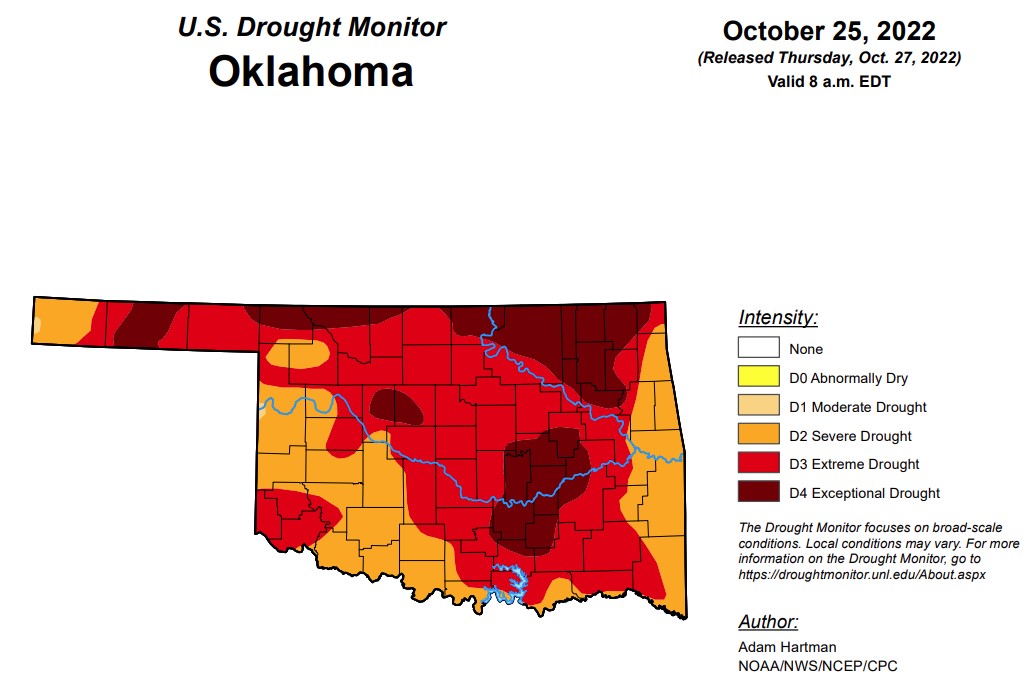


Oklahoma Grain Elevator Cash Bids as of 2 p.m. October 17, 2022

Mon, 17 Oct 2022 16:15:58 CDT


Oklahoma Grain Elevator Cash Bids as of 2 p.m. October 17, 2022


The U.S. Department of Agriculture and the Oklahoma Department of Agriculture are now putting the Daily Cash Grain Report into a PDF format - we are saving that PDF and archiving them for today's specific report. To see today's update, click on the PDF report link at the bottom of this story.

In addition to the PDF of the daily report, you can also listen to the Cash Grain Report by calling 405-621-5533. Push 2 for the grain report.


Click here: 04494_OklaCashGrain10172022.pdf


Additional 5 Million Approved for Emergency Drought Relief in Oklahoma

Mon, 17 Oct 2022 16:10:54 CDT


Additional 5 Million Approved for Emergency Drought Relief in Oklahoma

Click here to listen to audio


Farm Director, KC Sheperd, caught up with Oklahoma Secretary of Agriculture, Blayne Arthur at the third Emergency Drought Commission meeting and talked about meeting highlights.

Arthur said one concern producers in Oklahoma stressed was the importance of the drought policies being retroactive. Because many producers have already put time and money into drought-related projects, Arthur said the drought commission is flexible and chose to scroll back dollars for individuals in those circumstances.

"The legislature approved 20 million dollars, so we had done 3 million dollars, the drought commission approved another 5 today which leaves 15 million there to be allocated," Arthur said. "I think the important thing for us is to see how these dollars go out the door, but continue to take public input, because I think we will learn things as time goes on."

The next step, Arthur said, is watching how the funds move so that in the next meeting, everyone can address how to allocate what is left in the drought relief fund.

Arthur said these dollars are available to all producers in Oklahoma.

"Certainly, to clarify for everyone, if you are a new and beginning farmer, if you are a smaller producer, if you have got 600 head of cattle on feed, then you are eligible for these funds," Arthur said. "So, we really encourage folks certainly to go to their conservation district offices, but also want to make sure they are going to their FSA office as well too and signing up for any of those programs from USDA."

Arthur said the majority of what she had heard as far as using the drought relief funds is focused on pond cleanout because there is a delay in having wells drilled.

"I think everyone has seen delays in so many things, especially skilled labor, specific to that," Arthur said. "The best time to clean out a pond is when we are in a drought, and then we are able to capture so much more of that rainwater and increase that storage capacity for our producers into the future."

During the meeting, Arthur said, for now, they have decided to table the allocation of funds toward the transportation of hay because there is no cap on the FSA program for hay transport.

"Since there is no cap on that FSA program for hay transport, we want to make sure that those producers get all the funds that they can there through the FSA program," Arthur said. "I think there is an opportunity for some gaps we are hearing that exist in regard to what the FSA programs can do, but think it's beneficial for us to take some more time to really analyze that and have the best data available to the Emergency Drought Commission if we decide to move that direction."

Arthur said she is appreciative of Oklahoma producers coming forward to voice their concerns during this time.

"You know, you can get us on the phone, you can shoot us an email, you can talk to the commodity groups that you are a member of." Arthur said, "But that is what we want to do is find ways to use these dollars that really benefit producers."


Click the LISTEN BAR below to listen to KC's conversation with Secretary Blayne Arthur recapping the third Emergency Drought Commission meeting.


Governor Kevin Stitt Continues to Advocate for Agriculture

Mon, 17 Oct 2022 12:12:19 CDT


Governor Kevin Stitt Continues to Advocate for Agriculture

Click here to listen to audio


KC Sheperd, Farm Director, got the chance to visit with Governor Kevin Stitt at the 2022 Stockyards Steak Out, which was held at the Oklahoma National Stockyards over the weekend. Coinciding with the Stockyard Stampede, activities for the entire family took place throughout the day.


During this event, local beef producers cooked their best steaks and offered them to the public. These steaks were judged by national judges who chose a champion, and then the general public had the opportunity to taste and vote for a separate award, the "People's Choice".

"It is unbelievable- all of these Oklahoma producers," Stitt said. "I only serve Oklahoma beef at the Governor's Mansion, so I have got a pocket full of cards and I am going to make sure they order some Oklahoma beef."

Stitt said he always enjoys his time at the stockyards, as it reminds him of when his grandad was the vet in the stockyards for 25 years until the mid-80s. Stitt joined in on the activities and partook in the cooking of steaks at the event.

"Wonderful ranches here," Stitt said.

As Oklahoma producers are facing tough times due to drought and the economy, Stitt talked about actions he is taking to provide some relief to those producers.

"I signed an executive order this week to kind of wave some requirements," Stitt said. "I know farmers are having to bring hay in from other states. We also did a 23-million-dollar drought relief assistance that Secretary Blayne Arthur, my secretary, is going to be getting out all across the state."

Stitt said he continues to pray for rain, especially with wheat plantings taking place.

With around 20 million dollars in negative ads spent to spread inaccurate information about the governor, Stitt said he wants to remind Oklahomans that he always supports agriculture.

"We always have your back," Stitt said. "I am an agricultural guy, and my opponent has joined the Biden administration and, you know, they attack our way of life and our lifestyle, and they believe in more regulations and attacking our industry and our way of life."

Stitt said he has heard many dark money comments, including some claiming that he plans to tear down the Governor's Mansion.


"It also broke my heart, a young lady came up to me and said, 'hey, I heard you are going to tear down the Governor's Mansion,' and there has been this hit piece on the news station," Stitt said. "I said, 'ma'am, that is absolutely not true; we love the Governor's Mansion. There is only one Governor's Mansion.'"

Another important point Stitt mentioned is that Oklahoma has the largest savings account in state history.

"I have heard, 'Governor Stitt wants to defund our schools,' which is just the most ridiculous thing ever," Stitt said. "I have put more money into education than any other governor in history and also set up a Redbud fund to make sure rural schools got more money proportionally than the big city schools."

Stitt said he is very fond of Oklahoma's rural school system, and he will continue to support teachers.

"I gave teachers a huge pay raise and I put more money into education than any other governor in history," Stitt said. "We will continue to do that, and at the same time, though, I stand with parents and not big unions."

Stitt said he does not agree with Washington D.C. trying to control what is taught in Oklahoma schools.

"That is not Oklahoma," Stitt said. "I am going to stand with parents and make sure parents have the last say in what is taught to their schools and that is the way I was raised. I am a fourth-generation Oklahoman, and I think Oklahomans will see right through these negative ads."

Click the LISTEN BAR below to listen to KC's full conversation with the Governor as he advocates for Oklahoma and Oklahoma ag.


Congressman Tom Cole: Inflation Hurts Farmers

Mon, 17 Oct 2022 12:04:10 CDT


Congressman Tom Cole: Inflation Hurts Farmers


By Congressman Tom Cole


Raging inflation over the last two years has caused prices to increase for Americans on nearly everything. This includes the skyrocketing cost of the most basic necessity of food. Following last week's recognition of National Farmers Day, it is certainly not lost on me that soaring prices are squeezing our hardworking agricultural producers and communities. Indeed, it is not just at the grocery stores where these prices have risen, but also for our food producers, where the production line begins.


During my travels across the Fourth District throughout this year, I have visited with numerous farmers and ranchers. As their biggest challenges to productivity, they always pointed to soaring prices, supply chain issues and labor shortages. First, not only has it become increasingly difficult to buy farm equipment and other necessities such as fertilizer for crops due to our supply chain's dependence on other countries around the world, but the price has skyrocketed as well. In fact, just last week, fertilizer prices in North America rose by 11 percent, which is the sharpest increase since March. And in the coming months, the cost of growing food is expected to increase 18 percent in the United States.


As a result, the U.S. Department of Agriculture has been forced to increase the Supplemental Nutrition Assistance Program (SNAP) benefits by 12.5 percent, giving recipients a roughly $104 bonus for food. While this increase certainly helps lower income families and seniors living on fixed incomes, it still does not keep up with the ever-rising costs of food at the grocery stores, which jumped 13.5 percent in August alone.


With the cost of groceries increasing and the holiday season approaching, putting food on the table during Thanksgiving and Christmas will be even more difficult for American families this year. According to the Oklahoma Farm Report, the price of turkey reached a record high in September and is 112 percent more expensive than last year.


Our nation's agriculture industry is comprised of some of the hardest workers in our country. They have learned how to adapt to harsh weather conditions in order to keep their operations going. That alone is difficult, but when combined with rising inflation and the supply chain crisis, it puts family owned farms and ranches at risk as they struggle to navigate the unforeseen increase costs. Indeed, our hardworking farmers and ranchers work year-round to keep food on the tables of American families.


In September, the Biden Administration hosted a White House Conference on Hunger, Nutrition, and Health and outlined a national strategy for solutions to these challenges. Within this strategy is an emphasis on families being able to afford healthy food options at home and in schools. While I agree this is a very important concern, Democrats unfortunately continue to push policies that do not allow for this issue to be solved effectively. How can families afford nutritious food options when the prices continue to rise? How can farmers continue to produce this food when they can't afford to grow crops or raise cattle?


It is far past time that Democrats controlling the White House and both chambers of Congress work with Republicans to rebuild our economy and help the American people during these hard times. This issue transcends beyond partisan politics and as elected officials, we must uphold our sacred duty to safeguard the pursuit of the American Dream for all our citizens.


2022 Stockyards Steak Out Takes Oklahoma Beef to the Next Level

Mon, 17 Oct 2022 11:09:14 CDT 2022 Stockyards Steak Out Takes Oklahoma Beef to the Next Level


Senior Farm and Ranch Broadcaster, Ron Hays, is featuring comments from Mariah Reimer, the Foundation coordinator at Oklahoma Cattlemen's Association talking about the inaugural Oklahoma Best Beef Competition, a part of the 2022 Stockyards Steak Out, which was held at the Oklahoma National Stockyards over the weekend. This event coincided with the Stockyard Stampede, with events for the whole family taking place throughout the day.

During this event, local beef producers cooked their best steaks and offered them to the public. These steaks were judged by national judges who chose a champion, and then the general public had the opportunity to taste and vote for a separate award, the "People's Choice".

After hosting a state cookoff association event for the past few years, Reimer said Oklahoma National Stockyards President, Kelli Payne, sought to create an event where the Oklahoma Cattlemen's Foundation could be the beneficiary. The goal of the event, Reimer said, was to take Oklahoma producers and the cattle industry to the next level.

"Every entry fee from that national competition comes to the foundation and goes straight to scholarships and educational opportunities for students who are going to better the agricultural industry and really make an impact and give back," Reimer said.

Reimer said nationally sanctioned judges were blown away by Oklahoma beef.

"We only did ten finalists this year because we wanted to test it out and see how it went and we had such a positive response," Reimer said. "At the end of the day, all of this goes to scholarships for students who are going to do this exact same thing in the future- 20 years, 30 years, and continue this legacy."

National judges selected Oklahoma Beef Market LLC of Hulbert, Oklahoma as the champion of the competition, and the People's Choice Award was presented to 4T Ranch Beef of Agra, Oklahoma.

"We had such a positive response," Reimer said. "The people came out for the people's choice. National sanctioned judges, judging Oklahoma Beef and blown away by their product compared to national steak competitors is just phenomenal when you think about it."

This event is unique, Reimer said, because it features all different kinds of beef raised in Oklahoma from grassland Wagyu to grain-fed beef. Reimer said the event was a good opportunity for Oklahomans to see the many choices of beef in the state and encourage them to shop local.

"Come see, educate yourself, and learn about the different varieties, it is not just a hamburger; it is not just steak," Reimer said. "These producers- this is their livelihood and they have poured everything they know into it, and it shows through every piece of sample steak today and just a phenomenal job by every single one of those people."


Click the LISTEN BAR below to listen to Mariah Reimer talking about the 2022 Stockyards Steak Out.

The Beef Buzz is a regular feature heard on radio stations around the region on the Radio Oklahoma Network and is a regular audio feature found on this website as well. Click on the LISTEN BAR below for today's show and check out our archives for older Beef Buzz shows covering the gamut of the beef cattle industry today.


click to play audio or right-click to download

Protecting the Home Landscape from Deer

Mon, 17 Oct 2022 10:47:03 CDT


Protecting the Home Landscape from Deer


Deer are always looking for their next meal, and they often find forage in a well-kept landscape. Whether rural or urban, homeowners can get frustrated when their landscape ends up looking like a salad bar after the lunchtime rush.


In many cases, plants in a home landscape have been fertilized and are well taken care of, which makes them especially attractive to wildlife.
There are different things homeowners can try to deter the deer, but some control methods are too expensive or unreliable, said Casey Hentges, host of Oklahoma State University Agriculture's television program, Oklahoma Gardening.


"Installing a high fence around the entire property is costly, and home-remedy repellents, such as soap shavings or pet waste, aren't reliable. One of the best ways to keep deer out of your landscape is by not providing their favorite snacks," she said. "While there's no such thing as a true deer-resistant plant, there are some that deer simply don't find palatable."


Some plants and shrubs considered to be deer resistant include:

• Aphrodite Sweetshrub
• Spirea
• Ornamental grasses (Pink Muhly, Ravenna grass, Lemon grass and Switch grass)
• Beebalm
• Goldenrod
• Verbena
• Marigold
• Bottlebrush Buckeye
• Butterfly Bush
• Gardenia


"Deer don't like plants with strong smells. One way to keep deer from using the landscape as a snack bar is to plant lantana, chives, mint and other strong-smelling herbs around those plants you've noticed deer prefer," Hentges said. "Plants with prickly or rough leaves or those with a bitter taste aren't at the top of the favorite foods list, either."


Depending on environmental conditions, such as drought or large deer populations, deer may be enticed to eat plants they don't generally find palatable because natural food supplies are limited.


Hentges said deer will sometimes browse new plantings or established plants with tender new growth but then avoid those same plants when the leaves are mature.


Homeowners looking to upgrade the landscape may choose to plant new trees, and fall is a good time to establish new trees. However, this time of year is also deer mating season, said Dwayne Elmore, OSU Extension wildlife specialist and Bollenbach Chair in the OSU Department of Natural Resource Ecology and Management.


"Rut is the time in which deer breed. Deer start to rub the dried velvet on a small tree or shrub in the fall and will continue to rub to mark territory for the next couple of months," Elmore said. "Repellants can be found in stores, but they really aren't a good option. Cages and protective wrap are the most effective ways for homeowners to protect the newly planted trees."


Hentges said the rubbing removes the thin layer of bark on small trees and can cause serious damage or destroy them.


"Plastic or mesh tree guards are a quick fix. Another option is to make a small cage or fence around the trees to prevent the deer from getting close to them," she said. "Trees are an investment in your landscape, and it's important to protect them."


OSU Extension offers more gardening information.


OSU Extension uses research-based information to help all Oklahomans solve local issues and concerns, promote leadership and manage resources wisely throughout the state's 77 counties. Most information is available at little to no cost.


Study: Access to E15 Fuel Would Save Drivers Over $20 Billion in Annual Fuel Costs

Mon, 17 Oct 2022 10:09:17 CDT


Study: Access to E15 Fuel Would Save Drivers Over $20 Billion in Annual Fuel Costs


Today, Growth Energy released a study conducted by ABF Economics that found that nationwide access to E15, a 15 percent ethanol blended fuel, could save drivers billions in annual fuel costs, create new jobs, and return billions to the U.S. economy. Specifically, the data show that a nationwide transition to E15 would:


• Save consumers $20.6 billion in annual fuel costs,
• Put an additional $36.3 billion in income into the pockets of American households,
• Support an additional 188,000 jobs,
• And generate $66.3 billion for the U.S. GDP.


"The price of gas remains top of mind for American families who don't want to lose access to a low-carbon, low-cost choice at the pump," said Growth Energy CEO Emily Skor. "Over the summer, E15 saved drivers up to nearly a dollar per gallon at the pump in some areas, with savings averaging to $0.16 per gallon across the country. Today's study shows that expanded, year-round access of this higher biofuel blend can provide a much-needed boost to the farm economy and even greater savings to American families."


The release of today's study follows months of record-high gas prices across the country and President Joe Biden's emergency waiver to allow the sale of E15 for the 2022 summer driving season to address those prices. Thanks to the availability of E15, drivers found savings of up to nearly a dollar per gallon at the pump by filling up with this higher blend of biofuel.


E15 is currently sold at over 2,700 stations across 31 states, and drivers have chosen the biofuel blend to fuel 35 billion miles total. E15 is approved for cars 2001 and newer — more than 96 percent of cars on the road.


Read the full ABF report here. Learn more about E15 here.


Oklahoma Teacher of the Year Embarks on Statewide Teacher Respect and Appreciation Tour

Mon, 17 Oct 2022 10:07:19 CDT


Oklahoma Teacher of the Year Embarks on Statewide Teacher Respect and Appreciation Tour


Rebecka Peterson, Oklahoma's 2022 Teacher of the Year, has launched a statewide, 77-county teacher respect and appreciation campaign to highlight the important work of teachers who are making a positive impact in their schools and communities.

As part of her year-long "Teachers of Oklahoma" campaign – inspired by Humans of New York – Peterson will meet with and observe teachers in the classroom setting for written featurettes to be shared via social media on Facebook, Instagram and Twitter, as well as in a full-page ad in each teacher's local newspaper.


"My hope this year is to elevate the teaching profession in Oklahoma by sharing the good and important work that teachers all over Oklahoma are doing every day, and to offer words of encouragement for teachers, students and their communities," Peterson said. "I am specifically looking for teachers who are highly effective but may not get a lot of recognition, for whatever reason, in other words, a true unsung hero."


People can submit teacher nominations online through Dec. 1, 2022, for consideration.


"Rebecka is a tremendous ambassador and champion for the teaching profession in Oklahoma," State Superintendent of Public Instruction Joy Hofmeister said. "Kudos to her for this outstanding campaign in support of teachers. I encourage all Oklahomans to seek creative ways to express how much we respect and appreciate our teachers and the valuable role they play in our classrooms and communities. Teachers need our support now more than ever."
Peterson teaches pre-calculus and AP calculus at Union High School. She has taught for 13 years – including the past 10 years at Union – and was recently named as a Presidential Awards for Excellence in Mathematics and Science Teaching finalist, the highest honor a K-12 mathematics or science teacher can receive in the U.S.


She earned a bachelor's degree in mathematics from Oklahoma Wesleyan University and a master's degree in mathematics from the University of South Dakota.


Learn more about Teachers of Oklahoma at sde.ok.gov/teachersofok.


Watch the the Teachers of Oklahoma campaign video below:


Mexican Beef and Cattle Industry Development Continues

Mon, 17 Oct 2022 09:22:27 CDT


Mexican Beef and Cattle Industry Development Continues


Mondays, Dr. Derrell Peel, Oklahoma State University Extension Livestock Marketing Specialist, offers his economic analysis of the beef cattle industry. This analysis is a part of the weekly series known as the "Cow Calf Corner" published electronically by Dr. Peel and Mark Johnson. Today, Dr. Peel talks about Mexican beef and cattle industry.


USDA's Foreign Agricultural Service recently released the latest Livestock and Poultry: World Markets and Trade report. The report provides estimates for production, consumption and trade for beef, pork and chicken for major countries. The article focuses on the Mexican beef and cattle industry.


Mexico continues to develop as a major beef exporting country. In recent years, Mexican beef production has continued to grow while total domestic consumption has been relatively stable leading to growing beef exports from the country. Current USDA projections for 2023 have Mexico as the number ten beef exporting country in the world. Over 80 percent of Mexican beef exports go to the U.S. although other global markets are receiving larger amounts of Mexican beef in recent years. Beef imports from Mexico have accounted for 18.9 percent of total U.S. beef imports and, 2021, Mexico was the second largest source of U.S. beef imports, accounting for a record 20.2 percent share of the total.


Mexico continues to be a significant beef importer with total beef imports relatively steady in the last decade. However, the current level of Mexican beef imports is about half of the peak levels in the previous decade.   The majority of Mexican beef imports originate in the U.S. Beef exports from the U.S. to Mexico were relatively steady in the decade prior to the pandemic albeit at levels significantly lower compared to the peak levels in the 2000s. However, U.S. beef exports to Mexico decreased the past two years, with 2021 down 30 percent from 2018.   Mexico has dropped from being the number three market for U.S. beef exports to number five behind Japan, South Korea, China/Hong Kong and Canada.


In the 1990s and early 2000s, Mexican beef imports were a matter of supplementing the total supply of beef to meet demand in the country. As domestic production and exports have developed, Mexico has been a net exporter of beef since 2015. Mexican beef exports and imports are now more a matter of specific product flows in and out to match domestic demand and increased value opportunities in global markets, similar to the economic role of beef trade in the U.S. and Canada. Mexico is the largest source of imported beef cuts that are marketed directly to consumers in the U.S.


Historically, Mexico had a comparative advantage in cow-calf production with many of the feeder cattle exported to the U.S. for growing, finishing and processing. For the past twenty years, the U.S. has imported roughly 1.2 million head of cattle from Mexico annually. In 2021, lower cattle imports, combined with increased cattle exports to Mexico, resulted in the lowest net cattle imports since 2016. Thus far in 2022, reduced cattle imports and increased cattle exports has reduced net cattle imports sharply and is projected to lead to annual net cattle imports of roughly 700,000 head, the lowest total since 2008.   It is unclear if the current reduction in net cattle flows from Mexico to the U.S. is a short-term or long-term change. Short-term production conditions, e.g. droughts, does not appear to be the explanation although cattle number do change year to year. The change may be more long-term in nature as the continued development of beef production and net exports in Mexico may be a reason for fewer cattle exports in the coming years. Mexico continues to develop the finishing and processing infrastructure to retain more cattle in the country for value-added production. Time will tell how beef and cattle flows in Mexico continue to develop.


Farmers Nationwide Send a Strong Message to EPA on Atrazine

Mon, 17 Oct 2022 09:17:28 CDT


Farmers Nationwide Send a Strong Message to EPA on Atrazine


More than 16,000 farmers and agricultural organizations representing corn, citrus, grain sorghum, sugar cane, and other crops recently united against EPA's proposed revision to its 2020 atrazine registration review decision, submitting comments calling for the agency to base decisions on credible scientific evidence. Efforts to help farmers speak out against the proposal were coordinated by the Triazine Network, a diverse coalition of state and national agricultural groups across the nation that rely on atrazine and other triazine herbicides to control weeds. The atrazine comment period ended October 7.

"EPA's actions have been more like a tennis match than a product registration review," said Greg Krissek, Triazine Network co-chair and Kansas Corn Growers Association CEO. "In its 2020 decision, EPA finalized and published the aquatic level of concern at 15 parts per billion. Then it used an activist court case against its own decision to reconsider the level of concern. In June, EPA announced it wanted to change the level of concern to an ultra-low 3.4 parts per billion. They floated that number in a 2016 risk assessment but never implemented it. They told us this year that 3.4 ppb was always the number, but that was just their staff's wishful thinking until they rolled out this year's proposed revision."

In their comments, growers expressed frustration with the EPA's lack of transparency and its repeated efforts to implement measures that would end effective use of atrazine for weed control. In addition to the ultra-low 3.4 ppb level, EPA doubled and tripled down by creating an over-predictive model that predicted 72 percent of U.S. corn acres would be in violation.

"Instead of relying on real-world water testing, the agency would simply look at a map it made up with a questionable model to decide if a grower would be required to add between one and four mitigation practices from its problematic pick list," said Triazine Network Co-Chair Gary Marshall, who is Missouri Corn Growers Association emeritus executive director. "If EPA would have used just a little bit of common sense, we wouldn't be fighting this fight."

The next step is a Scientific Advisory Panel, which EPA has committed to convening to examine the science behind its proposed 3.4 ppb level of concern.

"Our growers are frustrated with the repeated attacks on atrazine, one of the safest and most studied herbicides in history," Krissek said. "The Triazine Network and others have been fighting this fight for over 25 years. We have science on our side, but EPA continues its attempts to rework the discredited research to reach its own conclusions. We look forward to participating in the upcoming Scientific Advisory Panel."


Federal Milk Marketing Order Forum Successfully Brings Sector Together

Mon, 17 Oct 2022 09:15:56 CDT


Federal Milk Marketing Order Forum Successfully Brings Sector Together


The American Farm Bureau Federation was joined by representatives of the National Milk Producers Federation, dairy cooperatives, processors, state dairy associations and dairy farmers from across the country for a successful first-of-its-kind industry-wide Federal Milk Marketing Order (FMMO) Forum.

The three-day event provided a platform for farmers' voices to be heard while also answering the call from USDA Secretary Tom Vilsack to bring the dairy producer community together to discuss FMMO modernization. Discussions at the forum focused on Class price formulas and de-pooling, among other topics.

The American Farm Bureau Federation and the National Milk Producers Federation agreed on a joint statement regarding the need for FMMO improvements. A number of dairy organizations attending the event also supported the joint AFBF-NMPF statement and are listed below.

The AFBF-NMPF statement reads:

"We support the federal milk marketing order (FMMO) system as key to fair market-based farmer milk pricing and recognize the importance of periodically updating the program to reflect changes in the dynamic U.S. dairy industry. With the last major update to the FMMO system occurring in 2000, we believe it is time to consider improvements that better reflect today's milk markets.

"In addition, the pandemic-related market disruptions of 2020 also highlighted the need to modernize the program so that it can better mitigate the impacts on producers of disruptions in milk pricing such as occurred then. At that time, a combination of federal order price formulas, temporary market imbalances, and sudden demand disruptions created disorderly marketing of milk, to the detriment of producers.

"We anticipate the prospect of a hearing conducted by USDA in 2023 that could address FMMO price formulas, including all four Classes, as well as the Class I price surface. An amended pricing system should improve price discovery, improve the clarity of the program, continue to support timely payments to producers, and reduce price incentives to de-pool milk.

"We are encouraged by the healthy discussion at this week's Federal Milk Marketing Order Forum and look forward to continuing the discussion about promoting a healthy dairy industry through modernization of federal order pricing."

Organizations participating in the event and endorsing the joint statement include:
American Dairy Coalition
National All-Jersey
Georgia Milk Producers
Indiana Dairy Producers
Missouri Dairy
Dairy Producers of New Mexico
Ohio Dairy Producers Association
Virginia State Dairymen's Association


A Spike in fire Activity late week was Quelled by a Weather system that Ushered in rain showers Over the Weekend

Mon, 17 Oct 2022 08:45:11 CDT


 A Spike in fire Activity late week was Quelled by a Weather system that Ushered in rain showers Over the Weekend


Statewide Discussion:
A spike in fire activity late week was quelled by a weather system that ushered in rain showers and some storms Saturday evening into Sunday providing wetting amounts at some locations primarily in the southern half of the Oklahoma. Much cooler temperatures will dominate the forecast over the next few days bringing the first frost to many parts of the state and a freeze to areas of northern and northeastern Oklahoma. Dry air will again overspread the state with dewpoint temperatures in the 20°'s resulting in afternoon relative humidity values in the 20% range across the state facilitating rapid drying of wildland fuels. Over the next two days, fire danger will be highest in the afternoon hours across the northern tier of counties where weekend rainfall did not occur. Initial attack activity is expected to be successful with limited large fire potential.

North-Central / Northwestern Oklahoma:
Most of the area did not receive rainfall over the weekend and where rains did develop, wetting amounts were very scattered. Following a cool start, temperature will warm into the low-60°'s with afternoon relative humidity values 19-26% and fine-dead fuel moisture values 5-6% for a brief period. North winds sustained 11-15 mph with some higher gusts will support moderate rates of spread in un-grazed grass stands at 73-119 ft/min with flame lengths around 15 ft. Brush fuels will move nearer to 50 ft/min with average flame lengths 8-10 ft. with frequent torching and short-range spotting where juniper is present.

Southeastern/Eastern Oklahoma:
Rains have calmed conditions a bit although the underlying dryness remains firmly in place. Initial attack activity over the next few days is expected to be lighter although increasing into late week. Large fire concerns have been reduced with the rainfall for the next few days. Today, drying conditions will quickly return as relative humidity values fall into the 20-25% range with afternoon temperatures 60°-67° under clear skies. This will yield fine-dead fuel moisture values this afternoon at 5-6% noting that little improvement to larger dead-fuel size classes was realized. North winds sustained 11-16 mph with some gusts nearing 20 mph will drive head fire rates of spread in grass dominated fuels at 70-110 ft/min with flame lengths around 13 ft. Timber litter fuels will exhibit less activity than in previous days with established wildfires exhibiting ROS 9-20 ft/min and FL 3-4 ft. Any fire that becomes established in plantation fuels will still likely exhibit problematic fire behavior.

Western Oklahoma:
Much of the area received wetting rainfall amounts noting that much of southwestern Oklahoma registered amounts less than 0.10". New fire occurrence is not expected to prove overly challenging to suppress for the next few days although strong drying conditions will prompt increasing concern mid-week. Today, temperatures will top out in the low- to mid60°'s while relative humidity values 24-33% holding fine-dead fuel moisture values in the 6-7% range. North winds 10-12 mph will hold maximum rates of spread in rangeland fuels 55-90 ft/min with flame lengths 8-10 ft. providing very good opportunity for successful initial attack efforts.

Near-Term:
Frost and freeze conditions in the morning on Tuesday across northern and eastern Oklahoma and cooler temperatures overall will serve to compress the burning period into a few hours during the afternoon. With dewpoint temperature below 20°, afternoon conditions will be very dry again as relative humidity sinks into the upper-teens and 20% range. Rather light winds will hold rates of fire spread in the moderate range providing good opportunity for initial attack success.

Widespread frost/freeze is expected Wednesday morning serving as harbinger to the end of the growing season. Given current composite fuel moisture values, the transition to dormancy will be quick in herbaceous fuels. Late-week and into the weekend, south winds return prompting another uptick in fire danger overall. There is some signal of a pattern change Sunday into Monday bringing another opportunity for rainfall although current forecaster confidence is low.

NE Area – 3 Fires Burned 7.5 Acres (Cause: 1-Lightning, 2-Incendiary)
EC Area – 8 Fires Burned 230.4 Acres (Cause: 1-Equipment, 7-Incendiary)
SE Area – 15 Fires Burned 4,403.1 Acres (Cause: 15-Incendiary)
Large / Significant Fire Activity within the OFS Protection Area:
• Bethel Fire (McCurtain County) – 3,600 Acres (est.), 85% Contained
• Williams Fire (McCurtain County) – 463 Acres, 50% Contained
• Quarry Fire (Haskell County) – 206.5 Acres, 95%
• Shale Pit Fire (McCurtain County) – 120 Acres, 50% Contained
Fire Activity with OFS Response outside of the Protection Area: 2 Fires Burned 410 Acres (Cause:2-Incendiary)
OFS Prescribed Fire Activity: No New Activity
Fire Department Statistics: Moderate Initial Attack Activity

Burn Bans:
Refer to: https://ag.ok.gov/divisions/forestry-services/ for the most current burn ban information and links to specific burn ban proclamations.


Integrated Beef Cattle Program for Veterinarians

Mon, 17 Oct 2022 08:18:09 CDT


Integrated Beef Cattle Program for Veterinarians


The inaugural class of the Integrated Beef Cattle Program completed their final module this weekend!

The Oklahoma State University College of Veterinary Medicine and Extension will soon offer a series of courses on intervention strategies for rural veterinary practice sustainability as part of the Integrated Beef Cattle Program for Veterinarians. OSU is developing a veterinary continuing education curriculum that will expand veterinary skills and knowledge of beef cattle herd health, nutrition, forage management, reproductive management, and other common veterinary and producer needs.

The opportunity for expanded veterinary services will allow veterinarians and beef cattle producers to become more productive while simultaneously enhancing animal health and wellbeing. These benefits will ensure greater food safety, public health, and increase opportunities for Oklahoma and the region's economic development and prosperity. We anticipate practices will experience an improvement in their businesses. Finally, students will attend the program and learn along with practicing DVMs. OSU expects students in this program will graduate ready to enter rural practice with the skills needed to effectively sustain a rural practice and by providing networking opportunities with current rural practitioners.

2022 Module Dates

Module 1: January 21-22, 2022

Module 2: April 8-9, 2022

Module 3: July 29-30, 2022

Module 4: October 14-15, 2022

Modules are scheduled to start at 4 p.m. on Fridays in Stillwater and run through 5 p.m. on Saturdays.

2023 Module Dates

2023 Module dates will be announced in late fall 2023.

The program aims to expand participants' veterinary skills and knowledge of herd health, food nutrition, forage management, reproductive management and other common needs of beef producers. Applications are now open for the 2023 IBCP! Apply here:


U.S. Grains Council Marks End Of Export Exchange 2022 With 10 Post-Event Trade Teams Visiting Farm Operations Across 11 States

Mon, 17 Oct 2022 08:10:56 CDT


U.S. Grains Council Marks End Of Export Exchange 2022 With 10 Post-Event Trade Teams Visiting Farm Operations Across 11 States


The U.S. Grains Council (USGC) is continuing to build business-to-business relationships between domestic producers and global end-users by sponsoring 10 trade teams following the culmination of Export Exchange 2022. Eleven other groups have already spent time meeting with key partners along the value chain prior to Export Exchange to further their connection to U.S. agricultural stakeholders and their understanding of the export system as a whole.

Export Exchange is a biennial educational and trade forum for U.S. feed grains that hosts nearly 500 international buyers, importers and domestic suppliers. This year's edition was held in Minneapolis from Oct. 12-14.

"The Council takes pride in being able to attract such diverse groups of international buyers and government officials from various countries in support of Export Exchange and in overall market capacity building," said Ryan LeGrand, USGC President and CEO. "The lasting memories and relationships created from this event will benefit U.S. producers and end-users worldwide for years to come."

The trade teams represent a wide range of industry leaders who contribute to strong U.S. export numbers year after year in commodities including corn, distiller's dried grains with solubles (DDGS) and sorghum.

A description of the teams and the dates of their travel are listed below:
• Canadian corn and DDGS team to Minnesota, Oct. 14
• Mexican sorghum and DDGS team to Kansas and Texas, Oct. 15-18
• Latin American logistics team to Minnesota, Michigan and Louisiana, Oct. 15-19
• Japanese corn team to North Dakota, Oct. 15-19
• Vietnamese corn team to Indiana and Kentucky, Oct. 15-19
• North and West African corn, DDGS and sorghum team to Ohio, Oct. 15-19
• Mexican white corn team to Kentucky and Louisiana, Oct. 15-20
• Southeast Asian (SEA) aquaculture team to Idaho, Oct. 15-20
• SEA DDGS team to Illinois, Oct. 15-20
• Taiwanese corn and DDGS team to Illinois and Washington, Oct. 15-21

More information about future Export Exchange programs will be made available online at www.exportexchange.org and content from the event and its accompanying trade teams can be found on social media using the hashtag #ExEx22.

Those interested can sign up for a mailing list to automatically receive conference updates by emailing info@exportexchange.org


Water Sustainability Conference on tap for Nov. 8-9

Mon, 17 Oct 2022 08:10:08 CDT


Water Sustainability Conference on tap for Nov. 8-9


On Nov. 8-9, top state and tribal water leaders, researchers and other experts will take the stage at the Seventh Annual Oka' (Water) Sustainability Conference on the East Central University campus in Ada, Oklahoma. The event, featuring a curated lineup of speakers as well as water resource-oriented field trips for attendees, is hosted by the Oka' Institute.


Featured speakers at the two-day conference, which annually attracts hundreds of citizens and water professionals interested in sustainable water use and protection in both the state and its Tribal Nations, include Chickasaw Nation Governor Bill Anoatubby; Dr. Chris Frey, U.S. Environmental Protection Agency assistant administrator of Research and Development; new Oklahoma Secretary of Energy and Environment Ken McQueen; and ECU President Wendell Godwin.


According to Duane Smith, executive director of the Oka' Institute, sustainable management of Oklahoma's water resources is evolving from a trendy expression to real-world practice.


"State and federal agencies are now discovering what our indigenous peoples have known for millennia. That is, with a little creative thinking and innovation, we can leverage our water resources for economic development while sustainably managing those very waters for our many needs — both consumptive and non-consumptive — well into the future," Smith said. "The experienced and diverse group of speakers we've assembled for the Conference are well-positioned to stimulate that conversation and advance new ways of thinking about the future of our water."


The conference will explore the latest developments in water management, policy and law as well as Tribal water perspectives and ongoing research initiatives dealing with water sustainability.


The first day's events will conclude with a reception followed by dinner at the CBCC Banquet Hall. Day two of the conference will also feature separate optional field trips to the Arbuckle-Simpson aquifer enhanced recharge site and nearby Byrds Mill Spring, Ada's water source.


For more information on the Conference or to register, visit okainstitute.org or contact Conference Coordinator Brandy Kaeshoefer, at bramkae@ecok.edu or 580-272-8686.


NCBA Beltway Beef Podcast: Agriculture in Focus at the Supreme Court

Mon, 17 Oct 2022 08:04:09 CDT


NCBA Beltway Beef Podcast: Agriculture in Focus at the Supreme Court


Each week, the National Cattlemen's Beef Association's Beltway Beef brings you the latest policy news affecting the U.S. cattle and beef industry. Hear from subject-matter experts, producers, and industry leaders on the topics that impact the business viability of farms and ranches across the country.


On this episode, NCBA Chief Counsel Mary-Thomas Hart joins for an in-depth discussion on two major agricultural cases currently before the U.S. Supreme Court. The case Sackett v. EPA is considering the longstanding issue of "Waters of the United States" and the federal government's proper jurisdiction in regulating bodies of water, while National Pork Producer's Council v. Ross is considering the dormant commerce clause and its implications for livestock producers selling goods across state lines. NCBA has filed amicus briefs before the court in both cases to advocate for the unique needs of cattle producers.

Listen below or click here to listen on Sound Cloud.


Pig Farmer Scott Hays Believes Prop 12 Has Become a Moral Battle- California Versus the Rest of the Country

Mon, 17 Oct 2022 04:20:31 CDT


Pig Farmer Scott Hays Believes Prop 12 Has Become a Moral Battle- California Versus the Rest of the Country

Click here to listen to audio


The officers of the National Pork Producers Council were among those in the public gallery of the US Supreme Court this past week when the nine Justices listened to the oral arguments over the legality of California's Proposition 12- which prescribes controversial space requirements for sows, veal calves and egg laying hens. One of those hog farmers was Scott Hays, President Elect for the organization. The Missouri producer talked after this unique experience with Senior Farm and Ranch broadcaster Ron Hays of the Oklahoma Farm Report- saying he anticipated that it would be a once in a lifetime type experience- and it did not disappoint.


Scott Hays says that he came onto the NPPC board shortly after the initial passage of Prop 12- "this is an issue that I have worked on from the very beginning...I feel like I am getting to see it all the way through."


The NPPC officer says California has been antagonistic to the pork producers for years- "California has regulated the pig industry out of the state," adding "that's not by accident- there used to be a pig industry in the state." Hays contends that California wants to impose their values on every other state in the US- "They're trying to impose these arbitrary rules on the rest of us, touting that it's better for the animals or healthier- and it's just not. This is a bunch of people that don't know anything aout raising pigs. If you listen to the Veterinarians and University people and pig farmers themselves, who are really the experts on how to take care of the animals- you know we get up every morning and try to figure out how to make the pig's life better."


Scott Hays believes that the science shows that Prop 12 does not improve the lives of sows or their pigs so "all California was left with was their effort to impose their morals on the rest of the country." Several of the justices questioned the lawyers for California- asking them to explain how their state would respond if another state tried to impose a similar moral judgement on them. Scott Hays says the lawyers for the state had little to say in response. Chief Justice John Roberts questioned the validity of Proposition 12 based on the question of morality.


Justice Ketanji Brown Jackson also addressed the moral question by saying: "To what extent does California get to control what Iowa does with respect to the housing of its pork?" She asked why California couldn't do something less burdensome to the industry, like "segregating Iowa's pork when it comes in, putting a big label over it that says 'This is immorally produced.'"


Scott Hays tells Ron Hays "At the end of the day- at the end of the hearing- I had the feeling that we did our job here and and the that they get it- they understand where we are coming from and they understand the adverse effects that this is gonna have on the entire country" not just the pork industry."


Listen to the full conversation that Ron Hays has with NPPC President Elect Scott Hays by clicking on the "click to play" link at the bottom of the story.


Oklahoma Beef Market LLC and 4T Ranch Win Inaugural Stockyards Steak Out Awards

Mon, 17 Oct 2022 17:04:36 CDT


Oklahoma Beef Market LLC and 4T Ranch Win Inaugural Stockyards Steak Out Awards

Click here to listen to audio


The inaugural Oklahoma Best Beef Competition, a part of the 2022 Stockyards Steak Out was held over the weekend in Oklahoma City at the Oklahoma National Stockyards and brought out plenty of tasty steaks from local producers into two categories: People's Choice and The National Judges Award. Beef Producers were teamed with local dignitaries to cook their best steaks and offer up samples to the public. Governor Kevin Stitt, Debbie Harrison, Larry Stein, Jay Steagall, Bailey Ballou, and several others were on hand to help with the preparation of the steaks.

The champion as determined by the a team of national judges was Oklahoma Beef Market LLC of Hulbert, Oklahoma. The People's Choice Award was presented to 4T Ranch Beef of Agra, Oklahoma.

After the event, Farm Director KC Sheperd caught up with Mariah Reimer, the Foundation coordinator at Oklahoma Cattlemen's Association. She said this event was the brainchild of Oklahoma National Stockyards President Kelli Payne. Payne has been hosting a State Cookoff Association Event for the past few years. They wanted to come up with an event in which the Oklahoma Cattlemen's foundation could be the beneficiary of the event. This means every entry fee from the National competition comes to the foundation andgoes straight to scholarships and educational opportunities for students who are going to better the agricultural industry, "She came to me she said, how do we benefit Oklahoma? How do we benefit these producers? And that's where this event came to life. How do we take cattle producers to the next level? How do we go directly to the consumers and give people options? Go Local. Go Oklahoma, support local, Oklahoma beef."

Since this was the first time for the event, Reimer said they only took ten finalists to see how the competition would go, "We had such a positive response. The people came out for the people's choice. National sanctioned judges judging Oklahoma Beef and blown away by their product compared to national steak competitors is just phenomenal when you think about it."

Producers came from all across the state, and Reimer said the Steak Out offered all types of steak, "It's all across the board, and that's what we wanted, Local Oklahomans to experience. Some are grass-fed, and some are grain fed, come see, educate yourself, and learn about the different varieties. It's not just a hamburger; it's not just a steak. For these producers, this is their livelihood. So they poured everything they know into it, and it shows through every piece of sample steak today, and just a phenomenal job by every single one of those people."

Reimer said the National judges were very impressed by what Oklahoma producers were serving and the story of each producer, "That's what makes them unique, their story, every time people walked out they said, "wow, this is what Oklahoma is serving our consumers, this quality of steak."

Reimer said next year would be even bigger and better, "We're hoping to open it up. We've had many calls, many producers wanting in on this, and many sponsors wanting in on this. We had phenomenal sponsors, but we're hoping to open it up to as many as we can handle. We really want to build this and make it its own competition. Fill the entire Stockyard and get as many producers and let's promote them as much as we can. And let's really educate the public and allow them to show what Oklahoma producers are made of and what they're working day in and day out to do."

This event coincided with the Stockyard Stampede, with events for the whole family taking place in the stockyards throughout the day.


National Judging Awards went to:
1) Oklahoma Beef LLC, Hulbert
2) Grasslands Wagyu, Tuttle
3) Diamond H Cattle Company, Pryor


Winners of the People Choice Award went to:
1) 4T Ranch Beef, Agra
2) Piguets Prime Time, Vinita
3) Cowgirl Beef, Ft. Cobb


Oklahoma Grain Elevator Cash Bids as of 2 p.m. October 14, 2022

Fri, 14 Oct 2022 15:11:46 CDT


Oklahoma Grain Elevator Cash Bids as of 2 p.m. October 14, 2022


The U.S. Department of Agriculture and the Oklahoma Department of Agriculture are now putting the Daily Cash Grain Report into a PDF format - we are saving that PDF and archiving them for today's specific report. To see today's update, click on the PDF report link at the bottom of this story.

In addition to the PDF of the daily report, you can also listen to the Cash Grain Report by calling 405-621-5533. Push 2 for the grain report.


Click here: 04457_OklaCashGrain10142022.pdf


Construction Begins on the Cash Family Ranch Life Learning Center

Fri, 14 Oct 2022 12:16:02 CDT


Construction Begins on the Cash Family Ranch Life Learning Center


The National Ranching Heritage Center hosted a groundbreaking ceremony today.


Envisioned as an indoor and outdoor comprehensive learning experience for the public, The Cash Family Ranch Life Learning Center will provide all ages an immersive ranching experience, guided by the famous character, Hank the Cowdog.


"Hank the Cowdog author John R. Erickson has captured the complexities of the ranching industry in a format that is so natural for children to enjoy while learning through the character of Hank," said Julie Hodges, NRHC Helen DeVitt Jones Endowed Director of Education. "Hank's influence has touched audiences across the country and beyond. With Hank as the guide, The Cash Family Ranch Life Learning Center is expected to be an incredible local and national-level attraction."


The overall experience will artfully meld the latest in high-tech exhibit technology – such as holograms, video projection and simulation tables – with authentic, hands-on ranching exploration including activities with cowboy gear, water resources and livestock feeds.


Indoor exhibits will cover many aspects of modern ranching. Visitors will walk away with a greater knowledge of the ranching industry and its impact on their daily lives. Each exhibit will emphasize the science, technology, values and grit it takes to be a modern-day rancher.


Outdoor exhibits will bring Hank's fictional ranch to life. Visitors will have the opportunity to explore a half-acre of exhibits and natural areas focused on natural resources, wildlife, range nutrition, grassland, horses, cowboys, ranch equipment and roles of a ranch family.


"We want to tell our story of heritage and history, but we also have to make agriculture relatable to a large majority of people who didn't grow up around horses, livestock and land," said Jim Bret Campbell, NRHC Executive Director.


In 2016, the NRHC worked with Erickson to publish a series of books and establish a classroom curriculum called Ranch Life Learning. The books and educator resources help students learn science and social studies through Hank the Cowdog and his ranch. The Ranch Life Learning series has become a classroom staple due to its relatability and real-world application. Now, The Cash Family Ranch Life Learning Center will bring those lessons to life in a hands-on way for NRHC patrons of all ages.


The groundbreaking signifies the beginning of the construction phase of The Cash Family Ranch Life Learning Center. Construction is anticipated to be completed in summer 2023.


While construction has started, there is still an opportunity to reach a fundraising goal to support this transformative facility for years to come. For more information on The Cash Family Ranch Life Learning Center and how to contribute to the project, visit ranchingheritage.org.


OSU's Dr. Coon talks New Frontiers Progress, Plan for OSU and 2023 Farm Bill

Fri, 14 Oct 2022 12:11:39 CDT


OSU's Dr. Coon talks New Frontiers Progress, Plan for OSU and 2023 Farm Bill

Click here to listen to audio


KC Sheperd, Farm Director, caught up with the Dean of Agriculture at Oklahoma State University, Dr. Thomas Coon about the latest at OSU and the 2023 Farm Bill.

Now that the goal has been met for the New Frontiers project, Dr. Coon talked about the current state of the project.

"Construction has really been moving along," Coon said. "I hate to say it but one of the advantages of a drought is that construction projects get ahead of schedule. We have been pouring a lot of concrete, the crew has been really efficient about that, so it is really starting to look like a building, and I think by Thanksgiving, we are probably going to see pretty much the basic outline of the building- all three stories- so, we are excited about that."

They are now taking a more relaxed approach to the fundraising side of the project, Coon said, but there are many people who are still getting involved to honor someone who means a lot to them.

"We have several features in the building that we are not able to include in the budget," Coon said. "With inflation and everything, the price went up and we really had to kind of hold the line on that, but there are a couple of features that, if we get some extra funding coming in from donors, we could add those to the project."

As for President Shrum presenting her new strategy for OSU, Coon talked about the different parts of that strategy.

"I think the key feature is that she is really embracing the land grant mission of Oklahoma State University," Coon said. "Not that we have ever left it behind, but she is talking about it very openly and really identifying that as the key difference and unique thing about OSU is that we have that land grant responsibility."

Coon said President Shrum has identified four key priority areas for investing further.

"One of those is nourishing the world," Coon said. "Another one has to do with helping to build sustainable energy sources for Oklahoma and beyond."

The third area, Coon said, is focusing on improving human and animal health.

"So, our one health approach that we do particularly with the college of veterinary medicine really fits in with that, as well as some of the health education programming we have been doing in OSU extension," Coon said.

The fourth priority area, Coon said, is with aerospace.

"Really building on the strengths of Oklahoma's aerospace industry and trying to feed into that with even more engineers, even more innovation and research and so on," Coon said.

President Shrum is a fan of extension, Coon said, so she has articulated that as imagining extension in a way that makes extension a platform for all of OSU.

"That is not to come at the expense of what we do in the division of Ag Sciences and Natural Resources," Coon said. "Our cooperative extension programs get to continue to be as they are, but having that office in every county means there is a presence of OSU in every county."

Coon also talked about the upcoming 2023 farm bill and how he believes a research title is a key part.

"There is a separate title for research that authorizes the work that the National Institute of Food and Agriculture does- that is our partner at USDA," Coon said. "That is where our federal funding comes from to support the Agricultural Experiment Station, and Cooperative Extension Service and then in addition, the National Ag Statistics Service is in that, the Economic Research Service and the Agriculture Research Service is all in that research title."

The research title is often ignored, Coon said, and on the policy side there may be a few adjustments there, but it is more on the funding side where improvements can be made.

"We are still getting the same federal funding levels today as we were getting 25 years ago and so there aren't many enterprises that can keep going today on what their revenue was 25 years ago with inflation and so on," Coon said.

Research is important, Coon said, to driving innovation in Oklahoma's agriculture and natural resource economies.

"It takes research to bring along those new ideas and those new technologies and I will tell you, there are other countries in the world that are investing a lot more aggressively in that," Coon said.


Click the LISTEN BAR below to listen to KC's full conversation with Dr. Coon talking about New Frontiers, 2023 Farm Bill and more.


Attitudes Improving in the Cattle Industry with Some Wheat Coming up and Chance of Rain Next Week

Fri, 14 Oct 2022 11:15:38 CDT


Attitudes Improving in the Cattle Industry with Some Wheat Coming up and Chance of Rain Next Week

Click here to listen to audio


KC Sheperd, Farm Director, is visiting with Bob Rodenberger, a partner with Stockman Oklahoma Livestock Marketing. Rodenberger and Sheperd talk about the current cattle market and the upcoming Emergency Drought Commission Meeting.

"We are still seeing an ample number of calves come to down," Rodenberger said.

On the positive side, Rodenberger said he has seen that many people have dusted their wheat in, and some wheat has come up, so people are optimistic.

"We have a chance of rain later in next week sometime," Rodenberger said. "A little rain continuously will help some of these people that have got this wheat up."

The calf market, Rodenberger said, has limited places to go.

"The cow market was not saturated- we saturated it back four or five months ago," Rodenberger said. "But we have got ample amount of cows available and the killing condition keeps dropping off, and when your cow gets thinner, it doesn't matter whether she weighs 1000 or 1500 (pounds), she is worth less dollars because there is less meat to salvage off of her."

As for the feeder cattle market, Rodenberger said he did not see many feeders, even in Oklahoma City on Monday.

"It would have steady at best," Rodenberger said. "We have dropped the index down five or six dollars in the last three months, so it is back down."

In general, Rodenberger said the overall market is doing well for this time of year for the situation we are going through.

"What I am seeing coming to town now is calves that are normally put on wheat and carried and sold after the first of the year, you know, January through March," Rodenberger said.

This coming Monday, on October 17th, there will be another Oklahoma Emergency Drought Commission meeting to discuss the allocation of funds and additional funds for drought relief in the state.


Click the LISTEN BAR below to hear KC's full conversation with Bob Rodenberger as he gives a cattle market update.


How to Ward off Those Pesky Armadillos

Fri, 14 Oct 2022 10:33:44 CDT


How to Ward off Those Pesky Armadillos


Armadillos are sneaky critters that destroy flower beds, root up lawns and test the sanity of homeowners. Oklahoma State University Extension offers advice on how to control armadillo damage during warm months when the animal's destructive behavior is most visible.


"There is seldom a quick and easy fix to any wildlife damage problem," said Dwayne Elmore, OSU Extension wildlife specialist. "Often the cost (time and money) of control exceeds the damage caused, and in this particular case, damage is mostly aesthetics or nuisance."


Elmore's OSU Extension fact sheet on nuisance armadillos suggests the following:


• Armadillo damage to Bermudagrass is manageable because healthy grass will quickly fill in bare patches.

• Bare patches in cool season grasses will need to be reseeded in the fall.

• The extra irrigation required by cool season grasses makes them especially attractive to armadillos.

• Wear gloves when filling in holes with soil and turf or smoothing out flower beds.

• Repellants and scare tactics are not effective in keeping armadillos out of the landscape.

• Fences more than 12 inches tall should eliminate most armadillo activity.


The armadillo is a mammal that typically gives birth to four identical young. They have sparse hair under their armored shell. They feed on insects and earthworms by digging in loose soil with their long claws.


"The armadillo expanded its distribution north in recent decades but is not adapted to the cold," Elmore said. "Its population is sometimes reduced in northern Oklahoma following prolonged cold winters."


Other interesting facts about armadillos:

• Armadillos have an excellent sense of smell but poor eyesight.

• They can swim and sometimes walk under water when crossing shallow ditches.

• They do not hibernate but become less active in the winter.

• Armadillos are the only other mammal other than humans known to carry leprosy.

• During the hottest months of the year, they are most active from 2 to 5 a.m.

• It is illegal to move an armadillo to another location for release unless the landowner grants permission.


Elmore said armadillos are not protected in Oklahoma and may be trapped or shot year-round. Trapping is highly effective using a live catch trap that is 12 inches tall, 12 inches wide and 32 inches deep. Traps that include a door work best.


As a safety reminder to those who may encounter an armadillo in close range, they often jump several feet off the ground when frightened and can cause injury if a person is standing too close. While the probability of a leprosy infection is low, Elmore cautions against handling armadillos or disturbed soil with bare skin.


OSU Extension uses research-based information to help all Oklahomans solve local issues and concerns, promote leadership and manage resources wisely throughout the state's 77 counties. Most information is available at little to no cost.


Southern Plains Perspective Blog Talks About Increased Risk of Fire Danger During Drought

Fri, 14 Oct 2022 10:25:50 CDT


Southern Plains Perspective Blog Talks About Increased Risk of Fire Danger During Drought


There is a new blog post out at the Southern Plains Perspective, by Clay Pope. Read Below!


"Fire danger will be elevated at times this week, and not just because of the deepening drought. Dry and windy conditions will lead to fire conditions that could be very high to extreme Tuesday, with more high fire danger possible Wednesday and Thursday."—KVOE radio, Emporia, Ks.


"The Texas A&M Forest Service raised the State Wildland Fire Preparedness Level to Level 2 this week due to increased wildfire activity, particularly in the eastern half of the state. The Texas preparedness level has been raised due to dry conditions across the state. Preparedness Levels 1-5 are planning assumptions and actions dictated by fuel and weather conditions, fire activity and fire suppression resource availability in the state. Level 5 is the highest level of wildland fire activity and indicates heavy resource commitment."—Texas A&M Agri-life today.


"More than half of the counties in Oklahoma are under a burn ban. Right now, 46 counties are under a burn ban in our state. Oklahoma has had a record-breaking year for wildfires, ranking 4th in the nation for acres burned. Dry conditions with no end in sight have firefighters around Oklahoma on high alert."—Ponca City (Oklahoma) Now.com


These are just a few of the headlines a quick internet search of fire conditions in the Southern Plains turned up this morning.   As the drought continues to deepen in the region, the specter of wildfire is one of the many dangers that we have to be mindful of and careful about. If fact, people and their activities cause more than 90 percent of all wildfires in Texas alone, according to Texas A&M and most of the things that cause these fires are preventable. In fact, the largest number of these human-caused wildfires are the result of careless acts—things like debris burning in a drought, sparks from welding and grinding equipment, carelessly discarded smoking materials, the exhaust systems of vehicles and, of course, arson.   All activities that can easily be avoided.


Not all causes of wildfire though, are due to human carelessness. There also exists the threat of fire from things like lightning strikes, downed powerlines, or accidental sparks from vehicles or trains. Even with our best efforts, we still are at risk of being impacted by an out-of-control fire; that's why we have to take what precautions we can to be as well prepared as possible if and when a fire breaks out.


Luckily, the land-grant Universities in Kansas, Oklahoma and Texas all have great resources on what a homeowner and/or agriculture producer can do to get their property ready for wildfires. Here are just a few tips...


• Remove leaves and debris from roof and gutters

• Don't store flammable items under deck or patio

• Move all flammable materials away from exterior walls, including mulch, flammable trees and shrubs, leaves, firewood piles, lumber piles and other combustible items

• Consider using non-combustible mulch, such as crushed stone or gravel around buildings

• Mow or graze lawns and native vegetation to heights of less than 4 inches

• Prune trees 6 to 10 feet up from the ground

• Plant trees in locations where the mature canopy will not be within 10 feet of a structure

• Aboveground fuel storage tanks should be placed well away from structures, preferably on gravel or concrete pads

• Clear and keep vegetation from growing under propane and fuel storage tanks

• Place firebreaks inside fence lines along roads to help reduce wildfire risk on light wind days; however, do not expect this to effectively stop a fire on extremely windy days

• Conduct prescribed burns to create blackened areas around structures before wildfire season; planned grazing can also be used to reduce or manage fuels and wildfire risk

• Store hay on bare ground if possible

• Mow or graze fuels down next to hay storage

• Create firebreaks around stored hay by blading or disking to bare ground

• Store hay away from buildings, equipment or other items that may be damaged by burning hay bales

• If fires are likely to come from a specific direction, place hay on the opposite side of roads, ponds or other firebreaks to reduce the probability of fire reaching the bales

• Park equipment at least 20 feet from other vehicles and buildings on cement pads, bare ground or gravel. If this is not possible, regularly mow or graze vegetation in and around equipment

• Keep all wind-blown debris, such as tumbleweeds, from collecting around equipment

• Make sure equipment is not leaking fuel or other flammable fluids

• Keep all windows and doors on equipment closed to keep embers out

• Do not try to herd animals in front of an oncoming wildfire; this is extremely dangerous

• Maintain gates so they open easily and without tools

• Prepare safe areas or firebreaks for livestock by maximizing trampling along fence lines and in pasture corners through strategic salt and mineral placement or winter feeding

• Consider using patch-burning techniques to create firebreaks and safety areas

• Conduct prescribed burns on a regular basis to reduce fuel loads and volatile fuels

• Create firebreaks and maintain roads along pasture perimeters to reduce fuels, as well as making safe areas for livestock to congregate

• Have a livestock evacuation plan that considers how and where livestock will be taken in the event of a wildfire


You can find more helpful information from Oklahoma State University here, Texas A&M here and Kansas State University here.


Remember, the worst time to try and prepare for a fire is when you see smoke on the horizon and smell it in the air.   With the drought all of us are now dealing with in the region, we would do well to give a little thought to wildfire preparedness.


To view this blog post at the Southern Plains Perspective, click here.

To access other blog posts and content at the Southern Plains Perspective, click here.


Stockyard Stampede Kicks off Tomorrow in the Stockyards with All Kinds of Fun for the Family

Fri, 14 Oct 2022 10:12:02 CDT


Stockyard Stampede Kicks off Tomorrow in the Stockyards with All Kinds of Fun for the Family


Tomorrow is the day! Stockyards City Main Street would like to invite everyone to attend the annual Stockyards Stampede event that will be held on Saturday, October 15th from 10:00 a.m. to 3:00 p.m. Activities will be held throughout the district, with additional activities after 3:00 held at the Oklahoma National Stockyards.

The Slash O' Ranch Longhorns will kick off the event at 10:00 a.m. by parading down the street. They will begin at the iconic Oklahoma National Stockyards archway on Exchange. The longhorns will be in the National Saddlery Arena until noon, then they will return to Oklahoma National Stockyards.

For the cute cowboys and cowgirls, we have the Little Miss and Mr. Stockyards City pageant. Here is what you need to know!
There are 3 age groups.
2 - 3 Tiny Miss & Mr.
4 - 6 Little Miss & Mr.
7 - 9 Miss & Mr.
Due to time, there will be 10 participants per category

Registration starts at 10:45am at the Oklahoma Opry Stage and the pageant starts at noon. No participation fee Kids will be asked a few questions and are encouraged to wear their favorite western wear!

The event kicks off at 10:00am with the LONGHORN procession down Exchange and continues with family fun!
Live Entertainment on the Oklahoma Opry Stage
Chuckwagon Camp
Made in Oklahoma Market
Kids Corral
Equestrian Meet and Greet
Steak Out
The Armory Park Alpacas will be joining us so you can come out and visit with these Furry Friends!

The chuckwagon camp is a long-standing part of the event. Visitors can chat with the chuckwagon cooks and have a taste of traditional cowboy cooking. They will be serving from noon until 3pm or as long as supplies last.


The entire event is family friendly. Join us on Saturday, October 15th for this year's Stockyards Stampede. For more information about the Stampede please visit www.stockyardscity.org.


Good Chances of Rain and Cooler Temps arrive in the State This Weekend

Fri, 14 Oct 2022 09:35:53 CDT


Good Chances of Rain and Cooler Temps arrive in the State This Weekend


Chances for Rain look better across the state for this weekend according to State Climatologist Gary McManus, "Models have certainly given us some hope for a good 1" of rain across a good portion of the state, and a bit less (or more) here and there, associated with this cold front coming to the state Saturday. Should rain through parts of Sunday."

The Rain is bringing a cold front with it where we could see widespread lows in the 30's and the possibility of a freeze across some portions of the state which would be and early first fall freeze for even Northern Oklahoma.

McManus says fire danger will continue across the state, especially across the historically dry Northeast Oklahoma Area, but hopefully some timely rains will help with that.


Good Chances of Rain and Cooler Temps arrive in the State This Weekend


Checkoff's 'Dairy Dream Team' Influencer Sparks Butter Board Sensation

Fri, 14 Oct 2022 08:53:50 CDT


Checkoff's 'Dairy Dream Team' Influencer Sparks Butter Board Sensation


The "butter board" food craze that has become a viral sensation is rooted in dairy checkoff strategy.


Dairy Management Inc. (DMI) assembled a "Dairy Dream Team" consisting of chefs, recipe developers, "foodies," gamers and lifestyle influencers who have a combined 25 million social media followers. They are joined by another 100-plus influencers who work with state and regional checkoff teams and are tasked with presenting unique recipes and ways dairy can be enjoyed by consumers, particularly Gen Z (ages 9 to 24).


The latest result has put butter on the lips of people across the country.


A TikTok video featuring steps to create a butter board has generated millions of views and coverage from some of the country's largest news and entertainment outlets, including Good Morning America, New York Times, CNN and Bon Appetit.


The butter board video, produced by "Dream Team" member Justine Doiron, features multiple sticks of soft butter mixed with other ingredients, such as vegetables, in a fashion similar to a charcuterie board. Dorian's post went viral, inspiring people to post their own butter board versions on TikTok, Instagram and other social media channels, and the hashtag #butterboard has appeared in more than 5,000 posts.


With recent 2021 per capita data indicating a strong consumption performance in butter overall, there has been a surge corresponding with the butter board craze.


"This is part of what the checkoff's modern marketing strategy looks like," said DMI CEO and President Barb O'Brien. "By working with social media influencers, we are meeting consumers where they are and giving them new reasons to choose dairy."


O'Brien said the checkoff's commitment to whole-fat dairy foods research has partly helped change perceptions. She said the checkoff has funded more than 60 studies over the last 20-plus years on whole-fat dairy that produced scientific evidence for dietary acceptance. She pointed to other successes resulting from this research, such as the checkoff working with McDonald's to switch from margarine to butter across its chain in 2015.


"This is a lightning-strike moment that is the culmination of years of investment in science that not only is considered by health professionals and thought leaders but influences consumers' purchase decisions," said Pennsylvania dairy farmer Marilyn Hershey, who serves as chair of DMI.


In addition, DMI used its partnership with Doiron and other influencers to engage the American Butter Institute, which partners with the checkoff, in a contest seeking "hacks" – or tips/tricks – people use to help spread butter on bread. O'Brien said the strategy has led to DMI receiving stacks of contest entrants and an increase of more than 36,000 views of www.usdairy.com in one week and 4 million-plus views on the checkoff's social media channels.


For more information about the dairy checkoff, visit www.usdairy.com


A Red Flag Warning is in effect Across Northeastern and parts of Eastern Oklahoma.

Fri, 14 Oct 2022 08:51:37 CDT


 A Red Flag Warning is in effect Across Northeastern and parts of Eastern Oklahoma.


A Red Flag Warning is in effect today from Noon through 8:00 PM across northeastern and parts of eastern Oklahoma. Another warm and dry day across Oklahoma with west-southwest winds increasing into the afternoon ahead of a weather system that will push rain chances across Oklahoma Saturday afternoon through Sunday. While those rain chances are widespread, the current forecast continues to favor areas along and south of I-40 and portions of eastern Oklahoma. Today, temperatures will again be above normal and afternoon relative humidity values will dip into the 16-24% range across Oklahoma while increasing westsouthwest winds will drive potential for moderate to rapid rates of fire spread on established wildfires.

Warned Area/Southeastern Oklahoma: The benefit of respectable overnight moisture recovery will quickly wane as temperature warms into the 82°-88° range under clear skies with afternoon relative humidity values dropping to 16-23%. Fine-dead fuel moisture will register 4% with some locations observing 3% yielding very receptive carrier fuels. West-southwest winds sustained 11-17 mph with some gusts 25 and potentially 30 mph this afternoon will support moderate to rapid rates of fire spread and continued problematic fire behavior including single/group tree torching and frequent spotting. Grass-dominated fuels will exhibit head fire rates of spread at 87-140 ft/min with flame lengths 10-16 ft. Timber-litter ROS 15-30 ft/min and FL around 6 ft at the head fire should be anticipated. Pine-dominated and pine plantation fuel types will exhibit problematic fire behavior very quickly after ignition and have potential to transition to extreme fire behavior (short crown runs / extended spotting distance) with average ROS 27-53 ft/min and surface fire FL 7.5-10 ft. Wind speeds are expected to subside after sunset offering improved opportunity to contain going fires.

Central/Western Oklahoma: Moderate to marginal overnight moisture recovery will rapidly erode as temperatures warm today prompting an earlier start to the active burning period unlike recent days. Under clear skies, temperature will warm into the 80°'s (78° in the far western Panhandle) with afternoon relative humidity values 15-24% yielding very receptive fine fuels at 3% across the western counties and 3-4% in central Oklahoma. Probability of ignition greater than 80% indicates that frequent spot fires should be expected on going fires. Rangeland fuels will exhibit head fire rates of fire spread at 84-135 ft/min with flame lengths around 12 ft. During the peak burning period, increased rates of spread and intensified fire behavior should be expected where winds are aligned with topographic influence. Mixed fuels where brush/juniper is present will exhibit single/group tree torching and frequent spotting. Winds will calm following sunset although fine-dead fuel moisture will be slow to improve prompting an extended burning period today.

Near-Term: Another warm day on Saturday (90° on the Red River) although a front is expected to stall out over Oklahoma with wind speeds generally less than 10 mph sustained and fine-dead fuel moisture values stalling at 7% or so. Widespread rain chances overspread Oklahoma Saturday evening and more so in the overnight hours persisting into Sunday when opportunity remains focused across southern Oklahoma. Some optimism for solidly wetting amounts of rainfall is reflected in NOAA's 72-hr. Quantitative Precipitation Forecast. Much cooler temperatures are forecasted for early next week shifting into a more-fall like pattern. A quick glance at the into the 6-10 day outlook points to a return to an overall dry pattern.


OFS STATISTICS for October 1, 2022 OFS
NE Area – 3 Fires Burned 33.1 Acres (Cause: 1-Equipment, 2-Incendiary)
EC Area – 1 Fire Burned 2 Acres (Cause: 1-Escaped Debris)
SE Area – 4 Fires Burned 12.1 Acres (Cause: 1-Escaped Debris, 1-Equipment, 2-Incendiary)
Large / Significant Fire Activity within the OFS Protection Area: No New Activity
Fire Activity with OFS Response outside of the Protection Area: 1 Fire Burned 32 Acres (Cause:1-Incendiary)
OFS Prescribed Fire Activity: No New Activity
Fire Department Statistics: Light Initial Attack Activity

Burn Bans:
Refer to: https://ag.ok.gov/divisions/forestry-services/ for the most current burn
ban information and links to specific burn ban proclamations.


Register for the 2022 ASAC Conference Oct. 23-25 in Oklahoma City

Fri, 14 Oct 2022 08:47:24 CDT


Register for the 2022 ASAC Conference Oct. 23-25 in Oklahoma City


The 2022 Annual Conference and Meeting of the American Society of Agricultural Consultants (ASAC) will be held Sunday, October 23 - Tuesday, October 25 in Oklahoma City at the Skirvin Hilton Hotel.


An engaging lineup of speakers is scheduled to present on a variety of topics pertinent to the challenging environment in which agricultural professionals live and operate their businesses.


Session topics include:

   ?   You Cannot NOT Communicate, Ron Rabou
   ?   Best Practices for Today's Ag Consultant, Keith Dickinson
   ?   Diversity and Inclusion, Rodney Patterson
   ?   Technology in Ag Consulting, Hylon Kaufmann
   ?   Accounting, Taxes and Business Planning, Paul Neiffer
   ?   Macroeconomics: Finance and the Federal Reserve, Harold Black
   ?   Discussion of the Center?s Mission and Focus on Various Regulatory Issues
            National Ag Law Center at the University of Arkansas, Rusty Rumley
   ?   Regenerative Agriculture ? Noble Research Institute, Dr. Hugh Aljoe


The Annual Banquet on Monday evening features our keynote speaker, Brittany Krehbiel-Hukill, a fifth-generation farmer from Hydro, Oklahoma, who is among the vanguard of an emerging generation of young leaders in state, regional and national agriculture. Tuesday afternoon includes a tour of the USDA-ARS National Grazinglands Research Laboratory, located west of Oklahoma City. We plan to visit Oklahoma National Stockyards on our return from the USDA station. Stockyard City is the home of the largest stocker/feeder cattle market in the world. Since its inception, more than 102,000,000 head of livestock have passed through the iron gates leading to the Stockyards operation. Cattle auctions are held Monday and Tuesday each week. There will be an opportunity to enjoy a great steak dinner at the Cattlemen's Steakhouse.


Come to Oklahoma City and "Imagine the Possibilities – The Sooner, the Better"!


Register for the conference on the ASAC website: www.agconsultants.org/2022_annual_conference.php


About the American Society of Agricultural Consultants (ASAC)


The American Society of Agriculture Consultants (ASAC) is a non-profit organization whose members represent a diverse range of disciplines in the agriculture industry. ASAC's membership is comprised primarily of experienced consultants boasting a wide array of expertise. Their business models range from sole proprietorships to leadership roles in larger, multi-consultant organizations, which cover a wide geographical area. To learn more about how ASAC can help you grow your agricultural consulting business, go to www.agconsultants.org.


Rail Labor Negotiations Threaten to Disrupt Ag Supply Chains for 2022 Harvest

Fri, 14 Oct 2022 08:38:01 CDT


Rail Labor Negotiations Threaten to Disrupt Ag Supply Chains for 2022 Harvest


Rail labor negotiations hit a speed bump Monday when it was announced the Brotherhood of Maintenance of Way Employees Division (BMWED), a division of the International Brotherhood of Teamsters and the third-largest union representing rail workers, has rejected the Sept.15 tentative labor agreement reached among the National Carriers' Conference Committee (NCCC) and representing the Class I railroads and 12 rail worker labor unions.


After reaching the tentative labor agreement, each union is now required to have its membership ratify the deal. The ratification timeline for each union is different, with votes occurring from late Sept. to mid-Nov. During the BMWED ratification vote, 56% of the membership opposed ratification. As per the previous tentative labor agreement terms, both parties must maintain status quo for now—meaning BMWED workers will not strike nor will the railroads lock them out before a period of continued negotiation. BMWED will go back to the bargaining table with the NCCC until mid-Nov. in an attempt to reach a new agreement.


If even one union does not reach a labor agreement, it is possible that all 12 unions will strike in solidarity. To date, four of the 11 other railroad worker unions have voted in favor of ratification, albeit with narrow vote margins. Seven unions are yet to vote. If a deal is not ratified by all 12 unions, per the tentative agreement reached in Sept., Congress will be provided a window to act and prevent a potential stoppage.


Ag Supply Chain Disruptions Looming


This rail development comes as a great concern to the U.S. soy industry and agricultural supply chain. As realized last month, neither the trucking nor barge industry has the capacity to backfill the level of demand that would be needed if a rail stoppage occurs. The rail stoppage threat last month led to barge freight rates for grain reaching seasonal highs compared to previous years. Now, ongoing drought has resulted in barges coming to a halt on the lower Mississippi River. The barge and towing industry continue to institute a 25-barge maximum tow size south of St. Louis. Under normal conditions, a single tow in this region can include 30-40 barges. Since Sept. 1, 40% fewer barges have been unloaded in New Orleans. While the U.S. Army Corps of Engineers is working to mitigate some of the current barge logjam via emergency dredging, the region will need significant rainfall to reach anywhere near normal levels of service.


Low water levels are causing rates to skyrocket for both barge and rail: This, paired with rail service uncertainty, could be catastrophic. The 2022 harvest is in full effect, and growers remain dependent on a reliable transportation system to get their soybeans and other crops from field to market. According to Mike Steenhoek, executive director of the Soy Transportation Council, 80% of soybean exports occur between the months of Sept. and Feb.


On the rail side of the supply chain, as unions work through the ratification process, ASA continues to share data related to U.S. soy's reliance on rail service with interested parties in Congress and the administration. Additionally, ASA remains in communication with coalitions and other agricultural commodity groups focusing on this issue to coordinate on next steps should congressional action be needed.


Export Exchange 2022 Spotlights Opportunity for Global Grain Trade

Fri, 14 Oct 2022 08:27:37 CDT


Export Exchange 2022 Spotlights Opportunity for Global Grain Trade


A global audience of approximately 500 buyers and suppliers of U.S. coarse grains and co-products kicked off a full day of learning and networking at the Export Exchange 2022 in Minneapolis, sponsored by the U.S. Grains Council (USGC), Growth Energy and the Renewable Fuels Association (RFA). Among the top speakers on Thursday were Minnesota Ag Commissioner Thom Petersen and USDA Acting Deputy Under Secretary for Trade and Foreign Ag Relations Jason Hafemeister.


In his presentation, Petersen spoke of the importance of global trade at the state level, noting how Minnesota established an office in Taiwan that recently helped secure the sale of $2.7 billion in corn and soy products to that country. "We've built some great relationships, we had some delegations here over the past few weeks, Peru, Colombia, the Philippines," he said. "I think that's really opened up doors and I can see the value of these discussions around trade."


Hafemeister spoke of the importance of global trade for reducing overall extreme poverty, how innovations have increased crop yields, and how the global trade map has shifted over the last several decades.


"If we don't have open markets, we won't have the investment needed to do the research and solve new problems," Hafemeister said. "If the markets aren't open, our farmers can't adopt new ideas to sell into those markets. We can't discriminate against techniques that stifle development and shut out producers."


"We are pleased that both speakers set the tone for this exciting meeting," said USGC President and CEO Ryan LeGrand. "They provided not only a localized perspective on the ag sector here in Minnesota, but also provided the larger national view of the U.S. and global grains market."


"This week has been an exciting opportunity to network and build relationships that will last into the future," said Growth Energy Senior Vice President of Market Development Mike Lorenz. "The content in the presentations has been very informative and relevant given all the trade challenges we are facing in today's market from supply issues to logistics."


"It was great to see this event kick off with so much enthusiasm," said RFA Vice President for Technical and Regulatory Affairs Kelly Davis. "It has been four years since the last event, but the high level of interest in Export Exchange for networking and connecting across markets continues as if there was no gap. Today's presentations helped everyone understand the global dynamics at play during this period of abnormal inflation and continuing post-pandemic logistics challenges."


Also on the agenda Thursday was:

• a WASDE report overview by Reece Cannady of the USGC,
• a review of inflation, monetary policy and commodities by Arlan Suderman of StoneX,
• a shipping and logistics overview by Jay O'Neil of HJ O'Neil Commodity Consulting,
• a DDGS Global production, supply and demand briefing by Matt Fitzthum of CHS,
• a pet food outlook from Lisa Schole of Evolve Consulting; and
• a look at aquafeed demand by USGC's Ronnie Tan.


Taking place biannually, Export Exchange offers attendees an unparalleled opportunity to meet and build relationships with domestic suppliers of corn, distiller's dried grains with solubles (DDGS), sorghum, barley and other commodities. The global buyers have been broken down into 20 trade teams that have either been in the United States ahead of Export Exchange or will continue their visits after the event to see corn-growing states during harvest, explore DDGS production at ethanol plants, view port facilities and more as they build their networks with U.S. suppliers.


The conference runs through Friday at the Hilton Minneapolis. More information is available at www.exportexchange.org or on social media at #ExEx22.


USDA Releases Proposed Regulatory Framework to Reduce Salmonella Infections Linked to Poultry Products

Fri, 14 Oct 2022 08:21:35 CDT


USDA Releases Proposed Regulatory Framework to Reduce Salmonella Infections Linked to Poultry Products


The U.S. Department of Agriculture's (USDA) Food Safety and Inspection Service (FSIS) today released a proposed regulatory framework for a new strategy to control Salmonella contamination in poultry products and reduce foodborne illnesses attributed to these products. The agency is hosting a virtual public meeting on Nov. 3, 2022, to seek input from stakeholders on the proposed framework.


The Centers for Disease Control and Prevention (CDC) estimates that Salmonella bacteria cause approximately 1.35 million human infections and 26,500 hospitalizations in the United States every year. Of those infections, over 23% are attributed to poultry consumption. Foodborne illness can have a devastating impact, both personally and financially, on people's lives, the cost of which reverberates through the economy. Data from USDA's Economic Research Service (ERS) show the total cost for foodborne Salmonella infections in the United States is a staggering $4.1 billion annually and the cost for the loss of productivity to the economy is $88 million. These are real costs to real people that can and should be prevented.


"We know that Salmonella in poultry is a complex problem with no single solution," said USDA Deputy Under Secretary Sandra Eskin. "However, we have identified a series of strategic actions FSIS could take that are likely to drive down Salmonella infections linked to poultry products consumption, and we are presenting those in this proposed framework."


"This is a historic first step toward final product standards that are science-based, risk-based, enforceable, and effective at protecting our vulnerable loved ones," said Amanda Craten, board member of STOP Foodborne Illness. "As a parent of a child who suffered from Salmonella illness and is left with permanent injury, I have advocated and engaged in the process to modernize poultry standards to ensure no child has to experience the devastation of a preventable, virulent Salmonella illness. I'm thankful that USDA is making the prevention of illnesses like my son Noah's a priority."


The proposed framework has been shaped by months of information-gathering and discussions with a wide range of stakeholders, researchers, and scientists. The proposed framework consists of three key components that, together, support a comprehensive approach to controlling Salmonella in poultry.


• Requiring that incoming flocks be tested for Salmonella before entering an establishment;
• Enhancing establishment process control monitoring and FSIS verification; and
• Implementing an enforceable final product standard.


The framework under consideration also addresses cross-cutting issues of testing for Salmonella, the impact on small and very small establishments and data sharing.


Dr. Craig Hedberg, a professor at University of Minnesota School of Public Health and Co-Director of the Minnesota Integrated Food Safety Center of Excellence, agrees that this framework "is an important step towards moving away from hazard-based regulation toward risk-based regulation. Focusing on levels of Salmonella and highly virulent strains of Salmonella rather than just the presence or absence of Salmonella should reduce the number of illnesses associated with poultry."


Dr. Angie Siemens, Vice President for Food Safety, Quality and Regulatory at Cargill, said, "In alignment with our strong commitment to food safety, Cargill supports the need to develop a public health risked based approach to assist in meeting the Healthy People 2030 Salmonella targets. We look forward to reviewing the FSIS Salmonella framework and engaging in a robust dialogue on this issue."


FSIS is soliciting input on all aspects of the draft framework, related to the three components as well as the cross-cutting issues. An online copy of the proposed framework is available at: www.fsis.usda.gov/inspection/inspection-programs/inspection-poultry-products/reducing-salmonella-poultry/proposed.


Concurrently, FSIS is gathering scientific evidence relevant to the approaches presented in the proposed framework.


• The National Advisory Committee on Microbiological Criteria for Foods (NACMCF) has been charged with providing guidance on what types of microbiological criteria FSIS might use to better prevent Salmonella infections associated with poultry products.

• FSIS is also completing a risk profile for pathogenic Salmonella subtypes in poultry and is collaborating on quantitative risk assessments for Salmonella in chicken and turkey that will address key risk management questions associated with this framework.

• FSIS also expanded its exploratory sampling program for young chicken carcasses to generate microbial data to help inform future policies.

• FSIS is transitioning from using presence-based tests to tests that quantify the amount of all Salmonella cells.


Representatives from industry, consumer groups and other stakeholders are invited to participate in the public meeting. Attendees must pre-register to attend the meeting. To view the agenda and to register to attend, please visit the Meetings and Events page on the FSIS website. The meeting will be held on Nov. 3 from 10 a.m. to 4 p.m. ET via Zoom.


FSIS is seeking feedback from stakeholders on the proposed framework, both at the public meeting and in written comments submitted to the meeting docket published in the Federal Register. Comments and information received on the proposed framework will be considered by FSIS before moving forward with any proposed changes to regulations or other actions. Anyone who wishes to provide oral comments on the proposed framework at the public meeting should indicate so when registering for the public meeting. Written comments should be submitted at www.regulations.gov. Interested persons will have 30 days to comment after the meeting notice is published in the Federal Register. To view the Federal Register meeting notice and information on how to comment or submit information, visit the FSIS website at www.fsis.usda.gov/policy/federal-register-rulemaking/federal-register-notices/proposed-framework-controlling.


Holding Onto Your Cow Herd a Little Longer is Projected to Pay Off, says Randy Blach

Fri, 14 Oct 2022 08:14:11 CDT Holding Onto Your Cow Herd a Little Longer is Projected to Pay Off, says Randy Blach


Senior Farm and Ranch Broadcaster, Ron Hays, is back visiting with CattleFax CEO, Randy Blach, talking more about the current cattle market conditions and the influence of drought.

Blach said factors in the market environment such as drought, inflation, high corn prices, a strong dollar, and more have created challenges for American farmers and ranchers in 2022 and onto 2023.

"Fewer pounds of beef, fewer pounds of pork, fewer pounds of poultry," Blach said. "There is going to be less meat out there and, again, our exports will slow down, we have got a record strong dollar, we are not going to export as much protein and so we will have a little more of that, that will flow back into our market, so it will balance out."

Looking back to 2014 when there were record-high calf prices and fed cattle prices, Blach said he believes we will revisit those types of price levels again.

"I think when we look out here, it won't be as profitable this time around as it was the last time, because the cost structure is so much more different," Blach said.

The La Nina weather pattern, Blach said, is expected to resist neutralizing until spring of next year.

"Likely still have another five or six months that we have got to fight through this type of a weather pattern," Blach said. "So, that will be the biggest thing is when we finally can get enough precipitation out here that we can stabilize our grasslands, stabilize our water resources for livestock water, and again, I think that can bring stability back to our operations and actually put us in a situation that we could potentially raise a little more roughage. Roughage is a real problem out here today."

Bach said he sees benefits for those producers who are able to hold on to some of their cow herd.

"I do think you are going to have a good payday here and I know it's difficult, it costs a lot to carry a cow right now, and it costs a lot to buy feed, but I do believe it will be worth it when we come through the other end of the funnel here over the next 12 months," Blach said.

Cattle prices, Blach said, are expected to continue to rise, although high input prices may have cattle producers to come out slightly above break-evens.

"We are at least moving in the right direction to where we get a little bit of stability in these grain and feed prices that hopefully we will be able to start to make some money down the road here," Blach said.


Click the LISTEN BAR below to listen to Ron Hays and Randy Blach talking about current cattle market conditions with influence of drought.

The Beef Buzz is a regular feature heard on radio stations around the region on the Radio Oklahoma Network and is a regular audio feature found on this website as well. Click on the LISTEN BAR below for today's show and check out our archives for older Beef Buzz shows covering the gamut of the beef cattle industry today.


Ron Hays Beef Buzzes with Randy Blach About the Current Cattle Market

click to play audio or right-click to download

Kansas Family's Forward Thinking Earns 2022 Progressive Partner Award

Fri, 14 Oct 2022 08:10:43 CDT


Kansas Family's Forward Thinking Earns 2022 Progressive Partner Award


Progress. For many, the word is one that often feels intangible, hard to grasp or clearly define.


"Progress means that we are measuring improvement, coming up with a benchmark and knowing where we are today and where we want to go," says Debbie Lyons-Blythe. "Not always making change, but always moving forward."


Adapting Angus cattle to perform better, in tandem with the land, and create a better end product is a labor of love 33 years in the making for the Blythe family. Every year they've improved one breeding decision, management change, farm tour and conversation at a time.


"Cattle producers and consumers are all vitally important to the progress of our environment, animal welfare and making sure our businesses are profitable," Debbie says.


Working toward a better beef business for themselves and the industry earned Blythe Family Farms the 2022 Certified Angus Beef (CAB) Progressive Partner Award. They accepted the award at the brand's Annual Conference in Phoenix on Sept. 30.


Succession plans aren't traditional dinner table conversation for most parents and their 20-something years-old children and spouses. But it's a frequent topic at Blythe Sunday dinners.


Duane and Debbie may have many more able years ahead, but they're already transitioning the farm to their five children.


"Working together, we've helped them and created an opportunity for them to learn the best practices from us," Duane shares. "They're going to find ways to build a better fence down the road, but they're not going to make the same mistakes I made."


The transition kit includes digital photos of pastures, plants and notes on weather and dates. Debbie says it's easy to reference management when questions arise on when to move cattle or burn a pasture.


This record-keeping practice and forward-thinking model helps find ways to make the farm better.


"Progress is difficult to define without the ability to compare to a baseline," Debbie says. "We have to be able to utilize this land in such a way that it will raise more food. We have to follow best-management practices and make sure we are doing a better job with what we have."


Doing so led to 175 registered Angus cows, 225 commercial females and a 375-head heifer development program.


With the rich native grass resource, they decided 17 years ago their time, skills and resources would be best spent in a commercial heifer program.


"We typically purchase heifers from families with cattle that have genetics we know," Debbie says. "I prefer weaned and preconditioned with two shots and bunk broke, but we're willing to do the work. The longer we own them, the better those heifers settle to AI."


After artificially inseminating (AI) once to a proven sire, heifers go to native grass with Blythe Angus bulls for 60 days for a tight calving interval starting February 1. Debbie uses an EPD (expected progeny difference) benchmarking system created to find ideal matings. Birth weight, weaning weight and marbling are priorities.


"We rely heavily on genomics when we're selecting bulls," she explains. "I believe strongly in carcass EPDs, especially marbling. If the hot new bull doesn't have a good marbling score, I won't use him. I just feel like it's my responsibility to be able to create good beef."


Bull customers rely on her decisions, too.


Many have commercial herds and retain ownership of their calves, but they leave the EPDs to Debbie. Making sure they meet both cattle customer and beef consumer demands, the Blythes often retain ownership on their calves at Tiffany Cattle Company.


A pen sold in 2021 graded 97% Choice or Prime, with 90% making CAB or Prime. Just more data pointing to progress, if not quite perfection.


The connection to the plate doesn't stop there. The Blythes are constantly building bridges for people who want to know who raised their food. The modern cattle business is only sustainable with demand for high-quality beef raised on productive land and food influencers and customers who understand that.


Many food bloggers, chefs, foodservice salespeople and retailers have had their first ranch experience at Blythe Family Farms. Whether it's opening the gate or giving time to industry endeavors, the beef industry can often count on the Blythe's to share their time, talents and treasures. Most recently, Debbie was elected Chairman of the U.S. Roundtable for Sustainable Beef (USRSB).


"Sustainability is taking care of the land, animals, people and making money," she says. "My involvement in the USRSB is part of what will make it possible for my kids to continue to farm and ranch."


Progress with tools, data, continuing education and a willingness to have the hard conversations over the dinner table or in the board room make their legacy a defining one that will only get better with time.


Expect Excellent Functional Quality In 2022 U.S. Hard Red Winter Export Supplies

Fri, 14 Oct 2022 08:08:20 CDT


Expect Excellent Functional Quality In 2022 U.S. Hard Red Winter Export Supplies


Even in the face of dry conditions across much of the central and southern production area, U.S. farmers produced one of the highest quality hard red winter (HRW) wheat crops in several years for 2022/23.

The new HRW crop has consistent kernel characteristics and protein across the export tributaries in the Gulf and Pacific. Flour quality attributes exceed last year and many of the 5-year averages, results that indicate this crop will make high quality end products. The 2022 crop meets or exceeds typical HRW contract specifications and should provide high value to the customer.

Plains Grains, Inc., and the USDA/ARS Hard Winter Wheat Quality Lab, Manhattan, Kan., collected and analyzed 524 samples from elevators in 11 states and the California Wheat Commission collected and analyzed 93 HRW samples in its state. The results are weighted by the estimated production for each of 40 reporting area and combined into Composite Average, PNW, Gulf and California values. This report shares Composite averages, but U.S. Wheat Associates (USW) will post the full Hard Red Winter Wheat 2022 Quality Survey, including data for each export tributary, on its website in late October.

USW encourages buyers to review their quality specifications to ensure purchases meet their expectations.

The Season in Review
Planted area for the 2022 HRW crop is estimated 23.5 million acres (9.5 million hectares) seeded in fall 2021, similar to planted area the previous year.

Growing conditions varied across the hard red winter production regions. Southern and Central Plains experienced historic drought resulting in lower yields, smaller kernels and higher than average protein. The Northern Great Plains and Pacific Northwest, while dry, experienced more favorable growing conditions resulting in high yields, good kernel characteristics and desirable protein.

Estimated 2022 U.S. HRW production is 14.4 million metric tons (MMT), down 29% from 20.4 MMT in 2021 due to the widespread drought. That total is the lowest for many years. Carry-in U.S. HRW stocks are estimated at 9.6 MMT.

2022 Hard Red Winter Crop Highlights – Composite Averages

*The Composite average grade for the 2022 HRW harvest survey is U.S. No. 1 HRW.
*Test weight Composite average is 61.0 lb/bu (80.2 kg/hl), indicative of sound wheat.
*Protein content Composite average is 13.0% (12% mb), well above the 5-year average.
*Wet gluten average of 32.3% is well above last year and the 5-year average, reflective of excellent gluten strength.
*Wheat falling number Composite average is 361 sec.
*Kernels are larger and slightly harder than last year.
*Flour ash average of 0.52% (14% mb) is comparable to last year and 5-year averages.
*Dough properties suggest that this crop has excellent water absorption, higher than last year and the 5-year average with good stability slightly below last year but in-line with the 5-year average.
*Composite average bake absorption is 65.3%, higher than last year and above the 5-year average.
*Average loaf volume of 939 cc is well above last year and 5-year averages, indicative of excellent baking quality.


NCC Says FSIS's New Salmonella Framework Lacks Data, Research

Fri, 14 Oct 2022 08:03:56 CDT


NCC Says FSIS's New Salmonella Framework Lacks Data, Research


The U.S. Department of Agriculture's Food Safety and Inspection Service (FSIS) today is announcing a new regulatory framework in an effort it says will reduce Salmonella illnesses associated with poultry products.


Specifically, FSIS said it would be proposing three components, including:

• Requiring incoming flocks be tested for Salmonella before entering an establishment;
• Enhancing establishment process control monitoring and FSIS verification;
• Implementing an enforceable final product standard.


"We support the need to develop science-based approaches that will impact public health, but this is being done backwards," said Ashley Peterson, Ph.D., National Chicken Council senior vice president of scientific and regulatory affairs. "The agency is formulating regulatory policies and drawing conclusions before gathering data, much less analyzing it. This isn't science - it's speculation.


"We continue to be disappointed that the agency has failed to use science and research to drive its regulatory policies."


The facts are that CDC and FSIS's own data demonstrate progress and clear reductions in Salmonella on chicken products:

• From July 2021 through June 2022, the latest USDA data available, more than 97% of whole chickens tested negative for Salmonella, as did more than 93% of chicken parts.

• More than 90% of the industry is meeting or exceeding the FSIS performance standard for Salmonella on whole broiler carcasses. Similarly, more than 90% of broiler establishments are meeting and exceeding the performance standard for Salmonella on chicken parts.

• Since 2015, when the performance standard for chicken parts went into effect, the industry has reduced Salmonella prevalence by 65%.

• From 2017-2019, 89% of Salmonella illnesses associated with solved foodborne outbreaks came from food products other than chicken.

• From 2019-2020, overall outbreaks associated with food decreased 60%.


"While Salmonella prevalence continues to decline, there is still the possibility of illness if a raw product is improperly handled or cooked. Increased consumer education about proper handling and cooking of raw meat must be part of any framework moving forward. Proper handling and cooking of poultry is the last step – not the first – that will help eliminate any risk of foodborne illness. All bacteria potentially found on raw chicken, regardless of strain, are fully destroyed by handling the product properly and cooking it to an internal temperature of 165°.


"We pledge to continue to do our part to drive these numbers down even further. The industry will remain committed to investing significant resources – at the hatchery, feed mill, farm and plant – to build on our success and further enhance the safety profile of chicken products," Peterson continued.


"Americans eat about 150 million servings of chicken every day and can feel confident in the safety of the supply."


Last Day to Register to Vote is Today, October 14

Fri, 14 Oct 2022 08:01:12 CDT


Last Day to Register to Vote is Today, October 14


Today is the last day to register to vote or update your registration before the November 8 General Election. Applications must be postmarked (October 14.)
Voters can download a Voter Registration Application from the State Election Board website. Applications are also available at your County Election Board, most tag agencies, post offices, and libraries.


Voters can verify their voter registration information using the OK Voter Portal or by contacting their County Election Board or the State Election Board. As a reminder, voters who have changed their name or moved to a new county will need to complete a new Voter Registration Application and submit it to their new County Election Board.


For more information, please see our latest press release: https://oklahoma.gov/elections/newsroom/2022/october/voter-registration-deadline-approaching-for-november-8-election.html.


Feeder Steers Steady to Higher, Feeder Heifers Mixed, Steer Calves Steady to Lower, Heifer Calves Steady to Higher at Woodward Livestock Auction

Fri, 14 Oct 2022 03:25:31 CDT


Feeder Steers Steady to Higher, Feeder Heifers Mixed, Steer Calves Steady to Lower, Heifer Calves Steady to Higher at Woodward Livestock Auction


Woodward Livestock Auction
Thu Oct 13, 2022


AUCTION
This Week             3,948
Last Reported      4,095
Last Year               2,640

Compared to last week: Feeder steers steady to 3.00 higher. Feeder heifers under 750 lbs steady with over 750 lbs up to 8.00 higher. Steer calves steady to 5.00 lower. Heifer calves steady to 5.00 higher. Demand moderate. Quality average. Supply included: 100% Feeder Cattle (50% Steers, 45% Heifers, 5% Bulls). Feeder cattle supply over 600 lbs was 46%.

FEEDER CATTLE
STEERS - Medium and Large 1 (Per Cwt / Actual Wt)
Head        Wt Range        Avg Wt        Price Range        Avg Price
6                    347                 347               203.00               203.00
33             302-321             320         182.00-191.50       190.96 Unweaned
4               350-386              377        190.00-205.00        193.48
16             352-382             372         183.00-200.00       185.94 Unweaned

32             413-448             428         178.50-186.50       183.90
72             408-436             422         158.00-179.00       167.02 Unweaned
114           452-495            467          150.00-179.00       169.37 Unweaned

38             521-536             531         171.00-182.00       175.14
178           500-544            520          145.00-172.00       162.49 Unweaned
90             563-597             580         160.00-181.00        171.07
41             560-590             568         156.00-169.00        165.81 Unweaned

146           601-645             621         156.00-177.00        171.96
218           600-647             621         147.50-164.00        157.68 Unweaned
58             672-698             688         173.00-178.00        175.56
94             650-699             673         147.00-157.50        149.92 Unweaned

17                 726                  726              173.00                 173.00
93            700-740              714         148.00-157.00        154.52 Unweaned
94            756-784              776         172.00-180.25        178.07
10            758-790              768         146.00-150.00        148.76 Unweaned

72            824-830              826         170.00-178.00        172.57
28                821                  821               147.50                 147.50 Unweaned
23            860-867              865         174.00-185.00         177.33

12            922-926              925         150.00-165.00         160.01
10                972                  972               174.00                 174.00

For the complete market report from USDA Market News click on the PDF link below:

Click here: 04425_WoodwardLivestock_1002022.pdf


Russia and Ukraine Responsible for Largest Impacts on Grain Markets says OSU's Kim Anderson

Thu, 13 Oct 2022 16:28:15 CDT


Russia and Ukraine Responsible for Largest Impacts on Grain Markets says OSU's Kim Anderson

Click here to listen to audio


This Week on SUNUP is Oklahoma State University Extension grain market economist, Kim Anderson. During this week's edition, Anderson talks about crop prices and factors impacting the grain markets and economy.

There was not much movement this week with corn, beans and cotton, Anderson said, but wheat went up 55 cents on Monday and came back down 33 cents on Tuesday.

Corn this time last week was $7.54, Anderson said, and went down to $7.46 and back up to $7.60 and is looking like it is moving sideways.

Soybeans last week were $13.24, Anderson said, and $13.46 this week, so they are staying in a narrow range.

"Cotton was down at 83 (cents) last week, went up to 88, back down to 86 or 87, so it is just short, small movements there," Anderson said.

The Ukraine and Russian war, Anderson said, is to blame for the volatility in wheat prices.

"Ukraine and Russia are both important to the world's economy- especially Russia," Anderson said. "In the area over there, Russia invaded Ukraine and took some eastern section on around to the southeastern part of it. What they have accomplished there, is they have got poor facilities and they can, to a certain degree, control the exports, out of Ukraine and out of Russia."

Anderson said Russia has taken over a major industrialized agricultural section of Ukraine.

"You are talking about 5 million metric tons of crops coming out of that and going into exports," Anderson said. "Plus, you have got those export facilities along that Sea of Azov coming out there and Russia wants those export facilities so they can control them. Right now, all Ukraine has got is one export facility in the Black Sea, but the export facilities in Azov- they are not available anymore. Russia wants to control those, and when they control those, they control the good part of Ukraine's agriculture."

As for the WASDE (World Agricultural Supply and Demand Estimates), Anderson said he has never seen the report match the expectation so perfectly.

"There was just essentially no difference, you know minor differences, but no difference between expectations and what USDA came out with," Anderson said.

Russia and Ukraine are having the largest impact on the markets currently, Anderson said, because they are not only impacting grain prices, but other inputs that come out of Russia such as oil and gas.


This week on SUNUP:

• Todd Baughman, OSU Extension weeds scientist, discusses the concerns of herbicides in failed summer cropsused as forage.

• Wes Lee, OSU Extension Mesonet agricultural coordinator, explains how the recent rains had little impact on soil conditions. State climatologist Gary McManus says Oklahoma and Kansas are facing the worst drought conditions in the country.

• SUNUP visits the recent Rural Economic Outlook conference and speaks with James Mintert, professor and director of the Purdue University Center for Commercial Agriculture, about the challenges producers are dealing with, including high input costs.

• Derrell Peel, OSU Extension livestock marketing specialist, says the lack of wheat pasture prospects has led to a decline in the stocker cattle market.

• Mark Johnson, OSU Extension beef cattle breeding specialist, explains why retaining heifers and marketing them as bred heifers could be beneficial to your operation.

• Kim Anderson, OSU Extension grain marketing specialist, updates us on the continuing impact Russia's war on Ukraine is having on world crop markets.

• Finally, Marley Beem, OSU Extension aquaculture specialist, discusses drought-stricken livestock ponds.


Join us for SUNUP:
Saturday at 7:30 a.m. & Sunday at 6 a.m. on OETA (PBS)
YouTube.com/SUNUPtv
SUNUP.okstate.edu


Oklahoma Grain Elevator Cash Bids as of 2 p.m. October 13, 2022

Thu, 13 Oct 2022 15:01:25 CDT


Oklahoma Grain Elevator Cash Bids as of 2 p.m. October 13, 2022


The U.S. Department of Agriculture and the Oklahoma Department of Agriculture are now putting the Daily Cash Grain Report into a PDF format - we are saving that PDF and archiving them for today's specific report. To see today's update, click on the PDF report link at the bottom of this story.

In addition to the PDF of the daily report, you can also listen to the Cash Grain Report by calling 405-621-5533. Push 2 for the grain report.


Click here: 04420_OklaCashGrain10132022.pdf


Oklahoma Bureau of Narcotics Aggressively Targeting Criminal Activity Within the State's Medical Marijuana Program

Thu, 13 Oct 2022 14:04:37 CDT


Oklahoma Bureau of Narcotics Aggressively Targeting Criminal Activity Within the State's Medical Marijuana Program


The Oklahoma Bureau of Narcotics (OBN) is investigating and dismantling criminal organizations operating within the state's medical marijuana program. Over the past two weeks, OBN has served Search Warrants at nearly a dozen marijuana farms across Oklahoma.

"This is another phase in OBN's ongoing focus to aggressively target criminals hiding within the state's medical marijuana program." Said Agency Spokesman Mark Woodward,

"For over two years, OBN has identified numerous individuals and organizations that have moved to Oklahoma from out of State and used fraudulent business structures and so-called 'ghost owners' to obtain their Oklahoma Medical Marijuana licenses," Woodward said. "These criminals try to blend into our state's Medical Marijuana program while trafficking marijuana onto the illicit market around the United States, laundering money and moving millions of dollars in illicit drug proceeds overseas."

A total of 79,157 illegally cultivated plants were seized, along with 3,139 pounds of processed marijuana and 16 firearms. So far, 20 people have been arrested with more arrests expected as these investigations continue.

Woodward said the targets of these investigations face a variety of charges including Drug Trafficking, Aggravated Manufacturing, Unlawful Cultivation, and Acquiring Proceeds from Drug Activity.

"As these investigations continue across Oklahoma, we plan to focus on criminal growers and business owners, as well as the entities that helped facilitate the fraudulent documentation allowing these criminal organizations to get an Oklahoma Medical Marijuana license," Woodward said.

OBN Director, Donnie Anderson said that more of these large-scale law enforcement operations are planned as his agency continues to investigate criminal cultivators around the state.

"We are making it very clear that Oklahoma is not a safe harbor for criminals who think they can hide behind a Medical Marijuana license," Anderson said. "My agency is committed to aggressively targeting and dismantling these marijuana trafficking organizations that are attempting to gain a foothold in our state."

OBN was assisted by numerous Sheriff's departments, police departments, drug task force officers, county commissioners, and county workers.

Anderson said he is particularly grateful to the Oklahoma National Guard, which provided personnel and heavy equipment to assist with the eradication and disposal of plants during these operations.

"The Oklahoma National Guard's hard work and support were crucial to the success of this operation," Anderson said. "Their equipment and personnel save us time and effort that enables OBN to continue investigations that will have a positive impact on Oklahomans."


Attorney General O'Connor Fights Increased Regulation of Greenhouse Gases

Thu, 13 Oct 2022 13:38:58 CDT


Attorney General O'Connor Fights Increased Regulation of Greenhouse Gases


Attorney General John O'Connor is leading a coalition of state attorneys general in the fight against a lawless and unnecessary federal mandate to track and regulate greenhouse gas emissions from vehicles.


"The Biden Administration is diverting highway funds away from our roads and bridges to promote its political agenda," General O'Connor said. "We will not stand for this, which is why I am leading a coalition urging the U.S. Department of Transportation to decline to adopt Biden's unlawful proposed mandate."


Congress has already created and funded a program addressing greenhouse gas emissions on highways. The Biden Administration's new proposal requires state departments of transportation to measure and reduce greenhouse gas emissions on highways. The coalition argues this rule is an improper attempt to exceed statutory limits on the Biden Administration's authority.


In the letter, Attorney General O'Connor writes, "Your agency can only adopt performance measures described by Congress, and Congress did not give you unbounded authority to adopt any measure related to the National Highway System, nor did Congress include greenhouse gas measures in permissible projects under the statute. Your proposed rule is not in accordance with law, and you should decline to adopt it."


Joining General O'Connor are the attorneys general of Alabama, Alaska, Arkansas, Florida, Georgia, Indiana, Kansas, Kentucky, Louisiana, Mississippi, Montana, Nebraska, South Carolina, South Dakota, Texas, Utah and Virginia.


Read the letter, here.


Farm Bureau donates more than $60,000 to rural fire departments in battle against ongoing drought

Thu, 13 Oct 2022 12:05:27 CDT


Farm Bureau donates more than $60,000 to rural fire departments in battle against ongoing drought


The Oklahoma Farm Bureau Fire Department Matching Program donated a total of $61,300 to rural fire departments around the state of Oklahoma.


The program - a collaboration between OKFB, the OKFB Foundation for Agriculture and OKFB Insurance - matched donations made by county Farm Bureaus to local fire departments up to $450.


"Oklahoma farmers and ranchers - many of whom are volunteer firefighters themselves - understand the importance of rural fire departments during an intense drought," said David VonTungeln, president of the OKFB Foundation for Agriculture. "We hope the funds donated will provide some relief to our local firefighters in the form of food, water or supplies."


Forty-seven county Farm Bureaus participated in the program, donating varying amounts to their local fire departments. Comanche County Farm Bureau led the charge with a total donation of $20,000. A full list of participating counties is below.


· Beaver · Jackson · Oklahoma
· Blaine · Kay · Okmulgee
· Caddo · Kingfisher · Osage
· Choctaw · Kiowa · Ottawa
· Comanche · Latimer · Pawnee
· Craig · LeFlore · Payne
· Creek · Lincoln · Pottawatomie
· Dewey · Logan · Pushmataha
· Custer · Major · Rogers
· Ellis · Marshall · Roger Mills
· Garfield · McCurtain · Texas
· Grant · McIntosh · Tillman
· Greer · Murray · Washington
· Harper · Noble · Washita
· Haskell · Nowata · Woodward
· Hughes · Okfuskee


All 77 counties in the state are facing varying levels of drought, increasing the chances for wildfires to spark and calling local fire departments into action. To learn more about drought conditions in Oklahoma, visit okfb.news/DroughtMap.


OSU Scientist Uncovering the Mystery of Microbes in Plant Immunity

Thu, 13 Oct 2022 11:40:54 CDT


OSU Scientist Uncovering the Mystery of Microbes in Plant Immunity


An Oklahoma State University scientist is studying how beneficial microorganisms help plants acquire nutrients.


Through an almost $1 million grant from the National Institute of Food and Agriculture, Feng Feng, assistant professor in the OSU Department of Biochemistry and Molecular Biology, will study the interactions between plants and beneficial microorganisms. The microbes infect plant roots to establish a mutually beneficial relationship with the plant called symbiosis. This relationship provides plants with essential nutrients, such as nitrogen and phosphorus.


Much like people, plants are naturally exposed to a wide variety of microorganisms, some good and some bad, and they have an immune system that triggers defense responses to limit infection. To establish this symbiotic relationship with plants, microbes suppress a plant's immune system.


Feng said the microbes can produce signal molecules called lipo-chitooligosaccharides (LCOs). The LCOs are recognized by a plant receptor called NFP, and it is this recognition that triggers symbiosis, which hinders the plant's immunity to infection.


"What we want to know now is how do microbes use LCOs to hinder immunity for plant infections?" Feng said.


Feng and his colleagues at the University of Cambridge in the United Kingdom will work on a legume species called Medicago truncatula and barley to understand the molecular process that causes root microbes to suppress immune systems in plants.


"The underlying molecular mechanisms that regulate plant immunity during early symbiotic infection are still largely unclear," he said. "This project aims to identify a set of plant genes that are required for LCOs to suppress plant immune systems."


Once the genes have been identified in Medicago truncatula, Feng and his colleagues hope to place them into barley to determine if they enhance the plant's ability to take in soil nutrients and fight Fusarium graminearum, a fungal disease that causes head blight in small-grain cereals.


"Our research might also bring new insights into engineering nitrogen-fixing symbioses into cereal crops, an important approach to sustaining cereal yields and reducing dependence on inorganic fertilizers," Feng said.


This material is based upon work supported by the AFRI Competitive Grant under award number 2022-67014-38607 for $916,258 from the USDA National Institute of Food and Agriculture. Any opinions, findings, conclusions or recommendations expressed in this publication are those of the author(s) and do not necessarily reflect the view of the U.S. Department of Agriculture.


OSU Ag Research is Oklahoma's premier research and technology development agency in agriculture, natural resources and the life sciences.


Congressman Lucas Announces October Town Hall Meetings in North-Central Oklahoma

Thu, 13 Oct 2022 11:23:31 CDT


Congressman Lucas Announces October Town Hall Meetings in North-Central Oklahoma


Congressman Frank Lucas (OK-03) will hold town hall meetings in Alfalfa, Grant, Garfield, Noble, and Logan Counties on Wednesday, October 19th and Thursday, October 20th. Residents around the locations are invited to attend and share their thoughts on current events in Washington, DC and across Oklahoma.


Lucas will be discussing recent work in Congress, taking questions about issues important to constituents of the Third Congressional District, and seeking input on legislation currently before Congress.


Wednesday, October 19, 2022


Alfalfa County Town Hall Meeting

11:00 a.m.- 12:00 p.m.
Alfalfa County Farm Bureau
113 S Grand Ave.
Cherokee, OK 73728


Grant County Town Hall Meeting

2:00- 3:00 p.m.
Medford Municipal Building
615 N Front St.
Medford, OK 73759


Thursday, October 20, 2022


Garfield County Town Hall Meeting

10:00- 11:00 a.m.
The Gantz Center- GU100
100 S University Ave.
Enid, OK 73701


Noble County Town Hall Meeting

1:00- 2:00 p.m.
Heritage Center & Ditch Witch Museum
222 N 6th St.
Perry, OK 73077


Logan County Town Hall Meeting

3:00- 4:00 p.m.
Crescent City Hall
205 N Grand St.
Crescent, OK 73028


Oklahoma State Superintendent Candidate Jena Nelson Answers Critical Questions about Education in Oklahoma

Thu, 13 Oct 2022 11:09:12 CDT


Oklahoma State Superintendent Candidate Jena Nelson Answers Critical Questions about Education in Oklahoma

Click here to listen to audio


KC Sheperd, Farm Director, had the chance to visit with Jena Nelson, who is running for State Superintendent of Public Instruction as she answers questions concerning her stance on issues for education in Oklahoma.

With many teachers certified to teach in Oklahoma, teachers leaving the profession due to low salaries or lack of support has become a critical issue. Nelson said this issue is one of the main reasons she entered the race for Oklahoma State Superintendent.

"We have to address the teacher pay; we have to make sure that our professionals are paid a professional wage," Nelson said. "Then, we also need to make sure that we are toning down the rederick when it comes to public education. Our educators deserve to be celebrated and elevated and having one of their own as state superintendent is going to help with that morale issue as well."

Another part of Nelson's plan if elected is to ensure there are programs in place to help teachers in their first year, to the fifth year.

"At the state department level, we can actually take our standards and then make a website where our one through five, or even our veteran teachers who need a little brush-up, we can then put in curriculum and lesson plans and attach them to the standards so we can take one more thing off of their plate and then they can adjust those lessons and just keep themselves going because when you are a first-year teacher, you are kind of paddling a lot and so you need all of the support you can get as you are learning the school culture."

Another tactic Nelson plans to use to tackle to teacher shortage is to send out a school culture survey in January to each teacher in the state to find out what issues they are facing and see if there is a particular school where many teachers are leaving.

"We can bring the school culture team that is already developed at the state department level to help those administrators and districts maintain and sustain those teachers in the building so that our kids are not going to be out without a great instructor," Nelson said. "I just think offering that opportunity for educators to be listened to is very important."

Nelson said she has what it takes to run a large state agency.

"In addition to being a 17-year educator, as the state superintendent, obviously you are going to have to deal with a lot of policy," Nelson said. "When I was the state teacher of the year, I served on committees at the state and national level that dealt with teacher retention, career readiness, also food insecurity with children. We also had committees that I served on with mental health, I worked with members of Congress, I have worked with our state legislators, and I have also worked in the cooperate world. I have run my own small business and I have even sold real estate. "

Nelson said her diverse experience will be valuable to move the state department in a forward direction with new ideas she gained working across the country.


Click the LISTEN BAR below to hear Jena Nelson answer more questions about critical race theory, the application of agriculture in curriculum, administrative spending auditing, and more.


AFBF Establishes 2023 Farm Bill Priorities

Thu, 13 Oct 2022 10:16:30 CDT


AFBF Establishes 2023 Farm Bill Priorities


The American Farm Bureau Federation today released its priorities for what may be the most consequential legislation for agriculture in 2023 - renewal of the farm bill. The priorities were identified by a working group of Farm Bureau members and staff from across the country.
AFBF's overarching priorities include:
· Continuing current farm bill program funding;
· Maintaining a unified farm bill that includes nutrition programs and farm programs together;
· Prioritizing risk management tools that include federal crop insurance and commodity programs;
· Ensuring adequate USDA staffing and resources to provide technical assistance.

"The farm bill is the most significant piece of legislation that affects farmers and ranchers across the country," said AFBF President Zippy Duvall. "Since enactment of the 2018 farm bill, farmers have faced significant challenges from market volatility, increased input costs and devastating natural disasters. Despite these headwinds, farmers and ranchers have met the needs of consumers both here and abroad while continuing to improve our environmental stewardship. We look forward to working with Congress to ensure the appropriate resources are available to craft farm policy that reduces food insecurity, bolsters national security and encourages long-term stability for all of our farm and ranch families."
The priorities include more than 60 recommendations over multiple titles of the farm bill including reference price increases for commodities, more transparency for milk checks, funding for conservation programs, rural development, and streamlining of nutrition programs to get food to those who need it most.
The AFBF board of directors voted unanimously to approve the recommendations. Final approval of policy priorities will be accomplished by a vote of delegates at the AFBF Convention in Puerto Rico in January 2023.
Read AFBF farm bill priorities here


Oklahoma Facing Most Extreme Drought Conditions Since February 2013

Thu, 13 Oct 2022 09:57:01 CDT


Oklahoma Facing Most Extreme Drought Conditions Since February 2013


Oklahoma is now facing the most extreme/exceptional drought that is has seen since February of 2013 at 85.6 percent extreme drought or worse.


In Oklahoma, exceptional drought is at 29.1 percent, up significantly from last week's 17.78 percent.

Extreme drought or worse is now at 85.6, up about ten percentage points from last week's 75.7 percent.

Severe drought or worse is up to 99.6 percent, up slightly from last week's 99.5 percent.

Moderate drought or worse is up to 100 percent, up slightly from last week's 99.9 percent.

Abnormally dry or worse conditions remain at 100 percent.


According to the 6-10-day precipitation outlook map for Oklahoma, a 40-50 percent chance of precipitation through October 22, with the southwest corner of the state and the panhandle leaning below a 33-40 percent chance of precipitation.


To view the Oklahoma Drought Map, click here.


According to the latest U.S. drought monitor, following a drier-than-normal September for a majority of the contiguous U.S., this dry pattern continued into early October for many areas. Therefore, drought coverage increased and intensified throughout the Pacific Northwest, Great Plains, Ohio River Valley, and Southeast. From October 4-10, heavy rainfall (1 to 3 inches) was limited to the northern Mid-Atlantic, southern New England, and parts of the Southwest. New Mexico was especially wet this past week and this much above-normal precipitation extended eastward into west Texas. 7-day temperatures, ending on October 10, averaged above-normal across the West. Cooler-than-normal temperatures were observed from the Mississippi Valley to the East Coast with the first freeze of the season affecting parts of the Midwest.


To view the U.S. Drought Map, click here.


In the Southern Plains, widespread, heavy precipitation (1 to 3 inches) during early October along with a wet 2022 Monsoon supported large-scale improvements across New Mexico. These improving drought conditions extended eastward to include western Texas. During the past week, rainfall amounts ranged from 2 to 4 inches, locally more, across the Davis Mountains, Trans Pecos, and southern Permian Basin of western Texas. Farther to the east across central and eastern Texas, another week of degradations were made. Based on 120-day, soil moisture, and impact reports, the coverage of D3 (extreme) to D4 (exceptional) drought was expanded across parts of Oklahoma. Rainfall was not enough to justify any improvements in southwestern Oklahoma with little to no response in soil moisture. Increasing 30-day deficits resulted in a 1-category degradation across parts of Arkansas, Louisiana, Mississippi, and Tennessee. The expanding D3 area in Arkansas was based on 30 to 60-day SPI and soil moisture indicators.


In the High Plains, 30 to 120-day SPI along with soil moisture indicators supported expansion of moderate drought (D1) throughout northern and eastern North Dakota. Based on a consensus of indicators, severe drought (D2) was added to central North Dakota. Severe (D2) to extreme (D3) drought was expanded slightly across east-central Nebraska based on SPI at multiple time scales and soil moisture. Likewise, these indicators supported a 1-category degradation in parts of south-central and southwestern South Dakota. Impact reports from these areas of South Dakota include: zero soil moisture down to three feet on several fields and low stock ponds. The most widespread degradations made to Kansas were in northeast and east-central parts of the state, consistent with 90 to 120-day SPEI along with soil moisture indicators. An expansion of abnormal dryness (D0) and moderate drought (D1) was made to southeastern Colorado, based on 30-day SPIs, declining soil moisture and streamflows, and very dry VegDRI. Conversely, heavy rainfall (1 to 2 inches) since the beginning of October prompted a 1-category improvement for parts of southwestern Colorado. Slight improvements were justified across northwestern Wyoming, due to positive values of 30 to 90-day SPI and favorable soil moisture response from recent precipitation.


In the West, increasing 90-day precipitation deficits of more than 6 inches and above-normal temperatures during September resulted in the continued expansion of moderate drought (D1) across western Washington and northwest Oregon. SPI values, soil moisture indicators, and 28-day streamflows strongly support D1 in these areas. According to the NCEI statewide rankings, Montana had its warmest July-August-September on record. Based on the 90-day SPEI along with 24-month SPI, extreme drought (D3) was expanded across northern Montana. D3 was eliminated in parts of eastern Montana due to the lack of support from SPI and SPEI values at various time scales. Based on longer-term SPIs and local feedback, 1-category improvements were made to parts of Utah along with bordering northeast Nevada.


Looking ahead, from October 13 to 17, a series of cold fronts are forecast to progress southeastward across the central and eastern U.S. The heaviest precipitation (more than one inch), through Oct 17, is forecast across the Northeast and also extending from the lower Mississippi Valley west to New Mexico. Mostly dry weather is likely to persist across the north-central U.S. and Pacific Northwest. Above-normal temperatures are forecast to continue throughout the northwestern quarter of the U.S., while below-normal temperatures expand from the northern P
lains to the Corn Belt and Ohio Valley.
Spanish The Climate Prediction Center's 6-10-day outlook (valid October 18-23, 2022) strongly favors below-normal temperatures across the eastern and south-central U.S. with persistence of above-normal temperatures over the West. A majority of the contiguous U.S. is likely to experience drier-than-normal conditions with the largest probabilities (50 percent) for below-normal precipitation forecast across the north-central Great Plains. Elevated probabilities for above-normal precipitation are limited to the Southwest.

To view the 6-10 Day Precipitation Outlook Map, click here.
To view the 6-10 Day Temperature Outlook Map, click here.
To view the Monthly Drought Outlook Map, click here.


Oklahoma Facing Most Extreme Drought Conditions Since February 2013
   

Randy Blach Confident in Better Cattle Market Conditions Down the Road

Thu, 13 Oct 2022 09:43:08 CDT Randy Blach Confident in Better Cattle Market Conditions Down the Road


Senior Farm and Ranch Broadcaster, Ron Hays, is visiting with CattleFax CEO, Randy Blach, talking about the current cattle market conditions.

Blach said the cattle industry has faced many headwinds over the last three or four years.

"If you step back and you think about what we were sharing last fall and what we were sharing as we came out of convention early this year, the markets have largely performed very well with what we anticipated, but obviously we had a Russian invasion into Ukraine that stopped our rally early in the spring," Blach said. "We got most of that going here again in the fall, and again, we are selling our highest-priced cattle of the year this fall and will continue to see some push higher in here into the fall."

As it relates to the drought situation, Blach said the most difficult thing is to see many producers being forced to cull their cow herds to such high levels at this stage of the cattle cycle.

"We are finally in a position that cow-calf producers can get a payday, and they have to sell their herds," Blach said. "It is just devastating because we have gone through so many of these narrow margin years in here where we are just kind of getting by and make a few bucks, lose a few bucks, but now is a time for a payday and it is unfortunate they were not able to withstand the drought."

Blach said we are going to see the cowherd get nearly as tight as it did in 2013 and 2014.

"I didn't think we would have to revisit these levels, but again, mother nature ruled the beast and that is why we did it then too, it was all mother nature," Blach said.

Since the Russian invasion of Ukraine, Blach said there have been unprecedented basis levels in all regions of the country in terms of grain prices.

"We don't have much rain in the western corn belt regions, and you look at Nebraska, Kansas, Colorado, Oklahoma, Texas, we didn't get much dryland crop," Blach said. "That all ended up being chopped, we are out of position and where we need the grain, we don't have it."

Freight is a massive issue, Blach said, whether we are looking at rail freight or truck freight.

"We are still very confident that we are going to see better markets continue to present themselves as we go down the road," Blach said. "We really need to see a significant move in these prices over these next 12 months to where we can actually see some real profitability come back into this for these cow-calf producers. Again, we have cost of gains that are easily in here today, depending on regions of the country, you would be looking at cost of gains on cattle in feed yards from anywhere from $1.25 to $1.45 and if I were to make those forecasts looking down the road, it looks to me like we would be looking at $1.30 to $1.40 here over the next several months, so these are unprecedented cost of gains and we are seeing that not only influence the cattle markets, but we are seeing it influence pork production, poultry production, and all these meat supplies are going to be pulled back some as we go into 2023."

There are still a lot of good things about our economy, Blach said, but there are a lot of problems when we look around the globe.

"I think our situation is still much better than what most of them are when we look around the globe," Blach said, "We very well may end up in some sort of a recession when it is all said and done, but I don't believe a recession is going to trump the higher price trends that we see unfolding here over the next two to three years. These are significantly smaller supplies that we are going to be dealing with in '23 and '24 and '25."


Click the LISTEN BAR below to listen to Ron Hays and Randy Blach talking about the state of the cattle markets.

The Beef Buzz is a regular feature heard on radio stations around the region on the Radio Oklahoma Network and is a regular audio feature found on this website as well. Click on the LISTEN BAR below for today's show and check out our archives for older Beef Buzz shows covering the gamut of the beef cattle industry today.


Ron Hays Talks with Randy Blach About Cattle Market Conditions

click to play audio or right-click to download

Feeder Steers and Heifers Mostly Steady, Steer and Heifer Calves Steady to Higher at OKC West - El Reno

Thu, 13 Oct 2022 03:26:24 CDT


 Feeder Steers and Heifers Mostly Steady, Steer and Heifer Calves Steady to Higher at OKC West - El Reno


OKC West Livestock Auction - El Reno, OK
Wed Oct 12, 2022


AUCTION
This Week                6,811
Last Reported         7,084
Last Year                  5,548

Compared to last week: Feeder steers and heifers traded mostly steady. Demand moderate. Steer and heifer calves that were un weaned sold steady, long weaned calves traded 2.00-3.00 higher. Demand moderate. Most of the trade area has received moisture over the early parts of the week. Supply included: 100% Feeder Cattle (63% Steers, 36% Heifers, 2% Bulls). Feeder cattle supply over 600 lbs was 75%.

FEEDER CATTLE
STEERS - Medium and Large 1 (Per Cwt / Actual Wt)
Head       Wt Range       Avg Wt       Price Range       Avg Price
4                   309                309             209.00               209.00
14                368                 368             206.00               206.00
13            355-372             362       207.50-222.50      213.44 Fancy

14                406                 406             180.00              180.00
79            472-492            481        176.00-186.00     180.31

39            537-546            539        176.00-179.00     178.22
75            564-599            590        167.00-176.00     170.98
12                558                 558            187.50               187.50 Fancy
44                567                 567            165.00               165.00 Unweaned

288         604-649             631       167.50-178.50      174.25
36           612-633             623        163.00-165.00     163.87 Unweaned
166         651-688             667       170.00-179.00      175.10
20           658-659             658        162.00-164.00     162.60 Unweaned

258         701-741             722        170.00-181.00     174.84
19               708                 708             162.00               162.00 Unweaned
268         752-797             786        171.00-175.50     173.47

240         801-842             811         172.00-176.00     175.18
33               849                  849            166.00               166.00 Fleshy
167             853                  853            169.00               169.00
29               857                  857            161.00               161.00 Fleshy

69             1009                1009            156.50              156.50
36             1034                1034            166.25              166.25 Fancy

For the complete market report from USDA Market News click on the PDF link below:

Click here: 04401_OKC_West_El_Reno_10132022.pdf


No Imports or Exports Would Result in a Smaller U.S. Beef Cattle Industry

Wed, 12 Oct 2022 16:11:21 CDT No Imports or Exports Would Result in a Smaller U.S. Beef Cattle Industry


Senior Farm and Ranch Broadcaster, Ron Hays, is back with Oklahoma State University Livestock Marketing Economist, Dr. Derrell Peel, talking more about the study he and Kansas State's Dr. Glynn Tonsor conducted on the value of imports and exports of beef in the United States.

Peel said that based on the study, the U.S. would be looking at a 129-billion-dollar net loss to the feeder cattle industry and about 68 billion dollars to the fed industry if the country decided to do away with beef imports and exports.

"The bottom line is, you have lowered cattle values and you ultimately have a smaller industry," Peel said. "If we don't have those markets, the industry will, over time, adjust down. In the short run, you will have the loss of prices and so on, and that is the kind of thing that would lead to that long-run adjustment in the market and the bottom line is, we would have a smaller industry in the U.S."

Peel said imports and exports impact everyone, even the consumer. In some markets, exports compete with consumers in terms of value, Peel said, so if foreign customers are willing to pay more for a product, the marketplace will send those products toward them.

"On the other hand, given the role of ground beef in our industry, without the imported beef, we would not have the ground beef market that we have today, or if we did, it would be substantially more expensive," Peel said. "Consumers, specifically in that market, would certainly lose, and so the bottom line is we have a smaller industry- there is just not as much beef in the U.S.- I think everybody loses."

Exports give cattle producers in the United States an additional avenue to accomplish more with their product.

"It is important to keep in mind that we are talking about product markets and different sets of products," Peel said. "From a particular animal, we don't export typically all of the products from that animal, but in certain markets, certain pieces of many animals are exported by the same token. The import impacts parts of many animals and so you have to look at the whole industry, the whole set of products across all of the types of products that we produce and recognize the value to that and the additional value that trade provides to the industry."

Ultimately, Peel said the beef industry is responsible for several thousand different products and many are not aware that beyond the primary packing and fabrication of those animals, many beef products go through further processing.

"I like to describe it this way- every time you take a knife to a piece of meat, you turn one product into two," Peel said. "So, we are trimming it up, we are doing portion control, we are doing various things to make a specific product, but in the process, we are creating other products typically that are used in various markets."

The beef market, Peel said is an incredibly complex set of markets and involves different people. One of the points in the report, Peel said, was to recognize this.

"It is, for the most part, not the same people importing and exporting," Peel said. "Importers may be particular further processers or further end users that have a particular product need or whatever, so we see the net effect of all of it, but in fact, it is many different players involved in many different product markets."


Click the LISTEN BAR below to listen to Ron Hays and Dr. Derrell Peel Diving into the ways beef trade is valuable to the U.S.

The Beef Buzz is a regular feature heard on radio stations around the region on the Radio Oklahoma Network and is a regular audio feature found on this website as well. Click on the LISTEN BAR below for today's show and check out our archives for older Beef Buzz shows covering the gamut of the beef cattle industry today.


click to play audio or right-click to download

Oklahoma Grain Elevator Cash Bids as of 2 p.m. October 12, 2022

Wed, 12 Oct 2022 14:51:42 CDT


Oklahoma Grain Elevator Cash Bids as of 2 p.m. October 12, 2022


The U.S. Department of Agriculture and the Oklahoma Department of Agriculture are now putting the Daily Cash Grain Report into a PDF format - we are saving that PDF and archiving them for today's specific report. To see today's update, click on the PDF report link at the bottom of this story.

In addition to the PDF of the daily report, you can also listen to the Cash Grain Report by calling 405-621-5533. Push 2 for the grain report.


Click here: 04394_OklaCashGrain10122022.pdf


Ag Buyers, Suppliers Head to Minneapolis for Export Exchange 2022

Wed, 12 Oct 2022 14:49:11 CDT


Ag Buyers, Suppliers Head to Minneapolis for Export Exchange 2022


More than 200 international buyers and end-users of coarse grains and co-products from more than 50 countries are arriving in Minneapolis for Export Exchange 2022, ready to meet with nearly 300 U.S. suppliers and service providers across the value chain.


Co-sponsored by the U.S. Grains Council (USGC), Growth Energy and the Renewable Fuels Association (RFA), Export Exchange 2022 offers attendees an unparalleled opportunity to meet and build relationships with domestic suppliers of corn, distiller's dried grains with solubles (DDGS), sorghum, barley and other commodities.


"At a time when there is a clear need for international trade, Export Exchange is critical for our industry," said Ryan LeGrand, president and CEO of the U.S. Grains Council. "It is essential for us to strengthen the bonds between suppliers and partner countries, and the connections made this week will not only help propel our industry this year, but for years to come."


"We're excited to welcome U.S. producers and international grain buyers to Minneapolis this week for face-to-face business and relationship building and an opportunity to share the important role ethanol and its coproducts, like DDGS, play in countries across the globe and in supporting agriculture," said Growth Energy CEO Emily Skor.


"It's been a pleasure to be part of this key event from the very beginning, when we saw the need to strengthen the global marketplace for distiller's grains," said RFA President and CEO Geoff Cooper. "The growth in trade since then—with U.S. distiller's grains now reaching across the globe—is a testament both to the value and quality of our product and the hard work of so many to build connections on behalf of the ethanol industry."


The global buyers have been broken down into 20 trade teams that have either been in the United States ahead of Export Exchange or will continue their visits after the event to see corn-growing states during harvest, explore DDGS production at ethanol plants, view port facilities and more as they build their networks with U.S. suppliers.


The conference runs through Friday at the Hilton Minneapolis. More information is available at www.exportexchange.org or on social media at #ExEx22.


2023 Teacher of the Year Finalists announced

Wed, 12 Oct 2022 14:46:23 CDT


2023 Teacher of the Year Finalists announced


State Superintendent of Public Instruction Joy Hofmeister today revealed the 12 finalists for Oklahoma's next Teacher of the Year.

"These finalists represent some of the top teaching talent in Oklahoma," Hofmeister said. "They are exceptional individuals who have a tremendous heart for their students and an unwavering dedication to the teaching profession."

The 2023 Oklahoma Teacher of the Year will be named in March. Beginning July 1, the honoree will assume full-time Teacher of the Year duties, which include speaking engagements and serving as Oklahoma's ambassador for teachers. Teacher of the Year finalists are selected by a cross-section of leading educators, lawmakers and civic leaders representing all regions of the state.

The 2022 Oklahoma Teacher of the Year, Rebecka Peterson, will continue touring Oklahoma until July.

Hofmeister was joined by the finalists during an announcement today at the Oklahoma History Center in Oklahoma City.

2023 Oklahoma Teacher of the Year finalists
Kelsee Arnold, 3rd-5th grade Gifted and Talented Teacher
Spring Creek Elementary and Aspen Creek Elementary School (Broken Arrow Public Schools)

"The relationships I've had the privilege of cultivating throughout the years with students are not only dear to my heart, but are truly my proudest achievement. It is an honor to witness kids' dreams come to fruition, knowing that our reach is impacting future successes, and doing it hand-in-hand with other heart-driven, passionate educators."

Marcy Boudreaux-Johnson, kindergarten-3rd grade reading intervention teacher
Prairie Vale Elementary School (Deer Creek Public Schools)

"To this day I remember the teachers who helped to make me feel confident and comfortable in my learning environment. I work hard to be that teacher for students on our campus. An outstanding teacher, in my opinion, will meet a child where they are, not only academically but also emotionally, and guide them to academic achievements within the classroom."

Emily Boyett, speech-language pathologist
Frontier Elementary School (Edmond Public Schools)

"Effective educators are flexible and innovative, adapting to meet the various needs of their classroom. They know and remember their 'why' and find joy in the most difficult of days or in the smallest of their students' achievements. My philosophy of teaching is that every human, no matter how physically or cognitively involved or complex, deserves the freedom of self-expression and the dignity of inclusion and acceptance."


Rob Bradshaw, 5th-8th grade orchestra instructor
Longfellow Middle School (Norman Public Schools)

"I love the challenge of teaching middle school students. They come to class with a variety of energy levels, passions and their own unique brand of drama, but they are also at a place where they are inspired by so many different thoughts and ideas, and are willing to try most things. I strive to build a unique relationship with each of my students in their time in my classroom so that they feel comfortable and safe even when things are not going their way."


Julie Cryer, middle school band teacher
Jenks Middle School (Jenks Public Schools)

"The lessons learned and applied in teaching are not linear, but rather they intertwine like a web. My teaching philosophy is really the encapsulation of personal connectivity, a high level of pedagogy, firm boundaries and high expectations. They all affect each other. Each day in the classroom brings new challenges and new opportunities for growth."


Rexanne McCrary, 11th-12th grade AP language and composition teacher and virtual English teacher
Union High School (Union Public Schools)

"One of the things I do to strengthen and improve the teaching profession is using my creativity to develop ideas that help students not only inside the classroom, but outside the classroom as well. The teaching profession is not limited to a room. To teach the importance of observation, I take my students on walks inside and outside the school to learn how to take in their surroundings and the impact those observations can have."


Tenille Mehl, 4th-5th grade school counselor
Pioneer Elementary School (Noble Public Schools)

"Outstanding teachers are chameleons. They are characterized best by their willingness to change, innovate, self-reflect and be present. The biggest reward that I find in teaching is the love that I am able to give and receive."


Julie Osburn, 2nd grade teacher
Lincoln Elementary School (Pryor Public Schools)

"I see myself in many of the learners I have worked with. Over the years I have gained a toolbox of ideas that continuously grows, to help learners self-regulate in and out of the classroom. It is so rewarding to work with a learner that has struggled in the past and watch them feel success."


William Peeper, 10th-12th grade history teacher
Cushing High School (Cushing Public Schools)

"Getting students to engage with the content matter and each other is really the essence of all that I do within the walls of my classroom. It is a priority of mine every new school year to develop a considerate and compassionate classroom culture in which we can all learn, grow, be challenged and show support to each other."


Steven Smith, high school art teacher
Life Ready Center (Lawton Public Schools)

"My philosophy of teaching art aligns with my philosophy of life. I'm a constructivist. Humans build knowledge by engaging the world and making connections."


Alona Whitebird, high school social studies teacher
Southmoore High School (Moore Public Schools)

"An outstanding teacher is someone who goes beyond the content to see their students. Fantastic teachers are passionate about their subject area, but, more importantly, they are passionate about being a cheerleader for their students. I believe fantastic teachers are a model for their students, showcasing the tenets of hard work, dedication and perseverance."


To see photos of each finalist, click here.


Uncertainty in Today's Economy is the Largest Factor Influencing Low Producer Sentiment

Wed, 12 Oct 2022 19:38:36 CDT


Uncertainty in Today's Economy is the Largest Factor Influencing Low Producer Sentiment

Click here to listen to audio


At the 2022 Rural Economic Conference put on by the Oklahoma State University's Agricultural Economics Department at the ConocoPhillips Alumni Center located on the OSU campus, Senior Farm and Ranch Broadcaster, Ron Hays, got the chance to speak with Dr. Jim Mintert from Purdue University about the Ag Economy Barometer project he started in 2015 aimed at providing a tool for producers, economists, traders, finance industry professionals and journalists who are interested in understanding the agriculture industry and the broader global economy.

The Purdue University/CME Group Ag Economy Barometer is a nationwide measure of the health of the U.S. agricultural economy. On the first Tuesday of each month, the Ag Economy Barometer provides a sense of the agricultural economy's health with an index value. The index is based on a survey of 400 agricultural producers on economic sentiment each month. Quarterly, the index is accompanied by an in-depth survey of 100 agriculture and agribusiness thought leaders.

"We had an opportunity back in 2015 to launch a project and partnership with the CME (Purdue University's Center for Commercial Agriculture) group to create an index called the Ag Economy Barometer," Mintert said. "It is a sentiment index for U.S. agricultural producers. It really mirrors what has been done for decades with the survey of consumers that has been done by the University of Michigan."

The Ag Economy Barometer, Mintert said, specifically looks at production agriculture.

"We talk to people that produce the primary ag commodities on the crop side- corn, wheat, soybeans, and cotton," Mintert said. "On the livestock side, we talk to people that produce beef, pork, and dairy producers."

By specifying the target groups to survey, Mintert said the Ag Economy Barometer is able to focus on the major food groups and production outlets that are fueled by producers who grow about 80 percent of the nation's food.

"We have identified people that have an estimated gross farm income of 500,000 dollars and up because we want to talk to people who are engaged in agriculture as maybe not the single source of their farm's income, but a major source of their farm's income," Mintert said. "So, these are people that are engaged from a business management standpoint."

The Ag Economy Barometer is a telephone survey, Mintert said, and the goal is to not keep individuals on the phone for over five minutes.

"A typical survey for us usually has somewhere between 20 and 30 questions on it depending on some of the flow charts that go with it in terms of who is asking or who is responding to what," Mintert said. "One of our questions we get a lot of interest in is, 'is now a good time or a bad time to make large investments in your farming operation in things like machinery, equipment, and buildings," and we have had to ask follow-up questions to that to maybe better understand and explain why people are answering that the way they are, because over the last year and a half, people have increasingly told us that it is not a good time to make large investments, yet we look at farm machinery sales, used farm machinery sales, and those continue to be pretty strong."

Mintert said people are saying that now is not a great time to buy, because it is expensive to do so.

"Prices on machinery have gone up very rapidly to levels that we are not very comfortable with," Mintert said. "That doesn't mean we won't buy, but do we feel like we are getting a good deal? No. Therefore it is not a good time to make investments."

Mintert said producers are asked some of the same questions each month, but some are different. These questions are formulated based on a number of things, he said, including the current economic situation and what questions were asked at the same time in the previous year.

"The number one concern people are telling us is in input prices," Mintert said. "They are very worried about input prices and secondly, they are also worried about input availability. That was probably a little bit of a surprise to us, but that is still as big of an issue for producers today as it was earlier in the pandemic."

In a most recent survey, Mintert said around 15 percent of the producers in the survey said one of their top concerns for the 2023 crop season was input availability.

"Very interesting with respect to all of the volatility we have got out there and all the uncertainty," Mintert said.

The uncertainty aspect, Mintert said, is why the sentiment among producers is so weak today.

"I look at it from the standpoint of, producers are looking at very elevated production costs right now, and based on current budget projections, for example, in the crops, looks like we should be profitable," Mintert said. "But the risk level has increased, they have got this big investment going into the ground, and the question is, can you guarantee me that I am going to have the opportunity to sell wheat, corn, soybeans, milo, at profitable prices when I harvest that?"


To visit the Ag Economy Barometer and access it's available resources, click here.


Click the LISTEN BAR below to listen to Ron's full conversation with Dr. Jim Mintert on factors influencing producer sentiment and the Ag Economy Barometer.


Biden-Harris Administration Invests $1.17 Million to Improve Health Care for Rural People in Oklahoma

Wed, 12 Oct 2022 13:41:45 CDT


Biden-Harris Administration Invests $1.17 Million to Improve Health Care for Rural People in Oklahoma


U.S. Department of Agriculture (USDA) Rural Development Oklahoma State Director Kenneth Corn today announced that USDA is awarding $1.17 million in grants to improve health care facilities in rural towns across Oklahoma. These grants will help five rural health care organizations in Anadarko, Atoka, Choctaw County, Coal County and Prague continue to deliver vital health services.


"Access to modern and sustainable health care infrastructure in rural Oklahoma is critical to the health, well-being and prosperity for our rural and Tribal communities," Corn said. "That's why the Biden-Harris Administration remains committed to making sure that people who need it most, no matter where they live, have access to high-quality and reliable health care services like urgent care, primary care and dental care. Through the Emergency Rural Health Care Grants, I am announcing today, USDA is reinvesting more than $1.17 million in rural Oklahoman's long-term health."


The investments USDA is announcing will help equip Oklahoma health care facilities and emergency services and provide improved services to their rural communities. The Biden-Harris Administration is making this Emergency Rural Health Care Grants Program funding available through its historic legislative package, the American Rescue Plan Act. The Act and this program are examples of the government's ability to respond quickly to ensure every person and family has access to high-quality health care no matter their zip code.


The investments will be used for projects such as those to help rural hospitals and health care providers implement telehealth and nutrition assistance programs, increase staffing to administer COVID-19 vaccines and testing, build or renovate facilities, and purchase medical supplies. They will also help regional partnerships, public bodies, nonprofits and Tribes solve regional rural health care problems, which will help build a stronger, more sustainable rural health care system in response to the pandemic. For example, in Oklahoma:


• The City of Anadarko receives $152,495 to purchase an ambulance for the city. The ambulance will replace a high mileage, outdated ambulance to improve access to quality health care, improve health outcomes, and improve emergency response for the community. Anadarko has a population of approximately 6,700 residents.

• Atoka County Emergency Medical Services receives $102,500 to purchase four cardiac monitors and two CPR compression devices to be used in treatments including but not limited to COVID-19. The new cardiac monitors will replace the older obsolete monitors and provide up to date cardiac assessment, diagnosis and care to the patients. This will allow Atoka County Emergency Medical Services the ability to respond to future pandemic surges and offer improved health care options. This purchase will benefit the people of the City of Atoka as well as the Atoka County.

• Choctaw County Ambulance Authority receives $147,000 to purchase a new 4- wheel drive ambulance. This ambulance will be fully equipped to help protect patients and employees from Covid-19. Choctaw County Ambulance Authority will purchase ventilators and a lift system to transfer patients.

• Coal County Healthcare Authority receives two grants totaling $359,300 and $361,900 respectively to reimburse lost revenue due to the COVID-19 pandemic for the Coal County Hospital. This will ease some of the financial burden the county hospital experienced during the pandemic.

• Prague Healthcare Authority receives $53,300 to install a bulk oxygen system, repair the medical vacuum system and purchase computer equipment for the
enhancement of telehealth services. These improvements will expand the health care offerings and ability to respond to COVID-19 mental health issues and complications. The bulk oxygen system repaired medical vacuum system and computer equipment will allow the Prague Healthcare Authority to respond to future pandemic surges and offer improved health care options.


The investments USDA is announcing today will expand health care services in Alabama, Arizona, Arkansas, California, Colorado, Delaware, Florida, Hawaii, Illinois, Indiana, Iowa, Kansas, Kentucky, Louisiana, Maine, Maryland, Massachusetts, Minnesota, Missouri, Mississippi, Montana, Nebraska, Nevada, New Hampshire, New Jersey, New Mexico, New York, North Carolina, North Dakota, Ohio, Oklahoma, Pennsylvania, Rhode Island, South Carolina, South Dakota, Tennessee, Texas, Utah, Vermont, Virginia, Washington, West Virginia, Wyoming and Guam.


Background: Emergency Rural Health Care Grants

Congress passed the American Rescue Plan Act in March 2021 to deliver immediate economic relief to people impacted by the pandemic. Within months after the Act's passage, USDA responded quickly by making this funding available to ensure the longterm availability of rural health care services.


In August 2021, USDA made the Emergency Rural Health Care Grants available through the American Rescue Plan Act to help rural health care facilities, tribes and communities expand access to health care services and nutrition assistance.


The assistance is helping provide immediate relief to support rural hospitals, health care clinics and local communities. USDA is administering the funds through Rural Development's Community Facilities Program.


Under the Biden-Harris Administration, Rural Development provides loans and grants to help expand economic opportunities, create jobs and improve the quality of life for millions of Americans in rural areas. This assistance supports infrastructure improvements; business development; housing; community facilities such as schools, public safety and health care; and high-speed internet access in rural, tribal and highpoverty areas. For more information, visit www.rd.usda.gov. If you'd like to subscribe to USDA Rural Development updates, visit the GovDelivery subscriber page.


USDA touches the lives of all Americans each day in so many positive ways. Under the Biden-Harris Administration, USDA is transforming America's food system with a greater focus on more resilient local and regional food production, fairer markets for all producers, ensuring access to safe, healthy and nutritious food in all communities, building new markets and streams of income for farmers and producers using climatesmart food and forestry practices, making historic investments in infrastructure and clean energy capabilities in rural America, and committing to equity across the Department by
removing systemic barriers and building a workforce more representative of America. To learn more, visit www.usda.gov.


Join the Animal Agriculture Alliance as "Partners in Progress" at 2023 Stakeholders Summit

Wed, 12 Oct 2022 14:49:33 CDT


Join the Animal Agriculture Alliance as "Partners in Progress" at 2023 Stakeholders Summit


The Animal Agriculture Alliance announced today that its 2023 Stakeholders Summit, scheduled for May 4-5 in Arlington, Va., will be themed "Partners in Progress: Building a Sustainable Future for Animal Ag." A request for speaking proposals has been issued and will be accepted through November 25.


How can we create a sustainable future for animal agriculture? By building it together. And the 2023 Stakeholders Summit is your opportunity to help take the incredible progress we've already made to new heights. It's your best chance to partner with stakeholders throughout the food chain and across commodities. To share ideas and form connections that will elevate the farm and food communities in ways that lift everyone. To collaborate toward vital progress. And to learn how you can do your part to help protect, sustain, and advance our entire community. So, wherever you are in the food chain, join us in making a real difference. Join us as "Partners in Progress."


"Working on behalf of America's farmers, ranchers, and everyone involved in the food supply chain, we're incredibly proud of the progress that has been made over generations to improve animal care, health, responsible antibiotic use, and environmental stewardship," said Hannah Thompson-Weeman, Alliance president and CEO. "We also know there's more work to be done and that the farm and food communities are committed to furthering that progress. The 2023 Summit is the ideal place for all links of the supply chain to come together to take those efforts to new levels."


The Alliance is currently seeking proposals for keynote presentations and panel discussions that fit this theme. Proposals to speak at the event are being accepted through November 25, 2022. For more information, visit the proposal guidelines and form. For questions about the speaker proposal process, contact Abby Kornegay at akornegay@animalagalliance.org.


The Summit is a one-of-a-kind conference attended by a diverse group of decision makers, including representatives from farms, ranches, allied industries, food processors, restaurants, grocery stores, legislatures, universities, government agencies and media. The 2022 Summit marked the return of an in-person event since 2019 and attracted over 385 registered attendees. Select session recordings were recently made available for public viewing on the Alliance's YouTube channel.


Registration for the Summit will open in early 2023 and a tentative schedule will be shared at that time. Check the Summit website for the most up-to-date information. You can also follow the hashtag #AAA23 for periodic updates about the event on social media. For general questions about the Summit please email summit@animalagalliance.org or call (703) 562-5160.


Get involved:

Show your support for the Alliance's outreach efforts by becoming an official Summit sponsor today! For more information on 2023 sponsorship opportunities, contact Casey Kinler at ckinler@animalagalliance.org.


About the Alliance:

The Animal Agriculture Alliance safeguards the future of animal agriculture and its value to society by bridging the communication gap between the farm and food communities. We connect key food industry stakeholders to arm them with responses to emerging issues. We engage food chain influencers and promote consumer choice by helping them better understand modern animal agriculture. We protect by exposing those who threaten our nation's food security with damaging misinformation.


USDA Lowers Corn, Soybean Yields Slightly in Latest WASDE Report

Wed, 12 Oct 2022 13:27:18 CDT


USDA Lowers Corn, Soybean Yields Slightly in Latest WASDE Report


USDA on Wednesday released its October Crop Production and World Agricultural Supply and Demand Estimates (WASDE) reports.


USDA shaved corn production 49 million bushels (mb) to 13.895 billion bushels (bb) and cut yield .6 bushels per acre (bpa) to 171.9 bpa, right in line with pre-report estimates.


USDA lowered its yield estimate for soybeans to 49.8 bpa, .7 bpa lower than September's estimate. It left planted and harvested area unchanged at 87.5 million acres and 86.6 million acres, respectively. That put overall production at 4.313 bb, within the range of pre-report expectations.


USDA estimates U.S. wheat ending stocks at 576 mb, the lowest level in 15 years and above the pre-report estimate of 563 mb.


USDA also increased corn imports from 25 mb to 50 mb as well. That put total supply at 15.322 bb, still down 172 mb from September's forecast.


On the demand side, USDA increased feed and residual use 50 mb but lowered domestic demand 50 mb for "Feed, Seed and Residual" to 6.725 bb.


Ethanol demand was also lowered 50 mb to 5.275 bb. That put total domestic use at 12 bb, the same as September.


Exports were also lowered 125 mb to 2.15 bb as well.


Total use came in at 14.15 bb, down 125 mb from September.


The 2022-23 ending stocks are projected at 1.172 bb, a 10-year low.


USDA bumped up the farmgate price 5 cents a bushel to $6.80 a bushel.


Globally, USDA lowered 2022-23 beginning stocks 5.13 million metric tons (mmt) to 307.01 mmt. Production was reduced globally 3.84 mmt to 1168.74 mmt. Exports globally were lowered .54 mmt to 183.04 mmt. Ending stocks are now forecast at 301.19 mmt, down 3.34 mmt.


Looking at production elsewhere, USDA held pat on Brazil at 126 mmt and Argentina at 55 mmt. On Exports, USDA increased Ukraine's export 2.5 mmt to 15.5 mmt.


SOYBEANS


USDA lowered its yield estimate for soybeans to 49.8 bpa, .7 bpa lower than September's estimate. It left planted and harvested area unchanged at 87.5 million acres and 86.6 million acres, respectively. That put overall production at 4.313 bb, within the range of pre-report expectations.


Ending stocks for 2022-23 were left unchanged at 200 mb, although USDA did adjust demand categories. The estimate for crush use increased by 10 mb, while export demand was lowered by 40 mb. Residual use declined by 1 mb. Lower production estimates and higher beginning stocks made up the difference.


Beginning stocks, which are also 2021-22 ending stocks, increased by 34 mb to 274 mb, reflecting increased production following September's Grain Stocks report.


For the 2022-23 marketing year, USDA lowered the national average farm gate price to $14 per bushel.


Global soybean ending stocks for 2022-23 increased 1.6 mmt to 100.52 mmt, within the range of pre-report estimates. The increase is largely due to higher beginning stocks and production.


South American farmers are just getting started planting the 2022-23 crop, and while USDA left Argentina's soybean production unchanged from previous estimates at 51 mmt, it increased Brazilian production by 3 mmt to 152 mmt. USDA also sees higher exports from Brazil and Argentina offsetting a decline in U.S. exports.


China is expected to buy 1 mmt more soybean on the global market than previously thought, amounting to 98 mmt.


WHEAT


USDA estimates U.S. wheat use at 1.86 bb, down from 1.94 bb in September. USDA estimates production at 1.65 bb for October, down from 1.78 bbin September. USDA estimates total acres harvested at 35.5 million, down from 37.5 million in September.


Wheat exports were estimated at 775 mb, also down from September. USDA bumped the farmgate price of wheat from $9 to $9.20 in October.


Wheat world ending stocks were estimated 267.5 mmt, above pre-report estimates of 267.1 mmt and a reduction from 268.6 mmt in September.


USDA estimates global wheat production at 781.7 mmt, down from 783.9 mmt in September.


USDA estimates wheat production in Russia at 91 mmt, unchanged from September. Ukraine wheat production is estimated at 20.5 mmt, also unchanged from September.


Wheat exports from Russia were estimated at 42 mmt, unchanged from September. Ukraine's wheat exports also were left unchanged at 11 mmt.


LIVESTOCK

Wednesday's WASDE report shared mostly supportive news to the beef and cattle markets. Beef production for 2022 was raised, as both the third and fourth quarters expect larger production than what was originally anticipated a month ago. This hike in production stems from aggressive throughput in the packing sector, along with heavier carcass weights. Production for 2022 rose by 130 million pounds from last month's report. The third quarter's average steer price gained $0.42 from September's report to average $143.42, and fourth quarter steer prices are now expected to average $148.00, which is a $1.00 increase from last month.


Both the first and second quarters of 2023 are unchanged for price projections as in the first quarter of 2023 steers are expected to average $151, and in the second quarter $152. Beef imports for 2022 were fell by 25 million pounds, while beef exports grew by 10 million pounds.


Wednesday's WASDE report shared mixed news for the hog complex. Pork production for 2022 grew by 15 million pounds from September's report as slaughter speeds have been running more aggressively than originally assumed for the third quarter. The third quarter saw a slight price reduction as third quarter prices are now expected to average $71.30, as opposed to $73.80, which was September's projection. Barrow and gilt prices in the fourth quarter saw a minor reduction as they're now anticipated to average $71.08, as opposed to September's projection of $71.30. Pork imports for 2022 were reduced by 20 million pounds, but exports also fell by 105 million pounds.


You can also access the full reports here:

For Crop Production, click here.

For World Agricultural Supply and Demand Estimates (WASDE), click here.


October Crop Production Indicates 2022 Cotton Production in Oklahoma Down 68 Percent from 2021

Wed, 12 Oct 2022 12:55:38 CDT


October Crop Production Indicates 2022 Cotton Production in Oklahoma Down 68 Percent from 2021


COTTON: Oklahoma cotton production is estimated down 68 percent from 2021.

All cotton production is forecast at 13.8 million 480-pound bales, down less than 1 percent from the previous forecast, and down 21 percent from 2021. Based on conditions as of October 1, yields are expected to average 842 pounds per harvested acre, down 1 pound from the previous forecast but up 23 pounds from 2021. Upland cotton production is forecast at 13.3 million 480-pound bales, down less than 1 percent from the previous forecast and down 22 percent from 2021. Pima cotton production is forecast at 468,000 bales, up 2 percent from the previous forecast and up 41 percent from 2021. All cotton area harvested is forecast at 7.88 million acres, unchanged from the previous forecast but down 23 percent from 2021.

Oklahoma upland cotton area harvested is forecast at 310,000 acres as of October 1, which is 30 percent less area harvested than in 2021 at 440,00 acres, and the same as last month's estimate. As for pounds per acre, the October 1 estimate of 341 pounds per acre is down from the September 1 forecast of 387 and down about 55 percent from 2021, which was 756 pounds per acre. Oklahoma is forecast to produce 220 thousand 480-pound bales, down from last month's estimate of 250,000 bales and down 68 percent from 2021's production of 693,000 bales.

In Texas, USDA predicts cotton area harvested for 2022 to be 2.53 million acres, which is 55 percent less than last year's area harvested at 5.56 million acres and the same as last month's estimate. Yield per acre is predicted to be 654 pounds per acre, which is up from last month's estimate of 616 pounds per acre and down 1.8 percent from last's year's yield per acre which was 666 pounds. For 2022, the USDA predicts Texas will produce 3.4 million bales, which is up from last month's forecast of 3.2 million bales, but 55.4 percent less than 2021 (7.7 million bales).


CORN: 2022 Production for Kansas and Texas over 20 percent lower than 2021

All Corn production for grain is forecast at 13.9 billion bushels, down less than 1 percent from the previous forecast and down 8 percent from 2021. Based on conditions as of October 1, yields are expected to average 171.9 bushels per harvested acre, down 0.6 bushel from the previous forecast and down 4.8 bushels from last year. After a thorough review of all available data, acreage estimates are unchanged from last month. Total planted area, at 88.6 million acres, is unchanged from the previous estimate but down 5 percent from the previous year. Area harvested for grain, forecast at 80.8 million acres, is unchanged from the previous forecast but down 5 percent from the previous year.

Oklahoma corn harvested for grain is forecast at 305,000 acres, which is unchanged from last month and 3.2 percent more than 2021 at 295,000. In 2021, Oklahoma averaged 150 bushels per acre. As of October 1, USDA estimates Oklahoma to yield 125 bushels per acre, up from the September forecast of 120 bushels per acre. Total corn production for Oklahoma is forecasted to be 38.1 million bushels, which is down from the September estimate of 36.6 million bushels and 13.8 percent lower than the 2021 corn production of 44.2 million bushels.

Over in Texas, the USDA predicts corn harvested for grain to be at 1.78 million acres, unchanged from last month and 4 percent less than in 2021 at 1.8 million acres. As of October 1, Texas if forecasted to yield 100 bushels per acre- 4 bushels per acre less than the September forecast and 21.8 percent lower than the 2021 yield of 128 bushels per acre. Corn production for Texas is estimated to be 178 million bushels, which is less than the September estimate of 185 million bushels and 24.8 percent less than in 2022 at 236.8 million bushels.

In Kansas, the USDA predicts 5.15 million acres of corn to be harvested for grain, which is unchanged from last month and is about 5 percent less than 2021 at 5.4 million acres. As of October 1, Kansas is forecast to yield 115 bushels per acre, down from the September forecast of 122 bushels per acre and down 17 percent from 2021 at 139 bushels per acre. Lastly, for 2022, Kansas is forecasted to produce 592.25 million bushels of corn, which is down from last month's estimate of 628.3 million bushels and 21 percent less than in 2021 at 750.6 million bushels.


SOYBEANS: Soybean Production in South Plains Estimated Lower in 2022

Soybean production for beans is forecast at 4.31 billion bushels, down 1 percent from the previous forecast and down 3 percent from 2021. Based on conditions as of October 1, yields are expected to average 49.8 bushels per acre, down 0.7 bushel from the previous forecast and down 1.9 bushels from 2021. After a thorough review of all available data, acreage estimates are unchanged from last month. The total planted area, at 87.5 million acres, is unchanged from the previous estimate but up less than 1 percent from the previous year. The area harvested for beans in the United States is forecast at 86.6 million acres, unchanged from the previous forecast but up less than 1 percent from 2021.

In Oklahoma, the soybean area harvested is forecast at 525,000 acres, down 1.8 percent from the 2021 acres harvested of 535,000. Yield per acre is forecasted at 16 bushels per acre, unchanged from the September estimates, but down 30 percent from 2021, which was 23 bushels per acre. USDA estimates soybean production in Oklahoma will yield 8.4 million bushels, down 31.7 percent from 2021's production of 12.3 million bushels.

Over in Texas, the soybean area harvested is forecast at 140,000 acres, which is up from 2021's harvested acreage of 100,000 acres. Yield per acre is forecasted at 33 bushels per acre as of October 1, which is up from the September estimates of 28 bushels per acre. USDA estimated soybean production in Texas will yield 74.5 million bushels, down 2 percent from 2021's production of 76 million bushels.

In Kansas, the soybean area harvested is forecast at 5 million acres, up from 2021's 4.8 million harvested acres. Yield per acre is forecasted at 28 bushels per acre as of October 1, down from the September estimate of 32 bushels per acre, and down 30 percent from the 2021 yield of 40 bushels per acre. USDA estimates soybean production in Kansas will yield 140 million bushels, which is down from 27 percent from the 2021 soybean production of 192 million bushels.


To view the USDA October Crop Production Report, click here.


World Food Prize Side Event on Livestock, Nutrition & Climate

Wed, 12 Oct 2022 11:13:42 CDT


World Food Prize Side Event on Livestock, Nutrition & Climate


World Food Prize Side Event


Innovating Towards a Virtuous Cycle: Animal protein's potential to support climate-positive outcomes while reducing malnutrition


Today, the world faces two conflicting challenges. Climate change is pushing global temperatures to unprecedented levels, while at the same time rising incomes around the world mean that people are demanding more meat and dairy for their nutrition - with livestock creating even more pressure on the climate and environment. To address these challenges, agricultural researchers and the international development community are using innovation to flip this vicious cycle into a more virtuous one. This panel will discuss why protein is a critical tool for solving global malnutrition, how the world can produce more protein more sustainably, and why support for agricultural research and innovation is necessary for addressing both malnutrition and climate challenges.


MODERATOR
Shawn Baker
Chief Nutritionist
USAID

PANEL
Dr. Mike McFarland
Chief Medical Officer
Zoetis

Ken Nobis
Farmer Ambassador
Farm Journal Foundation

Dr. Shirley Tarawali
Assistant Director General
International Livestock Research Institute (ILRI)
Chair
Global Agenda for Sustainable Livestock (GASL)


Please contact Maddie Skellie at mskellie@farmjournalfoundation.org
?with any questions.

This virtual zoom event will be held on October 13 from 11:30- 1 p.m.

To register, click here.


Farmers Invest in New Frontiers with Commodity Donations

Wed, 12 Oct 2022 10:32:01 CDT


Farmers Invest in New Frontiers with Commodity Donations


The Oklahoma State University New Frontiers campaign, which will help build a state-of-the-art teaching, research and Extension facility for OSU Agriculture, is creating unique opportunities for supporters to give back to the university.


With the option to donate commodities, farmers can invest in the future of agriculture.


Richard and Melodee Wuerflein of Kremlin and Keith and Marlene Kisling of Burlington became New Frontiers major gift donors when they donated commodity crops.


Richard Wuerflein returned to Kremlin to take over his family farming operation after graduating from OSU in 1977 with a degree in agricultural economics. Successful in his operation, Wuerflein said he has been blessed to support different scholarship and campaign funds, but this was his first time to give grain.


"We had a couple of good years and had extra bushels of soybeans," he said. "Once I found out I could roll my grain to the OSU Foundation through the local co-op store, the process was simple."


Gifting bushels of soybeans through Farmers Grain Co., Wuerflein later made an additional donation in support of Alpha Gamma Rho to name a space in the new building.


"After transferring ownership of the grain, which was immediately sold to support the New Frontiers campaign, I found out AGR was trying to name a room, so I decided I could donate two years in a row and help finish out that project," he said.


With Wuerflein's support, AGR named a group study room on the second floor of the New Frontiers Agricultural Hall. Wuerflein said he hopes the room will be a useful resource for students to study and interact with one another.


In addition, Keith and Marlene Kisling gifted wheat from their operation to the New Frontiers campaign and named the Keith & Marlene Kisling Family faculty office on the second floor of the new facility.


A 1970 OSU agricultural education graduate, Keith Kisling was teaching in Burlington when a local farmer asked him to take over a farming operation. Kisling and his wife established the Kisling Family Farm in 1975 and produced a variety of crops before retiring.


"Farmers are cash poor and asset rich; that's why it can be so difficult to get farmers to donate," Kisling said. "It makes sense to donate a commodity. It doesn't have to be wheat or soybeans; it can be any crop."


Kisling said the New Frontiers Agricultural Hall will not only improve the quality of teaching, research and Extension in agriculture, but it will also be a useful tool for recruiting students, faculty and staff. "New facilities tend to draw in new people," he said. "If you look at the current Ag Hall when you drive by, you can tell it's dated. New Frontiers is going to be a fantastic facility, and the new labs and classrooms are going to make a huge difference."


With the support of commodity gifts and other donations, the New Frontiers campaign reached its $50 million fundraising goal in record time. It is recognized as one of the fastest capital campaigns at OSU and the first academic capital campaign of this magnitude to reach its fundraising goal prior to the building opening.


"The variety of support we have received shows just how generous our alumni and friends are and that they believe in investing in the future of not only our OSU Agriculture family but also the state of Oklahoma," said Thomas G. Coon, vice president and dean for OSU Agriculture. "Although we have surpassed our fundraising goal, we will continue to raise support for the project to enhance our teaching, research and Extension efforts."


Donna Koeppe, vice president of administration and treasurer for the OSU Foundation, said it could be advantageous for farmers to donate commodities versus writing a check or giving cash.


"If a farmer sells grain and gifts the proceeds to the OSU Foundation, the income recognized from the sale is ordinary income to the farmer, subject to self-employment tax," she said. "Donating the commodity instead of the sales proceeds may mean that the farmer will not recognize any income for the commodity itself, which means the producer may pay no self-employment tax on the value of the gift. The producer may still be able to deduct the expenses associated with the donated commodity."


To learn more or donate agricultural commodities to the New Frontiers campaign, farmers can contact the OSU Foundation at 800-622-4678 and consult their tax advisors to understand potential benefits.


The New Frontiers campaign was launched in January 2020 to build a new state-of-the-art facility for OSU Agriculture. The New Frontiers Agricultural Hall, expected to open in fall 2024, further advances teaching, research and Extension efforts that are critical to the state's economy, citizens' safety and quality of life. By advancing OSU Agriculture and its programs, New Frontiers is fostering innovation to help feed the world.


OKFB Praises Modified Regulations on Hay Transport During Historic Drought

Wed, 12 Oct 2022 09:59:14 CDT


OKFB Praises Modified Regulations on Hay Transport During Historic Drought


Governor Kevin Stitt signed an executive order Tuesday, Oct. 11 temporarily waiving many load regulations for vehicles transporting hay into Oklahoma during the state's historic drought.


The executive order expands the acceptable load width from 11 feet to 12 feet, allowing two 6-foot round bales to be loaded side-by-side. Load heights max out at 14 feet, and transport vehicles must be marked with an "oversize load" sign.


"Oklahoma Farm Bureau greatly appreciates the continued support from Gov. Stitt during this challenging time for Oklahoma farmers and ranchers," said Rodd Moesel, OKFB president. "The intense drought during most of the 2022 growing season depleted many producers' forage supply, forcing them to source and transport hay across state lines. This executive order will allow shipments of desperately needed livestock forage to take place as efficiently as possible while keeping safety as a top priority for all involved."


Read the full executive order here.


Sorghum Yield Contest Entry Deadline Extended

Wed, 12 Oct 2022 09:39:44 CDT


Sorghum Yield Contest Entry Deadline Extended


National Sorghum Producers is extending the entry deadline for the Sorghum Yield Contest to November 15.


"This has been an unusual and difficult growing season," NSP Chairman Craig Meeker said. "We are extending the yield contest entry deadline to provide sorghum producers more time to assess their fields and enter the contest."


The 10-day waiting period between submission of the entry form and the harvest report has been eliminated for this year's contest. Harvest reports were made available to contest entrants beginning October 16, and all forms must be received at the NSP office or postmarked no later than November 25.


Yield contestants are split into east and west regions for each division. Contest divisions include irrigated, dryland no-till and dryland tillage, and one winner is selected for the food grade division.


To find the entry form, 2022 yield contest rules and more information, interested contestants can visit www.sorghumgrowers.com/yield-contest/ or contact the NSP office at 806-749-3478.


Oklahoma Farmer, Rancher and Registered Dietitian Brings Agriculture and Nutrition Together

Wed, 12 Oct 2022 09:03:24 CDT


Oklahoma Farmer, Rancher and Registered Dietitian Brings Agriculture and Nutrition Together


Sheri Glazier, also known as the Dirt Road Dietitian, is an Oklahoma farmer and rancher, as well as a registered dietitian. She combines her lifelong connection to agriculture with her love for food and nutrition to help people understand where their food comes from.


The Dirt Road Dietitian recently sat down with American Farm Bureau Federation President Zippy Duvall to talk about the ways people misunderstand agriculture and how she shares her agriculture story through food.


Glazier explained some of the reasons why there is so much conflicting information about what should go into a healthy diet.


"It's not very shiny or sexy to eat a balanced diet with 75% fruits and vegetable and a quarter protein. That's not really that fun, and so there's just a lot of misinformation out there," she said.


The two also discussed how cultural upbringing can impact each person's and family's perspectives on food.


"We really underappreciate the generational impact that our families have on our food culture, which ultimately impacts how we think about food and nutrition," Glazier said.


President Duvall mentioned that not many people think about agriculture when they cook and eat their food.


"A lot of people go to the kitchen and start cooking their meals and have absolutely no thoughts of what a farmer does or how science and technology is involved in growing that food," he said.


Glazier added that it is important for farmers to share their stories to bridge the gap between food, nutrition and agriculture.


"It may seem second nature because this is what you wake up and do every day," she said. "But if you don't tell someone what you do, someone else could be writing a very different story for you."


Glazier is a fifth-generation farmer. She and her husband are proud to pass on their farming heritage and a strong nutrition foundation to their two children.


To learn more about Sheri Glazier and her work, visit The Dirt Road Dietitian.


Written by: Kelsea Forward, Communications assistant at AFBF.


Oklahoma Hay Market Report Shows Hay Supplies getting Tighter

Wed, 12 Oct 2022 08:22:18 CDT


Oklahoma Hay Market Report Shows Hay Supplies getting Tighter


Compared to the last report: As hay gets tighter and drought continues to worsen in our state, the farmers continue to bale up their crops to sell as hay. We are already seeing hay coming in from all parts of the country in hopes it will be enough to get through these tough times. For the drought according to the Oklahoma Mesonet exceptional drought is at 13.6 percent, Extreme drought is now at 53.9 percent, Severe drought has reached 89.2 percent, Moderate drought is at 98.9 percent, and Abnormally dry conditions are at 99.9 percent.

*** The next report release will be on October 14th ***

Central

Alfalfa: Supreme (Trade/Per Ton)
Large Square 238 275.00 275.00 Delivered

Alfalfa: Supreme (Ask/Per Ton)
Large Round 245.00 F.O.B

Alfalfa: Supreme (Ask/Per Ton)
Large Square 225.00 F.O.B

Alfalfa: Premium (Trade/Per Ton)
Large Square 154 250.00 250.00 Delivered

Milo: Good (Ask/Per Ton)
Large Round 150.00 F.O.B

Soybean: Good (Ask/Per Ton)
Large Round 170.00 F.O.B

North Central

Bermuda Grass: Premium/Supreme (Trade/Per Bale)
Large Round 72 90.00 90.00 F.O.B

Bermuda Grass: Premium/Supreme (Trade/Per Bale)
Small Square 98 11.00 11.00 F.O.B

Bermuda Grass: Good/Premium (Trade/Per Bale)
Large Round 150 80.00 80.00 F.O.B

Milo: Good (Ask/Per Ton)
Large Round 272 140.00 140.00 Delivered

Northeastern

Alfalfa: Supreme (Trade/Per Ton)
Large Round 204 280.00 280.00 Delivered

Alfalfa: Premium/Supreme (Trade/Per Ton)
Large Round 136 270.00 270.00 Delivered

Milo: Good (Ask/Per Ton)
Large Round 68 175.00 175.00 Delivered

Prairie/Meadow: Premium/Supreme (Trade/Per Bale)
Medium Round 200 65.00 65.00 Delivered

Prairie/Meadow: Good/Premium (Trade/Per Bale)
Medium Round 272 60.00 60.00 Delivered

To read the full hay report for the State, click here:

If you would like to be apart of our free hay directory AD
Click Here: Oklahoma Hay Directory Form
If you would like to see our hay directory
Click Here: Hay Provider – ODAFF (ok.gov)
Hay Report Information
Hay Quality Guidelines (usda.gov)


Community invited to explore OSU Vet Med at Open House

Wed, 12 Oct 2022 08:12:00 CDT


Community invited to explore OSU Vet Med at Open House


The Oklahoma State University College of Veterinary Medicine Open House returns from 9 a.m. to 4 pm. on Saturday, Oct. 29.

The community is invited to a day of exploring veterinary medicine through demonstrations and hands-on activities for all ages. The event is free and will take place at the Vet Med complex located at 208 N. McFarland St., Stillwater, Oklahoma, 74078.

"Open House is a fantastic opportunity for people of all ages to learn more about veterinary medicine," said Dr. Carlos Risco, CVM dean. "Whether you are interested in a career in the veterinary field or just curious about what we do at the college, there is something for everyone."

Plan for a full day of activities, including face painting; food trucks; meet and greet with Bullet, the Spirit Riders and Pistol Pete; teddy bear surgery; an adopt-a-thon with pets from local shelters; and hands-on, science-based activities for children of all ages.

Guests will also see student organizations on display and Vet Med apparel will be available to purchase. Children are encouraged to wear their favorite Halloween costumes to Open House for treats from each booth.

No personal pets are allowed for the safety of your animals and of others. An adult must accompany children at all times.

"With a strong reputation for graduating competent and practice-ready veterinarians, the CVM is a jewel in the crown of Oklahoma State University," said Dr. Jerry Ritchey, associate dean of Academic and Student Affairs for CVM. "We have missed the opportunity to share this valuable resource with the public due to the pandemic and we are extremely excited to provide a glimpse into our programs and facilities through Open House."

For questions, please contact CVM's Office of Student Services at 405-744-6961 or dvm@okstate.edu. For directions and more information, visit Vet Med Open House.


Weaning Strategies for Preconditioning Calves with OSU's Paul Beck

Wed, 12 Oct 2022 08:08:42 CDT


Weaning Strategies for Preconditioning Calves with OSU's Paul Beck


Weekly, Oklahoma State University Extension Beef Cattle Nutrition Specialist Paul Beck offers his expertise on the beef cattle industry. This is a part of the weekly series known as the "Cow-Calf Corner" published electronically by Beck. Today, he talks about finding the best way to wean calves when preconditioning.


Weaning is a stressful time for calves. There are social stresses associated with removal from the dam and disrupting social hierarchy, physical stresses of transportation and the marketing system, and nutritional stresses of changing feed and water sources. There is a lot of interest in finding the best way to wean calves when we are preconditioning. Common options that have been researched include: abrupt weaning - which is stressful and completely changes the environment the calf is accustomed to; nursing prevention tools - which prevent suckling but maintain contact with the dam; Short term separation from the dam to acclimate calves to weaning pens, feed and water sources; and fenceline weaning - placing cows and calves in adjacent pastures for 7 days allowing contact but preventing suckling.


Researchers from the OSU College of Veterinary Medicine compared these methods and found that for the 2 weeks before weaning calves fitted with a nose flap had reduced gains and weaning weight. During the 28-day preconditioning period calves that had fenceline access to dams and calves that had short term (24-hour separation) from dam gained the most, while abrupt weaned calves and calves fitted with a nose flap pre-weaning gained the least.


The reduced performance by the calves fitted with the nose flap can be explained by research that the nose flap decreased activities like grazing, walking, ruminating, and playing, while increasing sucking attempts increase and time spent near the dam. Additionally, blood cortisol levels (an indicator or stress) increase when the nose flap is present. Calves in the fencelne weaning system only spent 2 days with the majority of time spent within 15 feet of the fence and time spent near the fence reduced dramatically over the next 3 days. Fenceline weaning was shown to reduce stress and increase grazing and feeding behaviors during the weaning process. The success of the short term separation treatment shows the benefits of familiarization of calves to supplements and facilities prior to weaning.


Preconditioning is a good way to add value to calves. Last year the Oklahoma Quality Beef Network enrolled over 2,674 calves with an average premium of $14.89/cwt, this gives an estimated increased gross revenue of $199,000 for the producers involved in the program. Research has shown that buyers of preconditioned calves can expect 90% reduction in first treatment sick-pulls from respiratory disease, a 60% reduction in calves treated three times, and 64% reduction in chronically morbid calves. Reductions in bovine respiratory disease can have huge impacts on performance throughout the stocker or finishing phases, resulting in higher overall performance and feed efficiency and higher quality carcasses. Reducing stress while we are weaning is a good idea to increase calf gains during preconditioning and backgrounding.

Below, watch Dr. Mark Johnson as he discusses the process of fenceline weaning on SunUp TV's Cow-Calf Corner from August 23, 2021.


NCBA Denounces Google Feature That Misrepresents Beef?s Environmental Impact

Wed, 12 Oct 2022 08:04:59 CDT


NCBA Denounces Google Feature That Misrepresents Beef's Environmental Impact


On Tuesday October 11, the National Cattlemen's Beef Association (NCBA) denounced Google's decision to bias consumers against beef through their new sustainability search feature that provides inaccurate climate information on cattle production.

"Google is using its billions of dollars of resources to target cattle producers and ignore the science that demonstrates beef's sustainability and value to the environment," said NCBA President Don Schiefelbein, a Minnesota cattle producer. "Cattle producers have a demonstrated record of continuous improvement, which has led to the United States recording the lowest global greenhouse gas emissions from beef while contributing to food security for the world. Additionally, cattle production protects green space, upcycles grass and forages, and provides consumers with a lean protein source packed with essential nutrients. Google should seriously reconsider this feature."

Livestock play an important role in protecting open spaces and account for only a very small portion of greenhouse gas emissions. Eliminating all livestock in the U.S. and removing beef from the diet would only reduce greenhouse gas emissions by 0.36% globally. NCBA is urging Google to consider the science of beef production before making this new feature widely available.


As Drought Continues- Slaughter Cows Steady to $4 Lower in Oklahoma City on Tuesday October 11

Sun, 16 Oct 2022 19:31:24 CDT


As Drought Continues- Slaughter Cows Steady to $4 Lower in Oklahoma City on Tuesday October 11


Oklahoma National Stockyards
Cow and Bull Sale
Tuesday, October 11, 2022

Total Receipts:
Today           1,379
Last Week   1,546
Year Ago       1,346


Compared to last week: Slaughter cows steady to 4.00 lower. Slaughter bulls sold steady on a light test. Demand moderate. Several large drafts
of cows included. The drought continues, leaving no choice for the rancher but to sell. Hay supplies are limited or priced high making it not
worth it to winter cows. Wheat prospects also very dim with just over 50 percent of the crop planted and with no rain the chances of it making
is very low.

Click on the PDF Link below to see the complete USDA Market News Report on Cows and Bulls for 10/11/2022:


Click here: 04465_ONSY_Cow_and_Bull_Sale_10112022b.pdf


Ag Groups React to Hay Hauling Restrictions Suspended By Governor Stitt

Wed, 12 Oct 2022 05:07:06 CDT


Ag Groups React to Hay Hauling Restrictions Suspended By Governor Stitt


Today, Governor Kevin Stitt signed Executive Order No. 2022-26, temporarily suspending restrictions on the size and weight of hay transported in the state. Executive order no. 2022-26 adjusts size and weight measurements for commercial hay loads, extending the width limit from 11' to 12', while maintaining high standards of safety.

Executive Vice President of the Oklahoma Cattlemen's Association, Michael Kelsey, reacts to Governer Stitt's Suspension of Hay Hauling Restrictions:

"Feed, specifically hay, in Oklahoma is in such tight supply due to the ongoing drought. Kelsey said. "Many Oklahoma ranchers are trying to find it in other states. Further, with fuel prices going back up, the freight price on hay is tremendous. The Governor's temporary suspension will allow many Oklahoma ranchers to secure much-needed forage and have it transported to their ranch more efficiently. OCA greatly appreciates the Governor's efforts to provide relief to Oklahoma's beef ranchers during this horrific drought."

To read the Executive Order, click here.


OCA's Michael Kelsey Reacts to Governer Stitt's Suspension of Hay Hauling Restrictions

Tue, 11 Oct 2022 17:50:42 CDT


OCA's Michael Kelsey Reacts to Governer Stitt's Suspension of Hay Hauling Restrictions


Today, Gov. Stitt signed Executive Order No. 2022-26, temporarily suspending restrictions on the size and weight of hay transported in the state. Executive order no. 2022-26 adjusts size and weight measurements for commercial hay loads, extending the width limit from 11' to 12', while maintaining high standards of safety.

"Feed, specifically hay, in Oklahoma is in such tight supply due to the ongoing drought. Kelsey said. "Many Oklahoma ranchers are trying to find it in other states. Further, with fuel prices going back up, the freight price on hay is tremendous. The Governor's temporary suspension will allow many Oklahoma ranchers to secure much-needed forage and have it transported to their ranch more efficiently. OCA greatly appreciates the Governor's efforts to provide relief to Oklahoma's beef ranchers during this horrific drought."

To read the Executive Order, click here.


Winter Wheat Plantings in Oklahoma Continue to Fall Behind Last Year and the Average

Tue, 11 Oct 2022 16:31:58 CDT


Winter Wheat Plantings in Oklahoma Continue to Fall Behind Last Year and the Average


In Oklahoma, good to excellent range and pasture conditions fall to 2 percent this week. The nation's row-crop harvest - particularly the soybean harvest - picked up speed last week, pushing progress ahead of five-year averages, USDA NASS reported in its weekly Crop Progress report on Tuesday. The report is normally released on Mondays but was delayed this week due to the holiday.

Nationwide Winter Wheat:

Winter wheat planted for the U.S. reached 55 percent, down 3 percentage points from the previous year and the average. Winter wheat emerged reached 26 percent, down 3 points from the previous year and down 6 points from the average.


Nationwide Cotton:

Cotton bolls opening for the U.S. reached 84 percent, up 7 points from the previous year and up 3 points from the average. Cotton harvested reached 29 percentage points, up 10 points from the previous year and up 4 points from the average.

Cotton conditions for the 15 states reported rated 30 percent good to excellent, 23 percent fair and 47 percent poor to very poor.


Nationwide Corn:

Corn mature for the U.S. reached 87 percent, down 6 points from the previous year and up 2 points from the average. Corn harvested reached 31 percent, down 8 points from the previous year and up 1 point from the average.

Corn conditions for the 18 states reported rated 54 percent good to excellent, 26 percent fair and 20 percent poor to very poor.


Nationwide Range and Pasture:

Range and pasture conditions for the U.S rated 23 percent good to excellent, 31 percent fair and 46 percent poor to very poor.


To view the U.S. Crop Progress Report, click here.


Oklahoma:

Winter wheat planted reached 38 percent, down 10 points from the previous year and down 18 points from normal. Winter wheat emerged reached 20 percent, down 3 points from the previous year and down 9 points from normal.

Cotton bolls opening reached 89 percent, up 4 points from the previous year and up 9 points from normal. Cotton conditions reached 5 percent good to excellent, 47 percent fair and 48 percent poor to very poor. (Since last week, good to excellent cotton conditions have dropped by 2 percentage points, but poor to very poor has also decreased- by 6 percentage points.)

Corn mature reached 97 percent, up 3 points from the previous year and from normal. Corn harvested reached 51 percent, down 7 points from the previous year and down 5 points from normal. Corn conditions rated 24 percent good to excellent, 31 percent fair and 45 percent poor to very poor. (Since last week, good to excellent corn conditions have dropped by 1 percentage point.)

Sorghum mature reached 76 percent, down 12 points from the previous year but up 1 point from normal. Sorghum harvested reached 30 percent, down 2 points from the previous year and down 5 points from normal. Sorghum conditions rated 10 percent good to excellent, 29 percent fair and 61 percent poor to very poor. (Since last week, good to excellent sorghum conditions have dropped by 4 percentage points and poor to very poor conditions have increased by 7 points.)

Soybeans dropping leaves reached 50 percent, down 9 points from the previous year and down 4 points from normal. Soybeans harvested reached 15 percent, up 2 points from the previous year and up 1 point from normal. Soybean conditions rated 22 percent good to excellent, 46 percent fair and 32 percent poor to very poor.

Peanuts harvested reached 5 percent, down 6 points from the previous year and down 5 points from normal. Peanut conditions rated 77 percent good to excellent, and 23 percent fair.

Hay:
In the West Central district, reporters indicated that hay is in very short supply. Statewide, the fourth cutting of alfalfa hay reached 87 percent, down 1 point from the previous year and down 2 points from normal. The fifth cutting of alfalfa hay reached 25 percent, up 1 point from the previous year and up 11 points from normal. The third cutting of other hay reached 80 percent, up 25 points from the previous year and up 28 points from normal. The fourth cutting of other hay reached 15 percent.

Pasture and Livestock:
Pasture and range conditions rated 2 percent good to excellent, 20 percent fair and 78 percent poor to very poor. Livestock conditions rated 26 percent good to excellent, 46 percent fair and 28 percent poor to very poor.

Since last week, good to excellent pasture and range conditions have dropped 1 percentage point and poor to very poor conditions have increased by 2 percentage points.


To view the Oklahoma Crop Progress Report, click here.


Kansas:

Winter wheat planted was 50 percent, behind 60 percent last year, and near 54 percent for the five-year average. Emerged was 19 percent, behind 29 percent last year and 31 percent average.

Corn mature was 95 percent, near 97 percent last year and 93 percent average. Harvested was 61 percent, near 64 percent last year, but ahead of 54 percent average. Corn conditions rated 22 percent good to excellent, 24 percent fair and 54 percent poor to very poor.

Soybeans dropping leaves was 82 percent, equal to both last year and the average. Harvested was 30 percent, ahead of 25 percent, last year and 21 percent, average. Soybean conditions rated 25 percent good to excellent, 29 percent fair and 46 percent poor to very poor.

Sorghum coloring was 96 percent, near 99 percent last year, and 98 percent average. Mature was 70 percent, behind 79 percent last year, and near 72 percent average. Harvested was 25 percent, behind 30 percent last year, but ahead of 19 percent average. Sorghum conditions rated 21 percent good to excellent, 25 percent fair and 54 percent poor to very poor.

Cotton bolls opening was 81 percent, equal to last year, and ahead of 73 percent average. Harvested was 16 percent, ahead of 2 percent both last year and the average. Cotton conditions rated 17 percent good to excellent, 25 percent fair and 58 percent poor to very poor.

Pasture and Range:
Pasture and range conditions rated 8 percent good to excellent, 18 percent fair and 74 percent poor to very poor. Since last week, good to excellent ratings have increased by 2 percentage points and poor to very poor has decreased by 4 percentage points.


To view the Kansas Crop Progress Report, click here.
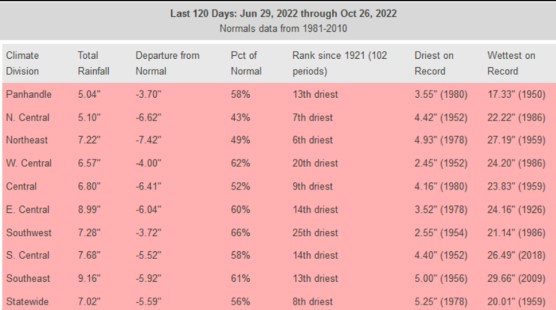

Texas:

Winter wheat planted reached 58 percent, up 5 percentage points from the previous year and up 4 points from the average. Winter wheat emerged reached 28 percent, even with the previous year and down 1 point from the average.

Cotton bolls opening reached 78 percent, up 7 percentage points from the previous year and up 4 points from the average. Cotton harvested reached 35 percent, up 7 points from the previous and the average. Cotton conditions rated 10 percent good to excellent, 18 percent fair and 72 percent poor to very poor.

Corn harvested reached 85 percent, down 3 percentage points from the previous year and up 6 points from the average. Corn conditions rated 18 percent good to excellent, 31 percent fair and 52 percent poor to very poor.

Sorghum harvested reached 95 percent, up 8 percentage points from the previous year and up 12 points from the average. Sorghum conditions rated 17 percent good to excellent, 41 percent fair and 42 percent poor to very poor.

Soybeans harvested reached 55 percent, down 18 points from the previous year and down 15 points from the average. Soybean conditions rated 13 percent good to excellent, 24 percent fair and 63 percent poor to very poor.

Peanuts mature reached 51 percent, up 1 percent from the previous year and up 9 percentage points from the average. Peanuts harvested reached 18 percent, even with the previous year and up 6 points from the average. Peanut conditions rated 31 percent good to excellent, 50 percent fair and 19 percent poor to very poor.

Pasture and Range:
Pasture and range conditions rated 14 percent good to excellent, 30 percent fair and 56 percent poor to very poor. Since last week, good to excellent conditions have decreased by 4 percentage points and poor to very poor conditions have increased by 4 points.


To view the Texas Crop Progress Report, click here.



Oklahoma Grain Elevator Cash Bids as of 2 p.m. October 11, 2022

Tue, 11 Oct 2022 15:11:27 CDT


Oklahoma Grain Elevator Cash Bids as of 2 p.m. October 11, 2022


The U.S. Department of Agriculture and the Oklahoma Department of Agriculture are now putting the Daily Cash Grain Report into a PDF format - we are saving that PDF and archiving them for today's specific report. To see today's update, click on the PDF report link at the bottom of this story.

In addition to the PDF of the daily report, you can also listen to the Cash Grain Report by calling 405-621-5533. Push 2 for the grain report.


Click here: 04359_OklaCashGrain10112022.pdf


North American Combine Harvesters Stay Positive, Tractors Gains Focus on Bigger Units

Tue, 11 Oct 2022 14:38:17 CDT


North American Combine Harvesters Stay Positive, Tractors Gains Focus on Bigger Units


Combine harvester sales grew in September for both the U.S. and Canadian markets, while total tractors fell in both countries according to the latest data from the Association of Equipment Manufacturers (AEM).

Total U.S. ag equipment unit sales stayed above the 5-year average for the second month since April 2022. U.S. total farm tractor sales fell 12.8 percent for the month of September compared to 2021, while U.S. self-propelled combine sales for the month grew 6.6 percent, slowing the previous month's gains. The 100+ horsepower 2WD tractor segment was again the only positive segment in the U.S., up 9.6 percent, while mid-range tractors between 40 and 100 horsepower were down 10.2 percent, and the sub-40hp segment fell 16.3 percent. Total farm tractor sales are down 14.3 percent year-to-date, a slight improvement from the previous month, while combine harvester unit sales growth streak, now at four months, have the segment up 3.4 percent year-to-date.

In Canada, growth in the majority of segments led to the first 2-month growth streak of the year, with growth led by combine harvesters, up 105.6 percent. Overall unit sales in tractors were down 0.9 percent, with 4WD units leading sales again, up 64.3 percent year-on-year. Unit sales in 2WD segments fell 1.6 percent due to a 13.1 percent decline in the sub-40hp segment. Both mid-range (+12.5 percent) and 100+ hp units (+41.1 percent) were positive. Year-to-date farm tractor unit sales cut their losses, now only down 6 percent in Canada, while harvesters are only 1 unit off their pace this time last year, currently at 1,241 units sold.

"The ag equipment market, as with most markets for manufactured goods, is turbulent," said Curt Blades, senior vice president, industry sectors and product leadership at the Association of Equipment Manufacturers. "Farmers want to take advantage of the efficiency gains and technology that new equipment brings to their operations, especially with commodity markets being as positive as they are. However, supply chain difficulties continue to weigh on our member manufacturers' deliveries."

The full reports can be found in the Market Data section of the AEM website under Ag Tractor and Combine Reports.

To read the U.S. report, click here.

To read Canada's report, click here.


Soy Checkoff Supports Research to Expand Key Soybean Meal Export Infrastructure

Tue, 11 Oct 2022 14:36:38 CDT


Soy Checkoff Supports Research to Expand Key Soybean Meal Export Infrastructure


United Soybean Board, Qualified State Soybean Boards and the Soy Transportation Coalition funds research and analysis to enhance infrastructure in Pacific Northwest.


To provide efficient access and bolster international trade markets for U.S. soybean meal, the United Soybean Board (USB) will invest $400,000 in the research, analysis and design costs of the Port of Grays Harbor's Terminal 4 Expansion and Redevelopment Project. The terminal, located in Aberdeen, Washington, plays an important role in international exports.

"The Port of Grays Harbor is critical in expanding high-value soybean meal exports. Farmers recognize this through their checkoff to fund significant work informing these upgrades that bring value to all U.S. soybean farmers," said Tony Johanson, USB director and Soy Transportation Coalition board member from Nebraska. "I'm proud of our farmers' commitment to enhance and maintain U.S. infrastructure. Doing so helps sustain our competitive advantage over global competitors."

USB joins the Soy Transportation Coalition, Iowa Soybean Association, Kansas Soybean Commission, Nebraska Soybean Board, North Dakota Soybean Council and South Dakota Soybean Research and Promotion Council, bringing the total farmer research investment to $1.3 million.

Earlier this year, AG Processing Inc. (AGP), an Omaha-based cooperative that owns and operates 10 soybean processing facilities in the Midwest, announced it would expand its export terminal at the Port of Grays Harbor.

Scheduled to be operational in 2025, the upgrades will allow the AGP terminal to increase soybean meal exports from three to six million metric tons. To accommodate the growth, the Port of Grays Harbor will expand the rail infrastructure, allowing the terminal to handle the volume and mitigate traffic congestion in the community.

"It is well established how investments in the Pacific Northwest will result in greater farmer profitability in the Midwest," said Mike Steenhoek, executive director, Soy Transportation Coalition. "In turn, profitable farmers in the Midwest result in increased investments in the Pacific Northwest. AGP's expansion project at the Port of Grays Harbor is arguably the most immediate opportunity for soybean farmers to assist with the need for increased soybean meal export capacity. The Soy Transportation Coalition and other farmer organizations are pleased to partner in this important project."

The Port of Grays Harbor's Terminal 4 research project is the latest infrastructure initiative from the soy checkoff. In 2019, the checkoff funded research, education and promotion costs related to dredging the Mississippi River. And in 2021, the checkoff funded pre-engineering and design work to maintain Lock and Dam #25 on the Upper Mississippi River.

To learn about key priorities of U.S. soybean farmers and programs underway to build demand for U.S. Soy, sign up for the Soy Hopper newsletter by clicking here.


AFBF Presents Interstate Commerce Issue Before Supreme Court

Tue, 11 Oct 2022 12:45:25 CDT


AFBF Presents Interstate Commerce Issue Before Supreme Court


The American Farm Bureau Federation and National Pork Producers Council presented oral arguments before the U.S. Supreme Court today, challenging the ability of one state to set agricultural production standards for the entire country. The case involves California's Proposition 12 law that bans the sale of pork from hogs that don't meet the state's arbitrary production standards, even if the hogs were raised outside of California.


"Today's arguments have implications not just for farmers and ranchers, but for businesses and consumers across the country," said AFBF President Zippy Duvall. "At the heart of this argument is whether one state can set the rules for the entire country. Proposition 12 has the potential to put small hog farmers out of business by requiring costly renovations and forces them to adopt practices that farmers and their veterinarians may find harmful to their animals.


"Farmers share California's goal of ensuring animals are well cared for and raised in a safe environment. Unfortunately, Proposition 12's misguided approach will ultimately cost every family through higher food prices."


Read the Supreme Court brief here.


NCBA Joins NPPC in Defending Interstate Commerce for Livestock Producers

Tue, 11 Oct 2022 12:24:01 CDT


NCBA Joins NPPC in Defending Interstate Commerce for Livestock Producers


Today, the National Cattlemen's Beef Association (NCBA) reaffirmed support for the National Pork Producer's Council (NPPC) following Supreme Court oral arguments in the case NPPC v. Ross.


"While this case is not focused on cattle producers, the precedent set by the court will determine all producers' ability to engage in interstate commerce," said NCBA Vice President of Government Affairs Ethan Lane. "NCBA strongly supports economic freedom for all livestock producers to sell their high-quality protein from coast to coast and we join NPPC in urging the Supreme Court to reject unconstitutional mandates on agricultural production."


Earlier this year, NCBA filed an amicus brief before the court arguing that California's mandates on livestock production methods violated the dormant commerce clause of the Constitution. Opening the door to state-level mandates creates a patchwork of rules that unreasonably restricts cattle producers' ability to conduct business across state lines.


Executive Cotton Update: U.S. Macroeconomic Indicators & the Cotton Supply Chain

Tue, 11 Oct 2022 11:09:02 CDT


Executive Cotton Update: U.S. Macroeconomic Indicators & the Cotton Supply Chain


U.S. Macroeconomic Indicators & the Cotton Supply Chain
October 2022


Macroeconomic Overview:
The International Monetary Fund (IMF) will release an updated set of estimates for global economic growth in the first half of October (after this publication's release). Current IMF figures (released July 2022) already suggest that countries accounting for one-third of the world economy will contract in consecutive quarters either in 2022 or 2023. Inflation is a global issue. The rise in European energy prices, a slowdown in the Chinese property market, and climbing interest rates in the U.S. were cited as additional sources of concern in preliminary remarks by the IMF's director ahead of October's release. While reiterating the risk of downside revision, the IMF official expects a loss in global output around $4 trillion between now and 2026 (for context, $4 trillion is about the size of Germany's economy, the world's fourth largest market).


Another major development in the global economy has been a steep increase in the value of the U.S. dollar. As U.S. interest rates increased relative to those in other markets over the past several months, it made investment in dollar-denominated assets more attractive and the resulting influx of money caused the dollar to strengthen. For emerging markets, this can have several adverse effects. Emerging market debt is often expressed in dollar terms. When the dollar becomes stronger relative to the currency of a country with debt, payments become more expensive in domestic terms. This exchange rate issue is compounded by the rise in interest rates, which can directly impact debt payments. Emerging markets have been an engine of global economic growth in recent decades, but mounting financial pressures may push some countries toward default.


Employment: The U.S. economy was estimated to have added +263,000 jobs in September. The existing figure for July increased +11,000 positions to +537,000. The existing figure for August was unchanged at +315,000. The twelve-month average for job gains is +474,000.


The unemployment rate decreased from 3.7% to 3.5%. Since the end of 2021, the unemployment rate has been below four percent. In the history of U.S. unemployment data (since 1948), there have only been three other periods (1950-53, 1965-69, 2018-19, and the present) where the unemployment rate persisted below four percent.


Wage growth has likely been pulling more workers back into the economy. Compared to early months of the pandemic, the labor force participation rate has increased by one percentage point (from 61.4% in the summer of 2020 to 62.4% most recently). Despite the improvement, the ratio of people wanting to work relative to the entire population is about half a point lower than the level before COVID (average near 63.0% from 2014 through 2019).


Since June 2020, the rate of wage growth has generally been between 5.0% and 5.5%. The latest value (September) was 5.0%. This is near the lower end of the range established since COVID. There was a sharp (10% month-over-month) downturn in job openings in August (latest figure available). If openings continue to decline, it could create slack in the labor market and inhibit wage growth. Wage growth often correlates with inflation. Slower wage growth could diminish general price pressures throughout the economy but could come at the expense of slower consumer spending.


Consumer Confidence & Spending: The Conference Board's Index of Consumer Confidence increased for a second consecutive month in September (+8.3 points in August, +4.4 points in September). The current value (108.0) is the highest since April. Since COVID, the index ranged between 87.1 (February 2021) and 128.9 (June 2021). The long-term average is 93.8 (since 1970).


In August, overall consumer spending increased marginally (+0.1%) month-over-month. Year-over-year, overall spending was +1.8% higher. Consumer spending on garments was -0.4% lower both month-over-month and year-over-year in August. Every month between June 2020 and February 2022, the growth rate in consumer spending on apparel exceeded the growth rate in overall spending. In every month since March 2022, the overall rate has been higher than the rate of spending on apparel.


Consumer Prices & Import Data: Retail prices for garments have been increasing more slowly than the overall inflation rate. Relative to averages in 2019 (pre-COVID), the CPI for apparel was +2.2% higher in August, while the overall CPI was 15.8% higher.


Import costs have been rising. The latest seasonally-adjusted value per square meter equivalent (SME) of cotton-dominant apparel was $4.04/SME. This is the highest cost on record (data since 1989). The posting of a record high represents a sharp reversal relative to import costs during the pandemic that nearly set record lows. Seasonally-adjusted import costs for cotton-dominant apparel were below $3.00/SME in late 2020 and early 2021. Imports during these months likely included deliveries resulting from contracts signed during the most challenging months of the pandemic 8-10 months earlier.


To view the full report and charts, click here.


New NSP Leadership Elected at Annual Board Meeting

Tue, 11 Oct 2022 10:56:53 CDT


New NSP Leadership Elected at Annual Board Meeting


The National Sorghum Producers board of directors elected officers and new directors at its annual board and budget meeting in August. Craig Meeker of Wellington, Kansas, was selected as chairman of the organization, replacing Kody Carson from Olton, Texas. Amy France of Marienthal, Kansas, was elected vice chair.


"I am incredibly humbled I have the opportunity to serve as chairman of the National Sorghum Producers," Meeker said. "As I look forward to the things we have coming in the near future, I think we have a great opportunity to lay a firm foundation through the farm bill process to ensure sorghum farmers have a sustainable industry moving forward. With the Partnerships for Climate-Smart Commodities grant NSP recently received, it gives me great excitement to think about how we can leverage this initial investment to move the sorghum industry forward. I know with dry weather, it's easy to get down; however, I am optimistic most farmers see the great potential sorghum has, and I look forward to guiding the association in a great future."


"I am excited to welcome Craig and Amy to new leadership roles," NSP CEO Tim Lust said. "Their drive and passion for the industry will be crucial as our industry moves through a challenging but exciting year."


The NSP board of directors elected two new members—Garrett Love from Montezuma, Kansas, and Kent Martin from Alva, Oklahoma. Larry Richardson from Vega, Texas, was also re-elected. Love and Richardson will serve a three-year term beginning Oct. 1, and Martin will take his seat on the NSP board in December once his term is complete on the United Sorghum Checkoff Program board of directors.


"We are excited to welcome Kent and Garrett, and for the return of Larry, to the NSP board of directors," Lust said. "I have had the pleasure of working with all three individuals in various capacities during my tenure as CEO of NSP and the Sorghum Checkoff. Larry is a leader in the sorghum seed industry, and the knowledge and experience Kent and Garrett bring as farmers, plus their respective backgrounds in research and government affairs, will prove as great assets to the NSP board."


The NSP board recognized two leaders who ended their terms as directors on Sept. 30—Dan Atkisson of Stockton, Kansas, and Bobby Nedbalek of Sinton, Texas.


"We are sincerely grateful for the leadership and perspective Dan and Bobby have provided through their service to the sorghum industry," outgoing NSP Chairman Kody Carson said. "These men have dedicated a significant portion of their time to the improvement of the sorghum industry, advocating on behalf of U.S. sorghum farmers across the nation. I deeply respect their contributions to our industry, and I wish my friends well as they move on to the next chapter."
New directors and officers took their respective positions on the NSP board Oct. 1. Visit SorghumGrowers.com/leadership/ to learn more.


Chances of Rain throughout the State, but no Drought-Busting Rain in Sight

Tue, 11 Oct 2022 10:40:29 CDT


Chances of Rain throughout the State, but no Drought-Busting Rain in Sight


Looking at the last 7 days we have seen some precipitation across the state, but State Climatologist Gary McManus says we still aren't seeing any drought-relief. McManus says its more like "Drought delaying" relief at most.

He says."We need a whole lot more. Even for the last 30 days, that was still just a blip in our secondary rainy season where we should be seeing a statewide average of about 3.5" or so. And that period is still the second driest in the last 100 years."

McManus says we will see a few chances of rain throughout the day and tomorrow, then over the weekend, but said not to expect much accumulation, We'll be dealing with another of those closed low situations (and we all know just how painful that can be) in the Desert Southwest. At least I think it looks like a closed low in the forecast models as it wanders around. Whenever it decides to meander over this way, it might bring some rain to the area later on, but still not sure about that one."


We also have to be prepared for fire danger, "Now with the dead vegetation hanging around due to the drought and our elongated summer weather, anytime one of these fronts moves into the area the winds will kick up and we'll see elevated fire danger. Not into the extreme territory just yet, but we're just getting started."

If you have been wanting colder air, McManus says that is on the way, "There should be some actual COLD air coming our way next week with a large area of winter plunging into the eastern half of the U.S. bulges its way towards us, even as that upper-low across the Desert SW allows for some rain in our western areas."

To read more from State Climatologist, Gary McManus visit his Ticker here:


Chances of Rain throughout the State, but no Drought-Busting Rain in Sight


Farmers National Company Announces New Senior Vice President of Energy

Tue, 11 Oct 2022 09:30:21 CDT


Farmers National Company Announces New Senior Vice President of Energy


Farmers National Company is pleased to announce that Chace Daley has joined as senior vice president of energy, based in Tulsa, Okla.


Chace has 14 years of oil and gas experience in private practice and leading oil and gas companies, guiding more than $1.6 billion in oil and gas transactions. Chace served as vice president of land and general counsel of Sage Natural Resources in Tulsa, Okla., where he managed all land, division order, and legal functions of the company and organically built high-value leasehold positions and drilling inventory. Prior to Sage, Chace served as lead in-house counsel for all operational facets of Samson Resources Company in Tulsa, Okla., across 14 states. Prior to Samson, Chace served as an attorney at Hall Estill, P.C.


Chace received his MBA, with a focus in energy, from the University of Tulsa; his J.D. from Washington and Lee School of Law; and his BSBA. from the University of Missouri.


In his new role, Chace will lead Farmers National Company's Energy business, including oil and gas asset management, leasing, sales, and renewable energy. "Chace is a dynamic leader, adept at building honest and trusting relationships with clients, peers, and direct reports. He is an experienced land and legal executive who will bring operational skills and strategic perspective to help our business continue to grow." said Clayton Becker, President.


"Farmers National Company has a legacy of high performance and leadership across the land, energy and specialty asset management that is self-evident from the breadth of its services, the loyalty of its customer base and the unmatched skill and experience of its people," said Daley. "I'm grateful for the opportunity to join this company that is well-positioned to meet the ever-evolving needs of property managers everywhere. In particular, I look forward to leading our team of energy experts as we walk side-by-side with our customers to tackle the challenges and opportunities presented by the sourcing of our domestic and global energy needs today."


Farmers National Company, an employee-owned company, is one of the largest independent oil and gas management firms in the country. Located in the heart of the nation's oil and gas production region, the company's industry experts include Certified Professional Landmen, Registered Professional Landmen, Certified Mineral Managers, Certified Lease and Title Analysts, accountants and geologists. Additional services provided by the company include Farm and Ranch Management, Real Estate Sales, Appraisals, Insurance, Consultations, Hunting Lease Network, Forest Management, and FNC Ag Stock. For more information, visit the Farmers National Company website at www.FarmersNational.com.


Preparing for Financial Opportunity - Retention of Heifers

Tue, 11 Oct 2022 09:31:15 CDT


Preparing for Financial Opportunity - Retention of Heifers


Mark Johnson, Oklahoma State University Extension Beef Cattle Breeding Specialist, offers herd health advice as part of the weekly series known as the "Cow Calf Corner" published electronically by Dr. Peel, Mark Johnson, and Paul Beck. today Johnson is talking about benefits of heifer retention.


After a couple months of dealing with drought and heat related topics it's time to look ahead at some of the financial opportunities on the horizon.   Cattle producers need to act as business managers and assess inventories of all resources and commodities on hand to determine the best course of action to maximize their profit potential over the next several years. Regardless of what you have done in the past, now is the time to prepare for the financial opportunities that lie ahead in the cattle business. This week we address the upside of heifer retention.


Consider the following:

- Drought has resulted in cyclically low cattle inventories. The laws of supply and demand dictate that when cattle inventories are low the future value of cows, calves, yearlings and feds will increase. Feedlot placement data shows more heifers going on fed as opposed to being retained as replacements. What opportunities does this create? The opportunity to market bred replacement heifers at premium values in the future.


- This week, the USDA Oklahoma Weekly Cattle Auction Summary tells us that 477 pound, Medium and Large frame, Muscle Score 1 heifer calves traded at an average of $162.79/cwt. This translates to a total value per head of $777.


- If we collect weights on our four to seven year old cows at weaning we can determine the average mature weight of our cow herd.


- If we assume: 1) these heifers will be 14-15 months old by May 1, 2023 when we are ready to begin our breeding season, 2) they need to be at 65% of their mature weight at that time to be cycling and ready to breed and, 3) our average mature cow weighs 1,300 pounds.


- It permits us to calculate the following:

o 1,300 x .65 = 845 pounds target weight by May 1, 2023
o 845 - 477 = 368 pounds of gain needed over the next 200 days
o 368/200 = 1.84 pound average daily gain needed from now until breeding season


- As we take inventory of our hay, silage, feed grains and potential for winter grazing we need to arrive at a ball park figure for the cost of gain (COG) on the 368 pounds needed to reach the target weight. This could be achieved in multiple ways depending on available feed resources. For this example I will assume a cost of gain at $.80, $1.05 and $1.30 to make the following calculations:


o At $.80 COG: 368 x .80 = $295. This added to the current value of the heifer at $777 equals $1,072. To account for opportunity cost, financing, additional grazing past breeding season, potential death loss and the cost of breeding naturally or AI, I am raising this value by 10% resulting in a breakeven value of $1,180. Do you believe bred heifers will be worth at least $1,180/head a year from now?

o At $1.05 COG: 368 x 1.05 = $387. This added to the current value of the heifer at $777 equals $1,164. Again, raising that value by 10% to account for previously stated expenses results in a breakeven of $1,281.

o At $1.30 COG: 368 x 1.30 = $479. This added to the current value of the heifer at $777 equals $1,256. Again, raising that value by 10% results in a breakeven of $1,382.


Manage your business, do the math, take inventory of your resources and consult with a nutritionist. Each of the breakevens calculated above are below the fall values of good quality, spring calving, bred heifers over the past couple of years.   


Resource: USDA Oklahoma Weekly Cattle Auction Summary. AMS Livestock, Poultry & Grain Market News. Oklahoma Dept. of Ag Mrkt News. October 7, 2022


Below, listen to Dr. Mark Johnson as he talks about management of replacement heifers on SunUP TV's Cow-Calf Corner from April 2, 2022.


Derrell Peel Explains Why International Trade of Beef is Valuable

Tue, 11 Oct 2022 08:19:35 CDT Derrell Peel Explains Why International Trade of Beef is Valuable


Senior Farm and Ranch Broadcaster, Ron Hays, is visiting with Oklahoma State University Livestock Marketing Economist, Derrell Peel about the value of imports and exports for the U.S. beef market.

Peel and his colleague, Dr. Glynn Tonsor of Kansas State University had the opportunity to work on a study researching the value of imports and exports of beef. The report was commissioned by the Kansas Beef Council, Oklahoma Beef Council, and the Texas Beef Council. Peel talks about their findings during this study as it applies to the beef industry.

"The bottom line is, there continue to be conversations in the industry about the value of trade and how that value has changed over time," Peel said. "Sometimes we want to focus on exports, sometimes we focus on imports, but the fact of the matter is, in terms of the reality of trading in a global market, we have to do both."

This report looks at both beef imports and exports, Peel said, but strictly the meat part. The report asks a question, Peel said, of what would happen if we didn't trade.

"We looked at it in two stages," Peel said. "One was a ten percent reduction, and we sort of extrapolate that to what would happen if we just totally withdrew from the global market."

A ten percent reduction in import and export trade, Peel said, would mean billions of dollars worth of losses for both futures and fed cattle sellers.

When running different adjustments for imports and exports together through the economic model, Peel said the net impact over a ten-year frame of a 10 percent reduction in trade was valued at over 12 billion dollars of impact on feeder cattle producers and over 6 billion dollars in the feedlot sector.

On the imports side of the equation, many people have a hard time understanding why the United States is allowing international beef to come in and compete with us when we have an adequate amount of beef to feed the country. Peel says the beef market is much more complex.

Once each individual animal is fabricated, Peel said thousands of basic products are produced and each has its own market.

"The markets are related in some cases, heavily related in some cases, so both imports and exports are driven by this underlying tendency of any market to seek out value, and so in the case of beef imports, we seek out value because we have such a huge ground beef market primarily in the U.S.- that is the primary driver of the imports- and we need additional lean to drive that market."

Peel said the United States brings in additional lean to supplement domestic production of cull cow beef and other lean products that we can use, but also as a way to add value to our fed cattle because it gives us the ability to utilize all of the fatty trimmings from fed cattle in the ground beef market by supplying the additional lean that we need to turn it into ground beef products.


To read more conclusions from the report estimating the impacts of ceasing both U.S. beef exports and imports, click here.


Click the LISTEN BAR below to listen to Ron Hays and Dr. Derrell Peel talking about the value of beef trade for the United States.

The Beef Buzz is a regular feature heard on radio stations around the region on the Radio Oklahoma Network and is a regular audio feature found on this website as well. Click on the LISTEN BAR below for today's show and check out our archives for older Beef Buzz shows covering the gamut of the beef cattle industry today.


Ron Hays Beef Buzzes with Derrell Peel about Trade Value

click to play audio or right-click to download

Nanovel Introduces Revolutionary Autonomous Tree Fruit Harvester

Tue, 11 Oct 2022 08:07:40 CDT


Nanovel Introduces Revolutionary Autonomous Tree Fruit Harvester


Isaac Mazor, Founder and CEO of Nanovel Ltd. (www.nanovel.ag) reveals a revolutionary autonomous tree fruit harvester. Mazor is a successful serial entrepreneur in the field of semiconductors leveraging his experience to solve this complex technological challenge in agriculture.


Nanovel has been self-funded and operating in stealth mode since established in 2018. It has been intensively researching and developing its technologies, proving the concept, securing its intellectual property, conducting field testing and customer demonstrations of its robotic harvester.


The company expects to launch its beta version in 2023 for the citrus market.


"Nanovel is committed to address a serious threat to the future supply of tree fruit. Enhancing grove profitability is a driving motivator behind building our new AI-driven robotic harvester," says Mazor. "Nanovel's robot is extremely intelligent, ag-environment durable and cost-effective. Grower input throughout the development process sharpens the Nanovel team's focus on solving real world problems using our proprietary technology. Our mission is to provide growers a reliable, productive and affordable solution for tree fruit harvesting."


"Farm labor shortage is one of the main challenges we are facing today." Says Tal Fogelman, a California grower and Business Development Advisor to Nanovel. "Especially around harvest time, farm labor is scarce, challenging to secure," Fogelman says. "Nanovel's solution will be serving a multi-billion dollar market that is currently relying on the traditional method of manual picking."


Nanovel Autonomous Tree Fruit Harvester Will Provide Multiple Benefits To Growers


   - Deep foliage real time 'Find and Pick' capability is enabled by edge vision and computing.
   - Supports gripping and trimming using proprietary technology suitable for a wide variety of fruit types: citrus, stone fruit, avocado, mango and more.
   -   Reliable harvest scheduling.
   -   Valuable insights of yield and quality by big data collection and analysis.
   -   Cost-competitive compared to traditional manual picking.


About Nanovel Ltd.

Nanovel Ltd, founded in 2018, is a pioneer in the field of autonomous harvesting of deep foliage tree fruit. Founder and CEO Isaac Mazor and the Nanovel team bring vast expertise leveraging artificial intelligence (AI) and robotic technologies to solve complex tecnological challenges. Nanovel is driven by the enormous need for innovation in fresh fruit harvesting. Its proprietary solution combines AI, computer vision, machine learning and proprietary robotics technologies, to enable autonomous tree fruit harvesting to become more productive, reliable and cost effective than hand harvesting.


To learn more about Nanovel, visit: www.nanovel.ag.


Sen. Stephens Holds Interim Study on Predatory Birds and Harm to Livestock, Property

Tue, 11 Oct 2022 08:06:22 CDT


Sen. Stephens Holds Interim Study on Predatory Birds and Harm to Livestock, Property


Sen. Blake "Cowboy" Stephens held an interim study Monday to look into the significant harm done to livestock and property by predatory birds. Stephens, R-Tahlequah, said the most destructive is the black vulture.


"Most people have no idea how deadly and vicious black vultures can be for livestock. They will attack baby calves as they are being born and literally eat them alive, and they'll attack the mother as she's giving birth," Stephens said. "It is a gruesome situation that can cost a family thousands of dollars in lost livestock, but their hands are literally tied by federal law."


Stephens said black vultures are protected under the federal Migratory Bird Treaty Act. Oklahomans can get a permit to take up to five birds per permit, per year, but Stephens said that's woefully inadequate to address the exploding population of vultures.


"We heard testimony from numerous agriculture experts and producers who said the numbers of black vultures have definitely increased over the past 60 years. Not only do they kill cattle, but they also kill sheep, and there have been reports of the loss of horses, donkeys, goats and other animals," Stephens said. "But beyond that, they destroy property. They'll pick shingles off of roofs, tear the rubber off of windshield wipers, and destroy wiring on transmission lines and cell towers. The birds' feces is acidic, and it can actually cause holes to form in the metal in water towers and other structures."


Testimony was given by Chuck Roberts with Oklahoma Farm Bureau Insurance; Neal Boatwright, a farmer from Cherokee County; Dr. Dwayne Elmore with Oklahoma State University; Scott Blubaugh, president of American Farmers and Ranchers Insurance; and Scott Alls, state director, United States Department of Agriculture Wildlife Services and Oklahoma Department of Wildlife Services. The livestream of the full hearing can be viewed at https://oksenate.gov/live-chamber.


After the study, Stephens said the five-bird cap needs to be eliminated and citizens need to be able to actually set up traps, which can be far more effective than hunting the vultures with guns. These changes, however, must come at the federal level.


"This study is one way to raise awareness and help us bring this problem to the attention of the federal government. We want to work with our federal delegation as well to try and get something done and provide a pathway for livestock producers to be able to protect their own animals without being in violation of the law."


Nanovel Introduces Revolutionary Autonomous Tree Fruit Harvester

Tue, 11 Oct 2022 08:07:40 CDT


Nanovel Introduces Revolutionary Autonomous Tree Fruit Harvester


Isaac Mazor, Founder and CEO of Nanovel Ltd. (www.nanovel.ag) reveals a revolutionary autonomous tree fruit harvester. Mazor is a successful serial entrepreneur in the field of semiconductors leveraging his experience to solve this complex technological challenge in agriculture.


Nanovel has been self-funded and operating in stealth mode since established in 2018. It has been intensively researching and developing its technologies, proving the concept, securing its intellectual property, conducting field testing and customer demonstrations of its robotic harvester.


The company expects to launch its beta version in 2023 for the citrus market.


"Nanovel is committed to address a serious threat to the future supply of tree fruit. Enhancing grove profitability is a driving motivator behind building our new AI-driven robotic harvester," says Mazor. "Nanovel's robot is extremely intelligent, ag-environment durable and cost-effective. Grower input throughout the development process sharpens the Nanovel team's focus on solving real world problems using our proprietary technology. Our mission is to provide growers a reliable, productive and affordable solution for tree fruit harvesting."


"Farm labor shortage is one of the main challenges we are facing today." Says Tal Fogelman, a California grower and Business Development Advisor to Nanovel. "Especially around harvest time, farm labor is scarce, challenging to secure," Fogelman says. "Nanovel's solution will be serving a multi-billion dollar market that is currently relying on the traditional method of manual picking."


Nanovel Autonomous Tree Fruit Harvester Will Provide Multiple Benefits To Growers


   - Deep foliage real time 'Find and Pick' capability is enabled by edge vision and computing.
   - Supports gripping and trimming using proprietary technology suitable for a wide variety of fruit types: citrus, stone fruit, avocado, mango and more.
   -   Reliable harvest scheduling.
   -   Valuable insights of yield and quality by big data collection and analysis.
   -   Cost-competitive compared to traditional manual picking.


About Nanovel Ltd.

Nanovel Ltd, founded in 2018, is a pioneer in the field of autonomous harvesting of deep foliage tree fruit. Founder and CEO Isaac Mazor and the Nanovel team bring vast expertise leveraging artificial intelligence (AI) and robotic technologies to solve complex tecnological challenges. Nanovel is driven by the enormous need for innovation in fresh fruit harvesting. Its proprietary solution combines AI, computer vision, machine learning and proprietary robotics technologies, to enable autonomous tree fruit harvesting to become more productive, reliable and cost effective than hand harvesting.


To learn more about Nanovel, visit: www.nanovel.ag.


Slaughter Cows $2 to $3 Lower Monday at OKC West in El Reno

Tue, 11 Oct 2022 05:18:36 CDT


Slaughter Cows $2 to $3 Lower Monday at OKC West in El Reno


OKC West, El Reno Cow and Bull Market

Monday, October 10, 2022

Receipts

This week 1,044
Last Week 1,359
Year Ago 575

Compared to last week slaughter cows sold 2.00-3.00 lower. Slaughter bulls were lightly tested again this week but a lower undertone was
noted. Demand light to moderate. Supply included: 2% Feeder Cattle (100% Steers); 91% Slaughter Cattle (97% Cows, 3% Bulls); 7%
Replacement Cattle (26% Stock Cows, 67% Bred Cows, 7% Cow-Calf Pairs). Feeder cattle supply over 600 lbs was 0%.

Click on the PDF link below for the October 10th Cow and Bull Market Report as compiled by USDA Market News from OKC West


Click here: 04334_OKCWestElRenoCowBullMkt10102022.pdf


Feeder Steers Steady to Lower, Feeder Heifers Lower at Joplin Regional Stockyards on Monday

Tue, 11 Oct 2022 03:11:55 CDT


Feeder Steers Steady to Lower, Feeder Heifers Lower at Joplin Regional Stockyards on Monday


Joplin Regional Stockyards
Mon Oct 10, 2022


AUCTION
This Week             4,972
Last Reported      5,314
Last Year               3,728

**CLOSE**
Compared to last week feeder steers traded steady to 3.00 lower. Feeder heifers under 425 lbs. traded 8.00-11.00 lower with heavier weights trading 3.00-5.00 lower. Supply and demand was moderate. Supply included: 100% Feeder Cattle (52% Steers, 41% Heifers, 7% Bulls). Feeder cattle supply over 600 lbs was 57%.

FEEDER CATTLE
STEERS - Medium and Large 1 (Per Cwt / Actual Wt)
Head       Wt Range       Avg Wt       Price Range       Avg Price
8                318-343           327       195.00-215.00      207.14
10              351-392           373       195.00-200.00      198.59

19              421-444           436       189.00-190.00      189.64
25              463-492           480       183.00-187.00      184.92

68              503-548           529       173.00-194.00      181.89
97              550-589           563       175.00-196.00      183.75

214            621-639           627       179.00-194.00      184.47
6                     602               602           179.00                179.00 Value Added

174            700-746           720       171.00-185.00      179.69
84              763-782           781       171.50-172.00       171.53

135            852-860           854       170.00-172.00       170.99

18                  946                946           162.00                 162.00

6                   1045              1045          151.00                 151.00
52                 1061              1061          150.00                 150.00

For the complete report from USDA Market News click on the PDF link below:

Click here: 04330_JoplinRegional10102022.pdf


Feeder Steers Lower, Seeder Heifers Unevenly Steady, Steer Calves Steady, Heifer Calves Lower at Oklahoma National Stockyards on Monday

Tue, 11 Oct 2022 03:09:01 CDT


Feeder Steers Lower, Seeder Heifers Unevenly Steady, Steer Calves Steady, Heifer Calves Lower at Oklahoma National Stockyards on Monday


Oklahoma National Stockyards
Mon Oct 10, 2022


AUCTION
This Week                 9,400
Last Reported          8,346
Last Year                   7,410

***Close***
Compared to last week: Feeder steers 1.00 to 3.00 lower. Feeder heifers unevenly steady. Demand moderate to good. Quality mostly average. Steer calves unevenly steady. Heifer calves 2.00 to 4.00 lower. Demand moderate for calves. Some of the region received much needed moisture over the weekend with more in the forecast early this week. Supply included: 100% Feeder Cattle (52% Steers, 41% Heifers, 7% Bulls). Feeder cattle supply over 600 lbs was 39%.

FEEDER CATTLE
STEERS - Medium and Large 1 (Per Cwt / Actual Wt)
Head       Wt Range       Avg Wt       Price Range       Avg Price
32                 369                369             201.00              201.00

92             408-443            427      187.50-199.00       191.07
175           451-499           476       180.00-190.00      181.97

159           519-549           536       177.00-187.00      182.98
214           554-589           572       172.00-182.00      177.49

252           600-646           618       165.00-174.00      169.69
7                    624               624             162.00              162.00 Unweaned
398           655-695           671       163.00-176.00      169.43
68             652-685           672             161.00               161.00 Unweaned

311           701-747           719       160.00-174.50       169.78
375           750-785           756       162.00-173.50       170.71

301           807-847           819       159.00-170.25       168.82
15             855-864           860       155.00-161.00       158.62

5                   929                929             160.00               160.00
14                 995               995              152.50               152.50

For the complete market report from USDA Market News click on the PDF link below:

Click here: 04328_OklahomaNational10102022.pdf


Oklahoma Grain Elevator Cash Bids as of 2 p.m. October 10, 2022

Mon, 10 Oct 2022 15:07:08 CDT


Oklahoma Grain Elevator Cash Bids as of 2 p.m. October 10, 2022


The U.S. Department of Agriculture and the Oklahoma Department of Agriculture are now putting the Daily Cash Grain Report into a PDF format - we are saving that PDF and archiving them for today's specific report. To see today's update, click on the PDF report link at the bottom of this story.

In addition to the PDF of the daily report, you can also listen to the Cash Grain Report by calling 405-621-5533. Push 2 for the grain report.


Click here: 04325_OklaCashGrain10102022.pdf


Speaker McCall, House Republicans tout parental choice success under new open transfer law

Mon, 10 Oct 2022 15:05:49 CDT


Speaker McCall, House Republicans tout parental choice success under new open transfer law


Thousands of Oklahoma families have used Oklahoma's new open transfer law to send students to the public schools that best meet their needs.

Nearly 11,000 transfer requests have been made since the open transfer law took effect this year, with more than 8,400 transfers approved, according to State Department of Education data.

"In less than a year, Oklahoma is already seeing big success with open transfer," said House Speaker Charles McCall, R-Atoka. "Open transfer is equitably benefitting families in all parts of the state, regardless of geography or income level, without harming public school budgets. I appreciate all the work legislators, parents, school officials and others did to collaborate on a consensus law that is successfully giving families the choices they asked for within their child's education."

McCall added: "Oklahoma's open transfer law is what parental choice done right looks like. We are now one of the best states in the country for parental choice that works, thanks to open transfer."

Oklahoma's open transfer law went into effect Jan. 1, 2022, and allows students to transfer to any public school district in the state. The law was authored by McCall and co-authored by several House Republicans through Senate Bill 783 in the first regular session of the 58th Oklahoma Legislature in 2021, after being first proposed in a bill by McCall, House Bill 2074, that was advanced by the House that session, as well.

Preliminary data shows transfers requested to hundreds of districts across the entire state, in urban, suburban and rural areas. On average, about three of every four transfer requests were approved. Nearly 90% of transfer denials were due to district capacity limits, while the remainder were due to student behavior, attendance or documentation issues.

"Parental choice within the public school system is very popular under the open transfer law because Oklahoma loves our public schools," said Rep. Rhonda Baker, R-Yukon, chair of the House Education Committee. "As a former school teacher, I am very pleased to see parents using choice to improve their children's educational opportunities and outcomes within Oklahoma's public school system."

Before the law was passed, families could not transfer openly among districts unless the receiving district had a transfer option, which many did not. The pandemic exacerbated the problem when some schools went online only, causing complications for many families.

"Family desire for open transfer was clearly not isolated to the pandemic, given the thousands of transfer requests made post-pandemic. There are a variety of reasons parents are transferring their children, but what's most important is families now have more options available within the public school system," said Rep. Brad Boles, R-Marlow, a former school board member who presented the open transfer legislation in the House. "School districts are also exercising appropriate local control through capacity limits and other measures to maintain quality within districts. This is the balanced, fair approach we sought when bringing all parties together to craft this law, and I'm pleased the early statewide results have been positive."

Under the law, school districts must regularly provide the State Department of Education with data on transfers requests, approvals and denials. The Office of Educational Quality and Accountability then audits a portion of the data annually to ensure compliance with state open transfer laws and local open transfer policies set by school boards.


Rain Chances Across the State Ward Off Fire Danger, but Burn Bans still Cover Several Counties

Mon, 10 Oct 2022 12:49:47 CDT


Rain Chances Across the State Ward Off Fire Danger, but Burn Bans still Cover Several Counties


Statewide Discussion: Rain chances in the forecast span much of Oklahoma today with the best opportunity for wetting rainfall amounts in southwest Oklahoma extending into parts of central Oklahoma. Southeastern Oklahoma, where fire occurrence is running well above normal, is less likely to see rainfall today although relative humidity values will be higher than in previous days combined with sky cover holding fine-dead fuel moisture from dipping into the critical range. Composite fuel moisture, however, remains concerning with Energy Release Component nearing the 100th percentile. The western Oklahoma Panhandle counties will also likely remain dry and benefit from wetting rains from seven days ago has begun to wane. Lacking critical fire weather inputs, initial attack activity is expected to be successful noting continued suppression difficulty in southeastern Oklahoma. A somewhat stronger weather system moves in on Tuesday presenting some severe weather potential in southwestern Oklahoma extending into central and north-central counties will again dampen fire danger concerns across much of western Oklahoma. Precipitation chances remain slim for southeastern Oklahoma, and wind speeds increase to 5-15 mph with higher gusts with increased instability.

Southeastern, Eastern & South-Central Oklahoma: Overcast skies are expected to persist southeast through much of the day with afternoon temperatures 79°-86° and relative humidity values hovering around 37% holding fine-dead fuel moisture values around 7% with some localized 6% observations likely. While improved 1-hour fuel moisture may limit ignition potential, and fire that becomes established will continue to exhibit problematic fire behavior. Light southerly winds will support rates of fire spread in grass-dominated fuels around 35 ft/min with flame lengths 4.5-8 ft. Timber fuels will move at 10-33 ft/min with FL 4-7 ft. With increasing wind speeds on Tuesday, ROS in grass-dominated fuels will move around 90 ft/min with FL 8-15 ft. ROS in timber fuels will be 19-40 ft/min with FL 5-9 ft.

Western & North-Central Oklahoma: Rain chances are minimal in the Panhandle counties where temperatures this afternoon will warm into the 71°-77° range. Relative humidity values today are not expected to fall below 30% limiting ignition potential today. Southwest winds around 10 mph with some gusts nearing 20 mph will support head fire rates of spread 70-95 ft/min with flame lengths around 9 ft. Tuesday will bring slightly warmer temperatures, lower humidity values and stronger southwest winds. For Tuesday, temperature in the Panhandle counties will range from 78°-85° with afternoon relative humidity values 17-28% yielding fine-dead fuel moisture values 4-5%. Southwest winds sustained 10-18 mph with some gusts around 25 mph will support head fire rates of spread on established fires at 90-140 ft/min with flame lengths 9-14 ft.

Near-Term: Climatologically, weather patterns tend to become more dynamic mid- to late-October offering some rainfall potential. However, given the depth and severity of drought indices and the current state of fuels, the probability of unseasonal fire behavior should be anticipated. Dry conditions are expected mid-week ahead another weather system later this weekend.

Burn Bans:

Refer to: https://ag.ok.gov/divisions/forestry-services/ for the most current burn ban information and links to specific burn ban proclamations.

NE Area – 4 Fires Burned 60.5 Acres (Cause: 1-Escaped Debris, 3-Incendiary)
EC Area – 1 Fire Burned 368 Acres (Cause:1-Incendiary)
SE Area – 10 Fires Burned 76.2 Acres (Cause: 1-Escaped Debris, 1-Electrical, 8-Incendiary)

Large / Significant Fire Activity within the OFS Protection Area:
• Wildhorse Fire (LeFlore County – 368 Acres, 60% Contained

Fire Activity with OFS Response outside of the Protection Area
• 4250 Fire (Choctaw Cunty) – 786 Acres, 60% Contained


First Public Meeting for Illinois River Watershed Management Plan Set for Tuesday, October 11

Mon, 10 Oct 2022 12:39:44 CDT


First Public Meeting for Illinois River Watershed Management Plan Set for Tuesday, October 11


The Oklahoma Conservation Commission (OCC), in partnership with the Arkansas Department of Agriculture's Natural Resource Division (NRD), has scheduled the first in a series of public meetings to update the watershed-based management plan for the Illinois River Watershed. The in-person meeting will be held Tuesday, October 11 in Siloam Springs, Arkansas. There is also a virtual option (please see Zoom link above).


The Illinois River and its tributaries have a variety of uses set forth by the Oklahoma Water Resources Board, including recreation, aquatic life, drinking water supply, and agricultural and industrial water supply. The goal of this watershed-based plan is to protect and improve water quality in the watershed by addressing non-regulatory issues through voluntary activities or practices. This plan will focus on reducing impacts of nonpoint source pollution (pollution which results when rainfall carries pollutants into rivers, streams, wetlands and lakes) to the Illinois River and its tributaries and ultimately downstream to Lake Tenkiller and the Arkansas River.


"The OCC and the NRD are working collaboratively to host a series of stakeholder meetings that will guide the update of the Illinois River Watershed management plan for the next decade," said Shanon Phillips, OCC Water Quality Division Director. "The two states' holistic approach to update the plan in unison will better align nonpoint source needs across the entire watershed. The current watershed plan has led to notable water quality improvements on both sides of the state line from which a collaborative update can build upon."


The meeting is open to the public and will provide an overview of the watershed management planning process. Stakeholders will discuss water quality issues, conservation practices, the current state of the watershed, and the next steps in the development of the management plan.


The meeting is set for October 11 from 3 p.m. to 5 p.m. and will be held at the First Baptist Church located at 2000 Dawn Hill Rd., Siloam Springs, Arkansas, 72761.


For more information about the meeting, contact Shanon Phillips at shanon.phillips@conservation.ok.gov.


For more information about Oklahoma's current Watershed Plan for the Illinois River, visit:
https://conservation.ok.gov/.../Illinois-River-Watershed


There will be a Zoom option for tomorrow's public meeting, to join the Zoom Meeting please go to, https://us06web.zoom.us/j/88222263262?pwd=cExXWjU4V29lb0p4Z1RERGZIZVBmQT09
Meeting ID: 882 2226 3262
Passcode: 184342


Harvest Time! An Update on Ginning in the High Plains

Mon, 10 Oct 2022 11:40:29 CDT


Harvest Time! An Update on Ginning in the High Plains


Harvest has begun in the High Plains region, primarily in the Panhandle, but even Texas Star Co-op Gin in Slaton, Texas, had some modules on the yard. "We did some custom ginning for Farmers Co-op Gin in Ackerly, Texas, who decided not to open this year," said Cary Eubanks, gin manager for Texas Star. "We ginned about 43 modules, producing 580 bales and it was phenomenal cotton."


The cotton came from a drip irrigated field in Ackerly and Eubanks decided to gin immediately to preserve the grade of the cotton. Brian Nichols, manager of Farmers Co-op Gin, reported he had received grades on 190 of those bales and most averaged loan values of about 56 cents.


"It was nice to start out on a positive note," Eubanks added. "Not that it's not a tough year, but with all the negativity, it's nice that our first round was a good one."


Jerrell Key, manager at Adobe Walls Gin in Spearman, Texas, expects to start ginning next week. "We estimate to gin around 80,000 bales give or take 10,000," he added.


Pictured: First modules unload at Texas Star Co-op Gin.
Story Credit: Plains Cotton Growers


Walmart Foundation Teams Up with National FFA Foundation on Building National Sustainability Program

Mon, 10 Oct 2022 11:36:43 CDT


Walmart Foundation Teams Up with National FFA Foundation on Building National Sustainability Program


The Walmart Foundation has awarded the National FFA Foundation Inc. a grant of $750,000 to incorporate sustainability principles in school education. The National FFA Foundation will leverage the expertise of the National FFA Organization to develop these educational resources.

Knowing that building a sustainable system is a crucial focus for many industries, the National FFA Organization is working to ensure they meet the demand by educating the next generation of leaders. This generation will lead by example, act responsibly and create solutions to feed, clothe and fuel the world.

"The funding made available allows us to create new sustainability-focused education resources and programming that integrates current sustainable practices across multiple disciplines," said Chief Program Officer of the National FFA Organization Christine White. "We plan to equip our members to create solutions that will address the sustainability challenges of the future."

The focus of these resources will be to leverage the social influences of students by creating an inclusive program so all students enrolled in agricultural education can see how sustainability is meeting the needs of the present without compromising the ability of future generations to meet theirs.

"In 2020, Walmart and the Walmart Foundation committed to help protect, restore, and more sustainably manage 50 million acres of land and 1 million square miles of ocean by 2030," said Julie Gehrki, VP and COO of the Walmart Foundation. "An important element of this work is equipping the next generation of agriculture leaders with the knowledge and skills they need to be successful. That includes critical knowledge of how to conserve soil, water, and biodiversity so that together, we can help build a prosperous, sustainable agricultural sector for future generations."

The National FFA Organization is a school-based national youth leadership development organization of more than 850,000 student members as part of 8,995 local FFA chapters in all 50 states, Puerto Rico and the U.S. Virgin Islands.


Superior Livestock Auction - October 6, 2022

Mon, 10 Oct 2022 11:06:54 CDT


Superior Livestock Auction - October 6, 2022


Superior Livestock Auction hosted their video auction live on October 6th from the Superior Livestock Auction Studio in Hudson Oaks, Texas. Cattle producers offered over 24,500 head of calves, yearlings and bred stock from 21 states for this auction. Cattle were sold on contract to deliver immediately through July 2023. Superior Livestock went live with the auction at 8 a.m. CDT. The October 6th Video Auction was broadcast in HD on SLA-TV, Dish Network Ch. 997 and streamed on Superior Livestock Auction's Click to Bid website. Drought, inflation and raising interest rates dominated the headlines all week and also overshadowed the offering however; with lighter trading across the board Thursday's offering was an important test of the market.


Regions 3/4/5/6 Feeder Steers witnessed a strong market on lighter weight steers. Feeder Steers were $7 to $8 lower and Feeder Heifers from the same regions were $8 to $10 lower with heavier weights under the most pressure. Region 1&2 Feeder Steers and Heifers were only lightly tested and met with lower prices since our last offering. Region 1&2 Weaned Calves and Calves on Cows were also in very short supply. Beef Dairy Crosses saw a fully steady market. Region 3/4/5/6 Weaned Calves and Calves on Cows saw a weaker market undertone.


Superior Livestock's next offering is our Weekly Video Auction on October 13th at 10 a.m. CT followed by our Holstein Steer Auction at 11 a.m. CT live from Superior Livestock's Studio located in Hudson Oaks, Texas. Then, tune into the October 20th Video Auction live from our Studio in Hudson Oaks, Texas. Consignment deadline for the October 13th Weekly & Holstein Auction is Tuesday, October 11th & the consignment deadline for the October 20th Video Auction is Monday, October 10th. Be sure and visit www.superiorlivestock.com to view the online auction catalog. For a buyers' number or more information on becoming a consignor please call the Hudson Oaks office at 800-422-2117.


TOP LOTS:

REGION 3,4,5,6 FEEDER STEERS & HEIFERS:

Mitchell Ranch, Fletcher, OK. 160 Feeder Steers @ 625#. VAC PRECON, Other, Pred. Angus & Angus Exotic cross, balance Charolais, Charolais cross, Red & Red Motley Face, few showing Brahman influence. Approx. 90+% Black hided. $183.50, Oct 7-21 Del
.

Penz Angus Ranch Jeff Penz, Caddo, OK. 75 Feeder Steers @ 675#. VAC 60 & VAC PRECON, Superior Progressive Genetics, Angus & BWF. Home raised cattle sired by Penz Angus Ranch bulls. $190.00, Oct 13-20 Del.


R&J Cattle, Bryan, TX. 70 Feeder Steers @ 700#. VAC PRECON, English & English Exotic cross with 1/4 or less Brahman influence, few up to 3/8. Black, BWF, Charolais, Charolais cross, Red & RWF. $171.00, Oct 10-21 Del.


Ashe County Farms, Crumpler, NC. 39 Feeder Steers @ 725#/ 26 Feeder Heifers @ 700# $8.00/CWT Back. Owner Certified Natural, Approx. 28 hd out of Angus cross cows by Angus bulls & approx. 6 hd out of Charolais cross cows by Charolais bulls. 7 Redneck Hereford sired & 25 Gelbvieh sired. Str & hfr counts may vary, depending on sort. $154.00, Nov 14-19 Del.


Ferguson Livestock LLC, Randlett, OK. 66 Feeder Steers @ 750#. Red Angus, Red Angus cross, Angus, Angus cross & 3-4 hd Charolais cross. 3-4 hd with 1/8 or less ear. $172.50, Oct 10-21 Del.


Thompson Land & Cattle, Munday, TX. 64 Feeder Steers @ 775#. VAC 60, Out of pred. Angus cross & Red Angus cross cows by Angus, Red Angus & Hereford bulls. Approx. 60% Black hided, balance Red & RWF. $172.50, Oct 10-31 Del.


Thompson Land & Cattle, Munday, TX. 63 Feeder Heifers @ 750#. VAC 60, Out of pred. Angus cross & Red Angus cross cows by Angus, Red Angus & Hereford bulls. Approx. 60% Black hided, balance Red & RWF. $160.00, Oct 10-31 Del.


Sand Hill Livestock LLC, Canadian, TX. 157 Feeder Steers @ 800#. VAC PRECON, English, English cross & English Exotic cross. Few show 1/4 or less ear. Approx. 90% Black hided, balance Charolais cross & Red. $180.50, Oct 24-Nov 5 Del.


Allex Ventures, Bartlesville, OK. 62 Feeder Steers @ 850#. VAC PRECON, Superior Verified, NHTC, Angus & Angus cross. Some with Hereford influence. Pred. Black hided. $177.50, Oct 10-15 Del.


Leeco LLC, Quitman, GA. 55 Feeder Steers @ 900#. VAC PRECON, BQA Certified, Angus, Angus cross & Charolais cross. $157.00, Nov 21-Dec 21 Del.


Leeco LLC, Quitman, GA. 60 Feeder Heifers @ 820#. VAC PRECON, BQA Certified, Angus, Angus cross & Charolais cross. $153.00, Nov 21-Dec 21 Del.


Tim Morrow, Folsom, NM. 75 Feeder Steers @ 950#. Superior Verified, NHTC, Out of Angus & Angus cross (BWF) cows by Black & Red Angus bulls (Bieber genetics.) Head counts may vary (could be 5-10 more). $170.00, Oct 7-14 Del.


Troy Arledge & Joel Walzel, Milano, TX. 73 Feeder Heifers @ 675#. VAC 60 & VAC PRECON, Out of Brangus & a few Braford cows by outstanding Angus & Charolais bulls. $161.00, Oct 17-21 Del.


Quick Cattle, Stigler, OK. 75 Feeder Heifers @ 700#. VAC 60, Superior Progressive Genetics, Out Angus, Angus Plus & Braford cows by Eaton Charolais & Spur Ranch Angus bulls. $162.50, Oct 10-14 Del.


Roger Buller, Andover, KS. 140 Feeder Heifers @ 725#. VAC PRECON, Angus, Angus cross & Red Angus cross. $170.00, Oct 10-20 Del.


Mark Enze, Ulysses, KS. 250 Feeder Heifers @ 750#. Angus, Angus cross, English cross & Charolais cross. Approx. 80% Black hided. $158.00, Oct 10-19 Del.


Darrell Graybeal, Creston, NC. 35 Feeder Steers @ 800#/ 29 Feeder Heifers @ 750# $8.00/CWT Back. VAC 60, Owner Certified Natural Plus, Out of Angus & SimAngus cross cows by reg. Angus bulls. Approx. 3 Smokey & 2 Red. Approx. 50% sired by Jackson Farms Angus bulls. $163.00, Oct 10-19 Del.


Ronnie Teague, Charleston, AR. 56 Feeder Heifers @ 825#. English, English cross, Exotic & Exotic cross. Approx. 10% showing 3/8 ear. $154.00, Oct 7-15 Del.


REGION 1 & 2 FEEDER STEERS & HEIFERS:

Roberts Cattle, Beaver, UT. 63 Feeder Steers @ 790#. VAC PRECON, Superior Progressive Genetics, BQA Certified, Angus, Angus cross & Simmental cross. Approx. 90-95% Black & BWF., Oct 7-15 Del.


AL Ranch, Axtell, UT. 58 Feeder Steers @ 850#. BQA Certified, Approx. 70% Black, balance Red Angus cross & Charolais cross. $160.00, Oct 17-31 Del.


Western States Ranches LLC, Boulder, CO. 170 Feeder Steers @ 880#. AngusLink, NHTC, Verified Natural Beef, Veg. Fed Approved, Superior Progressive Genetics, Verified Grassfed, Certified Organic, Angus & Angus cross sired by Leachman Stablizer bulls. $178.00, Oct 10-12 Del.


Western States Ranches LLC, Boulder, CO. 208 Feeder Steers @ 950#. AngusLink, NHTC, Verified Natural Beef, Veg. Fed Approved, Superior Progressive Genetics, Verified Grassfed, Angus & Angus cross sired by Leachman Stablizer bulls. $175.00, Oct 10-12 Del.


Roberts Cattle, Beaver, UT. 65 Feeder Heifers @ 770#. VAC PRECON, Superior Progressive Genetics, BQA Certified, Angus, Angus cross & Simmental cross. Approx. 90-95% Black & BWF. $158.00, Oct 7-15 Del.


Curt Selensky, Park, KS. 130 Feeder Heifers @ 800#. English & English cross. Approx. 80-85% Black hided, balance pred. Red & few Charolais, before sort. $166.00, Dec 28-Jan 11 Del.


AL Ranch, Axtell, UT. 64 Feeder Heifers @ 830#. BQA Certified, Approx. 70% Black hided, balance Red Angus cross & Charolais cross. $154.00, Oct 17-31 Del.


M&K Ranch, Centerfield, UT. 224 Feeder Heifers @ 895#. VAC PRECON, Black Angus, Angus cross, SimAngus, Red Angus cross & Charolais cross. Approx. 85% Black hided. $150.00, Oct 15-31 Del.


BEEF DAIRY CROSSES:

S-D Feeders, Syracuse, KS. 120 Beef Dairy Cross Steers @ 400#. VAC PRECON, Superior Verified, NHTC, Superior Progressive Genetics, BQA Certified, Out of Holstein cows AI sired by reg. Angus (44 Second Act X811, Quaker Hill Royal Flush, Quaker Hill Disciple, Quaker Hill Big Stuff, 2 Bar Mile High & Quaker Hill Chieftain) & Cowboy SimAngus bulls. Bred for muscling. Some w/White under belly, head, socks & tip on tail. $202.00, Mar 1-Apr 1 Del.


S-D Feeders, Syracuse, KS. 154 Beef Dairy Cross Steers @ 650#. VAC 60, Superior Verified, NHTC, Superior Progressive Genetics, BQA Certified, Out of Holstein cows AI'd to reg. Angus (44 Second Act X811, Quaker Hill Royal Flush, Quaker Hill Disciple, Quaker Hill Big Stuff, 2 Bar Mile High & Quaker Hill Chieftain) & Cowboy SimAngus bull. Bred for muscling. Some w/White under belly, head, socks & tip on tail. $189.50, May 1-Jun 1 Del.


S-D Feeders, Syracuse, KS. 120 Beef Dairy Cross Heifers @ 400#. VAC PRECON, Superior Verified, NHTC, Superior Progressive Genetics, BQA Certified, Out of Holstein cows AI'd to reg. Angus (44 Second Act X811, Quaker Hill Royal Flush, Quaker Hill Disciple, Quaker Hill Big Stuff, 2 Bar Mile High & Quaker Hill Chieftain) & Cowboy SimAngus bull. Bred for muscling. Some w/White under belly, head, socks & tip on tail. $185.00, Mar 1-Apr 1 Del.


S-D Feeders, Syracuse, KS. 154 Beef Dairy Cross Heifers @ 650#. VAC 60, Superior Verified, NHTC, Superior Progressive Genetics, BQA Certified, Out of Holstein cows AI'd to reg. Angus (44 Second Act X811, Quaker Hill Royal Flush, Quaker Hill Disciple, Quaker Hill Big Stuff, 2 Bar Mile High & Quaker Hill Chieftain) & Cowboy SimAngus bulls. Bred for muscling. Some w/White under belly, head, socks & tip on tail. $169.00, Jun 1-Jul 1 Del.


Kirkman Farms LLP, Kirkman, IA. 100 Beef Dairy Cross Heifers @ 500#. VAC 60, Superior Verified, Black Angus Verified Beef, NHTC, BQA Certified, Out of Holstein cows by Grimmius Cattle Co. (Springfield Prodigal, Welytok Wisdom, C7 Confindence & EPF Magnificient) AI sires. Closed herd. Birthdates can be provided. Will have 840 EID tags. China & Saudi Arabia approved & approved for no growth promotants. $141.00, Oct 10-12 Del.


Lakin Dairy, Lakin, KS. 144 Beef Dairy Cross Heifers @ 700#. VAC 60, Superior Progressive Genetics, BQA Certified, Out of Holstein cows AI'd to approx. 90% ST Genetics, 5% Alta Genetics & 5% Genex Black Angus bulls. Top 25% in breed for growth & marbling. Sired by GAR Storm, Cowboy Up & Rhinestone Cowboy. $156.00, Nov 17-18 Del.


Batemans Mosida Farms, Genola, UT. 37 Beef Dairy Cross Steers @ 1000#/ 13 Beef Dairy Cross Heifers @ 1000# $8.00/CWT Back. VAC 60, Superior Progressive Genetics, Out of Holstein cows by Select Sires Angus (Teamwork) bulls. 100% Black. Few with spots on belly, head & tail. $126.00, Oct 7-10 Del.


Tuls Cattle Company III, Clovis, NM. 250 Beef Dairy Cross Heifers @ 400#. Superior Verified, NHTC, Out of straight Holstein cows by Angus & SimAngus Beef bulls. 100% Black hided. Few with White socks, stars, tails &/or bellies. Dairies are required to meet specific calf care guidelines in feeding of high-quality colostrum to create a vigorous immune system. $171.00, Oct 11-Nov 1 Del.


REGION 1 & 2 WEANED CALVES & CALVES ON COWS:

Robert & Karen Furrow, Yuma, CO. 140 Weaned Str Calves @ 350#. Angus & Angus cross. Black, BWF & Black Brockle Face. 100% Black hided. $269.00, Oct 10-24 Del.


Robert & Karen Furrow, Yuma, CO. 140 Weaned Hfr Calves @ 350#. Angus & Angus cross. Black, BWF & Black Brockle Face. 100% Black hided. $238.00, Oct 10-24 Del.


Davidson Yellow Jacket Ranch Ltd, Meeker, CO. 86 Steer Calves @ 575#. VAC 34+, Superior Verified, NHTC, Verified Natural Beef, Veg. Fed Approved, Owner Certified Natural Plus, Superior Progressive Genetics, Out of Angus & Angus cross cows by Diamond Peak (1/3 Angus & 2/3 SimAngus) bulls. 100% Black hided. $191.00, Oct 15-20 Del.


Davidson Yellow Jacket Ranch Ltd, Meeker, CO. 87 Heifer Calves @ 550#. VAC 34+, Superior Verified, NHTC, Verified Natural Beef, Veg. Fed Approved, Owner Certified Natural Plus, Superior Progressive Genetics, Out of Angus & Angus cross cows by Diamond Peak (1/3 Angus & 2/3 SimAngus) bulls. 100% Black hided. $179.00, Oct 15-20 Del.


Frank & Kathy Bengoa, Golconda, NV. 157 Steer Calves @ 650#. VAC 34+, Superior Progressive Genetics, Out of pred. Charolais cross, few Black Angus & Red Angus cross cows by DeBruycker Charolais bulls & out of Charolais cross 1st calf hfrs by DeBruycker Red Angus bulls. $167.00, Oct 20-Nov 5 Del.


REGION 3,4,5,6 WEANED CALVES & CALVES ON COWS:

Birdsong & Everton Ranch, Gorman, TX. 48 Weaned Str Calves @ 450#/ 48 Weaned Hfr Calves @ 400# $25.00/CWT Back. VAC 60, Out of mixed crossbred cows by Charolais, Angus & a few Horned Hereford bulls. $191.00, Oct 10-20 Del.


Jeff Lewey, Uvalde, TX. 105 Weaned Str Calves @ 450#. VAC PRECON, Predominantly English & English cross, Charolais cross & Red Angus cross. Some will show light Brahman influence. $199.00, Oct 11-14 Del.


Jeff Lewey, Uvalde, TX. 100 Weaned Hfr Calves @ 435#. VAC PRECON, Predominantly English & English cross, Charolais cross & Red Angus cross. Some will show Brahman influence. $186.50, Oct 11-14 Del.


Holton Cattle Co. LLC, Cisco, TX. 96 Weaned Str Calves @ 500#. VAC 45+, Superior Verified, NHTC, Verified Natural Beef, Veg. Fed Approved, Superior Progressive Genetics, Out of pred. Red Angus & Red Angus cross cows AI sired by VGW OLY Red Angus & cleaned up w/Barber Hereford bulls. Red hided w/a few Black, depending on sort. Few BWF calves out of Black cows by Barber Hereford bulls. $210.00, Nov 7-17 Del.


Bill Adamcik, Wallis, TX. 48 Weaned Str Calves @ 525#/ 48 Weaned Hfr Calves @ 515# $10.00/CWT Back. VAC 60, Red Angus FCCP, NHTC, Verified Natural Beef, Owner Certified Natural Plus, Superior Progressive Genetics, BQA Certified, Beef CARE Certified, Out of pred. Red Angus cross (RA Brown genetics) cows by Bieber & Pieper Red Angus bulls. Pred. Conquest, Marble Bar & Stockman bloodlines. Approx. 85% 1/8 Brahman influence, balance no more than 1/4. 6-7 Black hided. $180.00, Oct 12-14 Del.


Hendrick Ranch Ltd., Ranger, TX. 166 Weaned Str Calves @ 550#. VAC 45+, Superior Verified, NHTC, Verified Natural Beef, Veg. Fed Approved, Superior Progressive Genetics, BQA Certified, Out of BWF cows by Wilks & Evans Black Angus, Holton Red Angus & RA Brown SimAngus bulls & out of Black Angus & Angus cross cows by Langford Hereford bulls. 6 Charolais cross in film available at buyer's option. $200.00, Oct 27-Nov 4 Del.


Rodney Sklar, Belcher, LA. 86 Weaned Str Calves @ 575#. VAC 60, Out of pred. Brahman cross with some English & Exotic cross cows by 100% Charolais bulls. $171.00, Oct 20-Nov 10 Del.


Rodney Sklar, Belcher, LA. 90 Weaned Hfr Calves @ 550#. VAC 60, Out of pred. Brahman cross with some English & Exotic cross cows by 100% Charolais bulls. $160.00, Oct 20-Nov 10 Del.


Brownfield/Kellogg, Moberly, MO. 70 Weaned Str Calves @ 625#/ 0 Weaned Hfr Calves @ 585# $15.00/CWT Back. Angus, Angus cross & Angus Simmental cross. Approx. 99% Black & BWF. Pred. AI sired. $189.00, Oct 7-12 Del.


R&K Cattle, LLC, Davis, OK. 80 Weaned Str Calves @ 625#. VAC 60, Superior Verified, NHTC, Verified Natural Beef, Veg. Fed Approved, Owner Certified Natural Plus, Superior Progressive Genetics, BQA Certified, Beef CARE Certified, Out of Red Angus & Angus cows by B&L Red Angus & approx. 25 head by South Devon bulls. All 50-100% Red Angus & Angus genetics. Approx. 80-85% Red & RWF, balance Black & BWF, depending on sort. $185.00, Oct 20 Del.


R&K Cattle, LLC, Davis, OK. 84 Weaned Hfr Calves @ 595#. VAC 60, Superior Verified, NHTC, Verified Natural Beef, Veg. Fed Approved, Owner Certified Natural Plus, Superior Progressive Genetics, BQA Certified, Beef CARE Certified, Out of Red Angus & Angus cows by B&L Red Angus & approx. 25 head by South Devon bulls. All 50-100% Red Angus & Angus genetics. Approx. 80-85% Red & RWF, balance Black & BWF, depending on sort. $174.00, Oct 20 Del.


De Baca Land & Cattle Co., Fort Sumner, NM. 155 Weaned Str Calves @ 650#. VAC PRECON, Angus cross & Charolais cross. Pred. 1/8 ear, few with 1/4. Approx. 80% Black, 20% Red & Charolais. $175.00, Oct 10-15 Del.


Circle T Ranch, Crockett, TX. 115 Weaned Hfr Calves @ 415#. VAC 60, Out of crossbred cows by SimAngus & Charolais bulls. 1/8 to 1/4 ear, few with 3/8. $191.00, Nov 10-21 Del.


Dees Cattle Co. Ltd., Schulenburg, TX. 110 Weaned Hfr Calves @ 440#. English & Exotic cross with 1/4 or less Brahman, some having a little more ear. $178.00, Oct 23-26 Del.


Triangle C Ranch, Bellaire, TX. 75 Weaned Hfr Calves @ 650#. VAC 60, Superior Verified, NHTC, Verified Natural Beef, Veg. Fed Approved, BQA Certified, Beef CARE Certified, Black & BWF carrying 1/4 or less Brahman influence, most 1/8. Sired by Double Creek Angus bulls. $161.00, Oct 10-22 Del.


J.R. Paul Properties, LaBelle, FL. 104 Steer Calves @ 475#/ 0 Heifer Calves @ 475# $12.00/CWT Back. VAC 34+, Out of English cross & Brahman cross cows by Angus & Charolais bulls. Approx. 70% strs. $181.00, Nov 1-15 Del.


Norfleet Cattle Co., Newberry, FL. 100 Steer Calves @ 500#/ 0 Weaned Hfr Calves @ 480# $12.00/CWT Back. VAC 34+, Owner Certified Natural Plus, Out of pred. Angus cross, some English cross & English Brahman cross cows by outstanding Black Angus bulls. Pred. Black & BWF. $173.00, Oct 15-30 Del.


Immokalee Ranch, Immokalee, FL. 94 Steer Calves @ 525#/ 0 Heifer Calves @ 500# $12.00/CWT Back. VAC 34, Superior Verified, Approx. 90% out of crossbred cows by Charolais bulls. 3/8 or less Brahman influence. $163.00, Oct 10-14 Del.


VCH Ranch LLC, Kerens, TX. 67 Steer Calves @ 440#/ 50 Heifer Calves @ 440# $16.00/CWT Back. VAC 34+, Out of Angus cross, Brangus & a few Charolais cows sired by Black Angus bulls. Approx. 95% Black & 5% Charolais & Red. Pred. 1/8 ear, few with 1/4. $202.00, Nov 1-12 Del.


Everett Cattle Co. LLC, Breckenridge, TX. 96 Steer Calves @ 500#. VAC 34, Superior Verified, NHTC, Verified Natural Beef, Veg. Fed Approved, Owner Certified Natural Plus, Superior Progressive Genetics, Out of Angus & Angus Hereford cross cows by RA Brown, Double Creek, Bradley 3, Leachman & Muleshoe Angus bulls. Could be 1 or 2 solid Red. $188.00, Oct 17-21 Del.


Everett Cattle Co. LLC, Breckenridge, TX. 96 Heifer Calves @ 500#. VAC 34, Superior Verified, NHTC, Verified Natural Beef, Veg. Fed Approved, Owner Certified Natural Plus, Superior Progressive Genetics, Out of Angus & Angus Hereford cross cows by RA Brown, Double Creek, Bradley 3, Leachman & Muleshoe Angus bulls. Could be 1 or 2 solid Red. $162.00, Oct 17-21 Del.


Murphy Cattle Co., Livingston, TX. 160 Steer Calves @ 515#. VAC 34, Owner Certified Natural Plus, Superior Progressive Genetics, Out of Brangus & Tiger Stripe cows by Gardiner Black Angus bulls. Approx. 90% Black, 10% Red & Charolais. $180.00, Nov 1-10 Del.


Murphy Cattle Co., Livingston, TX. 160 Heifer Calves @ 485#. VAC 34, Owner Certified Natural Plus, Superior Progressive Genetics, Out of Brangus & Tiger Stripe cows by Gardiner Black Angus bulls. Approx. 70% Black, 30% Red & Charolais. $180.00, Nov 1-10 Del.


Bill & Laurie Riggins, Santa Rosa, NM. 90 Steer Calves @ 550#. VAC 24, Owner Certified Natural Plus, Out of Black Angus cows by Black Angus bulls. 100% Black hided. $197.50, Oct 24-31 Del.


Bill & Laurie Riggins, Santa Rosa, NM. 60 Heifer Calves @ 525#. VAC 24, Owner Certified Natural Plus, Out of Black Angus cows by Black Angus bulls. 100% Black hided. $185.00, Oct 24-31 Del.


Crockett Sand & Gravel, Crockett, TX. 80 Steer Calves @ 615#. VAC 34+, Out of F1 Brangus cows by Angus bulls. $160.00, Oct 13 Del.


Crockett Sand & Gravel, Crockett, TX. 84 Heifer Calves @ 585#. VAC 34+, Out of F1 Brangus cows by Angus bulls. $153.50, Oct 13 Del.


BRED STOCK:

Jay Steffen, Cunninghan, KS. 26 Bred Cows @ 1000#. Angus & Angus cross (100% Black hided) cows. Preg checked 9/28/22. Start calving approx. 2/20/23 for approx. 60 days. $1825.00, Oct 7-14 Del.


Moore Feeding, Gage, OK. 34 Bred Cows @ 1275#. High quality Angus cows bred to 44 Farms & Baldridge Angus bulls turned in 5/1/22 for 90 days. Cows purchased in '18 & have had a calf every year. Will range in weight from #1200-1400 lbs. All solid mouth. 5-8 yr olds. Calves weaned off 9/1/22. $1060.00, Oct 10-28 Del.


Hladik Land & Cattle LLC, Drummond, OK. 61 1st Calf Heifer Pairs @ 1300#. Superior Verified, GAP 4, CARE Certified, NHTC, Verified Natural Beef, Veg. Fed Approved, Certified Natural Plus. Angus & Angus cross (BWF & BBF) cows with calves sired by Mike & Julie Livingston bulls (Schaff bloodlines). Bulls turned in April 25. Approx. 90-95% calves born Feb 1 through March 10. Cows are all Northern origin. Calves are pred. Black hided. $2750.00, October 7-29 Del.


Hladik Land & Cattle LLC, Drummond, OK. 30 Cow/Calf Pairs @ 1600#. Superior Verified, GAP 4, CARE Certified, NHTC, Verified Natural Beef, Veg. Fed Approved, Certified Natural Plus. Pred. Angus & few Angus cross (BWF & Black Brockle Face) cows with calves sired by Mike & Julie Livingston bulls (Schaff bloodlines). Bulls turned in April 25. Approx. 90-95% calves born Feb 1 through March 10. 3-year-olds. Calves are pred. Black hided. All Northern origin cows. $2750.00, October 7-29 Del.


OSU Extension Helping Children have a Flavorful Fall Break

Mon, 10 Oct 2022 10:41:11 CDT


OSU Extension Helping Children have a Flavorful Fall Break


With fall break just around the corner for Oklahoma students, Oklahoma State University Extension and the Oklahoma Nutrition Information Education Project are partnering to promote healthy snacks while children are home for the school break.


The Flavorful Fall Break resource features a variety of healthy snack recipes children can easily make during fall break, said Jenni Klufa, associate state specialist for youth programs through OSU Extension's Community Nutrition Education Program.


Klufa said nutrition education assistants with CNEP will build on what they're already doing in many schools across the state by also offering Flavorful Fall Break materials. In addition, all the recipes are available on the CNEP Facebook page, through county OSU Extension offices and the ONIE website.


"We want to encourage healthy eating habits for youth, and that includes when they're on fall break," Klufa said. "Youth involved in making their own meals and snacks tend to try healthier foods. The recipes created by ONIE are quick, easy and full of flavor. Some of the recipes require assistance from a parent or caregiver."


Flavorful Fall Break recipes include:

• Cranberry Almond Snack Mix
• Peanut Butter Spiders
• Parmesan Zucchini Squash Fries
• Candy Corn Parfait
• Healthy Spider Munch
• Cheesy Witches Broomsticks


With the holiday season right around the corner, many classrooms will celebrate with parties. These tasty treats are a great alternative to some of the more traditional sugary treats found at classroom festivities.


"We all love to celebrate the holidays, but the typical classroom party tends to provide too much sugar for children," Klufa said. "Parents and teachers who are in charge of party planning can use these recipes as a healthy food choice, but the students can actually make them during the party. This will help with party planning and gives them a fun activity to do."


A balanced eating pattern for children encourages no more than 25 grams of added sugar per day, and school parties can reach that limit quickly. A 12 ounce can of soda contains about 40 grams of added sugar, and a regular size chocolate bar has about 20 grams of added sugar. It's easy to see how quickly added sugar can add up.


Melody Nabors, a teacher at Fort Towson Elementary School in Choctaw County, said she is happy to have more healthy snack options for her students.
"Classroom parties are a lot of fun, but the amount of sugar consumed can sometimes interfere with learning. It's nice for our students to have healthy alternatives," Nabors said. "We have a great working relationship with OSU Extension, and I'm looking forward to using the information offered through these resources."


Klufa said the recipes are designed to encourage healthy eating, and when a child develops good habits, it helps them make healthier choices throughout their lives.


"When children are involved in the process of making their food, they're more receptive to trying new, healthy options," she said. "It's important to keep in mind that all foods can fit into an eating plan, and adults need to serve as good role models with their food choices."


Contact the nearest county OSU Extension office for more information about the Flavorful Fall Break resources.


OSU Extension offers additional health, nutrition and wellness information.


OSU Extension uses research-based information to help all Oklahomans solve local issues and concerns, promote leadership and manage resources wisely throughout the state's 77 counties. Most information is available at little to no cost.


Dairy Defined Podcast: Hall of Famer Stammer Says Cooperatives as Valuable as Ever

Mon, 10 Oct 2022 10:04:08 CDT


Dairy Defined Podcast: Hall of Famer Stammer Says Cooperatives as Valuable as Ever


To celebrate National Cooperative Month (and the centennial of the Capper-Volstead Act that underpins farm cooperatives to this day), Cooperative Hall of Fame Member Rich Stammer, former CEO of Agri-Mark, says the values of cooperatives remain important as new challenges to dairy farmers emerge.


"As more and more people moved away from the farm, didn't know anything about farming, co-ops have played a bigger role in informing consumers about dairy and farmers and what they do," he said. "We have attacks from animal rights groups. Dairy farmers take great care of their animals, but getting that message out to consumers with all the negative things that come down, is an important role of co-ops. We have a program, our FARM program, basically to ensure animals are treated right, to have a measurable way of animal care, and to get that message out to consumers about how well we care for our animals.


"You have more and more challenges on the environmental side of our business. And dairy co-ops have become very involved in sustainability efforts, and again, showing how sustainable dairy farms are and how we take care of our land. We are much more involved in getting messages out to consumers, representing farmers and environmental laws, and there's so many areas," he said.


For more about the value cooperatives provide, NMPF has a page here. The full podcast is here. The full podcast is here. You can also find the podcast on Apple Podcasts, Spotify, Google Podcasts and Amazon Music. A transcript is linked below. Broadcast outlets may use the MP3 file.


Animal Agriculture Hopeful for a Win as U.S. Supreme Court Looks at California's Proposition 12

Mon, 10 Oct 2022 09:26:22 CDT Animal Agriculture Hopeful for a Win as U.S. Supreme Court Looks at California's Proposition 12


On Tuesday, the U.S. Supreme Court will hear oral arguments on the challenge to California's Proposition 12 by the American Farm Bureau and the National Pork Producers Council. While the Beef Cattle Industry is not in the direct crosshairs of activists who were successful in getting Proposition 12 approved in 2018, the implications of that dictate to pork, egg, and veal production will reverberate over all of animal agriculture in the future.

Today, we feature comments about the battle against California over Prop 12 with Michael Formica, Chief Legal Strategist for the National Pork Producers (our thanks to Jeff Nalley of the Cromwell Network for sharing a recent interview with Formica).

"The case is about pigs and pig farming," Formica said. "The activists raised tens of millions of dollars for this. Had we raised money and engaged with them in California, they would have raised 100 million dollars."

These activists, Formica said, strategically select target states for their ballot initiatives.

"Basically, to speak of, there is no pork raised in California," Formica said.

By selecting a state such as California, Formica said it is easy to ban practices that citizens do not understand.

"It becomes very easy to do in a state like California where it is incredibly expensive to engage when you are backed by some of the richest people in Silicon Valley and the biggest stars in Hollywood," Formica said. "They got this ballot initiative through and prior to that, they passed another one in Massachusetts- Question 3. But both of them seek to cut off sales in those marketplaces unless you comply with very specific, prescriptive standards."

Formica said California's Proposition 12 is aiming to reach thousands of miles outside of the state to tell farmers in other states how to raise their product.

"We don't think that is constitutional and apparently the Biden administration has agreed with us and come down and signed with us," Formica said. "We had the U.S Chamber of Commerce, we've got the National Association of Manufacturers, we have the entire retail industry behind us, we have law professors behind us, and we have got 26 state attorney generals supporting us."

In 2018, when California voters approved Proposition 12, Formica said during that time, millions of dollars were spent to have them answer the question of whether or not they oppose cruel treatment on farms.

"Of course, everyone is going to choose yes," Formica said. "I am still shocked that 36 percent of people in California said no. Not because they don't oppose cruel treatment on farms, it is because they know that the ballot initiatives are a fraud. The devil is in the details and 160 pages of statutory and regulatory text that doesn't appear on the ballot initiative is going to do something far different than that simple yes or no question."

Proposition 12 did not pass through legislative committees, Formica said, so the findings and statements in it do not carry much weight.

"The statutory requirement of not selling pork into California is still alive and well hopefully until the Supreme Court rules," Formica said.

A possible ruling on Proposition 12 is likely to come in early 2023.


CLICK HERE to read a dedicated resource page from the National Pork Producer's Council (NPPC) on California Proposition 12 and related legislation.


Click the LISTEN BAR below to listen to Michael Formica talking about California's Proposition 12.

The Beef Buzz is a regular feature heard on radio stations around the region on the Radio Oklahoma Network and is a regular audio feature found on this website as well. Click on the LISTEN BAR below for today's show and check out our archives for older Beef Buzz shows covering the gamut of the beef cattle industry today.


Michael Formica Talks Prop 12

click to play audio or right-click to download

Derrell Peel Talks Worsening Drought Conditions in Oklahoma

Mon, 10 Oct 2022 11:53:04 CDT


Derrell Peel Talks Worsening Drought Conditions in Oklahoma


Mondays, Dr. Derrell Peel, Oklahoma State University Extension Livestock Marketing Specialist, offers his economic analysis of the beef cattle industry. This analysis is a part of the weekly series known as the "Cow Calf Corner" published electronically by Dr. Peel and Mark Johnson. Today, Dr. Peel talks about drought conditions worsening in Oklahoma.


The drought situation in Oklahoma is increasingly critical with winter approaching. According to the Drought Monitor, 99.97 percent of the state is in some stage of drought (D0-D4), with 75.77 percent in D3 (Extreme) or D4 (Exceptional) drought. Drought conditions in the Drought Monitor are summarized in the Drought Severity and Coverage Index (DSCI), which can range from 0 to 500. The Oklahoma DSCI was at 93 in mid-June and has advanced to 393 in the latest weekly Drought Monitor, currently the highest (worst) DSCI of any state in the nation. The DSCI has not been this high in Oklahoma since February 2013. According to the Oklahoma Mesonet system, the last 120 days are the driest for the period in records since 1921.


USDA rated Oklahoma pasture conditions 72 percent poor to very poor in the latest crop progress report. The same report showed that winter wheat planting in Oklahoma was 28 percent complete last week, well below the previous 5-year average of 41 percent complete at this time. Wheat that is planted will either not germinate or may not survive due to dry conditions. There is little prospect for winter wheat grazing this fall. Hay supplies are very tight and a wide range of hay types and qualities are being offered. Failed summer crops are being baled for hay including grain sorghum and soybeans. The risk of nitrates is high in many crops and all hay should be tested. Oklahoma Cooperative Extension Service (OCES) is offering reduced testing rates through the end of the year for nitrates, basic forage (quality), and livestock water. Contact your local County Extension office for assistance with sampling and testing forage and water.


The water situation may soon be the most critical, even more than forage, for many producers. Water quantity and quality is low and decreasing rapidly. Oklahoma relies heavily on surface water ponds which are filled by spring and summer thunderstorms. Ponds rarely get replenished in the winter, even in a normal year.


The impacts of drought are very evident in cattle auction volumes. Since July 1, the volume of feeder cattle in Oklahoma auctions has been 19 percent higher year over year, with the volume the last two weeks up nearly 28 percent over last year. The volume of cull cows has been up 112 percent year over year since July and is up 150 percent the last two weeks. Persistent drought conditions are continuing to force producers to market feeder cattle early and cull additional cows.


Help Needed for OSU Research

Oklahoma State University researchers are requesting input from farmers and ranchers to gauge their interest in crop and livestock insurance. Jenna Bryant, a graduate student in agricultural economics, hopes the findings will support efficient operations for agricultural lending insurance companies. The survey has 12 questions. Participants must be at least 18 years old and live and farm in Oklahoma. The link to the survey is: https://okstatecasnr.az1.qualtrics.com/jfe/form/SV_9XiSZWjfiZJHEDY


Bryant will use the survey results to determine the expected impact on customer retention, additional loan volume and any new loan volume. Findings will inform operations at Oklahoma Ag Credit locations and be made available to support efficient operations for all ag lending insurance companies. The survey closes November 15 and is open to all qualifying producers in Oklahoma. Your help with this survey is greatly appreciated.


Oklahoma Grain Elevator Cash Bids as of 2 p.m. October 7, 2022

Fri, 07 Oct 2022 14:59:14 CDT


Oklahoma Grain Elevator Cash Bids as of 2 p.m. October 7, 2022


The U.S. Department of Agriculture and the Oklahoma Department of Agriculture are now putting the Daily Cash Grain Report into a PDF format - we are saving that PDF and archiving them for today's specific report. To see today's update, click on the PDF report link at the bottom of this story.

In addition to the PDF of the daily report, you can also listen to the Cash Grain Report by calling 405-621-5533. Push 2 for the grain report.


Click here: 04302_OklaCashGrain10072022.pdf


New Competitor Joins Semi-Finalist Teams in Ag Innovation Challenge

Fri, 07 Oct 2022 12:53:56 CDT


New Competitor Joins Semi-Finalist Teams in Ag Innovation Challenge


The American Farm Bureau Federation, in partnership with Farm Credit, announces a change in the 10 semi-finalist teams in the 2023 Farm Bureau Ag Innovation Challenge. California-based Vence was acquired by another company and no longer qualifies for the competition.


Iowa-based ChopLocal is now one of the 10 semi-finalist teams.


"We congratulate the owners of Vence and wish them all the best as they move forward with this exciting opportunity," said AFBF President Zippy Duvall. "Recognizing entrepreneurs who are committed to helping rural communities and supporting farmers and ranchers in their mission to provide the food, fuel and fiber we all rely on remains a cornerstone of the Ag Innovation Challenge."


The competition provides an opportunity for individuals to showcase ideas and business innovations in agriculture. This is the ninth year of the Challenge, which was the first national business competition focused exclusively on rural entrepreneurs launching food and agriculture businesses.


The updated list of 10 semi-finalist teams each awarded $10,000 is below.


Atlantic Aquaculture Technologies, Massachusetts. Team lead: Daniel Ward

ChopLocal, Iowa. Team lead: Katie Olthoff

EmGenisys Inc., Texas. Team lead: Cara Wells

Hennen Pig Chute, Minnesota. Team lead: Brad Hennen

MycoLogic LLC, Georgia. Team lead: Chris Cornelison

NORDEF, Kansas. Team lead: William Walls

ReEnvision Ag, Iowa. Team lead: Jayson Ryner

Symbrosia, Hawaii. Team lead: Alexia Akbay

TrackerSled, Illinois. Team lead: Lawrence Kearns

TreadSure, Nebraska. Team lead: Preston Parmley


The 10 semi-finalist teams will compete at the AFBF Convention in San Juan, Puerto Rico, on Friday, Jan. 6, to advance to the final round where the four finalist teams will receive an additional $5,000 for a total of $15,000 each. The final four teams will compete live in front of Farm Bureau members, investors and industry representatives on Sunday, Jan. 8, to win three top titles and prizes:


• Farm Bureau Ag Innovation Challenge Winner, for a total of $50,000
• Farm Bureau Ag Innovation Challenge Runner-up, for a total of $20,000
• People's Choice Team selected by public vote, for an additional $5,000 (all 10 semi-finalist teams compete for this honor)


The top 10 semi-finalist teams will participate in pitch training and mentorship from Cornell University's SC Johnson College of Business faculty prior to competing at AFBF's Convention. In addition, the top 10 semi-finalist teams will have the opportunity to network with industry leaders and venture capital representatives from the Agriculture Department's Rural Business Investment Program.


Farm Bureau would not be able to recognize and support these rural businesses without generous funding provided by sponsors Farm Credit, Bayer Crop Science, John Deere, Farm Bureau Bank and Microsoft.


To learn more about the Challenge visit fb.org/challenge.


Celebrate The Fall Season with Oklahoma Agritourism Pumpkin Patches and Mazes all Over the State

Fri, 07 Oct 2022 12:22:26 CDT


Celebrate The Fall Season with Oklahoma Agritourism Pumpkin Patches and Mazes all Over the State

Click here to listen to audio


Associate Farm Editor, Reagan Calk, got the chance to visit with the Agritourism and Farmers Market Coordinator at the Oklahoma Department of Ag, Micaela Halverson, talking about Oklahoma Agritourism and exciting things coming up this month.

"I am the marketing coordinator for Oklahoma Agritourism and if you don't know what agritourism is, it is anywhere you can experience agriculture in the state of Oklahoma," Halverson said. "So, all of these farms and ranches are inviting the public out to their farm to experience agriculture in some sort of way."

There are many different categories to explore, Halverson said, from "U-pick" farms where visitors can enjoy locally grown harvestables they pick themselves, to horseback riding and Christmas tree farms.

"This is one of my favorite times of the year," Halverson said. "Everyone is getting ready for fall and the way to do that is to visit a pumpkin patch or maze."

Halverson said there are over 40 different pumpkin patches and mazes across the state that are opening their gates to visitors. These operations offer an assortment of activities, she added, such as U-pick produce and hayrides.

"If you haven't been to one of our fall venues, a pumpkin patch or maze, I highly recommend it," Halverson said. "I have been to a couple already this week and have had a blast getting to pick out pumpkins. At any age, I would recommend going. Whether it is small children to adults- there is something for everyone and they are just a lot of fun."

The food at many of these venues, Halverson said, is great as well.

"I got to sample some pumpkin pecan fudge that was made right there on the farm and was used with some of the pumpkins that were grown," Halverson said.

There is something for everyone, Halverson said, whether it is the food, games, mazes, pumpkin picking, or great fall picture opportunities.

"We have all of our pumpkin patches and mazes listed on our website," Halverson said. "You will search by their category and then you can see what venues are around you depending on where you are located in the state or maybe where you are traveling."

Information such as venue websites, and Facebook and Instagram links are listed on the Oklahoma Agritourism website, Halverson said.

Another great place to look for venue information, Halverson said, is on the Oklahoma Agritourism Facebook and Instagram pages where they are sharing posts from the venues and pictures of what to expect at these pumpkin patches and mazes.

"We are sharing a lot of our venues, and their posts, so you can stay up to date with when they are open and what their seasonal hours are," Halverson said.

For those who want to be part of Oklahoma Agritourism and open their farm or ranch to the public, Halverson said they can reach out to her or Whitney Wilkinson, the other Oklahoma agritourism coordinator.

"We have to officially approve them to be in our program," Halverson said. "It is free, but it is just a consultation and sight visit out to the farm and getting them signed up, so my contact information is on the website, or you can even direct message us on Facebook or Instagram or give us a call or email us, and we would love to visit with those potential producers and would love to sign up more pumpkin patches across the state."


Click the LISTEN BAR below to listen to Reagan's conversation with Micaela Halverson on Oklahoma Agritourism this fall.


U.S. Grains Council Applauds Kenya's Leadership on GMO Crops

Fri, 07 Oct 2022 12:08:41 CDT


U.S. Grains Council Applauds Kenya's Leadership on GMO Crops

Click here: that decision


After a recent Kenyan governmental task force recommendation regarding genetically modified organisms (GMOs) and food safety, this week, Kenya's president, William Ruto, lifted the ban on GM crops, opening the market to both the production and import of GMO derived crops.


The president's statement read:


"In accordance with the recommendation of the Task Force to Review Matters Relating to Genetically Modified Foods and Food Safety, and in fidelity with the guidelines of the National Biosafety Authority on all applicable international treaties, including the Cartagena Protocol on Biosafety (CPB), Cabinet vacated its earlier decision of November 8, 2012, prohibiting the open cultivation of genetically modified crops and the importation of food crops and animal feeds produced through biotechnology innovations; effectively lifting the ban on genetically modified crops. By dint of the executive action open cultivation and importation of white (GMO) maize is now authorized."


"This is an encouraging development," said Kurt Shultz, senior director of global strategies, "the Kenyan government is responding to the reality that its farmers and livestock industry need new tools to increase their agricultural productivity. Lifting this ban will enhance domestic production in Kenya and allow Kenya to participate in the global corn trade market where 90 percent of the corn and soybeans are GM making it easier for imports to backfill their needs in times of crop shortfalls, such as increasingly recurring droughts."


President Ruto's statement also mentioned the decision was two-fold - allowing the government to respond to an ongoing drought, but also building upon Kenya's redefinition of acceptable agricultural commodities that began in 2019 with acceptance of a particular strain of pest-resistant cotton.


"Today's Cabinet decision builds on and also extends its benefits to other agricultural and manufacturing sectors," the Kenyan president's statement read.


The U.S. Grains Council (USGC) has been working closely with the Association of Kenya Feed Manufacturers (AKEFEMA) for several years focused on the long-term strategic plan for the sector's development and to address shortfalls in domestic feed production which has limited long-term growth for the sector.


Last year, the Council partnered with the poultry and feed industries in Kenya to address an annual deficit in corn and increasing demand for milk, meat and eggs in Kenya. In partnership with the U.S. Department of Agriculture's Foreign Agricultural Service-Nairobi and AKEFEMA, the Council organized multiple round table seminars in Nairobi to provide key Kenyan stakeholders information about the feed grain demand situation, compound feed nutritional composition and the economic benefits of using U.S. sorghum and DDGS in poultry and dairy feeds.


"This announcement is a key turning point in the development of Kenya's food and feed markets," said Shultz. "It will allow Kenya to meet the challenges of growing demand as consumption increases and as it faces the challenges associated with climate change. Kenya has taken a leadership role in the region by providing the framework to increase its overall agricultural productivity."


Bob Rodenberger Talks Significant Increase in Culled Cows in 2022 and Waiting for Rain

Fri, 07 Oct 2022 11:05:44 CDT


Bob Rodenberger Talks Significant Increase in Culled Cows in 2022 and Waiting for Rain

Click here to listen to audio


KC Sheperd, Farm Director, is visiting with Bob Rodenberger, a partner with Stockman Oklahoma Livestock Marketing, as he talks about this week's cattle market conditions.

"We started out with bigger-than-average runs this time of year," Rodenberger said. "Of course, our cow runs are bigger everywhere."

On Monday, Rodenberger said the market was a couple of dollars cheaper for feeder steers going straight to the feed yard. Stocker cattle, Rodenberger added, are under pressure.

"There is a big gap in the very front-end calf to just the average calf, price-wise," Rodenberger said. "There is a gap between the front-end calf that has had all the bells and whistles 60 days weaned, but that same calf that is just like him without all the bells and whistles if all the quality is there- there is a difference. Not the difference we have seen back in the spring. Right now, it is just finding somebody that wants one and has a place to take one."

In the last two weeks, Rodenberger said we have taken every bit of 20 to 25 dollars off calves coming off cows weighing under 650 lbs. and there is nowhere to put them. The grow yards are full, he added, and it is difficult to find somebody who wants to take them.

Rodenberger said if we can get some rain, there can be some late wheat grazing, but that will need to happen promptly. Wheat is all over the board, he added.

"Killing cows are 10 dollars cheaper, 15 dollars cheaper than they were two weeks ago, and that is not going to change," Rodenberger said. "Cow runs are large everywhere."

From 2019 through 2021, from June through September, Rodenberger said around 4,000 cows were sold on average.

"In 2022 at this time from June to September, we are at 11,000 cull cows," Rodenberger said. "That is how much we have ramped up the culling stage. It is bigger in different parts of the state."

With these dry conditions, Rodenberger said the culling of the cows is not going to change.

"We know from January through August next year, the availability of stockers is going to be down considerably," Rodenberger said. "That doesn't mean they are out of the system; they are just not going to be available for the buyers because they are already in a grow yard or in the second or third hands that are going to put them somewhere in a feed yard in a timely fashion."

A very small percentage of the industry that has pivots, silage, and personal grow yard facilities, Rodenberger said, is buying and weaning calves and holding them over.

"I do not think that we are going to start buying back cows in April," Rodenberger said. "We have got to get to April to know if we are going to get rains to have hay to cut for next year. We have got to rebuild the whole process from the grass to the cow."


Click the LISTEN BAR below to listen to KC's full conversation with Bob Rodenberger about the current cattle markets.


U.S. Grains Council Welcomes 11 Pre-Event Trade Teams to 12 States Ahead of Export Exchange 2022

Fri, 07 Oct 2022 10:05:18 CDT


U.S. Grains Council Welcomes 11 Pre-Event Trade Teams to 12 States Ahead of Export Exchange 2022


The U.S. Grains Council (USGC) is sponsoring 21 trade teams made up of agricultural product importers, government officials and agribusiness leaders from more than 50 countries in support of the Council's headline event, Export Exchange. Eleven of these teams will arrive in the United States this weekend to visit farm operations and export facilities, as well as conduct meetings with partners along the value chain.


Export Exchange is a biennial educational and trade forum for U.S.
feed grains that will host nearly 500 international buyers, importers and
domestic suppliers. This year's edition will be held in Minneapolis from Oct. 12-14.


"Hosting trade teams prior to Export Exchange is a great opportunity for these stakeholders to meet the people that produce the materials they need," said Emily Byron, USGC director of global programs. "There is nothing like conducting business face-to-face and that's what makes this entire event so impactful for U.S. agricultural exports."


The trade teams represent a diverse group of industry leaders who contribute to strong U.S. export numbers year after year in commodities including corn, distiller's dried grains with solubles (DDGS), ethanol, sorghum and barley.


A description of the teams and the dates of their travel are listed below:
• Korean DDGS team to Washington, Nebraska, Iowa and Illinois, Oct. 3-12
• South Asian export logistics team to Louisiana, Oct. 8-12
• Middle Eastern, European and African (MEA) corn and DDGS team to Wisconsin and Illinois, Oct. 8-12
• MEA DDGS team to Louisiana and Minnesota, Oct. 8-12
• MEA bulk logistics team to Missouri and Louisiana, Oct. 8-12
• MEA sorghum team to Kansas, Oct. 8-12
• Southeast Asian (SEA) DDGS team to Kentucky, Oct. 9-12
• SEA corn team to South Dakota, Oct. 9-12
• Latin American (LTA) feed grain team to Kansas, Oct. 9-12
• LTA poultry team to Arkansas, Oct. 9-12
• Mexican DDGS team to Iowa, Oct. 9-12


More information will be made available online at www.exportexchange.org and on social media using the hashtag #ExEx22. Those interested can sign up for a mailing list to automatically receive conference updates by emailing info@exportexchange.org.


Amy Hagerman Highlights Federal Drought Help for Cattlemen and Lower Pricing for Forage/Water Testing from OSU

Fri, 07 Oct 2022 09:43:20 CDT Amy Hagerman Highlights Federal Drought Help for Cattlemen and Lower Pricing for Forage/Water Testing from OSU


As pasture and range conditions continue to drop in the Southern Plains, Senior Farm and Ranch Broadcaster, Ron Hays, is visiting with Oklahoma State University Agricultural Economist, Amy Hagerman, talking about federal programs that can aid producers in covering the cost of buying and transporting forage for livestock.

"A lot of the programs that we have from the federal level are pretty consistent, so we are talking about the LFP Program (Livestock Forage Program), to cover the cost of the hay or the feed that is being brought into the operation," Hagerman said.

Hagerman said producers can also take advantage of the ELAP (Emergency Assistance for Livestock, Honey Bees and Farm-raised Fish) transportation program to cover part of the transportation cost of bringing hay or feed in.

"The deadline for pasture, rangeland, and forage insurance protection is coming up pretty soon and that is something producers can consider protecting against upcoming months of drought given our weather expectations going forward," Hagerman said. "Also, thinking about this Livestock Risk Protection- this price protection program- if you are going to invest the cost of feeding calves for a number of months into this winter, being able to lock in some price protection on those calves may be really valuable."

Hagerman talked about how OSU Extension decided to decrease the cost of testing for their basic forage test, nitrate toxicity test, and livestock water test. These lower prices for OSU forage and water tests will be in effect through December 31st.

"So, what those new rates will look like is 2 dollars instead of 6 dollars for the nitrate toxicity, 4 dollars instead of 14 dollars for the basic forage, and 5 dollars instead of 15 dollars for the livestock water test," Hagerman said. "It is just recognizing that people are going to be taking more tests because of the way forage is coming in, because of watching pond levels, those that still have water, going through into the coming year."

Testing is open now, Hagerman said, so producers can go to their county extension office to find out the details and turn in their samples for their tests.

"We have videos on how to take a forage sample or how to take a water sample that are available on our OSU Extension web page, and we just hope people really take advantage of this to protect the health and safety of their livestock and make sure they are getting adequate nutrition going forward in this year," Hagerman said.

The basic forage test, Hagerman said, is going to help the producer set up a ration around the hay.

"They will know how much the cows need to be eating around that particular kind of forage, what kind of supplementation they might need to do to make sure that cattle are getting the nutrients they need," Hagerman said. "So, if you are bringing in hay from different places of different qualities, it helps you figure out how to do that ration for going forward into the next year, which is really important especially with late gestation cows in the coming months moving into spring calving season."

In the water testing, Hagerman said as those pond levels go down, there can be an increased concentration in the water that is remaining of things like salinity and nitrate, so it is important to make sure that water is still good quality for the cattle that are drinking it.


Click the LISTEN BAR below to listen to Amy Hagerman talking about federal assistance for producers during drought.

The Beef Buzz is a regular feature heard on radio stations around the region on the Radio Oklahoma Network and is a regular audio feature found on this website as well. Click on the LISTEN BAR below for today's show and check out our archives for older Beef Buzz shows covering the gamut of the beef cattle industry today.


Amy Hagerman Talks Federal Drought Aid for Producers and OSU Water/Forage Testing

click to play audio or right-click to download

New Southern Plains Perspective Blog Post Launches Video Series: Voices from the Drought

Fri, 07 Oct 2022 09:18:21 CDT


New Southern Plains Perspective Blog Post Launches Video Series: Voices from the Drought


There is a new blog post out at the Southern Plains Perspective by Clay Pope talking about drought in the Southern Plains. Read Below!


Dry Dry Dry Dry Dry Dry Dry Dry Dry Dry....


That's the blog.


Not really, but it could be.


This is really starting to feel like a broken record. The latest drought monitor tells the tale (remember, the darker the color, the worse the drought).


That is a whole lot of dry in the Southern Plains. Especially in Kansas and Oklahoma.   Hopefully it's going to get a little better; there is, according to NOAA, a better than average chance over the next 6 to 10 days for at least some precipitation in the region, but I'm not holding out hope for any kind of "drought buster" making its way through the Southern Plains (although one can always hope).


With what seems like an ever-extending drought now settled in on the region, I think its important that we start sharing more of the stories of the farmer, ranchers and rural communities that are being affected by this weather trend.   That's why this week we are launching our "voices from the drought" video series. Over the next few weeks, we are going to try and post a few videos from a handful of folks in the region that have felt first-hand the impact of this drought on their farming and ranching operations.


For our first video we caught up with Laura Gay Burdick, a rancher in Palo Pinto County Texas and the Chair of her local Soil and Water Conservation District Board. She visited with us about the conditions in her community and what she has been dealing with trying to cope with the drought. You watch below:


Here's hoping that we see some rain soon and can cut the video series short!!


LMA recognizes Roberts, Marshall, and Costa as "Friends of the Livestock Marketing Industry"

Fri, 07 Oct 2022 09:11:58 CDT


LMA recognizes Roberts, Marshall, and Costa as "Friends of the Livestock Marketing Industry"


During the Livestock Marketing Association's (LMA) annual D.C. Fly In, Retired Senate Agriculture Committee Chairman Pat Roberts (R-KS), Senator Roger Marshall (R-KS), and House Livestock Subcommittee Chairman Jim Costa (D-CA) received the Friend of the Livestock Marketing Industry award for going above and beyond in their legislative service on behalf of the livestock marketing industry. This is the first time in more than 20 years that LMA has given the award. It is the first time legislators have been award recipients.


"It takes true leadership and quite a bit of grit to be a leader in livestock policy," said Chelsea Good, LMA Vice President of Government and Industry Affairs and Legal. "LMA has been blessed by the leadership of Senators Roberts and Marshall and Representative Costa. They roll their sleeves up, dig into the details, and are willing to stand up for what is right."


Sen. Roberts is the only individual to chair both the House and Senate agriculture committees. He remained true to his Kansas roots throughout his forty years of serving in Washington D.C., prioritizing the interests of the livestock sector. In fact, he was known to some simply as the "Farm Guy."


In the 115th and 116th Congresses, Sen. Marshall, who was serving in the U.S. House of Representatives at the time, partnered with Rep. Costa to lead the Securing All Livestock Equitably (SALE) Act. The SALE Act, which passed into law, created a Dealer Statutory Trust. The Dealer Statutory Trust helps to provide sellers of livestock with payment protection during dealer payment defaults. Modeled after the Packer Statutory Trust, the Dealer Statutory Trust gives unpaid sellers of livestock (producers, livestock auction markets, and other dealers) first priority in unpaid-for livestock or, if the livestock have already been resold, the proceeds and receivables from those livestock. Dealer Trust was a top priority for LMA.


Both Marshall and Costa continue their service to Congress and the livestock industry. Rep. Costa is Chairman of the House Agriculture Committee's Subcommittee on Livestock and Foreign Agriculture. Sen. Marshall, who has served in the Senate since 2021, is a member of the Senate Committee on Agriculture, Nutrition, and Forestry.


"The state of Kansas, and livestock industry as a whole, greatly appreciate the tremendous service of Chairman Pat Roberts," said Dan Harris, owner of Holton Livestock Exchange in Holton, Kan. and LMA Board Member. "Chairman Roberts served well and was always a champion for competitive livestock marketing businesses like mine. I'm particularly proud of the Holton High School graduate and the impact he has made."    


"Congressmen Costa has long been a friend of and advocate for the Livestock Marketing Association," said Jake Parnell, manager of Cattlemen's Livestock Market in Galt, Calif. and LMA Board Member. "His commitment to passing the Dealer Statutory Trust and helping Agriculture navigate the recent supply chain issue are just two examples of the congressman's leadership within our industry. He has made the agriculture community a priority in his more than four decades of service and is beyond deserving of this award. We look forward to continuing our positive relationship and working with Congressmen Costa as he chairs the House Livestock Subcommittee."


"It's pretty cool to have a Senator whose first job was working out back at his local Kansas sale barn," said Brody Peak, owner of Emporia Livestock Sales in Emporia, Kan. and LMA Board Member. "Senator Marshall really stuck to his guns in making sure Dealer Statutory Trust became law. Thanks to this, cattle producers and sellers now have payment priority in the event of a livestock dealer default, as they should."


Approximately 50 LMA members and staff traveled to Washington D.C. for the 2022 LMA D.C. Fly In to meet with leaders on issues that matter to the livestock marketing industry. Priority topics included needed changes to the Packers and Stockyards Act to allow livestock auction owners to invest in small packers and to incentivize electronic payment for livestock. In addition to meetings on Capitol Hill, attendees also met with USDA officials and hosted briefings on Capitol Hill about the livestock marketing industry.


U.S. Cotton Trust Protocol Welcomes Timeless Luxury Brand, Ralph Lauren, as a Member

Fri, 07 Oct 2022 08:32:22 CDT


U.S. Cotton Trust Protocol Welcomes Timeless Luxury Brand, Ralph Lauren, as a Member


The U.S. Cotton Trust Protocol ("Trust Protocol") is pleased to announce the membership of Ralph Lauren Corporation ("Ralph Lauren") (NYSE:RL), an iconic luxury brand with an enduring philosophy of creating timeless products that are meant to be worn and loved for generations. This membership will support Ralph Lauren in its efforts to scale sustainable practices in U.S. cotton production.


Grounded in its philosophy of timelessness, Ralph Lauren's Global Citizenship and Sustainability strategy, Timeless by Design, is the Company's commitment to a lasting, positive impact on the planet and the communities it serves across three pillars: Create with Intent, Protect the Environment, and Champion Better Lives. Aligned with Timeless by Design, Ralph Lauren is working to improve soil health through programs that support regenerative agriculture practices and rigorous impact measurement, believing that these efforts are fundamental to building a resilient cotton industry in the U.S. and globally.


"Cotton makes up more than three quarters of our total material use, and we are committed to ensuring this critical fiber is fully sustainably-sourced in our portfolio by 2025. Our ambition requires collaboration and partnership with organizations like the Trust Protocol as we work together to make progress on sustainable cotton goals – within our business and the winder industry," said Katie Ioanilli, Chief Global Impact & Communications Officer at Ralph Lauren.
The Trust Protocol drives continuous improvement in six key sustainability areas—land use, soil carbon, water management, soil loss, greenhouse gas emissions, and energy efficiency. The Trust Protocol integrates these sustainability metrics from Field to Market's Fieldprint® Platform, enabling enrolled growers to measure the environmental impacts of their operation and identify opportunities for continuous improvement.


"We are proud to welcome Ralph Lauren as a new member and aid in their efforts to advance better sustainability practices within the industry," said Dr. Gary Adams, President of the U.S. Cotton Trust Protocol. "Ralph Lauren's Timeless by Design strategy emphasizes the importance of respecting the planet and adopting science-based practices that help protect natural resources, both of which are key pillars of the Trust Protocol. The program was designed to enable improvements in soil health and better management of natural resources by supporting the transition to more sustainable and responsible techniques."


The Trust Protocol was recently awarded funding as one of those selected as part of the USDA Partnership for Climate-Smart Commodities pilot projects to build markets for climate-smart cotton and provide technical and financial assistance to over 1,000 U.S. cotton farmers to advance adoption of climate smart practices on more than one million acres. The project is a multi-stakeholder initiative that includes the Soil Health Institute, which the Ralph Lauren Corporate Foundation supports through the U.S. Regenerative Cotton Fund.


The Trust Protocol is aligned with the UN Sustainable Development Goals, recognized by Textile Exchange and Forum for the Future, and part of the Sustainable Apparel Coalition, Cotton 2025 Sustainable Cotton Challenge, Cotton 2040 and Cotton Up initiatives. It has also been recognized and published in the ITC Standards Map, recognized as a standard for sustainable cotton by the Partnership for Sustainable Textiles, and confirmed as an ISEAL Community Member.


To learn more about The Trust Protocol visit TrustUSCotton.org.


Feeder Steers and Heifers Unevenly Steady, Steer and Heifer Calves Unevenly Steady at Woodward Livestock Auction

Fri, 07 Oct 2022 03:44:37 CDT


Feeder Steers and Heifers Unevenly Steady, Steer and Heifer Calves Unevenly Steady at Woodward Livestock Auction


Woodward Livestock Auction Feeder Cattle - Woodward, OK
Thu Oct 6, 2022


AUCTION
This Week              4,095
Last Reported       4,201
Last Year                3,580

Compared to last week: Feeder steers and heifers unevenly steady. Steer and heifer calves unevenly steady. Demand moderate to good. Quality average to attractive. Drought continues to drive cattle to markets early. Cooler temperatures are forecasted for the remainder of the week with a chance of some much needed moisture. Supply included: 100% Feeder Cattle (45% Steers, 45% Heifers, 10% Bulls). Feeder cattle supply over 600 lbs was 56%

FEEDER CATTLE
STEERS - Medium and Large 1 (Per Cwt / Actual Wt)
Head        Wt Range     Avg Wt        Price Range         Avg Price
23              350-390         379         195.00-206.00       197.90
8                    385              385               184.00               184.00 Unweaned

26             408-420    410         193.00-209.00       205.85
14             420-449          443         179.00-185.00       180.22 Unweaned
34             450-489          476         177.00-188.00       184.50

89             517-547          538         169.00-183.00       171.87
22             500-545          536         165.00-168.00       165.94 Unweaned
26             578-599          596         177.00-180.00       179.32
13             570-576          574         163.00-164.50       163.93 Unweaned

86             611-642          631         172.50-183.00       176.66
32             602-646          630         160.00-163.00       162.08 Unweaned
62             653-693          681         166.00-178.00       171.26
65             670-687          680         156.00-160.00       157.16 Unweaned

90             713-746          737         166.00-177.50       175.07
41                 706              706                158.75               158.75 Unweaned
42             753-798          787         161.00-172.00       164.37
88             764-794          779         148.00-158.25       153.76 Unweaned

65             802-839          822         165.00-168.50       167.63
53                 867              867                174.00               174.00

76             904-944          939         161.00-169.00        162.99
49                 978              978                166.00               166.00

7                  1004            1004               160.00               160.00
85           1054-1099      1065        149.50-156.00        151.31

For the complete market report from USDA Market News click on the PDF link below:

Click here: 04277_WoodwardLivestock_10072022.pdf


Oklahoma Grain Elevator Cash Bids as of 2 p.m. October 6, 2022

Thu, 06 Oct 2022 15:23:33 CDT


Oklahoma Grain Elevator Cash Bids as of 2 p.m. October 6, 2022


The U.S. Department of Agriculture and the Oklahoma Department of Agriculture are now putting the Daily Cash Grain Report into a PDF format - we are saving that PDF and archiving them for today's specific report. To see today's update, click on the PDF report link at the bottom of this story.

In addition to the PDF of the daily report, you can also listen to the Cash Grain Report by calling 405-621-5533. Push 2 for the grain report.


Click here: 04274_OklaCashGrain10062022.pdf


Economic Uncertainty Forcing Oklahoma Producers to Make Difficult Decisions

Fri, 07 Oct 2022 08:43:18 CDT


Economic Uncertainty Forcing Oklahoma Producers to Make Difficult Decisions

Click here to listen to audio


This Week on SUNUP is Oklahoma State University Extension grain market economist, Kim Anderson. During this week's edition, Anderson talks about the current economic situation and how it is impacting the grain markets.

"Crop prices were up a little bit this week, but I don't think there are any big changes," Anderson said.

Wheat went up about 40 cents, Anderson said, from $9.25 to $9.65.

"I think we have got the drought problems that are impacting prices," Anderson said. "And of course, things that are going on in the war in Russia and Ukraine."

Corn had around a 15-cent price increase Anderson said, and harvest is about 20 percent complete.

"If you look at soybeans, going from $13.30 up to $13.70, about 40 cents there- a little price move, but when you have got $13.50 beans, or $13.70 beans, 40 cents is just not very much," Anderson said.

Cotton was volatile, Anderson said, but no big moves.

"It started out at 84, went up to 88 and it is back down to 83, so moving in the mid- '80s on that futures contract and you can take about 3 cents off of that to get to Oklahoma prices," Anderson said.

We have got relatively tight stocks, Anderson said, especially for wheat.

"You get into corn they are tight," Anderson said. "Domestically, a little less in the world situation."

Anderson said soybeans are also relatively tight.

"To ship a container from Asia to the United States was $19,000 a container," Anderson said. "You come into January; it was $14,500. Now, it is $39,000, an 80 percent decline in the cost to transport something from Asia to the United States, and I think that should help our prices come down, and of course, the markets watching the war."

Russia's invasion of Ukraine, Anderson said, is impacting prices all over the board. Russia is a number one wheat, and natural gas exporter, he added, not to mention many other world exports such as nitrogen fertilizers.

"You mess up the supply of those products and commodities, you've got problems with prices," Anderson said.

The current economic situation, Anderson said makes decision-making for Oklahoma farmers more difficult with all of the uncertainty in the market.

"You got relatively high input prices, you've got relatively high output prices, but you've got uncertainty on those prices," Anderson said.

The drought situation, Anderson said, does not help matters

Anderson and his colleagues will be talking about the current economic situation at next week's Rural Economic Outlook Conference at the ConocoPhillips Alumni Center located on the OSU campus on October 12.

This week on SUNUP:

• Amy Hagerman, OSU Extension agricultural policy specialist, examines the Oklahoma Legislature's recent approval of $20 million for drought relief.
• Dave Lalman, OSU Extension beef cattle specialist, discusses the discounted hay and livestock water testing OSU Extension is offering to producers.
• We have information on farm stress and mental health programs available for those in need.
• Wes Lee, OSU Extension Mesonet agricultural coordinator, predicts more above average temperatures for next week. State climatologist Gary McManus says this is the driest period in the past 100 years.
• Kim Anderson, OSU Extension grain marketing specialist, discusses the impact Russia's war with Ukraine is having on world crop markets.
• Mark Johnson, OSU Extension beef cattle breeding specialist, gives winter preparation tips for cattle producers.
• John Weir, OSU Extension fire ecologist, explains how these extremely dry conditions could increase wildfire potential this fall and winter.
• We preview the upcoming OK-Fire workshops.
• Finally, Barry Whitworth, OSU Extension veterinarian, says avian influenza could become an issue again as waterfowl migrate south.


Join us for SUNUP:
Saturday at 7:30 a.m. & Sunday at 6 a.m. on OETA (PBS)
YouTube.com/SUNUPtv
SUNUP.okstate.edu


August Pork Exports Trend Higher; Beef Exports Again Top $1 Billion

Thu, 06 Oct 2022 14:54:14 CDT


August Pork Exports Trend Higher; Beef Exports Again Top $1 Billion


August exports of U.S. pork topped year-ago totals for the first time in 2022, according to data released by USDA and compiled by the U.S. Meat Export Federation (USMEF). Beef exports were slightly above last August's large volume and again topped $1 billion in value, reaching this milestone in seven out of eight months this year.


"We speak often about the importance of developing a wide range of markets for U.S. red meat, and the August export results are a great illustration of that," said USMEF President and CEO Dan Halstrom. "Exports face significant headwinds in some key destinations, with weakened currencies topping the list. But the emphasis on broad-based growth really pays dividends in these situations, allowing the overall export picture to remain very positive. I also cannot say enough about the loyalty of our international customers, many of whom have diminished purchasing power but continue to show a strong preference for U.S. red meat."


Pork exports led by growth in Mexico, Korea, strong variety meat demand


August pork exports were once again led by Mexico, where 2022 shipments remain on a record pace. While August export volume (81,178 mt) was up only slightly from a year ago, export value increased 20% to $195 million. This pushed January-August exports to Mexico to 620,718 mt, up 14% from a year ago, while value increased 13% to $1.25 billion. Unlike many trading partner currencies, the Mexican peso has been remarkably stable, averaging just over 20 pesos to the dollar this year, remaining essentially steady with 2021.


Fueled by strengthening demand for pork variety meat, pork exports to China/Hong Kong totaled 55,695 mt in August, up 14% from a year ago, while export value climbed 31% to $137.8 million. Most of the volume increase was in the variety meat category, for which exports were record large (34,831 mt, up 18%). But muscle cut exports were also 7% above last year at 20,864 mt, the highest since June 2021. For January through August, total exports to China/Hong Kong remained 44% below last year at 323,422 mt, with value down 37% to $850.1 million.


South Korea recently opened a duty-free quota on imported pork – a move that mainly benefited Canadian, Mexican and Brazilian pork, because imports from the U.S., the European Union and Chile already enter Korea at zero duty. While August volume was the smallest in six months, U.S. exports to Korea were still sharply higher than the small year-ago total, climbing 37% to 13,568 mt. Export value reached $48.6 million, up 34%. For the first eight months of 2022, pork exports to Korea were 1% above last year at 120,687 mt, while value was up 9% to $424.1 million.


Other January-August results for U.S. pork exports include:


Fueled by record exports to China/Hong Kong (see above), global exports of U.S. pork variety meat were the third largest on record in August at 52,958 mt, up 14% from a year ago. Export value was the second largest on record at $118.3 million, up 12%. In addition to China/Hong Kong, August exports increased year-over-year to the Philippines, Vietnam, Canada, Colombia, the Dominican Republic, Japan, Korea, Guatemala, Honduras and Taiwan.
August pork exports to the Philippines rebounded to 5,712 mt, up 44% from a year ago and the largest in 13 months. Export value climbed to $18.1 million, up 66%. August exports to Vietnam and Singapore were also higher year-over-year, pushing shipments to the ASEAN region to 6,489 mt (up 49% from a year ago), valued at $20.5 million (up 66%). For January through August, exports to the region were still 53% below last year at 35,432 mt, valued at $102.6 million (down 49%).


Although August exports to Colombia were slightly below last year in both volume and value, year-to-date exports remain on a record pace. Through August, shipments to Colombia increased 10% to 69,502 mt, while value was up 9% to $163 million.


Led by strong demand in the Dominican Republic, pork exports to the Caribbean also remained on a record pace through August at 64,294 mt, up 33% from a year ago, valued at $175.6 million (up 36%). While the DR accounted for most of this growth, exports are also on a record pace to the Bahamas, the Leeward-Windward Islands, Bermuda and Turks and Caicos. Shipments also trended higher to most other markets, including Barbados, Cayman Islands, Haiti and the Netherlands Antilles.


Pork exports to Japan continued to trend lower in August at just under 27,000 mt, down 18% from a year ago, valued at $107.4 million (down 25%). Through August, exports to Japan were 10% below last year's pace at $245.3 million, valued at $1.02 billion (down 11%). With the historic devaluation of the yen, Japan has been importing dramatically more pork from the European Union, Mexico and Brazil.


August pork export value equated to $60.04 per head slaughtered, up slightly from a year ago. The January-August average was $59.40 per head, down 9%. Exports accounted for 27.3% of total August pork production and 22.5% for muscle cuts, down from 28.3% and 24.3%, respectively, a year ago. The January-August ratios were 26.9% and 23.5%, down from 30.4% and 26.8% in the first eight months of 2021.


Widespread growth, led by China/Hong Kong, Middle East and ASEAN, bolster August beef exports


Despite China's ongoing travel restrictions and periodic lockdowns in some of its largest metropolitan areas, demand for U.S. beef continues to grow. August exports to China/Hong Kong reached a record 30,806 mt, up 20% from a year ago, while value increased 17% to $272.3 million. Through August, exports increased 25% to 193,511 mt, while value was up 38% to $1.77 billion. China/Hong Kong is the second highest value destination for U.S. beef in 2022, trailing only South Korea, and China was the top value destination for U.S. beef muscle cut exports in August. Though not reflected in the January-August results, Hong Kong's foodservice and hospitality sectors recently received a boost as health officials lifted onerous hotel quarantine requirements for incoming travelers.


August beef exports to Korea were slightly above last year's large volume at 24,546 mt, though export value slipped 2% to $213.1 million. Through August, exports to Korea were 4% above last year's record pace at 197,749 mt, with value climbing 28% to $1.93 billion. Similar to pork, Korea recently opened a duty-free quota for imported beef. Although the quota temporarily eliminated U.S. beef's tariff rate advantage over major competitors and helped underpin a sharp increase in imports from Australia and Canada, the move has bolstered overall beef demand amid rising inflation and sharp devaluation of the Korean won.


Following a strong July performance, beef exports to Japan took a step back in August at 25,959 mt, down 18% from a year ago. Export value was $189.3 million, down 19%. This included a sharp decline in beef variety meat exports (mainly tongues and skirts), which fell 46% to 3,964 mt. Through August, Japan remained the leading volume destination for U.S. beef exports at 212,198 mt, down 2% from a year ago, while export value increased 11% to $1.67 billion. Japan is the leading value destination for U.S. beef variety meat exports, and while January-August exports were down 8% in volume (37,545 mt), export value climbed 28% above last year's record pace at $379.4 million.


Other January-August results for U.S. beef exports include:


August beef exports to Taiwan rebounded from a down month in July but were still 7% lower than a year ago in both volume (6,008 mt) and value ($65.8 million). Through August, exports to Taiwan remain on a record pace in 2022, climbing 15% to 47,865 mt, valued at $561.5 million (up 36%).


Led by growth in Egypt and the United Arab Emirates, August beef exports to the Middle East reached 5,691 mt, up 85% from a year ago, while export value more than doubled to $28.3 million (up 114%). For beef muscle cuts, August exports were the second highest since 2013 (after May of this year) at 2,098 mt, up 114%, while value increased 132% to $219 million. Fueled by a rebound in the foodservice and hospitality sectors, January-August exports to the region increased 15% from a year ago to 46,280 mt, valued at $210.9 million (up 64%).


Beef exports to Canada posted a strong August performance at 9,440 mt, up 10% from a year ago, while export value climbed 16% to $77.1 million. Through August, exports to Canada were 2% above last year at 70,160 mt, while value increased 16% to $574.2 million. Tourism in Canada is likely to get a boost from removal of COVID vaccination and testing requirements for incoming travelers, which were dropped on Oct. 1.


In the ASEAN region, beef exports are on a record pace to the Philippines, Singapore, Thailand and Cambodia and year-over-year growth is robust to Vietnam. January-August exports were 8% higher than a year ago at 43,472 mt, while value soared 57% to $318 million. Export value to the Philippines more than doubled to $113.3 million (up 112%), while Vietnam climbed 72% to $56.7 million. Exports to the Philippines set a new record in August, nearly tripling last year's totals in both volume (2,744 mt, up 196%) and value ($16.8 million, up 177%).


Beef exports to Colombia continued to climb in August, increasing 45% in volume (784 mt) and 13% in value ($3.3 million). Through August, exports to Colombia are on a record pace at 6,690 mt, up 51%, while value increased 64% to $32.2 million.


August beef export value equated to $437.98 per head of fed slaughter, down 7% from a year ago, but the January-August average was still up 23% to $471.18. Exports accounted for 15.6% of total July beef production and 13.4% for muscle cuts only, down from 16.4% and 14.2%, respectively, in August 2021. The January-August ratios were 15.5% and 13.3%, each up about one-half percentage point from a year ago.


August exports of lamb muscle cuts trend lower


For the first time in 2022, exports of U.S. lamb muscle cuts were lower than a year ago at 125 mt, down 35%. Export value totaled $827,000, down just 4%. Through August, muscle cut exports increased 65% to 1,407 mt, valued at $8.54 million (up 68%). Led by the Dominican Republic, Netherlands Antilles and Bahamas, exports to the Caribbean more than doubled from a year ago to 720 mt (up 106%) and increased 88% in value to $5.2 million. Exports also increased to Mexico, the ASEAN region and Panama.


As noted last month, USMEF has raised concerns in recent years with USDA about export data collected by the Department of Commerce for lamb variety meat to Mexico. Reported volumes declined dramatically in both July and August to reflect more accurate volumes to Mexico, suggesting that the data reported in prior months and years were disproportionately high. For the time being, USMEF will therefore focus year-over-year comparisons on lamb muscle cuts only.


Complete January-August export results for U.S. pork, beef and lamb are available from USMEF's statistic's web page.


U.S. Department of Agriculture Announces Andy Berke as Rural Utilities Service Administrator

Thu, 06 Oct 2022 14:21:46 CDT


U.S. Department of Agriculture Announces Andy Berke as Rural Utilities Service Administrator


Andy Berke was appointed today by President Biden to serve as Administrator of the Rural Utilities Service at the U.S. Department of Agriculture (USDA).

Berke is a dedicated public servant with a history of advocating for rural communities in federal, state and local government. Most recently, he served as a Special Representative for Broadband at the National Telecommunications and Information Administration (NTIA) in the U.S. Department of Commerce. Prior to joining NTIA, Berke served as Mayor of Chattanooga, Tennessee from 2013 to 2021, during which he established a first-of-its-kind program to expand free high-speed internet service to families with children receiving free or reduced lunch at school. In addition, his administration launched efforts to reduce poverty, improve aging infrastructure and increase the use of clean energy. During his time as Mayor, Berke was named a Digital Inclusion Trailblazer by the National Digital Inclusion Alliance, Municipal Leader of the Year by American City and County magazine, and City Executive of the Year by State Scoop. He was also awarded the Digital Inclusion Award from Next Century Cities in 2017.

In 2007, Berke was elected to the Tennessee State Senate, where he served until 2012. During his tenure, he was on the Senate Transportation and Education Committees and was appointed to the Governor's State Workforce Development Board and Interagency Coordinating Council on Early Learning. Berke also served as a law clerk for the U.S. Tenth Circuit Court of Appeals and as a legislative assistant for U.S. Representative Bart Gordon of Tennessee.

"Throughout his career, Andy has demonstrated a clear and constant vision to improve the lives of rural Americans," said Agriculture Secretary Tom Vilsack. "Andy's advocacy for better services, safer streets and improved infrastructure makes him an inspired choice for the role of Rural Utilities Service Administrator. I look forward to his continued leadership at USDA."

Outside of government, Berke has been a partner at urban planning and consulting firm Cityfi, a special advisor to the Chancellor of Vanderbilt University, and a managing partner at Berke, Berke & Berke.

He received his Bachelor of Science from Stanford University and his Juris Doctorate from the University of Chicago Law School.


Gross Receipts Set Landmark High

Thu, 06 Oct 2022 14:16:58 CDT


Gross Receipts Set Landmark High


Gross Receipts to the Treasury for the past 12 months topped a landmark high of $17 billion, State Treasurer Randy McDaniel announced today.

Twelve-month gross receipts through September are $17.03 billion, up by $2.51 billion, or 17.3 percent, from the prior 12 months. That total is more than $4 billion, or 31 percent, higher than the trough of $13 billion measured in June 2020.

"Oklahoma's economic expansion since the depths of the pandemic are nothing short of remarkable," Treasurer McDaniel said. "Unemployment remains low, economic indicators are strong, and virtually every core sector of the economy as measured by gross receipts shows growth."

Major revenue streams for the past 12 months have increased by rates ranging from 94 percent for oil and gas gross production collections to 2.6 percent for motor vehicle receipts. The largest components - taxes on income and consumption - show double-digit growth with income tax collections up 16.5 percent and combined sales and use taxes up 11.9 percent.

The economic picture for the month of September, alone, is equally strong. September collections of $1.59 billion are up by $210.2 million, or 15.2 percent, from September 2021. All major revenue streams reflect growth, led by an increase of 74.1 percent for oil and gas gross production receipts. Sales and use tax collections continue to outpace inflation with growth of 9.7 percent compared to the same month of last year.

Other indicators
As measured by the Consumer Price Index, the U.S. Bureau of Labor Statistics (BLS) reports the annual inflation rate at 8.3 percent in August. The energy component of the index is up 23.8 percent over the year. The food index rose by 11.4 percent.

The Oklahoma unemployment rate in August was reported as 3.1 percent by the BLS. That is up from 2.9 percent in July. The U.S. jobless rate was listed as 3.7 percent in August, up by two-tenths of a percentage point from July.

The monthly Oklahoma Business Conditions Index shrank in September. The index for the month was set at 55.6, down from 60.7 in August. The outlook remains positive as numbers above 50 indicate economic expansion during the next three to six months.

September collections
September 2022 collections compared to gross receipts from September 2021 show:

· Total monthly gross collections are $1.59 billion, up by $210.2 million, or 15.2 percent.
· Gross income tax collections, a combination of individual and corporate income taxes, generated $601.3 million, up by $71.3 million, or 13.5 percent.
o Individual income tax collections are $404.2 million, an increase of $30.9 million, or 8.3 percent.
o Corporate collections are $197.1 million, up by $40.4 million, or 25.8 percent.
· Combined sales and use tax collections, including remittances on behalf of cities and counties, total $583.3 million - up by $51.5 million - or 9.7 percent.
o Sales tax collections total $495.8 million, an increase of $39.9 million, or 8.7 percent.
o Use tax receipts, collected on out-of-state purchases including internet sales, generated $87.5 million, an increase of $11.7 million, or 15.4 percent.
· Gross production taxes on oil and natural gas total $184.7 million, an increase of $78.6 million, or 74.1 percent.
· Motor vehicle taxes produced $74 million, up by $3.4 million, or 4.8 percent.
· Other collections composed of some 60 different sources including taxes on fuel, tobacco, medical marijuana, and alcoholic beverages, produced $145.9 million - up by $5.3 million, or 3.8 percent.
o The medical marijuana tax produced $4.2 million, down by $1.2 million, or 22.7 percent from September 2021.

Twelve-month collections
Combined gross receipts for the past 12 months compared to the prior period show:
· Gross revenue totals $17.03 billion. That is $2.51 billion, or 17.3 percent, above collections from the previous 12 months.
· Gross income taxes generated $5.92 billion, an increase of $839.1 million, or 16.5 percent.
o Individual income tax collections total $4.9 billion, up by $622 million, or 14.6 percent.
o Corporate collections are $1.03 billion, an increase of $217.1 million, or 26.9 percent.
· Combined sales and use taxes generated $6.74 billion, an increase of $717.8 million, or 11.9 percent.
o Gross sales tax receipts total $5.72 billion, up by $585.3 million, or 11.4 percent.
o Use tax collections generated $1.02 billion, an increase of $132.5 million, or 14.9 percent.
· Oil and gas gross production tax collections generated $1.82 billion, up by $879.7 million, or 94 percent.
· Motor vehicle collections total $875.8 million, an increase of $22.3 million, or 2.6 percent.
· Other sources generated $1.68 billion, up by $51.8 million, or 3.2 percent.
o Medical marijuana taxes generated $56.6 million, down by $10 million, or 15 percent.

About Gross Receipts to the Treasury
The monthly Gross Receipts to the Treasury report, developed by the state treasurer's office, provides a timely and broad view of the state's economy.

It is released in conjunction with the General Revenue Fund report from the Office of Management and Enterprise Services, which provides information to state agencies for budgetary planning purposes.

The General Revenue Fund, the state's main operating account, receives less than half of the state's gross receipts with the remainder apportioned to other state funds, remitted to cities and counties, and paid in rebates and refunds.


Fusionware Announces John Deere Integration to Optimize Farming Operations

Thu, 06 Oct 2022 12:40:48 CDT


Fusionware Announces John Deere Integration to Optimize Farming Operations


Fusionware, a leading end-to-end 'cloud-based' supply chain platform, announces integration with John Deere Operation Center™ precision ag, data management software. The new connection further empowers Fusionware users with increased ability to optimize on and off-farm operations. With this new API integration, Fusionware simplifies data acquisition for farm managers, agronomists, and data analysts.


This new integration enables Fusionware to sync data on-farm data seamlessly. Regarding machine assets, Fusionware can easily track data from the John Deer Operation Center for total run-time, idle time, and location. For precision ag metrics, this data includes acres planted by field, seed spacing, and harvest data that syncs John Deere's data sets directly with Fusionware.


Fusionware's focus since 2020 has been to optimize the entire farming operation by minimizing duplicate input into multiple systems. "With pressure on labor and cost of goods, farming operations are constantly under incredible pressure to operate as efficiently as possible with constant staffing issues and multiple software solutions to keep updated and maintained," says Fusionware Founder Creg Fielding. "With this integration, Fusionware clients can now centralize data input between John Deere Operations Center and the Fusionware Data Ecosystem, creating a unique data set for business intelligence without duplicate entry."


"Fusionware has been helping us digitize and move our physical operations' data to the cloud for several years. This integration is yet another step forward, providing us with complete visibility for enhanced connectivity and more informed decision-making," notes Travis Allen IT Director with Black Gold Farms.


To learn more about this software integration click here or visit https://www.fusionware.com/products.


OSU Scientists Helping to Seek Cure for Tuberculosis

Thu, 06 Oct 2022 12:11:43 CDT


OSU Scientists Helping to Seek Cure for Tuberculosis


Oklahoma State University and the Oklahoma Center for Respiratory and Infectious Diseases (OCRID) are teaming up through a National Institutes of Health grant to take the first steps in curing Mycobacterium tuberculosis.


Tuberculosis is one of the deadliest infections in the world with 10 million active infections each year and 1.4 million deaths in 2019, according to the World Health Organization.


"It is important to understand the mechanism that causes TB in humans. We are studying how immune cells fight against tuberculosis," said Yong Cheng, an assistant professor in the OSU Department of Biochemistry and Molecular Biology. "Additionally, to better control global TB spread, it is necessary to understand immune defense. The focus of our study is to understand the immune response in humans as a means to cure TB."


Both the immune system and the bacteria that cause TB determine the outcome of the infection, according to Cheng. The long-term goal of the study in his laboratory is to identify host lncRNAs that are beneficial to immune defense against TB infection and to further understand how lncRNAs help regulate host immunity.


Data from previous research showed that a group of host molecules called long noncoding RNAs (lncRNAs) plays an important role in the immune defense of microbial infections, but there is limited knowledge on their role when it comes to TB specifically.


OCRID recently developed a gene-editing screening technique to study lncRNAs in human cells.


"In collaboration with them, we are using this new technique to identify host molecules that can activate the immune response to kill Mycobacterium tuberculosis," Cheng said. "Our aim is to screen and develop new therapeutic tools and techniques that can be used to treat TB disease in humans."


Research reported in this publication was supported by the National Institute of Allergy and Infectious Diseases of the National Institutes of Health under award number 1R21AI166118-01A1 through the exploratory/developmental research grant (R21). The content is solely the responsibility of the authors and does not necessarily represent the official views of the National Institutes of Health. The project is also supported by the OCRID CoBRE grant and the OCRID center mentorship program, which provides training and mentoring to junior faculty and the next generation of scientists.


As Drought Burdens Producers, OSU's JC Hobbs Provides Tax Tips for Farmers and Ranchers

Thu, 06 Oct 2022 11:59:12 CDT


As Drought Burdens Producers, OSU's JC Hobbs Provides Tax Tips for Farmers and Ranchers

Click here to listen to audio


Now is the time of year for producers to start thinking about having things in line for their taxes. KC Sheperd, Farm Director, visited with JC Hobbs, Oklahoma State University Extension Tax Specialist, talking about what producers should be doing now, and some tips to help them utilize resources available to them.

"Producers need to be aware of if they have sold animals due to the drought conditions in Oklahoma," Hobbs said. "These are animals in excess of what they would normally sell so they could get some relief on their pasture possibly."

For producers selling livestock that they would not normally sell in a year with ideal weather conditions, they need to be sure to document the number of animals sold in excess of normal for 2022.

"This is fairly simple," Hobbs said. "Basically, you are looking, going back '21, '20 and '19 as being what we would consider our normal years. Then, this year, we compare that to the three-year average, and anything in excess of the three-year average would be our sales in excess of normal and then we would basically keep track of that number and either report the excess in 2023 as sales because they would have normally been sold after the first of the year, or if they are breeding livestock, we can elect to then postpone recognition of that gain by determining on the tax return that we want to buy them back and have them bought back within basically two years from the time they were sold- two years after the drought ends."

However, Hobbs said for Oklahoma, every county has been given a federal disaster regulation that now allows them four years to buy their livestock back, so instead of having to buy them back by the end of 2024, they will have until the end of 2026 to repurchase the same dollar amount of what was sold.

Hobbs said it is important to discuss your tax options with your tax advisor before you file so everyone is on the same page.

"What is going on here is depending upon what all has taken place in the last few years," Hobbs said. "As an example, if you have had some losses on your tax return from the last couple of years and those losses have carried forward, it might be wise to go ahead and pay the losses this year on the sale of those excess animals and absorb some of that loss."

Instead of buying back animals and making that election, Hobbs said it may be better to go ahead and report all the income in 2022 or spit in between 2022 and 2023 instead of buying them back.

"There are a lot of opportunities here and a lot of it depends on what the farmer or rancher decides they want to do," Hobbs said.

First and foremost, Hobbs said producers need to keep their sale information up to date and on hand. They also need to print out the drought monitor online when they sell certain livestock to show the state of their area during that time.

Hobbs also said to keep track of the excess hay sales and the transportation costs of hay.


To visit OSU Extension's Drought Resource Page, click here.

To read Sales Tax Rules for Farmers Markets and On-Farm Sales: The Exemption Ends at the Farm Gate from OSU Extension, click here.


Click the LISTEN BAR below to listen to KC Sheperd and JC Hobbs talking about preparing for tax season.


Collaboration Will Propel Advancements

Thu, 06 Oct 2022 11:25:30 CDT


Collaboration Will Propel Advancements


Field to Market has released the third edition of its annual report, Climate Action in U.S. Agriculture: A Compendium of Field to Market Member Climate Commitments, showcasing an increase in climate commitments across Field to Market's diverse membership sectors. The compendium highlights the commitments of each of Field to Market's membership sectors: affiliate, agribusiness, brand & retail, civil society and grower. By creating a clearinghouse of self-set sustainability and climate targets, companies and organizations are provided a one-stop shop where they can effectively benchmark goals, drive performance, facilitate collaboration, foster research and promote accountability.


KEY FINDINGS FROM THE REPORT

- 73% (117) of Field to Market's 161 members have public commitments on climate action, growing from 68% in 2021.

- 22% (17) of Field to Market's 29 corporate members have set science-based targets for emissions reductions.

- 45% (5) of the 11 commodity crops engaged in the Alliance have set national targets for emissions reduction from all producers—corn, cotton, soybean, dairy and sorghum


"Our U.S. corn environmental sustainability goals were announced in June of 2021, and we continue to formulate on how best to assist our growers in reaching—and hopefully exceeding—these targets by 2030," said Stewardship and Sustainability Director Rachel Orf. "By creating conversation and transparency with organizations in both the private and public sectors, we are strengthening productivity and profitability across U.S. agriculture as a whole."


Two of NCGA's five goals for 2030 directly address climate concerns, and are documented in the compendium:

- Reduce greenhouse gas emissions by 13%

- Increase energy use efficiency by 13%


To read more on corn's continued commitment to sustainability, visit ncga.com/sustainability.


NCBA Urges EPA to Press Pause on New WOTUS Rulemaking

Thu, 06 Oct 2022 10:32:10 CDT NCBA Urges EPA to Press Pause on New WOTUS Rulemaking


Senior Farm and Ranch Broadcaster, Ron Hays, is back with National Cattlemen's Beef Association's Executive Director for National Resources and Executive Director of the Public Lands Council, Kaitlynn Glover, talking about urging the Biden administration to press pause on a new WOTUS (Waters of the U.S.) rule.

The NCBA has urged the EPA (Environmental Protection Agency) to halt their efforts for now on a new WOTUS rule. The Biden administration is working swiftly on their new rule currently, but Glover said they have asked the EPA to wait until the Supreme Court makes its ruling on the Sacket v. EPA case to avoid two rulemakings.

Now that the Supreme Court has taken in oral arguments on the Sackett v. EPA case, it is likely that a ruling can be expected in early 2023.

"We have urged the EPA and the Army Corps to pause their rulemaking," Glover said. "It has been such a significant whiplash for cattle producers, for private landowners, and even for the agency itself."

On average, Glover said the WOTUS rule has changed every 3.5 years because of the way the definition has changed.

"For the EPA to proceed with their rulemaking- to have a race to the finish line with the Supreme Court, is not a responsible regulatory perspective at this stage," Glover said. "What we really want is a very clear definition of what is jurisdictional and in order for the EPA and for stakeholders to come to a conclusion on what that clear definition is, we are going to have to know where the Supreme Court is coming down on us, even if the EPA were to finalize this new definition before the court issues their decision, the agencies are going to have to go back to the drawing board."

No matter what this court says, Glover said the administration is going to have to revisit the rule.

"So, rather than having a two for one- a rulemaking special, here in back-to-back years, we have urged the EPA to pause their process to allow for this Supreme Court process to move forward," Glover said. "I'll tell you right now that the rule is at OMB, the Office of Management and Budget. As we look at the administration's process, they have moved swiftly to issue a final rule to have their positions in public, on paper, and move to enactment. This is exactly the wrong step to take for any administration, but to replace a rule just to spite a previous administration or in spite of a previous administration is not a significant enough motivation to take this kind of action."

Glover said she is hopeful that the agencies will take a second look and realize that their timeline does not match a responsible regulatory process with respect to the Supreme Court.

"At the end of the day, NCBA, and our partners we have been really clear," Glover said. "What we want to see in a definition of WOTUS, we want it to be clear and consistent, we don't want this back and forth, but we also want to make sure that it's common sense. Don't regulate the things that are very clearly isolated, that very clearly don't have that relative permanence."

Glover said the conservation work that cattle producers do on a daily basis should not result in additional regulation for them. Maintaining those strong ag exemptions like stock ponds and farm ditches, she added, is critical in any final rule.

"The concern is, if there is more back and forth with the administration or EPA, or Army Corps on a WOTUS definition, because of the way they have handled timing with the court, the concern is that one of those things would be missed or that you would have less of a focus on making a good rule- a durable rule," Glover said. "We want something that is clear, something that is durable, and something that makes sense."

Glover said a WOTUS ruling needs to be one that support the work that cattle producers do to create and maintain healthy and safe water. The question of durability, she added, is absolutely key.

"I, for one, would really like to see the administration do it once and do it right, rather than have this back and forth that we seem to see coming down the road," Glover said.


Click the LISTEN BAR below to listen to Ron Hays and Kaitlynn Glover talking about urging EPA to press pause on redefining WOTUS.


Listen to Kaitlynn Glover Talk About Asking EPA to Halt WOTUS Rulemaking

click to play audio or right-click to download

Beef Industry Scholarship Applications Are Now Available for Undergraduate Students

Thu, 06 Oct 2022 10:05:10 CDT


Beef Industry Scholarship Applications Are Now Available for Undergraduate Students


CME Group, National Cattlemen's Foundation and NCBA to Award 10 Scholarships to College Students Pursuing Careers in the Beef Industry


The?National Cattlemen's Foundation (NCF) is now accepting applications for the 2023-2024?CME Group Beef Industry Scholarship. Ten scholarships of $1,500 each will be awarded to outstanding students pursuing careers in the beef industry.?


Introduced in 1989 and sponsored by CME Group, the scholarship identifies and encourages talented students who play a vital role in the future of food production. Students studying education, communication, production, research or other areas related to the beef industry are eligible to apply for the annual scholarship program.


"We are extremely pleased to continue our decades-long collaboration with the National Cattlemen's Foundation and NCBA to support and inspire the next generation of food producers through this scholarship program," said Tim Andriesen, CME Group managing director of agricultural products. "In addition to financial assistance to deserving students, the CME Group Beef Industry Scholarship program also provides important risk management education to these hardworking students that will help them succeed in their ultimate careers."


Eligible applicants must be a graduating high school senior or full-time undergraduate student enrolled at a two- or four-year institution. The application process includes submitting a one-page letter expressing career goals related to the beef industry, a 750-word essay describing an issue in the beef industry and offering solutions to this problem and two letters of recommendation. The applicant or a family member must be a member of the National Cattlemen's Beef Association.?


The application deadline is Nov.?11, 2022,?at midnight Central Time. For more information and to apply, visit www.nationalcattlemensfoundation.org. Scholarship winners will be announced?during the 2023?Cattle Industry Convention and NCBA Trade Show, Feb. 1-3, 2023, in New Orleans.?


Organized in 1972, NCF is a 501(c)(3) nonprofit organization providing charitable, scientific and educational activities to benefit the cattle industry.


Oklahoma Drought Levels Rise in All Categories This Week, But Chance of Rain In Forecast

Thu, 06 Oct 2022 13:54:39 CDT


Oklahoma Drought Levels Rise in All Categories This Week, But Chance of Rain In Forecast


According to the Oklahoma Mesonet, 76% of the state is in Extreme/Exceptional (D3/D4) drought on the Drought Monitor, which is territory not seen in the state since early February 2013. Through the next seven days, there is a chance of precipitation throughout the state.


In Oklahoma, exceptional drought is at 17.78 percent, up slightly from last week's 17.25 percent.

Extreme drought or worse is now at 75.7 percent, up from last week's 64.5 percent.

Severe drought or worse has reached 99.5 percent, up from last week's 94.4 percent.

Moderate drought or worse it up to 99.9 percent, up slightly from last week's 99.8 percent.

Abnormally dry or worse remains the same as last week at 100 percent.


According to the 6-10-day precipitation outlook map for Oklahoma, the majority of the state is leaning above a 40 to 50 percent chance of precipitation through October 15, with the southern border of the state likely above a 50 to 60 percent chance of precipitation.


To view the Oklahoma Drought Map, click here.


According the this week's U.S. Drought Monitor Report, major Hurricane Ian made landfall in southwestern Florida on September 28 and then reemerged offshore of the Atlantic coast, with another landfall near Georgetown, South Carolina two days later. Excessive rainfall (more than 10 inches) caused widespread inland flooding throughout the central Florida Peninsula and heavy rainfall overspread the Carolinas, Mid-Atlantic, and central Appalachians. After a mid-level low pressure system tracked inland from the northeastern Pacific and became stationary over the interior West, heavy precipitation (1 to 3 inches) occurred across northern Idaho along with the north-central Rockies. Therefore, improvements were made across much of the East and north-central Rockies. Conversely, a dry week resulted in an expansion of abnormal dryness (D0) and moderate drought (D1) along with intensifying drought conditions across much of the Great Plains, Mississippi Valley, and Midwest. D1 was added to parts of the Pacific Northwest. A mix of improvements and degradations were made to Hawaii, while Alaska and Puerto Rico remain drought-free.


To view the U.S. Drought Map, click here.


In the Southern Plains, due to a very dry pattern during the past month along with periods of above-normal temperatures, a 1-category degradation was necessary for parts of the Ozarks, lower Mississippi Valley, western Gulf Coast, and southern Great Plains. 30-day precipitation deficits exceed 4 inches in eastern Oklahoma and northwestern Arkansas. Much of these areas along with interior portions of southeastern Texas have received less than 0.10 inch of rainfall during the past 30 days. 30-day SPI/SPEI along with NLDAS and NASA SPoRT soil moisture were the primary indicators used in depicting these degradations along with recommendations from regional partners. Low to dry ponds, poor pastures, and cattle selloffs continue to be major impacts for Arkansas and Oklahoma. Although moderate drought (D1) was added to southwestern Louisiana, a broader D1 coverage was not designated this week due to a strong wet signal at 60 days and lack of support from soil moisture indicators. A couple of small D1 areas were added to Tennessee (near Nashville and northeast of Chattanooga), based on SPI/SPEIs and declining soil moisture.


In the High Plains, short and long-term NDMC blends, SPIs, soil moisture, and crop conditions support a 1-category degradation for southern South Dakota, southwestern Nebraska, and parts of Kansas. Pond levels are low in Kansas and limited soil moisture is available for winter wheat planting. Abundant recent precipitation (locally more than 2 inches) prompted improvements along the western slopes of the Colorado Rockies. Improvements were also made to northeastern Colorado due to relatively significant precipitation (more than 0.5 inch) this past week. Following heavy precipitation during early August, little to no rainfall for a six week period resulted in an increase in D1 across southeastern Colorado. Beneficial precipitation during the past 30 to 60 days along with improving soil moisture conditions prompted improvements across parts of Wyoming.


In the West, late summer heat and increasing 90-day precipitation deficits of more than 6 inches resulted in the addition of short-term moderate drought (D1) to parts of northwest Oregon and western Washington. This new D1 area is supported by 30 to 120-day SPI values, near record low 28-day streamflows for this time of year, and declining soil moisture. Conversely, heavy precipitation (1 to 4 inches) supported a broad 1-category improvement across parts of west-central Montana and the impact was changed from SL to L only. 12 to 24-month SPI values continue to support D1+ throughout western Montana. Based in part on above-normal temperatures during August and September, 1-category degradations were made to parts of southern Idaho. Farther to the north, beneficial precipitation during the past week resulted in a 1-cateogry improvement to northern Idaho. Although Arizona and much of New Mexico were status quo this week, this region will be reevaluated next week as many areas received more than 0.5 inch of rainfall from September 27 to October 3 and it was a wet Monsoon for the Southwest.


Looking ahead, from October 6 to 10, mid-level low pressure, the tail end of a front, and enhanced moisture from the East Pacific are expected to bring widespread rainfall (1 to 3 inches) to eastern Arizona, New Mexico, and the northern Texas Panhandle. Elsewhere, across the contiguous United States, little to no precipitation is forecast. Behind a cold front, below-normal temperatures are forecast to shift southeastward across the central and eastern U.S. The first frost or light freeze of the season may affect the Corn Belt. Above-normal temperatures are likely to persist throughout the northwestern U.S.

The Climate Prediction Center's 6-10 day outlook (valid October 11-15, 2022) expects a variable temperature pattern during this 5-day period. Below-normal temperatures are most likely across the Rockies and Southwest, while above normal temperatures are favored for the Pacific Northwest and lower to middle Mississippi Valley. Probabilities for above-normal precipitation are elevated across the southwestern and south-central U.S. with a likely continuation of a drier-than-normal pattern for the Pacific Northwest.

To view the 6-10 Day Precipitation Outlook Map, click here.
To view the 6-10 Day Temperature Outlook Map, click here.
To view the Monthly Drought Outlook Map, click here.


Oklahoma Drought Levels Rise in All Categories This Week, But Chance of Rain In Forecast
   

Market Update with Paul Dykstra-Texas Grade Tumbles

Thu, 06 Oct 2022 09:21:26 CDT


Market Update with Paul Dykstra-Texas Grade Tumbles


The fed cattle slaughter pace continues on a strong course with last week's steer/heifer total coming in at 521,000 head. Friday's smaller head count of 89,000 head stood out from the Monday through Thursday pace, which averaged 99,000 head per day. In the most recent three weeks, fed cattle slaughter has been 3.6% larger than last year at this time, with an additional 18,000 head per week processed.
     
Fed cattle prices have trended slightly stronger in the past three weeks. The six-state fed steer average increased from $142.58/cwt. to last week's average of $144.06/cwt.
     
Four of five of the most recent years featured a distinct late summer market bottom in the first half of September before moving higher. The average across all five years shows a 12.5% price increase from the September low to the fall high in early December.

Live Cattle and Feeder Cattle futures have been exceptionally choppy in the past two weeks. Equity market jitters are generating more price pressure to these contracts than supply and demand fundamentals indicate is warranted. The October Live Cattle contract has converged with current cash cattle values in the $144/cwt. area, dropping $2/cwt. since September 21.
     
Boxed beef values have continued lower in the past two weeks. The market expectation is a short-term bottom in mid-October before cruising higher on holiday rib demand to a late November peak, then drifting down again into the end of the year. However, given the recent concern with the equity markets and the United States' economic health, there is less certainty about what this year's fourth quarter demand will be. Consumers may be more apt to save money this holiday season when and where they can, including the meat counter.
     
Even as questions may arise about fourth-quarter demand, the rib complex moved decidedly higher last week with the CAB rib up $6.35/cwt. The rest of the cuts showed less aggressive price moves, with some end cuts like chuck rolls, chuck tenders and peeled knuckles from the round complex slightly higher. Thin meats are pricing seasonally weaker with inside skirts touching an annual low and outside skirts cheaper as well. Wholesale briskets aren't a fall highlight for consumers but some may want to keep the smoker handy given the wholesale price point of just $3.15/lb.

TEXAS GRADE TUMBLES


Following beef quality grade trends may not be as exciting as college football, but for beef marketers quality grade is the game. This season is nothing short of dynamic, as we've been waiting on improvement in what has been a subpar carcass marbling achievement across the northern tier of cattle feeding country most of this year.
     
We hope and expect the fed cattle supply to turn quality higher in late October, when inevitable carcass weight increases pull quality up. Yet, just as we're nearing the red zone, there's another snag, and this time it's not the dip in Prime carcasses in Nebraska that is concerning. Instead, it's the plummeting Choice grade in Texas that sticks out on the chart.
     
The improvement in Texas quality grade has been exemplary over the past 15 years, with a 23 percentage point (ppt.) gain in percent Choice, up from 43% in 2007 to 66% Choice in 2021. Granted, Texas is easily the softest hitter when it comes to the Prime category with just 4.3% of fed cattle harvested there reaching Prime in 2021, while the national average touched 10%. Even so, that's a fivefold improvement from the state's 2007 Prime grade share.

However, the current trend with the Texas quality grade shows a 5.8 ppt. decline in Choice carcasses since early August. This is a major departure from the trend in a production environment where 2 ppt. changes are impactful. In comparison, the seasonal grade dip since early August puts Nebraska's Choice decline at just 0.7 ppt. and the Kansas decline at 1.2 ppt. The U.S. total Choice grade was down 1.9 ppt. from early August through the recent late September report. The latest U.S. total percent Choice is 1.4% below a year ago, and 1.7% below the same week in 2021.

Small percentages may seem trivial to most, but they have affected retail and foodservice customers in the market. Large retail grocers intending to feature front page sale ads need to secure large quantities of any beef item before implementing the sale. The retailer needs their entire order (think truckloads) to be fulfilled by the packer or distributor in order to meet their ad requirements. When there is not enough premium product available in the market place to fulfill their specific order, the ad doesn't run and the supply chain loses a large sale.
     
What does this mean to cattlemen? First, there is still a need for higher carcass quality achievement in the supply chain despite near-record production of CAB and Prime beef. Second, cattle feeders are again in a position to reap meaningful quality premiums through the fourth quarter. The decline, however slight, in premium grade carcasses has kept the Choice-Select spread elevated, currently at $24.87/cwt. on the USDA grid report. The Prime premium to Choice continues to advance, last quoted at $31.69/cwt. while the CAB premium to Choice is averaging $4.64/cwt. with the top of the range at $8/cwt. again this week.


Best Chance for Rain Shows up in Western Oklahoma and Panhandle Over the Next Week

Thu, 06 Oct 2022 09:03:56 CDT


Best Chance for Rain Shows up in Western Oklahoma and Panhandle Over the Next Week


According to state climatologist Gary McManus We now have 76% of the state in that Extreme/Exceptional (D3/D4) drought on the Drought Monitor. McManus says "This is territory not seen in the state since early February 2013. While that was year three of our horrible 2010-15 drought period, what I remember from that time was empty lakes, water emergencies, and runaway wildfires. While we're not in emergency territory yet with our lakes, they ain't good. And we are going to have a horrible wildfire season without help. We might anyway."

Not Many rain chances are showing up on the radar, McManus says the forecast for far Western Oklahoma and the Panhandle have the best chances over the next seven days.

Oklahoma reservoir Levels show most of the lake levels are below normal pool storage with Lake Lugert-Altus at -25ft below the normal pool elevation, Draper is -10ft, and Broken Bow -12ft.

McManus says fall weather is headed this way next week though starting on Friday with the arrival of the strongest cold front we have seen thus far, "I would expect to see highs struggle to reach the 60s where it's drizzly/rainy out west, especially in NW OK...60s and 70s elsewhere. Then a longer stretch of "hey, shouldn't we be in the 70s" weather coming back with highs up into the 80s again. "


Best Chance for Rain Shows up in Western Oklahoma and Panhandle Over the Next Week


Triangle H Named CAB Feedyard Commitment to Excellence Honoree

Thu, 06 Oct 2022 08:46:41 CDT


Triangle H Named CAB Feedyard Commitment to Excellence Honoree


Sam Hands and Marisa Kleysteuber recognized for feeding high-quality Angus at the Certified Angus Beef 2022 Annual Conference.


By Morgan Boecker


Rocking in Adirondack chairs on the patio, a glass of tea in hand, Sam Hands and daughter Marisa Kleysteuber make their game plan. It's the only slow part of their day, reflecting on what happened, how to improve and what needs attention next at Triangle H.


Together, they care for more than 8,000 feeder cattle between a feedyard at Garden City, Kan., and another 20 miles west near Deerfield.


For Hands, there are no short answers. Problems are met with careful consideration of every possible outcome, solutions executed with care and evaluation. It's simply the Triangle H way to deal with every challenge from people to cattle to equipment. Work to be the best in everything they do - a mindset Hands is passing on to his daughter.


Their sharp focus on quality and thoughtful customer service earned Triangle H the 2022 Feedyard Commitment to Excellence Award from Certified Angus Beef (CAB), presented Sept. 30 at the brand's Annual Conference in Phoenix.


Located in the heart of prime cattle country where genetics excel equally at the ranch and feedyard, bulls for the family's own commercial Angus herd are selected knowing calves will be in their feeding pens within 15-18 months.


"I just hope from a feeder's standpoint that we don't prevent them from reaching their genetic potential," Hands says.


Raising premium beef starts with genetics, then it's on the shoulders of the caretakers.


"Good cattle can't afford to have a bad day," Kleysteuber says. "So we do everything in our power to give them every opportunity to perform and express the genetics that are there."


Hands is the kind who wants to understand an entire process. In the 1970s and '80s, he and wife Janet spent hours in the packing plant coolers tracking their cattle through harvest to know exactly how they were performing.


"If I'm going to produce beef knowing I'm going to sell on the rail, then I want to know if I'm getting the dollars that I hope to reach," he says. "I've got to be on target."


Size, scale and decades of experience allow them to uniquely tailor each customers' feedyard and carcass data to best cattle performance.


"This is a powerful tool that we can share with our customers to make improvements with their herd and add more value to their bottom line," Kleysteuber says.


Through the U.S. Premium Beef grid, Hands knows individual carcass performance. As long as a pen stays above average, they see black in their bottom line.


And they do. In the first quarter of 2022, Triangle H averaged 97% Choice or better, 18% Prime and 44% CAB resulting in a $91.60 per head premium. At certain times of the year, premiums can reach more than $200 per head.


But cattle don't perform to their greatest potential without the right people. A reoccurring question for the father-daughter duo is how to bring in good employees and then help them grow and develop.


"We may not be a big yard, but we feel there are some natural niches where we can give opportunities to a person to have a career opportunity," Hands says. "Especially those who may not be in a position to marry into ag or inherit it."


Their investments pay off with tenured employees.


"We give them a lot of responsibility to make decisions and keep things moving," he says. "This lets us focus on more of the business side at the office."


"Over time dad has helped me gain more confidence in different areas of the business," Kleysteuber says. Every day she accepts more of the daily weight that comes with managing a feedyard.


She naturally fills the role but continues to take full advantage of the time spent with her dad. "As long as he can get up and come out here, I plan on us working side-by-side."


Next Generation Leaders Discuss Solutions to Food Waste

Thu, 06 Oct 2022 08:42:19 CDT


Next Generation Leaders Discuss Solutions to Food Waste


Food waste is a serious issue that contributes to food insecurity and lack of sustainability, and solving it will require stakeholders to consider issues of food access, affordability, and cultural acceptability, according to a panel of next-generation leaders participating in Farm Journal Foundation's Speaker Series.


About one-third of all food produced globally is wasted, and about 8 percent of all greenhouse gas emissions come from food waste, said Katy Hart, Operations Director for ReFED, a national nonprofit that focuses on data-driven solutions to food loss and waste. Hart was the keynote speaker for the Sept. 29 event, titled "Food Waste: Access, Affordability and Acceptability," the second installment in Farm Journal Foundation's Speaker Series this year on food waste and loss. The panel was moderated by Roger Thurow, Scholar in Residence at the Hunger Solutions Institute at Auburn University and a Senior Fellow at the Chicago Council on Global Affairs, and was presented in partnership with Universities Fighting World Hunger.


The Speaker Series event followed the White House Conference on Hunger, Nutrition, and Health held in late September, which pledged to end hunger in America by 2030. Part of the U.S. commitment included reducing barriers to food recovery, including "to prevent food loss and waste across the food supply chain." Hunger has increased in the U.S. and around the world since the start of the COVID-19 pandemic. In addition to its implications for food security, food waste also contributes to greenhouse gas emissions, as fuel, water, fertilizer, and other inputs are used to produce foods that are never eaten.


"Food waste is solvable in our time. We know a lot about the solutions available today that are needed to halve food waste, and we know where we have remaining opportunities to innovate, to design new solutions, and to make existing ones more effective," Hart said. "It is absurd that we are letting 35% of our food go unsold or uneaten, alongside the major challenges facing our climate, society, and economy today. When we solve food waste, we will relieve tremendous pressures on each of these systems."


Food waste and loss occurs in both developing and industrialized countries at different points in the supply chain. In the U.S., there are a number of efforts underway to address food waste, including The FarmLink Project, a nonprofit organization that connects farmers with local food banks to prevent produce from being wasted and to help hungry families eat healthy. Aidan Reilly, Co-Founder and Head of Partnerships at The FarmLink Project, said donated food needs to be culturally appropriate for consumers in order to prevent waste.


"You have to understand what kind of food you are sending and the way in which you send it, so that number one, organizations have the capacity to take it and it's not overwhelming their storage, and number two, so that people are going to be able to know what to do with it," Reilly said.


Ridwan Abdul Rashid, a student at Loyola University in Chicago who is affiliated with the Islamic Food and Nutrition Council of America (IFANCA), knows firsthand about how lack of food acceptability can contribute to food waste. While in high school, he noticed that many students were going hungry, and cafeteria food was being wasted, because his school did not offer halal food options for Muslim students. Rashid advocated for change with his school's food supplier, and the school now offers halal food.


"At first I thought, I'm just an immigrant's kid, a refugee kid, I don't speak English and I can't do anything to change the world," Rashid said on the panel. "I was proud of myself that I could do something, impact something, and inspire somebody else."


Food waste is also being addressed on college campuses, through initiatives such as the Campus Kitchen at the University of Kentucky. Kendra OoNorasak, the Director of Community Outreach at the Department of Dietetics and Human Nutrition at the University of Kentucky, said the program recovers food from campus dining facilities, grocery stores, and farmers markets, and transforms it into healthy meals for those experiencing hunger and poverty in the local community.


"Though food insecurity is often defined as 'not knowing where your next meal is coming from,' it is important to note that it is not just about putting any meal on the table, and it is about having a reliable consistent access to affordable, nutritious, culturally appropriate meals and resources in an equitable manner," OoNorasak said. "Food insecurity has such a negative connotation that often blames victims instead of our current food systems, but we, as food citizens, need to come together, destigmatize this, and fight against this multifaceted issue together."


Farm Journal Foundation's annual Speaker Series brings together thought leaders from the food and agricultural industry, academia, student groups, and the nonprofit world to discuss issues and challenges facing food and agriculture. The Speaker Series works in partnership with 15 universities and six student organizations, with many university partners including the series in their curriculum. To watch a replay of the Sept. 29 event, visit Farm Journal Foundation's YouTube channel.


Cattlemen Praise Bill Shielding U.S. Farmers & Ranchers from Proposed SEC Rule

Thu, 06 Oct 2022 08:10:25 CDT


Cattlemen Praise Bill Shielding U.S. Farmers & Ranchers from Proposed SEC Rule


More than 100 members of the U.S. House of Representatives introduced legislation that would shield agricultural producers from a climate disclosure rule proposed earlier this year by the Securities Exchange Commission.


The "Protect Americas Farmers from the SEC Act" prohibits the SEC from requiring an issuer of securities to disclose greenhouse gas emissions from upstream and downstream activities in the issuer's value chain arising from a farm.


The SEC's proposed rule issued earlier this year stated that registrants would be required to disclose information about its direct and indirect greenhouse gas emissions and "climate-related risks." The U.S. Cattlemen's Association (USCA) submitted public comments in June opposing the rule.


USCA President Brooke Miller issued the following statement:


"U.S. farmers and ranchers absolutely need this exemption from the Securities Exchange Commission's climate disclosure proposal.


"Our producer members already face nearly insurmountable proposed and ongoing regulatory burdens from an array of federal agencies. Their main job should be putting American beef on American plates, not managing the complex clerical duties of SEC compliance rules.


"USCA appreciates Rep. Frank Lucas of Oklahoma for his leadership on introducing this important legislation."


For bill text of Protect Farmers from the SEC Act, click here.

For a summary, click here.


Minnesota Farmer Tom Haag Takes Over as NCGA President

Thu, 06 Oct 2022 08:06:52 CDT


Minnesota Farmer Tom Haag Takes Over as NCGA President


This week, National Corn Growers Association (NCGA) President and Minnesota farmer Tom Haag held a news conference with the media to outline his goals for his year as president.


Haag told reporters, "This year is already shaping up to be a big one for America's corn farmers. There's the next farm bill, the Next Generation Fuels Act, and that's barely scratching the surface."


Haag acknowledged that there's a lot of work to tackle in the year ahead. "I am focused on going all in for corn farmers and I can't do it alone. It will take all of us to ensure our voice is heard in Washington D.C., while also increasing demand for our product. It's hard to know what other issues could come our way, but I am ready to tackle them together."


Haag answered questions from the media, which focused on the farm bill, ethanol, the Mexican ban on GM corn, and crop progress on his farm.


You can learn more about Tom by reading his bio here or watching this brief introduction video below.


You can watch the news conference with the media here.


Feeder Steers Steady to Higher, Feeder Heifers Higher, Steer and Heifer Calves Lower at OKC West - El Reno

Thu, 06 Oct 2022 03:58:03 CDT


Feeder Steers Steady to Higher, Feeder Heifers Higher, Steer and Heifer Calves Lower at OKC West - El Reno


OKC West Livestock Auction - El Reno, OK
Wed Oct 5, 2022


AUCTION
This Week             7,084
Last Reported      6,610
Last Year               5,878

Compared to last week: Feeder steers sold steady to 3.00 higher. Feeder heifers traded 1.00-3.00 higher. Demand moderate to good, especially for heavier weight cattle. Steer and heifer calves sold 6.00-9.00 lower, with exception of long weaned steer calves steady to weak on very limited offerings. Demand light, few trades moderate. Severe drought continues across the trade area with no moisture in the near future. Supply included: 100% Feeder Cattle (56% Steers, 41% Heifers, 3% Bulls). Feeder cattle supply over 600 lbs was 64%.

FEEDER CATTLE
STEERS - Medium and Large 1 (Per Cwt / Actual Wt)
Head        Wt Range       Avg Wt       Price Range       Avg Price
16                  386                386             197.50              197.50
12                  373                373             207.50              207.50 Fancy

79             418-446             434       181.00-195.00      189.48
5                    426                426              207.50              207.50 Thin Fleshed
139           457-496            481        174.00-190.00     182.35
12                 465                 465              192.00             192.00 Fancy

86             515-546             535        174.00-186.00     176.21
148           554-591             572        167.00-178.50     173.34
21                 550                  550             162.00              162.00 Unweaned

128           606-646             630        166.00-178.50     172.13
20                 611                 611              162.00              162.00 Unweaned
90              654-684            669         175.00-184.50    180.11

450            700-748            729         170.00-180.50    177.30
296            751-792            777         169.50-179.50    176.21

353            804-845            828         170.00-174.50    172.92
475            850-872            867         171.00-174.20    173.44

12                  913                 913             166.00              166.00

For the complete market report from USDA Market News click on the PDF link below:

Click here: 04236_OKC_West_El_Reno10052022.pdf


Top Winners of the 2022 Tulsa State Fair Market Animal Show Awarded Over $400,000

Thu, 06 Oct 2022 08:43:23 CDT Top Winners of the 2022 Tulsa State Fair Market Animal Show Awarded Over $400,000 For the second year, the Tulsa State Fair Market Animal show ended with the grand champion drive and then the awarding of cash prizes to the top 150 4-H and FFA members in the five species. The Grand Champion Market Steer was the Champion Charolais- owned by Case Conley of the Murray County 4-H. The Grand Champion Steer was presented with a check for $25,000 by the Tulsa State Fair Ringmasters. Reserve Grand Champion Market Steer was shown by Mannford FFA's Charlie Hudgins with his Champion Chianina Steer. Charlie was awarded $20,000 for his Resrve Grand Steer. The Grand Champion Barrow was shown by Garvin Straka from the Yukon FFA- Garvin's Grand Barrow was the Champion Hamp and he was presented a check for $10,000. Reserve Grand Barrow also came from the Hampshire breed- and shown by Dax Johnson of Crowder 4-H, who got $7,500 for his efforts. The Grand Champion Market Lamb was the Champion Hamp shown by Callen Minard from the Canadian County 4-H The Grand Lamb also picked up a cash prize of $10,000. The Reserve Grand Champion lamb was the best Crossbred- shown by Jamison Scott of Central High FFA who received $7,500. The Grand Champion Market Goat was shown by Josie White from the Ft Gibson 4-H, receiving $7,500 for her top goat while the Reserve Grand Goat belongs to JC Treadwell of the Oologah FFA, who earned $5,000. The Grand Champion Pen of Broilers were shown by Lucas Harmon from the Perry FFA. He received a cash award of $1,500. Over $400,000 in Scholarships and Cash Premiums were handed out by the Tulsa State Fair and Tulsa State Fair Ringmasters as the Market Animal Show came to a close. (Pictured above are the five Grand Champions from the 2022 Market Show.    

Oklahoma Grain Elevator Cash Bids as of 2 p.m. October 5, 2022

Wed, 05 Oct 2022 15:02:38 CDT


Oklahoma Grain Elevator Cash Bids as of 2 p.m. October 5, 2022


The U.S. Department of Agriculture and the Oklahoma Department of Agriculture are now putting the Daily Cash Grain Report into a PDF format - we are saving that PDF and archiving them for today's specific report. To see today's update, click on the PDF report link at the bottom of this story.

In addition to the PDF of the daily report, you can also listen to the Cash Grain Report by calling 405-621-5533. Push 2 for the grain report.


Click here: 04227_OklaCashGrain10052022.pdf


Growth Energy Cheers Missouri Biofuel Incentives Signed into Law

Wed, 05 Oct 2022 13:59:20 CDT


Growth Energy Cheers Missouri Biofuel Incentives Signed into Law


Today, Growth Energy applauded Governor Mike Parson and the Missouri Legislature for passing and signing into law legislation in Missouri aimed at boosting rural economic opportunity, including tax incentives of up to five cents per gallon for retailers offering higher biofuel blends, like E15.


"The savings available on E15 surged to nearly a dollar per gallon in some areas this summer, and this important legislation will help more Missouri retailers make those lower-carbon, lower-cost options available to drivers across the state," said Growth Energy CEO Emily Skor. "We're very thankful to Governor Parson and members of the legislature for working tirelessly to get this bill over the finish line. These targeted incentives will open up a wealth of new economic opportunities for farmers, biofuel producers, and rural families, while boosting Missouri's leadership on clean, domestic energy."


Growth Energy members in Missouri include ICM, Inc., POET Biorefining – Laddonia, POET Biorefining – Macon, and the Missouri Corn Growers Association.


Congressman Lucas Announces October Town Hall Meetings in Oklahoma Panhandle

Wed, 05 Oct 2022 13:58:11 CDT


Congressman Lucas Announces October Town Hall Meetings in Oklahoma Panhandle


Congressman Frank Lucas (OK-03) will hold town hall meetings in Harper, Cimarron, Texas, and Beaver Counties on Wednesday, October 12th and Thursday, October 13th. Residents around the locations are invited to attend and share their thoughts on current events in Washington, DC and across Oklahoma.

Lucas will be discussing recent work in Congress, taking questions about issues important to constituents of the Third Congressional District, and seeking input on legislation currently before Congress.


Wednesday, October 12, 2022


Harper County Town Hall Meeting
2:00- 3:00 p.m.
Laverne Community Center
201 S. Broadway Street
Laverne, OK 73848


Thursday, October 13, 2022


Cimarron County Town Hall Meeting
10:00- 11:00 a.m.
Panhandle Telephone Cooperative, Inc.
115 West Main Street
Boise City, OK 73933


Texas County Town Hall Meeting
1:00- 2:00 p.m.
City Hall
424 N. Main Street
Guymon, OK 73942


Beaver County Town Hall Meeting
3:30- 4:30 p.m.
First Security Bank of Beaver
15 S. Douglas Street
Beaver, OK 73932


Upcoming OLAC Workshop to Help Grow Capacity of Local Oklahoma Agriculture

Wed, 05 Oct 2022 12:00:25 CDT


Upcoming OLAC Workshop to Help Grow Capacity of Local Oklahoma Agriculture

Click here to listen to audio


KC Sheperd, Farm Director, visited with Meredith Scott with the Oklahoma Local Agriculture Collaborative talking about how the OLAC serves to unite partner agencies with agriculture entrepreneurs to recognize and represent the needs of local agribusiness.

The Oklahoma Local Agriculture Collaborative was established to strengthen and grow the capacity of Oklahoma's local agriculture.

"We are an organization that has recently been established," Scott said. "We receive federal funding through the Regional Food Assistance Partnership grant through USDA to build Oklahoma Local Ag Collaborative to serve as an organization for local agriculture entities of all kinds."

Scott said the OLAC is centered around beginning or smaller "homestead style" producers.

"We want to give them as many discounted or free resources such as workshops on how to turn their current practice into a more prosperous business as well as growing their season and expanding their markets," Scott said. "Our goal is to really help support and build our local agricultural system- especially with our small agricultural entrepreneurs."

This whole idea, Scott said, sparked from hosting the Oklahoma Local Ag Summit.

"We have been partnering with the Department of agriculture for many years now, since I think 2015, to host this annual conference where we invite all of the agricultural entrepreneurs across the state to one-day training, workshops- we even do some farm tours- and that is offered usually in the winter," Scott said.

Scott said many producers communicated that they would like to have support year-round.

"So, we created the Oklahoma Local Ag Collaborative and are hosting regional meetings that are a bit smaller and focused on particular regions," Scott said. "We just finished up our western Oklahoma workshop back in July. It was a huge success. It was our first workshop where we really focused on drought resistance and innovative farm practices that are geared towards issues that western Oklahoma faces, more so than maybe eastern or southeastern Oklahoma."

Scott said the OLAC central Oklahoma workshop is also coming up on October 12 at The Well in Norman.

"We will be focusing a lot on concerns and issues that our central Oklahoma producers have identified," Scott said. "Really trying to look at that urban ag as well as making a business out of your farm."

At the workshop, Scott said there will be talk about business development, turning a profit, and connecting with the right resources.

"We are also going to be talking about selling beyond the farmer's market," Scott said. "Talking about food hubs, selling to restaurants, we are going to have restaurant owners, we are going to have grocery store owners, we are going to have other food hub entities to try and help people see all of the different opportunities for them."

Scott said the workshop will also go over how to apply for USDA grants that are meant to help producers grow their businesses.

"We also are going to have people who have actually received those grants talk about how they did it and what they learned," Scott said. "Another thing that is cool about the Oklahoma Local Ag Collaborative is we are trying to do an assessment of all the different resources across the state to support our agriculture system. With that, we have identified some underutilized resources. One great one is that related to grant writing- OSU has an entire team that can help you build a business plan for free or help you review your grant applications."

Langston University, Scott said, also has a lot of different entities related to supporting a person's agricultural business for free.

"We really want to help try to get our producers to utilize these valuable resources," Scott said. "These are very highly educated, successful universities that want to provide more support to grow our system, but they are not being utilized."

Scott also talked about the value of using Oklahoma-grown products.

Scott said the workshop will be at the Well in Norman, Okla. on Wednesday, October 12, and it is free to register. Registration info can be found on the website oklac.org/events/51


To visit the OLAC Facebook Page, click here.

Click Here to Listen to KC's full conversation with Meredith Scott talking about the OLAC and their upcoming workshop.


OKFB Welcomes Appropriation of Additional Drought-Relief Funds

Wed, 05 Oct 2022 10:58:33 CDT


OKFB Welcomes Appropriation of Additional Drought-Relief Funds


Governor Kevin Stitt announced Tuesday his signing of HB 1006 XX, a measure allocating an additional $20 million in drought relief for Oklahoma farmers and ranchers.


In the midst of a historic drought, Oklahoma Farm Bureau President Rodd Moesel said the additional funding will provide some welcome relief to agricultural producers.


"Oklahoma Farm Bureau members deeply appreciate Gov. Kevin Stitt and the state legislature for appropriating an additional $20 million in drought assistance for Oklahoma farmers and ranchers," Moesel said. "These funds will help alleviate some of the strain and stress that our members have been facing for months on end."


"Oklahoma farmers and ranchers are no strangers to our state's harsh weather conditions, but with no immediate relief in sight, the agriculture community must rally together to support one another and find solutions to carry on our important mission until this natural disaster is over," he said. "Despite these challenging times, our state's agricultural producers are resilient and will continue to forge ahead in feeding, clothing and fueling the world."


The $20 million, added to the initial $3 million allocated to the state's Emergency Drought Relief Fund, will be used to help producers in sharing the costs of many drought-relief efforts, including pond cleanout, water well drilling and more.


Funds will be distributed across all 77 counties and will be administered by each area's local conservation district.


Producers needing assistance should reach out to their local conservation district beginning Wednesday, Oct. 5 for more information on the application process.


Oklahoma Public Employees Association Endorses Governor Kevin Stitt

Wed, 05 Oct 2022 10:30:54 CDT


Oklahoma Public Employees Association Endorses Governor Kevin Stitt


The Stitt for Governor 2022 campaign announced today that the Oklahoma Public Employees Association (OPEA) endorsed Governor Kevin Stitt for re-election in 2022. During his first term, Governor Stitt has been recognized for his work on civil service modernization and agency accountability reform to improve efficiency for state employees and Oklahomans.


"I've had the honor of serving under the past three governors, and I can say OPEA has had the best access and voice with Governor Stitt and his administration," said Sterling Zearley, executive director of OPEA. "Governor Stitt was elected in 2018 and has proven to be a solid advocate for state employees, equipping us with a thoughtful career ladder to keep growing and delivering the best services for Oklahomans."


This endorsement comes after Governor Stitt called for and signed government reform legislation into law that aligned 5 of the 12 largest state agencies under the executive branch, giving the Governor hire and fire authority of the executive directors and expanding the governing boards. This reform has resulted in a decrease in bureaucracy and more accountability to the voter.


Since the beginning of his term, Governor Stitt has appointed more than 18 new agency heads and made over 400 government appointments to boards and commissions, attracting fresh, new leadership from across the State to serve and guide the Oklahoma Turnaround.


"I am proud to have the support of my fellow colleagues in State government. They have been on the front lines leading our efforts to reduce red tape, deliver public services on target, and make government more efficient and accountable to the voter," said Gov. Kevin Stitt. "By consolidating and aligning government under the executive branch, we have made the State a better place to work and have an impactful career."


In 2020, Governor Stitt called for and signed into law a cost-of-living-adjustment (COLA) for public employee retirees, including teachers and firefighters, the first one in more than a decade. More recently, Governor Stitt called for and signed the Civil Service and Human Capital Modernization Act in 2021, which modernized Oklahoma's civil service system and removed the broken merit protection system. (Source)


Once re-elected, Governor Stitt will continue to implement the state employee Market Based Pay legislation he signed into law in 2021 (HB 3422). As we seek the best and brightest our state has to offer, Market Based Pay will pave the way for Oklahoma to become a Top 10 employer.


OSU Extension Reduces Lab Testing Rates for Drought-Stricken Producers

Wed, 05 Oct 2022 10:27:21 CDT


OSU Extension Reduces Lab Testing Rates for Drought-Stricken Producers


By Trisha Gedon


As farmers and ranchers across Oklahoma are dealing with the financial repercussions of the 2022 drought, Oklahoma State University Extension is stepping in to help ease some of the financial strain.


From Oct. 5 through Dec. 31, the Soil, Water and Forage Analytical Laboratory at OSU is offering reduced costs for nitrate toxicity, forage and feed testing, and livestock water testing.


The drought, along with increases in other agricultural inputs required for successful farming and ranching, has led to producers spending more to keep their operations running.


"We understand the growing stress that farmers and ranchers are feeling as a result of continued drought," said Damona Doye, associate vice president, OSU Extension. "We want to assist them in making the best possible decisions for their operations in a challenging time. Appropriate tests can help producers avoid costly mistakes. We hope that discounting the costs of testing services during this critical period encourages more use of our testing facility and makes the tests accessible to all."


Testing rates are:

• Nitrate toxicity: $2 (was $6)
• Basic forage: $4 (was $14)
• Livestock water: $5 (was $15)


Hailin Zhang, a professor in the OSU Department of Plant and Soil Sciences and testing lab director, said there are several reasons why producers should consider the lab's testing capabilities.


"Severe drought and other stressful conditions can reduce forage quality and result in nitrate concentration to toxic levels for sorghum and johnsongrass," Zhang said. "Forage quality or nitrate testing can optimize livestock rations and avoid cattle poisoning."


Testing can also improve marketability of the forage and help identify best management practices for forage production.


In addition, drought can have an adverse effect on a pond used as a water source for livestock. If a new well is used, Zhang said water quality should be checked.


With the expected increase in submitted samples, results may take a little longer than the typical two- to five-day turnaround.


Amy Hagerman, OSU Extension agriculture and food policy specialist, said the reduced cost for testing is just one of several initiatives offered for drought support.


"This is something Extension wanted to offer our producers because this has been a tough year," she said. "I hope people will take advantage of this testing as one more way to protect the safety of their stock."


Producers who want to test soil, water or forage should contact their local county OSU Extension office for assistance in submitting samples. County Extension educators are well informed on the forages harvested in their areas and can conduct testing for farmers and ranchers. OSU Extension offices also provide sample bags, water bottles, tools and technical assistance for collecting and shipping samples, in addition to results analysis.


Find the nearest county Extension office: https://extension.okstate.edu/county/index.html


OSU Extension supports Oklahoma farmers and ranchers with mental health resources and programming. If you or someone you know is experiencing mental health challenges, please call the Comprehensive Crisis Response at 9-8-8 or visit OSU Extension Farm Stress.


OSU Extension also offers additional drought resources and information.


OSU Extension
uses research-based information to help all Oklahomans solve local issues and concerns, promote leadership and manage resources wisely throughout the state's 77 counties. Most information is available at little to no cost.


Kaitlynn Glover Reviews Supreme Court Oral Arguments on WOTUS

Wed, 05 Oct 2022 09:45:37 CDT Kaitlynn Glover Reviews Supreme Court Oral Arguments on WOTUS


Senior Farm and Ranch Broadcaster, Ron Hays, is visiting with National Cattlemen's Beef Association's Executive Director for National Resources and Executive Director of the Public Lands Council, Kaitlynn Glover, as she gives her take on the Supreme Court's oral arguments on WOTUS (Waters of the United States).

During the oral arguments for the Sackett v. EPA, Glover said several things stuck out to her.

"The interesting thing about this case is the Supreme Court has considered the concept of Waters of the United States a number of times in recent history," Glover said. "Six of the nine justices who currently sit on this court are considering WOTUS for the first time."

Glover said she believes the justices are interested in figuring out how to draw the line where federal jurisdiction ended and where it began, especially related to congressional intent.

"I think that concept of cooperative federalism, federal governments working with the states is incredibly important, but from a legal perspective, I heard a lot of questions centering around where to draw the line," Glover said.

There were some questions about adjacent versus abutting wetlands, Glover said, and there was a lot of those sort of biological questions that lead to jurisdictional conclusions that the court was focusing on pretty heavily.

"I think all of the justices recognize the significance of the deliberations of the oral arguments yesterday, and so thinking about that durability, it was obviously top of mind for them as well," Glover said.

This is an issue not only for cattle producers, Glover said, but for every part of the supply chain.

"I am having trouble thinking of another issue that is as pivotal to cattle producers and their ability to have business as usual but also to be good stewards as this question of where federal jurisdiction ends in the water space," Glover said. "We have talked this year a lot about drought. Drought has been significant across the west and across the Midwest. There is no question that water is truly the lifeblood of western communities, but really of any community."

When you start talking about the regulation of water and who is responsible and what the process is for managing some of those features, Glover said it becomes very personal, and immense quickly.

"I cannot underscore the importance enough," Glover said. "This is why we at NCBA have been so engaged from the beginning. Not only in the definition of WOTUS but in a number of these cases as they have moved through the court system, through every single regulatory process."

Glover said NCBA encourages producers to stay engaged through these processes.

"Nothing is as constant as a regulatory process that might look okay on paper but just doesn't work in implementation," Glover said. "I don't think that WOTUS has ever been in that category, but what is really clear is that the personal story, the question of implementation, and how a rule would be implemented is such an important part of the process in embedding our positions on a rule and how we engage."


To visit the NCBA policy page and read policy background on WOTUS, click here.


Click the LISTEN BAR below to listen to Ron Hays and Kaitlynn Glover talking about Supreme Court's oral arguments on WOTUS.

The Beef Buzz is a regular feature heard on radio stations around the region on the Radio Oklahoma Network and is a regular audio feature found on this website as well. Click on the LISTEN BAR below for today's show and check out our archives for older Beef Buzz shows covering the gamut of the beef cattle industry today.


Ron Hays Beef Buzzes with Kaitlynn Glover on WOTUS

click to play audio or right-click to download

OCA Grateful to Legislature and Governor for Emergency Drought Help

Wed, 05 Oct 2022 09:04:47 CDT


OCA Grateful to Legislature and Governor for Emergency Drought Help


On Tuesday, Governor Stitt signed HB 1006 which appropriates an additional $20 million to the Emergency Drought Commission for funding assistance to Oklahoma's farmers and ranchers. The Oklahoma Cattlemen's Association (OCA) is extremely grateful to the Oklahoma Legislature and Governor Stitt for prioritizing this funding assistance on an emergency basis.


"The 2022 drought has drastically impacted Oklahoma's beef cattle ranchers with negative effects for many years to come," said Michael Kelsey, Oklahoma Cattlemen's Executive Vice President. "OCA estimates Oklahoma's beef cow herd to be at least 10% lower because of the drought with many ranchers selling significant portions of their cowherd. Without any foreseeable rainfall relief, more cattle will be sold as hay supplies are dwindling and water sources are drying up."


The Emergency Drought Commission has met twice to assemble a list of strategies that provide immediate and long-term relief to Oklahoma farmers and ranchers.


"The Commission has done an excellent job of receiving input and feedback while creating a proactive approach to the disbursement of the assistance funds," added Kelsey.


Oklahoma farmers and ranchers should look to their county Conservation District office for an application to receive assistance from this fund.


The Oklahoma Cattlemen's Association is the trusted voice of the Oklahoma Cattle Industry. OCA is the only voice that speaks solely for the cattlemen of Oklahoma and represents beef producers in all 77 counties across the state. The OCA officers, board of directors and membership encourages you to join us in our advocacy efforts to ensure less government intervention, lower taxes and a better bottom line. For more information about OCA membership, the theft reward program or activities call 405-235-4391 or visit www.okcattlemen.org.


?

YF&R to host Competitive events at Annual Meeting

Wed, 05 Oct 2022 08:50:24 CDT


YF&R to host Competitive events at Annual Meeting


Oklahoma Farm Bureau members ages 18 to 35 have the opportunity to participate in a variety of OKFB Young Farmers and Ranchers competitive events during the organization's annual meeting Nov. 11-13.

Applications for the YF&R competitive events, which include the Achievement Award, the Excellence in Agriculture Award, the Discussion Meet, the High School Discussion Meet and the Charles Roff Award can be found on the applications center page on the OKFB website.

All awards will be presented during the convention awards ceremony on Saturday, Nov. 12.

Achievement Award
The Achievement Award recognizes OKFB's top young farm and ranch family or individual actively engaged in production agriculture. The award is judged on involvement in the community and Farm Bureau as well as the quality of the contestants' farming operation and leadership activities. Applicants submit an application, which is judged by an independent committee. The winner of the Achievement Award will receive an all-expense paid trip to the American Farm Bureau Convention Jan. 6-11 in San Juan, Puerto Rico, and a John Deere Gator XUV560E, a crossover utility vehicle.

Excellence in Agriculture Award
The Excellence in Agriculture Award recognizes YF&R members who do not earn the majority of their income from their own farm or ranch, but still actively contribute to agriculture and grow through involvement in Farm Bureau. Applicants submit an application for the award and give a presentation on their agricultural and community involvement at OKFB's annual meeting in Norman on Friday, Nov. 11. An all-expense paid trip to the American Farm Bureau Convention Jan. 6-11 in San Juan, Puerto Rico, and a Can-Am Outlander 450 ATV will be presented to the Excellence in Agriculture Award winner.

Discussion Meet and High School Discussion Meet
The discussion meet is a panel-type forum that provides contestants an opportunity to hone their ability to discuss top agriculture issues in a meeting-style format. Participants attempt to influence each other by posing and answering questions with the goal of reaching a solution to a stated agricultural problem. All participants must fill out the online form on the application center page on OKFB's website before Oct. 24.

Limited to 20 participants, the high school discussion meet takes place on Thursday, Nov. 10, starting with orientation at 5 p.m., and the top four participants will receive a scholarship ranging from $1,500 to $250.

YF&R and collegiate Farm Bureau members will compete in a joint discussion meet taking place at OKFB's annual meeting in Norman on Friday, Nov. 11, with orientation beginning at 9:30 a.m.

The winner of the discussion meet will receive an all-expense paid trip to the American Farm Bureau Convention Jan. 6-11 in San Juan, Puerto Rico, and a John Deere Z355E ZTrak Mower. The collegiate winner will receive an all-expense paid trip to the American Farm Bureau FUSION Conference in Jacksonville, Florida.

Charles Roff Award
The Charles Roff award recognizes Oklahoma's top county YF&R committee. Applications are judged on the county's activities for the year and must be accompanied by no more than three pages (front and back) of photos and clippings for verification, and the applications can be found on the OKFB application center, which is due Oct. 10. The award is presented at OKFB's annual meeting on Saturday, Nov. 12.

For more information about the competitive events, contact Zac Swartz at (405) 523-2300. Find the full OKFB Annual Meeting schedule on the OKFB website.


National Bison Association Regenerative Bison Field Day Pleasant Valley Preserve, Illinois on October 15th

Wed, 05 Oct 2022 08:45:27 CDT


National Bison Association Regenerative Bison Field Day Pleasant Valley Preserve, Illinois on October 15th


The National Bison Association (NBA), in cooperation with Ruhter Bison LLC and the Illinois/Indiana Bison Association, will hold its next Regenerative Bison Ranching Field Day in and around Crystal Lake, IL on Saturday, October 15th. This is the third out of six workshops in a series funded by a grant from the North Central Region Sustainable Agriculture Education and Research (SARE) at the University of Minnesota.


The day will begin at McHenry County College-Scots Room/Cafeteria (8900 US Hwy 14, Crystal Lake, IL 60012) and conclude at Pleasant Valley Bison Ranch, McHenry County, IL (14935 Pleasant Valley Road, Union, IL). The field day will feature both classroom and field sessions that will cover an array of topics that will showcase how to utilize bison as a tool in regenerating healthy soils and grasslands, while sequestering carbon and adding value to your farm or ranch.


"This is a great opportunity to come out and see first-hand how to raise bison in a regenerative manner that is not only good for the land that they graze on, but also for the farm's bottom line. This is a well rounded day that will not only focus on regenerative agriculture in the field, but other components that makeup a successful bison operation, including how to fund your operation, a bison management producer panel Q&A, even a cooking demonstration and bison lunch. There's something here for everyone", said event organizer and NBA Program Manager, Lydia Whitman.


Registration is just $30/person and includes access to all field day sessions and a bison lunch. Please register online at - https://bisoncentral.com/nba-illinois-regenerative-workshop/.


The NBA thanks the North Central Region Sustainable Agriculture Education and Research (SARE) and the University of Minnesota for their support in this project. Learn more at https://https://www.sare.org/.


National Institute for Animal Agriculture Partners with CDC

Wed, 05 Oct 2022 08:42:44 CDT


National Institute for Animal Agriculture Partners with CDC


NIAA invited animal agriculture leaders from across the country engage with CDC professionals at their home office in Atlanta, Georgia.


In August, The National Institute for Animal Agriculture (NIAA) hosted a group of ten farmers, ranchers, and veterinarians on a tour and engagement visit with the Centers for Disease Control and Prevention (CDC).


Each year the Cattlemen's Beef Board designates Beef Checkoff funding to programming that includes research, foreign marketing, industry information, consumer information and safety. NIAA's project was approved in 2021 with a plan to connect farmers and ranchers and industry professionals to CDC and other public health professionals to learn and engage on the importance of responsible antibiotic use in animal agriculture.


"The responsible use of antibiotics in animal agriculture is one of the most misunderstood topics in today's food system," said J.J. Jones, executive director of NIAA. "Farmers, ranchers and veterinarians face an ever-changing landscape of consumer demands without much needed constructive discussion or feedback."


NIAA believes the future of animal antibiotic use will be shaped by consistent, effective communication and collaboration between the animal agriculture sector and its allies to combat antimicrobial resistance (AMR) through a One Health approach.


Megin Nichols, DVM, MPH, DACVPM, CDC Deputy Division Director, Division of Foodborne, Waterborne, and Environmental Diseases and co-chair of the NIAA antibiotics council, sees the mutual benefits to be gained from collaborative in-person sessions "The opportunity to meet in-person and share ideas through the NIAA engagement with livestock producers regarding the intersection of human health and animal health was invaluable to our team. It opened the door to dialogue and innovation on topics of mutual interest," said Nichols. Dr. Nichols is a veterinarian employed by CDC and understands the lapse in knowledge with her public health colleagues.


Andy Bishop, a rancher from Kentucky, appreciated the opportunity to connect with leaders outside of the industry. "The CDC visit was a great opportunity to bring a multi-faceted group of individuals together in a collaborative effort to protect animal agriculture and the American population," said Bishop. NIAA's animal agriculture guests included:


• Allison Phibbs, Public Policy & Government Relations, Merck Animal Health
• Andy Bishop, Board Member, Cattlemen's Beef Board
• Brandon Burks, Education Lead, Kentucky Beef Council
• Joe Lowe, Farmer and Rancher, Member, Kentucky Beef Council
• Josh Barnett, Farmer and Rancher, Member, Kentucky Beef Council
• Heather Fowler, DVM, MPH, PhD., Director for Producer and Public Health, National Pork Board
• Dave Moody, Farmer and Rancher, Iowa Select Farms
• Bruce Stewart-Brown, DVM, Sr VP of Technical Services and Innovation, Perdue Foods
• Taylor Spronk, DVM, Pipestone Veterinary
• J.J. Jones, Executive Director, NIAA


As an addition to the great collaboration in Atlanta, NIAA will be hosting a webinar for members and Qualified State Beef Council staff and members featuring Dr. Heather Fowler, Dr. Megin Nichols, and Andy Bishop on October 20 at 2 p.m. central. The webinar will share experiences from farmers, ranchers, and veterinarians, allow for a question-and-answer session and will discuss how we keep the conversation around antibiotic stewardship alive. To register, visit animalagriculture.org


Will it Pay to Retain and Background Calves this Year?

Wed, 05 Oct 2022 08:15:00 CDT


Will it Pay to Retain and Background Calves this Year?


Mondays, Dr. Derrell Peel, Oklahoma State University Extension Livestock Marketing Specialist, offers his economic analysis of the beef cattle industry. This analysis is a part of the weekly series known as the "Cow Calf Corner" published electronically by Dr. Peel and Mark Johnson. Today, Dr. Peel talks about the value of retaining and backgrounding calves this year.

In a recent presentation by Dr Derrell Peel, we were shown that projected value of gains for growing calves this winter are in the $1.35 to $1.40 per pound range, and has the potential to go even higher based on projections for available feeder cattle numbers next spring. What this means is if we can put gain on calves for less than the projected value of gain backgrounding our calves to higher weights should be profitable. Pasture is probably not an option, so calves may have to be fed all winter. This may be difficult to do this year with reports of hay sales in the country of $150 to $170 per bale and feed prices over $400/ton. Based on these feed prices, our most common feeding program of feeding free-choice hay and about 1% of body weight of a supplement would cost about $2.60 per day and around $1.63 per pound of gain with gains around 1.5 pounds per day. Other feeding programs may be more profitable, but are much more complex and management intensive. Limit feeding a higher concentrate grower diet to about 90% of projected free-choice intake could achieve gains of around 2 to 2.5 pounds per day that would cost $1.25 to 1.30 per pound of gain.

Be sure to feed calves appropriately. Neither excessively thin (body condition score 1, 2, or 3) nor excessively fat (body condition score 7, 8 or 9) would be considered ideal from a marketing perspective. Excessively fat or fleshy calves will be discounted because of reduced potential for gain. Overly thin cattle may (or may not) receive premiums because of the possibility of compensatory gains, but these premiums are never enough to make up for the reduced pounds of sale weight. Moderate flesh (body condition score of 4 or 5) should be the targeted condition at marketing. Body fat accretion rate occurs at different rates depending on the animal's frame score, sex, post-weaning backgrounding gains, and growth promoting technologies used (for instance, implants and beta agonists).

How much gain should we try to put on calves during the backgrounding period? A medium frame steer weighing 450 pounds with an expected finished weight of 1,200 pounds and a beginning body fat percentage of 15% (BCS = 4) could gain 2.5 lbs/day and still only reach a body condition of 5 if marketed at 600 pounds. A medium frame heifer should only be pushed to gain 2.0 lbs/day, because fat deposits at a greater rate in heifers and expected mature weights are 100 pounds lighter. All targeted rates of gain depend on accurate estimation of mature weights previous nutrition and the use of growth promoting technologies.

Backgrounding programs are an important component of adding value to calves post-weaning. Cost effective nutrition programs should be designed to market these calves in the best possible manner.


Governor Kevin Stitt Signs Into Law Twenty Million Dollars of Aid to Help to Push Back on Drought on Farms and Ranches

Tue, 04 Oct 2022 21:51:21 CDT


Governor Kevin Stitt Signs Into Law Twenty Million Dollars of Aid to Help to Push Back on Drought on Farms and Ranches


Governor Kevin Stitt signed HB 1006 today to help Oklahoma farmers and ranchers overcome challenges created by this year's extreme drought conditions. Specifically, the bill appropriates $20 million to the Emergency Drought Relief Fund. HB 1006 went into effect immediately upon the governor's signature.

"This year's extreme drought conditions have created unprecedented challenges for our agricultural producers and as governor I will always do everything I can to support Oklahoma's great farmers and ranchers," said Governor Stitt. "I am proud to have partnered up with the Legislature to deliver this much-needed relief."

Agriculture producers across the state are being impacted by the severe drought that has persisted throughout the spring and summer. These funds will allow them to implement conservation practices and provide essential water and forage to livestock to withstand this drought and be prepared in the future.

Read HB 1006 by clicking here.

The state's largest general farm organization was quick to praise the Governor. In the midst of a historic drought, Oklahoma Farm Bureau President Rodd Moesel said the additional funding will provide some welcome relief to agricultural producers.

"Oklahoma Farm Bureau members deeply appreciate Gov. Kevin Stitt and the state legislature for appropriating an additional $20 million in drought assistance for Oklahoma farmers and ranchers," Moesel said. "These funds will help alleviate some of the strain and stress that our members have been facing for months on end."

"Oklahoma farmers and ranchers are no strangers to our state's harsh weather conditions, but with no immediate relief in sight, the agriculture community must rally together to support one another and find solutions to carry on our important mission until this natural disaster is over," he said. "Despite these challenging times, our state's agricultural producers are resilient and will continue to forge ahead in feeding, clothing and fueling the world."

The $20 million, added to the initial $3 million allocated to the state's Emergency Drought Relief Fund, will be used to help producers in sharing the costs of many drought-relief efforts, including pond cleanout, water well drilling and more.

Funds will be distributed across all 77 counties and will be administered by each area's local conservation district.

Producers needing assistance should reach out to their local conservation district as early as Wednesday, Oct. 5 for more information on the application process.


Governor Stitt Delivers $20 Million to Farmers for Emergency Drought Relief

Tue, 04 Oct 2022 21:24:51 CDT


Governor Stitt Delivers $20 Million to Farmers for Emergency Drought Relief


Governor Kevin Stitt signed HB 1006 today to help Oklahoma farmers and ranchers overcome challenges created by this year's extreme drought conditions. Specifically, the bill appropriates $20 million to the Emergency Drought Relief Fund. HB 1006 went into effect immediately upon the governor's signature.

"This year's extreme drought conditions have created unprecedented challenges for our agricultural producers and as governor I will always do everything I can to support Oklahoma's great farmers and ranchers," said Governor Stitt. "I am proud to have partnered up with the Legislature to deliver this much-needed relief."

Agriculture producers across the state are being impacted by the severe drought that has persisted throughout the spring and summer. These funds will allow them to implement conservation practices and provide essential water and forage to livestock to withstand this drought and be prepared in the future.

Read HB 1006 here


OKFB Welcomes Appropriation of Additional Drought-Relief Funds

Tue, 04 Oct 2022 16:48:50 CDT


OKFB Welcomes Appropriation of Additional Drought-Relief Funds


Governor Kevin Stitt announced today his signing of HB 1006 XX, a measure allocating an additional $20 million in drought relief for Oklahoma farmers and ranchers.


In the midst of a historic drought, Oklahoma Farm Bureau President Rodd Moesel said the additional funding will provide some welcome relief to agricultural producers.


"Oklahoma Farm Bureau members deeply appreciate Gov. Kevin Stitt and the state legislature for appropriating an additional $20 million in drought assistance for Oklahoma farmers and ranchers," Moesel said. "These funds will help alleviate some of the strain and stress that our members have been facing for months on end."


"Oklahoma farmers and ranchers are no strangers to our state's harsh weather conditions, but with no immediate relief in sight, the agriculture community must rally together to support one another and find solutions to carry on our important mission until this natural disaster is over," he said. "Despite these challenging times, our state's agricultural producers are resilient and will continue to forge ahead in feeding, clothing and fueling the world."


The $20 million, added to the initial $3 million allocated to the state's Emergency Drought Relief Fund, will be used to help producers in sharing the costs of many drought-relief efforts, including pond cleanout, water well drilling and more.


Funds will be distributed across all 77 counties and will be administered by each area's local conservation district.


Producers needing assistance should reach out to their local conservation district as early as Wednesday, Oct. 5 for more information on the application process.


Oklahoma Grain Elevator Cash Bids as of 2 p.m. October 4, 2022

Tue, 04 Oct 2022 15:26:52 CDT


Oklahoma Grain Elevator Cash Bids as of 2 p.m. October 4, 2022


The U.S. Department of Agriculture and the Oklahoma Department of Agriculture are now putting the Daily Cash Grain Report into a PDF format - we are saving that PDF and archiving them for today's specific report. To see today's update, click on the PDF report link at the bottom of this story.

In addition to the PDF of the daily report, you can also listen to the Cash Grain Report by calling 405-621-5533. Push 2 for the grain report.


Click here: 04199_OklaCashGrain10042022.pdf


Dell Kerbs Cheers Drought Help Soon to Head to the Country

Tue, 04 Oct 2022 14:35:16 CDT


Dell Kerbs Cheers Drought Help Soon to Head to the Country

Click here to listen to audio


Senior Farm and Ranch Broadcaster, Ron Hays, visited with the Chair of the Oklahoma House of Representatives Committee on Agriculture and Rural Development, Dell Kerbs, talking about the dollars allocated to aid Oklahoma producers in drought.

"I am very thankful that we have the three million to go ahead and start getting deployed and I think the plans that have come forth today and what the drought commission has moved on is definitely a good start," Kerbs said. "We all know three million when we talk on a statewide level is not a lot of funds. Again, I will go back to, at least we have three million to be able to start."

Kerbs said he is thankful for his colleagues in supporting the language in the bill in HB1006xx (Emergency Drought Relief Fund) in the special session to bring 20 million dollars more into the drought commission.

In these early stages of getting the drought funds deployed, Kerbs said a priority is figuring out how to help in the transportation of hay feed and water without superseding or stepping over FSA.

"FSA has been really good to a lot of our producers," Kerbs said. "We want to make sure we are helping with those and supplementing and hitting those gaps that FSA didn't cover for transportation and for hay feed and water."

Kerbs said it is time to think outside of the box toward long-term investments to help mitigate future drought issues.

"It is really interesting on the drought map, because when we talk about drought, the western side, we always think is drought," Kerbs said. "If you look at the drought map right now, it is really centrally and southern centrally located and further to the east where we don't think about drought. So, I commend the commission on making sure that even on the three million they are deploying, that it is going to all 84 conservation districts to really spread that money out."

For producers who already had to spend money on drought-related issues, Kerbs said an essential part of the Emergency Drought Commission's plan needs to be helping those individuals with some reimbursement.

"We don't want to penalize them for being proactive in those kinds of things," Kerbs said. "And I want to be able to help those that don't have those means sitting available to do that."

Kerbs said as we look to the next legislative session, the drought discussion shall continue.

Because drought and inflation will probably be here for a while, Kerbs said, it is critical to be proactive and reactive, so the work for drought aid shall continue as the next legislative session approaches.


Click Here to Listen to Ron Hays and Dell Kerbs talking highlights from the second Emergency Drought Commission meeting.


WTAS: Farm Country Supports Lucas' Protect Farmers from the SEC Act

Tue, 04 Oct 2022 14:01:59 CDT


WTAS: Farm Country Supports Lucas' Protect Farmers from the SEC Act


Last week, Congressman Frank Lucas (OK-03) proposed legislation that would exclude agriculture from the U.S. Securities and Exchange Commission's (SEC) climate disclosure rulemaking.


The Protect Farmers from the SEC Act is supported by the American Farm Bureau Federation, National Cattlemen's Beef Association, National Association of Wheat Growers, National Cotton Council, National Corn Growers Association, National Pork Producers Council, USA Rice, American Sugar Alliance, American Soybean Association, National Potato Council, United States Cattlemen's Association, National Council of Farmer Cooperatives, Agricultural Retailers Association, Oklahoma Farm Bureau, and the Oklahoma Cattlemen's Association.


Industry leaders and Members of Congress representing America's farmers and ranchers issued statements of support for the Protect Farmers from the SEC Act:


"Farmers in Central Washington and across the country are struggling due to overreaching regulations, supply chain disruptions, labor shortages, and skyrocketing inflation. Imposing even more regulations on the men and women who produce the food for our families would be devastating at any time, but it may well cripple the entire industry when food prices are already at a 40-year high. The SEC's proposed climate rules are a major government overreach and would make it nearly impossible for farmers to continue to farm the way they do-keeping sustainability and conservation in mind," said Congressional Western Caucus Chairman Dan Newhouse. "I am proud to stand up for our nation's farmers, and I urge my colleagues to support this legislation and ensure U.S. farmers and ranchers can continue to survive and thrive."


"The farmers across Virginia's 5th Congressional District work hard to feed their families and ours. Like so many other critical industries, the Biden Administration is putting unnecessary strain on family farmers by imposing burdensome environmental mandates. The Protect Farmers from the SEC Act will counteract Biden's extreme agenda and recognize that Virginia's farmers already know how to bring agriculture products to market while caring for the environment," said Congressman Good (R-VA).


"Oklahoma Farm Bureau members appreciate Rep. Frank Lucas' tireless work to protect family farmers and ranchers from the flawed SEC emissions rule proposed earlier this year," said Rodd Moesel, OKFB President. "Our agricultural producers strive to produce the safest, most affordable and most abundant food supply in the world, and this burdensome and expensive rule would threaten many of our family farmers. Without the changes laid out in this bill brought forth by Rep. Lucas, the proposed SEC regulations would be nearly impossible to comply with and the ramifications would be felt throughout our nation's food supply and by our consumers. We applaud Rep. Lucas for his continued efforts to advocate for farmers and ranchers across our state and nation."


"The SEC is considering rules that would create an overwhelming documentation burden on Oklahoma's family farmers and ranchers requiring data that doesn't exist nor is it necessary," said Oklahoma Cattlemen's Association Executive Vice President Michael Kelsey. "OCA greatly appreciates the leadership of Representative Lucas to file this legislation to stop the overreach of liberal environmental ideals that are not factual but rather detrimental to Oklahoma's family farmers and ranchers."


"The Securities and Exchange Commission's proposed climate disclosure rule could create substantial costs and legal liabilities for farm families. Unlike large corporations, farmers don't have teams of compliance officers or attorneys dedicated to handling SEC compliance issues," said American Farm Bureau Federation President Zippy Duvall. "We appreciate Rep. Lucas for his efforts to ensure the SEC remains focused on Wall Street while farmers remain focused on putting food on the table for America's families."


"The SEC's climate disclosure rule would lead to unintended consequences for small businesses like farms and ranches and adds yet another regulatory burden on cattle producers. NCBA is grateful to Rep. Lucas for protecting cattle producers from more federal overreach," said National Cattlemen's Beef Association Executive Director of Natural Resources Kaitlynn Glover. "The SEC should stick to regulating Wall Street, not main street."


"NAWG thanks Congressman Lucas for introducing this important legislation addressing the inclusion of farming in SEC regulation," said National Association of Wheat Growers President and Washington State wheat grower Nicole Berg. "This regulation could add layers of reporting requirements on wheat farmers that are focused on producing a quality wheat crop for domestic and international customers. With all the uncertainty in agriculture today, we don't need additional regulation, we need to focus on keeping farming operations productive."


National Cotton Council Chairman Ted Schneider said the U.S. cotton industry welcomes Representative Lucas' bill which will prevent more unnecessary regulation of this nation's producers and ranchers. The Louisiana cotton producer said, "The cotton sector already has committed to reducing greenhouse gas emissions and our producers are escalating that and other key conservation practices under the umbrella of the industry's U.S. Cotton Trust Protocol sustainability initiative. The SEC's proposal would just complicate the efforts of cotton producers' who already are dealing with a plethora of regulations, weather challenges and market volatility."


"Not only would the SEC's proposed climate rule be wildly burdensome, expensive and impossible for many farmers to comply with, but it also raises serious data privacy concerns," said Minnesota farmer and National Corn Growers Association President Tom Haag. "That is why we are appreciative of Congressman Lucas for introducing this legislation, which ensures farmers are not subject to SEC's reporting requirements and can remain focused on sustainably feeding and fueling a growing world."


"USA Rice applauds Congressman Lucas' introduction of the Protect Farmers from the SEC Act," said Kirk Satterfield, a Mississippi rice farmer and Chair of USA Rice. "This legislation would protect farmers against undue regulatory burden and overreach, and we hope that Congress will pass this bill."


"For sugar farmers, sustainability is already a key component of our production. Our farmers and employees work around the clock to make sure consumers have access to this essential ingredient. While we appreciate that Chairman Gensler has stated that the SEC's proposal is not intended to regulate the thousands of family farms and ranches that already operate on razor thin margin; we are grateful to Representative Lucas for advancing legislation that makes the law clear on this point," said Ryan Weston, Chairman of the American Sugar Alliance. "The Protect Farmers from the SEC Act puts farmers first and prevents any danger of regulatory overreach."


"While we understand SEC's intentions, requiring all partners and suppliers of publicly traded companies to disclose their greenhouse gas emissions places a burden on farmers that they realistically are not equipped to shoulder. ASA appreciates congressional support to exclude farmers and ranchers from climate disclosure rulemaking and applauds Rep. Lucas for introducing the Protect Farmers from the SEC Act," said Pam Snelson of the American Soybean Association and soy farmer from Wann, Oklahoma. "As its name implies, this legislation would protect our soy farmers and others from SEC rulemaking that would place cumbersome, costly regulatory and reporting requirements on our farmers without real benefit to what the commission aims to accomplish."


"If finalized in its current form, the SEC's climate disclosure rule would reach into every corner of U.S. agriculture, all the way down to our family farms," said Jared Balcom, National Potato Council 2022 President and potato grower from Washington state. "The costs and burdens to comply with this new mandate from a Wall Street regulator would be devastating for rural America. We appreciate Congressman Lucas and the 101 original cosponsors of the Protect Farmers from the SEC Act for supporting American agriculture by opposing this governmental overreach."


"U.S. farmers and ranchers absolutely need this exemption from the Securities Exchange Commission's climate disclosure proposal. Our producer members already face nearly insurmountable proposed and ongoing regulatory burdens from an array of federal agencies. Their main job should be putting American beef on American plates, not managing the complex clerical duties of SEC compliance rules," said USCA President Brooke Miller. "USCA appreciates Rep. Frank Lucas of Oklahoma for his leadership on introducing this important legislation."


"I would like to thank Representative Lucas for his leadership in introducing this legislation and ensuring that farmers and ranchers across the country are not forced into costly reporting requirements based on commitments made by public companies hundreds-or even thousands-of miles from a corn field in Indiana or a dairy barn in Idaho," said Chuck Conner, President and CEO of the National Council of Farmer Cooperatives. "Agricultural producers and their co-ops are already implementing many practices that sequester carbon, reduce greenhouse gas emissions and address other critical resource concerns. To encourage this trend, the adoption of these practices must remain voluntary, incentive-based and guided by the science-not something that is dictated to producers by either government agencies or public companies."


"The Agricultural Retailers Association (ARA) is proud to support Congressman Lucas' legislation, Protect Farmers from the SEC Act. These days, farmers and ranchers are being asked to produce more using fewer resources while also being responsible for decreasing GHG emissions. The ag retailers that supply those producers are doing what they can to provide voluntary and incentive-based options for growers to help solve these issues. The SEC's proposed reporting rule would be extremely burdensome to both ag retailers and their grower customers, and this legislation addresses those issues at a critical time. American farmers are the true conservationists and are doing everything they can to preserve the land and address climate issues while feeding a growing population. Now is not the time to stifle progress in these areas via onerous regulatory oversight."


Lucas was joined by 101 original cosponsors, including Representatives John Rose (TN-06), Austin Scott (GA-08), Ron Estes (KS-04), Mike Rogers (AL-03), Dan Meuser (PA-09), Tom Cole (0K-04), Bill Johnson (OH-6), Rick Crawford (AR-01), Jake La Turner (KS-02), Diana Harshbarger (TN-01), Jack Bergman (MI-01), Bob Gibbs (OH-07), Barry Moore (AL-02), Jim Baird (IN-04), Markwayne Mullin (OK-02), Randy Weber (TX-14), John Curtis (UT-03), Virginia Foxx (NC-05), Stephanie Bice (OK-05), Ken Buck (CO-04), Dan Newhouse (WA-04), Mary Miller (IL-15), Buddy Carter (GA-01), Mariannette Miller-Meeks (IA-02), Kat Cammack (FL-03), Tracey Mann (KS-01), Tom McClintock (CA-04), Sam Graves (MO-06), Julia Letlow (LA-05), Dusty Johnson (SD-AL), Rob Wittman (VA-01), David Rouzer (NC-07), Chris Stewart (UT-02), Ted Budd (NC-13), Rick Allen (GA-12), Scott Franklin (FL-15), Michael Guest (MS-03), Bruce Westerman (AR-04), Ashley Hinson (IA-01), Liz Cheney (WY-AL), Greg Murphy (NC-03), Steve Womack (AR-03), Tim Walberg (MI-07), Doug LaMalfa (CA-01), Richard Hudson (NC-08), Greg Pence (IN-06), August Pfluger (TX-11), Joe Wilson (SC-02), Jerry L. Carl (AL-01), Randy Feenstra (IA-04), Young Kim (CA-39), Nancy Mace (SC-01), Louie Gohmert (TX-01), Pete Stauber (MN-08), Yvette Herrell (NM-02), Bill Posey (FL-08), Mike Bost (IL-12), Andy Biggs (AZ-05), Pete Sessions (TX-17), Chuck Fleischmann (TN-03), Mike Flood (NE-01), Claudia Tenney (NY-22), Mike Carey (OH-15), David McKinley (WV-01), Ralph Norman (SC-05), Jake Ellzey (TX-06), Clay Higgins (LA-03), Bob Good (VA-05), Drew Ferguson (GA-03), Larry Bucshon (IN-08), Chris Jacobs (NY-27), Michael McCaul (TX-10), Doug Lamborn (CO-05), Lance Gooden (TX-05), Russ Fulcher (ID-01), Neal Dunn (FL-02), Michael Waltz (FL-06), Andy Barr (KY-06) Kelly Armstrong (ND-AL), Brad Wenstrup (OH-02), Tom Tiffany (WI-07), Mike Johnson (LA-04), Mayra Flores (TX-34), Adrian Smith (NE-03), Kevin Brady (TX-08), Ben Cline (VA-06), Troy E. Nehls (TX-22), Vicky Hartzler (MO-4), Matt Rosendale (MT-AL), Cathy McMorris Rodgers (WA-05), Roger Williams (TX-25), Brian Babin (TX-36), Tom Emmer (MN-06), Matt Rosendale (MT-AL), Trent Kelly (MS-01), Michelle Fischbach (MN-07), Tony Gonzales (TX-23), Ronny Jackson (TX-13), Michael Cloud (TX-27), Darin LaHood (IL-18), Brad Finstad (MN-01), and David Kustoff (TN-8).


Read more about the Protect Farmers from the SEC Act here.


For bill text of Protect Farmers from the SEC Act, click here.

For a summary, click here.


Dairy MAX Connects with National Ag in the Classroom

Tue, 04 Oct 2022 12:44:08 CDT


Dairy MAX Connects with National Ag in the Classroom


We live in a hyperconnected world where we have access to more information than ever before. Recognizing this shift in how people, especially youth, receive and consume information is pivotal in continuing to reach an emerging generation of consumers who are making their own food consumption decisions earlier in life. Using the latest technology, the Dairy MAX team created an opportunity for people of all ages to visit a dairy farm and introduced Dairy Tour 360 this past June. Through recent collaborations with National Ag in the Classroom, the virtual farm experience will reach students across the country and allow them to see firsthand how dairy farmers care for their animals and the environment.


Dairy Tour 360 gives viewers a 360-degree encounter that combines immersive, interactive virtual reality with an engaging guided tour. Three viewing options were developed for the tour: desktop experience, virtual reality headset, and mobile device. Throughout the tour viewers will feel like they are on the dairy farm – standing in the feed lane, riding the milking carousel or flying over the fields, connecting audiences to farms like never before.


"Dairy MAX understands the importance of consumers seeing firsthand how dairy farmers care for the cows and the environment. A virtual tour is one of the best ways to share the life on the farm with consumers," said Todd Green, vice president industry image and relations. "The creation of the virtual dairy tour has been key to bringing dairy farms to the homes of consumers, but also allows collaboration with partners like Ag in the Classroom."


National Ag in the Classroom works with over 80,000 teachers nationwide to incorporate agricultural concepts in their classrooms. The Dairy Tour 360 was recently linked to 14 lessons in the National Agricultural Literacy Curriculum Matrix. The matrix provides K-12 educators with relevant standards-based instructional resources. The lesson plans and companion resources use agriculture as a context for science, social studies, and nutrition education content.


"We are creating a more informed current, as well as a future consumer so that they understand the industry through science-based information," said Randy Bernhardt, who oversees the National Ag in the Classroom programs in Colorado and New Mexico. "If we have a more informed consumer, it benefits every dairy farm."


The pros of a virtual program are accessibility and affordability. Despite a teacher's allotted time, location or budget, educational experiences such as Dairy Tour 360 allow them to increase awareness and expose students to where the dairy cows live, how they are fed, how the land is used, the milking process, and how the milk ends up at the store.


"Dairy MAX's purpose is to connect the dairy experience with communities and consumers of all ages. Continued collaborations with partners are key to amplifying checkoff dollars," said Green.


Check out the tour at DairyTour360.com.


Cooperative Spirit Promotes Dairy's Progress

Tue, 04 Oct 2022 12:41:51 CDT


Cooperative Spirit Promotes Dairy's Progress


By Jim Mulhern, President and CEO of National Milk Producers Federation


October is significant in the NMPF calendar. Many years, including this one, it features our annual meeting, when dairy farmers gather to share a common voice on important policies and represent the best practices and advances this industry has to offer. It's also National Co-op Month, a time dear to our own hearts as the nationwide federation of dairy cooperatives. The principles of self-help and pursuit of common goals that cooperatives embody are core values of our organization, ideals we see lived by our members every day.


A very public example of how co-op leadership combined with sound public policy can advance dairy and serve broader communities came in September, as NMPF members received a significant portion of USDA's $2.8 billion in funding for 70 projects in the first round of awards under the department's Partnerships for Climate-Smart Commodities initiative. California Dairies Inc., Dairy Farmers of America, Land O'Lakes, and the Maryland & Virginia Milk Producers Cooperative Association are leading or partnering on specific projects that may receive up to $245 million in funding that will further industry goals on greenhouse gas emissions reductions, optimal resource use and sustainability.


These member cooperatives, along with others in dairy who are building a better future through climate-smart agriculture projects, should be commended for taking a proactive approach to continuing dairy's leadership within all agriculture. Following on the heels of the Inflation Reduction Act - which promises more opportunities for solutions that create both a more sustainable planet and a sustainable future for many dairy farms - it's a powerful investment, and a significant signal from USDA that co-ops have the tools to succeed in meeting 21st century challenges.


Speaking of challenges ... anyone who has followed industry discussions since the 2020 pandemic knows of the need to modernize the Federal Milk Marketing Order system, as well as NMPF's leadership in crafting a plan that can gain broad-based support from farmers across the country. After more than a year of examination of important and relevant issues by our Economic Policy Committee, along with a task force created to craft consensus on critical topics, and wide-ranging discussions with our leadership and throughout the industry, we've gained important insights into what changes are critical and which ones need extra attention to get right.


For example: Any solution that works for farmers and the entire industry needs to address FMMOs comprehensively. Milk-pricing formulas, to name one area, need to reflect milk component composition in 2022 - not the lower levels assumed by the industry experts of nearly a quarter century ago. Pricing formulas also should better reflect what dairy products are being sold in 2022 so that price reporting covers the right markets, in the right proportion for a fair price. At the same time, addressing make-allowances - which haven't been adjusted in nearly 15 years and don't fully reflect present-day manufacturing costs - is important.


It's also clear that changes made to FMMOs must be implemented gradually enough to keep markets calm. Most importantly, solutions need broad buy-in from farmers first, closely followed by everyone else. Proposals that have advanced from our task force are ones that had strong support among many of the experts who crafted them, ensuring that a firm consensus stands behind our proposals.


To some, that may slow down progress; but proposed progress that ends up being eventually rejected leaves everyone back where they started. Our goal is to move forward and forge lasting solutions work for all regions of the country, all sizes of farms, and perspectives from across dairy.


We've come a long way toward meeting that goal, in no small part due to the ethic that we, as a federation of cooperatives, follow of making sure that our efforts benefit all. But our work is far from over: Any plan we advance will need to go before a USDA-directed federal order hearing - we're aiming for next year - that would be subject to a producer vote on a modernized FMMO system, if USDA approves a plan. In the meantime, as our members create consensus, we're also consulting with other farmer groups, other industry organizations, and experts from across dairy to make sure our proposal addresses widely shared concerns and attracts wide support.


As the largest dairy-farmer organization in the United States, as well as the one that, due to the structure of cooperatives, also represents farmers invested in their own milk processing capacity, we're well positioned to lead Federal Milk Marketing Order system modernization, and we're looking forward to discussions that yield a proposal that will nourish this entire industry for a generation, and potentially beyond.


That is how our members lead, and that's what we will celebrate, both at our annual meeting, throughout National Co-op Month, and as we move forward on FMMO modernization. The work is never-ending. But neither is our progress.


National Sorghum Foundation, BASF Open Joint Scholarship Application

Tue, 04 Oct 2022 11:38:29 CDT


National Sorghum Foundation, BASF Open Joint Scholarship Application


The National Sorghum Foundation (NSF) and BASF are now accepting applications for a joint scholarship that will be awarded January 2023, providing $2,500 for tuition for the 2022-2023 academic year.


"The National Sorghum Foundation has a longstanding commitment to developing the leadership potential of college students with a passion for improving the sorghum industry," newly appointed NSF Chairman Jeff Dahlberg said. "BASF has worked with us on this endeavor for many years, and we're excited to provide deserving students with the financial support necessary to help them succeed."


Scholarship applicants must be the child or grandchild of a National Sorghum Producers member and be pursuing an undergraduate or graduate degree in an agriculturally-related curriculum. Applications must be postmarked by December 1, 2022. More information about scholarship criteria and application forms can be found online at SorghumGrowers.com/foundation-scholarships/.


Lake Ringgold: Another fight for rural Texans

Tue, 04 Oct 2022 11:09:04 CDT


Lake Ringgold: Another fight for rural Texans


Below is an editorial by Joe Parker Jr., the past president of Texas & Southwestern Cattle Raisers Association and ranches in Clay County.


Try as you might, you cannot raise cattle without land. They either need plenty of space to graze or to be fed forage and grain from land elsewhere.

Fortunately, generations of Texans have had access to plentiful grazing lands, making Texas the largest cattle-producing state in the nation. With 12.7 million head at the beginning of this year, we aren't going anywhere anytime soon, but that doesn't mean we can rest easy.


Around 83% of our lands are rural, yet 85% of the population lives in urban and suburban areas. As Texas grows at an unprecedented speed, so does the competition for land and other resources.


We are an easy target in rural Texas - where land is plentiful and people are few. The latest fight is playing out between the City of Wichita Falls and the citizens of rural Clay County.


As the city plans for future water needs, it's moving to construct a massive reservoir in the county next door, which is mainly rural and dominated by agriculture. If the project moves forward, more than 16,000 acres of prime agricultural land and wildlife habitat will be flooded to create the reservoir.


According to the latest USDA Census of Agriculture, Clay County is home to more than 1,300 agricultural producers and 77,500 cattle. Thousands of acres of agricultural production will be lost, and ranches will be flooded out of existence or cut into small pieces with a lake standing between them. Other producers will likely suffer from decreased water flow elsewhere along the basin they rely upon to water their cattle.


Businesses supplying these agricultural operations also stand in harm's way. Every county citizen does, too.


They will all suffer increased costs or decreased services, such as waiting for emergency responders to drive around a 16,000-acre lake unless the county expands operations. All while removing more than 40,000 acres from the county's tax rolls.


There's another wrinkle in this precedent-setting battle. According to the state water plan, the city's water needs will remain relatively flat throughout the next 50 years. Further, a new water reuse project at Lake Arrowhead is now operational to help protect supplies during times of drought.


With the enormous impact on agriculture, the questionable need and the implications for similar water projects across the state, Texas & Southwestern Cattle Raisers Association has taken an active role in the fight.


To proceed, the City of Wichita Falls must get a water use permit from the Texas Commission on Environmental Quality. We sought affected party status and are contesting the permit issuance before the agency. The hearing process will culminate in fall 2023, and we continue to explore other avenues of opposition.


The proposed Lake Ringgold project reminds us why we must continually advocate for rural Texas.


Developing new water sources is sometimes necessary, but not this time. We cannot allow rural citizens and communities to foot the entire bill for urban growth, or our grocery store shelves are sure to suffer.


Join the Animal Science Alumni Association for a Cowboy Tailgate This Saturday October 8

Tue, 04 Oct 2022 09:47:45 CDT


Join the Animal Science Alumni Association for a Cowboy Tailgate This Saturday October 8


ASAA Cowboy Tailgate

Join us this Saturday, October 8

beginning at 10:30 a.m. until kickoff at 2:30 p.m.


We invite you to join the OSU Animal Science Alumni Association for the annual Cowboy Tailgate during OSU vs. Texas Tech this Saturday, October 8. The ASAA will be at the P&K Equipment tent west of Boone Pickens Stadium beginning at 10:30 a.m. Come early for an opportunity to meet and visit with the new OSU Animal and Food Sciences Department Head, Dr. Richard Coffey along with the ASAA Board of Directors. You will have the chance to sign up for a lifetime membership or purchase ASAA Raffle Tickets. All animal and food sciences alumni and friends are welcome to join us!


The ASAA will have raffle tickets available for purchase at the tailgate for a chance to win a set of custom handmade luxury OSU Steak Knives, Yoder Smoker or $1,000 worth of USDA Prime Steaks. Three winners will be drawn at the OSU Animal Science Alumni Gala Reunion on Saturday, April 15, 2023, for their choice of prizes, you do not have to be present to win.


To secure your chance to win, you can purchase tickets online now at www.ASAAgala.givesmart.com. All proceeds go to support OSU Animal and Food Sciences student scholarships.


We hope you will make plans to join us and help cheer on the Cowboys!


For more information related to the Cowboy Tailgate, including a map of the location or the ASAA Raffle visit www.ASAAgala.givesmart.com.


NCBA Working to Keep GIPSA Rules in the Past

Tue, 04 Oct 2022 09:15:36 CDT NCBA Working to Keep GIPSA Rules in the Past


The USDA recently proposed new competition and market integrity rules under the Packers and Stockyards Act. Collectively referred to by the agriculture industry as the GIPSA rules, Senior Farm and Ranch Broadcaster, Ron Hays, is featuring comments from National Cattlemen's Beef Association CEO Colin Woodall talking about these regulations.

Before he was CEO of NCBA, Woodall was a long-time lobbyist for NCBA in their Washington D.C. office. One of the things he worked on during the Obama years was the GIPSA rules. These rules have resurfaced again from the Biden administration's most recent ideas of coming up with fairness for livestock markets.

"This, once again, is USDA coming in and trying to tell cattle producers how they can and cannot market cattle," Woodall said. "What is most concerning is just how broad this seems to be. It is very broad in scope, a little light in details, and anytime you have anything from a federal agency that is so broad in scope and light in details, you have to get worried because it goes back to what we have spent the past two years talking about and that is where is the appropriate role of government in cattle markets."

While it is ideal for government to stay out of cattle markets, Woodall said when it comes to the Packers and Stockyards Act as it exists today, he believes it does a good job, but it just needs to be fully enforced instead of adding more layers.

"If we do that, then a lot of the issues that are popping up in this proposed rule are going to be ones that just aren't as important anymore," Woodall said.

Woodall also talked about the SEC's (Securities and Exchange Commission) effort to require reporting of greenhouse gas emissions. He said the SEC's role is not to regulate greenhouse gasses.

"Their role is to regulate those publicly traded companies and the financial transactions between them," Woodall said. "It is not meant to regulate greenhouse gasses. They don't have the jurisdiction, and they don't have the expertise."

Attempting to regulate greenhouse gasses, Woodall said, is an agenda-driven action to try to enforce more greenhouse gas regulations on all segments of the supply chain.

"With this, especially if it covers scope three, it means that all of our greenhouse gas emissions as cattle producers are going to have to be passed up the chain as we sell our cattle," Woodall said. "SEC needs to focus on Wall Street, not on Main Street because their jurisdiction, their area of expertise is on financial markets, it's not on greenhouse gasses."

NCBA is working hard to make sure that Gary Gensler, the chair of SEC, understands that this does not need to go any further.

"We have quite a few members on Capital Hill who have been very willing to step up and help us fight back," Woodall said.

One of those helping in the fight is Congressman Frank Lucas, who recently introduced the Protect Farmers from the SEC Act. Over 100 Co-sponsors signed with Lucas to get the SEC to take a step back from cattle producers.


Click the LISTEN BAR below to listen to Colin Woodall talking about the SEC's attempts to regulate greenhouse gasses on all segments of the supply chain.

The Beef Buzz is a regular feature heard on radio stations around the region on the Radio Oklahoma Network and is a regular audio feature found on this website as well. Click on the LISTEN BAR below for today's show and check out our archives for older Beef Buzz shows covering the gamut of the beef cattle industry today.


NCBA's Colin Woodall Talks GIPSA Rules

click to play audio or right-click to download

American Society of Agricultural Consultants Annual Conference Aimed at Targeting All Aspects of Ag

Tue, 04 Oct 2022 08:58:36 CDT


American Society of Agricultural Consultants Annual Conference Aimed at Targeting All Aspects of Ag

Click here to listen to audio


Farm Director, KC Sheperd, got the chance to visit with the President of the American Society of Agricultural Consultants, Kyle Walker, and the Chair of Marketing and Promotions, Paige Gilligan talking about the ASAC annual conference which will be held in Oklahoma City on October 23-26.

"We are pretty excited," Walker said. "We are hosting our 59th annual ASAC National Conference this year. It will be held at the Skirvin Hilton in downtown Oklahoma City. Pretty excited about Oklahoma City and being able to finally get to Oklahoma. I don't believe we have ever had a national conference in Oklahoma, so we are pretty excited."

The conference will also consist of a tour, Walker said, which involves going to the Oklahoma National Stockyards and National Grazinglands Research Laboratory.

"We have industry professionals coming in from all over the country that will be discussing numerous topics and key ideas that our membership likes to hear," Walker said.

The American Society of Agricultural Consultants, Walker said, is a very diverse group. The ASAC has approximately 70 members across the country and specializes in agriculture as its main focus.

"We have a lot of people that are in the ag finance world, or in crop consulting," Walker said. "I am a farm manager by trade. We have guys in organics and people that handle farm software."

Gilligan said she believes the biggest benefit of the conference is being able to network with people from across the United States. This year, she added, attendees will get the chance to get to know more about Oklahoma and the agriculture that occurs within the state.

"I personally am from California, so Oklahoma ag is a lot different from California ag and we also have a lot of members that are from the east coast, so it just gives you the opportunity to network and learn from people that you normally wouldn't see in your day-to-day lives," Gilligan said.

There will be sessions at the conference that focus on ethics, diversity inclusion, and more, Gilligan said. This year's keynote speaker, she added, will be a young farmer and rancher.

Walker said the conference is best suited for anyone in the agriculture profession who is interested in learning more about agriculture and meeting industry professionals.

"As far as being open to the public, anyone can come and we welcome anyone that would be interested," Walker said. "Registration is open at our website agconsultants.org and you can go to that or just google American society of Ag Consultants and there is a tab that will take you to the Oklahoma City conference."

Current registration is $595, Gilligan said, which includes the three-day event, meals, and the tour.

The theme of this year's conference is Agriculture- Imagine the Possibilities: The Sooner the Better. The goal of the conference is to target all aspects of agriculture.

"We just want to help people realize that ag is more than just planting a seed in the ground and watering it and watching it grow," Gilligan said. "There is so much to agriculture and imagine what we could do if we all worked together."

Walker and Gilligan also talked more about the diversity of the ASAC and past conferences.

Click the LISTEN BAR below to hear KC's full conversation with Walker and Gilligan talking about the upcoming ASAC Annual Conference.


Farmer Sentiment Drifts Lower, Rising Interest Rates Contribute to Uneasiness

Tue, 04 Oct 2022 12:07:51 CDT


Farmer Sentiment Drifts Lower, Rising Interest Rates Contribute to Uneasiness


The Purdue University/CME Group Ag Economy Barometer farmer sentiment index declined 5 points to a reading of 112 in September. The decline in farmer sentiment was primarily the result of producers' weakened perception of current conditions, as the Current Conditions Index declined 9 points to 109. The Index of Future Expectations also weakened slightly, declining 3 points from a month earlier to a reading of 113. The Ag Economy Barometer is calculated each month from 400 U.S. agricultural producers' responses to a telephone survey. This month's survey was conducted between September 19-23.


"Concerns about input costs and, in some cases, availability are key factors behind the relative weakness in this month's farmer sentiment," said James Mintert, the barometer's principal investigator and director of Purdue University's Center for Commercial Agriculture. "However, a growing number of producers are also concerned about the impact of rising interest rates on their farm operations."


Higher input costs remain the number one concern among survey respondents. In September, 44% of respondents chose "higher input costs" as their number one concern, while 23% chose "rising interest rates," and 14% chose "availability of inputs." When asked to look ahead to 2023, the largest share (38%) of producers expect input prices to rise from 1% to 9%, compared to 2022 prices. Meanwhile, nearly a fourth (24%) of producers expect input prices to rise from 10% to 19%, and 9% of survey respondents said they expect an input price rise of 20% or more.


The Farm Capital Investment Index declined to a record low of 31 in September, as producers continue to indicate now is not a "good time" to make large investments in their farming operations. To understand why they felt that way, a follow-up question was posed to farmers who reported now being a "bad time" to make large investments. For the third month in a row, producers overwhelmingly (46%) said it was due to increasing prices for farm machinery and new construction; however, 21% indicated that "rising interest rates" were a primary reason, up from 14% who cited interest rates back in August.


Despite that negative perspective, fewer producers plan to reduce their farm machinery purchases. Since peaking in March 2022 at 62%, the share of producers who plan to reduce their machinery purchases compared to a year earlier has been declining, dipping to 47% in September. Their plans for farm building purchases tell a similar story. Since the March 2022 high of 68%, producers who planned to reduce their building and grain bin purchases has fallen to 56% in September.


Producers' perspective on farmland values continues to soften. This month the Short-Term Farmland Value Expectations Index fell 5 points to 123 and the Long-Term Farmland Value Expectations Index fell 7 points to 139. Compared to a year ago, the short-term index is down 21%, while the long-term index has fallen 12% over the same time frame. In a follow-up question posed to respondents who expect farmland values to rise over the next 5 years, non-farm investor demand (60%) remains their primary reason for the rise.


This month's survey included a series of questions to understand producers' cover crop usage. Nearly six out of 10 (57%) respondents said they currently plant cover crops on a portion of their farmland, while approximately one out of four producers said they have never planted a cover crop. Most producers who report planting cover crops say they only plant them on a portion of their farmland with half indicating they plant on 25% or less of their acreage. However, some farms report more intensive use of cover crops as nearly a fourth of respondents said they plant cover crops on over 50% of their farms' acreage. A large share (40%) of producers who reported planting cover crops this month said they have been planting cover crops for 5 years or less, while 28% of respondents said they have been planting cover crops for more than 10 years. The reasons for planting cover crops vary, with 37% citing "improve soil health" and 33% citing "improve erosion control" as the primary motivators. Just 5% of cover crop users indicated "carbon sequestration" as a motivation for planting cover crops.


Read the full Ag Economy Barometer report at https://purdue.ag/agbarometer. The site also offers additional resources – such as past reports, charts and survey methodology – and a form to sign up for monthly barometer email updates and webinars.


Each month, the Purdue Center for Commercial Agriculture provides a short video analysis of the barometer results, available at https://purdue.ag/barometervideo. For more information, check out the Purdue Commercial AgCast podcast available at https://purdue.ag/agcast, which includes a detailed breakdown of each month's barometer, in addition to a discussion of recent agricultural news that affects farmers.


The Ag Economy Barometer, Index of Current Conditions and Index of Future Expectations are available on the Bloomberg Terminal under the following ticker symbols: AGECBARO, AGECCURC and AGECFTEX.


About the Purdue University Center for Commercial Agriculture


The Center for Commercial Agriculture was founded in 2011 to provide professional development and educational programs for farmers. Housed within Purdue University's Department of Agricultural Economics, the center's faculty and staff develop and execute research and educational programs that address the different needs of managing in today's business environment.


Preparing for Winter with OSU's Mark Johnson

Tue, 04 Oct 2022 08:07:06 CDT


Preparing for Winter with OSU's Mark Johnson


Weekly, Mark Johnson, extension beef cattle breeding specialist at Oklahoma State University, offers his expertise in cattle breeding. This is a part of the weekly series known as the "Cow-Calf Corner" published electronically by Paul Beck. Today, Johnson talks about preparing for winter.


It's not too early to be preparing for winter. In recent weeks, I have covered some of the "best management practices" to deal with the drought and excessive heat that continues to plague Oklahoma cattle and cattlemen in the summer of 2022. This week we look ahead at a checklist to consider to be ready for winter. Many of these are typical of preparing for the winter months, some are of more significance this year. Here goes......


1. Water is the most important of the classes of nutrients. A clean and abundant supply of water is critical for the health, reproduction and production of beef cattle. In a year when ponds are low now is the time to be planning for your winter water supply. Evaluate your ponds or water sources now. Whether it is pond cleanout, installing automatic waterers, checking wells, windmills, etc. Now is the time to take action before freezing temperatures are upon us. Most ponds are at low levels. Shallower ponds are more subject to freezing. Plan accordingly.


2. Secure your feed and hay supply. Even if we receive ample moisture before the first frost, we are running short of growing days for warm season grasses. The warm season forage base you have now is all you will have. As we move into the typical hay feeding season demand (and price) for hay (already scarce) will increase. In a year like this, getting a feed analysis on your hay is more critical than ever. If you are buying hay, ask for the feed analysis before you agree to purchase. If your grass is short and hay inventory is low.......    


3. Eliminating Cow Inventory/Culling may be necessary. Culling criteria for cows and replacement heifers has been covered recently in Cow-Calf Corner Newsletters. In a year of record high hay and feed prices, keeping open cows and heifers around through the winter greatly diminishes the profit potential of your cow-calf operation. Believe it or not, there are parts of the country not in drought. If you do some checking, it may be possible to custom graze your cows in other regions. If this is what you decide to do, don't overlook the cost of trucking your cowherd to areas where there is grass. The trucking bill could exceed the grazing bill.


4. Repair or Install Shelter and Windbreaks


5. Monitor the Body Condition of your cow herd. The dry period is the most efficient time to put flesh and weight on cows that may have gotten too thin while raising a calf this past summer. Managing now for optimum BCS at calving next spring will pay dividends in future reproductive efficiency and breed back.


Below, watch Dr. Mark Johnson discuss management of cow body condition scores on SunUp TV from October 1, 2022.


Dairy is Retro-Hot With Demand That's Back to the '50s

Tue, 04 Oct 2022 08:02:58 CDT


Dairy is Retro-Hot With Demand That's Back to the '50s


Note: This article first appeared in Hoard's Dairyman Intel.


With this year's USDA report on per-capita U.S. dairy consumption, the industry has finally moved past the 1960s. In terms of favor with the American public, dairy has returned to 1959.


Sound strange?


It's true.


The USDA's annual report on per-capita U.S. dairy consumption released Friday, September 30, saw an emphatic rise in domestic dairy demand, going from 655 pounds per person in 2020 to 667 pounds per person last year. That's a level of dairy popularity that surpasses 1960, when it was 659 pounds, and is approaching 1959's consumer appeal of 672 pounds.


In other words, the last time Americans wanted as much dairy as they do today, Elvis was in the Army. And keep in mind, the 1959 population of the United States. then was only slightly more than half of what it is now. And exports, which now take up nearly 20% of domestic production, barely existed back in those days.


So, what does this say about the industry?


What it doesn't say is that Americans are consuming dairy the same way now as they did then. Fluid milk has continued its slow decline, according to the USDA data. But cheese continues to rise - American-style cheese consumption reached another record last year. And butter - well, butter actually is returning to Eisenhower-era levels, so in that case, a "Back to the Future" comparison may be appropriate.


But even as the dairy product consumption mix shifts over time, the overall positive trajectory - the 2021 gain is the seventh in the past eight years - is clear, and impressive. Despite more and more competition from nondairy competitors . . . despite an increasingly demanding consumer . . . and despite disruptions that range from diet fads to pandemics . . . consumers continue to find dairy increasingly useful, preferable, and important. That's a tribute to the hard work of dairy farmers and the entire industry. And it's worth celebrating.


So put on your turntable some Buddy Holly, some Johnny Cash, maybe some Little Richard, or whatever else suits your taste as dairy celebrates. Maybe serve some cheese, some yogurt, or if you're feeling really old-school, some whole milk - a bright spot in the fluid segment. Just stay away from playing any Chubby Checker. "The Twist" was a hit in 1960. And as dairy breaks historical barriers to reach ever-higher levels of popularity, that's so last year.


Financial Institutions Support New Frontiers Agricultural Hall

Tue, 04 Oct 2022 08:00:38 CDT


Financial Institutions Support New Frontiers Agricultural Hall


By Alyssa Hardaway


A group of Oklahoma financial institutions are supporting the Oklahoma State University New Frontiers campaign to help build a new home for OSU Agriculture.


Armstrong Bank, established in 1909 in Vian, is one of 11 financial institution affiliates to invest in replacing OSU's aging Agricultural Hall.


Billy Taylor, chief executive officer of Armstrong Bank, said contributing to the New Frontiers campaign aligns with one of Armstrong Bank's core values – to never stop learning.


"We feel it's a natural partnership that allows us to align our values," he said. "We believe in education wholeheartedly, and we believe in the success that will come out of this facility and this agricultural program."


Creating opportunities for life-changing discoveries in agricultural science and natural resource industries, the state-of-the-art facility will improve recruitment and retention and elevate teaching, research and Extension.


The New Frontiers campaign has raised more than $50 million in private support, reaching its fundraising goal in record time. The support includes donations from many individual and corporate major gift donors.


In addition to supporting the future of OSU Agriculture, Armstrong Bank continuously supports agricultural youth organizations, investing nearly $250,000 in the last three years.


"In many of our communities, agriculture is the heartbeat of the town," Taylor said. "As a true hometown and community bank, we believe in supporting our neighbors like family. We have invested right where we live, working alongside other local businesses, friends and neighbors. We plan on continuing to do that for years to come through our support of the New Frontiers campaign."


Armstrong Bank officials praised OSU for producing excellent leaders, and the bank has employed many outstanding OSU graduates over the years. As a corporate major gift donor to the New Frontiers campaign, Armstrong Bank representatives named an office in the Student Success Center.


"The mission of a land-grant university, like OSU, teaches the same principles that we want to instill in our members," Taylor said. "It only makes sense to support a university that complements our business so well."


In addition to Armstrong Bank, other financial institutions that have invested in the New Frontiers project with significant commitments include AgPreference, American AgCredit, Farm Credit of Enid, Farm Credit of Western Oklahoma, Oklahoma AgCredit, BancCentral, BancFirst, Farmers State Bank, First Bank & Trust Co. in Perry, Billings, Covington and Pawnee, and Great Plains Bank.


"Seeing leaders within these financial institutions, who serve Oklahoma and have strong community-centered values, step up to support this project helps to send the message that the future depends on continued excellence in recruiting students and faculty to our college," said Thomas G. Coon, vice president and dean for OSU Agriculture.


The New Frontiers campaign was launched in January 2020 to build a new state-of-the-art facility for OSU Agriculture. The New Frontiers Agricultural Hall, expected to open in fall 2024, further advances teaching, research and Extension efforts that are critical to the state's economy, citizens' safety and quality of life. By advancing OSU Agriculture and its programs, New Frontiers is fostering innovation to help feed the world.


Ag in the Classroom Contest Time- Oklahoma Agriculture: Our Roots Run Deep

Tue, 04 Oct 2022 07:53:15 CDT


Ag in the Classroom Contest Time- Oklahoma Agriculture: Our Roots Run Deep


Ag in the Classroom is excited to announce the contest theme for 2023!


OKLAHOMA AGRICULTURE: OUR ROOTS RUN DEEP!

There are so many ways to think about this theme! Families, historical aspects of agriculture, genetics, crops, and pioneers in the agriculture field. We hope you will take the time to talk about the different aspects of Oklahoma Agriculture with your students and explore a variety of lessons that touch on this theme. You and your students may think of an entirely different connection to the theme!

There are 4 aspects to the AITC Contest!
PreK to 2nd grade students-Coloring Contest
3rd-12th grade students-Poster Contest
9th-12th grade students-Photography Contest
PreK to 12th grade teachers-Teacher of the Year Contest


Write this great opportunity on your calendar and in your lesson plans today!! Make a plan to have your students enter the contest!!

Click Here to learn all of the details!


Feeder Steers Lower, Feeder Heifers Steady, Steer and Heifer Calves Unevenly Steady at Oklahoma National Stockyards on Monday

Tue, 04 Oct 2022 05:49:14 CDT


Feeder Steers Lower, Feeder Heifers Steady, Steer and Heifer Calves Unevenly Steady at Oklahoma National Stockyards on Monday


Oklahoma National Stockyards        

Mon Oct 3, 2022

AUCTION

This Week              8,500
Last Reported       6,794
Last Year                6,210


***Close***
Compared to last week: Feeder steers 1.00 to 3.00 lower. Heifers mostly steady. Demand moderate to good for feeder cattle. Quality average to attractive. Steer and heifer calves, most classes unevenly steady. Demand moderate for calves. Many cattle continue to head to market some 4-5 months early due to drought conditions. Extreme drought continues to plague most of the region as cooler temperatures are expected this week with a slight chance of moisture. Supply included: 100% Feeder Cattle (59% Steers, 37% Heifers, 4% Bulls). Feeder cattle supply over 600 lbs was 41%.


FEEDER CATTLE
STEERS - Medium and Large 1 (Per Cwt / Actual Wt)
Head         Wt Range      Avg Wt         Price Range        Avg Price
11                   358              358                 206.00              206.00

123            406-435          426           181.00-193.00      187.51
174            451-493          477           180.50-194.00      184.69
15                  462               462                 177.00              177.00 Unweaned

315            503-539          521           175.00-186.00      181.67
21                  548               548                 191.00              191.00 Thin Fleshed
168            550-596          569           170.00-179.00      174.59
14                  563               563                 189.00              189.00 Thin Fleshed
90              556-584           564           158.00-167.00      161.89 Unweaned

151            601-649           631           172.00-186.00      177.55
27              610-621           614           156.00-163.00      160.12 Unweaned
244            651-697           673           170.00-184.00      174.79
9                     696               696                 165.00              165.00 Unweaned

376            704-748           723           167.00-176.00      171.07
17                   714               714                 155.00              155.00 Unweaned
306            758-792           775           165.00-173.50      170.31

132            800-820           806           168.00-170.50      169.77
33               822-835           829           158.00-159.00      158.45 Unweaned
172            853-899           867           157.50-167.50      161.95
4                     875               875                 155.00               155.00 Unweaned

84               927-942          938            156.00-164.00      162.10
81               954-986          960            150.00-157.50      154.82

50                  1068             1068                158.00              158.00


Or the complete market report from USDA Market News click on the PDF link below:


Click here:


Feeder Steers Steady to Higher, Feeder Heifers Higher at Joplin Regional Stockyards on Monday

Tue, 04 Oct 2022 21:23:43 CDT


Feeder Steers Steady to Higher, Feeder Heifers Higher at Joplin Regional Stockyards on Monday


Joplin Regional Stockyards       

Mon Oct 3, 2022

AUCTION

This Week              5,314
Last Reported       5,858
Last Year                3,662


**CLOSE**
Compared to last week feeder steers traded steady to 4.00 higher. Feeder heifers traded 2.00-6.00 higher. Supply and demand was moderate. Supply included: 100% Feeder Cattle (56% Steers, 39% Heifers, 5% Bulls). Feeder cattle supply over 600 lbs was 46%.


FEEDER CATTLE
STEERS - Medium and Large 1 (Per Cwt / Actual Wt)
Head       Wt Range       Avg Wt       Price Range       Avg Price
13              307-325          311       200.00-205.00      201.14
58              361-390          382       202.00-215.00      212.33

48              401-439          423       193.00-209.00      201.17
14                  405              405              216.00             216.00 Thin Fleshed
48              459-493          478       190.00-195.00      192.22

72              500-540          517       175.00-181.00      177.63
84              550-594          568       175.00-194.00      183.05

93              601-634          627       185.00-186.50      186.03
5                     613              613             190.00              190.00 Thin Fleshed
68              652-697          667       180.00-188.50      184.52

129            700-744          725       177.00-187.00      179.92
144            766-781         770        175.50-179.75      177.16

212            806-837         824        170.00-178.00      173.91
50              859-869          866       170.00-177.50      172.38

34                   920             920              174.40              174.40
57              963-966          965        163.00-167.00     165.46


For the complet market report from USDA Market News click on the PDF link below:


Click here: 04202_JoplinRegional10032022.pdf


Winter wheat Planted in Oklahoma and Kansas Behind Last Year and the Average Due to Dry Conditions

Mon, 03 Oct 2022 16:12:33 CDT


Winter wheat Planted in Oklahoma and Kansas Behind Last Year and the Average Due to Dry Conditions


In the Southwest district, reporters indicated that wheat seeding has slowed due to drier conditions. Corn and soybean harvest both remained slightly behind the average pace last week. In the Southern Plains, range and pasture ratings continue to drop lower.


Nationwide Winter Wheat:
Winter wheat for the U.S planted reached 40 percent, down 5 percentage points from last year and down 4 points from the average. Winter wheat emerged reached 15 percent, down 3 points from the previous year and down 2 points from the average.


Nationwide Cotton:
Cotton bolls opening for the U.S reached 77 percent, up 8 percentage points from the previous year and up 4 points from the average. Cotton harvested reached 22 percent, up 9 percentage points from the previous year and up 5 points from the average.

Cotton conditions for the 15 states reported rated 31 percent good to excellent, 23 percent fair and 46 percent poor to very poor.


Nationwide Corn:

Corn dented for the U.S. reached 96 percent, down 4 percentage points from the previous year and down 1 point from the average. Corn mature reached 75 percent, down 11 points from the previous year and even with the average. Corn harvested reached 20 percent, down 7 points from the previous year and down 2 points from the average.

Corn conditions for the 18 states reported rated 52 percent good to excellent, 27 percent fair and 21 percent poor to very poor.


Nationwide Range and Pasture:

Range and pasture for the U.S. is rated 24 percent good to excellent, 32 percent fair and 44 percent poor to very poor. Since last week, good to excellent ratings have dropped 2 percentage points.

To view the U.S Crop Progress Report, click here.

Oklahoma:

Winter wheat planted reached 28 percent, down 8 points from the previous year and down 13 points from normal. Winter wheat emerged reached 10 percent, down 2 points from the previous year and down 2 points from normal.

Cotton bolls opening reached 85 percent, up 5 points from the previous year and up 18 points from normal. Cotton conditions rated 7 percent good to excellent, 39 percent fair and 54 percent poor to very poor. (Since last week, good to excellent cotton conditions have dropped by 1 percentage point.)

Corn mature reached 89 percent, up 4 points from the previous year and up 6 points from normal. Corn harvested reached 41 percent, down 1 point from the previous year and down 4 points from normal. Corn conditions rated 25 percent good to excellent, 30 percent fair and 45 percent poor to very poor. (Since last week, good to excellent corn conditions have dropped by 2 percentage points.)

Sorghum coloring reached 95 percent, down 2 points from the previous year but up 1 point from normal. Sorghum mature reached 65 percent, down 11 points from the previous year but up 2 points from normal. Sorghum harvested reached 20 percent, up 1 point from the previous year but down 7 points from normal. Sorghum conditions rated 14 percent good to excellent, 32 percent fair and 54 percent poor to very poor.

Soybeans setting pods reached 95 percent, up 1 point from the previous year and up 1 point from normal. Soybeans dropping leaves reached 41 percent, down 7 points from the previous year but unchanged from normal. Soybean conditions rated 23 percent good to excellent, 39 percent fair and 38 percent poor to very poor. (Since last week, good to excellent soybean conditions have dropped 7 percent points and poor to very poor conditions have increased by 8 points.)

Peanuts mature reached 60 percent, up 3 points from the previous year and up 8 points from normal. Peanut conditions rated 68 percent good to excellent, and 32 percent fair.

Hay:
The fourth cutting of alfalfa hay reached 81 percent, down 4 points from the previous year and down 4 points from normal. The fifth cutting of alfalfa hay reached 20 percent, up 1 point from the previous year and up 10 points from normal. The third cutting of other hay reached 75 percent, up 22 points from the previous year and up 28 points from normal. The fourth cutting of other hay reached 10 percent.

Pasture, Range, and Livestock:
Pasture and range conditions rated 3 percent good to excellent, 25 percent fair and 72 percent poor to very poor. Livestock conditions rated 29 percent good to excellent, 45 percent fair and 26 percent poor to very poor.

Since last week, good to excellent pasture and range conditions have dropped 3 percentage points poor to very poor conditions have increased by 3 points. Livestock good to excellent conditions have dropped since last week as well by 2 percentage points.


To view the Oklahoma Crop Progress Report, click here.


Kansas:

Winter wheat planted was 30 percent, behind 40 percent last year and 39 percent for the five-year average. Emerged was 6 percent, behind 15 percent last year and 17 percent average.

Corn mature was 83 percent, behind 90 percent last year, and near 87 percent average. Harvested was 50 percent, near 49 percent last year, and ahead of 42 percent average. Corn conditions rated 22 percent good to excellent, 24 percent fair and 54 percent poor to very poor.

Soybeans dropping leaves was 68 percent, equal to last year, and near 70 percent average. Harvested was 19 percent, ahead of 13 percent last year and 11 percent average. Soybean conditions rated 23 percent good to excellent, 27 percent fair and 50 percent poor to very poor.

Sorghum coloring was 92 percent, behind 97 percent last year, and near 96 percent average. Mature was 53 percent, behind 68 percent last year, and near 56 percent average. Harvested was 10 percent, behind 18 percent last year, and near 11 percent average. Sorghum conditions rated 17 percent good to excellent, 27 percent fair and 56 percent poor to very poor.

Cotton bolls opening was 76 percent, ahead of 69 percent last year and 60 percent average. Harvested was 7 percent, ahead of 1 percent both last year and average. Cotton conditions rated 15 percent good to excellent, 31 percent fair and 54 percent poor to very poor.

Pasture and Range:
Pasture and range conditions rated 6 percent good to excellent, 16 percent fair and 78 percent poor to very poor. Since last week, good to excellent ratings have fallen 4 percentage points and poor to very poor has increased by 7 points.

To view the Kansas Crop Progress Report, click here.


TEXAS:

Winter wheat planted reached 48 percent, up 2 percentage points from the previous year and up 5 points from the average. Winter wheat emerged reached 18 percent, even with the previous year and up 4 points from the average.

Cotton bolls opening reached 70 percent, up 7 percentage points from the previous year and up 4 points from the average. Cotton harvested reached 31 percentage points, up 8 points from the previous year and the average. Cotton conditions reached 10 percent good to excellent, 21 percent fair and 69 percent poor to very poor.

Sorghum harvested reached 91 percent, up 8 percentage points form the previous year and up 10 points from the average. Sorghum conditions rated 17 percent good to excellent, 41 percent fair and 42 percent poor to very poor.

Soybeans dropping leaves reached 95 percent, up 1 point from the previous year and up 11 points from the average. Soybeans harvested reached 41 percent, down 27 points from the previous year and down 23 points from the average. Soybean conditions rated 14 percent good to excellent, 30 percent fair and 56 percent poor to very poor.

Peanuts mature reached 41 percent, up 1 percentage point from the previous year and up 8 points from the average. Peanuts harvested reached 9 percent, down 1 point from the previous year and up 3 points from the average. Peanut conditions rated 30 percent good to excellent, 48 percent fair and 1 percent poor to very poor.

Pasture and Range:
Pasture and range conditions rated 18 percent good to excellent, 30 percent fair and 52 percent poor to very poor. Since last week, good to excellent conditions have dropped by 2 percentage points and poor to very poor conditions have increased by 4 percentage points.


To view the Texas Crop Progress Report, click here.


Oklahoma Grain Elevator Cash Bids as of 2 p.m. October 3, 2022

Mon, 03 Oct 2022 15:35:55 CDT


Oklahoma Grain Elevator Cash Bids as of 2 p.m. October 3, 2022


The U.S. Department of Agriculture and the Oklahoma Department of Agriculture are now putting the Daily Cash Grain Report into a PDF format - we are saving that PDF and archiving them for today's specific report. To see today's update, click on the PDF report link at the bottom of this story.

In addition to the PDF of the daily report, you can also listen to the Cash Grain Report by calling 405-621-5533. Push 2 for the grain report.


Click here:


Cost-Share Program Proposal Unanimously Approved by Commissioners of the Oklahoma Conservation Commission

Mon, 03 Oct 2022 15:34:47 CDT


Cost-Share Program Proposal Unanimously Approved by Commissioners of the Oklahoma Conservation Commission


Today, Oct. 3, 2022, in their regular meeting, Commissioners of the Oklahoma Conservation Commission unanimously approved a program in which emergency drought cost-share funds are being made available to all 77 Oklahoma counties via distribution by local Conservation Districts.


Implementation of the program through the state's 84 Conservation Districts is set to begin in the upcoming days.


Projects included in the program are water well drilling, pumping facilities, pipeline, pasture tap, watering facilities, heavy use Area protection, cover crop planting, forage and biomass planting (excluding Bermuda grass) and pond clean out.


On Friday, Sep. 30. 2022, the Emergency Drought Commission (EDC) - Blayne Arthur, Julie Cunningham and Trey Lam - met Friday and unanimously approved a program proposed by the OCC which will distribute the $3 million appropriated by the State Legislature and approved by Governor Stitt in House Bill 2959 to Oklahoma ag producers.


The latest U.S. Drought Monitor Report showed just under 100 percent of the state (99.88) in Moderate to Exceptional Drought, including 94 percent in Severe to Exceptional drought.


Gary Crawley is the Area V Commissioner for OCC, the OCC Commission Chair and a producer in Savanna (about 10 miles southwest of McAlester) in Pittsburg County. The bulk of his area is in Extreme to Exceptional drought.


"It started when the hay was short, then the grass was depleted and now the ponds are dry or down to puddles," Crawley said Monday. "It's actually a carryover from last fall and winter and then it lingered into spring and really clamped down on us in the summer. The liquidation of the cattle herds is so tough. I've got one place that is completely dry, there's no grass, no nothing, it looks like a desert. Producers are feeling this throughout Oklahoma and we are confident that this program will help bring some short and long-term relief."
    

Blayne Arthur, Secretary of Agriculture and EDC Chair, has shared her confidence in the program as well: "The emergency drought cost-share program will allow these funds to be distributed in a way that allows for each district to use the funds to best address the needs of the farmers and ranchers in the local area."


Julie Cunningham, Oklahoma Water Resources Board Executive Director, said "We are committed to putting the funds to use as quickly as possible" and the OCC and District staff are prepared to work diligently to ensure help arrives to those in need across the state.


"The Oklahoma Conservation Commission continues to be inspired by how our farmers and ranchers have come together to mitigate the disastrous impacts of Oklahoma's drought," said Trey Lam, Oklahoma Conservation Commission Executive Director. "I appreciate the leadership of Secretary Arthur and Executive Director Cunningham in tackling these difficult issues."


Followin
g are more details on this program:


Size of program: Allocate $33,000 to each County (not District) – hold back reserve to be allocated to Districts with greatest demand.

Cost share rate: Maximum 80%

Maximum payment: Not to exceed $7,500

Projected Timeline of Program: Guidelines were approved in the Oct. 3, 2022 Conservation Commission meeting initiating the start of the program.


Conservation Districts receive program guidelines and training Oct. 3-4, 2022 and then will begin implementation.


Overall Program Start Date – Oct. 3, 2022 (Guidelines approved at Commission meeting)


Allocation Period: Oct. 3 – Dec. 2, 2022

• Certify drought conditions exist on individual properties – Review/Rank Applications – Select Applicants – 60 days
• Establish Completion Deadline and Develop Extension Protocol


Implement Practices: Begins no later than Dec. 2, 2022. Program will be completed by Dec. 2, 2023.


Reallocate any remaining funds to Districts with highest demand: No later than Dec. 12, 2022


In the upcoming days, producers can contact their local Conservation District for more information on the program: To find your local Conservation District, please go to https://conservation.ok.gov/conservation-district-directory/


Voter Registration Deadline Approaching for November 8 Election

Mon, 03 Oct 2022 13:16:51 CDT


Voter Registration Deadline Approaching for November 8 Election


Registration deadline for voting in the November 8 General Election is quickly approaching. The deadline to register to vote or update your registration before the upcoming election is Friday, October 14. Applications must be received or postmarked by the deadline in order for voters to be eligible to participate in the November 8 election.


Individuals can fill out a Voter Registration Application using the OK Voter Portal "wizard." Applications filled out using the "wizard" must be printed, signed, and mailed or hand-delivered to the appropriate County Election Board to complete the process. Applications are also available at all 77 County Election Boards, most tag agencies, post offices, and libraries.    


Voters who have recently changed their name or moved should verify their registration through the OK Voter Portal or by contacting their County Election Board or the State Election Board. "A lot of changes take place when people move, get married or divorced, and often voter registration is the last thing on their minds until election season rolls around – and often it's too late. With several state and federal elections on the ballot, we want to make sure voters' registrations are up to date when they cast their ballot this November," said Oklahoma State Election Board Secretary Paul Ziriax.


Ziriax also reminds voters who will turn 18 years old on or before Election Day that they can pre-register by submitting their Voter Registration Application to their County Election Board now. Tips for new voters can be found on the State Election Board website.


Meanwhile, voter registration numbers have continued to increase in Oklahoma, since official voter registration numbers were released on January 15. September 30 voter registration statistics showed a net increase of nearly 68,000 voters statewide since January 15. The net increase was 47,669 for Republicans, 28,529 for Independents, and 1,558 for Libertarians. Democrats had a net decrease of 10,091 voters. More voter registration statistics – including statistics for each county – can be found on the State Election Board website.


Voter Registration Deadline Approaching for November 8 Election
   

State Climatologist Gary McManus Says we might see Some Slight Rain Events, but No Drought Busters Anytime Soon

Mon, 03 Oct 2022 12:43:10 CDT


State Climatologist Gary McManus Says we might see Some Slight Rain Events, but No Drought Busters Anytime Soon

Click here to listen to audio


Farm Director, KC Sheperd, caught up with State Climatologist Gary McManus and talked about his presentation at the Emergency Drought Commission's second meeting this past Friday.

"Just working on another very dry spell across Oklahoma," McManus said. "We have had several this summer dating back to early June and then here in September into early October, we are now working on more than a month of just very dry conditions and also above normal temperatures, which doesn't help things either."

When you look at the U.S. drought monitor report, McManus said the darkest red colors indicate a D4 drought level.

"That is considered a 1 in 50 to 100-year event," McManus said. "We have a lot of that down from just southeast of Oklahoma City metro down into southeast Oklahoma, into parts of Southern Oklahoma and also up into other parts of the state as well- some smaller areas. So, that doesn't mean we only see those droughts once every 50 or 100 years, because we have seen those once in 50 or 100 years quite often in the last 10 to 15 years in Oklahoma. It just means that they are supposed to be pretty rare, but that is not how it has been working for us here in the state."

Now, McManus said, we are no longer in a flash drought, we are just in a regular drought.

"It's really two droughts in one," McManus said. "So, we had that flash drought that began in early June, but we also had remnants of that longer-term drought that started back in August of 2021. Much of the state was relieved of that long-term drought when we went through that wet April and May, into the first 10 days of June, but some of that across western Oklahoma and the panhandle was still in place when the flash drought began."

It is very rare, McManus said, that we have been faced with a triple-dip La Nina.

"La Nina usually occurs in the cool season," McManus said. "It is that cooling of the oceanic waters and that equatorial pacific off the west coast of South America. It occurs every three to five years, but sometimes we get double dip La Nina's or two cool seasons in a row, and now we have a very rare triple dip La Nina, so a third La Nina episode going on right now through the cool season."

La Nina's, McManus said, often bring warmer and drier conditions through the cool season to Oklahoma.

"A triple dip La Nina is not good news for Oklahoma if it does end up bringing us warmer and drier conditions as we go through this cool season," McManus said.

McManus said there is a slight chance of some very low rainfall amounts coming at the end of this week with a strong cold front through the weekend, but that is not drought-busting rainfall.

"You look further out into the longer-range model output, we do see various rain events early next week, and later into next week, but I like to call those fantasy casts because that is beyond probably the scope of what our models could find," McManus said. "Then, when you just look at the long-term outlooks from the climate prediction center, the climate prediction center does show increased odds of above normal temperatures and below normal precipitation not only through October but through the end of the year."

McManus said there's always a chance of a good rain event showing up on the outlook in the future, but he does not see anything right now.

McManus said that one of the problems we have seen through this drought is that there is a lot of time in between rains. He added that this has caused soil moisture to plummet across the state and makes it hard for those trying to plant wheat right now.

"We have seen up in the 90th percent range on the short to very short USDA topsoil moisture," McManus said. "That is probably going to be even higher this week. It was 91 percent last week. I'm sure it will be up in the mid-90s this week."

McManus said Oklahoma is going to need multiple rainfall events of moderate intensity to help moisten the soil.


Click the LISTEN BAR below to listen to KC's entire conversation about Oklahoma drought conditions.


2023 Cattle Industry Convention Registration Now Open

Mon, 03 Oct 2022 12:37:54 CDT


2023 Cattle Industry Convention Registration Now Open


It's time to "Get Jazzed" in New Orleans for the 2023 Cattle Industry Convention & NCBA Trade Show. Registration and housing are now open for the annual event, which takes place Feb. 1-3, 2023. Every year, CattleCon draws thousands of cattlemen and women from across the country for education, entertainment and engagement.


Convention attendees will gain insights on current market trends during the CattleFax Outlook Seminar, hear a "State of the Industry" update from NCBA leadership, and recognize Regional Environmental Stewardship Award Program recipients and Beef Quality Assurance Award winners. Participants will also enjoy networking opportunities and entertainment, including a special Thursday evening event and a Cowboy Concert on Friday night featuring Neal McCoy and the country music group Midland.


The convention is preceded by the 30th annual Cattlemen's College, which is famous for highlighting cutting-edge topics from industry leaders. This event begins Tuesday, Jan. 31, with afternoon sessions and live animal demonstrations, followed by an evening reception. It continues Wednesday with 18 educational session options and a keynote presentation and lunch.


In addition to experiencing a wide variety of education and entertainment opportunities, producers will be hard at work guiding both Beef Checkoff and NCBA policy programs. Annual meetings of the National Cattlemen's Beef Association, the Cattlemen's Beef Board, American National CattleWomen, CattleFax and National Cattlemen's Foundation will also take place.


A variety of registration options are available including the popular Education Package, which includes full convention registration and admission to Cattlemen's College. For more information and to register and reserve housing, visit https://convention.ncba.org/.


NCBA's Colin Woodall Believes Beef is a Key Part of the Solution to Stamping out Hunger

Mon, 03 Oct 2022 11:53:03 CDT NCBA's Colin Woodall Believes Beef is a Key Part of the Solution to Stamping out Hunger


This past week, the White House held its conference on Hunger, Nutrition, and Health. One of those attending representing U.S. agriculture was the CEO of the National Cattlemen's Beef Association, Colin Woodall. Senior Farm and Ranch Broadcaster, Ron Hays, is featuring comments from Woodall as he talks about highlights from the conference concerning the beef industry.

The conference was an all-day event, Woodall said, with about 500 participants.

"We heard from everybody from the President to the Secretary of Agriculture and members of Congress," Woodall said. "It truly was a star-studded event with not only a lot of political celebrities but celebrity chefs around and it was a focus on what needs to be done now that we find ourselves 50 years past the last conference on hunger and nutrition and what more can be done to stamp out hunger."

The goal of the president, Woodall said, is to stamp out hunger in the U.S by 2023.

"The good news is, the beef industry is going to play a huge role in achieving that particular goal," Woodall said.

Woodall said it was important that NCBA and other ag groups were able to be at the conference to represent production agriculture.

"It doesn't matter what kind of conversation you have about hunger, nutrition, and health if you don't worry about us, those of us who are out there in the field, every day, actually producing the food," Woodall said. "Because we had a lot of community groups, we had celebrity chefs, but very few of us in that room were actually responsible for representing the people who produce the food."

I do believe that our message really resonated throughout the day," Woodall said. "We were able to make it very clear you could have all the lofty goals you want, but if agriculture is not there if we are not producing the food, if we don't have the beef available to go, then all of this is for not. "

Adequate supplies of nutritious food, Woodall said, was a key topic of discussion at the conference.

"That is where we get to play a huge role because we can provide that nutrient-dense protein that is high in B vitamins, it is high in Zinc, and a great source of both of those," Woodall said. "We know through all the research that has been done and funded by the checkoff over the years that we are an important part of a healthy diet. Things such as the BOLD study- Beef in an Optimum Lean Diet- has provided information that we have leaned on for years to make sure that we keep ourselves at the middle of the plate and throughout this conference, all the organizers spent a lot of time talking about evidence-based science."

Woodall said the beef industry can provide evidence that bases our role in the diet on many levels, including sustainability. Beef is part of the solution, Woodall said, not part of the problem.

It is important for Americans to understand that the food they eat goes back to the producers, Woodall said.

"All of these groups that attended today, whether is a charity, whether it is a non-government organization- NGO- whatever it may be, they have to understand that it doesn't matter what they want if they are not supporting the farmers and ranchers that actually produce the food," Woodall said. "That was a discussion point that was missing today. As I said, our engagement helped kind of spark that discussion and bring that discussion back in, but there needs to be more discussions about that and I also think that will be important as we go into this next farm bill because there is no doubt that this will have some influence on the Farm Bill and it is our opportunity, once again, to showcase what we bring not only from the nutritional value, but also what we provide in terms of protecting green space, and we know that if there is a need for beef, that this industry will be able to provide it."


Click the LISTEN BAR below to listen to NBCA's Colin Woodall talking about the conference on Hunger, Nutrition, and Health and the need for beef.

The Beef Buzz is a regular feature heard on radio stations around the region on the Radio Oklahoma Network and is a regular audio feature found on this website as well. Click on the LISTEN BAR below for today's show and check out our archives for older Beef Buzz shows covering the gamut of the beef cattle industry today.


click to play audio or right-click to download

NCBA Urges EPA to Pause WOTUS Rulemaking Following Supreme Court Arguments

Mon, 03 Oct 2022 11:26:51 CDT


NCBA Urges EPA to Pause WOTUS Rulemaking Following Supreme Court Arguments


The National Cattlemen's Beef Association (NCBA) called on the Environmental Protection Agency (EPA) to pause their "Waters of the United States" (WOTUS) rulemaking following today's Supreme Court oral arguments in the case Sackett v. EPA, a case that will determine the EPA's authority to regulate bodies of water under the Clean Water Act.


"Today's oral arguments highlighted the need for the Supreme Court to put this issue to bed once and for all. Since the passage of the Clean Water Act, cattle producers have experienced the regulatory whiplash of shifting WOTUS definitions—on average, a change every 3.8 years," said NCBA Natural Resources and Public Lands Council Executive Director Kaitlynn Glover. "NCBA is hopeful that the court will support NCBA's argument for clear and limited WOTUS definition, but in the meantime, we call on the EPA to suspend their rulemaking until the outcome of the case is clear."


In April 2022, NCBA filed an amicus brief before the Supreme Court calling for a new test for determining whether a water feature fell under the jurisdiction of the Clean Water Act. NCBA's argument would allow the government to protect substantial bodies of water while preventing overreach on small isolated agricultural water features.


NCBA also filed comments on the Biden administration's proposed "Waters of the U.S." rule. NCBA is calling for this rulemaking to halt until the Supreme Court issues a ruling in the Sackett v. EPA case.


Background

NCBA has been involved in every step of the WOTUS rulemaking process. In February, over 1,600 cattle producers from 44 states submitted a letter to the EPA calling for a limited WOTUS definition that retained exclusions for common small water features found on farms and ranches. The Kansas Livestock Association, an NCBA affiliate, also organized an EPA roundtable where cattle producers highlighted their concerns with an expansive WOTUS rule.


NCBA also backed a report from the EPA's own Farm, Ranch, and Rural Communities Advisory Committee that recommended the EPA develop a clear WOTUS definition, protect WOTUS exclusions of agricultural features like farm ditches, stock ponds, prairie potholes, and prior converted cropland, and ensure EPA compliance with the Clean Water Act and Supreme Court precedent.


Registration Open for 2023 American Farm Bureau Convention

Mon, 03 Oct 2022 10:11:39 CDT


Registration Open for 2023 American Farm Bureau Convention


The American Farm Bureau Federation announced the opening of general registration today for the 2023 American Farm Bureau Convention. The convention will be held in-person Jan. 6-11, 2023, in San Juan, Puerto Rico. AFBF assessed the status of San Juan and the convention facilities following Hurricane Fiona and determined that all are fully operational.


"Mi Familia" (My Family) is the theme of AFBF's 104th consecutive convention, a "must attend" event that offers attendees the inside track on policies and perspectives that will affect farms, ranches and agribusinesses in 2023 and beyond.


"This is your opportunity to gain insights about the future of agriculture, sharpen your skills and help define the agenda in Washington," said AFBF President Zippy Duvall. "I look forward to seeing you in January in Puerto Rico as the Farm Bureau family gathers together at the start of another year of feeding, clothing and fueling our great nation."


Attendees may participate in a variety of educational workshops to advance their leadership skills, expand business proficiency and gain insights from industry visionaries about food production-related policies and trends. The convention also offers the opportunity to learn about cutting-edge innovations in agriculture, hear from powerful speakers and explore a vibrant trade show with exhibitors showcasing the latest in agricultural technology, tools and services.
Workshop topics include the 2023 farm bill, policy updates, market outlooks, trade, the latest ag education resources and strategies for coping with farm stress.


More than 50% of the land in Puerto Rico is used for agriculture. An exciting aspect of this convention is the opportunity for farmers and ranchers from the 50 states to see and learn about crops and agricultural practices unique to Puerto Rico. Information about ag and leisure tours of Puerto Rico is available on the convention website. Details about additional tours will be posted when available.


View the high-level convention agenda here and register here. The official event hashtag is #AFBF23 and the event website is https://annualconvention.fb.org/.


Texas Tech Taking Lead in $1.6M Sorghum Project

Mon, 03 Oct 2022 10:08:32 CDT


Texas Tech Taking Lead in $1.6M Sorghum Project


Krishna Jagadish leads a team of researchers looking to improve grain sorghum.


Krishna Jagadish, a professor and the Thornton Distinguished Chair in the Department of Plant and Soil Science, received $1.6 million in funding in partnership with Texas A&M University, Kansas State University, the U.S Department of Agriculture's Agricultural Research Service locations in Lubbock and Manhattan, Kansas, and industry partners. Haydee Laza, an assistant professor of plant physiology in the Davis College of Agricultural Sciences & Natural Resources, is a co-investigator on the project as well.


Titled "Transforming grain sorghum's climatic yield potential and grain quality through trait-based ideotype breeding," the project is designed to maximize the sorghum crop by determining effective trait combinations for different environments.


"The project brings together major public sorghum improvement programs in the U.S.," Jagadish said. "The trans-disciplinary team aims to achieve the project goals by integrating agronomy, crop physiology, breeding, machine learning and crop and climate modeling."


Over the course of the project researchers, led by Jagadish, hope to develop trait-based ideotype sorghum hybrids specifically targeted to thrive in water-deficient areas and in areas considered favorable for growing sorghum.


"For the first time in modern history, we have an opportunity to reimagine the architecture of the plant and how it operates," USCP CEO Tim Lust said. "From drought tolerance to photosynthetic efficiency, this stellar team of physiology experts will leave no stone unturned in pursuit of a more productive, efficient sorghum plant for our farmers."


The project is scheduled to last five years and incorporate a number of students seeking both master's and doctoral degrees, giving it the added benefit of helping train the next generation of leaders in the sorghum industry.


"This project is timely and will be a difference-maker as we strive to improve crop resilience and feed the world," said Plant and Soil Science Department Chair Glen Ritchie. "The collaborators on this project are top experts in sorghum physiology and stress tolerance and they will make a global impact with their success."


About the USCP

The USCP is a producer-funded organization dedicated to improving the sorghum industry through research, promotion and education. For more information about the USCP and other sorghum promotion projects visit www.sorghumcheckoff.com.


What's Ahead in Agriculture's Journey Toward Artificial Intelligence

Mon, 03 Oct 2022 10:05:25 CDT


What's Ahead in Agriculture's Journey Toward Artificial Intelligence


By the Association of Equipment Manufacturers (AEM)


Agriculture is among the last major industries to become digitized. It's doesn't come as a major surprise, seeing as how off-road, rural environments are more challenging than roadway systems or manufacturing floors.


However, as the connectivity gap continues to close, there is tremendous opportunity to capture data that can ultimately lead to transformative technologies like artificial intelligence (AI).


"To put it as simply as possible, AI allows computer systems to complete tasks that are normally performed by humans," said Mark Kuehn, OEM sales manager for North America at Trimble.


Given that definition, AI could mean everything from cognitive tasks like data analytics and forecasting to physical tasks like spraying weeds and picking produce. As presented in AEM's whitepaper, The Future of Food Production, examples already exist that reinforce the positive impacts AI can have. For instance, robots utilizing machine learning can detect and pick harvestable fruit in a fraction of the time a human can.


ONE STEP AT A TIME

It's important to remember, though, that the road to AI and complete machine autonomy is a long one.


"Completely replacing a human is pretty hard to do - today," said Michael Gomes, vice president of business development for Agriculture at Topcon. Along the journey toward AI, several important steps can be taken that can have a profound effect on the way food is produced.


In the on-road world of automobiles, Gomes said that industry has outlined five levels of autonomy. Each level gains additional elements of autonomous operation until Level 5 where no human interaction is needed.


"In the off-road industry... the first step is mechanization," said Gomes. "Next is some form of automation, which much of the ag equipment industry has already been doing. Then the real opportunity emerges: an agricultural system comprised of smart, connected products."


"In looking at the current state in agriculture, we're still in the early stages of even understanding what the potential could be," Kuehn said. "Technologies are still being developed that enable a more complete understanding of what is happening in the field. Data not only has to be captured, but also processed into something digestible, enabling machines to ultimately carry out tasks by themselves."


Said Gomes, "Smart, connected devices with some amount of machine learning can become as smart as a dog today." Dogs can understand hand and verbal commands. Dogs can learn to go outside to go to the bathroom. Dogs know when they've done something right or wrong.


HOW INDUSTRY CAN PREPARE FOR THE JOURNEY

Gomes said ag equipment manufacturers must first identify where they currently are in the journey toward AI, and then decide where they ultimately want to go.


Kuehn noted that it's important to work closely with companies developing these technologies to ensure that equipment will be capable of carrying out the desired tasks.


As for the end-users, American farmers, Kuehn says a small percentage are utilizing the tech tools that are currently available. That will begin to change as rural access to high-speed internet improves and the next generation of farmers begins to establish itself.


"For those who are interested in things like machine learning and AI, it's important to stay informed about what is being developed," Kuehn said. "Talk with manufacturers and dealers about the options that are available. Precision agriculture technology providers can also help farmers understand what is available and what is coming."


Finally, Kuehn and Gomes agree that it's important for farmers to work with trusted advisors — advisors who are forward-thinkers and can help farmers navigate the fast-moving arena of technology and machine learning.


Telling the story of AI's potential in agriculture is another key element of enabling the transformation over the next decade.


"In addition to increased collaboration, the industry must continue to encourage the government to assist producers who want to acquire this kind of technology," Kuehn said. "There are already some government programs that can help, and we can learn from various programs that have been successful in other countries. This is an area where we can continue to improve. We can also continue to improve in the area of factory installation of precision agriculture technologies."


THE FUTURE IS COMING INTO FOCUS

The story of AI and efficiency optimization in agriculture becoming increasingly clear with time.
"As the population and food demand increase, the agriculture industry must find ways to adapt,"

Kuhn said. "The adaptation needs to allow farmers to grow more food with fewer resources, including people. AI is one of the core pieces to grow food more sustainably. Sensors can help identify which parts of a field actually require application. Water use is another huge driver. Moisture sensors in the ground can identify when a plant is reaching a wilting point and actually needs water."


According to Gomes, technology is a lot like fashion in that it is always changing, and sometimes the change can cause a person to become a bit apprehensive. "Nobody likes change, but most people do like progress," he continued. "The difference is when change has a purpose."


The purpose of transformational technologies like connectivity, sensors, machine learning and AI is very clear in the agriculture industry: enable farmers to fulfill higher production needs while reducing their environmental impact.


Sure, a little apprehension might come along with that. But so should a great deal of enthusiasm.


The Importance of Beef Trade to the Cattle Industry

Mon, 03 Oct 2022 10:01:16 CDT


The Importance of Beef Trade to the Cattle Industry


Weekly, Dr. Derrell Peel, Oklahoma State University Extension Livestock Marketing Specialist, offers his economic analysis of the beef cattle industry. This analysis is a part of the weekly series known as the "Cow Calf Corner" published electronically by Derrell Peel, Mark Johnson and Paul Beck. Today, Dr. Peel talks about the economic importance of beef exports and imports.


A recently released report estimated the impacts of ceasing both U.S. beef exports and imports. The report was authored by Glynn T. Tonsor, Kansas State University and Derrell S. Peel, Oklahoma State University. The report was commissioned by the Kansas Beef Council, Oklahoma Beef Council and the Texas Beef Council.


Major conclusions of the report include:

·     It is hard to over-state the complex and ever-growing role of beef exports and imports. Exports and imports are, to a large extent, conducted by different firms for different reasons precisely because they are mostly different sets of products. Beef exports and imports combine to provide opportunities to increase value to the U.S. industry by exporting products that have more value in foreign markets and importing products that can be sourced more economically in international markets.

·    The mix of countries the U.S. exports beef to has developed resulting in a more diverse, less concentrated export portfolio. Conversely, sources of U.S. beef imports have comparatively fluctuated less over time.

·     Implied trade prices clearly show the U.S. receives a higher $/lb. value for exports than it pays for imports reflecting core differences in product type and the role of each transaction in adding economic value. From 2016 through 2020, the U.S. experienced average annual unprepared beef exports of 2.05 billion pounds, export value of $6.4 billion, and implied export price of $3.13/lb. Conversely, 2016-2020 average annual unprepared beef imports were 2.30 billion pounds, import value was $5.8 billion, and implied import price was $2.52/lb. These statistics clearly indicate participation in the global market provides a net economic gain.

·    Export volume as a percentage of domestic production has grown substantially in recent decades while imports as a share of domestic disappearance have varied much less.

·     If both U.S. beef exports and imports declined by 10 percent, prices and quantities of feeder cattle and fed cattle would decline significantly. The cumulative, net present value of impacts over 10 years would be an economic loss of $12.9 billion to feeder cattle sellers and $6.8 billion to fed cattle sellers. Impacts would be distributed proportionately across states that produce feeder and fed cattle with the largest beef cow and feedlot states seeing the largest negative impacts of reduced beef trade.

·     Extrapolating the considered 10% beef trade loss case to a more extreme, full 100 percent loss scenario would suggest catastrophic impact, broadly approximated at $129 billion for feeder cattle sellers and $68 billion for fed cattle sellers reflecting a much smaller overall industry. While the methods used here are not precise for such extreme situations, the take-home point holds: entirely ceasing U.S. beef export and import trade would be economically catastrophic.

As an over-arching summary, the report concludes that the economic importance of beef exports and imports is substantial and growing with time. In the absence of beef trade, the entire industry would shrink significantly. The report focuses on impacts of losing international beef trade on domestic feeder and fed cattle sellers and does not consider spillover impacts on other sectors such as allied industries including input suppliers (row crops, feed, materials, etc.), local labor markets, and agricultural lending. As such, this assessment likely understates the total impact involved with the possibility of losing U.S. international beef trade. The study focuses on beef trade enabling a deeper and achievable assessment, leaving trade of cattle, hides, and other aspects of the broader industry to other projects.
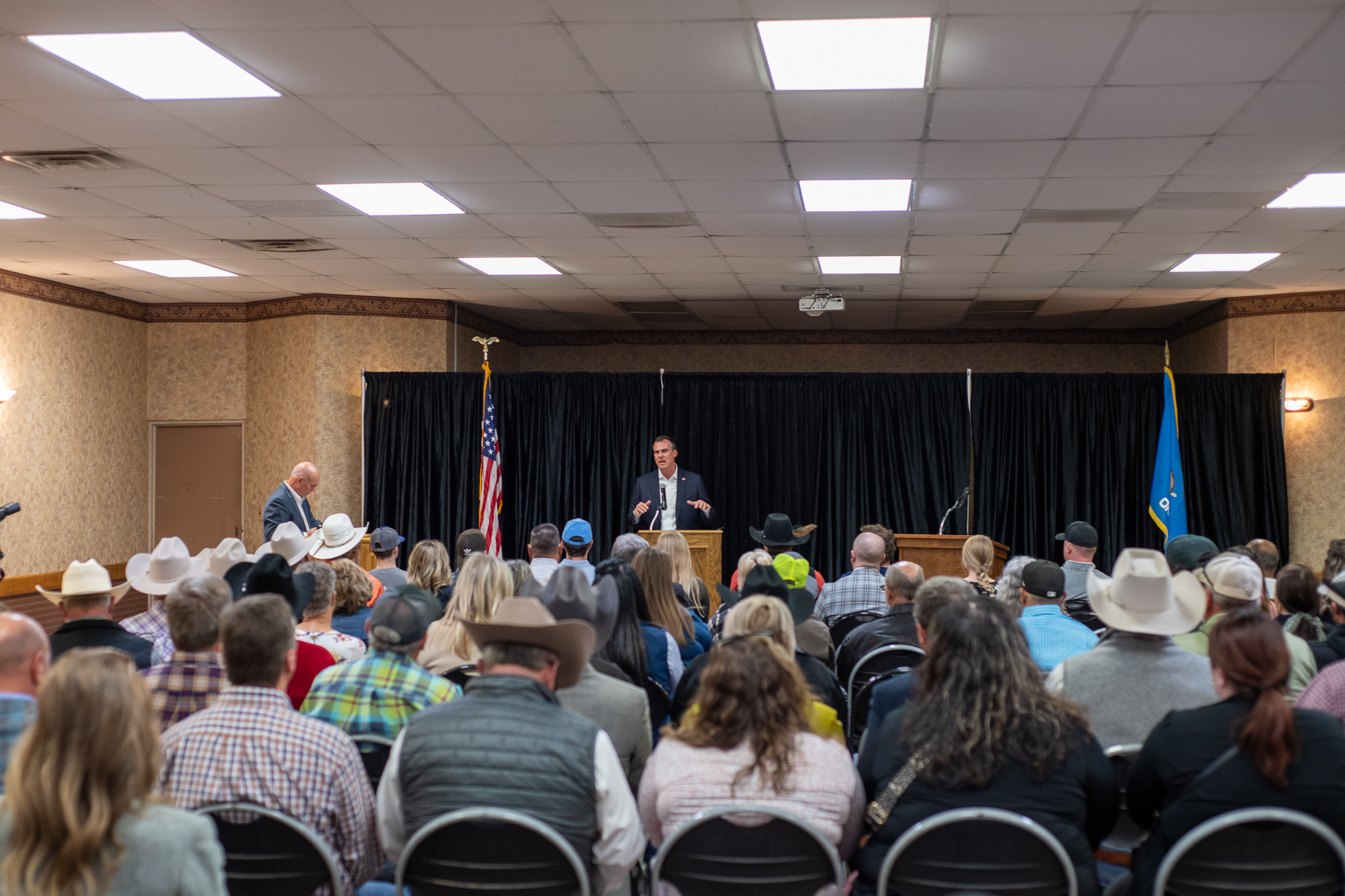

The importance of beef trade continues to grow as beef exports increased to a new record in 2021 and have increased even more thus far in 2022. The full report and executive summary are available on the KSU Ag Manager website at: https://www.agmanager.info/livestock-meat/marketing-extension-bulletins/trade-and-demand.


Growth Energy Files Court Intervention in Support of 2020, 2021, and 2022 RVOs

Mon, 03 Oct 2022 09:56:48 CDT


Growth Energy Files Court Intervention in Support of 2020, 2021, and 2022 RVOs


Growth Energy filed a motion in the U.S. Court of Appeals for the District of Columbia Circuit to intervene in support of the U.S. Environmental Protection Agency's (EPA) 2020, 2021, and 2022 Renewable Volume Obligations, which are currently being challenged by oil industry and environmental groups. On June 3rd, EPA finalized its 2020, 2021, and 2022 RVOs, setting the 2022 RVO for conventional biofuels at 15 billion gallons. Growth Energy CEO Emily Skor released the following statement in support of EPA's forward-looking volumes:


"By setting the 2022 RVO at 15 billion gallons, EPA set a baseline for strong future blending levels under the RFS, ensuring drivers have access to lower-cost, lower-carbon fuel at the pump," said Skor. "After drivers saw record-high fuel prices at the pump earlier this year and witnessed a volatile global fuel supply, we should be blending more low-cost biofuels into our fuel supply, not less. We support EPA's efforts to mitigate climate change and lower prices at the pump through robust RVOs and look forward to continuing our work with them to ensure a strong RVO in 2023 in beyond.


The full motion to intervene is available here.


BASF and the SCN Coalition continue nematode education for second annual SCN Action Month

Mon, 03 Oct 2022 09:13:28 CDT


BASF and the SCN Coalition continue nematode education for second annual SCN Action Month


Soybean cyst nematode (SCN) continues to be the leading cause of soybean yield loss in North America. BASF Agricultural Solutions and The SCN Coalition have joined forces for the second consecutive year to promote SCN Action Month, a monthlong initiative to provide growers with the tools and information they need to defend against this devastating pest.


Throughout October, BASF will once again provide free soil test kits to the first 500 growers who request online by October 31.


"We're finding there are still growers who either aren't aware of SCN or just don't believe they have it in their field," said Troy Bauer, BASF Senior Field Technical Representative for Seed Treatment – Western Corn Belt. "Soil testing during the month of October is key to this effort. When growers know their numbers, they can make a solid management plan for next year."


Dan Ory, a grower in Earlham, Iowa received a free soil test kit from the SCN Action Month campaign last year and was surprised by his results.

"I had the opportunity to test my soil using one of the free test kits. I suspected we had nematodes, but I was surprised by how many," Dan Ory said. "It was a revelation that has changed how I'll approach my soybean fields going forward."


Experts with The SCN Coalition say testing soil for SCN is the foundation for active SCN management.


"If a farmer doesn't know he or she has SCN and isn't actively managing it, yield potential can be lost," said Iowa State University Nematologist Greg Tylka. "It may be three or four bushels per acre, or it might be 23 to 24 bushels per acre. But you won't know until you test your soil."


SCN is present in nearly all areas where soybeans are grown and continues to rapidly spread throughout all geographies. Damage occurs when nematodes invade plant roots and establish feeding sites that take nutrients and water from the plant, which results in reducing yield potential. Because the damage occurs below ground, nematodes can cause losses in soybean yield without any visible signs of plant damage. Last year, nematodes were found in 74% of the fields sampled during SCN Action Month.


There are three things growers should do for SCN Management: rotate crops, plant a resistant variety and consider a seed treatment. Watch this video online to learn more about planning and preparing to manage SCN in your fields, and to access even more SCN management resources, visit SCNActionMonth.com.


Elevated Fire danger will again Develop over most of Oklahoma today and throughout the Week

Mon, 03 Oct 2022 08:40:42 CDT


Elevated Fire danger will again Develop over most of Oklahoma today and throughout the Week


Fire Situation Report for October 3, 2022

Statewide Discussion: Warm afternoon temperatures and low afternoon relative humidity values encouraged very receptive fine fuels each day through the weekend and moderate initial attack activity across Oklahoma. Ahead of a frontal boundary expected to arrive in the Oklahoma Panhandle late morning tomorrow, elevated fire danger will again develop over most of Oklahoma today and again on Tuesday. Some slight precipitation chances develop later today in the far western Oklahoma panhandle with slightly better opportunity for the Panhandle and extreme northwestern Oklahoma Tuesday night with the bulk of the state remaining dry. Another frontal boundary is forecasted to move into Oklahoma Thursday night into Friday again offering slight chances of rain. More notable will be the cooler temperatures on the heels of the cold fronts. The seasonal drying of fuels has been accelerated by the warm and dry pattern and the weather system late week may provide, at best, a speed bump, in building fire danger concern.

Southeastern & South-Central Oklahoma:
Temperature will warm into the upper-80°'s this afternoon under clear skies with afternoon relative humidity values settling in around 20% again offering very receptive fine-dead fuel moisture at 4%. Light easterly winds will limit fire spread potential offering good opportunity for initial attack success although timber and plantation fuels will continue to exhibit problematic fire behavior. Grass-dominated fuels will support head fire rates of spread around 52 ft/min with flame lengths 8-11 ft. while timber litter will exhibit ROS at 15 ft/min with FL 4-6 ft. Pine plantations will continue to exhibit problematic fire behavior and terrain influenced runs with ROS 15-35 ft/min with average FL 5-8 ft.

Western & North-central Oklahoma:
Temperature will warm into the mid-80°'s across most of the area with cooler temperatures in the western Panhandle counties where some slight precipitation chances develop later today. Relative humidity values will again dive into the 16-24% range with some sky cover later this afternoon yielding fine-dead fuel moisture at 4% with some local observation tapping 3%. South winds this afternoon sustained 10-15 mph with dome gusts nearing 20 mph during peak heating this afternoon will support head fire rates of spread 88-127 ft/min in rangeland fuels with flame lengths 9-13 ft. Wind speeds will diminish following sunset offering good opportunity for successful initial attack efforts.
Northeastern Oklahoma:
Light winds this afternoon will limit fire spread potential although fine fuels will be very receptive. Temperature this afternoon 84°-87° under clear skies with relative humidity values 19-24% will yield fine-dead fuel moisture at 4%. With light east to southeast winds, head fire rates of spread in grass dominated fuels will be generally less than 50 ft/min with flame lengths 7-11 ft. offering very good opportunity for successful initial attack efforts.

94% of Oklahoma is in the grips of drought intensity categorization of Severe (D2) as warm and dry conditions continue to drive composite fuel moisture values down. Nearly 18% of the state is in Exceptional (D4) drought categorization. Energy Release Component has eclipsed the 97th percentile in parts of southeastern Oklahoma with 90th percentile spanning much of the state. Opportunity for rainfall in the forecast may, at best, provide a brief pause in the deepening wildfire concern but only where that rainfall develops and provides wetting amounts. Cooler temperatures in the near-term forecast may offer abbreviated burning periods although the expectation for increasing rates of wildfire occurrence and fire severity continue to build.

Burn Bans:
Refer to: https://ag.ok.gov/divisions/forestry-services/ for the most current burn ban information and links to specific burn ban proclamations.

NE Area - 2 Fires Burned 8 Acres (Cause: 2-Incendiary)

EC Area - 2 Fires Burned 15.8 Acres (Cause:1-Debris, 1-Incendiary)

SE Area - 15 Fires Burned 70.9 Acres (Cause: 3-Escaped Debris, 2-Equipment, 10-Incendiary)

Large / Significant Fire Activity within the OFS Protection Area:
• Herndon Road Fire (McCurtain County) - 5 Acres / 80% Contained, 1 Structure
• Spare Fire (Delaware County) - 110 Acres / 95% Contained
• Kerns Ranch Fire (Pushmataha County) - 3,350 Acres / 90% Contained
• Rereg Road Fire (McCurtain County) - 260 Acres / 90% Contained
• Solomon's Grave Fire (Pushmataha County) - 414 Acres / 95% Contained
• Blue Hole Fire (McCurtain County) - 1,153 est. Acres / 95% Contained
Fire Activity with OFS Response outside of the Protection Area: No New Activity
OFS Prescribed Fire Activity: No New Activity


Beltway Beef Podcast: NCBA's CEO Goes to Washington

Mon, 03 Oct 2022 08:02:02 CDT


Beltway Beef Podcast: NCBA's CEO Goes to Washington


Each week, Beltway Beef brings you the latest policy news affecting the U.S. cattle and beef industry. Hear from subject-matter experts, producers, and industry leaders on the topics that impact the business viability of farms and ranches across the country.


On this episode, NCBA CEO Colin Woodall joins to provide his perspective as an attendee at the White House Conference on Hunger, Nutrition, and Health. Woodall also provides an update on key issues NCBA is focused on, including new Packers and Stockyards rules from the U.S. Department of Agriculture, the "Waters of the U.S." Supreme Court case of Sackett v. EPA, and the overreaching Securities and Exchange Commission climate disclosure rule. Finally, Woodall highlights some significant policy wins from the past year and explains NCBA's focus for this fall.


Listen below or CLICK HERE to listen and visit the NCBA Beltway Beef Podcast Channel.


Agriculture Secretary Tom Vilsack has proclaimed October 2-8, 2022, as National 4-H Week

Mon, 03 Oct 2022 07:30:54 CDT


Agriculture Secretary Tom Vilsack has proclaimed October 2-8, 2022, as National 4-H Week


U.S. Agriculture Secretary Tom Vilsack has proclaimed October 2-8, 2022, as National 4-H Week! You can read and download the Proclamation on National 4-H Week, 2022 - United States Department of Agriculture.

4-H engages, enables and empowers more than 6 million young people every day, and this year's annual 4-H Week is celebrating access and equity for all young people with a theme of #Opportunity4All. NIFA is celebrating all week long with a variety of events and social media campaigns.

Schedule of Events
•    Sunday, October 2, 4-H Flag-raising at USDA Headquarters: The 4-H flag will be raised at the USDA Headquarters on Washington, D.C., and will fly all week long.

•    Tuesday, October 4, 2:00-3:00pm EST, 4-H History Webinar: In collaboration with USDA's National Agricultural Library (NAL) Special Collections, NIFA will host a webinar on the history of 4-H. USDA's NAL Special Collections selects, preserves, describes and provides access to items of enduring historical value related to the history of agriculture. This includes materials related to the history of USDA and some of its affiliated groups, such as 4-H. In this talk, Sara Lee, Lead Librarian for NAL Special Collections, will highlight some of the library's major collections and selected materials related to the history of 4-H. Join the Webinar

•    Friday, October 7, 9:00am-2:00pm EST, 4-H Day at the USDA Farmers Market: NIFA staff members will be joined by 4-Hers from Washington, D.C., Virginia and Maryland for 4-H Day at the USDA Farmers Market. Located outside the USDA Headquarters on the corner of Independence Avenue and 12th Street SW, we will have interactive activities and 4-H information available while you shop with farmers market vendors. 4-H alums, wear green!

•    Friday, October 7, 2:00pm EST, Class of 2022 National 4-H Hall of Fame Induction Ceremony: In 2002, the National Association of Extension 4-H Youth Development Professionals, National 4-H Council and 4-H National Headquarters partnered to create the National 4-H Hall of Fame to recognize 4-H volunteers, Extension professionals, staff employees, donors and others who made a significant impact on the 4-H program and/or 4-H members through the contribution of time, energy, financial resources, etc. at the local, state or national level. Approximately 15 laureates are inducted annually. NIFA is pleased to share that Dr. Carol Benesh has been selected as this year's inductee on behalf of the organization. Before her retirement in 2016, Dr. Benesh served as our National Program Leader for 4-H. Her journey in 4-H spanned almost three decades as a county 4-H educator (Idaho and Washington state), state 4-H specialist (Idaho and Montana) and state 4-H program leader (Nevada). The Ceremony will be broadcasted live at 2:00pm EST from Kellogg Conference Hotel at Gallaudet University in Washington, DC.


Emergency Drought Commission Approves Three Million Dollar Cost Share Program to Push Back Against Drought

Sat, 01 Oct 2022 15:07:08 CDT


Emergency Drought Commission Approves Three Million Dollar Cost Share Program to Push Back Against Drought

Click here to listen to audio


Drought relief is one step closer to being on its way to Oklahoma farmers and ranchers following the second meeting of the Emergency Drought Commission. Commissioners Blayne Arthur, Julie Cunningham and Trey Lam met Friday, September 30, 2022, and unanimously approved a program proposed by the Oklahoma Conservation Commission which will distribute the $3 million appropriated by the State Legislature and approved by Governor Stitt in House Bill 2959 to Oklahoma ag producers.

After the meeting, Ron Hays, Senior Farm and Ranch Broadcaster, caught up with Ag Secretary Blayne Arthur- "I think certainly a longer meeting, but also lots of good discussion," Arthur said.

The Emergency Drought Commission, Arthur said, values public input from producers and producer groups. While there is not enough money to stretch as far as everyone would like, Arthur said the commission is putting thoughtful consideration into how to address the needs of ag producers and provide them long-term benefits.

"Today, our focus was on several of those items listed from proposal from the conservation commission and lots of things specific to water," Arthur said. "We will, I anticipate very soon, have another meeting to address a focus on the transport of hay and feed, because we know that is a great need for producers as well, but I think lots of good points were brought up today regarding that proposal and we want to be very thoughtful in what we decide to do so it is the best for Oklahoma."

Pending final approval by the OCC, scheduled to meet Monday, October 3, 2022, emergency drought cost-share funds will be made available to all 77 Oklahoma counties to be distributed by local conservation districts. Projects included in the program are water well drilling, pumping facilities, pipeline, pasture tap, watering facilities, heavy use protection, cover crop planting, forage and biomass planting (excluding Bermuda grass), and pond clean out(a point of emphasis in the discussion between the Commission and members of the Legislature present).
Arthur said the commission is appreciative of legislative members, and certainly the ag chairman and ag members that helped make everything happen at the capitol. More funds are on the way, she added. That's in reference to the legislature approving another $20 million on Thursday during the Special Session- that money will move to the Commission's banking account once that measure is signed by Governor Kevin Stitt.

"That certainly changes our conversation as an Emergency Drought Commission," Arthur said. "We initially just had the three million, and now as we look toward that twenty million, I think also gives us an opportunity to deploy a lot of dollars, see what works, see what we can improve on, and do an even better job with those dollars as they come our way."

One of the points of concern raised by lawmakers at the meeting as well as the Michael Kelsey with the Oklahoma Cattlemen's Association is the statement by Conservation Commission Executive Director Trey Lam that the rules that the Commission and Conservation Districts operate under would not allow any retroactive funding support of projects like pond clean out- and that projects could only be started until the the local Conservation District gives the go ahead- which would not be until mid November at the very earliest. Kelsey indicated to the Oklahoma Farm Report that he had urged Lam after the Commission meeting to ask the Conservation Commission to approve an Emergency Rule at their Monday meeting that would allow earlier work- if done correctly- to receive cost share funds.
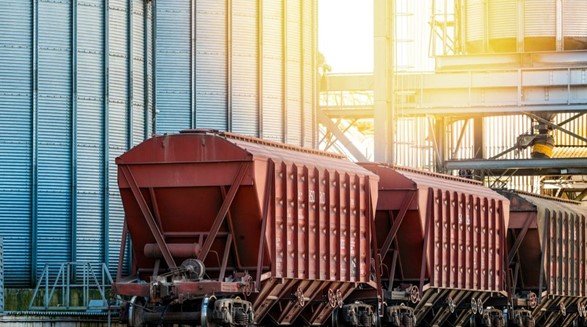
As for a time line on having the chance to apply for and receive these cost share funds- Trey Lam tells the Oklahoma Farm Report that if the Conservation Commission does approve the request to operate this project from the Emergency Drought Comission- "the application period should begin around the second week in October and close around November first. Districts should meet, rank and fund the qualifying applications in early November. Hopefully work can start by mid November. All work should be authorized by first week of December for sure. Some districts will move more quickly."

The Drought Commission stipulated to the Conservation Commission that the cost share max per contract would be 80% with the maximum payment not to exceed $7,500 per project.    

It is urgent, Arthur said, that these resources are made available to Oklahoma ag producers quickly we continue to sink further into extreme and exceptional drought.
Arthur said she likes to remind people that it is important to support the small percentage of farmers and ranchers in Oklahoma and the United States because they are the food supply.
"As we help these producers, ultimately that increases our food security, and also access to food and fiber across the United States," Arthur said.

Click the LISTEN BAR below to listen to Ron Hays and Ag Secretary Blayne Arthur talking highlights from the second Emergency Drought Commission meeting.


Ron salutes our daily email sponsors!
Upcoming Events

November

S M T W T F S
1 2 3 4 5 6 7
8 9 10 11 12 13 14
15 16 17 18 19 20 21
22 23 24 25 26 27 28
29 30          

Visitor Polls

Do you like the new website?
Add a Comment
(Fields are Optional)

Your email address is never published.