
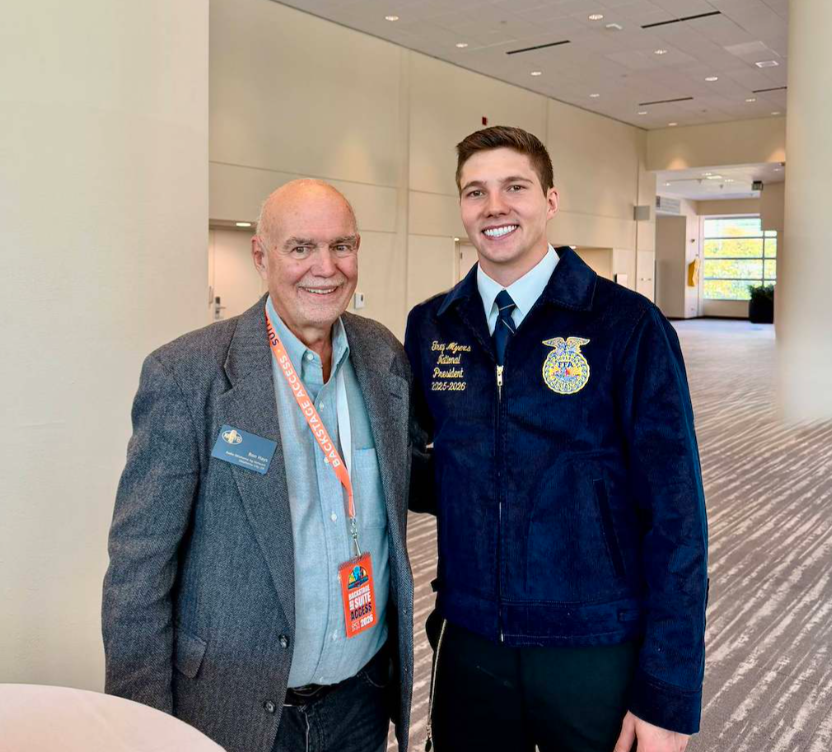
Trey Myers, a member of the Perkins-Tryon FFA chapter in Oklahoma, is wrapping up a year of national service as the ninth national FFA president from Oklahoma. In a conversation with Senior Farm and Ranch Broadcaster Ron Hays ahead of the 99th National FFA Convention in Indianapolis, Myers reflected on his journey through FFA, the mentors who shaped his leadership and the agricultural experiences that continue to influence his perspective.
Oklahoma has produced 24 national FFA officers during the organization’s 99-year history, including nine national presidents. For Myers, reaching the highest level of student leadership was something he never imagined when he first joined the organization in eighth grade. “It’s been an absolute dream come true,” Myers said. “It’s been a lot of weight, as you mentioned, but there’s no way I would have been here without the help of so many people, like pouring into me.”
Myers said his FFA journey began with a relatively simple motivation. After watching his older brother show livestock, he decided to get involved himself. “My FFA journey simply started because I saw my older brother showed livestock, and he showed hogs, and I knew that if I showed goats, I could go to livestock shows, but more importantly, I could miss a little bit of biology and chemistry,” Myers said. “So I literally started FFA to get out of school.”
What began as a way to participate in livestock shows eventually became an experience that shaped his education, leadership and outlook on life.
Livestock Projects Taught Myers to Overcome Failure
Myers recalled that his early livestock-show experiences were not always smooth. At one of his first shows, the halter on his goat broke while he was in the show ring. “One of those clips broke while I was in the show ring, and my goat almost got away,” Myers said. “I caught it. Put my hand under that doe’s neck and kind of caught her and walked her around the ring.”
Although the experience was challenging, Myers said livestock projects helped him learn how to respond when things do not go according to plan.
He connected those lessons to advice he received from a corporate executive earlier in the year, who told him young people need to fail quickly, recover and keep moving forward. “If I can send out a message that I learned from livestock, just to something that our world needs to hear, and what 16-year-old Trey needed to hear, was, don’t fear failure,” Myers said. “Get out there, fall on your face, learn really fast, and keep moving because that’s what our world needs right now.”
For Myers, agricultural education provides opportunities for students to develop resilience through real-world experiences, whether they are working with livestock, participating in competitions or taking on leadership responsibilities.
FFA Mentors Helped Shape His Leadership Journey
While livestock played an important role in his early involvement, Myers said a leadership experience helped him discover a deeper connection to FFA.
His agricultural education teacher, Caleb Wood, introduced him to Alumni Leadership Camp, where Myers became involved in a small group that left a lasting impression on him. “My ag teacher, Caleb Wood, another unsung hero that I would not be standing with you today if it was not for him, brought me to a place called Alumni Leadership Camp and just absolutely changed my life,” Myers said.
He said the relationships and experiences he developed through the camp influenced his mission as a national officer. “My mission was to bring small group 19 to FFA members and people across the country,” Myers said.
His path to national leadership was not immediate. After a difficult freshman year, Myers said he needed time away from state-level leadership before considering another role within the organization.
An invitation to return to the state convention eventually opened the door to conversations about national office. Even after becoming Oklahoma’s candidate, he questioned whether he should continue through the selection process.
A conversation at Aspen Coffee Shop in Stillwater helped him reconsider the opportunity. “That culminated with, consider the opportunity to share your story with FFA members across the country,” Myers said.
From that point forward, Myers said, the opportunity to connect with students nationwide became a meaningful part of his experience.
Agricultural Innovation Connects FFA Chapters Across the Country
During his travels as a national officer, Myers said he has seen how FFA chapters with different resources and backgrounds find ways to serve their communities.
He recalled visiting a chapter in North Carolina during FFA Week that had developed an aquaponics system in its agricultural shop. Using stock tanks and PVC pipes, students were raising tilapia and selling the fish to their community. “They just use some ragtag old stock tanks, and they built it with PVC pipes, and they grow tilapia in there, and then sell it to their community,” Myers said.
He said the project demonstrated how students can apply agricultural knowledge and creativity to meet local needs. “It’s just cool to see the innovation that chapters come up with, because they ultimately know their mission is to serve their members, yes, but also serve their communities,” Myers said.
For Myers, seeing chapters develop their own solutions reinforced the variety of opportunities available through agricultural education, regardless of where a chapter is located or what resources it has.
Japanese Farmer Shares a Lesson About Agriculture
One of Myers’ favorite memories from his year as a national officer came during a trip to Japan, where the officers visited students involved in FFJ, a sister organization to FFA.
During the trip, the group visited an island where a particular type of radish grows because of the area’s volcanic conditions. Myers said the radishes can weigh around 35 pounds, far larger than the radishes commonly seen in the United States.
The group met a farmer who had worked on the island since he was about 15 or 16 years old. At 91, the farmer had spent approximately 75 years growing radishes.
As the farmer demonstrated how to harvest the crop, he pulled a radish from the ground and fell over, alarming the visiting officers. He quickly stood back up and revealed the moment was a prank. “He stands up, looks at us, points his fingers, and says, ‘Gotcha,’” Myers said. “So we got pranked by a farmer, 91-year-old radish farmer in Japan.”
Beyond the humor of the encounter, Myers said the experience highlighted the common ground shared by agricultural communities around the world.
“Across the entire world, in a different country, the roots of agriculture still run deep,” Myers said. “And those same lessons that that 91-year-old was learning on his farm is the same things that our FFA members have the chance to learn every single day in this organization.”
The visit gave Myers another example of how agriculture connects people across generations and cultures, even when their farming practices and environments differ.
Myers Considers His Next Steps After National FFA Presidency
As his year in the blue jacket comes to an end, Myers said he plans to return to Stillwater to finish his degree in exercise science at Oklahoma State University.
He is considering graduate school and a possible career in physical therapy, particularly in rural health care. He has also thought about pursuing ministry. “I don’t have a phenomenal answer for you, taking it one day at a time,” Myers said.
For now, his focus remains on the National FFA Convention and the selection of the next six national officers who will lead the organization.
Reflecting on the year, Myers described the experience as one he would not trade for anything.
From his first livestock show with a broken goat halter to representing FFA members across the country and meeting agricultural producers overseas, Myers said the people who supported him made his journey possible.
His story highlights how agricultural education can develop leadership, encourage students to learn from failure and build connections that extend well beyond the farm and the classroom.
Our coverage of the 2026 99th National FFA Convention is powered by Hilliary Communications. Hilliary is a Medicine Park-based company with operations across Oklahoma, Texas, and Iowa including telecommunications, the Lawton Constitution, and a portfolio of radio and media holdings. The company has been a long-standing employer in southwest Oklahoma and is committed to investing in the region’s workforce and an equal opportunity employer.